Solvency II
A Practical Way of Delivery
Gain-Line & Solvency II

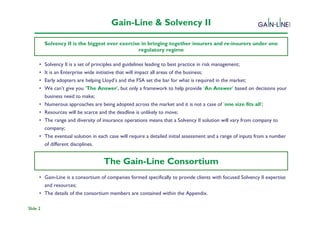
          Solvency II is the biggest ever exercise in bringing together insurers and re-insurers under one
                                                  regulatory regime

      •   Solvency II is a set of principles and guidelines leading to best practice in risk management;
                                                      Solvency II Programme
      •   It is an Enterprise wide initiative that will impact all areas of the business;
      •   Early adopters are helping Lloyd’s and the FSA set the bar for what is required in the market;
      •   We can’t give you ‘The Answer’, but only a framework to help provide ‘An Answer’ based on decisions your
          business need to make;
      •   Numerous approaches are being adopted across the market and it is not a case of ‘one size fits all’;
      •   Resources will be scarce and the deadline is unlikely to move;
      •   The range and diversity of insurance operations means that a Solvency II solution will vary from company to
          company;
      •   The eventual solution in each case will require a detailed initial assessment and a range of inputs from a number
          of different disciplines.

      •                              The Gain-Line Consortium
      • Gain-Line is a consortium of companies formed specifically to provide clients with focused Solvency II expertise
        and resources;
      • The details of the consortium members are contained within the Appendix.

Slide 2
Stakeholder Requirements

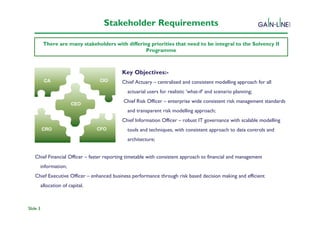
           There are many stakeholders with differing priorities that need to be integral to the Solvency II
                                                    Programme


                                               Solvency II Programme
                                           Key Objectives:-
           CA                      CIO     Chief Actuary – centralised and consistent modelling approach for all
                                             actuarial users for realistic ‘what-if’ and scenario planning;

                         CEO
                                            Chief Risk Officer – enterprise wide consistent risk management standards
                                             and transparent risk modelling approach;
                                           Chief Information Officer – robust IT governance with scalable modelling
          CRO                      CFO       tools and techniques, with consistent approach to data controls and
                                             architecture;


   Chief Financial Officer – faster reporting timetable with consistent approach to financial and management
          information;
   Chief Executive Officer – enhanced business performance through risk based decision making and efficient
          allocation of capital.


Slide 3
Solvency II Components

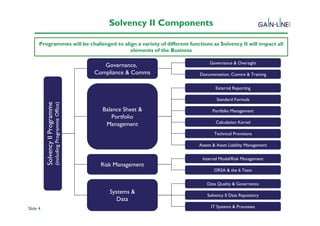
      Programmes will be challenged to align a variety of different functions as Solvency II will impact all
                                          elements of the Business

                                                                                             Governance & Oversight
                                                                    Governance,
                                                                 Compliance & Comms     Documentation, Comms & Training


                                                                                                External Reporting

                                                                                                 Standard Formula
          Solvency II Programme
                                  (including Programme Office)


                                                                   Balance Sheet &            Portfolio Management
                                                                       Portfolio
                                                                    Management                  Calculation Kernel

                                                                                               Technical Provisions

                                                                                        Assets & Asset Liability Management


                                                                                         Internal Model/Risk Management
                                                                   Risk Management
                                                                                               ORSA & the 6 Tests


                                                                                            Data Quality & Governance
                                                                      Systems &
                                                                                            Solvency II Data Repository
                                                                         Data
Slide 4                                                                                       IT Systems & Processes
Slide 5
                                                                   0.0%
                                                                          2.0%
                                                                                 4.0%
                                                                                        6.0%
                                                                                               8.0%
                                                                                                      10.0%
                                                                                                              12.0%
                                                                                                                      14.0%
                                                                                                                              16.0%
                                                                                                                                      18.0%
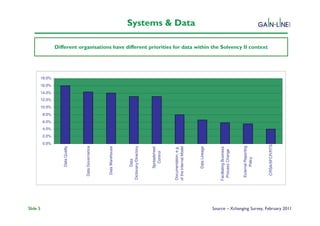
                                                   Data Quality


                                             Data Governance


                                              Data Warehouse


                                                   Data
                                           Dictionary/Directory


                                                  Spreadsheet
                                                    Control


                                           Documentation, e.g.
                                           of the Internal Model
                                                                                                                                                                                                                                          Systems & Data


                                                  Data Lineage


                                           Facilitating Business
                                            Process Change


                                             External Reporting
                                                   Policy
                                                                                                                                              Different organisations have different priorities for data within the Solvency II context


                                              ORSA/SFCR/RTS
Source – Xchanging Survey, February 2011
The Regulator’s View

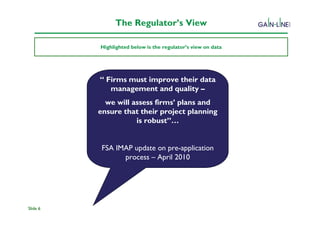
          Highlighted below is the regulator’s view on data


          “ Firms must improve their data
             management and quality –
            we will assess firms’ plans and
          ensure that their project planning
                     is robust”…


           FSA IMAP update on pre-application
                 process – April 2010


Slide 6
FSA Guidance

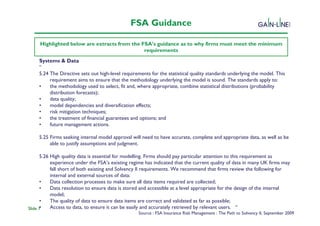
     Highlighted below are extracts from the FSA’s guidance as to why firms must meet the minimum
                                              requirements
     Systems & Data
     “                                           Solvency II Programme
     5.24 The Directive sets out high-level requirements for the statistical quality standards underlying the model. This
          requirement aims to ensure that the methodology underlying the model is sound. The standards apply to:
     •    the methodology used to select, fit and, where appropriate, combine statistical distributions (probability
          distribution forecasts);
     •    data quality;
     •    model dependencies and diversification effects;
     •    risk mitigation techniques;
     •    the treatment of financial guarantees and options; and
     •    future management actions.

     5.25 Firms seeking internal model approval will need to have accurate, complete and appropriate data, as well as be
          able to justify assumptions and judgment.

      5.26 High quality data is essential for modelling. Firms should pay particular attention to this requirement as
           experience under the FSA’s existing regime has indicated that the current quality of data in many UK firms may
           fall short of both existing and Solvency II requirements. We recommend that firms review the following for
           internal and external sources of data:
      •    Data collection processes to make sure all data items required are collected;
      •    Data resolution to ensure data is stored and accessible at a level appropriate for the design of the internal
           model;
      •    The quality of data to ensure data items are correct and validated as far as possible;
      •
Slide 7    Access to data, to ensure it can be easily and accurately retrieved by relevant users. “
                                                   Source : FSA Insurance Risk Management : The Path to Solvency II, September 2009
Systems & Data

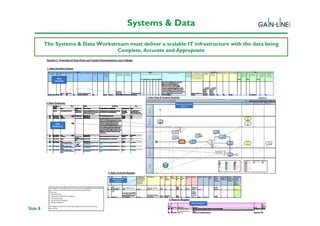
          The Systems & Data Workstream must deliver a scalable IT infrastructure with the data being
                                    Complete, Accurate and Appropriate


                                            Solvency II Programme


Slide 8
Key Deliverables

                  The Key Deliverables for Systems & Data workstream are highlighted below


      • Data Policy/Governance
                                              Solvency II Programme
           – A robust data policy/governance document which defines the date policy and, key data owners and the
              link between the various data deliverables.
      • Data Dictionary
           – A repository which defines all of the key data elements required for Solvency II, and an explanation of
              the data elements and a verbal definition of each specific data element.

      • Data Directory
           – A definitive repository of each model input into the standard model.

      • Data Controls & Flow Diagrams
           – A DFD must be created for each input to the standard model, i.e. row of the Data Directory, and cross
              reference the Data Dictionary.

      • Data Controls Register
           – A complete register of all controls applied to the data as it transfers through the organisation. Controls
              should also be categorised to show their relevance and strength.


Slide 9
Data Flows & Controls Diagrams

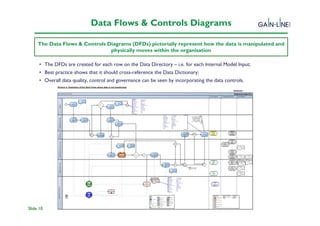
     The Data Flows & Controls Diagrams (DFDs) pictorially represent how the data is manipulated and
                                physically moves within the organisation

      • The DFDs are created for each row on the Data Directory – i.e. for each Internal Model Input;
      • Best practice shows that it should cross-reference the Data Dictionary;
      • Overall data quality, control and governance can be seen by incorporating the data controls.


Slide 10
The Gain-line Consortium
  Member Companies
Magellan Consultancy Services

      Magellan are an independent management consultancy focussing on programme management and
                                           project delivery

     Magellan’s Proposition is based on deep Project & Programme Management skills within this
     sector:-
           •   Specific Insurance experience (client references are available);

           •   Extensive Project & Programme Management experience within this environment with the
               Management Team coming from Big-4 consultancies and senior operational roles within industry;

           •   A wide range of programme services, including strategy definition, project and programme
               management, project delivery and QA;

           •   An innovative approach to delivering programme services;

           •   A collaborative approach to project delivery which has delivered in excess of £30m of savings in the
               programmes we have worked on with our clients.
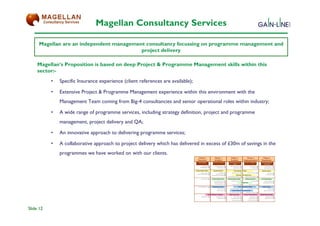
                                                                                      Phase 0                                              Phase 1                                   Phase 2                                    Phase 3                                   Phase 4
                                                                                    'Discovery'                                          'Initiation'                               'Analysis'                              'Implementation'                            'Realisation'
                                                                                      Initial Feasibility                             Planning and Definition                    Detailed Planning and                         'Go-Live' and Roll-out                     Benefits Realisation
                                                                                                                                                                                        Design                                                                               and Review
                                                                                                  High Level Planning                      Initial Implementation Planning          Detailed mplementation Planning                          Detailed Training Plans            Benefits Realisation Plan
                                                                                           Initial Cost Benefit Analysis                           Stage 1 Business Case                     Stage 2 Business Case                                 Roll-out Strategy         Post Implementation Review


                                                                                  Recommendation Report                                Operational Review                                     'To-Be' Operational Design                                                  Benefits Tracking
                                                                                               Initial Process Analysis                                   Process Review                 Define Controls and Checks                   Implement 'To-Be' Processess
                                                                                                                                                                                                                                                                                          BAU Handover
                                                                                    High Level Process Documentation                           Project Initiation Document
                                                                                                                                                                                                                                                                                    Future Training Plans
                                                                                                                                   Risks, Assumptions, Issues, Dependencies
                                                                                                                                                                                                        Operational Risk Assessments
                                                                                                                                                                              High Level Operational Risk Assessment           Detailed Operational Risk Assessment


                                                                                              Initial Technical Review              Technical Requirements                    Detailed Systems Design                          Testing and Roll-Out                     Technology Strategy
                                                                                                                                       Techni cal Requirements Document                 Techni cal Design Document                                 Testing Strategy            Define Technical Strategy
                                                                                                                                           Define Technical Specifications                                              Systems Pilot                                       Review Systems Performance

                                                                                                                                           Define Workflow Requirements
                                                                                                                                                                                          Define Systems Interfaces                        Implement Final Solution


                                                                                       Review Organisation Structures                Organisational Review                                                   'To-Be' Organisational Design                                 People Strategy
                                                                                                                                                    Analyse FTE numbers              Define Roles and Resposibilities                 Recruit/Re-organise Key Staff                      People Strategy

                                                                                                                                                   Review Staff Locations                 Communications Plan and Execution                                                  Ongoing Review of Structure

                                                                                                                                                                                High Level Staff/Union Consultations              Detailed Staff/Union Consultations


                                                                                                                           Supplier Selection / Evaluation                       Define Contractuals                         Service Level Agreements                  Supplier Review Strategy
                                                                                                Initial Supplier Review                         Detailed Supplier Analysis                    Supplier Due Diligence                          Agree Service Levels                Supplier Review Forum

                                                                                                                                                     Reference Site Visits            Create Contractual Framework                         Define MI Requirements                Agree Escalation Routes


                                                                                                                                                                                        Agree Terms and Conditions                     Business Continuity Planning


Slide 12
JMR

       JMR are an independent software services and solutions company that has been providing quality
                                      technical resource for 20 years

     JMR’s Proposition is based on the provision of experienced technical resource who have skills
     within this sector:-
           •   Specific Insurance experience (client references are available);

           •   Extensive analysis, design and modelling skills within this environment having delivered individual
               assignments and fixed price projects for data migration;

           •   A strong network of associates that that can join a team to deliver specific assignments;

           •   Willing to work on flexible commercial models;

           •   A collaborative approach to project delivery with a ‘can do’ attitude;

           •   A strong focus on clients requirements and delivery.


Slide 13
Hillway Consulting

      Hillway Consulting is an independent organisation focusing on operational and management issues
                                       in the London insurance market

     Hillway Consulting has:-
           •   Over 30 years experience in the London Insurance market;

           •   Operational and management experience in both active and run-off environments with particular
               knowledge of underwriting, claims and reinsurance operations;

           •   Experience at Board Level in regulated environments and in working with regulators;

           •   Excellent network and contacts within the UK and overseas;

           •   First hand experience of capital markets, risk and capital modelling;

           •   Experience in corporate formations, restructuring and M&A in both the direct and reinsurance
               markets.


Slide 14
CirclePeople

           Circle People are a boutique executive search firm operating across the FS Risk Management
                                                    community

     Summary
             •   Key sectors; Insurance, Retail Banking, Investment Banking and Big 4 Consulting and Strategy;

             •   Market discipline; Credit, Market and Operational Risk, Solvency II, Liquidity & Capital Management,
                 Basel II, Economic Capital, Quantitative and Risk Strategy;

             •   We typically place Senior Managers, Directors, Programme Directors & Managers, Head’s of and
                 Project Managers;

             •   We operate a search methodology whether working contingently or retained supported by a
                 dedicated research function providing detailed market mapping and ensuring we stay in regular contact
                 with our candidate community/key people.


Slide 15
End of Presentation

Solvency II - Systems & Data Workstream

  • 1.
    Solvency II A PracticalWay of Delivery
  • 2.
    Gain-Line & SolvencyII Solvency II is the biggest ever exercise in bringing together insurers and re-insurers under one regulatory regime • Solvency II is a set of principles and guidelines leading to best practice in risk management; Solvency II Programme • It is an Enterprise wide initiative that will impact all areas of the business; • Early adopters are helping Lloyd’s and the FSA set the bar for what is required in the market; • We can’t give you ‘The Answer’, but only a framework to help provide ‘An Answer’ based on decisions your business need to make; • Numerous approaches are being adopted across the market and it is not a case of ‘one size fits all’; • Resources will be scarce and the deadline is unlikely to move; • The range and diversity of insurance operations means that a Solvency II solution will vary from company to company; • The eventual solution in each case will require a detailed initial assessment and a range of inputs from a number of different disciplines. • The Gain-Line Consortium • Gain-Line is a consortium of companies formed specifically to provide clients with focused Solvency II expertise and resources; • The details of the consortium members are contained within the Appendix. Slide 2
  • 3.
    Stakeholder Requirements There are many stakeholders with differing priorities that need to be integral to the Solvency II Programme Solvency II Programme Key Objectives:- CA CIO Chief Actuary – centralised and consistent modelling approach for all actuarial users for realistic ‘what-if’ and scenario planning; CEO Chief Risk Officer – enterprise wide consistent risk management standards and transparent risk modelling approach; Chief Information Officer – robust IT governance with scalable modelling CRO CFO tools and techniques, with consistent approach to data controls and architecture; Chief Financial Officer – faster reporting timetable with consistent approach to financial and management information; Chief Executive Officer – enhanced business performance through risk based decision making and efficient allocation of capital. Slide 3
  • 4.
    Solvency II Components Programmes will be challenged to align a variety of different functions as Solvency II will impact all elements of the Business Governance & Oversight Governance, Compliance & Comms Documentation, Comms & Training External Reporting Standard Formula Solvency II Programme (including Programme Office) Balance Sheet & Portfolio Management Portfolio Management Calculation Kernel Technical Provisions Assets & Asset Liability Management Internal Model/Risk Management Risk Management ORSA & the 6 Tests Data Quality & Governance Systems & Solvency II Data Repository Data Slide 4 IT Systems & Processes
  • 5.
    Slide 5 0.0% 2.0% 4.0% 6.0% 8.0% 10.0% 12.0% 14.0% 16.0% 18.0% Data Quality Data Governance Data Warehouse Data Dictionary/Directory Spreadsheet Control Documentation, e.g. of the Internal Model Systems & Data Data Lineage Facilitating Business Process Change External Reporting Policy Different organisations have different priorities for data within the Solvency II context ORSA/SFCR/RTS Source – Xchanging Survey, February 2011
  • 6.
    The Regulator’s View Highlighted below is the regulator’s view on data “ Firms must improve their data management and quality – we will assess firms’ plans and ensure that their project planning is robust”… FSA IMAP update on pre-application process – April 2010 Slide 6
  • 7.
    FSA Guidance Highlighted below are extracts from the FSA’s guidance as to why firms must meet the minimum requirements Systems & Data “ Solvency II Programme 5.24 The Directive sets out high-level requirements for the statistical quality standards underlying the model. This requirement aims to ensure that the methodology underlying the model is sound. The standards apply to: • the methodology used to select, fit and, where appropriate, combine statistical distributions (probability distribution forecasts); • data quality; • model dependencies and diversification effects; • risk mitigation techniques; • the treatment of financial guarantees and options; and • future management actions. 5.25 Firms seeking internal model approval will need to have accurate, complete and appropriate data, as well as be able to justify assumptions and judgment. 5.26 High quality data is essential for modelling. Firms should pay particular attention to this requirement as experience under the FSA’s existing regime has indicated that the current quality of data in many UK firms may fall short of both existing and Solvency II requirements. We recommend that firms review the following for internal and external sources of data: • Data collection processes to make sure all data items required are collected; • Data resolution to ensure data is stored and accessible at a level appropriate for the design of the internal model; • The quality of data to ensure data items are correct and validated as far as possible; • Slide 7 Access to data, to ensure it can be easily and accurately retrieved by relevant users. “ Source : FSA Insurance Risk Management : The Path to Solvency II, September 2009
  • 8.
    Systems & Data The Systems & Data Workstream must deliver a scalable IT infrastructure with the data being Complete, Accurate and Appropriate Solvency II Programme Slide 8
  • 9.
    Key Deliverables The Key Deliverables for Systems & Data workstream are highlighted below • Data Policy/Governance Solvency II Programme – A robust data policy/governance document which defines the date policy and, key data owners and the link between the various data deliverables. • Data Dictionary – A repository which defines all of the key data elements required for Solvency II, and an explanation of the data elements and a verbal definition of each specific data element. • Data Directory – A definitive repository of each model input into the standard model. • Data Controls & Flow Diagrams – A DFD must be created for each input to the standard model, i.e. row of the Data Directory, and cross reference the Data Dictionary. • Data Controls Register – A complete register of all controls applied to the data as it transfers through the organisation. Controls should also be categorised to show their relevance and strength. Slide 9
  • 10.
    Data Flows &Controls Diagrams The Data Flows & Controls Diagrams (DFDs) pictorially represent how the data is manipulated and physically moves within the organisation • The DFDs are created for each row on the Data Directory – i.e. for each Internal Model Input; • Best practice shows that it should cross-reference the Data Dictionary; • Overall data quality, control and governance can be seen by incorporating the data controls. Slide 10
  • 11.
    The Gain-line Consortium Member Companies
  • 12.
    Magellan Consultancy Services Magellan are an independent management consultancy focussing on programme management and project delivery Magellan’s Proposition is based on deep Project & Programme Management skills within this sector:- • Specific Insurance experience (client references are available); • Extensive Project & Programme Management experience within this environment with the Management Team coming from Big-4 consultancies and senior operational roles within industry; • A wide range of programme services, including strategy definition, project and programme management, project delivery and QA; • An innovative approach to delivering programme services; • A collaborative approach to project delivery which has delivered in excess of £30m of savings in the programmes we have worked on with our clients. Phase 0 Phase 1 Phase 2 Phase 3 Phase 4 'Discovery' 'Initiation' 'Analysis' 'Implementation' 'Realisation' Initial Feasibility Planning and Definition Detailed Planning and 'Go-Live' and Roll-out Benefits Realisation Design and Review High Level Planning Initial Implementation Planning Detailed mplementation Planning Detailed Training Plans Benefits Realisation Plan Initial Cost Benefit Analysis Stage 1 Business Case Stage 2 Business Case Roll-out Strategy Post Implementation Review Recommendation Report Operational Review 'To-Be' Operational Design Benefits Tracking Initial Process Analysis Process Review Define Controls and Checks Implement 'To-Be' Processess BAU Handover High Level Process Documentation Project Initiation Document Future Training Plans Risks, Assumptions, Issues, Dependencies Operational Risk Assessments High Level Operational Risk Assessment Detailed Operational Risk Assessment Initial Technical Review Technical Requirements Detailed Systems Design Testing and Roll-Out Technology Strategy Techni cal Requirements Document Techni cal Design Document Testing Strategy Define Technical Strategy Define Technical Specifications Systems Pilot Review Systems Performance Define Workflow Requirements Define Systems Interfaces Implement Final Solution Review Organisation Structures Organisational Review 'To-Be' Organisational Design People Strategy Analyse FTE numbers Define Roles and Resposibilities Recruit/Re-organise Key Staff People Strategy Review Staff Locations Communications Plan and Execution Ongoing Review of Structure High Level Staff/Union Consultations Detailed Staff/Union Consultations Supplier Selection / Evaluation Define Contractuals Service Level Agreements Supplier Review Strategy Initial Supplier Review Detailed Supplier Analysis Supplier Due Diligence Agree Service Levels Supplier Review Forum Reference Site Visits Create Contractual Framework Define MI Requirements Agree Escalation Routes Agree Terms and Conditions Business Continuity Planning Slide 12
  • 13.
    JMR JMR are an independent software services and solutions company that has been providing quality technical resource for 20 years JMR’s Proposition is based on the provision of experienced technical resource who have skills within this sector:- • Specific Insurance experience (client references are available); • Extensive analysis, design and modelling skills within this environment having delivered individual assignments and fixed price projects for data migration; • A strong network of associates that that can join a team to deliver specific assignments; • Willing to work on flexible commercial models; • A collaborative approach to project delivery with a ‘can do’ attitude; • A strong focus on clients requirements and delivery. Slide 13
  • 14.
    Hillway Consulting Hillway Consulting is an independent organisation focusing on operational and management issues in the London insurance market Hillway Consulting has:- • Over 30 years experience in the London Insurance market; • Operational and management experience in both active and run-off environments with particular knowledge of underwriting, claims and reinsurance operations; • Experience at Board Level in regulated environments and in working with regulators; • Excellent network and contacts within the UK and overseas; • First hand experience of capital markets, risk and capital modelling; • Experience in corporate formations, restructuring and M&A in both the direct and reinsurance markets. Slide 14
  • 15.
    CirclePeople Circle People are a boutique executive search firm operating across the FS Risk Management community Summary • Key sectors; Insurance, Retail Banking, Investment Banking and Big 4 Consulting and Strategy; • Market discipline; Credit, Market and Operational Risk, Solvency II, Liquidity & Capital Management, Basel II, Economic Capital, Quantitative and Risk Strategy; • We typically place Senior Managers, Directors, Programme Directors & Managers, Head’s of and Project Managers; • We operate a search methodology whether working contingently or retained supported by a dedicated research function providing detailed market mapping and ensuring we stay in regular contact with our candidate community/key people. Slide 15
  • 16.