Burkina Faso

PAEPARD capitalization workshop

Highlights from the AIF reflection
meeting

By Monica Kapiriri

1
Introduction
Drew participants from 18 countries:
Burkina Faso; Burundi, Cameroon,
Congo Braz, France, Ghana, Malawi,
Mali, Netherlands, Nigeria, DR Congo,
Zimbabwe , Senegal, Togo, Zambia,
Kenya, Uganda, Benin
 PAEPARD staff, AIFs, Coordinators,
Partners, representatives from WP
leading institutions


By Monica Kapiriri

2
Purpose of the workshop
To review experiences of AIF’s, what did
we learn?
 To review AIF’s action plans for MSHRQD
workshops, the implementation
 The way forward: what will be the way
forward for PAEPARD? And what does it
mean for the AIF’s?
 To explore what ideas for PP III mean in
terms of capacity building and support for
AIF’s, consortia and the 5 ULP platforms.


By Monica Kapiriri

3
The process


Highly interactive and participatory
◦ Personal reflection and synthesis
◦ Group work
◦ Plenary feedback

Day 1: Harvesting
 Day 2: Brokerage in Multistakeholder processes
 Day 3: Way forward


By Monica Kapiriri

4
Experience sharing
Sharing experiences focusing on building
partnerships.
 Drawn from the process up to and during
the inception workshops.
Common “best” experiences
 Stakeholder mobilization and bring
together producers, researchers, and
agro-industry to form successful consortia,
 Mobilization and engagement of decisionmakers and successfully worked with
multi-stakeholder platforms.


By Monica Kapiriri

5
Harvesting








Participation/ engagement, consensus
building, conflict resolution and mediation.
They participated in lobbying and
advocacy, building teams, ensuring
equitable sharing of tasks,
Ensuring appropriate institutional
arrangement, and achieved good
collaboration between facilitators and
coordinators; created awareness,
Participated in documentation of
expériences and
Promotion of farming for business
(entrepreneurship).
By Monica Kapiriri

6
AIFs specific best experiences






Stakeholder/ partner mobilization,
Inception meetings,
MSRQDW,
RUFORUM workshops,
Multi-stakeholder partnership brokerage
events and facilitating meetings events
(funding, coordination,
facilitation/moderation).

By Monica Kapiriri

7
Coordinators specific best
experiences
Partner mobilization and brokerage,
 Trust and good working
relationships
 Once the consortia and
partnerships were established it
become easier to interest partners
in response to a call.


By Monica Kapiriri

8
Conclusion on “best”
experiences
Face-face meetings such as
inception workshops generated
most of the positive experiences.
 E-partnerships seem to be
superficial
 Need for more face-to-face
meetings until the partnerships are
solidified, then e-communication
can add value.


By Monica Kapiriri

9
Challenges - AIFs







Consortia not able to bring together all
the required stakeholder,
Failure to finalize concept notes for
timely submission in response to
calls,
Poor communication - timely response
to
emails/collaboration/communication.
AIFs noted that the of weak
development partnerships prior to
calls for good synergies,
By Monica Kapiriri

10
Challenges - Coordinators
Funds had not been secured for
proposals submitted,
 Absence of pre-funding to facilitate
concept/proposal developments
meetings,
 Managing partners dynamics when
there was dominance by a few
 Poor communication, collaboration,
and input (balanced) by partners


By Monica Kapiriri

11
Conclusion on challenges
Communication outside of face to
face meeting emerged from both
the AIFs and Coordinators as
affecting the partnership building
process the most
 Demoralization from not receiving
funding,


By Monica Kapiriri

12
The function and person of
AIFs


Heated discussions about AIFs
◦
◦
◦
◦



Selection process
Matching
Performance
M&E

Core issue was not the
roles/function of AIFs as it was their
competencies, relevancy to
consortia and costs.
By Monica Kapiriri

13
AIFS – views by Coordinators
Are they best external or internal?
 Advantages: Familiar with the
thematic area, cheaper, sustainable
 Disadvantages: Not neutral, liable to
manipulating the process and biases,
affects sense of ownership by
members, and the levels of
participation.
 The first cohort used Coordinators
and ownership was weak, generating
lessons that led to the birth of AIFs


By Monica Kapiriri

14
AIFs: Views by AIFs


These were divided into three
categories based on their
contractual process.
◦ Clear TOR and signed contracts: Seen
and effective, motivated and satisfied
◦ TOR/Contract not signed: Frustrated,
some seen as incompetent
◦ ULP AIFs: Several satisfied, but a few
felt marginalized by the Coordinators

By Monica Kapiriri

15
Reflections on the mini review
Discussions mainly focused on the
TORs
 Develop and negotiate the TORs
 Encourage full participation by all
stakeholders
 Promote mutual understanding
between partners
 Promote social learning among
partners
By Monica Kapiriri

16
Reflections on the mini review
Promoted and guided joint reflection
by the partners such that the partners
learned from the process and
improved their own ability to work in
partnership with other organisations
or interest groups
 Promoted the documentation by the
partners, both of the results and
outcomes of the research but also of
the partnership process itself and
lessons learned


By Monica Kapiriri

17
Mini review - Indicators
Indicators of success included
 Develop and negotiate the TORs
◦ The TORs of AIF were clearly formulated
◦ The TORs of AIF were discussed and
negotiated with the Project Leader
◦ The AIF know very well their
mission/TORs and roles

By Monica Kapiriri

18
Mini review – indicators


Promote mutual understanding between
partners

◦ The AIF guided the partners to agree on
well-defined and shared objectives, the roles
and responsibilities of each partner
organisation
◦ The AIF promoted communication and
information sharing between partners
◦ Encouraged the adoption of behaviour by
stakeholder representatives that is
conducive to an environment of mutual
respect and trust
◦ Ensured that group norms or organisational
culture do not oppress individual thinking,
creativity and innovation
By Monica Kapiriri

19
Mini review - Indicators


Promote social learning among
partners
◦ Ensured that group norms or
organisational culture do not oppress
individual thinking, creativity and
innovation
◦ Promoted consensual decision-making
by partners, and mutually inclusive
solutions;

By Monica Kapiriri

20
Conclusion
TORs were not shared a cross the
board
 Coordinators and AIFs adopted a
process based on assumptions that
were not clarified.
 The role of PAEPARD/ WP institutions
in the contractual process was
peripheral
 Recommended a tripartite
arrangement


◦ AIF
◦ Coordinators
◦ PAEPARD WP Institution

By Monica Kapiriri

21
Proposed improvement
Support by PAEPARD
 Money for
◦
◦
◦
◦

partnership building process
consolidating partnerships
consortia projects
Resource Persons support responses
to calls

Defines rules for funding consortia
and AIF activities
 Focus the capacity building of AIFs
to consortia needs


By Monica Kapiriri

22
Proposed improvement
M&E


Performance indicators developed
and shared among all the three
parties to review the effectiveness
of;
◦ AIFs,
◦ Coordinators and
◦ PAEPARD institutions against

By Monica Kapiriri

23
AIF selection process
The process needs to be designed
to draw out and align the
competencies of AIFs to consortia
needs.
 Coordinators must take part in
selection and appointment of AIFs


By Monica Kapiriri

24
Proposed improvement
TORS/ contract of AIFs


Contracts should
◦ Be explicit
◦ Be developed and signed between
AIFs, Coordinators and the
PAEPARD representatives
◦ Harmonize roles and responsibilities
of AIFs and Coordinators in all
regions
◦ Make facilitators neutral to avoid
any biases
◦ Commit more time for synergy
building between coordinators and
facilitators
By Monica Kapiriri

25
ULP
Conduct seminars to define and
clarify the roles and responsibilities
for Coordinators and AIFs in the Call
and User-led process.
 Orientation and training for AIFs to
better address the innovation
process.
 Write-shops based on Open Calls,
not just for learning skills.


By Monica Kapiriri

26
The extension of PAEPARD
Presentation by Jonas generated
discussions around:
 Drawing from lessons of prior Phases
◦ Competitive funding

Involvement of private sector,
 Fear that research would take the
upper hand in accessing the funds;
and
 Consortia membership coverage regional or country based partners


By Monica Kapiriri

27
The extension of PAEPARD
Value chain approach to enable
private sector find an attractive niche,
 Provision of resource persons to
guide the proposal writing and
address the disparities in proposal
writing abilities,
 Flexibility in partnership building to
enable ULP and consortia to solicit
and build wide partnerships at
country and sub-regional and
regional levels in response to calls


By Monica Kapiriri

28
The extension of PAEPARD
 Capitalization

workshop would
further consolidate lessons and
inform the final design of the
extension.
 Proposed expertise and roles
of AIFs and Coordinators for
the next 4 years of Phase II
extension (Report)
By Monica Kapiriri

29
World Café session


Merits and Demerits of a consortia
facilitator10



ToR of facilitation (role, objectives,
needs and expected results) 13



How to sustain interests of all
stakeholders in a consortium10
By Monica Kapiriri

30
World Café session


How to make a consortium
sustainable – obtain funding without
PAEPARD support13



Role of members of core group and
AIF Coordinator8

By Monica Kapiriri

31
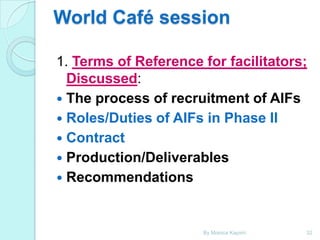
World Café session
1. Terms of Reference for facilitators;
Discussed:
 The process of recruitment of AIFs
 Roles/Duties of AIFs in Phase II
 Contract
 Production/Deliverables
 Recommendations

By Monica Kapiriri

32
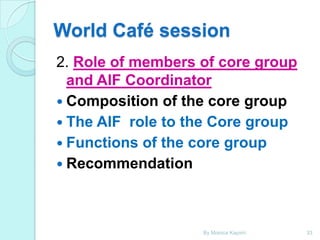
World Café session
2. Role of members of core group
and AIF Coordinator
 Composition of the core group
 The AIF role to the Core group
 Functions of the core group
 Recommendation

By Monica Kapiriri

33
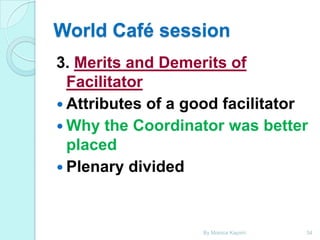
World Café session
3. Merits and Demerits of
Facilitator
 Attributes of a good facilitator
 Why the Coordinator was better
placed
 Plenary divided

By Monica Kapiriri

34
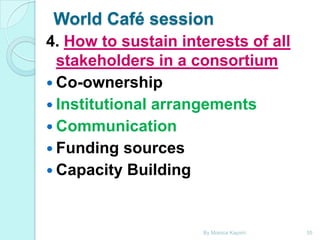
World Café session
4. How to sustain interests of all
stakeholders in a consortium
 Co-ownership
 Institutional arrangements
 Communication
 Funding sources
 Capacity Building

By Monica Kapiriri

35
World Café session
4. How to sustain interests of all
stakeholders in a consortium
 Contributions from plenary
◦ AIF should play a role in mediation
◦ Federating themes or topics that interest
members
◦ RUFORUM stakeholder platform be
adopted
◦ Consortia members need to share their
interests with no hidden agenda/motives.
◦ time span of the consortia
By Monica Kapiriri

36
World Café session
5. How to make a consortium sustainable –
obtain funding without PAEPARD support


Funding approach that ensures
continuity after PAEPARD:
◦ members contribution finances,
◦ detailed funding and activity plans,
◦ projects with clear exit strategies



There should be mechanism to exploit
the internal strength and explore
possibilities of having members
consortia fund priority activities.
By Monica Kapiriri

37
World Café session
Joint learning between African and
European researchers and nonresearchers
 Effective ownership by consortium
members
 Clear roles and responsibilities of
stakeholders to ensure clear and
balanced participation between
actors


By Monica Kapiriri

38
World Café session


Participants felt ULP stand a better
chance to be sustained than
Consortia
◦ Themes are broad
◦ central to members work



Consortia are motivated by calls
◦ Threatened if not funded
◦ Short lived – limited to project life

By Monica Kapiriri

39

Paepard capitalization workshop

  • 1.
    Burkina Faso PAEPARD capitalizationworkshop Highlights from the AIF reflection meeting By Monica Kapiriri 1
  • 2.
    Introduction Drew participants from18 countries: Burkina Faso; Burundi, Cameroon, Congo Braz, France, Ghana, Malawi, Mali, Netherlands, Nigeria, DR Congo, Zimbabwe , Senegal, Togo, Zambia, Kenya, Uganda, Benin  PAEPARD staff, AIFs, Coordinators, Partners, representatives from WP leading institutions  By Monica Kapiriri 2
  • 3.
    Purpose of theworkshop To review experiences of AIF’s, what did we learn?  To review AIF’s action plans for MSHRQD workshops, the implementation  The way forward: what will be the way forward for PAEPARD? And what does it mean for the AIF’s?  To explore what ideas for PP III mean in terms of capacity building and support for AIF’s, consortia and the 5 ULP platforms.  By Monica Kapiriri 3
  • 4.
    The process  Highly interactiveand participatory ◦ Personal reflection and synthesis ◦ Group work ◦ Plenary feedback Day 1: Harvesting  Day 2: Brokerage in Multistakeholder processes  Day 3: Way forward  By Monica Kapiriri 4
  • 5.
    Experience sharing Sharing experiencesfocusing on building partnerships.  Drawn from the process up to and during the inception workshops. Common “best” experiences  Stakeholder mobilization and bring together producers, researchers, and agro-industry to form successful consortia,  Mobilization and engagement of decisionmakers and successfully worked with multi-stakeholder platforms.  By Monica Kapiriri 5
  • 6.
    Harvesting      Participation/ engagement, consensus building,conflict resolution and mediation. They participated in lobbying and advocacy, building teams, ensuring equitable sharing of tasks, Ensuring appropriate institutional arrangement, and achieved good collaboration between facilitators and coordinators; created awareness, Participated in documentation of expériences and Promotion of farming for business (entrepreneurship). By Monica Kapiriri 6
  • 7.
    AIFs specific bestexperiences      Stakeholder/ partner mobilization, Inception meetings, MSRQDW, RUFORUM workshops, Multi-stakeholder partnership brokerage events and facilitating meetings events (funding, coordination, facilitation/moderation). By Monica Kapiriri 7
  • 8.
    Coordinators specific best experiences Partnermobilization and brokerage,  Trust and good working relationships  Once the consortia and partnerships were established it become easier to interest partners in response to a call.  By Monica Kapiriri 8
  • 9.
    Conclusion on “best” experiences Face-facemeetings such as inception workshops generated most of the positive experiences.  E-partnerships seem to be superficial  Need for more face-to-face meetings until the partnerships are solidified, then e-communication can add value.  By Monica Kapiriri 9
  • 10.
    Challenges - AIFs     Consortianot able to bring together all the required stakeholder, Failure to finalize concept notes for timely submission in response to calls, Poor communication - timely response to emails/collaboration/communication. AIFs noted that the of weak development partnerships prior to calls for good synergies, By Monica Kapiriri 10
  • 11.
    Challenges - Coordinators Fundshad not been secured for proposals submitted,  Absence of pre-funding to facilitate concept/proposal developments meetings,  Managing partners dynamics when there was dominance by a few  Poor communication, collaboration, and input (balanced) by partners  By Monica Kapiriri 11
  • 12.
    Conclusion on challenges Communicationoutside of face to face meeting emerged from both the AIFs and Coordinators as affecting the partnership building process the most  Demoralization from not receiving funding,  By Monica Kapiriri 12
  • 13.
    The function andperson of AIFs  Heated discussions about AIFs ◦ ◦ ◦ ◦  Selection process Matching Performance M&E Core issue was not the roles/function of AIFs as it was their competencies, relevancy to consortia and costs. By Monica Kapiriri 13
  • 14.
    AIFS – viewsby Coordinators Are they best external or internal?  Advantages: Familiar with the thematic area, cheaper, sustainable  Disadvantages: Not neutral, liable to manipulating the process and biases, affects sense of ownership by members, and the levels of participation.  The first cohort used Coordinators and ownership was weak, generating lessons that led to the birth of AIFs  By Monica Kapiriri 14
  • 15.
    AIFs: Views byAIFs  These were divided into three categories based on their contractual process. ◦ Clear TOR and signed contracts: Seen and effective, motivated and satisfied ◦ TOR/Contract not signed: Frustrated, some seen as incompetent ◦ ULP AIFs: Several satisfied, but a few felt marginalized by the Coordinators By Monica Kapiriri 15
  • 16.
    Reflections on themini review Discussions mainly focused on the TORs  Develop and negotiate the TORs  Encourage full participation by all stakeholders  Promote mutual understanding between partners  Promote social learning among partners By Monica Kapiriri 16
  • 17.
    Reflections on themini review Promoted and guided joint reflection by the partners such that the partners learned from the process and improved their own ability to work in partnership with other organisations or interest groups  Promoted the documentation by the partners, both of the results and outcomes of the research but also of the partnership process itself and lessons learned  By Monica Kapiriri 17
  • 18.
    Mini review -Indicators Indicators of success included  Develop and negotiate the TORs ◦ The TORs of AIF were clearly formulated ◦ The TORs of AIF were discussed and negotiated with the Project Leader ◦ The AIF know very well their mission/TORs and roles By Monica Kapiriri 18
  • 19.
    Mini review –indicators  Promote mutual understanding between partners ◦ The AIF guided the partners to agree on well-defined and shared objectives, the roles and responsibilities of each partner organisation ◦ The AIF promoted communication and information sharing between partners ◦ Encouraged the adoption of behaviour by stakeholder representatives that is conducive to an environment of mutual respect and trust ◦ Ensured that group norms or organisational culture do not oppress individual thinking, creativity and innovation By Monica Kapiriri 19
  • 20.
    Mini review -Indicators  Promote social learning among partners ◦ Ensured that group norms or organisational culture do not oppress individual thinking, creativity and innovation ◦ Promoted consensual decision-making by partners, and mutually inclusive solutions; By Monica Kapiriri 20
  • 21.
    Conclusion TORs were notshared a cross the board  Coordinators and AIFs adopted a process based on assumptions that were not clarified.  The role of PAEPARD/ WP institutions in the contractual process was peripheral  Recommended a tripartite arrangement  ◦ AIF ◦ Coordinators ◦ PAEPARD WP Institution By Monica Kapiriri 21
  • 22.
    Proposed improvement Support byPAEPARD  Money for ◦ ◦ ◦ ◦ partnership building process consolidating partnerships consortia projects Resource Persons support responses to calls Defines rules for funding consortia and AIF activities  Focus the capacity building of AIFs to consortia needs  By Monica Kapiriri 22
  • 23.
    Proposed improvement M&E  Performance indicatorsdeveloped and shared among all the three parties to review the effectiveness of; ◦ AIFs, ◦ Coordinators and ◦ PAEPARD institutions against By Monica Kapiriri 23
  • 24.
    AIF selection process Theprocess needs to be designed to draw out and align the competencies of AIFs to consortia needs.  Coordinators must take part in selection and appointment of AIFs  By Monica Kapiriri 24
  • 25.
    Proposed improvement TORS/ contractof AIFs  Contracts should ◦ Be explicit ◦ Be developed and signed between AIFs, Coordinators and the PAEPARD representatives ◦ Harmonize roles and responsibilities of AIFs and Coordinators in all regions ◦ Make facilitators neutral to avoid any biases ◦ Commit more time for synergy building between coordinators and facilitators By Monica Kapiriri 25
  • 26.
    ULP Conduct seminars todefine and clarify the roles and responsibilities for Coordinators and AIFs in the Call and User-led process.  Orientation and training for AIFs to better address the innovation process.  Write-shops based on Open Calls, not just for learning skills.  By Monica Kapiriri 26
  • 27.
    The extension ofPAEPARD Presentation by Jonas generated discussions around:  Drawing from lessons of prior Phases ◦ Competitive funding Involvement of private sector,  Fear that research would take the upper hand in accessing the funds; and  Consortia membership coverage regional or country based partners  By Monica Kapiriri 27
  • 28.
    The extension ofPAEPARD Value chain approach to enable private sector find an attractive niche,  Provision of resource persons to guide the proposal writing and address the disparities in proposal writing abilities,  Flexibility in partnership building to enable ULP and consortia to solicit and build wide partnerships at country and sub-regional and regional levels in response to calls  By Monica Kapiriri 28
  • 29.
    The extension ofPAEPARD  Capitalization workshop would further consolidate lessons and inform the final design of the extension.  Proposed expertise and roles of AIFs and Coordinators for the next 4 years of Phase II extension (Report) By Monica Kapiriri 29
  • 30.
    World Café session  Meritsand Demerits of a consortia facilitator10  ToR of facilitation (role, objectives, needs and expected results) 13  How to sustain interests of all stakeholders in a consortium10 By Monica Kapiriri 30
  • 31.
    World Café session  Howto make a consortium sustainable – obtain funding without PAEPARD support13  Role of members of core group and AIF Coordinator8 By Monica Kapiriri 31
  • 32.
    World Café session 1.Terms of Reference for facilitators; Discussed:  The process of recruitment of AIFs  Roles/Duties of AIFs in Phase II  Contract  Production/Deliverables  Recommendations By Monica Kapiriri 32
  • 33.
    World Café session 2.Role of members of core group and AIF Coordinator  Composition of the core group  The AIF role to the Core group  Functions of the core group  Recommendation By Monica Kapiriri 33
  • 34.
    World Café session 3.Merits and Demerits of Facilitator  Attributes of a good facilitator  Why the Coordinator was better placed  Plenary divided By Monica Kapiriri 34
  • 35.
    World Café session 4.How to sustain interests of all stakeholders in a consortium  Co-ownership  Institutional arrangements  Communication  Funding sources  Capacity Building By Monica Kapiriri 35
  • 36.
    World Café session 4.How to sustain interests of all stakeholders in a consortium  Contributions from plenary ◦ AIF should play a role in mediation ◦ Federating themes or topics that interest members ◦ RUFORUM stakeholder platform be adopted ◦ Consortia members need to share their interests with no hidden agenda/motives. ◦ time span of the consortia By Monica Kapiriri 36
  • 37.
    World Café session 5.How to make a consortium sustainable – obtain funding without PAEPARD support  Funding approach that ensures continuity after PAEPARD: ◦ members contribution finances, ◦ detailed funding and activity plans, ◦ projects with clear exit strategies  There should be mechanism to exploit the internal strength and explore possibilities of having members consortia fund priority activities. By Monica Kapiriri 37
  • 38.
    World Café session Jointlearning between African and European researchers and nonresearchers  Effective ownership by consortium members  Clear roles and responsibilities of stakeholders to ensure clear and balanced participation between actors  By Monica Kapiriri 38
  • 39.
    World Café session  Participantsfelt ULP stand a better chance to be sustained than Consortia ◦ Themes are broad ◦ central to members work  Consortia are motivated by calls ◦ Threatened if not funded ◦ Short lived – limited to project life By Monica Kapiriri 39