Group D
Ali Sher (E12-333)
Ehsan Shehroz (E12-332)
Nauman Aslam (E12-330)
Department of Metallurgy & Materials
Engineering
University of the Punjab, Lahore
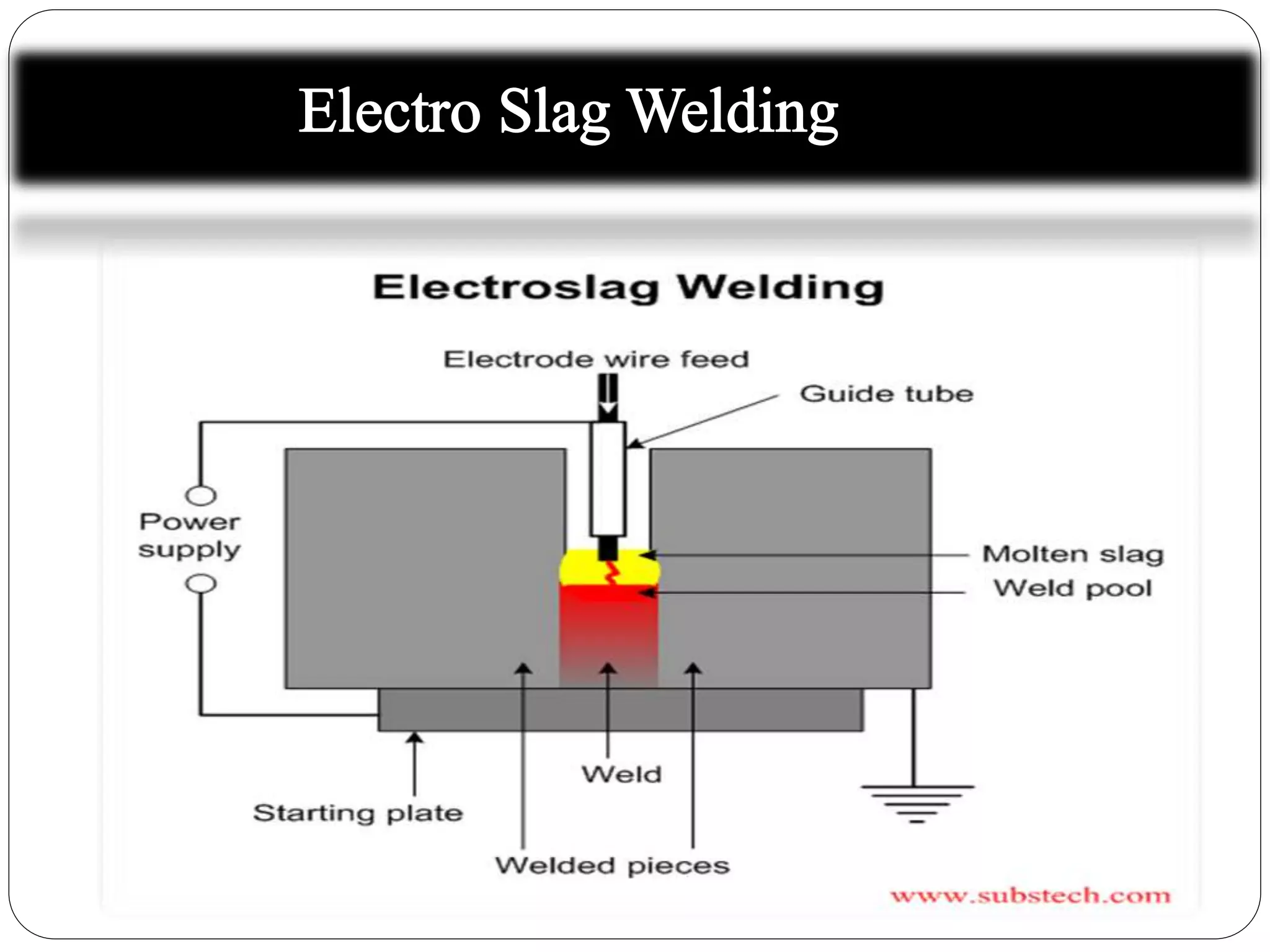
 A welding process where fusion of base metal and
filler metal is achieved from the heat generated by the
electrical resistance of the molten slag. Weld pool
shielded by the molten slag, which moves along the
joint as welding progresses.
.
 The process is initiated by an arc that heats up the
granulated flux and forms the slag.
 The arc then gets extinguished and molten slag
provides the conducting path to the current.
 The slag remains in the molten state by the heat
generated by it’s resistance.
 The electrode remains dipped in the molten slag and
gets melted and deposited as the welding progresses.
 The molten slag bath over the weld pool acts both
as the heat source as well as a shielding medium.
 A progressive solidification takes place from
bottom upwards, and always there is a molten
metal pool over the solidifying weld metal.
 Welds plates ranging in thickness from 19 to 460
mm.
Types
 Two types of electro slag welding ,
Non-consumable electrode guide cum
contact tube
Electrode with Non Consumable Guide
 One or more electrodes are fed to the molten slag
pool depending on the thickness of the metals
being joined.
 Water cooled copper shoes are used on both
sides of the plates to contain the molten metal
and the molten slag.
 Shoes move vertically up
Speed of this vertical movement determines the
welding speed
Consistent with the electrode melting and
 Contact surfaces of the shoes are shaped
concave.
Provides the required amount of reinforcement
on the weld deposit.
 As the shoes move up, the solidified weld deposit
gets exposed.
 The exposed surfaces are covered with a fine
layer of slag.
Small amounts of flux is added at intervals to
compensate for this consumption of slag.
Consumable guide
 Metal deposition is from both electrode and the
consumable guide.
 The consumable guide provides approximately 5 to
15% of the filler metal.
In this method non sliding shoes are used.
Entire joint height is covered by the shoes.
Shoes are of same length as the joint.
For longer joints, several sets of shoes are
used.
 With the progress of the weld as the metal solidifies,
the shoes from below are removed and placed above
 As the weld current is carried by the guide tube,
Needs to be insulated.
Required insulation may be provided by
Flux coating of the outer surface of the
guide tube.
Insulating tape.
 This method can be used to weld sections of
virtually unlimited thickness.
 Constant potential DC power source is used
Current rating of 500 to 1000 A.
Load voltages generally range from 30 to 55 V
Power Supply
 Constant potential DC power source is used
Current rating of 500 to 1000 A.
Load voltages generally range from 30 to 55 V.
Operating Variables
 Operating variables differ from those with
conventional arc welding processes.
Form Factor
 Solidification of molten metal takes place at a
slow rate.
Angle at which the grains meet in the center is
determined by the shape of the molten weld
pool.
 Weld pool shape can be expressed by a “form
factor”.
Form factor is the ratio of the weld pool width to
it’s maximum depth.
 A high factor weld deposit tends to solidify with
Grains meeting at an acute angle.
 In case of low form factor,
Grains meet at obtuse angle.
The weld cracking resistance
High in case of acute angles
Low in case of obtuse angle.
 Maximum resistance to cracking is obtained with
welds having high form factor.
 Form factor alone doesn’t control cracking .
Base metal composition, filler metal composition
and joint restraint have a significant effect on crack
formation.
Welding Current
 Increasing welding current
Increased heat input
Increased depth of molten weld pool.
 Effect of increasing current is to decrease the
form factor and thus lowering the resistance to
cracking.
 Generally currents of 500 to 700 A are used with
3.2 mm electrode.
 For metals more prone to cracks, current below
500 A used.
Welding Voltage
An extremely important variable.
 For stable operation voltages within 30 to 55 V
per electrode are used.
 Increasing the voltage
Increases the sideways depth of fusion in the
base metal
Increases the width of the weld.
Increases the form factor
Increases resistance to cracking.
 With thickness sections, higher voltages are
Electrode Oscillation
 Oscillation of electrode is generally carried out
horizontally across the thickness.
It distributes the heat and thus helps to obtain
better edge fusion.
Oscillation speeds vary between 8 to 40 mm/s,
with increasing speed to match the plate
thickness.
Advantages
 Very high deposition rates can be achieved with
ESW
 Very thick sections can be welded in a single
pass and more economically.
 Thickness up to 450 mm in plain and alloy steels
can be welded without difficulty.
 Residual stresses and distortion produced are
lower.
 During the electro slag process since no arc
exists no spattering or intense arc flashing
occurs.
Limitations
 Electro slag welding is not suitable for joints
below 60 mm.
 Coarse grain structure of the weld.
 Low toughness of the weld.
 Only vertical position can be welded.
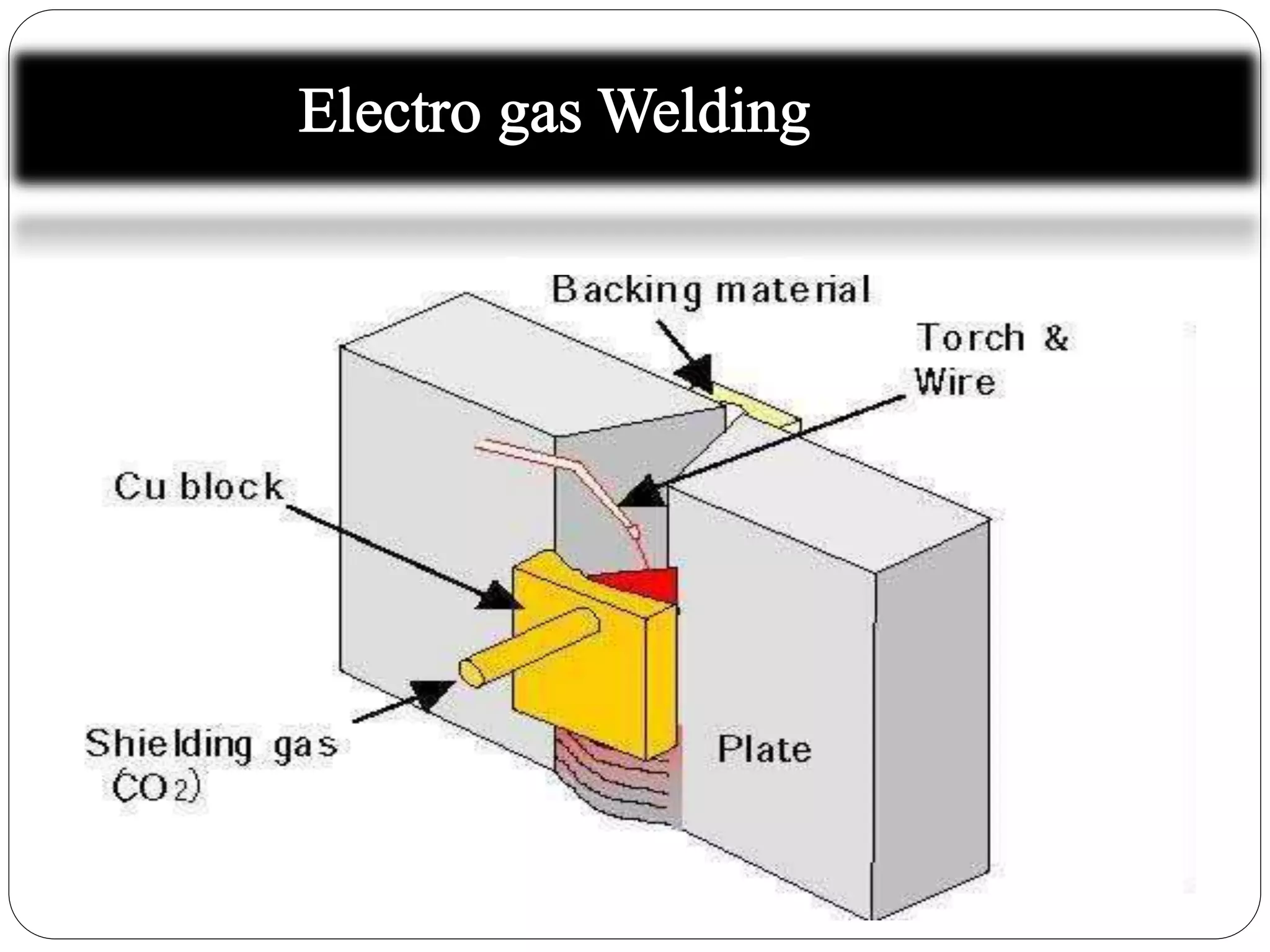
 A further development of electro slag welding
process.
Instead of resistance heating of molten
slag, the electrode is melted by the arc
heat in an inert gas environment, very
similar to that of GMAW process.
 Very useful for vertical welding of thick plates up
to a thickness of about 100 mm in a single pass.
 Led to large cost savings compared to
conventional GMAW process for welding of very
thick steel plates.
 Solid or flux cored wire electrodes are used.
 Produces a smaller heat-affected zone (HAZ)
 Better notch toughness as compared to electro
slag welding.
 Gives an advantage of extra melting of electrode
wire leading to high deposition rate and produces
less molten base material thereby resulting in
lesser HAZ.
Salient Features
 It is an automatic welding process.
 It welds only in vertical direction.
 The weld pool is bound either by two sliding water
cooled copper shoes or a sliding water cooled
copper shoe in the front and ceramic backing
strip at the back.
 The electrode is melted by a shielded arc.
 Constant current DC power supply is generally
used.
 Electrode is kept positive.
Process
Once the arc is initiated,
In the arc heat the electrode and the plate edges along
the vertical groove melts forming a weld pool covered side
ways with copper shoes.
In the process the molten material at the lower end of the
groove solidifies and the process continues till it reaches
the upper end.
 Synchronization of the feeding of electrode and moving up
of the shoes is extremely important.
 Any mismatch will lead to
Arc unstability or
Stubbing of electrode in the molten pool (may lead to
Single electrode EGW
 To reduce the heat input,
A fine diameter wire is used with a lower
welding current and a narrow groove.
 To attain a sound weld bead formation, the weld
wire (nozzle) is oscillated in the plate thickness
direction.
Enables proper welding with adequate
reinforcement on both sides of the plate.
 HAZ toughness and welding efficiency
substantially increases.
 Is used to weld 50 mm thick steel plates.
Double electrode EGW
 For plates having thickness greater than 50 mm
single electrode EGW can't be used. Plates of
thickness 50-70 mm is welded by double
electrode EGW process.
 Direct current power source is used.
 One of the electrode is made positive and the
other is kept negative.
 This provides for a stable arc.
 If both electrodes have the same polarity,
Arc becomes highly unstable and leads to high
amount of spatter.
Also with electrode positive
Wider bead is formed
With less penetration
Negative polarity gives
Narrow bead
With deeper penetration
 For a wide single V groove, the electrode on the
wider groove surface is made positive and
electrode on the rear side of the groove is made
negative.
Applications
Grain fully applied in Building of
 Storage tanks
 Vertical Vessels
 Blast furnaces
 Chemical Furnaces
 Ship Building
 Thick walled and large diameter pipes
 Bridges etc.
Advantages
 EGW process has higher welding speed.
 EGW process welds thicker plates in single pass.
 High Deposition Rate as compared to manual
welding.
 Welded joints have better mechanical properties
such as impact strength.
Limitations
 This process is limited for making vertical weld
joints.
 Massive, expensive welding equipment and
guidance system are required.
Any Question

Electro Slag and Electro Welding

  • 1.
    Group D Ali Sher(E12-333) Ehsan Shehroz (E12-332) Nauman Aslam (E12-330) Department of Metallurgy & Materials Engineering University of the Punjab, Lahore
  • 3.
     A weldingprocess where fusion of base metal and filler metal is achieved from the heat generated by the electrical resistance of the molten slag. Weld pool shielded by the molten slag, which moves along the joint as welding progresses. .  The process is initiated by an arc that heats up the granulated flux and forms the slag.  The arc then gets extinguished and molten slag provides the conducting path to the current.  The slag remains in the molten state by the heat generated by it’s resistance.  The electrode remains dipped in the molten slag and gets melted and deposited as the welding progresses.
  • 5.
     The moltenslag bath over the weld pool acts both as the heat source as well as a shielding medium.  A progressive solidification takes place from bottom upwards, and always there is a molten metal pool over the solidifying weld metal.  Welds plates ranging in thickness from 19 to 460 mm. Types  Two types of electro slag welding , Non-consumable electrode guide cum contact tube
  • 6.
    Electrode with NonConsumable Guide  One or more electrodes are fed to the molten slag pool depending on the thickness of the metals being joined.  Water cooled copper shoes are used on both sides of the plates to contain the molten metal and the molten slag.  Shoes move vertically up Speed of this vertical movement determines the welding speed Consistent with the electrode melting and
  • 7.
     Contact surfacesof the shoes are shaped concave. Provides the required amount of reinforcement on the weld deposit.  As the shoes move up, the solidified weld deposit gets exposed.  The exposed surfaces are covered with a fine layer of slag. Small amounts of flux is added at intervals to compensate for this consumption of slag.
  • 8.
    Consumable guide  Metaldeposition is from both electrode and the consumable guide.  The consumable guide provides approximately 5 to 15% of the filler metal. In this method non sliding shoes are used. Entire joint height is covered by the shoes. Shoes are of same length as the joint. For longer joints, several sets of shoes are used.  With the progress of the weld as the metal solidifies, the shoes from below are removed and placed above
  • 9.
     As theweld current is carried by the guide tube, Needs to be insulated. Required insulation may be provided by Flux coating of the outer surface of the guide tube. Insulating tape.  This method can be used to weld sections of virtually unlimited thickness.  Constant potential DC power source is used Current rating of 500 to 1000 A. Load voltages generally range from 30 to 55 V
  • 10.
    Power Supply  Constantpotential DC power source is used Current rating of 500 to 1000 A. Load voltages generally range from 30 to 55 V. Operating Variables  Operating variables differ from those with conventional arc welding processes.
  • 11.
    Form Factor  Solidificationof molten metal takes place at a slow rate. Angle at which the grains meet in the center is determined by the shape of the molten weld pool.  Weld pool shape can be expressed by a “form factor”. Form factor is the ratio of the weld pool width to it’s maximum depth.
  • 12.
     A highfactor weld deposit tends to solidify with Grains meeting at an acute angle.  In case of low form factor, Grains meet at obtuse angle. The weld cracking resistance High in case of acute angles Low in case of obtuse angle.  Maximum resistance to cracking is obtained with welds having high form factor.  Form factor alone doesn’t control cracking . Base metal composition, filler metal composition and joint restraint have a significant effect on crack formation.
  • 13.
    Welding Current  Increasingwelding current Increased heat input Increased depth of molten weld pool.  Effect of increasing current is to decrease the form factor and thus lowering the resistance to cracking.  Generally currents of 500 to 700 A are used with 3.2 mm electrode.  For metals more prone to cracks, current below 500 A used.
  • 14.
    Welding Voltage An extremelyimportant variable.  For stable operation voltages within 30 to 55 V per electrode are used.  Increasing the voltage Increases the sideways depth of fusion in the base metal Increases the width of the weld. Increases the form factor Increases resistance to cracking.  With thickness sections, higher voltages are
  • 15.
    Electrode Oscillation  Oscillationof electrode is generally carried out horizontally across the thickness. It distributes the heat and thus helps to obtain better edge fusion. Oscillation speeds vary between 8 to 40 mm/s, with increasing speed to match the plate thickness.
  • 16.
    Advantages  Very highdeposition rates can be achieved with ESW  Very thick sections can be welded in a single pass and more economically.  Thickness up to 450 mm in plain and alloy steels can be welded without difficulty.  Residual stresses and distortion produced are lower.  During the electro slag process since no arc exists no spattering or intense arc flashing occurs.
  • 17.
    Limitations  Electro slagwelding is not suitable for joints below 60 mm.  Coarse grain structure of the weld.  Low toughness of the weld.  Only vertical position can be welded.
  • 19.
     A furtherdevelopment of electro slag welding process. Instead of resistance heating of molten slag, the electrode is melted by the arc heat in an inert gas environment, very similar to that of GMAW process.  Very useful for vertical welding of thick plates up to a thickness of about 100 mm in a single pass.  Led to large cost savings compared to conventional GMAW process for welding of very thick steel plates.
  • 20.
     Solid orflux cored wire electrodes are used.  Produces a smaller heat-affected zone (HAZ)  Better notch toughness as compared to electro slag welding.  Gives an advantage of extra melting of electrode wire leading to high deposition rate and produces less molten base material thereby resulting in lesser HAZ.
  • 21.
    Salient Features  Itis an automatic welding process.  It welds only in vertical direction.  The weld pool is bound either by two sliding water cooled copper shoes or a sliding water cooled copper shoe in the front and ceramic backing strip at the back.  The electrode is melted by a shielded arc.  Constant current DC power supply is generally used.  Electrode is kept positive.
  • 22.
    Process Once the arcis initiated, In the arc heat the electrode and the plate edges along the vertical groove melts forming a weld pool covered side ways with copper shoes. In the process the molten material at the lower end of the groove solidifies and the process continues till it reaches the upper end.  Synchronization of the feeding of electrode and moving up of the shoes is extremely important.  Any mismatch will lead to Arc unstability or Stubbing of electrode in the molten pool (may lead to
  • 24.
    Single electrode EGW To reduce the heat input, A fine diameter wire is used with a lower welding current and a narrow groove.  To attain a sound weld bead formation, the weld wire (nozzle) is oscillated in the plate thickness direction. Enables proper welding with adequate reinforcement on both sides of the plate.  HAZ toughness and welding efficiency substantially increases.  Is used to weld 50 mm thick steel plates.
  • 25.
    Double electrode EGW For plates having thickness greater than 50 mm single electrode EGW can't be used. Plates of thickness 50-70 mm is welded by double electrode EGW process.  Direct current power source is used.  One of the electrode is made positive and the other is kept negative.  This provides for a stable arc.  If both electrodes have the same polarity, Arc becomes highly unstable and leads to high amount of spatter.
  • 26.
    Also with electrodepositive Wider bead is formed With less penetration Negative polarity gives Narrow bead With deeper penetration  For a wide single V groove, the electrode on the wider groove surface is made positive and electrode on the rear side of the groove is made negative.
  • 28.
    Applications Grain fully appliedin Building of  Storage tanks  Vertical Vessels  Blast furnaces  Chemical Furnaces  Ship Building  Thick walled and large diameter pipes  Bridges etc.
  • 29.
    Advantages  EGW processhas higher welding speed.  EGW process welds thicker plates in single pass.  High Deposition Rate as compared to manual welding.  Welded joints have better mechanical properties such as impact strength. Limitations  This process is limited for making vertical weld joints.  Massive, expensive welding equipment and guidance system are required.
  • 30.