Setting Posterior Teeth
Set for Function
Philosophies of Denture Occlusion
 Many philosophies of arranging
denture occlusion
 No definitive scientific studies
prove one occlusal scheme clearly
superior
Rationale for Dalhousie Approach
 Principals to choose an occlusal scheme
 Based on clinical experience
 Dalhousie: two occlusal schemes :
• Lingualized Occlusion
• Monoplane Occlusion
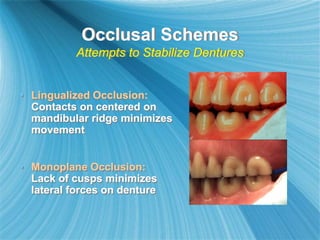
Occlusal Schemes
Attempts to Stabilize Dentures
 Lingualized Occlusion:
Contacts on centered on
mandibular ridge minimizes
movement
 Monoplane Occlusion:
Lack of cusps minimizes
lateral forces on denture
Based on the UCLA/IVOCLAR/ACP Series
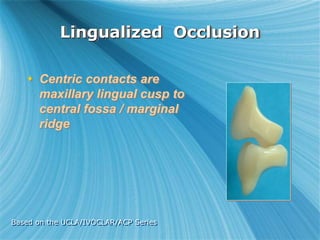
Lingualized Occlusion
 Centric contacts are
maxillary lingual cusp to
central fossa / marginal
ridge
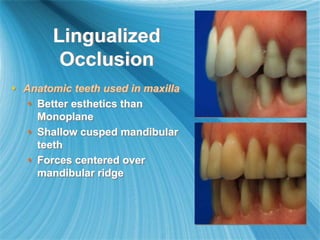
Lingualized
Occlusion
 Anatomic teeth used in maxilla
 Better esthetics than
Monoplane
 Shallow cusped mandibular
teeth
 Forces centered over
mandibular ridge
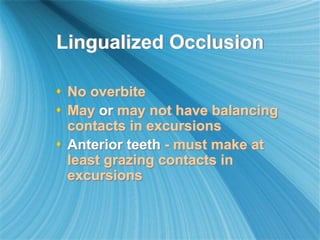
Lingualized Occlusion
 No overbite
 May or may not have balancing
contacts in excursions
 Anterior teeth - must make at
least grazing contacts in
excursions
Lingualized Occlusion
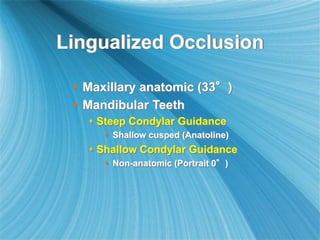
 Maxillary anatomic (33°)
 Mandibular Teeth
 Steep Condylar Guidance
 Shallow cusped (Anatoline)
 Shallow Condylar Guidance
 Non-anatomic (Portrait 0°)
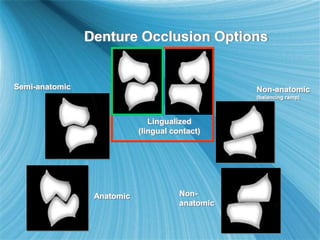
Denture Occlusion Options
Anatomic
Semi-anatomic
Lingualized
(lingual contact)
Non-anatomic
(balancing ramp)
Non-
anatomic
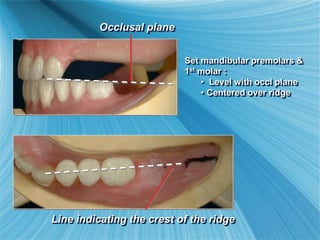
Set mandibular premolars &
1st molar :
• Level with occl plane
• Centered over ridge
Occlusal plane
Line indicating the crest of the ridge
Balanced
Lingualized Occlusion
Maxillary anatomic opposing
Mandibular shallow cusp
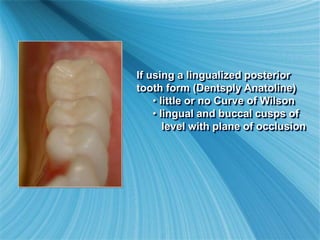
If using a lingualized posterior
tooth form (Dentsply Anatoline)
• little or no Curve of Wilson
• lingual and buccal cusps of
level with plane of occlusion
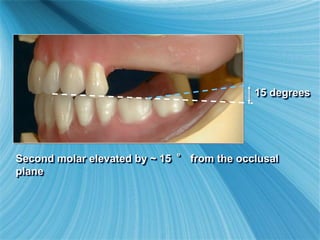
Second molar elevated by ~ 15 ° from the occlusal
plane
15 degrees
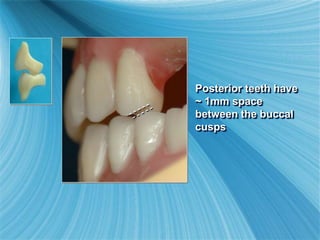
Posterior teeth have
~ 1mm space
between the buccal
cusps
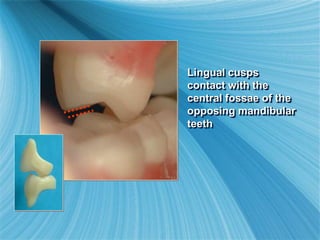
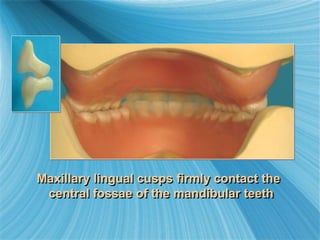
Lingual cusps
contact with the
central fossae of the
opposing mandibular
teeth
Maxillary lingual cusps firmly contact the
central fossae of the mandibular teeth
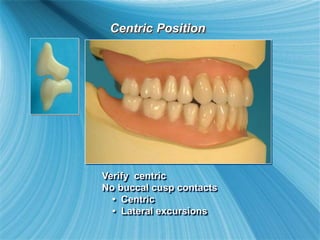
Verify centric
No buccal cusp contacts
• Centric
• Lateral excursions
Centric Position
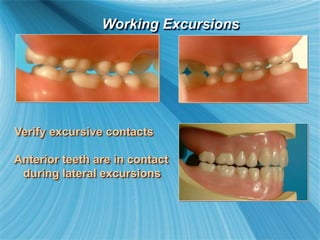
Verify excursive contacts
Anterior teeth are in contact
during lateral excursions
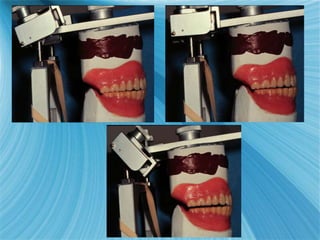
Working Excursions
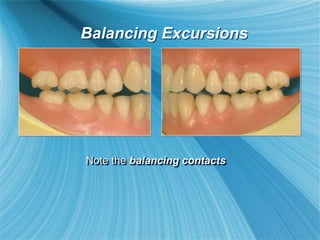
Note the balancing contacts
Balancing Excursions
Effect of Mandible Moving
Downward During Excursions
Maintaining Balancing
Contacts
 Change occlusal plane angle
 Increase compensating curves
 Increase cusp angles
Achieving Balance
• Condylar angulation
 Recorded with protrusive record
• Cusp angle
 Selected by dentist
Achieving Balance
• Occlusal Plane
 Determined by dentist with wax rims
• Curve of Spee & Curve of Wilson
 Controlled by inclination of teeth
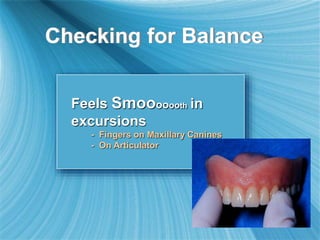
Checking for Balance
Feels Smooooooth in
excursions
- Fingers on Maxillary Canines
- On Articulator
Assessing Balance
• Jumps or bumps are due to cusp tips
moving over other cusp tips, inclines,
marginal ridges
Occlusal Refinement
Occlusal Adjustment, Selective Grinding
 Set teeth as close to:
 Maximum intercuspation
 Balance
 All setups will need some adjustment
‘IIF’ Rule
IIF you have contacts on the Inner Inclines of
Functional cusps they are balancing contacts
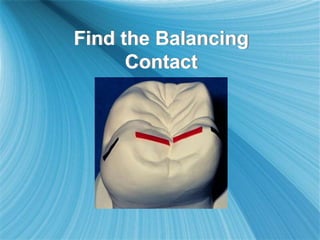
Find the Balancing
Contact
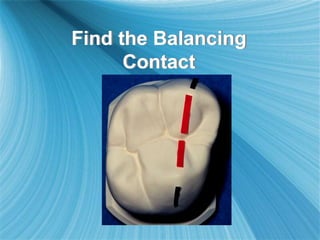
Find the Balancing
Contact
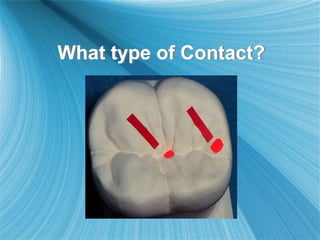
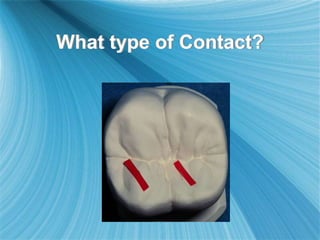
What type of Contact?
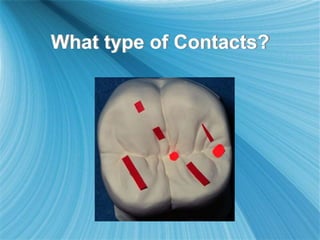
What type of Contacts?
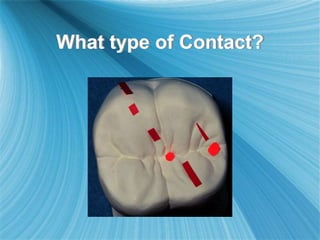
What type of Contact?
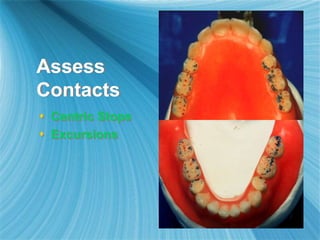
Assess
Contacts
 Centric Stops
 Excursions
Non-Balanced
Lingualized Occlusion
Maxillary anatomic opposing
mandibular non-anatomic
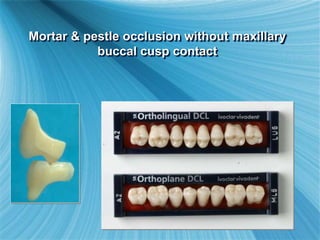
Mortar & pestle occlusion without maxillary
buccal cusp contact
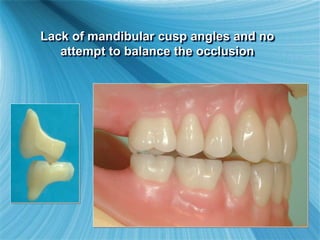
Lack of mandibular cusp angles and no
attempt to balance the occlusion
No compensating curves
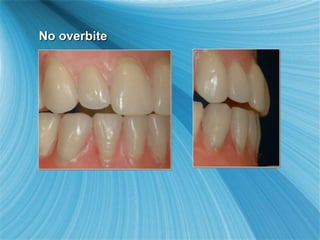
No overbite
No overbite
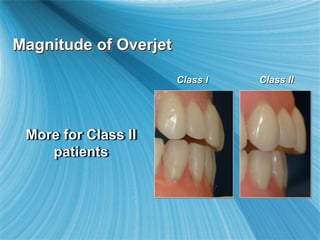
Magnitude of Overjet
More for Class II
patients
Class I Class II
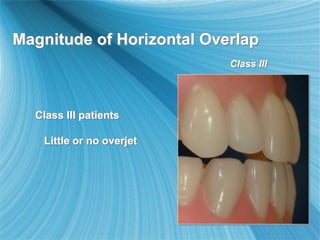
Magnitude of Horizontal Overlap
Class III patients
Little or no overjet
Class III
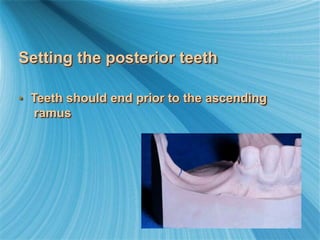
Setting the posterior teeth
• Teeth should end prior to the ascending
ramus
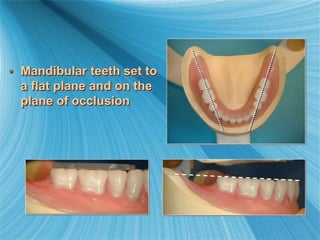
• Mandibular teeth set to
a flat plane and on the
plane of occlusion
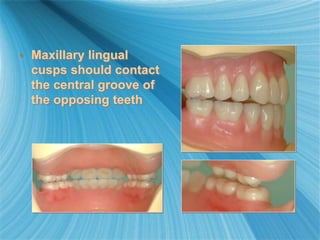
• Maxillary lingual
cusps should contact
the central groove of
the opposing teeth
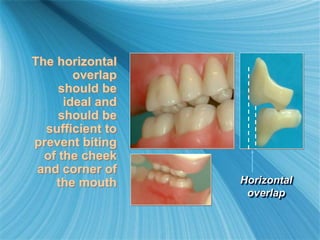
The horizontal
overlap
should be
ideal and
should be
sufficient to
prevent biting
of the cheek
and corner of
the mouth Horizontal
overlap
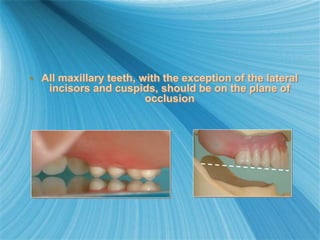
• All maxillary teeth, with the exception of the lateral
incisors and cuspids, should be on the plane of
occlusion
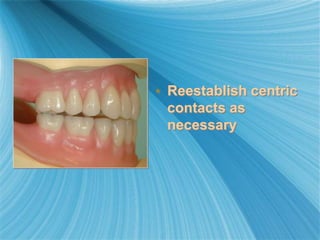
• Reestablish centric
contacts as
necessary
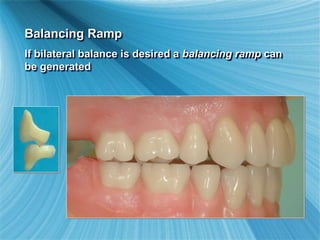
Balancing Ramp
If bilateral balance is desired a balancing ramp can
be generated
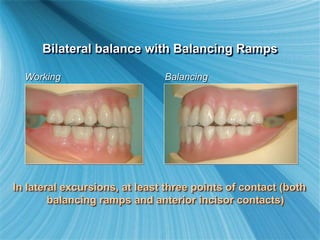
In lateral excursions, at least three points of contact (both
balancing ramps and anterior incisor contacts)
Bilateral balance with Balancing Ramps
Working Balancing
Monoplane Occlusion
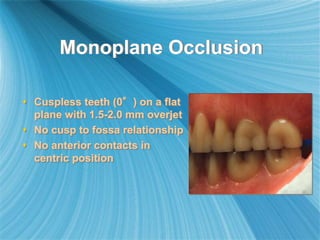
Monoplane Occlusion
 Cuspless teeth (0°) on a flat
plane with 1.5-2.0 mm overjet
 No cusp to fossa relationship
 No anterior contacts in
centric position
Monoplane Occlusion
 Eliminate cusps
 lateral forces reduced
 improves stability
 Simplifies tooth arrangement
Monoplane Occlusion
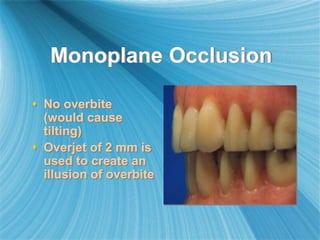
 No overbite
(would cause
tilting)
 Overjet of 2 mm is
used to create an
illusion of overbite
Monoplane Occlusion
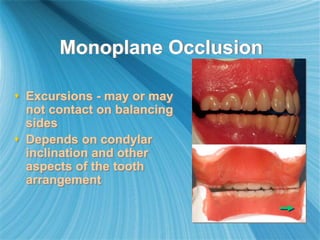
 Excursions - may or may
not contact on balancing
sides
 Depends on condylar
inclination and other
aspects of the tooth
arrangement
Monoplane Occlusion
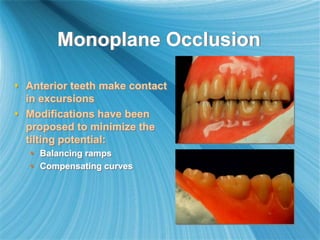
 Anterior teeth make contact
in excursions
 Modifications have been
proposed to minimize the
tilting potential:
 Balancing ramps
 Compensating curves
Monoplane Occlusion
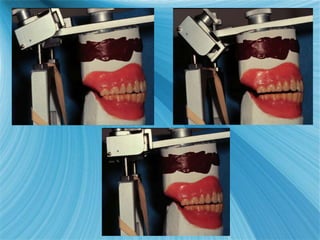
without condylar influence
Monoplane Occlusion
Monoplane Occlusion
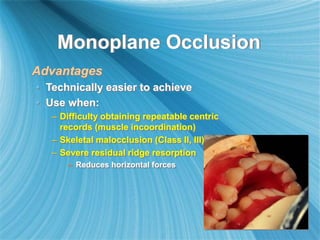
Advantages
• Technically easier to achieve
• Use when:
– Difficulty obtaining repeatable centric
records (muscle incoordination)
– Skeletal malocclusion (Class II, III)
– Severe residual ridge resorption
– Reduces horizontal forces
Monoplane
Occlusion
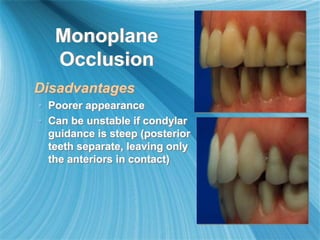
Disadvantages
• Poorer appearance
• Can be unstable if condylar
guidance is steep (posterior
teeth separate, leaving only
the anteriors in contact)
Monoplane Occlusion
 Clinical remount on an articulator
 Practice doing a clinical remount
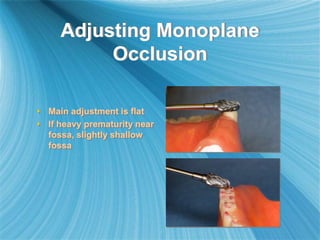
Adjusting Monoplane
Occlusion
 Main adjustment is flat
 If heavy prematurity near
fossa, slightly shallow
fossa

Set Posterior Teeth Ling & Monopl.ppt