QUESTION 1)
In what ways does your media product use, develop
or challenge forms and conventions?
THE TASK
The task was to create a 2 minute opening thriller sequence in a group which
displayed conventions learned through the planning we partook. We used the
preliminary as a step ladder to make the final product as the minimal skills we gained
from that helped us when it came to the practical side of making the final product.
Research into cinematography helped us as we gained an incentive into what camera
movement, size and angle was common in other thrillers and how we could apply them
to our own thriller to allow for our research to add up. Research into other stuff such
as the five different elements that make up Mise en Scene was also something we
were allowed to look into when creating our final product.
DOES MY THRILLER FOLLOW CONVENTIONS
• I believe my thriller follows common conventions of a thriller in some ways as it
takes on most of the planning elements such as body language, settings and
iconography. Looking at the last scene you can look at the way the antagonist puts
his arm around the presumed victim of the narrative, thus showing the audience
that it is shows similar conventions of a father/son or brother/brother relationship. It
shows bonding and closure even if you just watched the scene without knowing what
it was for.
• Also the scene being based in an urban location at later time in the day follows
conventions in terms of themes and setting; for themes the dark, and gloomy area
represents the tension around the plot and allows the audience to understand the
scene more in depth what is going on. With setting, the empty footpath surrounded
by trees and a darker shade of orange streetlights set the mood and tone of the path
the narrative has taken.
GENERIC CONVENTIONS OF A THRILLER
• Generic conventions of a thriller are adventuristic plots, uneventful narrative and
sound that generally appeals to most audiences. Thrillers such as The
Stepfather(1987) and Watchmen are prime examples of thrillers that take on sound
and execute it perfectly. As well as having a narrative that looks at the theory’s of
Todorov, Aristotle and Barthes they have taken them and mixed them into their
own, however I believe that between the three of the theorists, Todorov’s was used
most frequently and was more known than the others. For thrillers to take on
Barthes theory then they would have to be set during a certain time period rather
than any random normal period of the year. The main character positions held in
thrillers are Protagonist and Antagonist, mainly because they are the characters the
audience are more interested in, and play a role in deciding the path of the
characters characteristics.
CINEMATOGRAPHY
• For the task we had to consider the different cinematography that we could apply to
our opening thriller. Using different angles, sizes and movement was essential in
allowing the thriller to follow conventions of other thrillers. The tilt shot seen in
Scream was used in the scene showing the house of the antagonist, this was a good
example of cinematography as tilt shots are used very often in thrillers to either
show a character from top to bottom or to show the next location without it being an
establishing shot. The use of an extreme close up mixed with a tilt shot was very
unusual and unique for us to try as we cut out different images from a tilt shot of
the antagonist and focused on each image of entire antagonist and cut it up into
extreme close ups, from the toe to head.
ANGLES SIZES MOVEMENT
• My thriller opening sequence angles, sizes and movement are based on examples
and ideas taken from other thrillers. The tilt shot used near the start of the thriller
was an example of a convention commonly used in other thrillers, to maybe
introduce the next scene or to show the audience a new character physically. The
camera movement was normally stable and only moved when the antagonist was
seen walking up the stairs from a point of view, and the opening of the door, as well
as using that we used focus to show the facial expression and body language when
introducing the victim of the thriller.
SOUND
• My thriller took on sound as a stumbling block when it came to
following conventions of other thrillers. As majority of known thrillers
are set in the American region, looking at the different sound used for
different scenes was hard because of the urban and cultural
environment over in England compared to theirs. The sound in the
opening 20/30 seconds were conventional to that of other thrillers
intending to have an effect on their audience psychologically, as we
used parallel sound to ensure the scene was understood as being an
awkward introduction into the physical characteristics of the main
antagonist.
EDITING CUTS
• The cuts in the thriller were important in using common conventions
of a thriller and applying it to ours. We used jump cuts at the start
when introducing the character and showing the audience the mind
and mentality of the antagonist, the last section of the thriller also
uses jump cuts when the two characters are seen walking down the
long road to their next mission as a pair rather than the antagonist by
himself as mentioned in my groups final narrative idea. Straight cuts
were also used in the thriller opening as we aimed to use conventions
of other thrillers and blend it in with the ideas we had in the mind
EDITING TRANSITION
• The transitions in the thriller opening are common conventions used
by majority of other thriller films, the fade to black into the next
scene, just keeping the tone and the mood of the thriller at ease using
this type of transition. We didn’t feel the need to challenge
conventions as our thriller wasn’t that different from any other
thriller, however we worked with what we could and produced an
opening thriller sequence keeping it organized and simple.
MISE EN SCENE SETTING AND ICONOGRAPHY
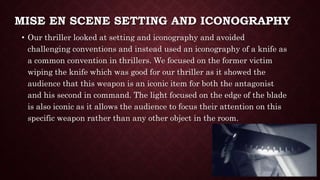
• Our thriller looked at setting and iconography and avoided
challenging conventions and instead used an iconography of a knife as
a common convention in thrillers. We focused on the former victim
wiping the knife which was good for our thriller as it showed the
audience that this weapon is an iconic item for both the antagonist
and his second in command. The light focused on the edge of the blade
is also iconic as it allows the audience to focus their attention on this
specific weapon rather than any other object in the room.
MISE EN SCENE LIGHTING AND COLOUR
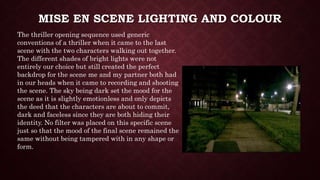
The thriller opening sequence used generic
conventions of a thriller when it came to the last
scene with the two characters walking out together.
The different shades of bright lights were not
entirely our choice but still created the perfect
backdrop for the scene me and my partner both had
in our heads when it came to recording and shooting
the scene. The sky being dark set the mood for the
scene as it is slightly emotionless and only depicts
the deed that the characters are about to commit,
dark and faceless since they are both hiding their
identity. No filter was placed on this specific scene
just so that the mood of the final scene remained the
same without being tampered with in any shape or
form.
MISE EN SCENE COSTUME – BODY LANGUAGE AND
FACIAL EXPRESSION
Our thriller developed conventions when it came to body language as facial
expressions were not a big issue in the opening. The introduction of the antagonist
was a perfect example of our thriller developing conventions as you don’t normally see
an antagonist behaving in that order whereas compared to thrillers such as ‘Psycho’
you only see the antagonist behaving the same way when the rest of the characters
recognize the character as an antagonist rather than a good guy. Only a few thrillers
take on this deranged, crazy antagonist and we have taken it and made it our own as
this character is a crazy, self-obsessed psycho-maniac with only a few negative things
on his mind which explains why he behaves so itchy at the start of the thriller. The
facial expression side of this thriller can only be seen from the second antagonists face
from when he is awaiting his fate in the room to when he is undergoing training with
the main antagonist
THEORY
• Barthes theory was that narratives and plots had a cultural understanding.
• Todorov’s theory was that there was an equilibrium, disruption, realization, restored
order, and then finally a new equilibrium.
• Aristotle theory was that there was a beginning, middle and end or in other terms
exposition, development, complication, climax and resolution.
• My thriller opening looked at Todorov’s theory and mixed it with Aristotles theory
from start to end of the two minutes. However we did challenge conventions by not
actually showing the audience which of the two we preferred and left it that way for
the audience to understand the narrative through their own preference and
judgement. This way we made sure we challenged the judgement of the theorists by
not blatantly showing or identifying which theory we felt was best suited to our final
idea.
THEMES
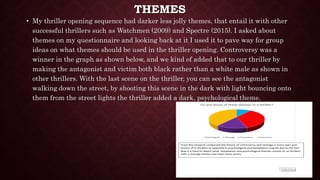
• My thriller opening sequence had darker less jolly themes, that entail it with other
successful thrillers such as Watchmen (2009) and Spectre (2015). I asked about
themes on my questionnaire and looking back at it I used it to pave way for group
ideas on what themes should be used in the thriller opening. Controversy was a
winner in the graph as shown below, and we kind of added that to our thriller by
making the antagonist and victim both black rather than a white male as shown in
other thrillers. With the last scene on the thriller, you can see the antagonist
walking down the street, by shooting this scene in the dark with light bouncing onto
them from the street lights the thriller added a dark, psychological theme.
TARGET AUDIENCE
• When it came to target audience our thriller opening appealed to those we included
and reached out to when planning. The questionnaires we took were additionally
effective as we asked reasonable and important questions to an audience we felt
necessary to ask, and not to an audience we know would not be interested in
thrillers or the plot we decided to take on. Target audience was something we had to
consider when creating our thriller opening sequence too as it was compulsory to
understand as producers, editors and directors what the audience wanted to see and
also their preferences based on other thrillers and characters. I asked a question on
who their favourite character in a thriller was this was a good question I felt to ask
as I looked into the personal characteristics of the characters and not just what their
characters behaved and looked like in their destined thriller film/opening.
CREDIT
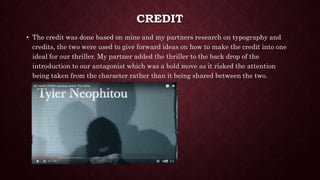
• The credit was done based on mine and my partners research on typography and
credits, the two were used to give forward ideas on how to make the credit into one
ideal for our thriller. My partner added the thriller to the back drop of the
introduction to our antagonist which was a bold move as it risked the attention
being taken from the character rather than it being shared between the two.
OVERALL
• Overall my thriller uses, develops and challenges convention through a variety of
ways as identified here and when watching the opening sequence. Questionnaires
taken during the research into thrillers helped as it gave us a step ladder to create
our final product as mentioned earlier. We used our research and planning to find
ways to use, develop and challenge conventions of a thriller to create an opening
suited to our taste and the target audience, with the characters and narrative the
main features of the thriller opening challenging conventions. We used sound as a
way to show that we could take a thriller convention and challenge it to our taste
rather than being like a majority of other thrillers. Contrapuntal sound was not
added in the thriller opening as seen in the Stepfather(1987) as we felt that our
thriller needed to show signs of cultural understanding of the scene through this. If
there is tension then we create that using sound. Thrillers often use Todorov’s
theory to display their narrative rather than attempting the others, whereas my
thriller used all three theories and blended them into one rather than using a
specific type.

Question 1

  • 1.
    QUESTION 1) In whatways does your media product use, develop or challenge forms and conventions?
  • 2.
    THE TASK The taskwas to create a 2 minute opening thriller sequence in a group which displayed conventions learned through the planning we partook. We used the preliminary as a step ladder to make the final product as the minimal skills we gained from that helped us when it came to the practical side of making the final product. Research into cinematography helped us as we gained an incentive into what camera movement, size and angle was common in other thrillers and how we could apply them to our own thriller to allow for our research to add up. Research into other stuff such as the five different elements that make up Mise en Scene was also something we were allowed to look into when creating our final product.
  • 3.
    DOES MY THRILLERFOLLOW CONVENTIONS • I believe my thriller follows common conventions of a thriller in some ways as it takes on most of the planning elements such as body language, settings and iconography. Looking at the last scene you can look at the way the antagonist puts his arm around the presumed victim of the narrative, thus showing the audience that it is shows similar conventions of a father/son or brother/brother relationship. It shows bonding and closure even if you just watched the scene without knowing what it was for. • Also the scene being based in an urban location at later time in the day follows conventions in terms of themes and setting; for themes the dark, and gloomy area represents the tension around the plot and allows the audience to understand the scene more in depth what is going on. With setting, the empty footpath surrounded by trees and a darker shade of orange streetlights set the mood and tone of the path the narrative has taken.
  • 4.
    GENERIC CONVENTIONS OFA THRILLER • Generic conventions of a thriller are adventuristic plots, uneventful narrative and sound that generally appeals to most audiences. Thrillers such as The Stepfather(1987) and Watchmen are prime examples of thrillers that take on sound and execute it perfectly. As well as having a narrative that looks at the theory’s of Todorov, Aristotle and Barthes they have taken them and mixed them into their own, however I believe that between the three of the theorists, Todorov’s was used most frequently and was more known than the others. For thrillers to take on Barthes theory then they would have to be set during a certain time period rather than any random normal period of the year. The main character positions held in thrillers are Protagonist and Antagonist, mainly because they are the characters the audience are more interested in, and play a role in deciding the path of the characters characteristics.
  • 5.
    CINEMATOGRAPHY • For thetask we had to consider the different cinematography that we could apply to our opening thriller. Using different angles, sizes and movement was essential in allowing the thriller to follow conventions of other thrillers. The tilt shot seen in Scream was used in the scene showing the house of the antagonist, this was a good example of cinematography as tilt shots are used very often in thrillers to either show a character from top to bottom or to show the next location without it being an establishing shot. The use of an extreme close up mixed with a tilt shot was very unusual and unique for us to try as we cut out different images from a tilt shot of the antagonist and focused on each image of entire antagonist and cut it up into extreme close ups, from the toe to head.
  • 6.
    ANGLES SIZES MOVEMENT •My thriller opening sequence angles, sizes and movement are based on examples and ideas taken from other thrillers. The tilt shot used near the start of the thriller was an example of a convention commonly used in other thrillers, to maybe introduce the next scene or to show the audience a new character physically. The camera movement was normally stable and only moved when the antagonist was seen walking up the stairs from a point of view, and the opening of the door, as well as using that we used focus to show the facial expression and body language when introducing the victim of the thriller.
  • 7.
    SOUND • My thrillertook on sound as a stumbling block when it came to following conventions of other thrillers. As majority of known thrillers are set in the American region, looking at the different sound used for different scenes was hard because of the urban and cultural environment over in England compared to theirs. The sound in the opening 20/30 seconds were conventional to that of other thrillers intending to have an effect on their audience psychologically, as we used parallel sound to ensure the scene was understood as being an awkward introduction into the physical characteristics of the main antagonist.
  • 8.
    EDITING CUTS • Thecuts in the thriller were important in using common conventions of a thriller and applying it to ours. We used jump cuts at the start when introducing the character and showing the audience the mind and mentality of the antagonist, the last section of the thriller also uses jump cuts when the two characters are seen walking down the long road to their next mission as a pair rather than the antagonist by himself as mentioned in my groups final narrative idea. Straight cuts were also used in the thriller opening as we aimed to use conventions of other thrillers and blend it in with the ideas we had in the mind
  • 9.
    EDITING TRANSITION • Thetransitions in the thriller opening are common conventions used by majority of other thriller films, the fade to black into the next scene, just keeping the tone and the mood of the thriller at ease using this type of transition. We didn’t feel the need to challenge conventions as our thriller wasn’t that different from any other thriller, however we worked with what we could and produced an opening thriller sequence keeping it organized and simple.
  • 10.
    MISE EN SCENESETTING AND ICONOGRAPHY • Our thriller looked at setting and iconography and avoided challenging conventions and instead used an iconography of a knife as a common convention in thrillers. We focused on the former victim wiping the knife which was good for our thriller as it showed the audience that this weapon is an iconic item for both the antagonist and his second in command. The light focused on the edge of the blade is also iconic as it allows the audience to focus their attention on this specific weapon rather than any other object in the room.
  • 11.
    MISE EN SCENELIGHTING AND COLOUR The thriller opening sequence used generic conventions of a thriller when it came to the last scene with the two characters walking out together. The different shades of bright lights were not entirely our choice but still created the perfect backdrop for the scene me and my partner both had in our heads when it came to recording and shooting the scene. The sky being dark set the mood for the scene as it is slightly emotionless and only depicts the deed that the characters are about to commit, dark and faceless since they are both hiding their identity. No filter was placed on this specific scene just so that the mood of the final scene remained the same without being tampered with in any shape or form.
  • 12.
    MISE EN SCENECOSTUME – BODY LANGUAGE AND FACIAL EXPRESSION Our thriller developed conventions when it came to body language as facial expressions were not a big issue in the opening. The introduction of the antagonist was a perfect example of our thriller developing conventions as you don’t normally see an antagonist behaving in that order whereas compared to thrillers such as ‘Psycho’ you only see the antagonist behaving the same way when the rest of the characters recognize the character as an antagonist rather than a good guy. Only a few thrillers take on this deranged, crazy antagonist and we have taken it and made it our own as this character is a crazy, self-obsessed psycho-maniac with only a few negative things on his mind which explains why he behaves so itchy at the start of the thriller. The facial expression side of this thriller can only be seen from the second antagonists face from when he is awaiting his fate in the room to when he is undergoing training with the main antagonist
  • 13.
    THEORY • Barthes theorywas that narratives and plots had a cultural understanding. • Todorov’s theory was that there was an equilibrium, disruption, realization, restored order, and then finally a new equilibrium. • Aristotle theory was that there was a beginning, middle and end or in other terms exposition, development, complication, climax and resolution. • My thriller opening looked at Todorov’s theory and mixed it with Aristotles theory from start to end of the two minutes. However we did challenge conventions by not actually showing the audience which of the two we preferred and left it that way for the audience to understand the narrative through their own preference and judgement. This way we made sure we challenged the judgement of the theorists by not blatantly showing or identifying which theory we felt was best suited to our final idea.
  • 14.
    THEMES • My thrilleropening sequence had darker less jolly themes, that entail it with other successful thrillers such as Watchmen (2009) and Spectre (2015). I asked about themes on my questionnaire and looking back at it I used it to pave way for group ideas on what themes should be used in the thriller opening. Controversy was a winner in the graph as shown below, and we kind of added that to our thriller by making the antagonist and victim both black rather than a white male as shown in other thrillers. With the last scene on the thriller, you can see the antagonist walking down the street, by shooting this scene in the dark with light bouncing onto them from the street lights the thriller added a dark, psychological theme.
  • 15.
    TARGET AUDIENCE • Whenit came to target audience our thriller opening appealed to those we included and reached out to when planning. The questionnaires we took were additionally effective as we asked reasonable and important questions to an audience we felt necessary to ask, and not to an audience we know would not be interested in thrillers or the plot we decided to take on. Target audience was something we had to consider when creating our thriller opening sequence too as it was compulsory to understand as producers, editors and directors what the audience wanted to see and also their preferences based on other thrillers and characters. I asked a question on who their favourite character in a thriller was this was a good question I felt to ask as I looked into the personal characteristics of the characters and not just what their characters behaved and looked like in their destined thriller film/opening.
  • 16.
    CREDIT • The creditwas done based on mine and my partners research on typography and credits, the two were used to give forward ideas on how to make the credit into one ideal for our thriller. My partner added the thriller to the back drop of the introduction to our antagonist which was a bold move as it risked the attention being taken from the character rather than it being shared between the two.
  • 17.
    OVERALL • Overall mythriller uses, develops and challenges convention through a variety of ways as identified here and when watching the opening sequence. Questionnaires taken during the research into thrillers helped as it gave us a step ladder to create our final product as mentioned earlier. We used our research and planning to find ways to use, develop and challenge conventions of a thriller to create an opening suited to our taste and the target audience, with the characters and narrative the main features of the thriller opening challenging conventions. We used sound as a way to show that we could take a thriller convention and challenge it to our taste rather than being like a majority of other thrillers. Contrapuntal sound was not added in the thriller opening as seen in the Stepfather(1987) as we felt that our thriller needed to show signs of cultural understanding of the scene through this. If there is tension then we create that using sound. Thrillers often use Todorov’s theory to display their narrative rather than attempting the others, whereas my thriller used all three theories and blended them into one rather than using a specific type.