Y LeCun
Convolutional Networks:
Unleashing the Potential of
Machine Learning for
Robust Perception Systems
Yann LeCun
Facebook AI Research &
Center for Data Science, NYU
yann@cs.nyu.edu
http://yann.lecun.com
Y LeCun
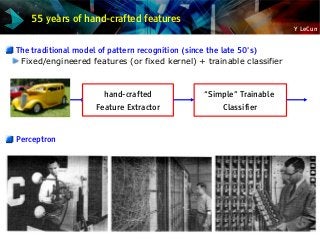
55 years of hand-crafted features
The traditional model of pattern recognition (since the late 50's)
Fixed/engineered features (or fixed kernel) + trainable classifier
Perceptron
“Simple” Trainable
Classifier
hand-crafted
Feature Extractor
Y LeCun
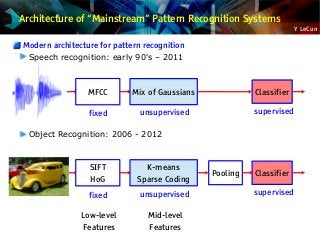
Architecture of “Mainstream” Pattern Recognition Systems
Modern architecture for pattern recognition
Speech recognition: early 90's – 2011
Object Recognition: 2006 - 2012
fixed unsupervised supervised
ClassifierMFCC Mix of Gaussians
Classifier
SIFT
HoG
K-means
Sparse Coding
Pooling
fixed unsupervised supervised
Low-level
Features
Mid-level
Features
Y LeCun
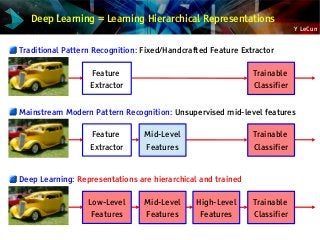
Deep Learning = Learning Hierarchical Representations
Traditional Pattern Recognition: Fixed/Handcrafted Feature Extractor
Trainable
Classifier
Feature
Extractor
Mainstream Modern Pattern Recognition: Unsupervised mid-level features
Trainable
Classifier
Feature
Extractor
Mid-Level
Features
Deep Learning: Representations are hierarchical and trained
Trainable
Classifier
Low-Level
Features
Mid-Level
Features
High-Level
Features
Y LeCun
Deep Learning = Learning Hierarchical Representations
It's deep if it has more than one stage of non-linear feature transformation
Trainable
Classifier
Low-Level
Feature
Mid-Level
Feature
High-Level
Feature
Feature visualization of convolutional net trained on ImageNet from [Zeiler & Fergus 2013]
Y LeCun
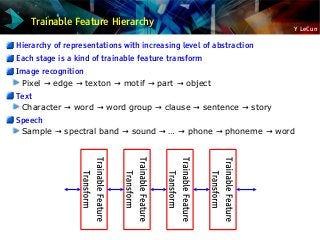
Trainable Feature Hierarchy
Hierarchy of representations with increasing level of abstraction
Each stage is a kind of trainable feature transform
Image recognition
Pixel edge texton motif part object→ → → → →
Text
Character word word group clause sentence story→ → → → →
Speech
Sample spectral band sound … phone phoneme word→ → → → → →
Y LeCun
Learning Representations: a challenge for
ML, CV, AI, Neuroscience, Cognitive Science...
How do we learn representations of the perceptual world?
How can a perceptual system build itself by looking
at the world?
How much prior structure is necessary
ML/AI: how do we learn features or feature hierarchies?
What is the fundamental principle? What is the
learning algorithm? What is the architecture?
Neuroscience: how does the cortex learn perception?
Does the cortex “run” a single, general learning
algorithm? (or a small number of them)
CogSci: how does the mind learn abstract concepts on top
of less abstract ones?
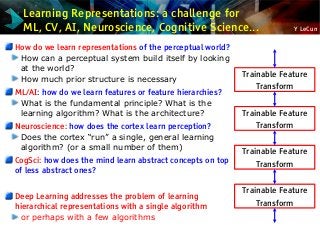
Deep Learning addresses the problem of learning
hierarchical representations with a single algorithm
or perhaps with a few algorithms
Trainable Feature
Transform
Trainable Feature
Transform
Trainable Feature
Transform
Trainable Feature
Transform
Y LeCun
The Mammalian Visual Cortex is Hierarchical
[picture from Simon Thorpe]
[Gallant & Van Essen]
The ventral (recognition) pathway in the visual cortex has multiple stages
Retina - LGN - V1 - V2 - V4 - PIT - AIT ....
Lots of intermediate representations
Y LeCun
Let's be inspired by nature, but not too much
It's nice imitate Nature,
But we also need to understand
How do we know which
details are important?
Which details are merely the
result of evolution, and the
constraints of biochemistry?
For airplanes, we developed
aerodynamics and compressible
fluid dynamics.
We figured that feathers and
wing flapping weren't crucial
QUESTION: What is the
equivalent of aerodynamics for
understanding intelligence?
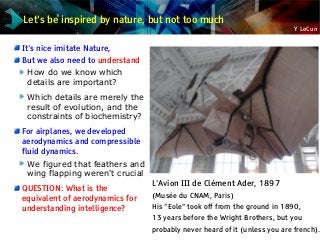
L'Avion III de Clément Ader, 1897
(Musée du CNAM, Paris)
His “Eole” took off from the ground in 1890,
13 years before the Wright Brothers, but you
probably never heard of it (unless you are french).
Y LeCun
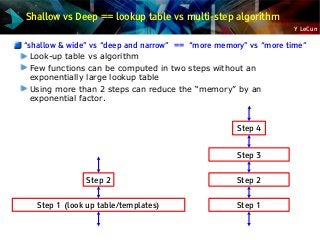
Shallow vs Deep == lookup table vs multi-step algorithm
“shallow & wide” vs “deep and narrow” == “more memory” vs “more time”
Look-up table vs algorithm
Few functions can be computed in two steps without an
exponentially large lookup table
Using more than 2 steps can reduce the “memory” by an
exponential factor.
Step 1
Step 2
Step 3
Step 4
Step 1 (look up table/templates)
Step 2
Y LeCun
What Are
Good Feature?
Y LeCun
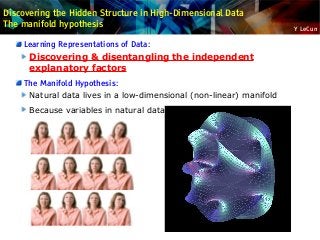
Discovering the Hidden Structure in High-Dimensional Data
The manifold hypothesis
Learning Representations of Data:
Discovering & disentangling the independent
explanatory factors
The Manifold Hypothesis:
Natural data lives in a low-dimensional (non-linear) manifold
Because variables in natural data are mutually dependent
Y LeCun
Discovering the Hidden Structure in High-Dimensional Data
Example: all face images of a person
1000x1000 pixels = 1,000,000 dimensions
But the face has 3 cartesian coordinates and 3 Euler angles
And humans have less than about 50 muscles in the face
Hence the manifold of face images for a person has <56 dimensions
The perfect representations of a face image:
Its coordinates on the face manifold
Its coordinates away from the manifold
We do not have good and general methods to learn functions that turns an
image into this kind of representation
Ideal
Feature
Extractor [
1.2
−3
0.2
−2...
]
Face/not face
Pose
Lighting
Expression
-----
Y LeCun
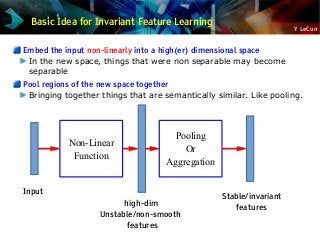
Basic Idea for Invariant Feature Learning
Embed the input non-linearly into a high(er) dimensional space
In the new space, things that were non separable may become
separable
Pool regions of the new space together
Bringing together things that are semantically similar. Like pooling.
Non-Linear
Function
Pooling
Or
Aggregation
Input
high-dim
Unstable/non-smooth
features
Stable/invariant
features
Y LeCun
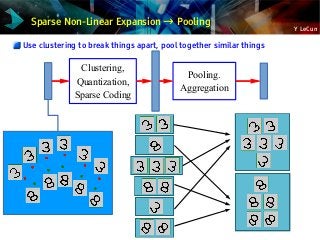
Sparse Non-Linear Expansion → Pooling
Use clustering to break things apart, pool together similar things
Clustering,
Quantization,
Sparse Coding
Pooling.
Aggregation
Y LeCun
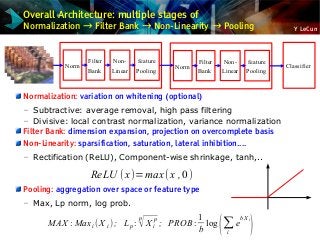
Overall Architecture: multiple stages of
Normalization → Filter Bank → Non-Linearity → Pooling
Normalization: variation on whitening (optional)
– Subtractive: average removal, high pass filtering
– Divisive: local contrast normalization, variance normalization
Filter Bank: dimension expansion, projection on overcomplete basis
Non-Linearity: sparsification, saturation, lateral inhibition....
– Rectification (ReLU), Component-wise shrinkage, tanh,..
Pooling: aggregation over space or feature type
– Max, Lp norm, log prob.
MAX : Maxi( X i) ; Lp :
p
√X i
p
; PROB:
1
b
log
(∑
i
e
bX i
)
Classifier
feature
Pooling
Non-
Linear
Filter
Bank
Norm
feature
Pooling
Non-
Linear
Filter
Bank
Norm
ReLU (x)=max (x ,0)
Y LeCun
Convolutional
Networks
Y LeCun
Convolutional Network
[LeCun et al. NIPS 1989]
Filter Bank +non-linearity
Pooling
Pooling
Filter Bank +non-linearity
Y LeCun
Early Hierarchical Feature Models for Vision
[Hubel & Wiesel 1962]:
simple cells detect local features
complex cells “pool” the outputs of simple
cells within a retinotopic neighborhood.
Cognitron & Neocognitron [Fukushima 1974-1982]
pooling
subsampling
“Simple cells”
“Complex
cells”
Multiple
convolutions
Y LeCun
The Convolutional Net Model
(Multistage Hubel-Wiesel system)
pooling
subsampling
“Simple cells”
“Complex cells”
Multiple
convolutions
Retinotopic Feature Maps
[LeCun et al. 89]
[LeCun et al. 98]
Training is supervised
With stochastic gradient
descent
Y LeCun
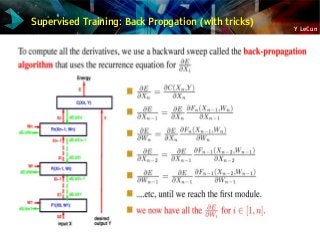
Supervised Training: Back Propgation (with tricks)
Y LeCun
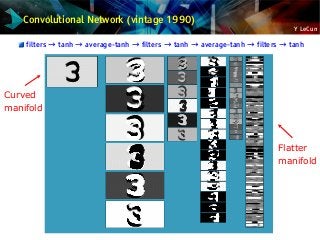
Convolutional Network (vintage 1990)
filters → tanh → average-tanh → filters → tanh → average-tanh → filters → tanh
Curved
manifold
Flatter
manifold
Y LeCun
“Mainstream” object recognition pipeline 2006-2012:
somewhat similar to ConvNets
Fixed Features + unsupervised mid-level features + simple classifier
SIFT + Vector Quantization + Pyramid pooling + SVM
[Lazebnik et al. CVPR 2006]
SIFT + Local Sparse Coding Macrofeatures + Pyramid pooling + SVM
[Boureau et al. ICCV 2011]
SIFT + Fisher Vectors + Deformable Parts Pooling + SVM
[Perronin et al. 2012]
Oriented
Edges
Winner
Takes All
Histogram
(sum)
Filter
Bank
feature
Pooling
Non-
Linearity
Filter
Bank
feature
Pooling
Non-
Linearity
Classifier
Fixed (SIFT/HoG/...)
K-means
Sparse Coding
Spatial Max
Or average
Any simple
classifier
Unsupervised Supervised
Y LeCun
Convolutional Networks
In
Visual Object Recognition
Y LeCun
Object Recognition [Krizhevsky, Sutskever, Hinton 2012]
CONV 11x11/ReLU 96fm
LOCAL CONTRAST NORM
MAX POOL 2x2sub
FULL 4096/ReLU
FULL CONNECT
CONV 11x11/ReLU 256fm
LOCAL CONTRAST NORM
MAX POOLING 2x2sub
CONV 3x3/ReLU 384fm
CONV 3x3ReLU 384fm
CONV 3x3/ReLU 256fm
MAX POOLING
FULL 4096/ReLU
Won the 2012 ImageNet LSVRC. 60 Million parameters, 832M MAC ops
4M
16M
37M
442K
1.3M
884K
307K
35K
4Mflop
16M
37M
74M
224M
149M
223M
105M
Y LeCun
Object Recognition [Krizhevsky, Sutskever, Hinton 2012]
Method: large convolutional net
650K neurons, 832M synapses, 60M parameters
Trained with backprop on GPU
Trained “with all the tricks Yann came up with in
the last 20 years, plus dropout” (Hinton, NIPS
2012)
Rectification, contrast normalization,...
Error rate: 15% (whenever correct class isn't in top 5)
Previous state of the art: 25% error
A REVOLUTION IN COMPUTER VISION
Acquired by Google in Jan 2013
Deployed in Google+ Photo Tagging in May 2013
Y LeCun
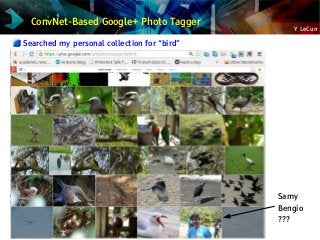
ConvNet-Based Google+ Photo Tagger
Searched my personal collection for “bird”
Samy
Bengio
???
Y LeCun
NYU ConvNet Trained on ImageNet: OverFeat
[Sermanet et al. arXiv:1312.6229]
Trained on GPU using Torch7
Uses a number of new tricks
Classification 1000 categories:
13.8% error (top 5) with an ensemble of
7 networks (Krizhevsky: 15%)
15.4% error (top 5) with a single
network (Krizhevksy: 18.2%)
Classification+Localization
30% error (Krizhevsky: 34%)
Detection (200 categories)
19% correct
Dowloadable code (running, no training)
Search for “overfeat NYU” on Google
http://cilvr.nyu.edu software→
CONV 7x7/ReLU 96fm
MAX POOL 3x3sub
FULL 4096/ReLU
FULL 1000/Softmax
CONV 7x7/ReLU 256fm
MAX POOLING 2x2sub
CONV 3x3/ReLU 384fm
CONV 3x3ReLU 384fm
CONV 3x3/ReLU 256fm
MAX POOLING 3x3sub
FULL 4096/ReLU
Y LeCun
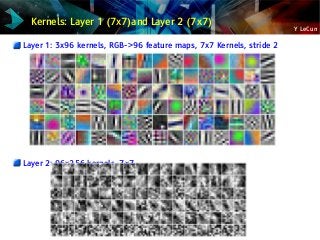
Kernels: Layer 1 (7x7)and Layer 2 (7x7)
Layer 1: 3x96 kernels, RGB->96 feature maps, 7x7 Kernels, stride 2
Layer 2: 96x256 kernels, 7x7
Y LeCun
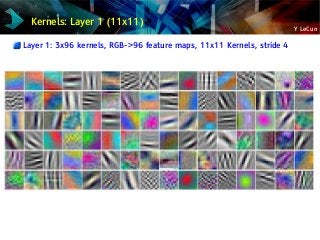
Kernels: Layer 1 (11x11)
Layer 1: 3x96 kernels, RGB->96 feature maps, 11x11 Kernels, stride 4
Y LeCun
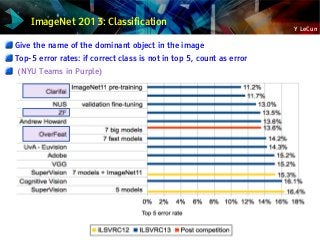
ImageNet 2013: Classification
Give the name of the dominant object in the image
Top-5 error rates: if correct class is not in top 5, count as error
(NYU Teams in Purple)
Y LeCun
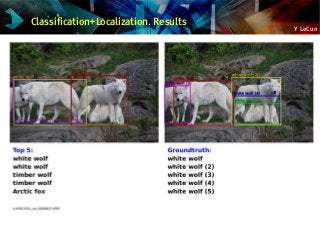
Classification+Localization. Results
Y LeCun
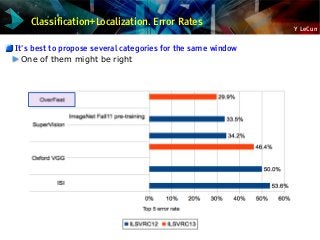
Classification+Localization. Error Rates
It's best to propose several categories for the same window
One of them might be right
Y LeCun
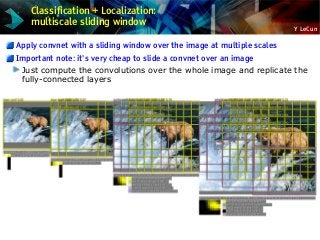
Classification + Localization:
multiscale sliding window
Apply convnet with a sliding window over the image at multiple scales
Important note: it's very cheap to slide a convnet over an image
Just compute the convolutions over the whole image and replicate the
fully-connected layers
Y LeCun
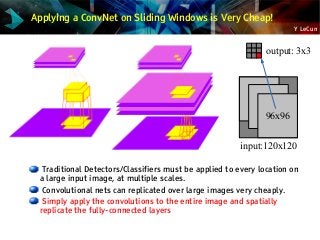
96x96
input:120x120
output: 3x3
Traditional Detectors/Classifiers must be applied to every location on
a large input image, at multiple scales.
Convolutional nets can replicated over large images very cheaply.
Simply apply the convolutions to the entire image and spatially
replicate the fully-connected layers
Applying a ConvNet on Sliding Windows is Very Cheap!
Y LeCun
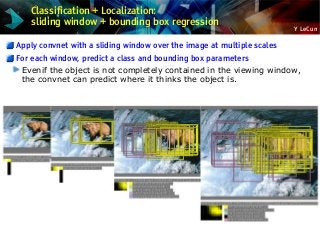
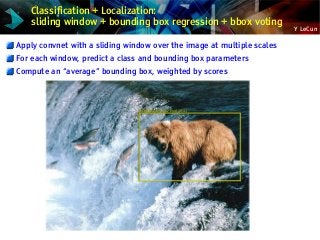
Classification + Localization:
sliding window + bounding box regression
Apply convnet with a sliding window over the image at multiple scales
For each window, predict a class and bounding box parameters
Evenif the object is not completely contained in the viewing window,
the convnet can predict where it thinks the object is.
Y LeCun
Classification + Localization:
sliding window + bounding box regression + bbox voting
Apply convnet with a sliding window over the image at multiple scales
For each window, predict a class and bounding box parameters
Compute an “average” bounding box, weighted by scores
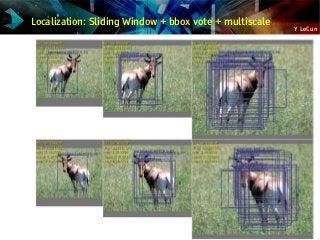
Y LeCun
Localization: Sliding Window + bbox vote + multiscale
Y LeCun
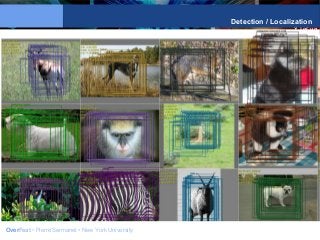
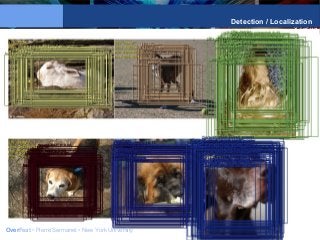
Detection / Localization
OverFeat • Pierre Sermanet • New York University
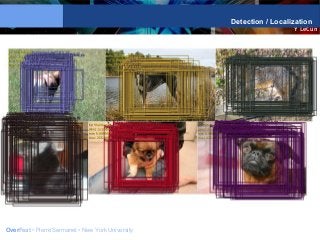
Y LeCun
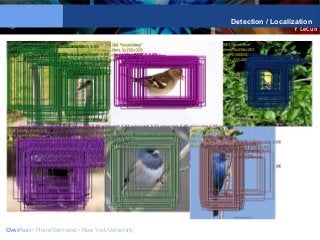
Detection / Localization
OverFeat • Pierre Sermanet • New York University
Y LeCun
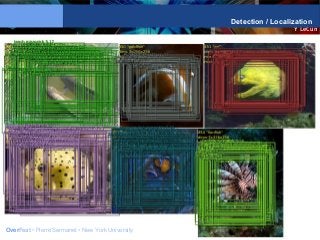
Detection / Localization
OverFeat • Pierre Sermanet • New York University
Y LeCun
Detection / Localization
OverFeat • Pierre Sermanet • New York University
Y LeCun
Detection / Localization
OverFeat • Pierre Sermanet • New York University
Y LeCun
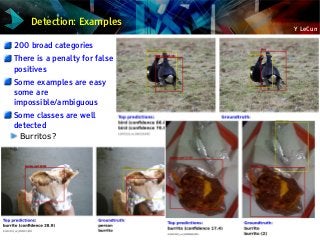
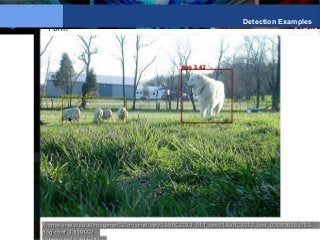
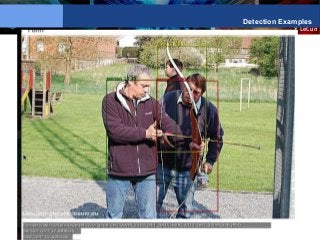
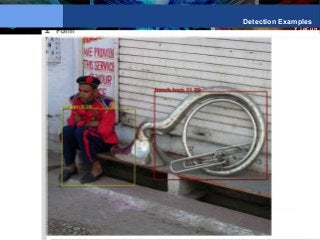
Detection: Examples
200 broad categories
There is a penalty for false
positives
Some examples are easy
some are
impossible/ambiguous
Some classes are well
detected
Burritos?
Y LeCun
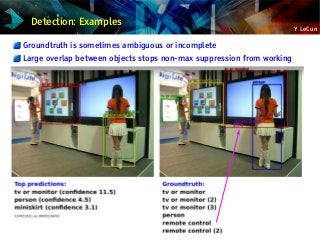
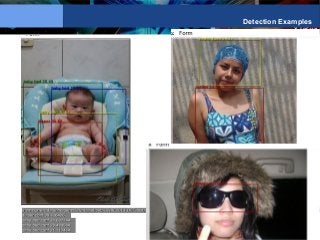
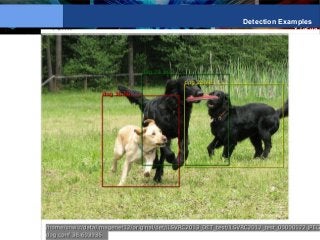
Detection: Examples
Groundtruth is sometimes ambiguous or incomplete
Large overlap between objects stops non-max suppression from working
Y LeCun
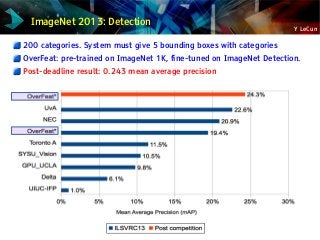
ImageNet 2013: Detection
200 categories. System must give 5 bounding boxes with categories
OverFeat: pre-trained on ImageNet 1K, fine-tuned on ImageNet Detection.
Post-deadline result: 0.243 mean average precision
(best known result until May 2014)
Y LeCun
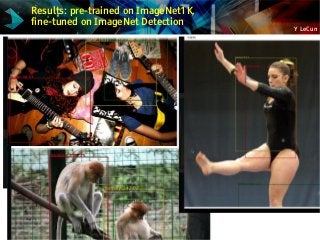
Results: pre-trained on ImageNet1K,
fine-tuned on ImageNet Detection
Y LeCun
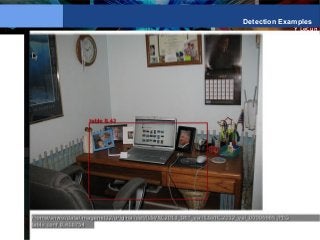
Detection Examples
Y LeCun
Detection Examples
Y LeCun
Detection Examples
Y LeCun
Detection Examples
Y LeCun
Detection Examples
Y LeCun
Detection Examples
Y LeCun
Detection Examples
Y LeCun
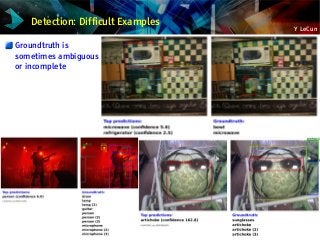
Detection: Difficult Examples
Groundtruth is
sometimes ambiguous
or incomplete
Y LeCun
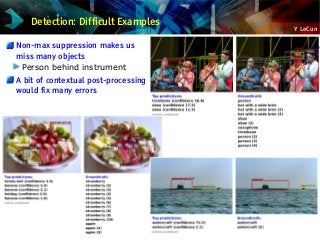
Detection: Difficult Examples
Non-max suppression makes us
miss many objects
Person behind instrument
A bit of contextual post-processing
would fix many errors
Y LeCun
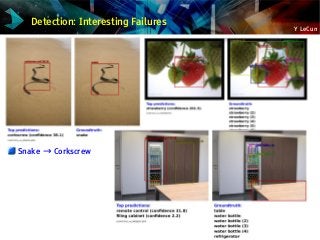
Detection: Interesting Failures
Snake → Corkscrew
Y LeCun
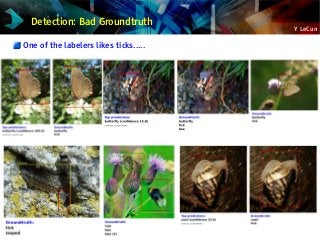
Detection: Bad Groundtruth
One of the labelers likes ticks.....
Y LeCun
State of the art with
only 6 training examples
Features are generic: Caltech 256
Network first
trained on
ImageNet.
Last layer
chopped off
Last layer
trained on
Caltech 256,
first layers N-1
kept fixed.
State of the art
accuracy with
only 6 training
samples/class
3: [Bo, Ren, Fox. CVPR, 2013] 16: [Sohn, Jung, Lee, Hero ICCV 2011]
Y LeCun
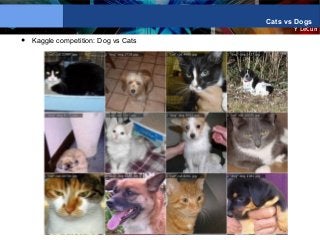
Cats vs Dogs
● Kaggle competition: Dog vs Cats
Y LeCun
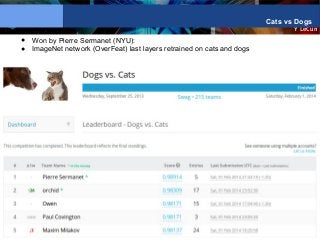
Cats vs Dogs
● Won by Pierre Sermanet (NYU):
● ImageNet network (OverFeat) last layers retrained on cats and dogs
Y LeCun
Real-Time Demo
Real-Time demo
2.6 fps on quadcore Intel
7.6fps on Nvidia Geforce GTX 680m (mobile GPU)
Network trained in ImageNet 1K
Y LeCun
Other Applications
Of
Convolutional Nets
Y LeCun
ConvNet in Connectomics [Jain, Turaga, Seung 2007-present]
3D ConvNet
Volumetric
Images
Each voxel
labeled as
“membrane” or
“non-membrane
using a 7x7x7
voxel
neighborhood
Y LeCun
Face Recognition:DeepFace (Facebook AI Research)
[Taigman et al. CVPR 2014]
Alignment
Convnet
Y LeCun
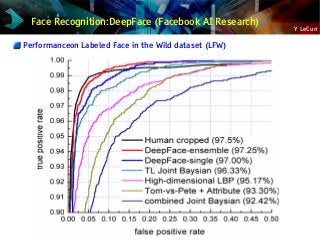
Face Recognition:DeepFace (Facebook AI Research)
Performanceon Labeled Face in the Wild dataset (LFW)
Y LeCun
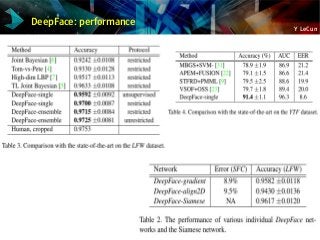
DeepFace: performance
Y LeCun
Pose Estimation and Attribute Recovery with ConvNets
Body pose estimation [Tompson et al. ICLR, 2014]
Real-time hand pose recovery
[Tompson et al. Trans. on Graphics 14]
Pose-Aligned Network for Deep Attribute Modeling
[Zhang et al. CVPR 2014]
Y LeCun
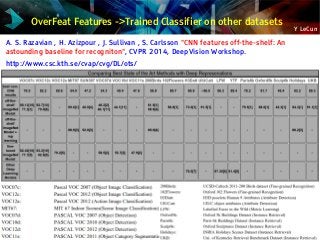
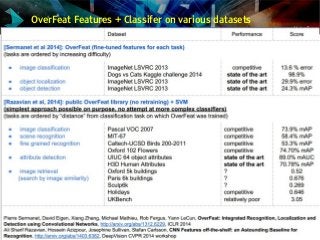
OverFeat Features ->Trained Classifier on other datasets
A. S. Razavian , H. Azizpour , J. Sullivan , S. Carlsson "CNN features off-the-shelf: An
astounding baseline for recogniton", CVPR 2014, DeepVision Workshop.
http://www.csc.kth.se/cvap/cvg/DL/ots/
Y LeCun
OverFeat Features + Classifer on various datasets
Y LeCun
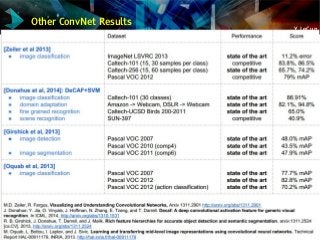
Other ConvNet Results
Y LeCun
Other ConvNet Results
Results compiled by Pierre Sermanet
http://cs.nyu.edu/~sermanet/papers/Deep_ConvNets_for_Vision-Results.pdf
Y LeCun
Other Tasks for Which Deep Convolutional Nets are the Best
Handwriting recognition MNIST (many), Arabic HWX (IDSIA)
OCR in the Wild [2011]: StreetView House Numbers (NYU and others)
Traffic sign recognition [2011] GTSRB competition (IDSIA, NYU)
Asian handwriting recognition [2013] ICDAR competition (IDSIA)
Pedestrian Detection [2013]: INRIA datasets and others (NYU)
Volumetric brain image segmentation [2009] connectomics (IDSIA, MIT)
Human Action Recognition [2011] Hollywood II dataset (Stanford)
Object Recognition [2012] ImageNet competition (Toronto)
Scene Parsing [2012] Stanford bgd, SiftFlow, Barcelona datasets (NYU)
Scene parsing from depth images [2013] NYU RGB-D dataset (NYU)
Speech Recognition [2012] Acoustic modeling (IBM and Google)
Breast cancer cell mitosis detection [2011] MITOS (IDSIA)
The list of perceptual tasks for which ConvNets hold the record is growing.
Most of these tasks (but not all) use purely supervised convnets.
Y LeCun
Deep Learning and
Convolutional Networks in
Speech, Audio, and Signals
Y LeCun
Feature
Extraction
Neural
Network
Decoder
Transducer
&
Language
Model
Hi,howareyou?
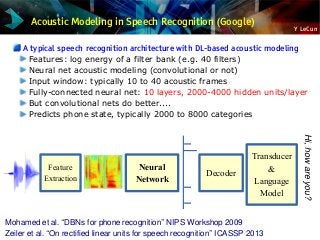
Acoustic Modeling in Speech Recognition (Google)
A typical speech recognition architecture with DL-based acoustic modeling
Features: log energy of a filter bank (e.g. 40 filters)
Neural net acoustic modeling (convolutional or not)
Input window: typically 10 to 40 acoustic frames
Fully-connected neural net: 10 layers, 2000-4000 hidden units/layer
But convolutional nets do better....
Predicts phone state, typically 2000 to 8000 categories
Mohamed et al. “DBNs for phone recognition” NIPS Workshop 2009
Zeiler et al. “On rectified linear units for speech recognition” ICASSP 2013
Y LeCun
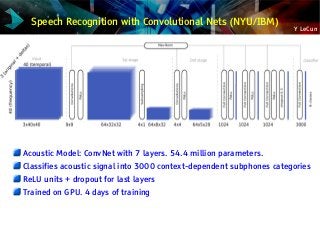
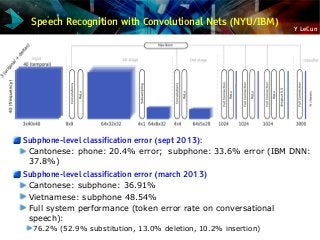
Speech Recognition with Convolutional Nets (NYU/IBM)
Acoustic Model: ConvNet with 7 layers. 54.4 million parameters.
Classifies acoustic signal into 3000 context-dependent subphones categories
ReLU units + dropout for last layers
Trained on GPU. 4 days of training
Y LeCun
Speech Recognition with Convolutional Nets (NYU/IBM)
Subphone-level classification error (sept 2013):
Cantonese: phone: 20.4% error; subphone: 33.6% error (IBM DNN:
37.8%)
Subphone-level classification error (march 2013)
Cantonese: subphone: 36.91%
Vietnamese: subphone 48.54%
Full system performance (token error rate on conversational
speech):
76.2% (52.9% substitution, 13.0% deletion, 10.2% insertion)
Y LeCun
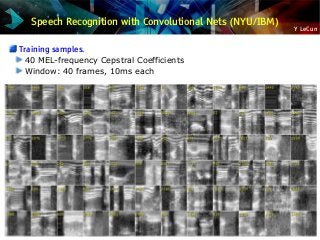
Speech Recognition with Convolutional Nets (NYU/IBM)
Training samples.
40 MEL-frequency Cepstral Coefficients
Window: 40 frames, 10ms each
Y LeCun
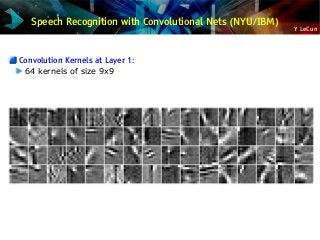
Speech Recognition with Convolutional Nets (NYU/IBM)
Convolution Kernels at Layer 1:
64 kernels of size 9x9
Y LeCun
Convolutional Networks
In
Semantic Segmentation,
Scene Labeling
Y LeCun
Semantic Labeling:
Labeling every pixel with the object it belongs to
[Farabet et al. ICML 2012, PAMI 2013]
Would help identify obstacles, targets, landing sites, dangerous areas
Would help line up depth map with edge maps
Y LeCun
Scene Parsing/Labeling: ConvNet Architecture
Each output sees a large input context:
46x46 window at full rez; 92x92 at ½ rez; 184x184 at ¼ rez
[7x7conv]->[2x2pool]->[7x7conv]->[2x2pool]->[7x7conv]->
Trained supervised on fully-labeled images
Laplacian
Pyramid
Level 1
Features
Level 2
Features
Upsampled
Level 2 Features
Categories
Y LeCun
Method 1: majority over super-pixel regions
[Farabet et al. IEEE T. PAMI 2013]
Multi-scaleConvNetSuper-pixelboundaryhypetheses
Convolutionalclassifier
Majority
Vote
Over
Superpixels
Input image
Superpixel boundaries
Features from
Convolutional net
(d=768 per pixel)
“soft” categories scores
Categories aligned
With region
boundaries
Y LeCun
Scene Parsing/Labeling: Performance
Stanford Background Dataset [Gould 1009]: 8 categories
[Farabet et al. IEEE T. PAMI 2013]
Y LeCun
Scene Parsing/Labeling: Performance
[Farabet et al. IEEE T. PAMI 2012]
SIFT Flow Dataset
[Liu 2009]:
33 categories
Barcelona dataset
[Tighe 2010]:
170 categories.
Y LeCun
Scene Parsing/Labeling: SIFT Flow dataset (33 categories)
Samples from the SIFT-Flow dataset (Liu)
[Farabet et al. ICML 2012, PAMI 2013]
Y LeCun
Scene Parsing/Labeling: SIFT Flow dataset (33 categories)
[Farabet et al. ICML 2012, PAMI 2013]
Y LeCun
Scene Parsing/Labeling
[Farabet et al. ICML 2012, PAMI 2013]
Y LeCun
Scene Parsing/Labeling
[Farabet et al. ICML 2012, PAMI 2013]
Y LeCun
Scene Parsing/Labeling
[Farabet et al. ICML 2012, PAMI 2013]
Y LeCun
Scene Parsing/Labeling
[Farabet et al. ICML 2012, PAMI 2013]
Y LeCun
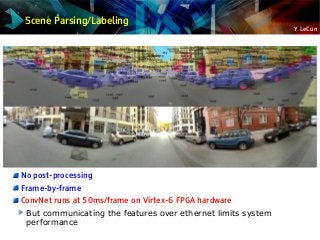
Scene Parsing/Labeling
No post-processing
Frame-by-frame
ConvNet runs at 50ms/frame on Virtex-6 FPGA hardware
But communicating the features over ethernet limits system
performance
Y LeCun
Temporal Consistency
Spatio-Temporal Super-Pixel segmentation
[Couprie et al ICIP 2013]
[Couprie et al JMLR under review]
Majority vote over super-pixels
Y LeCun
Scene Parsing/Labeling: Temporal Consistency
Causal method for temporal consistency
[Couprie, Farabet, Najman, LeCun ICLR 2013, ICIP 2013]
Y LeCun
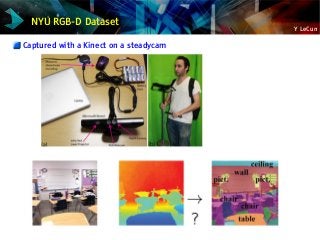
NYU RGB-D Dataset
Captured with a Kinect on a steadycam
Y LeCun
Results
Depth helps a bit
Helps a lot for floor and props
Helps surprisingly little for structures, and hurts for furniture
[C. Cadena, J. Kosecka “Semantic Parsing for Priming Object Detection in RGB-D Scenes”
Semantic Perception Mapping and Exploration (SPME), Karlsruhe 2013]
Y LeCun
Scene Parsing/Labeling on RGB+Depth Images
With temporal consistency
[Couprie, Farabet, Najman, LeCun ICLR 2013, ICIP 2013]
Y LeCun
Scene Parsing/Labeling on RGB+Depth Images
With temporal consistency
[Couprie, Farabet, Najman, LeCun ICLR 2013, ICIP 2013]
Y LeCun
Labeling Videos
Temporal consistency
[Couprie, Farabet, Najman, LeCun ICLR 2013]
[Couprie, Farabet, Najman, LeCun ICIP 2013]
[Couprie, Farabet, Najman, LeCun submitted to JMLR]
Y LeCun
Semantic Segmentation on RGB+D Images and Videos
[Couprie, Farabet, Najman, LeCun ICLR 2013, ICIP 2013]
Y LeCun
Commercial Applications of Convolutional Nets
Form Reading: AT&T 1994
Check reading: AT&T 1996 (read 10-20% of all US checks in 2000)
Handwriting recognition: Microsoft early 2000
Face and person detection: NEC 2005
Gender and age recognition: NEC 2010 (vending machines)
OCR in natural images: Google 2013 (StreetView house numbers)
Photo tagging: Google 2013
Image Search by Similarity: Baidu 2013
Many applications at Facebook, Google, Baidu, Microsoft, IBM, NEC,.....
Speech recognition, face recognition, image search, porn filtering,....
Y LeCun
Self-Learning
ConvNet for Scene Labeling
Vision-Based Navigation
for Off-Road Robots
Y LeCun
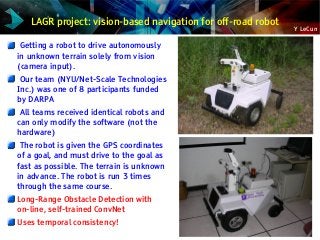
LAGR project: vision-based navigation for off-road robot
Getting a robot to drive autonomously
in unknown terrain solely from vision
(camera input).
Our team (NYU/Net-Scale Technologies
Inc.) was one of 8 participants funded
by DARPA
All teams received identical robots and
can only modify the software (not the
hardware)
The robot is given the GPS coordinates
of a goal, and must drive to the goal as
fast as possible. The terrain is unknown
in advance. The robot is run 3 times
through the same course.
Long-Range Obstacle Detection with
on-line, self-trained ConvNet
Uses temporal consistency!
Y LeCun
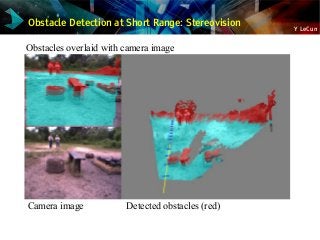
Obstacle Detection at Short Range: Stereovision
Camera image Detected obstacles (red)
Obstacles overlaid with camera image
Y LeCun
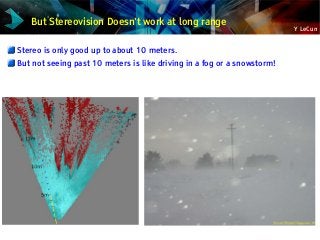
But Stereovision Doesn't work at long range
Stereo is only good up to about 10 meters.
But not seeing past 10 meters is like driving in a fog or a snowstorm!
Y LeCun
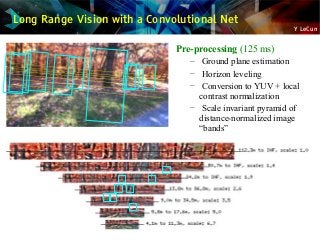
Long Range Vision with a Convolutional Net
Pre-processing (125 ms)
– Ground plane estimation
– Horizon leveling
– Conversion to YUV + local
contrast normalization
– Scale invariant pyramid of
distance-normalized image
“bands”
Y LeCun
Input imageInput image Stereo LabelsStereo Labels
Classifier OutputClassifier Output
Scene Labeling with ConvNet + online learning
Image Labeling for Off-Road Robots [Hadsell JFR 2008]
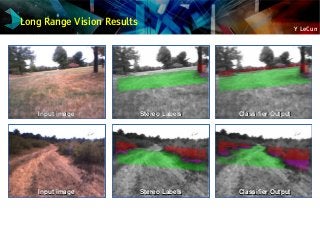
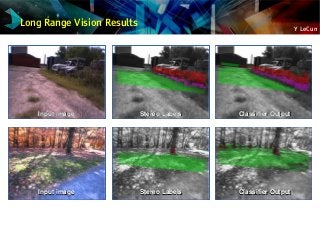
ConvNet labels pixels as one of 3 categories
Traversible/flat (green), non traversible (red), foot of obstacle
(purple)
Labels obtained from stereo vision and SLAM
Input imageInput image Stereo LabelsStereo Labels Classifier OutputClassifier Output
Y LeCun
Long Range Vision Results
Input imageInput image Stereo LabelsStereo Labels Classifier OutputClassifier Output
Y LeCun
Long Range Vision Results
Input imageInput image Stereo LabelsStereo Labels Classifier OutputClassifier Output
Y LeCun
Software Tools
and
Hardware Acceleration
for
Convolutional Networks
Y LeCun
Module-Based Deep Learning with Torch7
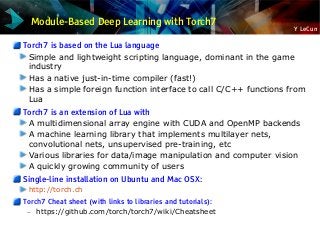
Torch7 is based on the Lua language
Simple and lightweight scripting language, dominant in the game
industry
Has a native just-in-time compiler (fast!)
Has a simple foreign function interface to call C/C++ functions from
Lua
Torch7 is an extension of Lua with
A multidimensional array engine with CUDA and OpenMP backends
A machine learning library that implements multilayer nets,
convolutional nets, unsupervised pre-training, etc
Various libraries for data/image manipulation and computer vision
A quickly growing community of users
Single-line installation on Ubuntu and Mac OSX:
http://torch.ch
Torch7 Cheat sheet (with links to libraries and tutorials):
– https://github.com/torch/torch7/wiki/Cheatsheet
Y LeCun
Example: building a Neural Net in Torch7
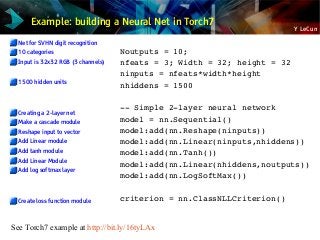
Net for SVHN digit recognition
10 categories
Input is 32x32 RGB (3 channels)
1500 hidden units
Creating a 2-layer net
Make a cascade module
Reshape input to vector
Add Linear module
Add tanh module
Add Linear Module
Add log softmax layer
Create loss function module
Noutputs = 10; 
nfeats = 3; Width = 32; height = 32
ninputs = nfeats*width*height
nhiddens = 1500
­­ Simple 2­layer neural network
model = nn.Sequential()
model:add(nn.Reshape(ninputs))
model:add(nn.Linear(ninputs,nhiddens))
model:add(nn.Tanh())
model:add(nn.Linear(nhiddens,noutputs))
model:add(nn.LogSoftMax())
criterion = nn.ClassNLLCriterion()
See Torch7 example at http://bit.ly/16tyLAx
Y LeCun
Specialized Hardware can Accelerate Convolutions
Large-scale convolutional networks are trained on GPUs
Generally implemented on NVIDIA GPUs using CUDA
But exploiting all the power of GPUs for ConvNets is extremely difficult
Limited by memory bandwidth and memory architecture
Multi-core architectures may become competitive
e.g. Intel Xeon Phi
Major hardware manufacturers are exploring how to support convolutional nets
more efficiently with their hardware.
Direct support for convnet operations in mobile CPU/GPU, as well as in
high-end CPU/GPU may soon become available.
But dedicated ConvNet hardware is also on the way
Mostly for embedded applications (smart cameras, robots...)
Y LeCun
NeuFlow architecture (NYU + Purdue)
Collaboration NYU-Purdue: Eugenio Culurciello's e-Lab.
Running on Picocomputing 8x10cm high-performance FPGA board
Virtex 6 LX240T: 680 MAC units, 20 neuflow tiles
Full scene labeling at 20 frames/sec (50ms/frame) at 320x240
board with Virtex-6
Y LeCun
NewFlow: Architecture
grid of passive processing tiles (PTs)
CPU
DMA
MEM
global network­on­chip to 
allow fast reconfiguration
RISC CPU, to 
reconfigure tiles and 
data paths, at runtime
Multi­port memory 
controller (DMA)
[x20 on a Virtex6 LX240T]
[x12 on a V6 LX240T]
Y LeCun
NewFlow: Processing Tile Architecture
Term­by:­term 
streaming  operators 
(MUL,DIV,ADD,SU
B,MAX)
configurable bank of 
FIFOs , for stream 
buffering, up to 10kB 
per PT
full 1/2D  parallel convolver 
with 100 MAC units
configurable piece­wise 
linear  or quadratic 
mapper
configurable router, 
to stream data in 
and out of the tile, to 
neighbors or DMA 
ports
[x8,2 per tile]
[x4] [x8]
[x4]
[Virtex6 LX240T]
[x20]
Y LeCun
NewFlow ASIC: 2.5x5 mm, 45nm, 0.6Watts, >300GOPS
Collaboration Purdue-NYU: Eugenio Culurciello's e-Lab
Suitable for vision-enabled embedded and mobile devices
(but the fabrication was botched...)
[Pham, Jelaca, Farabet, Martini, LeCun, Culurciello 2012]
Y LeCun
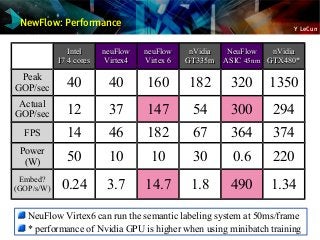
NewFlow: Performance
IntelIntel
I7 4 coresI7 4 cores
neuFlowneuFlow
Virtex4Virtex4
neuFlowneuFlow
Virtex 6Virtex 6
nVidianVidia
GT335mGT335m
NeuFlowNeuFlow
ASICASIC 45nm45nm
nVidianVidia
GTX480*GTX480*
Peak
GOP/sec 40 40 160 182 320 1350
Actual
GOP/sec 12 37 147 54 300 294
FPS 14 46 182 67 364 374
Power
(W) 50 10 10 30 0.6 220
Embed?
(GOP/s/W) 0.24 3.7 14.7 1.8 490 1.34
NeuFlow Virtex6 can run the semantic labeling system at 50ms/frame
* performance of Nvidia GPU is higher when using minibatch training
Y LeCun
Unsupervised Learning
Y LeCun
Sparse auto-encoder: Predictive Sparse Decomposition (PSD)
Prediction the optimal code with a trained encoder
Energy = reconstruction_error + code_prediction_error + code_sparsity
EYi
,Z =∥Yi
−W d Z∥2
∥Z−ge W e ,Yi
∥2
∑j
∣z j∣
ge (W e ,Y
i
)=shrinkage(W e Y
i
)
[Kavukcuoglu, Ranzato, LeCun, 2008 → arXiv:1010.3467],
INPUT Y Z
∥Y
i
− Y∥
2
∣z j∣
W d Z
FEATURES
∑j
.
∥Z− Z∥
2
ge W e ,Y
i

Y LeCun
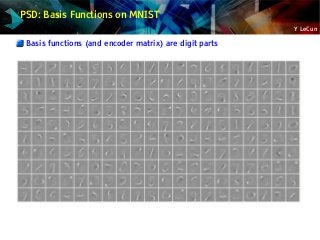
PSD: Basis Functions on MNIST
Basis functions (and encoder matrix) are digit parts
Y LeCun
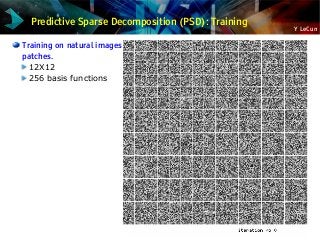
Training on natural images
patches.
12X12
256 basis functions
Predictive Sparse Decomposition (PSD): Training
Y LeCun
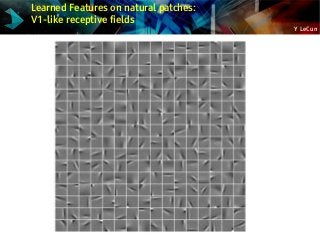
Learned Features on natural patches:
V1-like receptive fields
Y LeCun
Replace the dot products with dictionary element by convolutions.
Input Y is a full image
Each code component Zk is a feature map (an image)
Each dictionary element is a convolution kernel
Regular sparse coding
Convolutional S.C.
∑
k
. * Zk
Wk
Y =
“deconvolutional networks” [Zeiler, Taylor, Fergus CVPR 2010]
Convolutional Sparse Coding
Y LeCun
Convolutional Formulation
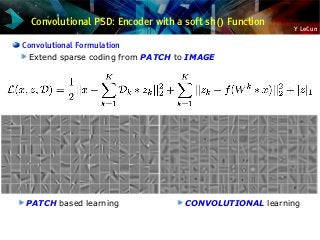
Extend sparse coding from PATCH to IMAGE
PATCH based learning CONVOLUTIONAL learning
Convolutional PSD: Encoder with a soft sh() Function
Y LeCun
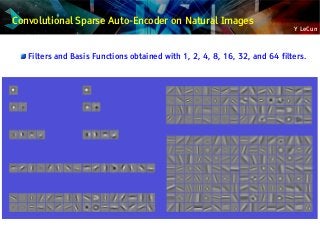
Convolutional Sparse Auto-Encoder on Natural Images
Filters and Basis Functions obtained with 1, 2, 4, 8, 16, 32, and 64 filters.
Y LeCun
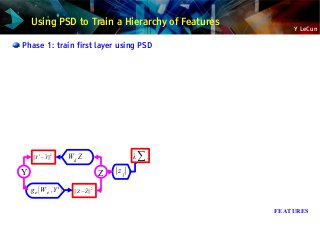
Phase 1: train first layer using PSD
FEATURES
Y Z
∥Y i
− ̃Y∥2
∣z j∣
Wd Z λ∑.
∥Z− ̃Z∥
2
ge(W e ,Y i
)
Using PSD to Train a Hierarchy of Features
Y LeCun
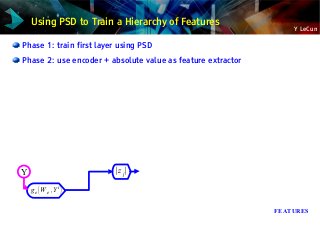
Phase 1: train first layer using PSD
Phase 2: use encoder + absolute value as feature extractor
FEATURES
Y ∣z j∣
ge(W e ,Y i
)
Using PSD to Train a Hierarchy of Features
Y LeCun
Phase 1: train first layer using PSD
Phase 2: use encoder + absolute value as feature extractor
Phase 3: train the second layer using PSD
FEATURES
Y ∣z j∣
ge(W e ,Y i
)
Y Z
∥Y i
− ̃Y∥2
∣z j∣
Wd Z λ∑.
∥Z− ̃Z∥
2
ge(W e ,Y i
)
Using PSD to Train a Hierarchy of Features
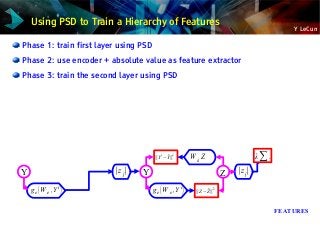
Y LeCun
Phase 1: train first layer using PSD
Phase 2: use encoder + absolute value as feature extractor
Phase 3: train the second layer using PSD
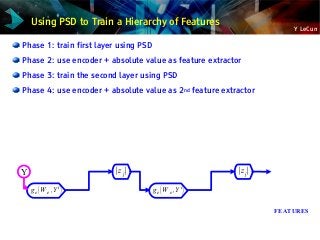
Phase 4: use encoder + absolute value as 2nd feature extractor
FEATURES
Y ∣z j∣
ge(W e ,Y i
)
∣z j∣
ge(W e ,Y i
)
Using PSD to Train a Hierarchy of Features
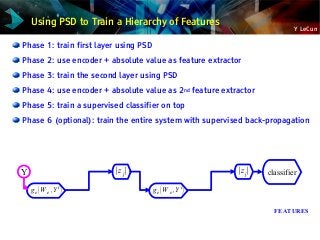
Y LeCun
Phase 1: train first layer using PSD
Phase 2: use encoder + absolute value as feature extractor
Phase 3: train the second layer using PSD
Phase 4: use encoder + absolute value as 2nd feature extractor
Phase 5: train a supervised classifier on top
Phase 6 (optional): train the entire system with supervised back-propagation
FEATURES
Y ∣z j∣
ge(W e ,Y i
)
∣z j∣
ge(W e ,Y i
)
classifier
Using PSD to Train a Hierarchy of Features
Y LeCun
Unsupervised + Supervised
For
Pedestrian Detection
Y LeCun
[Osadchy,Miller LeCun JMLR 2007],[Kavukcuoglu et al. NIPS 2010] [Sermanet et al. CVPR 2013]
Pedestrian Detection, Face Detection
Y LeCun
Feature maps from all stages are pooled/subsampled and sent to the final
classification layers
Pooled low-level features: good for textures and local motifs
High-level features: good for “gestalt” and global shape
[Sermanet, Chintala, LeCun CVPR 2013]
7x7 filter+tanh
38 feat maps
Input
78x126xYUV
L2 Pooling
3x3
2040 9x9
filters+tanh
68 feat maps
Av Pooling
2x2 filter+tanh
ConvNet Architecture with Multi-Stage Features
Y LeCun
[Kavukcuoglu et al. NIPS 2010] [Sermanet et al. ArXiv 2012]
ConvNet
Color+Skip
Supervised
ConvNet
Color+Skip
Unsup+Sup
ConvNet
B&W
Unsup+Sup
ConvNet
B&W
Supervised
Pedestrian Detection: INRIA Dataset. Miss rate vs false
positives
Y LeCun
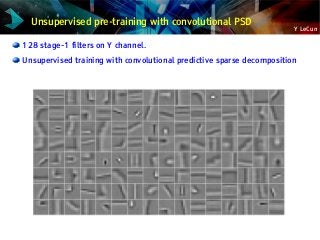
128 stage-1 filters on Y channel.
Unsupervised training with convolutional predictive sparse decomposition
Unsupervised pre-training with convolutional PSD
Y LeCun
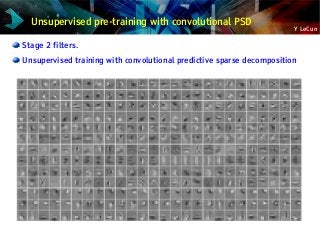
Stage 2 filters.
Unsupervised training with convolutional predictive sparse decomposition
Unsupervised pre-training with convolutional PSD
Y LeCun
VIDEOS
Y LeCun
VIDEOS
Y LeCun
[Kavukcuoglu et al. NIPS 2010] [Sermanet et al. ArXiv 2012]
ConvNet
Color+Skip
Supervised
ConvNet
Color+Skip
Unsup+Sup
ConvNet
B&W
Unsup+Sup
ConvNet
B&W
Supervised
Pedestrian Detection: INRIA Dataset. Miss rate vs false
positives
Y LeCun
Unsupervised Learning:
Invariant Features
Y LeCun
Learning Invariant Features with L2 Group Sparsity
Unsupervised PSD ignores the spatial pooling step.
Could we devise a similar method that learns the pooling layer as well?
Idea [Hyvarinen & Hoyer 2001]: group sparsity on pools of features
Minimum number of pools must be non-zero
Number of features that are on within a pool doesn't matter
Pools tend to regroup similar features
INPUT Y Z
∥Y
i
− ̃Y∥
2
W d Z
FEATURES
λ∑.
∥Z− ̃Z∥
2
ge(W e ,Y i
)
√(∑ Z k
2
)
L2 norm within
each pool
E (Y,Z )=∥Y −W d Z∥2
+∥Z−ge (W e ,Y )∥2
+∑
j √∑
k∈P j
Zk
2
Y LeCun
Learning Invariant Features with L2 Group Sparsity
Idea: features are pooled in group.
Sparsity: sum over groups of L2 norm of activity in group.
[Hyvärinen Hoyer 2001]: “subspace ICA”
decoder only, square
[Welling, Hinton, Osindero NIPS 2002]: pooled product of experts
encoder only, overcomplete, log student-T penalty on L2 pooling
[Kavukcuoglu, Ranzato, Fergus LeCun, CVPR 2010]: Invariant PSD
encoder-decoder (like PSD), overcomplete, L2 pooling
[Le et al. NIPS 2011]: Reconstruction ICA
Same as [Kavukcuoglu 2010] with linear encoder and tied decoder
[Gregor & LeCun arXiv:1006:0448, 2010] [Le et al. ICML 2012]
Locally-connect non shared (tiled) encoder-decoder
INPUT
Y
Encoder only (PoE, ICA),
Decoder Only or
Encoder-Decoder (iPSD, RICA)
Z INVARIANT
FEATURES
λ∑.
√(∑ Z k
2
)
L2 norm within
each pool
SIMPLE
FEATURES
Y LeCun
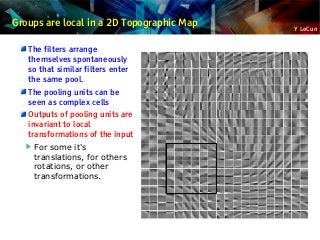
Groups are local in a 2D Topographic Map
The filters arrange
themselves spontaneously
so that similar filters enter
the same pool.
The pooling units can be
seen as complex cells
Outputs of pooling units are
invariant to local
transformations of the input
For some it's
translations, for others
rotations, or other
transformations.
Y LeCun
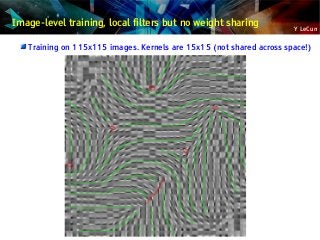
Image-level training, local filters but no weight sharing
Training on 115x115 images. Kernels are 15x15 (not shared across space!)
Y LeCun
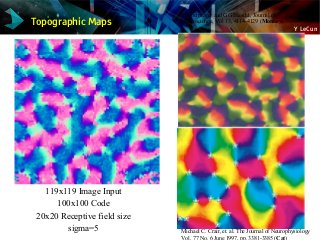
119x119 Image Input
100x100 Code
20x20 Receptive field size
sigma=5 Michael C. Crair, et. al. The Journal of Neurophysiology
Vol. 77 No. 6 June 1997, pp. 3381-3385 (Cat)
K Obermayer and GG Blasdel, Journal of
Neuroscience, Vol 13, 4114-4129 (Monkey)Topographic Maps
Y LeCun
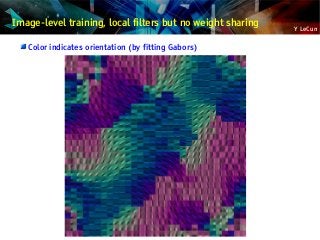
Image-level training, local filters but no weight sharing
Color indicates orientation (by fitting Gabors)
Y LeCun
Invariant Features Lateral Inhibition
Replace the L1 sparsity term by a lateral inhibition matrix
Easy way to impose some structure on the sparsity
[Gregor, Szlam, LeCun NIPS 2011]
Y LeCun
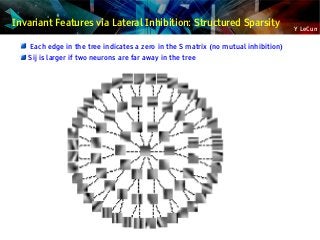
Invariant Features via Lateral Inhibition: Structured Sparsity
Each edge in the tree indicates a zero in the S matrix (no mutual inhibition)
Sij is larger if two neurons are far away in the tree
Y LeCun
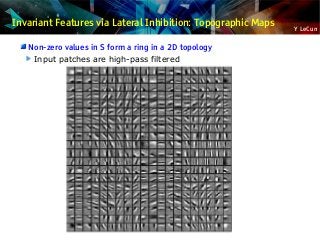
Invariant Features via Lateral Inhibition: Topographic Maps
Non-zero values in S form a ring in a 2D topology
Input patches are high-pass filtered
Y LeCun
Invariant Features through Temporal Constancy
Object is cross-product of object type and instantiation parameters
Mapping units [Hinton 1981], capsules [Hinton 2011]
small medium large
Object type Object size[Karol Gregor et al.]
Y LeCun
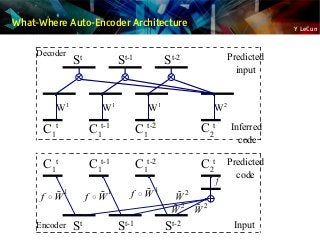
What-Where Auto-Encoder Architecture
St
St-1
St-2
C1
t
C1
t-1
C1
t-2
C2
t
Decoder
W1
W1
W1
W2
Predicted
input
C1
t
C1
t-1
C1
t-2
C2
t
St
St-1
St-2
Inferred
code
Predicted
code
InputEncoder
f ∘ ̃W
1
f ∘ ̃W
1 f ∘ ̃W
1
̃W
2
f
̃W
2
̃W
2
Y LeCun
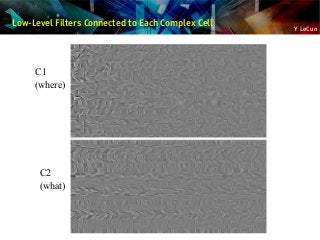
Low-Level Filters Connected to Each Complex Cell
C1
(where)
C2
(what)
Y LeCun
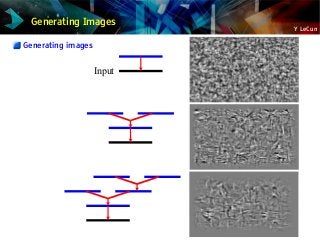
Input
Generating Images
Generating images
Y LeCun
Deep Learning
And
Structured Prediction
Y LeCun
Integrating Deep Learning and Structured Prediction
Structured prediction: when the output is
structured: string, graph.....
Integrating deep learning and structured
prediction is an old idea
In fact, it predates structured prediction
[LeCun, Bottou, Bengio, Haffner 1998]
Globally-trained convolutional-net +
graphical models for handwriting recognition
trained discriminatively at the word
level
Loss identical to CRF and structured
perceptron
Compositional movable parts model
A system like this was reading 10 to 20% of
all the checks in the US around 1998
Y LeCun
Deep Recurrent Neural Language Model
[Mirowski-LeCun MLKDD 2009][Mirowski et al.
Y LeCun
Future
Challenges
Y LeCun
Future Challenges
Integrated feed-forward and feedback
Deep Boltzmann machine do this, but there are issues of scalability.
Integrating supervised and unsupervised learning in a single algorithm
Again, deep Boltzmann machines do this, but....
Integrating deep learning and structured prediction (“reasoning”)
This has been around since the 1990's but needs to be revived
Learning representations for complex reasoning
“recursive” networks that operate on vector space representations
of knowledge [Pollack 90's] [Bottou 2010] [Socher, Manning, Ng
2011]
Representation learning in natural language processing
[Y. Bengio 01],[Collobert Weston 10], [Mnih Hinton 11] [Socher 12]
Better theoretical understanding of deep learning and convolutional nets
e.g. Stephane Mallat's “scattering transform”, work on the sparse
representations from the applied math community....
Y LeCun
Towards Practical AI: Challenges
Applying deep learning to NLP (requires “structured prediction”)
Video analysis/understanding (requires unsupervised learning)
High-performance/low power embedded systems for ConvNets (FPGA/ASIC?)
Very-large-scale deep learning (distributed optimization)
Integrating reasoning with DL (“energy-based models”, recursive neural nets)
Then we can have
Automatically-created high-performance data analytics systems
Vector-space embedding of everything (language, users,...)
Multimedia content understanding, search and indexing
Multilingual speech dialog systems
Driver-less cars
Autonomous maintenance robots / personal care robots
Y LeCun
The Graph of Deep Learning Sparse Modeling Neuroscience↔ ↔
Architecture of V1
[Hubel, Wiesel 62]
Basis/Matching Pursuit
[Mallat 93; Donoho 94]
Sparse Modeling
[Olshausen-Field 97]
Neocognitron
[Fukushima 82]
Backprop
[many 85]
Convolutional Net
[LeCun 89]
Sparse Auto-Encoder
[LeCun 06; Ng 07]
Restricted
Boltzmann
Machine
[Hinton 05]
Normalization
[Simoncelli 94]
Speech Recognition
[Goog, IBM, MSFT 12]
Object Recog
[Hinton 12]
Scene Labeling
[LeCun 12]
Connectomics
[Seung 10]
Object Reco
[LeCun 10]
Compr. Sensing
[Candès-Tao 04]
L2-L1 optim
[Nesterov,
Nemirovski
Daubechies,
Osher....]
Scattering
Transform
[Mallat 10]
Stochastic Optimization
[Nesterov, Bottou
Nemirovski,....]
Sparse Modeling
[Bach, Sapiro. Elad]
MCMC, HMC
Cont. Div.
[Neal, Hinton]
Visual Metamers
[Simoncelli 12]

"Convolutional Networks: Unleashing the Potential of Machine Learning for Robust Perception Systems," a Presentation from Yann LeCun of Facebook and NYU

  • 1.
    Y LeCun Convolutional Networks: Unleashingthe Potential of Machine Learning for Robust Perception Systems Yann LeCun Facebook AI Research & Center for Data Science, NYU yann@cs.nyu.edu http://yann.lecun.com
  • 2.
    Y LeCun 55 yearsof hand-crafted features The traditional model of pattern recognition (since the late 50's) Fixed/engineered features (or fixed kernel) + trainable classifier Perceptron “Simple” Trainable Classifier hand-crafted Feature Extractor
  • 3.
    Y LeCun Architecture of“Mainstream” Pattern Recognition Systems Modern architecture for pattern recognition Speech recognition: early 90's – 2011 Object Recognition: 2006 - 2012 fixed unsupervised supervised ClassifierMFCC Mix of Gaussians Classifier SIFT HoG K-means Sparse Coding Pooling fixed unsupervised supervised Low-level Features Mid-level Features
  • 4.
    Y LeCun Deep Learning= Learning Hierarchical Representations Traditional Pattern Recognition: Fixed/Handcrafted Feature Extractor Trainable Classifier Feature Extractor Mainstream Modern Pattern Recognition: Unsupervised mid-level features Trainable Classifier Feature Extractor Mid-Level Features Deep Learning: Representations are hierarchical and trained Trainable Classifier Low-Level Features Mid-Level Features High-Level Features
  • 5.
    Y LeCun Deep Learning= Learning Hierarchical Representations It's deep if it has more than one stage of non-linear feature transformation Trainable Classifier Low-Level Feature Mid-Level Feature High-Level Feature Feature visualization of convolutional net trained on ImageNet from [Zeiler & Fergus 2013]
  • 6.
    Y LeCun Trainable FeatureHierarchy Hierarchy of representations with increasing level of abstraction Each stage is a kind of trainable feature transform Image recognition Pixel edge texton motif part object→ → → → → Text Character word word group clause sentence story→ → → → → Speech Sample spectral band sound … phone phoneme word→ → → → → →
  • 7.
    Y LeCun Learning Representations:a challenge for ML, CV, AI, Neuroscience, Cognitive Science... How do we learn representations of the perceptual world? How can a perceptual system build itself by looking at the world? How much prior structure is necessary ML/AI: how do we learn features or feature hierarchies? What is the fundamental principle? What is the learning algorithm? What is the architecture? Neuroscience: how does the cortex learn perception? Does the cortex “run” a single, general learning algorithm? (or a small number of them) CogSci: how does the mind learn abstract concepts on top of less abstract ones? Deep Learning addresses the problem of learning hierarchical representations with a single algorithm or perhaps with a few algorithms Trainable Feature Transform Trainable Feature Transform Trainable Feature Transform Trainable Feature Transform
  • 8.
    Y LeCun The MammalianVisual Cortex is Hierarchical [picture from Simon Thorpe] [Gallant & Van Essen] The ventral (recognition) pathway in the visual cortex has multiple stages Retina - LGN - V1 - V2 - V4 - PIT - AIT .... Lots of intermediate representations
  • 9.
    Y LeCun Let's beinspired by nature, but not too much It's nice imitate Nature, But we also need to understand How do we know which details are important? Which details are merely the result of evolution, and the constraints of biochemistry? For airplanes, we developed aerodynamics and compressible fluid dynamics. We figured that feathers and wing flapping weren't crucial QUESTION: What is the equivalent of aerodynamics for understanding intelligence? L'Avion III de Clément Ader, 1897 (Musée du CNAM, Paris) His “Eole” took off from the ground in 1890, 13 years before the Wright Brothers, but you probably never heard of it (unless you are french).
  • 10.
    Y LeCun Shallow vsDeep == lookup table vs multi-step algorithm “shallow & wide” vs “deep and narrow” == “more memory” vs “more time” Look-up table vs algorithm Few functions can be computed in two steps without an exponentially large lookup table Using more than 2 steps can reduce the “memory” by an exponential factor. Step 1 Step 2 Step 3 Step 4 Step 1 (look up table/templates) Step 2
  • 11.
  • 12.
    Y LeCun Discovering theHidden Structure in High-Dimensional Data The manifold hypothesis Learning Representations of Data: Discovering & disentangling the independent explanatory factors The Manifold Hypothesis: Natural data lives in a low-dimensional (non-linear) manifold Because variables in natural data are mutually dependent
  • 13.
    Y LeCun Discovering theHidden Structure in High-Dimensional Data Example: all face images of a person 1000x1000 pixels = 1,000,000 dimensions But the face has 3 cartesian coordinates and 3 Euler angles And humans have less than about 50 muscles in the face Hence the manifold of face images for a person has <56 dimensions The perfect representations of a face image: Its coordinates on the face manifold Its coordinates away from the manifold We do not have good and general methods to learn functions that turns an image into this kind of representation Ideal Feature Extractor [ 1.2 −3 0.2 −2... ] Face/not face Pose Lighting Expression -----
  • 14.
    Y LeCun Basic Ideafor Invariant Feature Learning Embed the input non-linearly into a high(er) dimensional space In the new space, things that were non separable may become separable Pool regions of the new space together Bringing together things that are semantically similar. Like pooling. Non-Linear Function Pooling Or Aggregation Input high-dim Unstable/non-smooth features Stable/invariant features
  • 15.
    Y LeCun Sparse Non-LinearExpansion → Pooling Use clustering to break things apart, pool together similar things Clustering, Quantization, Sparse Coding Pooling. Aggregation
  • 16.
    Y LeCun Overall Architecture:multiple stages of Normalization → Filter Bank → Non-Linearity → Pooling Normalization: variation on whitening (optional) – Subtractive: average removal, high pass filtering – Divisive: local contrast normalization, variance normalization Filter Bank: dimension expansion, projection on overcomplete basis Non-Linearity: sparsification, saturation, lateral inhibition.... – Rectification (ReLU), Component-wise shrinkage, tanh,.. Pooling: aggregation over space or feature type – Max, Lp norm, log prob. MAX : Maxi( X i) ; Lp : p √X i p ; PROB: 1 b log (∑ i e bX i ) Classifier feature Pooling Non- Linear Filter Bank Norm feature Pooling Non- Linear Filter Bank Norm ReLU (x)=max (x ,0)
  • 17.
  • 18.
    Y LeCun Convolutional Network [LeCunet al. NIPS 1989] Filter Bank +non-linearity Filter Bank +non-linearity Pooling Pooling Filter Bank +non-linearity
  • 19.
    Y LeCun Early HierarchicalFeature Models for Vision [Hubel & Wiesel 1962]: simple cells detect local features complex cells “pool” the outputs of simple cells within a retinotopic neighborhood. Cognitron & Neocognitron [Fukushima 1974-1982] pooling subsampling “Simple cells” “Complex cells” Multiple convolutions
  • 20.
    Y LeCun The ConvolutionalNet Model (Multistage Hubel-Wiesel system) pooling subsampling “Simple cells” “Complex cells” Multiple convolutions Retinotopic Feature Maps [LeCun et al. 89] [LeCun et al. 98] Training is supervised With stochastic gradient descent
  • 21.
    Y LeCun Supervised Training:Back Propgation (with tricks)
  • 22.
    Y LeCun Convolutional Network(vintage 1990) filters → tanh → average-tanh → filters → tanh → average-tanh → filters → tanh Curved manifold Flatter manifold
  • 23.
    Y LeCun “Mainstream” objectrecognition pipeline 2006-2012: somewhat similar to ConvNets Fixed Features + unsupervised mid-level features + simple classifier SIFT + Vector Quantization + Pyramid pooling + SVM [Lazebnik et al. CVPR 2006] SIFT + Local Sparse Coding Macrofeatures + Pyramid pooling + SVM [Boureau et al. ICCV 2011] SIFT + Fisher Vectors + Deformable Parts Pooling + SVM [Perronin et al. 2012] Oriented Edges Winner Takes All Histogram (sum) Filter Bank feature Pooling Non- Linearity Filter Bank feature Pooling Non- Linearity Classifier Fixed (SIFT/HoG/...) K-means Sparse Coding Spatial Max Or average Any simple classifier Unsupervised Supervised
  • 24.
  • 25.
    Y LeCun Object Recognition[Krizhevsky, Sutskever, Hinton 2012] CONV 11x11/ReLU 96fm LOCAL CONTRAST NORM MAX POOL 2x2sub FULL 4096/ReLU FULL CONNECT CONV 11x11/ReLU 256fm LOCAL CONTRAST NORM MAX POOLING 2x2sub CONV 3x3/ReLU 384fm CONV 3x3ReLU 384fm CONV 3x3/ReLU 256fm MAX POOLING FULL 4096/ReLU Won the 2012 ImageNet LSVRC. 60 Million parameters, 832M MAC ops 4M 16M 37M 442K 1.3M 884K 307K 35K 4Mflop 16M 37M 74M 224M 149M 223M 105M
  • 26.
    Y LeCun Object Recognition[Krizhevsky, Sutskever, Hinton 2012] Method: large convolutional net 650K neurons, 832M synapses, 60M parameters Trained with backprop on GPU Trained “with all the tricks Yann came up with in the last 20 years, plus dropout” (Hinton, NIPS 2012) Rectification, contrast normalization,... Error rate: 15% (whenever correct class isn't in top 5) Previous state of the art: 25% error A REVOLUTION IN COMPUTER VISION Acquired by Google in Jan 2013 Deployed in Google+ Photo Tagging in May 2013
  • 27.
    Y LeCun ConvNet-Based Google+Photo Tagger Searched my personal collection for “bird” Samy Bengio ???
  • 28.
    Y LeCun NYU ConvNetTrained on ImageNet: OverFeat [Sermanet et al. arXiv:1312.6229] Trained on GPU using Torch7 Uses a number of new tricks Classification 1000 categories: 13.8% error (top 5) with an ensemble of 7 networks (Krizhevsky: 15%) 15.4% error (top 5) with a single network (Krizhevksy: 18.2%) Classification+Localization 30% error (Krizhevsky: 34%) Detection (200 categories) 19% correct Dowloadable code (running, no training) Search for “overfeat NYU” on Google http://cilvr.nyu.edu software→ CONV 7x7/ReLU 96fm MAX POOL 3x3sub FULL 4096/ReLU FULL 1000/Softmax CONV 7x7/ReLU 256fm MAX POOLING 2x2sub CONV 3x3/ReLU 384fm CONV 3x3ReLU 384fm CONV 3x3/ReLU 256fm MAX POOLING 3x3sub FULL 4096/ReLU
  • 29.
    Y LeCun Kernels: Layer1 (7x7)and Layer 2 (7x7) Layer 1: 3x96 kernels, RGB->96 feature maps, 7x7 Kernels, stride 2 Layer 2: 96x256 kernels, 7x7
  • 30.
    Y LeCun Kernels: Layer1 (11x11) Layer 1: 3x96 kernels, RGB->96 feature maps, 11x11 Kernels, stride 4
  • 31.
    Y LeCun ImageNet 2013:Classification Give the name of the dominant object in the image Top-5 error rates: if correct class is not in top 5, count as error (NYU Teams in Purple)
  • 32.
  • 33.
    Y LeCun Classification+Localization. ErrorRates It's best to propose several categories for the same window One of them might be right
  • 34.
    Y LeCun Classification +Localization: multiscale sliding window Apply convnet with a sliding window over the image at multiple scales Important note: it's very cheap to slide a convnet over an image Just compute the convolutions over the whole image and replicate the fully-connected layers
  • 35.
    Y LeCun 96x96 input:120x120 output: 3x3 TraditionalDetectors/Classifiers must be applied to every location on a large input image, at multiple scales. Convolutional nets can replicated over large images very cheaply. Simply apply the convolutions to the entire image and spatially replicate the fully-connected layers Applying a ConvNet on Sliding Windows is Very Cheap!
  • 36.
    Y LeCun Classification +Localization: sliding window + bounding box regression Apply convnet with a sliding window over the image at multiple scales For each window, predict a class and bounding box parameters Evenif the object is not completely contained in the viewing window, the convnet can predict where it thinks the object is.
  • 37.
    Y LeCun Classification +Localization: sliding window + bounding box regression + bbox voting Apply convnet with a sliding window over the image at multiple scales For each window, predict a class and bounding box parameters Compute an “average” bounding box, weighted by scores
  • 38.
    Y LeCun Localization: SlidingWindow + bbox vote + multiscale
  • 39.
    Y LeCun Detection /Localization OverFeat • Pierre Sermanet • New York University
  • 40.
    Y LeCun Detection /Localization OverFeat • Pierre Sermanet • New York University
  • 41.
    Y LeCun Detection /Localization OverFeat • Pierre Sermanet • New York University
  • 42.
    Y LeCun Detection /Localization OverFeat • Pierre Sermanet • New York University
  • 43.
    Y LeCun Detection /Localization OverFeat • Pierre Sermanet • New York University
  • 44.
    Y LeCun Detection: Examples 200broad categories There is a penalty for false positives Some examples are easy some are impossible/ambiguous Some classes are well detected Burritos?
  • 45.
    Y LeCun Detection: Examples Groundtruthis sometimes ambiguous or incomplete Large overlap between objects stops non-max suppression from working
  • 46.
    Y LeCun ImageNet 2013:Detection 200 categories. System must give 5 bounding boxes with categories OverFeat: pre-trained on ImageNet 1K, fine-tuned on ImageNet Detection. Post-deadline result: 0.243 mean average precision (best known result until May 2014)
  • 47.
    Y LeCun Results: pre-trainedon ImageNet1K, fine-tuned on ImageNet Detection
  • 48.
  • 49.
  • 50.
  • 51.
  • 52.
  • 53.
  • 54.
  • 55.
    Y LeCun Detection: DifficultExamples Groundtruth is sometimes ambiguous or incomplete
  • 56.
    Y LeCun Detection: DifficultExamples Non-max suppression makes us miss many objects Person behind instrument A bit of contextual post-processing would fix many errors
  • 57.
    Y LeCun Detection: InterestingFailures Snake → Corkscrew
  • 58.
    Y LeCun Detection: BadGroundtruth One of the labelers likes ticks.....
  • 59.
    Y LeCun State ofthe art with only 6 training examples Features are generic: Caltech 256 Network first trained on ImageNet. Last layer chopped off Last layer trained on Caltech 256, first layers N-1 kept fixed. State of the art accuracy with only 6 training samples/class 3: [Bo, Ren, Fox. CVPR, 2013] 16: [Sohn, Jung, Lee, Hero ICCV 2011]
  • 60.
    Y LeCun Cats vsDogs ● Kaggle competition: Dog vs Cats
  • 61.
    Y LeCun Cats vsDogs ● Won by Pierre Sermanet (NYU): ● ImageNet network (OverFeat) last layers retrained on cats and dogs
  • 62.
    Y LeCun Real-Time Demo Real-Timedemo 2.6 fps on quadcore Intel 7.6fps on Nvidia Geforce GTX 680m (mobile GPU) Network trained in ImageNet 1K
  • 63.
  • 64.
    Y LeCun ConvNet inConnectomics [Jain, Turaga, Seung 2007-present] 3D ConvNet Volumetric Images Each voxel labeled as “membrane” or “non-membrane using a 7x7x7 voxel neighborhood
  • 65.
    Y LeCun Face Recognition:DeepFace(Facebook AI Research) [Taigman et al. CVPR 2014] Alignment Convnet
  • 66.
    Y LeCun Face Recognition:DeepFace(Facebook AI Research) Performanceon Labeled Face in the Wild dataset (LFW)
  • 67.
  • 68.
    Y LeCun Pose Estimationand Attribute Recovery with ConvNets Body pose estimation [Tompson et al. ICLR, 2014] Real-time hand pose recovery [Tompson et al. Trans. on Graphics 14] Pose-Aligned Network for Deep Attribute Modeling [Zhang et al. CVPR 2014]
  • 69.
    Y LeCun OverFeat Features->Trained Classifier on other datasets A. S. Razavian , H. Azizpour , J. Sullivan , S. Carlsson "CNN features off-the-shelf: An astounding baseline for recogniton", CVPR 2014, DeepVision Workshop. http://www.csc.kth.se/cvap/cvg/DL/ots/
  • 70.
    Y LeCun OverFeat Features+ Classifer on various datasets
  • 71.
  • 72.
    Y LeCun Other ConvNetResults Results compiled by Pierre Sermanet http://cs.nyu.edu/~sermanet/papers/Deep_ConvNets_for_Vision-Results.pdf
  • 73.
    Y LeCun Other Tasksfor Which Deep Convolutional Nets are the Best Handwriting recognition MNIST (many), Arabic HWX (IDSIA) OCR in the Wild [2011]: StreetView House Numbers (NYU and others) Traffic sign recognition [2011] GTSRB competition (IDSIA, NYU) Asian handwriting recognition [2013] ICDAR competition (IDSIA) Pedestrian Detection [2013]: INRIA datasets and others (NYU) Volumetric brain image segmentation [2009] connectomics (IDSIA, MIT) Human Action Recognition [2011] Hollywood II dataset (Stanford) Object Recognition [2012] ImageNet competition (Toronto) Scene Parsing [2012] Stanford bgd, SiftFlow, Barcelona datasets (NYU) Scene parsing from depth images [2013] NYU RGB-D dataset (NYU) Speech Recognition [2012] Acoustic modeling (IBM and Google) Breast cancer cell mitosis detection [2011] MITOS (IDSIA) The list of perceptual tasks for which ConvNets hold the record is growing. Most of these tasks (but not all) use purely supervised convnets.
  • 74.
    Y LeCun Deep Learningand Convolutional Networks in Speech, Audio, and Signals
  • 75.
    Y LeCun Feature Extraction Neural Network Decoder Transducer & Language Model Hi,howareyou? Acoustic Modelingin Speech Recognition (Google) A typical speech recognition architecture with DL-based acoustic modeling Features: log energy of a filter bank (e.g. 40 filters) Neural net acoustic modeling (convolutional or not) Input window: typically 10 to 40 acoustic frames Fully-connected neural net: 10 layers, 2000-4000 hidden units/layer But convolutional nets do better.... Predicts phone state, typically 2000 to 8000 categories Mohamed et al. “DBNs for phone recognition” NIPS Workshop 2009 Zeiler et al. “On rectified linear units for speech recognition” ICASSP 2013
  • 76.
    Y LeCun Speech Recognitionwith Convolutional Nets (NYU/IBM) Acoustic Model: ConvNet with 7 layers. 54.4 million parameters. Classifies acoustic signal into 3000 context-dependent subphones categories ReLU units + dropout for last layers Trained on GPU. 4 days of training
  • 77.
    Y LeCun Speech Recognitionwith Convolutional Nets (NYU/IBM) Subphone-level classification error (sept 2013): Cantonese: phone: 20.4% error; subphone: 33.6% error (IBM DNN: 37.8%) Subphone-level classification error (march 2013) Cantonese: subphone: 36.91% Vietnamese: subphone 48.54% Full system performance (token error rate on conversational speech): 76.2% (52.9% substitution, 13.0% deletion, 10.2% insertion)
  • 78.
    Y LeCun Speech Recognitionwith Convolutional Nets (NYU/IBM) Training samples. 40 MEL-frequency Cepstral Coefficients Window: 40 frames, 10ms each
  • 79.
    Y LeCun Speech Recognitionwith Convolutional Nets (NYU/IBM) Convolution Kernels at Layer 1: 64 kernels of size 9x9
  • 80.
    Y LeCun Convolutional Networks In SemanticSegmentation, Scene Labeling
  • 81.
    Y LeCun Semantic Labeling: Labelingevery pixel with the object it belongs to [Farabet et al. ICML 2012, PAMI 2013] Would help identify obstacles, targets, landing sites, dangerous areas Would help line up depth map with edge maps
  • 82.
    Y LeCun Scene Parsing/Labeling:ConvNet Architecture Each output sees a large input context: 46x46 window at full rez; 92x92 at ½ rez; 184x184 at ¼ rez [7x7conv]->[2x2pool]->[7x7conv]->[2x2pool]->[7x7conv]-> Trained supervised on fully-labeled images Laplacian Pyramid Level 1 Features Level 2 Features Upsampled Level 2 Features Categories
  • 83.
    Y LeCun Method 1:majority over super-pixel regions [Farabet et al. IEEE T. PAMI 2013] Multi-scaleConvNetSuper-pixelboundaryhypetheses Convolutionalclassifier Majority Vote Over Superpixels Input image Superpixel boundaries Features from Convolutional net (d=768 per pixel) “soft” categories scores Categories aligned With region boundaries
  • 84.
    Y LeCun Scene Parsing/Labeling:Performance Stanford Background Dataset [Gould 1009]: 8 categories [Farabet et al. IEEE T. PAMI 2013]
  • 85.
    Y LeCun Scene Parsing/Labeling:Performance [Farabet et al. IEEE T. PAMI 2012] SIFT Flow Dataset [Liu 2009]: 33 categories Barcelona dataset [Tighe 2010]: 170 categories.
  • 86.
    Y LeCun Scene Parsing/Labeling:SIFT Flow dataset (33 categories) Samples from the SIFT-Flow dataset (Liu) [Farabet et al. ICML 2012, PAMI 2013]
  • 87.
    Y LeCun Scene Parsing/Labeling:SIFT Flow dataset (33 categories) [Farabet et al. ICML 2012, PAMI 2013]
  • 88.
    Y LeCun Scene Parsing/Labeling [Farabetet al. ICML 2012, PAMI 2013]
  • 89.
    Y LeCun Scene Parsing/Labeling [Farabetet al. ICML 2012, PAMI 2013]
  • 90.
    Y LeCun Scene Parsing/Labeling [Farabetet al. ICML 2012, PAMI 2013]
  • 91.
    Y LeCun Scene Parsing/Labeling [Farabetet al. ICML 2012, PAMI 2013]
  • 92.
    Y LeCun Scene Parsing/Labeling Nopost-processing Frame-by-frame ConvNet runs at 50ms/frame on Virtex-6 FPGA hardware But communicating the features over ethernet limits system performance
  • 93.
    Y LeCun Temporal Consistency Spatio-TemporalSuper-Pixel segmentation [Couprie et al ICIP 2013] [Couprie et al JMLR under review] Majority vote over super-pixels
  • 94.
    Y LeCun Scene Parsing/Labeling:Temporal Consistency Causal method for temporal consistency [Couprie, Farabet, Najman, LeCun ICLR 2013, ICIP 2013]
  • 95.
    Y LeCun NYU RGB-DDataset Captured with a Kinect on a steadycam
  • 96.
    Y LeCun Results Depth helpsa bit Helps a lot for floor and props Helps surprisingly little for structures, and hurts for furniture [C. Cadena, J. Kosecka “Semantic Parsing for Priming Object Detection in RGB-D Scenes” Semantic Perception Mapping and Exploration (SPME), Karlsruhe 2013]
  • 97.
    Y LeCun Scene Parsing/Labelingon RGB+Depth Images With temporal consistency [Couprie, Farabet, Najman, LeCun ICLR 2013, ICIP 2013]
  • 98.
    Y LeCun Scene Parsing/Labelingon RGB+Depth Images With temporal consistency [Couprie, Farabet, Najman, LeCun ICLR 2013, ICIP 2013]
  • 99.
    Y LeCun Labeling Videos Temporalconsistency [Couprie, Farabet, Najman, LeCun ICLR 2013] [Couprie, Farabet, Najman, LeCun ICIP 2013] [Couprie, Farabet, Najman, LeCun submitted to JMLR]
  • 100.
    Y LeCun Semantic Segmentationon RGB+D Images and Videos [Couprie, Farabet, Najman, LeCun ICLR 2013, ICIP 2013]
  • 101.
    Y LeCun Commercial Applicationsof Convolutional Nets Form Reading: AT&T 1994 Check reading: AT&T 1996 (read 10-20% of all US checks in 2000) Handwriting recognition: Microsoft early 2000 Face and person detection: NEC 2005 Gender and age recognition: NEC 2010 (vending machines) OCR in natural images: Google 2013 (StreetView house numbers) Photo tagging: Google 2013 Image Search by Similarity: Baidu 2013 Many applications at Facebook, Google, Baidu, Microsoft, IBM, NEC,..... Speech recognition, face recognition, image search, porn filtering,....
  • 102.
    Y LeCun Self-Learning ConvNet forScene Labeling Vision-Based Navigation for Off-Road Robots
  • 103.
    Y LeCun LAGR project:vision-based navigation for off-road robot Getting a robot to drive autonomously in unknown terrain solely from vision (camera input). Our team (NYU/Net-Scale Technologies Inc.) was one of 8 participants funded by DARPA All teams received identical robots and can only modify the software (not the hardware) The robot is given the GPS coordinates of a goal, and must drive to the goal as fast as possible. The terrain is unknown in advance. The robot is run 3 times through the same course. Long-Range Obstacle Detection with on-line, self-trained ConvNet Uses temporal consistency!
  • 104.
    Y LeCun Obstacle Detectionat Short Range: Stereovision Camera image Detected obstacles (red) Obstacles overlaid with camera image
  • 105.
    Y LeCun But StereovisionDoesn't work at long range Stereo is only good up to about 10 meters. But not seeing past 10 meters is like driving in a fog or a snowstorm!
  • 106.
    Y LeCun Long RangeVision with a Convolutional Net Pre-processing (125 ms) – Ground plane estimation – Horizon leveling – Conversion to YUV + local contrast normalization – Scale invariant pyramid of distance-normalized image “bands”
  • 107.
    Y LeCun Input imageInput image Stereo LabelsStereo Labels Classifier OutputClassifier Output SceneLabeling with ConvNet + online learning Image Labeling for Off-Road Robots [Hadsell JFR 2008] ConvNet labels pixels as one of 3 categories Traversible/flat (green), non traversible (red), foot of obstacle (purple) Labels obtained from stereo vision and SLAM Input imageInput image Stereo LabelsStereo Labels Classifier OutputClassifier Output
  • 108.
    Y LeCun Long RangeVision Results Input imageInput image Stereo LabelsStereo Labels Classifier OutputClassifier Output Input imageInput image Stereo LabelsStereo Labels Classifier OutputClassifier Output
  • 109.
    Y LeCun Long RangeVision Results Input imageInput image Stereo LabelsStereo Labels Classifier OutputClassifier Output Input imageInput image Stereo LabelsStereo Labels Classifier OutputClassifier Output
  • 110.
    Y LeCun Software Tools and HardwareAcceleration for Convolutional Networks
  • 111.
    Y LeCun Module-Based DeepLearning with Torch7 Torch7 is based on the Lua language Simple and lightweight scripting language, dominant in the game industry Has a native just-in-time compiler (fast!) Has a simple foreign function interface to call C/C++ functions from Lua Torch7 is an extension of Lua with A multidimensional array engine with CUDA and OpenMP backends A machine learning library that implements multilayer nets, convolutional nets, unsupervised pre-training, etc Various libraries for data/image manipulation and computer vision A quickly growing community of users Single-line installation on Ubuntu and Mac OSX: http://torch.ch Torch7 Cheat sheet (with links to libraries and tutorials): – https://github.com/torch/torch7/wiki/Cheatsheet
  • 112.
    Y LeCun Example: buildinga Neural Net in Torch7 Net for SVHN digit recognition 10 categories Input is 32x32 RGB (3 channels) 1500 hidden units Creating a 2-layer net Make a cascade module Reshape input to vector Add Linear module Add tanh module Add Linear Module Add log softmax layer Create loss function module Noutputs = 10;  nfeats = 3; Width = 32; height = 32 ninputs = nfeats*width*height nhiddens = 1500 ­­ Simple 2­layer neural network model = nn.Sequential() model:add(nn.Reshape(ninputs)) model:add(nn.Linear(ninputs,nhiddens)) model:add(nn.Tanh()) model:add(nn.Linear(nhiddens,noutputs)) model:add(nn.LogSoftMax()) criterion = nn.ClassNLLCriterion() See Torch7 example at http://bit.ly/16tyLAx
  • 113.
    Y LeCun Specialized Hardwarecan Accelerate Convolutions Large-scale convolutional networks are trained on GPUs Generally implemented on NVIDIA GPUs using CUDA But exploiting all the power of GPUs for ConvNets is extremely difficult Limited by memory bandwidth and memory architecture Multi-core architectures may become competitive e.g. Intel Xeon Phi Major hardware manufacturers are exploring how to support convolutional nets more efficiently with their hardware. Direct support for convnet operations in mobile CPU/GPU, as well as in high-end CPU/GPU may soon become available. But dedicated ConvNet hardware is also on the way Mostly for embedded applications (smart cameras, robots...)
  • 114.
    Y LeCun NeuFlow architecture(NYU + Purdue) Collaboration NYU-Purdue: Eugenio Culurciello's e-Lab. Running on Picocomputing 8x10cm high-performance FPGA board Virtex 6 LX240T: 680 MAC units, 20 neuflow tiles Full scene labeling at 20 frames/sec (50ms/frame) at 320x240 board with Virtex-6
  • 115.
  • 116.
    Y LeCun NewFlow: ProcessingTile Architecture Term­by:­term  streaming  operators  (MUL,DIV,ADD,SU B,MAX) configurable bank of  FIFOs , for stream  buffering, up to 10kB  per PT full 1/2D  parallel convolver  with 100 MAC units configurable piece­wise  linear  or quadratic  mapper configurable router,  to stream data in  and out of the tile, to  neighbors or DMA  ports [x8,2 per tile] [x4] [x8] [x4] [Virtex6 LX240T] [x20]
  • 117.
    Y LeCun NewFlow ASIC:2.5x5 mm, 45nm, 0.6Watts, >300GOPS Collaboration Purdue-NYU: Eugenio Culurciello's e-Lab Suitable for vision-enabled embedded and mobile devices (but the fabrication was botched...) [Pham, Jelaca, Farabet, Martini, LeCun, Culurciello 2012]
  • 118.
    Y LeCun NewFlow: Performance IntelIntel I74 coresI7 4 cores neuFlowneuFlow Virtex4Virtex4 neuFlowneuFlow Virtex 6Virtex 6 nVidianVidia GT335mGT335m NeuFlowNeuFlow ASICASIC 45nm45nm nVidianVidia GTX480*GTX480* Peak GOP/sec 40 40 160 182 320 1350 Actual GOP/sec 12 37 147 54 300 294 FPS 14 46 182 67 364 374 Power (W) 50 10 10 30 0.6 220 Embed? (GOP/s/W) 0.24 3.7 14.7 1.8 490 1.34 NeuFlow Virtex6 can run the semantic labeling system at 50ms/frame * performance of Nvidia GPU is higher when using minibatch training
  • 119.
  • 120.
    Y LeCun Sparse auto-encoder:Predictive Sparse Decomposition (PSD) Prediction the optimal code with a trained encoder Energy = reconstruction_error + code_prediction_error + code_sparsity EYi ,Z =∥Yi −W d Z∥2 ∥Z−ge W e ,Yi ∥2 ∑j ∣z j∣ ge (W e ,Y i )=shrinkage(W e Y i ) [Kavukcuoglu, Ranzato, LeCun, 2008 → arXiv:1010.3467], INPUT Y Z ∥Y i − Y∥ 2 ∣z j∣ W d Z FEATURES ∑j . ∥Z− Z∥ 2 ge W e ,Y i 
  • 121.
    Y LeCun PSD: BasisFunctions on MNIST Basis functions (and encoder matrix) are digit parts
  • 122.
    Y LeCun Training onnatural images patches. 12X12 256 basis functions Predictive Sparse Decomposition (PSD): Training
  • 123.
    Y LeCun Learned Featureson natural patches: V1-like receptive fields
  • 124.
    Y LeCun Replace thedot products with dictionary element by convolutions. Input Y is a full image Each code component Zk is a feature map (an image) Each dictionary element is a convolution kernel Regular sparse coding Convolutional S.C. ∑ k . * Zk Wk Y = “deconvolutional networks” [Zeiler, Taylor, Fergus CVPR 2010] Convolutional Sparse Coding
  • 125.
    Y LeCun Convolutional Formulation Extendsparse coding from PATCH to IMAGE PATCH based learning CONVOLUTIONAL learning Convolutional PSD: Encoder with a soft sh() Function
  • 126.
    Y LeCun Convolutional SparseAuto-Encoder on Natural Images Filters and Basis Functions obtained with 1, 2, 4, 8, 16, 32, and 64 filters.
  • 127.
    Y LeCun Phase 1:train first layer using PSD FEATURES Y Z ∥Y i − ̃Y∥2 ∣z j∣ Wd Z λ∑. ∥Z− ̃Z∥ 2 ge(W e ,Y i ) Using PSD to Train a Hierarchy of Features
  • 128.
    Y LeCun Phase 1:train first layer using PSD Phase 2: use encoder + absolute value as feature extractor FEATURES Y ∣z j∣ ge(W e ,Y i ) Using PSD to Train a Hierarchy of Features
  • 129.
    Y LeCun Phase 1:train first layer using PSD Phase 2: use encoder + absolute value as feature extractor Phase 3: train the second layer using PSD FEATURES Y ∣z j∣ ge(W e ,Y i ) Y Z ∥Y i − ̃Y∥2 ∣z j∣ Wd Z λ∑. ∥Z− ̃Z∥ 2 ge(W e ,Y i ) Using PSD to Train a Hierarchy of Features
  • 130.
    Y LeCun Phase 1:train first layer using PSD Phase 2: use encoder + absolute value as feature extractor Phase 3: train the second layer using PSD Phase 4: use encoder + absolute value as 2nd feature extractor FEATURES Y ∣z j∣ ge(W e ,Y i ) ∣z j∣ ge(W e ,Y i ) Using PSD to Train a Hierarchy of Features
  • 131.
    Y LeCun Phase 1:train first layer using PSD Phase 2: use encoder + absolute value as feature extractor Phase 3: train the second layer using PSD Phase 4: use encoder + absolute value as 2nd feature extractor Phase 5: train a supervised classifier on top Phase 6 (optional): train the entire system with supervised back-propagation FEATURES Y ∣z j∣ ge(W e ,Y i ) ∣z j∣ ge(W e ,Y i ) classifier Using PSD to Train a Hierarchy of Features
  • 132.
    Y LeCun Unsupervised +Supervised For Pedestrian Detection
  • 133.
    Y LeCun [Osadchy,Miller LeCunJMLR 2007],[Kavukcuoglu et al. NIPS 2010] [Sermanet et al. CVPR 2013] Pedestrian Detection, Face Detection
  • 134.
    Y LeCun Feature mapsfrom all stages are pooled/subsampled and sent to the final classification layers Pooled low-level features: good for textures and local motifs High-level features: good for “gestalt” and global shape [Sermanet, Chintala, LeCun CVPR 2013] 7x7 filter+tanh 38 feat maps Input 78x126xYUV L2 Pooling 3x3 2040 9x9 filters+tanh 68 feat maps Av Pooling 2x2 filter+tanh ConvNet Architecture with Multi-Stage Features
  • 135.
    Y LeCun [Kavukcuoglu etal. NIPS 2010] [Sermanet et al. ArXiv 2012] ConvNet Color+Skip Supervised ConvNet Color+Skip Unsup+Sup ConvNet B&W Unsup+Sup ConvNet B&W Supervised Pedestrian Detection: INRIA Dataset. Miss rate vs false positives
  • 136.
    Y LeCun 128 stage-1filters on Y channel. Unsupervised training with convolutional predictive sparse decomposition Unsupervised pre-training with convolutional PSD
  • 137.
    Y LeCun Stage 2filters. Unsupervised training with convolutional predictive sparse decomposition Unsupervised pre-training with convolutional PSD
  • 138.
  • 139.
  • 140.
    Y LeCun [Kavukcuoglu etal. NIPS 2010] [Sermanet et al. ArXiv 2012] ConvNet Color+Skip Supervised ConvNet Color+Skip Unsup+Sup ConvNet B&W Unsup+Sup ConvNet B&W Supervised Pedestrian Detection: INRIA Dataset. Miss rate vs false positives
  • 141.
  • 142.
    Y LeCun Learning InvariantFeatures with L2 Group Sparsity Unsupervised PSD ignores the spatial pooling step. Could we devise a similar method that learns the pooling layer as well? Idea [Hyvarinen & Hoyer 2001]: group sparsity on pools of features Minimum number of pools must be non-zero Number of features that are on within a pool doesn't matter Pools tend to regroup similar features INPUT Y Z ∥Y i − ̃Y∥ 2 W d Z FEATURES λ∑. ∥Z− ̃Z∥ 2 ge(W e ,Y i ) √(∑ Z k 2 ) L2 norm within each pool E (Y,Z )=∥Y −W d Z∥2 +∥Z−ge (W e ,Y )∥2 +∑ j √∑ k∈P j Zk 2
  • 143.
    Y LeCun Learning InvariantFeatures with L2 Group Sparsity Idea: features are pooled in group. Sparsity: sum over groups of L2 norm of activity in group. [Hyvärinen Hoyer 2001]: “subspace ICA” decoder only, square [Welling, Hinton, Osindero NIPS 2002]: pooled product of experts encoder only, overcomplete, log student-T penalty on L2 pooling [Kavukcuoglu, Ranzato, Fergus LeCun, CVPR 2010]: Invariant PSD encoder-decoder (like PSD), overcomplete, L2 pooling [Le et al. NIPS 2011]: Reconstruction ICA Same as [Kavukcuoglu 2010] with linear encoder and tied decoder [Gregor & LeCun arXiv:1006:0448, 2010] [Le et al. ICML 2012] Locally-connect non shared (tiled) encoder-decoder INPUT Y Encoder only (PoE, ICA), Decoder Only or Encoder-Decoder (iPSD, RICA) Z INVARIANT FEATURES λ∑. √(∑ Z k 2 ) L2 norm within each pool SIMPLE FEATURES
  • 144.
    Y LeCun Groups arelocal in a 2D Topographic Map The filters arrange themselves spontaneously so that similar filters enter the same pool. The pooling units can be seen as complex cells Outputs of pooling units are invariant to local transformations of the input For some it's translations, for others rotations, or other transformations.
  • 145.
    Y LeCun Image-level training,local filters but no weight sharing Training on 115x115 images. Kernels are 15x15 (not shared across space!)
  • 146.
    Y LeCun 119x119 ImageInput 100x100 Code 20x20 Receptive field size sigma=5 Michael C. Crair, et. al. The Journal of Neurophysiology Vol. 77 No. 6 June 1997, pp. 3381-3385 (Cat) K Obermayer and GG Blasdel, Journal of Neuroscience, Vol 13, 4114-4129 (Monkey)Topographic Maps
  • 147.
    Y LeCun Image-level training,local filters but no weight sharing Color indicates orientation (by fitting Gabors)
  • 148.
    Y LeCun Invariant FeaturesLateral Inhibition Replace the L1 sparsity term by a lateral inhibition matrix Easy way to impose some structure on the sparsity [Gregor, Szlam, LeCun NIPS 2011]
  • 149.
    Y LeCun Invariant Featuresvia Lateral Inhibition: Structured Sparsity Each edge in the tree indicates a zero in the S matrix (no mutual inhibition) Sij is larger if two neurons are far away in the tree
  • 150.
    Y LeCun Invariant Featuresvia Lateral Inhibition: Topographic Maps Non-zero values in S form a ring in a 2D topology Input patches are high-pass filtered
  • 151.
    Y LeCun Invariant Featuresthrough Temporal Constancy Object is cross-product of object type and instantiation parameters Mapping units [Hinton 1981], capsules [Hinton 2011] small medium large Object type Object size[Karol Gregor et al.]
  • 152.
    Y LeCun What-Where Auto-EncoderArchitecture St St-1 St-2 C1 t C1 t-1 C1 t-2 C2 t Decoder W1 W1 W1 W2 Predicted input C1 t C1 t-1 C1 t-2 C2 t St St-1 St-2 Inferred code Predicted code InputEncoder f ∘ ̃W 1 f ∘ ̃W 1 f ∘ ̃W 1 ̃W 2 f ̃W 2 ̃W 2
  • 153.
    Y LeCun Low-Level FiltersConnected to Each Complex Cell C1 (where) C2 (what)
  • 154.
  • 155.
  • 156.
    Y LeCun Integrating DeepLearning and Structured Prediction Structured prediction: when the output is structured: string, graph..... Integrating deep learning and structured prediction is an old idea In fact, it predates structured prediction [LeCun, Bottou, Bengio, Haffner 1998] Globally-trained convolutional-net + graphical models for handwriting recognition trained discriminatively at the word level Loss identical to CRF and structured perceptron Compositional movable parts model A system like this was reading 10 to 20% of all the checks in the US around 1998
  • 157.
    Y LeCun Deep RecurrentNeural Language Model [Mirowski-LeCun MLKDD 2009][Mirowski et al.
  • 158.
  • 159.
    Y LeCun Future Challenges Integratedfeed-forward and feedback Deep Boltzmann machine do this, but there are issues of scalability. Integrating supervised and unsupervised learning in a single algorithm Again, deep Boltzmann machines do this, but.... Integrating deep learning and structured prediction (“reasoning”) This has been around since the 1990's but needs to be revived Learning representations for complex reasoning “recursive” networks that operate on vector space representations of knowledge [Pollack 90's] [Bottou 2010] [Socher, Manning, Ng 2011] Representation learning in natural language processing [Y. Bengio 01],[Collobert Weston 10], [Mnih Hinton 11] [Socher 12] Better theoretical understanding of deep learning and convolutional nets e.g. Stephane Mallat's “scattering transform”, work on the sparse representations from the applied math community....
  • 160.
    Y LeCun Towards PracticalAI: Challenges Applying deep learning to NLP (requires “structured prediction”) Video analysis/understanding (requires unsupervised learning) High-performance/low power embedded systems for ConvNets (FPGA/ASIC?) Very-large-scale deep learning (distributed optimization) Integrating reasoning with DL (“energy-based models”, recursive neural nets) Then we can have Automatically-created high-performance data analytics systems Vector-space embedding of everything (language, users,...) Multimedia content understanding, search and indexing Multilingual speech dialog systems Driver-less cars Autonomous maintenance robots / personal care robots
  • 161.
    Y LeCun The Graphof Deep Learning Sparse Modeling Neuroscience↔ ↔ Architecture of V1 [Hubel, Wiesel 62] Basis/Matching Pursuit [Mallat 93; Donoho 94] Sparse Modeling [Olshausen-Field 97] Neocognitron [Fukushima 82] Backprop [many 85] Convolutional Net [LeCun 89] Sparse Auto-Encoder [LeCun 06; Ng 07] Restricted Boltzmann Machine [Hinton 05] Normalization [Simoncelli 94] Speech Recognition [Goog, IBM, MSFT 12] Object Recog [Hinton 12] Scene Labeling [LeCun 12] Connectomics [Seung 10] Object Reco [LeCun 10] Compr. Sensing [Candès-Tao 04] L2-L1 optim [Nesterov, Nemirovski Daubechies, Osher....] Scattering Transform [Mallat 10] Stochastic Optimization [Nesterov, Bottou Nemirovski,....] Sparse Modeling [Bach, Sapiro. Elad] MCMC, HMC Cont. Div. [Neal, Hinton] Visual Metamers [Simoncelli 12]