Programming at
Compile Time
Rainer Grimm
Training, Coaching, and
Technology Consulting
www.ModernesCpp.de
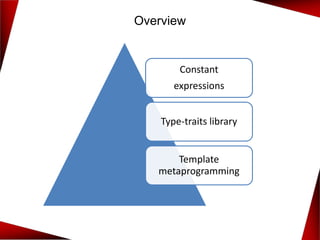
Constant
expressions
Type-traits library
Template
metaprogramming
Overview
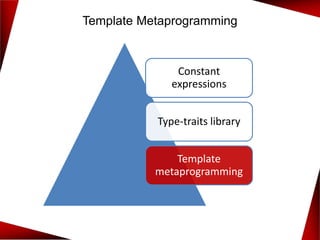
Constant
expressions
Type-traits library
Template
metaprogramming
Template Metaprogramming
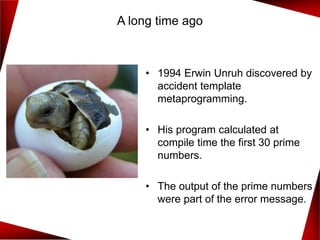
A long time ago
• 1994 Erwin Unruh discovered by
accident template
metaprogramming.
• His program calculated at
compile time the first 30 prime
numbers.
• The output of the prime numbers
were part of the error message.
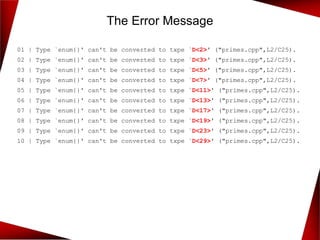
The Error Message
01 | Type `enum{}' can't be converted to txpe `D<2>' ("primes.cpp",L2/C25).
02 | Type `enum{}' can't be converted to txpe `D<3>' ("primes.cpp",L2/C25).
03 | Type `enum{}' can't be converted to txpe `D<5>' ("primes.cpp",L2/C25).
04 | Type `enum{}' can't be converted to txpe `D<7>' ("primes.cpp",L2/C25).
05 | Type `enum{}' can't be converted to txpe `D<11>' ("primes.cpp",L2/C25).
06 | Type `enum{}' can't be converted to txpe `D<13>' ("primes.cpp",L2/C25).
07 | Type `enum{}' can't be converted to txpe `D<17>' ("primes.cpp",L2/C25).
08 | Type `enum{}' can't be converted to txpe `D<19>' ("primes.cpp",L2/C25).
09 | Type `enum{}' can't be converted to txpe `D<23>' ("primes.cpp",L2/C25).
10 | Type `enum{}' can't be converted to txpe `D<29>' ("primes.cpp",L2/C25).
<< Factorial<5>::value <<
std::endl; std::cout << 120 <<
std::endl; return 0;}
dsfa
sdf
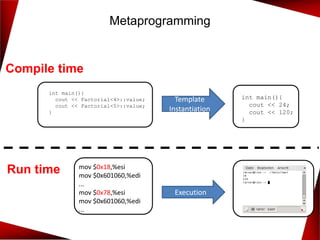
Template
Instantiation
Execution
Compile time
Run time
int main(){
cout << Factorial<4>::value;
cout << Factorial<5>::value;
}
int main(){
cout << 24;
cout << 120;
}
mov $0x18,%esi
mov $0x601060,%edi
...
mov $0x78,%esi
mov $0x601060,%edi
...
Metaprogramming
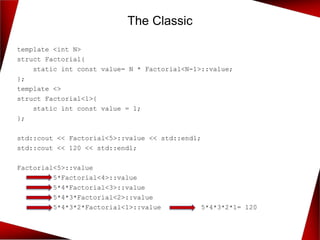
The Classic
template <int N>
struct Factorial{
static int const value= N * Factorial<N-1>::value;
};
template <>
struct Factorial<1>{
static int const value = 1;
};
std::cout << Factorial<5>::value << std::endl;
std::cout << 120 << std::endl;
Factorial<5>::value
5*Factorial<4>::value
5*4*Factorial<3>::value
5*4*3*Factorial<2>::value
5*4*3*2*Factorial<1>::value 5*4*3*2*1= 120
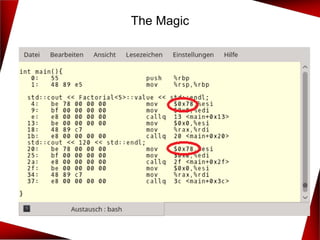
The Magic
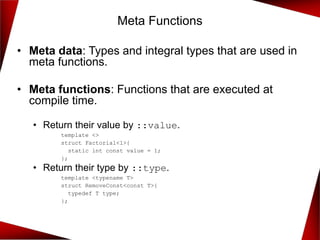
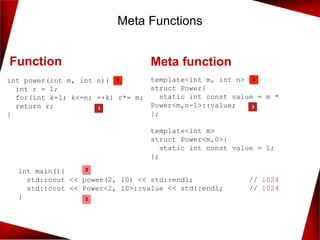
Meta Functions
• Meta data: Types and integral types that are used in
meta functions.
• Meta functions: Functions that are executed at
compile time.
• Return their value by ::value.
template <>
struct Factorial<1>{
static int const value = 1;
};
• Return their type by ::type.
template <typename T>
struct RemoveConst<const T>{
typedef T type;
};
Meta Functions
11
2
2
3 3
int power(int m, int n){
int r = 1;
for(int k=1; k<=n; ++k) r*= m;
return r;
}
template<int m, int n>
struct Power{
static int const value = m *
Power<m,n-1>::value;
};
template<int m>
struct Power<m,0>{
static int const value = 1;
};
int main(){
std::cout << power(2, 10) << std::endl; // 1024
std::cout << Power<2, 10>::value << std::endl; // 1024
}
Meta functionFunction
Pure Functional Sublanguage
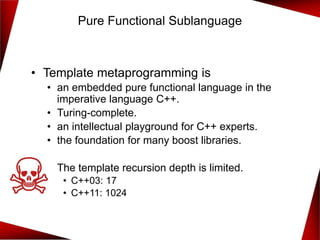
• Template metaprogramming is
• an embedded pure functional language in the
imperative language C++.
• Turing-complete.
• an intellectual playground for C++ experts.
• the foundation for many boost libraries.
• The template recursion depth is limited.
• C++03: 17
• C++11: 1024
Constant
expressions
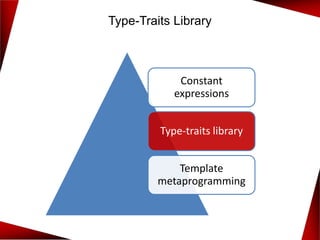
Type-traits library
Template
metaprogramming
Type-Traits Library
Type-Traits Library
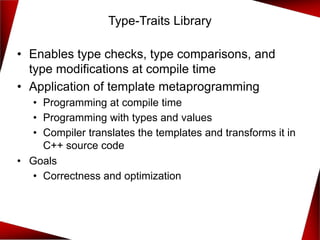
• Enables type checks, type comparisons, and
type modifications at compile time
• Application of template metaprogramming
• Programming at compile time
• Programming with types and values
• Compiler translates the templates and transforms it in
C++ source code
• Goals
• Correctness and optimization
Type-Traits Library
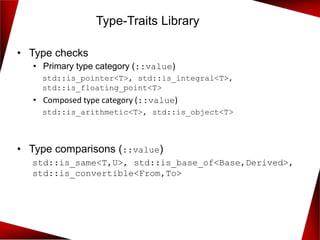
• Type checks
• Primary type category (::value)
std::is_pointer<T>, std::is_integral<T>,
std::is_floating_point<T>
• Composed type category (::value)
std::is_arithmetic<T>, std::is_object<T>
• Type comparisons (::value)
std::is_same<T,U>, std::is_base_of<Base,Derived>,
std::is_convertible<From,To>
Type-Traits Library
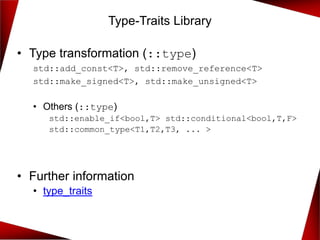
• Type transformation (::type)
std::add_const<T>, std::remove_reference<T>
std::make_signed<T>, std::make_unsigned<T>
• Others (::type)
std::enable_if<bool,T> std::conditional<bool,T,F>
std::common_type<T1,T2,T3, ... >
• Further information
• type_traits
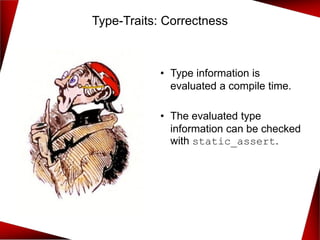
Type-Traits: Correctness
• Type information is
evaluated a compile time.
• The evaluated type
information can be checked
with static_assert.
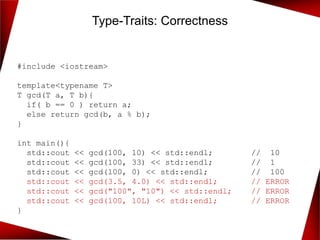
#include <iostream>
template<typename T>
T gcd(T a, T b){
if( b == 0 ) return a;
else return gcd(b, a % b);
}
int main(){
std::cout << gcd(100, 10) << std::endl; // 10
std::cout << gcd(100, 33) << std::endl; // 1
std::cout << gcd(100, 0) << std::endl; // 100
std::cout << gcd(3.5, 4.0) << std::endl; // ERROR
std::cout << gcd("100", "10") << std::endl; // ERROR
std::cout << gcd(100, 10L) << std::endl; // ERROR
}
Type-Traits: Correctness
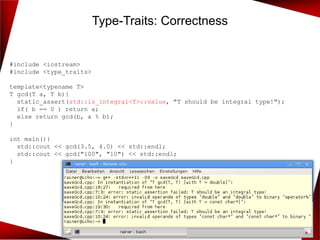
#include <iostream>
#include <type_traits>
template<typename T>
T gcd(T a, T b){
static_assert(std::is_integral<T>::value, "T should be integral type!");
if( b == 0 ) return a;
else return gcd(b, a % b);
}
int main(){
std::cout << gcd(3.5, 4.0) << std::endl;
std::cout << gcd("100", "10") << std::endl;
}
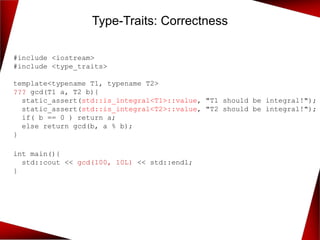
Type-Traits: Correctness
#include <iostream>
#include <type_traits>
template<typename T1, typename T2>
??? gcd(T1 a, T2 b){
static_assert(std::is_integral<T1>::value, "T1 should be integral!");
static_assert(std::is_integral<T2>::value, "T2 should be integral!");
if( b == 0 ) return a;
else return gcd(b, a % b);
}
int main(){
std::cout << gcd(100, 10L) << std::endl;
}
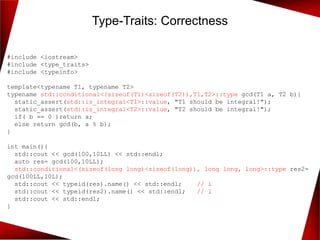
Type-Traits: Correctness
#include <iostream>
#include <type_traits>
#include <typeinfo>
template<typename T1, typename T2>
typename std::conditional<(sizeof(T1)<sizeof(T2)),T1,T2>::type gcd(T1 a, T2 b){
static_assert(std::is_integral<T1>::value, "T1 should be integral!");
static_assert(std::is_integral<T2>::value, "T2 should be integral!");
if( b == 0 )return a;
else return gcd(b, a % b);
}
int main(){
std::cout << gcd(100,10LL) << std::endl;
auto res= gcd(100,10LL);
std::conditional<(sizeof(long long)<sizeof(long)), long long, long>::type res2=
gcd(100LL,10L);
std::cout << typeid(res).name() << std::endl; // i
std::cout << typeid(res2).name() << std::endl; // l
std::cout << std::endl;
}
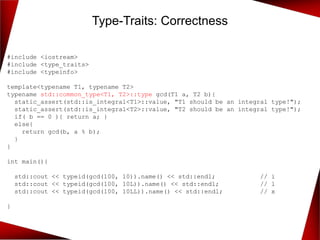
Type-Traits: Correctness
#include <iostream>
#include <type_traits>
#include <typeinfo>
template<typename T1, typename T2>
typename std::common_type<T1, T2>::type gcd(T1 a, T2 b){
static_assert(std::is_integral<T1>::value, "T1 should be an integral type!");
static_assert(std::is_integral<T2>::value, "T2 should be an integral type!");
if( b == 0 ){ return a; }
else{
return gcd(b, a % b);
}
}
int main(){
std::cout << typeid(gcd(100, 10)).name() << std::endl; // i
std::cout << typeid(gcd(100, 10L)).name() << std::endl; // l
std::cout << typeid(gcd(100, 10LL)).name() << std::endl; // x
}
Type-Traits: Correctness
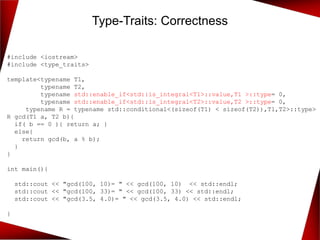
#include <iostream>
#include <type_traits>
template<typename T1,
typename T2,
typename std::enable_if<std::is_integral<T1>::value,T1 >::type= 0,
typename std::enable_if<std::is_integral<T2>::value,T2 >::type= 0,
typename R = typename std::conditional<(sizeof(T1) < sizeof(T2)),T1,T2>::type>
R gcd(T1 a, T2 b){
if( b == 0 ){ return a; }
else{
return gcd(b, a % b);
}
}
int main(){
std::cout << "gcd(100, 10)= " << gcd(100, 10) << std::endl;
std::cout << "gcd(100, 33)= " << gcd(100, 33) << std::endl;
std::cout << "gcd(3.5, 4.0)= " << gcd(3.5, 4.0) << std::endl;
}
Type-Traits: Correctness
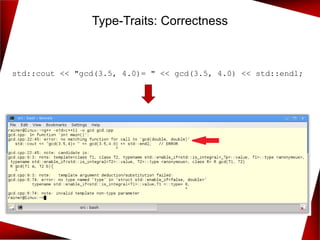
std::cout << "gcd(3.5, 4.0)= " << gcd(3.5, 4.0) << std::endl;
Type-Traits: Optimization
• Code that optimizes itself.
A algorithm is chosen
dependent on the type of a
variable.
• The STL has optimized
versions of std::copy,
std::fill, or
std::equal.
Algorithm can directly work on
the memory.
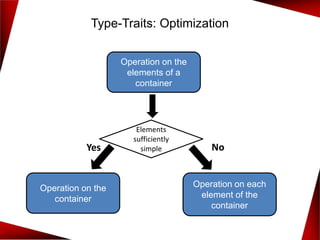
Operation on the
elements of a
container
Operation on the
container
Operation on each
element of the
container
Elements
sufficiently
simpleYes No
Type-Traits: Optimization
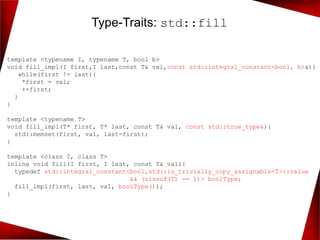
template <typename I, typename T, bool b>
void fill_impl(I first,I last,const T& val,const std::integral_constant<bool, b>&){
while(first != last){
*first = val;
++first;
}
}
template <typename T>
void fill_impl(T* first, T* last, const T& val, const std::true_type&){
std::memset(first, val, last-first);
}
template <class I, class T>
inline void fill(I first, I last, const T& val){
typedef std::integral_constant<bool,std::is_trivially_copy_assignable<T>::value
&& (sizeof(T) == 1)> boolType;
fill_impl(first, last, val, boolType());
}
Type-Traits: std::fill
const int arraySize = 100'000'000;
char charArray1[arraySize]= {0,};
char charArray2[arraySize]= {0,};
int main(){
auto begin= std::chrono::system_clock::now();
fill(charArray1, charArray1 + arraySize,1);
auto last= std::chrono::system_clock::now() - begin;
std::cout << "charArray1: " << std::chrono::duration<double>(last).count() << "
seconds";
begin= std::chrono::system_clock::now();
fill(charArray2, charArray2 + arraySize, static_cast<char>(1));
last= std::chrono::system_clock::now() - begin;
std::cout << "charArray2: " << std::chrono::duration<double>(last).count() << "
seconds";
}
Type-Traits: std::fill
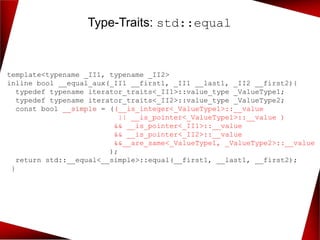
template<typename _II1, typename _II2>
inline bool __equal_aux(_II1 __first1, _II1 __last1, _II2 __first2){
typedef typename iterator_traits<_II1>::value_type _ValueType1;
typedef typename iterator_traits<_II2>::value_type _ValueType2;
const bool __simple = ((__is_integer<_ValueType1>::__value
|| __is_pointer<_ValueType1>::__value )
&& __is_pointer<_II1>::__value
&& __is_pointer<_II2>::__value
&&__are_same<_ValueType1, _ValueType2>::__value
);
return std::__equal<__simple>::equal(__first1, __last1, __first2);
}
Type-Traits: std::equal
Constant
expressions
Type-traits library
Template
metaprogramming
Constant Expressions
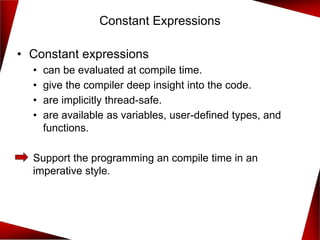
• Constant expressions
• can be evaluated at compile time.
• give the compiler deep insight into the code.
• are implicitly thread-safe.
• are available as variables, user-defined types, and
functions.
Support the programming an compile time in an
imperative style.
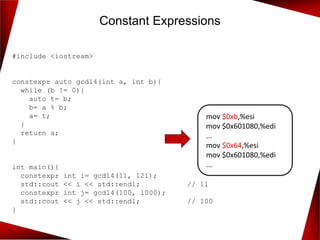
#include <iostream>
constexpr auto gcd14(int a, int b){
while (b != 0){
auto t= b;
b= a % b;
a= t;
}
return a;
}
int main(){
constexpr int i= gcd14(11, 121);
std::cout << i << std::endl; // 11
constexpr int j= gcd14(100, 1000);
std::cout << j << std::endl; // 100
}
mov $0xb,%esi
mov $0x601080,%edi
...
mov $0x64,%esi
mov $0x601080,%edi
...
Constant Expressions
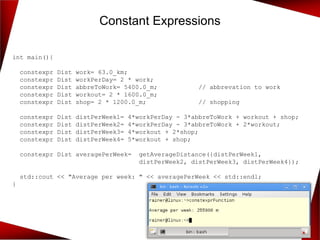
int main(){
constexpr Dist work= 63.0_km;
constexpr Dist workPerDay= 2 * work;
constexpr Dist abbreToWork= 5400.0_m; // abbrevation to work
constexpr Dist workout= 2 * 1600.0_m;
constexpr Dist shop= 2 * 1200.0_m; // shopping
constexpr Dist distPerWeek1= 4*workPerDay - 3*abbreToWork + workout + shop;
constexpr Dist distPerWeek2= 4*workPerDay - 3*abbreToWork + 2*workout;
constexpr Dist distPerWeek3= 4*workout + 2*shop;
constexpr Dist distPerWeek4= 5*workout + shop;
constexpr Dist averagePerWeek= getAverageDistance({distPerWeek1,
distPerWeek2, distPerWeek3, distPerWeek4});
std::cout << "Average per week: " << averagePerWeek << std::endl;
}
Constant Expressions
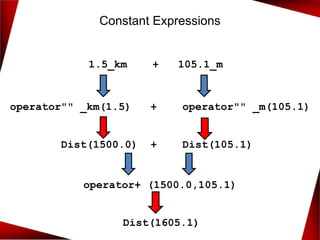
1.5_km + 105.1_m
operator"" _km(1.5) + operator"" _m(105.1)
Dist(1500.0) + Dist(105.1)
operator+ (1500.0,105.1)
Dist(1605.1)
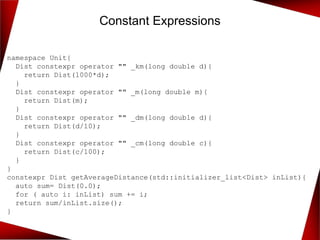
namespace Unit{
Dist constexpr operator "" _km(long double d){
return Dist(1000*d);
}
Dist constexpr operator "" _m(long double m){
return Dist(m);
}
Dist constexpr operator "" _dm(long double d){
return Dist(d/10);
}
Dist constexpr operator "" _cm(long double c){
return Dist(c/100);
}
}
constexpr Dist getAverageDistance(std::initializer_list<Dist> inList){
auto sum= Dist(0.0);
for ( auto i: inList) sum += i;
return sum/inList.size();
}
Constant Expressions
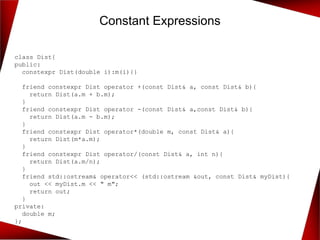
class Dist{
public:
constexpr Dist(double i):m(i){}
friend constexpr Dist operator +(const Dist& a, const Dist& b){
return Dist(a.m + b.m);
}
friend constexpr Dist operator -(const Dist& a,const Dist& b){
return Dist(a.m - b.m);
}
friend constexpr Dist operator*(double m, const Dist& a){
return Dist(m*a.m);
}
friend constexpr Dist operator/(const Dist& a, int n){
return Dist(a.m/n);
}
friend std::ostream& operator<< (std::ostream &out, const Dist& myDist){
out << myDist.m << " m";
return out;
}
private:
double m;
};
Constant Expressions
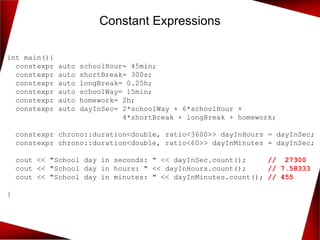
int main(){
constexpr auto schoolHour= 45min;
constexpr auto shortBreak= 300s;
constexpr auto longBreak= 0.25h;
constexpr auto schoolWay= 15min;
constexpr auto homework= 2h;
constexpr auto dayInSec= 2*schoolWay + 6*schoolHour +
4*shortBreak + longBreak + homework;
constexpr chrono::duration<double, ratio<3600>> dayInHours = dayInSec;
constexpr chrono::duration<double, ratio<60>> dayInMinutes = dayInSec;
cout << "School day in seconds: " << dayInSec.count(); // 27300
cout << "School day in hours: " << dayInHours.count(); // 7.58333
cout << "School day in minutes: " << dayInMinutes.count(); // 455
}
Constant Expressions
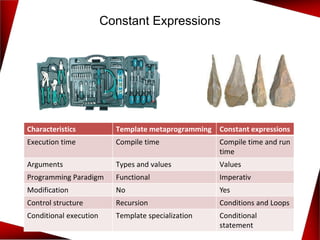
Characteristics Template metaprogramming Constant expressions
Execution time Compile time Compile time and run
time
Arguments Types and values Values
Programming Paradigm Functional Imperativ
Modification No Yes
Control structure Recursion Conditions and Loops
Conditional execution Template specialization Conditional
statement
Constant Expressions
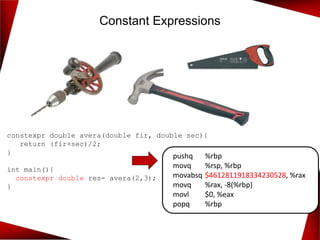
constexpr double avera(double fir, double sec){
return (fir+sec)/2;
}
int main(){
constexpr double res= avera(2,3);
}
pushq %rbp
movq %rsp, %rbp
movabsq $4612811918334230528, %rax
movq %rax, -8(%rbp)
movl $0, %eax
popq %rbp
Constant Expressions
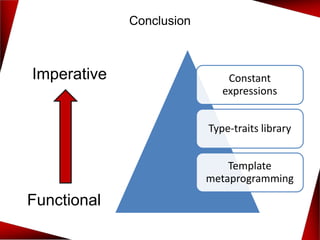
Constant
expressions
Type-traits library
Template
metaprogramming
Imperative
Functional
Conclusion
Rainer Grimm
Training, Coaching, and
Technology Consulting
www.ModernesCpp.de
Blogs
www.grimm-jaud.de [Ger]
www.ModernesCpp.de

Programming at Compile Time

  • 1.
    Programming at Compile Time RainerGrimm Training, Coaching, and Technology Consulting www.ModernesCpp.de
  • 2.
  • 3.
  • 4.
    A long timeago • 1994 Erwin Unruh discovered by accident template metaprogramming. • His program calculated at compile time the first 30 prime numbers. • The output of the prime numbers were part of the error message.
  • 5.
    The Error Message 01| Type `enum{}' can't be converted to txpe `D<2>' ("primes.cpp",L2/C25). 02 | Type `enum{}' can't be converted to txpe `D<3>' ("primes.cpp",L2/C25). 03 | Type `enum{}' can't be converted to txpe `D<5>' ("primes.cpp",L2/C25). 04 | Type `enum{}' can't be converted to txpe `D<7>' ("primes.cpp",L2/C25). 05 | Type `enum{}' can't be converted to txpe `D<11>' ("primes.cpp",L2/C25). 06 | Type `enum{}' can't be converted to txpe `D<13>' ("primes.cpp",L2/C25). 07 | Type `enum{}' can't be converted to txpe `D<17>' ("primes.cpp",L2/C25). 08 | Type `enum{}' can't be converted to txpe `D<19>' ("primes.cpp",L2/C25). 09 | Type `enum{}' can't be converted to txpe `D<23>' ("primes.cpp",L2/C25). 10 | Type `enum{}' can't be converted to txpe `D<29>' ("primes.cpp",L2/C25).
  • 6.
    << Factorial<5>::value << std::endl;std::cout << 120 << std::endl; return 0;} dsfa sdf Template Instantiation Execution Compile time Run time int main(){ cout << Factorial<4>::value; cout << Factorial<5>::value; } int main(){ cout << 24; cout << 120; } mov $0x18,%esi mov $0x601060,%edi ... mov $0x78,%esi mov $0x601060,%edi ... Metaprogramming
  • 7.
    The Classic template <intN> struct Factorial{ static int const value= N * Factorial<N-1>::value; }; template <> struct Factorial<1>{ static int const value = 1; }; std::cout << Factorial<5>::value << std::endl; std::cout << 120 << std::endl; Factorial<5>::value 5*Factorial<4>::value 5*4*Factorial<3>::value 5*4*3*Factorial<2>::value 5*4*3*2*Factorial<1>::value 5*4*3*2*1= 120
  • 8.
  • 9.
    Meta Functions • Metadata: Types and integral types that are used in meta functions. • Meta functions: Functions that are executed at compile time. • Return their value by ::value. template <> struct Factorial<1>{ static int const value = 1; }; • Return their type by ::type. template <typename T> struct RemoveConst<const T>{ typedef T type; };
  • 10.
    Meta Functions 11 2 2 3 3 intpower(int m, int n){ int r = 1; for(int k=1; k<=n; ++k) r*= m; return r; } template<int m, int n> struct Power{ static int const value = m * Power<m,n-1>::value; }; template<int m> struct Power<m,0>{ static int const value = 1; }; int main(){ std::cout << power(2, 10) << std::endl; // 1024 std::cout << Power<2, 10>::value << std::endl; // 1024 } Meta functionFunction
  • 11.
    Pure Functional Sublanguage •Template metaprogramming is • an embedded pure functional language in the imperative language C++. • Turing-complete. • an intellectual playground for C++ experts. • the foundation for many boost libraries. • The template recursion depth is limited. • C++03: 17 • C++11: 1024
  • 12.
  • 13.
    Type-Traits Library • Enablestype checks, type comparisons, and type modifications at compile time • Application of template metaprogramming • Programming at compile time • Programming with types and values • Compiler translates the templates and transforms it in C++ source code • Goals • Correctness and optimization
  • 14.
    Type-Traits Library • Typechecks • Primary type category (::value) std::is_pointer<T>, std::is_integral<T>, std::is_floating_point<T> • Composed type category (::value) std::is_arithmetic<T>, std::is_object<T> • Type comparisons (::value) std::is_same<T,U>, std::is_base_of<Base,Derived>, std::is_convertible<From,To>
  • 15.
    Type-Traits Library • Typetransformation (::type) std::add_const<T>, std::remove_reference<T> std::make_signed<T>, std::make_unsigned<T> • Others (::type) std::enable_if<bool,T> std::conditional<bool,T,F> std::common_type<T1,T2,T3, ... > • Further information • type_traits
  • 16.
    Type-Traits: Correctness • Typeinformation is evaluated a compile time. • The evaluated type information can be checked with static_assert.
  • 17.
    #include <iostream> template<typename T> Tgcd(T a, T b){ if( b == 0 ) return a; else return gcd(b, a % b); } int main(){ std::cout << gcd(100, 10) << std::endl; // 10 std::cout << gcd(100, 33) << std::endl; // 1 std::cout << gcd(100, 0) << std::endl; // 100 std::cout << gcd(3.5, 4.0) << std::endl; // ERROR std::cout << gcd("100", "10") << std::endl; // ERROR std::cout << gcd(100, 10L) << std::endl; // ERROR } Type-Traits: Correctness
  • 18.
    #include <iostream> #include <type_traits> template<typenameT> T gcd(T a, T b){ static_assert(std::is_integral<T>::value, "T should be integral type!"); if( b == 0 ) return a; else return gcd(b, a % b); } int main(){ std::cout << gcd(3.5, 4.0) << std::endl; std::cout << gcd("100", "10") << std::endl; } Type-Traits: Correctness
  • 19.
    #include <iostream> #include <type_traits> template<typenameT1, typename T2> ??? gcd(T1 a, T2 b){ static_assert(std::is_integral<T1>::value, "T1 should be integral!"); static_assert(std::is_integral<T2>::value, "T2 should be integral!"); if( b == 0 ) return a; else return gcd(b, a % b); } int main(){ std::cout << gcd(100, 10L) << std::endl; } Type-Traits: Correctness
  • 20.
    #include <iostream> #include <type_traits> #include<typeinfo> template<typename T1, typename T2> typename std::conditional<(sizeof(T1)<sizeof(T2)),T1,T2>::type gcd(T1 a, T2 b){ static_assert(std::is_integral<T1>::value, "T1 should be integral!"); static_assert(std::is_integral<T2>::value, "T2 should be integral!"); if( b == 0 )return a; else return gcd(b, a % b); } int main(){ std::cout << gcd(100,10LL) << std::endl; auto res= gcd(100,10LL); std::conditional<(sizeof(long long)<sizeof(long)), long long, long>::type res2= gcd(100LL,10L); std::cout << typeid(res).name() << std::endl; // i std::cout << typeid(res2).name() << std::endl; // l std::cout << std::endl; } Type-Traits: Correctness
  • 21.
    #include <iostream> #include <type_traits> #include<typeinfo> template<typename T1, typename T2> typename std::common_type<T1, T2>::type gcd(T1 a, T2 b){ static_assert(std::is_integral<T1>::value, "T1 should be an integral type!"); static_assert(std::is_integral<T2>::value, "T2 should be an integral type!"); if( b == 0 ){ return a; } else{ return gcd(b, a % b); } } int main(){ std::cout << typeid(gcd(100, 10)).name() << std::endl; // i std::cout << typeid(gcd(100, 10L)).name() << std::endl; // l std::cout << typeid(gcd(100, 10LL)).name() << std::endl; // x } Type-Traits: Correctness
  • 22.
    #include <iostream> #include <type_traits> template<typenameT1, typename T2, typename std::enable_if<std::is_integral<T1>::value,T1 >::type= 0, typename std::enable_if<std::is_integral<T2>::value,T2 >::type= 0, typename R = typename std::conditional<(sizeof(T1) < sizeof(T2)),T1,T2>::type> R gcd(T1 a, T2 b){ if( b == 0 ){ return a; } else{ return gcd(b, a % b); } } int main(){ std::cout << "gcd(100, 10)= " << gcd(100, 10) << std::endl; std::cout << "gcd(100, 33)= " << gcd(100, 33) << std::endl; std::cout << "gcd(3.5, 4.0)= " << gcd(3.5, 4.0) << std::endl; } Type-Traits: Correctness
  • 23.
    Type-Traits: Correctness std::cout <<"gcd(3.5, 4.0)= " << gcd(3.5, 4.0) << std::endl;
  • 24.
    Type-Traits: Optimization • Codethat optimizes itself. A algorithm is chosen dependent on the type of a variable. • The STL has optimized versions of std::copy, std::fill, or std::equal. Algorithm can directly work on the memory.
  • 25.
    Operation on the elementsof a container Operation on the container Operation on each element of the container Elements sufficiently simpleYes No Type-Traits: Optimization
  • 26.
    template <typename I,typename T, bool b> void fill_impl(I first,I last,const T& val,const std::integral_constant<bool, b>&){ while(first != last){ *first = val; ++first; } } template <typename T> void fill_impl(T* first, T* last, const T& val, const std::true_type&){ std::memset(first, val, last-first); } template <class I, class T> inline void fill(I first, I last, const T& val){ typedef std::integral_constant<bool,std::is_trivially_copy_assignable<T>::value && (sizeof(T) == 1)> boolType; fill_impl(first, last, val, boolType()); } Type-Traits: std::fill
  • 27.
    const int arraySize= 100'000'000; char charArray1[arraySize]= {0,}; char charArray2[arraySize]= {0,}; int main(){ auto begin= std::chrono::system_clock::now(); fill(charArray1, charArray1 + arraySize,1); auto last= std::chrono::system_clock::now() - begin; std::cout << "charArray1: " << std::chrono::duration<double>(last).count() << " seconds"; begin= std::chrono::system_clock::now(); fill(charArray2, charArray2 + arraySize, static_cast<char>(1)); last= std::chrono::system_clock::now() - begin; std::cout << "charArray2: " << std::chrono::duration<double>(last).count() << " seconds"; } Type-Traits: std::fill
  • 28.
    template<typename _II1, typename_II2> inline bool __equal_aux(_II1 __first1, _II1 __last1, _II2 __first2){ typedef typename iterator_traits<_II1>::value_type _ValueType1; typedef typename iterator_traits<_II2>::value_type _ValueType2; const bool __simple = ((__is_integer<_ValueType1>::__value || __is_pointer<_ValueType1>::__value ) && __is_pointer<_II1>::__value && __is_pointer<_II2>::__value &&__are_same<_ValueType1, _ValueType2>::__value ); return std::__equal<__simple>::equal(__first1, __last1, __first2); } Type-Traits: std::equal
  • 29.
  • 30.
    Constant Expressions • Constantexpressions • can be evaluated at compile time. • give the compiler deep insight into the code. • are implicitly thread-safe. • are available as variables, user-defined types, and functions. Support the programming an compile time in an imperative style.
  • 31.
    #include <iostream> constexpr autogcd14(int a, int b){ while (b != 0){ auto t= b; b= a % b; a= t; } return a; } int main(){ constexpr int i= gcd14(11, 121); std::cout << i << std::endl; // 11 constexpr int j= gcd14(100, 1000); std::cout << j << std::endl; // 100 } mov $0xb,%esi mov $0x601080,%edi ... mov $0x64,%esi mov $0x601080,%edi ... Constant Expressions
  • 32.
    int main(){ constexpr Distwork= 63.0_km; constexpr Dist workPerDay= 2 * work; constexpr Dist abbreToWork= 5400.0_m; // abbrevation to work constexpr Dist workout= 2 * 1600.0_m; constexpr Dist shop= 2 * 1200.0_m; // shopping constexpr Dist distPerWeek1= 4*workPerDay - 3*abbreToWork + workout + shop; constexpr Dist distPerWeek2= 4*workPerDay - 3*abbreToWork + 2*workout; constexpr Dist distPerWeek3= 4*workout + 2*shop; constexpr Dist distPerWeek4= 5*workout + shop; constexpr Dist averagePerWeek= getAverageDistance({distPerWeek1, distPerWeek2, distPerWeek3, distPerWeek4}); std::cout << "Average per week: " << averagePerWeek << std::endl; } Constant Expressions
  • 33.
    Constant Expressions 1.5_km +105.1_m operator"" _km(1.5) + operator"" _m(105.1) Dist(1500.0) + Dist(105.1) operator+ (1500.0,105.1) Dist(1605.1)
  • 34.
    namespace Unit{ Dist constexproperator "" _km(long double d){ return Dist(1000*d); } Dist constexpr operator "" _m(long double m){ return Dist(m); } Dist constexpr operator "" _dm(long double d){ return Dist(d/10); } Dist constexpr operator "" _cm(long double c){ return Dist(c/100); } } constexpr Dist getAverageDistance(std::initializer_list<Dist> inList){ auto sum= Dist(0.0); for ( auto i: inList) sum += i; return sum/inList.size(); } Constant Expressions
  • 35.
    class Dist{ public: constexpr Dist(doublei):m(i){} friend constexpr Dist operator +(const Dist& a, const Dist& b){ return Dist(a.m + b.m); } friend constexpr Dist operator -(const Dist& a,const Dist& b){ return Dist(a.m - b.m); } friend constexpr Dist operator*(double m, const Dist& a){ return Dist(m*a.m); } friend constexpr Dist operator/(const Dist& a, int n){ return Dist(a.m/n); } friend std::ostream& operator<< (std::ostream &out, const Dist& myDist){ out << myDist.m << " m"; return out; } private: double m; }; Constant Expressions
  • 36.
    int main(){ constexpr autoschoolHour= 45min; constexpr auto shortBreak= 300s; constexpr auto longBreak= 0.25h; constexpr auto schoolWay= 15min; constexpr auto homework= 2h; constexpr auto dayInSec= 2*schoolWay + 6*schoolHour + 4*shortBreak + longBreak + homework; constexpr chrono::duration<double, ratio<3600>> dayInHours = dayInSec; constexpr chrono::duration<double, ratio<60>> dayInMinutes = dayInSec; cout << "School day in seconds: " << dayInSec.count(); // 27300 cout << "School day in hours: " << dayInHours.count(); // 7.58333 cout << "School day in minutes: " << dayInMinutes.count(); // 455 } Constant Expressions
  • 37.
    Characteristics Template metaprogrammingConstant expressions Execution time Compile time Compile time and run time Arguments Types and values Values Programming Paradigm Functional Imperativ Modification No Yes Control structure Recursion Conditions and Loops Conditional execution Template specialization Conditional statement Constant Expressions
  • 38.
    constexpr double avera(doublefir, double sec){ return (fir+sec)/2; } int main(){ constexpr double res= avera(2,3); } pushq %rbp movq %rsp, %rbp movabsq $4612811918334230528, %rax movq %rax, -8(%rbp) movl $0, %eax popq %rbp Constant Expressions
  • 39.
  • 40.
    Rainer Grimm Training, Coaching,and Technology Consulting www.ModernesCpp.de Blogs www.grimm-jaud.de [Ger] www.ModernesCpp.de