State Content Standards Revision:
K-12 Social Studies
Catherine Truitt, Superintendent of Public Instruction
Dr. David Stegall, Deputy Superintendent for Innovation
Sneha Shah Coltrane, Director of Advanced Learning and Gifted Education
Dr. Angie Mullennix, Director of K-12 Academics (SC&I) and Innovation Strategy
Dr. Kristi Day, Assistant Director of K-12 Standards, Curriculum, and Instruction
Dr. Lori Major Carlin, Section Chief, Social Studies and Arts Education
K-12 Standards, Curriculum, and Instruction, NCDPI
January 27, 2021
Superintendent Truitt - Overview
● Role of the Department of Public Instruction (DPI) and
State Board of Education (SBE).
● Concerns expressed in January.
● Suggested remedies to concerns.
● Role of Installation Period / Supporting Documents.
● Role of Public School Units (PSUs) / Local Boards.
Standards & Curriculum
● The State writes the
standards, and our support for
LEAs and Charters as they
delve into the Curriculum and
Instruction will be in the
Supporting Documents.
● Supporting Documents will
play a key role in the daily life
of curriculum and instruction.
● Standards are the only
documents approved by the
State Board of Education.
SBE Policies
Concerning Standards
Relevant Legislation Current SS HS Grad
Reqs for students
entering Grade 9 in 2021
SCOS-012
Policy lays out the manner,
timeframe, and process in
which standards are
revised, created, and
adopted.
GRAD-004
Policy lays out the
requirements for
graduation from high
school.
● Session Law 2009-
236
● Founding Principles
Legislation
● Personal Financial
Literacy (EPF
Course)
Legislated Courses:
● North Carolina History - 4th Grade
● US/NC History - 8th Grade
● Economics and Personal Finance -
High School (2020-21)
● Founding Principles of the United
States of America and North Carolina:
Civic Literacy - High School (2021-22)
Already approved and
aligned to legislation.
1. Founding Principles of
the US and NC: Civic
Literacy
2. Economics and
Personal Finance
3. American History
4. World History
SS Standards revision was
legislated.
Legislation & Policies
The Proposed K-
12 Social Studies
Standards have
been influenced
by...
Feedback from
NC Social Studies
Educators
Feedback from
Citizen
Stakeholders
Across NC
Feedback from
Non-Formal
Educators
Feedback from
Social Studies
Partner
Organizations
Feedback from
Institutions of
Higher Learning
(IHEs)
National Social
Studies Standards
Framework
(NCSS)
National
C3 Framework
National
History
Standards
National
Standards for
Civics and
Government
National
Geography
Standards
National
Humanities
Center
National
Standards for
Economic
Education
National
Standards for
Financial
Education
National Global
Education
Standards
(GEBG)
NAEP
Framework for
Geography,
History,
Economics, and
Civics
North Carolina
Legislation
North Carolina
State Board of
Education
Directives
2018-2020
NCDPI K-12
Social Studies
Surveys
Partnership for
21st Century
Learning (P21)
The Smithsonian
Institution
Education
Division
Feedback from
the North
Carolina
Association of
Educators (NCAE)
State Advisory
Council on
American Indian
Education
Guidance and
Feedback
from Dr. Lorin
Anderson (RBT)
Formal and
Informal
Dialogue with
Social Studies
Educators
Guidance and
Feedback from
American
Institute for
Research
Social Studies
State Standards
from across the
nation
Teams in Action
Revision Timeline for SBE Draft Submittal
April 2019
State Board
votes to proceed
with the revision
of the social
studies
standards.
Sep 2019 - May
2020
Writing and review
teams from all over
the state worked on
three different
drafts of the
standards.
Drafts had public
feedback periods to
inform the following
draft.
Surveys Open: 103 days
Responses: 7000+
July 2020
State Board of
Education voted
to delay
approval and
give time to add
language in the
standards to
reflect a more
inclusive
approach.
July 2020 - Jan
2021
DPI team works
with writing and
review teams to
complete fourth
draft and
receive public
feedback.
Public
feedback was
85% in
support of
Draft 4
standards.
Statewide Collaboration for
Standards Development
• Over 70 Social Studies educators from
across the state, representing each of the 8
SBE districts, for entire academic-year.
• Over 7000 survey responses.
• Countless focus groups, round tables, LEA
groups, and individual communications.
• Public feedback surveys open for 103 days.
• Facilitation by NCDPI’s diverse Social
Studies Section.
Refinement Requests
Refinement Requests:
Explicit language which promotes the
deliberate inclusion of multiple voices
Additional public feedback
Snapshot examples of documents that will
be developed to support the
implementation of the standards upon
their approval
Refinement of terms
Public Feedback:
● GovDelivery
○ Social Studies Leaders
○ Social Studies Teachers/Listserv
○ Academic Leaders
○ State Board of Education
○ Curriculum Leaders Update
○ Character Education Listserv
○ Charter Schools
● Shared with all 8 SBE districts via emails to all local PSUs within each district
● Shared with regional contacts
● Posted on our Google site
● District Leaders Focus Group
● Posted on NCDPI site
● Social media links
● Shared in the Top Ten
● Shared with North Carolina Council of Social Studies (NCCSS)
● Shared with North Carolina Association of Educators (NCAE)
● Shared with Council of State Social Studies Supervisors (CS4)
● State Advisory Council for Indian Education
● Department of Education Office of Indian Affairs
● American Indian Smithsonian Museum
● Shared with State Board of Education Members with request to share with specific stakeholders
Public Feedback:
• 1,572 Draft 4 survey responses.
• Questions in the survey were based on national
recommendations for identifying equity within
state standards.
• Overall: 85% of respondents indicated a
favorable response to the Draft 4 standards.
Refinement of Terms:
Current Draft 4 Term: Proposed Changes: How the change will be
addressed:
Systemic Racism Racism Glossary definition to include
multiple types/forms/etc. of
racism; Term included on
unpacking document.
Gender Identity Identity Glossary definition to include
multiple types/forms/etc. of
identity; Term included on
unpacking document.
Systemic Discrimination Discrimination Glossary definition to include
multiple types/forms/etc. of
discrimination; Term included on
unpacking document.
Explicit Language Examples: Defined
in Glossary & Unpacking Documents
Founding
Principles
of North
Carolina
and United
States
History:
Civic
Literacy
Resources to Follow Approval:
• Glossary
• Strand Maps
• Crosswalks
• Unpacking Documents
• Professional Development
• Office Hours
• Technical Assistance
• Webinars
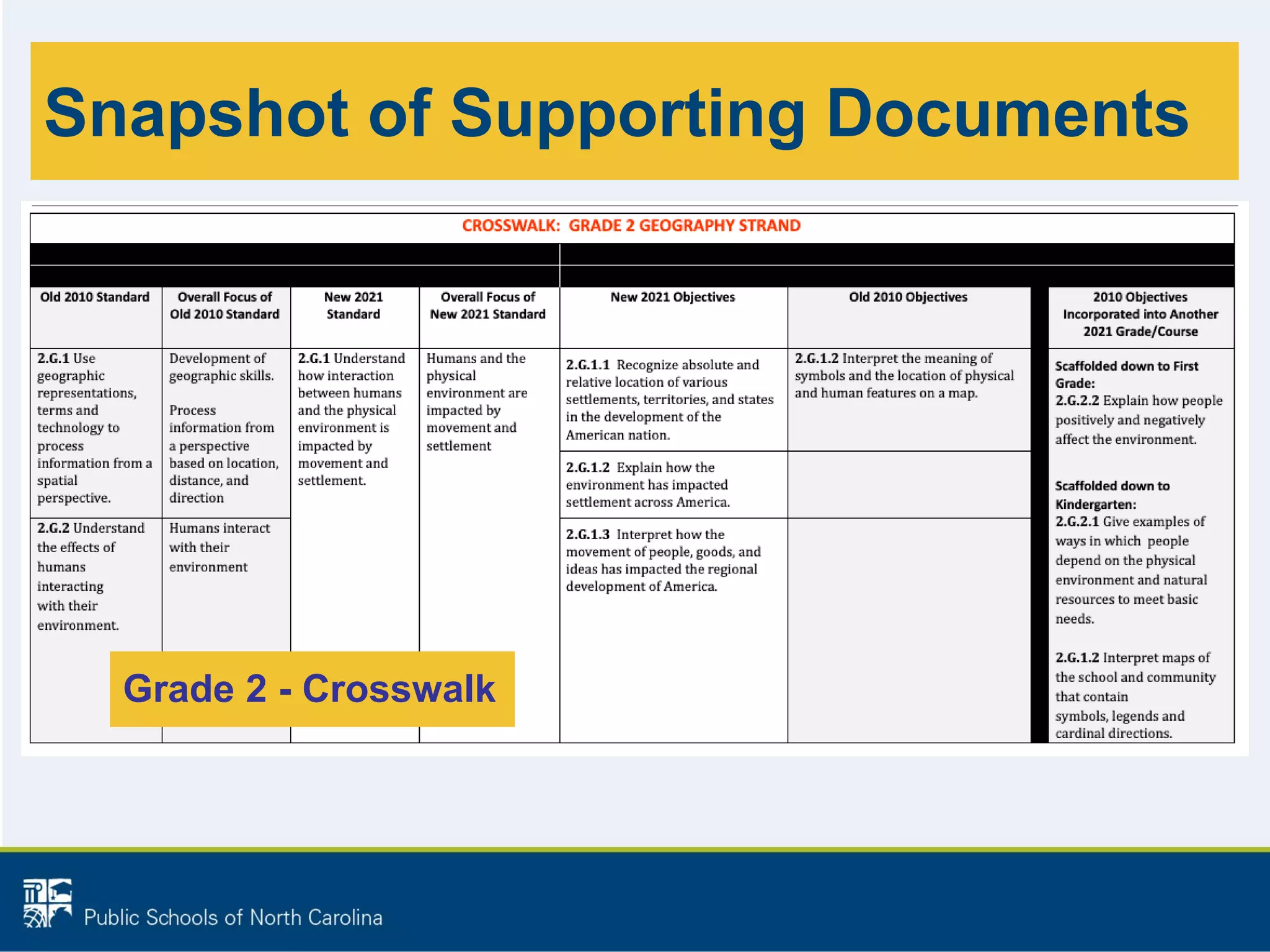
Snapshot of Supporting Documents
Glossary of
Terms
Discrimination Discrimination is made up of actions based on conscious or
unconscious prejudice that favor one group over others in the provision
of goods, services or opportunities.
Identity Identity is an awareness of one’s own values, attitudes, and the
characteristics that define a person as an individual and as a member
of different groups. It is the way an individual views themselves as well
as how they are viewed by others. Some examples of types of identity
may include religious, gender, ethnic, racial, regional, socio-economic,
educational, and ability.
Racism Racism can be defined as a belief that race is the primary determinant
of human traits and capacities and that racial differences produce an
inherent superiority of a particular race. The concept of racism is
widely thought of as simply personal prejudice, but in fact, it is a
complex system of racial hierarchies and inequities. At the micro level
of racism, or individual level, are internalized and interpersonal racism.
At the macro level of racism, we look beyond the individuals to the
broader dynamics, including institutional and structural racism.
Snapshot of Supporting Documents
American History - Unpacking
Snapshot of Supporting Documents
Grade 2 - Crosswalk
Snapshot of Supporting Documents
Civics & Government -
Strand Map
Resource Development Timeline:
If standards are approved:
Feb - April: Glossary*
Strand Maps*
Crosswalks*
Professional Development Plan*
*Share with SBE in April prior to public release
May - August: Professional Development
Unpacking Documents
Technical Assistance
In Summary:
● Process followed SBE policy SCOS-012 and standards
revision was feedback-based, research informed, improvement
oriented, and process-driven.
● Writing and Review teams were comprised of 70+ educators
from across all SBE districts.
● Public feedback surveys represented the opinions of over
7,000 stakeholders and were open for 103 days.
● SBE support was requested to ensure that the survey was
accessible and open to feedback from all stakeholder groups.
● Draft 4 Public Feedback resulted in 85% overall favorable for
adoption of standards.
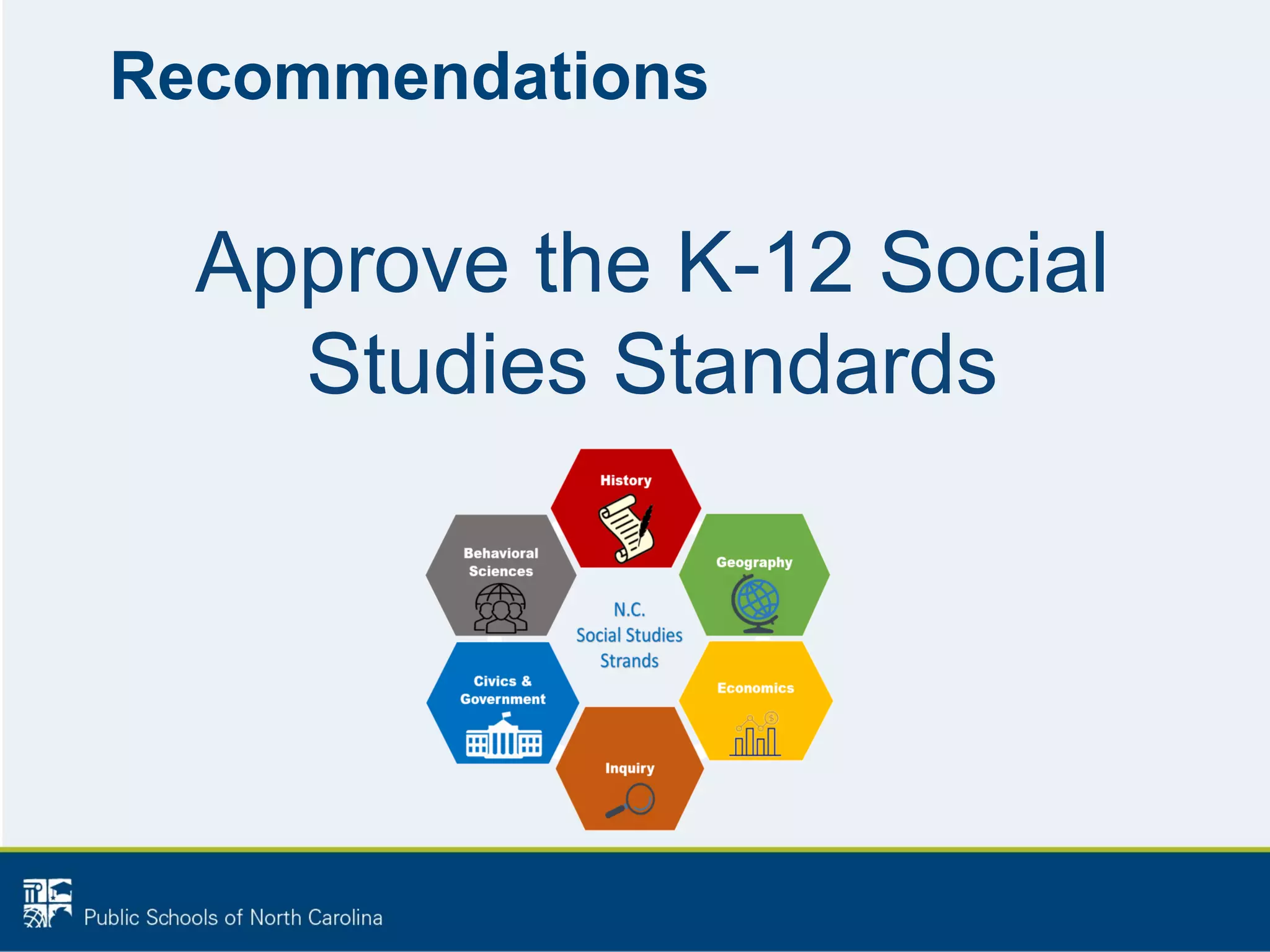
Recommendations
Approve the K-12 Social
Studies Standards

Social studies standards revisions

  • 1.
    State Content StandardsRevision: K-12 Social Studies Catherine Truitt, Superintendent of Public Instruction Dr. David Stegall, Deputy Superintendent for Innovation Sneha Shah Coltrane, Director of Advanced Learning and Gifted Education Dr. Angie Mullennix, Director of K-12 Academics (SC&I) and Innovation Strategy Dr. Kristi Day, Assistant Director of K-12 Standards, Curriculum, and Instruction Dr. Lori Major Carlin, Section Chief, Social Studies and Arts Education K-12 Standards, Curriculum, and Instruction, NCDPI January 27, 2021
  • 2.
    Superintendent Truitt -Overview ● Role of the Department of Public Instruction (DPI) and State Board of Education (SBE). ● Concerns expressed in January. ● Suggested remedies to concerns. ● Role of Installation Period / Supporting Documents. ● Role of Public School Units (PSUs) / Local Boards.
  • 3.
    Standards & Curriculum ●The State writes the standards, and our support for LEAs and Charters as they delve into the Curriculum and Instruction will be in the Supporting Documents. ● Supporting Documents will play a key role in the daily life of curriculum and instruction. ● Standards are the only documents approved by the State Board of Education.
  • 4.
    SBE Policies Concerning Standards RelevantLegislation Current SS HS Grad Reqs for students entering Grade 9 in 2021 SCOS-012 Policy lays out the manner, timeframe, and process in which standards are revised, created, and adopted. GRAD-004 Policy lays out the requirements for graduation from high school. ● Session Law 2009- 236 ● Founding Principles Legislation ● Personal Financial Literacy (EPF Course) Legislated Courses: ● North Carolina History - 4th Grade ● US/NC History - 8th Grade ● Economics and Personal Finance - High School (2020-21) ● Founding Principles of the United States of America and North Carolina: Civic Literacy - High School (2021-22) Already approved and aligned to legislation. 1. Founding Principles of the US and NC: Civic Literacy 2. Economics and Personal Finance 3. American History 4. World History SS Standards revision was legislated. Legislation & Policies
  • 5.
    The Proposed K- 12Social Studies Standards have been influenced by... Feedback from NC Social Studies Educators Feedback from Citizen Stakeholders Across NC Feedback from Non-Formal Educators Feedback from Social Studies Partner Organizations Feedback from Institutions of Higher Learning (IHEs) National Social Studies Standards Framework (NCSS) National C3 Framework National History Standards National Standards for Civics and Government National Geography Standards National Humanities Center National Standards for Economic Education National Standards for Financial Education National Global Education Standards (GEBG) NAEP Framework for Geography, History, Economics, and Civics North Carolina Legislation North Carolina State Board of Education Directives 2018-2020 NCDPI K-12 Social Studies Surveys Partnership for 21st Century Learning (P21) The Smithsonian Institution Education Division Feedback from the North Carolina Association of Educators (NCAE) State Advisory Council on American Indian Education Guidance and Feedback from Dr. Lorin Anderson (RBT) Formal and Informal Dialogue with Social Studies Educators Guidance and Feedback from American Institute for Research Social Studies State Standards from across the nation
  • 6.
  • 7.
    Revision Timeline forSBE Draft Submittal April 2019 State Board votes to proceed with the revision of the social studies standards. Sep 2019 - May 2020 Writing and review teams from all over the state worked on three different drafts of the standards. Drafts had public feedback periods to inform the following draft. Surveys Open: 103 days Responses: 7000+ July 2020 State Board of Education voted to delay approval and give time to add language in the standards to reflect a more inclusive approach. July 2020 - Jan 2021 DPI team works with writing and review teams to complete fourth draft and receive public feedback. Public feedback was 85% in support of Draft 4 standards.
  • 8.
    Statewide Collaboration for StandardsDevelopment • Over 70 Social Studies educators from across the state, representing each of the 8 SBE districts, for entire academic-year. • Over 7000 survey responses. • Countless focus groups, round tables, LEA groups, and individual communications. • Public feedback surveys open for 103 days. • Facilitation by NCDPI’s diverse Social Studies Section.
  • 9.
  • 10.
    Refinement Requests: Explicit languagewhich promotes the deliberate inclusion of multiple voices Additional public feedback Snapshot examples of documents that will be developed to support the implementation of the standards upon their approval Refinement of terms
  • 11.
    Public Feedback: ● GovDelivery ○Social Studies Leaders ○ Social Studies Teachers/Listserv ○ Academic Leaders ○ State Board of Education ○ Curriculum Leaders Update ○ Character Education Listserv ○ Charter Schools ● Shared with all 8 SBE districts via emails to all local PSUs within each district ● Shared with regional contacts ● Posted on our Google site ● District Leaders Focus Group ● Posted on NCDPI site ● Social media links ● Shared in the Top Ten ● Shared with North Carolina Council of Social Studies (NCCSS) ● Shared with North Carolina Association of Educators (NCAE) ● Shared with Council of State Social Studies Supervisors (CS4) ● State Advisory Council for Indian Education ● Department of Education Office of Indian Affairs ● American Indian Smithsonian Museum ● Shared with State Board of Education Members with request to share with specific stakeholders
  • 12.
    Public Feedback: • 1,572Draft 4 survey responses. • Questions in the survey were based on national recommendations for identifying equity within state standards. • Overall: 85% of respondents indicated a favorable response to the Draft 4 standards.
  • 13.
    Refinement of Terms: CurrentDraft 4 Term: Proposed Changes: How the change will be addressed: Systemic Racism Racism Glossary definition to include multiple types/forms/etc. of racism; Term included on unpacking document. Gender Identity Identity Glossary definition to include multiple types/forms/etc. of identity; Term included on unpacking document. Systemic Discrimination Discrimination Glossary definition to include multiple types/forms/etc. of discrimination; Term included on unpacking document.
  • 14.
    Explicit Language Examples:Defined in Glossary & Unpacking Documents Founding Principles of North Carolina and United States History: Civic Literacy
  • 15.
    Resources to FollowApproval: • Glossary • Strand Maps • Crosswalks • Unpacking Documents • Professional Development • Office Hours • Technical Assistance • Webinars
  • 16.
    Snapshot of SupportingDocuments Glossary of Terms Discrimination Discrimination is made up of actions based on conscious or unconscious prejudice that favor one group over others in the provision of goods, services or opportunities. Identity Identity is an awareness of one’s own values, attitudes, and the characteristics that define a person as an individual and as a member of different groups. It is the way an individual views themselves as well as how they are viewed by others. Some examples of types of identity may include religious, gender, ethnic, racial, regional, socio-economic, educational, and ability. Racism Racism can be defined as a belief that race is the primary determinant of human traits and capacities and that racial differences produce an inherent superiority of a particular race. The concept of racism is widely thought of as simply personal prejudice, but in fact, it is a complex system of racial hierarchies and inequities. At the micro level of racism, or individual level, are internalized and interpersonal racism. At the macro level of racism, we look beyond the individuals to the broader dynamics, including institutional and structural racism.
  • 17.
    Snapshot of SupportingDocuments American History - Unpacking
  • 18.
    Snapshot of SupportingDocuments Grade 2 - Crosswalk
  • 19.
    Snapshot of SupportingDocuments Civics & Government - Strand Map
  • 20.
    Resource Development Timeline: Ifstandards are approved: Feb - April: Glossary* Strand Maps* Crosswalks* Professional Development Plan* *Share with SBE in April prior to public release May - August: Professional Development Unpacking Documents Technical Assistance
  • 21.
    In Summary: ● Processfollowed SBE policy SCOS-012 and standards revision was feedback-based, research informed, improvement oriented, and process-driven. ● Writing and Review teams were comprised of 70+ educators from across all SBE districts. ● Public feedback surveys represented the opinions of over 7,000 stakeholders and were open for 103 days. ● SBE support was requested to ensure that the survey was accessible and open to feedback from all stakeholder groups. ● Draft 4 Public Feedback resulted in 85% overall favorable for adoption of standards.
  • 22.
    Recommendations Approve the K-12Social Studies Standards