IMMERSIVE TECHNOLOGY
                                                                    STRATEGIES


Gamification
Concepts and Applications
Introduction
Gamification is becoming a hot topic without, I believe, any real common understanding
of what it is or how it can be applied. The word itself implies the use of games
technologies and/or methodologies to solve some of the challenges we face in today's
business and society. This article seeks to explore why gamification has become such a
hot topic and how it might be practically applied in real world situations.

What is Gamification ?
In a blog to be found at http://bit.ly/LKtU5o, Linda King of G2G3 differentiates between
gamification, simulations and serious games. A summary of her definition of gamification
is here:

Gamification is all about applying game elements (the ‘DNA’ of games) to non-game
activities. It’s about making ‘normal’, day-to-day activities more compelling. Gamification
leverages ‘game mechanics’ such as points, levels, badges and achievements to create
engagement and interest.
                                                                                              !1
Like Linda, I find the term "Gamification" inadequate and misleading because it over-
simplifies the true importance and significance of what really lies behind the role of
"Gamification" - simply incorporating game mechanics into day to day activities is not
enough. I would define gamification as "the application of the characteristics and benefits
of games to real world processes and problems". The key point is that the focus is not on
game mechanics but characteristics and benefits. Gamification is ultimately about
building relationships through sustainable engagement.

It is about "relationshipification", "engagification" and "experiencification".

Characteristics of Games and Gamification
Gamification is not a new idea and every human being on the planet has been a
practitioner at some time in their lives. From the time we are born, we constantly seek to
understand and shape the world around us, we test ourselves, explore and interact with
other human beings and objects.

Life itself is a game in which we are all players and spectators. Life has rules, challenges,
risks, rewards, levels, points, badges and achievements embedded into it and we
instinctively use "Gamification" to establish our place in the world. Watching children at
play is a master class in Gamification. Very young children introduced to each other for
the first time will soon develop their own "games" with rules, challenges and goals they
establish between themselves. The more "fun" they have, the more engaged they
become, the stronger are their relationships and the faster they develop.

The characteristics of Gamification include :-

• Challenges
• Rules
• Risks and Rewards
• Taste of success
• Fear of failure
• Competition
• Emotion and passion
• Collaboration
• Relationships
• Symbiosis and balance
• Importance
• Learning, Development and Growth
• Chance
• Dreams and ambitions

                                                                                             !2
• Control and influence
• Addiction
• Connections
• Choices
• Exploration
• Discovery
• Stories and Narratives
• Experiences

Benefits of Games and Gamification

Properly applied, Gamification establishes symbiotic, balanced and sustainable
relationships which bring :-

• "Win-win" scenarios
• "Intrinsic" positive experiences
• Achieved purposes
• Desire for repetition and enhancement
• Growth and development
• Shared commitment
• Loyalty

The Importance of Relationships and Psychology

Symbiotic Relationships are critical to the success of Gamification. The ability to attract
and engage the dreams, passions, ambitions and emotions of other human beings and
deliver rewarding experiences that can endure and grow for all involved is the "holy grail".
In today's society, where there are so many demands on our time and attention and where
there is so much choice, it is more difficult than ever not only to attract and engage but
also to sustain and develop lasting relationships whether personal, social or commercial.

If Gamification were simply embedding points, levels, badges and achievements linked
to rewards, then loyalty cards would be a classic success story that could be universally
applied, but loyalty cards only generate "extrinsic" rewards such as discounts or special
offers that apply to everyone on the scheme.

                                                                                              !3
Loyalty cards, by themselves, do not deliver "intrinsic" rewards that tap into our
psychology and bring positive emotions and pleasures based on our personal wants,
needs and desires. Really effective Gamification can engage us, excite our passions and
build commitment to the relationship.

The Role of Technology in Gamification

Technology is hugely influential in Gamification. It both creates the demand for
Gamification and provides some solutions.

Technology as a Demand Creator

Today's digital technologies provide unprecedented access to not only access
information and entertainment but also to create and publish rich media content to a
global audience. This is the age of the "Prosumer". We are all no longer content to
consume experiences, we want to create and share them. Technology has given us more
choice than ever before and as choice grows, loyalty and commitment to existing
relationships diminish.

It is this eroding of loyalty, commitment and motivation that fuels the demand for
Gamification as a solution to building and sustaining relationships.

Technology as a Solution Provider

The Video Games Industry and those working with "Immersive Technologies" are at the
cutting edge of the use of technology to engage and develop relationships. By providing
the tools which are finely tuned to our basic human personalities, they use a variety of
techniques to build on initial engagement that not only delivers the game mechanic
rewards etc., but provides with access to new experiences that tap into our dreams
passions and emotions.

The two key factors for me are accessibility and personalisation. Technology makes the
previously inaccessible accessible. A classic example of this is Golf which is a highly
absorbing physical game for both spectator and player. By its nature, without technology
                                                                                           !4
it is only accessible to those with the time, money, location and ability to enjoy it. Modern
technologies make the golf experience accessible to millions and Gamification
technologies like the Nintendo Wii have been able to turn spectators into players who can
experience the intrinsic rewards of golf on demand.

Personalisation will be critical to "next generation" Gamification technologies which will
have the ability to intelligently adjust the behaviour of the application to the individual
based on developing a personal profile. The use of cloud computing and crowd sourcing
techniques will be used to achieve relationship bonding and commitment that mirror the
way we build human to human relationships.

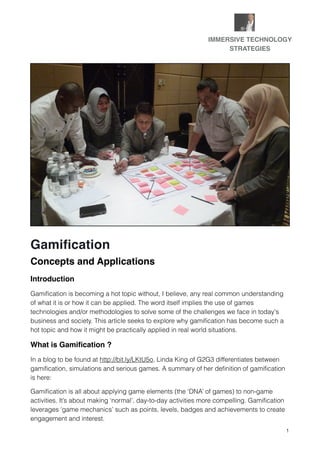
The Play with Purpose Workshop

The "Play with Purpose" workshop is designed to help individuals and organisations not
only understand why and how to apply Gamification to solve problems and/or improve
effectiveness, but also to equip them with a set of tools they can use to brainstorm and
evaluate innovative solutions.

The workshop uses the principles outlined in this document to develop "Play with
Purpose" canvas models that can be personalised to any circumstance in any sector.


For more details or to discuss the workshop, contact David Wortley by email at :-
david@davidwortley.com or mobile on +447896659695


                                                                                                !5

Gamification concepts and applications

  • 1.
    IMMERSIVE TECHNOLOGY STRATEGIES Gamification Concepts and Applications Introduction Gamification is becoming a hot topic without, I believe, any real common understanding of what it is or how it can be applied. The word itself implies the use of games technologies and/or methodologies to solve some of the challenges we face in today's business and society. This article seeks to explore why gamification has become such a hot topic and how it might be practically applied in real world situations. What is Gamification ? In a blog to be found at http://bit.ly/LKtU5o, Linda King of G2G3 differentiates between gamification, simulations and serious games. A summary of her definition of gamification is here: Gamification is all about applying game elements (the ‘DNA’ of games) to non-game activities. It’s about making ‘normal’, day-to-day activities more compelling. Gamification leverages ‘game mechanics’ such as points, levels, badges and achievements to create engagement and interest. !1
  • 2.
    Like Linda, Ifind the term "Gamification" inadequate and misleading because it over- simplifies the true importance and significance of what really lies behind the role of "Gamification" - simply incorporating game mechanics into day to day activities is not enough. I would define gamification as "the application of the characteristics and benefits of games to real world processes and problems". The key point is that the focus is not on game mechanics but characteristics and benefits. Gamification is ultimately about building relationships through sustainable engagement. It is about "relationshipification", "engagification" and "experiencification". Characteristics of Games and Gamification Gamification is not a new idea and every human being on the planet has been a practitioner at some time in their lives. From the time we are born, we constantly seek to understand and shape the world around us, we test ourselves, explore and interact with other human beings and objects. Life itself is a game in which we are all players and spectators. Life has rules, challenges, risks, rewards, levels, points, badges and achievements embedded into it and we instinctively use "Gamification" to establish our place in the world. Watching children at play is a master class in Gamification. Very young children introduced to each other for the first time will soon develop their own "games" with rules, challenges and goals they establish between themselves. The more "fun" they have, the more engaged they become, the stronger are their relationships and the faster they develop. The characteristics of Gamification include :- • Challenges • Rules • Risks and Rewards • Taste of success • Fear of failure • Competition • Emotion and passion • Collaboration • Relationships • Symbiosis and balance • Importance • Learning, Development and Growth • Chance • Dreams and ambitions !2
  • 3.
    • Control andinfluence • Addiction • Connections • Choices • Exploration • Discovery • Stories and Narratives • Experiences Benefits of Games and Gamification Properly applied, Gamification establishes symbiotic, balanced and sustainable relationships which bring :- • "Win-win" scenarios • "Intrinsic" positive experiences • Achieved purposes • Desire for repetition and enhancement • Growth and development • Shared commitment • Loyalty The Importance of Relationships and Psychology Symbiotic Relationships are critical to the success of Gamification. The ability to attract and engage the dreams, passions, ambitions and emotions of other human beings and deliver rewarding experiences that can endure and grow for all involved is the "holy grail". In today's society, where there are so many demands on our time and attention and where there is so much choice, it is more difficult than ever not only to attract and engage but also to sustain and develop lasting relationships whether personal, social or commercial. If Gamification were simply embedding points, levels, badges and achievements linked to rewards, then loyalty cards would be a classic success story that could be universally applied, but loyalty cards only generate "extrinsic" rewards such as discounts or special offers that apply to everyone on the scheme. !3
  • 4.
    Loyalty cards, bythemselves, do not deliver "intrinsic" rewards that tap into our psychology and bring positive emotions and pleasures based on our personal wants, needs and desires. Really effective Gamification can engage us, excite our passions and build commitment to the relationship. The Role of Technology in Gamification Technology is hugely influential in Gamification. It both creates the demand for Gamification and provides some solutions. Technology as a Demand Creator Today's digital technologies provide unprecedented access to not only access information and entertainment but also to create and publish rich media content to a global audience. This is the age of the "Prosumer". We are all no longer content to consume experiences, we want to create and share them. Technology has given us more choice than ever before and as choice grows, loyalty and commitment to existing relationships diminish. It is this eroding of loyalty, commitment and motivation that fuels the demand for Gamification as a solution to building and sustaining relationships. Technology as a Solution Provider The Video Games Industry and those working with "Immersive Technologies" are at the cutting edge of the use of technology to engage and develop relationships. By providing the tools which are finely tuned to our basic human personalities, they use a variety of techniques to build on initial engagement that not only delivers the game mechanic rewards etc., but provides with access to new experiences that tap into our dreams passions and emotions. The two key factors for me are accessibility and personalisation. Technology makes the previously inaccessible accessible. A classic example of this is Golf which is a highly absorbing physical game for both spectator and player. By its nature, without technology !4
  • 5.
    it is onlyaccessible to those with the time, money, location and ability to enjoy it. Modern technologies make the golf experience accessible to millions and Gamification technologies like the Nintendo Wii have been able to turn spectators into players who can experience the intrinsic rewards of golf on demand. Personalisation will be critical to "next generation" Gamification technologies which will have the ability to intelligently adjust the behaviour of the application to the individual based on developing a personal profile. The use of cloud computing and crowd sourcing techniques will be used to achieve relationship bonding and commitment that mirror the way we build human to human relationships. The Play with Purpose Workshop The "Play with Purpose" workshop is designed to help individuals and organisations not only understand why and how to apply Gamification to solve problems and/or improve effectiveness, but also to equip them with a set of tools they can use to brainstorm and evaluate innovative solutions. The workshop uses the principles outlined in this document to develop "Play with Purpose" canvas models that can be personalised to any circumstance in any sector. For more details or to discuss the workshop, contact David Wortley by email at :- david@davidwortley.com or mobile on +447896659695 !5