




REVIEW, PREVIEWL  O  N  G  VIEW
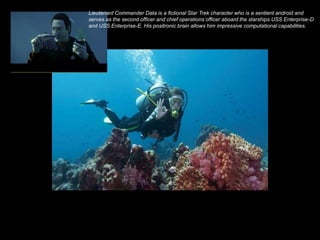
Lieutenant Commander Data is a fictional Star Trek character who is a sentient android and serves as the second officer and chief operations officer aboard the starships USS Enterprise-D and USS Enterprise-E. His positronic brain allows him impressive computational capabilities.
REVIEWEvolution of GSCC from July 2007
Evolution of Ideas
Evolution of How to do the WorkJuly 2007The First Concept Piece60 to 80 or Bust – Making community college basic skills programs hold and work for under-educated low-income Americans   
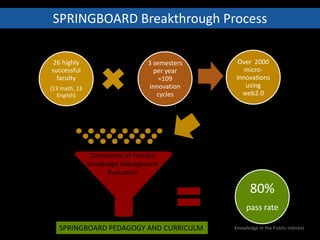
APRIL 2009Proposal to Gates FoundationCalled The Springboard ProjectProposed a breakthrough scalable pedagogy and curriculum 80 % pass ratefaculty-driven process online process of mass collaborationincubate innovationsrapid innovation and prototyping.
SPRINGBOARD Breakthrough ProcessCommunity of PracticeKnowledge ManagementEvaluationSPRINGBOARD PEDAGOGY AND CURRICULMKnowledge in the Public Interest
AUGUST 2009Grant Awarded
FAST FORWARD
NOVEMBER 2009FACULTY!
JUNE 2010PATTERNSPresentation to and Meeting with SRI
Composing Pedagogyusing e-portfolios, tagging, and scattergrams for identifying patternsKnowledge in the Public Interest Proprietary June 2010
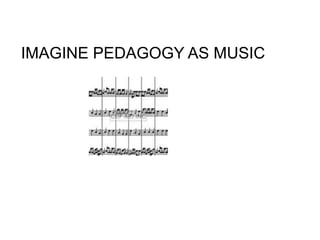
IMAGINE PEDAGOGY AS MUSIC
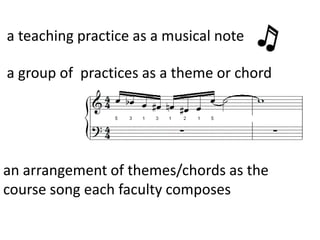
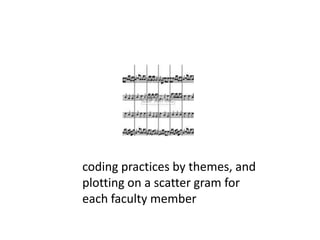
 a teaching practice as a musical note  a group of  practices as a theme or chordan arrangement of themes/chords as the course song each faculty composes
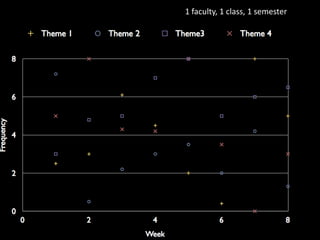
FACULTY COURSE SONGScoding practices by themes, and plotting on a scatter gram for each faculty member
D. Woolis Spring ‘10ENGL 052/Basic Writing 21 faculty, 1 class, 1 semester
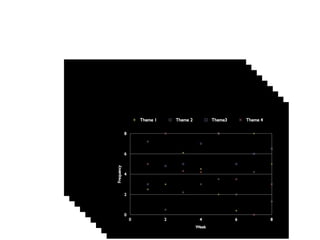
26 faculty x two semesters =
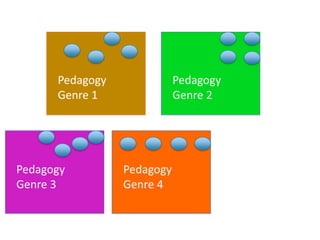
Pedagogy Genre 1PedagogyGenre 2PedagogyGenre 3PedagogyGenre 4
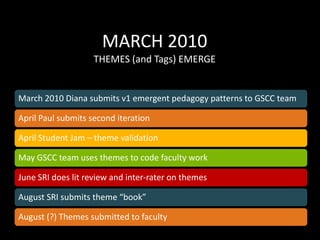
MARCH 2010THEMES (and Tags) EMERGE
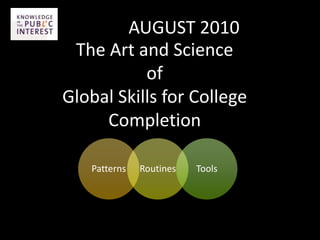
AUGUST 2010The Art and Science of Global Skills for College Completion
What we are looking for is an elegant set of pedagogical patterns that result from the culling and codification of practice across multiple faculty teaching that can be reproduced anywhere not just under special circumstances.GSCC Digital Story January 2009
KNOWLEDGE TAGSMore than keywords or terms
A type of metadata that captures knowledge in the form of descriptions, categorizations, classifications, semantics, comments, notes, annotations, hyperdata, hyperlinks
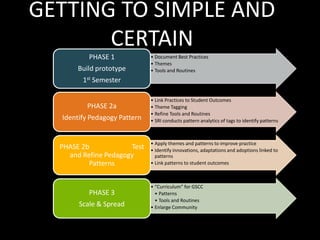
In GSCC themes are knowledge tagsGETTING TO SIMPLE AND CERTAIN
GSCC PATTERNwe set out to capture the essence of pedagogyat the most fundamental level. We ended up assembling dozens of pedagogicalattributes or  themes into a very large Pedagogy Patterns. Taken together these themescapture the unique and magical identity of a teaching practice.
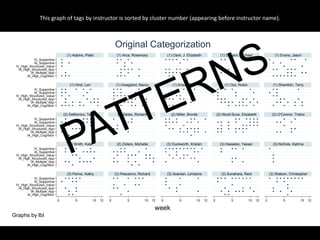
This graph of tags by instructor is sorted by cluster number (appearing before instructor name). PATTERNS
PREVIEWSCALE
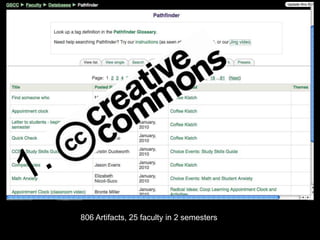
1.806 Artifacts, 25 faculty in 2 semesters
e3pd2.Experience Driven, Evidence-Based,  Electronically Delivered
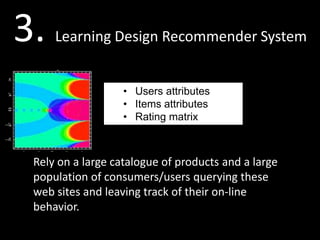
3. Learning Design Recommender SystemUsers attributes
Items attributes

GSCC Review, Preview, Longview

Editor's Notes

  • #2 We thought it would be useful to provide a quick re-view and pre-view of GSCC from our perspectives. In so doing we hope to illustrate the long view. Marisa (with the help of the librarians) has provided you with a wonderful time line. The view Gail and I will present is tightly focused on themes and patterns, tools and routines, and how together these are the foundational elements of GSCC. We look to new strategies of scale that are consistent with the power of social media and which some are calling “mass localism” –harnessing the energy and commitment of local groups to address big social challenges accessing local knowledge and social resources. To getthisdone requires lookingat GSCC from multiple viewing points. Yours for one – the on the grounddeepreflectivework. Gail and I representtwootherviews.
  • #3 Gail’s is the deep dive. Looking closely at the data and the faculty work.
  • #4 I am looking at the project in the context of the larger environment and particularly with regard to the ways in which social media –tools and the routines we design for their use– can be used in the service of GSCC strategy, simplicity and scale. GSCC is a complex project, with lots of moving parts. How can to convey the whole enchilada simply? Well…What is GSCC without at least one reference to TED? Here is a TED presentation I think provides some insight on what we are trying to do and see.
  • #6 Now let’s take a quick and selective look back
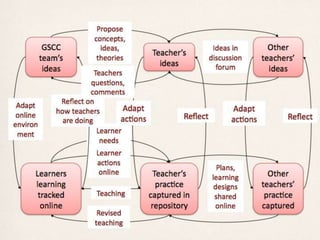
  • #9 This is how we conveyed our idea. Essentially real time faculty practice and reflection would be filtered through and subject to the community, knowledge management, and the evaluation to precipitate out pedagogical practices that improve student outcomes.
  • #13 Let me jump back to June of 2010 to explain a bit more howthe themes help see patterns and why this is critical. When SRI came on board we wanted to convey to them how we needed their work to produce scientifically derived and reliable ways of discovering and communicating this kind of data. Louise can tell you war stories about how challenging this has been and how different it is from any other research on improving student outcomes. But let me show you what we showed the SRI team.
  • #14 In this iteration I thought of pedagogy as music.
  • #15 I still like the image that composing pedagogy conjures and you will see we return a bit to the idea when we preview 2011 and beyond.
  • #17 Here I am trying to create a way to translate practice into something visual and accessible. A way for the faculty to SEE their practice, to be able to compare and group either faculty and/or their types of practice.
  • #18 I made up a plot showing themes used and how many times they were used in a hypothetical 8 week semester.
  • #19 100s of faculty using e-portfolioTagging portfolio and community contentEngaging in online communityPopulating databases as a consequence of doing workThen comparing and grouping all faculty scattergrams and looking for patterns
  • #20 Imagining that we could come up with something like this
  • #21 A variety of knowledge management practices have been applied to the work. But the use of themes and knowledge tags became two of the critical ways we codify and manage our collective knowledge. By August of 2010 we had had more than 5 iterations of theme development and have settled on 31 themes.The themes lay the groundwork for seeing patterns and will play a potent role in getting to scale.
  • #22 By August we had gone through a few more iterations represented in the Art and Science presentation where we homed in on the main concepts and activities.
  • #24 That we would use knowledge or theme tags to capture faculty practice
  • #25 WesaidWe are aiming not for dozens of things developmental education faculty might do to improve student outcomes but what handful of things they can do to assure those outcomes.
  • #26 And here we return to music as a metaphor for the work. We quoted the Pandora Radio Music Genome description substitutingng language about GSCC
  • #27 We see pedagogy in action and the locus of content to activity – and as in the TED presentation identify the nodes that might be most productive to scaling up.
  • #28 Well we did it!! by December of 2010 as a consequence of themes and tags and the brilliant SRI analysis you can actually see YOUR compositions or what SRI is calling your fingerprints. There is much work to be done here and that will be the focus of Gail’s work with you in this session.
  • #31 We want to scale your experience to developmental education faculty nationally. The developmental education pedagogy online Professional Development program would require faculty to enroll in a community of practice for one semester using the Tools and a sub-set of the Routines we have been using. The communities of practice would each contain 25-50 faculty, and would be facilitated by expert faculty members (hopefully drawn in part from the original GSCC faculty cohort). To design the most efficient and least burdensome engagement we need to determine the most essential elements of your experience. We need to create a streamlined version of what we are doing now.
  • #32 Drawing from the ongoing e3pd communities as well as faculty anywhere using a public version of pathfinder we can create and keep fresh a developmental education recommender system. You are familiar with these kinds of systems. Amazon, Pandora, Netflix, StumbleUpon, HunchTypically they make recommendations using 3 pieces of information. The reliability and robustness of these systems rely on…Find a pattern that is right for YOU
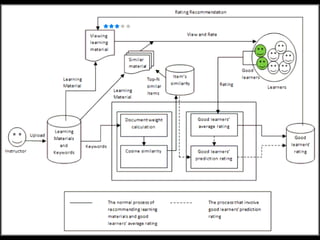
  • #33 We are not the first to think of this – but we did not know that until preparing for this presentation when I was looking for a graphic to represent our Pedagogy Recommender system. Here is a map of an actual system built for learning materials for students. Ours would be for faculty.A recommender system is a piece of software that helps users to identify the most interesting and relevant learning items from a large number of items. As we think about creating e3PD, we know that it will need certain elements. One is a stream-lined set of tools and routines, including self-tagging and dialogue with other faculty about tagging. One is a clear pedagogy pattern based upon the tags, which will get more and more robust as we have more faculty contributing their lessons and tags. Finally, we think we will need a Recommender system that helps faculty who are new to the GSCC process obtain the activities they need to either expand their theme use or to deepen their theme use. We imagine, in the future, that Pathfinder can be turned into such a system as we go forward, adding your materials, connecting it with student outcomes and other faculty comments, and categorizing the content according to the themes. s may be based on collaborative filtering (by user ratings), content-based filtering (by keywords), and hybrid filtering (by both collaborative and content-based filtering).This system uses content-based filtering and what they call good learners' ratings – what we might call good student outcomes, to recommend learning materials.The system successfullyincreased student's performance.
  • #34 If we are to scale or better said foment mass localism in 2011 we need to bring our attention back to themes and tagging and the quest to detect patterns in your practice. Here I turn the podium over to Gail. But before I do I want to share a little Star Trek clip that made me think of Gail and SRI and the search for patterns. When you hear the words life forms imagine that Data is saying pedagogy patterns…