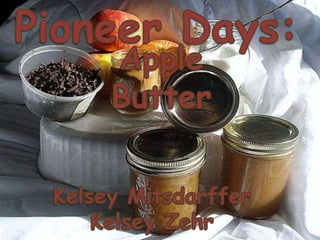
Pioneer Days:Apple ButterKelsey MitsdarfferKelsey Zehr
Standards1.1.1 :
Compare the way individuals in the community lived in the past to the way they live in the present.
 1.1.2 :
Compare past and present similarities and differences in daily life by using biographies, oral histories, and folklore.
1.1.9:
Use the library and other information resources to find information that answers questions about history. Who were the pioneers?Pioneerswere the first people to settle in the frontiers of North America.  Although many of the pioneers were farmers, others were doctors, shopkeepers, blacksmiths, missionaries, lawyers, and so on.  They came from many places in the United States to start their new lives.  The majority of their ancestorscame from European countries such as England, Germany, and Scotland.  Before leaving their homes they either saved money for the trip, sold their land and other possessions, or agreed to work for others on the trip.
How was Apple Butter Made In Pioneer Days? Apple butter, in pioneer days, was made over an open fire in a copper kettle.
 It took more than one open fire to make apple butter, so there had to be at least three fires going at once and a lot of help!
At one fire they filled the kettle with the cider, and they boiled it down until half of the cider was gone and then they dumped in the quartered apples. Several pennies were sometimes added to help keep the butter from sticking on the bottom of the kettle.
 Quartering the apples was usually the women's job and this meant sitting around big tables, slicing them into halves and then into quarters and sometimes into even smaller pieces. At a second fire they would be pre-heating the apple pieces so cold apples were never thrown into the big kettle.
 At yet a third fire they would be boiling down the cider to make sugar.
 In the old days apple butter was never sweetened with anything except the natural flavor of the boiled down cider.  To boil down cider to sugar took many gallons of cider and long, long hours of cooking.
 The butter was cooked to a thick red sauce as apples were added several times during the day. Then they would stir in the sugar made from boiling down cider. Next came the spices. Cinnamon, or cloves, and nutmeg were often used.
 In the old days, there was usually a group standing around the kettle humming, singing, or talking. Stirring the apple butter was an important job and somebody had to be doing it all the time. The old method for doing it was "twice around the outside and through the middle once" with a long paddle.

Pioneer Days Revisedf

  • 1.
    Pioneer Days:Apple ButterKelseyMitsdarfferKelsey Zehr
  • 2.
  • 3.
    Compare the wayindividuals in the community lived in the past to the way they live in the present.
  • 4.
  • 5.
    Compare past andpresent similarities and differences in daily life by using biographies, oral histories, and folklore.
  • 6.
  • 7.
    Use the libraryand other information resources to find information that answers questions about history. Who were the pioneers?Pioneerswere the first people to settle in the frontiers of North America.  Although many of the pioneers were farmers, others were doctors, shopkeepers, blacksmiths, missionaries, lawyers, and so on.  They came from many places in the United States to start their new lives.  The majority of their ancestorscame from European countries such as England, Germany, and Scotland.  Before leaving their homes they either saved money for the trip, sold their land and other possessions, or agreed to work for others on the trip.
  • 8.
    How was AppleButter Made In Pioneer Days? Apple butter, in pioneer days, was made over an open fire in a copper kettle.
  • 9.
    It tookmore than one open fire to make apple butter, so there had to be at least three fires going at once and a lot of help!
  • 10.
    At one firethey filled the kettle with the cider, and they boiled it down until half of the cider was gone and then they dumped in the quartered apples. Several pennies were sometimes added to help keep the butter from sticking on the bottom of the kettle.
  • 11.
    Quartering theapples was usually the women's job and this meant sitting around big tables, slicing them into halves and then into quarters and sometimes into even smaller pieces. At a second fire they would be pre-heating the apple pieces so cold apples were never thrown into the big kettle.
  • 12.
    At yeta third fire they would be boiling down the cider to make sugar.
  • 13.
    In theold days apple butter was never sweetened with anything except the natural flavor of the boiled down cider.  To boil down cider to sugar took many gallons of cider and long, long hours of cooking.
  • 14.
    The butterwas cooked to a thick red sauce as apples were added several times during the day. Then they would stir in the sugar made from boiling down cider. Next came the spices. Cinnamon, or cloves, and nutmeg were often used.
  • 15.
    In theold days, there was usually a group standing around the kettle humming, singing, or talking. Stirring the apple butter was an important job and somebody had to be doing it all the time. The old method for doing it was "twice around the outside and through the middle once" with a long paddle.