Body Image
and Sexual
Function
Dr. Martha Tara Lee, D.H.S.
(Singapore)
The NSpine 2019
London, United Kingdom
Dr. Martha Tara Lee
• Doctorate in Human
Sexuality
• Masters in Counselling
• Masters in Public Policy and
Management
• Bachelor of Arts (Comm)
• Cert in Sex Therapy
• Cert in Practical Counselling
• Cert in Life Coaching
Relationship Counselor & Clinical
Sexologist
AGENDA
• Definition of Body Image
• Different Aspects of Body
Image
• Body image affecting sexuality
• Treatments/ Suggestions
BODY IMAGE
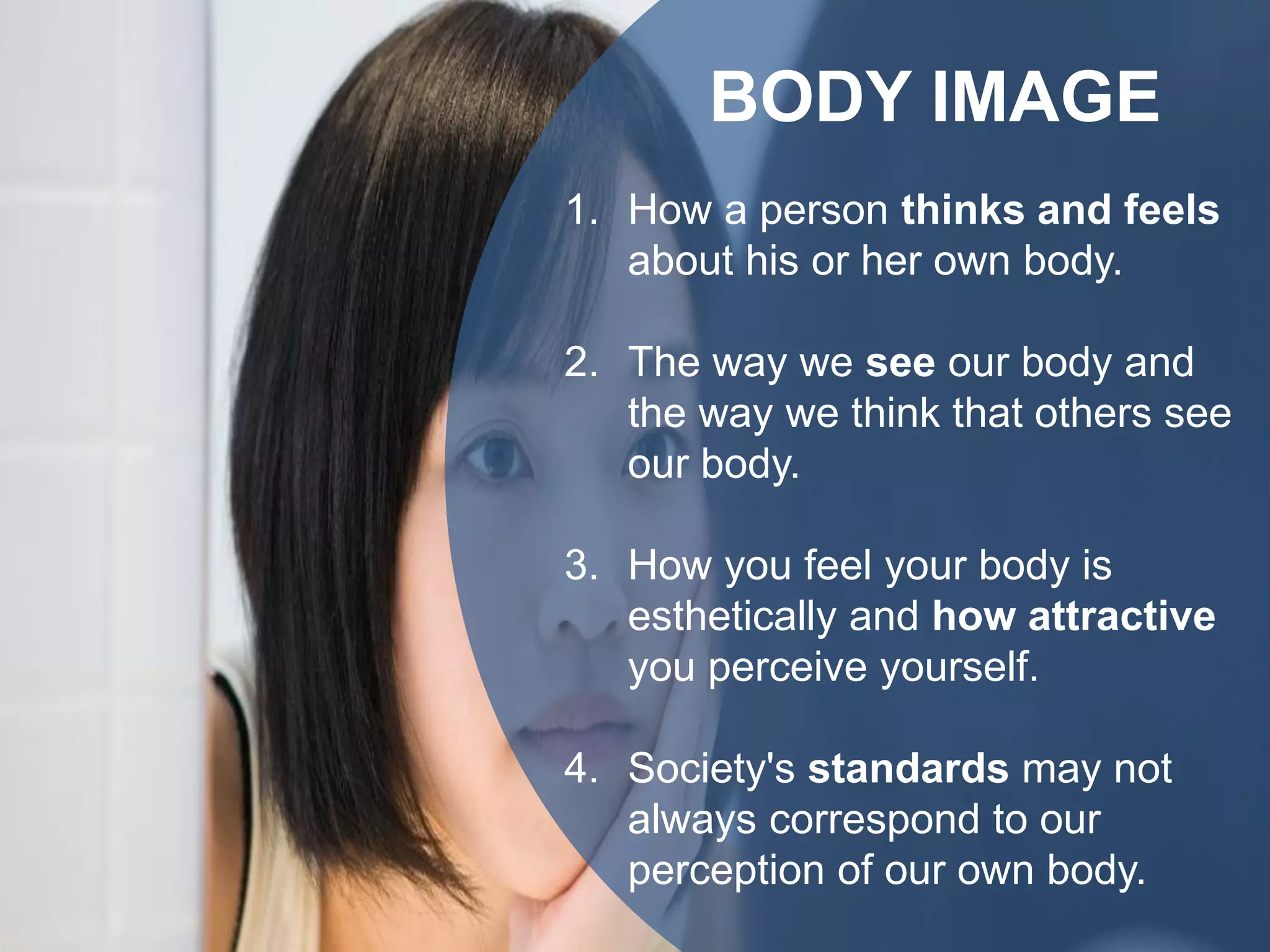
1. How a person thinks and feels
about his or her own body.
2. The way we see our body and
the way we think that others see
our body.
3. How you feel your body is
esthetically and how attractive
you perceive yourself.
4. Society's standards may not
always correspond to our
perception of our own body.
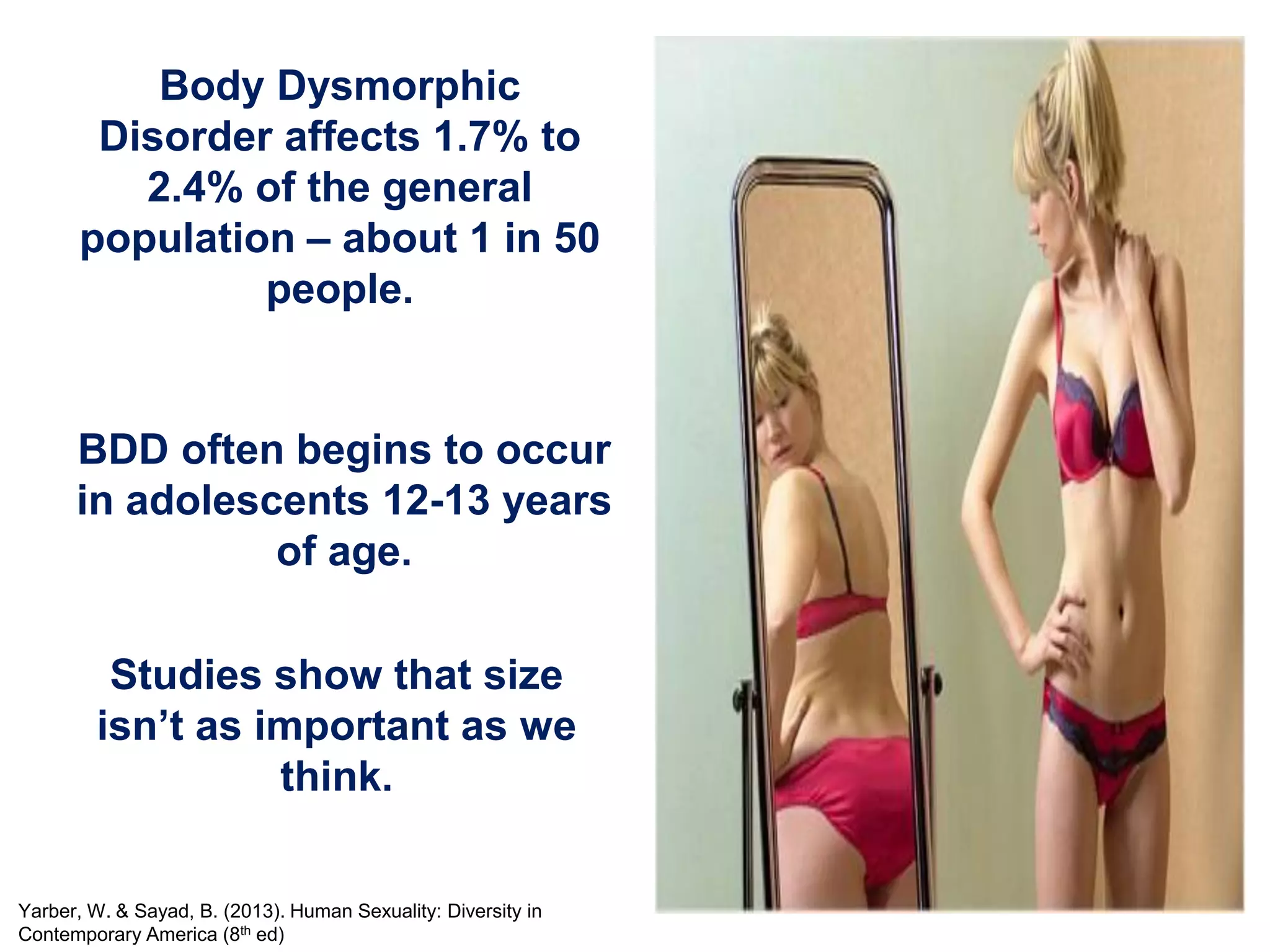
Body Dysmorphic
Disorder affects 1.7% to
2.4% of the general
population – about 1 in 50
people.
BDD often begins to occur
in adolescents 12-13 years
of age.
Studies show that size
isn’t as important as we
think.
Yarber, W. & Sayad, B. (2013). Human Sexuality: Diversity in
Contemporary America (8th ed)
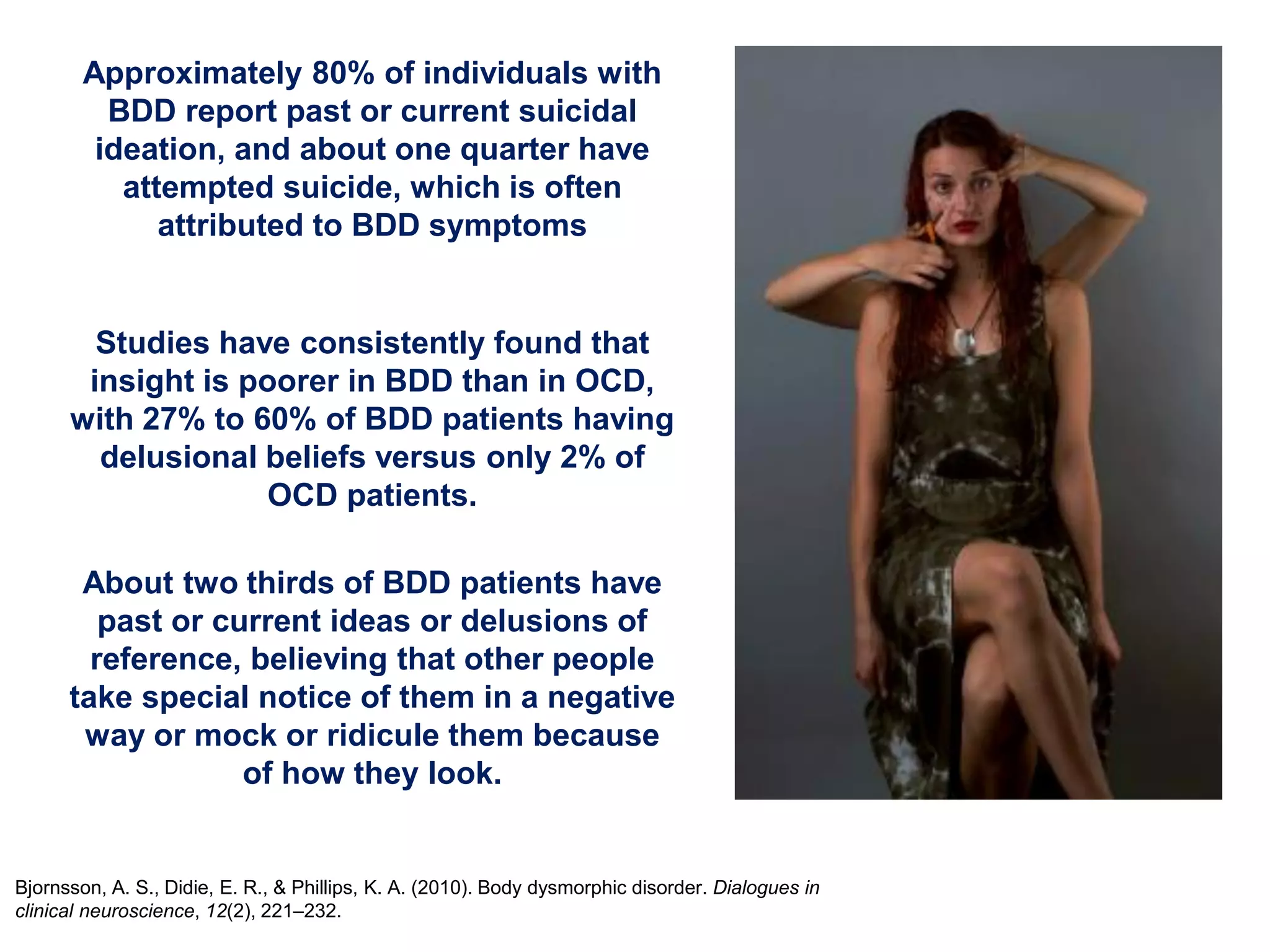
Approximately 80% of individuals with
BDD report past or current suicidal
ideation, and about one quarter have
attempted suicide, which is often
attributed to BDD symptoms
Bjornsson, A. S., Didie, E. R., & Phillips, K. A. (2010). Body dysmorphic disorder. Dialogues in
clinical neuroscience, 12(2), 221–232.
Studies have consistently found that
insight is poorer in BDD than in OCD,
with 27% to 60% of BDD patients having
delusional beliefs versus only 2% of
OCD patients.
About two thirds of BDD patients have
past or current ideas or delusions of
reference, believing that other people
take special notice of them in a negative
way or mock or ridicule them because
of how they look.
ALL IN MIND
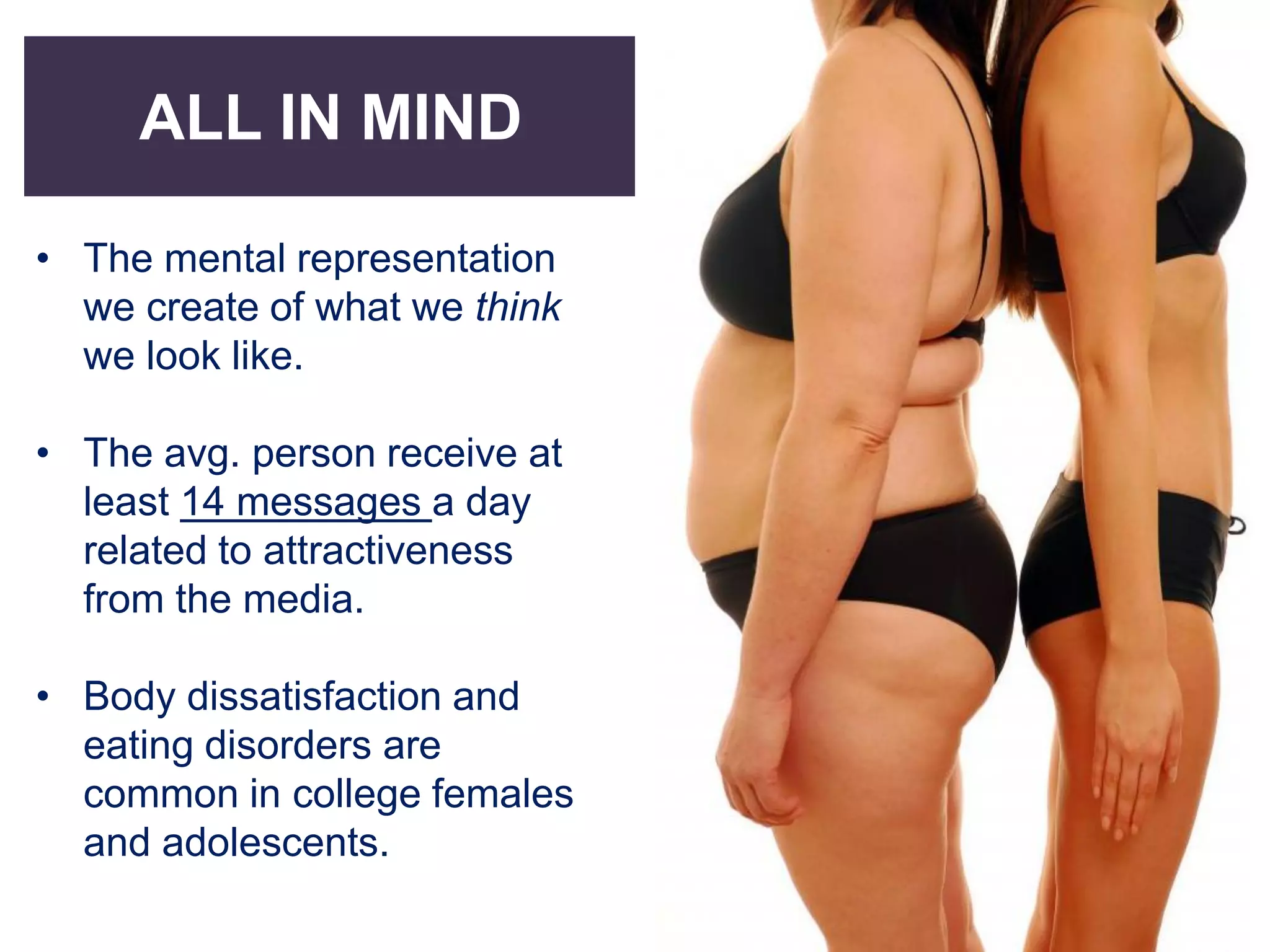
• The mental representation
we create of what we think
we look like.
• The avg. person receive at
least 14 messages a day
related to attractiveness
from the media.
• Body dissatisfaction and
eating disorders are
common in college females
and adolescents.
SEXUAL HEALTH
According to the current working
definition, sexual health is:
“…a state of physical, emotional,
mental and social well-being in
relation to sexuality; it is not merely
the absence of disease, dysfunction or
infirmity. Sexual health requires a
positive and respectful approach to
sexuality and sexual relationships,
as well as the possibility of having
pleasurable and safe sexual
experiences, free of coercion,
discrimination and violence.”
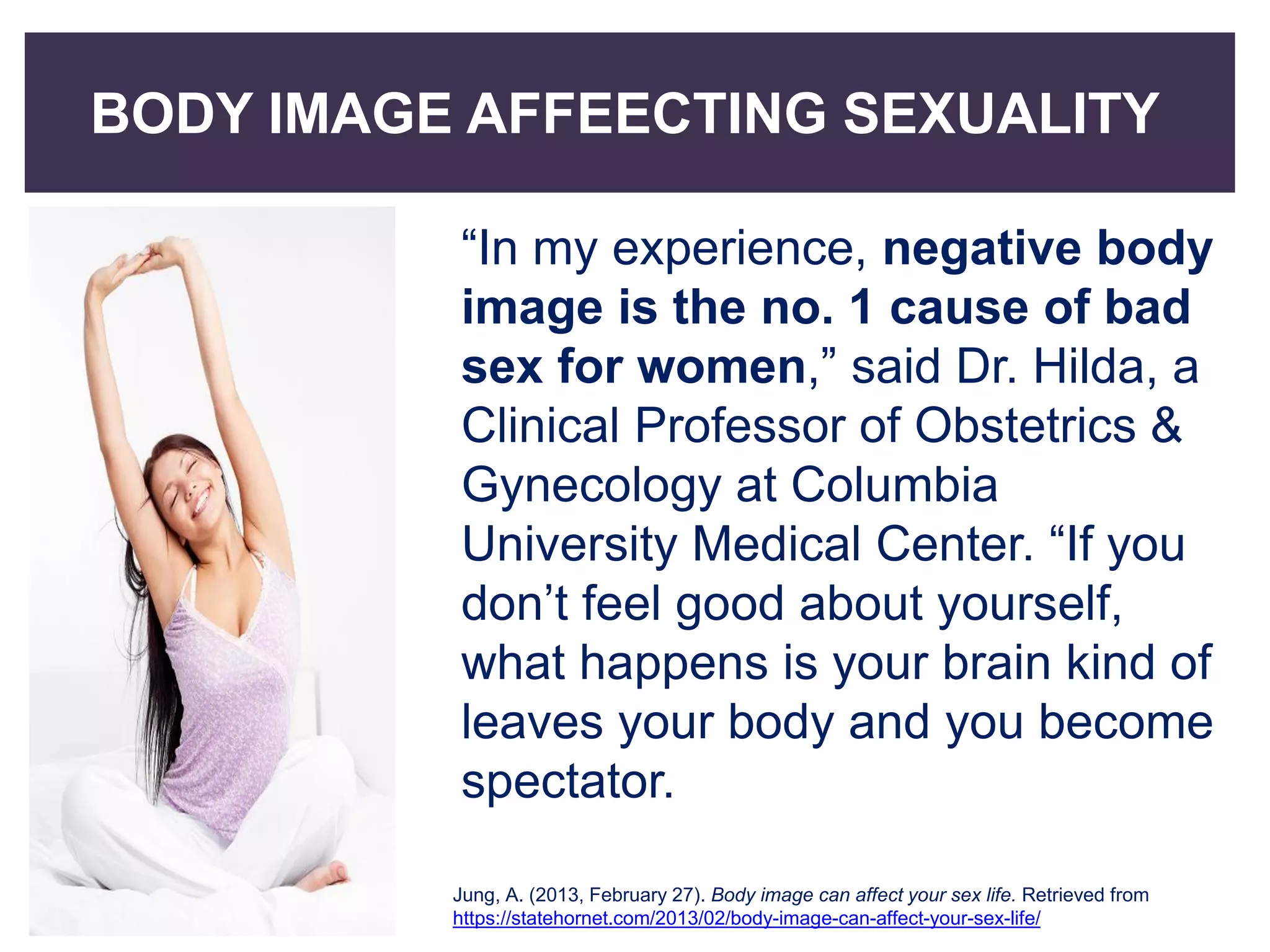
BODY IMAGE AFFEECTING SEXUALITY
“In my experience, negative body
image is the no. 1 cause of bad
sex for women,” said Dr. Hilda, a
Clinical Professor of Obstetrics &
Gynecology at Columbia
University Medical Center. “If you
don’t feel good about yourself,
what happens is your brain kind of
leaves your body and you become
spectator.
Jung, A. (2013, February 27). Body image can affect your sex life. Retrieved from
https://statehornet.com/2013/02/body-image-can-affect-your-sex-life/
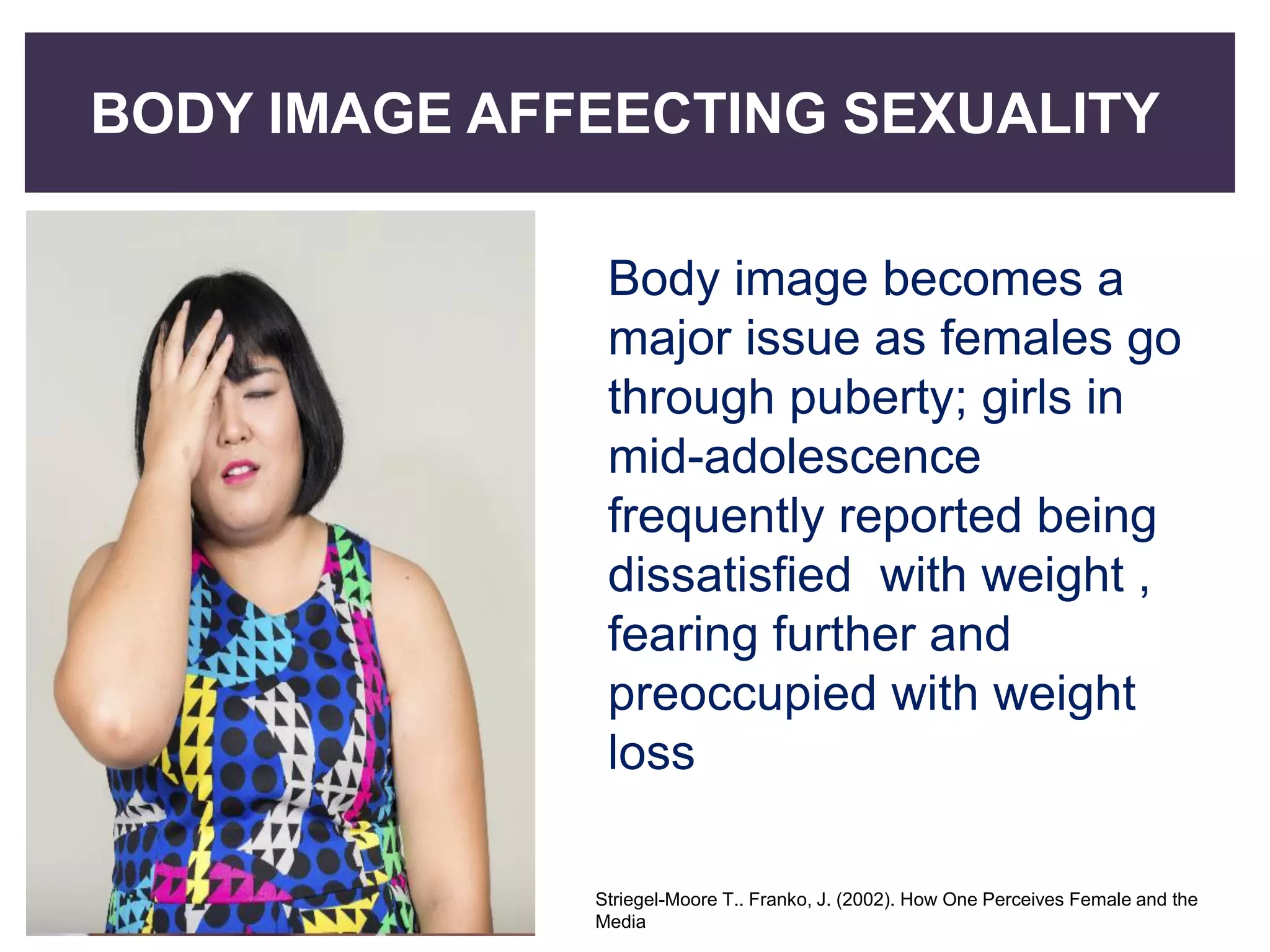
BODY IMAGE AFFEECTING SEXUALITY
Body image becomes a
major issue as females go
through puberty; girls in
mid-adolescence
frequently reported being
dissatisfied with weight ,
fearing further and
preoccupied with weight
loss
Striegel-Moore T.. Franko, J. (2002). How One Perceives Female and the
Media
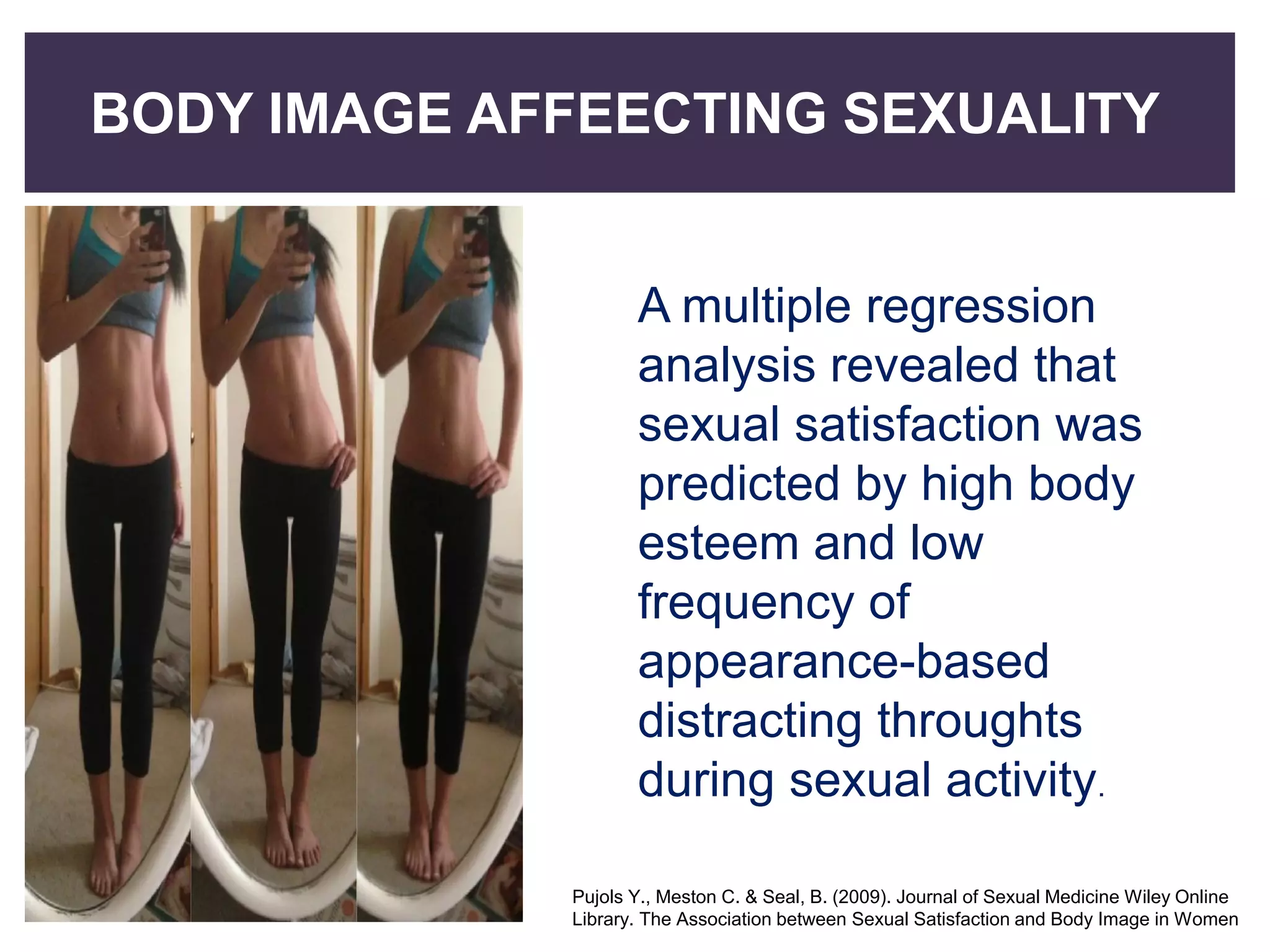
BODY IMAGE AFFEECTING SEXUALITY
A multiple regression
analysis revealed that
sexual satisfaction was
predicted by high body
esteem and low
frequency of
appearance-based
distracting throughts
during sexual activity.
Pujols Y., Meston C. & Seal, B. (2009). Journal of Sexual Medicine Wiley Online
Library. The Association between Sexual Satisfaction and Body Image in Women
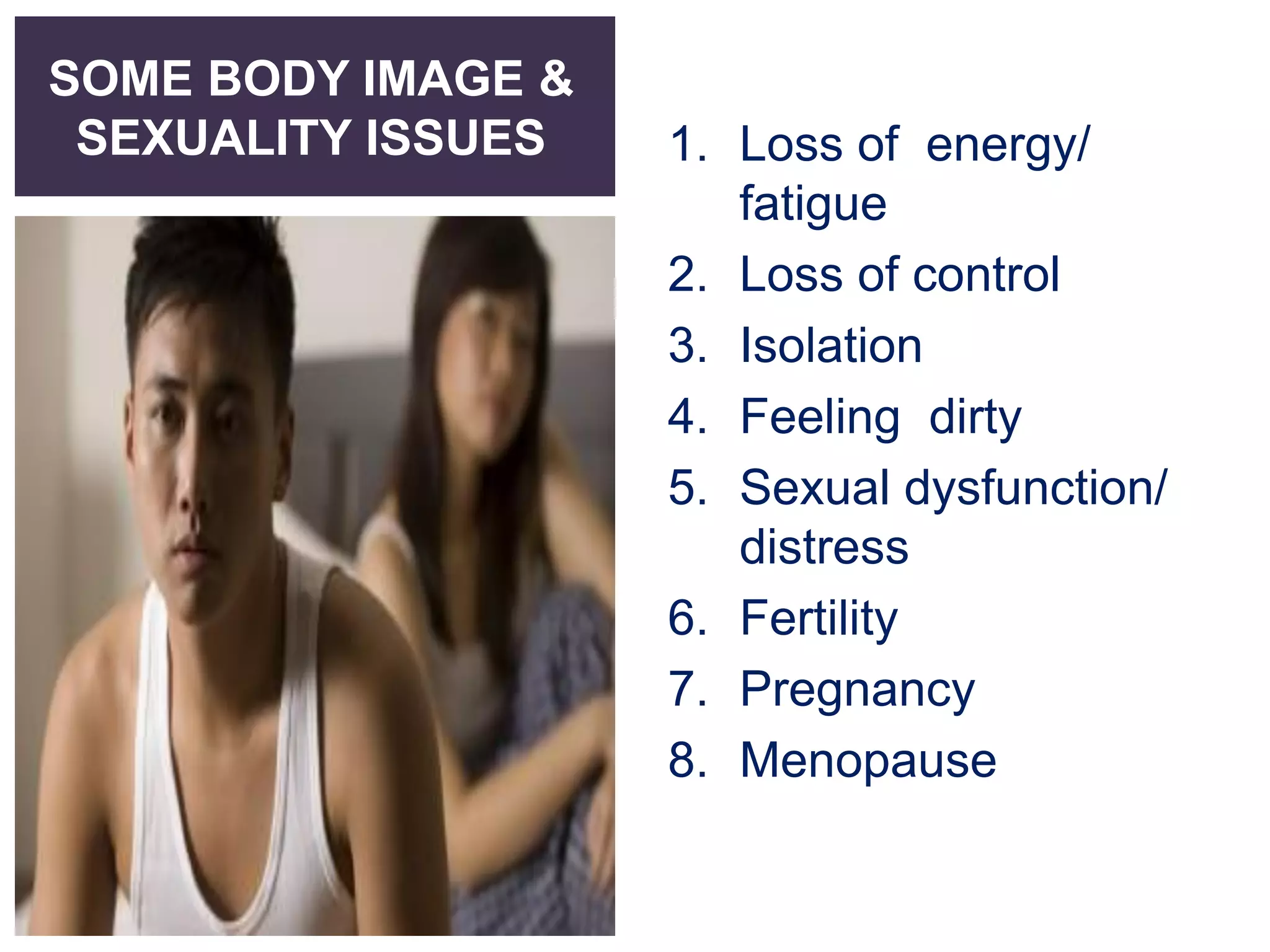
SOME BODY IMAGE &
SEXUALITY ISSUES 1. Loss of energy/
fatigue
2. Loss of control
3. Isolation
4. Feeling dirty
5. Sexual dysfunction/
distress
6. Fertility
7. Pregnancy
8. Menopause
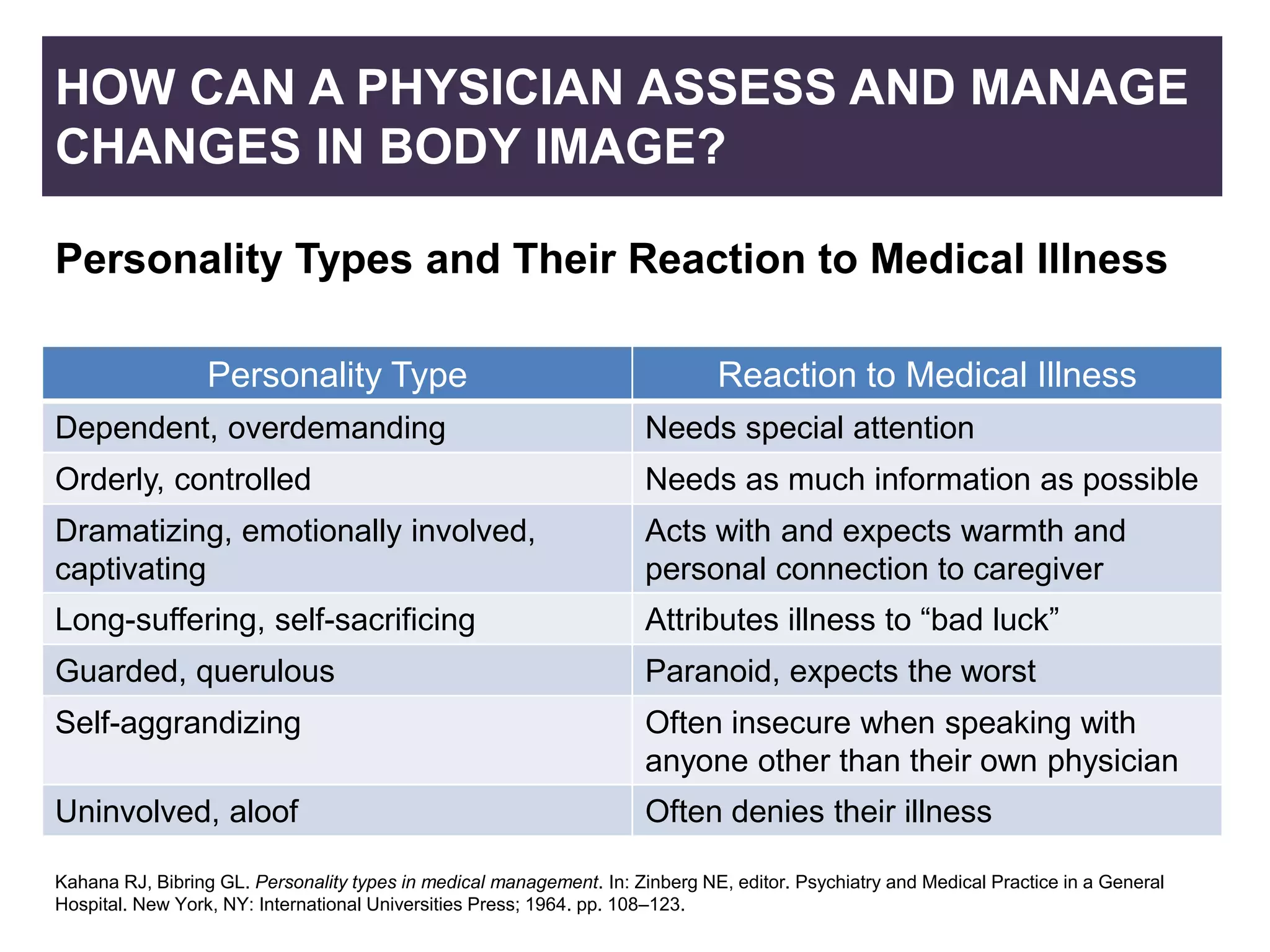
HOW CAN A PHYSICIAN ASSESS AND MANAGE
CHANGES IN BODY IMAGE?
Personality Type Reaction to Medical Illness
Dependent, overdemanding Needs special attention
Orderly, controlled Needs as much information as possible
Dramatizing, emotionally involved,
captivating
Acts with and expects warmth and
personal connection to caregiver
Long-suffering, self-sacrificing Attributes illness to “bad luck”
Guarded, querulous Paranoid, expects the worst
Self-aggrandizing Often insecure when speaking with
anyone other than their own physician
Uninvolved, aloof Often denies their illness
Personality Types and Their Reaction to Medical Illness
Kahana RJ, Bibring GL. Personality types in medical management. In: Zinberg NE, editor. Psychiatry and Medical Practice in a General
Hospital. New York, NY: International Universities Press; 1964. pp. 108–123.
5 RESEARCH-BASED TIPS FOR IMPROVING
BODY IMAGE
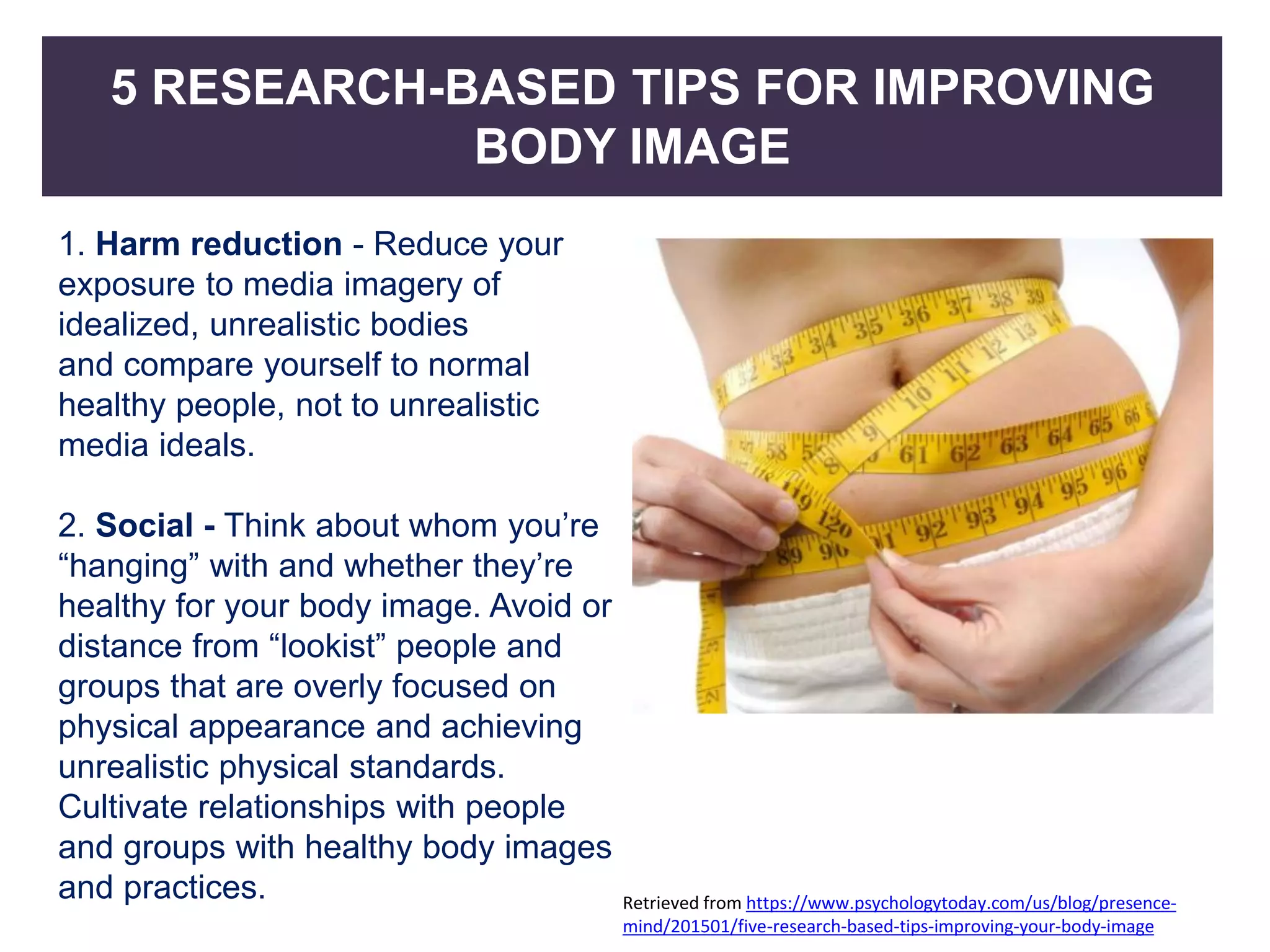
1. Harm reduction - Reduce your
exposure to media imagery of
idealized, unrealistic bodies
and compare yourself to normal
healthy people, not to unrealistic
media ideals.
2. Social - Think about whom you’re
“hanging” with and whether they’re
healthy for your body image. Avoid or
distance from “lookist” people and
groups that are overly focused on
physical appearance and achieving
unrealistic physical standards.
Cultivate relationships with people
and groups with healthy body images
and practices. Retrieved from https://www.psychologytoday.com/us/blog/presence-
mind/201501/five-research-based-tips-improving-your-body-image
5 RESEARCH-BASED TIPS FOR IMPROVING
BODY IMAGE
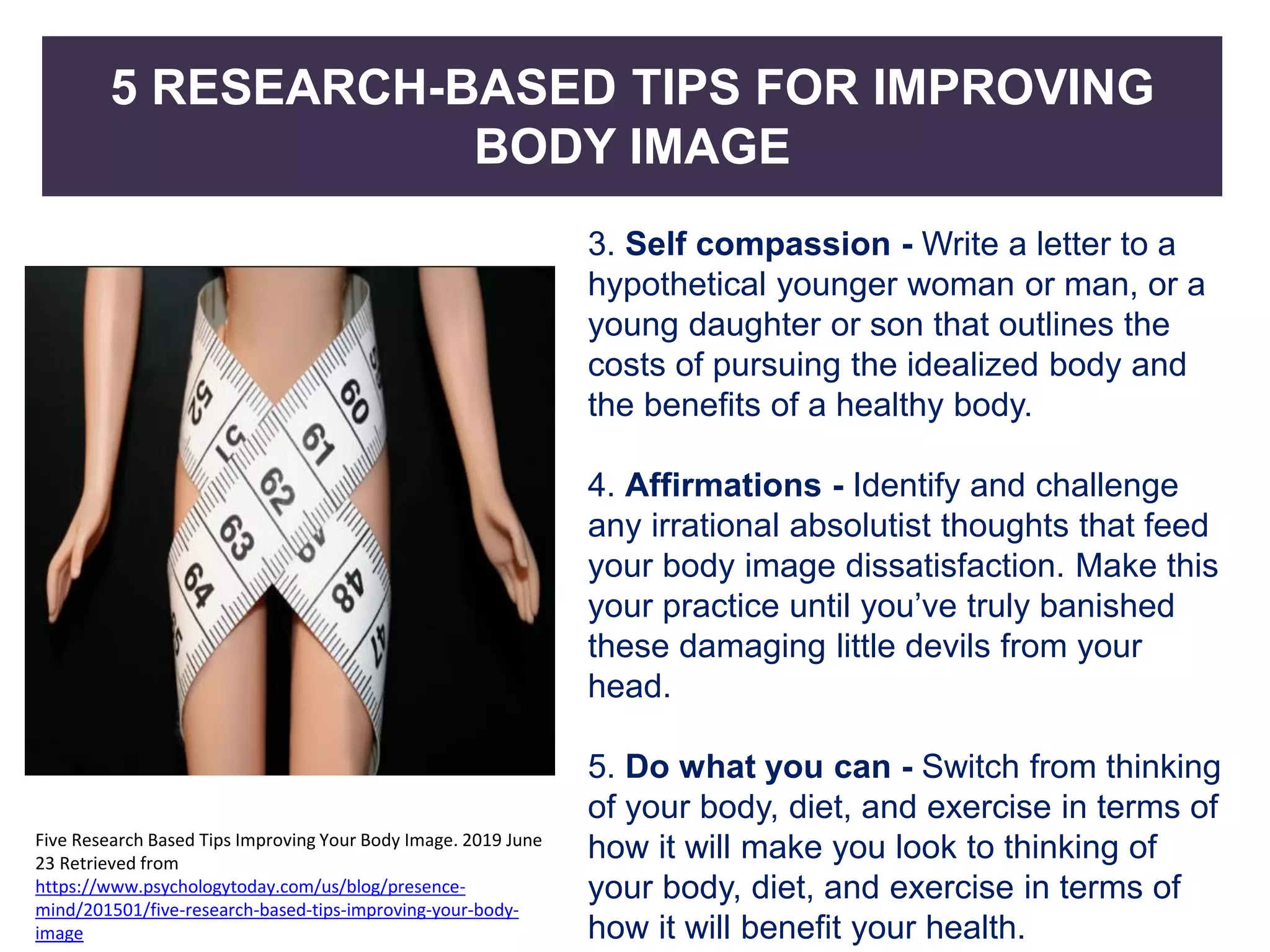
3. Self compassion - Write a letter to a
hypothetical younger woman or man, or a
young daughter or son that outlines the
costs of pursuing the idealized body and
the benefits of a healthy body.
4. Affirmations - Identify and challenge
any irrational absolutist thoughts that feed
your body image dissatisfaction. Make this
your practice until you’ve truly banished
these damaging little devils from your
head.
5. Do what you can - Switch from thinking
of your body, diet, and exercise in terms of
how it will make you look to thinking of
your body, diet, and exercise in terms of
how it will benefit your health.
Five Research Based Tips Improving Your Body Image. 2019 June
23 Retrieved from
https://www.psychologytoday.com/us/blog/presence-
mind/201501/five-research-based-tips-improving-your-body-
image
TIPS FOR BETTER
BODY IMAGE
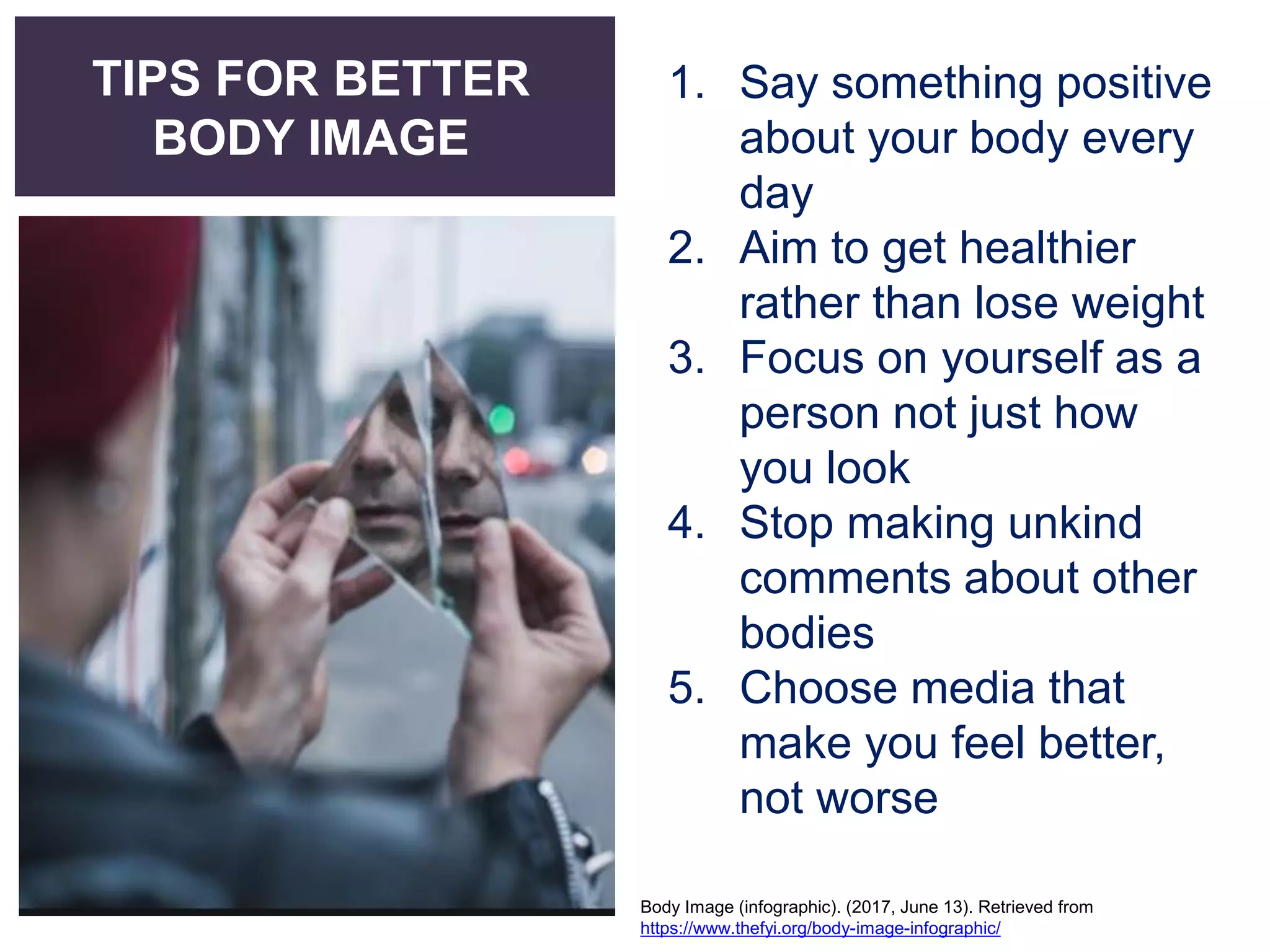
1. Say something positive
about your body every
day
2. Aim to get healthier
rather than lose weight
3. Focus on yourself as a
person not just how
you look
4. Stop making unkind
comments about other
bodies
5. Choose media that
make you feel better,
not worse
Body Image (infographic). (2017, June 13). Retrieved from
https://www.thefyi.org/body-image-infographic/
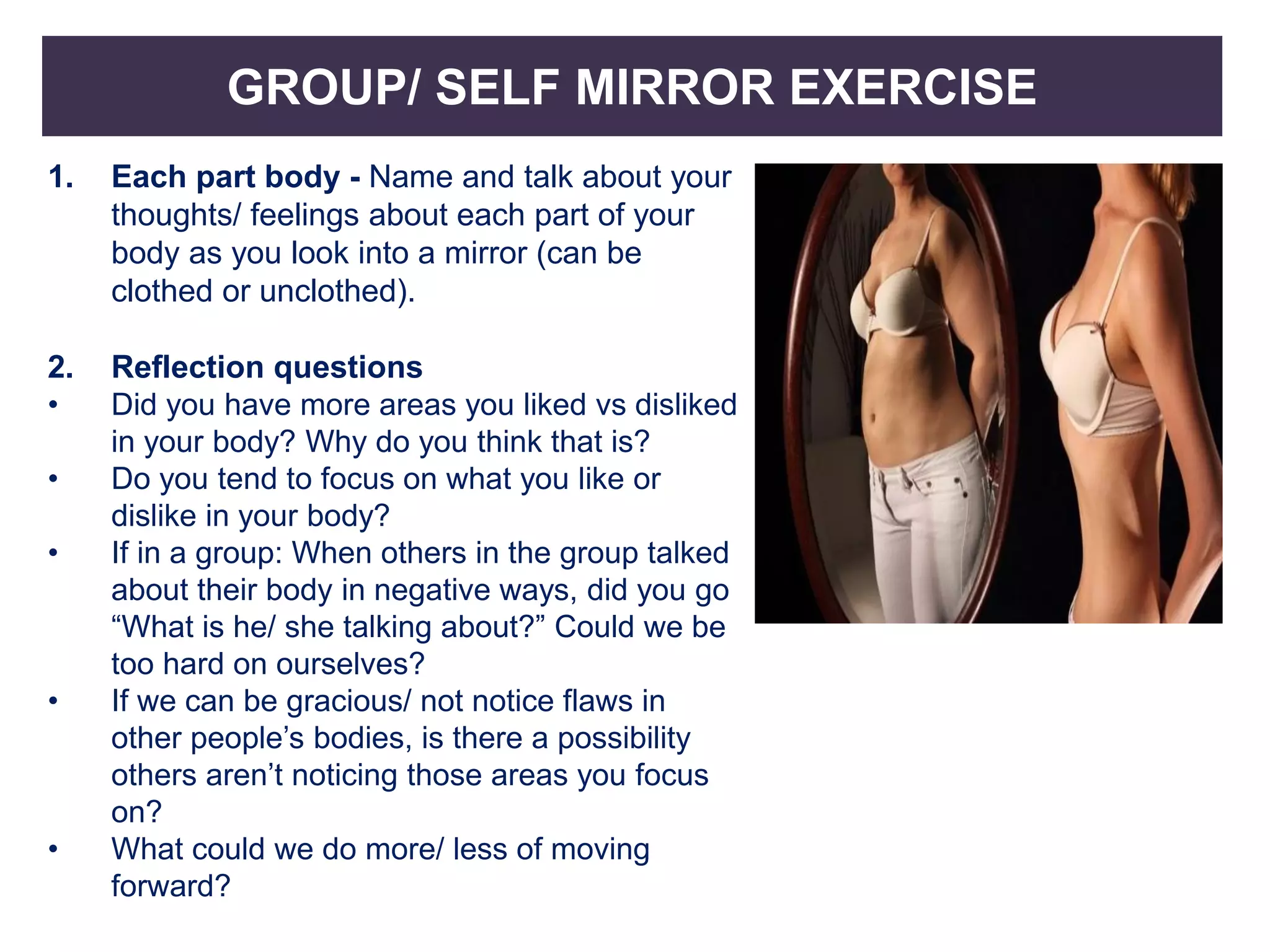
GROUP/ SELF MIRROR EXERCISE
1. Each part body - Name and talk about your
thoughts/ feelings about each part of your
body as you look into a mirror (can be
clothed or unclothed).
2. Reflection questions
• Did you have more areas you liked vs disliked
in your body? Why do you think that is?
• Do you tend to focus on what you like or
dislike in your body?
• If in a group: When others in the group talked
about their body in negative ways, did you go
“What is he/ she talking about?” Could we be
too hard on ourselves?
• If we can be gracious/ not notice flaws in
other people’s bodies, is there a possibility
others aren’t noticing those areas you focus
on?
• What could we do more/ less of moving
forward?
COGNITIVE BEHAVIORAL THERAPY AND BODY
IMAGE
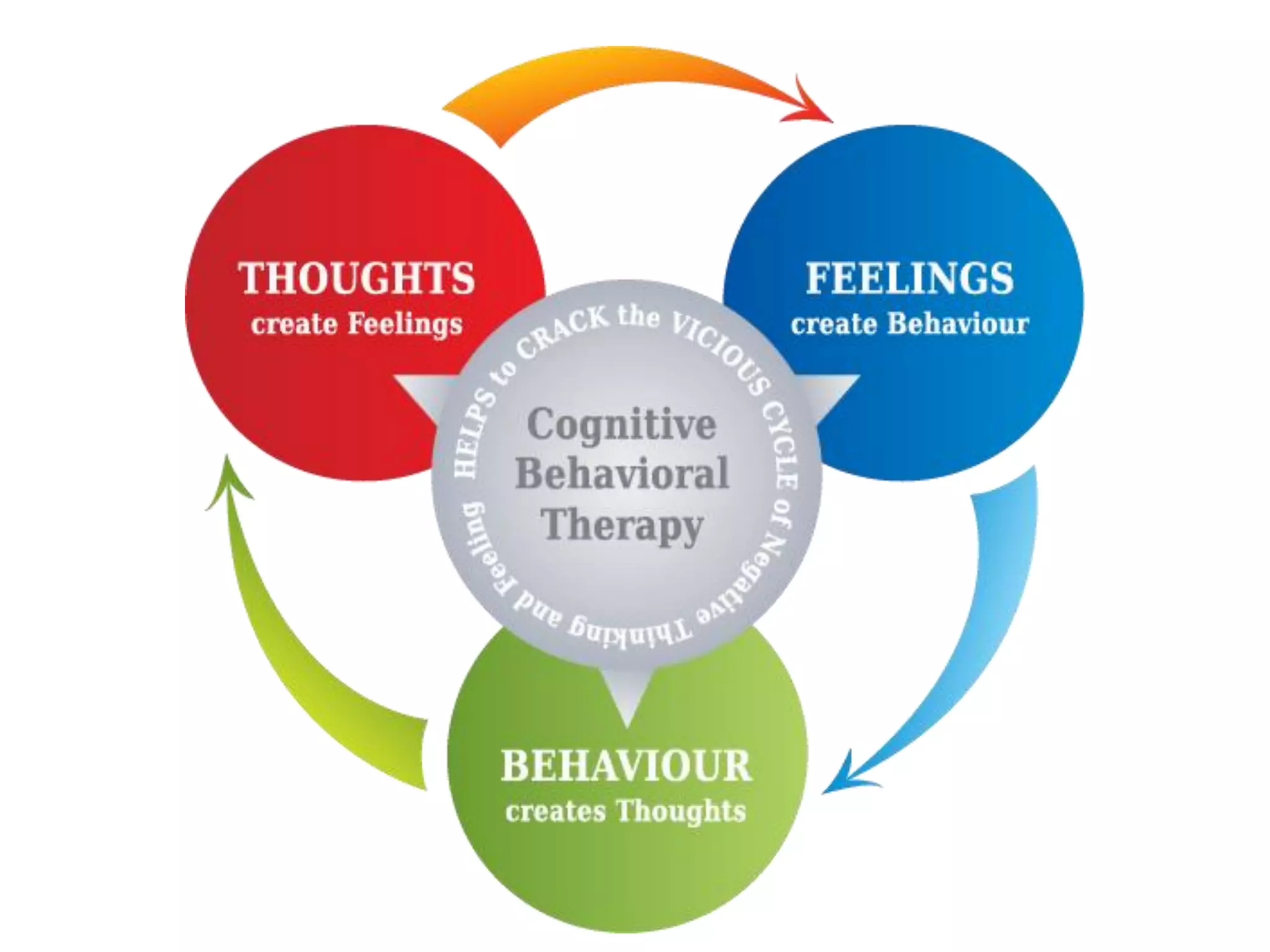
• Cognitive behavioral therapy (CBT) is a form of psychotherapy that
focuses on changing patterns of thinking or behavior in order to
change an emotion.
• CBT is used to treat a wide range of challenges including anxiety,
substance abuse, depression, and more.
• This problem-solving technique teaches the skills necessary to
overcome negative and destructive patterns of thinking.
• Cognitive behavioral therapy helps to identify which factors are
playing a role in maintaining a negative body image and works to
address each one by teaching the skills necessary to allow healing to
occur.
Cognitive Behavioral Therapy and Body Image. (2015, July 5). Retrieved from https://www.eatingdisorderhope.com/treatment-for-eating-
disorders/types-of-treatments/cognitive-behavioral-therapy-cbt/cognitive-behavioral-therapy-and-body-image
REFERENCES
1. American Psychiatric Association. (2013). Diagnostic and Statistical Manual of Mental Disorders. (5th Edition). Washington, DC.
2. Bjornsson, A. S., Didie, E. R., & Phillips, K. A. (2010). Body dysmorphic disorder. Dialogues in clinical neuroscience, 12(2), 221–232.
3. British Association of Sexual & RelationshipTherapy.020854432707 www.basrt.org.uk
4. Body Image (infographic). (2017, June 13). Retrieved from https://www.thefyi.org/body-image-infographic/
5. Cognitive Behavioral Therapy and Body Image. (2015, July 5). Retrieved from https://www.eatingdisorderhope.com/treatment-for-
eating-disorders/types-of-treatments/cognitive-behavioral-therapy-cbt/cognitive-behavioral-therapy-and-body-image
6. Five Research Based Tips Improving Your Body Image. 2019 June 23 Retrieved from https://www.psychologytoday.com/us/blog/presence-
mind/201501/five-research-based-tips-improving-your-body-image
7. Jung, A. 2013 February 27). Body image can affect your sex life. Retrieved from https://statehornet.com/2013/02/body-image-can-
affect-your-sex-life/
8. Lee,J,M (1970) Emotional reactions to trauma.Nursing Clinics of North America.Vol 5 pp 577-587`
9. Kahana RJ, Bibring GL. Personality types in medical management. In: Zinberg NE, editor. Psychiatry and Medical Practice in a
General Hospital. New York, NY: International Universities Press; 1964. pp. 108–123.
10. Price,B (1990) A model for body image care. Journal of Advanced Nursing Vol 15 pp 585 – 593
11. Pujols Y., Meston C. & Seal, B. (2009). Journal of Sexual Medicine Wiley Online Library. The Association between Sexual Satisfaction
and Body Image in Women
12. Striegel-Moore T.. Franko, J. (2002). How One Perceives Female and the Media
13. Tomlinson,J (2000) ABC of sexual health: Taking a sexual history. London: BMJ
14. Van de Velde,C,D ( 1985) Body images of ones’ self & others. Development & clinical significance. American Journal of Psychiatry.
Vol. 142 pp 527 – 537
15. Yarber, W. & Sayad, B. (2013). Human Sexuality: Diversity in Contemporary America (8th ed)
Dr. Martha Tara Lee,
D.H.S.
Clinical Sexologist
Eros Coaching Pte Ltd
Website: www.eroscoaching.com
Email:
drmarthalee@eroscoaching.com

Body Image and Sexual Function

  • 1.
    Body Image and Sexual Function Dr.Martha Tara Lee, D.H.S. (Singapore) The NSpine 2019 London, United Kingdom
  • 2.
    Dr. Martha TaraLee • Doctorate in Human Sexuality • Masters in Counselling • Masters in Public Policy and Management • Bachelor of Arts (Comm) • Cert in Sex Therapy • Cert in Practical Counselling • Cert in Life Coaching Relationship Counselor & Clinical Sexologist
  • 3.
    AGENDA • Definition ofBody Image • Different Aspects of Body Image • Body image affecting sexuality • Treatments/ Suggestions
  • 4.
    BODY IMAGE 1. Howa person thinks and feels about his or her own body. 2. The way we see our body and the way we think that others see our body. 3. How you feel your body is esthetically and how attractive you perceive yourself. 4. Society's standards may not always correspond to our perception of our own body.
  • 5.
    Body Dysmorphic Disorder affects1.7% to 2.4% of the general population – about 1 in 50 people. BDD often begins to occur in adolescents 12-13 years of age. Studies show that size isn’t as important as we think. Yarber, W. & Sayad, B. (2013). Human Sexuality: Diversity in Contemporary America (8th ed)
  • 6.
    Approximately 80% ofindividuals with BDD report past or current suicidal ideation, and about one quarter have attempted suicide, which is often attributed to BDD symptoms Bjornsson, A. S., Didie, E. R., & Phillips, K. A. (2010). Body dysmorphic disorder. Dialogues in clinical neuroscience, 12(2), 221–232. Studies have consistently found that insight is poorer in BDD than in OCD, with 27% to 60% of BDD patients having delusional beliefs versus only 2% of OCD patients. About two thirds of BDD patients have past or current ideas or delusions of reference, believing that other people take special notice of them in a negative way or mock or ridicule them because of how they look.
  • 7.
    ALL IN MIND •The mental representation we create of what we think we look like. • The avg. person receive at least 14 messages a day related to attractiveness from the media. • Body dissatisfaction and eating disorders are common in college females and adolescents.
  • 8.
    SEXUAL HEALTH According tothe current working definition, sexual health is: “…a state of physical, emotional, mental and social well-being in relation to sexuality; it is not merely the absence of disease, dysfunction or infirmity. Sexual health requires a positive and respectful approach to sexuality and sexual relationships, as well as the possibility of having pleasurable and safe sexual experiences, free of coercion, discrimination and violence.”
  • 9.
    BODY IMAGE AFFEECTINGSEXUALITY “In my experience, negative body image is the no. 1 cause of bad sex for women,” said Dr. Hilda, a Clinical Professor of Obstetrics & Gynecology at Columbia University Medical Center. “If you don’t feel good about yourself, what happens is your brain kind of leaves your body and you become spectator. Jung, A. (2013, February 27). Body image can affect your sex life. Retrieved from https://statehornet.com/2013/02/body-image-can-affect-your-sex-life/
  • 10.
    BODY IMAGE AFFEECTINGSEXUALITY Body image becomes a major issue as females go through puberty; girls in mid-adolescence frequently reported being dissatisfied with weight , fearing further and preoccupied with weight loss Striegel-Moore T.. Franko, J. (2002). How One Perceives Female and the Media
  • 11.
    BODY IMAGE AFFEECTINGSEXUALITY A multiple regression analysis revealed that sexual satisfaction was predicted by high body esteem and low frequency of appearance-based distracting throughts during sexual activity. Pujols Y., Meston C. & Seal, B. (2009). Journal of Sexual Medicine Wiley Online Library. The Association between Sexual Satisfaction and Body Image in Women
  • 12.
    SOME BODY IMAGE& SEXUALITY ISSUES 1. Loss of energy/ fatigue 2. Loss of control 3. Isolation 4. Feeling dirty 5. Sexual dysfunction/ distress 6. Fertility 7. Pregnancy 8. Menopause
  • 13.
    HOW CAN APHYSICIAN ASSESS AND MANAGE CHANGES IN BODY IMAGE? Personality Type Reaction to Medical Illness Dependent, overdemanding Needs special attention Orderly, controlled Needs as much information as possible Dramatizing, emotionally involved, captivating Acts with and expects warmth and personal connection to caregiver Long-suffering, self-sacrificing Attributes illness to “bad luck” Guarded, querulous Paranoid, expects the worst Self-aggrandizing Often insecure when speaking with anyone other than their own physician Uninvolved, aloof Often denies their illness Personality Types and Their Reaction to Medical Illness Kahana RJ, Bibring GL. Personality types in medical management. In: Zinberg NE, editor. Psychiatry and Medical Practice in a General Hospital. New York, NY: International Universities Press; 1964. pp. 108–123.
  • 14.
    5 RESEARCH-BASED TIPSFOR IMPROVING BODY IMAGE 1. Harm reduction - Reduce your exposure to media imagery of idealized, unrealistic bodies and compare yourself to normal healthy people, not to unrealistic media ideals. 2. Social - Think about whom you’re “hanging” with and whether they’re healthy for your body image. Avoid or distance from “lookist” people and groups that are overly focused on physical appearance and achieving unrealistic physical standards. Cultivate relationships with people and groups with healthy body images and practices. Retrieved from https://www.psychologytoday.com/us/blog/presence- mind/201501/five-research-based-tips-improving-your-body-image
  • 15.
    5 RESEARCH-BASED TIPSFOR IMPROVING BODY IMAGE 3. Self compassion - Write a letter to a hypothetical younger woman or man, or a young daughter or son that outlines the costs of pursuing the idealized body and the benefits of a healthy body. 4. Affirmations - Identify and challenge any irrational absolutist thoughts that feed your body image dissatisfaction. Make this your practice until you’ve truly banished these damaging little devils from your head. 5. Do what you can - Switch from thinking of your body, diet, and exercise in terms of how it will make you look to thinking of your body, diet, and exercise in terms of how it will benefit your health. Five Research Based Tips Improving Your Body Image. 2019 June 23 Retrieved from https://www.psychologytoday.com/us/blog/presence- mind/201501/five-research-based-tips-improving-your-body- image
  • 16.
    TIPS FOR BETTER BODYIMAGE 1. Say something positive about your body every day 2. Aim to get healthier rather than lose weight 3. Focus on yourself as a person not just how you look 4. Stop making unkind comments about other bodies 5. Choose media that make you feel better, not worse Body Image (infographic). (2017, June 13). Retrieved from https://www.thefyi.org/body-image-infographic/
  • 17.
    GROUP/ SELF MIRROREXERCISE 1. Each part body - Name and talk about your thoughts/ feelings about each part of your body as you look into a mirror (can be clothed or unclothed). 2. Reflection questions • Did you have more areas you liked vs disliked in your body? Why do you think that is? • Do you tend to focus on what you like or dislike in your body? • If in a group: When others in the group talked about their body in negative ways, did you go “What is he/ she talking about?” Could we be too hard on ourselves? • If we can be gracious/ not notice flaws in other people’s bodies, is there a possibility others aren’t noticing those areas you focus on? • What could we do more/ less of moving forward?
  • 18.
    COGNITIVE BEHAVIORAL THERAPYAND BODY IMAGE • Cognitive behavioral therapy (CBT) is a form of psychotherapy that focuses on changing patterns of thinking or behavior in order to change an emotion. • CBT is used to treat a wide range of challenges including anxiety, substance abuse, depression, and more. • This problem-solving technique teaches the skills necessary to overcome negative and destructive patterns of thinking. • Cognitive behavioral therapy helps to identify which factors are playing a role in maintaining a negative body image and works to address each one by teaching the skills necessary to allow healing to occur. Cognitive Behavioral Therapy and Body Image. (2015, July 5). Retrieved from https://www.eatingdisorderhope.com/treatment-for-eating- disorders/types-of-treatments/cognitive-behavioral-therapy-cbt/cognitive-behavioral-therapy-and-body-image
  • 20.
    REFERENCES 1. American PsychiatricAssociation. (2013). Diagnostic and Statistical Manual of Mental Disorders. (5th Edition). Washington, DC. 2. Bjornsson, A. S., Didie, E. R., & Phillips, K. A. (2010). Body dysmorphic disorder. Dialogues in clinical neuroscience, 12(2), 221–232. 3. British Association of Sexual & RelationshipTherapy.020854432707 www.basrt.org.uk 4. Body Image (infographic). (2017, June 13). Retrieved from https://www.thefyi.org/body-image-infographic/ 5. Cognitive Behavioral Therapy and Body Image. (2015, July 5). Retrieved from https://www.eatingdisorderhope.com/treatment-for- eating-disorders/types-of-treatments/cognitive-behavioral-therapy-cbt/cognitive-behavioral-therapy-and-body-image 6. Five Research Based Tips Improving Your Body Image. 2019 June 23 Retrieved from https://www.psychologytoday.com/us/blog/presence- mind/201501/five-research-based-tips-improving-your-body-image 7. Jung, A. 2013 February 27). Body image can affect your sex life. Retrieved from https://statehornet.com/2013/02/body-image-can- affect-your-sex-life/ 8. Lee,J,M (1970) Emotional reactions to trauma.Nursing Clinics of North America.Vol 5 pp 577-587` 9. Kahana RJ, Bibring GL. Personality types in medical management. In: Zinberg NE, editor. Psychiatry and Medical Practice in a General Hospital. New York, NY: International Universities Press; 1964. pp. 108–123. 10. Price,B (1990) A model for body image care. Journal of Advanced Nursing Vol 15 pp 585 – 593 11. Pujols Y., Meston C. & Seal, B. (2009). Journal of Sexual Medicine Wiley Online Library. The Association between Sexual Satisfaction and Body Image in Women 12. Striegel-Moore T.. Franko, J. (2002). How One Perceives Female and the Media 13. Tomlinson,J (2000) ABC of sexual health: Taking a sexual history. London: BMJ 14. Van de Velde,C,D ( 1985) Body images of ones’ self & others. Development & clinical significance. American Journal of Psychiatry. Vol. 142 pp 527 – 537 15. Yarber, W. & Sayad, B. (2013). Human Sexuality: Diversity in Contemporary America (8th ed)
  • 21.
    Dr. Martha TaraLee, D.H.S. Clinical Sexologist Eros Coaching Pte Ltd Website: www.eroscoaching.com Email: drmarthalee@eroscoaching.com