
An Introduction To Software
Development Using Python
Spring Semester, 2015
Class #2:
Python, Print()
An Example Python Job Description
• Python Developer (Icreon Tech Inc, NYC, NY, 1 month ago)
• Job Description: Title: Python Developer Location: Remote Work
• Responsibilities:
– Have to code, debug, and unit test systems per requirements and technical design.
– Ensuring quality of the deliverables
– Understanding client requirements & functional specifications
– Communicating the project status and updates regularly and clearly.
– Keeping Track of effort spend on tasks assigned to him.
– Work with TEAM to develop complex web-based applications
– Support, refactor and enhance an existing application/ system.
• Requirement:
– Proven application development experience using (Python with MySQL/Postgre
SQL/Couchbase/MongoDB)
– Understanding of MVC Architecture, OOPS, REST, SOA, SaaS, NoSQL Database, Unit
Testing Framework Like PyUnit, Version control ( Like SVN,GIT), Sphinx, Redis, PyLint,
Deployment and maintenance tools such as SaltStack, Chef, Puppet.
What Is Programming?
• The term programming means to create (or develop) software, which is
also called a program.
• In basic terms, software contains the instructions that tell a computer—or
a computerized device—what to do.
• Software is all around you, even in devices that you might not think would
need it. Of course, you expect to find and use software on a personal
computer, but software also plays a role in running airplanes, cars, cell
phones, and even toasters.
• On a personal computer, you use word processors to write documents,
Web browsers to explore the Internet, and e-mail programs to send
messages. These programs are all examples of software.
Image Credit: www.fotosearch.com
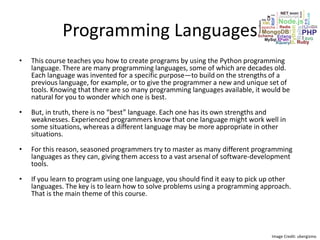
Programming Languages
• This course teaches you how to create programs by using the Python programming
language. There are many programming languages, some of which are decades old.
Each language was invented for a specific purpose—to build on the strengths of a
previous language, for example, or to give the programmer a new and unique set of
tools. Knowing that there are so many programming languages available, it would be
natural for you to wonder which one is best.
• But, in truth, there is no “best” language. Each one has its own strengths and
weaknesses. Experienced programmers know that one language might work well in
some situations, whereas a different language may be more appropriate in other
situations.
• For this reason, seasoned programmers try to master as many different programming
languages as they can, giving them access to a vast arsenal of software-development
tools.
• If you learn to program using one language, you should find it easy to pick up other
languages. The key is to learn how to solve problems using a programming approach.
That is the main theme of this course.
Image Credit: ubergizmo
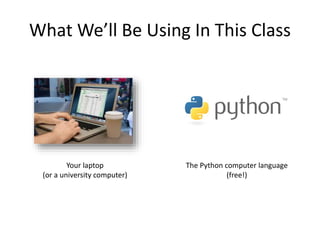
What We’ll Be Using In This Class
Your laptop
(or a university computer)
The Python computer language
(free!)
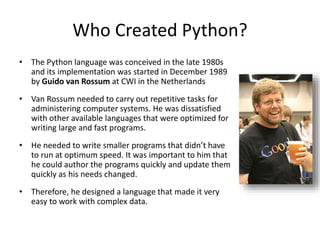
Who Created Python?
• The Python language was conceived in the late 1980s
and its implementation was started in December 1989
by Guido van Rossum at CWI in the Netherlands
• Van Rossum needed to carry out repetitive tasks for
administering computer systems. He was dissatisfied
with other available languages that were optimized for
writing large and fast programs.
• He needed to write smaller programs that didn’t have
to run at optimum speed. It was important to him that
he could author the programs quickly and update them
quickly as his needs changed.
• Therefore, he designed a language that made it very
easy to work with complex data.
The History Of Python
• Python 2.0 was released on October 16, 2000. With this
release the development process was changed and became
more transparent and community-backed.
• Python 3.0 (also called Python 3000 or py3k), a major,
backwards-incompatible release, was released on December
3, 2008 after a long period of testing. Many of its major
features have been backported to the backwards-compatible
Python 2.6 and 2.7.
• Python 2.x is very popular right now, we'll be learning Python
3.x because it's the future of Python.
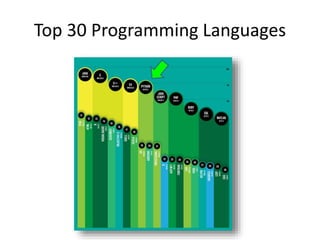
Top 30 Programming Languages
What Is Python?
• Python is a widely used general-purpose, high-level
programming language.
• Its design philosophy emphasizes code readability,
and its syntax allows programmers to express
concepts in fewer lines of code than would be
possible in languages such as C++ or Java.
• Python supports multiple programming paradigms,
including object-oriented, imperative and functional
programming.
Where Can I Run Python Programs?
• Python interpreters are available for installation on many operating
systems, allowing Python code execution on a majority of systems.
• Python code can be packaged into stand-alone executable programs for
some of the most popular operating systems, allowing for the distribution
of Python-based software for use on those environments without
requiring the installation of a Python interpreter.
• CPython, the reference implementation of Python, is free and open-
source software and has a community-based development model, as do
nearly all of its alternative implementations. CPython is managed by the
non-profit Python Software Foundation.
Image Credit: Logo Database,
Why Do People Like Python?
• Python has a much simpler and cleaner syntax than
other popular languages such as Java, C, and C++,
which makes it easier to learn.
• You can try out short Python programs in an
interactive environment, which encourages
experimentation and rapid turnaround.
• Python is also very portable between computer
systems. The same Python program will run, without
change, on Windows, UNIX, Linux, or Macintosh.
Image Credit: Hans-Jörg Aleff
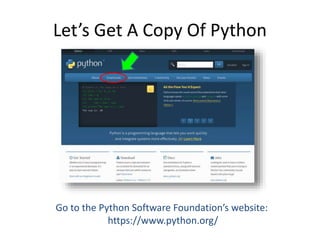
Let’s Get A Copy Of Python
Go to the Python Software Foundation’s website:
https://www.python.org/
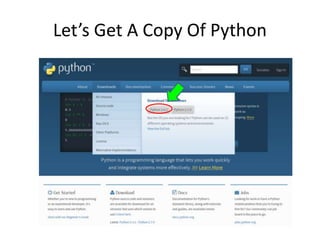
Let’s Get A Copy Of Python
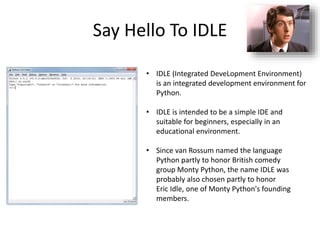
Say Hello To IDLE
• IDLE (Integrated DeveLopment Environment)
is an integrated development environment for
Python.
• IDLE is intended to be a simple IDE and
suitable for beginners, especially in an
educational environment.
• Since van Rossum named the language
Python partly to honor British comedy
group Monty Python, the name IDLE was
probably also chosen partly to honor
Eric Idle, one of Monty Python's founding
members.
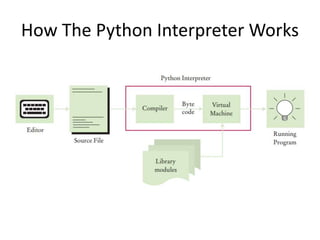
How The Python Interpreter Works
Our First Program: Hello World!
• Python is case sensitive. You must enter
upper- and lowercase letters exactly as they
appear in a program listing.
• You cannot type Print or PRINT.
Image Credit: ClipArt Best
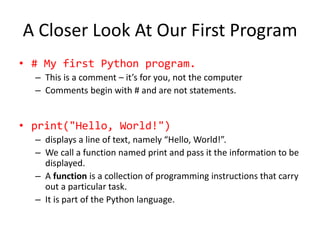
A Closer Look At Our First Program
• # My first Python program.
– This is a comment – it’s for you, not the computer
– Comments begin with # and are not statements.
• print("Hello, World!")
– displays a line of text, namely “Hello, World!”.
– We call a function named print and pass it the information to be
displayed.
– A function is a collection of programming instructions that carry
out a particular task.
– It is part of the Python language.
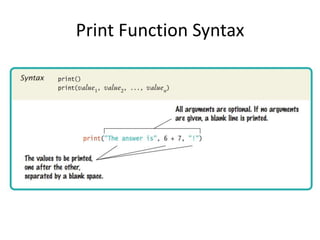
Print Function Syntax
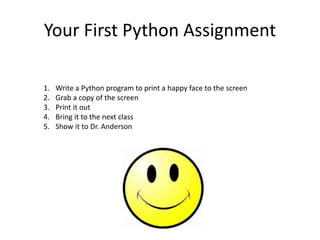
Your First Python Assignment
1. Write a Python program to print a happy face to the screen
2. Grab a copy of the screen
3. Print it out
4. Bring it to the next class
5. Show it to Dr. Anderson
What’s In Your Python Toolbox?
print()
What We Covered Today
1. Learned who invented Python
and why.
2. Came to understand what
Python is good at doing.
3. Downloaded and installed a
copy of the Python
interpreter.
4. Discovered the built-in IDLE
IDE.
5. Used our first BIF: print()
Image Credit: http://www.tswdj.com/blog/2011/05/17/the-grooms-checklist/
What We’ll Be Covering Next Time
1. Variables
2. Math!
Image Credit: http://merchantblog.thefind.com/2011/01/merchant-newsletter/resolve-to-take-advantage-of-these-5-e-commerce-trends/attachment/crystal-ball-fullsize/

An Introduction To Python - Python, Print()

  • 1.
    An Introduction ToSoftware Development Using Python Spring Semester, 2015 Class #2: Python, Print()
  • 2.
    An Example PythonJob Description • Python Developer (Icreon Tech Inc, NYC, NY, 1 month ago) • Job Description: Title: Python Developer Location: Remote Work • Responsibilities: – Have to code, debug, and unit test systems per requirements and technical design. – Ensuring quality of the deliverables – Understanding client requirements & functional specifications – Communicating the project status and updates regularly and clearly. – Keeping Track of effort spend on tasks assigned to him. – Work with TEAM to develop complex web-based applications – Support, refactor and enhance an existing application/ system. • Requirement: – Proven application development experience using (Python with MySQL/Postgre SQL/Couchbase/MongoDB) – Understanding of MVC Architecture, OOPS, REST, SOA, SaaS, NoSQL Database, Unit Testing Framework Like PyUnit, Version control ( Like SVN,GIT), Sphinx, Redis, PyLint, Deployment and maintenance tools such as SaltStack, Chef, Puppet.
  • 3.
    What Is Programming? •The term programming means to create (or develop) software, which is also called a program. • In basic terms, software contains the instructions that tell a computer—or a computerized device—what to do. • Software is all around you, even in devices that you might not think would need it. Of course, you expect to find and use software on a personal computer, but software also plays a role in running airplanes, cars, cell phones, and even toasters. • On a personal computer, you use word processors to write documents, Web browsers to explore the Internet, and e-mail programs to send messages. These programs are all examples of software. Image Credit: www.fotosearch.com
  • 4.
    Programming Languages • Thiscourse teaches you how to create programs by using the Python programming language. There are many programming languages, some of which are decades old. Each language was invented for a specific purpose—to build on the strengths of a previous language, for example, or to give the programmer a new and unique set of tools. Knowing that there are so many programming languages available, it would be natural for you to wonder which one is best. • But, in truth, there is no “best” language. Each one has its own strengths and weaknesses. Experienced programmers know that one language might work well in some situations, whereas a different language may be more appropriate in other situations. • For this reason, seasoned programmers try to master as many different programming languages as they can, giving them access to a vast arsenal of software-development tools. • If you learn to program using one language, you should find it easy to pick up other languages. The key is to learn how to solve problems using a programming approach. That is the main theme of this course. Image Credit: ubergizmo
  • 5.
    What We’ll BeUsing In This Class Your laptop (or a university computer) The Python computer language (free!)
  • 6.
    Who Created Python? •The Python language was conceived in the late 1980s and its implementation was started in December 1989 by Guido van Rossum at CWI in the Netherlands • Van Rossum needed to carry out repetitive tasks for administering computer systems. He was dissatisfied with other available languages that were optimized for writing large and fast programs. • He needed to write smaller programs that didn’t have to run at optimum speed. It was important to him that he could author the programs quickly and update them quickly as his needs changed. • Therefore, he designed a language that made it very easy to work with complex data.
  • 7.
    The History OfPython • Python 2.0 was released on October 16, 2000. With this release the development process was changed and became more transparent and community-backed. • Python 3.0 (also called Python 3000 or py3k), a major, backwards-incompatible release, was released on December 3, 2008 after a long period of testing. Many of its major features have been backported to the backwards-compatible Python 2.6 and 2.7. • Python 2.x is very popular right now, we'll be learning Python 3.x because it's the future of Python.
  • 8.
  • 9.
    What Is Python? •Python is a widely used general-purpose, high-level programming language. • Its design philosophy emphasizes code readability, and its syntax allows programmers to express concepts in fewer lines of code than would be possible in languages such as C++ or Java. • Python supports multiple programming paradigms, including object-oriented, imperative and functional programming.
  • 10.
    Where Can IRun Python Programs? • Python interpreters are available for installation on many operating systems, allowing Python code execution on a majority of systems. • Python code can be packaged into stand-alone executable programs for some of the most popular operating systems, allowing for the distribution of Python-based software for use on those environments without requiring the installation of a Python interpreter. • CPython, the reference implementation of Python, is free and open- source software and has a community-based development model, as do nearly all of its alternative implementations. CPython is managed by the non-profit Python Software Foundation. Image Credit: Logo Database,
  • 11.
    Why Do PeopleLike Python? • Python has a much simpler and cleaner syntax than other popular languages such as Java, C, and C++, which makes it easier to learn. • You can try out short Python programs in an interactive environment, which encourages experimentation and rapid turnaround. • Python is also very portable between computer systems. The same Python program will run, without change, on Windows, UNIX, Linux, or Macintosh. Image Credit: Hans-Jörg Aleff
  • 12.
    Let’s Get ACopy Of Python Go to the Python Software Foundation’s website: https://www.python.org/
  • 13.
    Let’s Get ACopy Of Python
  • 14.
    Say Hello ToIDLE • IDLE (Integrated DeveLopment Environment) is an integrated development environment for Python. • IDLE is intended to be a simple IDE and suitable for beginners, especially in an educational environment. • Since van Rossum named the language Python partly to honor British comedy group Monty Python, the name IDLE was probably also chosen partly to honor Eric Idle, one of Monty Python's founding members.
  • 15.
    How The PythonInterpreter Works
  • 16.
    Our First Program:Hello World! • Python is case sensitive. You must enter upper- and lowercase letters exactly as they appear in a program listing. • You cannot type Print or PRINT. Image Credit: ClipArt Best
  • 17.
    A Closer LookAt Our First Program • # My first Python program. – This is a comment – it’s for you, not the computer – Comments begin with # and are not statements. • print("Hello, World!") – displays a line of text, namely “Hello, World!”. – We call a function named print and pass it the information to be displayed. – A function is a collection of programming instructions that carry out a particular task. – It is part of the Python language.
  • 18.
  • 19.
    Your First PythonAssignment 1. Write a Python program to print a happy face to the screen 2. Grab a copy of the screen 3. Print it out 4. Bring it to the next class 5. Show it to Dr. Anderson
  • 20.
    What’s In YourPython Toolbox? print()
  • 21.
    What We CoveredToday 1. Learned who invented Python and why. 2. Came to understand what Python is good at doing. 3. Downloaded and installed a copy of the Python interpreter. 4. Discovered the built-in IDLE IDE. 5. Used our first BIF: print() Image Credit: http://www.tswdj.com/blog/2011/05/17/the-grooms-checklist/
  • 22.
    What We’ll BeCovering Next Time 1. Variables 2. Math! Image Credit: http://merchantblog.thefind.com/2011/01/merchant-newsletter/resolve-to-take-advantage-of-these-5-e-commerce-trends/attachment/crystal-ball-fullsize/

Editor's Notes

  • #2 New name for the class I know what this means Technical professionals are who get hired This means much more than just having a narrow vertical knowledge of some subject area. It means that you know how to produce an outcome that I value. I’m willing to pay you to do that.