







How to decide a research
topic?
How to Turn Research Topic
into an Argument?
How to write first draft of
research proposal?
Research Methodology Workshop
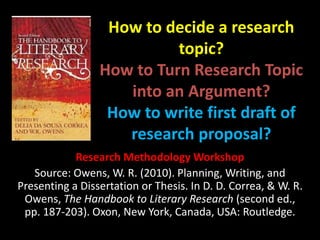
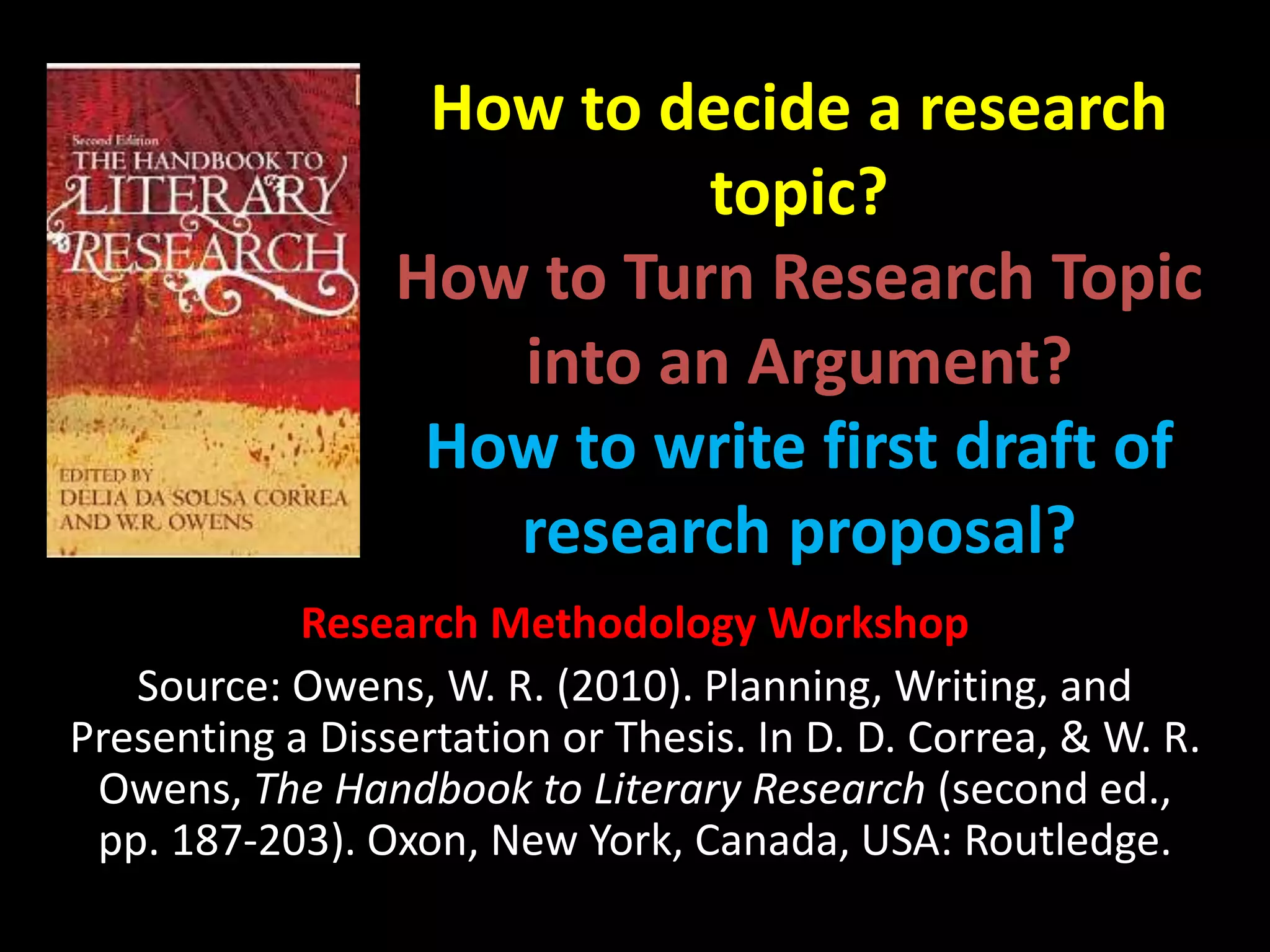
Source: Owens, W. R. (2010). Planning, Writing, and
Presenting a Dissertation or Thesis. In D. D. Correa, & W. R.
Owens, The Handbook to Literary Research (second ed.,
pp. 187-203). Oxon, New York, Canada, USA: Routledge.
Deciding on a Topic
• What would you like to learn more about?
• Make a list of things related to it.
• Read around – not aimlessly but purposively.
• Read with questions in your mind:
– What are some of the key studies in this field?
– What kinds of approaches have been taken to the
subject?
– What are the key issues and questions in this field?
– Are there any possible gaps, or approaches yet to be
explored? (Digital Humanities, Film Studies, et al)
Turning a Topic into an Argument
• After ‘deciding a relatively narrow and
sharply defined topic which nevertheless
opens out into large and important issues’,
the next step is to give it a direction.
• How?
• The way to do this is to develop out of your
topic a set of questions you want to answer,
or problems that you want to solve.
• Doing research is not about
gathering information or data for its
own sake:
–the information or data is presented in
order to answer questions, in order to
try to change what is thought about
something.
• Virtually every good dissertation / thesis will
take the form of argument
–An attempt to prove or establish something
by means of analysis of evidence.
–An insight of criminal lawyer and crime
reporter is necessary in collection and
analysis of evidence / proof. (Altick, Richard. The Art
of Literary Research)
There are many possible ways of turning a topic
into an argument.
• To give some examples, your dissertation might
be one of the following:
– An argument for or against an existing critic ( or
critical position) in relation to the author or group of
works you are studying.
– An argument about the importance of a particular
influence on a writer or influence exerted by him or
her.
– An argument for the importance of some hitherto
little-regarded piece of evidence to the discussion of
the work of some author or group of authors.
There are many possible ways of turning a topic
into an argument.
–An argument about the value of a new
theoretical approach to a text or set of
texts.
–An argument turning upon the nature of
the genre of a work or group of works.
–An argument about some historical or
literary-historical aspect of literature.
–An argument about the adequacy of
existing scholarly texts of particular work
There are many possible ways of turning a topic into
an argument.
–An argument about the significance of a
little – known or undervalued author or
work.
–An argument bringing together some aspect
of a well-known literary text with a lesser-
known text or with other media.
–An argument showing how a particular
theme or concept may be related to a group
of texts
Preparing a Research Proposal
• Title: Do not feel bound by this: it is imp to
have title that is clear and informative, but a
first attempt can be altered in the finished
product.
• Argument: State as concisely as possible what
your subject is and what your argument will
be.
• Materials: Primary, Secondary, Tertiary
Sources
Preparing a Research Proposal
• Chapters: Show how you think your discussion
may be organized.
• Conclusion: Clearly this will be provisional at
this stage. You have not yet argued your case,
merely outlined the materials and likely
directions of your argument.
• Bibliography: List of key primary, secondary
and tertiary texts – it is provisional and will
expand when your begin serious work.
Thank you
• Compiled by:
Dilip Barad
Dept. of English
Maharaja Krishnakumarsinhji Bhavnagar University
Bhavnagar – Gujarat – India
www.dilipbarad.com

Turning Research Topic into an Argument

  • 1.
    How to decidea research topic? How to Turn Research Topic into an Argument? How to write first draft of research proposal? Research Methodology Workshop Source: Owens, W. R. (2010). Planning, Writing, and Presenting a Dissertation or Thesis. In D. D. Correa, & W. R. Owens, The Handbook to Literary Research (second ed., pp. 187-203). Oxon, New York, Canada, USA: Routledge.
  • 2.
    Deciding on aTopic • What would you like to learn more about? • Make a list of things related to it. • Read around – not aimlessly but purposively. • Read with questions in your mind: – What are some of the key studies in this field? – What kinds of approaches have been taken to the subject? – What are the key issues and questions in this field? – Are there any possible gaps, or approaches yet to be explored? (Digital Humanities, Film Studies, et al)
  • 3.
    Turning a Topicinto an Argument • After ‘deciding a relatively narrow and sharply defined topic which nevertheless opens out into large and important issues’, the next step is to give it a direction. • How? • The way to do this is to develop out of your topic a set of questions you want to answer, or problems that you want to solve.
  • 4.
    • Doing researchis not about gathering information or data for its own sake: –the information or data is presented in order to answer questions, in order to try to change what is thought about something.
  • 5.
    • Virtually everygood dissertation / thesis will take the form of argument –An attempt to prove or establish something by means of analysis of evidence. –An insight of criminal lawyer and crime reporter is necessary in collection and analysis of evidence / proof. (Altick, Richard. The Art of Literary Research)
  • 6.
    There are manypossible ways of turning a topic into an argument. • To give some examples, your dissertation might be one of the following: – An argument for or against an existing critic ( or critical position) in relation to the author or group of works you are studying. – An argument about the importance of a particular influence on a writer or influence exerted by him or her. – An argument for the importance of some hitherto little-regarded piece of evidence to the discussion of the work of some author or group of authors.
  • 7.
    There are manypossible ways of turning a topic into an argument. –An argument about the value of a new theoretical approach to a text or set of texts. –An argument turning upon the nature of the genre of a work or group of works. –An argument about some historical or literary-historical aspect of literature. –An argument about the adequacy of existing scholarly texts of particular work
  • 8.
    There are manypossible ways of turning a topic into an argument. –An argument about the significance of a little – known or undervalued author or work. –An argument bringing together some aspect of a well-known literary text with a lesser- known text or with other media. –An argument showing how a particular theme or concept may be related to a group of texts
  • 9.
    Preparing a ResearchProposal • Title: Do not feel bound by this: it is imp to have title that is clear and informative, but a first attempt can be altered in the finished product. • Argument: State as concisely as possible what your subject is and what your argument will be. • Materials: Primary, Secondary, Tertiary Sources
  • 10.
    Preparing a ResearchProposal • Chapters: Show how you think your discussion may be organized. • Conclusion: Clearly this will be provisional at this stage. You have not yet argued your case, merely outlined the materials and likely directions of your argument. • Bibliography: List of key primary, secondary and tertiary texts – it is provisional and will expand when your begin serious work.
  • 11.
    Thank you • Compiledby: Dilip Barad Dept. of English Maharaja Krishnakumarsinhji Bhavnagar University Bhavnagar – Gujarat – India www.dilipbarad.com