Selection of the Statement of the
Problem/Topic [Literature]
Dr. Sheela P. Karthick
Associate Professor & Head,
Department of English
The Madura College (Autonomous),
Madurai – 625 011
E-mail sheelapkarthick@yahoo.co.in
Part – I
Definition of Research
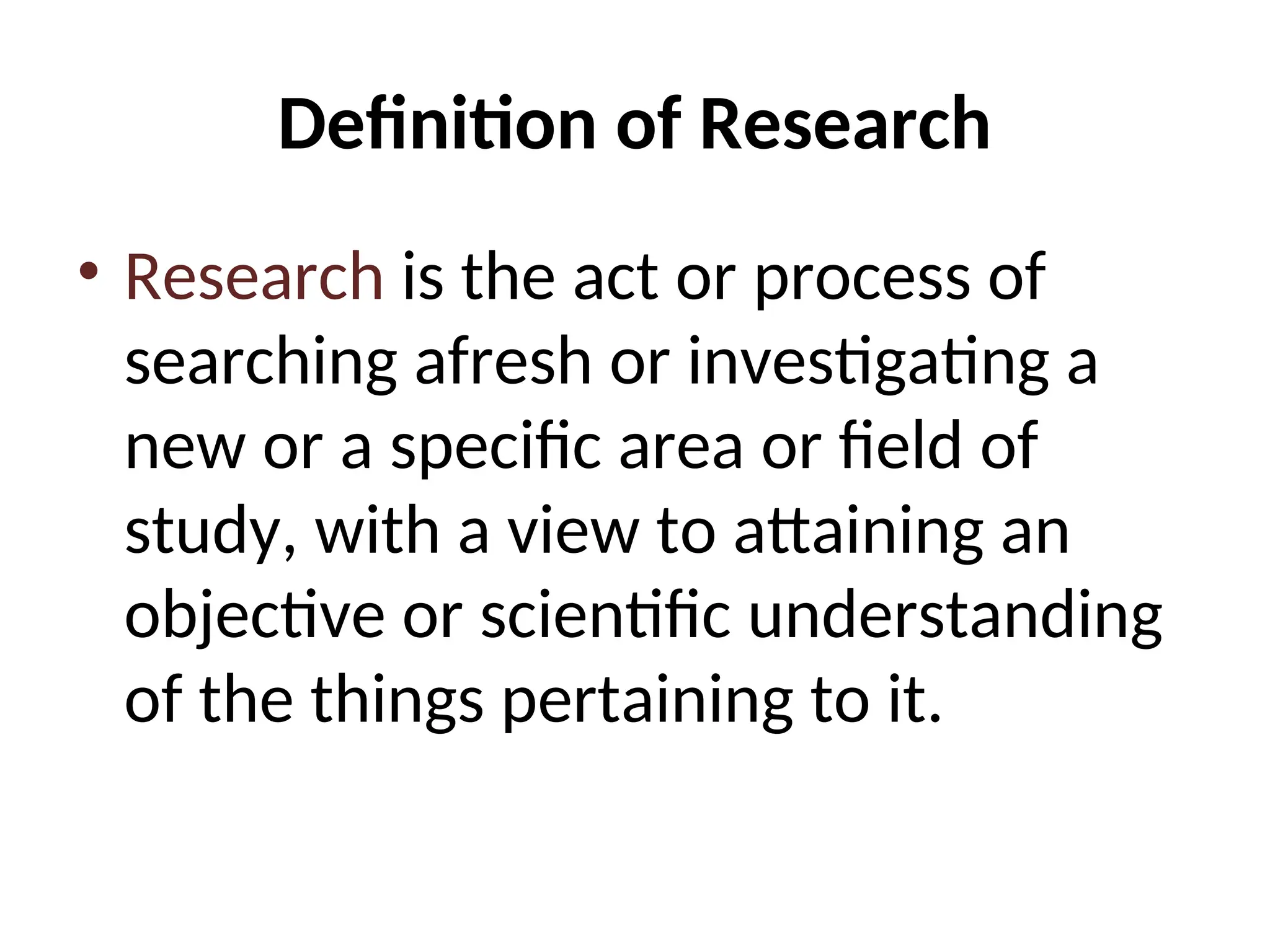
• Research is the act or process of
searching afresh or investigating a
new or a specific area or field of
study, with a view to attaining an
objective or scientific understanding
of the things pertaining to it.
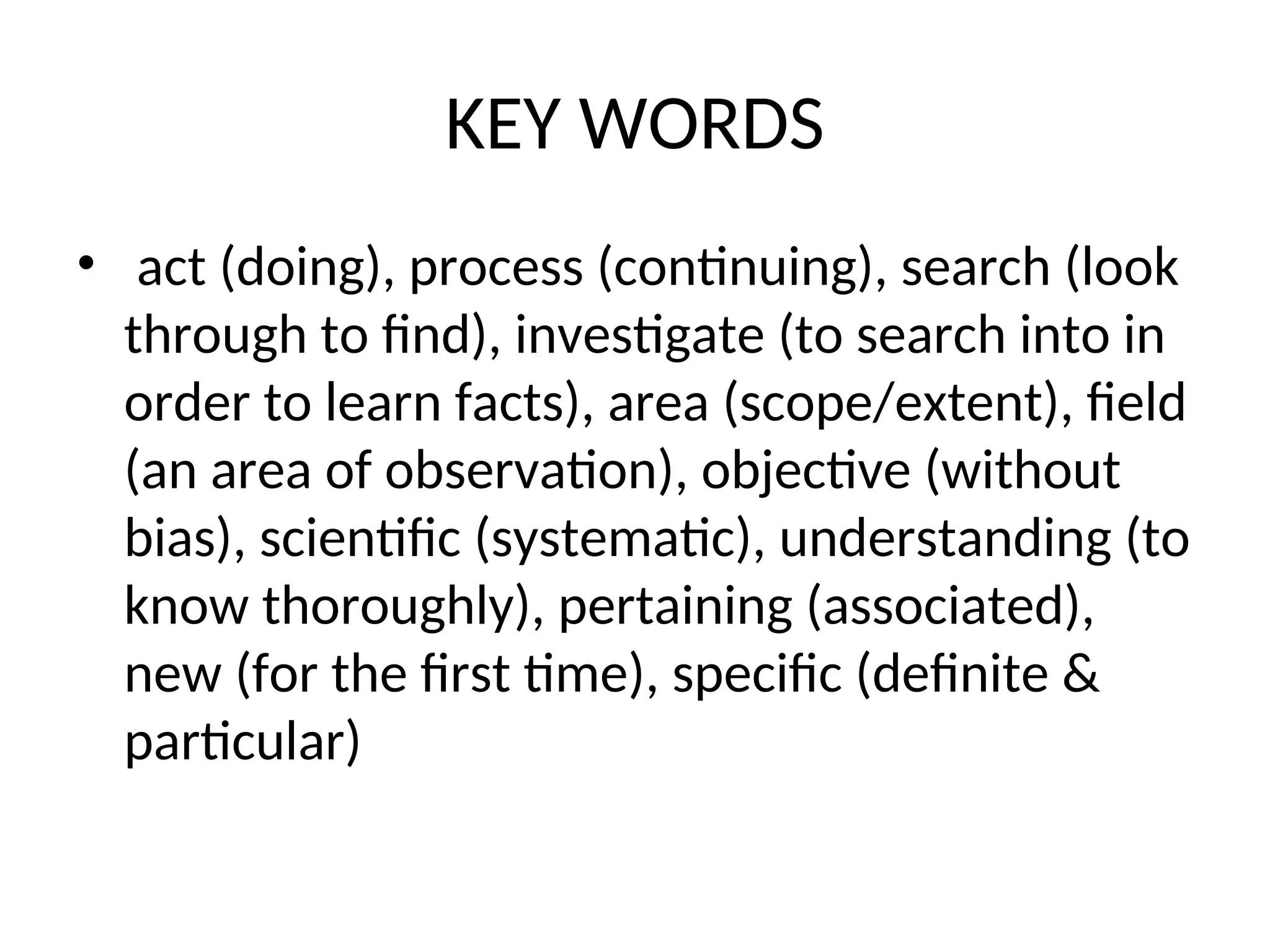
KEY WORDS
• act (doing), process (continuing), search (look
through to find), investigate (to search into in
order to learn facts), area (scope/extent), field
(an area of observation), objective (without
bias), scientific (systematic), understanding (to
know thoroughly), pertaining (associated),
new (for the first time), specific (definite &
particular)
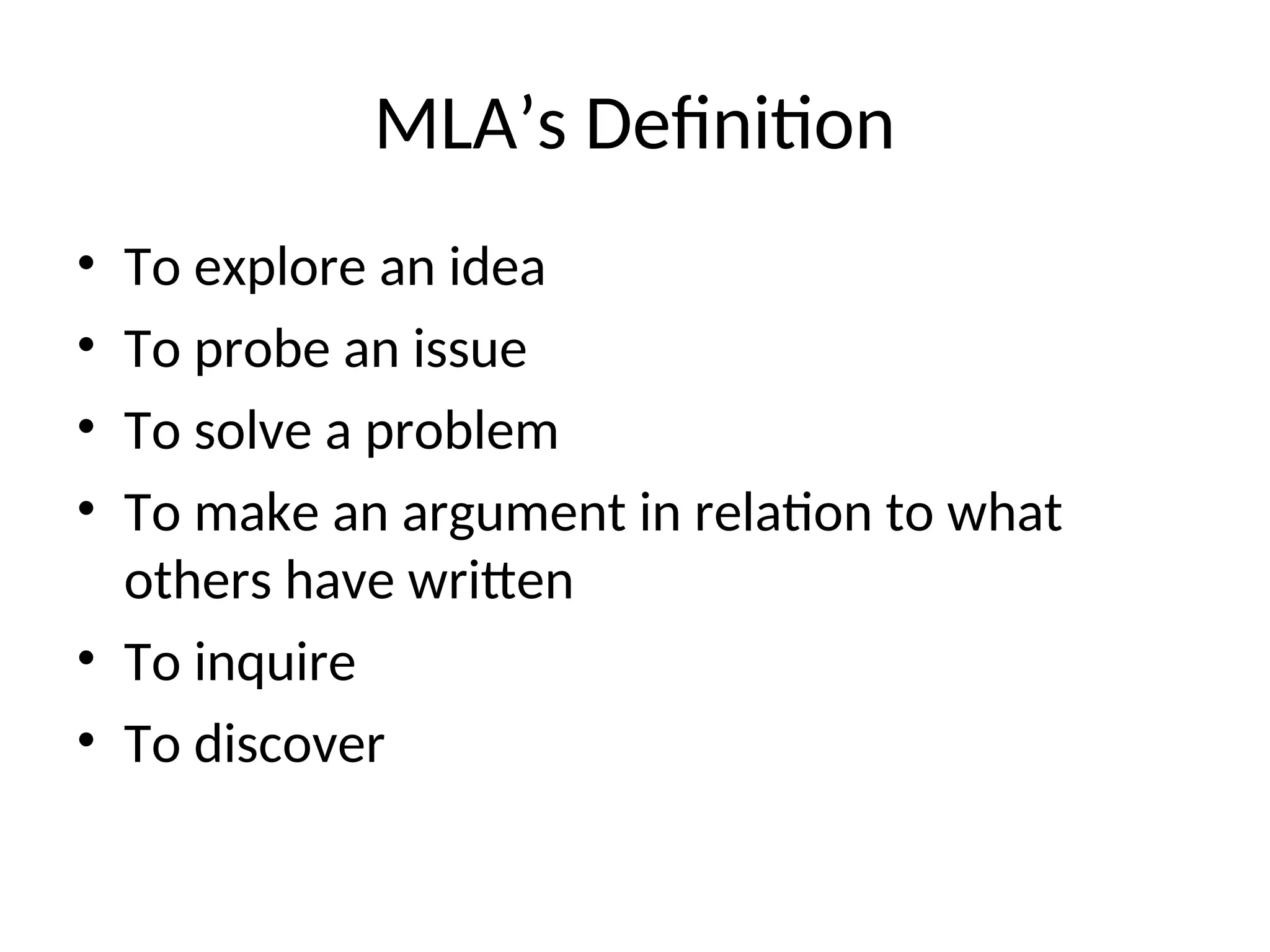
MLA’s Definition
• To explore an idea
• To probe an issue
• To solve a problem
• To make an argument in relation to what
others have written
• To inquire
• To discover
Research in Literature
“So what is research, especially in literary studies, after all?
In very ordinary language, research is a contribution to a
particular domain of knowledge. By contribution, I mean
addition to what we already know about the particular
area. If I want to write one more thesis on
‘Postcolonialism in Amitav Ghosh’ ‘ Spirituality in Sri
Aurobindo’ or ‘ Feminism in Shashi Deshpande’, I am not
really adding to what scholars already know about these
things. Research which provides knowledge which is
obvious and already known is of little use to anyone.”
--Sachin C. Ketkar
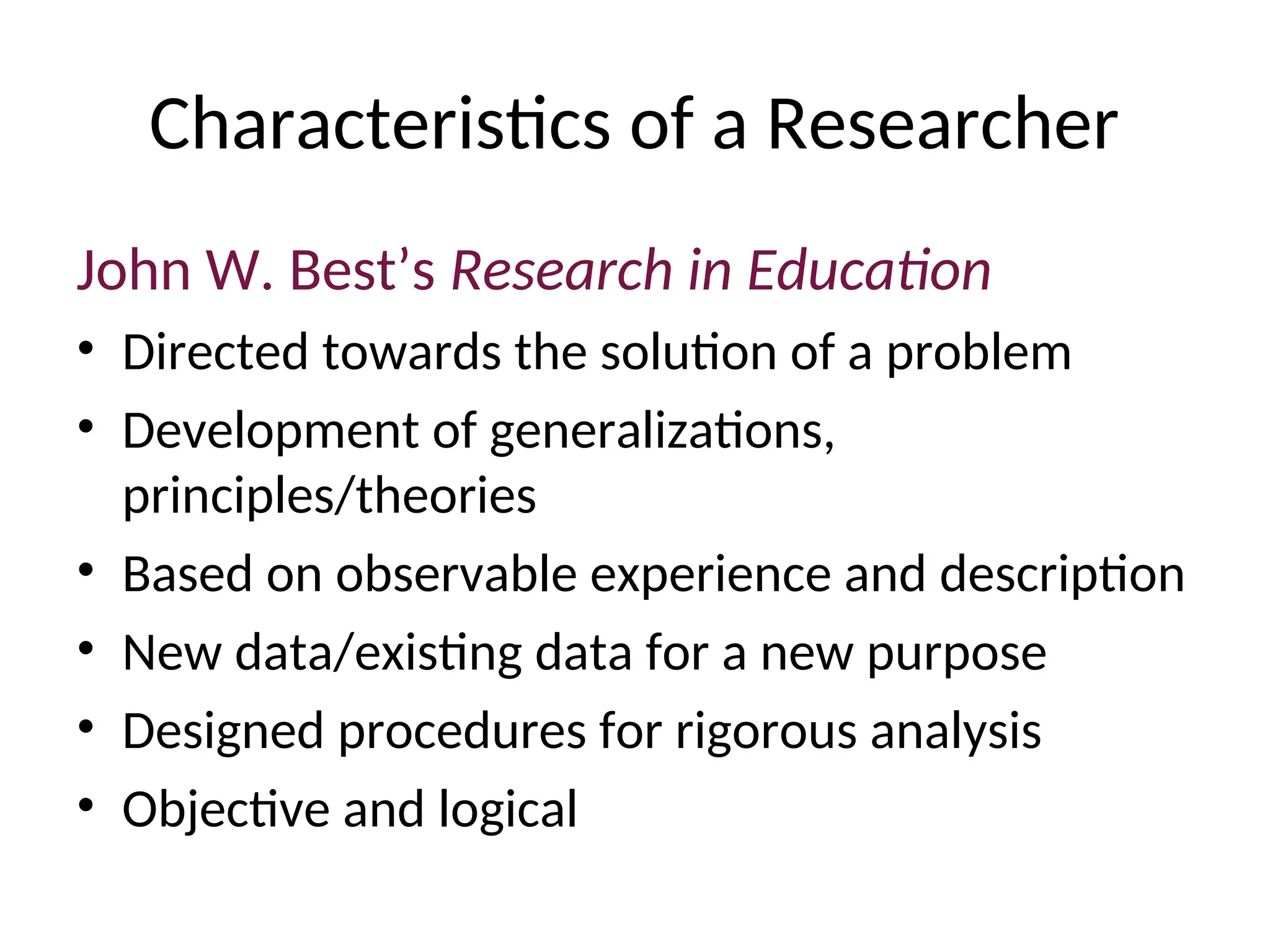
Characteristics of a Researcher
John W. Best’s Research in Education
• Directed towards the solution of a problem
• Development of generalizations,
principles/theories
• Based on observable experience and description
• New data/existing data for a new purpose
• Designed procedures for rigorous analysis
• Objective and logical
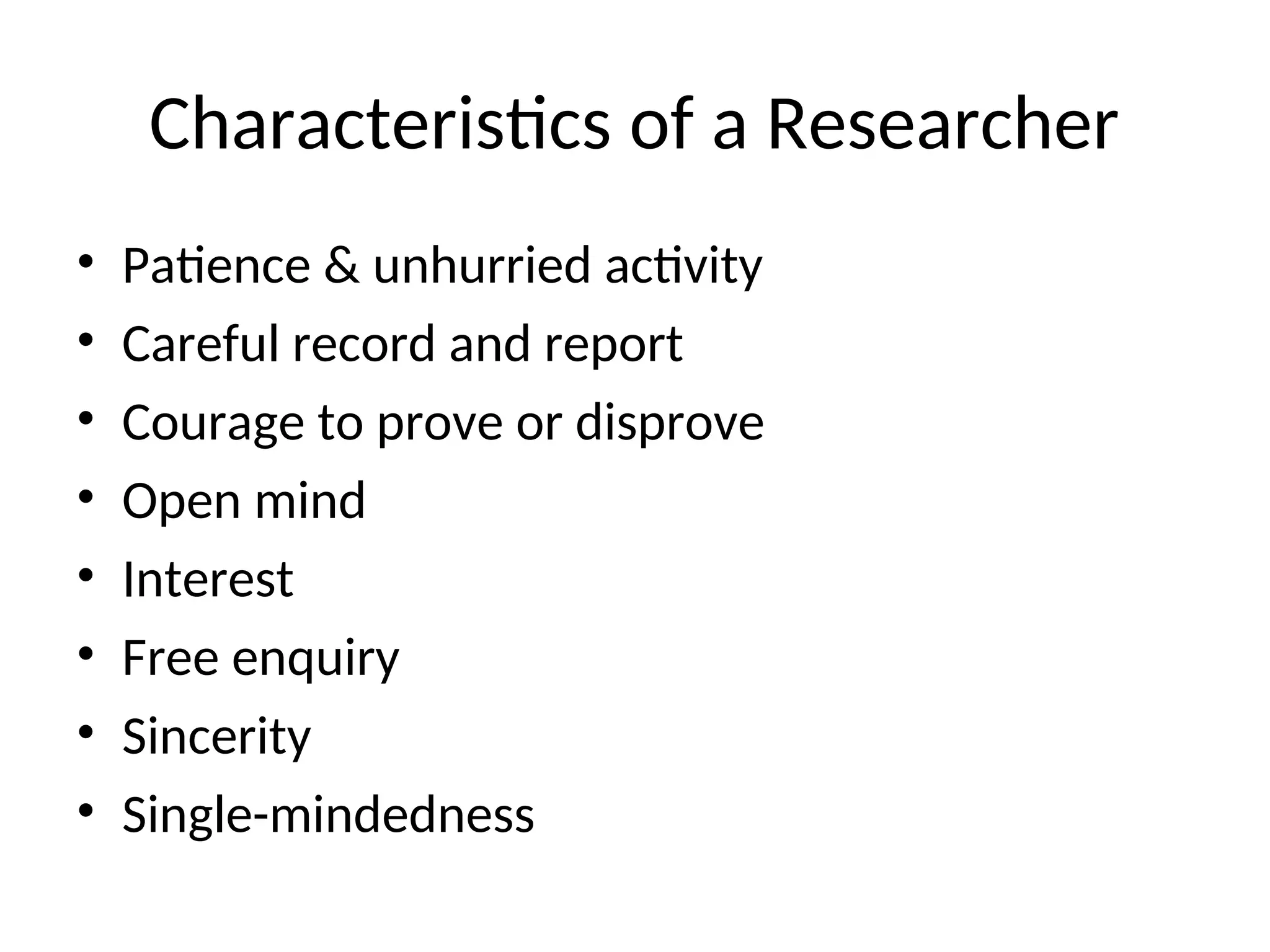
Characteristics of a Researcher
• Patience & unhurried activity
• Careful record and report
• Courage to prove or disprove
• Open mind
• Interest
• Free enquiry
• Sincerity
• Single-mindedness
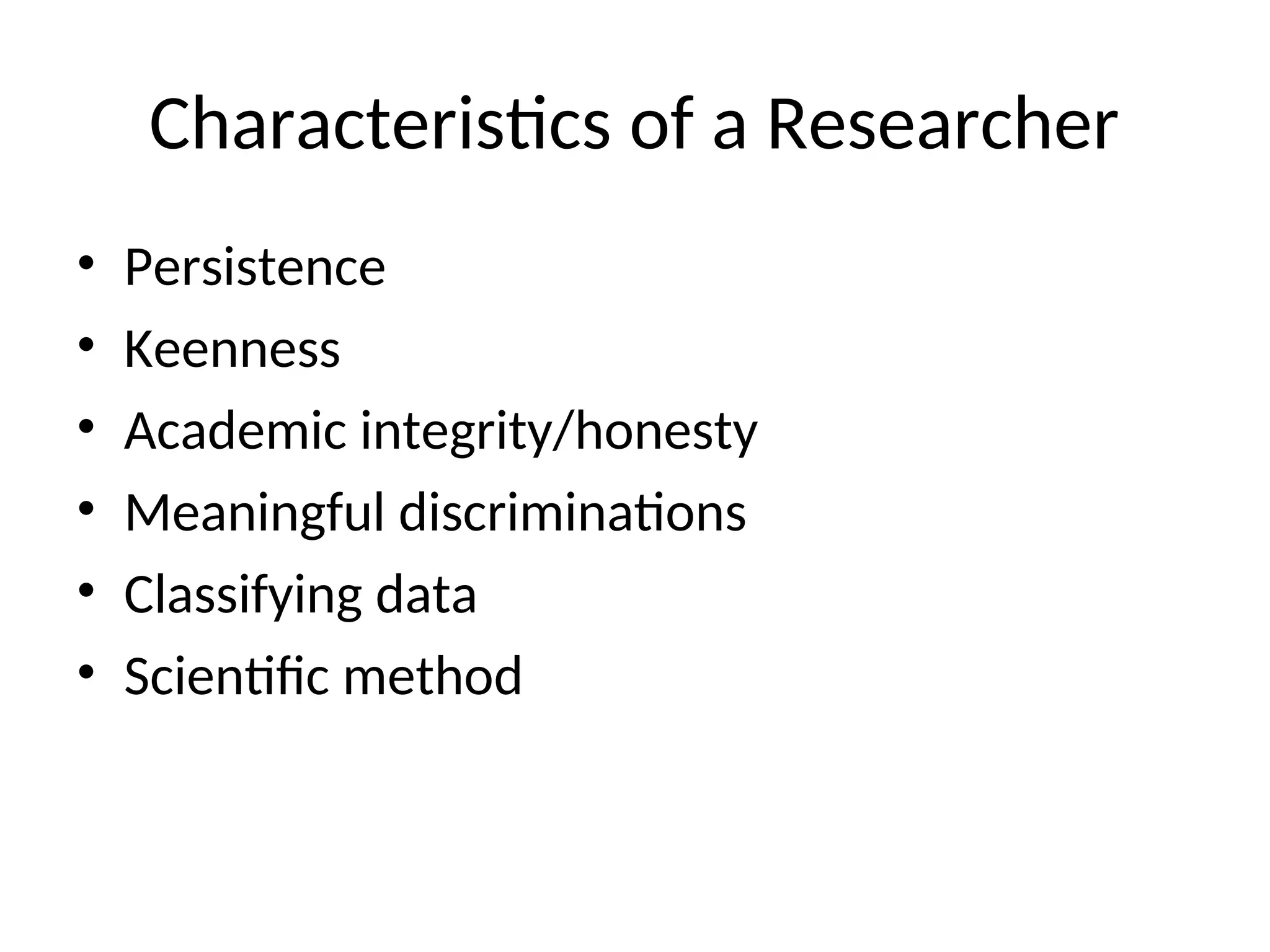
Characteristics of a Researcher
• Persistence
• Keenness
• Academic integrity/honesty
• Meaningful discriminations
• Classifying data
• Scientific method
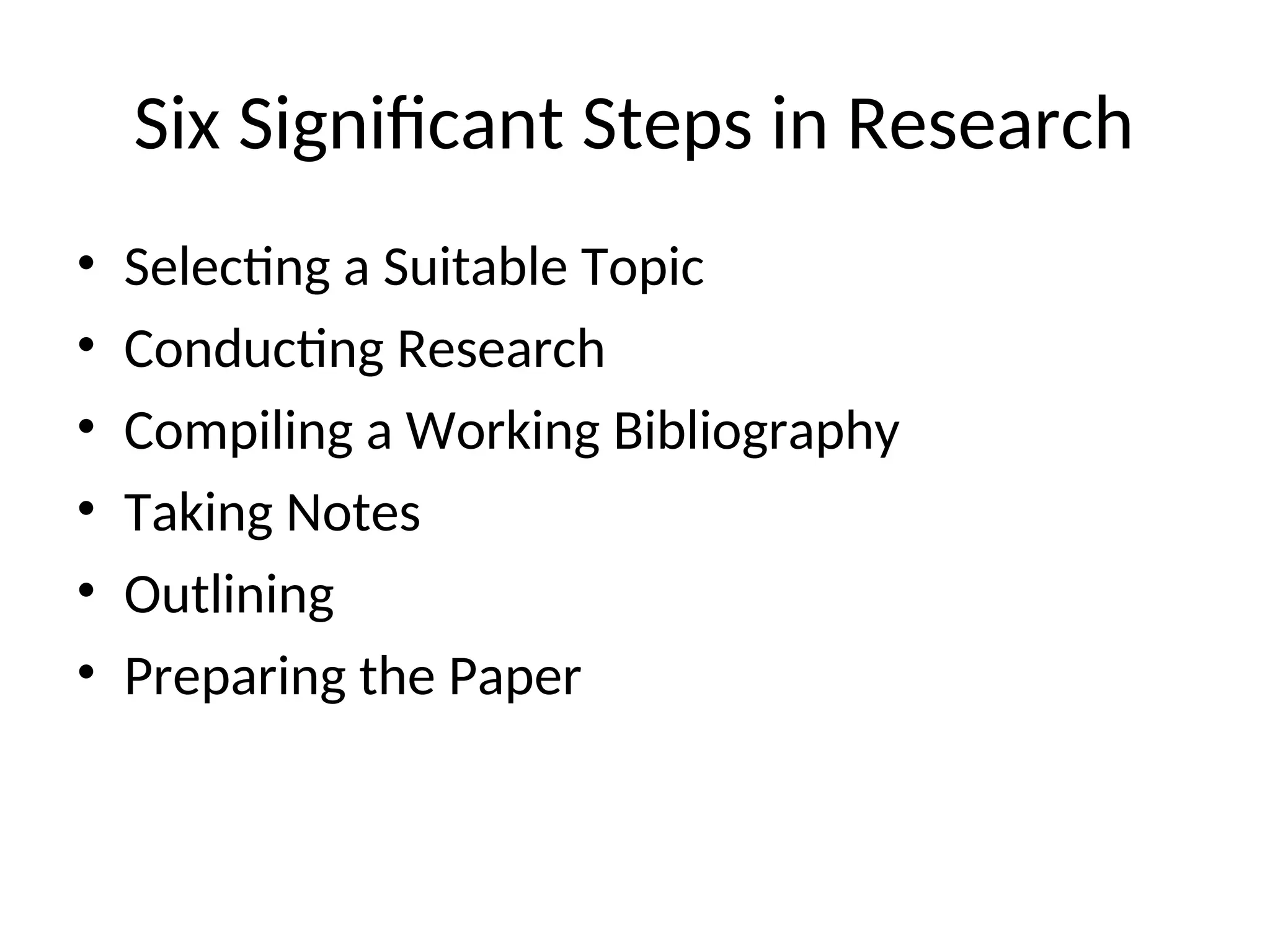
Six Significant Steps in Research
• Selecting a Suitable Topic
• Conducting Research
• Compiling a Working Bibliography
• Taking Notes
• Outlining
• Preparing the Paper
Part – II
Selecting a Topic: A Few Tips & Steps
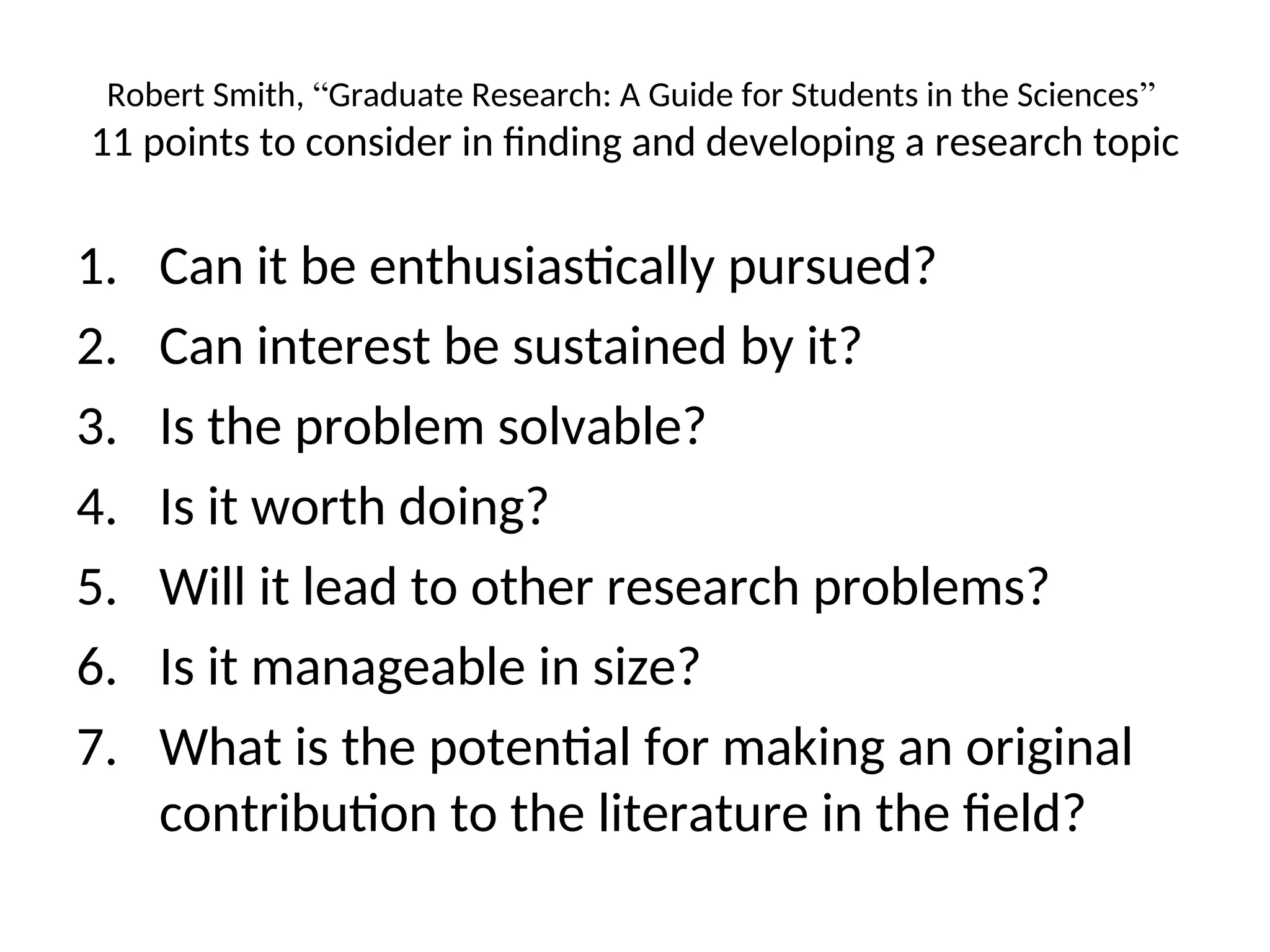
Robert Smith, “Graduate Research: A Guide for Students in the Sciences”
11 points to consider in finding and developing a research topic
1. Can it be enthusiastically pursued?
2. Can interest be sustained by it?
3. Is the problem solvable?
4. Is it worth doing?
5. Will it lead to other research problems?
6. Is it manageable in size?
7. What is the potential for making an original
contribution to the literature in the field?
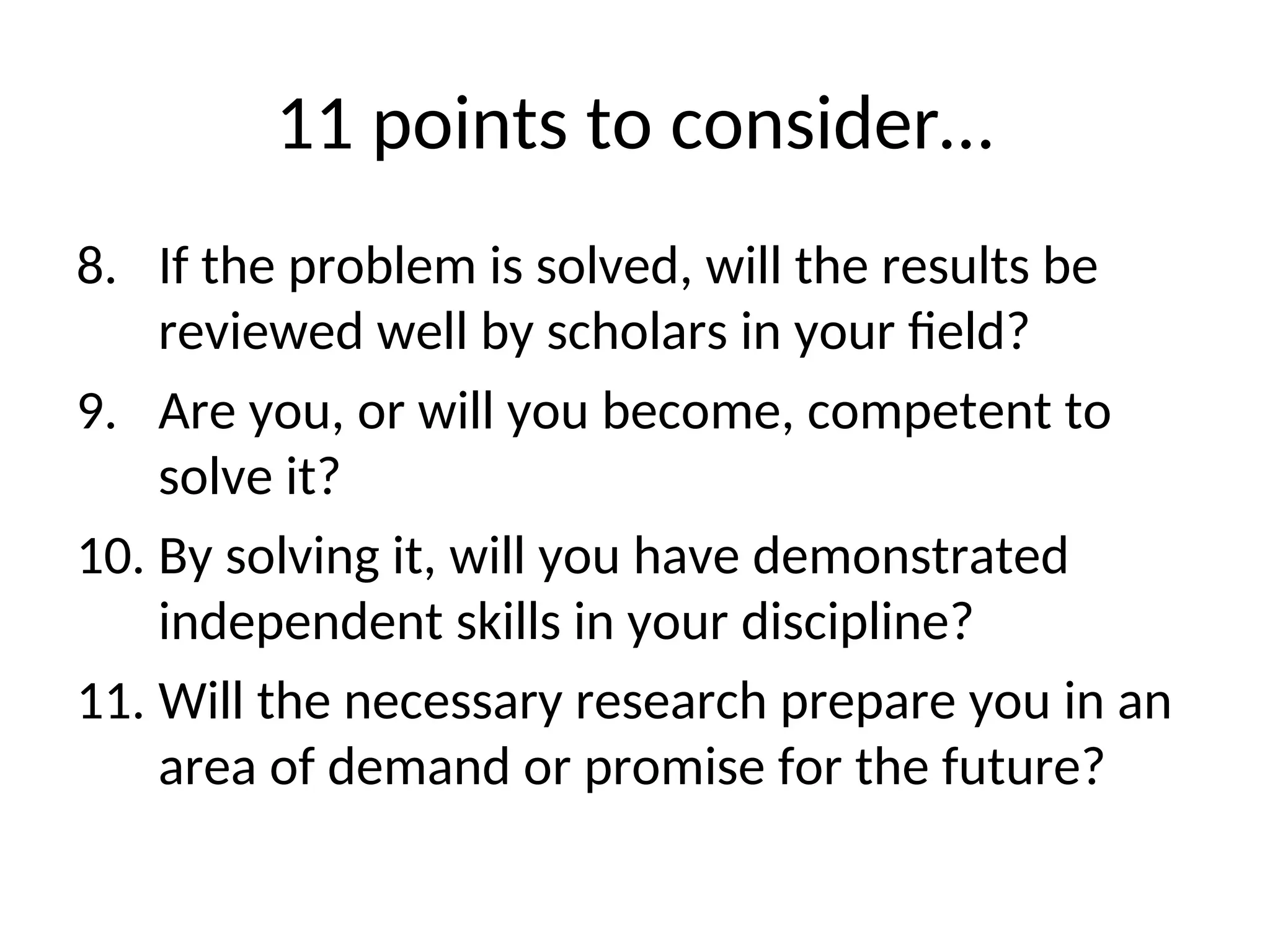
11 points to consider…
8. If the problem is solved, will the results be
reviewed well by scholars in your field?
9. Are you, or will you become, competent to
solve it?
10. By solving it, will you have demonstrated
independent skills in your discipline?
11. Will the necessary research prepare you in an
area of demand or promise for the future?
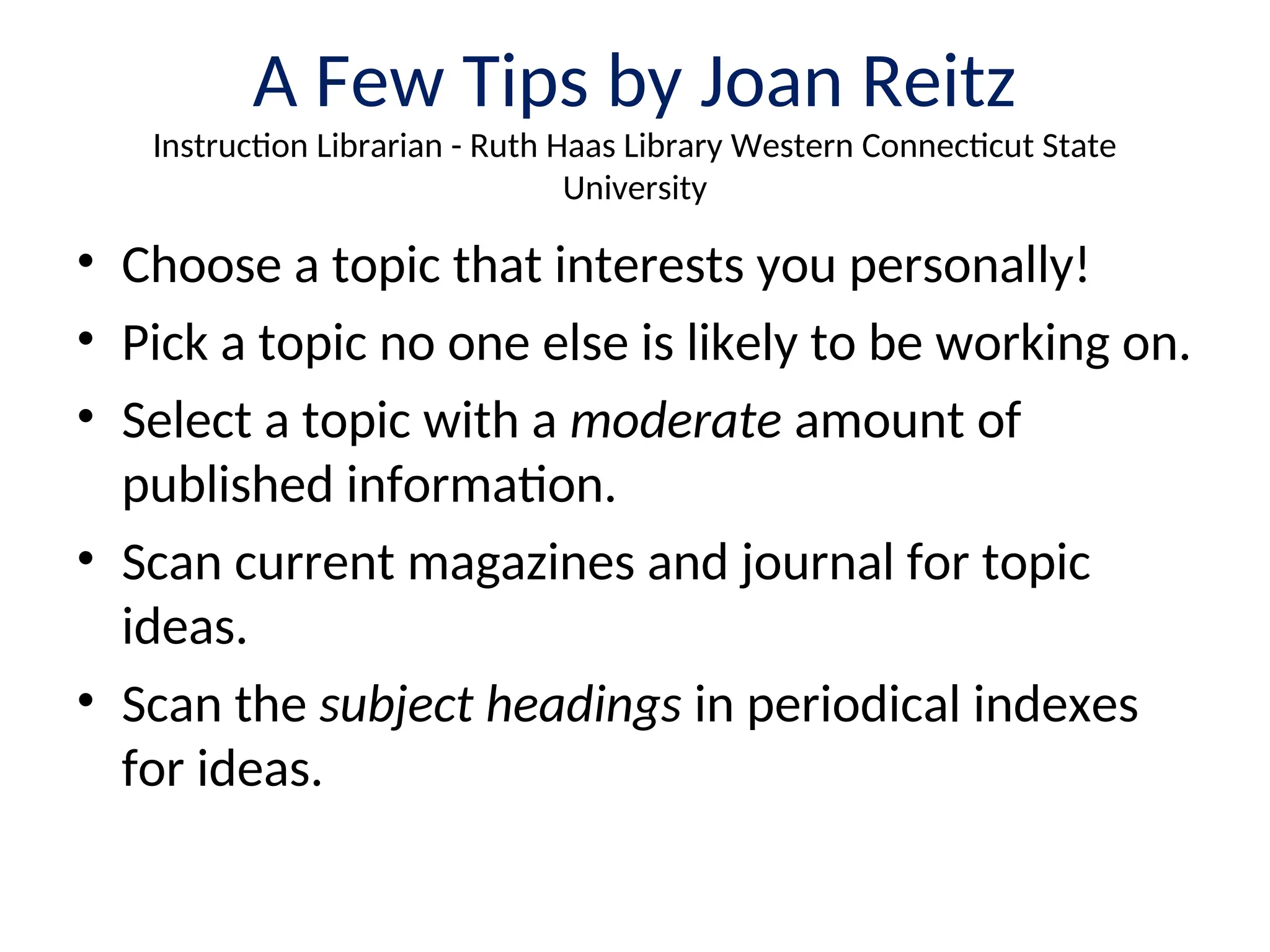
A Few Tips by Joan Reitz
Instruction Librarian - Ruth Haas Library Western Connecticut State
University
• Choose a topic that interests you personally!
• Pick a topic no one else is likely to be working on.
• Select a topic with a moderate amount of
published information.
• Scan current magazines and journal for topic
ideas.
• Scan the subject headings in periodical indexes
for ideas.
Tips….
• Be flexible - unforeseen circumstances may
require a shift of focus.
• Get an early start.
• Don't be shy about talking with your
instructor!
Some more Tips
• Preliminary reading at the library to check
whether enough work is done and whether
possibility of contributing
• Reading other dissertations
• Classroom interactions
• Listen to the problems discussed in seminars
and conferences
Some more…
• Do not select favourite author/writer who stood
the test of time
• See whether primary sources are easily available
• Not too technical a topic
• No controversial subjects
• No grand general topics like Democracy, Religion
• Probable, acceptable and true topic
Some more…
• Ask others—fellow researchers, other
supervisors, research-oriented people
• Reasons for research: personal interest, some
confusions in previous findings, social needs,
utilitarian consideration
• Be watchful—”Chance favours only the
prepared mind”
Some Questions
• Adequate Supervision
• Time Limit
• Tools & Techniques
• Adequate Finance
• People to co-operate
• Instructor’s Choice
Eight Watchful Steps
The Regents of the University of Michigan
• brainstorm for ideas
• choose a topic that will enable you to read and understand
the literature
• ensure that the topic is manageable and that material is
available
• make a list of key words
• be flexible
• define your topic as a focused research question
• research and read more about your topic
• formulate a thesis statement
Topics for Literary Research
• Gender roles
• Comparisons between genres
• Historical background
• Politics
• Religion
• Comparisons between two characters
• Comparisons between two novels
• Allusions within the novel
• Criticism
• Symbolism
Topics…
• Literature belonging to different countries
• Literature of a particular age
• Single author—biography, typical styles of the
author, his/her achievements
• Different themes in a work
• Literary devices used in a work
Good Topics in Literary Research
• A discussion of a work's characters: are they realistic,
symbolic, historically-based?
• A comparison/contrast of the choices different authors
or characters make in a work
• A reading of a work based on an outside philosophical
perspective (Ex. how would a Freudian read Hamlet?)
• A study of the sources or historical events that
occasioned a particular work (Ex. comparing G.B. Shaw's
Pygmalion with the original Greek myth of Pygmalion)
Good Topics…
• An analysis of a specific image occurring in several
works (Ex. the use of moon imagery in certain plays,
poems, novels)
• A "deconstruction" of a particular work (Ex. unfolding
an underlying racist worldview in Joseph Conrad's
Heart of Darkness)
• A reading from a political perspective (Ex. how would a
Marxist read William Blake's "London"?)
• A study of the social, political, or economic context in
which a work was written — how does the context
influence the work?
Good Topics…
• Modern metrical forms
• Patterns of modern novels, rhetoric and
linguistic developments
• Public prose & language as used in periodicals
• Recent theatrical texts
• Comparative literature
• Annotated bibliography
Part – III
Refining a Research Topic
Why To Refine
• Broad topic is unmanageable
• To suit the amount & depth of research
required
• To suit the time & length prescribed
• To be specific/focused
• Too narrow a topic must also be avoided.
Commonly Used Ways of Narrowing
Joan Reitz
• By date/time period
• By place(city, state, region, country,
continent)
• By a specific characteristic of the person (age,
gender, ethnicity, education, marital status)
• By a specific viewpoint/critical approach to
the topic
Possible Means in Literary Studies
• A prominent theme in the literary work
• One or two of the main characters in the work
• A specific chapter, scene, or passage of the work
• An event in the author's life that may be related
to a theme in the work
• A specific school or type of literary criticism
• To broaden the too narrow a topic comparative
study of two/more works by the same author/by
different authors
Example Topics
• “Postcolonial Consciousness in Indian Writing
in English”—too vast an area
• Analysis of a single novel by any author is too
narrow for making valuable generalizations
• “Imagery in Shakespeare” into “Blood Imagery
in Macbeth”
• “Violence in the Media” into “The Effects of
Cartoon Violence on Preschool Children”
Example Topics
• ‘The Elements of Grotesque in Sri Aurobindo’s
Poetry’ or ‘ Folk motifs in Shashi Deshpande Short
Fiction’ would yield knowledge that is not very
common and hence, interesting.
• ‘Surrealism in Arun Kolatkar’s poetry’ is an obvious
observation, the research, however, begins when
you want to understand why surrealism is found in
his works, how does he deploy surrealistic devices,
what does it do in the particular cultural context and
what is its significance.
Part – IV
Definition of Thesis Statement/Proposition
What is a
Thesis Statement/Proposition?
• An assertion that may be believed,
disbelieved, or doubted.
• Governing idea/hard core of one’s intuition.
• A focused research question.
{Inductive/Deductive}
• An answer to the research question.
• A way to clearly state the purpose of the
research undertaken.
• A precise statement of what is to be
answered, proven, or what the researcher will
inform the audience.
A Debatable Thesis Statement
• Shakespeare's Hamlet is a play about a young man
who seeks revenge. [mere summarising]
• Hamlet experiences internal conflict because he is in
love with his mother. [highly debatable]
• Spirituality means different things to different people.
King Lear, The Book of Romans, and Zen and the Art of
Motorcycle Maintenance each view the spirit
differently. [nothing that's not already self-evident]
• Lear, Romans, and Zen each view the soul as the
center of human personality. [provable]
Part – V
Title of the Thesis
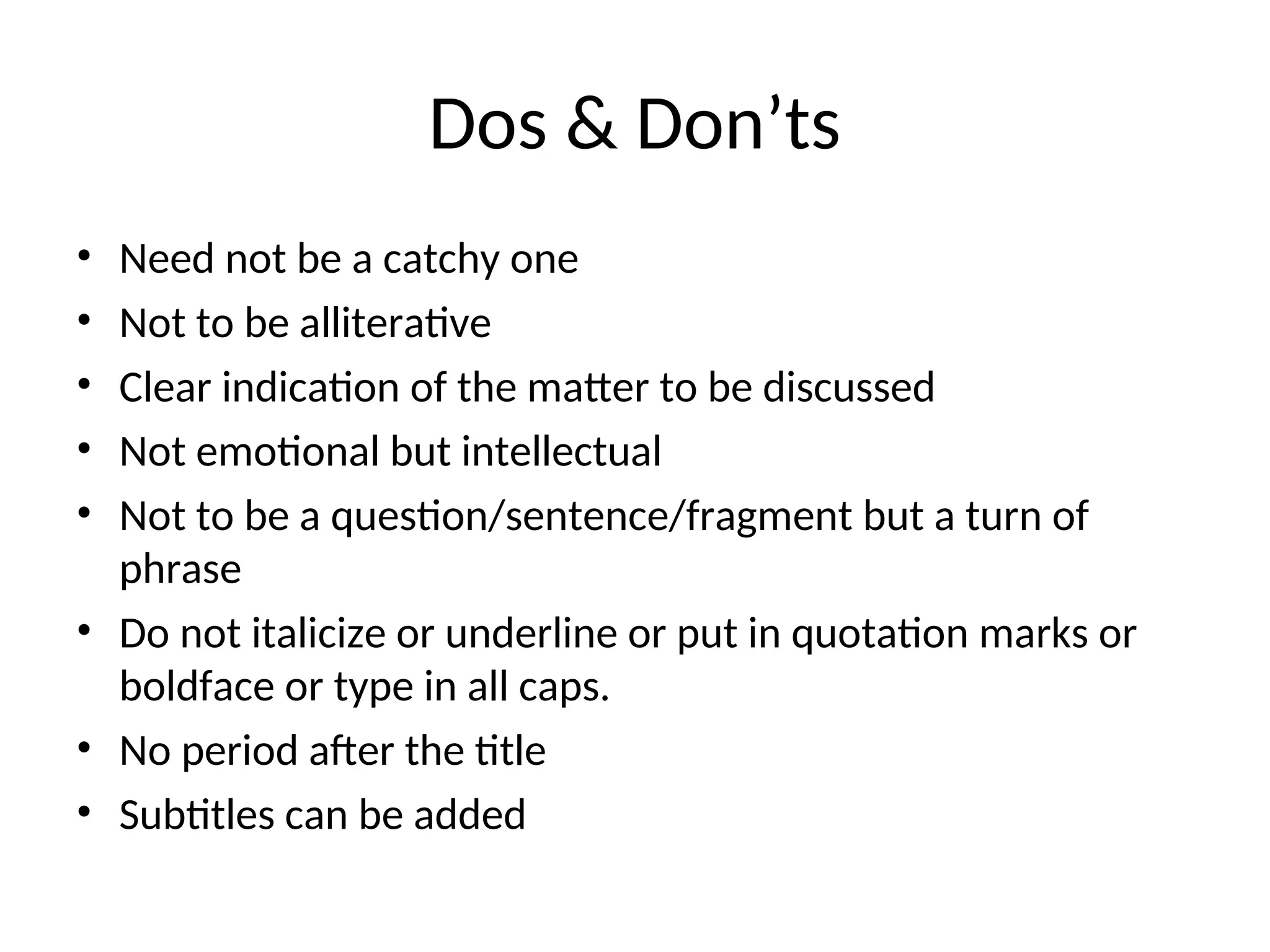
Dos & Don’ts
• Need not be a catchy one
• Not to be alliterative
• Clear indication of the matter to be discussed
• Not emotional but intellectual
• Not to be a question/sentence/fragment but a turn of
phrase
• Do not italicize or underline or put in quotation marks or
boldface or type in all caps.
• No period after the title
• Subtitles can be added
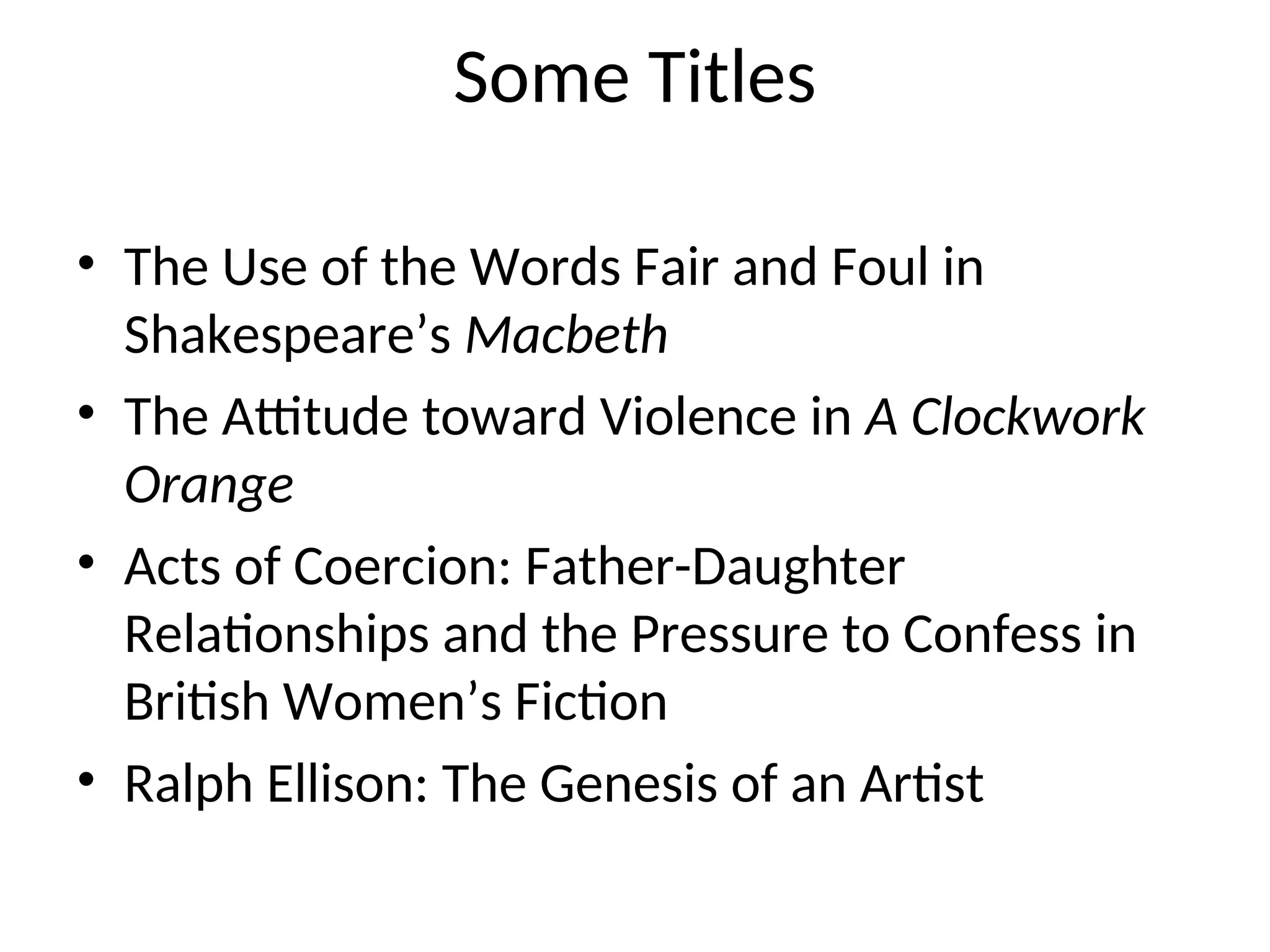
Some Titles
• The Use of the Words Fair and Foul in
Shakespeare’s Macbeth
• The Attitude toward Violence in A Clockwork
Orange
• Acts of Coercion: Father-Daughter
Relationships and the Pressure to Confess in
British Women’s Fiction
• Ralph Ellison: The Genesis of an Artist
Dr Sheela P Karthick's ppt on Selecting a topic.ppt

Dr Sheela P Karthick's ppt on Selecting a topic.ppt

  • 1.
    Selection of theStatement of the Problem/Topic [Literature] Dr. Sheela P. Karthick Associate Professor & Head, Department of English The Madura College (Autonomous), Madurai – 625 011 E-mail sheelapkarthick@yahoo.co.in
  • 2.
  • 3.
    Definition of Research •Research is the act or process of searching afresh or investigating a new or a specific area or field of study, with a view to attaining an objective or scientific understanding of the things pertaining to it.
  • 4.
    KEY WORDS • act(doing), process (continuing), search (look through to find), investigate (to search into in order to learn facts), area (scope/extent), field (an area of observation), objective (without bias), scientific (systematic), understanding (to know thoroughly), pertaining (associated), new (for the first time), specific (definite & particular)
  • 5.
    MLA’s Definition • Toexplore an idea • To probe an issue • To solve a problem • To make an argument in relation to what others have written • To inquire • To discover
  • 6.
    Research in Literature “Sowhat is research, especially in literary studies, after all? In very ordinary language, research is a contribution to a particular domain of knowledge. By contribution, I mean addition to what we already know about the particular area. If I want to write one more thesis on ‘Postcolonialism in Amitav Ghosh’ ‘ Spirituality in Sri Aurobindo’ or ‘ Feminism in Shashi Deshpande’, I am not really adding to what scholars already know about these things. Research which provides knowledge which is obvious and already known is of little use to anyone.” --Sachin C. Ketkar
  • 7.
    Characteristics of aResearcher John W. Best’s Research in Education • Directed towards the solution of a problem • Development of generalizations, principles/theories • Based on observable experience and description • New data/existing data for a new purpose • Designed procedures for rigorous analysis • Objective and logical
  • 8.
    Characteristics of aResearcher • Patience & unhurried activity • Careful record and report • Courage to prove or disprove • Open mind • Interest • Free enquiry • Sincerity • Single-mindedness
  • 9.
    Characteristics of aResearcher • Persistence • Keenness • Academic integrity/honesty • Meaningful discriminations • Classifying data • Scientific method
  • 10.
    Six Significant Stepsin Research • Selecting a Suitable Topic • Conducting Research • Compiling a Working Bibliography • Taking Notes • Outlining • Preparing the Paper
  • 11.
    Part – II Selectinga Topic: A Few Tips & Steps
  • 12.
    Robert Smith, “GraduateResearch: A Guide for Students in the Sciences” 11 points to consider in finding and developing a research topic 1. Can it be enthusiastically pursued? 2. Can interest be sustained by it? 3. Is the problem solvable? 4. Is it worth doing? 5. Will it lead to other research problems? 6. Is it manageable in size? 7. What is the potential for making an original contribution to the literature in the field?
  • 13.
    11 points toconsider… 8. If the problem is solved, will the results be reviewed well by scholars in your field? 9. Are you, or will you become, competent to solve it? 10. By solving it, will you have demonstrated independent skills in your discipline? 11. Will the necessary research prepare you in an area of demand or promise for the future?
  • 14.
    A Few Tipsby Joan Reitz Instruction Librarian - Ruth Haas Library Western Connecticut State University • Choose a topic that interests you personally! • Pick a topic no one else is likely to be working on. • Select a topic with a moderate amount of published information. • Scan current magazines and journal for topic ideas. • Scan the subject headings in periodical indexes for ideas.
  • 15.
    Tips…. • Be flexible- unforeseen circumstances may require a shift of focus. • Get an early start. • Don't be shy about talking with your instructor!
  • 16.
    Some more Tips •Preliminary reading at the library to check whether enough work is done and whether possibility of contributing • Reading other dissertations • Classroom interactions • Listen to the problems discussed in seminars and conferences
  • 17.
    Some more… • Donot select favourite author/writer who stood the test of time • See whether primary sources are easily available • Not too technical a topic • No controversial subjects • No grand general topics like Democracy, Religion • Probable, acceptable and true topic
  • 18.
    Some more… • Askothers—fellow researchers, other supervisors, research-oriented people • Reasons for research: personal interest, some confusions in previous findings, social needs, utilitarian consideration • Be watchful—”Chance favours only the prepared mind”
  • 19.
    Some Questions • AdequateSupervision • Time Limit • Tools & Techniques • Adequate Finance • People to co-operate • Instructor’s Choice
  • 20.
    Eight Watchful Steps TheRegents of the University of Michigan • brainstorm for ideas • choose a topic that will enable you to read and understand the literature • ensure that the topic is manageable and that material is available • make a list of key words • be flexible • define your topic as a focused research question • research and read more about your topic • formulate a thesis statement
  • 21.
    Topics for LiteraryResearch • Gender roles • Comparisons between genres • Historical background • Politics • Religion • Comparisons between two characters • Comparisons between two novels • Allusions within the novel • Criticism • Symbolism
  • 22.
    Topics… • Literature belongingto different countries • Literature of a particular age • Single author—biography, typical styles of the author, his/her achievements • Different themes in a work • Literary devices used in a work
  • 23.
    Good Topics inLiterary Research • A discussion of a work's characters: are they realistic, symbolic, historically-based? • A comparison/contrast of the choices different authors or characters make in a work • A reading of a work based on an outside philosophical perspective (Ex. how would a Freudian read Hamlet?) • A study of the sources or historical events that occasioned a particular work (Ex. comparing G.B. Shaw's Pygmalion with the original Greek myth of Pygmalion)
  • 24.
    Good Topics… • Ananalysis of a specific image occurring in several works (Ex. the use of moon imagery in certain plays, poems, novels) • A "deconstruction" of a particular work (Ex. unfolding an underlying racist worldview in Joseph Conrad's Heart of Darkness) • A reading from a political perspective (Ex. how would a Marxist read William Blake's "London"?) • A study of the social, political, or economic context in which a work was written — how does the context influence the work?
  • 25.
    Good Topics… • Modernmetrical forms • Patterns of modern novels, rhetoric and linguistic developments • Public prose & language as used in periodicals • Recent theatrical texts • Comparative literature • Annotated bibliography
  • 26.
    Part – III Refininga Research Topic
  • 27.
    Why To Refine •Broad topic is unmanageable • To suit the amount & depth of research required • To suit the time & length prescribed • To be specific/focused • Too narrow a topic must also be avoided.
  • 28.
    Commonly Used Waysof Narrowing Joan Reitz • By date/time period • By place(city, state, region, country, continent) • By a specific characteristic of the person (age, gender, ethnicity, education, marital status) • By a specific viewpoint/critical approach to the topic
  • 29.
    Possible Means inLiterary Studies • A prominent theme in the literary work • One or two of the main characters in the work • A specific chapter, scene, or passage of the work • An event in the author's life that may be related to a theme in the work • A specific school or type of literary criticism • To broaden the too narrow a topic comparative study of two/more works by the same author/by different authors
  • 30.
    Example Topics • “PostcolonialConsciousness in Indian Writing in English”—too vast an area • Analysis of a single novel by any author is too narrow for making valuable generalizations • “Imagery in Shakespeare” into “Blood Imagery in Macbeth” • “Violence in the Media” into “The Effects of Cartoon Violence on Preschool Children”
  • 31.
    Example Topics • ‘TheElements of Grotesque in Sri Aurobindo’s Poetry’ or ‘ Folk motifs in Shashi Deshpande Short Fiction’ would yield knowledge that is not very common and hence, interesting. • ‘Surrealism in Arun Kolatkar’s poetry’ is an obvious observation, the research, however, begins when you want to understand why surrealism is found in his works, how does he deploy surrealistic devices, what does it do in the particular cultural context and what is its significance.
  • 32.
    Part – IV Definitionof Thesis Statement/Proposition
  • 33.
    What is a ThesisStatement/Proposition? • An assertion that may be believed, disbelieved, or doubted. • Governing idea/hard core of one’s intuition. • A focused research question. {Inductive/Deductive} • An answer to the research question.
  • 34.
    • A wayto clearly state the purpose of the research undertaken. • A precise statement of what is to be answered, proven, or what the researcher will inform the audience.
  • 35.
    A Debatable ThesisStatement • Shakespeare's Hamlet is a play about a young man who seeks revenge. [mere summarising] • Hamlet experiences internal conflict because he is in love with his mother. [highly debatable] • Spirituality means different things to different people. King Lear, The Book of Romans, and Zen and the Art of Motorcycle Maintenance each view the spirit differently. [nothing that's not already self-evident] • Lear, Romans, and Zen each view the soul as the center of human personality. [provable]
  • 36.
    Part – V Titleof the Thesis
  • 37.
    Dos & Don’ts •Need not be a catchy one • Not to be alliterative • Clear indication of the matter to be discussed • Not emotional but intellectual • Not to be a question/sentence/fragment but a turn of phrase • Do not italicize or underline or put in quotation marks or boldface or type in all caps. • No period after the title • Subtitles can be added
  • 38.
    Some Titles • TheUse of the Words Fair and Foul in Shakespeare’s Macbeth • The Attitude toward Violence in A Clockwork Orange • Acts of Coercion: Father-Daughter Relationships and the Pressure to Confess in British Women’s Fiction • Ralph Ellison: The Genesis of an Artist