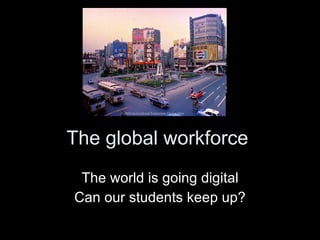
The global workforce The world is going digital Can our students keep up?
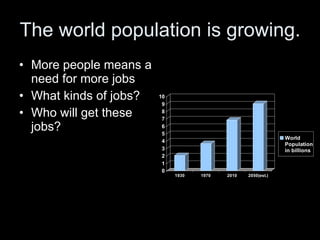
The world population is growing.  More people means a need for more jobs  What kinds of jobs? Who will get these jobs?
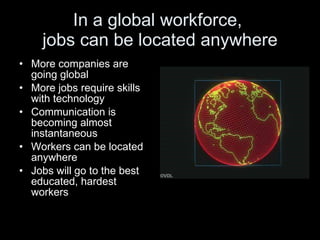
In a global workforce,  jobs can be located anywhere More companies are going global More jobs require skills with technology Communication is becoming almost instantaneous Workers can be located anywhere Jobs will go to the best educated, hardest workers
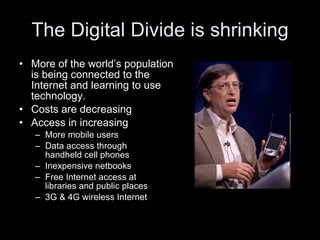
The Digital Divide is shrinking More of the world’s population  is being connected to the  Internet and learning to use  technology.  Costs are decreasing Access in increasing More mobile users Data access through  handheld cell phones Inexpensive netbooks Free Internet access at  libraries and public places 3G & 4G wireless Internet
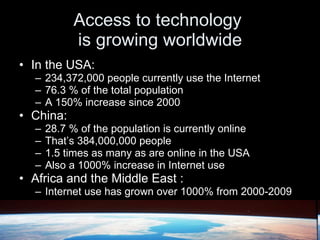
Access to technology  is growing worldwide In the USA: 234,372,000 people currently use the Internet 76.3 % of the total population A 150% increase since 2000 China: 28.7 % of the population is currently online That’s 384,000,000 people  1.5 times as many as are online in the USA Also a 1000% increase in Internet use Africa and the Middle East : Internet use has grown over 1000% from 2000-2009
In math, science, and problem solving, United States students score about 20 th  in the world.
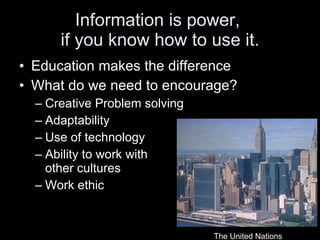
Information is power,  if you know how to use it. Education makes the difference What do we need to encourage? Creative Problem solving Adaptability Use of technology Ability to work with  other cultures Work ethic The United Nations
Information and Image Sources Arrison, S. (2002, March 13). What digital divide? - CNET News.  Technology News - CNET News . Retrieved July 1, 2010, from  http://news.cnet.com/2010-1071-858537.html BBC. (2005, February 25). BBC NEWS | Technology | Global digital divide 'narrowing'.  BBC NEWS  . Retrieved June 30, 2010, from  http://news.bbc.co.uk/2/hi/technology/4296919.stm HNPStats - Population Projection Tables by Country and Group. (2010).  The World Bank . Retrieved June 30, 2010, from  http://web.worldbank.org/WBSITE/EXTERNAL/TOPICS/EXTHEALTHNUTRITIONANDPOPULATION/EXTDATASTATISTICSHNP/EXTHNPSTATS/0,,contentMDK:21737699~menuPK:3385623~pagePK:64168445~piPK:64168309~theSitePK:3237118,00.html OECD PISA Results (2006) Retrieved July 3, 2010 from  http://www.oecd.org/document/2/0,3343,en_32252351_32236191_39718850_1_1_1_1,00.html   World Internet Usage Statistics News and World Population Stats. (n.d.).  Internet Usage World Stats - Internet and Population Statistics . Retrieved July 1, 2010, from  http://www.internetworldstats.com/stats.htm Images: Downtown scene in Taiwan.  http://player.discoveryeducation.com/index.cfm?guidAssetId=17943143-5297-49b3-bab9-57f80d24a7fa View of Earth from space  http://player.discoveryeducation.com/index.cfm?guidAssetId=57f4aebb-e666-49f4-80ea-b3825b780ff5 Bill Gates with PDA http://player.discoveryeducation.com/index.cfm?guidAssetId=fe91c114-e484-47ca-afe0-a803e39e736f Climate modeling grid pattern http://player.discoveryeducation.com/index.cfm?guidAssetId=6326b1d6-7a0a-4390-b10e-bccd805c9930 United Nations headquarters  http://player.discoveryeducation.com/index.cfm?guidAssetId=a09e1b1a-0a59-46d3-bb95-5b9cc3a5431b

The global workforce

  • 1.
    The global workforceThe world is going digital Can our students keep up?
  • 2.
    The world populationis growing. More people means a need for more jobs What kinds of jobs? Who will get these jobs?
  • 3.
    In a globalworkforce, jobs can be located anywhere More companies are going global More jobs require skills with technology Communication is becoming almost instantaneous Workers can be located anywhere Jobs will go to the best educated, hardest workers
  • 4.
    The Digital Divideis shrinking More of the world’s population is being connected to the Internet and learning to use technology. Costs are decreasing Access in increasing More mobile users Data access through handheld cell phones Inexpensive netbooks Free Internet access at libraries and public places 3G & 4G wireless Internet
  • 5.
    Access to technology is growing worldwide In the USA: 234,372,000 people currently use the Internet 76.3 % of the total population A 150% increase since 2000 China: 28.7 % of the population is currently online That’s 384,000,000 people 1.5 times as many as are online in the USA Also a 1000% increase in Internet use Africa and the Middle East : Internet use has grown over 1000% from 2000-2009
  • 6.
    In math, science,and problem solving, United States students score about 20 th in the world.
  • 7.
    Information is power, if you know how to use it. Education makes the difference What do we need to encourage? Creative Problem solving Adaptability Use of technology Ability to work with other cultures Work ethic The United Nations
  • 8.
    Information and ImageSources Arrison, S. (2002, March 13). What digital divide? - CNET News. Technology News - CNET News . Retrieved July 1, 2010, from http://news.cnet.com/2010-1071-858537.html BBC. (2005, February 25). BBC NEWS | Technology | Global digital divide 'narrowing'. BBC NEWS . Retrieved June 30, 2010, from http://news.bbc.co.uk/2/hi/technology/4296919.stm HNPStats - Population Projection Tables by Country and Group. (2010). The World Bank . Retrieved June 30, 2010, from http://web.worldbank.org/WBSITE/EXTERNAL/TOPICS/EXTHEALTHNUTRITIONANDPOPULATION/EXTDATASTATISTICSHNP/EXTHNPSTATS/0,,contentMDK:21737699~menuPK:3385623~pagePK:64168445~piPK:64168309~theSitePK:3237118,00.html OECD PISA Results (2006) Retrieved July 3, 2010 from http://www.oecd.org/document/2/0,3343,en_32252351_32236191_39718850_1_1_1_1,00.html World Internet Usage Statistics News and World Population Stats. (n.d.). Internet Usage World Stats - Internet and Population Statistics . Retrieved July 1, 2010, from http://www.internetworldstats.com/stats.htm Images: Downtown scene in Taiwan. http://player.discoveryeducation.com/index.cfm?guidAssetId=17943143-5297-49b3-bab9-57f80d24a7fa View of Earth from space http://player.discoveryeducation.com/index.cfm?guidAssetId=57f4aebb-e666-49f4-80ea-b3825b780ff5 Bill Gates with PDA http://player.discoveryeducation.com/index.cfm?guidAssetId=fe91c114-e484-47ca-afe0-a803e39e736f Climate modeling grid pattern http://player.discoveryeducation.com/index.cfm?guidAssetId=6326b1d6-7a0a-4390-b10e-bccd805c9930 United Nations headquarters http://player.discoveryeducation.com/index.cfm?guidAssetId=a09e1b1a-0a59-46d3-bb95-5b9cc3a5431b

Editor's Notes

  • #3 From a current estimate by the World Bank (2010) of 6,852,893 people here on Earth right now in mid 2010 to the projection of a world population of 9,064,687 by 2050