Creative Digital
Media Production
Pearson
BTEC Level 3 National
in
Sample
Assessment
Materials (SAMs)
Unit 5: Specialist Subject
Investigation
For use with:
• Extended Diploma in Creative Digital Media
Production
First teaching from September 2016 Issue 1
Pearson BTEC Level 3 Nationals in Creative Digital Media Production – Unit 5 – Final Sample Assessment Materials –
Issue 1 – November 2015 © Pearson Education Limited 2015
2
Edexcel, BTEC and LCCI qualifications
Edexcel, BTEC and LCCI qualifications are awarded by Pearson, the UK’s largest awarding body
offering academic and vocational qualifications that are globally recognised and benchmarked.
For further information, please visit our qualification websites at www.edexcel.com, www.btec.co.uk
or www.lcci.org.uk. Alternatively, you can get in touch with us using the details on our contact us
page at qualifications.pearson.com/contactus
About Pearson
Pearson is the world's leading learning company, with 40,000 employees in more than 70 countries
working to help people of all ages to make measurable progress in their lives through learning.
We put the learner at the centre of everything we do, because wherever learning flourishes, so do
people. Find out more about how we can help you and your learners at qualifications.pearson.com
References to third-party material made in this specification are made in good faith. We do not
endorse, approve or accept responsibility for the content of materials, which may be subject to
change, or any opinions expressed therein. (Material may include textbooks, journals,
magazines and other publications and websites.)
All information in this document is correct at time of publication.
All the material in this publication is copyright
© Pearson Education Limited 2015
Pearson BTEC Level 3 Nationals in Creative Digital Media Production – Unit 5 – Final Sample Assessment Materials –
Issue 1 – November 2015 © Pearson Education Limited 2015
1
Turn over
Level
3
Write your name here
Surname Forename
*S50147A*
Paper reference
XXXX/XX
S50147A
©2015 Pearson Education Ltd.
1/1/1/1
Creative Digital Media
Production
Unit 5: Specialist Subject Investigation ≠≠
Extended Diploma
Sample assessment material for first teaching
September 2016
Instructions
Part A contains material for the completion of the preparatory work for the
set task.
Part A should be undertaken over a maximum of 18 hours across a period of
6 weeks
Part A may be given to learners 6 weeks in advance of the supervised
assessment period.
Part A is specific to each series and this material must only be issued to learners
who have been entered to undertake the task in relevant series
Part B materials for the set task will be issued prior to the start of the supervised
assessment period according to the guidance in the specification.
Pearson BTEC Level 3 Nationals
Part
A
Pearson BTEC Level 3 Nationals in Creative Digital Media Production – Unit 5 – Final Sample Assessment Materials –
Issue 1 – November 2015 © Pearson Education Limited 2015
2
2
S50147A
Instructions to Teachers/Tutors
This paper must be read in conjunction with the unit information in the
specification and the BTEC Nationals Information for Conducting External
Assessments (ICEA) document. See Pearson website for details.
Part A should be issued to learners 6 weeks prior to undertaking Part B of
the assessment.
Learners will be expected to conduct research and can take up to 4 sides of
A4 notes and diagrams into the supervised assessment.
Research is expected to be carried out over approximately 18 hours.
Teachers/Tutors cannot give any support to the notes and the work must be
completed independently by the learner.
Centres are free to arrange the supervised assessment period how they wish
provided the 2 hours for producing final outcomes are under the level of
supervision specified, and in accordance with the conduct procedures.
Refer carefully to the instructions in this task booklet and the Information
for Conducting External Assessments (ICEA) document to ensure that
the preparatory period is conducted correctly and that learners have the
opportunity to carry out the required activities independently.
Pearson BTEC Level 3 Nationals in Creative Digital Media Production – Unit 5 – Final Sample Assessment Materials –
Issue 1 – November 2015 © Pearson Education Limited 2015
3S50147A
3
Turn over
Instructions for Learners
Read the set task information carefully.
This contains Part A of the information you need to prepare for the set task.
You will need to carry out your own research over the next 6 weeks.
You will then be given the set task to complete under supervised conditions.
You must work independently and should not share your work with
other learners.
Your teacher may give guidance on when you can complete the
preparatory work.
Your teacher cannot give you feedback during the preparation period.
Pearson BTEC Level 3 Nationals in Creative Digital Media Production – Unit 5 – Final Sample Assessment Materials –
Issue 1 – November 2015 © Pearson Education Limited 2015
4
4
S50147A
Set Task Brief
You have 18 hours to investigate the issues raised in the stimulus material.
During this time you should:
1. Read the stimulus material in the set task information. If there is anything
in the task instructions you are unclear about you should ask your tutor.
2. Analyse the stimulus material.
3. Conduct primary and secondary research into the issues raised in the
stimulus material. You must relate your research to a specific media
sector.
4. Compile a catalogue of research that includes all primary and secondary
sources you intend to reference.
You should base your research for the task on a minimum of two different
primary and four different secondary sources therefore no more than ten
sources should be used, in addition to the stimulus material.
5. Prepare handwritten notes of up to 4 sides of A4 about the stimulus
article and your own additional research. In Part B you will have 2 hours
supervised time to complete your set task based on the topics raised in
the Part A.
During the supervised assessment period you are not permitted to:
ÂÂ use a pre-prepared script
ÂÂ work with others.
During the supervised period, you will be permitted access to the stimulus
material, your research catalogue and your notes. You will not be allowed
to carry out any additional research and you will not have access to the
internet during this time.
Pearson BTEC Level 3 Nationals in Creative Digital Media Production – Unit 5 – Final Sample Assessment Materials –
Issue 1 – November 2015 © Pearson Education Limited 2015
5S50147A
5
Turn over
Part A Set Task Information
Stimulus material – article
Ofcom 2014 – Children and Parents: Media Use and Attitudes.
Developments in technology affect the ways in which we access, consume
and produce different types of media. Ofcom (Office of Communications,
the regulator for the communications industries) conducted research into
the changing use of media by children in the report Children and Parents:
Media Use and Attitudes. The following are edited extracts from that report.
Section 1
Executive summary
Our 2014 Children and Parents: Media Use and Attitudes report provides
detailed evidence on media use, attitudes and understanding among
children and young people aged 5–15, as well as detailed information about
media access and use among children aged 3–4.
Our report also includes findings relating to parents’ views about their
children’s media use, and the ways that parents seek – or not – to monitor
or limit such use.
Summary of key themes
This year’s report shows that:
ÂÂ There has been a significant increase in access to, ownership of and use
of tablet computers by children of all ages. In contrast, the incidence of
TVs and games consoles in the bedroom is declining, while smartphone
ownership remains steady.
ÂÂ Almost twice as many children aged 5–15 are going online via a tablet
than in 2013. At the same time, the number of those only using a device
other than a PC/laptop/netbook to go online has increased, and access to
the internet at home via a PC/laptop/netbook has declined.
ÂÂ 12–15 year olds are twice as likely to say they would miss their mobile
phone than the TV, say they spend more time going online than
watching television in a typical week, and say they prefer to socialise
online rather than watch TV. In contrast, younger children still prefer TV
to any other device, and spend more time in a typical week watching TV
than doing any other media activity.
Pearson BTEC Level 3 Nationals in Creative Digital Media Production – Unit 5 – Final Sample Assessment Materials –
Issue 1 – November 2015 © Pearson Education Limited 2015
6
6
S50147A
ÂÂ Gender differences are evident from an early age. Differences include
a preference for gaming among boys and for communicating online
among girls. Parents also treat boys and girls differently, monitoring some
aspects of girls’online activity more closely than boys’.
ÂÂ Older children are making judgements about the truthfulness of online
content, including search engine results and how accurately people
present themselves online.
Around a quarter of parents express concern about the media content their
child has access to, with concerns about the internet more likely among
parents of older children (8–15).
ÂÂ Nine in ten parents mediate their child’s access to the internet in some
way, with most parents using a combination of approaches including
using technical tools, having rules around access and use, regularly
talking to the child about specific risks and supervising the child’s online
activity.
Changes in children’s media consumption
Seven in ten children aged 5–15 now have access to a tablet computer
at home…
Children’s access to a tablet computer at home has increased from 51% to
71% for 5–15 year olds since 2013. In addition, use of a tablet computer at
home has increased by 20 percentage points since 2013 for children aged
5–15; six in ten (62% vs. 42%) in this age group, while four in ten children
aged 3–4 now use tablets at home (39% vs 28%).
Ownership of tablets has almost doubled, with one in three (34%) children
aged 5–15 now owning their own tablet computer, up from one in five
(19%) in 2013.
… and children are almost twice as likely to go online using a tablet
Four in ten children aged 5–15 year olds go online using a tablet computer,
almost twice as many as in 2013 (42% vs. 23%), while two in ten children
aged 3–4 go online using a tablet (20% vs. 12% in 2013). Tablets are now the
second most likely device – after laptops/netbooks – to be ‘mostly’used by
5–15 year olds to go online.
Going online using a mobile is also more likely…
Four in ten 5–15s own a mobile phone, rising to almost eight in ten children
aged 12–15. Children in each age group are more likely than in 2013 to use a
mobile phone to go online (36% vs. 27% for 5–15s).
Pearson BTEC Level 3 Nationals in Creative Digital Media Production – Unit 5 – Final Sample Assessment Materials –
Issue 1 – November 2015 © Pearson Education Limited 2015
7S50147A
7
Turn over
This varies significantly by age, with 59% of 12–15s going online using a
mobile phone. This coincides with a big increase in smartphone ownership
at 13, when ownership jumps from four in ten for 12 year olds (41%) to
almost seven in ten for 13 year olds (67%). Among 12–15s the mobile
phone is the second most likely device to be ‘mostly’used to go online, after
laptops/netbooks, with tablets coming third.
… while access to the internet via a PC/laptop has decreased
For the first time since this survey began in 2005, access to the internet at
home via a PC/laptop/netbook by children aged 5–15 has decreased; from
91% in 2013 to 88% in 2014. At the same time the number of 5–15 year olds
who go online only through a device other than a PC/laptop/netbook has
doubled, from 4% to 8%.
*Despite these changes among 5–15 year olds, laptops/netbooks remain
the most popular device that are ever used to go online for each age group,
and the laptop/PC is the preferred device for finding information for school
work, among all age groups.
More kids have access to smart TVs but fewer have TVs and games
consoles in their bedroom
Smart TV access has increased, from 13% of 5–15 year olds in 2013 to 39%
in 2014. However, there have been decreases in the number of children
aged 5–15 having a TV in the bedroom (46% in 2014 vs. 52% in 2013) and a
games console/player in the bedroom (41% vs. 47%).
Gaming on tablets is on the rise, while gaming on some other devices
is falling
While the use of dedicated gaming devices has declined (77% vs. 81% in
2013), and use of computers/laptops for gaming has also decreased, use of
tablet computers to play games has increased among 5–15s (30% vs. 23%).
TV is the media device that would be most missed overall…
At an overall level, the television set is the device that children aged 5–15
would miss most, and television is also nominated by 5–15 year olds as the
media activity that they would prefer to do when given the choice. However,
preferences for media devices and media activities vary greatly by age,
and 12–15 year olds are twice as likely to say they would miss their mobile
phone, compared to the TV (37% vs. 18%). The TV set is the only media
device used almost every day by a majority of children aged 5 to 15. More
time is spent watching television every week (14.6 hours) than undertaking
any other media activity, although less time is now spent watching
television in a typical week than in 2013 (15.4 hours).
Pearson BTEC Level 3 Nationals in Creative Digital Media Production – Unit 5 – Final Sample Assessment Materials –
Issue 1 – November 2015 © Pearson Education Limited 2015
8
8
S50147A
Around four in ten children aged 5–15 (38%) use an alternative device to
watch TV. While they are now more likely than last year to watch television
programmes on a tablet computer (20% vs. 15%), they are less likely to use
other alternative devices to watch TV.
Three-quarters of all 12–15 year olds (76%) and over half of 8–11s say
they never watch YouTube channels. Of those who watch TV channels and
YouTube channels, a quarter of the 12–15 year olds (25%) and three in ten
8–11 year olds (29%) say they prefer to watch YouTube.
But older children spend more time online and prefer mobile phones
for social activities
Children aged 12–15 spend more time going online than watching
television in a typical week (17.2 vs. 15.7 hours) and say they prefer to
socialise online rather than watch TV (33% vs. 20%).
Among 12–15s who go online, the mobile phone is the most popular
device for social and creative activities such as: arranging to meet friends
(71%); messaging friends (53%); looking at photos posted online (47%); and
sharing photos they have taken (45%).
8–11 year olds are spending more time online than in 2013
Children aged 8–11 are spending more hours per week using the internet than
in 2013 (10.5 vs. 9.2 hours). However, as with 12–15 year olds, children aged
8–11 tend to prefer using mobile phones for more social and creative activities.
Children are using a broader range of social media services, with
differences by gender
Seven in ten 12–15 year olds who go online have a social media profile, and
Facebook remains the dominant social media site or app among this group
of children. Use of Instagram has doubled to 36% since 2013. A significant
minority of 12–15 year olds with a social media profile use other photo- or
video-message sites or apps such as SnapChat.
Among those 12–15 year olds with a social media profile, boys are more
likely than girls to have a profile on YouTube (29% vs. 15%) while girls are
more likely than boys to have a profile on three sites or apps: Instagram
(42% vs. 30%), SnapChat (33% vs. 20%) and Tumblr (11% vs. 3%).
Girls aged 12–15 are more likely than boys to have any concerns or dislikes
about social media sites (73% vs. 52%); in particular, these relating to people
being bullied, spending too much time on these sites or apps, and friends
acting thoughtlessly or hurtfully.
Pearson BTEC Level 3 Nationals in Creative Digital Media Production – Unit 5 – Final Sample Assessment Materials –
Issue 1 – November 2015 © Pearson Education Limited 2015
9S50147A
9
Turn over
Boys’ preference for gaming devices is evident from an early age…
Three in ten (30%) boys aged 3–4 use a handheld/portable games player,
compared to two in ten (21%) girls aged 3–4, while boys aged 5–7 are
almost twice as likely as girls to say they regularly use a games console/
player (29% vs. 17%). The gender gap widens as age increases (47% vs. 21%
for 8–11s, 52% vs. 19% for 12–15s). In contrast, girls aged 5–7 are more likely
than boys to play games on a tablet (36% vs. 23%).
Among 5–15 year olds, boys in each age group are over five times as likely
as girls to say they would most miss a games console/ player (15% vs. 1% for
5–7s, 22% vs. 4% for 8–11s and 22% vs. 3% for 12–15s).
… while girls are more likely than boys to miss mobile phones
and reading
While both boys and girls aged 12–15 would miss a mobile phone the
most, this accounts for almost half of girls (46%) compared to three in ten
boys (29%). Girls aged 12–15 are also more likely than boys to miss a tablet
computer (16% vs. 9%).
Girls aged 5–7 are more likely than boys to say they regularly use books,
magazines and comics (48% vs. 32%) and girls aged 5–7 and 8–11 are more
than twice as likely as boys to say they would miss books, magazines or
comics
Changes in children’s attitudes, behaviour and cognitive skills
More children are demonstrating a level of‘critical understanding’ in
relation to different sources of online information
Compared to 2013, it appears that 8–11 year olds are now less likely to
believe that all the information that they see on websites used for school
work or homework is true (20% vs. 36%), or that all the information found on
news sites or apps is true (12% vs. 26%).
There was a change in the survey’s focus, from a child’s use of media ‘at
home’in previous years to ‘at home and elsewhere’in 2014. Therefore, we
cannot be entirely confident that the differences since 2013 represent a ‘real’
change in attitudes over time.
It also appears that 12–15 year olds are now less likely than in 2013 to
believe that all the information they see on websites used for school work or
homework is true (16% vs. 30%), or that all the information found on news
sites or apps is true (8% vs. 18%).
Similarly, compared to 2013, children aged 12–15 are less likely to say that
all or most of the information on social media sites or apps is true (21% vs.
30%) and three in four 12–15s who go online (77%) agree that most people
behave in a different way online from when they talk to people face to face.
Pearson BTEC Level 3 Nationals in Creative Digital Media Production – Unit 5 – Final Sample Assessment Materials –
Issue 1 – November 2015 © Pearson Education Limited 2015
10
10
S50147A
These findings indicate an increase in critical awareness of the truthfulness
of online content as well as a level of critical awareness of how accurately
people might present themselves online.
Word of mouth is important when discovering online and TV content…
When asked where they would go to find out about “fun things like hobbies
or interests”, 33% of 12–15 year olds say they would turn first to Google for
accurate and true online information, 26% to YouTube, and 18% to social
media. In terms of“how to build, make or create things”, 33% would turn first
to YouTube, a similar proportion as the 31% who would turn first to Children.
Children and parents: media use and attitudes report
Devices in the child’s bedroom
In order to understand more about children’s and young people’s media
habits, it is useful to know the various types of media activity that take place
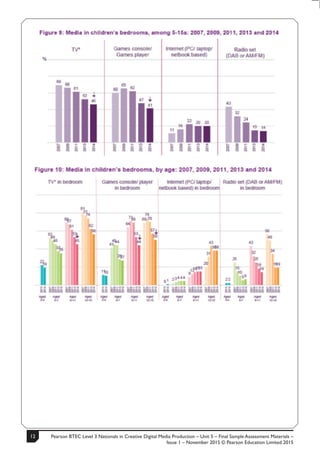
in a child’s bedroom. Figure 9 below shows results for all children aged 5–15,
while Figure 10 shows how the results vary by each of the four age groups:
3–4, 5–7, 8–11 and 12–15.
TV
Virtually all children aged 3–4 (99%) or 5–15 (98%) have access to a
television at home. The incidence of having a television in the bedroom,
however, increases with each age group; accounting for one in five 3–4
year olds (19%), around one-third of 5–7 year olds (35%), just under half
of 8–11 year olds (45%), and just over half of 12–15 year olds (56%). Since
2013, there has been a decrease in the incidence of having a television in
the bedroom among children aged 5–15 (46% in 2014 vs. 52% in 2013). This
decrease is evident only among 8–11 year olds (45% vs. 53%), but Figure 10
shows a downward trend for each age group from 5 to 15 since 2007. Across
the socio-economic groups, having a television in the bedroom is less likely
than in 2013 for children in AB households (34% vs. 45%), but is unchanged
for other groups.
Games
Games consoles/games players (either fixed or portable) are the second
most common type of media device present in children’s bedrooms,
accounting for one in ten 3–4 year olds (10%), a quarter of 5–7 year olds
(27%), just under half of 8–11 year olds (44%) and half of 12–15 year olds
(50%). Compared to 2013, children aged 5–15 are now less likely to have a
games console/player in their bedroom (41% vs. 47%), with this decrease
evident for 8–11 year olds (44% vs. 53%) and 12–15s (50% vs. 57%). The
overall decline since 2013 in ownership of a fixed or portable games
console in the bedroom is evident for girls aged 5–15 (31% vs. 41%), but is
unchanged for boys aged 5–15.
Pearson BTEC Level 3 Nationals in Creative Digital Media Production – Unit 5 – Final Sample Assessment Materials –
Issue 1 – November 2015 © Pearson Education Limited 2015
11S50147A
11
Turn over
Internet
Although most children aged 5–15 have PC/ laptop/netbook-based internet
access in the household (88%, as shown in Figure 1), a minority of 5–15
year olds (20%) have access to the internet in their bedroom through one
of these devices. The incidence increases with each age group; accounting
for very few in the 3–4 age group (1%), around one in 20 5–7 year olds (4%),
one in seven 8–11 year olds (15%), and two in five 12–15 year olds (38%).
Each of these measures is unchanged since 2013.
Radio
One in seven children aged 5–15 (14%) have a radio in their bedroom, with
this incidence increasing with the age of the child, accounting for very few
3–4s (2%), one in 20 5–7s (6%), one in seven 8–11s (14%) and one in five
12–15 year olds (19%). Each of these measures is unchanged since 2013,
following several years of a significant downward trend for each age group
from 5 to 15 since 2007, as shown in Figure 10.
Pearson BTEC Level 3 Nationals in Creative Digital Media Production – Unit 5 – Final Sample Assessment Materials –
Issue 1 – November 2015 © Pearson Education Limited 2015
12
12
S50147A
Pearson BTEC Level 3 Nationals in Creative Digital Media Production – Unit 5 – Final Sample Assessment Materials –
Issue 1 – November 2015 © Pearson Education Limited 2015
13S50147A
13
Turn over
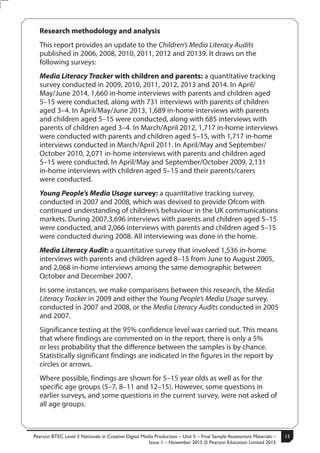
Research methodology and analysis
This report provides an update to the Children’s Media Literacy Audits
published in 2006, 2008, 2010, 2011, 2012 and 20139. It draws on the
following surveys:
Media Literacy Tracker with children and parents: a quantitative tracking
survey conducted in 2009, 2010, 2011, 2012, 2013 and 2014. In April/
May/June 2014, 1,660 in-home interviews with parents and children aged
5–15 were conducted, along with 731 interviews with parents of children
aged 3–4. In April/May/June 2013, 1,689 in-home interviews with parents
and children aged 5–15 were conducted, along with 685 interviews with
parents of children aged 3–4. In March/April 2012, 1,717 in-home interviews
were conducted with parents and children aged 5–15, with 1,717 in-home
interviews conducted in March/April 2011. In April/May and September/
October 2010, 2,071 in-home interviews with parents and children aged
5–15 were conducted. In April/May and September/October 2009, 2,131
in-home interviews with children aged 5–15 and their parents/carers
were conducted.
Young People’s Media Usage survey: a quantitative tracking survey,
conducted in 2007 and 2008, which was devised to provide Ofcom with
continued understanding of children’s behaviour in the UK communications
markets. During 2007,3,696 interviews with parents and children aged 5–15
were conducted, and 2,066 interviews with parents and children aged 5–15
were conducted during 2008. All interviewing was done in the home.
Media Literacy Audit: a quantitative survey that involved 1,536 in-home
interviews with parents and children aged 8–15 from June to August 2005,
and 2,068 in-home interviews among the same demographic between
October and December 2007.
In some instances, we make comparisons between this research, the Media
Literacy Tracker in 2009 and either the Young People’s Media Usage survey,
conducted in 2007 and 2008, or the Media Literacy Audits conducted in 2005
and 2007.
Significance testing at the 95% confidence level was carried out. This means
that where findings are commented on in the report, there is only a 5%
or less probability that the difference between the samples is by chance.
Statistically significant findings are indicated in the figures in the report by
circles or arrows.
Where possible, findings are shown for 5–15 year olds as well as for the
specific age groups (5–7, 8–11 and 12–15). However, some questions in
earlier surveys, and some questions in the current survey, were not asked of
all age groups.
Pearson BTEC Level 3 Nationals in Creative Digital Media Production – Unit 5 – Final Sample Assessment Materials –
Issue 1 – November 2015 © Pearson Education Limited 2015
14
14
S50147A
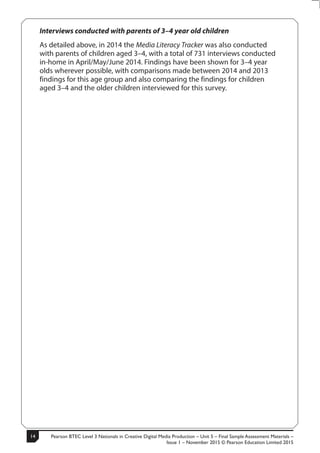
Interviews conducted with parents of 3–4 year old children
As detailed above, in 2014 the Media Literacy Tracker was also conducted
with parents of children aged 3–4, with a total of 731 interviews conducted
in-home in April/May/June 2014. Findings have been shown for 3–4 year
olds wherever possible, with comparisons made between 2014 and 2013
findings for this age group and also comparing the findings for children
aged 3–4 and the older children interviewed for this survey.
Pearson BTEC Level 3 Nationals in Creative Digital Media Production – Unit 5 – Final Sample Assessment Materials –
Issue 1 – November 2015 © Pearson Education Limited 2015
15
Turn over
Level
3
Write your name here
Surname Forename
*S50633A*
Paper reference
XXXX/XX
S50633A
©2015 Pearson Education Ltd.
1/1/1
Pearson BTEC Level 3 Nationals
Creative Digital
Media Production
Unit 5: Specialist Subject Investigation
Extended Diploma
Sample assessment material for first teaching
September 2016
Instructions
Part A will need to have been used in preparation for completion of Part B.
Part B contains material for the completion of the set task under
supervised conditions.
Part B should be undertaken in 2 hours during the assessment period of 3 days
as timetabled by Pearson.
Part B is specific to each series and this material must only be issued to learners
who have been entered to undertake the task in the relevant series.
Part B should be kept securely until the start of the 2-hour supervised
assessment period.
Information
The total mark for this paper is 65.
Centre NumberLearner Registration Number
Part
B
Marks
Supervised
hours
2
Pearson BTEC Level 3 Nationals in Creative Digital Media Production – Unit 5 – Final Sample Assessment Materials –
Issue 1 – November 2015 © Pearson Education Limited 2015
162 S50633A
Instructions to Teachers/Tutors and/or Invigilators
This paper must be read in conjunction with the unit information in the
specification and the BTEC Nationals Information for Conducting External
Assessments (ICEA) document. See Pearson website for details.
The set task should be carried out under supervised conditions.
Work should be completed in this task book.
All learner work must be completed independently and authenticated by
the Teacher/Tutor and/or Invigilator before being submitted to Pearson.
Centres are free to arrange the supervised assessment period how they wish
within the 3 day window, provided the 2 hours for producing final outcomes
are under the level of supervision specified, and in accordance with the
conduct procedures.
Refer carefully to the instructions in this task booklet and the Information
for Conducting External Assessments (ICEA) document to ensure that the
assessment is supervised correctly. An authentication statement will be
required confirming that learner work has been completed as directed.
Learners must not bring anything into the supervised environment or take
anything out without your approval.
Centres are responsible for putting in place appropriate checks to ensure
that only permitted material is introduced into the supervised environment.
Maintaining security:
ÂÂ During supervised assessment periods, the assessment areas must only
be accessible to the individual learner and to named members of staff.
ÂÂ Learners can only access their work under supervision.
ÂÂ Any work learners produce under supervision must be kept secure.
ÂÂ Any materials being used by learners must be collected in at the end of
each session, stored securely and handed back at the beginning of the
next session.
ÂÂ Learners are not permitted to have access to the internet during the
supervised assessment period.
Pearson BTEC Level 3 Nationals in Creative Digital Media Production – Unit 5 – Final Sample Assessment Materials –
Issue 1 – November 2015 © Pearson Education Limited 2015
17S50633A 3
Turn over
Outcomes for Submission
The following documents will need to be submitted by each learner:
ÂÂ Part B booklet.
The prepared notes do not need to be submitted to Pearson with the
final outcomes.
Pearson BTEC Level 3 Nationals in Creative Digital Media Production – Unit 5 – Final Sample Assessment Materials –
Issue 1 – November 2015 © Pearson Education Limited 2015
184 S50633A
Instructions for Learners
Read the set task information carefully.
You must plan your time accordingly and be prepared to submit all the
required evidence by the date specified.
You will need to refer to any preparatory work from Part A to complete the
set task in Part B.
You will complete this set task under supervision and your work will be kept
securely during any breaks taken.
You must work independently throughout the supervised assessment
period and should not share your work with other learners.
Outcomes for Submission
You will need to submit one document on completion of the supervised
assessment period:
ÂÂ Part B booklet.
Any prepared notes do not need to be submitted to Pearson with the
final outcomes.
Set Task
You must complete ALL activities.
You will need to refer to the article and your research notes completed in
Part A.
Pearson BTEC Level 3 Nationals in Creative Digital Media Production – Unit 5 – Final Sample Assessment Materials –
Issue 1 – November 2015 © Pearson Education Limited 2015
19S50633A 5
Turn over
Catalogue
Provide a fully referenced list of the primary and secondary sources you
have used in your research in addition to the stimulus material (no more
than ten sources).
Primary
Secondary
Pearson BTEC Level 3 Nationals in Creative Digital Media Production – Unit 5 – Final Sample Assessment Materials –
Issue 1 – November 2015 © Pearson Education Limited 2015
206 S50633A
Activity 1
Article: Ofcom: Children and Parents: Media Use and Attitudes.
What are the key issues raised in the article and how has qualitative and
quantitative research been applied to explore them?
.....................................................................................................................................................................................................................................................
.....................................................................................................................................................................................................................................................
.....................................................................................................................................................................................................................................................
.....................................................................................................................................................................................................................................................
.....................................................................................................................................................................................................................................................
.....................................................................................................................................................................................................................................................
.....................................................................................................................................................................................................................................................
.....................................................................................................................................................................................................................................................
.....................................................................................................................................................................................................................................................
.....................................................................................................................................................................................................................................................
.....................................................................................................................................................................................................................................................
.....................................................................................................................................................................................................................................................
.....................................................................................................................................................................................................................................................
.....................................................................................................................................................................................................................................................
.....................................................................................................................................................................................................................................................
.....................................................................................................................................................................................................................................................
.....................................................................................................................................................................................................................................................
.....................................................................................................................................................................................................................................................
.....................................................................................................................................................................................................................................................
.....................................................................................................................................................................................................................................................
Pearson BTEC Level 3 Nationals in Creative Digital Media Production – Unit 5 – Final Sample Assessment Materials –
Issue 1 – November 2015 © Pearson Education Limited 2015
21S50633A 7
Turn over
.....................................................................................................................................................................................................................................................
.....................................................................................................................................................................................................................................................
.....................................................................................................................................................................................................................................................
.....................................................................................................................................................................................................................................................
.....................................................................................................................................................................................................................................................
.....................................................................................................................................................................................................................................................
.....................................................................................................................................................................................................................................................
.....................................................................................................................................................................................................................................................
.....................................................................................................................................................................................................................................................
.....................................................................................................................................................................................................................................................
.....................................................................................................................................................................................................................................................
.....................................................................................................................................................................................................................................................
.....................................................................................................................................................................................................................................................
.....................................................................................................................................................................................................................................................
.....................................................................................................................................................................................................................................................
.....................................................................................................................................................................................................................................................
.....................................................................................................................................................................................................................................................
.....................................................................................................................................................................................................................................................
.....................................................................................................................................................................................................................................................
.....................................................................................................................................................................................................................................................
.....................................................................................................................................................................................................................................................
.....................................................................................................................................................................................................................................................
Total for Activity 1 = 15 marks
Pearson BTEC Level 3 Nationals in Creative Digital Media Production – Unit 5 – Final Sample Assessment Materials –
Issue 1 – November 2015 © Pearson Education Limited 2015
228 S50633A
Activity 2
How far does the primary and secondary research you have conducted
support the conclusions drawn in the article?
.....................................................................................................................................................................................................................................................
.....................................................................................................................................................................................................................................................
.....................................................................................................................................................................................................................................................
.....................................................................................................................................................................................................................................................
.....................................................................................................................................................................................................................................................
.....................................................................................................................................................................................................................................................
.....................................................................................................................................................................................................................................................
.....................................................................................................................................................................................................................................................
.....................................................................................................................................................................................................................................................
.....................................................................................................................................................................................................................................................
.....................................................................................................................................................................................................................................................
.....................................................................................................................................................................................................................................................
.....................................................................................................................................................................................................................................................
.....................................................................................................................................................................................................................................................
.....................................................................................................................................................................................................................................................
.....................................................................................................................................................................................................................................................
.....................................................................................................................................................................................................................................................
.....................................................................................................................................................................................................................................................
.....................................................................................................................................................................................................................................................
.....................................................................................................................................................................................................................................................
.....................................................................................................................................................................................................................................................
Pearson BTEC Level 3 Nationals in Creative Digital Media Production – Unit 5 – Final Sample Assessment Materials –
Issue 1 – November 2015 © Pearson Education Limited 2015
23S50633A 9
Turn over
.....................................................................................................................................................................................................................................................
.....................................................................................................................................................................................................................................................
.....................................................................................................................................................................................................................................................
.....................................................................................................................................................................................................................................................
.....................................................................................................................................................................................................................................................
.....................................................................................................................................................................................................................................................
.....................................................................................................................................................................................................................................................
.....................................................................................................................................................................................................................................................
.....................................................................................................................................................................................................................................................
.....................................................................................................................................................................................................................................................
.....................................................................................................................................................................................................................................................
.....................................................................................................................................................................................................................................................
.....................................................................................................................................................................................................................................................
.....................................................................................................................................................................................................................................................
.....................................................................................................................................................................................................................................................
.....................................................................................................................................................................................................................................................
.....................................................................................................................................................................................................................................................
.....................................................................................................................................................................................................................................................
.....................................................................................................................................................................................................................................................
.....................................................................................................................................................................................................................................................
.....................................................................................................................................................................................................................................................
.....................................................................................................................................................................................................................................................
Total for Activity 2 = 15 marks
Pearson BTEC Level 3 Nationals in Creative Digital Media Production – Unit 5 – Final Sample Assessment Materials –
Issue 1 – November 2015 © Pearson Education Limited 2015
2410 S50633A
Activity 3
What is the impact of the topic on media production in your specific media
sector? Refer to your primary and secondary research in your response.
.....................................................................................................................................................................................................................................................
.....................................................................................................................................................................................................................................................
.....................................................................................................................................................................................................................................................
.....................................................................................................................................................................................................................................................
.....................................................................................................................................................................................................................................................
.....................................................................................................................................................................................................................................................
.....................................................................................................................................................................................................................................................
.....................................................................................................................................................................................................................................................
.....................................................................................................................................................................................................................................................
.....................................................................................................................................................................................................................................................
.....................................................................................................................................................................................................................................................
.....................................................................................................................................................................................................................................................
.....................................................................................................................................................................................................................................................
.....................................................................................................................................................................................................................................................
.....................................................................................................................................................................................................................................................
.....................................................................................................................................................................................................................................................
.....................................................................................................................................................................................................................................................
.....................................................................................................................................................................................................................................................
.....................................................................................................................................................................................................................................................
.....................................................................................................................................................................................................................................................
.....................................................................................................................................................................................................................................................
Pearson BTEC Level 3 Nationals in Creative Digital Media Production – Unit 5 – Final Sample Assessment Materials –
Issue 1 – November 2015 © Pearson Education Limited 2015
25S50633A 11
Turn over
.....................................................................................................................................................................................................................................................
.....................................................................................................................................................................................................................................................
.....................................................................................................................................................................................................................................................
.....................................................................................................................................................................................................................................................
.....................................................................................................................................................................................................................................................
.....................................................................................................................................................................................................................................................
.....................................................................................................................................................................................................................................................
.....................................................................................................................................................................................................................................................
.....................................................................................................................................................................................................................................................
.....................................................................................................................................................................................................................................................
.....................................................................................................................................................................................................................................................
.....................................................................................................................................................................................................................................................
.....................................................................................................................................................................................................................................................
.....................................................................................................................................................................................................................................................
.....................................................................................................................................................................................................................................................
.....................................................................................................................................................................................................................................................
.....................................................................................................................................................................................................................................................
.....................................................................................................................................................................................................................................................
.....................................................................................................................................................................................................................................................
.....................................................................................................................................................................................................................................................
.....................................................................................................................................................................................................................................................
.....................................................................................................................................................................................................................................................
Total for Activity 3 = 15 marks
Pearson BTEC Level 3 Nationals in Creative Digital Media Production – Unit 5 – Final Sample Assessment Materials –
Issue 1 – November 2015 © Pearson Education Limited 2015
2612 S50633A
Activity 4
With reference to the article and your own research, how has the topic
impacted on consumption patterns in your specific media sector?
.....................................................................................................................................................................................................................................................
.....................................................................................................................................................................................................................................................
.....................................................................................................................................................................................................................................................
.....................................................................................................................................................................................................................................................
.....................................................................................................................................................................................................................................................
.....................................................................................................................................................................................................................................................
.....................................................................................................................................................................................................................................................
.....................................................................................................................................................................................................................................................
.....................................................................................................................................................................................................................................................
.....................................................................................................................................................................................................................................................
.....................................................................................................................................................................................................................................................
.....................................................................................................................................................................................................................................................
.....................................................................................................................................................................................................................................................
.....................................................................................................................................................................................................................................................
.....................................................................................................................................................................................................................................................
.....................................................................................................................................................................................................................................................
.....................................................................................................................................................................................................................................................
.....................................................................................................................................................................................................................................................
.....................................................................................................................................................................................................................................................
.....................................................................................................................................................................................................................................................
.....................................................................................................................................................................................................................................................
Pearson BTEC Level 3 Nationals in Creative Digital Media Production – Unit 5 – Final Sample Assessment Materials –
Issue 1 – November 2015 © Pearson Education Limited 2015
27S50633A 13
Turn over
.....................................................................................................................................................................................................................................................
.....................................................................................................................................................................................................................................................
.....................................................................................................................................................................................................................................................
.....................................................................................................................................................................................................................................................
.....................................................................................................................................................................................................................................................
.....................................................................................................................................................................................................................................................
.....................................................................................................................................................................................................................................................
.....................................................................................................................................................................................................................................................
.....................................................................................................................................................................................................................................................
.....................................................................................................................................................................................................................................................
.....................................................................................................................................................................................................................................................
.....................................................................................................................................................................................................................................................
.....................................................................................................................................................................................................................................................
.....................................................................................................................................................................................................................................................
.....................................................................................................................................................................................................................................................
.....................................................................................................................................................................................................................................................
.....................................................................................................................................................................................................................................................
.....................................................................................................................................................................................................................................................
.....................................................................................................................................................................................................................................................
.....................................................................................................................................................................................................................................................
.....................................................................................................................................................................................................................................................
.....................................................................................................................................................................................................................................................
Total for Activity 4 = 10 marks
Pearson BTEC Level 3 Nationals in Creative Digital Media Production – Unit 5 – Final Sample Assessment Materials –
Issue 1 – November 2015 © Pearson Education Limited 2015
2814 S50633A
Activity 5
What other research might be carried out in order to gain a greater
understanding of the topic? You must refer both to your own research and
that carried out in the article.
.....................................................................................................................................................................................................................................................
.....................................................................................................................................................................................................................................................
.....................................................................................................................................................................................................................................................
.....................................................................................................................................................................................................................................................
.....................................................................................................................................................................................................................................................
.....................................................................................................................................................................................................................................................
.....................................................................................................................................................................................................................................................
.....................................................................................................................................................................................................................................................
.....................................................................................................................................................................................................................................................
.....................................................................................................................................................................................................................................................
.....................................................................................................................................................................................................................................................
.....................................................................................................................................................................................................................................................
.....................................................................................................................................................................................................................................................
.....................................................................................................................................................................................................................................................
.....................................................................................................................................................................................................................................................
.....................................................................................................................................................................................................................................................
.....................................................................................................................................................................................................................................................
.....................................................................................................................................................................................................................................................
.....................................................................................................................................................................................................................................................
.....................................................................................................................................................................................................................................................
.....................................................................................................................................................................................................................................................
Pearson BTEC Level 3 Nationals in Creative Digital Media Production – Unit 5 – Final Sample Assessment Materials –
Issue 1 – November 2015 © Pearson Education Limited 2015
29S50633A 15
.....................................................................................................................................................................................................................................................
.....................................................................................................................................................................................................................................................
.....................................................................................................................................................................................................................................................
.....................................................................................................................................................................................................................................................
.....................................................................................................................................................................................................................................................
.....................................................................................................................................................................................................................................................
.....................................................................................................................................................................................................................................................
.....................................................................................................................................................................................................................................................
.....................................................................................................................................................................................................................................................
.....................................................................................................................................................................................................................................................
.....................................................................................................................................................................................................................................................
.....................................................................................................................................................................................................................................................
.....................................................................................................................................................................................................................................................
.....................................................................................................................................................................................................................................................
.....................................................................................................................................................................................................................................................
.....................................................................................................................................................................................................................................................
.....................................................................................................................................................................................................................................................
.....................................................................................................................................................................................................................................................
.....................................................................................................................................................................................................................................................
.....................................................................................................................................................................................................................................................
.....................................................................................................................................................................................................................................................
Total for Activity 5 = 10 marks
END OF TASK TOTAL FOR TASK = 65 MARKS
Pearson BTEC Level 3 Nationals in Creative Digital Media Production – Unit 5 – Final Sample Assessment Materials –
Issue 1 – November 2015 © Pearson Education Limited 2015
30
1
Unit 5: Specialist Subject Investigation-
Sample marking grid
General Marking Guidance
● All learners must receive the same treatment. Examiners must mark the first learner
in exactly the same way as they mark the last.
● Marking grids should be applied positively. Learners must be rewarded for what they
have shown they can do rather than penalised for omissions.
● Examiners should mark according to the marking grid not according to their
perception of where the grade boundaries may lie.
● All marks on the marking grid should be used appropriately.
● All the marks on the marking grid are designed to be awarded. Examiners should
always award full marks if deserved. Examiners should also be prepared to award
zero marks if the learner’s response is not rewardable according to the marking grid.
● Where judgment is required, a marking grid will provide the principles by which
marks will be awarded.
● When examiners are in doubt regarding the application of the marking grid to a
learner’s response, a senior examiner should be consulted.
Specific Marking guidance
The marking grids have been designed to assess learner work holistically.
Rows within the grids identify the assessment focus/objective being targeted. When
using a marking grid, the ‘best fit’ approach should be used.
● Examiners should first make a holistic judgement on which band most closely
matches the learner response and place it within that band. Learners will be
placed in the band that best describes their answer.
● The mark awarded within the band will be decided based on the quality of the
answer in response to the assessment focus/objective and will be modified
according to how securely all bullet points are displayed at that band.
● Marks will be awarded towards the top or bottom of that band depending on how
they have evidenced each of the descriptor bullet points.
Pearson BTEC Level 3 Nationals in Animal Management - Unit 3 - Final Sample November 2015
© Pearson Education Limited 2015
31
2
Question 1
Assessmen
t focus
Band 0 Band 1 Band 2 Band 3 Band 4
Understanding
research
methods and
interpreting
research data
0 1-4 5-8 9-12 13-15
No
rewardabl
e material
● Basic understanding of
the topic presented with
limited connections
made to media theories
and debates relating to
the topic of the article.
● Basic description of
research methods
referred to in the article
with limited reference to
data usage/extraction.
● Use of qualitative or
quantitative data
superficially interpreted,
showing limited
consideration of the
information, occasionally
applied to the response
● An understanding of the
topic presented with
some relevant
connections made to
media theories and
debates relating to the
topic of the article.
● Research methods
referred to in the article
are described
demonstrating an
understanding of data
usage; response includes
unsupported evaluative
judgements on suitability.
● Use of qualitative and
quantitative data has
been interpreted showing
consideration of the
information applied to the
response
● Understanding of the
significance of the topic
presented with mostly
relevant connections made
to media theories and
debates relating to the
topic of the article
● Research methods referred
to in the article are
analysed demonstrating an
understanding of data
usage; response likely to
include some supported
evaluative judgements on
suitability.
● Use of qualitative and
quantitative data clearly
interpreted with
consideration of the
validity of the information,
applied to the response.
● Comprehensive understanding
of the significance of the topic
presented with detailed and
precise connections made to
relevant media theories and
debates relating to the topic of
the article.
● Research methods referred to
in the article are evaluated
demonstrating a thorough
understanding of data usage;
response includes fully
supported evaluative
judgements on suitability.
● Use of qualitative and
quantitative data fully and
effectively interpreted by
considering the validity of the
information, clearly applied
throughout the response.
Pearson BTEC Level 3 Nationals in Animal Management - Unit 3 - Final Sample November 2015
© Pearson Education Limited 2015
32
3
Question 2
Assessmen
t focus
Band 0 Band 1 Band 2 Band 3 Band 4
Understanding
the relationship
between own
research and
article and how
this relationship
reinforces the
importance of
the issue.
0 1-4 5-8 9-12 13-15
No
rewardable
material
● Basic description of
primary or secondary
research findings
● Isolated links to the
relationship between
research and the article
● Any comments about how
research supports article’s
conclusions are superficial
● Primary and secondary
research findings described
● Links made demonstrates
an understanding of the
relationship between
research and the article
● Makes relevant comments
about how research
supports article’s
conclusions
● Primary and secondary
research findings and their
relationship to the context
the article explained
● Demonstrates a good
understanding of the
relationship between
research and the article
● Explains the article’s
conclusions with detailed
consideration of the extent
to which research supports
them
● Primary and secondary
research findings and their
relationship to the context
of the article are evaluated
● Demonstrates a thorough
understanding of the
relationship between
research and the article
● Evaluates the article’s
conclusions with
justification of the extent
to which research supports
them
Pearson BTEC Level 3 Nationals in Animal Management - Unit 3 - Final Sample November 2015
© Pearson Education Limited 2015
33
4
Question 3
Assessment
focus
Band 0 Band 1 Band 2 Band 3 Band 4
Impact of the
topic on
Production
0 1-4 5-8 9-12 13-15
No
rewardable
material
● Limited consideration
of the information in
the article, with
superficial reference
made to research
sources.
● Basic understanding
of outcomes
presented with limited
connections made to
media debates
occasionally relating
to topic identified in
the article.
● A basic appraisal is
produced that follows
limited chains of
reasoning.
● The topic has been
partially interpreted with
consideration of the
information in the article,
and appropriate reference
made to research sources.
● Understanding of outcomes
will be evident with a few
connections made to media
debates relevant to topic
identified in the article.
● An appraisal is produced
that follows chains of
reasoning with some
imbalance.
● The topic has been
interpreted with
consideration of the
validity of the information,
detailed reference made to
research sources
● Sound understanding of
the significance of
outcomes is presented
with consistent
connections made to
media debates relevant to
topic identified in the
article.
● A balanced appraisal is
produced that clearly
follows chains of
reasoning.
● The topic has been fully
interpreted with detailed
consideration of the validity of
the information. Sustained
reference made to research
sources which support
response including illustrative
examples
● Comprehensive
understanding of the
significance of outcomes is
presented with detailed and
precise connections made to
media debates of direct
relevance to topic identified in
the article
● A balanced and well-rounded
appraisal is produced that
effectively follows chains of
reasoning.
Pearson BTEC Level 3 Nationals in Animal Management - Unit 3 - Final Sample November 2015
© Pearson Education Limited 2015
34
5
Question 4
Assessment
focus
Band 0 Band 1 Band 2 Band 3 Band 4
Impact on
Media
Consumption
patterns
0 1-4 5-8 9-12 13-15
No
rewardabl
e material
● limited consideration
of the information in
the article, with
superficial reference
made to research
sources.
● basic understanding
of outcomes
presented with
limited connections
made to media
debates occasionally
relating to topic
identified in the
article.
● A basic appraisal is
produced that follows
limited chains of
reasoning.
● the topic has been
partially interpreted
with consideration of
the information in the
article, and
appropriate reference
made to research
sources.
● understanding of
outcomes will be
evident with a few
connections made to
media debates
relevant to topic
identified in the
article.
● An appraisal is
produced that follows
chains of reasoning
with some inbalance.
● the topic has been
interpreted with
consideration of the
validity of the
information, detailed
reference made to
research sources
● sound understanding
of the significance of
outcomes is presented
with consistent
connections made to
media debates
relevant to topic
identified in the
article.
● A balanced appraisal
is produced that
clearly follows chains
of reasoning.
● the topic has been fully
interpreted with detailed
consideration of the
validity of the
information. Sustained
reference made to
research sources which
support response
including illustrative
examples
● comprehensive
understanding of the
significance of outcomes
is presented with detailed
and precise connections
made to media debates
of direct relevance to
topic identified in the
article
● A balanced and well-
rounded appraisal is
produced that effectively
follows chains of
reasoning.
Pearson BTEC Level 3 Nationals in Animal Management - Unit 3 - Final Sample November 2015
© Pearson Education Limited 2015
35
6
Question 5
Assessment
focus
Band 0 Band 1 Band 2 Band 3 Band 4
Research
recommendatio
ns for future
provision and/or
practice
0 1-2 3-5 6-8 9-10
No
rewardable
material
● Basic description of
research for
provision/practice in
the sector.
● Research referred to
will be generic and
without links to topic
in article and
research sources.
● Rationale for further
research is
superficial and
unsupported.
● Recommendations for the
research for
provision/practice in the
sector are explained
● Research referred to
demonstrates an
understanding of the
context within article
making links with research
sources.
● Rationale for further
research is offered with
some supported evidence.
● Recommendations for the
research for
provision/practice in the
sector are analysed
effectively
● Research referred to
demonstrates a good
understanding of the issue
making many accurate
links with its context within
article and research
sources.
● Rationale for further
research is offered and
mostly supported.
● Recommendations for research
for provision/practice in the
sector are justified
systematically throughout the
response.
● Research referred to
demonstrates a thorough
understanding of the issue
making consistently accurate
links with its context within
article and research sources.
● Rationale for further research
offered is fully and effectively
supported.
For more information about Edexcel, BTEC or LCCI qualifications
visit qualifications.pearson.com
BTEC is a registered trademark of Pearson Education Limited
Pearson Education Limited. Registered in England and Wales No. 872828
Registered Office: 80 Strand, London WC2R 0RL
VAT Reg No GB 278 537121

Sample assessment-material-unit-5-specialist-subject-investigation

  • 1.
    Creative Digital Media Production Pearson BTECLevel 3 National in Sample Assessment Materials (SAMs) Unit 5: Specialist Subject Investigation For use with: • Extended Diploma in Creative Digital Media Production First teaching from September 2016 Issue 1
  • 2.
    Pearson BTEC Level3 Nationals in Creative Digital Media Production – Unit 5 – Final Sample Assessment Materials – Issue 1 – November 2015 © Pearson Education Limited 2015 2 Edexcel, BTEC and LCCI qualifications Edexcel, BTEC and LCCI qualifications are awarded by Pearson, the UK’s largest awarding body offering academic and vocational qualifications that are globally recognised and benchmarked. For further information, please visit our qualification websites at www.edexcel.com, www.btec.co.uk or www.lcci.org.uk. Alternatively, you can get in touch with us using the details on our contact us page at qualifications.pearson.com/contactus About Pearson Pearson is the world's leading learning company, with 40,000 employees in more than 70 countries working to help people of all ages to make measurable progress in their lives through learning. We put the learner at the centre of everything we do, because wherever learning flourishes, so do people. Find out more about how we can help you and your learners at qualifications.pearson.com References to third-party material made in this specification are made in good faith. We do not endorse, approve or accept responsibility for the content of materials, which may be subject to change, or any opinions expressed therein. (Material may include textbooks, journals, magazines and other publications and websites.) All information in this document is correct at time of publication. All the material in this publication is copyright © Pearson Education Limited 2015
  • 3.
    Pearson BTEC Level3 Nationals in Creative Digital Media Production – Unit 5 – Final Sample Assessment Materials – Issue 1 – November 2015 © Pearson Education Limited 2015 1 Turn over Level 3 Write your name here Surname Forename *S50147A* Paper reference XXXX/XX S50147A ©2015 Pearson Education Ltd. 1/1/1/1 Creative Digital Media Production Unit 5: Specialist Subject Investigation ≠≠ Extended Diploma Sample assessment material for first teaching September 2016 Instructions Part A contains material for the completion of the preparatory work for the set task. Part A should be undertaken over a maximum of 18 hours across a period of 6 weeks Part A may be given to learners 6 weeks in advance of the supervised assessment period. Part A is specific to each series and this material must only be issued to learners who have been entered to undertake the task in relevant series Part B materials for the set task will be issued prior to the start of the supervised assessment period according to the guidance in the specification. Pearson BTEC Level 3 Nationals Part A
  • 4.
    Pearson BTEC Level3 Nationals in Creative Digital Media Production – Unit 5 – Final Sample Assessment Materials – Issue 1 – November 2015 © Pearson Education Limited 2015 2 2 S50147A Instructions to Teachers/Tutors This paper must be read in conjunction with the unit information in the specification and the BTEC Nationals Information for Conducting External Assessments (ICEA) document. See Pearson website for details. Part A should be issued to learners 6 weeks prior to undertaking Part B of the assessment. Learners will be expected to conduct research and can take up to 4 sides of A4 notes and diagrams into the supervised assessment. Research is expected to be carried out over approximately 18 hours. Teachers/Tutors cannot give any support to the notes and the work must be completed independently by the learner. Centres are free to arrange the supervised assessment period how they wish provided the 2 hours for producing final outcomes are under the level of supervision specified, and in accordance with the conduct procedures. Refer carefully to the instructions in this task booklet and the Information for Conducting External Assessments (ICEA) document to ensure that the preparatory period is conducted correctly and that learners have the opportunity to carry out the required activities independently.
  • 5.
    Pearson BTEC Level3 Nationals in Creative Digital Media Production – Unit 5 – Final Sample Assessment Materials – Issue 1 – November 2015 © Pearson Education Limited 2015 3S50147A 3 Turn over Instructions for Learners Read the set task information carefully. This contains Part A of the information you need to prepare for the set task. You will need to carry out your own research over the next 6 weeks. You will then be given the set task to complete under supervised conditions. You must work independently and should not share your work with other learners. Your teacher may give guidance on when you can complete the preparatory work. Your teacher cannot give you feedback during the preparation period.
  • 6.
    Pearson BTEC Level3 Nationals in Creative Digital Media Production – Unit 5 – Final Sample Assessment Materials – Issue 1 – November 2015 © Pearson Education Limited 2015 4 4 S50147A Set Task Brief You have 18 hours to investigate the issues raised in the stimulus material. During this time you should: 1. Read the stimulus material in the set task information. If there is anything in the task instructions you are unclear about you should ask your tutor. 2. Analyse the stimulus material. 3. Conduct primary and secondary research into the issues raised in the stimulus material. You must relate your research to a specific media sector. 4. Compile a catalogue of research that includes all primary and secondary sources you intend to reference. You should base your research for the task on a minimum of two different primary and four different secondary sources therefore no more than ten sources should be used, in addition to the stimulus material. 5. Prepare handwritten notes of up to 4 sides of A4 about the stimulus article and your own additional research. In Part B you will have 2 hours supervised time to complete your set task based on the topics raised in the Part A. During the supervised assessment period you are not permitted to: ÂÂ use a pre-prepared script ÂÂ work with others. During the supervised period, you will be permitted access to the stimulus material, your research catalogue and your notes. You will not be allowed to carry out any additional research and you will not have access to the internet during this time.
  • 7.
    Pearson BTEC Level3 Nationals in Creative Digital Media Production – Unit 5 – Final Sample Assessment Materials – Issue 1 – November 2015 © Pearson Education Limited 2015 5S50147A 5 Turn over Part A Set Task Information Stimulus material – article Ofcom 2014 – Children and Parents: Media Use and Attitudes. Developments in technology affect the ways in which we access, consume and produce different types of media. Ofcom (Office of Communications, the regulator for the communications industries) conducted research into the changing use of media by children in the report Children and Parents: Media Use and Attitudes. The following are edited extracts from that report. Section 1 Executive summary Our 2014 Children and Parents: Media Use and Attitudes report provides detailed evidence on media use, attitudes and understanding among children and young people aged 5–15, as well as detailed information about media access and use among children aged 3–4. Our report also includes findings relating to parents’ views about their children’s media use, and the ways that parents seek – or not – to monitor or limit such use. Summary of key themes This year’s report shows that: ÂÂ There has been a significant increase in access to, ownership of and use of tablet computers by children of all ages. In contrast, the incidence of TVs and games consoles in the bedroom is declining, while smartphone ownership remains steady. ÂÂ Almost twice as many children aged 5–15 are going online via a tablet than in 2013. At the same time, the number of those only using a device other than a PC/laptop/netbook to go online has increased, and access to the internet at home via a PC/laptop/netbook has declined. ÂÂ 12–15 year olds are twice as likely to say they would miss their mobile phone than the TV, say they spend more time going online than watching television in a typical week, and say they prefer to socialise online rather than watch TV. In contrast, younger children still prefer TV to any other device, and spend more time in a typical week watching TV than doing any other media activity.
  • 8.
    Pearson BTEC Level3 Nationals in Creative Digital Media Production – Unit 5 – Final Sample Assessment Materials – Issue 1 – November 2015 © Pearson Education Limited 2015 6 6 S50147A ÂÂ Gender differences are evident from an early age. Differences include a preference for gaming among boys and for communicating online among girls. Parents also treat boys and girls differently, monitoring some aspects of girls’online activity more closely than boys’. ÂÂ Older children are making judgements about the truthfulness of online content, including search engine results and how accurately people present themselves online. Around a quarter of parents express concern about the media content their child has access to, with concerns about the internet more likely among parents of older children (8–15). ÂÂ Nine in ten parents mediate their child’s access to the internet in some way, with most parents using a combination of approaches including using technical tools, having rules around access and use, regularly talking to the child about specific risks and supervising the child’s online activity. Changes in children’s media consumption Seven in ten children aged 5–15 now have access to a tablet computer at home… Children’s access to a tablet computer at home has increased from 51% to 71% for 5–15 year olds since 2013. In addition, use of a tablet computer at home has increased by 20 percentage points since 2013 for children aged 5–15; six in ten (62% vs. 42%) in this age group, while four in ten children aged 3–4 now use tablets at home (39% vs 28%). Ownership of tablets has almost doubled, with one in three (34%) children aged 5–15 now owning their own tablet computer, up from one in five (19%) in 2013. … and children are almost twice as likely to go online using a tablet Four in ten children aged 5–15 year olds go online using a tablet computer, almost twice as many as in 2013 (42% vs. 23%), while two in ten children aged 3–4 go online using a tablet (20% vs. 12% in 2013). Tablets are now the second most likely device – after laptops/netbooks – to be ‘mostly’used by 5–15 year olds to go online. Going online using a mobile is also more likely… Four in ten 5–15s own a mobile phone, rising to almost eight in ten children aged 12–15. Children in each age group are more likely than in 2013 to use a mobile phone to go online (36% vs. 27% for 5–15s).
  • 9.
    Pearson BTEC Level3 Nationals in Creative Digital Media Production – Unit 5 – Final Sample Assessment Materials – Issue 1 – November 2015 © Pearson Education Limited 2015 7S50147A 7 Turn over This varies significantly by age, with 59% of 12–15s going online using a mobile phone. This coincides with a big increase in smartphone ownership at 13, when ownership jumps from four in ten for 12 year olds (41%) to almost seven in ten for 13 year olds (67%). Among 12–15s the mobile phone is the second most likely device to be ‘mostly’used to go online, after laptops/netbooks, with tablets coming third. … while access to the internet via a PC/laptop has decreased For the first time since this survey began in 2005, access to the internet at home via a PC/laptop/netbook by children aged 5–15 has decreased; from 91% in 2013 to 88% in 2014. At the same time the number of 5–15 year olds who go online only through a device other than a PC/laptop/netbook has doubled, from 4% to 8%. *Despite these changes among 5–15 year olds, laptops/netbooks remain the most popular device that are ever used to go online for each age group, and the laptop/PC is the preferred device for finding information for school work, among all age groups. More kids have access to smart TVs but fewer have TVs and games consoles in their bedroom Smart TV access has increased, from 13% of 5–15 year olds in 2013 to 39% in 2014. However, there have been decreases in the number of children aged 5–15 having a TV in the bedroom (46% in 2014 vs. 52% in 2013) and a games console/player in the bedroom (41% vs. 47%). Gaming on tablets is on the rise, while gaming on some other devices is falling While the use of dedicated gaming devices has declined (77% vs. 81% in 2013), and use of computers/laptops for gaming has also decreased, use of tablet computers to play games has increased among 5–15s (30% vs. 23%). TV is the media device that would be most missed overall… At an overall level, the television set is the device that children aged 5–15 would miss most, and television is also nominated by 5–15 year olds as the media activity that they would prefer to do when given the choice. However, preferences for media devices and media activities vary greatly by age, and 12–15 year olds are twice as likely to say they would miss their mobile phone, compared to the TV (37% vs. 18%). The TV set is the only media device used almost every day by a majority of children aged 5 to 15. More time is spent watching television every week (14.6 hours) than undertaking any other media activity, although less time is now spent watching television in a typical week than in 2013 (15.4 hours).
  • 10.
    Pearson BTEC Level3 Nationals in Creative Digital Media Production – Unit 5 – Final Sample Assessment Materials – Issue 1 – November 2015 © Pearson Education Limited 2015 8 8 S50147A Around four in ten children aged 5–15 (38%) use an alternative device to watch TV. While they are now more likely than last year to watch television programmes on a tablet computer (20% vs. 15%), they are less likely to use other alternative devices to watch TV. Three-quarters of all 12–15 year olds (76%) and over half of 8–11s say they never watch YouTube channels. Of those who watch TV channels and YouTube channels, a quarter of the 12–15 year olds (25%) and three in ten 8–11 year olds (29%) say they prefer to watch YouTube. But older children spend more time online and prefer mobile phones for social activities Children aged 12–15 spend more time going online than watching television in a typical week (17.2 vs. 15.7 hours) and say they prefer to socialise online rather than watch TV (33% vs. 20%). Among 12–15s who go online, the mobile phone is the most popular device for social and creative activities such as: arranging to meet friends (71%); messaging friends (53%); looking at photos posted online (47%); and sharing photos they have taken (45%). 8–11 year olds are spending more time online than in 2013 Children aged 8–11 are spending more hours per week using the internet than in 2013 (10.5 vs. 9.2 hours). However, as with 12–15 year olds, children aged 8–11 tend to prefer using mobile phones for more social and creative activities. Children are using a broader range of social media services, with differences by gender Seven in ten 12–15 year olds who go online have a social media profile, and Facebook remains the dominant social media site or app among this group of children. Use of Instagram has doubled to 36% since 2013. A significant minority of 12–15 year olds with a social media profile use other photo- or video-message sites or apps such as SnapChat. Among those 12–15 year olds with a social media profile, boys are more likely than girls to have a profile on YouTube (29% vs. 15%) while girls are more likely than boys to have a profile on three sites or apps: Instagram (42% vs. 30%), SnapChat (33% vs. 20%) and Tumblr (11% vs. 3%). Girls aged 12–15 are more likely than boys to have any concerns or dislikes about social media sites (73% vs. 52%); in particular, these relating to people being bullied, spending too much time on these sites or apps, and friends acting thoughtlessly or hurtfully.
  • 11.
    Pearson BTEC Level3 Nationals in Creative Digital Media Production – Unit 5 – Final Sample Assessment Materials – Issue 1 – November 2015 © Pearson Education Limited 2015 9S50147A 9 Turn over Boys’ preference for gaming devices is evident from an early age… Three in ten (30%) boys aged 3–4 use a handheld/portable games player, compared to two in ten (21%) girls aged 3–4, while boys aged 5–7 are almost twice as likely as girls to say they regularly use a games console/ player (29% vs. 17%). The gender gap widens as age increases (47% vs. 21% for 8–11s, 52% vs. 19% for 12–15s). In contrast, girls aged 5–7 are more likely than boys to play games on a tablet (36% vs. 23%). Among 5–15 year olds, boys in each age group are over five times as likely as girls to say they would most miss a games console/ player (15% vs. 1% for 5–7s, 22% vs. 4% for 8–11s and 22% vs. 3% for 12–15s). … while girls are more likely than boys to miss mobile phones and reading While both boys and girls aged 12–15 would miss a mobile phone the most, this accounts for almost half of girls (46%) compared to three in ten boys (29%). Girls aged 12–15 are also more likely than boys to miss a tablet computer (16% vs. 9%). Girls aged 5–7 are more likely than boys to say they regularly use books, magazines and comics (48% vs. 32%) and girls aged 5–7 and 8–11 are more than twice as likely as boys to say they would miss books, magazines or comics Changes in children’s attitudes, behaviour and cognitive skills More children are demonstrating a level of‘critical understanding’ in relation to different sources of online information Compared to 2013, it appears that 8–11 year olds are now less likely to believe that all the information that they see on websites used for school work or homework is true (20% vs. 36%), or that all the information found on news sites or apps is true (12% vs. 26%). There was a change in the survey’s focus, from a child’s use of media ‘at home’in previous years to ‘at home and elsewhere’in 2014. Therefore, we cannot be entirely confident that the differences since 2013 represent a ‘real’ change in attitudes over time. It also appears that 12–15 year olds are now less likely than in 2013 to believe that all the information they see on websites used for school work or homework is true (16% vs. 30%), or that all the information found on news sites or apps is true (8% vs. 18%). Similarly, compared to 2013, children aged 12–15 are less likely to say that all or most of the information on social media sites or apps is true (21% vs. 30%) and three in four 12–15s who go online (77%) agree that most people behave in a different way online from when they talk to people face to face.
  • 12.
    Pearson BTEC Level3 Nationals in Creative Digital Media Production – Unit 5 – Final Sample Assessment Materials – Issue 1 – November 2015 © Pearson Education Limited 2015 10 10 S50147A These findings indicate an increase in critical awareness of the truthfulness of online content as well as a level of critical awareness of how accurately people might present themselves online. Word of mouth is important when discovering online and TV content… When asked where they would go to find out about “fun things like hobbies or interests”, 33% of 12–15 year olds say they would turn first to Google for accurate and true online information, 26% to YouTube, and 18% to social media. In terms of“how to build, make or create things”, 33% would turn first to YouTube, a similar proportion as the 31% who would turn first to Children. Children and parents: media use and attitudes report Devices in the child’s bedroom In order to understand more about children’s and young people’s media habits, it is useful to know the various types of media activity that take place in a child’s bedroom. Figure 9 below shows results for all children aged 5–15, while Figure 10 shows how the results vary by each of the four age groups: 3–4, 5–7, 8–11 and 12–15. TV Virtually all children aged 3–4 (99%) or 5–15 (98%) have access to a television at home. The incidence of having a television in the bedroom, however, increases with each age group; accounting for one in five 3–4 year olds (19%), around one-third of 5–7 year olds (35%), just under half of 8–11 year olds (45%), and just over half of 12–15 year olds (56%). Since 2013, there has been a decrease in the incidence of having a television in the bedroom among children aged 5–15 (46% in 2014 vs. 52% in 2013). This decrease is evident only among 8–11 year olds (45% vs. 53%), but Figure 10 shows a downward trend for each age group from 5 to 15 since 2007. Across the socio-economic groups, having a television in the bedroom is less likely than in 2013 for children in AB households (34% vs. 45%), but is unchanged for other groups. Games Games consoles/games players (either fixed or portable) are the second most common type of media device present in children’s bedrooms, accounting for one in ten 3–4 year olds (10%), a quarter of 5–7 year olds (27%), just under half of 8–11 year olds (44%) and half of 12–15 year olds (50%). Compared to 2013, children aged 5–15 are now less likely to have a games console/player in their bedroom (41% vs. 47%), with this decrease evident for 8–11 year olds (44% vs. 53%) and 12–15s (50% vs. 57%). The overall decline since 2013 in ownership of a fixed or portable games console in the bedroom is evident for girls aged 5–15 (31% vs. 41%), but is unchanged for boys aged 5–15.
  • 13.
    Pearson BTEC Level3 Nationals in Creative Digital Media Production – Unit 5 – Final Sample Assessment Materials – Issue 1 – November 2015 © Pearson Education Limited 2015 11S50147A 11 Turn over Internet Although most children aged 5–15 have PC/ laptop/netbook-based internet access in the household (88%, as shown in Figure 1), a minority of 5–15 year olds (20%) have access to the internet in their bedroom through one of these devices. The incidence increases with each age group; accounting for very few in the 3–4 age group (1%), around one in 20 5–7 year olds (4%), one in seven 8–11 year olds (15%), and two in five 12–15 year olds (38%). Each of these measures is unchanged since 2013. Radio One in seven children aged 5–15 (14%) have a radio in their bedroom, with this incidence increasing with the age of the child, accounting for very few 3–4s (2%), one in 20 5–7s (6%), one in seven 8–11s (14%) and one in five 12–15 year olds (19%). Each of these measures is unchanged since 2013, following several years of a significant downward trend for each age group from 5 to 15 since 2007, as shown in Figure 10.
  • 14.
    Pearson BTEC Level3 Nationals in Creative Digital Media Production – Unit 5 – Final Sample Assessment Materials – Issue 1 – November 2015 © Pearson Education Limited 2015 12 12 S50147A
  • 15.
    Pearson BTEC Level3 Nationals in Creative Digital Media Production – Unit 5 – Final Sample Assessment Materials – Issue 1 – November 2015 © Pearson Education Limited 2015 13S50147A 13 Turn over Research methodology and analysis This report provides an update to the Children’s Media Literacy Audits published in 2006, 2008, 2010, 2011, 2012 and 20139. It draws on the following surveys: Media Literacy Tracker with children and parents: a quantitative tracking survey conducted in 2009, 2010, 2011, 2012, 2013 and 2014. In April/ May/June 2014, 1,660 in-home interviews with parents and children aged 5–15 were conducted, along with 731 interviews with parents of children aged 3–4. In April/May/June 2013, 1,689 in-home interviews with parents and children aged 5–15 were conducted, along with 685 interviews with parents of children aged 3–4. In March/April 2012, 1,717 in-home interviews were conducted with parents and children aged 5–15, with 1,717 in-home interviews conducted in March/April 2011. In April/May and September/ October 2010, 2,071 in-home interviews with parents and children aged 5–15 were conducted. In April/May and September/October 2009, 2,131 in-home interviews with children aged 5–15 and their parents/carers were conducted. Young People’s Media Usage survey: a quantitative tracking survey, conducted in 2007 and 2008, which was devised to provide Ofcom with continued understanding of children’s behaviour in the UK communications markets. During 2007,3,696 interviews with parents and children aged 5–15 were conducted, and 2,066 interviews with parents and children aged 5–15 were conducted during 2008. All interviewing was done in the home. Media Literacy Audit: a quantitative survey that involved 1,536 in-home interviews with parents and children aged 8–15 from June to August 2005, and 2,068 in-home interviews among the same demographic between October and December 2007. In some instances, we make comparisons between this research, the Media Literacy Tracker in 2009 and either the Young People’s Media Usage survey, conducted in 2007 and 2008, or the Media Literacy Audits conducted in 2005 and 2007. Significance testing at the 95% confidence level was carried out. This means that where findings are commented on in the report, there is only a 5% or less probability that the difference between the samples is by chance. Statistically significant findings are indicated in the figures in the report by circles or arrows. Where possible, findings are shown for 5–15 year olds as well as for the specific age groups (5–7, 8–11 and 12–15). However, some questions in earlier surveys, and some questions in the current survey, were not asked of all age groups.
  • 16.
    Pearson BTEC Level3 Nationals in Creative Digital Media Production – Unit 5 – Final Sample Assessment Materials – Issue 1 – November 2015 © Pearson Education Limited 2015 14 14 S50147A Interviews conducted with parents of 3–4 year old children As detailed above, in 2014 the Media Literacy Tracker was also conducted with parents of children aged 3–4, with a total of 731 interviews conducted in-home in April/May/June 2014. Findings have been shown for 3–4 year olds wherever possible, with comparisons made between 2014 and 2013 findings for this age group and also comparing the findings for children aged 3–4 and the older children interviewed for this survey.
  • 17.
    Pearson BTEC Level3 Nationals in Creative Digital Media Production – Unit 5 – Final Sample Assessment Materials – Issue 1 – November 2015 © Pearson Education Limited 2015 15 Turn over Level 3 Write your name here Surname Forename *S50633A* Paper reference XXXX/XX S50633A ©2015 Pearson Education Ltd. 1/1/1 Pearson BTEC Level 3 Nationals Creative Digital Media Production Unit 5: Specialist Subject Investigation Extended Diploma Sample assessment material for first teaching September 2016 Instructions Part A will need to have been used in preparation for completion of Part B. Part B contains material for the completion of the set task under supervised conditions. Part B should be undertaken in 2 hours during the assessment period of 3 days as timetabled by Pearson. Part B is specific to each series and this material must only be issued to learners who have been entered to undertake the task in the relevant series. Part B should be kept securely until the start of the 2-hour supervised assessment period. Information The total mark for this paper is 65. Centre NumberLearner Registration Number Part B Marks Supervised hours 2
  • 18.
    Pearson BTEC Level3 Nationals in Creative Digital Media Production – Unit 5 – Final Sample Assessment Materials – Issue 1 – November 2015 © Pearson Education Limited 2015 162 S50633A Instructions to Teachers/Tutors and/or Invigilators This paper must be read in conjunction with the unit information in the specification and the BTEC Nationals Information for Conducting External Assessments (ICEA) document. See Pearson website for details. The set task should be carried out under supervised conditions. Work should be completed in this task book. All learner work must be completed independently and authenticated by the Teacher/Tutor and/or Invigilator before being submitted to Pearson. Centres are free to arrange the supervised assessment period how they wish within the 3 day window, provided the 2 hours for producing final outcomes are under the level of supervision specified, and in accordance with the conduct procedures. Refer carefully to the instructions in this task booklet and the Information for Conducting External Assessments (ICEA) document to ensure that the assessment is supervised correctly. An authentication statement will be required confirming that learner work has been completed as directed. Learners must not bring anything into the supervised environment or take anything out without your approval. Centres are responsible for putting in place appropriate checks to ensure that only permitted material is introduced into the supervised environment. Maintaining security: ÂÂ During supervised assessment periods, the assessment areas must only be accessible to the individual learner and to named members of staff. ÂÂ Learners can only access their work under supervision. ÂÂ Any work learners produce under supervision must be kept secure. ÂÂ Any materials being used by learners must be collected in at the end of each session, stored securely and handed back at the beginning of the next session. ÂÂ Learners are not permitted to have access to the internet during the supervised assessment period.
  • 19.
    Pearson BTEC Level3 Nationals in Creative Digital Media Production – Unit 5 – Final Sample Assessment Materials – Issue 1 – November 2015 © Pearson Education Limited 2015 17S50633A 3 Turn over Outcomes for Submission The following documents will need to be submitted by each learner: ÂÂ Part B booklet. The prepared notes do not need to be submitted to Pearson with the final outcomes.
  • 20.
    Pearson BTEC Level3 Nationals in Creative Digital Media Production – Unit 5 – Final Sample Assessment Materials – Issue 1 – November 2015 © Pearson Education Limited 2015 184 S50633A Instructions for Learners Read the set task information carefully. You must plan your time accordingly and be prepared to submit all the required evidence by the date specified. You will need to refer to any preparatory work from Part A to complete the set task in Part B. You will complete this set task under supervision and your work will be kept securely during any breaks taken. You must work independently throughout the supervised assessment period and should not share your work with other learners. Outcomes for Submission You will need to submit one document on completion of the supervised assessment period: ÂÂ Part B booklet. Any prepared notes do not need to be submitted to Pearson with the final outcomes. Set Task You must complete ALL activities. You will need to refer to the article and your research notes completed in Part A.

  • 21.
    Pearson BTEC Level3 Nationals in Creative Digital Media Production – Unit 5 – Final Sample Assessment Materials – Issue 1 – November 2015 © Pearson Education Limited 2015 19S50633A 5 Turn over Catalogue Provide a fully referenced list of the primary and secondary sources you have used in your research in addition to the stimulus material (no more than ten sources). Primary Secondary
  • 22.
    Pearson BTEC Level3 Nationals in Creative Digital Media Production – Unit 5 – Final Sample Assessment Materials – Issue 1 – November 2015 © Pearson Education Limited 2015 206 S50633A Activity 1 Article: Ofcom: Children and Parents: Media Use and Attitudes. What are the key issues raised in the article and how has qualitative and quantitative research been applied to explore them? ..................................................................................................................................................................................................................................................... ..................................................................................................................................................................................................................................................... ..................................................................................................................................................................................................................................................... ..................................................................................................................................................................................................................................................... ..................................................................................................................................................................................................................................................... ..................................................................................................................................................................................................................................................... ..................................................................................................................................................................................................................................................... ..................................................................................................................................................................................................................................................... ..................................................................................................................................................................................................................................................... ..................................................................................................................................................................................................................................................... ..................................................................................................................................................................................................................................................... ..................................................................................................................................................................................................................................................... ..................................................................................................................................................................................................................................................... ..................................................................................................................................................................................................................................................... ..................................................................................................................................................................................................................................................... ..................................................................................................................................................................................................................................................... ..................................................................................................................................................................................................................................................... ..................................................................................................................................................................................................................................................... ..................................................................................................................................................................................................................................................... .....................................................................................................................................................................................................................................................
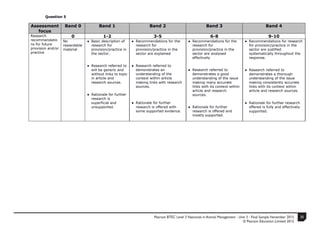
  • 23.
    Pearson BTEC Level3 Nationals in Creative Digital Media Production – Unit 5 – Final Sample Assessment Materials – Issue 1 – November 2015 © Pearson Education Limited 2015 21S50633A 7 Turn over ..................................................................................................................................................................................................................................................... ..................................................................................................................................................................................................................................................... ..................................................................................................................................................................................................................................................... ..................................................................................................................................................................................................................................................... ..................................................................................................................................................................................................................................................... ..................................................................................................................................................................................................................................................... ..................................................................................................................................................................................................................................................... ..................................................................................................................................................................................................................................................... ..................................................................................................................................................................................................................................................... ..................................................................................................................................................................................................................................................... ..................................................................................................................................................................................................................................................... ..................................................................................................................................................................................................................................................... ..................................................................................................................................................................................................................................................... ..................................................................................................................................................................................................................................................... ..................................................................................................................................................................................................................................................... ..................................................................................................................................................................................................................................................... ..................................................................................................................................................................................................................................................... ..................................................................................................................................................................................................................................................... ..................................................................................................................................................................................................................................................... ..................................................................................................................................................................................................................................................... ..................................................................................................................................................................................................................................................... ..................................................................................................................................................................................................................................................... Total for Activity 1 = 15 marks
  • 24.
    Pearson BTEC Level3 Nationals in Creative Digital Media Production – Unit 5 – Final Sample Assessment Materials – Issue 1 – November 2015 © Pearson Education Limited 2015 228 S50633A Activity 2 How far does the primary and secondary research you have conducted support the conclusions drawn in the article? ..................................................................................................................................................................................................................................................... ..................................................................................................................................................................................................................................................... ..................................................................................................................................................................................................................................................... ..................................................................................................................................................................................................................................................... ..................................................................................................................................................................................................................................................... ..................................................................................................................................................................................................................................................... ..................................................................................................................................................................................................................................................... ..................................................................................................................................................................................................................................................... ..................................................................................................................................................................................................................................................... ..................................................................................................................................................................................................................................................... ..................................................................................................................................................................................................................................................... ..................................................................................................................................................................................................................................................... ..................................................................................................................................................................................................................................................... ..................................................................................................................................................................................................................................................... ..................................................................................................................................................................................................................................................... ..................................................................................................................................................................................................................................................... ..................................................................................................................................................................................................................................................... ..................................................................................................................................................................................................................................................... ..................................................................................................................................................................................................................................................... ..................................................................................................................................................................................................................................................... .....................................................................................................................................................................................................................................................
  • 25.
    Pearson BTEC Level3 Nationals in Creative Digital Media Production – Unit 5 – Final Sample Assessment Materials – Issue 1 – November 2015 © Pearson Education Limited 2015 23S50633A 9 Turn over ..................................................................................................................................................................................................................................................... ..................................................................................................................................................................................................................................................... ..................................................................................................................................................................................................................................................... ..................................................................................................................................................................................................................................................... ..................................................................................................................................................................................................................................................... ..................................................................................................................................................................................................................................................... ..................................................................................................................................................................................................................................................... ..................................................................................................................................................................................................................................................... ..................................................................................................................................................................................................................................................... ..................................................................................................................................................................................................................................................... ..................................................................................................................................................................................................................................................... ..................................................................................................................................................................................................................................................... ..................................................................................................................................................................................................................................................... ..................................................................................................................................................................................................................................................... ..................................................................................................................................................................................................................................................... ..................................................................................................................................................................................................................................................... ..................................................................................................................................................................................................................................................... ..................................................................................................................................................................................................................................................... ..................................................................................................................................................................................................................................................... ..................................................................................................................................................................................................................................................... ..................................................................................................................................................................................................................................................... ..................................................................................................................................................................................................................................................... Total for Activity 2 = 15 marks
  • 26.
    Pearson BTEC Level3 Nationals in Creative Digital Media Production – Unit 5 – Final Sample Assessment Materials – Issue 1 – November 2015 © Pearson Education Limited 2015 2410 S50633A Activity 3 What is the impact of the topic on media production in your specific media sector? Refer to your primary and secondary research in your response. ..................................................................................................................................................................................................................................................... ..................................................................................................................................................................................................................................................... ..................................................................................................................................................................................................................................................... ..................................................................................................................................................................................................................................................... ..................................................................................................................................................................................................................................................... ..................................................................................................................................................................................................................................................... ..................................................................................................................................................................................................................................................... ..................................................................................................................................................................................................................................................... ..................................................................................................................................................................................................................................................... ..................................................................................................................................................................................................................................................... ..................................................................................................................................................................................................................................................... ..................................................................................................................................................................................................................................................... ..................................................................................................................................................................................................................................................... ..................................................................................................................................................................................................................................................... ..................................................................................................................................................................................................................................................... ..................................................................................................................................................................................................................................................... ..................................................................................................................................................................................................................................................... ..................................................................................................................................................................................................................................................... ..................................................................................................................................................................................................................................................... ..................................................................................................................................................................................................................................................... .....................................................................................................................................................................................................................................................
  • 27.
    Pearson BTEC Level3 Nationals in Creative Digital Media Production – Unit 5 – Final Sample Assessment Materials – Issue 1 – November 2015 © Pearson Education Limited 2015 25S50633A 11 Turn over ..................................................................................................................................................................................................................................................... ..................................................................................................................................................................................................................................................... ..................................................................................................................................................................................................................................................... ..................................................................................................................................................................................................................................................... ..................................................................................................................................................................................................................................................... ..................................................................................................................................................................................................................................................... ..................................................................................................................................................................................................................................................... ..................................................................................................................................................................................................................................................... ..................................................................................................................................................................................................................................................... ..................................................................................................................................................................................................................................................... ..................................................................................................................................................................................................................................................... ..................................................................................................................................................................................................................................................... ..................................................................................................................................................................................................................................................... ..................................................................................................................................................................................................................................................... ..................................................................................................................................................................................................................................................... ..................................................................................................................................................................................................................................................... ..................................................................................................................................................................................................................................................... ..................................................................................................................................................................................................................................................... ..................................................................................................................................................................................................................................................... ..................................................................................................................................................................................................................................................... ..................................................................................................................................................................................................................................................... ..................................................................................................................................................................................................................................................... Total for Activity 3 = 15 marks
  • 28.
    Pearson BTEC Level3 Nationals in Creative Digital Media Production – Unit 5 – Final Sample Assessment Materials – Issue 1 – November 2015 © Pearson Education Limited 2015 2612 S50633A Activity 4 With reference to the article and your own research, how has the topic impacted on consumption patterns in your specific media sector? ..................................................................................................................................................................................................................................................... ..................................................................................................................................................................................................................................................... ..................................................................................................................................................................................................................................................... ..................................................................................................................................................................................................................................................... ..................................................................................................................................................................................................................................................... ..................................................................................................................................................................................................................................................... ..................................................................................................................................................................................................................................................... ..................................................................................................................................................................................................................................................... ..................................................................................................................................................................................................................................................... ..................................................................................................................................................................................................................................................... ..................................................................................................................................................................................................................................................... ..................................................................................................................................................................................................................................................... ..................................................................................................................................................................................................................................................... ..................................................................................................................................................................................................................................................... ..................................................................................................................................................................................................................................................... ..................................................................................................................................................................................................................................................... ..................................................................................................................................................................................................................................................... ..................................................................................................................................................................................................................................................... ..................................................................................................................................................................................................................................................... ..................................................................................................................................................................................................................................................... .....................................................................................................................................................................................................................................................
  • 29.
    Pearson BTEC Level3 Nationals in Creative Digital Media Production – Unit 5 – Final Sample Assessment Materials – Issue 1 – November 2015 © Pearson Education Limited 2015 27S50633A 13 Turn over ..................................................................................................................................................................................................................................................... ..................................................................................................................................................................................................................................................... ..................................................................................................................................................................................................................................................... ..................................................................................................................................................................................................................................................... ..................................................................................................................................................................................................................................................... ..................................................................................................................................................................................................................................................... ..................................................................................................................................................................................................................................................... ..................................................................................................................................................................................................................................................... ..................................................................................................................................................................................................................................................... ..................................................................................................................................................................................................................................................... ..................................................................................................................................................................................................................................................... ..................................................................................................................................................................................................................................................... ..................................................................................................................................................................................................................................................... ..................................................................................................................................................................................................................................................... ..................................................................................................................................................................................................................................................... ..................................................................................................................................................................................................................................................... ..................................................................................................................................................................................................................................................... ..................................................................................................................................................................................................................................................... ..................................................................................................................................................................................................................................................... ..................................................................................................................................................................................................................................................... ..................................................................................................................................................................................................................................................... ..................................................................................................................................................................................................................................................... Total for Activity 4 = 10 marks
  • 30.
    Pearson BTEC Level3 Nationals in Creative Digital Media Production – Unit 5 – Final Sample Assessment Materials – Issue 1 – November 2015 © Pearson Education Limited 2015 2814 S50633A Activity 5 What other research might be carried out in order to gain a greater understanding of the topic? You must refer both to your own research and that carried out in the article. ..................................................................................................................................................................................................................................................... ..................................................................................................................................................................................................................................................... ..................................................................................................................................................................................................................................................... ..................................................................................................................................................................................................................................................... ..................................................................................................................................................................................................................................................... ..................................................................................................................................................................................................................................................... ..................................................................................................................................................................................................................................................... ..................................................................................................................................................................................................................................................... ..................................................................................................................................................................................................................................................... ..................................................................................................................................................................................................................................................... ..................................................................................................................................................................................................................................................... ..................................................................................................................................................................................................................................................... ..................................................................................................................................................................................................................................................... ..................................................................................................................................................................................................................................................... ..................................................................................................................................................................................................................................................... ..................................................................................................................................................................................................................................................... ..................................................................................................................................................................................................................................................... ..................................................................................................................................................................................................................................................... ..................................................................................................................................................................................................................................................... ..................................................................................................................................................................................................................................................... .....................................................................................................................................................................................................................................................
  • 31.
    Pearson BTEC Level3 Nationals in Creative Digital Media Production – Unit 5 – Final Sample Assessment Materials – Issue 1 – November 2015 © Pearson Education Limited 2015 29S50633A 15 ..................................................................................................................................................................................................................................................... ..................................................................................................................................................................................................................................................... ..................................................................................................................................................................................................................................................... ..................................................................................................................................................................................................................................................... ..................................................................................................................................................................................................................................................... ..................................................................................................................................................................................................................................................... ..................................................................................................................................................................................................................................................... ..................................................................................................................................................................................................................................................... ..................................................................................................................................................................................................................................................... ..................................................................................................................................................................................................................................................... ..................................................................................................................................................................................................................................................... ..................................................................................................................................................................................................................................................... ..................................................................................................................................................................................................................................................... ..................................................................................................................................................................................................................................................... ..................................................................................................................................................................................................................................................... ..................................................................................................................................................................................................................................................... ..................................................................................................................................................................................................................................................... ..................................................................................................................................................................................................................................................... ..................................................................................................................................................................................................................................................... ..................................................................................................................................................................................................................................................... ..................................................................................................................................................................................................................................................... Total for Activity 5 = 10 marks END OF TASK TOTAL FOR TASK = 65 MARKS
  • 32.
    Pearson BTEC Level3 Nationals in Creative Digital Media Production – Unit 5 – Final Sample Assessment Materials – Issue 1 – November 2015 © Pearson Education Limited 2015 30 1 Unit 5: Specialist Subject Investigation- Sample marking grid General Marking Guidance ● All learners must receive the same treatment. Examiners must mark the first learner in exactly the same way as they mark the last. ● Marking grids should be applied positively. Learners must be rewarded for what they have shown they can do rather than penalised for omissions. ● Examiners should mark according to the marking grid not according to their perception of where the grade boundaries may lie. ● All marks on the marking grid should be used appropriately. ● All the marks on the marking grid are designed to be awarded. Examiners should always award full marks if deserved. Examiners should also be prepared to award zero marks if the learner’s response is not rewardable according to the marking grid. ● Where judgment is required, a marking grid will provide the principles by which marks will be awarded. ● When examiners are in doubt regarding the application of the marking grid to a learner’s response, a senior examiner should be consulted. Specific Marking guidance The marking grids have been designed to assess learner work holistically. Rows within the grids identify the assessment focus/objective being targeted. When using a marking grid, the ‘best fit’ approach should be used. ● Examiners should first make a holistic judgement on which band most closely matches the learner response and place it within that band. Learners will be placed in the band that best describes their answer. ● The mark awarded within the band will be decided based on the quality of the answer in response to the assessment focus/objective and will be modified according to how securely all bullet points are displayed at that band. ● Marks will be awarded towards the top or bottom of that band depending on how they have evidenced each of the descriptor bullet points.

  • 33.
    Pearson BTEC Level3 Nationals in Animal Management - Unit 3 - Final Sample November 2015 © Pearson Education Limited 2015 31 2 Question 1 Assessmen t focus Band 0 Band 1 Band 2 Band 3 Band 4 Understanding research methods and interpreting research data 0 1-4 5-8 9-12 13-15 No rewardabl e material ● Basic understanding of the topic presented with limited connections made to media theories and debates relating to the topic of the article. ● Basic description of research methods referred to in the article with limited reference to data usage/extraction. ● Use of qualitative or quantitative data superficially interpreted, showing limited consideration of the information, occasionally applied to the response ● An understanding of the topic presented with some relevant connections made to media theories and debates relating to the topic of the article. ● Research methods referred to in the article are described demonstrating an understanding of data usage; response includes unsupported evaluative judgements on suitability. ● Use of qualitative and quantitative data has been interpreted showing consideration of the information applied to the response ● Understanding of the significance of the topic presented with mostly relevant connections made to media theories and debates relating to the topic of the article ● Research methods referred to in the article are analysed demonstrating an understanding of data usage; response likely to include some supported evaluative judgements on suitability. ● Use of qualitative and quantitative data clearly interpreted with consideration of the validity of the information, applied to the response. ● Comprehensive understanding of the significance of the topic presented with detailed and precise connections made to relevant media theories and debates relating to the topic of the article. ● Research methods referred to in the article are evaluated demonstrating a thorough understanding of data usage; response includes fully supported evaluative judgements on suitability. ● Use of qualitative and quantitative data fully and effectively interpreted by considering the validity of the information, clearly applied throughout the response.
  • 34.
    Pearson BTEC Level3 Nationals in Animal Management - Unit 3 - Final Sample November 2015 © Pearson Education Limited 2015 32 3 Question 2 Assessmen t focus Band 0 Band 1 Band 2 Band 3 Band 4 Understanding the relationship between own research and article and how this relationship reinforces the importance of the issue. 0 1-4 5-8 9-12 13-15 No rewardable material ● Basic description of primary or secondary research findings ● Isolated links to the relationship between research and the article ● Any comments about how research supports article’s conclusions are superficial ● Primary and secondary research findings described ● Links made demonstrates an understanding of the relationship between research and the article ● Makes relevant comments about how research supports article’s conclusions ● Primary and secondary research findings and their relationship to the context the article explained ● Demonstrates a good understanding of the relationship between research and the article ● Explains the article’s conclusions with detailed consideration of the extent to which research supports them ● Primary and secondary research findings and their relationship to the context of the article are evaluated ● Demonstrates a thorough understanding of the relationship between research and the article ● Evaluates the article’s conclusions with justification of the extent to which research supports them
  • 35.
    Pearson BTEC Level3 Nationals in Animal Management - Unit 3 - Final Sample November 2015 © Pearson Education Limited 2015 33 4 Question 3 Assessment focus Band 0 Band 1 Band 2 Band 3 Band 4 Impact of the topic on Production 0 1-4 5-8 9-12 13-15 No rewardable material ● Limited consideration of the information in the article, with superficial reference made to research sources. ● Basic understanding of outcomes presented with limited connections made to media debates occasionally relating to topic identified in the article. ● A basic appraisal is produced that follows limited chains of reasoning. ● The topic has been partially interpreted with consideration of the information in the article, and appropriate reference made to research sources. ● Understanding of outcomes will be evident with a few connections made to media debates relevant to topic identified in the article. ● An appraisal is produced that follows chains of reasoning with some imbalance. ● The topic has been interpreted with consideration of the validity of the information, detailed reference made to research sources ● Sound understanding of the significance of outcomes is presented with consistent connections made to media debates relevant to topic identified in the article. ● A balanced appraisal is produced that clearly follows chains of reasoning. ● The topic has been fully interpreted with detailed consideration of the validity of the information. Sustained reference made to research sources which support response including illustrative examples ● Comprehensive understanding of the significance of outcomes is presented with detailed and precise connections made to media debates of direct relevance to topic identified in the article ● A balanced and well-rounded appraisal is produced that effectively follows chains of reasoning.
  • 36.
    Pearson BTEC Level3 Nationals in Animal Management - Unit 3 - Final Sample November 2015 © Pearson Education Limited 2015 34 5 Question 4 Assessment focus Band 0 Band 1 Band 2 Band 3 Band 4 Impact on Media Consumption patterns 0 1-4 5-8 9-12 13-15 No rewardabl e material ● limited consideration of the information in the article, with superficial reference made to research sources. ● basic understanding of outcomes presented with limited connections made to media debates occasionally relating to topic identified in the article. ● A basic appraisal is produced that follows limited chains of reasoning. ● the topic has been partially interpreted with consideration of the information in the article, and appropriate reference made to research sources. ● understanding of outcomes will be evident with a few connections made to media debates relevant to topic identified in the article. ● An appraisal is produced that follows chains of reasoning with some inbalance. ● the topic has been interpreted with consideration of the validity of the information, detailed reference made to research sources ● sound understanding of the significance of outcomes is presented with consistent connections made to media debates relevant to topic identified in the article. ● A balanced appraisal is produced that clearly follows chains of reasoning. ● the topic has been fully interpreted with detailed consideration of the validity of the information. Sustained reference made to research sources which support response including illustrative examples ● comprehensive understanding of the significance of outcomes is presented with detailed and precise connections made to media debates of direct relevance to topic identified in the article ● A balanced and well- rounded appraisal is produced that effectively follows chains of reasoning.
  • 37.
    Pearson BTEC Level3 Nationals in Animal Management - Unit 3 - Final Sample November 2015 © Pearson Education Limited 2015 35 6 Question 5 Assessment focus Band 0 Band 1 Band 2 Band 3 Band 4 Research recommendatio ns for future provision and/or practice 0 1-2 3-5 6-8 9-10 No rewardable material ● Basic description of research for provision/practice in the sector. ● Research referred to will be generic and without links to topic in article and research sources. ● Rationale for further research is superficial and unsupported. ● Recommendations for the research for provision/practice in the sector are explained ● Research referred to demonstrates an understanding of the context within article making links with research sources. ● Rationale for further research is offered with some supported evidence. ● Recommendations for the research for provision/practice in the sector are analysed effectively ● Research referred to demonstrates a good understanding of the issue making many accurate links with its context within article and research sources. ● Rationale for further research is offered and mostly supported. ● Recommendations for research for provision/practice in the sector are justified systematically throughout the response. ● Research referred to demonstrates a thorough understanding of the issue making consistently accurate links with its context within article and research sources. ● Rationale for further research offered is fully and effectively supported.
  • 38.
    For more informationabout Edexcel, BTEC or LCCI qualifications visit qualifications.pearson.com BTEC is a registered trademark of Pearson Education Limited Pearson Education Limited. Registered in England and Wales No. 872828 Registered Office: 80 Strand, London WC2R 0RL VAT Reg No GB 278 537121