crisedrendelapeña
the concept of entertainment
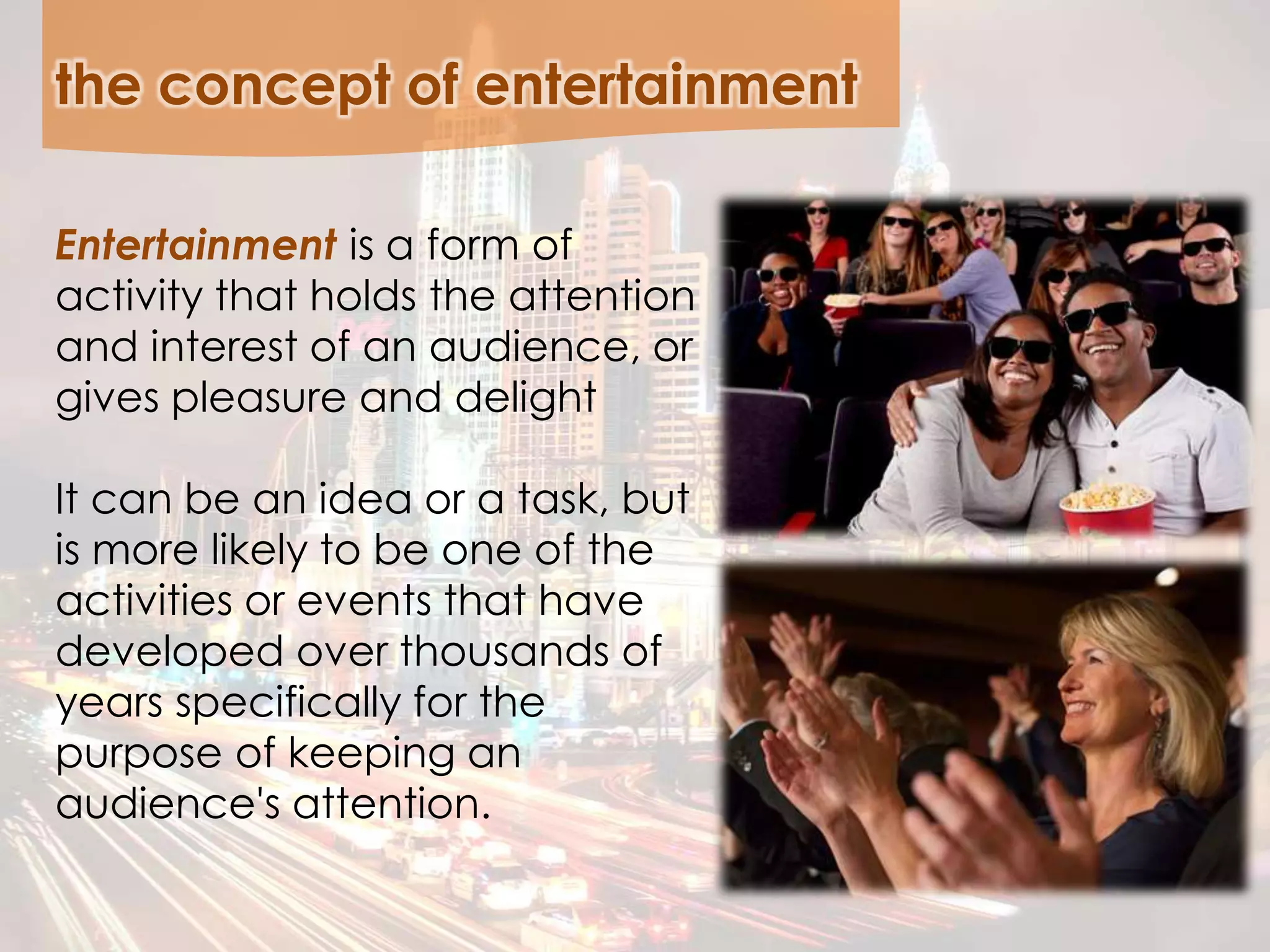
Entertainment is a form of
activity that holds the attention
and interest of an audience, or
gives pleasure and delight
It can be an idea or a task, but
is more likely to be one of the
activities or events that have
developed over thousands of
years specifically for the
purpose of keeping an
audience's attention.
the concept of entertainment
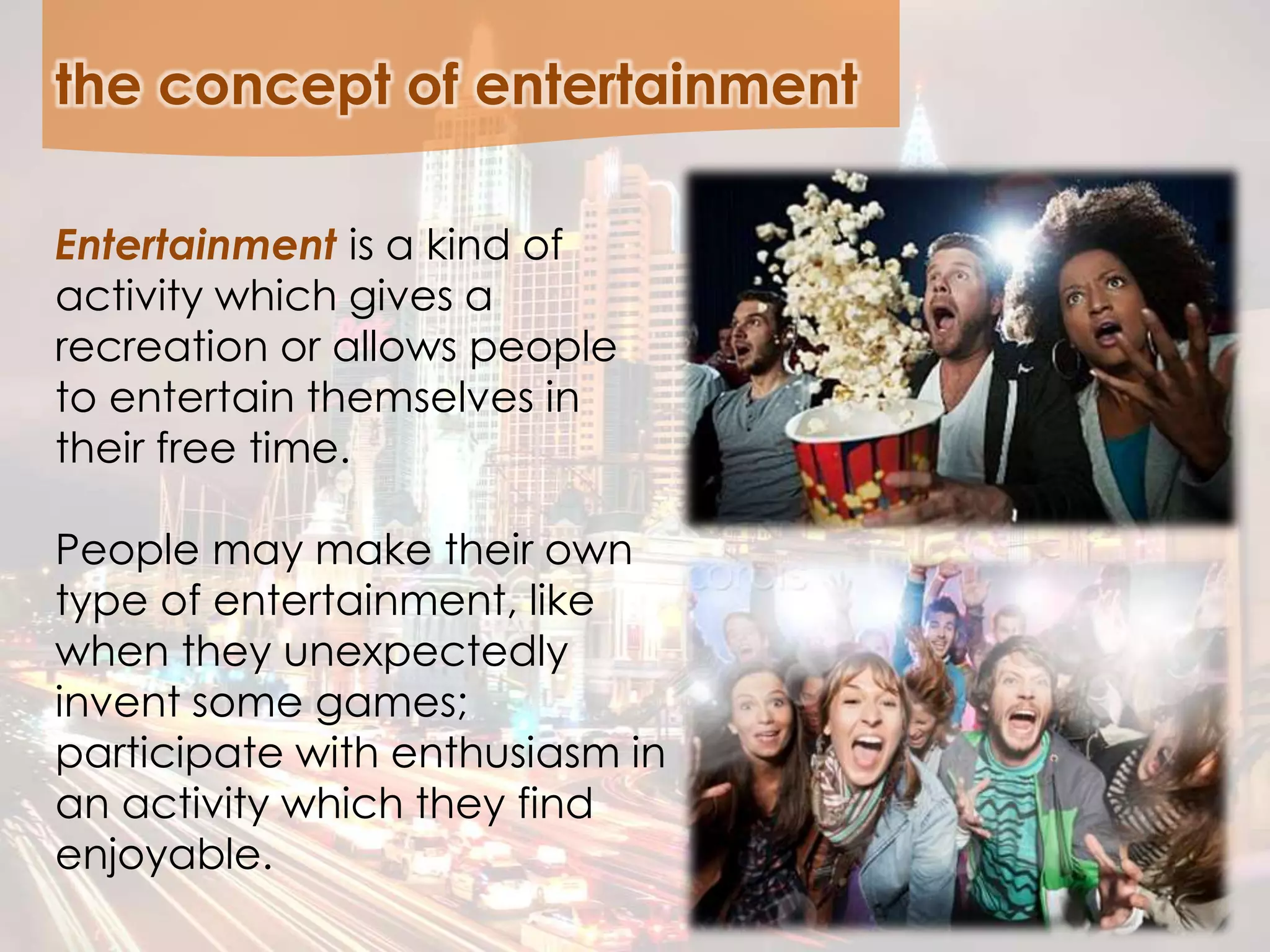
Entertainment is a kind of
activity which gives a
recreation or allows people
to entertain themselves in
their free time.
People may make their own
type of entertainment, like
when they unexpectedly
invent some games;
participate with enthusiasm in
an activity which they find
enjoyable.
the concept of entertainment
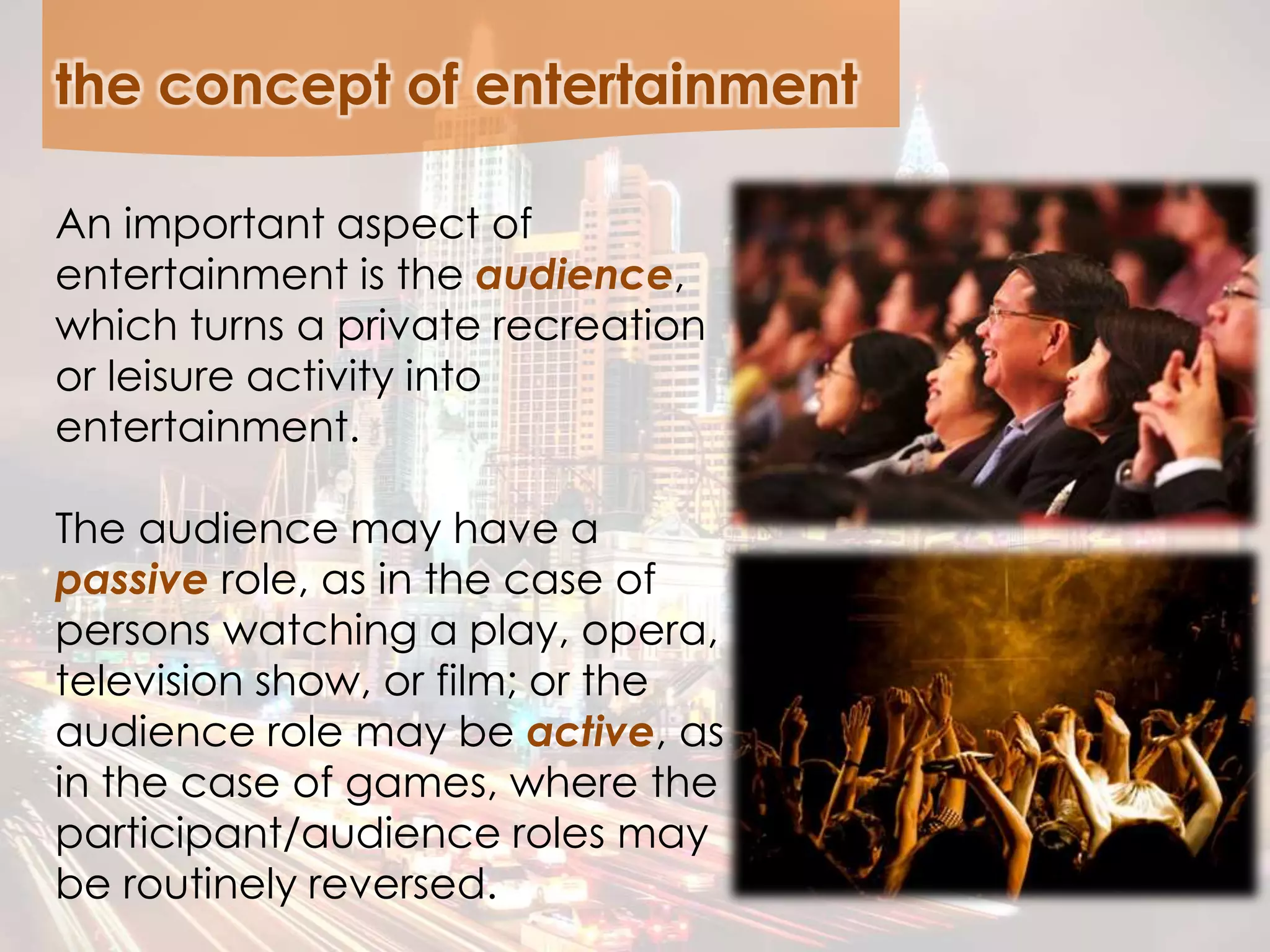
An important aspect of
entertainment is the audience,
which turns a private recreation
or leisure activity into
entertainment.
The audience may have a
passive role, as in the case of
persons watching a play, opera,
television show, or film; or the
audience role may be active, as
in the case of games, where the
participant/audience roles may
be routinely reversed.
types of entertainment
• Banquets
• Music
• Games
• Reading
• Comedy
• Performance
• Theatre
• Cinema and Film
• Dance
• Animals
• Circus
• Magic
• Street Performances
• Parades
• Fireworks
• Sports
• Fairs, Expositions, Shopping
banquets
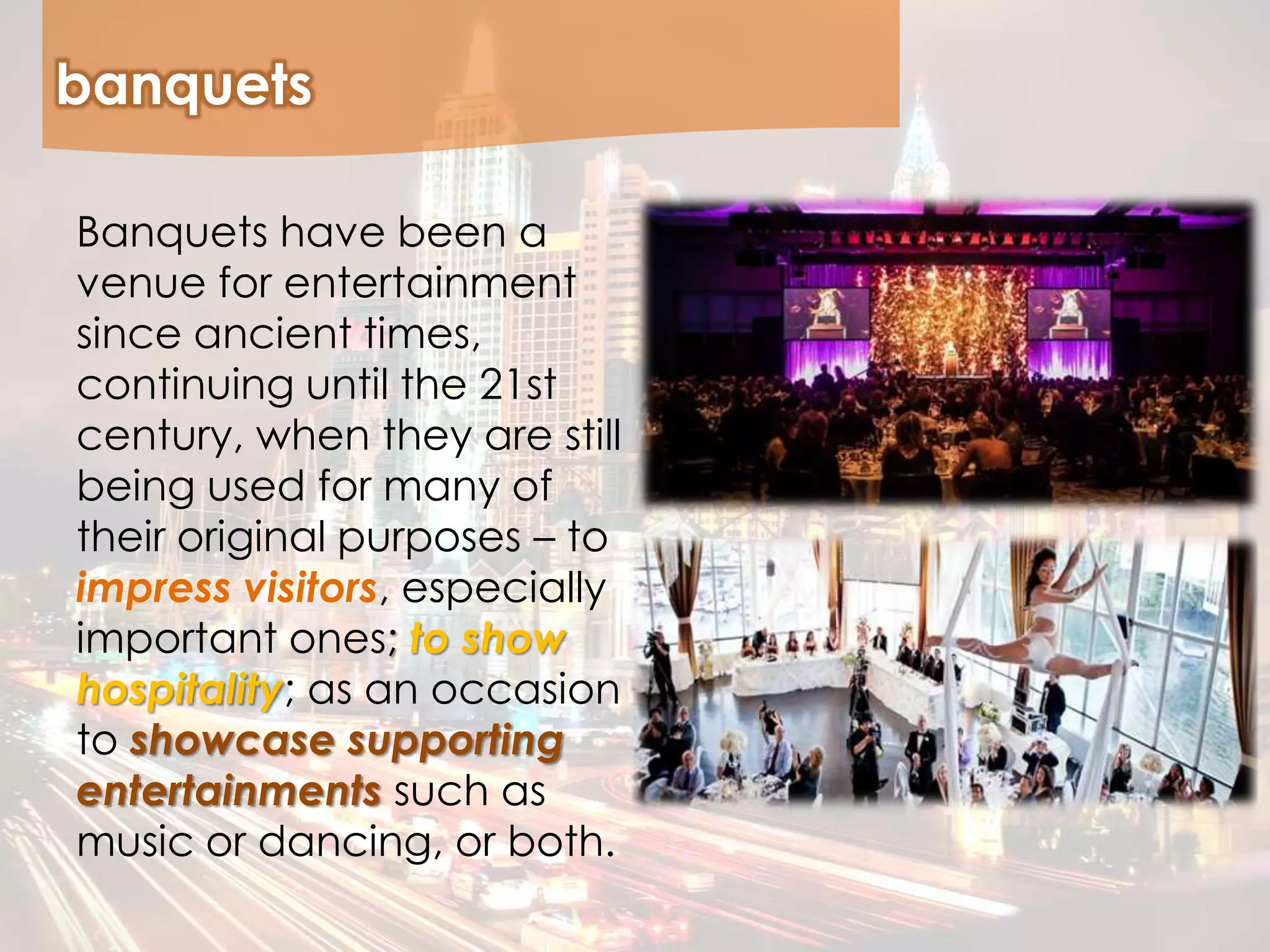
Banquets have been a
venue for entertainment
since ancient times,
continuing until the 21st
century, when they are still
being used for many of
their original purposes – to
impress visitors, especially
important ones; to show
hospitality; as an occasion
to showcase supporting
entertainments such as
music or dancing, or both.
banquets
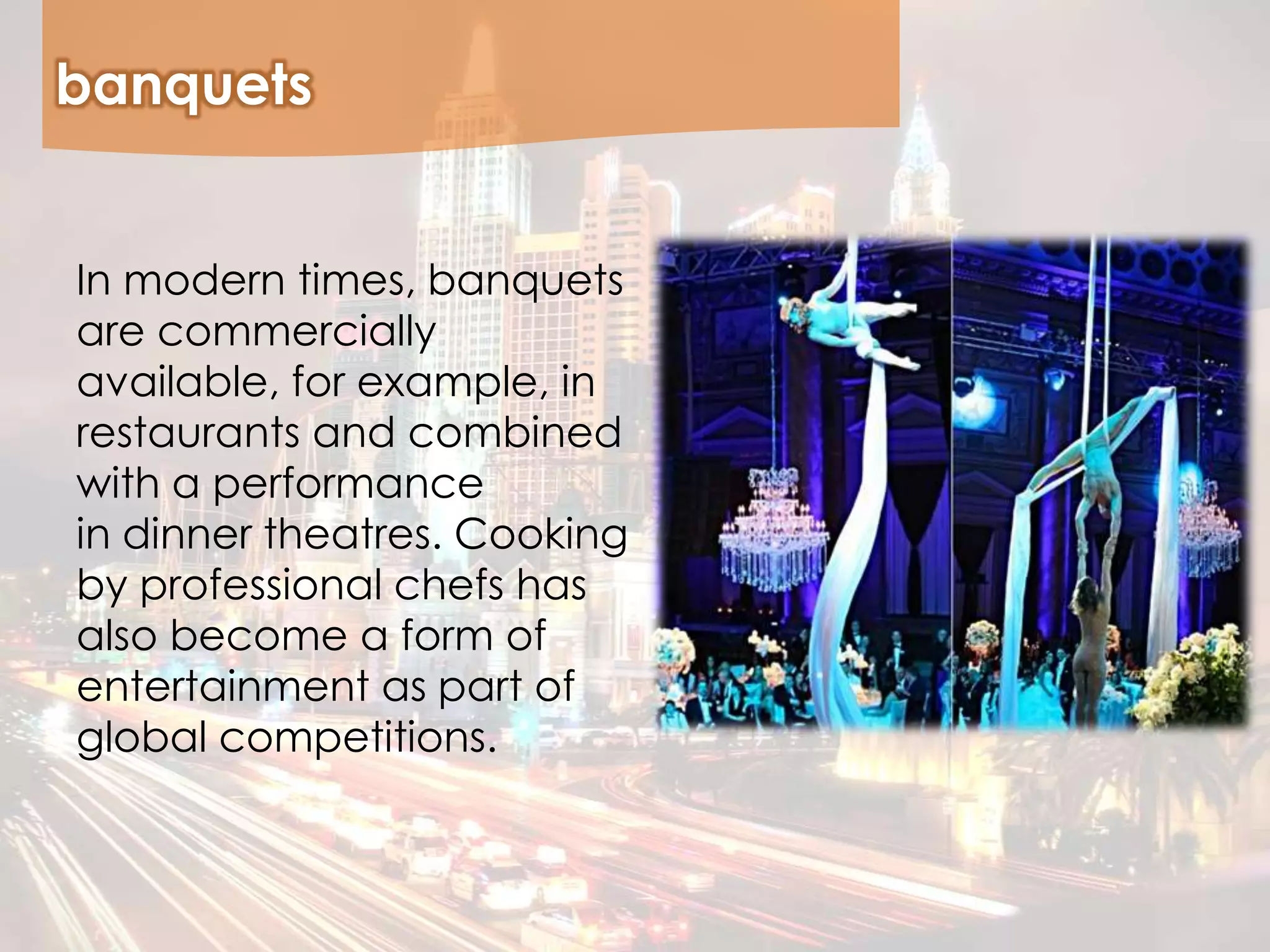
In modern times, banquets
are commercially
available, for example, in
restaurants and combined
with a performance
in dinner theatres. Cooking
by professional chefs has
also become a form of
entertainment as part of
global competitions.
music
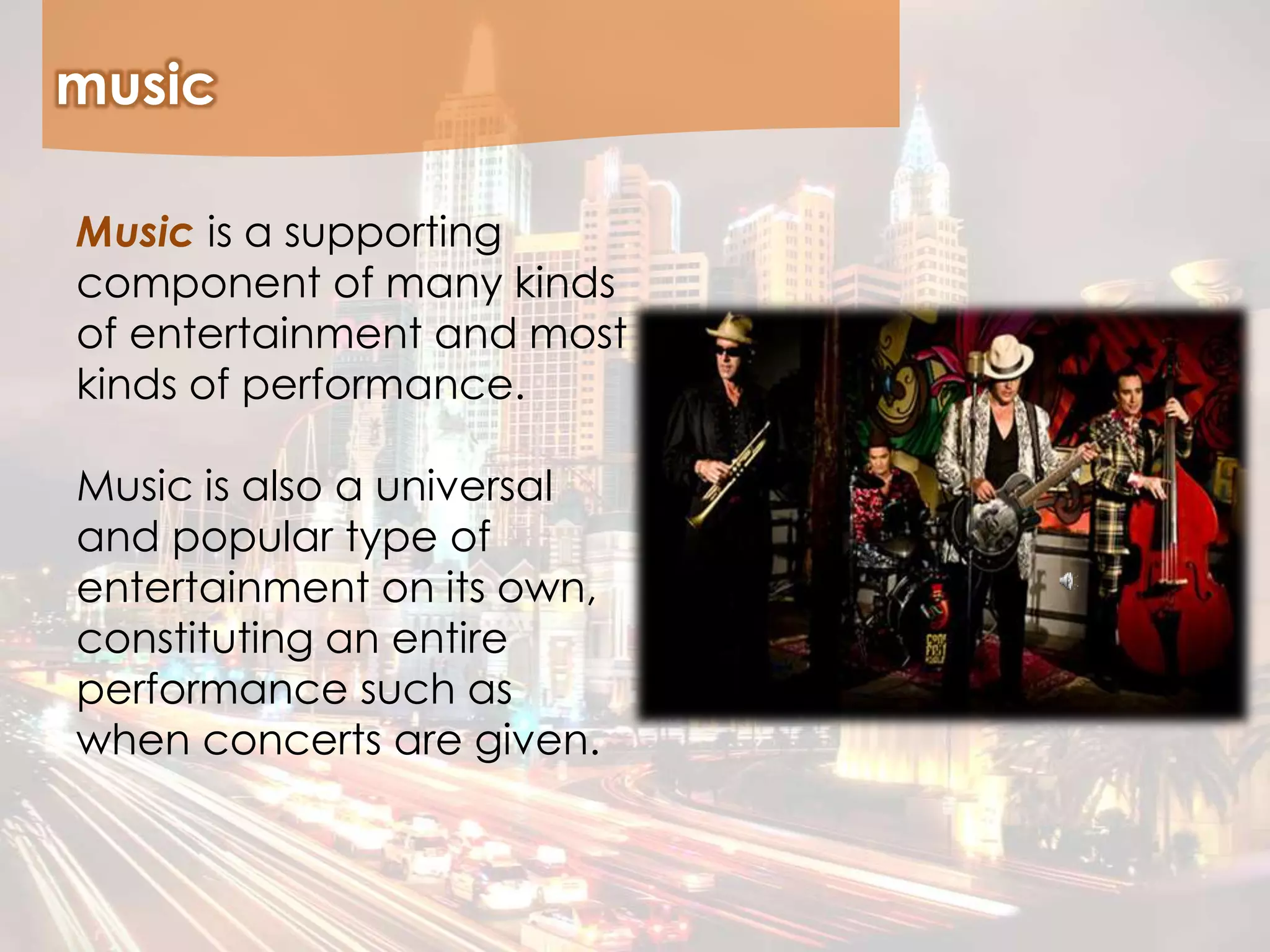
Music is a supporting
component of many kinds
of entertainment and most
kinds of performance.
Music is also a universal
and popular type of
entertainment on its own,
constituting an entire
performance such as
when concerts are given.
music
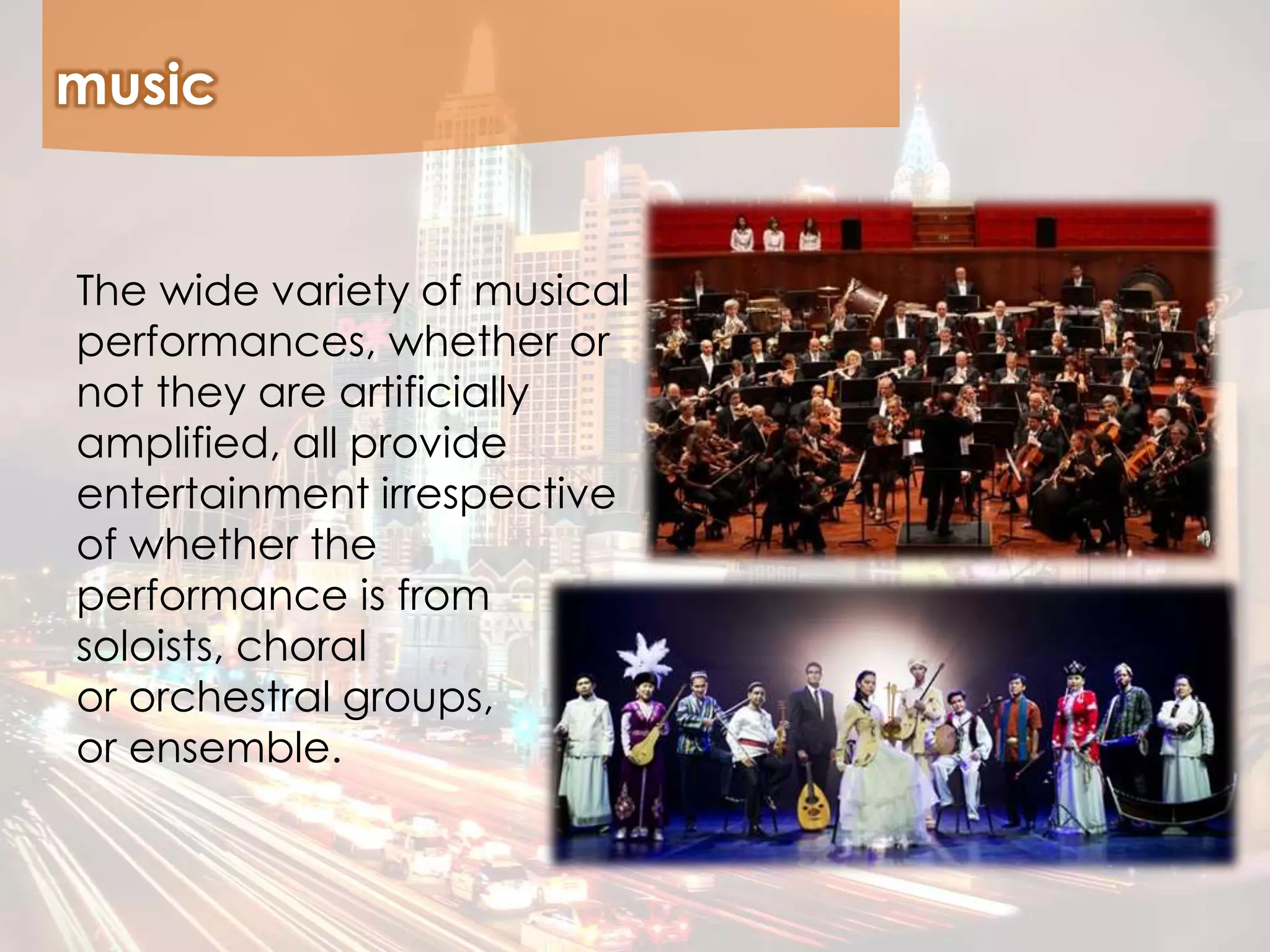
The wide variety of musical
performances, whether or
not they are artificially
amplified, all provide
entertainment irrespective
of whether the
performance is from
soloists, choral
or orchestral groups,
or ensemble.
games
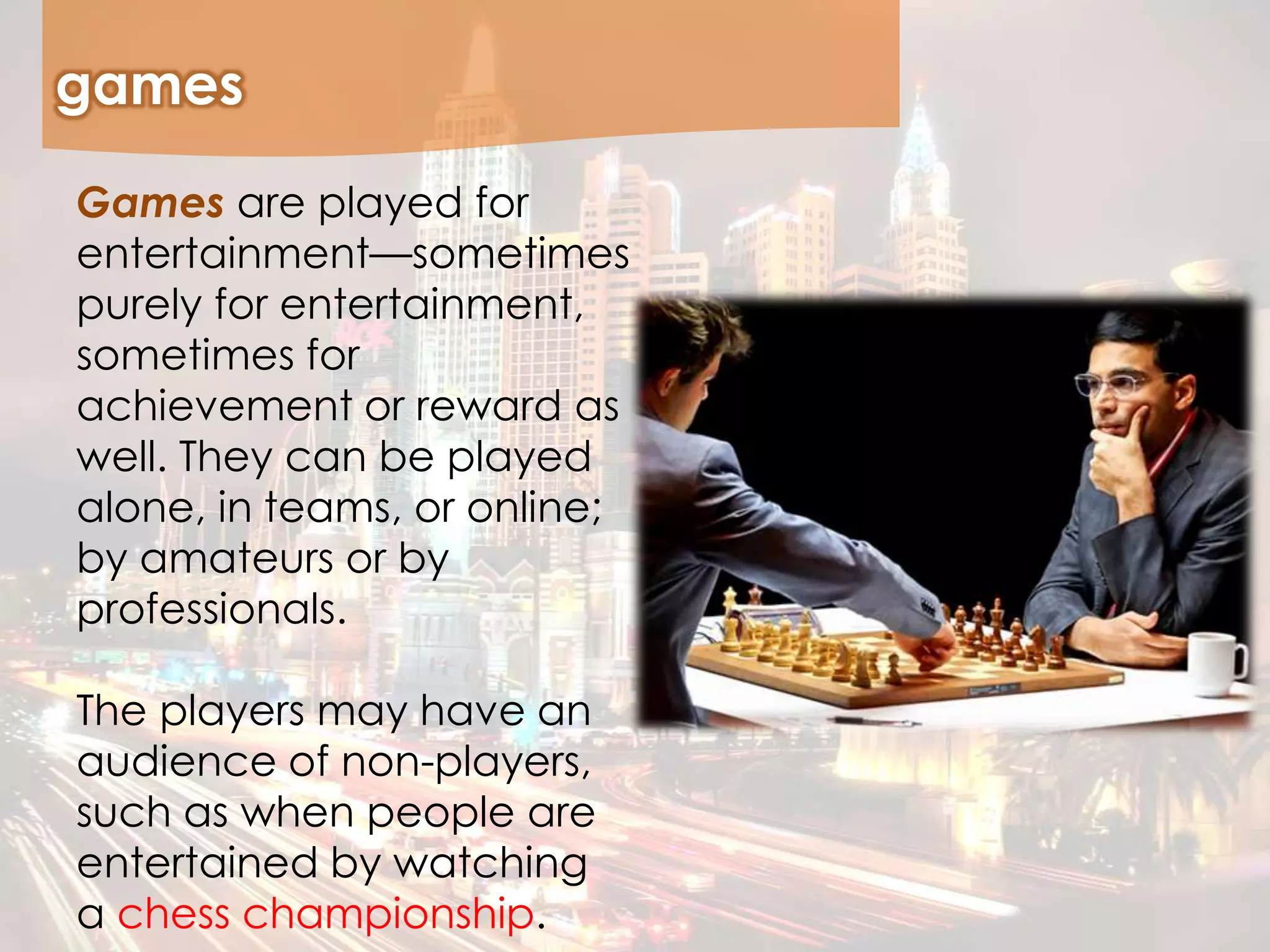
Games are played for
entertainment—sometimes
purely for entertainment,
sometimes for
achievement or reward as
well. They can be played
alone, in teams, or online;
by amateurs or by
professionals.
The players may have an
audience of non-players,
such as when people are
entertained by watching
a chess championship.
games
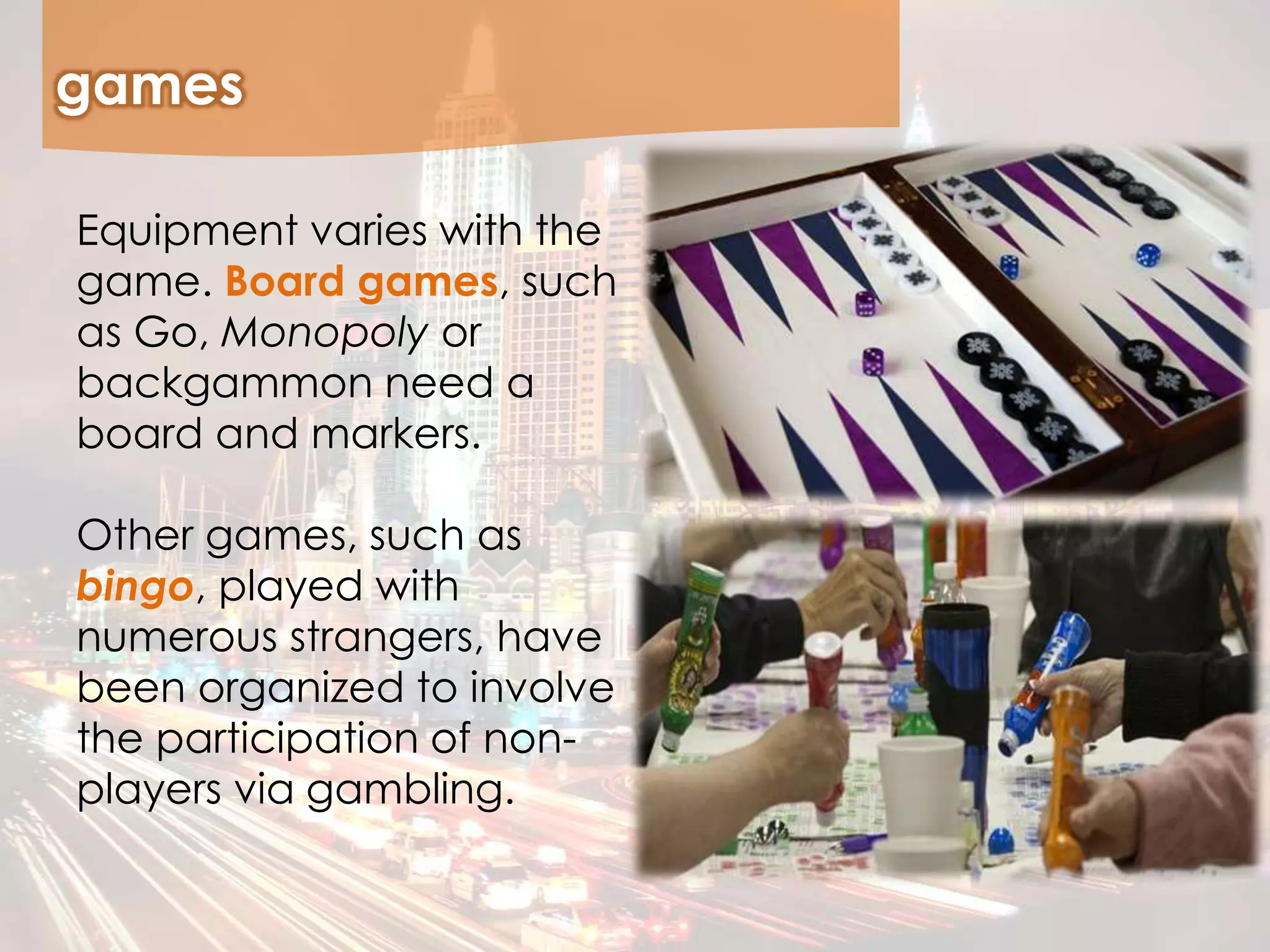
Equipment varies with the
game. Board games, such
as Go, Monopoly or
backgammon need a
board and markers.
Other games, such as
bingo, played with
numerous strangers, have
been organized to involve
the participation of non-
players via gambling.
games
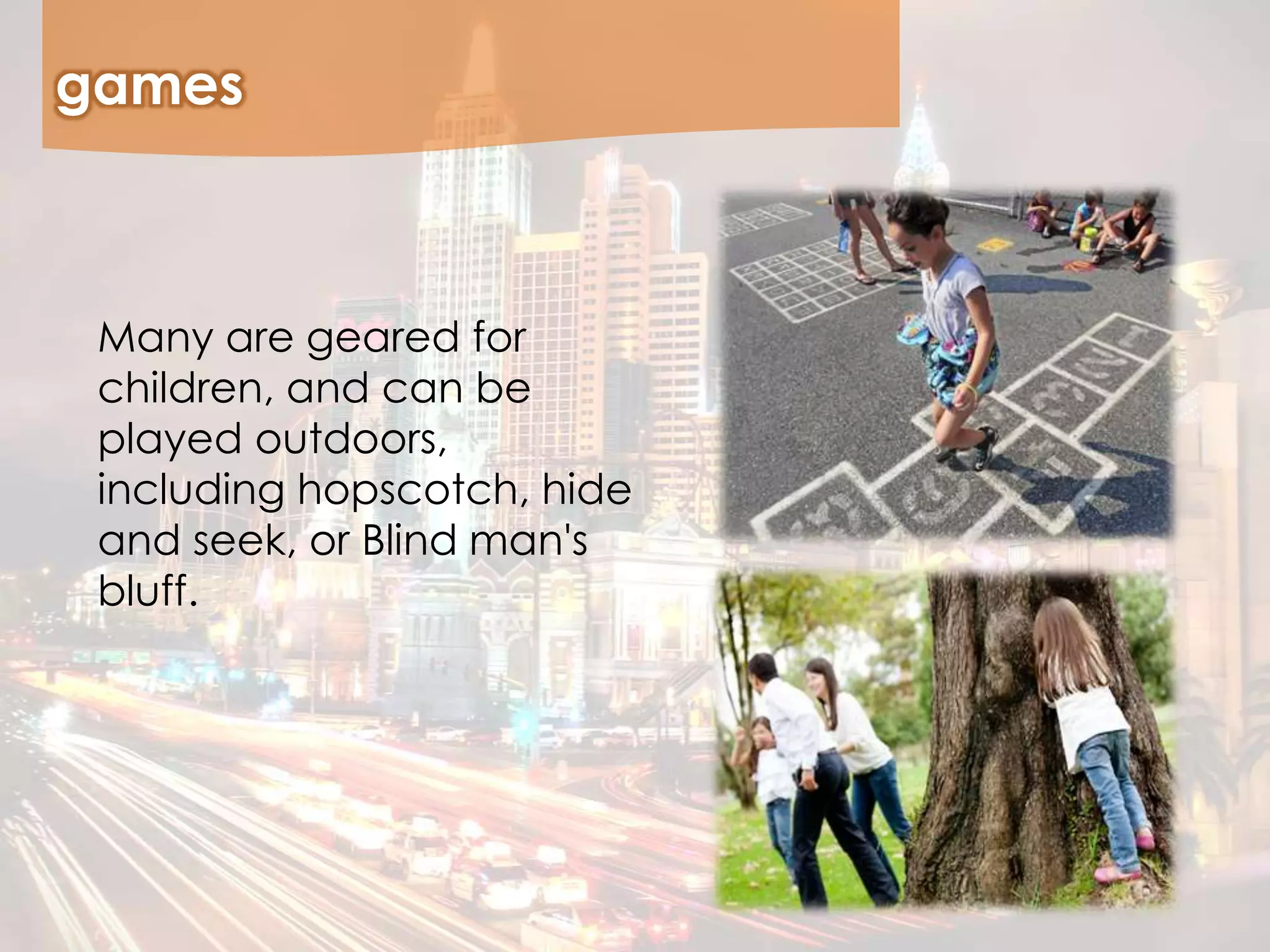
Many are geared for
children, and can be
played outdoors,
including hopscotch, hide
and seek, or Blind man's
bluff.
games
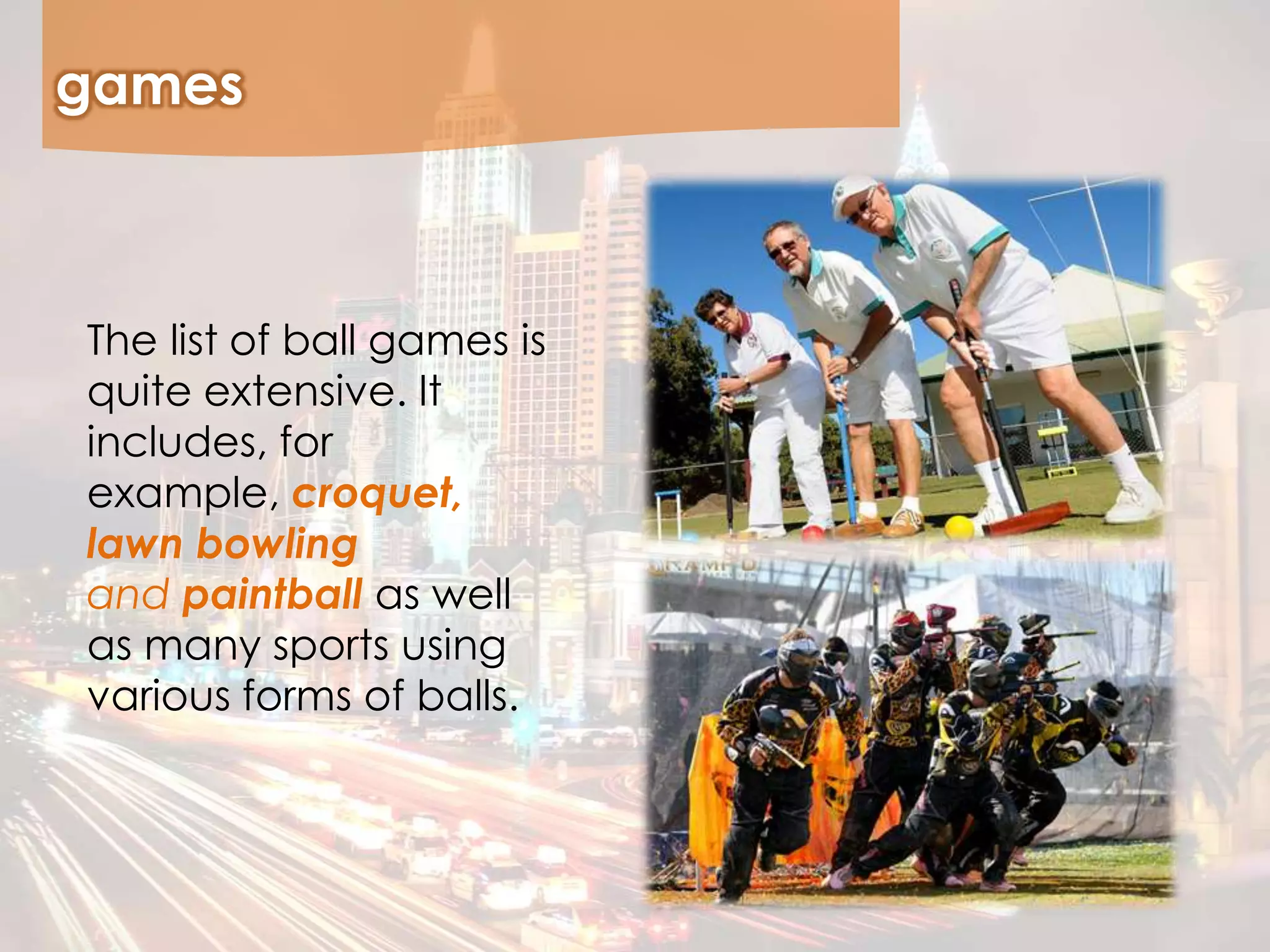
The list of ball games is
quite extensive. It
includes, for
example, croquet,
lawn bowling
and paintball as well
as many sports using
various forms of balls.
games
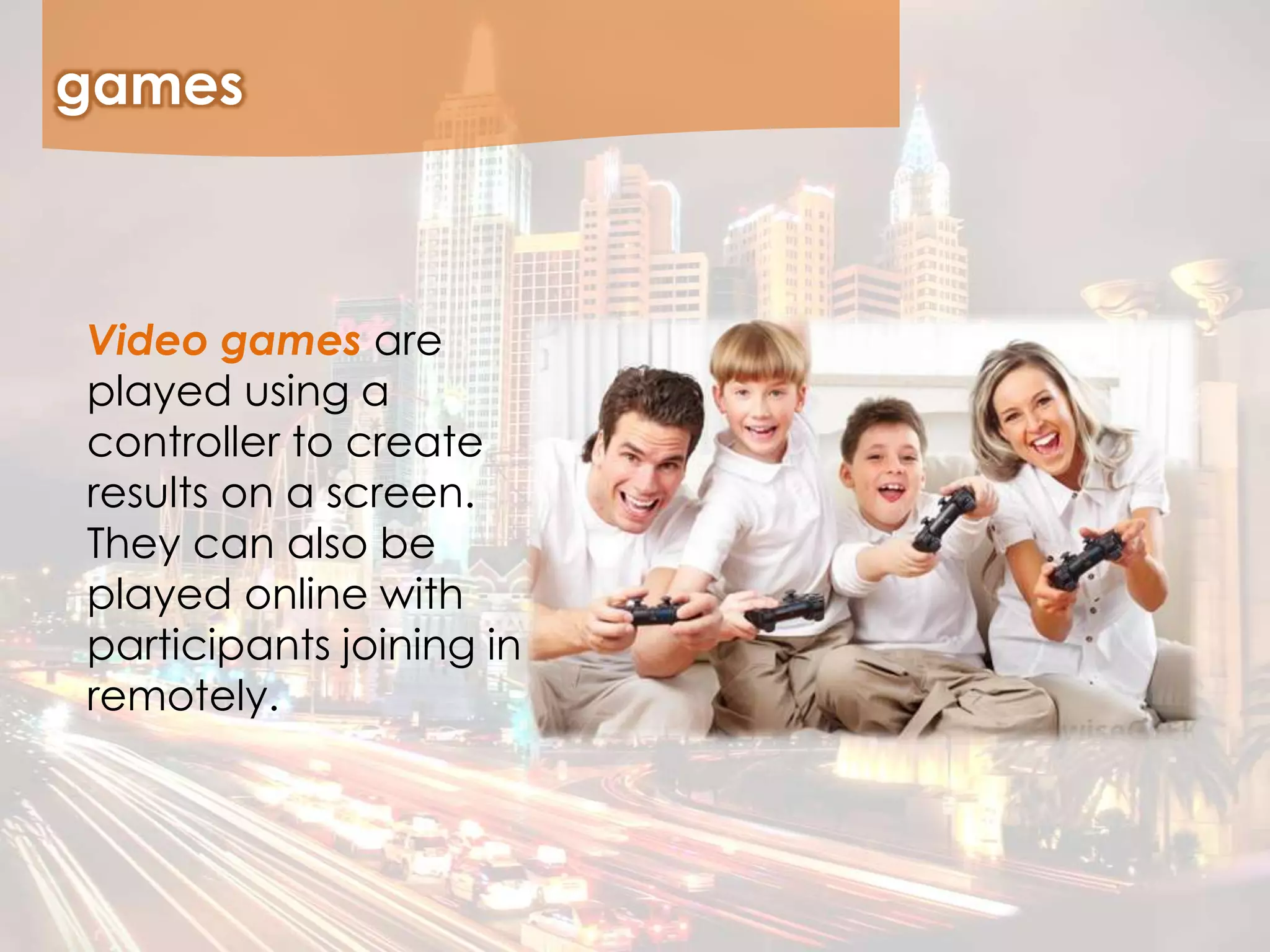
Video games are
played using a
controller to create
results on a screen.
They can also be
played online with
participants joining in
remotely.
reading
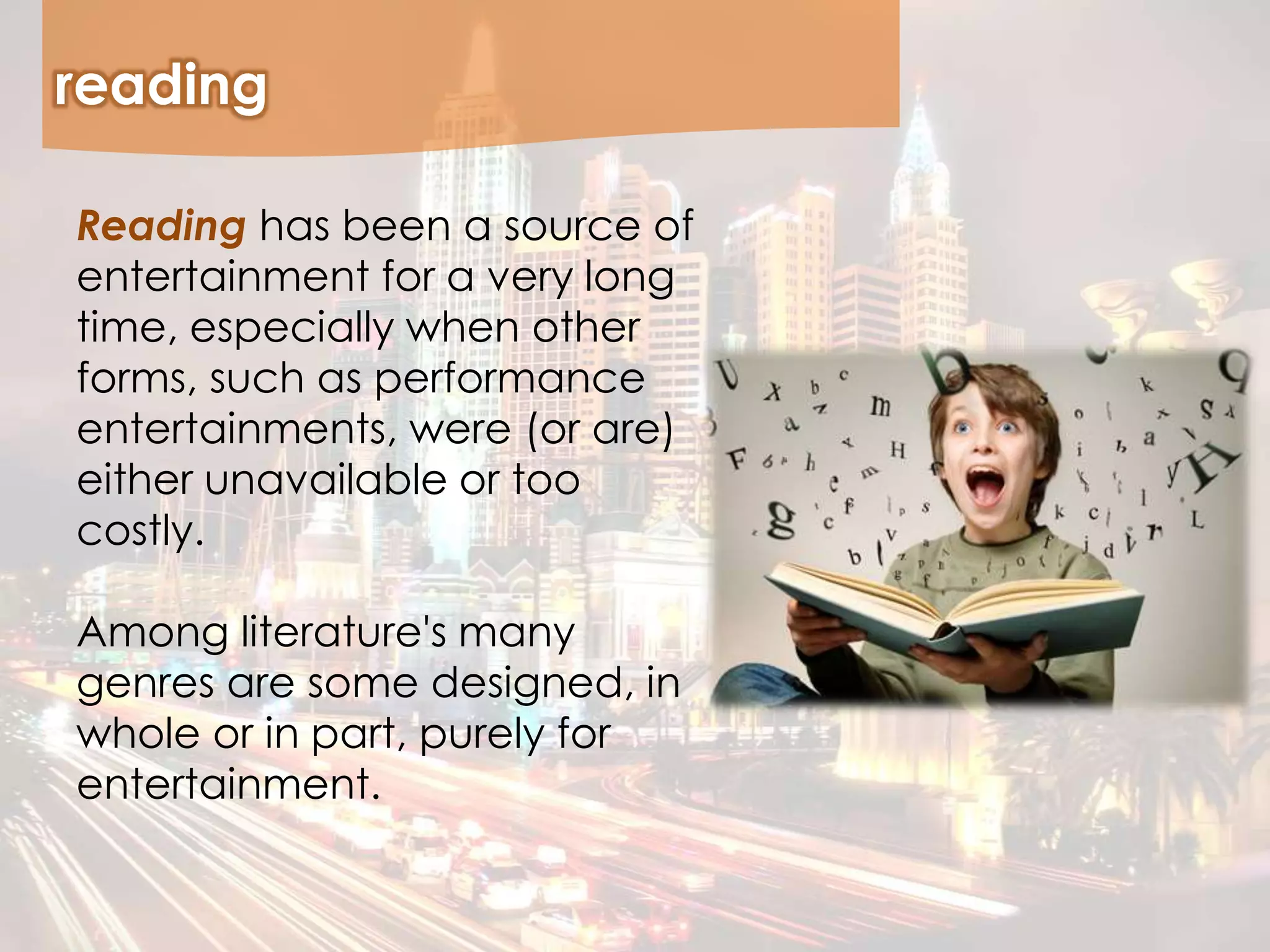
Reading has been a source of
entertainment for a very long
time, especially when other
forms, such as performance
entertainments, were (or are)
either unavailable or too
costly.
Among literature's many
genres are some designed, in
whole or in part, purely for
entertainment.
reading
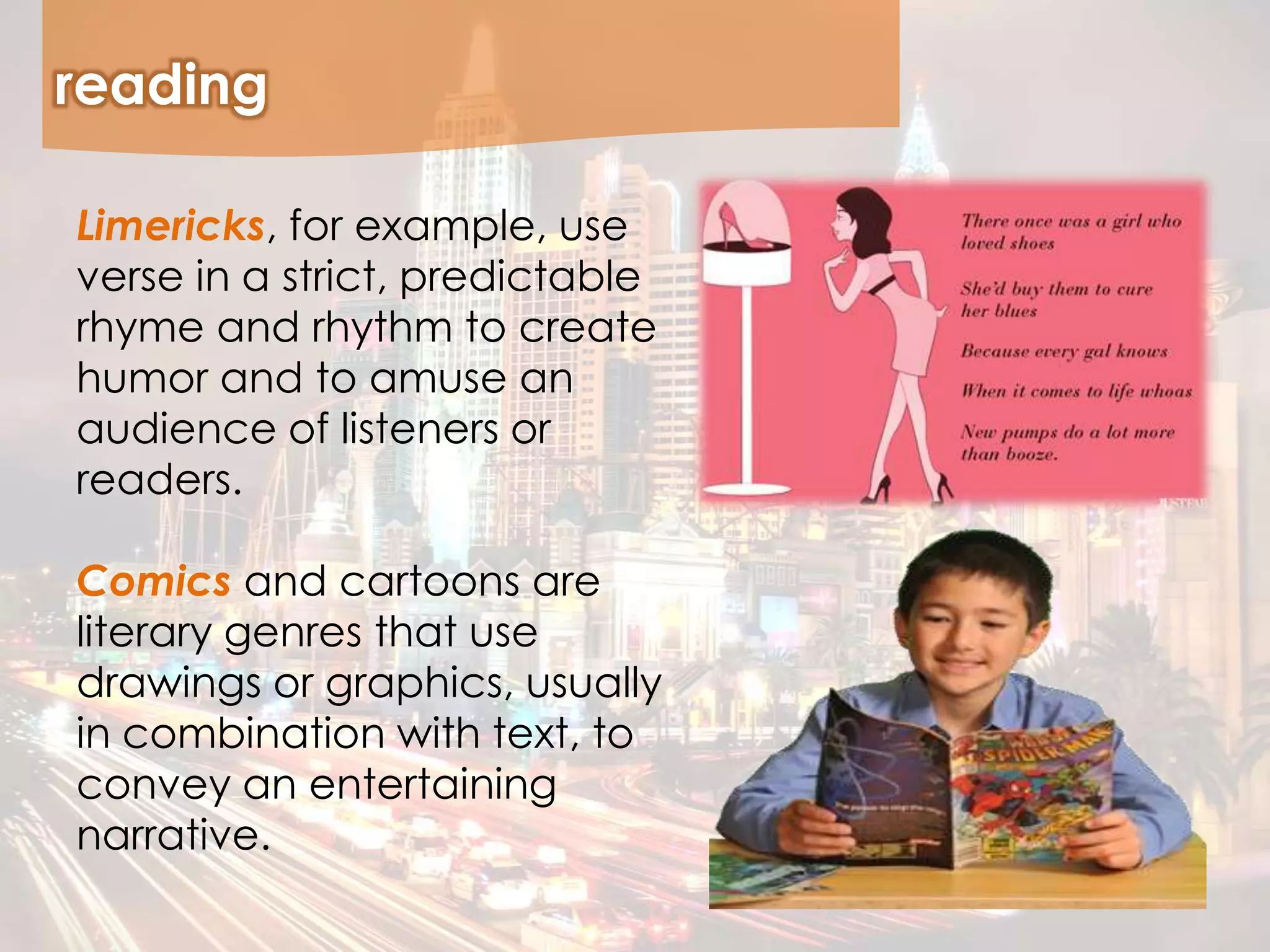
Limericks, for example, use
verse in a strict, predictable
rhyme and rhythm to create
humor and to amuse an
audience of listeners or
readers.
Comics and cartoons are
literary genres that use
drawings or graphics, usually
in combination with text, to
convey an entertaining
narrative.
reading
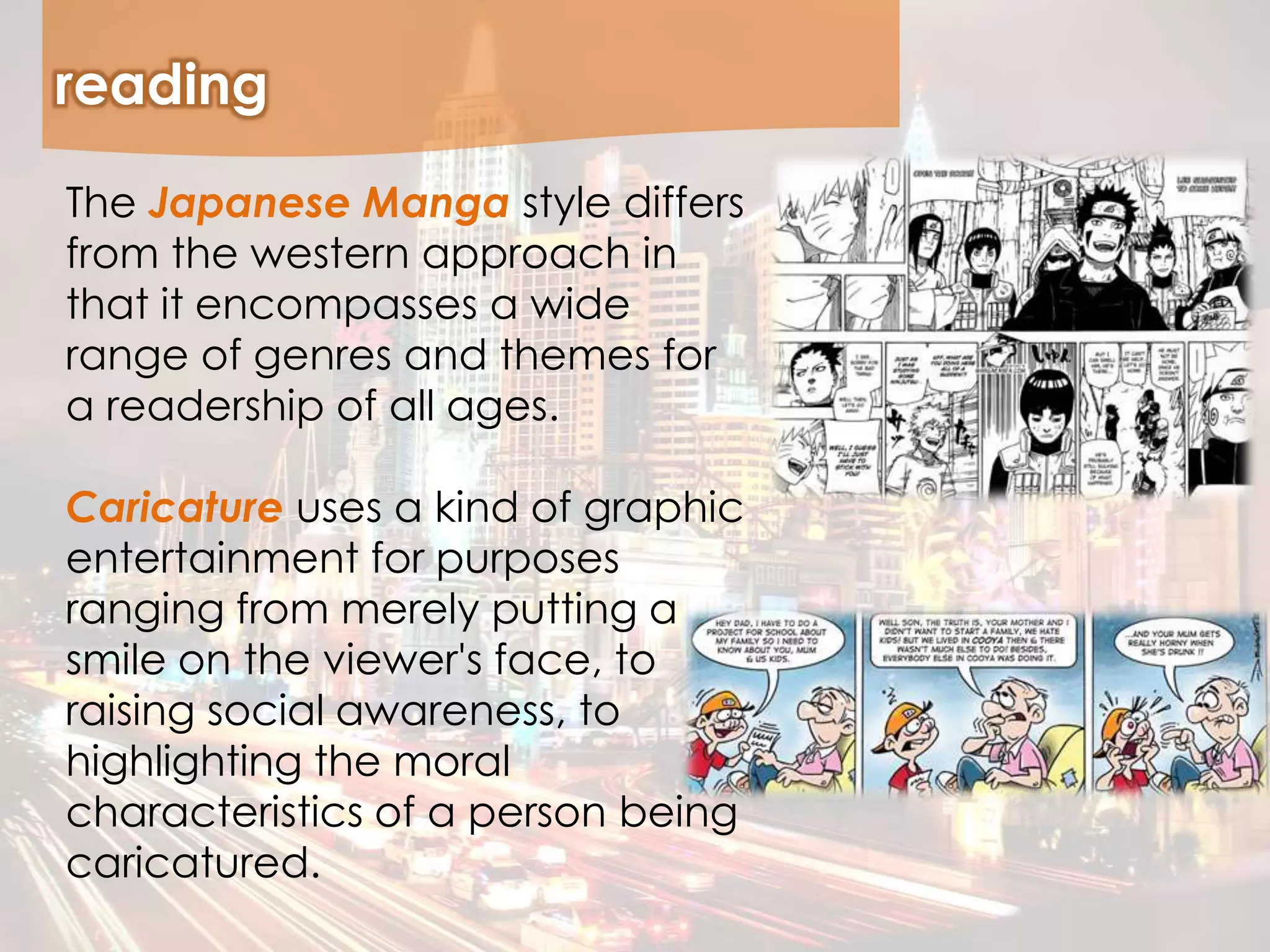
The Japanese Manga style differs
from the western approach in
that it encompasses a wide
range of genres and themes for
a readership of all ages.
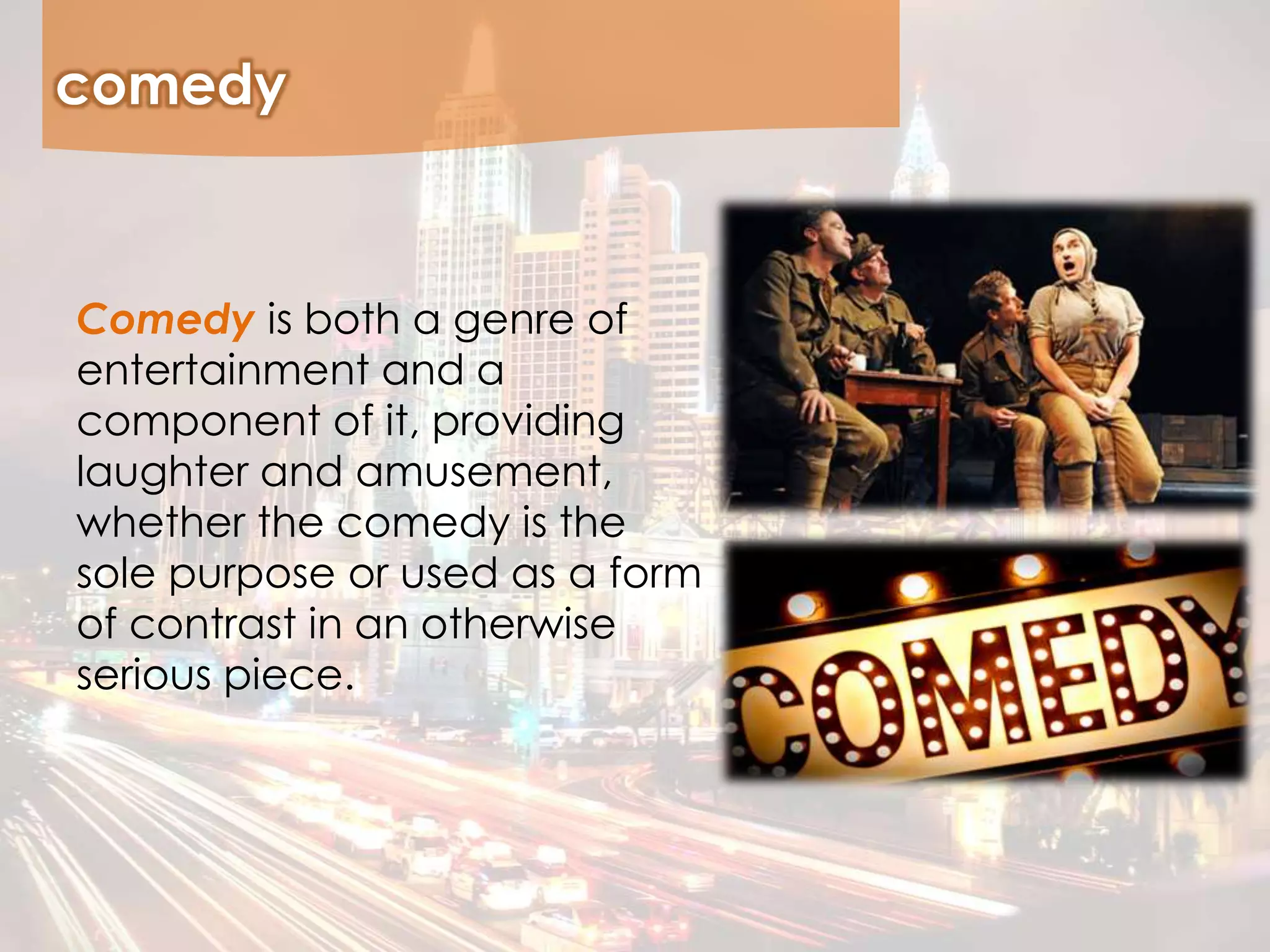
Caricature uses a kind of graphic
entertainment for purposes
ranging from merely putting a
smile on the viewer's face, to
raising social awareness, to
highlighting the moral
characteristics of a person being
caricatured.
comedy
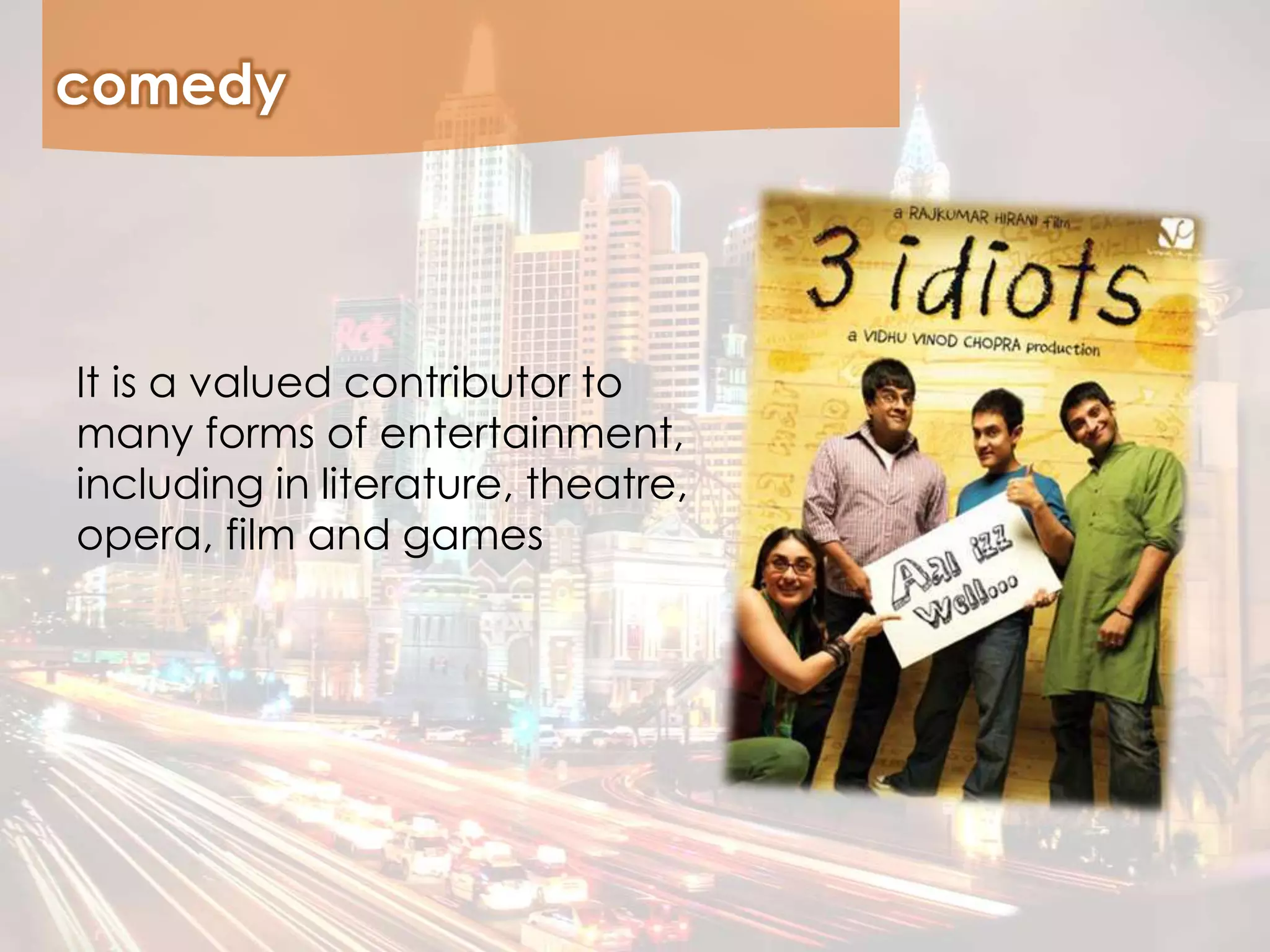
Comedy is both a genre of
entertainment and a
component of it, providing
laughter and amusement,
whether the comedy is the
sole purpose or used as a form
of contrast in an otherwise
serious piece.
comedy
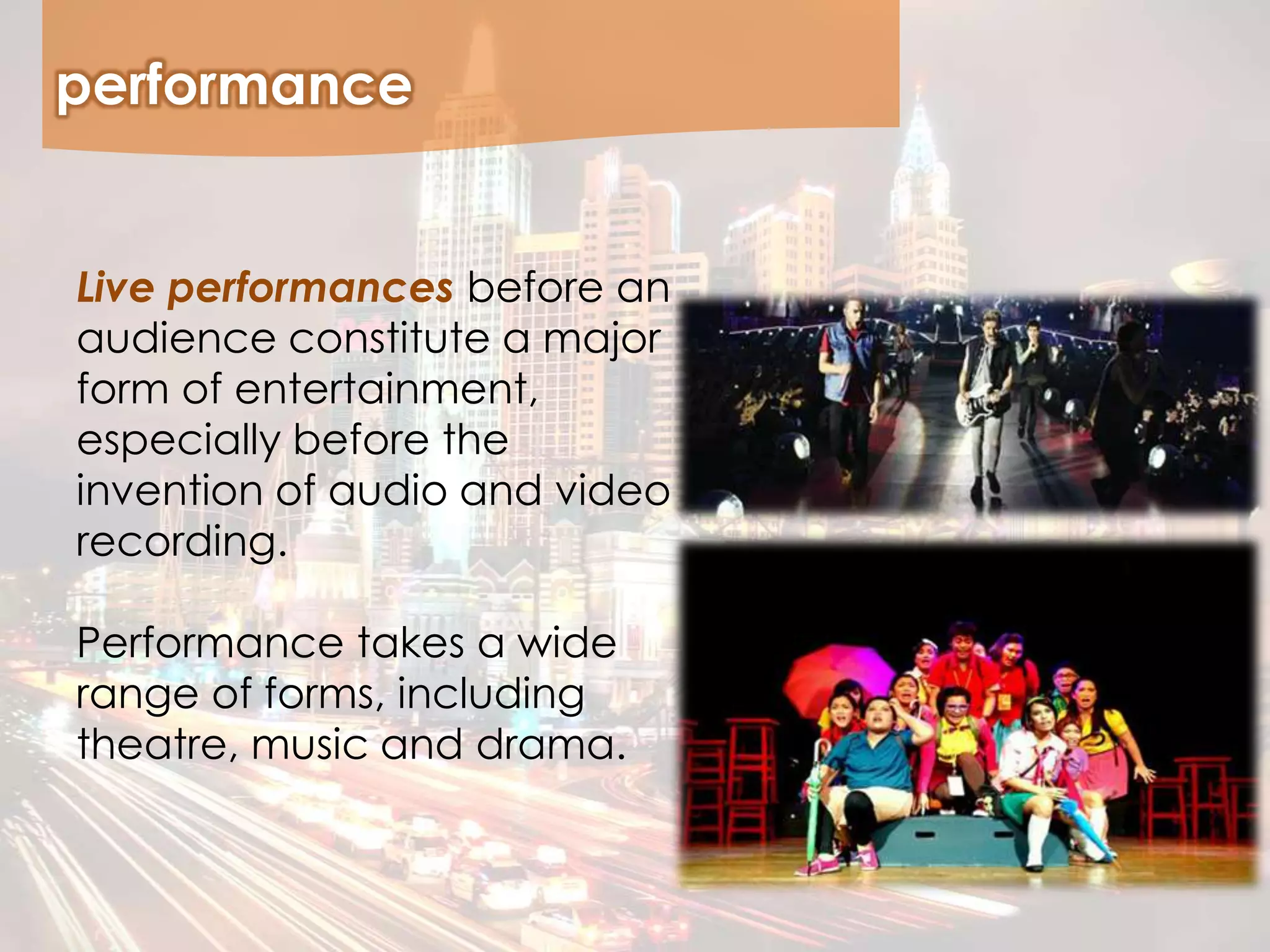
It is a valued contributor to
many forms of entertainment,
including in literature, theatre,
opera, film and games
performance
Live performances before an
audience constitute a major
form of entertainment,
especially before the
invention of audio and video
recording.
Performance takes a wide
range of forms, including
theatre, music and drama.
performance
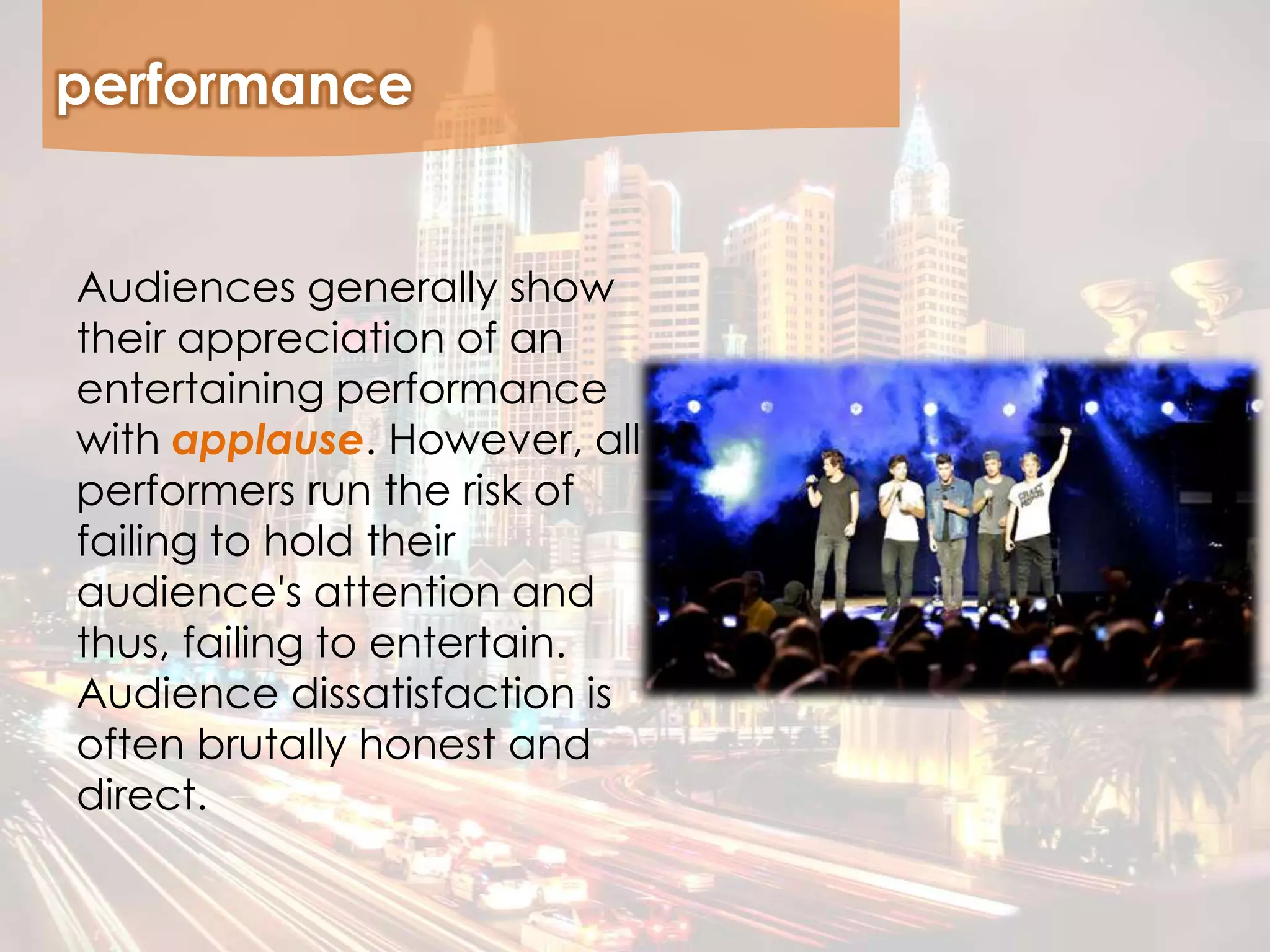
Audiences generally show
their appreciation of an
entertaining performance
with applause. However, all
performers run the risk of
failing to hold their
audience's attention and
thus, failing to entertain.
Audience dissatisfaction is
often brutally honest and
direct.
performance
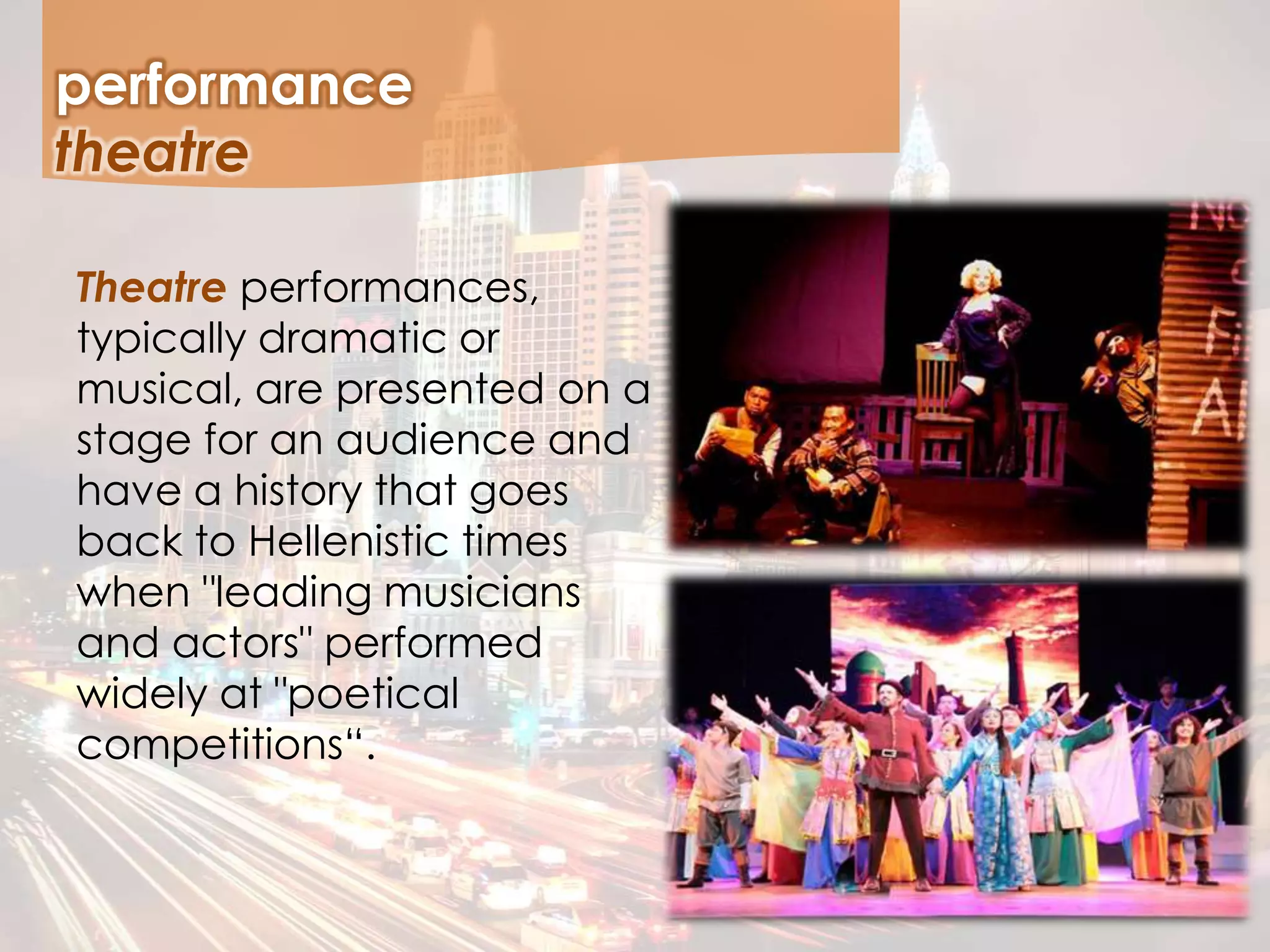
Theatre performances,
typically dramatic or
musical, are presented on a
stage for an audience and
have a history that goes
back to Hellenistic times
when "leading musicians
and actors" performed
widely at "poetical
competitions“.
theatre
performance
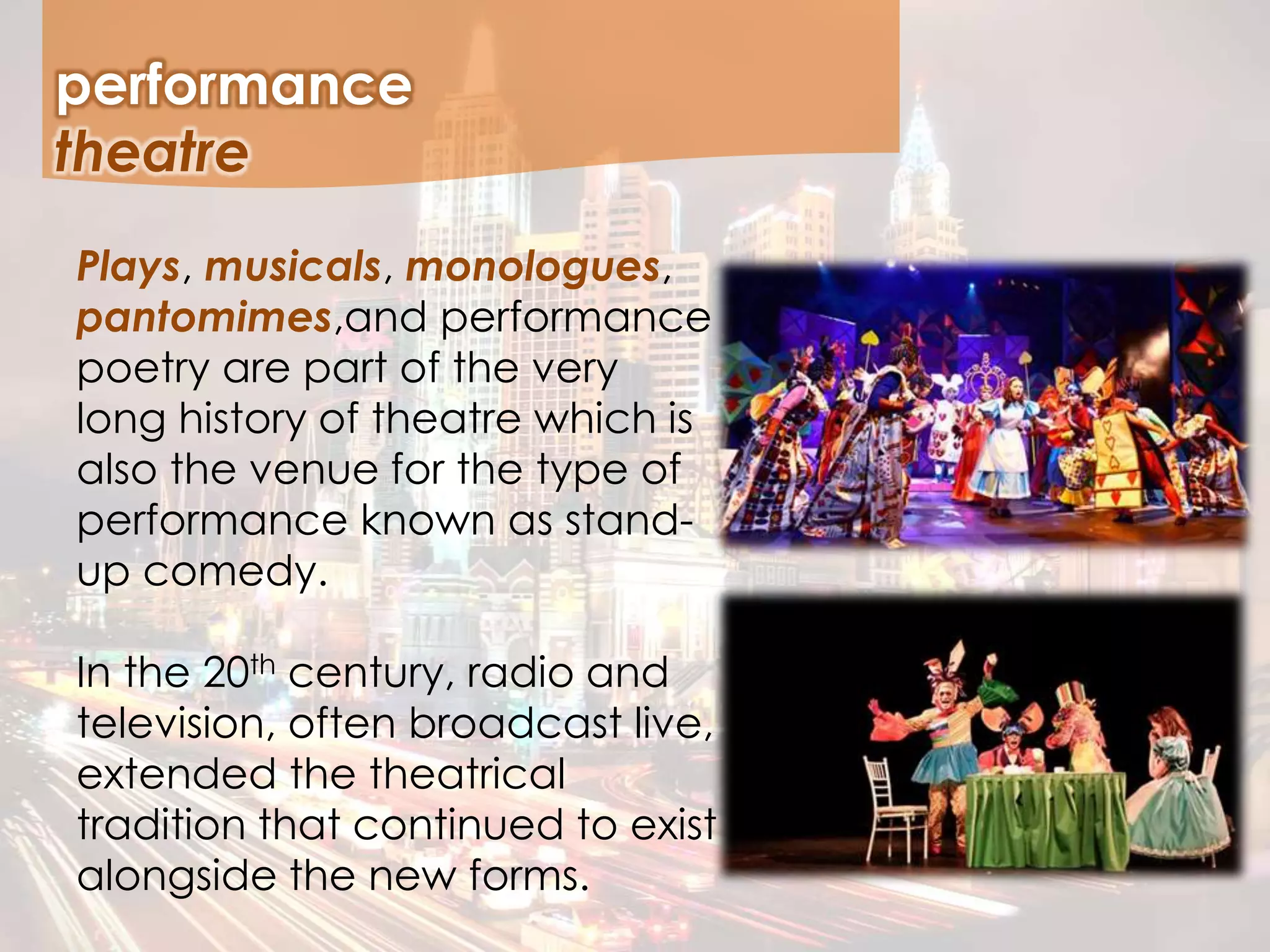
Plays, musicals, monologues,
pantomimes,and performance
poetry are part of the very
long history of theatre which is
also the venue for the type of
performance known as stand-
up comedy.
In the 20th century, radio and
television, often broadcast live,
extended the theatrical
tradition that continued to exist
alongside the new forms.
theatre
performance
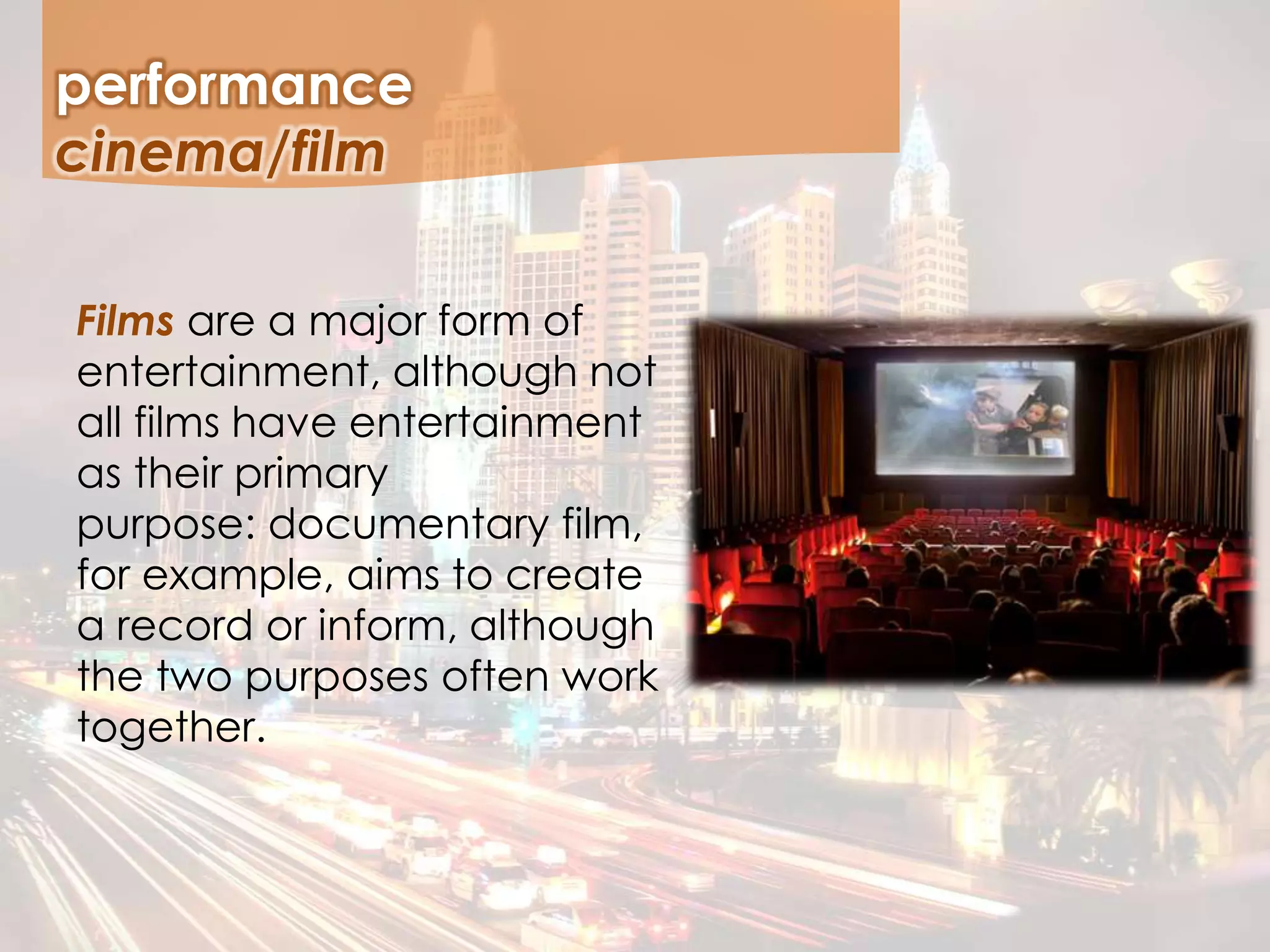
Films are a major form of
entertainment, although not
all films have entertainment
as their primary
purpose: documentary film,
for example, aims to create
a record or inform, although
the two purposes often work
together.
cinema/film
performance
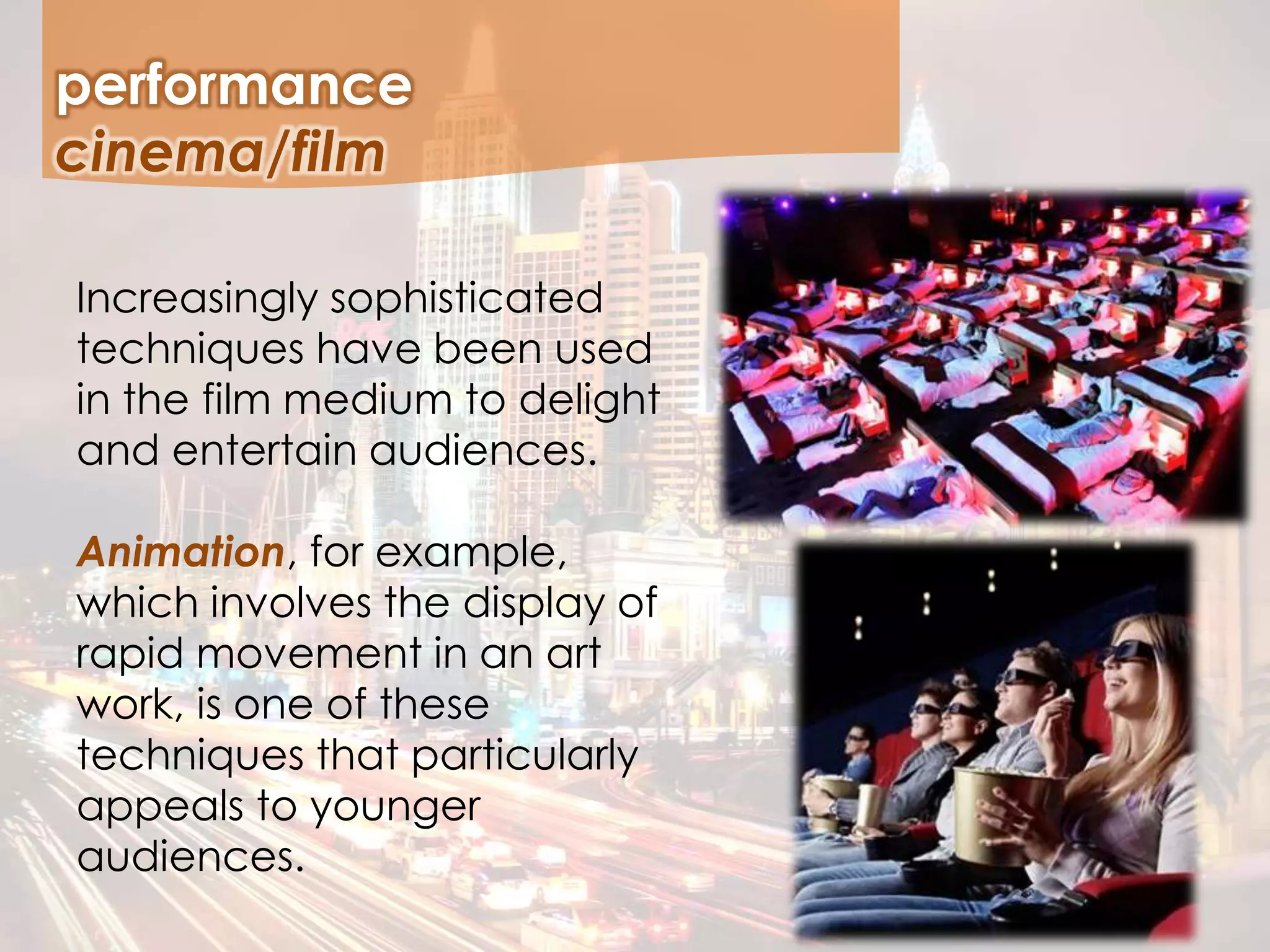
Increasingly sophisticated
techniques have been used
in the film medium to delight
and entertain audiences.
Animation, for example,
which involves the display of
rapid movement in an art
work, is one of these
techniques that particularly
appeals to younger
audiences.
cinema/film
performance
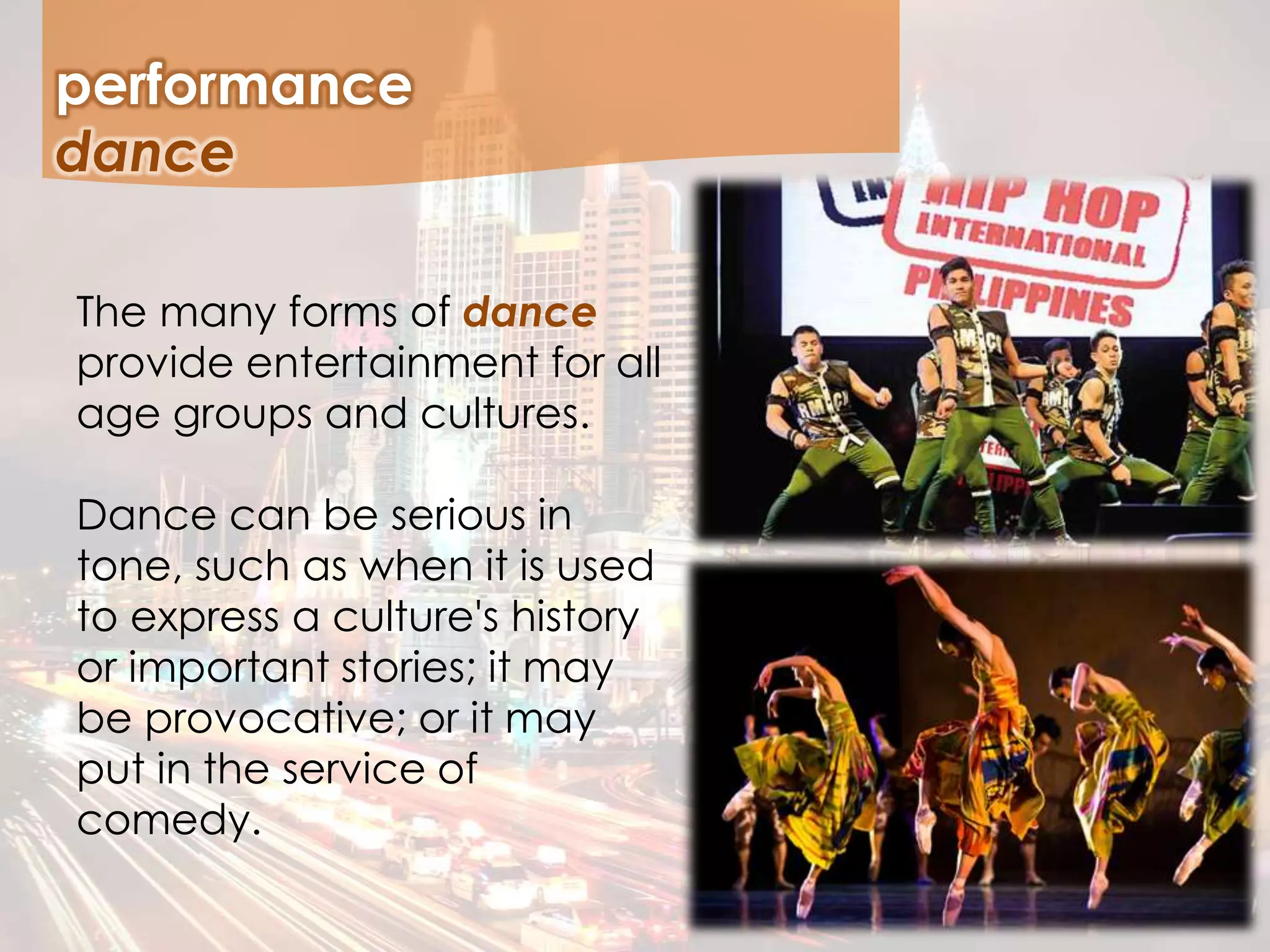
The many forms of dance
provide entertainment for all
age groups and cultures.
Dance can be serious in
tone, such as when it is used
to express a culture's history
or important stories; it may
be provocative; or it may
put in the service of
comedy.
dance
performance
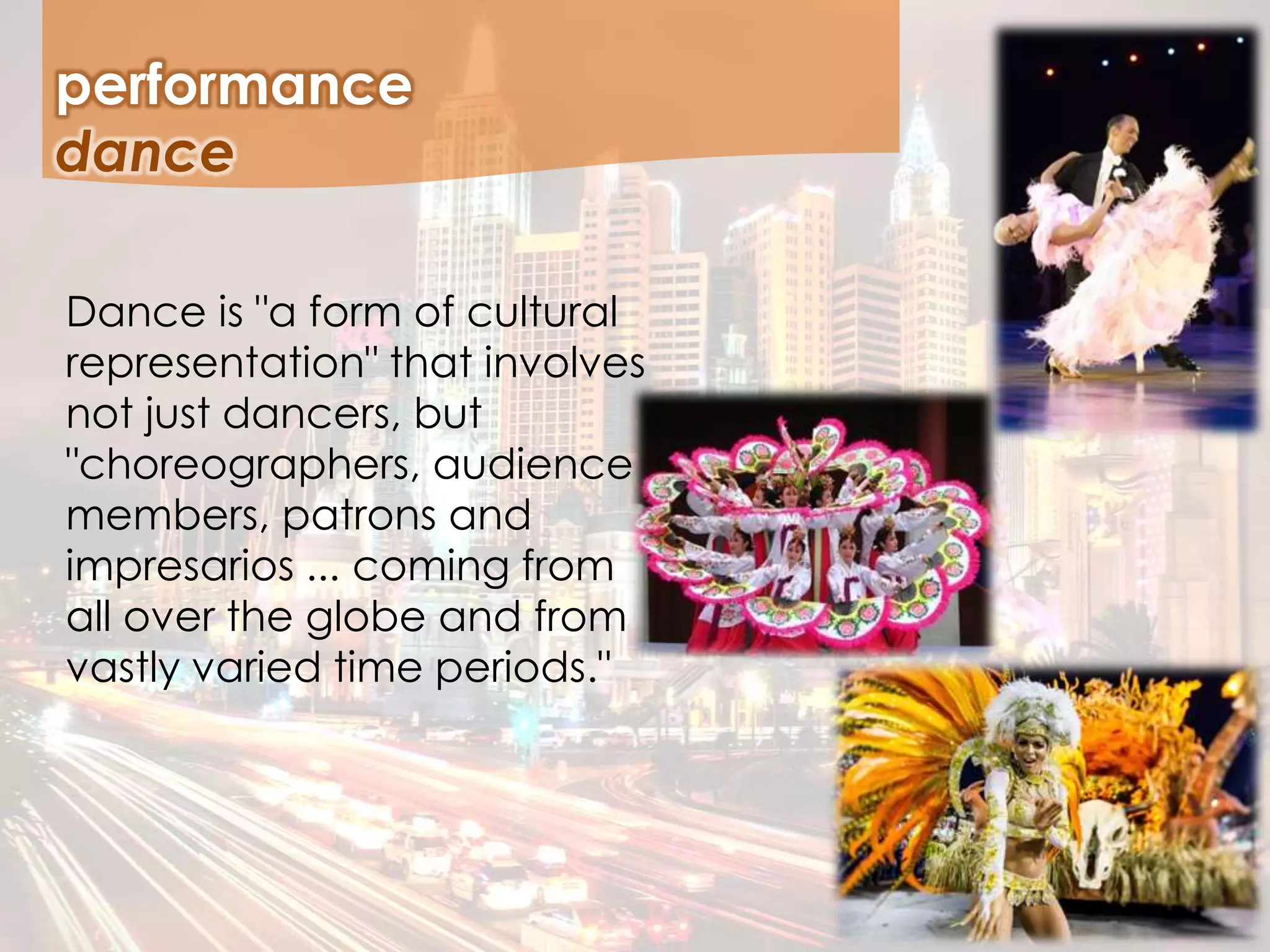
Dance is "a form of cultural
representation" that involves
not just dancers, but
"choreographers, audience
members, patrons and
impresarios ... coming from
all over the globe and from
vastly varied time periods."
dance
performance
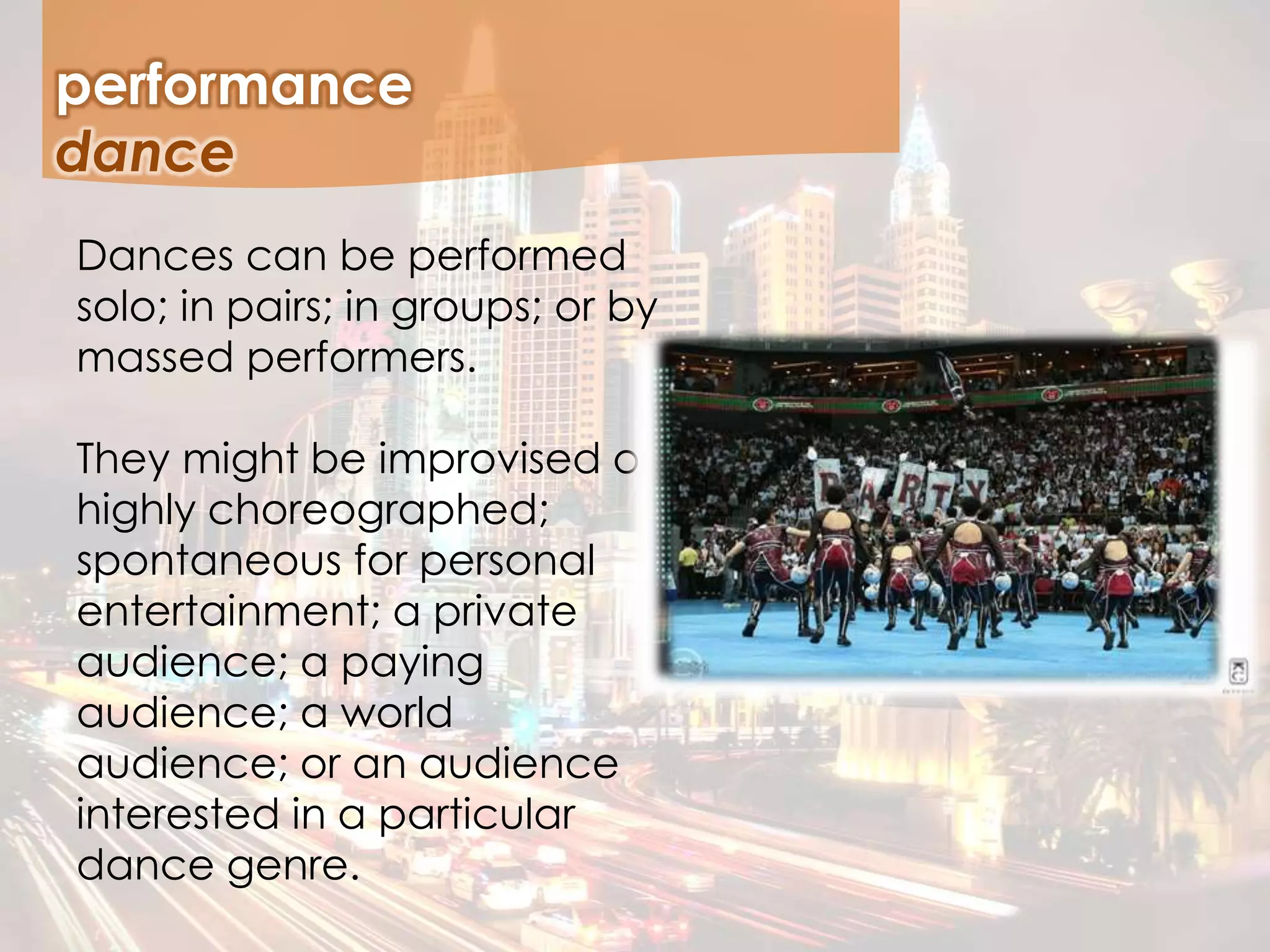
Dances can be performed
solo; in pairs; in groups; or by
massed performers.
They might be improvised or
highly choreographed;
spontaneous for personal
entertainment; a private
audience; a paying
audience; a world
audience; or an audience
interested in a particular
dance genre.
dance
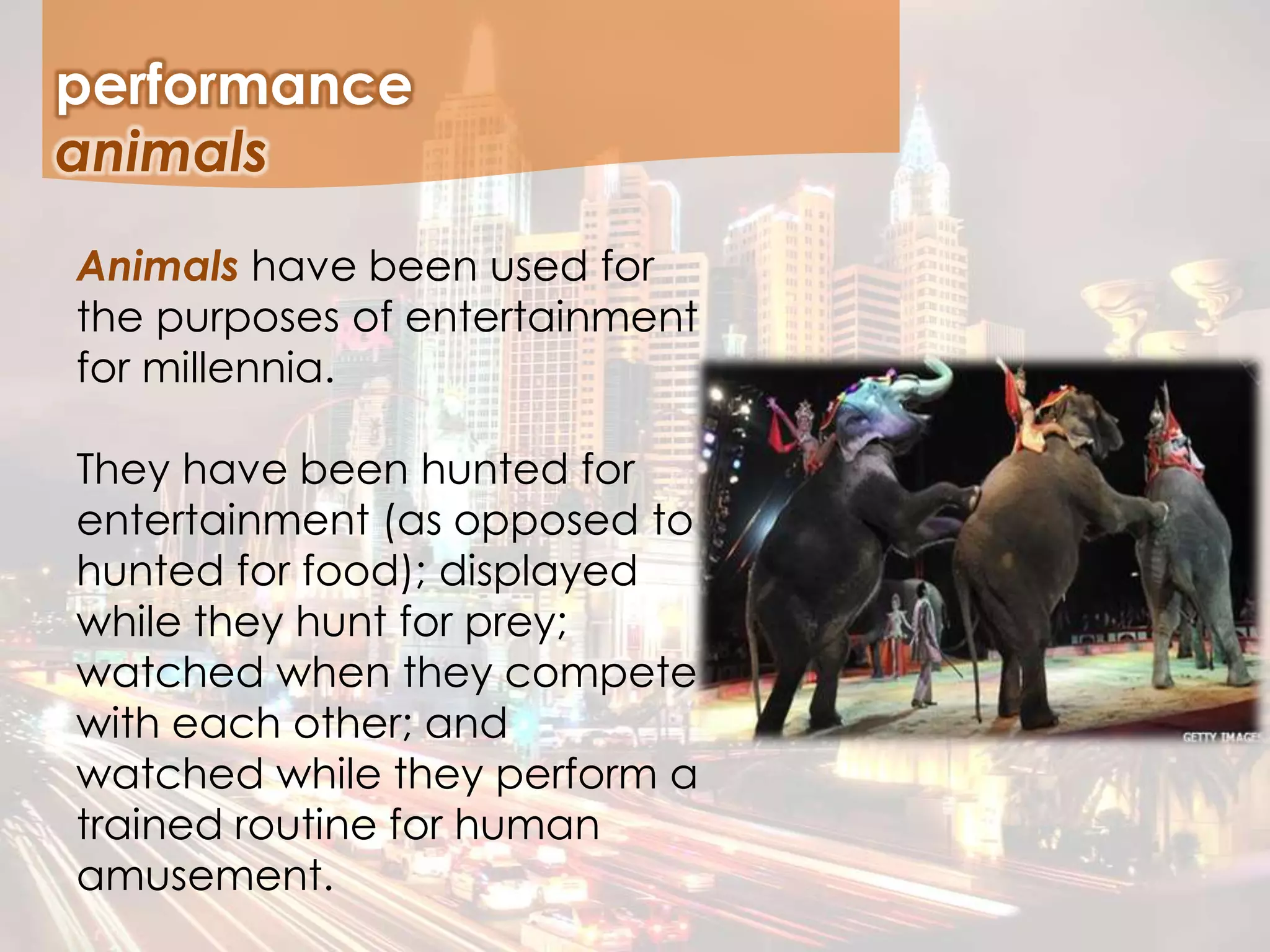
Animals have been used for
the purposes of entertainment
for millennia.
They have been hunted for
entertainment (as opposed to
hunted for food); displayed
while they hunt for prey;
watched when they compete
with each other; and
watched while they perform a
trained routine for human
amusement.
performance
animals
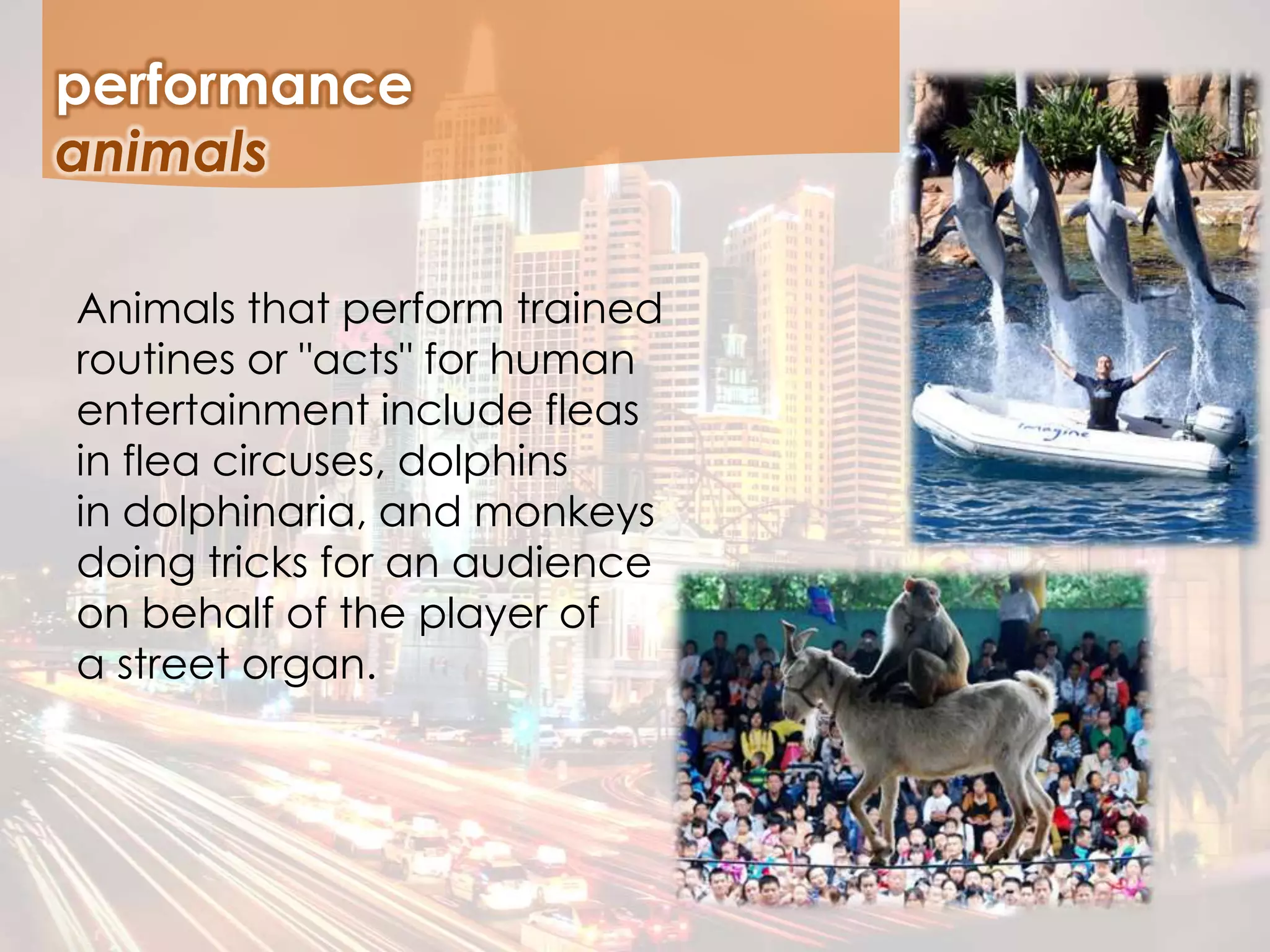
Animals that perform trained
routines or "acts" for human
entertainment include fleas
in flea circuses, dolphins
in dolphinaria, and monkeys
doing tricks for an audience
on behalf of the player of
a street organ.
performance
animals
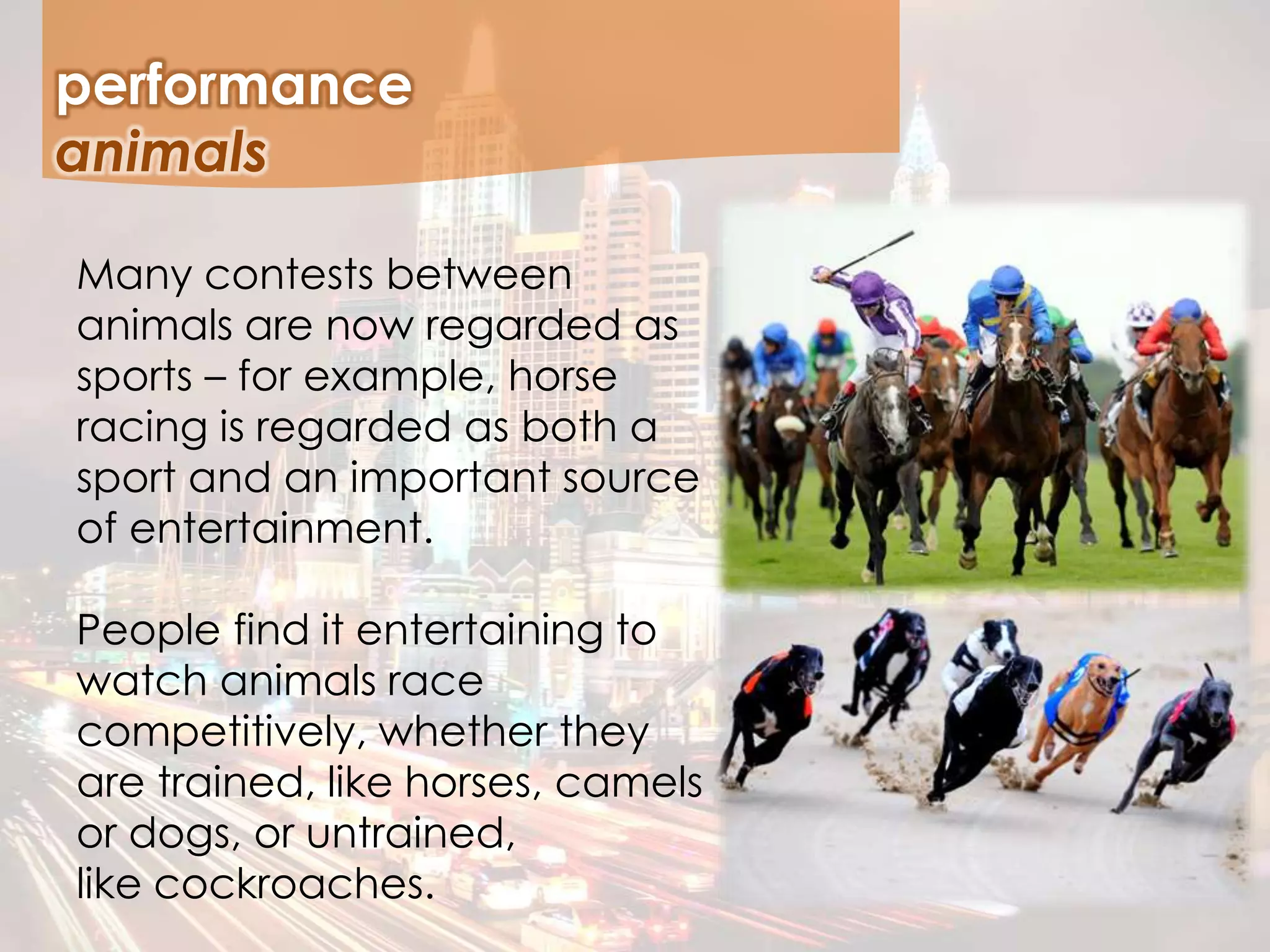
Many contests between
animals are now regarded as
sports – for example, horse
racing is regarded as both a
sport and an important source
of entertainment.
People find it entertaining to
watch animals race
competitively, whether they
are trained, like horses, camels
or dogs, or untrained,
like cockroaches.
performance
animals
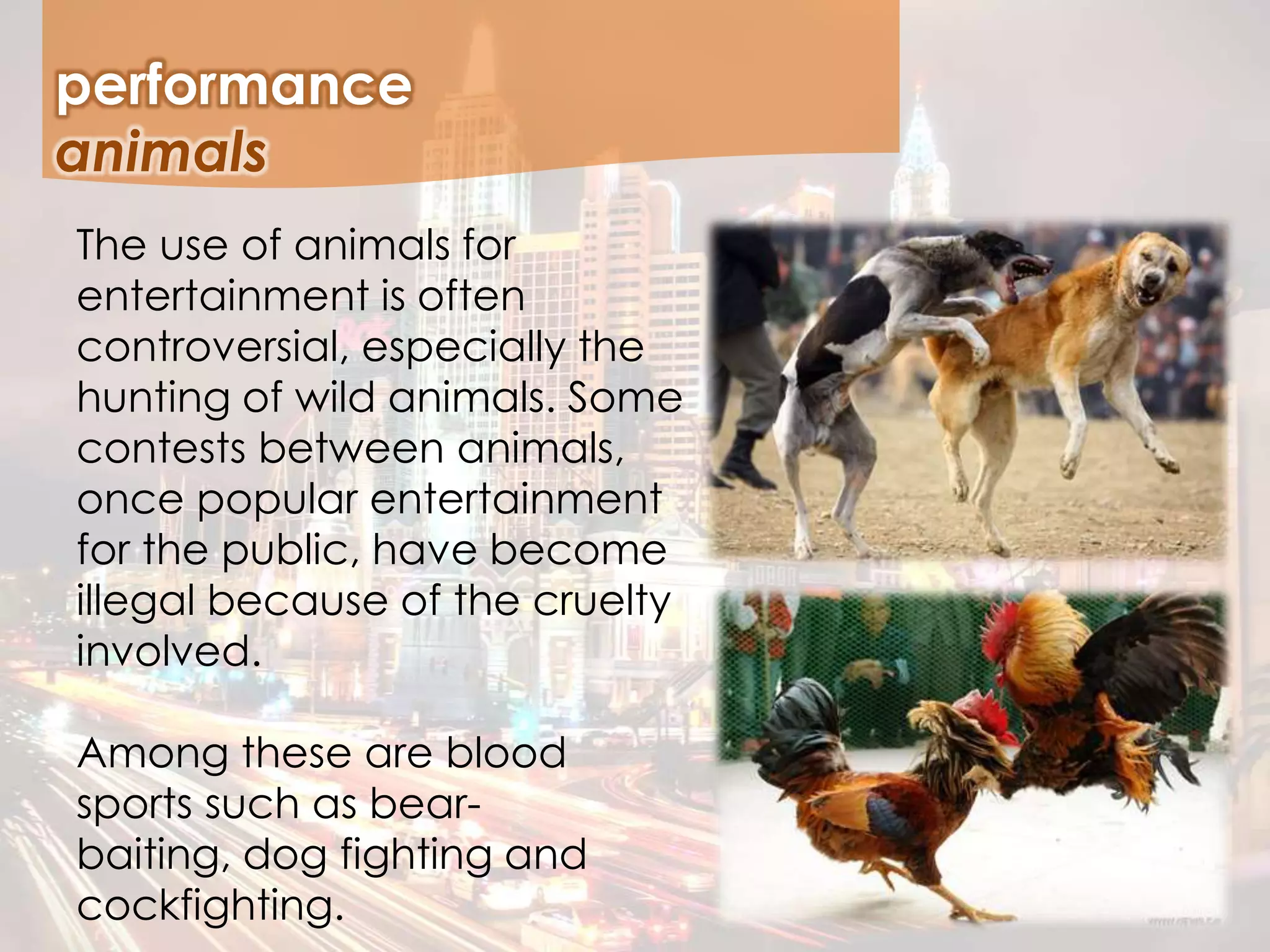
The use of animals for
entertainment is often
controversial, especially the
hunting of wild animals. Some
contests between animals,
once popular entertainment
for the public, have become
illegal because of the cruelty
involved.
Among these are blood
sports such as bear-
baiting, dog fighting and
cockfighting.
performance
animals
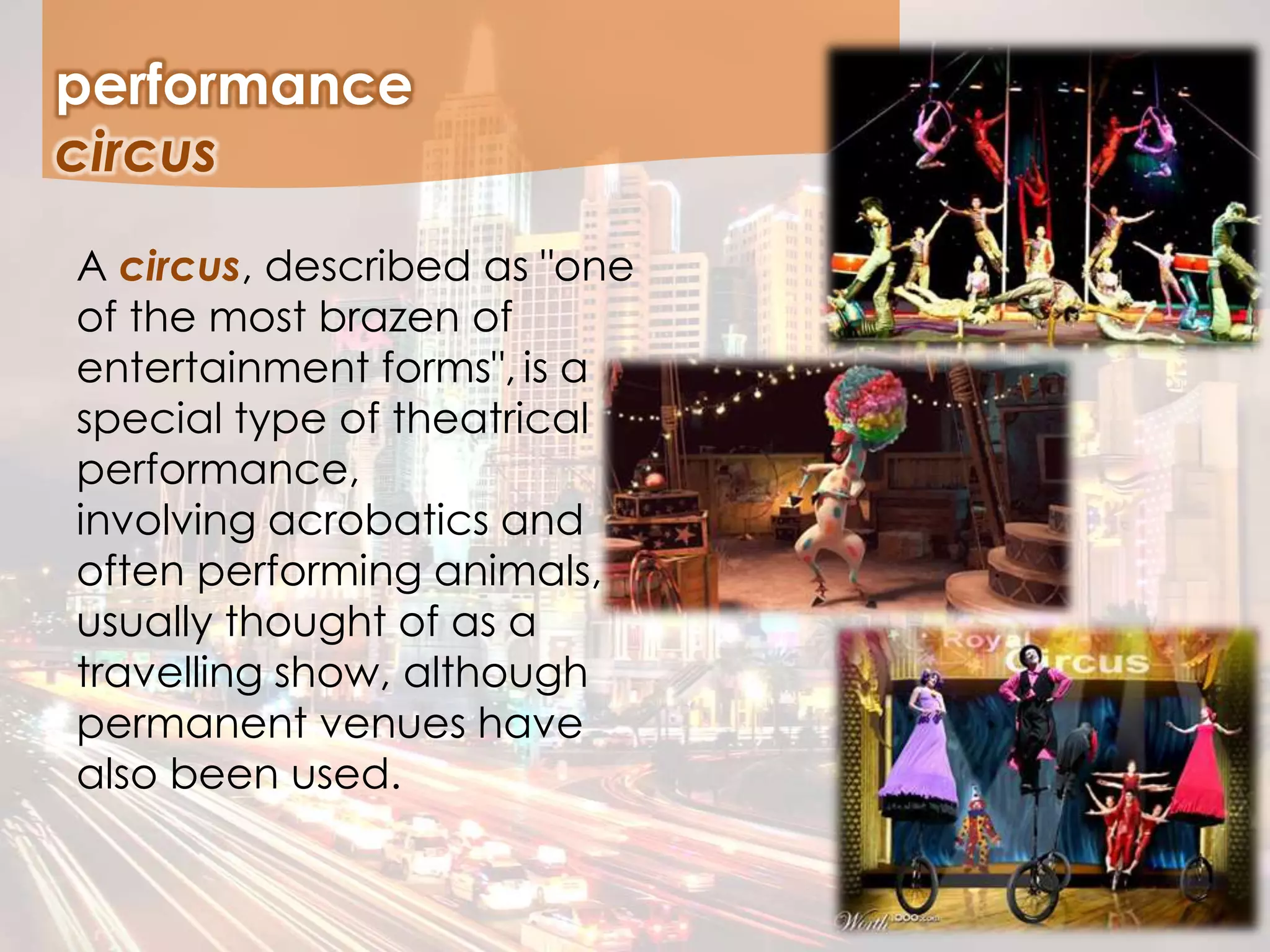
A circus, described as "one
of the most brazen of
entertainment forms", is a
special type of theatrical
performance,
involving acrobatics and
often performing animals,
usually thought of as a
travelling show, although
permanent venues have
also been used.
performance
circus
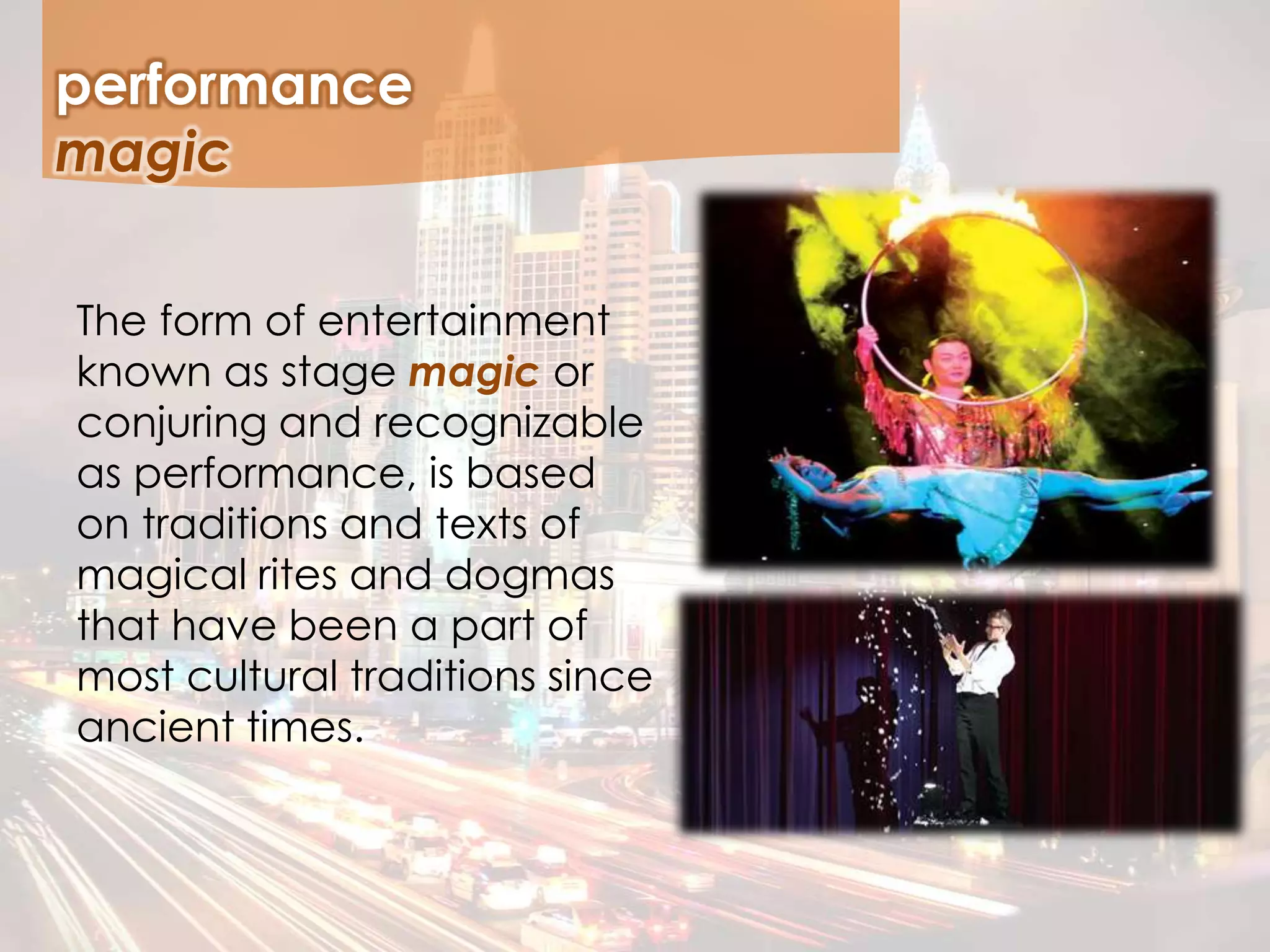
The form of entertainment
known as stage magic or
conjuring and recognizable
as performance, is based
on traditions and texts of
magical rites and dogmas
that have been a part of
most cultural traditions since
ancient times.
performance
magic
Stage magic is performed for
an audience in a variety of
media and locations: on
stage, on television, in the
street, and live at parties or
events.
It is often combined with
other forms of entertainment,
such as comedy or music
and showmanship is often an
essential part of magic
performances.
performance
magic
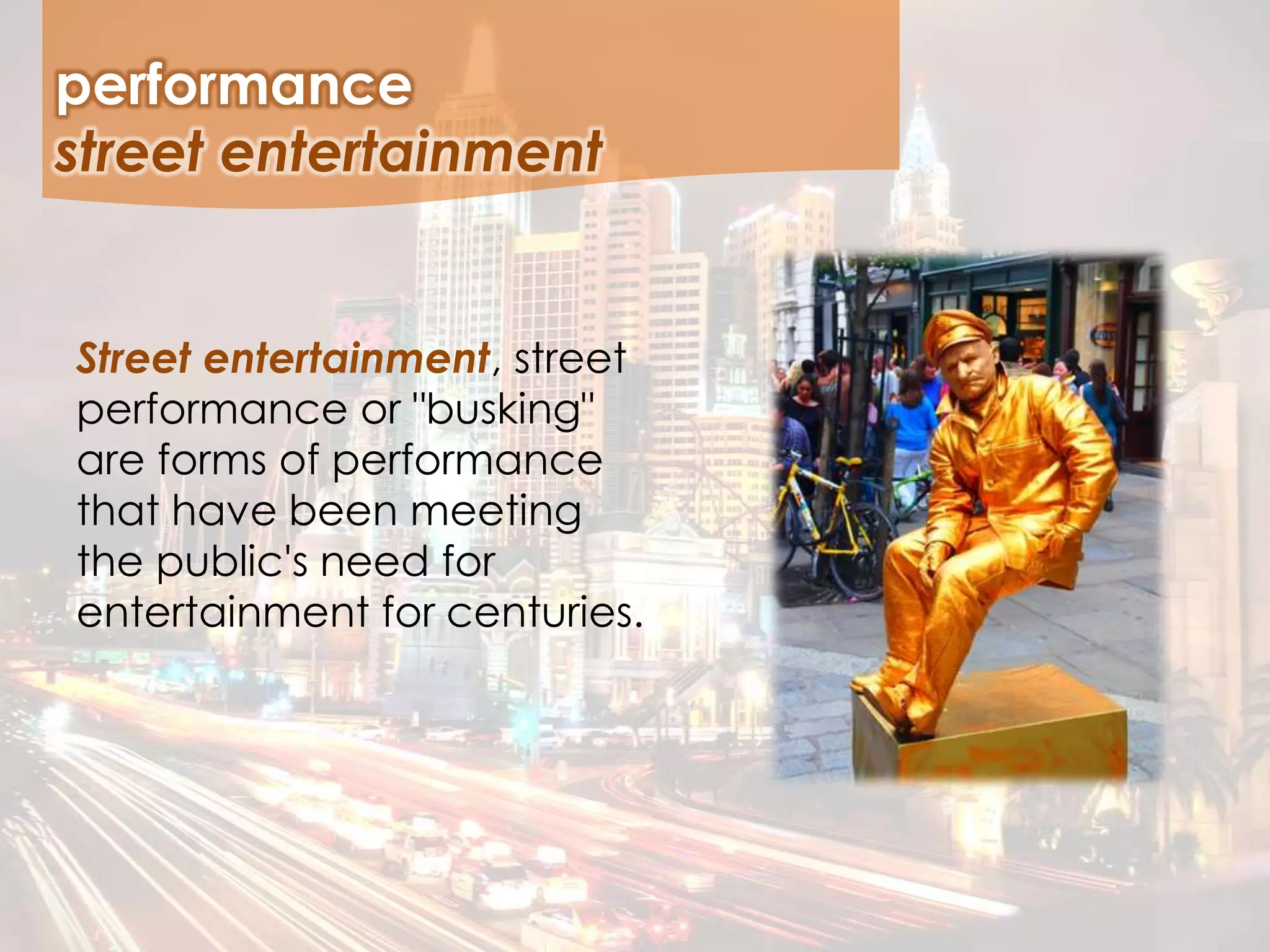
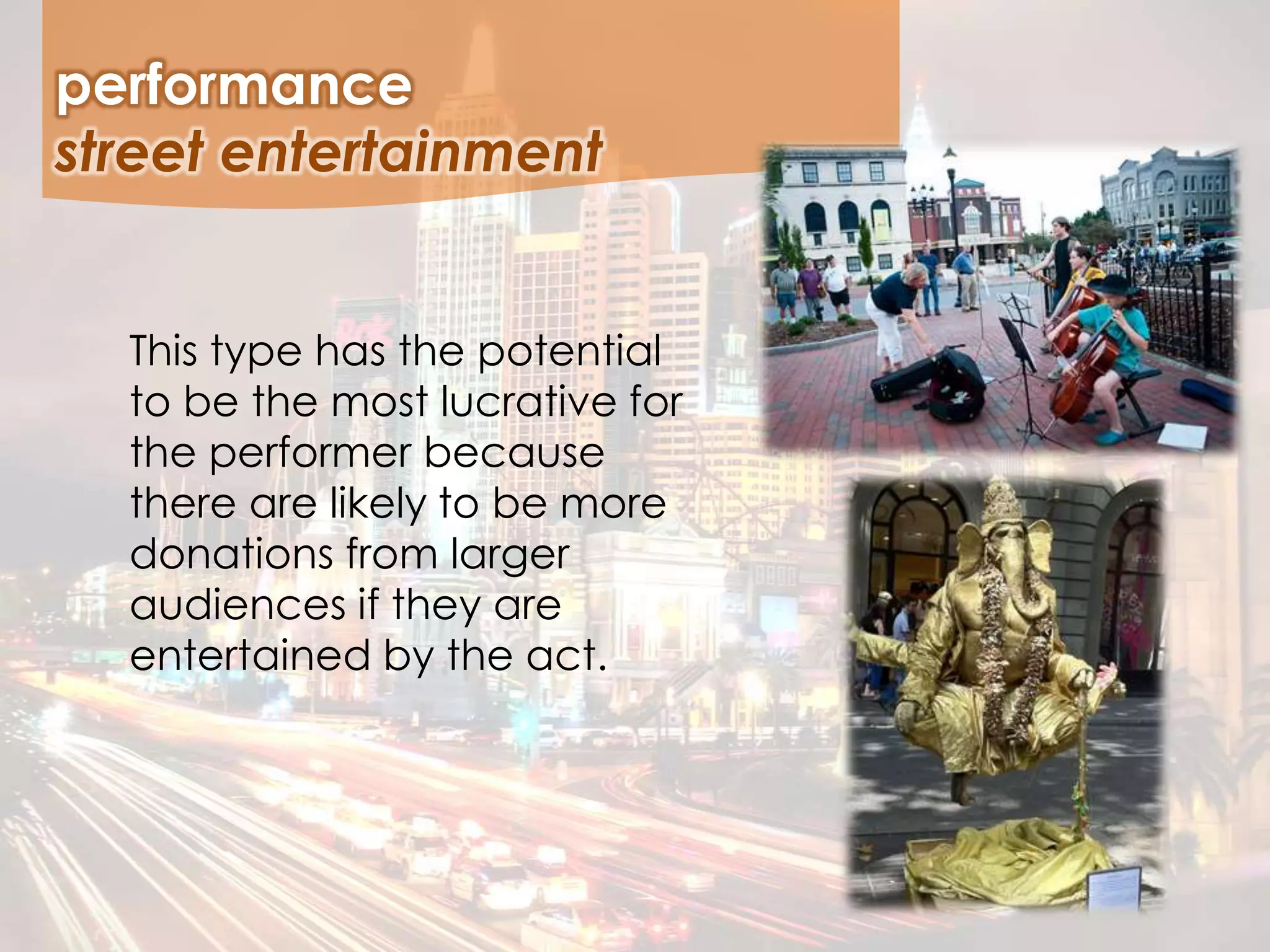
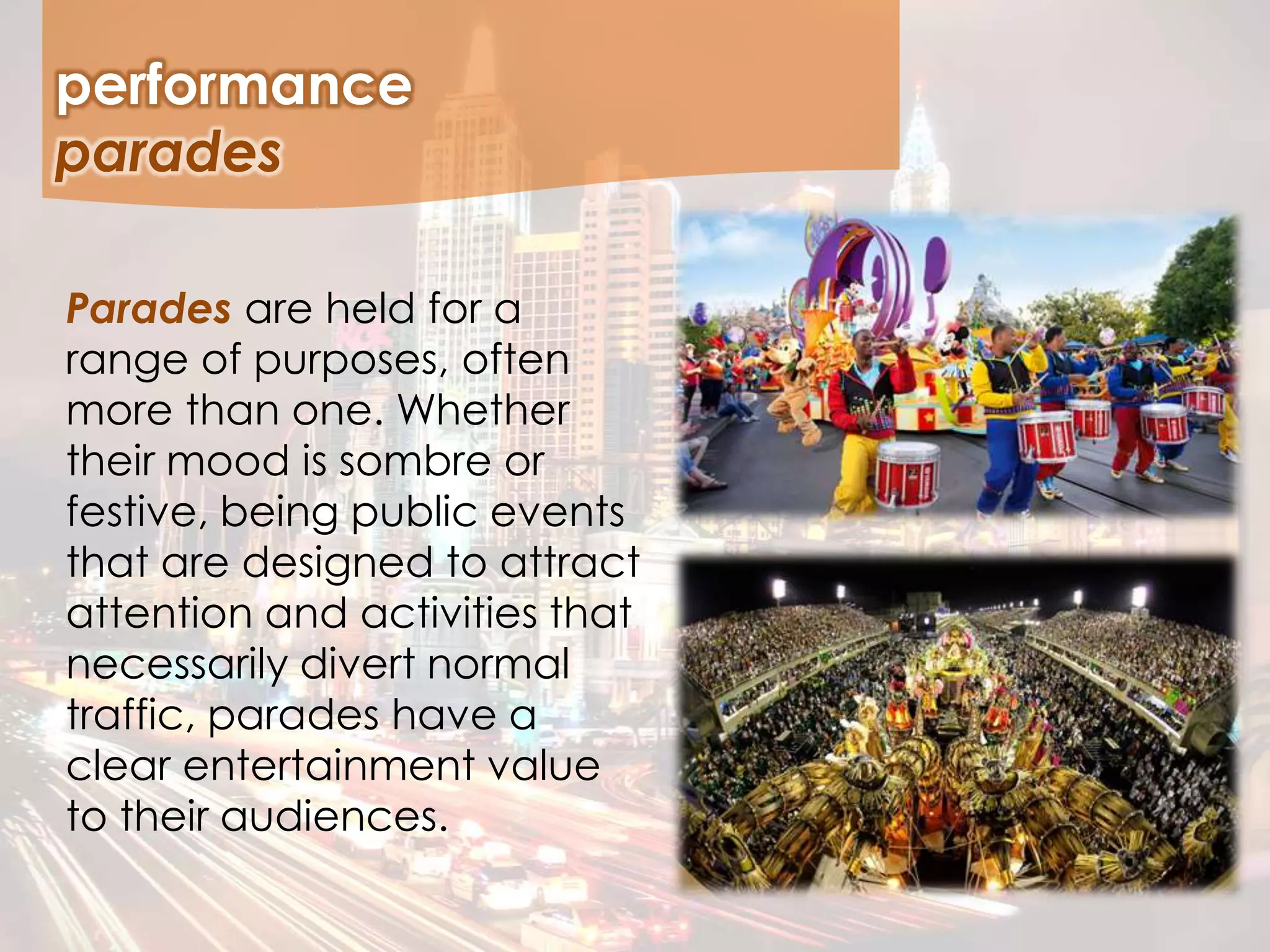
Street entertainment, street
performance or "busking"
are forms of performance
that have been meeting
the public's need for
entertainment for centuries.
performance
street entertainment
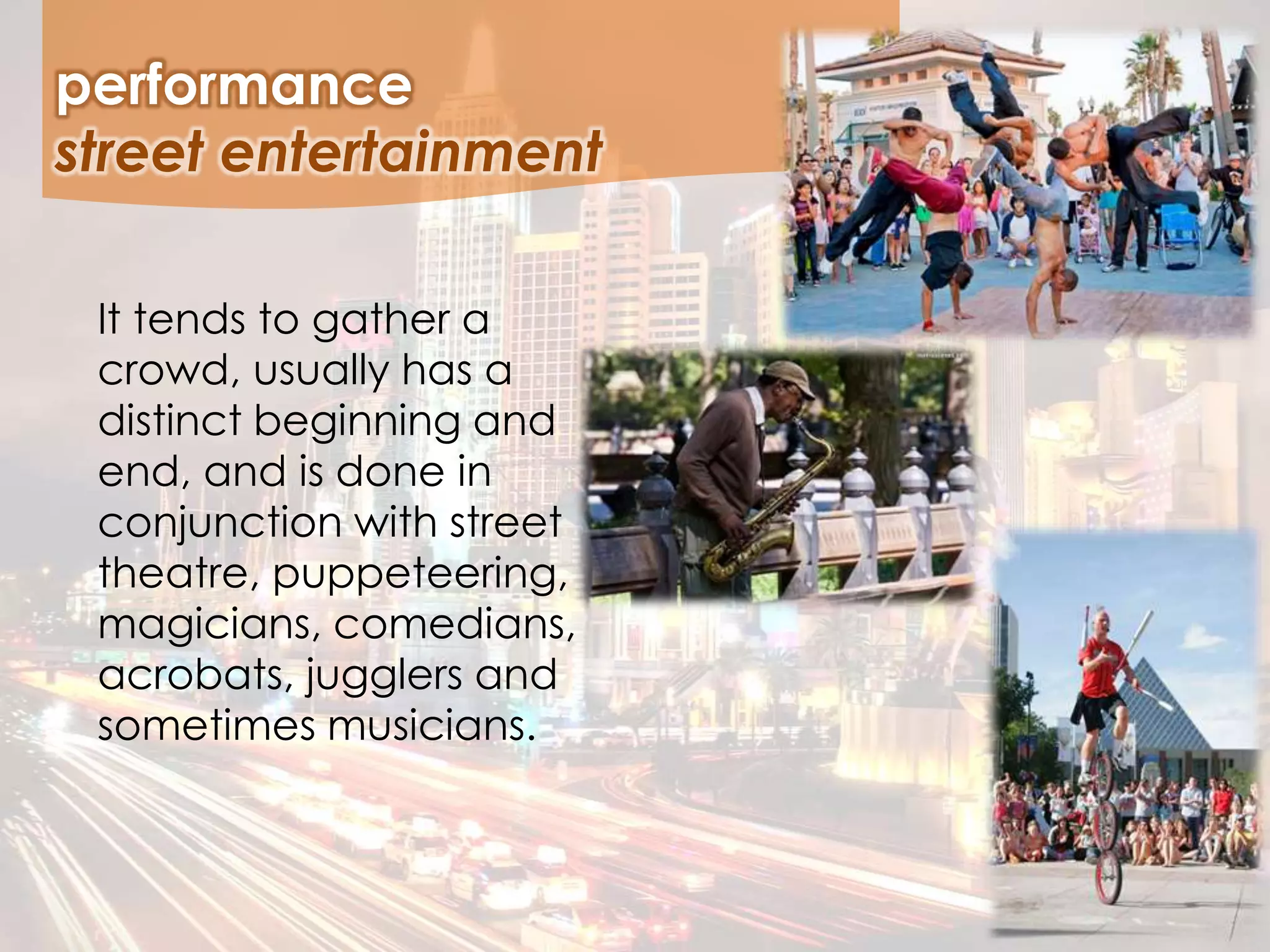
It tends to gather a
crowd, usually has a
distinct beginning and
end, and is done in
conjunction with street
theatre, puppeteering,
magicians, comedians,
acrobats, jugglers and
sometimes musicians.
performance
street entertainment
This type has the potential
to be the most lucrative for
the performer because
there are likely to be more
donations from larger
audiences if they are
entertained by the act.
performance
street entertainment
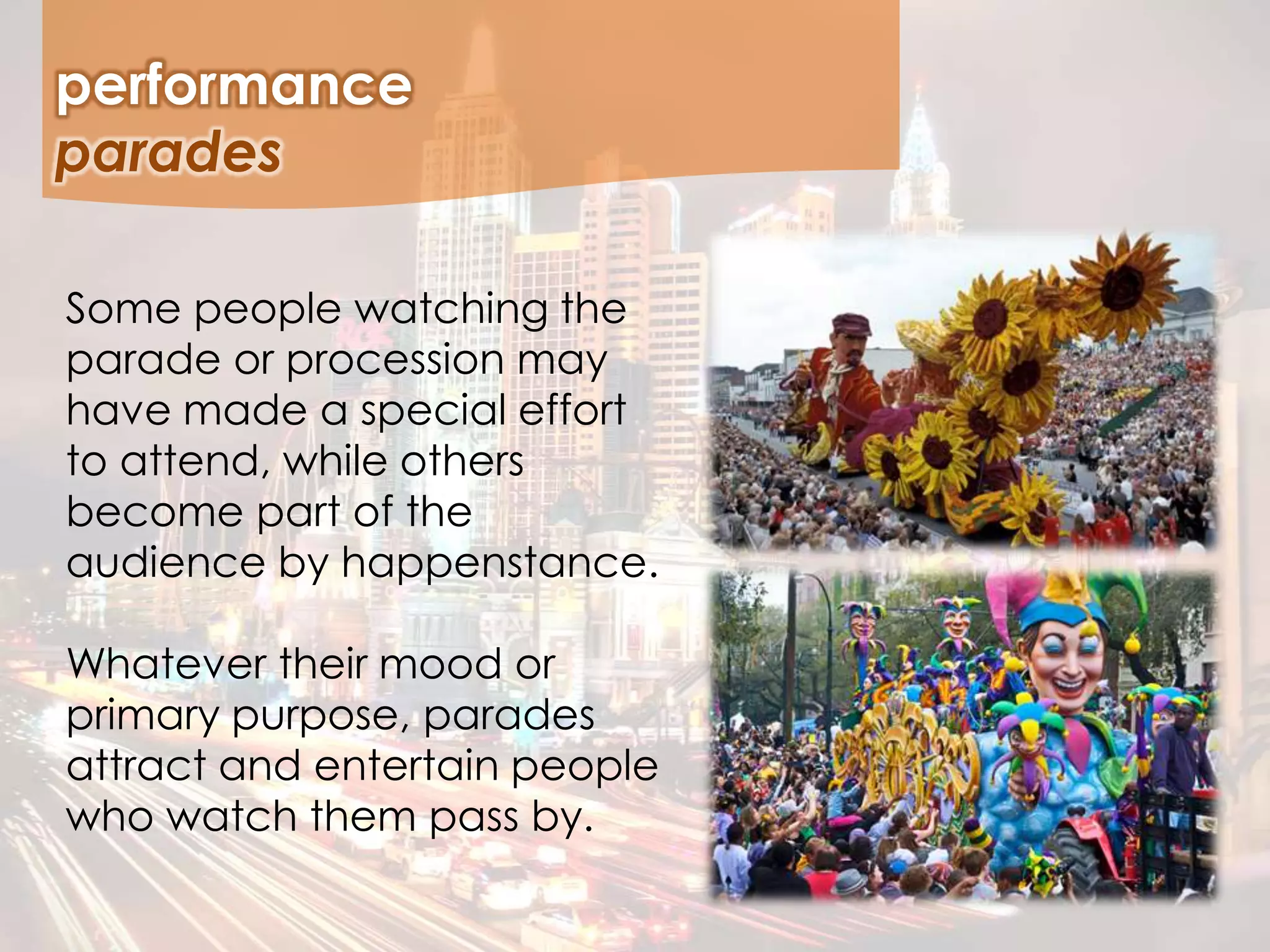
Parades are held for a
range of purposes, often
more than one. Whether
their mood is sombre or
festive, being public events
that are designed to attract
attention and activities that
necessarily divert normal
traffic, parades have a
clear entertainment value
to their audiences.
performance
parades
Some people watching the
parade or procession may
have made a special effort
to attend, while others
become part of the
audience by happenstance.
Whatever their mood or
primary purpose, parades
attract and entertain people
who watch them pass by.
performance
parades
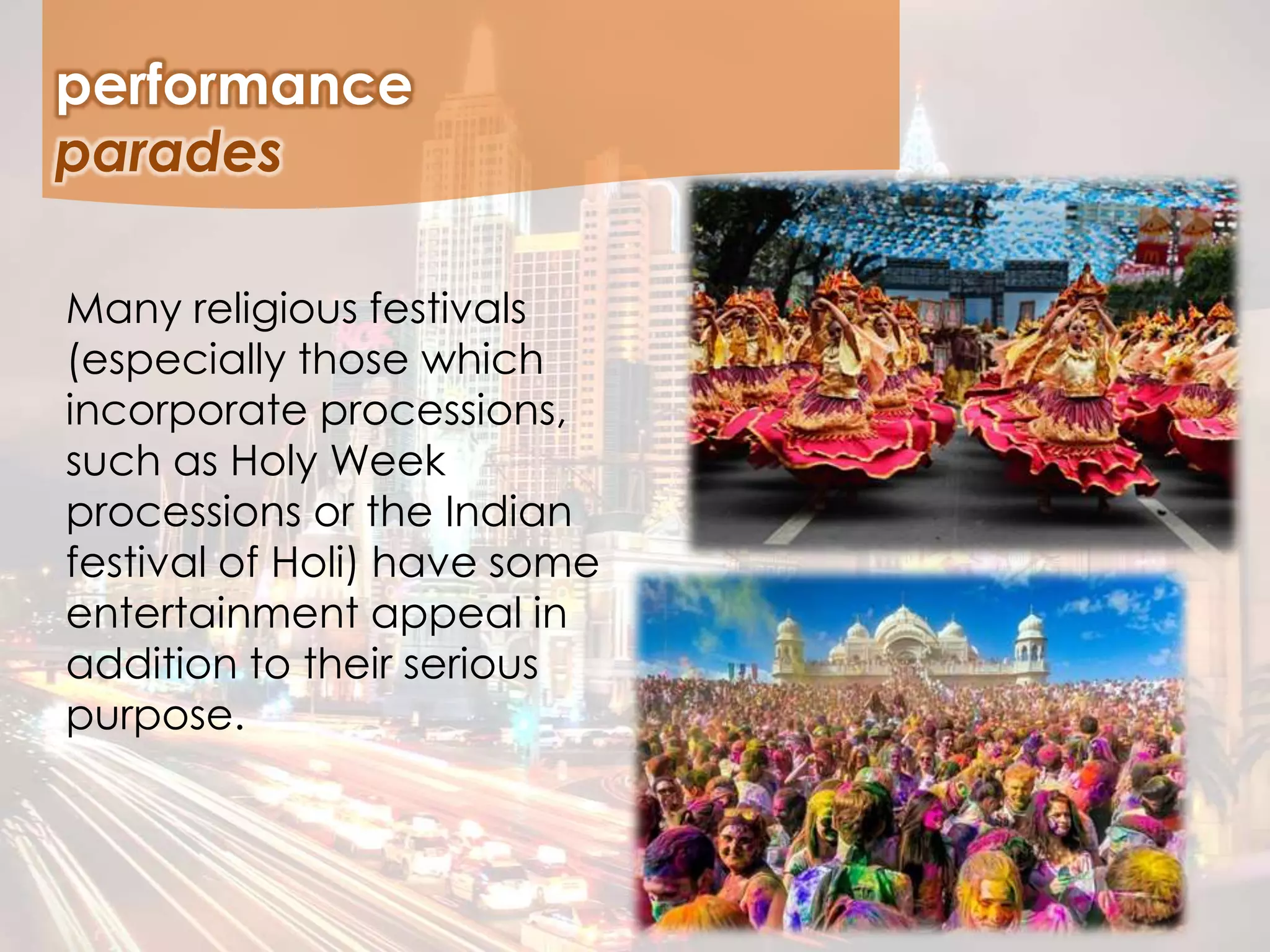
Many religious festivals
(especially those which
incorporate processions,
such as Holy Week
processions or the Indian
festival of Holi) have some
entertainment appeal in
addition to their serious
purpose.
performance
parades
Fireworks are a part of
many public entertainments
and have retained an
enduring popularity since
they became a "crowning
feature of elaborate
celebrations" in the 17th
century.
performance
fireworks
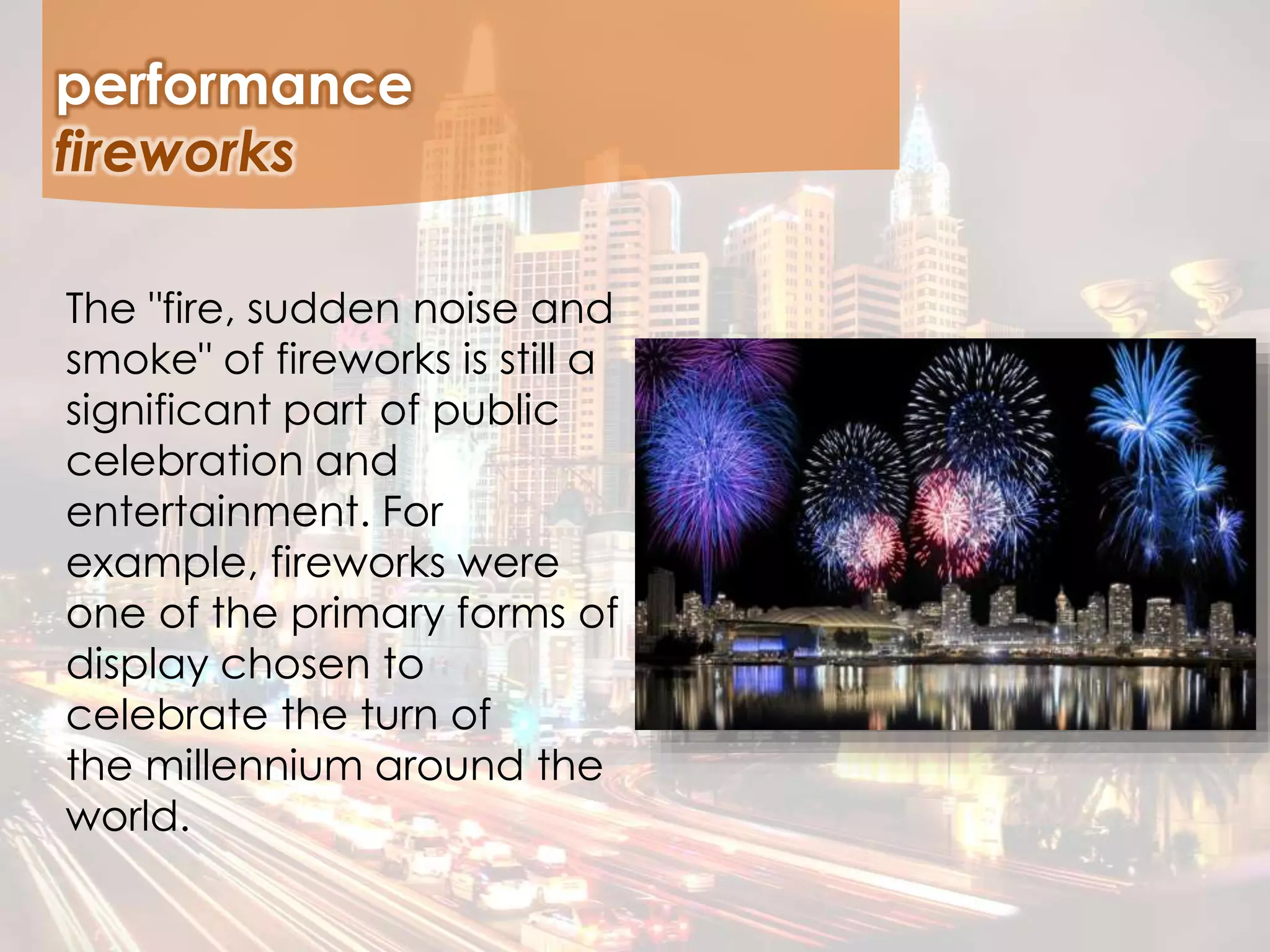
The "fire, sudden noise and
smoke" of fireworks is still a
significant part of public
celebration and
entertainment. For
example, fireworks were
one of the primary forms of
display chosen to
celebrate the turn of
the millennium around the
world.
performance
fireworks
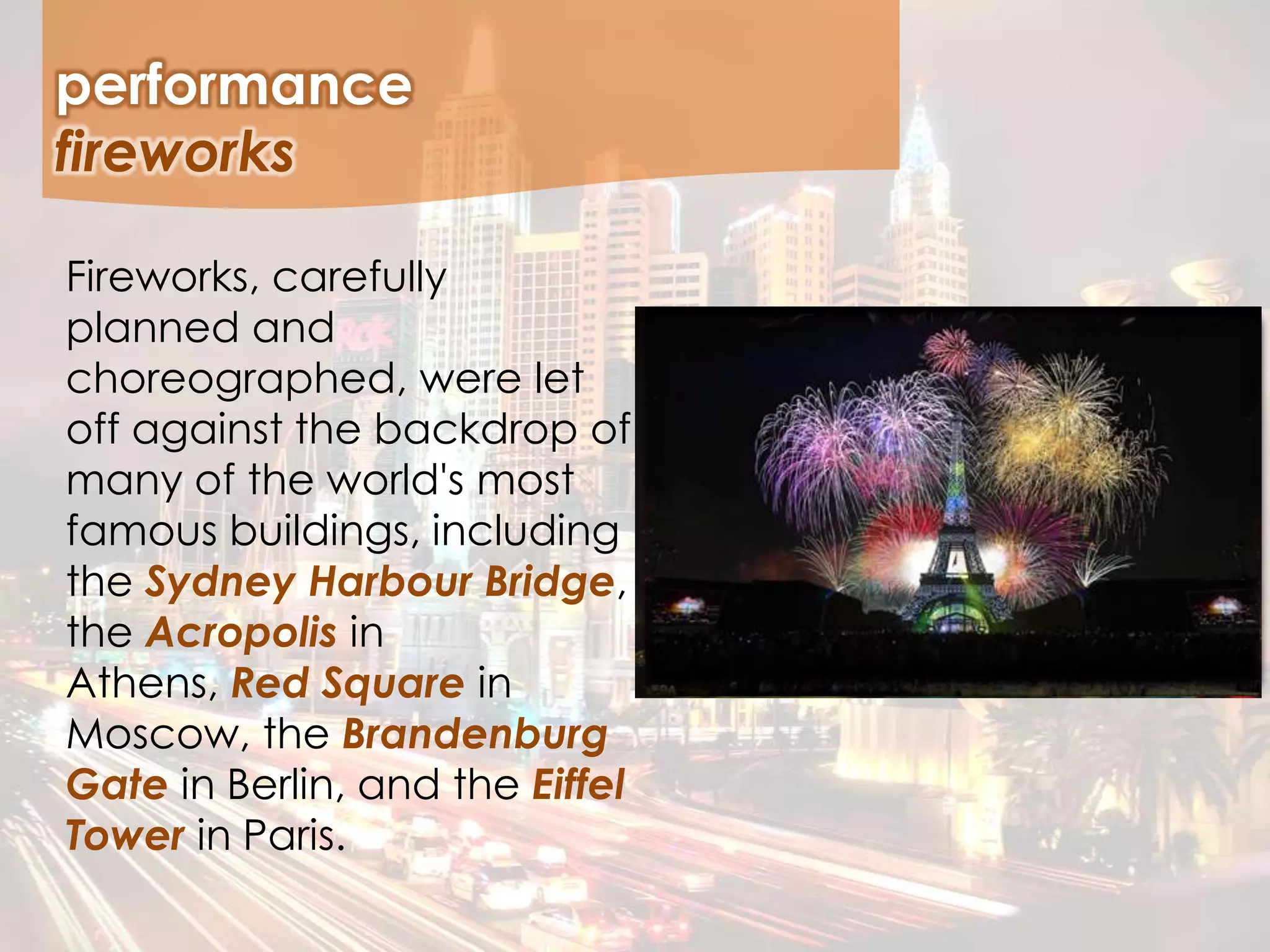
Fireworks, carefully
planned and
choreographed, were let
off against the backdrop of
many of the world's most
famous buildings, including
the Sydney Harbour Bridge,
the Acropolis in
Athens, Red Square in
Moscow, the Brandenburg
Gate in Berlin, and the Eiffel
Tower in Paris.
performance
fireworks
sport
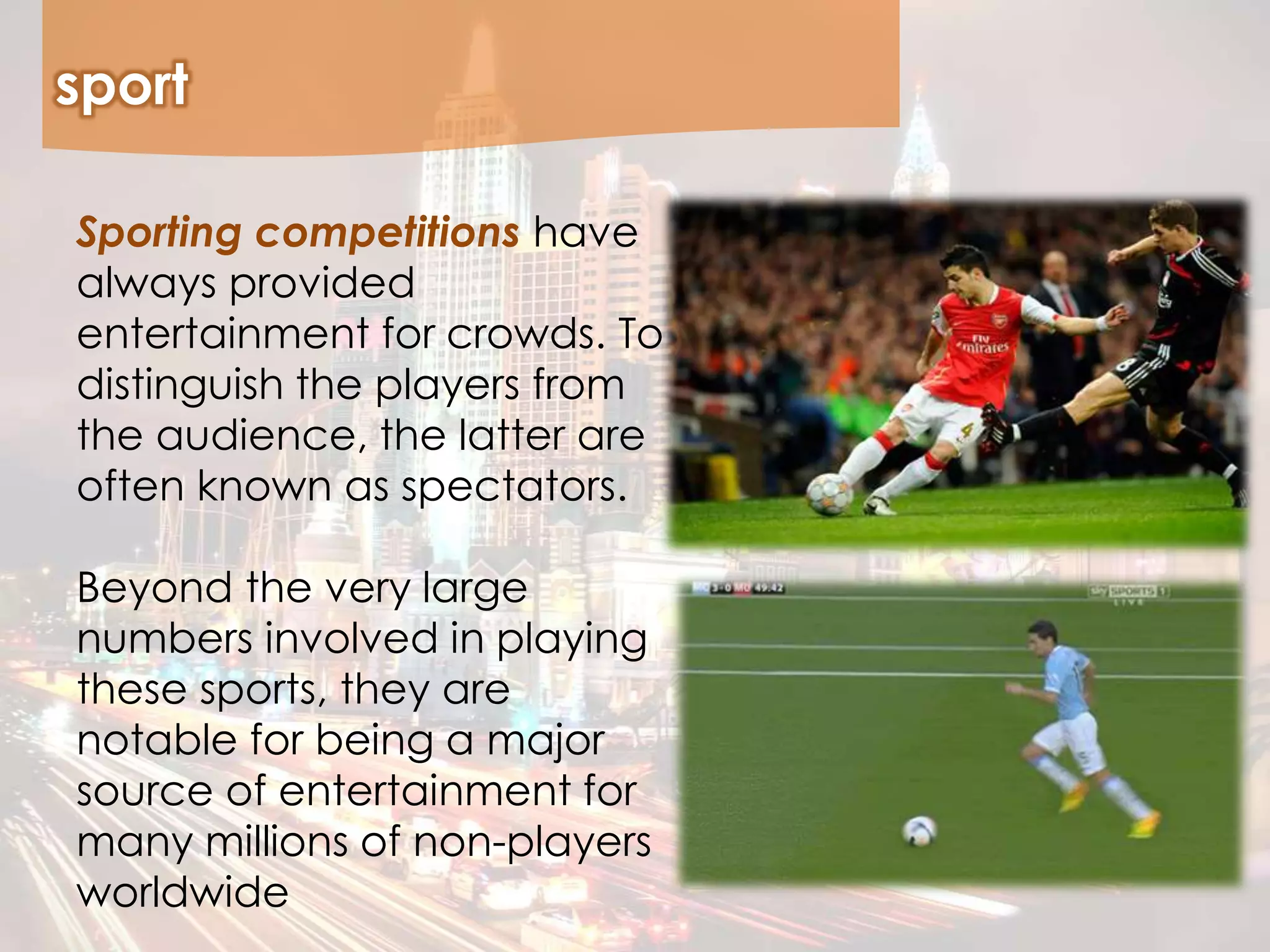
Sporting competitions have
always provided
entertainment for crowds. To
distinguish the players from
the audience, the latter are
often known as spectators.
Beyond the very large
numbers involved in playing
these sports, they are
notable for being a major
source of entertainment for
many millions of non-players
worldwide
sport
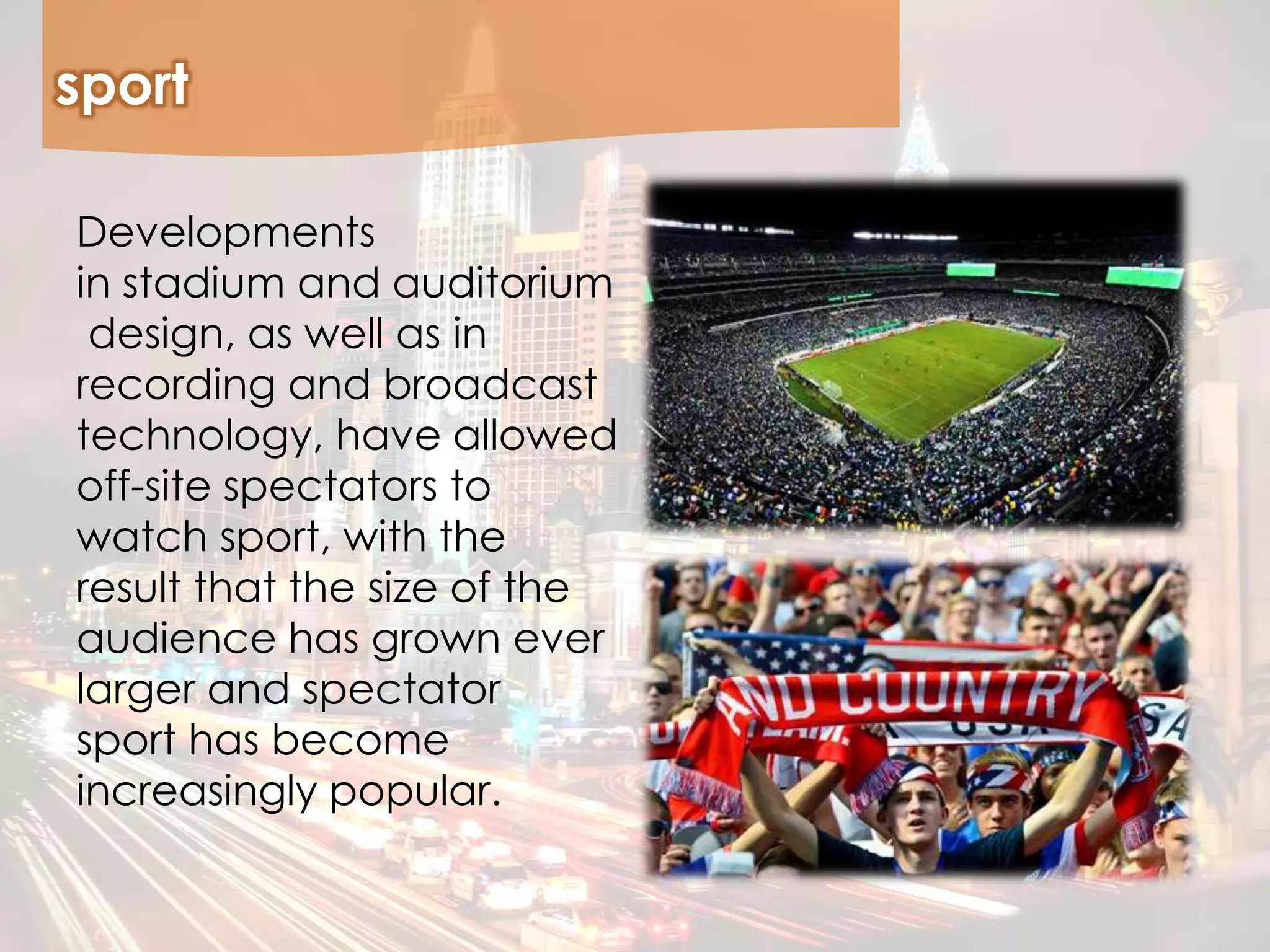
Developments
in stadium and auditorium
design, as well as in
recording and broadcast
technology, have allowed
off-site spectators to
watch sport, with the
result that the size of the
audience has grown ever
larger and spectator
sport has become
increasingly popular.
sport
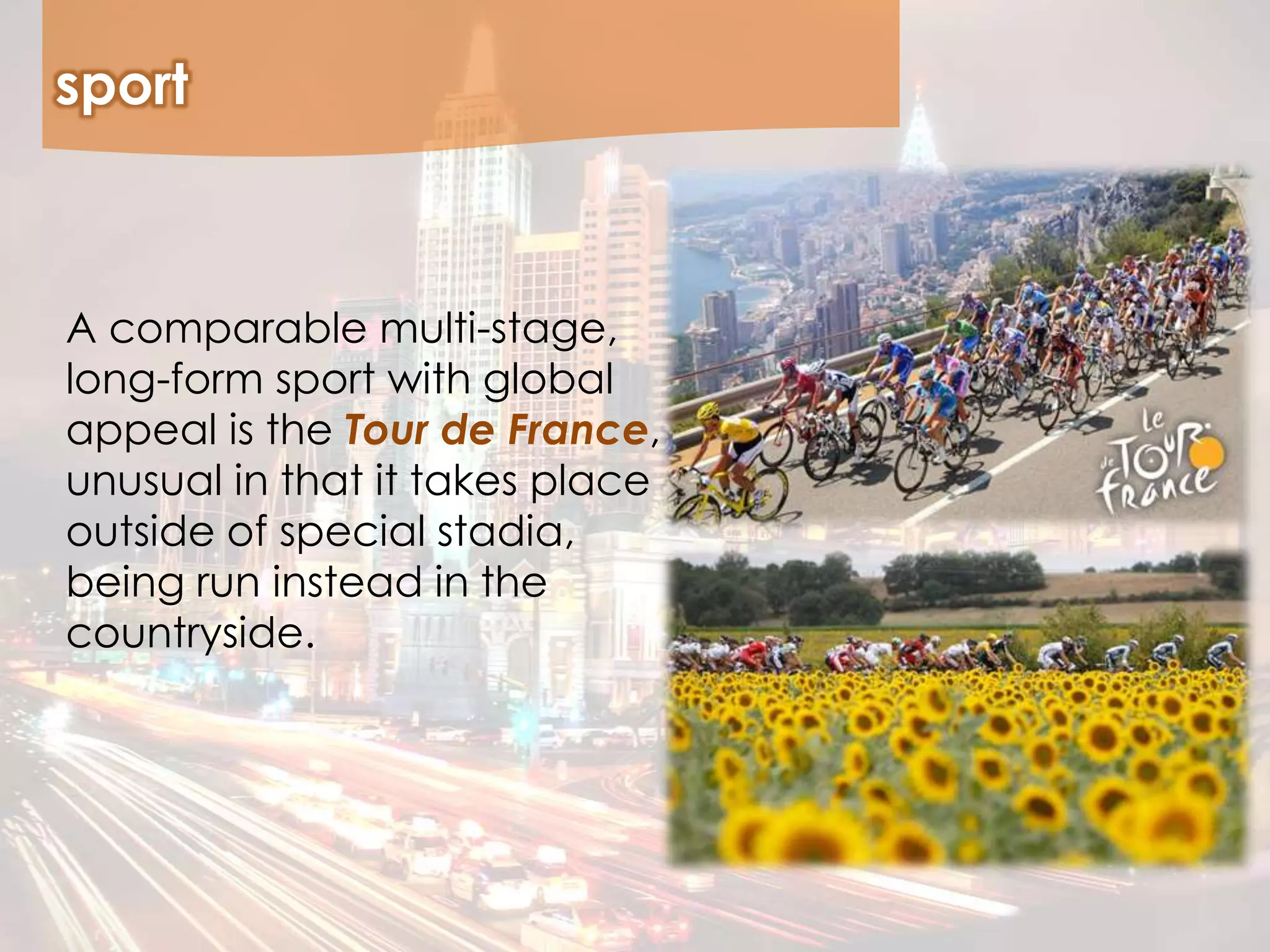
A comparable multi-stage,
long-form sport with global
appeal is the Tour de France,
unusual in that it takes place
outside of special stadia,
being run instead in the
countryside.
sport
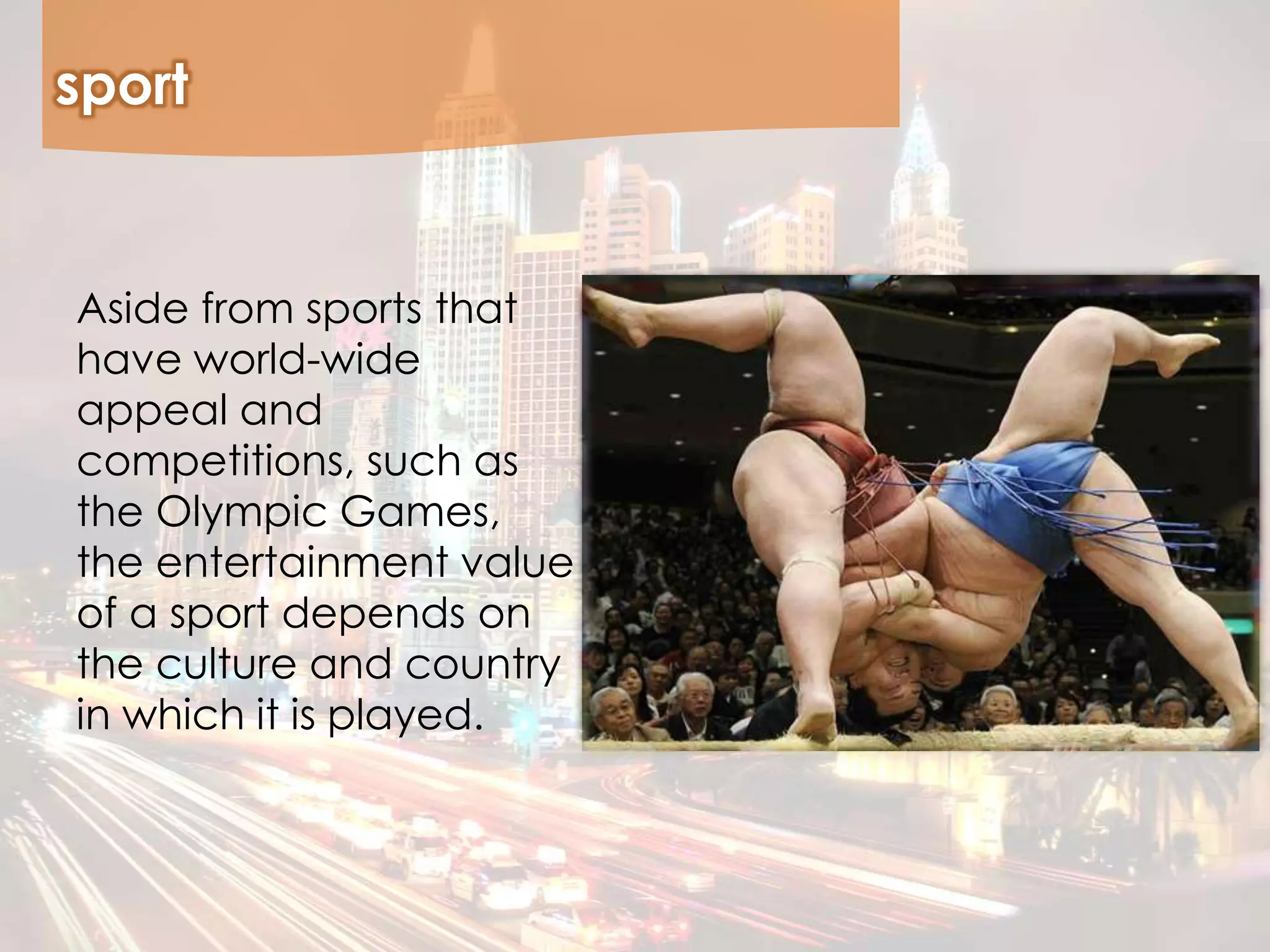
Aside from sports that
have world-wide
appeal and
competitions, such as
the Olympic Games,
the entertainment value
of a sport depends on
the culture and country
in which it is played.
sport
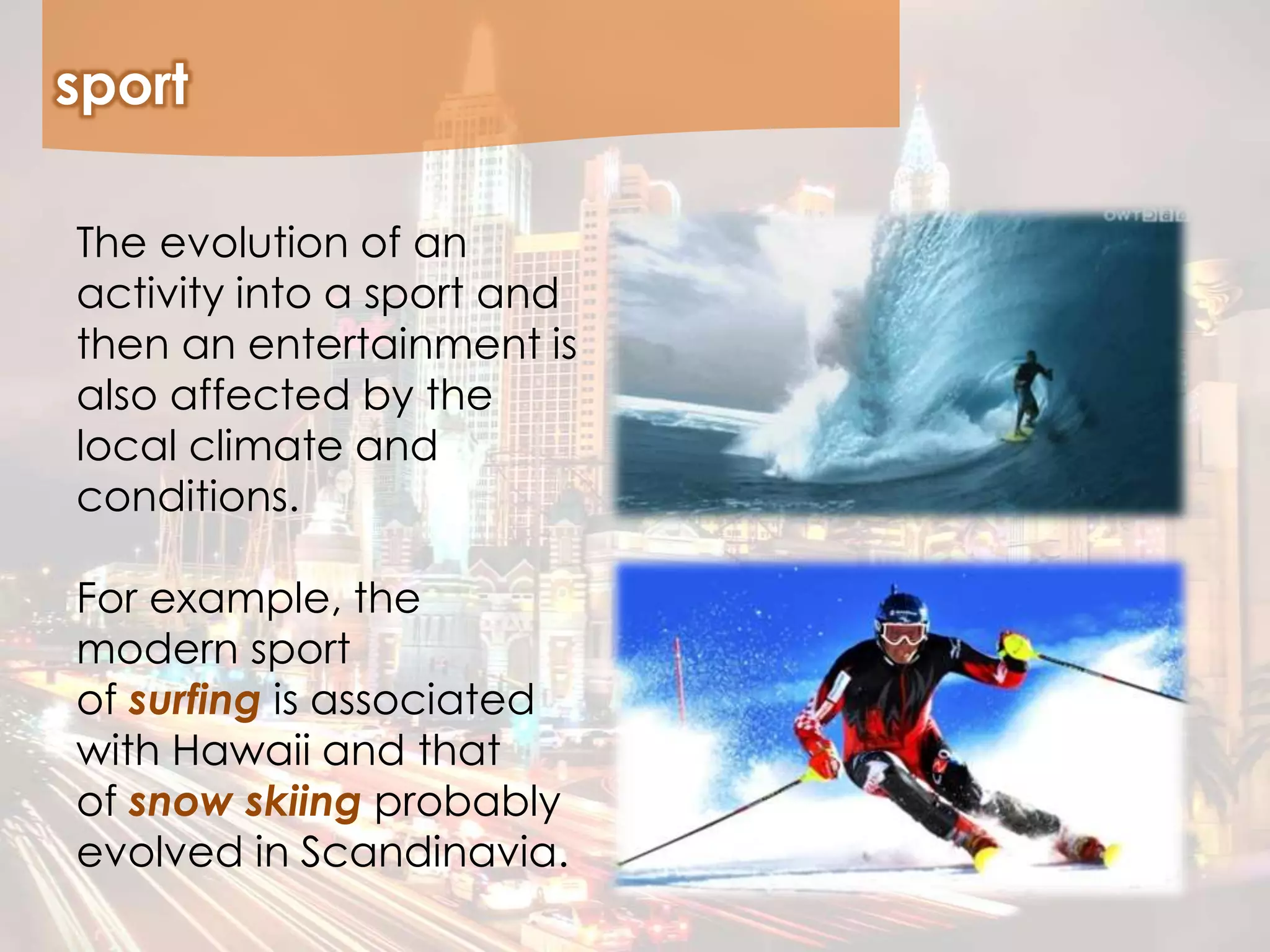
The evolution of an
activity into a sport and
then an entertainment is
also affected by the
local climate and
conditions.
For example, the
modern sport
of surfing is associated
with Hawaii and that
of snow skiing probably
evolved in Scandinavia.
sport
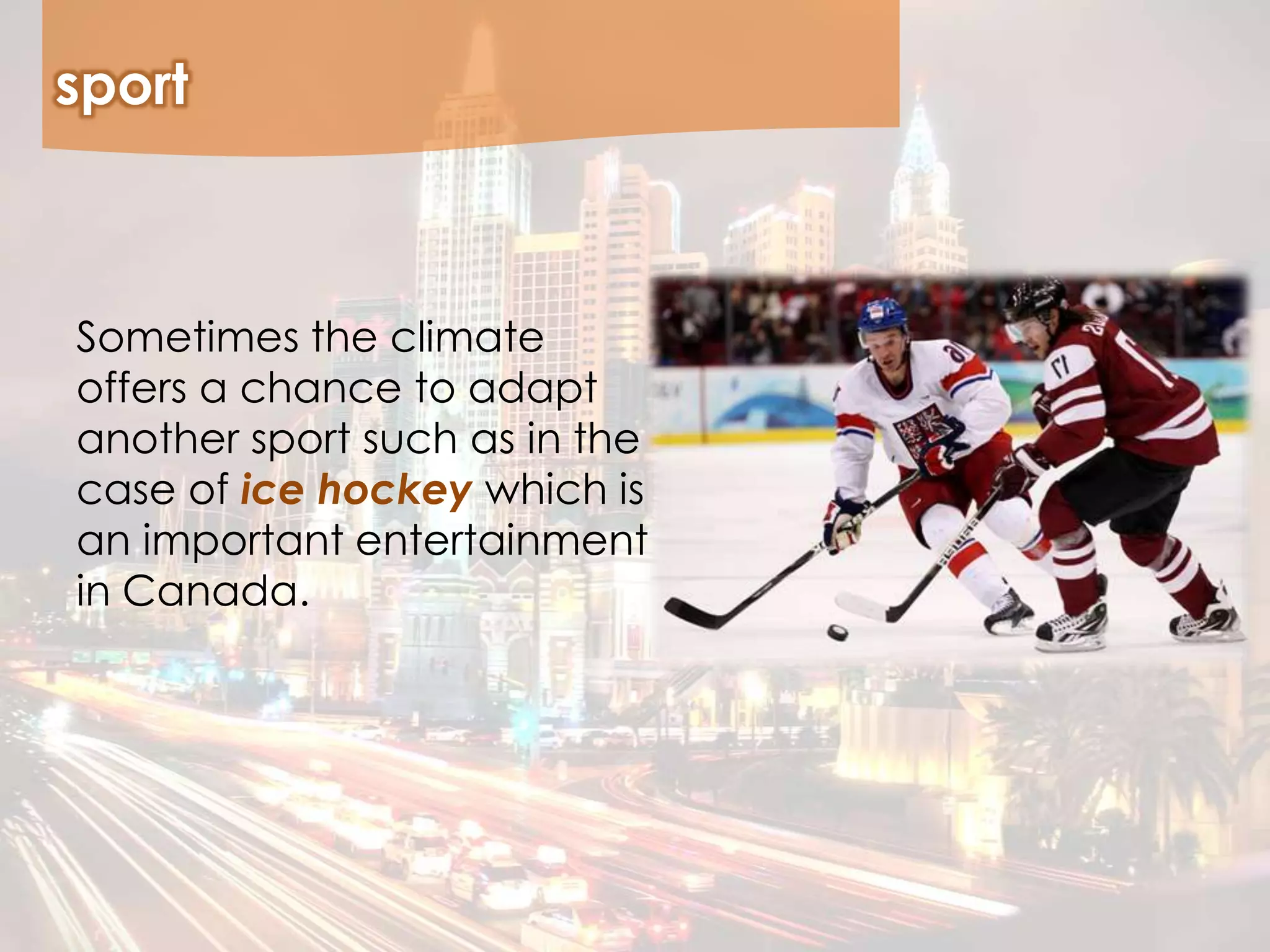
Sometimes the climate
offers a chance to adapt
another sport such as in the
case of ice hockey which is
an important entertainment
in Canada.
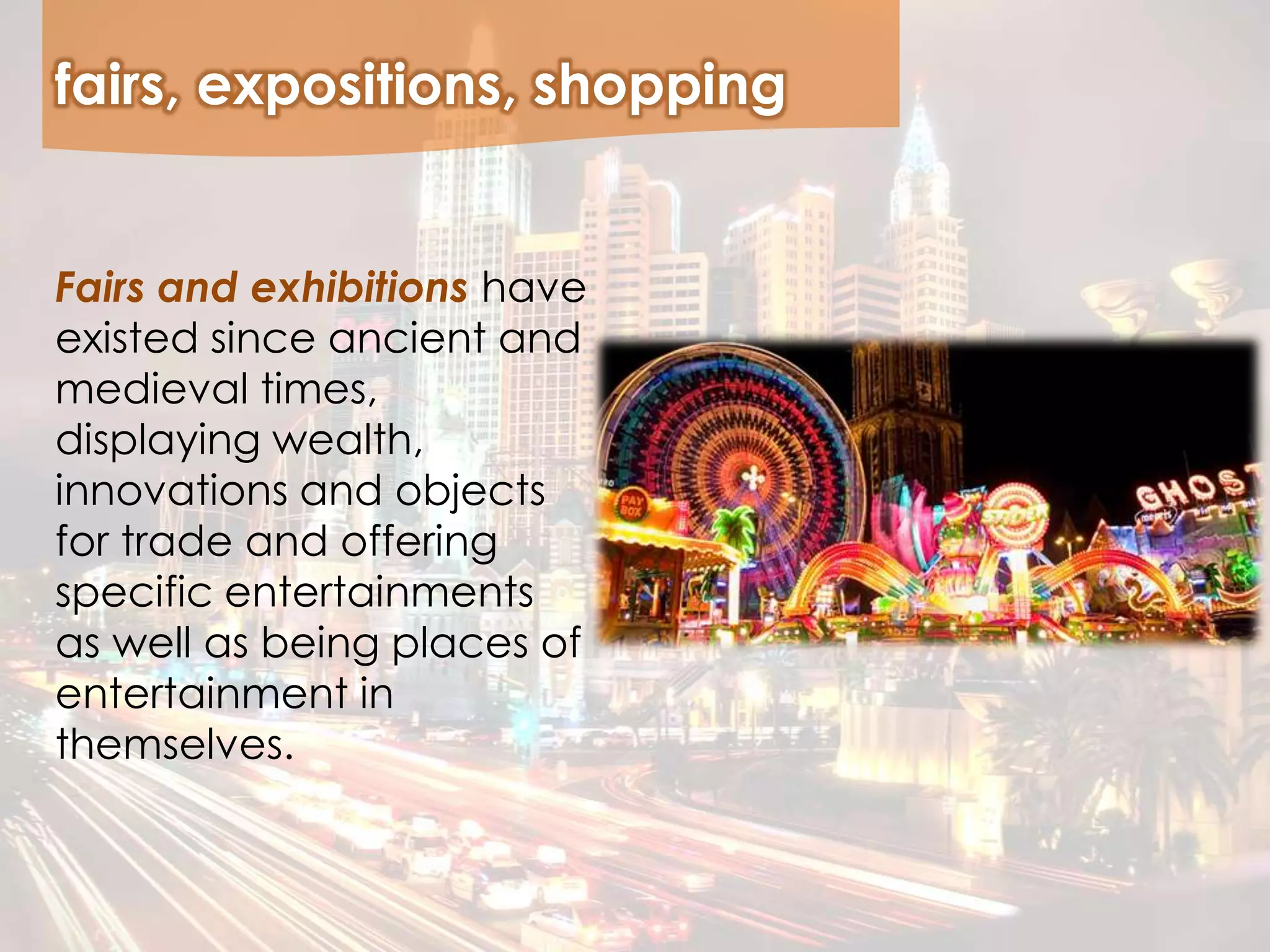
fairs, expositions, shopping
Fairs and exhibitions have
existed since ancient and
medieval times,
displaying wealth,
innovations and objects
for trade and offering
specific entertainments
as well as being places of
entertainment in
themselves.
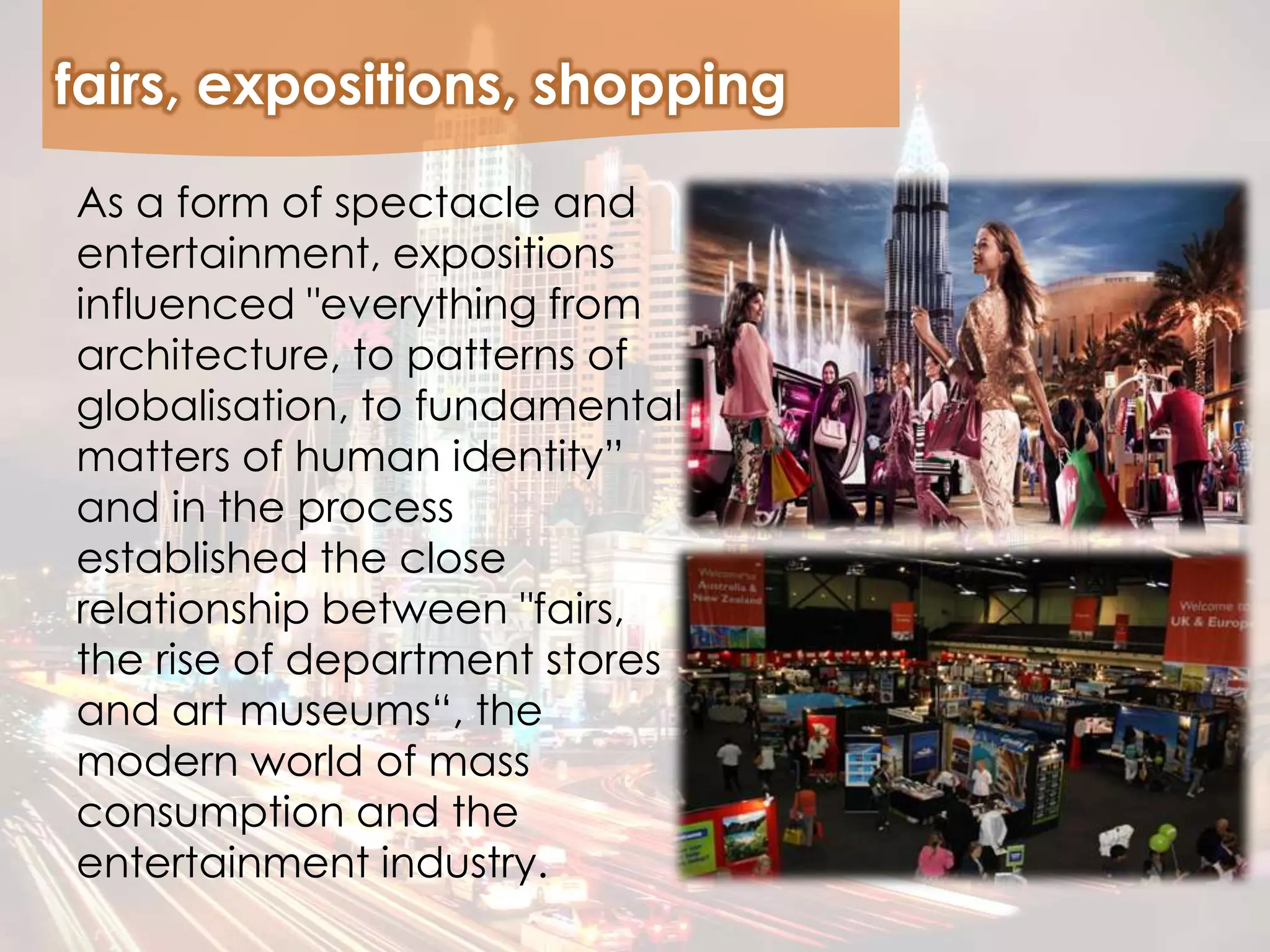
fairs, expositions, shopping
As a form of spectacle and
entertainment, expositions
influenced "everything from
architecture, to patterns of
globalisation, to fundamental
matters of human identity”
and in the process
established the close
relationship between "fairs,
the rise of department stores
and art museums“, the
modern world of mass
consumption and the
entertainment industry.
cris edren dela peña

The Concept and Types of Entertainment

  • 1.
  • 2.
    the concept ofentertainment Entertainment is a form of activity that holds the attention and interest of an audience, or gives pleasure and delight It can be an idea or a task, but is more likely to be one of the activities or events that have developed over thousands of years specifically for the purpose of keeping an audience's attention.
  • 3.
    the concept ofentertainment Entertainment is a kind of activity which gives a recreation or allows people to entertain themselves in their free time. People may make their own type of entertainment, like when they unexpectedly invent some games; participate with enthusiasm in an activity which they find enjoyable.
  • 4.
    the concept ofentertainment An important aspect of entertainment is the audience, which turns a private recreation or leisure activity into entertainment. The audience may have a passive role, as in the case of persons watching a play, opera, television show, or film; or the audience role may be active, as in the case of games, where the participant/audience roles may be routinely reversed.
  • 5.
    types of entertainment •Banquets • Music • Games • Reading • Comedy • Performance • Theatre • Cinema and Film • Dance • Animals • Circus • Magic • Street Performances • Parades • Fireworks • Sports • Fairs, Expositions, Shopping
  • 6.
    banquets Banquets have beena venue for entertainment since ancient times, continuing until the 21st century, when they are still being used for many of their original purposes – to impress visitors, especially important ones; to show hospitality; as an occasion to showcase supporting entertainments such as music or dancing, or both.
  • 7.
    banquets In modern times,banquets are commercially available, for example, in restaurants and combined with a performance in dinner theatres. Cooking by professional chefs has also become a form of entertainment as part of global competitions.
  • 8.
    music Music is asupporting component of many kinds of entertainment and most kinds of performance. Music is also a universal and popular type of entertainment on its own, constituting an entire performance such as when concerts are given.
  • 9.
    music The wide varietyof musical performances, whether or not they are artificially amplified, all provide entertainment irrespective of whether the performance is from soloists, choral or orchestral groups, or ensemble.
  • 10.
    games Games are playedfor entertainment—sometimes purely for entertainment, sometimes for achievement or reward as well. They can be played alone, in teams, or online; by amateurs or by professionals. The players may have an audience of non-players, such as when people are entertained by watching a chess championship.
  • 11.
    games Equipment varies withthe game. Board games, such as Go, Monopoly or backgammon need a board and markers. Other games, such as bingo, played with numerous strangers, have been organized to involve the participation of non- players via gambling.
  • 12.
    games Many are gearedfor children, and can be played outdoors, including hopscotch, hide and seek, or Blind man's bluff.
  • 13.
    games The list ofball games is quite extensive. It includes, for example, croquet, lawn bowling and paintball as well as many sports using various forms of balls.
  • 14.
    games Video games are playedusing a controller to create results on a screen. They can also be played online with participants joining in remotely.
  • 15.
    reading Reading has beena source of entertainment for a very long time, especially when other forms, such as performance entertainments, were (or are) either unavailable or too costly. Among literature's many genres are some designed, in whole or in part, purely for entertainment.
  • 16.
    reading Limericks, for example,use verse in a strict, predictable rhyme and rhythm to create humor and to amuse an audience of listeners or readers. Comics and cartoons are literary genres that use drawings or graphics, usually in combination with text, to convey an entertaining narrative.
  • 17.
    reading The Japanese Mangastyle differs from the western approach in that it encompasses a wide range of genres and themes for a readership of all ages. Caricature uses a kind of graphic entertainment for purposes ranging from merely putting a smile on the viewer's face, to raising social awareness, to highlighting the moral characteristics of a person being caricatured.
  • 18.
    comedy Comedy is botha genre of entertainment and a component of it, providing laughter and amusement, whether the comedy is the sole purpose or used as a form of contrast in an otherwise serious piece.
  • 19.
    comedy It is avalued contributor to many forms of entertainment, including in literature, theatre, opera, film and games
  • 20.
    performance Live performances beforean audience constitute a major form of entertainment, especially before the invention of audio and video recording. Performance takes a wide range of forms, including theatre, music and drama.
  • 21.
    performance Audiences generally show theirappreciation of an entertaining performance with applause. However, all performers run the risk of failing to hold their audience's attention and thus, failing to entertain. Audience dissatisfaction is often brutally honest and direct.
  • 22.
    performance Theatre performances, typically dramaticor musical, are presented on a stage for an audience and have a history that goes back to Hellenistic times when "leading musicians and actors" performed widely at "poetical competitions“. theatre
  • 23.
    performance Plays, musicals, monologues, pantomimes,andperformance poetry are part of the very long history of theatre which is also the venue for the type of performance known as stand- up comedy. In the 20th century, radio and television, often broadcast live, extended the theatrical tradition that continued to exist alongside the new forms. theatre
  • 24.
    performance Films are amajor form of entertainment, although not all films have entertainment as their primary purpose: documentary film, for example, aims to create a record or inform, although the two purposes often work together. cinema/film
  • 25.
    performance Increasingly sophisticated techniques havebeen used in the film medium to delight and entertain audiences. Animation, for example, which involves the display of rapid movement in an art work, is one of these techniques that particularly appeals to younger audiences. cinema/film
  • 26.
    performance The many formsof dance provide entertainment for all age groups and cultures. Dance can be serious in tone, such as when it is used to express a culture's history or important stories; it may be provocative; or it may put in the service of comedy. dance
  • 27.
    performance Dance is "aform of cultural representation" that involves not just dancers, but "choreographers, audience members, patrons and impresarios ... coming from all over the globe and from vastly varied time periods." dance
  • 28.
    performance Dances can beperformed solo; in pairs; in groups; or by massed performers. They might be improvised or highly choreographed; spontaneous for personal entertainment; a private audience; a paying audience; a world audience; or an audience interested in a particular dance genre. dance
  • 29.
    Animals have beenused for the purposes of entertainment for millennia. They have been hunted for entertainment (as opposed to hunted for food); displayed while they hunt for prey; watched when they compete with each other; and watched while they perform a trained routine for human amusement. performance animals
  • 30.
    Animals that performtrained routines or "acts" for human entertainment include fleas in flea circuses, dolphins in dolphinaria, and monkeys doing tricks for an audience on behalf of the player of a street organ. performance animals
  • 31.
    Many contests between animalsare now regarded as sports – for example, horse racing is regarded as both a sport and an important source of entertainment. People find it entertaining to watch animals race competitively, whether they are trained, like horses, camels or dogs, or untrained, like cockroaches. performance animals
  • 32.
    The use ofanimals for entertainment is often controversial, especially the hunting of wild animals. Some contests between animals, once popular entertainment for the public, have become illegal because of the cruelty involved. Among these are blood sports such as bear- baiting, dog fighting and cockfighting. performance animals
  • 33.
    A circus, describedas "one of the most brazen of entertainment forms", is a special type of theatrical performance, involving acrobatics and often performing animals, usually thought of as a travelling show, although permanent venues have also been used. performance circus
  • 34.
    The form ofentertainment known as stage magic or conjuring and recognizable as performance, is based on traditions and texts of magical rites and dogmas that have been a part of most cultural traditions since ancient times. performance magic
  • 35.
    Stage magic isperformed for an audience in a variety of media and locations: on stage, on television, in the street, and live at parties or events. It is often combined with other forms of entertainment, such as comedy or music and showmanship is often an essential part of magic performances. performance magic
  • 36.
    Street entertainment, street performanceor "busking" are forms of performance that have been meeting the public's need for entertainment for centuries. performance street entertainment
  • 37.
    It tends togather a crowd, usually has a distinct beginning and end, and is done in conjunction with street theatre, puppeteering, magicians, comedians, acrobats, jugglers and sometimes musicians. performance street entertainment
  • 38.
    This type hasthe potential to be the most lucrative for the performer because there are likely to be more donations from larger audiences if they are entertained by the act. performance street entertainment
  • 39.
    Parades are heldfor a range of purposes, often more than one. Whether their mood is sombre or festive, being public events that are designed to attract attention and activities that necessarily divert normal traffic, parades have a clear entertainment value to their audiences. performance parades
  • 40.
    Some people watchingthe parade or procession may have made a special effort to attend, while others become part of the audience by happenstance. Whatever their mood or primary purpose, parades attract and entertain people who watch them pass by. performance parades
  • 41.
    Many religious festivals (especiallythose which incorporate processions, such as Holy Week processions or the Indian festival of Holi) have some entertainment appeal in addition to their serious purpose. performance parades
  • 42.
    Fireworks are apart of many public entertainments and have retained an enduring popularity since they became a "crowning feature of elaborate celebrations" in the 17th century. performance fireworks
  • 43.
    The "fire, suddennoise and smoke" of fireworks is still a significant part of public celebration and entertainment. For example, fireworks were one of the primary forms of display chosen to celebrate the turn of the millennium around the world. performance fireworks
  • 44.
    Fireworks, carefully planned and choreographed,were let off against the backdrop of many of the world's most famous buildings, including the Sydney Harbour Bridge, the Acropolis in Athens, Red Square in Moscow, the Brandenburg Gate in Berlin, and the Eiffel Tower in Paris. performance fireworks
  • 45.
    sport Sporting competitions have alwaysprovided entertainment for crowds. To distinguish the players from the audience, the latter are often known as spectators. Beyond the very large numbers involved in playing these sports, they are notable for being a major source of entertainment for many millions of non-players worldwide
  • 46.
    sport Developments in stadium andauditorium design, as well as in recording and broadcast technology, have allowed off-site spectators to watch sport, with the result that the size of the audience has grown ever larger and spectator sport has become increasingly popular.
  • 47.
    sport A comparable multi-stage, long-formsport with global appeal is the Tour de France, unusual in that it takes place outside of special stadia, being run instead in the countryside.
  • 48.
    sport Aside from sportsthat have world-wide appeal and competitions, such as the Olympic Games, the entertainment value of a sport depends on the culture and country in which it is played.
  • 49.
    sport The evolution ofan activity into a sport and then an entertainment is also affected by the local climate and conditions. For example, the modern sport of surfing is associated with Hawaii and that of snow skiing probably evolved in Scandinavia.
  • 50.
    sport Sometimes the climate offersa chance to adapt another sport such as in the case of ice hockey which is an important entertainment in Canada.
  • 51.
    fairs, expositions, shopping Fairsand exhibitions have existed since ancient and medieval times, displaying wealth, innovations and objects for trade and offering specific entertainments as well as being places of entertainment in themselves.
  • 52.
    fairs, expositions, shopping Asa form of spectacle and entertainment, expositions influenced "everything from architecture, to patterns of globalisation, to fundamental matters of human identity” and in the process established the close relationship between "fairs, the rise of department stores and art museums“, the modern world of mass consumption and the entertainment industry.
  • 53.