Хитрости мультипоточочности, Максим Лысков, 2016
Хитрости
мультипоточности
Максим Лысков
Минск, 2016
Хитрости мультипоточочности, Максим Лысков, 2016
Знакомимся?
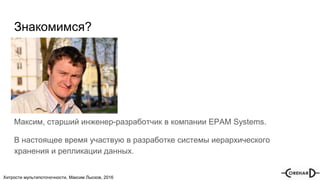
Максим, старший инженер-разработчик в компании EPAM Systems.
В настоящее время участвую в разработке системы иерархического
хранения и репликации данных.
Хитрости мультипоточочности, Максим Лысков, 2016
Хитрость №1
Начиная с С++11, у нас есть
механизм параллельного
выполнения задач
Хитрости мультипоточочности, Максим Лысков, 2016
Хитрость №2
std::packaged_task<T(U ...Args)>
● Содержит в себе callable объект
● Может быть вызвана асинхронно
● Можно получить результат через
std::future
Хитрости мультипоточочности, Максим Лысков, 2016
std::packaged_task<int(int,int)> task([](int a, int b) {
return a * b;
});
std::future<int> result = task.get_future();
// any other code
task(2, 9);
std::cout << "task result: " << result.get() << 'n';
Хитрости мультипоточочности, Максим Лысков, 2016
Методы std::packaged_task
● valid()
● get_future() // must be called once
● operator()(Args … args) // execute and fill the future
● make_ready_at_thread_exit(Args … args) // execute
and fill on thread exit
● reset() // clear previous call result, necessary to
get_future again
● swap()
Хитрости мультипоточочности, Максим Лысков, 2016
Хитрость №3
std::future std::async(F, Args … args)
std::future std::async(policy, F, Args … args)
Policy может быть:
● deferred - отложенное выполнение
● async - выполнение в новом потоке
Хитрости мультипоточочности, Максим Лысков, 2016
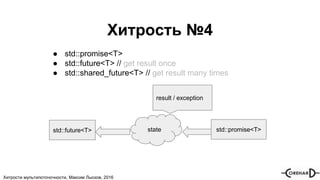
Хитрость №4
● std::promise<T>
● std::future<T> // get result once
● std::shared_future<T> // get result many times
std::future<T> std::promise<T>state
result / exception
Хитрости мультипоточочности, Максим Лысков, 2016
Методы std::promise<T>
● get_future
● set_value
● set_value_at_thread_exit
● set_exception // std::current_exception
● set_exception_at_thread_exit
Хитрости мультипоточочности, Максим Лысков, 2016
Методы std::future<T>
● share() // create shared_future
● get() // result or exception
● valid()
● wait() // blocks until result is ready
● wait_for() / wait_until() // deferred/ready/timeout
Хитрости мультипоточочности, Максим Лысков, 2016
Хитрость №5
std::thread(F, Args … args)
Методы:
● detach()
● join()
● joinable()
● get_id()
● hardware_concurrency()
● native_handle()
Хитрости мультипоточочности, Максим Лысков, 2016
Утилиты текущего потока
● std::this_thread::get_id
● std::this_thread::yield
● std::this_thread::sleep_for / sleep_until
Хитрости мультипоточочности, Максим Лысков, 2016
Do and dont
● Не вызывать join() для !joinable()
потоков
● Не забывать вызывать join() перед
деструктором, если joinable()
Хитрости мультипоточочности, Максим Лысков, 2016
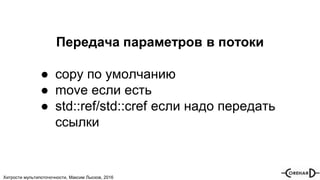
Передача параметров в потоки
● сopy по умолчанию
● move если есть
● std::ref/std::cref если надо передать
ссылки
Хитрости мультипоточочности, Максим Лысков, 2016
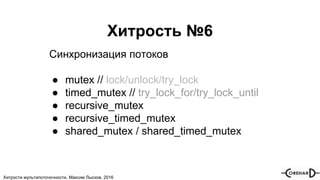
Хитрость №6
Синхронизация потоков
● mutex // lock/unlock/try_lock
● timed_mutex // try_lock_for/try_lock_until
● recursive_mutex
● recursive_timed_mutex
● shared_mutex / shared_timed_mutex
Хитрости мультипоточочности, Максим Лысков, 2016
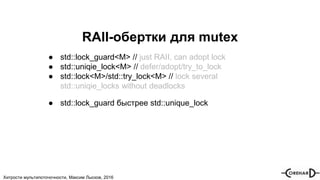
RAII-обертки для mutex
● std::lock_guard<M> // just RAII, can adopt lock
● std::uniqie_lock<M> // defer/adopt/try_to_lock
● std::lock<M>/std::try_lock<M> // lock several
std::uniqie_locks without deadlocks
● std::lock_guard быстрее std::unique_lock
Хитрости мультипоточочности, Максим Лысков, 2016
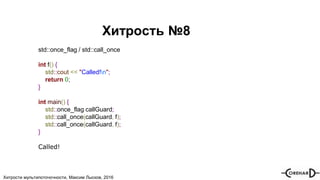
Хитрость №8
std::once_flag / std::call_once
int f() {
std::cout << "Called!n";
return 0;
}
int main() {
std::once_flag callGuard;
std::call_once(callGuard, f);
}
Called!
Хитрости мультипоточочности, Максим Лысков, 2016
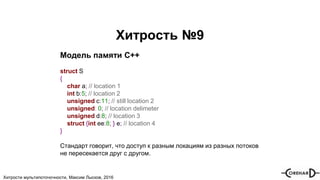
Хитрость №9
Модель памяти С++
struct S
{
char a; // location 1
int b:5; // location 2
unsigned c:11; // still location 2
unsigned: 0; // location delimeter
unsigned d:8; // location 3
struct {int ee:8; } e; // location 4
}
Стандарт говорит, что доступ к разным локациям из разных потоков
не пересекается друг с другом.
Хитрости мультипоточочности, Максим Лысков, 2016
Хитрость №10*
Memory order в С++
enum memory_order {
memory_order_relaxed,
memory_order_consume,
memory_order_acquire,
memory_order_release,
memory_order_acq_rel,
memory_order_seq_cst
};
Хитрости мультипоточочности, Максим Лысков, 2016
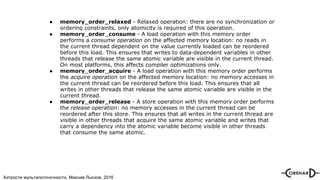
● memory_order_relaxed - Relaxed operation: there are no synchronization or
ordering constraints, only atomicity is required of this operation.
● memory_order_consume - A load operation with this memory order
performs a consume operation on the affected memory location: no reads in
the current thread dependent on the value currently loaded can be reordered
before this load. This ensures that writes to data-dependent variables in other
threads that release the same atomic variable are visible in the current thread.
On most platforms, this affects compiler optimizations only.
● memory_order_acquire - A load operation with this memory order performs
the acquire operation on the affected memory location: no memory accesses in
the current thread can be reordered before this load. This ensures that all
writes in other threads that release the same atomic variable are visible in the
current thread.
● memory_order_release - A store operation with this memory order performs
the release operation: no memory accesses in the current thread can be
reordered after this store. This ensures that all writes in the current thread are
visible in other threads that acquire the same atomic variable and writes that
carry a dependency into the atomic variable become visible in other threads
that consume the same atomic.
Хитрости мультипоточочности, Максим Лысков, 2016
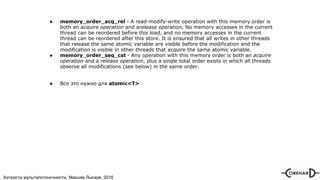
● memory_order_acq_rel - A read-modify-write operation with this memory order is
both an acquire operation and arelease operation. No memory accesses in the current
thread can be reordered before this load, and no memory accesses in the current
thread can be reordered after this store. It is ensured that all writes in other threads
that release the same atomic variable are visible before the modification and the
modification is visible in other threads that acquire the same atomic variable.
● memory_order_seq_cst - Any operation with this memory order is both an acquire
operation and a release operation, plus a single total order exists in which all threads
observe all modifications (see below) in the same order.
● Все это нужно для atomic<T>
Хитрости мультипоточочности, Максим Лысков, 2016
Валидное выражение в С++
[](){}()
Хитрости мультипоточочности, Максим Лысков, 2016
?
Хитрости мультипоточочности, Максим Лысков, 2016
Спасибо!

Хитрости мультипоточности

  • 1.
    Хитрости мультипоточочности, МаксимЛысков, 2016 Хитрости мультипоточности Максим Лысков Минск, 2016
  • 2.
    Хитрости мультипоточочности, МаксимЛысков, 2016 Знакомимся? Максим, старший инженер-разработчик в компании EPAM Systems. В настоящее время участвую в разработке системы иерархического хранения и репликации данных.
  • 3.
    Хитрости мультипоточочности, МаксимЛысков, 2016 Хитрость №1 Начиная с С++11, у нас есть механизм параллельного выполнения задач
  • 4.
    Хитрости мультипоточочности, МаксимЛысков, 2016 Хитрость №2 std::packaged_task<T(U ...Args)> ● Содержит в себе callable объект ● Может быть вызвана асинхронно ● Можно получить результат через std::future
  • 5.
    Хитрости мультипоточочности, МаксимЛысков, 2016 std::packaged_task<int(int,int)> task([](int a, int b) { return a * b; }); std::future<int> result = task.get_future(); // any other code task(2, 9); std::cout << "task result: " << result.get() << 'n';
  • 6.
    Хитрости мультипоточочности, МаксимЛысков, 2016 Методы std::packaged_task ● valid() ● get_future() // must be called once ● operator()(Args … args) // execute and fill the future ● make_ready_at_thread_exit(Args … args) // execute and fill on thread exit ● reset() // clear previous call result, necessary to get_future again ● swap()
  • 7.
    Хитрости мультипоточочности, МаксимЛысков, 2016 Хитрость №3 std::future std::async(F, Args … args) std::future std::async(policy, F, Args … args) Policy может быть: ● deferred - отложенное выполнение ● async - выполнение в новом потоке
  • 8.
    Хитрости мультипоточочности, МаксимЛысков, 2016 Хитрость №4 ● std::promise<T> ● std::future<T> // get result once ● std::shared_future<T> // get result many times std::future<T> std::promise<T>state result / exception
  • 9.
    Хитрости мультипоточочности, МаксимЛысков, 2016 Методы std::promise<T> ● get_future ● set_value ● set_value_at_thread_exit ● set_exception // std::current_exception ● set_exception_at_thread_exit
  • 10.
    Хитрости мультипоточочности, МаксимЛысков, 2016 Методы std::future<T> ● share() // create shared_future ● get() // result or exception ● valid() ● wait() // blocks until result is ready ● wait_for() / wait_until() // deferred/ready/timeout
  • 11.
    Хитрости мультипоточочности, МаксимЛысков, 2016 Хитрость №5 std::thread(F, Args … args) Методы: ● detach() ● join() ● joinable() ● get_id() ● hardware_concurrency() ● native_handle()
  • 12.
    Хитрости мультипоточочности, МаксимЛысков, 2016 Утилиты текущего потока ● std::this_thread::get_id ● std::this_thread::yield ● std::this_thread::sleep_for / sleep_until
  • 13.
    Хитрости мультипоточочности, МаксимЛысков, 2016 Do and dont ● Не вызывать join() для !joinable() потоков ● Не забывать вызывать join() перед деструктором, если joinable()
  • 14.
    Хитрости мультипоточочности, МаксимЛысков, 2016 Передача параметров в потоки ● сopy по умолчанию ● move если есть ● std::ref/std::cref если надо передать ссылки
  • 15.
    Хитрости мультипоточочности, МаксимЛысков, 2016 Хитрость №6 Синхронизация потоков ● mutex // lock/unlock/try_lock ● timed_mutex // try_lock_for/try_lock_until ● recursive_mutex ● recursive_timed_mutex ● shared_mutex / shared_timed_mutex
  • 16.
    Хитрости мультипоточочности, МаксимЛысков, 2016 RAII-обертки для mutex ● std::lock_guard<M> // just RAII, can adopt lock ● std::uniqie_lock<M> // defer/adopt/try_to_lock ● std::lock<M>/std::try_lock<M> // lock several std::uniqie_locks without deadlocks ● std::lock_guard быстрее std::unique_lock
  • 17.
    Хитрости мультипоточочности, МаксимЛысков, 2016 Хитрость №8 std::once_flag / std::call_once int f() { std::cout << "Called!n"; return 0; } int main() { std::once_flag callGuard; std::call_once(callGuard, f); std::call_once(callGuard, f); } Called!
  • 18.
    Хитрости мультипоточочности, МаксимЛысков, 2016 Хитрость №9 Модель памяти С++ struct S { char a; // location 1 int b:5; // location 2 unsigned c:11; // still location 2 unsigned: 0; // location delimeter unsigned d:8; // location 3 struct {int ee:8; } e; // location 4 } Стандарт говорит, что доступ к разным локациям из разных потоков не пересекается друг с другом.
  • 19.
    Хитрости мультипоточочности, МаксимЛысков, 2016 Хитрость №10* Memory order в С++ enum memory_order { memory_order_relaxed, memory_order_consume, memory_order_acquire, memory_order_release, memory_order_acq_rel, memory_order_seq_cst };
  • 20.
    Хитрости мультипоточочности, МаксимЛысков, 2016 ● memory_order_relaxed - Relaxed operation: there are no synchronization or ordering constraints, only atomicity is required of this operation. ● memory_order_consume - A load operation with this memory order performs a consume operation on the affected memory location: no reads in the current thread dependent on the value currently loaded can be reordered before this load. This ensures that writes to data-dependent variables in other threads that release the same atomic variable are visible in the current thread. On most platforms, this affects compiler optimizations only. ● memory_order_acquire - A load operation with this memory order performs the acquire operation on the affected memory location: no memory accesses in the current thread can be reordered before this load. This ensures that all writes in other threads that release the same atomic variable are visible in the current thread. ● memory_order_release - A store operation with this memory order performs the release operation: no memory accesses in the current thread can be reordered after this store. This ensures that all writes in the current thread are visible in other threads that acquire the same atomic variable and writes that carry a dependency into the atomic variable become visible in other threads that consume the same atomic.
  • 21.
    Хитрости мультипоточочности, МаксимЛысков, 2016 ● memory_order_acq_rel - A read-modify-write operation with this memory order is both an acquire operation and arelease operation. No memory accesses in the current thread can be reordered before this load, and no memory accesses in the current thread can be reordered after this store. It is ensured that all writes in other threads that release the same atomic variable are visible before the modification and the modification is visible in other threads that acquire the same atomic variable. ● memory_order_seq_cst - Any operation with this memory order is both an acquire operation and a release operation, plus a single total order exists in which all threads observe all modifications (see below) in the same order. ● Все это нужно для atomic<T>
  • 22.
    Хитрости мультипоточочности, МаксимЛысков, 2016 Валидное выражение в С++ [](){}()
  • 23.
  • 24.