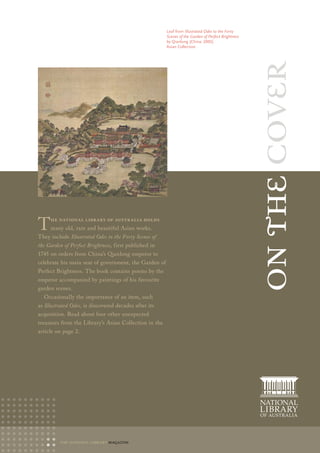
march 2009
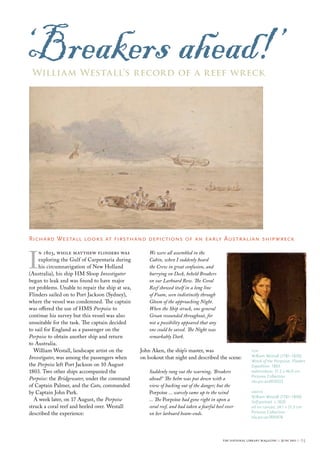
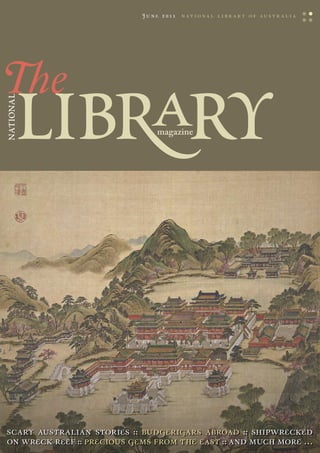
                          June 2011   nat iona l libr a ry of austr a li a


   libRary
naTional


                             magazine
                             magazine


  scary australian stories budgerigars abroad shipwrecked
  on wreck reef precious gems from the east and much more …
treasures
national library of australia                                         treasures gallery a new destination


Nora Heysen (1911–2003) Self portrait c.1932 (detail) oil on canvas 65.5 x 51.5 cm Pictures Collection, nla.pic-vn4179750


The National Library of Australia is building a permanent state-of-the-art                                                  treasures gallery.
You will be able to view some of our finest national treasures — rare hand-drawn maps, rich holdings of personal papers,

manuscripts and oral histories, publications in all forms, from the earliest hand-printed books to archived websites and

pictures ranging from significant colonial paintings to striking photographs.
                                                         To make a donation to the               treasures gallery
                                                         please contact the Development Office on (02) 62621141 or development@nla.gov.au
volume 3 Number 2


june 2011
                                                                                                                     the national library magazine


the aim of the quarterly The National
Library Magazine is to inform the Australian                 co N t eN t s
community about the National library of
Australia’s collections and services, and
its role as the information resource for the
nation. copies are distributed through the
Australian library network to state, public and
community libraries and most libraries within
                                                            Unexpected
tertiary-education institutions. copies are also
made available to the library’s international               Treasures from Asia
associates, and state and federal government
departments and parliamentarians. Additional                Andrew Gosling presents some of the
copies of the magazine may be obtained by
libraries, public institutions and educational              Library’s most precious gems from China,
authorities. Individuals may receive copies by
mail by becoming a member of the Friends of
                                                            Korea and Persia
the National library of Australia.
For further information about becoming a
Friend, contact Friends of the National library


                                                                                  8                                              12
of Australia. tel: (02) 6262 1698;
email: friends@nla.gov.au or go to
www.nla.gov.au/friends/.
For further information about supporting the
library, please contact the Development office,
National library of Australia, canberra Act
2600. tel: (02) 6262 1141;
email: development@nla.gov.au.
to find out more about the library and its
collections and services, go to www.nla.gov.au or                                 A Picture Asks a                               Nature’s Businessman:
phone (02) 6262 1111.                                                             Thousand Questions                             Shrewd or Stoic?
NatioNal library of australia CouNCil                                             marie-louise Ayres wonders                     roslyn russell reassesses
Chair: The Hon. James Spigelman                                                   whether a drawing of a                         John Gould’s reputation for
Deputy Chair: Prof. John Hay                                                      squatter reprisal in 1843 is
Members: Ms Jane Hemstritch,                                                                                                     ruthless ambition
 Ms Mary Kostakidis, Mr Brian Long,                                               an eyewitness account
 Mr Kevin McCann am, Dr Nonja Peters,
 Ms Deborah Thomas, Senator Russell Trood


                                                                                  18                                              22
Director-General and Executive Member:
 Anne-Marie Schwirtlich
seNior exeCutive staff
Director-General: Anne-Marie Schwirtlich
Assistant Directors-General, by Division:
Innovation and Resource Sharing: Warwick Cathro
Collections Management: Pam Gatenby
Australian Collections and Reader Services:
  Margy Burn
Information Technology: Mark Corbould                                             The Flight of the                              Australian Ghost
Public Programs and Executive Support:
                                                                                  Budgerigar                                     Stories
  Jasmine Cameron
Corporate Services: Gerry Linehan                                                 Penny olsen takes a look                       James Doig looks for
editorial/produCtioN                                                              at the humble budgie and                       Australian supernatural
Commissioning Editor: Susan Hall                                                  uncovers the world’s most                      fiction authors and
Editor: Tina Mattei                                                               successfully marketed pet                      unearths their curious lives
Photographers: Sam Cooper, Craig Mackenzie


                                                                                  25
  and Greg Power


                                                                                                                                  28
Picture Researcher: Felicity Harmey
Designer: Kathryn Wright
Printed by Blue Star Print, Canberra
© 2011 National Library of Australia and
individual contributors
ISSN 1836-6147
PP237008/00012
Send magazine submission queries or
proposals to: shall@nla.gov.au
unless otherwise acknowledged, the photographs                                    ‘Breakers ahead!’                              Knowing the Past:
in this magazine were taken by Digitisation and
                                                                                  William Westall’s Record                       Interviews with
Photography, National library of Australia. the views
expressed in The National Library Magazine are those                              of a Reef Wreck                                Australian Historians
of the individual contributors and do not necessarily
                                                                                  richard Westall looks at                       susan marsden delves
reflect the views of the editors or the publisher. every
                                                                                  firsthand depictions of an early               into the lives of recent
reasonable effort has been made to contact relevant
copyright holders for illustrative material in this
                                                                                  Australian shipwreck                           Australian historians
magazine. Where this has not proved possible, the
copyright holders are invited to contact the publisher.


                                                           regulars    collections feature An Enduring Gift   16
                                                            friends   31     support us   32
2::
Unexpected
Treasures
O
          ccasionally, the significance
          of items in the National Library of
          Australia’s collection is unrealised
                                                   Andrew Gosling presents some of the Library’s
                                                   most precious gems from China, Korea and Persia


                                                                                          from AsiA

                                                   devoted the rest of his life to translating them.
                                                   While the name Xuanzang may be unfamiliar
                                                   to most Australians, he is known here and
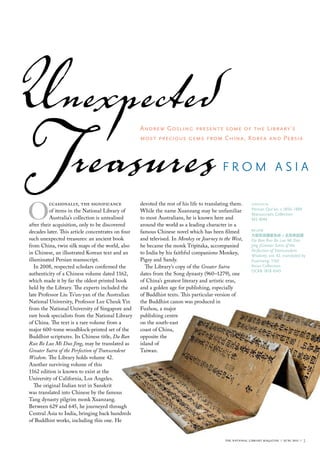
                                                                                                          opposite
                                                                                                          Persian Qur’an, c.1850–1899
                                                                                                          manuscripts collection
                                                                                                          ms 4949
after their acquisition, only to be discovered     around the world as a leading character in a
decades later. This article concentrates on four   famous Chinese novel which has been filmed             below
                                                                                                          大般若波羅蜜多經 / 玄奘奉詔譯
such unexpected treasures: an ancient book         and televised. In Monkey or Journey to the West,       Da Ban Ruo Bo Luo Mi Duo
from China, twin silk maps of the world, also      he became the monk Tripitaka, accompanied              Jing (Greater Sutra of the
                                                                                                          Perfection of Transcendent
in Chinese, an illustrated Korean text and an      to India by his faithful companions Monkey,            Wisdom), vol. 42, translated by
illuminated Persian manuscript.                    Pigsy and Sandy.                                       Xuanzang, 1162
   In 2008, respected scholars confirmed the          The Library’s copy of the Greater Sutra             Asian collection
                                                                                                          ocrb 1818 4343
authenticity of a Chinese volume dated 1162,       dates from the Song dynasty (960–1279), one
which made it by far the oldest printed book       of China’s greatest literary and artistic eras,
held by the Library. The experts included the      and a golden age for publishing, especially
late Professor Liu Ts’un-yan of the Australian     of Buddhist texts. This particular version of
National University, Professor Lee Cheuk Yin       the Buddhist canon was produced in
from the National University of Singapore and      Fuzhou, a major
rare book specialists from the National Library    publishing centre
of China. The text is a rare volume from a         on the south-east
major 600-tome woodblock-printed set of the        coast of China,
Buddhist scriptures. Its Chinese title, Da Ban     opposite the
Ruo Bo Luo Mi Duo Jing, may be translated as       island of
Greater Sutra of the Perfection of Transcendent    Taiwan.
Wisdom. The Library holds volume 42.
Another surviving volume of this
1162 edition is known to exist at the
University of California, Los Angeles.
   The original Indian text in Sanskrit
was translated into Chinese by the famous
Tang dynasty pilgrim monk Xuanzang.
Between 629 and 645, he journeyed through
Central Asia to India, bringing back hundreds
of Buddhist works, including this one. He


                                                                                           the national library magazine :: june 2011 ::   3
Fang spent most of his adult life in the United
                                                                                       States, but worked in Canberra as Curator
                                                                                       of the Oriental Collection at the Australian
                                                                                       National University from 1961 to 1963.
                                                                                          In 1921 the Australian architect, artist and
                                                                                       writer William Hardy Wilson (1881–1955)
                                                                                       spent several months in China, where he
                                                                                       took photographs, produced sketches of
                                                                                       traditional buildings and sought bargains
                                                                                       from antique dealers. He visited Beijing,
                                                                                       Hangzhou, Guangzhou (Canton) and
                                                                                       Macao. His purchases included a twin-scroll
                                                                                       map representing the eastern and western
                                                                                       hemispheres. Each was about 1.6 metres
                                                                                       in diameter and produced by woodblock
                                                                                       printing on silk. They were badly cracked
                                                                                       and dirty, with silk panels peeling from
                                                                                       their paper backing. Wilson presented them
                                                                                       to the Library in 1949. The gift was clearly
                                                                                       significant, although at the time neither he
                                                                                       nor the Library realised its true value. In
                                                                                       1970 the Library sent the scrolls to Japan,
                                                                                       where Shinkichi Endo, a renowned restorer of
                                                                                       national treasures, spent several years carefully
                                                                                       lifting thousands of tiny silk fragments from
                                                                                       the original paper backing and remounting
                                                                                       them on new stiffened silk panels. His efforts
                                                                                       are thought to have extended the map’s life by
                                                                                       about 400 years.
                                                                                          Meanwhile, experts from the Australian
                                                                                       National University and overseas confirmed
                                                                                       that it was a rare 1674 world map created
                                                                                       in China by the Flemish Jesuit Ferdinand
                                                                                       Verbiest (1623–1688). This brilliant
                                                                                       astronomer, mathematician and inventor
                                                                                       spent 30 years in China. He rose to become a
                                                                                       high official and close adviser to the Kangxi
                                                                                       emperor, who ruled from 1661 to 1722. This
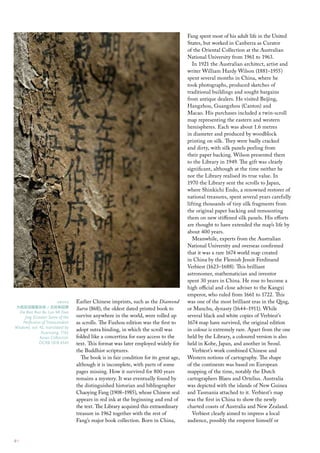
                        above     Earlier Chinese imprints, such as the Diamond        was one of the most brilliant eras in the Qing,
 大般若波羅蜜多經 / 玄奘奉詔譯                 Sutra (868), the oldest dated printed book to        or Manchu, dynasty (1644–1911). While
  Da Ban Ruo Bo Luo Mi Duo
     Jing (Greater Sutra of the   survive anywhere in the world, were rolled up        several black and white copies of Verbiest’s
    Perfection of Transcendent    as scrolls. The Fuzhou edition was the first to      1674 map have survived, the original edition
Wisdom), vol. 42, translated by
               Xuanzang, 1162
                                  adopt sutra binding, in which the scroll was         in colour is extremely rare. Apart from the one
              Asian collection    folded like a concertina for easy access to the      held by the Library, a coloured version is also
              ocrb 1818 4343      text. This format was later employed widely for      held in Kobe, Japan, and another in Seoul.
                                  the Buddhist scriptures.                                Verbiest’s work combined Chinese and
                                    The book is in fair condition for its great age,   Western notions of cartography. The shape
                                  although it is incomplete, with parts of some        of the continents was based on European
                                  pages missing. How it survived for 800 years         mapping of the time, notably the Dutch
                                  remains a mystery. It was eventually found by        cartographers Blaeu and Ortelius. Australia
                                  the distinguished historian and bibliographer        was depicted with the islands of New Guinea
                                  Chaoying Fang (1908–1985), whose Chinese seal        and Tasmania attached to it. Verbiest’s map
                                  appears in red ink at the beginning and end of       was the first in China to show the newly
                                  the text. The Library acquired this extraordinary    charted coasts of Australia and New Zealand.
                                  treasure in 1962 together with the rest of              Verbiest clearly aimed to impress a local
                                  Fang’s major book collection. Born in China,         audience, possibly the emperor himself or


4::
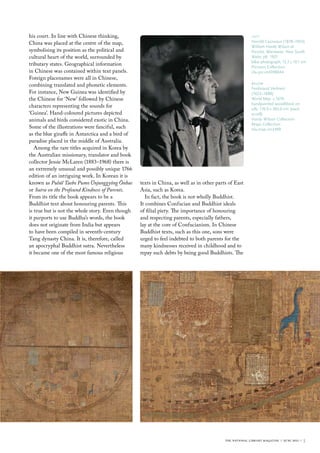
his court. In line with Chinese thinking,                                                                left
China was placed at the centre of the map,                                                               Harold cazneaux (1878–1953)
                                                                                                         William Hardy Wilson at
symbolising its position as the political and                                                            Purulia, Warrawee, New South
cultural heart of the world, surrounded by                                                               Wales (4) 1921
                                                                                                         b&w photograph; 12.7 x 10.1 cm
tributary states. Geographical information                                                               Pictures collection
in Chinese was contained within text panels.                                                             nla.pic-vn4398044
Foreign placenames were all in Chinese,
combining translated and phonetic elements.                                                              below
                                                                                                         Ferdinand verbiest
For instance, New Guinea was identified by                                                               (1623–1688)
the Chinese for ‘New’ followed by Chinese                                                                World Map c.1674
                                                                                                         handpainted woodblock on
characters representing the sounds for                                                                   silk; 176.0 x 263.0 cm (each
‘Guinea’. Hand-coloured pictures depicted                                                                scroll)
animals and birds considered exotic in China.                                                            Hardy Wilson collection
                                                                                                         maps collection
Some of the illustrations were fanciful, such                                                            nla.map-rm3499
as the blue giraffe in Antarctica and a bird of
paradise placed in the middle of Australia.
   Among the rare titles acquired in Korea by
the Australian missionary, translator and book
collector Jessie McLaren (1883–1968) there is
an extremely unusual and possibly unique 1766
edition of an intriguing work. In Korean it is
                              ˘        ˘ ˘
known as Puls˘ Taebo Pumo Unjunggyong Onhae
                ol                                texts in China, as well as in other parts of East
or Sutra on the Profound Kindness of Parents.     Asia, such as Korea.
From its title the book appears to be a              In fact, the book is not wholly Buddhist.
Buddhist text about honouring parents. This       It combines Confucian and Buddhist ideals
is true but is not the whole story. Even though   of filial piety. The importance of honouring
it purports to use Buddha’s words, the book       and respecting parents, especially fathers,
does not originate from India but appears         lay at the core of Confucianism. In Chinese
to have been compiled in seventh-century          Buddhist texts, such as this one, sons were
Tang dynasty China. It is, therefore, called      urged to feel indebted to both parents for the
an apocryphal Buddhist sutra. Nevertheless        many kindnesses received in childhood and to
it became one of the most famous religious        repay such debts by being good Buddhists. The


                                                                                          the national library magazine :: june 2011 ::   5
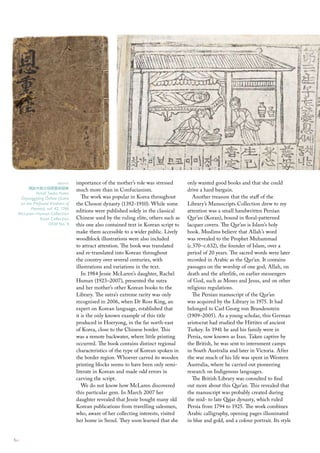
above     importance of the mother’s role was stressed       only wanted good books and that she could
       彿說大報父母恩重經諺解                much more than in Confucianism.                    drive a hard bargain.
           Puls˘ l Taebo Pumo
               o
   ˘        o ˘
   Unjunggy˘ ng Onhae (Sutra         The work was popular in Korea throughout           Another treasure that the staff of the
   on the Profound Kindness of    the Choson dynasty (1392–1910). While some         Library’s Manuscripts Collection drew to my
        Parents), vol. 42, 1766
  mclaren–Human collection
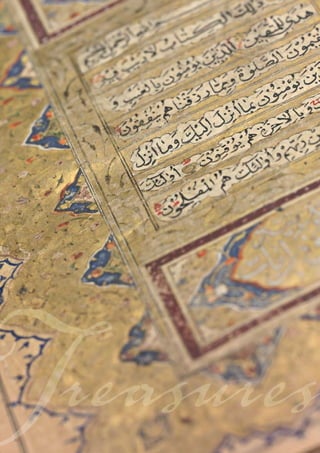
                                  editions were published solely in the classical    attention was a small handwritten Persian
              Asian collection    Chinese used by the ruling elite, others such as   Qur’an (Koran), bound in floral-patterned
                    oKm No. 9     this one also contained text in Korean script to   lacquer covers. The Qur’an is Islam’s holy
                                  make them accessible to a wider public. Lively     book. Muslims believe that Allah’s word
                                  woodblock illustrations were also included         was revealed to the Prophet Muhammad
                                  to attract attention. The book was translated      (c.570–c.632), the founder of Islam, over a
                                  and re-translated into Korean throughout           period of 20 years. The sacred words were later
                                  the country over several centuries, with           recorded in Arabic as the Qur’an. It contains
                                  illustrations and variations in the text.          passages on the worship of one god, Allah, on
                                     In 1984 Jessie McLaren’s daughter, Rachel       death and the afterlife, on earlier messengers
                                  Human (1923–2007), presented the sutra             of God, such as Moses and Jesus, and on other
                                  and her mother’s other Korean books to the         religious regulations.
                                  Library. The sutra’s extreme rarity was only          The Persian manuscript of the Qur’an
                                  recognised in 2006, when Dr Ross King, an          was acquired by the Library in 1975. It had
                                  expert on Korean language, established that        belonged to Carl Georg von Brandenstein
                                  it is the only known example of this title         (1909–2005). As a young scholar, this German
                                  produced in Hoeryong, in the far north-east        aristocrat had studied the Hittites of ancient
                                  of Korea, close to the Chinese border. This        Turkey. In 1941 he and his family were in
                                  was a remote backwater, where little printing      Persia, now known as Iran. Taken captive by
                                  occurred. The book contains distinct regional      the British, he was sent to internment camps
                                  characteristics of the type of Korean spoken in    in South Australia and later in Victoria. After
                                  the border region. Whoever carved its wooden       the war much of his life was spent in Western
                                  printing blocks seems to have been only semi-      Australia, where he carried out pioneering
                                  literate in Korean and made odd errors in          research on Indigenous languages.
                                  carving the script.                                   The British Library was consulted to find
                                     We do not know how McLaren discovered           out more about this Qur’an. This revealed that
                                  this particular gem. In March 2007 her             the manuscript was probably created during
                                  daughter revealed that Jessie bought many old      the mid- to late Qajar dynasty, which ruled
                                  Korean publications from travelling salesmen,      Persia from 1794 to 1925. The work combines
                                  who, aware of her collecting interests, visited    Arabic calligraphy, opening pages illuminated
                                  her home in Seoul. They soon learned that she      in blue and gold, and a colour portrait. Its style


6::
is thought to have been influenced by fine
examples of Ottoman Turkish calligraphy.
As is generally the case with such works,
the writer’s name is unknown. The
manuscript contains the complete Qur’an
in Arabic. On the final page there is a
prayer for piety, health and wellbeing.
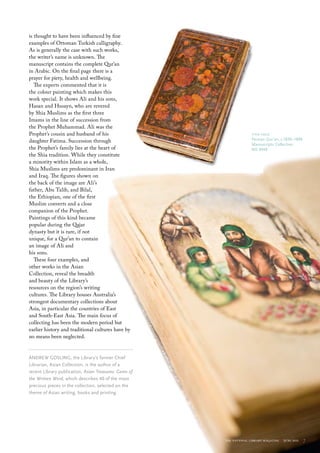
   The experts commented that it is
the colour painting which makes this
work special. It shows Ali and his sons,
Hasan and Husayn, who are revered
by Shia Muslims as the first three
Imams in the line of succession from
the Prophet Muhammad. Ali was the
Prophet’s cousin and husband of his                                   this page
daughter Fatima. Succession through                                   Persian Qur’an, c.1850–1899
                                                                      manuscripts collection
the Prophet’s family lies at the heart of                             ms 4949
the Shia tradition. While they constitute
a minority within Islam as a whole,
Shia Muslims are predominant in Iran
and Iraq. The figures shown on
the back of the image are Ali’s
father, Abu Talib, and Bilal,
the Ethiopian, one of the first
Muslim converts and a close
companion of the Prophet.
Paintings of this kind became
popular during the Qajar
dynasty but it is rare, if not
unique, for a Qur’an to contain
an image of Ali and
his sons.
   These four examples, and
other works in the Asian
Collection, reveal the breadth
and beauty of the Library’s
resources on the region’s writing
cultures. The Library houses Australia’s
strongest documentary collections about
Asia, in particular the countries of East
and South-East Asia. The main focus of
collecting has been the modern period but
earlier history and traditional cultures have by
no means been neglected.


ANDreW GoslING, the library’s former chief
librarian, Asian collection, is the author of a
recent library publication, Asian Treasures: Gems of
the Written Word, which describes 40 of the most
precious pieces in the collection, selected on the
theme of Asian writing, books and printing


                                                       the national library magazine :: june 2011 ::   7
A Picture Asks a Thousand Questions
                                      Marie-Louise Ayres wonders whether a drawing of a squatter
                                      reprisal in 1843 is an eyewitness account


                                      I
                    background             f a picture tells a thousand words,            early life but can assume it was comfortable.
   thomas John Domville taylor             then it can also raise a thousand questions.   He probably grew up in the ancestral home,
                    (c.1817–1889)
The Blacks who Robbed the Drays            And when the picture in question has           Lymm Hall in Lymm, Cheshire, built by the
 on the Main Range of Mountains       been tucked away inside an innocent looking         Domvilles in the early seventeenth century at
                    (detail) 1843
           pencil; 10.5 x 29.2 cm
                                      nineteenth-century woman’s scrapbook, the           the centre of a wealthy estate.
             Pictures collection      gap between what we know and what we can               We do not know exactly when Domville
              nla.pic-vn4970952       only surmise is tantalising indeed.                 Taylor came to Australia or why. By the early
                             below      In October 2010, the National Library of          1840s, when he would have been in his early
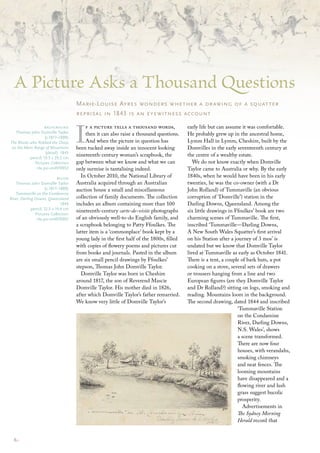
    thomas John Domville taylor       Australia acquired through an Australian            twenties, he was the co-owner (with a Dr
                      (c.1817–1889)   auction house a small and miscellaneous             John Rolland) of Tummaville (an obvious
   Tummaville on the Condamine
River, Darling Downs, Queensland      collection of family documents. The collection      corruption of ‘Domville’) station in the
                               1844   includes an album containing more than 100          Darling Downs, Queensland. Among the
             pencil; 12.5 x 19.4 cm
                                      nineteenth-century carte-de-visite photographs      six little drawings in Ffoulkes’ book are two
               Pictures collection
                nla.pic-vn4970907     of an obviously well-to-do English family, and      charming scenes of Tummaville. The first,
                                      a scrapbook belonging to Patty Ffoulkes. The        inscribed ‘Tummaville—Darling Downs,
                                      latter item is a ‘commonplace’ book kept by a       A New South Wales Squatter’s first arrival
                                      young lady in the first half of the 1800s, filled   on his Station after a journey of 3 mos’ is
                                      with copies of flowery poems and pictures cut       undated but we know that Domville Taylor
                                      from books and journals. Pasted in the album        lived at Tummaville as early as October 1841.
                                      are six small pencil drawings by Ffoulkes’          There is a tent, a couple of bark huts, a pot
                                      stepson, Thomas John Domville Taylor.               cooking on a stove, several sets of drawers
                                        Domville Taylor was born in Cheshire              or trousers hanging from a line and two
                                      around 1817, the son of Reverend Mascie             European figures (are they Domville Taylor
                                      Domville Taylor. His mother died in 1826,           and Dr Rolland?) sitting on logs, smoking and
                                      after which Domville Taylor’s father remarried.     reading. Mountains loom in the background.
                                      We know very little of Domville Taylor’s            The second drawing, dated 1844 and inscribed
                                                                                                                  ‘Tummaville Station
                                                                                                                  on the Condamine
                                                                                                                  River, Darling Downs,
                                                                                                                  N.S. Wales’, shows
                                                                                                                  a scene transformed.
                                                                                                                  There are now four
                                                                                                                  houses, with verandahs,
                                                                                                                  smoking chimneys
                                                                                                                  and neat fences. The
                                                                                                                  looming mountains
                                                                                                                  have disappeared and a
                                                                                                                  flowing river and lush
                                                                                                                  grass suggest bucolic
                                                                                                                  prosperity.
                                                                                                                     Advertisements in
                                                                                                                  The Sydney Morning
                                                                                                                  Herald record that


  8::
Domville Taylor and Rolland dissolved their         have estimated that several hundred
business partnership in September 1844.             Aboriginal people may have died
Domville Taylor stayed in the Downs for             in the region during the 1840s to
at least another year. He departed from the         1860s.
nearby Jimbour Station in August 1845,                 From late 1842, The Sydney
returning there in late September with a party      Morning Herald regularly reports
searching for the doomed explorer Ludwig            on how ‘troublesome’ the ‘blacks’
Leichhardt. Domville Taylor’s journal of the        on the Downs are and how unsafe
trip, including a sketch map of the party’s         it is to travel unless in company
route and descriptions of encounters with           and well armed. By August 1843,
Indigenous people, is held in private hands but     the Herald ’s correspondent reports
was microfilmed by the State Library of New         that another white shepherd has
South Wales’ Mitchell Library in the 1970s.         been murdered and that ‘the whole
   It seems likely that Domville Taylor             of the settlers on the Downs are
returned to Britain shortly after the death of      in a complete state of excitement,
his father in 1845. We know little about his        compelled to keep their servants
life after his return, except that it seems to      constantly armed and on the alert
have been prosperous. He died in Brighton           for fear of an attack, so daring
in September 1889, leaving a considerable           have the blacks become’.
personal estate of just over £19 000. His name         That ‘state of excitement’ reflects a systematic     above
remains inscribed on the Australian landscape.      attempt to harry the white settlers of the              southwell brothers,
                                                                                                            Photographers royal
The small town of Tummaville is built on the        Downs by more than 100 Barunggahm,                      Portrait of Thomas Domville
site of his original station, on the banks of the   Jarowair, Giabal and Keinjan men who banded             Taylor 1862
                                                                                                            carte-de-visite mount; 8.5 x 5.5 cm
Condamine River. Mount Domville, named              together under the leadership of Multuggerah.           Pictures collection
by C.P. Hodgson, the leader of the Leichhardt       In effect, the group declared war on the                nla.pic-vn4982302
search party, is 50 kilometres south-west of        Europeans, using intermediary ‘Tinker’
                                                                                                            below
the town.                                           Campbell to deliver a warning that they                 ‘News from the Interior—
   Domville Taylor arrived in the Downs at          planned to attack stations and supply routes,           moreton bay’, The Sydney
a critical moment in the history of European        harassing several settled properties in the             Morning Herald, 6 July 1843
                                                                                                            Newspapers and microforms
and Aboriginal contact. Allan Cunningham            middle months of 1843. By August, they had              collection
reached the Downs in 1827, the first European       developed a strategic and logical plan to block
to do so, and most historians agree that            the main supply route from Moreton
local Aboriginal people did not immediately         Bay to the Downs. By blocking
perceive the small number of white visitors         supply, they believed, they could force
as a major threat. However, European                the white settlers to quit the area.
settlement began in earnest in 1840 and, by            Multuggerah’s plan was initially
1841, when Domville Taylor was certainly in         successful. On 12 September, his men
residence at Tummaville, the area’s original        ambushed three drays, attended by 18
inhabitants found that their access to food         men, on the only road from Moreton
and water was severely affected by pastoral         Bay to the Downs. At the ambush
activity. From 1842 to 1843, tension built          site on the Helidon Run (some
between Aboriginal people and European              20 kilometres east of the modern
settlers. Aboriginal attacks on white settlers      Toowoomba, then named ‘Drayton’,
increased, with around two dozen white              and 100 kilometres north-east of
deaths, including the murder of an infant girl,     Tummaville), the road was barely
recorded by the press and in personal accounts.     wide enough for bullocks and drays
There are no press records of Aboriginal            to pass. Confronted by a determined
deaths but, consulting diaries and letters,         and organised group of Multuggerah’s
specialist historians of the Darling Downs          warriors, the Europeans retreated to


                                                                                             the national library magazine :: june 2011 ::   9
above   find that the Commissioner for Crown Lands,       of Foot reached the area. We cannot be sure
   thomas John Domville taylor      Dr Stephen Simpson, his police and a group        whether Domville Taylor witnessed the attack,
                    (c.1817–1889)
The Blacks who Robbed the Drays     of some 20 squatters had gathered nearby to       participated in it or drew the scene after hearing
 on the Main Range of Mountains     discuss their response to the repeated attacks    of it from other squatters. There are, however,
                    (detail) 1843
           pencil; 10.5 x 29.2 cm
                                    on their stations by organised groups of          strong stylistic hints that suggest the immediacy
             Pictures collection    Aboriginal men. This combined party was also      of a ‘there and then’ sketch, and other written
              nla.pic-vn4970952     repulsed by Multuggerah’s group, with serious     records indicate that he was involved in at least
                                    injuries but no deaths among the squatters, in    one other, slightly earlier conflict with a large
                                    what is known as the Battle of One Tree Hill.     group of Aboriginal people.
                                       Following this defeat, Commissioner               In the drawing, 11 European men fire on
                                    Simpson rode to Brisbane to seek assistance,      a group of 25 Aboriginal men, women and
                                    returning on 19 September with a group of         children. Three of the Aboriginal people
                                    12 men from the 99th Regiment of Foot.            appear to have been shot. The drawing has a
                                    The regiment was dispatched to deal with          great sense of immediacy and movement, with
                                    the retreating Aboriginal people, who             guns firing, people running and the unlucky
                                    were eventually cornered in a camp in the         victims of gunshots falling or flying through
                                    Rosewood Scrub on 10 October. At least            the air. Everything is focused on the action.
                                    two of the Aboriginal men, believed to have       There is no sky, scrub is merely sketched in
                                    murdered the young white girl some months         the background and the foreground contains
                                    earlier, were killed.                             nothing but firing squatters, fleeing Aboriginal
                                       The squatters did not leave their protection   people, a humpy and a tree. And yet there
                                    solely in the hands of the regiment. Letters      is fine detail. One man carries two spears,
                                    and diaries from the period suggest that small    another carries a boomerang. To the left of the
                                    parties of squatters independently hunted and     drawing, a mother flees with one baby on her
                                    attacked Aboriginal groups from the time of       back, while a small child runs behind.
                                    ‘One Tree Hill’ to at least the end of 1843.         Close examination shows that most of the
                                    Conflict continued for another decade, albeit     figures have been sketched in from postural
                                    at a lower volume.                                stick figures, with dots indicating the
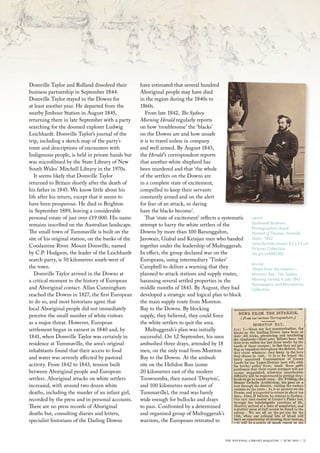
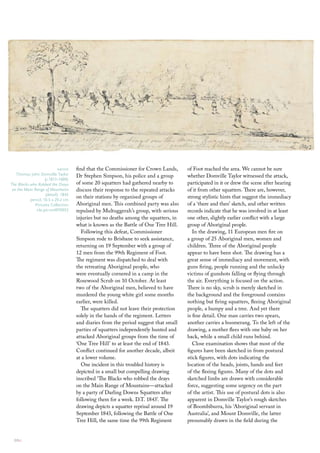
                                       One incident in this troubled history is       location of the heads, joints, hands and feet
                                    depicted in a small but compelling drawing        of the fleeing figures. Many of the dots and
                                    inscribed ‘The Blacks who robbed the drays        sketched limbs are drawn with considerable
                                    on the Main Range of Mountains—attacked           force, suggesting some urgency on the part
                                    by a party of Darling Downs Squatters after       of the artist. This use of postural dots is also
                                    following them for a week. D.T. 1843’. The        apparent in Domville Taylor’s rough sketches
                                    drawing depicts a squatter reprisal around 19     of Boombiburra, his ‘Aboriginal servant in
                                    September 1843, following the Battle of One       Australia’, and Mount Domville, the latter
                                    Tree Hill, the same time the 99th Regiment        presumably drawn in the field during the


 10::
1845 search for Leichhardt. His much more          Aboriginal men of south-west Queensland—
‘finished’ drawing of a night corroboree, which    can be confidently identified as being an
Domville Taylor inscribes as having been           eyewitness account.
‘taken from life’, shows that these postural          The Domville Taylor drawing is distinct
dots were used to indicate the positions of the    from these examples, which all dramatise the
hands, arms and knees of the moving dancers.       moments of tension before guns are fired or
They are still visible despite later shading to    spears are thrown. In Hodgkinson’s work,
convey the impression of firelight flickering      a large group of Aboriginal men advances
on bodies. These stylistic similarities strongly   on a small group of Europeans behind a
suggest that Domville Taylor used postural         palisade, but the battle has not yet begun.
dots and quick lines to sketch ‘from life’.        The other images highlight the sense of threat
They are not apparent in his more complete         to Europeans by showing quite large groups
Tummaville landscapes, presumably drawn at         of Aboriginal warriors armed with spears
some leisure.                                      against smaller groups of white settlers armed
   It is hard to imagine any scenario in which     with guns. The Domville Taylor drawing, by
Domville Taylor heard a tale of such an attack     contrast, depicts the moments after firing has
(or an amalgam of tales) and then proceeded        commenced. While the Aboriginal group of
to draw a visual record of the story. It is        25 is much larger than the European group of
harder still to imagine him including the          11, numbers are no defence against guns.
detail of a mother and children fleeing from          At this stage, with no helpful explanatory
bullets, unless he witnessed the scene himself.    letters or diaries from Domville Taylor, it
Domville Taylor’s documented presence in           is impossible to prove beyond doubt that
the Darling Downs during these troubled            the drawing is a unique eyewitness account
years, his role as a squatter, together with       of a specific event or to know where the
the liveliness, detail and ‘presence’ of the       attack occurred, who was involved or how
drawing strongly suggests that it is indeed an     many finally fell to the gun. Even with these
eyewitness account.                                silences, the drawing speaks with great power
   The issue of whether the drawing is an          and poignancy of the inevitable tragedy of
eyewitness account is important. Only a few        dispossession unfolding across the Downs.
visual images of conflict between Europeans
and Aboriginal people are held in Australian
libraries and only one of these—the Library’s      Dr mArIe-louIse Ayres is the senior curator of
William Oswald Hodgkinson watercolour of           Pictures and manuscripts at the National library
a conflict at ‘Bulla’ between members of the       of Australia
Burke and Wills expedition’s supply party and


                                                                                                         left
                                                                                                         William oswald Hodgkinson
                                                                                                         (1835–1900)
                                                                                                         Bulla, Queensland 1861
                                                                                                         in ‘Album of miss eliza
                                                                                                         younghusband, south Australia,
                                                                                                         1856–1865’
                                                                                                         watercolour; 21.8 x 13.4 cm
                                                                                                         Pictures collection
                                                                                                         nla.pic-vn4189024-s46


                                                                                         the national library magazine :: june 2011 ::   11
Nature’s
BusiNessmaN
Shrewd or Stoic?
       Roslyn Russell reassesses John Gould’s
         reputation for ruthless ambition


                                                J     ohn gould was born in lyme regis,
                                                      Devon, on 14 September 1804, the
                                                      son of a gardener and his wife. From
                                                this humble beginning, he embarked on a
                                                remarkable career in ornithology, and natural
                                                science generally, achieving enduring renown
                                                as the ‘father of Australian ornithology’.
                                                   Gould’s identification of finches from
                                                the Galapagos Islands provided Charles
                                                Darwin with a key to unlocking the mystery
                                                of the origin of species. In 1838 Gould
                                                and his talented wife, Elizabeth, travelled
                                                to the far-flung colony of Van Diemen’s
                                                Land; from there, he and his natural
                                                history collectors travelled around mainland
                                                Australia, several of them paying with their
                                                lives for their commitment to collecting
                                                and exploration. Gould’s artists depicted in
                                                exquisite lithographs, accompanied by Gould’s
                                                expert commentary, the birds (including
                                                the budgerigar, see following article) and
                                                mammals of Australia and of other parts of
                                                the world.
                                                   Gould’s ability as a highly capable
                                                coordinator of the process of producing
                                                ornithological prints and the accompanying
                                                expert commentary, coupled with his
                                                taxidermy business, made him a rich man
                                                and elevated him far above the social setting
                                                into which he was born. The story of his
                                                remarkable life, his practical skills, his driving
                                                energy and shrewd business judgment, his


12::
conspicuous talent for determining and              and undermine his reputation for callous
describing the characteristics of birds and         indifference.
animals, his travels to locate, classify and           That Gould was a driven man, though,
illustrate new species, and his interactions with   is clear. In common with many self-made
those with whom he worked and did business          men, he had scant patience with those who
have been told many times.                          were less focused on achievement. One of
   Yet, John Gould has not always had a good        the first people to complain of Gould’s curt
press. While he has had effective champions,        manner and single-mindedness was Edward
such as Gordon Sauer, who collected and             Lear, one of his earliest illustrators.
published all his correspondence, Ann                  Lear, better known as the author
Datta, who collaborated with Sauer on the           of nonsense verse, was epileptic and
Gould letters and has also written of Gould’s       depressive, the polar opposite of the bluff,
Australian experience, and his own great-           energetic Gould. Born to a bankrupted
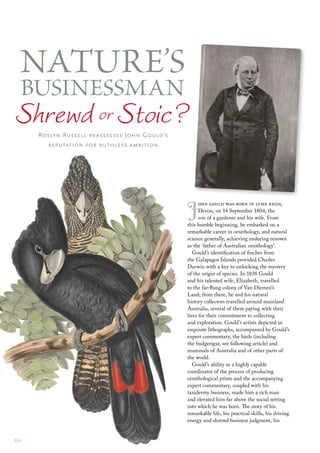
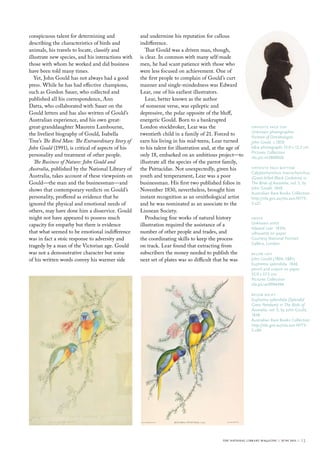
great-granddaughter Maureen Lambourne,              London stockbroker, Lear was the                       opposite page top
                                                                                                           unknown photographer
the liveliest biography of Gould, Isabella          twentieth child in a family of 21. Forced to
                                                                                                           Portrait of Ornithologist
Tree’s The Bird Man: The Extraordinary Story of     earn his living in his mid-teens, Lear turned          John Gould c.1850
John Gould (1991), is critical of aspects of his    to his talent for illustration and, at the age of      b&w photograph; 15.0 x 12.2 cm
                                                                                                           Pictures collection
personality and treatment of other people.          only 18, embarked on an ambitious project—to           nla.pic-vn3800026
   The Business of Nature: John Gould and           illustrate all the species of the parrot family,
Australia, published by the National Library of     the Psittacidae. Not unexpectedly, given his           opposite page bottom
                                                                                                           calyptorhynchus macrorhynchus
Australia, takes account of these viewpoints on     youth and temperament, Lear was a poor                 (Great-billed Black Cockatoo) in
Gould—the man and the businessman—and               businessman. His first two published folios in         The Birds of Australia, vol. 5, by
shows that contemporary verdicts on Gould’s         November 1830, nevertheless, brought him               John Gould, 1848
                                                                                                           Australian rare books collection
personality, proffered as evidence that he          instant recognition as an ornithological artist        http://nla.gov.au/nla.aus-f4773-
ignored the physical and emotional needs of         and he was nominated as an associate to the            5-s21
others, may have done him a disservice. Gould       Linnean Society.
might not have appeared to possess much                Producing fine works of natural history             above
capacity for empathy but there is evidence          illustration required the assistance of a              unknown artist
                                                                                                           Edward Lear 1830s
that what seemed to be emotional indifference       number of other people and trades, and                 silhouette on paper
was in fact a stoic response to adversity and       the coordinating skills to keep the process            courtesy National Portrait
                                                                                                           Gallery, london
tragedy by a man of the Victorian age. Gould        on track. Lear found that extracting from
was not a demonstrative character but some          subscribers the money needed to publish the            below left
of his written words convey his warmer side         next set of plates was so difficult that he was        John Gould (1804–1881)
                                                                                                           euphema splendida 1846
                                                                                                           pencil and crayon on paper
                                                                                                           53.0 x 37.5 cm
                                                                                                           Pictures collection
                                                                                                           nla.pic-an9994496

                                                                                                           below right
                                                                                                           euphema splendida (Splendid
                                                                                                           Grass Parakeet) in The Birds of
                                                                                                           Australia, vol. 5, by John Gould,
                                                                                                           1848
                                                                                                           Australian rare books collection
                                                                                                           http://nla.gov.au/nla.aus-f4773-
                                                                                                           5-s90


                                                                                           the national library magazine :: june 2011 ::   13
forced to find paying       Anyone who has toiled over a letter (or more
                                                                 work elsewhere. In 1831     likely these days, an email) in an attempt to
                                                                 he began to work with       maintain a relationship or to share views with
                                                                 John and Elizabeth          another person and who has received one line
                                                                 Gould on The Birds          in reply, will sympathise with Lear. But Gould
                                                                 of Europe, and taught       was a busy man and not a natural writer
                                                                 Elizabeth the finer         outside his area of specialisation.
                                                                 points of lithographic         Thirty years after he worked with Gould,
                                                                 illustration.               Lear delivered a verdict that clearly stemmed
                                                                    Lear found Gould a       from his disappointment that their relationship
                                                                 relentless taskmaster       had not survived time and distance, and which
                                                                 and, when the               has contributed to Gould’s reputation as an
                                                                 opportunity arose in        unsympathetic character: ‘A more singularly
                                                                 1832 to take another        offensive mannered man than G. hardly can
                                                                 position, he did so.        be: but the queer fellow means well, tho’s more
                                                                 He nevertheless             of an Egotist than can be described’. After
                                                                 finished his quota for      Gould’s death Lear called him
                                                                 The Birds of Europe
                                                                 and, in 1833, agreed            a harsh and violent man … ever the same
                                                                 to work on another              persevering hardworking toiler in his own
                                                                 Gould ornithological            (ornithological) line—but ever as unfeeling
                                                                 publication, contributing       for those about him. In the earliest phase of
                                                                 ten plates to Monograph         his bird drawing he owed everything to his
                                                                 of the Ramphistidae, or         excellent wife, & to myself—without whose
                                                                 Family of Toucans.              help in drawing he had done nothing.
                            above         Lear’s artistic interests then took a different
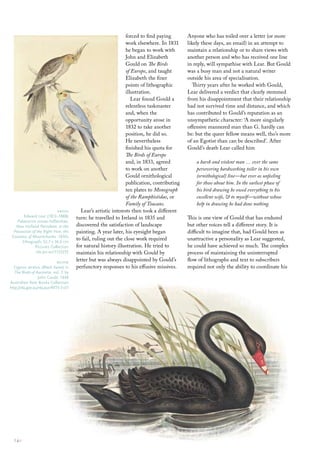
        edward lear (1812–1888)         turn: he travelled to Ireland in 1835 and            This is one view of Gould that has endured
    Palaeornis novae-hollandiae,
   New Holland Parrakeet, in the        discovered the satisfaction of landscape             but other voices tell a different story. It is
  Possession of the Right Hon. the      painting. A year later, his eyesight began           difficult to imagine that, had Gould been as
 Countess of Mountcharles 1830s
       lithograph; 52.7 x 36.6 cm
                                        to fail, ruling out the close work required          unattractive a personality as Lear suggested,
               Pictures collection      for natural history illustration. He tried to        he could have achieved so much. The complex
               nla.pic-an11135255       maintain his relationship with Gould by              process of maintaining the uninterrupted
                              below     letter but was always disappointed by Gould’s        flow of lithographs and text to subscribers
  cygnus atratus (Black Swan) in        perfunctory responses to his effusive missives.      required not only the ability to coordinate his
   The Birds of Australia, vol. 7, by
                  John Gould, 1848
Australian rare books collection
http://nla.gov.au/nla.aus-f4773-7-s17


  14::
business affairs but also to inspire loyalty in     feelings when he asked for a comment
his assistants. He was clearly a man who was        from a subscriber on Elizabeth’s
able to motivate others with his vision, starting   contribution to Part 5 of The
with his wife.                                      Birds of Australia, showing his
  Elizabeth Gould was the next person               keen desire to have her work
that Gould was thought to have treated less         praised: ‘I shall be glad of
than considerately. Born Elizabeth Coxen at         a line saying how you like
Ramsgate in the same year as her husband,           the present part; almost
she was rescued by marriage from the                the last of the work of
isolation and indeterminate social status of a      my Dear and never to be
governess. After she married John Gould in          forgotten partner’.
January 1829, Elizabeth found that, despite            Three years later, when
her married status and frequent childbearing,       Part 15 of The Birds of
she was expected to work, albeit at an              Australia was published,
occupation that did not violate the code of         Gould paid Elizabeth the
gentility—drawing birds on lithographic stone       highest tribute when he
to her husband’s directions, a task to which        named the multicoloured
she brought considerable skill and dedication.      Gouldian Finch after her.
Instead of enduring soul-destroying boredom,        He wrote:
she travelled with her husband to Europe and
to Australia and met with a wide range of               It is therefore with feelings of
people and situations. She and John appeared            no ordinary nature that I have
to the outside world to be ‘soulmates’, as they         ventured to dedicate this new
worked together in their business and raised a          and lovely bird to the memory of
growing family.                                         her, who in addition to being a most
  Gould has been accused of insufficiently              affectionate wife, for a number of years
acknowledging Elizabeth’s contribution to               laboured so hard and so zealously assisted
his early success in ornithological illustration.       me with her pencil in my various works,               above
His restrained comments to correspondents               but who, after having made a circuit of the           tanysiptera sylvia (White-tailed
                                                                                                              Tanysiptera) in The Birds of
after Elizabeth’s untimely death in 1841                globe with me, and braved many dangers                Australia, supplement, by John
have been interpreted as signifying his lack            with a courage only equalled by her virtues,          Gould, 1869
                                                                                                              Australian rare books collection
of emotion. Nevertheless, he did express his            and while cheerfully engaged in illustrating
                                                                                                              http://nla.gov.au/nla.aus-f4773-
                                                        the present work, was by the Divine will              5-s21
                                                        of her Maker suddenly called from this to a
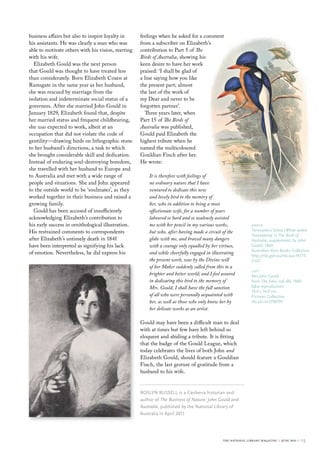
                                                                                                              left
                                                        brighter and better world; and I feel assured         Mrs John Gould
                                                        in dedicating this bird to the memory of              from The Emu, vol. 60, 1960
                                                        Mrs. Gould, I shall have the full sanction            b&w reproduction
                                                                                                              19.4 x 14.0 cm
                                                        of all who were personally acquainted with            Pictures collection
                                                        her, as well as those who only know her by            nla.pic-vn3799791
                                                        her delicate works as an artist.

                                                    Gould may have been a difficult man to deal
                                                    with at times but few have left behind so
                                                    eloquent and abiding a tribute. It is fitting
                                                    that the badge of the Gould League, which
                                                    today celebrates the lives of both John and
                                                    Elizabeth Gould, should feature a Gouldian
                                                    Finch, the last gesture of gratitude from a
                                                    husband to his wife.


                                                    roslyN russell is a canberra historian and
                                                    author of The Business of Nature: John Gould and
                                                    Australia, published by the National library of
                                                    Australia in April 2011


                                                                                              the national library magazine :: june 2011 ::   15
An
        enduring
                   gift
        by iaN WardeN


       O
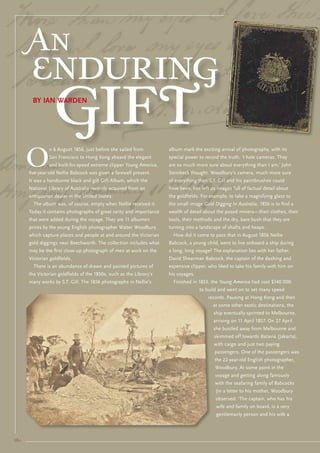
                n 6 August 1856, just before she sailed from          album mark the exciting arrival of photography, with its
                san Francisco to Hong Kong aboard the elegant         special power to record the truth. ‘I hate cameras. they
                and built-for-speed extreme clipper Young America,    are so much more sure about everything than I am,’ John
       five-year-old Nellie babcock was given a farewell present.     steinbeck thought. Woodbury’s camera, much more sure
       It was a handsome black and gilt Gift Album, which the         of everything than s.t. Gill and his paintbrushes could
       National library of Australia recently acquired from an        have been, has left us images full of factual detail about
       antiquarian dealer in the united states.                       the goldfields. For example, to take a magnifying glass to
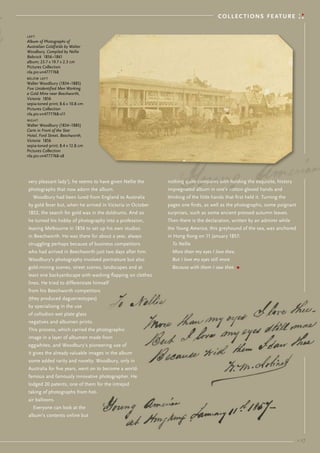
         the album was, of course, empty when Nellie received it.     the small image Gold Digging In Australia, 1856 is to find a
       today it contains photographs of great rarity and importance   wealth of detail about the posed miners—their clothes, their
       that were added during the voyage. they are 11 albumen         tools, their methods and the dry, bare bush that they are
       prints by the young english photographer Walter Woodbury       turning into a landscape of shafts and heaps.
       which capture places and people at and around the victorian      How did it come to pass that in August 1856 Nellie
       gold diggings near beechworth. the collection includes what    babcock, a young child, went to live onboard a ship during
       may be the first close-up photograph of men at work on the     a long, long voyage? the explanation lies with her father,
       victorian goldfields.                                          David shearman babcock, the captain of the dashing and
         there is an abundance of drawn and painted pictures of       expensive clipper, who liked to take his family with him on
       the victorian goldfields of the 1850s, such as the library’s   his voyages.
       many works by s.t. Gill. the 1856 photographs in Nellie’s        Finished in 1853, the Young America had cost $140 000
                                                                                     to build and went on to set many speed
                                                                                         records. Pausing at Hong Kong and then
                                                                                           at some other exotic destinations, the
                                                                                           ship eventually sprinted to melbourne,
                                                                                           arriving on 11 April 1857. on 27 April
                                                                                           she bustled away from melbourne and
                                                                                           skimmed off towards batavia (Jakarta),
                                                                                           with cargo and just two paying
                                                                                            passengers. one of the passengers was
                                                                                            the 22-year-old english photographer,
                                                                                            Woodbury. At some point in the
                                                                                            voyage and getting along famously
                                                                                            with the seafaring family of babcocks
                                                                                            (in a letter to his mother, Woodbury
                                                                                            observed: ‘the captain, who has his
                                                                                            wife and family on board, is a very
                                                                                            gentlemanly person and his wife a


16::
C o l l e C t i o N s f e at u r e


left
Album of Photographs of
Australian Goldfields by Walter
Woodbury, Compiled by Nellie
Babcock 1856–1861
album; 23.7 x 19.7 x 2.3 cm
Pictures collection
nla.pic-vn4777768
below left
Walter Woodbury (1834–1885)
Five Unidentified Men Working
a Gold Mine near Beechworth,
Victoria 1856
sepia-toned print; 8.6 x 10.8 cm
Pictures collection
nla.pic-vn4777768-s11
right
Walter Woodbury (1834–1885)
Carts in Front of the Star
Hotel, Ford Street, Beechworth,
Victoria 1856
sepia-toned print; 8.4 x 12.8 cm
Pictures collection
nla.pic-vn4777768-s8


very pleasant lady’), he seems to have given Nellie the     nothing quite compares with holding the exquisite, history
photographs that now adorn the album.                       impregnated album in one’s cotton-gloved hands and
   Woodbury had been lured from england to Australia        thinking of the little hands that first held it. turning the
by gold fever but, when he arrived in victoria in october   pages one finds, as well as the photographs, some poignant
1852, the search for gold was in the doldrums. And so       surprises, such as some ancient pressed autumn leaves.
he turned his hobby of photography into a profession,       then there is the declaration, written by an admirer while
leaving melbourne in 1856 to set up his own studios         the Young America, this greyhound of the sea, was anchored
in beechworth. He was there for about a year, always        in Hong Kong on 11 January 1857:
struggling perhaps because of business competitors            To Nellie
who had arrived in beechworth just two days after him.        More than my eyes I love thee,
Woodbury’s photography involved portraiture but also          But I love my eyes still more
gold-mining scenes, street scenes, landscapes and at          Because with them I saw thee.    •
least one backyardscape with washing flapping on clothes
lines. He tried to differentiate himself
from his beechworth competitors
(they produced daguerreotypes)
by specialising in the use
of collodion wet plate glass
negatives and albumen prints.
this process, which carried the photographic
image in a layer of albumen made from
eggwhites, and Woodbury’s pioneering use of
it gives the already valuable images in the album
some added rarity and novelty. Woodbury, only in
Australia for five years, went on to become a world-
famous and famously innovative photographer. He
lodged 20 patents, one of them for the intrepid
taking of photographs from hot-
air balloons.
   everyone can look at the
album’s contents online but


                                                                                                                           ::   17
T he F light of the
        Budgerigar
              Penny Olsen takes a look at the
                  humble budgie and uncovers
                the world’s most successfully
                                 marketed pet


                                   T
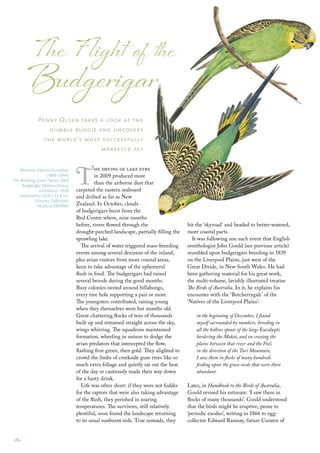
    ebenezer edward Gostelow                he drying of lake eyre
                   (1866–1944)              in 2009 produced more
The Warbling Grass Parrot, Shell
     Budgerigar (melopsittacus
                                            than the airborne dust that
              undulatus) 1928      carpeted the eastern seaboard
    watercolour; 43.0 x 22.0 cm    and drifted as far as New
            Pictures collection
             nla.pic-an3829066     Zealand. In October, clouds
                                   of budgerigars burst from the
                                   Red Centre where, nine months
                                   before, rivers flowed through the                   hit the ‘skyroad’ and headed to better-watered,
                                   drought-parched landscape, partially filling the    more coastal parts.
                                   sprawling lake.                                       It was following one such event that English
                                      The arrival of water triggered mass-breeding     ornithologist John Gould (see previous article)
                                   events among several denizens of the inland,        stumbled upon budgerigars breeding in 1839
                                   plus avian visitors from more coastal areas,        on the Liverpool Plains, just west of the
                                   keen to take advantage of the ephemeral             Great Divide, in New South Wales. He had
                                   flush in food. The budgerigars had raised           been gathering material for his great work,
                                   several broods during the good months.              the multi-volume, lavishly illustrated treatise
                                   Busy colonies nested around billabongs,             The Birds of Australia. In it, he explains his
                                   every tree hole supporting a pair or more.          encounter with the ‘Betcherrygah’ of the
                                   The youngsters contributed, raising young           ‘Natives of the Liverpool Plains’:
                                   when they themselves were but months old.
                                   Great chattering flocks of tens of thousands            in the beginning of December, I found
                                   built up and streamed straight across the sky,          myself surrounded by numbers, breeding in
                                   wings whirring. The squadrons maintained                all the hollow spouts of the large Eucalypti
                                   formation, wheeling in unison to dodge the              bordering the Mokai; and on crossing the
                                   avian predators that intercepted the flow,              plains between that river and the Peel,
                                   flashing first green, then gold. They alighted to       in the direction of the Turi Mountain,
                                   crowd the limbs of creekside gum trees like so          I saw them in flocks of many hundreds
                                   much extra foliage and quietly sat out the heat         feeding upon the grass-seeds that were there
                                   of the day or cautiously made their way down            abundant.
                                   for a hasty drink.
                                      Life was often short: if they were not fodder    Later, in Handbook to the Birds of Australia,
                                   for the raptors that were also taking advantage     Gould revised his estimate: ‘I saw them in
                                   of the flush, they perished in soaring              flocks of many thousands’. Gould understood
                                   temperatures. The survivors, still relatively       that the birds might be eruptive, prone to
                                   plentiful, soon found the landscape returning       ‘periodic exodus’, writing in 1866 to egg-
                                   to its usual sunburnt reds. True nomads, they       collector Edward Ramsay, future Curator of


18::
the Australian Museum: ‘The Black Fellows           Gould confided that he was expecting to fend
of the Upper Hunter told me that the little         off royalty:
Melopsittacus undulatus had come to meet me,
for they had never seen the bird in that district       I met Prince Albert at the last Soc.
until the year I arrived’.                              Meeting, the little pets were … of course
   In 1840 Gould returned to London with                introduced. The Prince was very much
a vast collection of specimen skins, nests              pleased with them and I am any day
and eggs. He arrived bearing ‘presents for a            expecting a Command from the Queen
few private friends’—a collection of parrots,           requesting they should be submitted to her.
including a galah and several eastern and
crimson rosellas, the only animals in his           Gould’s birds may not have been a pair, for
menagerie to survive the four-month voyage          apparently they never bred. Derby, however,
from Port Jackson to London.                        eventually obtained some live birds for his
   Gould’s sponsor Lord Derby soon expressed        extensive private zoo and is credited with
a keen interest in the budgerigars, asking ‘How     breeding the first budgies in captivity. Early in
many of these are now in Life?’ and adding          February 1848 he wrote to Gould:
‘I suppose you have heard that Wh[?] has
three of them for which he has the modesty              I have pleasure to tell you that we have
to ask 20£ each’, a fortune at the time. Gould          been most pleased here by the fact of a Pair
replied that he had left the colony with 19 live        of the Melopsittacus undulatus breeding
budgerigars but only two had survived:                  … We do not yet know anything more than
                                                        she certainly has hatched, for we can hear
                                                                                                              melopsittacus undulatus
    At one time I had fifteen of Nanodes                the young, but how many we can not even               (Warbling Grass-Parrakeet) in
    undulatus alive, all of which died on our           guess. This is curious & I believe it is the          The Birds of Australia, vol. 5, by
    leaving the country, however Mrs Gould’s            1st instance. I trust they may go well, but           John Gould, 1848
                                                                                                              Australian rare books collection
    brother presented her with four other living        can not help further more than hoping.                http://nla.gov.au/nla.aus-f4773-5-s94
    specimens of this beautiful bird—two of
    these also died, the others arrived in safety
    and are especial pets of Mrs Gould.

Excusing his failure to forward them to
his patron, Gould pleaded sentimental
association: ‘Had they not been given to
[Elizabeth] by her brother they would have
been at once forwarded to your Lordship’. To
make amends he offered ‘a pair of Platycercus
barnardii [Australian ringnecks] as a slight
token of respect of one who is ever sensible
of the many favors he has received at your
Lordship’s hands’.
  The following April, Gould reported back
to the Australian-based donor of their petite
parrots, his brother-in-law Stephen Coxen.
Gould’s collecting trip had enhanced his
reputation and given him access to high
society. The two budgerigars, ‘the most
animated cheerful little creatures you can
possibly imagine’, were a boon:

    They are looked upon by every one with
    great interest and I can take them out with
    me not only to the Scientific Meetings of
    the Society but to some of the large homes
    of the Nobility who discuss my return from
    Australia.


                                                                                              the national library magazine :: june 2011 ::   19
Australia added to numbers in Britain, where
                                                                                   2000 budgies at a time crowded London
                                                                                   dealers’ bird rooms. The peak of importation
                                                                                   was in the first six months of 1879, when
                                                                                   50 000 pairs were estimated to have been
                                                                                   shipped and dispersed across Europe, where,
                                                                                   by the 1880s, budgie ‘factories’ were producing
                                                                                   batches of 15 000 birds.
                                                                                     By the mid-nineteenth century the general
                                                                                   population was enjoying the fruits of the
                                                                                   industrial revolution. Many ordinary families
                                                                                   could afford a pet, even an exotic parrot, once
                                                                                   the preserve of nobility. The little budgerigar
                                                                                   was affordable, hardy, easy to keep, playful,
                                                                                   social, devoted and long-lived. Its happy
                                                                                   disposition and pleasant, conversational chatter
                                                                                   made it good company.
                                                                                     Books on cagebirds extolled the virtues of
                                                                                   the miniature parrot. One of the earliest was
                                                                                   Charles Gedney’s Foreign Cage Birds (1877),
                                                                                   which gushed:

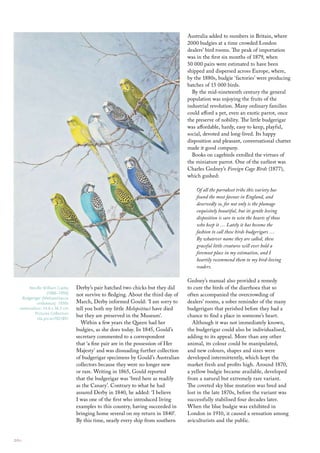
                                                                                       Of all the parrakeet tribe this variety has
                                                                                       found the most favour in England, and
                                                                                       deservedly so, for not only is the plumage
                                                                                       exquisitely beautiful, but its gentle loving
                                                                                       disposition is sure to win the hearts of those
                                                                                       who keep it … Lately it has become the
                                                                                       fashion to call these birds budgerigars …
                                                                                       By whatever name they are called, these
                                                                                       graceful little creatures will ever hold a
                                                                                       foremost place in my estimation, and I
                                                                                       heartily recommend them to my bird-loving
                                                                                       readers.

                                                                                   Gedney’s manual also provided a remedy
        Neville William cayley   Derby’s pair hatched two chicks but they did      to cure the birds of the diarrhoea that so
                  (1886–1950)    not survive to fledging. About the third day of   often accompanied the overcrowding of
    Budgerigar (melopsittacus
            undulatus) 1930s     March, Derby informed Gould: ‘I am sorry to       dealers’ rooms, a sober reminder of the many
   watercolour; 54.0 x 36.5 cm   tell you both my little Melopsittaci have died    budgerigars that perished before they had a
           Pictures collection
            nla.pic-an7021891
                                 but they are preserved in the Museum’.            chance to find a place in someone’s heart.
                                   Within a few years the Queen had her              Although it was not immediately known,
                                 budgies, as she does today. In 1845, Gould’s      the budgerigar could also be individualised,
                                 secretary commented to a correspondent            adding to its appeal. More than any other
                                 that ‘a fine pair are in the possession of Her    animal, its colour could be manipulated,
                                 Majesty’ and was dissuading further collection    and new colours, shapes and sizes were
                                 of budgerigar specimens by Gould’s Australian     developed intermittently, which kept the
                                 collectors because they were no longer new        market fresh and profits high. Around 1870,
                                 or rare. Writing in 1865, Gould reported          a yellow budgie became available, developed
                                 that the budgerigar was ‘bred here as readily     from a natural but extremely rare variant.
                                 as the Canary’. Contrary to what he had           The coveted sky blue mutation was bred and
                                 assured Derby in 1840, he added: ‘I believe       lost in the late 1870s, before the variant was
                                 I was one of the first who introduced living      successfully stabilised four decades later.
                                 examples to this country, having succeeded in     When the blue budgie was exhibited in
                                 bringing home several on my return in 1840’.      London in 1910, it caused a sensation among
                                 By this time, nearly every ship from southern     aviculturists and the public.


20::
The cult of the budgerigar had taken            Exhibition in Berlin caused a sensation
flight. There were societies, exhibitions and      and confounded the sceptics:
standards of perfection. Within a few decades
the budgerigar was Europe’s most popular               There … stood the [speaking budgerigar]
cagebird, before conquering the United                 … bodily before the eyes of the
States, Japan and beyond. Shortly after the            unbelieving, and thousands of visitors
Second World War, bright red budgerigars               to the exhibition could convince
were imported from India to England, South             themselves that they were not the
Africa and Australia to great fanfare. When            victims of deception.
the much-admired birds went through
their annual moult, the fraud was revealed.        Back in their home country no one
They were white birds, dyed scarlet by some        was interested in breeding budgies.
enterprising trader. To this day, the burgundy     In season, in the early decades of
budgerigar remains a dream.                        the twentieth century, they could be
   Some 30 primary colour mutations are now        purchased by the dozen at the cost
recognised, making hundreds of variations          of only a few shillings and
possible. Recognised colours range from            they were still exported
violet to cobalt, anthracite and cinnamon,         en masse. But by the late
and patterns from saddleback, clearbody and        1930s, Neville Cayley,
lacewing to pied. The standard English show        well-known ornithologist
budgie is now a puffy headed giant nearly          and author, lamented: ‘We
twice the weight of the original.                  Australians now realise
   If the potential for ‘improvement’ on nature    that great opportunities
was not enough, with an early start, the budgie    were missed’, and the
also proved highly trainable: it could shake       budgerigar, in its new
hands, ring bells, climb poles and pull small      multi-coloured garb,
wagons on command. In the last decades             available also in super-
of the nineteenth century, a few expatriate        sized, crested and curly
budgerigars began new careers, performing          feathered models, was
tricks in mini-circuses and, as the mediums        imported at great expense.
of fortune tellers in the marketplace, selecting      Gould’s humble budgies
scraps of paper bearing forecasts. Later still     started a craze that
they made charming magicians’ accomplices.         eventually spread around
   But most amazing of all, the miniature          the world. They remain
parrots could talk. More extraordinary still,      common, much-loved
they could speak several languages! In 1880,       household pets and coveted
a little speaking budgerigar in the Ornis          show birds, more popular even than the                   top
                                                   canary. The budgerigar’s story stands as the             unknown photographer
                                                                                                            Johnny Hart—Young English Bird
                                                   most successful mass marketing of a pet in               Magi c.1945–1993
                                                   history and an early example of Australians’             gelatin silver print; 10.0 x 8.0 cm
                                                                                                            state library of victoria
                                                   perplexing propensity to export their nation’s           P.293/No.981
                                                   ‘raw’ natural resources so that others profit
                                                   from their development.                                  below
                                                                                                            unknown photographer
                                                      Sadly, many Australians are unaware that              Gracie Fields with Two
                                                   the ubiquitous little cagebird is an Australian          Budgerigars on Top of Her Head
                                                   native, found naturally wild nowhere else in             1945
                                                                                                            b&w photograph; 20.3 x 15.2 cm
                                                   the world. Even its original colours are ‘true           Pictures collection
                                                   blue’—Australia’s national colours of green              nla.pic-vn3600628
                                                   and gold.
                                                                                                            left
                                                                                                            Cricket-playing Budgerigar in
                                                                                                            The Advertiser (south Australia),
                                                                                                            20 November 1953
                                                   PeNNy olseN, a former National library of                Newspapers and microforms
                                                   Australia Harold White Fellow, was assisted in her       collection
                                                   research on the social history of the budgerigar by
                                                   a literature Grant from the Australia council for
                                                   the Arts


                                                                                            the national library magazine :: june 2011 ::   21
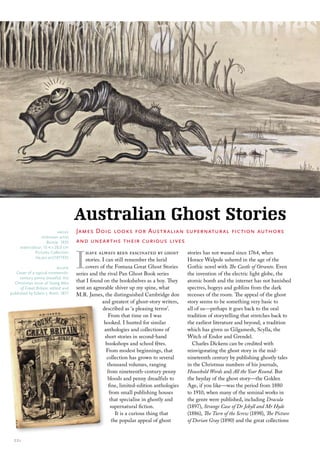
Australian Ghost Stories
                          above      James Doig looks for Australian supernatural fiction authors
                 unknown artist
                    Bunyip 1935      and unearths their curious lives


                                     I
     watercolour; 15.4 x 28.0 cm
             Pictures collection          have always been fascinated by ghost             stories has not waned since 1764, when
             nla.pic-an21971935
                                          stories. I can still remember the lurid          Horace Walpole ushered in the age of the
                            below         covers of the Fontana Great Ghost Stories        Gothic novel with The Castle of Otranto. Even
   cover of a typical nineteenth-    series and the rival Pan Ghost Book series            the invention of the electric light globe, the
     century penny dreadful, the
  christmas issue of Young Men       that I found on the bookshelves as a boy. They        atomic bomb and the internet has not banished
      of Great Britain, edited and   sent an agreeable shiver up my spine, what            spectres, bogeys and goblins from the dark
published by edwin J. brett, 1877    M.R. James, the distinguished Cambridge don           recesses of the room. The appeal of the ghost
                                                   and greatest of ghost-story writers,    story seems to be something very basic to
                                                   described as ‘a pleasing terror’.       all of us—perhaps it goes back to the oral
                                                      From that time on I was              tradition of storytelling that stretches back to
                                                    hooked. I hunted for similar           the earliest literature and beyond, a tradition
                                                    anthologies and collections of         which has given us Gilgamesh, Scylla, the
                                                    short stories in second-hand           Witch of Endor and Grendel.
                                                     bookshops and school fêtes.              Charles Dickens can be credited with
                                                     From modest beginnings, that          reinvigorating the ghost story in the mid-
                                                     collection has grown to several       nineteenth century by publishing ghostly tales
                                                      thousand volumes, ranging            in the Christmas numbers of his journals,
                                                      from nineteenth-century penny        Household Words and All the Year Round. But
                                                      bloods and penny dreadfuls to        the heyday of the ghost story—the Golden
                                                       fine, limited-edition anthologies   Age, if you like—was the period from 1880
                                                       from small publishing houses        to 1910, when many of the seminal works in
                                                        that specialise in ghostly and     the genre were published, including Dracula
                                                        supernatural fiction.              (1897), Strange Case of Dr Jekyll and Mr Hyde
                                                           It is a curious thing that      (1886), The Turn of the Screw (1898), The Picture
                                                         the popular appeal of ghost       of Dorian Gray (1890) and the great collections


  22::
from the pens of M.R. James, Algernon                housing thousands
Blackwood and Arthur Machen, among many              of microfilms, the
others. Women also figured prominently               room itself would
and ghost stories by Mary Braddon, Amelia            make a great setting
Edwards, Charlotte Perkins Gilman, Violet            for a ghost story. And
Hunt and Vernon Lee are classics of their kind.      it represents a true
  But where are the Australian writers in this       national treasure—a
great flowering of supernatural fiction? Go to       near complete
any of the dozens of anthologies that sample         set of Australian
the supernatural tales of the period and you         periodicals, journals,
will be struggling to find a single story by an      newspapers and
Australian author among them. This seems             other ephemeral
a glaring omission. After all, it is not as if       publications dating
the Australian landscape or the colonial             back to the earliest
experience lacks the elements necessary for a        colonial times.
good ghost story:                                    Moreover, the microfilm readers allow stories        above
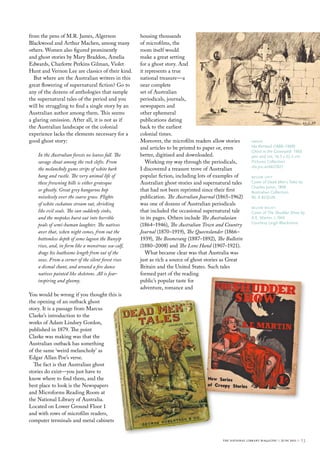
                                                     and articles to be printed to paper or, even         Ida rentoul (1888–1960)
                                                                                                          Ghost in the Graveyard 1903
    In the Australian forests no leaves fall. The    better, digitised and downloaded.                    pen and ink; 16.3 x 22.5 cm
    savage shout among the rock clefts. From            Working my way through the periodicals,           Pictures collection
                                                                                                          nla.pic-an6621827
    the melancholy gums strips of white bark         I discovered a treasure trove of Australian
    hang and rustle. The very animal life of         popular fiction, including lots of examples of       below left
    these frowning hills is either grotesque         Australian ghost stories and supernatural tales      cover of Dead Men’s Tales by
                                                                                                          charles Junor, 1898
    or ghostly. Great grey kangaroos hop             that had not been reprinted since their first        Australian collection
    noiselessly over the coarse grass. Flights       publication. The Australian Journal (1865–1962)      Nl A 823JuN
    of white cockatoos stream out, shrieking         was one of dozens of Australian periodicals
                                                                                                          below right
    like evil souls. The sun suddenly sinks,         that included the occasional supernatural tale       cover of The Shudder Show by
    and the mopokes burst out into horrible          in its pages. Others include The Australasian        A.e. martin, c.1945
                                                                                                          courtesy leigh blackmore
    peals of semi-human laughter. The natives        (1864–1946), The Australian Town and Country
    aver that, when night comes, from out the        Journal (1870–1919), The Queenslander (1866–
    bottomless depth of some lagoon the Bunyip       1939), The Boomerang (1887–1892), The Bulletin
    rises, and, in form like a monstrous sea-calf,   (1880–2008) and The Lone Hand (1907–1921).
    drags his loathsome length from out of the          What became clear was that Australia was
    ooze. From a corner of the silent forest rises   just as rich a source of ghost stories as Great
    a dismal chant, and around a fire dance          Britain and the United States. Such tales
    natives painted like skeletons. All is fear-     formed part of the reading
    inspiring and gloomy.                            public’s popular taste for
                                                     adventure, romance and
You would be wrong if you thought this is
the opening of an outback ghost
story. It is a passage from Marcus
Clarke’s introduction to the
works of Adam Lindsey Gordon,
published in 1879. The point
Clarke was making was that the
Australian outback has something
of the same ‘weird melancholy’ as
Edgar Allan Poe’s verse.
  The fact is that Australian ghost
stories do exist—you just have to
know where to find them, and the
best place to look is the Newspapers
and Microforms Reading Room at
the National Library of Australia.
Located on Lower Ground Floor 1
and with rows of microfilm readers,
computer terminals and metal cabinets


                                                                                          the national library magazine :: june 2011 ::   23
right       sensation, and Australian writers cashed in          Australia’, Fortune was born in Belfast in 1833
                 elliot and Fry      on their popularity. Greats, such as Marcus          and came to Australia via Canada in 1855,
   Mrs Campbell Praed c.1895
b&w photograph; 21.3 x 15.9 cm       Clarke, Henry Lawson and Edward Dyson,               leaving her husband behind in Quebec. Of
           Pictures collection       dabbled in the form, as did many                              her two sons, one died aged five on
           nla.pic-an24793813
                                     others who were once popular                                        the Victorian goldfields, while
                          below      but have now drifted into                                               the other, George, became a
cover of Australian Ghost Stories,   obscurity.                                                                criminal, spending 20 years
   selected by James Doig, 2010
                                        I have often found in                                                     in Victorian prisons.
                                     literary research that                                                         Although deserving a
                                     the lives of authors                                                            place in Australian
                                     are in many ways                                                                 literary history, such
                                     more compelling and                                                               was the obscurity
                                     fascinating than the                                                              into which Fortune
                                     stories they wrote.                                                                fell that even the
                                     Take James Francis                                                                 year of her death
                                     Dwyer, for instance,                                                               remains a mystery.
                                     a popular writer of                                                                  Another forgotten
                                     adventure stories in                                                              Australian writer
                                     the first half of the                                                            of ghost stories and
                                     twentieth century.                                                              occult thrillers is Rosa
                                     Born in Camden Park,                                                           Campbell Praed, born
                                     New South Wales, in                                                          in 1851 in a slab hut on
                                     1874, Dwyer spent seven                                                   a remote station in south-
                                     years in Goulburn Gaol for                                              east Queensland. Even as a
                                     forgery. From the damp confines                                     child she was acutely aware of
                                     of his cell he was inspired to compose                        the strangeness and emotional impact
                                     poetry which was published in The Bulletin.          of the vast Australian continent. She turned
                                     Dwyer left Australia in 1906 and travelled           this to good effect in her writing, especially
                                     widely in the United States, Asia and Africa         the classic story The Bunyip, which combines
                                     before settling in France. He became a prolific      the traditional blood-curdling campfire tale
                                     novelist and short-story writer, most of them        with the all-too-real colonial horror of the
                                     tales of mystery and adventure written for the       death of a child lost in the outback. Her life
                                     popular pulp magazines of the day. His short-        was marred by extraordinary personal tragedy:
                                     story collection, Breath of the Jungle (1915),       not only was she tied to a loveless marriage
                                     contains a number of supernatural tales related      but also her daughter, deaf from birth, went
                                                        by Hochdorf, a German             insane and was committed to an asylum, and
                                                        naturalist who has various        her three sons predeceased her, one by suicide.
                                                        hair-raising adventures in        Praed’s consolation was her partner of many
                                                         exotic locales.                  years, Nancy Harwood, a medium whom she
                                                            More remarkable is Mary       believed to be the reincarnation of a Roman
                                                         Fortune (1833–c.1910), who       slave girl. Praed died on 10 April 1935 in
                                                         wrote under the pseudonym        Torquay, Devon, alone and forgotten.
                                                         Waif Wander or W.W.                 Writing was a precarious business: many
                                                         Fortune is best known as         writers struggled to earn a living and died
                                                         the author of the longest-       in poor circumstances. Much of the pleasure
                                                          running early detective         in compiling anthologies of early Australian
                                                          serial anywhere in the          popular fiction is rescuing the names and
                                                          world, The Detective’s Album,   reputations of otherwise forgotten writers
                                                          which was published in          from obscurity.
                                                           The Australian Journal
                                                           between 1868 and 1933.
                                                           Described in an 1898           JAmes DoIG is the editor of four anthologies
                                                           article as ‘probably the       of Australian supernatural fiction, including
                                                           only truly Bohemian lady       Australian Ghost Stories (2010)
                                                           writer who has ever earned
                                                           a living by her pen in


  24::
‘Breakers ahead!’
 William Westall’s record of a reef wreck


Richard Westall looks at firsthand depictions of an early Australian shipwreck


I
     n 1803, while matthew flinders was               We were all assembled in the
     exploring the Gulf of Carpentaria during         Cabin, when I suddenly heard
     his circumnavigation of New Holland              the Crew in great confusion, and
(Australia), his ship HM Sloop Investigator           hurrying on Deck, beheld Breakers
began to leak and was found to have major             on our Larboard Bow. The Coral
rot problems. Unable to repair the ship at sea,       Reef showed itself in a long line
Flinders sailed on to Port Jackson (Sydney),          of Foam, seen indistinctly through
where the vessel was condemned. The captain           Gloom of the approaching Night.
was offered the use of HMS Porpoise to                When the Ship struck, one general
continue his survey but this vessel was also          Groan resounded throughout, for
unsuitable for the task. The captain decided          not a possibility appeared that any
to sail for England as a passenger on the             one could be saved. The Night was
Porpoise to obtain another ship and return            remarkably Dark.
to Australia.
  William Westall, landscape artist on the        John Aken, the ship’s master, was                          top
Investigator, was among the passengers when       on lookout that night and described the scene:             William Westall (1781–1850)
                                                                                                             Wreck of the Porpoise, Flinders
the Porpoise left Port Jackson on 10 August                                                                  Expedition 1803
1803. Two other ships accompanied the                 Suddenly rang out the warning, ‘Breakers               watercolour; 31.2 x 46.0 cm
                                                                                                             Pictures collection
Porpoise: the Bridgewater, under the command          ahead!’ The helm was put down with a
                                                                                                             nla.pic-an4910322
of Captain Palmer, and the Cato, commanded            view of backing out of the danger; but the
by Captain John Park.                                 Porpoise ... scarcely came up to the wind              above
                                                                                                             William Westall (1781–1850)
  A week later, on 17 August, the Porpoise            ... The Porpoise had gone right in upon a              Self-portrait c.1820
struck a coral reef and heeled over. Westall          coral reef, and had taken a fearful heel over          oil on canvas; 24.1 x 21.5 cm
described the experience:                             on her larboard beam-ends.                             Pictures collection
                                                                                                             nla.pic-an7692976


                                                                                             the national library magazine :: june 2011 ::   25
right
  William Westall (1781–1850)
         Shipwreck, Wreck Reef
        pencil; 10.75 x 14.5 cm
       courtesy Anthony spink


                                  In her romantic history, My Love Must Wait:            or cutters, which Westall recorded in his
                                  The Story of Matthew Flinders (1941), Ernestine        watercolour Wreck of the Porpoise, Flinders
                                  Hill imagined the scene:                               Expedition, held by the National Library of
                                                                                         Australia. In the background, to the left,
                                      ‘Helm alee!’ Aken’s shout ... ‘Breakers            the Cato is almost sunk and, to the right,
                                      ahead!‘—the cry of the lookout ... ‘A reef!        the Porpoise lies on its side. In another
                                      Here we come!’ ... There was a rip and creak       work, Shipwreck, Wreck Reef, the Porpoise
                                      of straining timbers, and the ship leaned          is viewed looking out from the reef and, in
                                      over ... Rush of sailors from the fo’c’sle ... a   the foreground, two figures on the right sit
                                      paralysing shock as the ship heeled over ...       next to an illustration, possibly another of
                                      they were down in a welter of ghostly foam.        Westall’s works.
                                                                                            The 80 survivors inhabited a stretch of land
                                  Westall takes up the account:                          measuring less than 300 metres in length and
                                                                                         100 metres in width. They discovered that the
                                      During this dreadful Scene, after the first        Bridgewater had avoided the reef and it was
                                      confusion had subsided, all was coolness and       hoped it would come and assist the stranded
                                      prompt Obedience. Many though drenched             seamen. Hopes were soon dashed when the
                                      with the Sea, and exhausted with Fatigue,          Bridgewater sailed away without having made
                                      would only accept with moderation the              any effort to give assistance to the marooned
                                      Spirits served out to recruit their strength.      survivors. Flinders later reported: ‘The captain
                                                                                         of the ship presumed on slight evidence that
                                  A fire broke out from a fallen candle and,             all had drowned’. The group quickly set about
                                  suddenly, burning to death became as much              establishing a camp, which Westall recorded
                                  a danger as drowning. ‘The Crew laboured               in his watercolour, View of Wreck Reef Bank
                                  incessantly’, wrote Westall. They eventually all       Taken at Low Water, Terra Australis, also in the
                                  fell asleep in the wreck of the vessel.                Library’s collection. The coral reef is shown
                                    The next morning the fate of the Cato                in the foreground and several tents of varying
                                  became clear: it was also a total wreck. Three         sizes appear in the distance, huddled around a
                                  boys were lost while trying to swim to safety          distress flag.
                                  but, fortunately, most of the castaways from              Aken described the hilarity when the crew
                                  both ships managed to make it to a dry                 of the Cato, who had little with them but their
                                  sandbank in the middle of the reef. Some               shirts, were provided with officers’ uniforms,
                                  of the stragglers were rescued in lifeboats            thus celebrating their unexpected ‘promotion’.


26::
Aken explained how ‘the provisions of the
Porpoise were distributed ... on a strict footing
of equality ... Officers and men shared exactly
alike ... supplies of coats and blankets from
the Porpoise [were] liberally divided’. Aken
went on to describe how a ‘new government’
was formed to establish ‘rigid equality of
distribution’.
  Westall was able to save most of his
sketches. However, ‘young Franklin and his
fellow midshipmen, wishing to enliven the
dull monotony of their time after the wreck,
amused themselves by driving the remnant of
the live stock over the sketches whilst spread
out on the sand’. The artist also lost a silver pallet
that he had been awarded at 16 years of age in a
competition at the Society of Arts. This memento,        told sailor and amateur artist Jorgen Jorgenson        above
inscribed with his name, was later returned to           about the shipwrecks. In 1804 Jorgenson                William Westall (1781–1850)
                                                                                                                View of Wreck Reef Bank Taken
an astonished Westall by a pawnbroker in                 completed his watercolour, Loss of His Majesty’s       at Low Water, Terra Australis
London who had bought it from a seaman.                  Ship the Porpoise, being his notion of the event.      c.1803
                                                                                                                pencil and wash
  Flinders decided to use the Porpoise’s cutter             The Rolla arrived at Canton on 14 December          14.1 x 22.2 cm
to attempt to return to Port Jackson with                1803. Westall proposed to stay in China                Pictures collection
Captain Park and 12 rowers. He organised                 for a while and then travel to India. While            nla.pic-an4910283
the construction of another boat, which was              in China, he went up river and ‘enriched               below left
to be used by the remaining men should help              his portfolio with many sketches of that               William Westall (1781–1850)
not arrive within two months. Embarking on               interesting country’. Some of the Chinese              A View in China
                                                                                                                Private collection
26 August, the group reached Port Jackson                drawings later became watercolours, two
13 days later. There, the Cumberland was given           illustrated here: one of a Hong Kong                   below right
                                                                                                                William Westall (1781–1850)
to their disposal, with two other vessels, the           merchant’s garden and the other of a scene
                                                                                                                A Hong Kong Merchant’s
Rolla, bound for China, and the Francis. The             near the garden. The garden painting was               Garden
ships sailed on 21 September.                            exhibited at the Royal Academy of Arts,                watercolour
                                                                                                                courtesy martyn Gregory
  On 7 October, six weeks after his departure,           London, in 1814. Westall left China in early
Flinders returned to Wreck Reef. On                      February 1804.
11 October, 54 days after the wreck and the
day before Westall’s twenty-second birthday,
the stranded survivors left the reef. Westall            rIcHArD J. WestAll is the great-great-grandson
was next bound for China aboard the Rolla.               of William Westall, whose life he has been
A party returned to Port Jackson on the                  researching for 30 years. He has a blog
Francis and Flinders embarked for England on             www.westallart.blogspot.com on both richard and
the Cumberland. Among those who returned to              William Westall, where you can find references
Port Jackson, someone, possibly John Franklin,           relating to this article


                                                                                                the national library magazine :: june 2011 ::   27
Knowing the Past                interviews with australian historians
                                  Susan Marsden delves into
                                  the lives of recent Australian
                                  historians


                                  S
                          right          ince 2002 i have been recording
          Greg Power (b.1974)            a series of interviews with historians
  Portrait of Alistair Thomson,
    Canberra, 5 January 2009             for the National Library of Australia’s
            digital photograph    Oral History and Folklore collection. The
  National library of Australia
                                  aim of these interviews has been to explore
                       below      the many different ways of knowing the
  susan marsden interviewing      past and the intersections between personal
stuart macIntyre, university of
 melbourne, 14 February 2006      and professional histories. I have adopted a
          courtesy the author     similar approach to every interview, asking
                                  participants to provide a brief biography and
                                  then prompting a discussion of their lives
                                  and observations as historians or ‘professional
                                  observers of our own times’.
                                     The request to speak about ‘your history’
                                  elicited detailed family stories, throwing           about rural life and farming families because
                                  light on the experiences and aspirations of          she worked really hard. And it was very much
                                  generations of Australians, summarised by            a family enterprise’. Alistair Thomson’s father
                                  Alistair Thomson as ‘upwardly mobile through         was a career soldier who moved frequently. As
                                  the church and education’. Inga Clendinnen           a teenager, Thomson discovered ‘a big sea chest
                                  referred to her father’s ‘Mechanics Institute        with all the letters that Mum had written,
                                  tradition’—this ‘radical working-class               from when she got married, to her parents’.
                                  heritage has mattered to me a very great deal.       Reading them was not simply a vivid memory.
                                  I’m delighted that I come from the wrong             His book, Moving Stories: British Women and
                                  side of the tracks’. Bill Gammage spoke of           the Postwar Australian Dream, is about four
                                  ‘Grandfather Gammage, also Bill’, a political        British postwar migrant women and the letters
                                  activist and reporter for Narrandera Argus: ‘He      they wrote to their mothers in the 1950s, when
                                  remained interested in politics all his life …       his own mother was writing to her parents:
                                  He spoke often of the conscription campaign
                                  of World War One. He opposed conscription                And it really became clear to me that a lot
                                  but he had a brother in the AIF [Australian              of my work’s been as an oral historian, but
                                  Imperial Force] and there were all sorts of              under the surface I've been interested in life
                                                          public and family tensions       stories generally and the different ways that
                                                          over that’.                      people tell their lives. [I’ve been] drawn to
                                                            Family influences on           letters, diaries, memoirs and people talking.
                                                          history writing are often        Reading my mum’s letters was a very
                                                          significant. Marilyn Lake        significant recognition of that.
                                                          recalled her mother’s work
                                                          in the family orchard in     Asked why his writing drew so much upon
                                                          Tasmania as being an         personal experience, Hugh Stretton replied:
                                                          experience that ‘certainly
                                                          did influence the sort of        I felt strongly with social science that you’re
                                                          history I then wrote about       dealing with human thought and behaviour
                                                          soldier settlement and           of infinite complexity. You ought to keep


28::
anything you do close to detailed individual        with their parents, handle them with
    human experience because that’s what                more tenderness and understanding.
    ultimately it all has to enrich or impoverish
    and answer to democratically. So you can        Alan Powell was the only foundation
    people it with real creatures.                  staff member of all four of Darwin’s
                                                    tertiary institutions (now Charles
The most surprising feature of these interviews     Darwin University). He spent his first
is the variety in life experiences, further         year at a half-built Darwin Community
enriched in recollection by the historians. Alan    College. Travelling south on leave
Powell remarked wryly that the trajectory of        in December 1974, he returned
his working life could be titled, ‘From Garbo       to a city devastated by Cyclone
to Prof ’. Recalling service on a naval corvette    Tracy. In his own flat, his patiently
during the Second World War, Stretton               acquired books and PhD research
said, ‘I could claim—and have ever since,           material formed ‘a pile of pulp on
boringly—to be probably the only man in the         the floor’.
armed forces of any of the combatants in that         Some historians introduced
war who has engaged an enemy torpedo with a         radical new courses to universities.
Bren Gun.’                                          While a PhD student, Ann
   The careers explored in the interviews date      Curthoys helped set up two
from the 1940s, a period of great change            women’s liberation newspapers,
for the profession both academically and in         Mejane and Refractory Girl. ‘We’d
public history. Following an early academic         been reading mainly American
career in New Zealand and England,                  texts and so in ’71 we were
Trevor Wilson took up a lectureship at the          starting to develop our own stuff
University of Adelaide in the 1960s, a time         … Then in 1973 … the journal Refractory Girl               top
of ‘breathtaking’ expansion: ‘Menzies had           got formed … bringing together the scholarly               Damian mcDonald
                                                                                                               Susan Marsden Interviewing
obviously been caught by the education bug          side and the activist side.’ Her own articles              Ann Curthoys (left), 28 November
and was developing the universities on a very       on women’s liberation and historiography,                  2002
                                                                                                               digital photograph
wide scale, so this was the place you looked        published in these newspapers and elsewhere,               National library of Australia
to, to get a job’.                                  were ‘the basis, I think, on which I got the
   Some historians were founding members            women’s studies job in ’76 at the Australian               above
of staff at new universities, including             National University. Some of her male                      cover of Refractory Girl: A
                                                                                                               Womens Study Journal, vol. 1, 1972
Gammage at the University of Papua New              colleagues were ‘very restive about women’s                Australian collection
Guinea, Jill Roe at Macquarie University            history, very unsettled by it’.                            N 301.41205 reF
and Inga Clendinnen at La Trobe University.           Stuart Macintyre also explored the                       below
Clendinnen recalled of the 1960s and 1970s ‘a       intersection of ideological activism—in his                Damian mcDonald
whole heavy degree of student activity, which       case, in the Communist Party—with his                      Inga Clendinnen at the
                                                                                                               National Library of Australia,
the staff sometimes tried to suppress and           research and teaching, noting:                             30 October 2005
sometimes supported. It was a very dynamic                                                                     digital photograph
time’. High immigration rates fuelled influxes          I choose topics because I have an                      National library of Australia

of Greek, Turkish and other newcomers to the            attachment to them but also because I
student body. She introduced the only full-year         have a slightly ambiguous attachment
course on Aztecs, teaching her students in              … And so, in the case of my doctoral
workshops:                                              subject on Marxist working-class
                                                        education in the British labour
    One of the fascinations for me teaching the         movement up to the 1930s. It was …
    way I did, with a fairly heavy emphasis             extraordinary and admirable … and
    on sociological and anthropological-type            yet I was also struck by the fact that the
    analyses was … that it really helped quite          content of much of this education was
    a lot of the first generation migrant kids          very dogmatic. So, it was me trying
    have a way of understanding what was                to think more carefully about where I
    happening in their relationship with their          stand in relationship to something …
    parents. They would start bringing their            I've always thought of history as a way
    experiences to the very open circumstances          in which it's not simply constructing
    of workshops and getting some distance on           a past to suit yourself. It’s trying
    them … then they could negotiate better             to clarify your own understanding


                                                                                               the national library magazine :: june 2011 ::   29
and even your own attitude towards                  participated in all those changes in the
           subjects.                                           sixties and seventies and with maturity
                                                               in the eighties and nineties. I do joke
       Some 1970s graduates became pioneer                     sometimes I’m spending the second half of
       professional (public) historians who grappled           my life writing about the first half. But I
       with other modes of interpreting history. I             think there’s something interesting about
       was one of them and Margaret Anderson                   writing about stuff that you lived through
       was another. She described moving in 1982               but now when you look back on it it’s really
       from the Western Australian Museum to the               quite different from what you thought at
       History Trust of South Australia, becoming              the time. There’s a double vision there …
       the first director of the Migration Museum              I think it’s been an interesting period to
       at a time when there was very little published          be a historian in and to be reflective about
       about the immigration history of Australia.             because the society changed so dramatically
       The Trust was ‘at the absolute forefront in             and yet some things are very persistent …
       terms of the public interpretation of history in        such as racism. On the gender front it really
       Australia’.                                             has changed dramatically … [T]hat’s been
         Michelle (Mickey) Dewar discovered                    interesting to live through and to chronicle
       few historical resources of any kind on the             as a participant and eventually to write
       Northern Territory on her arrival in the 1980s.         about as a historian.
       Historiography involved ‘a broad inclusive
       approach’, encompassing heritage, publication
       and oral history supported by the National          Dr susAN mArsDeN is a professional historian
       Trust and the Museum and Art Gallery of the         who runs her own consultancy business based in
       Northern Territory, where she worked. To the        Adelaide. she has recorded 50 interviews for the
       frequently asked question about Australia’s         National library of Australia
       recent ‘history wars’, she replied that her view
       of contact history was similarly shaped by her
       Northern Territory location.
         The question of having a historical impact
       of their own brought mixed responses. Bill
       Gammage’s work on the First AIF fostered               Susan Marsden has interviewed the following
       the resurgence of Australian interest in the           prominent Australian historians for the
       Anzac experience. He was pleased that a                National Library of Australia (except for her
       distinction is now ‘commonly made between              own interview, recorded by Roslyn Russell):
       the experiences of soldiers, of citizens of war,
       and the rhetoric of war itself. That … was             Margaret Anderson (1952–) TRC 5320
       a difference that was not being made in the            David Carment (1949–) TRC 5084
       sixties’. However:                                     Inga Clendinnen (1934–) TRC 5038
                                                              Ann Curthoys (1945–) TRC 4911
           I have an ambivalent view of Anzac                 Graeme Davison (1940–) TRC 4977
           Day. It’s a very powerful tradition …              Michelle ‘Mickey’ Dewar (1956–) TRC 5187
           [but] Australians have never been able             Bill Gammage (1942–) TRC 4912
           to shake free of it. The terrible cost of war      Marilyn Lake (1949–) TRC 5956
           means that on Anzac Day we always look             Janet McCalman (1948–) TRC 5546
           backwards. Whereas, in the nineteenth              Stuart Macintyre (1947–) TRC 5611
           century, I think the Australian rhetoric was       Susan Marsden (1952–) TRC 4952
           to talk about … what this country might            Alan Powell (1936–) TRC 5186
           become … [Anzac] slowed down all those             Marian Quartly (1942–) TRC 5545
           radical movements.                                 Jill Roe (1940–) TRC 5383
                                                              Mary Sheehan (1946–) TRC 5037
       My last and largest question invited each              Hugh Stretton (1924–) TRC 4895
       historian to review the past in their lifetime.        Alistair Thomson (1960–) TRC 6035
       Ann Curthoys responded:                                Trevor Wilson (1928–) TRC 5957

           I do feel like I’ve lived through huge             The interviews, both audio and transcript, form
           changes, given that I grew up in the fifties,      part of the Library’s Oral History and Folklore
                                                              Collection. They can be searched through the
                                                              Library’s catalogue (www.nla.gov.au) using the
30::                                                          above ‘TRC’ entries.
Friends   of the National Library of Australia


                                                                                                        BOOKINGS ARe ReQuIReD FOR ALL e veNTS, e xCeP T FILMS: 02 6262 1698 or friends@nla.gov.au


                                                                                                        Dear Friends                                       hours of sound recordings, is a treasure            beCoMe a frieNd of tHe
                                                                                                                                                           of the library in its own right. recordings         library
                                                                                                        this year marks an exciting period in the          from this collection will be displayed to            As a Friend you can enjoy exclusive
                                                                                                        history of the National library of Australia.      visitors on the wall in the new central foyer        behind-the-scenes visits, discover
                                                                                                        After many years of fundraising and                adjacent to the treasures Gallery. Five              collections that reveal our unique heritage
                                                                                                        planning, 2011 will see the completion of a        sound chairs will play a curated program             and experience one of the world’s great
                                                                                                        purpose-built treasures Gallery, as well as        of oral histories from the library’s                 libraries.
                                                                                                        a new exhibition Gallery and entrance to           collection, accompanied by images on a                  Friends of the library enjoy exclusive
                                                                                                        the main reading room.                             screen. For the first time, this collection          access to the Friends lounge, located on
                                                                                                           the library’s treasures Gallery will            will be given a prominent display space              level 4. the lounge features seating areas,
                                                                                                        give visitors the unique experience of             with a program that will change every                a dedicated eating space and panoramic
                                                                                                        seeing many of the library’s most-prized           six months. the Friends committee is                 views of lake burley Griffin.
                                                                                                        items and will powerfully demonstrate              very pleased to be able to support this                 other benefits include:
                                                                                                        Australian history and culture. Items on           installation.                                        • discounts at the National library
                                                                                                        display will range from the remarkable                the treasures Gallery will open to the               bookshop and other selected
                                                                                                        and unexpected to the rare and the                 public on saturday 8 october. An exclusive              booksellers
                                                                                                        priceless, and will include the handwritten        preview evening will be held for Friends             • discounts at the library’s cafés,
                                                                                                        Endeavour journal of James cook, edward            prior to the public opening. Further                    bookplate and paperplate
                                                                                                        Koiki mabo’s diary and manuscript                  details of this event will be available in           • invitations to Friends-only events
                                                                                                        maps, the original words and music for             september.                                           • quarterly mailing of the Friends’
                                                                                                        Waltzing Matilda, art and maps from the                                                                    newsletter, The National Library
                                                                                                        First Fleet, a page from the Gutenberg           sharyn o’brien                                            Magazine and What’s On.
                                                                                                        bible, Jørn utzon’s preliminary model for        Friends executive officer
                                                                                                        the shells of sydney opera House, tim                                                                   Join by calling 02 6262 1698 or visit our
                                                                                                        Winton’s manuscript for Cloudstreet and                                                                 website www.nla.gov.au/friends/.
                                                                                                        much, much more. the Gallery will be
Donald Friend (1915–1989) Shoppers at Night, Bondi (details), manuscripts collection, ms 5959, Item 2


                                                                                                        open free of charge to the public and will
                                                                                                        offer visitors the opportunity to view the
                                                                                                        library’s treasures in a specially designed                                                      NatioNal library booksHop
                                                                                                        space incorporating the highest standards                                                        speCial offer
                                                                                                        of display, interpretation, new technology                                                       tim bonyhady’s great-grandparents were leading
                                                                                                        and preservation.                                                                                patrons of the arts in fin de siècle vienna: Gustav Klimt
                                                                                                                                                                                                         painted his great-grandmother’s portrait and the family
                                                                                                           the Friends of the library are proud
                                                                                                                                                                                                         knew many of vienna’s leading cultural figures. In
                                                                                                        to be a silver treasured Partner of the                                                          Good Living Street bonyhady follows the lives of three
                                                                                                        treasures Gallery, having donated $52 000                                                        generations of women in his family in an intimate
                                                                                                        towards the new Gallery since 2001.                                                              account of fraught relationships, romance and business.
                                                                                                        We are also delighted to announce an                                                             From high society in vienna to a small flat in sydney,
                                                                                                                                                                                                         from patrons of the arts to refugees from the holocaust,
                                                                                                        additional gift of $10 000 that will be
                                                                                                                                                                                                         bonyhady tells an enthralling story spanning a century
                                                                                                        made this year to support an oral                                                                of upheaval.
                                                                                                        history display.
                                                                                                           since the 1950s, the library                                                                                Good Living Street: The Fortunes of
                                                                                                        has been collecting and                                                                                        My Viennese Family by tim bonyhady
                                                                                                        preserving an extensive                                                                                        sale Price $28 rrP $35
                                                                                                        audio archive. the oral
                                                                                                                                                 this offer is available only to members of Friends of the National library of Australia. to order a copy, phone
                                                                                                        History and Folklore
                                                                                                                                                 1800 800 100 or email nlshop@nla.gov.au, and quote your membership number. mail orders within Australia incur
                                                                                                        collection, of over 40 000
                                                                                                                                                    a $5 postage and handling fee. oFFer eNDs 31 AuGust 2011    • oFFer Not eXteNDeD to oNlINe orDers •
                                                                                                                                                    No FurtHer DIscouNts APPly

                                                                                                                                                                                                                     the national library magazine :: june 2011 ::   31
support us


                            support us
supporting innovative technologies
and our amazing collections online

Help to expaNd our digital ColleCtioN
the end of the financial year and the start                   Already you can view more than 162 000
of a new one is a great time to consider                   collection items online and the library’s
giving to the National library of Australia                trove discovery service provides access
Fund to help the continued expansion                       to even more Australian resources. these
of our digitisation program. Free and                      online resources are vitally important
direct access to the collections through                   to many. In its first year, trove attracted
digitisation opens the door to people                      3.2 million unique users—over 1 million
across Australia and around the world,                     beyond anticipated usage. the library’s
allowing them to immerse themselves in a                   website attracted 2.5 billion visits in 2009,
wealth of resources, no matter where they                  giving a ranking for international cultural                    canberra business council guests enjoy the
                                                                                                                          collection items on view at the canberra connect
are located.                                               institution website visitations second only
                                                                                                                          event hosted by the library in February
                                                           to the library of congress.
                                                              your gift to the National library of
                                                           Australia Fund will ensure we continue to                      CoNNeCtiNg WitH busiNess
                                                           increase access to information through                         At the library, we are always keen to
                                                           digitisation of collection material and                        engage people with our marvellous
                                                           through the groundbreaking technological                       collection and, as the canberra business
                                                           innovation which has been the hallmark of                      council learned first hand, the collection
                                                           our digitisation program.                                      has something for everyone. In February,
                                                                                                                          guests of the canberra business
                                                           Senja Robey, Doug Hook and Alix Newbigin during the            council and the Australia business Arts
                                                           Australian Women Pilots’ Association Reliability Trials 1954
                                                           b&w photograph; 15.7 x 20.9 cm                                 Foundation joined the library for an
                                                           Pictures collection                                            exclusive collection viewing and cocktails,
                                                           nla.pic-vn5015566
                                                                                                                          and enjoyed the exquisite new Friends
                                                                                                                          lounge on level 4, with its panoramic
                                                                                                                          views of lake burley Griffin.
The AuSTrALiAn WoMen’S WeekLy oNliNe                                                                                         the collections on display featured
support for our digitisation projects has                  journalists and academics were followed                        the beautiful, the iconic and the quirky
enabled the first 50 years of the nation’s                 by a vintage afternoon tea. cherry slice                       from the Asian, manuscripts, maps and
favourite magazine, The Australian Women’s                 and ‘pigs in blankets’ were prepared, using                    Pictures collections. the early canberra
Weekly, to be digitised and made available                 recipes from the Weekly. Frocks from the                       material was particularly appreciated and
online, giving free and searchable access to               1950s and 1960s, worn by a bevy of library                     the whole viewing experience pleased and
all those stories, recipes, ideas and unique               staff, added to the vintage ambience.                          surprised our guests—some of whom
insights into Australia’s social fabric.                                                                                  hadn’t crossed our marble foyer since
    A full complement of guests was                                                                                       their student days.
delighted by the celebratory and                                                                                             Participants discovered the many
entertaining launch of this project at the                                                                                ways the library makes its collections
library in February. talks and shared                                                                                     accessible to all, including a hands-on
memories from current and former editors,                                                                                 demonstration of trove. they also learned
                                                                                                                          about opportunities for doing business
National library staff members wore vintage frocks from                                                                   with the library and supporting our
the private collection of canberra resident lyn cummings
                                                                                                                          collections at a corporate level.
to Just What a Woman Wants, the official launch of
The Australian Women’s Weekly digitisation project


   Help us to preserve Australia’s stories by giving to the National Library of Australia Fund. For further information about
   any of the programs supporting the National Library of Australia, please go to www.nla.gov.au/supportus/. You can also call
        the Development Office on (02) 6262 1441 or email development@nla.gov.au. Your generosity is greatly appreciated.

32::
N At i o N A L L ib r A ry o f Aus t r A L i A


                           The Business of naTure:                                                         liBrary of dreams: Treasures
                           John Gould and ausTralia                                                        from The naTional liBrary of
                           By Roslyn Russell                                                               ausTralia
                           The Business of Nature provides a brief                                          beautifully illustrated throughout,
                           sketch of the life of John Gould, whose                                          Library of Dreams examines what makes
                           classic volumes, The Birds of Australia                                          a national treasure and reflects on the
                           and The Mammals of Australia, have been                                          importance of libraries as custodians of
                           admired by generations of Australians. the                                       history, heritage and imagination. the
                           publication features over 130 colour plates                                      publication interprets and celebrates a
 of some of Australia’s favourite birds and mammals from Gould’s                                            rich selection of items from the Library’s
 works held by the National Library of Australia.                             collections, spanning the first sightings of Australia in the 1600s and
 ISBN 978-0-642-27699-5 • 2011, hb, 284 x 233 mm, 228 pp                      the infamous mutiny on the Bounty in 1789, to the growth of the early
 RRP $49.95                                                                   colonies in the 1800s, the federation of Australia in 1901 and the
                                                                              landmark Mabo ruling in the early 1990s.
                          a BrillianT Touch: adam forsTer’s                   ISBN 978-0-642-27702-2 • 2011, hb, 250 x 220 mm, 132 pp
                          WildfloWer PainTinGs                                RRP $49.95
                          By Christobel Mattingley
                             Adam Forster (1848–1928) began life as                                 liTTle Book of WeaTher
                             Carl Ludwig August Wiarda in East Friesland                             the latest addition to the National Library
                             (Germany). After serving in the Franco–                                 of Australia’s Little books series reflects the
                                                                                                     fascination Australians have with the weather
                             Prussian War, he spent many years as a
                                                                                                     of their arid continent. Little Book of Weather
                             businessman in south Africa and, in 1891,
                                                                                                     features the work of some of Australia’s much-
                             he migrated to sydney. A few years later,
                                                                                                     loved poets, including Judith Wright, Les Murray,
 forster was appointed registrar of the Pharmaceutical board, an
                                                                                                     David Campbell and Dorothea Mackellar,
 office he held for over 20 years until his retirement.                                              along with beautiful images from the Library’s
    the second and latest title in the Library’s Portfolio series,            collection by Ellis Rowan, Harold Cazneaux, Peter Dombrovskis,
 A Brilliant Touch focuses on forster’s passion for the flora of his          olegas truchanas and others.
 adopted country. Forster was a skilled, self-taught botanical artist         ISBN 978-0-642-27719-0 • 2011, pb, 176 x 125 mm, 48 pp
 whose goal was to paint 1000 species of Australian wildflowers. to           rrP $15.95
 this end, he travelled all over the sydney region and country New
 south Wales to sketch and collect plant specimens, the stunning                                     John alexander ferGuson:
 results of which can be sampled in this book.                                                       PreservinG our PasT, insPirinG our
 ISBN 978-0-642-27717-6 • 2011, hb, 198 x 154 mm, 180 pp                                             fuTure By James Ferguson
 rrP $29.95                                                                                           For a period of over 30 years, John Alexander
                                                                                                      ferguson transferred a wealth of material
                             for The love of naTure:                                                  from his private collection of Australiana to
                             e.e. GosTeloW’s Birds and                                                the National Library of Australia. following
                             floWers By Christobel Mattingley                                         his death in 1969, the Library purchased the
                               Ebenezer Edward Gostelow (1866–1944)                                   remaining materials from ferguson’s estate,
                               spent much of his 50-year teaching career                              thus creating the ferguson Collection of some
                               in country schools across New south            34 000 items—the Library’s largest private collection.
                               Wales. Although not a trained artist, he          this insightful biography by ferguson’s grandson James gives the
                               began to paint as many wildflowers as he       reader access to a man of remarkable faith, integrity and strength
 could find. After retirement, Gostelow gave himself the new challenge        of character and to the singularity of purpose in his personal,
 of depicting all the recorded species of Australian birds.                   professional and collecting life.
    in For the Love of Nature, a short biography of Gostelow is followed      ISBN 978-0-642-27718-3 • 2011, pb, 160 x 250 mm, 236 pp
 by beautiful full-colour plates of his bird and flower watercolours,         RRP $39.95
 drawn from the Library’s collection. the publication is the first in the
 Library’s Portfolio series.
 ISBN 978-0-642-27696-4 • 2010, hb, 198 x 154 mm, 180 pp
 rrP $29.95

                                            To purchase: http://shop.nla.gov.au or 1800 800 100 (freecall) • Also available from the
                       National Library Bookshop and selected retail outlets • Enquiries: nlasales@nla.gov.au • ABN 28 346 858 075
Leaf from Illustrated Odes to the Forty
                                                       Scenes of the Garden of Perfect Brightness
                                                       by Qianlong (China: 2005)
                                                       Asian Collection


                                                                                                    on the cover
T    he NatioNal library of australia holds
     many old, rare and beautiful Asian works.
They include Illustrated Odes to the Forty Scenes of
the Garden of Perfect Brightness, first published in
1745 on orders from China’s Qianlong emperor to
celebrate his main seat of government, the Garden of
Perfect Brightness. The book contains poems by the
emperor accompanied by paintings of his favourite
garden scenes.
  Occasionally the importance of an item, such
as Illustrated Odes, is discovered decades after its
acquisition. Read about four other unexpected
treasures from the Library’s Asian Collection in the
article on page 2.


          the national library magazine

NLA Magazine [issue Jun 2011]

  • 1.
    march 2009 June 2011 nat iona l libr a ry of austr a li a libRary naTional magazine magazine scary australian stories budgerigars abroad shipwrecked on wreck reef precious gems from the east and much more …
  • 2.
    treasures national library ofaustralia treasures gallery a new destination Nora Heysen (1911–2003) Self portrait c.1932 (detail) oil on canvas 65.5 x 51.5 cm Pictures Collection, nla.pic-vn4179750 The National Library of Australia is building a permanent state-of-the-art treasures gallery. You will be able to view some of our finest national treasures — rare hand-drawn maps, rich holdings of personal papers, manuscripts and oral histories, publications in all forms, from the earliest hand-printed books to archived websites and pictures ranging from significant colonial paintings to striking photographs. To make a donation to the treasures gallery please contact the Development Office on (02) 62621141 or development@nla.gov.au
  • 3.
    volume 3 Number2 june 2011 the national library magazine the aim of the quarterly The National Library Magazine is to inform the Australian co N t eN t s community about the National library of Australia’s collections and services, and its role as the information resource for the nation. copies are distributed through the Australian library network to state, public and community libraries and most libraries within Unexpected tertiary-education institutions. copies are also made available to the library’s international Treasures from Asia associates, and state and federal government departments and parliamentarians. Additional Andrew Gosling presents some of the copies of the magazine may be obtained by libraries, public institutions and educational Library’s most precious gems from China, authorities. Individuals may receive copies by mail by becoming a member of the Friends of Korea and Persia the National library of Australia. For further information about becoming a Friend, contact Friends of the National library 8 12 of Australia. tel: (02) 6262 1698; email: friends@nla.gov.au or go to www.nla.gov.au/friends/. For further information about supporting the library, please contact the Development office, National library of Australia, canberra Act 2600. tel: (02) 6262 1141; email: development@nla.gov.au. to find out more about the library and its collections and services, go to www.nla.gov.au or A Picture Asks a Nature’s Businessman: phone (02) 6262 1111. Thousand Questions Shrewd or Stoic? NatioNal library of australia CouNCil marie-louise Ayres wonders roslyn russell reassesses Chair: The Hon. James Spigelman whether a drawing of a John Gould’s reputation for Deputy Chair: Prof. John Hay squatter reprisal in 1843 is Members: Ms Jane Hemstritch, ruthless ambition Ms Mary Kostakidis, Mr Brian Long, an eyewitness account Mr Kevin McCann am, Dr Nonja Peters, Ms Deborah Thomas, Senator Russell Trood 18 22 Director-General and Executive Member: Anne-Marie Schwirtlich seNior exeCutive staff Director-General: Anne-Marie Schwirtlich Assistant Directors-General, by Division: Innovation and Resource Sharing: Warwick Cathro Collections Management: Pam Gatenby Australian Collections and Reader Services: Margy Burn Information Technology: Mark Corbould The Flight of the Australian Ghost Public Programs and Executive Support: Budgerigar Stories Jasmine Cameron Corporate Services: Gerry Linehan Penny olsen takes a look James Doig looks for editorial/produCtioN at the humble budgie and Australian supernatural Commissioning Editor: Susan Hall uncovers the world’s most fiction authors and Editor: Tina Mattei successfully marketed pet unearths their curious lives Photographers: Sam Cooper, Craig Mackenzie 25 and Greg Power 28 Picture Researcher: Felicity Harmey Designer: Kathryn Wright Printed by Blue Star Print, Canberra © 2011 National Library of Australia and individual contributors ISSN 1836-6147 PP237008/00012 Send magazine submission queries or proposals to: shall@nla.gov.au unless otherwise acknowledged, the photographs ‘Breakers ahead!’ Knowing the Past: in this magazine were taken by Digitisation and William Westall’s Record Interviews with Photography, National library of Australia. the views expressed in The National Library Magazine are those of a Reef Wreck Australian Historians of the individual contributors and do not necessarily richard Westall looks at susan marsden delves reflect the views of the editors or the publisher. every firsthand depictions of an early into the lives of recent reasonable effort has been made to contact relevant copyright holders for illustrative material in this Australian shipwreck Australian historians magazine. Where this has not proved possible, the copyright holders are invited to contact the publisher. regulars collections feature An Enduring Gift 16 friends 31 support us 32
  • 4.
  • 5.
    Unexpected Treasures O ccasionally, the significance of items in the National Library of Australia’s collection is unrealised Andrew Gosling presents some of the Library’s most precious gems from China, Korea and Persia from AsiA devoted the rest of his life to translating them. While the name Xuanzang may be unfamiliar to most Australians, he is known here and opposite Persian Qur’an, c.1850–1899 manuscripts collection ms 4949 after their acquisition, only to be discovered around the world as a leading character in a decades later. This article concentrates on four famous Chinese novel which has been filmed below 大般若波羅蜜多經 / 玄奘奉詔譯 such unexpected treasures: an ancient book and televised. In Monkey or Journey to the West, Da Ban Ruo Bo Luo Mi Duo from China, twin silk maps of the world, also he became the monk Tripitaka, accompanied Jing (Greater Sutra of the Perfection of Transcendent in Chinese, an illustrated Korean text and an to India by his faithful companions Monkey, Wisdom), vol. 42, translated by illuminated Persian manuscript. Pigsy and Sandy. Xuanzang, 1162 In 2008, respected scholars confirmed the The Library’s copy of the Greater Sutra Asian collection ocrb 1818 4343 authenticity of a Chinese volume dated 1162, dates from the Song dynasty (960–1279), one which made it by far the oldest printed book of China’s greatest literary and artistic eras, held by the Library. The experts included the and a golden age for publishing, especially late Professor Liu Ts’un-yan of the Australian of Buddhist texts. This particular version of National University, Professor Lee Cheuk Yin the Buddhist canon was produced in from the National University of Singapore and Fuzhou, a major rare book specialists from the National Library publishing centre of China. The text is a rare volume from a on the south-east major 600-tome woodblock-printed set of the coast of China, Buddhist scriptures. Its Chinese title, Da Ban opposite the Ruo Bo Luo Mi Duo Jing, may be translated as island of Greater Sutra of the Perfection of Transcendent Taiwan. Wisdom. The Library holds volume 42. Another surviving volume of this 1162 edition is known to exist at the University of California, Los Angeles. The original Indian text in Sanskrit was translated into Chinese by the famous Tang dynasty pilgrim monk Xuanzang. Between 629 and 645, he journeyed through Central Asia to India, bringing back hundreds of Buddhist works, including this one. He the national library magazine :: june 2011 :: 3
  • 6.
    Fang spent mostof his adult life in the United States, but worked in Canberra as Curator of the Oriental Collection at the Australian National University from 1961 to 1963. In 1921 the Australian architect, artist and writer William Hardy Wilson (1881–1955) spent several months in China, where he took photographs, produced sketches of traditional buildings and sought bargains from antique dealers. He visited Beijing, Hangzhou, Guangzhou (Canton) and Macao. His purchases included a twin-scroll map representing the eastern and western hemispheres. Each was about 1.6 metres in diameter and produced by woodblock printing on silk. They were badly cracked and dirty, with silk panels peeling from their paper backing. Wilson presented them to the Library in 1949. The gift was clearly significant, although at the time neither he nor the Library realised its true value. In 1970 the Library sent the scrolls to Japan, where Shinkichi Endo, a renowned restorer of national treasures, spent several years carefully lifting thousands of tiny silk fragments from the original paper backing and remounting them on new stiffened silk panels. His efforts are thought to have extended the map’s life by about 400 years. Meanwhile, experts from the Australian National University and overseas confirmed that it was a rare 1674 world map created in China by the Flemish Jesuit Ferdinand Verbiest (1623–1688). This brilliant astronomer, mathematician and inventor spent 30 years in China. He rose to become a high official and close adviser to the Kangxi emperor, who ruled from 1661 to 1722. This above Earlier Chinese imprints, such as the Diamond was one of the most brilliant eras in the Qing, 大般若波羅蜜多經 / 玄奘奉詔譯 Sutra (868), the oldest dated printed book to or Manchu, dynasty (1644–1911). While Da Ban Ruo Bo Luo Mi Duo Jing (Greater Sutra of the survive anywhere in the world, were rolled up several black and white copies of Verbiest’s Perfection of Transcendent as scrolls. The Fuzhou edition was the first to 1674 map have survived, the original edition Wisdom), vol. 42, translated by Xuanzang, 1162 adopt sutra binding, in which the scroll was in colour is extremely rare. Apart from the one Asian collection folded like a concertina for easy access to the held by the Library, a coloured version is also ocrb 1818 4343 text. This format was later employed widely for held in Kobe, Japan, and another in Seoul. the Buddhist scriptures. Verbiest’s work combined Chinese and The book is in fair condition for its great age, Western notions of cartography. The shape although it is incomplete, with parts of some of the continents was based on European pages missing. How it survived for 800 years mapping of the time, notably the Dutch remains a mystery. It was eventually found by cartographers Blaeu and Ortelius. Australia the distinguished historian and bibliographer was depicted with the islands of New Guinea Chaoying Fang (1908–1985), whose Chinese seal and Tasmania attached to it. Verbiest’s map appears in red ink at the beginning and end of was the first in China to show the newly the text. The Library acquired this extraordinary charted coasts of Australia and New Zealand. treasure in 1962 together with the rest of Verbiest clearly aimed to impress a local Fang’s major book collection. Born in China, audience, possibly the emperor himself or 4::
  • 7.
    his court. Inline with Chinese thinking, left China was placed at the centre of the map, Harold cazneaux (1878–1953) William Hardy Wilson at symbolising its position as the political and Purulia, Warrawee, New South cultural heart of the world, surrounded by Wales (4) 1921 b&w photograph; 12.7 x 10.1 cm tributary states. Geographical information Pictures collection in Chinese was contained within text panels. nla.pic-vn4398044 Foreign placenames were all in Chinese, combining translated and phonetic elements. below Ferdinand verbiest For instance, New Guinea was identified by (1623–1688) the Chinese for ‘New’ followed by Chinese World Map c.1674 handpainted woodblock on characters representing the sounds for silk; 176.0 x 263.0 cm (each ‘Guinea’. Hand-coloured pictures depicted scroll) animals and birds considered exotic in China. Hardy Wilson collection maps collection Some of the illustrations were fanciful, such nla.map-rm3499 as the blue giraffe in Antarctica and a bird of paradise placed in the middle of Australia. Among the rare titles acquired in Korea by the Australian missionary, translator and book collector Jessie McLaren (1883–1968) there is an extremely unusual and possibly unique 1766 edition of an intriguing work. In Korean it is ˘ ˘ ˘ known as Puls˘ Taebo Pumo Unjunggyong Onhae ol texts in China, as well as in other parts of East or Sutra on the Profound Kindness of Parents. Asia, such as Korea. From its title the book appears to be a In fact, the book is not wholly Buddhist. Buddhist text about honouring parents. This It combines Confucian and Buddhist ideals is true but is not the whole story. Even though of filial piety. The importance of honouring it purports to use Buddha’s words, the book and respecting parents, especially fathers, does not originate from India but appears lay at the core of Confucianism. In Chinese to have been compiled in seventh-century Buddhist texts, such as this one, sons were Tang dynasty China. It is, therefore, called urged to feel indebted to both parents for the an apocryphal Buddhist sutra. Nevertheless many kindnesses received in childhood and to it became one of the most famous religious repay such debts by being good Buddhists. The the national library magazine :: june 2011 :: 5
  • 8.
    above importance of the mother’s role was stressed only wanted good books and that she could 彿說大報父母恩重經諺解 much more than in Confucianism. drive a hard bargain. Puls˘ l Taebo Pumo o ˘ o ˘ Unjunggy˘ ng Onhae (Sutra The work was popular in Korea throughout Another treasure that the staff of the on the Profound Kindness of the Choson dynasty (1392–1910). While some Library’s Manuscripts Collection drew to my Parents), vol. 42, 1766 mclaren–Human collection editions were published solely in the classical attention was a small handwritten Persian Asian collection Chinese used by the ruling elite, others such as Qur’an (Koran), bound in floral-patterned oKm No. 9 this one also contained text in Korean script to lacquer covers. The Qur’an is Islam’s holy make them accessible to a wider public. Lively book. Muslims believe that Allah’s word woodblock illustrations were also included was revealed to the Prophet Muhammad to attract attention. The book was translated (c.570–c.632), the founder of Islam, over a and re-translated into Korean throughout period of 20 years. The sacred words were later the country over several centuries, with recorded in Arabic as the Qur’an. It contains illustrations and variations in the text. passages on the worship of one god, Allah, on In 1984 Jessie McLaren’s daughter, Rachel death and the afterlife, on earlier messengers Human (1923–2007), presented the sutra of God, such as Moses and Jesus, and on other and her mother’s other Korean books to the religious regulations. Library. The sutra’s extreme rarity was only The Persian manuscript of the Qur’an recognised in 2006, when Dr Ross King, an was acquired by the Library in 1975. It had expert on Korean language, established that belonged to Carl Georg von Brandenstein it is the only known example of this title (1909–2005). As a young scholar, this German produced in Hoeryong, in the far north-east aristocrat had studied the Hittites of ancient of Korea, close to the Chinese border. This Turkey. In 1941 he and his family were in was a remote backwater, where little printing Persia, now known as Iran. Taken captive by occurred. The book contains distinct regional the British, he was sent to internment camps characteristics of the type of Korean spoken in in South Australia and later in Victoria. After the border region. Whoever carved its wooden the war much of his life was spent in Western printing blocks seems to have been only semi- Australia, where he carried out pioneering literate in Korean and made odd errors in research on Indigenous languages. carving the script. The British Library was consulted to find We do not know how McLaren discovered out more about this Qur’an. This revealed that this particular gem. In March 2007 her the manuscript was probably created during daughter revealed that Jessie bought many old the mid- to late Qajar dynasty, which ruled Korean publications from travelling salesmen, Persia from 1794 to 1925. The work combines who, aware of her collecting interests, visited Arabic calligraphy, opening pages illuminated her home in Seoul. They soon learned that she in blue and gold, and a colour portrait. Its style 6::
  • 9.
    is thought tohave been influenced by fine examples of Ottoman Turkish calligraphy. As is generally the case with such works, the writer’s name is unknown. The manuscript contains the complete Qur’an in Arabic. On the final page there is a prayer for piety, health and wellbeing. The experts commented that it is the colour painting which makes this work special. It shows Ali and his sons, Hasan and Husayn, who are revered by Shia Muslims as the first three Imams in the line of succession from the Prophet Muhammad. Ali was the Prophet’s cousin and husband of his this page daughter Fatima. Succession through Persian Qur’an, c.1850–1899 manuscripts collection the Prophet’s family lies at the heart of ms 4949 the Shia tradition. While they constitute a minority within Islam as a whole, Shia Muslims are predominant in Iran and Iraq. The figures shown on the back of the image are Ali’s father, Abu Talib, and Bilal, the Ethiopian, one of the first Muslim converts and a close companion of the Prophet. Paintings of this kind became popular during the Qajar dynasty but it is rare, if not unique, for a Qur’an to contain an image of Ali and his sons. These four examples, and other works in the Asian Collection, reveal the breadth and beauty of the Library’s resources on the region’s writing cultures. The Library houses Australia’s strongest documentary collections about Asia, in particular the countries of East and South-East Asia. The main focus of collecting has been the modern period but earlier history and traditional cultures have by no means been neglected. ANDreW GoslING, the library’s former chief librarian, Asian collection, is the author of a recent library publication, Asian Treasures: Gems of the Written Word, which describes 40 of the most precious pieces in the collection, selected on the theme of Asian writing, books and printing the national library magazine :: june 2011 :: 7
  • 10.
    A Picture Asksa Thousand Questions Marie-Louise Ayres wonders whether a drawing of a squatter reprisal in 1843 is an eyewitness account I background f a picture tells a thousand words, early life but can assume it was comfortable. thomas John Domville taylor then it can also raise a thousand questions. He probably grew up in the ancestral home, (c.1817–1889) The Blacks who Robbed the Drays And when the picture in question has Lymm Hall in Lymm, Cheshire, built by the on the Main Range of Mountains been tucked away inside an innocent looking Domvilles in the early seventeenth century at (detail) 1843 pencil; 10.5 x 29.2 cm nineteenth-century woman’s scrapbook, the the centre of a wealthy estate. Pictures collection gap between what we know and what we can We do not know exactly when Domville nla.pic-vn4970952 only surmise is tantalising indeed. Taylor came to Australia or why. By the early below In October 2010, the National Library of 1840s, when he would have been in his early thomas John Domville taylor Australia acquired through an Australian twenties, he was the co-owner (with a Dr (c.1817–1889) auction house a small and miscellaneous John Rolland) of Tummaville (an obvious Tummaville on the Condamine River, Darling Downs, Queensland collection of family documents. The collection corruption of ‘Domville’) station in the 1844 includes an album containing more than 100 Darling Downs, Queensland. Among the pencil; 12.5 x 19.4 cm nineteenth-century carte-de-visite photographs six little drawings in Ffoulkes’ book are two Pictures collection nla.pic-vn4970907 of an obviously well-to-do English family, and charming scenes of Tummaville. The first, a scrapbook belonging to Patty Ffoulkes. The inscribed ‘Tummaville—Darling Downs, latter item is a ‘commonplace’ book kept by a A New South Wales Squatter’s first arrival young lady in the first half of the 1800s, filled on his Station after a journey of 3 mos’ is with copies of flowery poems and pictures cut undated but we know that Domville Taylor from books and journals. Pasted in the album lived at Tummaville as early as October 1841. are six small pencil drawings by Ffoulkes’ There is a tent, a couple of bark huts, a pot stepson, Thomas John Domville Taylor. cooking on a stove, several sets of drawers Domville Taylor was born in Cheshire or trousers hanging from a line and two around 1817, the son of Reverend Mascie European figures (are they Domville Taylor Domville Taylor. His mother died in 1826, and Dr Rolland?) sitting on logs, smoking and after which Domville Taylor’s father remarried. reading. Mountains loom in the background. We know very little of Domville Taylor’s The second drawing, dated 1844 and inscribed ‘Tummaville Station on the Condamine River, Darling Downs, N.S. Wales’, shows a scene transformed. There are now four houses, with verandahs, smoking chimneys and neat fences. The looming mountains have disappeared and a flowing river and lush grass suggest bucolic prosperity. Advertisements in The Sydney Morning Herald record that 8::
  • 11.
    Domville Taylor andRolland dissolved their have estimated that several hundred business partnership in September 1844. Aboriginal people may have died Domville Taylor stayed in the Downs for in the region during the 1840s to at least another year. He departed from the 1860s. nearby Jimbour Station in August 1845, From late 1842, The Sydney returning there in late September with a party Morning Herald regularly reports searching for the doomed explorer Ludwig on how ‘troublesome’ the ‘blacks’ Leichhardt. Domville Taylor’s journal of the on the Downs are and how unsafe trip, including a sketch map of the party’s it is to travel unless in company route and descriptions of encounters with and well armed. By August 1843, Indigenous people, is held in private hands but the Herald ’s correspondent reports was microfilmed by the State Library of New that another white shepherd has South Wales’ Mitchell Library in the 1970s. been murdered and that ‘the whole It seems likely that Domville Taylor of the settlers on the Downs are returned to Britain shortly after the death of in a complete state of excitement, his father in 1845. We know little about his compelled to keep their servants life after his return, except that it seems to constantly armed and on the alert have been prosperous. He died in Brighton for fear of an attack, so daring in September 1889, leaving a considerable have the blacks become’. personal estate of just over £19 000. His name That ‘state of excitement’ reflects a systematic above remains inscribed on the Australian landscape. attempt to harry the white settlers of the southwell brothers, Photographers royal The small town of Tummaville is built on the Downs by more than 100 Barunggahm, Portrait of Thomas Domville site of his original station, on the banks of the Jarowair, Giabal and Keinjan men who banded Taylor 1862 carte-de-visite mount; 8.5 x 5.5 cm Condamine River. Mount Domville, named together under the leadership of Multuggerah. Pictures collection by C.P. Hodgson, the leader of the Leichhardt In effect, the group declared war on the nla.pic-vn4982302 search party, is 50 kilometres south-west of Europeans, using intermediary ‘Tinker’ below the town. Campbell to deliver a warning that they ‘News from the Interior— Domville Taylor arrived in the Downs at planned to attack stations and supply routes, moreton bay’, The Sydney a critical moment in the history of European harassing several settled properties in the Morning Herald, 6 July 1843 Newspapers and microforms and Aboriginal contact. Allan Cunningham middle months of 1843. By August, they had collection reached the Downs in 1827, the first European developed a strategic and logical plan to block to do so, and most historians agree that the main supply route from Moreton local Aboriginal people did not immediately Bay to the Downs. By blocking perceive the small number of white visitors supply, they believed, they could force as a major threat. However, European the white settlers to quit the area. settlement began in earnest in 1840 and, by Multuggerah’s plan was initially 1841, when Domville Taylor was certainly in successful. On 12 September, his men residence at Tummaville, the area’s original ambushed three drays, attended by 18 inhabitants found that their access to food men, on the only road from Moreton and water was severely affected by pastoral Bay to the Downs. At the ambush activity. From 1842 to 1843, tension built site on the Helidon Run (some between Aboriginal people and European 20 kilometres east of the modern settlers. Aboriginal attacks on white settlers Toowoomba, then named ‘Drayton’, increased, with around two dozen white and 100 kilometres north-east of deaths, including the murder of an infant girl, Tummaville), the road was barely recorded by the press and in personal accounts. wide enough for bullocks and drays There are no press records of Aboriginal to pass. Confronted by a determined deaths but, consulting diaries and letters, and organised group of Multuggerah’s specialist historians of the Darling Downs warriors, the Europeans retreated to the national library magazine :: june 2011 :: 9
  • 12.
    above find that the Commissioner for Crown Lands, of Foot reached the area. We cannot be sure thomas John Domville taylor Dr Stephen Simpson, his police and a group whether Domville Taylor witnessed the attack, (c.1817–1889) The Blacks who Robbed the Drays of some 20 squatters had gathered nearby to participated in it or drew the scene after hearing on the Main Range of Mountains discuss their response to the repeated attacks of it from other squatters. There are, however, (detail) 1843 pencil; 10.5 x 29.2 cm on their stations by organised groups of strong stylistic hints that suggest the immediacy Pictures collection Aboriginal men. This combined party was also of a ‘there and then’ sketch, and other written nla.pic-vn4970952 repulsed by Multuggerah’s group, with serious records indicate that he was involved in at least injuries but no deaths among the squatters, in one other, slightly earlier conflict with a large what is known as the Battle of One Tree Hill. group of Aboriginal people. Following this defeat, Commissioner In the drawing, 11 European men fire on Simpson rode to Brisbane to seek assistance, a group of 25 Aboriginal men, women and returning on 19 September with a group of children. Three of the Aboriginal people 12 men from the 99th Regiment of Foot. appear to have been shot. The drawing has a The regiment was dispatched to deal with great sense of immediacy and movement, with the retreating Aboriginal people, who guns firing, people running and the unlucky were eventually cornered in a camp in the victims of gunshots falling or flying through Rosewood Scrub on 10 October. At least the air. Everything is focused on the action. two of the Aboriginal men, believed to have There is no sky, scrub is merely sketched in murdered the young white girl some months the background and the foreground contains earlier, were killed. nothing but firing squatters, fleeing Aboriginal The squatters did not leave their protection people, a humpy and a tree. And yet there solely in the hands of the regiment. Letters is fine detail. One man carries two spears, and diaries from the period suggest that small another carries a boomerang. To the left of the parties of squatters independently hunted and drawing, a mother flees with one baby on her attacked Aboriginal groups from the time of back, while a small child runs behind. ‘One Tree Hill’ to at least the end of 1843. Close examination shows that most of the Conflict continued for another decade, albeit figures have been sketched in from postural at a lower volume. stick figures, with dots indicating the One incident in this troubled history is location of the heads, joints, hands and feet depicted in a small but compelling drawing of the fleeing figures. Many of the dots and inscribed ‘The Blacks who robbed the drays sketched limbs are drawn with considerable on the Main Range of Mountains—attacked force, suggesting some urgency on the part by a party of Darling Downs Squatters after of the artist. This use of postural dots is also following them for a week. D.T. 1843’. The apparent in Domville Taylor’s rough sketches drawing depicts a squatter reprisal around 19 of Boombiburra, his ‘Aboriginal servant in September 1843, following the Battle of One Australia’, and Mount Domville, the latter Tree Hill, the same time the 99th Regiment presumably drawn in the field during the 10::
  • 13.
    1845 search forLeichhardt. His much more Aboriginal men of south-west Queensland— ‘finished’ drawing of a night corroboree, which can be confidently identified as being an Domville Taylor inscribes as having been eyewitness account. ‘taken from life’, shows that these postural The Domville Taylor drawing is distinct dots were used to indicate the positions of the from these examples, which all dramatise the hands, arms and knees of the moving dancers. moments of tension before guns are fired or They are still visible despite later shading to spears are thrown. In Hodgkinson’s work, convey the impression of firelight flickering a large group of Aboriginal men advances on bodies. These stylistic similarities strongly on a small group of Europeans behind a suggest that Domville Taylor used postural palisade, but the battle has not yet begun. dots and quick lines to sketch ‘from life’. The other images highlight the sense of threat They are not apparent in his more complete to Europeans by showing quite large groups Tummaville landscapes, presumably drawn at of Aboriginal warriors armed with spears some leisure. against smaller groups of white settlers armed It is hard to imagine any scenario in which with guns. The Domville Taylor drawing, by Domville Taylor heard a tale of such an attack contrast, depicts the moments after firing has (or an amalgam of tales) and then proceeded commenced. While the Aboriginal group of to draw a visual record of the story. It is 25 is much larger than the European group of harder still to imagine him including the 11, numbers are no defence against guns. detail of a mother and children fleeing from At this stage, with no helpful explanatory bullets, unless he witnessed the scene himself. letters or diaries from Domville Taylor, it Domville Taylor’s documented presence in is impossible to prove beyond doubt that the Darling Downs during these troubled the drawing is a unique eyewitness account years, his role as a squatter, together with of a specific event or to know where the the liveliness, detail and ‘presence’ of the attack occurred, who was involved or how drawing strongly suggests that it is indeed an many finally fell to the gun. Even with these eyewitness account. silences, the drawing speaks with great power The issue of whether the drawing is an and poignancy of the inevitable tragedy of eyewitness account is important. Only a few dispossession unfolding across the Downs. visual images of conflict between Europeans and Aboriginal people are held in Australian libraries and only one of these—the Library’s Dr mArIe-louIse Ayres is the senior curator of William Oswald Hodgkinson watercolour of Pictures and manuscripts at the National library a conflict at ‘Bulla’ between members of the of Australia Burke and Wills expedition’s supply party and left William oswald Hodgkinson (1835–1900) Bulla, Queensland 1861 in ‘Album of miss eliza younghusband, south Australia, 1856–1865’ watercolour; 21.8 x 13.4 cm Pictures collection nla.pic-vn4189024-s46 the national library magazine :: june 2011 :: 11
  • 14.
    Nature’s BusiNessmaN Shrewd or Stoic? Roslyn Russell reassesses John Gould’s reputation for ruthless ambition J ohn gould was born in lyme regis, Devon, on 14 September 1804, the son of a gardener and his wife. From this humble beginning, he embarked on a remarkable career in ornithology, and natural science generally, achieving enduring renown as the ‘father of Australian ornithology’. Gould’s identification of finches from the Galapagos Islands provided Charles Darwin with a key to unlocking the mystery of the origin of species. In 1838 Gould and his talented wife, Elizabeth, travelled to the far-flung colony of Van Diemen’s Land; from there, he and his natural history collectors travelled around mainland Australia, several of them paying with their lives for their commitment to collecting and exploration. Gould’s artists depicted in exquisite lithographs, accompanied by Gould’s expert commentary, the birds (including the budgerigar, see following article) and mammals of Australia and of other parts of the world. Gould’s ability as a highly capable coordinator of the process of producing ornithological prints and the accompanying expert commentary, coupled with his taxidermy business, made him a rich man and elevated him far above the social setting into which he was born. The story of his remarkable life, his practical skills, his driving energy and shrewd business judgment, his 12::
  • 15.
    conspicuous talent fordetermining and and undermine his reputation for callous describing the characteristics of birds and indifference. animals, his travels to locate, classify and That Gould was a driven man, though, illustrate new species, and his interactions with is clear. In common with many self-made those with whom he worked and did business men, he had scant patience with those who have been told many times. were less focused on achievement. One of Yet, John Gould has not always had a good the first people to complain of Gould’s curt press. While he has had effective champions, manner and single-mindedness was Edward such as Gordon Sauer, who collected and Lear, one of his earliest illustrators. published all his correspondence, Ann Lear, better known as the author Datta, who collaborated with Sauer on the of nonsense verse, was epileptic and Gould letters and has also written of Gould’s depressive, the polar opposite of the bluff, Australian experience, and his own great- energetic Gould. Born to a bankrupted great-granddaughter Maureen Lambourne, London stockbroker, Lear was the opposite page top unknown photographer the liveliest biography of Gould, Isabella twentieth child in a family of 21. Forced to Portrait of Ornithologist Tree’s The Bird Man: The Extraordinary Story of earn his living in his mid-teens, Lear turned John Gould c.1850 John Gould (1991), is critical of aspects of his to his talent for illustration and, at the age of b&w photograph; 15.0 x 12.2 cm Pictures collection personality and treatment of other people. only 18, embarked on an ambitious project—to nla.pic-vn3800026 The Business of Nature: John Gould and illustrate all the species of the parrot family, Australia, published by the National Library of the Psittacidae. Not unexpectedly, given his opposite page bottom calyptorhynchus macrorhynchus Australia, takes account of these viewpoints on youth and temperament, Lear was a poor (Great-billed Black Cockatoo) in Gould—the man and the businessman—and businessman. His first two published folios in The Birds of Australia, vol. 5, by shows that contemporary verdicts on Gould’s November 1830, nevertheless, brought him John Gould, 1848 Australian rare books collection personality, proffered as evidence that he instant recognition as an ornithological artist http://nla.gov.au/nla.aus-f4773- ignored the physical and emotional needs of and he was nominated as an associate to the 5-s21 others, may have done him a disservice. Gould Linnean Society. might not have appeared to possess much Producing fine works of natural history above capacity for empathy but there is evidence illustration required the assistance of a unknown artist Edward Lear 1830s that what seemed to be emotional indifference number of other people and trades, and silhouette on paper was in fact a stoic response to adversity and the coordinating skills to keep the process courtesy National Portrait Gallery, london tragedy by a man of the Victorian age. Gould on track. Lear found that extracting from was not a demonstrative character but some subscribers the money needed to publish the below left of his written words convey his warmer side next set of plates was so difficult that he was John Gould (1804–1881) euphema splendida 1846 pencil and crayon on paper 53.0 x 37.5 cm Pictures collection nla.pic-an9994496 below right euphema splendida (Splendid Grass Parakeet) in The Birds of Australia, vol. 5, by John Gould, 1848 Australian rare books collection http://nla.gov.au/nla.aus-f4773- 5-s90 the national library magazine :: june 2011 :: 13
  • 16.
    forced to findpaying Anyone who has toiled over a letter (or more work elsewhere. In 1831 likely these days, an email) in an attempt to he began to work with maintain a relationship or to share views with John and Elizabeth another person and who has received one line Gould on The Birds in reply, will sympathise with Lear. But Gould of Europe, and taught was a busy man and not a natural writer Elizabeth the finer outside his area of specialisation. points of lithographic Thirty years after he worked with Gould, illustration. Lear delivered a verdict that clearly stemmed Lear found Gould a from his disappointment that their relationship relentless taskmaster had not survived time and distance, and which and, when the has contributed to Gould’s reputation as an opportunity arose in unsympathetic character: ‘A more singularly 1832 to take another offensive mannered man than G. hardly can position, he did so. be: but the queer fellow means well, tho’s more He nevertheless of an Egotist than can be described’. After finished his quota for Gould’s death Lear called him The Birds of Europe and, in 1833, agreed a harsh and violent man … ever the same to work on another persevering hardworking toiler in his own Gould ornithological (ornithological) line—but ever as unfeeling publication, contributing for those about him. In the earliest phase of ten plates to Monograph his bird drawing he owed everything to his of the Ramphistidae, or excellent wife, & to myself—without whose Family of Toucans. help in drawing he had done nothing. above Lear’s artistic interests then took a different edward lear (1812–1888) turn: he travelled to Ireland in 1835 and This is one view of Gould that has endured Palaeornis novae-hollandiae, New Holland Parrakeet, in the discovered the satisfaction of landscape but other voices tell a different story. It is Possession of the Right Hon. the painting. A year later, his eyesight began difficult to imagine that, had Gould been as Countess of Mountcharles 1830s lithograph; 52.7 x 36.6 cm to fail, ruling out the close work required unattractive a personality as Lear suggested, Pictures collection for natural history illustration. He tried to he could have achieved so much. The complex nla.pic-an11135255 maintain his relationship with Gould by process of maintaining the uninterrupted below letter but was always disappointed by Gould’s flow of lithographs and text to subscribers cygnus atratus (Black Swan) in perfunctory responses to his effusive missives. required not only the ability to coordinate his The Birds of Australia, vol. 7, by John Gould, 1848 Australian rare books collection http://nla.gov.au/nla.aus-f4773-7-s17 14::
  • 17.
    business affairs butalso to inspire loyalty in feelings when he asked for a comment his assistants. He was clearly a man who was from a subscriber on Elizabeth’s able to motivate others with his vision, starting contribution to Part 5 of The with his wife. Birds of Australia, showing his Elizabeth Gould was the next person keen desire to have her work that Gould was thought to have treated less praised: ‘I shall be glad of than considerately. Born Elizabeth Coxen at a line saying how you like Ramsgate in the same year as her husband, the present part; almost she was rescued by marriage from the the last of the work of isolation and indeterminate social status of a my Dear and never to be governess. After she married John Gould in forgotten partner’. January 1829, Elizabeth found that, despite Three years later, when her married status and frequent childbearing, Part 15 of The Birds of she was expected to work, albeit at an Australia was published, occupation that did not violate the code of Gould paid Elizabeth the gentility—drawing birds on lithographic stone highest tribute when he to her husband’s directions, a task to which named the multicoloured she brought considerable skill and dedication. Gouldian Finch after her. Instead of enduring soul-destroying boredom, He wrote: she travelled with her husband to Europe and to Australia and met with a wide range of It is therefore with feelings of people and situations. She and John appeared no ordinary nature that I have to the outside world to be ‘soulmates’, as they ventured to dedicate this new worked together in their business and raised a and lovely bird to the memory of growing family. her, who in addition to being a most Gould has been accused of insufficiently affectionate wife, for a number of years acknowledging Elizabeth’s contribution to laboured so hard and so zealously assisted his early success in ornithological illustration. me with her pencil in my various works, above His restrained comments to correspondents but who, after having made a circuit of the tanysiptera sylvia (White-tailed Tanysiptera) in The Birds of after Elizabeth’s untimely death in 1841 globe with me, and braved many dangers Australia, supplement, by John have been interpreted as signifying his lack with a courage only equalled by her virtues, Gould, 1869 Australian rare books collection of emotion. Nevertheless, he did express his and while cheerfully engaged in illustrating http://nla.gov.au/nla.aus-f4773- the present work, was by the Divine will 5-s21 of her Maker suddenly called from this to a left brighter and better world; and I feel assured Mrs John Gould in dedicating this bird to the memory of from The Emu, vol. 60, 1960 Mrs. Gould, I shall have the full sanction b&w reproduction 19.4 x 14.0 cm of all who were personally acquainted with Pictures collection her, as well as those who only know her by nla.pic-vn3799791 her delicate works as an artist. Gould may have been a difficult man to deal with at times but few have left behind so eloquent and abiding a tribute. It is fitting that the badge of the Gould League, which today celebrates the lives of both John and Elizabeth Gould, should feature a Gouldian Finch, the last gesture of gratitude from a husband to his wife. roslyN russell is a canberra historian and author of The Business of Nature: John Gould and Australia, published by the National library of Australia in April 2011 the national library magazine :: june 2011 :: 15
  • 18.
    An enduring gift by iaN WardeN O n 6 August 1856, just before she sailed from album mark the exciting arrival of photography, with its san Francisco to Hong Kong aboard the elegant special power to record the truth. ‘I hate cameras. they and built-for-speed extreme clipper Young America, are so much more sure about everything than I am,’ John five-year-old Nellie babcock was given a farewell present. steinbeck thought. Woodbury’s camera, much more sure It was a handsome black and gilt Gift Album, which the of everything than s.t. Gill and his paintbrushes could National library of Australia recently acquired from an have been, has left us images full of factual detail about antiquarian dealer in the united states. the goldfields. For example, to take a magnifying glass to the album was, of course, empty when Nellie received it. the small image Gold Digging In Australia, 1856 is to find a today it contains photographs of great rarity and importance wealth of detail about the posed miners—their clothes, their that were added during the voyage. they are 11 albumen tools, their methods and the dry, bare bush that they are prints by the young english photographer Walter Woodbury turning into a landscape of shafts and heaps. which capture places and people at and around the victorian How did it come to pass that in August 1856 Nellie gold diggings near beechworth. the collection includes what babcock, a young child, went to live onboard a ship during may be the first close-up photograph of men at work on the a long, long voyage? the explanation lies with her father, victorian goldfields. David shearman babcock, the captain of the dashing and there is an abundance of drawn and painted pictures of expensive clipper, who liked to take his family with him on the victorian goldfields of the 1850s, such as the library’s his voyages. many works by s.t. Gill. the 1856 photographs in Nellie’s Finished in 1853, the Young America had cost $140 000 to build and went on to set many speed records. Pausing at Hong Kong and then at some other exotic destinations, the ship eventually sprinted to melbourne, arriving on 11 April 1857. on 27 April she bustled away from melbourne and skimmed off towards batavia (Jakarta), with cargo and just two paying passengers. one of the passengers was the 22-year-old english photographer, Woodbury. At some point in the voyage and getting along famously with the seafaring family of babcocks (in a letter to his mother, Woodbury observed: ‘the captain, who has his wife and family on board, is a very gentlemanly person and his wife a 16::
  • 19.
    C o ll e C t i o N s f e at u r e left Album of Photographs of Australian Goldfields by Walter Woodbury, Compiled by Nellie Babcock 1856–1861 album; 23.7 x 19.7 x 2.3 cm Pictures collection nla.pic-vn4777768 below left Walter Woodbury (1834–1885) Five Unidentified Men Working a Gold Mine near Beechworth, Victoria 1856 sepia-toned print; 8.6 x 10.8 cm Pictures collection nla.pic-vn4777768-s11 right Walter Woodbury (1834–1885) Carts in Front of the Star Hotel, Ford Street, Beechworth, Victoria 1856 sepia-toned print; 8.4 x 12.8 cm Pictures collection nla.pic-vn4777768-s8 very pleasant lady’), he seems to have given Nellie the nothing quite compares with holding the exquisite, history photographs that now adorn the album. impregnated album in one’s cotton-gloved hands and Woodbury had been lured from england to Australia thinking of the little hands that first held it. turning the by gold fever but, when he arrived in victoria in october pages one finds, as well as the photographs, some poignant 1852, the search for gold was in the doldrums. And so surprises, such as some ancient pressed autumn leaves. he turned his hobby of photography into a profession, then there is the declaration, written by an admirer while leaving melbourne in 1856 to set up his own studios the Young America, this greyhound of the sea, was anchored in beechworth. He was there for about a year, always in Hong Kong on 11 January 1857: struggling perhaps because of business competitors To Nellie who had arrived in beechworth just two days after him. More than my eyes I love thee, Woodbury’s photography involved portraiture but also But I love my eyes still more gold-mining scenes, street scenes, landscapes and at Because with them I saw thee. • least one backyardscape with washing flapping on clothes lines. He tried to differentiate himself from his beechworth competitors (they produced daguerreotypes) by specialising in the use of collodion wet plate glass negatives and albumen prints. this process, which carried the photographic image in a layer of albumen made from eggwhites, and Woodbury’s pioneering use of it gives the already valuable images in the album some added rarity and novelty. Woodbury, only in Australia for five years, went on to become a world- famous and famously innovative photographer. He lodged 20 patents, one of them for the intrepid taking of photographs from hot- air balloons. everyone can look at the album’s contents online but :: 17
  • 20.
    T he Flight of the Budgerigar Penny Olsen takes a look at the humble budgie and uncovers the world’s most successfully marketed pet T ebenezer edward Gostelow he drying of lake eyre (1866–1944) in 2009 produced more The Warbling Grass Parrot, Shell Budgerigar (melopsittacus than the airborne dust that undulatus) 1928 carpeted the eastern seaboard watercolour; 43.0 x 22.0 cm and drifted as far as New Pictures collection nla.pic-an3829066 Zealand. In October, clouds of budgerigars burst from the Red Centre where, nine months before, rivers flowed through the hit the ‘skyroad’ and headed to better-watered, drought-parched landscape, partially filling the more coastal parts. sprawling lake. It was following one such event that English The arrival of water triggered mass-breeding ornithologist John Gould (see previous article) events among several denizens of the inland, stumbled upon budgerigars breeding in 1839 plus avian visitors from more coastal areas, on the Liverpool Plains, just west of the keen to take advantage of the ephemeral Great Divide, in New South Wales. He had flush in food. The budgerigars had raised been gathering material for his great work, several broods during the good months. the multi-volume, lavishly illustrated treatise Busy colonies nested around billabongs, The Birds of Australia. In it, he explains his every tree hole supporting a pair or more. encounter with the ‘Betcherrygah’ of the The youngsters contributed, raising young ‘Natives of the Liverpool Plains’: when they themselves were but months old. Great chattering flocks of tens of thousands in the beginning of December, I found built up and streamed straight across the sky, myself surrounded by numbers, breeding in wings whirring. The squadrons maintained all the hollow spouts of the large Eucalypti formation, wheeling in unison to dodge the bordering the Mokai; and on crossing the avian predators that intercepted the flow, plains between that river and the Peel, flashing first green, then gold. They alighted to in the direction of the Turi Mountain, crowd the limbs of creekside gum trees like so I saw them in flocks of many hundreds much extra foliage and quietly sat out the heat feeding upon the grass-seeds that were there of the day or cautiously made their way down abundant. for a hasty drink. Life was often short: if they were not fodder Later, in Handbook to the Birds of Australia, for the raptors that were also taking advantage Gould revised his estimate: ‘I saw them in of the flush, they perished in soaring flocks of many thousands’. Gould understood temperatures. The survivors, still relatively that the birds might be eruptive, prone to plentiful, soon found the landscape returning ‘periodic exodus’, writing in 1866 to egg- to its usual sunburnt reds. True nomads, they collector Edward Ramsay, future Curator of 18::
  • 21.
    the Australian Museum:‘The Black Fellows Gould confided that he was expecting to fend of the Upper Hunter told me that the little off royalty: Melopsittacus undulatus had come to meet me, for they had never seen the bird in that district I met Prince Albert at the last Soc. until the year I arrived’. Meeting, the little pets were … of course In 1840 Gould returned to London with introduced. The Prince was very much a vast collection of specimen skins, nests pleased with them and I am any day and eggs. He arrived bearing ‘presents for a expecting a Command from the Queen few private friends’—a collection of parrots, requesting they should be submitted to her. including a galah and several eastern and crimson rosellas, the only animals in his Gould’s birds may not have been a pair, for menagerie to survive the four-month voyage apparently they never bred. Derby, however, from Port Jackson to London. eventually obtained some live birds for his Gould’s sponsor Lord Derby soon expressed extensive private zoo and is credited with a keen interest in the budgerigars, asking ‘How breeding the first budgies in captivity. Early in many of these are now in Life?’ and adding February 1848 he wrote to Gould: ‘I suppose you have heard that Wh[?] has three of them for which he has the modesty I have pleasure to tell you that we have to ask 20£ each’, a fortune at the time. Gould been most pleased here by the fact of a Pair replied that he had left the colony with 19 live of the Melopsittacus undulatus breeding budgerigars but only two had survived: … We do not yet know anything more than she certainly has hatched, for we can hear melopsittacus undulatus At one time I had fifteen of Nanodes the young, but how many we can not even (Warbling Grass-Parrakeet) in undulatus alive, all of which died on our guess. This is curious & I believe it is the The Birds of Australia, vol. 5, by leaving the country, however Mrs Gould’s 1st instance. I trust they may go well, but John Gould, 1848 Australian rare books collection brother presented her with four other living can not help further more than hoping. http://nla.gov.au/nla.aus-f4773-5-s94 specimens of this beautiful bird—two of these also died, the others arrived in safety and are especial pets of Mrs Gould. Excusing his failure to forward them to his patron, Gould pleaded sentimental association: ‘Had they not been given to [Elizabeth] by her brother they would have been at once forwarded to your Lordship’. To make amends he offered ‘a pair of Platycercus barnardii [Australian ringnecks] as a slight token of respect of one who is ever sensible of the many favors he has received at your Lordship’s hands’. The following April, Gould reported back to the Australian-based donor of their petite parrots, his brother-in-law Stephen Coxen. Gould’s collecting trip had enhanced his reputation and given him access to high society. The two budgerigars, ‘the most animated cheerful little creatures you can possibly imagine’, were a boon: They are looked upon by every one with great interest and I can take them out with me not only to the Scientific Meetings of the Society but to some of the large homes of the Nobility who discuss my return from Australia. the national library magazine :: june 2011 :: 19
  • 22.
    Australia added tonumbers in Britain, where 2000 budgies at a time crowded London dealers’ bird rooms. The peak of importation was in the first six months of 1879, when 50 000 pairs were estimated to have been shipped and dispersed across Europe, where, by the 1880s, budgie ‘factories’ were producing batches of 15 000 birds. By the mid-nineteenth century the general population was enjoying the fruits of the industrial revolution. Many ordinary families could afford a pet, even an exotic parrot, once the preserve of nobility. The little budgerigar was affordable, hardy, easy to keep, playful, social, devoted and long-lived. Its happy disposition and pleasant, conversational chatter made it good company. Books on cagebirds extolled the virtues of the miniature parrot. One of the earliest was Charles Gedney’s Foreign Cage Birds (1877), which gushed: Of all the parrakeet tribe this variety has found the most favour in England, and deservedly so, for not only is the plumage exquisitely beautiful, but its gentle loving disposition is sure to win the hearts of those who keep it … Lately it has become the fashion to call these birds budgerigars … By whatever name they are called, these graceful little creatures will ever hold a foremost place in my estimation, and I heartily recommend them to my bird-loving readers. Gedney’s manual also provided a remedy Neville William cayley Derby’s pair hatched two chicks but they did to cure the birds of the diarrhoea that so (1886–1950) not survive to fledging. About the third day of often accompanied the overcrowding of Budgerigar (melopsittacus undulatus) 1930s March, Derby informed Gould: ‘I am sorry to dealers’ rooms, a sober reminder of the many watercolour; 54.0 x 36.5 cm tell you both my little Melopsittaci have died budgerigars that perished before they had a Pictures collection nla.pic-an7021891 but they are preserved in the Museum’. chance to find a place in someone’s heart. Within a few years the Queen had her Although it was not immediately known, budgies, as she does today. In 1845, Gould’s the budgerigar could also be individualised, secretary commented to a correspondent adding to its appeal. More than any other that ‘a fine pair are in the possession of Her animal, its colour could be manipulated, Majesty’ and was dissuading further collection and new colours, shapes and sizes were of budgerigar specimens by Gould’s Australian developed intermittently, which kept the collectors because they were no longer new market fresh and profits high. Around 1870, or rare. Writing in 1865, Gould reported a yellow budgie became available, developed that the budgerigar was ‘bred here as readily from a natural but extremely rare variant. as the Canary’. Contrary to what he had The coveted sky blue mutation was bred and assured Derby in 1840, he added: ‘I believe lost in the late 1870s, before the variant was I was one of the first who introduced living successfully stabilised four decades later. examples to this country, having succeeded in When the blue budgie was exhibited in bringing home several on my return in 1840’. London in 1910, it caused a sensation among By this time, nearly every ship from southern aviculturists and the public. 20::
  • 23.
    The cult ofthe budgerigar had taken Exhibition in Berlin caused a sensation flight. There were societies, exhibitions and and confounded the sceptics: standards of perfection. Within a few decades the budgerigar was Europe’s most popular There … stood the [speaking budgerigar] cagebird, before conquering the United … bodily before the eyes of the States, Japan and beyond. Shortly after the unbelieving, and thousands of visitors Second World War, bright red budgerigars to the exhibition could convince were imported from India to England, South themselves that they were not the Africa and Australia to great fanfare. When victims of deception. the much-admired birds went through their annual moult, the fraud was revealed. Back in their home country no one They were white birds, dyed scarlet by some was interested in breeding budgies. enterprising trader. To this day, the burgundy In season, in the early decades of budgerigar remains a dream. the twentieth century, they could be Some 30 primary colour mutations are now purchased by the dozen at the cost recognised, making hundreds of variations of only a few shillings and possible. Recognised colours range from they were still exported violet to cobalt, anthracite and cinnamon, en masse. But by the late and patterns from saddleback, clearbody and 1930s, Neville Cayley, lacewing to pied. The standard English show well-known ornithologist budgie is now a puffy headed giant nearly and author, lamented: ‘We twice the weight of the original. Australians now realise If the potential for ‘improvement’ on nature that great opportunities was not enough, with an early start, the budgie were missed’, and the also proved highly trainable: it could shake budgerigar, in its new hands, ring bells, climb poles and pull small multi-coloured garb, wagons on command. In the last decades available also in super- of the nineteenth century, a few expatriate sized, crested and curly budgerigars began new careers, performing feathered models, was tricks in mini-circuses and, as the mediums imported at great expense. of fortune tellers in the marketplace, selecting Gould’s humble budgies scraps of paper bearing forecasts. Later still started a craze that they made charming magicians’ accomplices. eventually spread around But most amazing of all, the miniature the world. They remain parrots could talk. More extraordinary still, common, much-loved they could speak several languages! In 1880, household pets and coveted a little speaking budgerigar in the Ornis show birds, more popular even than the top canary. The budgerigar’s story stands as the unknown photographer Johnny Hart—Young English Bird most successful mass marketing of a pet in Magi c.1945–1993 history and an early example of Australians’ gelatin silver print; 10.0 x 8.0 cm state library of victoria perplexing propensity to export their nation’s P.293/No.981 ‘raw’ natural resources so that others profit from their development. below unknown photographer Sadly, many Australians are unaware that Gracie Fields with Two the ubiquitous little cagebird is an Australian Budgerigars on Top of Her Head native, found naturally wild nowhere else in 1945 b&w photograph; 20.3 x 15.2 cm the world. Even its original colours are ‘true Pictures collection blue’—Australia’s national colours of green nla.pic-vn3600628 and gold. left Cricket-playing Budgerigar in The Advertiser (south Australia), 20 November 1953 PeNNy olseN, a former National library of Newspapers and microforms Australia Harold White Fellow, was assisted in her collection research on the social history of the budgerigar by a literature Grant from the Australia council for the Arts the national library magazine :: june 2011 :: 21
  • 24.
    Australian Ghost Stories above James Doig looks for Australian supernatural fiction authors unknown artist Bunyip 1935 and unearths their curious lives I watercolour; 15.4 x 28.0 cm Pictures collection have always been fascinated by ghost stories has not waned since 1764, when nla.pic-an21971935 stories. I can still remember the lurid Horace Walpole ushered in the age of the below covers of the Fontana Great Ghost Stories Gothic novel with The Castle of Otranto. Even cover of a typical nineteenth- series and the rival Pan Ghost Book series the invention of the electric light globe, the century penny dreadful, the christmas issue of Young Men that I found on the bookshelves as a boy. They atomic bomb and the internet has not banished of Great Britain, edited and sent an agreeable shiver up my spine, what spectres, bogeys and goblins from the dark published by edwin J. brett, 1877 M.R. James, the distinguished Cambridge don recesses of the room. The appeal of the ghost and greatest of ghost-story writers, story seems to be something very basic to described as ‘a pleasing terror’. all of us—perhaps it goes back to the oral From that time on I was tradition of storytelling that stretches back to hooked. I hunted for similar the earliest literature and beyond, a tradition anthologies and collections of which has given us Gilgamesh, Scylla, the short stories in second-hand Witch of Endor and Grendel. bookshops and school fêtes. Charles Dickens can be credited with From modest beginnings, that reinvigorating the ghost story in the mid- collection has grown to several nineteenth century by publishing ghostly tales thousand volumes, ranging in the Christmas numbers of his journals, from nineteenth-century penny Household Words and All the Year Round. But bloods and penny dreadfuls to the heyday of the ghost story—the Golden fine, limited-edition anthologies Age, if you like—was the period from 1880 from small publishing houses to 1910, when many of the seminal works in that specialise in ghostly and the genre were published, including Dracula supernatural fiction. (1897), Strange Case of Dr Jekyll and Mr Hyde It is a curious thing that (1886), The Turn of the Screw (1898), The Picture the popular appeal of ghost of Dorian Gray (1890) and the great collections 22::
  • 25.
    from the pensof M.R. James, Algernon housing thousands Blackwood and Arthur Machen, among many of microfilms, the others. Women also figured prominently room itself would and ghost stories by Mary Braddon, Amelia make a great setting Edwards, Charlotte Perkins Gilman, Violet for a ghost story. And Hunt and Vernon Lee are classics of their kind. it represents a true But where are the Australian writers in this national treasure—a great flowering of supernatural fiction? Go to near complete any of the dozens of anthologies that sample set of Australian the supernatural tales of the period and you periodicals, journals, will be struggling to find a single story by an newspapers and Australian author among them. This seems other ephemeral a glaring omission. After all, it is not as if publications dating the Australian landscape or the colonial back to the earliest experience lacks the elements necessary for a colonial times. good ghost story: Moreover, the microfilm readers allow stories above and articles to be printed to paper or, even Ida rentoul (1888–1960) Ghost in the Graveyard 1903 In the Australian forests no leaves fall. The better, digitised and downloaded. pen and ink; 16.3 x 22.5 cm savage shout among the rock clefts. From Working my way through the periodicals, Pictures collection nla.pic-an6621827 the melancholy gums strips of white bark I discovered a treasure trove of Australian hang and rustle. The very animal life of popular fiction, including lots of examples of below left these frowning hills is either grotesque Australian ghost stories and supernatural tales cover of Dead Men’s Tales by charles Junor, 1898 or ghostly. Great grey kangaroos hop that had not been reprinted since their first Australian collection noiselessly over the coarse grass. Flights publication. The Australian Journal (1865–1962) Nl A 823JuN of white cockatoos stream out, shrieking was one of dozens of Australian periodicals below right like evil souls. The sun suddenly sinks, that included the occasional supernatural tale cover of The Shudder Show by and the mopokes burst out into horrible in its pages. Others include The Australasian A.e. martin, c.1945 courtesy leigh blackmore peals of semi-human laughter. The natives (1864–1946), The Australian Town and Country aver that, when night comes, from out the Journal (1870–1919), The Queenslander (1866– bottomless depth of some lagoon the Bunyip 1939), The Boomerang (1887–1892), The Bulletin rises, and, in form like a monstrous sea-calf, (1880–2008) and The Lone Hand (1907–1921). drags his loathsome length from out of the What became clear was that Australia was ooze. From a corner of the silent forest rises just as rich a source of ghost stories as Great a dismal chant, and around a fire dance Britain and the United States. Such tales natives painted like skeletons. All is fear- formed part of the reading inspiring and gloomy. public’s popular taste for adventure, romance and You would be wrong if you thought this is the opening of an outback ghost story. It is a passage from Marcus Clarke’s introduction to the works of Adam Lindsey Gordon, published in 1879. The point Clarke was making was that the Australian outback has something of the same ‘weird melancholy’ as Edgar Allan Poe’s verse. The fact is that Australian ghost stories do exist—you just have to know where to find them, and the best place to look is the Newspapers and Microforms Reading Room at the National Library of Australia. Located on Lower Ground Floor 1 and with rows of microfilm readers, computer terminals and metal cabinets the national library magazine :: june 2011 :: 23
  • 26.
    right sensation, and Australian writers cashed in Australia’, Fortune was born in Belfast in 1833 elliot and Fry on their popularity. Greats, such as Marcus and came to Australia via Canada in 1855, Mrs Campbell Praed c.1895 b&w photograph; 21.3 x 15.9 cm Clarke, Henry Lawson and Edward Dyson, leaving her husband behind in Quebec. Of Pictures collection dabbled in the form, as did many her two sons, one died aged five on nla.pic-an24793813 others who were once popular the Victorian goldfields, while below but have now drifted into the other, George, became a cover of Australian Ghost Stories, obscurity. criminal, spending 20 years selected by James Doig, 2010 I have often found in in Victorian prisons. literary research that Although deserving a the lives of authors place in Australian are in many ways literary history, such more compelling and was the obscurity fascinating than the into which Fortune stories they wrote. fell that even the Take James Francis year of her death Dwyer, for instance, remains a mystery. a popular writer of Another forgotten adventure stories in Australian writer the first half of the of ghost stories and twentieth century. occult thrillers is Rosa Born in Camden Park, Campbell Praed, born New South Wales, in in 1851 in a slab hut on 1874, Dwyer spent seven a remote station in south- years in Goulburn Gaol for east Queensland. Even as a forgery. From the damp confines child she was acutely aware of of his cell he was inspired to compose the strangeness and emotional impact poetry which was published in The Bulletin. of the vast Australian continent. She turned Dwyer left Australia in 1906 and travelled this to good effect in her writing, especially widely in the United States, Asia and Africa the classic story The Bunyip, which combines before settling in France. He became a prolific the traditional blood-curdling campfire tale novelist and short-story writer, most of them with the all-too-real colonial horror of the tales of mystery and adventure written for the death of a child lost in the outback. Her life popular pulp magazines of the day. His short- was marred by extraordinary personal tragedy: story collection, Breath of the Jungle (1915), not only was she tied to a loveless marriage contains a number of supernatural tales related but also her daughter, deaf from birth, went by Hochdorf, a German insane and was committed to an asylum, and naturalist who has various her three sons predeceased her, one by suicide. hair-raising adventures in Praed’s consolation was her partner of many exotic locales. years, Nancy Harwood, a medium whom she More remarkable is Mary believed to be the reincarnation of a Roman Fortune (1833–c.1910), who slave girl. Praed died on 10 April 1935 in wrote under the pseudonym Torquay, Devon, alone and forgotten. Waif Wander or W.W. Writing was a precarious business: many Fortune is best known as writers struggled to earn a living and died the author of the longest- in poor circumstances. Much of the pleasure running early detective in compiling anthologies of early Australian serial anywhere in the popular fiction is rescuing the names and world, The Detective’s Album, reputations of otherwise forgotten writers which was published in from obscurity. The Australian Journal between 1868 and 1933. Described in an 1898 JAmes DoIG is the editor of four anthologies article as ‘probably the of Australian supernatural fiction, including only truly Bohemian lady Australian Ghost Stories (2010) writer who has ever earned a living by her pen in 24::
  • 27.
    ‘Breakers ahead!’ WilliamWestall’s record of a reef wreck Richard Westall looks at firsthand depictions of an early Australian shipwreck I n 1803, while matthew flinders was We were all assembled in the exploring the Gulf of Carpentaria during Cabin, when I suddenly heard his circumnavigation of New Holland the Crew in great confusion, and (Australia), his ship HM Sloop Investigator hurrying on Deck, beheld Breakers began to leak and was found to have major on our Larboard Bow. The Coral rot problems. Unable to repair the ship at sea, Reef showed itself in a long line Flinders sailed on to Port Jackson (Sydney), of Foam, seen indistinctly through where the vessel was condemned. The captain Gloom of the approaching Night. was offered the use of HMS Porpoise to When the Ship struck, one general continue his survey but this vessel was also Groan resounded throughout, for unsuitable for the task. The captain decided not a possibility appeared that any to sail for England as a passenger on the one could be saved. The Night was Porpoise to obtain another ship and return remarkably Dark. to Australia. William Westall, landscape artist on the John Aken, the ship’s master, was top Investigator, was among the passengers when on lookout that night and described the scene: William Westall (1781–1850) Wreck of the Porpoise, Flinders the Porpoise left Port Jackson on 10 August Expedition 1803 1803. Two other ships accompanied the Suddenly rang out the warning, ‘Breakers watercolour; 31.2 x 46.0 cm Pictures collection Porpoise: the Bridgewater, under the command ahead!’ The helm was put down with a nla.pic-an4910322 of Captain Palmer, and the Cato, commanded view of backing out of the danger; but the by Captain John Park. Porpoise ... scarcely came up to the wind above William Westall (1781–1850) A week later, on 17 August, the Porpoise ... The Porpoise had gone right in upon a Self-portrait c.1820 struck a coral reef and heeled over. Westall coral reef, and had taken a fearful heel over oil on canvas; 24.1 x 21.5 cm described the experience: on her larboard beam-ends. Pictures collection nla.pic-an7692976 the national library magazine :: june 2011 :: 25
  • 28.
    right WilliamWestall (1781–1850) Shipwreck, Wreck Reef pencil; 10.75 x 14.5 cm courtesy Anthony spink In her romantic history, My Love Must Wait: or cutters, which Westall recorded in his The Story of Matthew Flinders (1941), Ernestine watercolour Wreck of the Porpoise, Flinders Hill imagined the scene: Expedition, held by the National Library of Australia. In the background, to the left, ‘Helm alee!’ Aken’s shout ... ‘Breakers the Cato is almost sunk and, to the right, ahead!‘—the cry of the lookout ... ‘A reef! the Porpoise lies on its side. In another Here we come!’ ... There was a rip and creak work, Shipwreck, Wreck Reef, the Porpoise of straining timbers, and the ship leaned is viewed looking out from the reef and, in over ... Rush of sailors from the fo’c’sle ... a the foreground, two figures on the right sit paralysing shock as the ship heeled over ... next to an illustration, possibly another of they were down in a welter of ghostly foam. Westall’s works. The 80 survivors inhabited a stretch of land Westall takes up the account: measuring less than 300 metres in length and 100 metres in width. They discovered that the During this dreadful Scene, after the first Bridgewater had avoided the reef and it was confusion had subsided, all was coolness and hoped it would come and assist the stranded prompt Obedience. Many though drenched seamen. Hopes were soon dashed when the with the Sea, and exhausted with Fatigue, Bridgewater sailed away without having made would only accept with moderation the any effort to give assistance to the marooned Spirits served out to recruit their strength. survivors. Flinders later reported: ‘The captain of the ship presumed on slight evidence that A fire broke out from a fallen candle and, all had drowned’. The group quickly set about suddenly, burning to death became as much establishing a camp, which Westall recorded a danger as drowning. ‘The Crew laboured in his watercolour, View of Wreck Reef Bank incessantly’, wrote Westall. They eventually all Taken at Low Water, Terra Australis, also in the fell asleep in the wreck of the vessel. Library’s collection. The coral reef is shown The next morning the fate of the Cato in the foreground and several tents of varying became clear: it was also a total wreck. Three sizes appear in the distance, huddled around a boys were lost while trying to swim to safety distress flag. but, fortunately, most of the castaways from Aken described the hilarity when the crew both ships managed to make it to a dry of the Cato, who had little with them but their sandbank in the middle of the reef. Some shirts, were provided with officers’ uniforms, of the stragglers were rescued in lifeboats thus celebrating their unexpected ‘promotion’. 26::
  • 29.
    Aken explained how‘the provisions of the Porpoise were distributed ... on a strict footing of equality ... Officers and men shared exactly alike ... supplies of coats and blankets from the Porpoise [were] liberally divided’. Aken went on to describe how a ‘new government’ was formed to establish ‘rigid equality of distribution’. Westall was able to save most of his sketches. However, ‘young Franklin and his fellow midshipmen, wishing to enliven the dull monotony of their time after the wreck, amused themselves by driving the remnant of the live stock over the sketches whilst spread out on the sand’. The artist also lost a silver pallet that he had been awarded at 16 years of age in a competition at the Society of Arts. This memento, told sailor and amateur artist Jorgen Jorgenson above inscribed with his name, was later returned to about the shipwrecks. In 1804 Jorgenson William Westall (1781–1850) View of Wreck Reef Bank Taken an astonished Westall by a pawnbroker in completed his watercolour, Loss of His Majesty’s at Low Water, Terra Australis London who had bought it from a seaman. Ship the Porpoise, being his notion of the event. c.1803 pencil and wash Flinders decided to use the Porpoise’s cutter The Rolla arrived at Canton on 14 December 14.1 x 22.2 cm to attempt to return to Port Jackson with 1803. Westall proposed to stay in China Pictures collection Captain Park and 12 rowers. He organised for a while and then travel to India. While nla.pic-an4910283 the construction of another boat, which was in China, he went up river and ‘enriched below left to be used by the remaining men should help his portfolio with many sketches of that William Westall (1781–1850) not arrive within two months. Embarking on interesting country’. Some of the Chinese A View in China Private collection 26 August, the group reached Port Jackson drawings later became watercolours, two 13 days later. There, the Cumberland was given illustrated here: one of a Hong Kong below right William Westall (1781–1850) to their disposal, with two other vessels, the merchant’s garden and the other of a scene A Hong Kong Merchant’s Rolla, bound for China, and the Francis. The near the garden. The garden painting was Garden ships sailed on 21 September. exhibited at the Royal Academy of Arts, watercolour courtesy martyn Gregory On 7 October, six weeks after his departure, London, in 1814. Westall left China in early Flinders returned to Wreck Reef. On February 1804. 11 October, 54 days after the wreck and the day before Westall’s twenty-second birthday, the stranded survivors left the reef. Westall rIcHArD J. WestAll is the great-great-grandson was next bound for China aboard the Rolla. of William Westall, whose life he has been A party returned to Port Jackson on the researching for 30 years. He has a blog Francis and Flinders embarked for England on www.westallart.blogspot.com on both richard and the Cumberland. Among those who returned to William Westall, where you can find references Port Jackson, someone, possibly John Franklin, relating to this article the national library magazine :: june 2011 :: 27
  • 30.
    Knowing the Past interviews with australian historians Susan Marsden delves into the lives of recent Australian historians S right ince 2002 i have been recording Greg Power (b.1974) a series of interviews with historians Portrait of Alistair Thomson, Canberra, 5 January 2009 for the National Library of Australia’s digital photograph Oral History and Folklore collection. The National library of Australia aim of these interviews has been to explore below the many different ways of knowing the susan marsden interviewing past and the intersections between personal stuart macIntyre, university of melbourne, 14 February 2006 and professional histories. I have adopted a courtesy the author similar approach to every interview, asking participants to provide a brief biography and then prompting a discussion of their lives and observations as historians or ‘professional observers of our own times’. The request to speak about ‘your history’ elicited detailed family stories, throwing about rural life and farming families because light on the experiences and aspirations of she worked really hard. And it was very much generations of Australians, summarised by a family enterprise’. Alistair Thomson’s father Alistair Thomson as ‘upwardly mobile through was a career soldier who moved frequently. As the church and education’. Inga Clendinnen a teenager, Thomson discovered ‘a big sea chest referred to her father’s ‘Mechanics Institute with all the letters that Mum had written, tradition’—this ‘radical working-class from when she got married, to her parents’. heritage has mattered to me a very great deal. Reading them was not simply a vivid memory. I’m delighted that I come from the wrong His book, Moving Stories: British Women and side of the tracks’. Bill Gammage spoke of the Postwar Australian Dream, is about four ‘Grandfather Gammage, also Bill’, a political British postwar migrant women and the letters activist and reporter for Narrandera Argus: ‘He they wrote to their mothers in the 1950s, when remained interested in politics all his life … his own mother was writing to her parents: He spoke often of the conscription campaign of World War One. He opposed conscription And it really became clear to me that a lot but he had a brother in the AIF [Australian of my work’s been as an oral historian, but Imperial Force] and there were all sorts of under the surface I've been interested in life public and family tensions stories generally and the different ways that over that’. people tell their lives. [I’ve been] drawn to Family influences on letters, diaries, memoirs and people talking. history writing are often Reading my mum’s letters was a very significant. Marilyn Lake significant recognition of that. recalled her mother’s work in the family orchard in Asked why his writing drew so much upon Tasmania as being an personal experience, Hugh Stretton replied: experience that ‘certainly did influence the sort of I felt strongly with social science that you’re history I then wrote about dealing with human thought and behaviour soldier settlement and of infinite complexity. You ought to keep 28::
  • 31.
    anything you doclose to detailed individual with their parents, handle them with human experience because that’s what more tenderness and understanding. ultimately it all has to enrich or impoverish and answer to democratically. So you can Alan Powell was the only foundation people it with real creatures. staff member of all four of Darwin’s tertiary institutions (now Charles The most surprising feature of these interviews Darwin University). He spent his first is the variety in life experiences, further year at a half-built Darwin Community enriched in recollection by the historians. Alan College. Travelling south on leave Powell remarked wryly that the trajectory of in December 1974, he returned his working life could be titled, ‘From Garbo to a city devastated by Cyclone to Prof ’. Recalling service on a naval corvette Tracy. In his own flat, his patiently during the Second World War, Stretton acquired books and PhD research said, ‘I could claim—and have ever since, material formed ‘a pile of pulp on boringly—to be probably the only man in the the floor’. armed forces of any of the combatants in that Some historians introduced war who has engaged an enemy torpedo with a radical new courses to universities. Bren Gun.’ While a PhD student, Ann The careers explored in the interviews date Curthoys helped set up two from the 1940s, a period of great change women’s liberation newspapers, for the profession both academically and in Mejane and Refractory Girl. ‘We’d public history. Following an early academic been reading mainly American career in New Zealand and England, texts and so in ’71 we were Trevor Wilson took up a lectureship at the starting to develop our own stuff University of Adelaide in the 1960s, a time … Then in 1973 … the journal Refractory Girl top of ‘breathtaking’ expansion: ‘Menzies had got formed … bringing together the scholarly Damian mcDonald Susan Marsden Interviewing obviously been caught by the education bug side and the activist side.’ Her own articles Ann Curthoys (left), 28 November and was developing the universities on a very on women’s liberation and historiography, 2002 digital photograph wide scale, so this was the place you looked published in these newspapers and elsewhere, National library of Australia to, to get a job’. were ‘the basis, I think, on which I got the Some historians were founding members women’s studies job in ’76 at the Australian above of staff at new universities, including National University. Some of her male cover of Refractory Girl: A Womens Study Journal, vol. 1, 1972 Gammage at the University of Papua New colleagues were ‘very restive about women’s Australian collection Guinea, Jill Roe at Macquarie University history, very unsettled by it’. N 301.41205 reF and Inga Clendinnen at La Trobe University. Stuart Macintyre also explored the below Clendinnen recalled of the 1960s and 1970s ‘a intersection of ideological activism—in his Damian mcDonald whole heavy degree of student activity, which case, in the Communist Party—with his Inga Clendinnen at the National Library of Australia, the staff sometimes tried to suppress and research and teaching, noting: 30 October 2005 sometimes supported. It was a very dynamic digital photograph time’. High immigration rates fuelled influxes I choose topics because I have an National library of Australia of Greek, Turkish and other newcomers to the attachment to them but also because I student body. She introduced the only full-year have a slightly ambiguous attachment course on Aztecs, teaching her students in … And so, in the case of my doctoral workshops: subject on Marxist working-class education in the British labour One of the fascinations for me teaching the movement up to the 1930s. It was … way I did, with a fairly heavy emphasis extraordinary and admirable … and on sociological and anthropological-type yet I was also struck by the fact that the analyses was … that it really helped quite content of much of this education was a lot of the first generation migrant kids very dogmatic. So, it was me trying have a way of understanding what was to think more carefully about where I happening in their relationship with their stand in relationship to something … parents. They would start bringing their I've always thought of history as a way experiences to the very open circumstances in which it's not simply constructing of workshops and getting some distance on a past to suit yourself. It’s trying them … then they could negotiate better to clarify your own understanding the national library magazine :: june 2011 :: 29
  • 32.
    and even yourown attitude towards participated in all those changes in the subjects. sixties and seventies and with maturity in the eighties and nineties. I do joke Some 1970s graduates became pioneer sometimes I’m spending the second half of professional (public) historians who grappled my life writing about the first half. But I with other modes of interpreting history. I think there’s something interesting about was one of them and Margaret Anderson writing about stuff that you lived through was another. She described moving in 1982 but now when you look back on it it’s really from the Western Australian Museum to the quite different from what you thought at History Trust of South Australia, becoming the time. There’s a double vision there … the first director of the Migration Museum I think it’s been an interesting period to at a time when there was very little published be a historian in and to be reflective about about the immigration history of Australia. because the society changed so dramatically The Trust was ‘at the absolute forefront in and yet some things are very persistent … terms of the public interpretation of history in such as racism. On the gender front it really Australia’. has changed dramatically … [T]hat’s been Michelle (Mickey) Dewar discovered interesting to live through and to chronicle few historical resources of any kind on the as a participant and eventually to write Northern Territory on her arrival in the 1980s. about as a historian. Historiography involved ‘a broad inclusive approach’, encompassing heritage, publication and oral history supported by the National Dr susAN mArsDeN is a professional historian Trust and the Museum and Art Gallery of the who runs her own consultancy business based in Northern Territory, where she worked. To the Adelaide. she has recorded 50 interviews for the frequently asked question about Australia’s National library of Australia recent ‘history wars’, she replied that her view of contact history was similarly shaped by her Northern Territory location. The question of having a historical impact of their own brought mixed responses. Bill Gammage’s work on the First AIF fostered Susan Marsden has interviewed the following the resurgence of Australian interest in the prominent Australian historians for the Anzac experience. He was pleased that a National Library of Australia (except for her distinction is now ‘commonly made between own interview, recorded by Roslyn Russell): the experiences of soldiers, of citizens of war, and the rhetoric of war itself. That … was Margaret Anderson (1952–) TRC 5320 a difference that was not being made in the David Carment (1949–) TRC 5084 sixties’. However: Inga Clendinnen (1934–) TRC 5038 Ann Curthoys (1945–) TRC 4911 I have an ambivalent view of Anzac Graeme Davison (1940–) TRC 4977 Day. It’s a very powerful tradition … Michelle ‘Mickey’ Dewar (1956–) TRC 5187 [but] Australians have never been able Bill Gammage (1942–) TRC 4912 to shake free of it. The terrible cost of war Marilyn Lake (1949–) TRC 5956 means that on Anzac Day we always look Janet McCalman (1948–) TRC 5546 backwards. Whereas, in the nineteenth Stuart Macintyre (1947–) TRC 5611 century, I think the Australian rhetoric was Susan Marsden (1952–) TRC 4952 to talk about … what this country might Alan Powell (1936–) TRC 5186 become … [Anzac] slowed down all those Marian Quartly (1942–) TRC 5545 radical movements. Jill Roe (1940–) TRC 5383 Mary Sheehan (1946–) TRC 5037 My last and largest question invited each Hugh Stretton (1924–) TRC 4895 historian to review the past in their lifetime. Alistair Thomson (1960–) TRC 6035 Ann Curthoys responded: Trevor Wilson (1928–) TRC 5957 I do feel like I’ve lived through huge The interviews, both audio and transcript, form changes, given that I grew up in the fifties, part of the Library’s Oral History and Folklore Collection. They can be searched through the Library’s catalogue (www.nla.gov.au) using the 30:: above ‘TRC’ entries.
  • 33.
    Friends of the National Library of Australia BOOKINGS ARe ReQuIReD FOR ALL e veNTS, e xCeP T FILMS: 02 6262 1698 or friends@nla.gov.au Dear Friends hours of sound recordings, is a treasure beCoMe a frieNd of tHe of the library in its own right. recordings library this year marks an exciting period in the from this collection will be displayed to As a Friend you can enjoy exclusive history of the National library of Australia. visitors on the wall in the new central foyer behind-the-scenes visits, discover After many years of fundraising and adjacent to the treasures Gallery. Five collections that reveal our unique heritage planning, 2011 will see the completion of a sound chairs will play a curated program and experience one of the world’s great purpose-built treasures Gallery, as well as of oral histories from the library’s libraries. a new exhibition Gallery and entrance to collection, accompanied by images on a Friends of the library enjoy exclusive the main reading room. screen. For the first time, this collection access to the Friends lounge, located on the library’s treasures Gallery will will be given a prominent display space level 4. the lounge features seating areas, give visitors the unique experience of with a program that will change every a dedicated eating space and panoramic seeing many of the library’s most-prized six months. the Friends committee is views of lake burley Griffin. items and will powerfully demonstrate very pleased to be able to support this other benefits include: Australian history and culture. Items on installation. • discounts at the National library display will range from the remarkable the treasures Gallery will open to the bookshop and other selected and unexpected to the rare and the public on saturday 8 october. An exclusive booksellers priceless, and will include the handwritten preview evening will be held for Friends • discounts at the library’s cafés, Endeavour journal of James cook, edward prior to the public opening. Further bookplate and paperplate Koiki mabo’s diary and manuscript details of this event will be available in • invitations to Friends-only events maps, the original words and music for september. • quarterly mailing of the Friends’ Waltzing Matilda, art and maps from the newsletter, The National Library First Fleet, a page from the Gutenberg sharyn o’brien Magazine and What’s On. bible, Jørn utzon’s preliminary model for Friends executive officer the shells of sydney opera House, tim Join by calling 02 6262 1698 or visit our Winton’s manuscript for Cloudstreet and website www.nla.gov.au/friends/. much, much more. the Gallery will be Donald Friend (1915–1989) Shoppers at Night, Bondi (details), manuscripts collection, ms 5959, Item 2 open free of charge to the public and will offer visitors the opportunity to view the library’s treasures in a specially designed NatioNal library booksHop space incorporating the highest standards speCial offer of display, interpretation, new technology tim bonyhady’s great-grandparents were leading and preservation. patrons of the arts in fin de siècle vienna: Gustav Klimt painted his great-grandmother’s portrait and the family the Friends of the library are proud knew many of vienna’s leading cultural figures. In to be a silver treasured Partner of the Good Living Street bonyhady follows the lives of three treasures Gallery, having donated $52 000 generations of women in his family in an intimate towards the new Gallery since 2001. account of fraught relationships, romance and business. We are also delighted to announce an From high society in vienna to a small flat in sydney, from patrons of the arts to refugees from the holocaust, additional gift of $10 000 that will be bonyhady tells an enthralling story spanning a century made this year to support an oral of upheaval. history display. since the 1950s, the library Good Living Street: The Fortunes of has been collecting and My Viennese Family by tim bonyhady preserving an extensive sale Price $28 rrP $35 audio archive. the oral this offer is available only to members of Friends of the National library of Australia. to order a copy, phone History and Folklore 1800 800 100 or email nlshop@nla.gov.au, and quote your membership number. mail orders within Australia incur collection, of over 40 000 a $5 postage and handling fee. oFFer eNDs 31 AuGust 2011 • oFFer Not eXteNDeD to oNlINe orDers • No FurtHer DIscouNts APPly the national library magazine :: june 2011 :: 31
  • 34.
    support us support us supporting innovative technologies and our amazing collections online Help to expaNd our digital ColleCtioN the end of the financial year and the start Already you can view more than 162 000 of a new one is a great time to consider collection items online and the library’s giving to the National library of Australia trove discovery service provides access Fund to help the continued expansion to even more Australian resources. these of our digitisation program. Free and online resources are vitally important direct access to the collections through to many. In its first year, trove attracted digitisation opens the door to people 3.2 million unique users—over 1 million across Australia and around the world, beyond anticipated usage. the library’s allowing them to immerse themselves in a website attracted 2.5 billion visits in 2009, wealth of resources, no matter where they giving a ranking for international cultural canberra business council guests enjoy the collection items on view at the canberra connect are located. institution website visitations second only event hosted by the library in February to the library of congress. your gift to the National library of Australia Fund will ensure we continue to CoNNeCtiNg WitH busiNess increase access to information through At the library, we are always keen to digitisation of collection material and engage people with our marvellous through the groundbreaking technological collection and, as the canberra business innovation which has been the hallmark of council learned first hand, the collection our digitisation program. has something for everyone. In February, guests of the canberra business Senja Robey, Doug Hook and Alix Newbigin during the council and the Australia business Arts Australian Women Pilots’ Association Reliability Trials 1954 b&w photograph; 15.7 x 20.9 cm Foundation joined the library for an Pictures collection exclusive collection viewing and cocktails, nla.pic-vn5015566 and enjoyed the exquisite new Friends lounge on level 4, with its panoramic views of lake burley Griffin. The AuSTrALiAn WoMen’S WeekLy oNliNe the collections on display featured support for our digitisation projects has journalists and academics were followed the beautiful, the iconic and the quirky enabled the first 50 years of the nation’s by a vintage afternoon tea. cherry slice from the Asian, manuscripts, maps and favourite magazine, The Australian Women’s and ‘pigs in blankets’ were prepared, using Pictures collections. the early canberra Weekly, to be digitised and made available recipes from the Weekly. Frocks from the material was particularly appreciated and online, giving free and searchable access to 1950s and 1960s, worn by a bevy of library the whole viewing experience pleased and all those stories, recipes, ideas and unique staff, added to the vintage ambience. surprised our guests—some of whom insights into Australia’s social fabric. hadn’t crossed our marble foyer since A full complement of guests was their student days. delighted by the celebratory and Participants discovered the many entertaining launch of this project at the ways the library makes its collections library in February. talks and shared accessible to all, including a hands-on memories from current and former editors, demonstration of trove. they also learned about opportunities for doing business National library staff members wore vintage frocks from with the library and supporting our the private collection of canberra resident lyn cummings collections at a corporate level. to Just What a Woman Wants, the official launch of The Australian Women’s Weekly digitisation project Help us to preserve Australia’s stories by giving to the National Library of Australia Fund. For further information about any of the programs supporting the National Library of Australia, please go to www.nla.gov.au/supportus/. You can also call the Development Office on (02) 6262 1441 or email development@nla.gov.au. Your generosity is greatly appreciated. 32::
  • 35.
    N At io N A L L ib r A ry o f Aus t r A L i A The Business of naTure: liBrary of dreams: Treasures John Gould and ausTralia from The naTional liBrary of By Roslyn Russell ausTralia The Business of Nature provides a brief beautifully illustrated throughout, sketch of the life of John Gould, whose Library of Dreams examines what makes classic volumes, The Birds of Australia a national treasure and reflects on the and The Mammals of Australia, have been importance of libraries as custodians of admired by generations of Australians. the history, heritage and imagination. the publication features over 130 colour plates publication interprets and celebrates a of some of Australia’s favourite birds and mammals from Gould’s rich selection of items from the Library’s works held by the National Library of Australia. collections, spanning the first sightings of Australia in the 1600s and ISBN 978-0-642-27699-5 • 2011, hb, 284 x 233 mm, 228 pp the infamous mutiny on the Bounty in 1789, to the growth of the early RRP $49.95 colonies in the 1800s, the federation of Australia in 1901 and the landmark Mabo ruling in the early 1990s. a BrillianT Touch: adam forsTer’s ISBN 978-0-642-27702-2 • 2011, hb, 250 x 220 mm, 132 pp WildfloWer PainTinGs RRP $49.95 By Christobel Mattingley Adam Forster (1848–1928) began life as liTTle Book of WeaTher Carl Ludwig August Wiarda in East Friesland the latest addition to the National Library (Germany). After serving in the Franco– of Australia’s Little books series reflects the fascination Australians have with the weather Prussian War, he spent many years as a of their arid continent. Little Book of Weather businessman in south Africa and, in 1891, features the work of some of Australia’s much- he migrated to sydney. A few years later, loved poets, including Judith Wright, Les Murray, forster was appointed registrar of the Pharmaceutical board, an David Campbell and Dorothea Mackellar, office he held for over 20 years until his retirement. along with beautiful images from the Library’s the second and latest title in the Library’s Portfolio series, collection by Ellis Rowan, Harold Cazneaux, Peter Dombrovskis, A Brilliant Touch focuses on forster’s passion for the flora of his olegas truchanas and others. adopted country. Forster was a skilled, self-taught botanical artist ISBN 978-0-642-27719-0 • 2011, pb, 176 x 125 mm, 48 pp whose goal was to paint 1000 species of Australian wildflowers. to rrP $15.95 this end, he travelled all over the sydney region and country New south Wales to sketch and collect plant specimens, the stunning John alexander ferGuson: results of which can be sampled in this book. PreservinG our PasT, insPirinG our ISBN 978-0-642-27717-6 • 2011, hb, 198 x 154 mm, 180 pp fuTure By James Ferguson rrP $29.95 For a period of over 30 years, John Alexander ferguson transferred a wealth of material for The love of naTure: from his private collection of Australiana to e.e. GosTeloW’s Birds and the National Library of Australia. following floWers By Christobel Mattingley his death in 1969, the Library purchased the Ebenezer Edward Gostelow (1866–1944) remaining materials from ferguson’s estate, spent much of his 50-year teaching career thus creating the ferguson Collection of some in country schools across New south 34 000 items—the Library’s largest private collection. Wales. Although not a trained artist, he this insightful biography by ferguson’s grandson James gives the began to paint as many wildflowers as he reader access to a man of remarkable faith, integrity and strength could find. After retirement, Gostelow gave himself the new challenge of character and to the singularity of purpose in his personal, of depicting all the recorded species of Australian birds. professional and collecting life. in For the Love of Nature, a short biography of Gostelow is followed ISBN 978-0-642-27718-3 • 2011, pb, 160 x 250 mm, 236 pp by beautiful full-colour plates of his bird and flower watercolours, RRP $39.95 drawn from the Library’s collection. the publication is the first in the Library’s Portfolio series. ISBN 978-0-642-27696-4 • 2010, hb, 198 x 154 mm, 180 pp rrP $29.95 To purchase: http://shop.nla.gov.au or 1800 800 100 (freecall) • Also available from the National Library Bookshop and selected retail outlets • Enquiries: nlasales@nla.gov.au • ABN 28 346 858 075
  • 36.
    Leaf from IllustratedOdes to the Forty Scenes of the Garden of Perfect Brightness by Qianlong (China: 2005) Asian Collection on the cover T he NatioNal library of australia holds many old, rare and beautiful Asian works. They include Illustrated Odes to the Forty Scenes of the Garden of Perfect Brightness, first published in 1745 on orders from China’s Qianlong emperor to celebrate his main seat of government, the Garden of Perfect Brightness. The book contains poems by the emperor accompanied by paintings of his favourite garden scenes. Occasionally the importance of an item, such as Illustrated Odes, is discovered decades after its acquisition. Read about four other unexpected treasures from the Library’s Asian Collection in the article on page 2. the national library magazine