SESSION ID:SESSION ID:
#RSAC
CSV-T10
Director of Cloud Security
Google
@MrDBCross
David B. Cross
What is needed in the Next
Generation Cloud trusted platform?
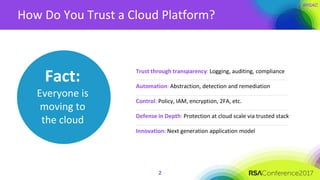
How Do You Trust a Cloud Platform?
Trust through transparency: Logging, auditing, compliance
Automation: Abstraction, detection and remediation
Control: Policy, IAM, encryption, 2FA, etc.
Defense in Depth: Protection at cloud scale via trusted stack
Innovation: Next generation application model
2
Fact:
Everyone is
moving to
the cloud
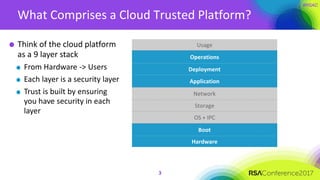
What Comprises a Cloud Trusted Platform?
Usage
Operations
Deployment
Application
Network
Storage
OS + IPC
Boot
Hardware
3
Think of the cloud platform
as a 9 layer stack
From Hardware -> Users
Each layer is a security layer
Trust is built by ensuring
you have security in each
layer
#RSAC
Hardware Layer
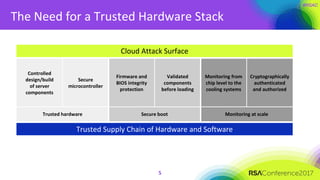
The Need for a Trusted Hardware Stack
5
Trusted Supply Chain of Hardware and Software
Cloud Attack Surface
Controlled
design/build
of server
components
Secure
microcontroller
Firmware and
BIOS integrity
protection
Validated
components
before loading
Monitoring from
chip level to the
cooling systems
Cryptographically
authenticated
and authorized
Trusted hardware Secure boot Monitoring at scale
#RSAC
Boot Layer
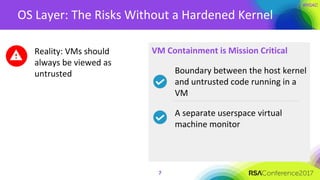
OS Layer: The Risks Without a Hardened Kernel
Reality: VMs should
always be viewed as
untrusted
7
VM Containment is Mission Critical
Boundary between the host kernel
and untrusted code running in a
VM
A separate userspace virtual
machine monitor
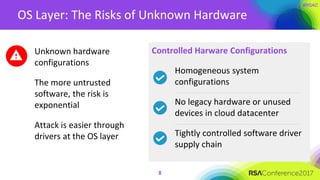
OS Layer: The Risks of Unknown Hardware
Unknown hardware
configurations
The more untrusted
software, the risk is
exponential
Attack is easier through
drivers at the OS layer
8
Controlled Harware Configurations
Homogeneous system
configurations
No legacy hardware or unused
devices in cloud datacenter
Tightly controlled software driver
supply chain
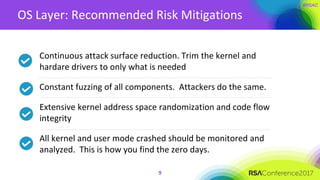
OS Layer: Recommended Risk Mitigations
Continuous attack surface reduction. Trim the kernel and
hardare drivers to only what is needed
Constant fuzzing of all components. Attackers do the same.
Extensive kernel address space randomization and code flow
integrity
All kernel and user mode crashed should be monitored and
analyzed. This is how you find the zero days.
9
#RSAC
Application Layer
#RSAC
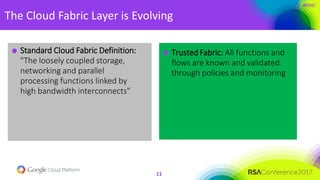
The Cloud Fabric Layer is Evolving
11
Standard Cloud Fabric Definition:
"The loosely coupled storage,
networking and parallel
processing functions linked by
high bandwidth interconnects"
TrustedFabric: All functions and
flows are known and validated
through policies and monitoring
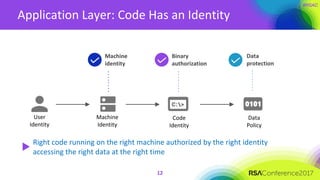
Application Layer: Code Has an Identity
12
Right code running on the right machine authorized by the right identity
accessing the right data at the right time
Data
Policy
Binary
authorization
Data
protection
Machine
Identity
Machine
identity
Code
Identity
User
Identity
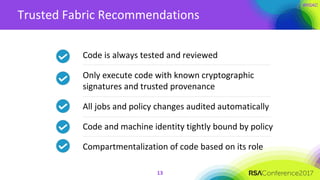
Trusted Fabric Recommendations
Code is always tested and reviewed
Only execute code with known cryptographic
signatures and trusted provenance
All jobs and policy changes audited automatically
Code and machine identity tightly bound by policy
Compartmentalization of code based on its role
13
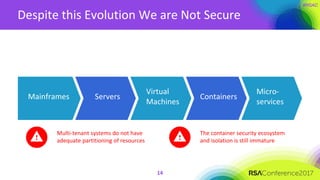
Despite this Evolution We are Not Secure
14
Mainframes ContainersServers
Virtual
Machines
Micro-
services
Multi-tenant systems do not have
adequate partitioning of resources
The container security ecosystem
and isolation is still immature
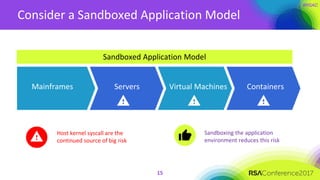
Consider a Sandboxed Application Model
15
Mainframes ContainersServers Virtual Machines
Host kernel syscall are the
continued source of big risk
Sandboxing the application
environment reduces this risk
Sandboxed Application Model
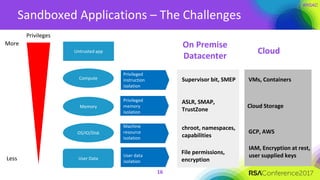
Sandboxed Applications – The Challenges
16
Untrusted app
Memory
Compute
OS/IO/Disk
User Data
Privileges
More
Less
Privileged
instruction
isolation
Privileged
memory
isolation
Machine
resource
isolation
User data
isolation
Supervisor bit, SMEP
ASLR, SMAP,
TrustZone
chroot, namespaces,
capabilities
File permissions,
encryption
VMs, Containers
Cloud Storage
GCP, AWS
IAM, Encryption at rest,
user supplied keys
On Premise
Datacenter
Cloud
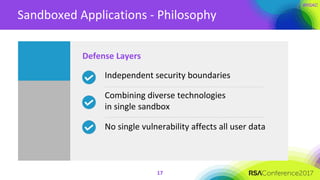
Sandboxed Applications - Philosophy
Defense Layers
17
Independent security boundaries
Combining diverse technologies
in single sandbox
No single vulnerability affects all user data
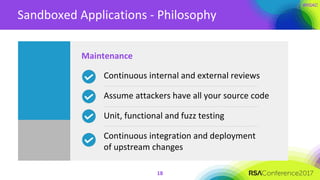
Sandboxed Applications - Philosophy
18
Continuous internal and external reviews
Assume attackers have all your source code
Unit, functional and fuzz testing
Continuous integration and deployment
of upstream changes
Maintenance
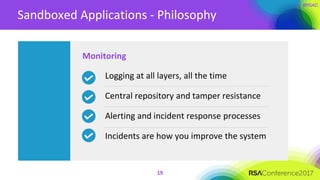
Sandboxed Applications - Philosophy
19
Monitoring
Logging at all layers, all the time
Central repository and tamper resistance
Alerting and incident response processes
Incidents are how you improve the system
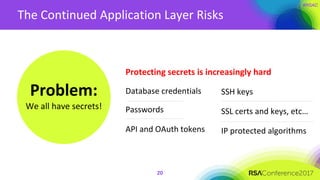
Problem:
We all have secrets!
The Continued Application Layer Risks
Protecting secrets is increasingly hard
Database credentials
Passwords
API and OAuth tokens
20
SSH keys
SSL certs and keys, etc…
IP protected algorithms
The Next Generation Cloud Application Model
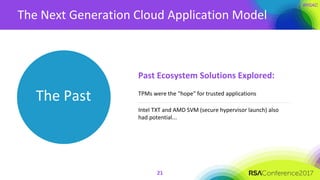
Past Ecosystem Solutions Explored:
TPMs were the "hope" for trusted applications
Intel TXT and AMD SVM (secure hypervisor launch) also
had potential...
21
The Past
The Next Generation Cloud Application Model
22
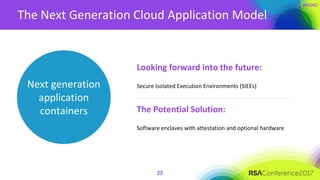
Looking forward into the future:
Secure Isolated Execution Environments (SIEEs)
The Potential Solution:
Software enclaves with attestation and optional hardware
Next generation
application
containers
Next Generation Cloud Apps Using Hardware
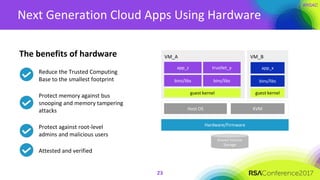
The benefits of hardware
Reduce the Trusted Computing
Base to the smallest footprint
Protect memory against bus
snooping and memory tampering
attacks
Protect against root-level
admins and malicious users
Attested and verified
VM_BVM_A
app_z
bins/libs
app_x
bins/libs
trustlet_y
bins/libs
guest kernel
Shared Volume
Storage
Hardware/Firmware
guest kernel
KVMHost OS
23
The Next Generation Cloud Application Model
24
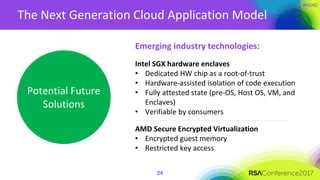
Emerging industry technologies:
Intel SGX hardware enclaves
• Dedicated HW chip as a root-of-trust
• Hardware-assisted isolation of code execution
• Fully attested state (pre-OS, Host OS, VM, and
Enclaves)
• Verifiable by consumers
AMD Secure Encrypted Virtualization
• Encrypted guest memory
• Restricted key access
Potential Future
Solutions
#RSAC
Deployment Layer
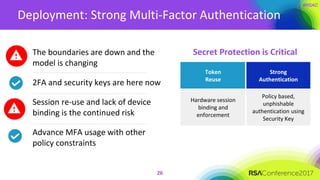
Deployment: Strong Multi-Factor Authentication
The boundaries are down and the
model is changing
2FA and security keys are here now
Session re-use and lack of device
binding is the continued risk
Advance MFA usage with other
policy constraints
26
Secret Protection is Critical
Token
Reuse
Strong
Authentication
Hardware session
binding and
enforcement
Policy based,
unphishable
authentication using
Security Key
#RSAC
Operations Layer
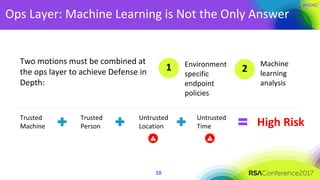
Ops Layer: Machine Learning is Not the Only Answer
28
Trusted
Machine
Trusted
Person
Untrusted
Location
Untrusted
Time High Risk
Environment
specific
endpoint
policies
Machine
learning
analysis
Two motions must be combined at
the ops layer to achieve Defense in
Depth:
1 2
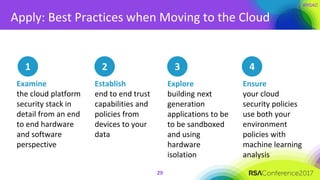
Apply: Best Practices when Moving to the Cloud
29
1
Examine
the cloud platform
security stack in
detail from an end
to end hardware
and software
perspective
Establish
end to end trust
capabilities and
policies from
devices to your
data
Ensure
your cloud
security policies
use both your
environment
policies with
machine learning
analysis
Explore
building next
generation
applications to be
to be sandboxed
and using
hardware
isolation
2 3 4

What is needed in the next generation cloud trusted platform ?

  • 1.
    SESSION ID:SESSION ID: #RSAC CSV-T10 Directorof Cloud Security Google @MrDBCross David B. Cross What is needed in the Next Generation Cloud trusted platform?
  • 2.
    How Do YouTrust a Cloud Platform? Trust through transparency: Logging, auditing, compliance Automation: Abstraction, detection and remediation Control: Policy, IAM, encryption, 2FA, etc. Defense in Depth: Protection at cloud scale via trusted stack Innovation: Next generation application model 2 Fact: Everyone is moving to the cloud
  • 3.
    What Comprises aCloud Trusted Platform? Usage Operations Deployment Application Network Storage OS + IPC Boot Hardware 3 Think of the cloud platform as a 9 layer stack From Hardware -> Users Each layer is a security layer Trust is built by ensuring you have security in each layer
  • 4.
  • 5.
    The Need fora Trusted Hardware Stack 5 Trusted Supply Chain of Hardware and Software Cloud Attack Surface Controlled design/build of server components Secure microcontroller Firmware and BIOS integrity protection Validated components before loading Monitoring from chip level to the cooling systems Cryptographically authenticated and authorized Trusted hardware Secure boot Monitoring at scale
  • 6.
  • 7.
    OS Layer: TheRisks Without a Hardened Kernel Reality: VMs should always be viewed as untrusted 7 VM Containment is Mission Critical Boundary between the host kernel and untrusted code running in a VM A separate userspace virtual machine monitor
  • 8.
    OS Layer: TheRisks of Unknown Hardware Unknown hardware configurations The more untrusted software, the risk is exponential Attack is easier through drivers at the OS layer 8 Controlled Harware Configurations Homogeneous system configurations No legacy hardware or unused devices in cloud datacenter Tightly controlled software driver supply chain
  • 9.
    OS Layer: RecommendedRisk Mitigations Continuous attack surface reduction. Trim the kernel and hardare drivers to only what is needed Constant fuzzing of all components. Attackers do the same. Extensive kernel address space randomization and code flow integrity All kernel and user mode crashed should be monitored and analyzed. This is how you find the zero days. 9
  • 10.
  • 11.
    #RSAC The Cloud FabricLayer is Evolving 11 Standard Cloud Fabric Definition: "The loosely coupled storage, networking and parallel processing functions linked by high bandwidth interconnects" TrustedFabric: All functions and flows are known and validated through policies and monitoring
  • 12.
    Application Layer: CodeHas an Identity 12 Right code running on the right machine authorized by the right identity accessing the right data at the right time Data Policy Binary authorization Data protection Machine Identity Machine identity Code Identity User Identity
  • 13.
    Trusted Fabric Recommendations Codeis always tested and reviewed Only execute code with known cryptographic signatures and trusted provenance All jobs and policy changes audited automatically Code and machine identity tightly bound by policy Compartmentalization of code based on its role 13
  • 14.
    Despite this EvolutionWe are Not Secure 14 Mainframes ContainersServers Virtual Machines Micro- services Multi-tenant systems do not have adequate partitioning of resources The container security ecosystem and isolation is still immature
  • 15.
    Consider a SandboxedApplication Model 15 Mainframes ContainersServers Virtual Machines Host kernel syscall are the continued source of big risk Sandboxing the application environment reduces this risk Sandboxed Application Model
  • 16.
    Sandboxed Applications –The Challenges 16 Untrusted app Memory Compute OS/IO/Disk User Data Privileges More Less Privileged instruction isolation Privileged memory isolation Machine resource isolation User data isolation Supervisor bit, SMEP ASLR, SMAP, TrustZone chroot, namespaces, capabilities File permissions, encryption VMs, Containers Cloud Storage GCP, AWS IAM, Encryption at rest, user supplied keys On Premise Datacenter Cloud
  • 17.
    Sandboxed Applications -Philosophy Defense Layers 17 Independent security boundaries Combining diverse technologies in single sandbox No single vulnerability affects all user data
  • 18.
    Sandboxed Applications -Philosophy 18 Continuous internal and external reviews Assume attackers have all your source code Unit, functional and fuzz testing Continuous integration and deployment of upstream changes Maintenance
  • 19.
    Sandboxed Applications -Philosophy 19 Monitoring Logging at all layers, all the time Central repository and tamper resistance Alerting and incident response processes Incidents are how you improve the system
  • 20.
    Problem: We all havesecrets! The Continued Application Layer Risks Protecting secrets is increasingly hard Database credentials Passwords API and OAuth tokens 20 SSH keys SSL certs and keys, etc… IP protected algorithms
  • 21.
    The Next GenerationCloud Application Model Past Ecosystem Solutions Explored: TPMs were the "hope" for trusted applications Intel TXT and AMD SVM (secure hypervisor launch) also had potential... 21 The Past
  • 22.
    The Next GenerationCloud Application Model 22 Looking forward into the future: Secure Isolated Execution Environments (SIEEs) The Potential Solution: Software enclaves with attestation and optional hardware Next generation application containers
  • 23.
    Next Generation CloudApps Using Hardware The benefits of hardware Reduce the Trusted Computing Base to the smallest footprint Protect memory against bus snooping and memory tampering attacks Protect against root-level admins and malicious users Attested and verified VM_BVM_A app_z bins/libs app_x bins/libs trustlet_y bins/libs guest kernel Shared Volume Storage Hardware/Firmware guest kernel KVMHost OS 23
  • 24.
    The Next GenerationCloud Application Model 24 Emerging industry technologies: Intel SGX hardware enclaves • Dedicated HW chip as a root-of-trust • Hardware-assisted isolation of code execution • Fully attested state (pre-OS, Host OS, VM, and Enclaves) • Verifiable by consumers AMD Secure Encrypted Virtualization • Encrypted guest memory • Restricted key access Potential Future Solutions
  • 25.
  • 26.
    Deployment: Strong Multi-FactorAuthentication The boundaries are down and the model is changing 2FA and security keys are here now Session re-use and lack of device binding is the continued risk Advance MFA usage with other policy constraints 26 Secret Protection is Critical Token Reuse Strong Authentication Hardware session binding and enforcement Policy based, unphishable authentication using Security Key
  • 27.
  • 28.
    Ops Layer: MachineLearning is Not the Only Answer 28 Trusted Machine Trusted Person Untrusted Location Untrusted Time High Risk Environment specific endpoint policies Machine learning analysis Two motions must be combined at the ops layer to achieve Defense in Depth: 1 2
  • 29.
    Apply: Best Practiceswhen Moving to the Cloud 29 1 Examine the cloud platform security stack in detail from an end to end hardware and software perspective Establish end to end trust capabilities and policies from devices to your data Ensure your cloud security policies use both your environment policies with machine learning analysis Explore building next generation applications to be to be sandboxed and using hardware isolation 2 3 4