Highly Refined Mineral Oil Plasticisers in
Polyolefin-based Hot Melt Adhesives
Dr. Peter Kaali
ASC Spring Convention
29 April 2014, Orlando, FL
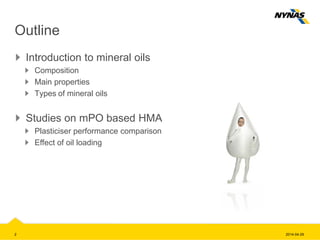
Outline
Introduction to mineral oils
Composition
Main properties
Types of mineral oils
Studies on mPO based HMA
Plasticiser performance comparison
Effect of oil loading
2014-04-292
Introduction to Mineral Oils
3 2014-04-29
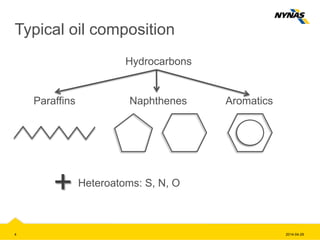
Typical oil composition
Hydrocarbons
Paraffins Naphthenes Aromatics
Heteroatoms: S, N, O
+
2014-04-294
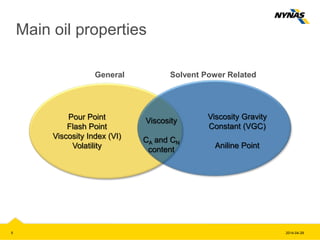
Main oil properties
General Solvent Power Related
5 2014-04-29
Viscosity
CA and CN
content
Viscosity Gravity
Constant (VGC)
Aniline Point
Pour Point
Flash Point
Viscosity Index (VI)
Volatility
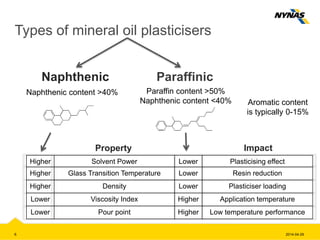
Types of mineral oil plasticisers
2014-04-296
Paraffin content >50%
Naphthenic content <40%
Naphthenic content >40%
Higher Solvent Power Lower Plasticising effect
Higher Glass Transition Temperature Lower Resin reduction
Higher Density Lower Plasticiser loading
Lower Viscosity Index Higher Application temperature
Lower Pour point Higher Low temperature performance
ParaffinicNaphthenic
Property Impact
Aromatic content
is typically 0-15%
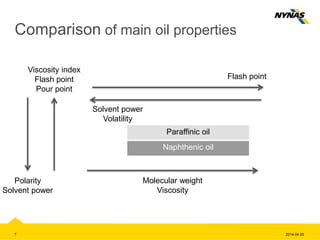
Comparison of main oil properties
Paraffinic oil
Naphthenic oil
Molecular weight
Viscosity
Flash point
Solvent power
Volatility
Polarity
Solvent power
Viscosity index
Flash point
Pour point
2014-04-297
Function of Oil in Adhesives
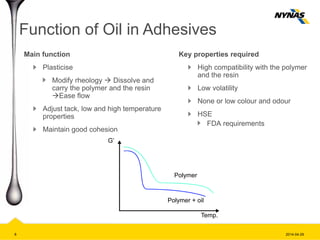
Main function
Plasticise
Modify rheology  Dissolve and
carry the polymer and the resin
Ease flow
Adjust tack, low and high temperature
properties
Maintain good cohesion
Key properties required
High compatibility with the polymer
and the resin
Low volatility
None or low colour and odour
HSE
FDA requirements
8 2014-04-29
G’
Polymer
Polymer + oil
Temp.
Types of adhesives using mineral oil
plasticisers
Hot melts and hot melt pressure
sensitive adhesives
Non-wovens
Tapes and labels
Water and solvent based
Flooring
Sealants
2014-04-299
Studies on mPO Based Hot Melt
Adhesives
10 2014-04-29
Test outline
Studies
Comparison of plasticiser performance
Effect of oil loading
Diaper construction adhesive formulation
Sample preparation
Spray coated to PE non-woven substrate, optimized spray pattern
Levels of add-on: 2, 3 and 4 grams
Analysis
Melt viscosity
T-peels to polymer
Initial at ambient temperature
Initial tested at 37oC after 4 hours conditioning
Aged for 2 weeks at 49oC and tested at ambient temperature
Shear adhesion failure temperature (SAFT)
Dynamic mechanical analysis (DMA)
2014-04-2911
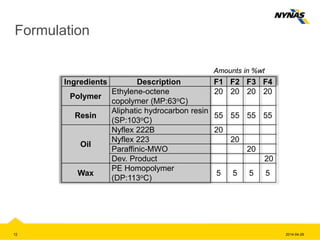
Formulation
Ingredients Description F1 F2 F3 F4
Polymer
Ethylene-octene
copolymer (MP:63oC)
20 20 20 20
Resin
Aliphatic hydrocarbon resin
(SP:103oC)
55 55 55 55
Oil
Nyflex 222B 20
Nyflex 223 20
Paraffinic-MWO 20
Dev. Product 20
Wax
PE Homopolymer
(DP:113oC)
5 5 5 5
Amounts in %wt
2014-04-2912
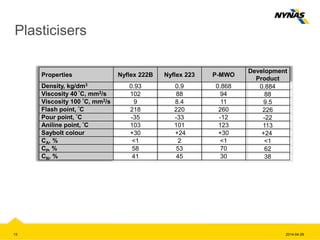
Plasticisers
Properties Nyflex 222B Nyflex 223 P-MWO
Development
Product
Density, kg/dm3 0.93 0.9 0.868 0.884
Viscosity 40 °C, mm2/s 102 88 94 88
Viscosity 100 °C, mm2/s 9 8.4 11 9.5
Flash point, °C 218 220 260 226
Pour point, °C -35 -33 -12 -22
Aniline point, °C 103 101 123 113
Saybolt colour +30 +24 +30 +24
CA, % <1 2 <1 <1
CP, % 58 53 70 62
CN, % 41 45 30 38
2014-04-2913
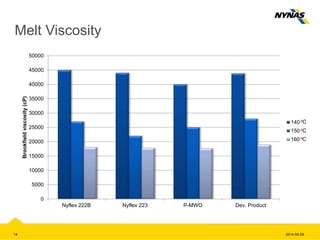
Melt Viscosity
14 2014-04-29
0
5000
10000
15000
20000
25000
30000
35000
40000
45000
50000
Nyflex 222B Nyflex 223 P-MWO Dev. Product
Brookfieldviscosity(cP)
140
150
160
oC
oC
oC
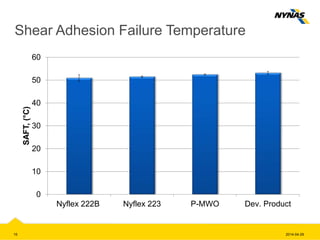
Shear Adhesion Failure Temperature
15 2014-04-29
0
10
20
30
40
50
60
Nyflex 222B Nyflex 223 P-MWO Dev. Product
SAFT,(°C)
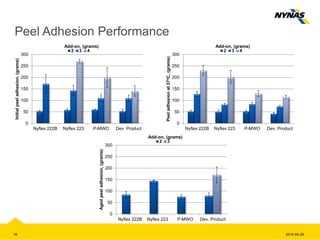
Peel Adhesion Performance
16 2014-04-29
0
50
100
150
200
250
300
Nyflex 222B Nyflex 223 P-MWO Dev. Product
Initialpeeladhesion,(grams)
2 3 4
0
50
100
150
200
250
300
Nyflex 222B Nyflex 223 P-MWO Dev. Product
Peeladhesionat37oC,(grams)
2 3 4
0
50
100
150
200
250
300
Nyflex 222B Nyflex 223 P-MWO Dev. Product
Agedpeeladhesion,(grams)
2 3
Add-on, (grams)
Add-on, (grams) Add-on, (grams)
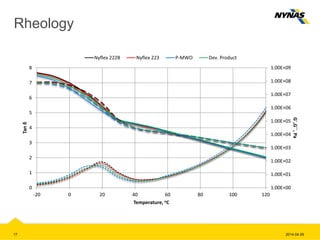
Rheology
2014-04-2917
1.00E+00
1.00E+01
1.00E+02
1.00E+03
1.00E+04
1.00E+05
1.00E+06
1.00E+07
1.00E+08
1.00E+09
0
1
2
3
4
5
6
7
8
-20 0 20 40 60 80 100 120
G´,G´´,Pa
Tanδ
Temperature, oC
Nyflex 222B Nyflex 223 P-MWO Dev. Product
0
0.2
0.4
0.6
0.8
1
1.2
1.4
1.6
1.8
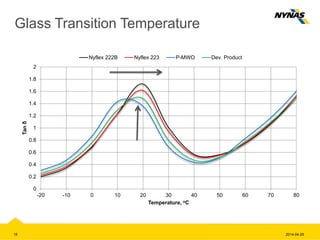
2
-20 -10 0 10 20 30 40 50 60 70 80
Tanδ
Temperature, oC
Nyflex 222B Nyflex 223 P-MWO Dev. Product
Glass Transition Temperature
2014-04-2918
1.00E+03
1.10E+04
2.10E+04
3.10E+04
4.10E+04
5.10E+04
6.10E+04
7.10E+04
8.10E+04
9.10E+04
0
0.2
0.4
0.6
0.8
1
1.2
1.4
1.6
1.8
2
32 33 34 35 36 37 38 39 40 41 42
G´,Pa
Tanδ
Temperature, oC
Nyflex 222B Nyflex 223 P-MWO Dev. Product
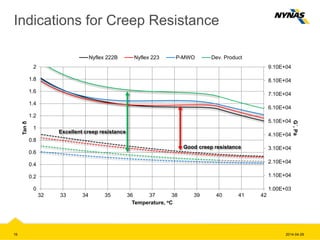
Indications for Creep Resistance
Excellent creep resistance
Good creep resistance
2014-04-2919
Effect of oil loading
20 2014-04-29
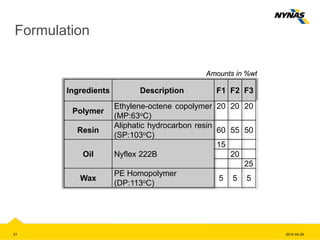
Formulation
Ingredients Description F1 F2 F3
Polymer
Ethylene-octene copolymer
(MP:63oC)
20 20 20
Resin
Aliphatic hydrocarbon resin
(SP:103oC)
60 55 50
Oil Nyflex 222B
15
20
25
Wax
PE Homopolymer
(DP:113oC)
5 5 5
Amounts in %wt
2014-04-2921
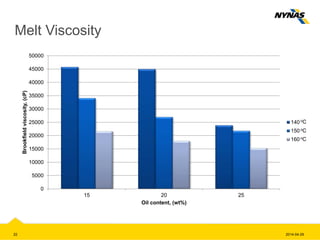
Melt Viscosity
22 2014-04-29
0
5000
10000
15000
20000
25000
30000
35000
40000
45000
50000
15 20 25
Brookfieldviscosity,(cP)
Oil content, (wt%)
140
150
160
oC
oC
oC
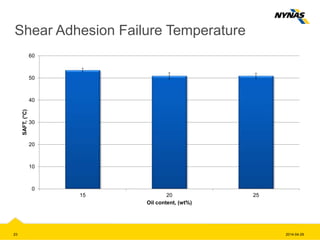
Shear Adhesion Failure Temperature
23 2014-04-29
0
10
20
30
40
50
60
15 20 25
SAFT,(°C)
Oil content, (wt%)
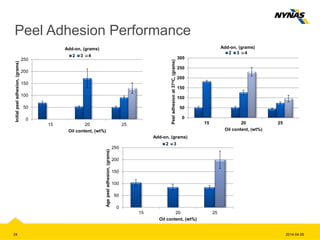
Peel Adhesion Performance
24 2014-04-29
0
50
100
150
200
250
15 20 25
Initialpeeladhesion,(grams)
Oil content, (wt%)
2 3 4
0
50
100
150
200
250
300
15 20 25
Peeladhesionat37oC,(grams)
Oil content, (wt%)
2 3 4
Add-on, (grams)
0
50
100
150
200
250
15 20 25
Agepeeladhesion,(grams)
Oil content, (wt%)
2 3
Add-on, (grams)
Add-on, (grams)
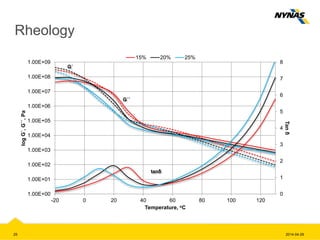
Rheology
25 2014-04-29
0
1
2
3
4
5
6
7
8
1.00E+00
1.00E+01
1.00E+02
1.00E+03
1.00E+04
1.00E+05
1.00E+06
1.00E+07
1.00E+08
1.00E+09
-20 0 20 40 60 80 100 120
Tanδ
logG´,G´´,Pa
Temperature, oC
15% 20% 25%
tanδ
G´
G´´
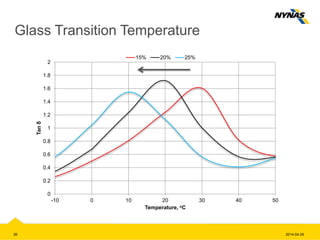
Glass Transition Temperature
26 2014-04-29
0
0.2
0.4
0.6
0.8
1
1.2
1.4
1.6
1.8
2
-10 0 10 20 30 40 50
Tanδ
Temperature, oC
15% 20% 25%
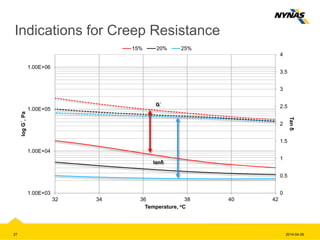
Indications for Creep Resistance
27 2014-04-29
0
0.5
1
1.5
2
2.5
3
3.5
4
1.00E+03
1.00E+04
1.00E+05
1.00E+06
32 34 36 38 40 42
Tanδ
logG´,Pa
Temperature, oC
15% 20% 25%
tanδ
G´
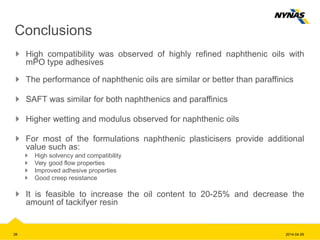
Conclusions
High compatibility was observed of highly refined naphthenic oils with
mPO type adhesives
The performance of naphthenic oils are similar or better than paraffinics
SAFT was similar for both naphthenics and paraffinics
Higher wetting and modulus observed for naphthenic oils
For most of the formulations naphthenic plasticisers provide additional
value such as:
High solvency and compatibility
Very good flow properties
Improved adhesive properties
Good creep resistance
It is feasible to increase the oil content to 20-25% and decrease the
amount of tackifyer resin
2014-04-2928
Nynas Group Head Office
P.O. Box 10700
SE-121 29 Stockholm
Sweden
Tel. +46-8-602 12 00
Fax +46-8-91 34 27
info@nynas.com
29

T03 2-140424100213-phpapp01

  • 1.
    Highly Refined MineralOil Plasticisers in Polyolefin-based Hot Melt Adhesives Dr. Peter Kaali ASC Spring Convention 29 April 2014, Orlando, FL
  • 2.
    Outline Introduction to mineraloils Composition Main properties Types of mineral oils Studies on mPO based HMA Plasticiser performance comparison Effect of oil loading 2014-04-292
  • 3.
    Introduction to MineralOils 3 2014-04-29
  • 4.
    Typical oil composition Hydrocarbons ParaffinsNaphthenes Aromatics Heteroatoms: S, N, O + 2014-04-294
  • 5.
    Main oil properties GeneralSolvent Power Related 5 2014-04-29 Viscosity CA and CN content Viscosity Gravity Constant (VGC) Aniline Point Pour Point Flash Point Viscosity Index (VI) Volatility
  • 6.
    Types of mineraloil plasticisers 2014-04-296 Paraffin content >50% Naphthenic content <40% Naphthenic content >40% Higher Solvent Power Lower Plasticising effect Higher Glass Transition Temperature Lower Resin reduction Higher Density Lower Plasticiser loading Lower Viscosity Index Higher Application temperature Lower Pour point Higher Low temperature performance ParaffinicNaphthenic Property Impact Aromatic content is typically 0-15%
  • 7.
    Comparison of mainoil properties Paraffinic oil Naphthenic oil Molecular weight Viscosity Flash point Solvent power Volatility Polarity Solvent power Viscosity index Flash point Pour point 2014-04-297
  • 8.
    Function of Oilin Adhesives Main function Plasticise Modify rheology  Dissolve and carry the polymer and the resin Ease flow Adjust tack, low and high temperature properties Maintain good cohesion Key properties required High compatibility with the polymer and the resin Low volatility None or low colour and odour HSE FDA requirements 8 2014-04-29 G’ Polymer Polymer + oil Temp.
  • 9.
    Types of adhesivesusing mineral oil plasticisers Hot melts and hot melt pressure sensitive adhesives Non-wovens Tapes and labels Water and solvent based Flooring Sealants 2014-04-299
  • 10.
    Studies on mPOBased Hot Melt Adhesives 10 2014-04-29
  • 11.
    Test outline Studies Comparison ofplasticiser performance Effect of oil loading Diaper construction adhesive formulation Sample preparation Spray coated to PE non-woven substrate, optimized spray pattern Levels of add-on: 2, 3 and 4 grams Analysis Melt viscosity T-peels to polymer Initial at ambient temperature Initial tested at 37oC after 4 hours conditioning Aged for 2 weeks at 49oC and tested at ambient temperature Shear adhesion failure temperature (SAFT) Dynamic mechanical analysis (DMA) 2014-04-2911
  • 12.
    Formulation Ingredients Description F1F2 F3 F4 Polymer Ethylene-octene copolymer (MP:63oC) 20 20 20 20 Resin Aliphatic hydrocarbon resin (SP:103oC) 55 55 55 55 Oil Nyflex 222B 20 Nyflex 223 20 Paraffinic-MWO 20 Dev. Product 20 Wax PE Homopolymer (DP:113oC) 5 5 5 5 Amounts in %wt 2014-04-2912
  • 13.
    Plasticisers Properties Nyflex 222BNyflex 223 P-MWO Development Product Density, kg/dm3 0.93 0.9 0.868 0.884 Viscosity 40 °C, mm2/s 102 88 94 88 Viscosity 100 °C, mm2/s 9 8.4 11 9.5 Flash point, °C 218 220 260 226 Pour point, °C -35 -33 -12 -22 Aniline point, °C 103 101 123 113 Saybolt colour +30 +24 +30 +24 CA, % <1 2 <1 <1 CP, % 58 53 70 62 CN, % 41 45 30 38 2014-04-2913
  • 14.
    Melt Viscosity 14 2014-04-29 0 5000 10000 15000 20000 25000 30000 35000 40000 45000 50000 Nyflex222B Nyflex 223 P-MWO Dev. Product Brookfieldviscosity(cP) 140 150 160 oC oC oC
  • 15.
    Shear Adhesion FailureTemperature 15 2014-04-29 0 10 20 30 40 50 60 Nyflex 222B Nyflex 223 P-MWO Dev. Product SAFT,(°C)
  • 16.
    Peel Adhesion Performance 162014-04-29 0 50 100 150 200 250 300 Nyflex 222B Nyflex 223 P-MWO Dev. Product Initialpeeladhesion,(grams) 2 3 4 0 50 100 150 200 250 300 Nyflex 222B Nyflex 223 P-MWO Dev. Product Peeladhesionat37oC,(grams) 2 3 4 0 50 100 150 200 250 300 Nyflex 222B Nyflex 223 P-MWO Dev. Product Agedpeeladhesion,(grams) 2 3 Add-on, (grams) Add-on, (grams) Add-on, (grams)
  • 17.
    Rheology 2014-04-2917 1.00E+00 1.00E+01 1.00E+02 1.00E+03 1.00E+04 1.00E+05 1.00E+06 1.00E+07 1.00E+08 1.00E+09 0 1 2 3 4 5 6 7 8 -20 0 2040 60 80 100 120 G´,G´´,Pa Tanδ Temperature, oC Nyflex 222B Nyflex 223 P-MWO Dev. Product
  • 18.
    0 0.2 0.4 0.6 0.8 1 1.2 1.4 1.6 1.8 2 -20 -10 010 20 30 40 50 60 70 80 Tanδ Temperature, oC Nyflex 222B Nyflex 223 P-MWO Dev. Product Glass Transition Temperature 2014-04-2918
  • 19.
    1.00E+03 1.10E+04 2.10E+04 3.10E+04 4.10E+04 5.10E+04 6.10E+04 7.10E+04 8.10E+04 9.10E+04 0 0.2 0.4 0.6 0.8 1 1.2 1.4 1.6 1.8 2 32 33 3435 36 37 38 39 40 41 42 G´,Pa Tanδ Temperature, oC Nyflex 222B Nyflex 223 P-MWO Dev. Product Indications for Creep Resistance Excellent creep resistance Good creep resistance 2014-04-2919
  • 20.
    Effect of oilloading 20 2014-04-29
  • 21.
    Formulation Ingredients Description F1F2 F3 Polymer Ethylene-octene copolymer (MP:63oC) 20 20 20 Resin Aliphatic hydrocarbon resin (SP:103oC) 60 55 50 Oil Nyflex 222B 15 20 25 Wax PE Homopolymer (DP:113oC) 5 5 5 Amounts in %wt 2014-04-2921
  • 22.
    Melt Viscosity 22 2014-04-29 0 5000 10000 15000 20000 25000 30000 35000 40000 45000 50000 1520 25 Brookfieldviscosity,(cP) Oil content, (wt%) 140 150 160 oC oC oC
  • 23.
    Shear Adhesion FailureTemperature 23 2014-04-29 0 10 20 30 40 50 60 15 20 25 SAFT,(°C) Oil content, (wt%)
  • 24.
    Peel Adhesion Performance 242014-04-29 0 50 100 150 200 250 15 20 25 Initialpeeladhesion,(grams) Oil content, (wt%) 2 3 4 0 50 100 150 200 250 300 15 20 25 Peeladhesionat37oC,(grams) Oil content, (wt%) 2 3 4 Add-on, (grams) 0 50 100 150 200 250 15 20 25 Agepeeladhesion,(grams) Oil content, (wt%) 2 3 Add-on, (grams) Add-on, (grams)
  • 25.
  • 26.
    Glass Transition Temperature 262014-04-29 0 0.2 0.4 0.6 0.8 1 1.2 1.4 1.6 1.8 2 -10 0 10 20 30 40 50 Tanδ Temperature, oC 15% 20% 25%
  • 27.
    Indications for CreepResistance 27 2014-04-29 0 0.5 1 1.5 2 2.5 3 3.5 4 1.00E+03 1.00E+04 1.00E+05 1.00E+06 32 34 36 38 40 42 Tanδ logG´,Pa Temperature, oC 15% 20% 25% tanδ G´
  • 28.
    Conclusions High compatibility wasobserved of highly refined naphthenic oils with mPO type adhesives The performance of naphthenic oils are similar or better than paraffinics SAFT was similar for both naphthenics and paraffinics Higher wetting and modulus observed for naphthenic oils For most of the formulations naphthenic plasticisers provide additional value such as: High solvency and compatibility Very good flow properties Improved adhesive properties Good creep resistance It is feasible to increase the oil content to 20-25% and decrease the amount of tackifyer resin 2014-04-2928
  • 29.
    Nynas Group HeadOffice P.O. Box 10700 SE-121 29 Stockholm Sweden Tel. +46-8-602 12 00 Fax +46-8-91 34 27 info@nynas.com 29