Hypothesis Driven
Development
Small Experiments to Validate the New Strategy, Demonstrate Concrete Action
Items, Forecast ROI
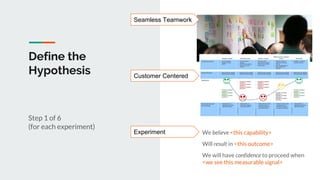
Define the
Hypothesis
Step 1 of 6
(for each experiment)
We believe <this capability>
Will result in <this outcome>
We will have confidence to proceed when
<we see this measurable signal>
Seamless Teamwork
Customer Centered
Experiment
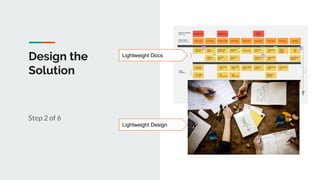
Design the
Solution
Step 2 of 6
Lightweight Docs
Lightweight Design
Build
Step 3 of 6
Together...
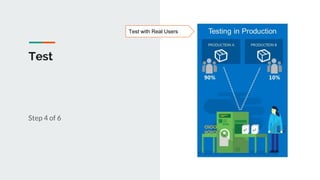
Test
Step 4 of 6
Test with Real Users
Controlled Release
Step 5 of 6
Gather Facts
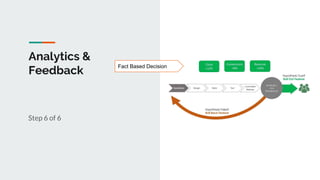
Analytics &
Feedback
Step 6 of 6
Fact Based Decision
What do we need for testing?
Feature Flags
Option 1: Mechanism for gathering
feedback
What it is
A technique to turn some functionality of your
application off, via configuration, without deploying
new code
Why use it
Efficiently and seamlessly manage the
[Dev]-[Test]-[ControlledRelease] lifecycle
We are engaging in actual development so we can
address all three outcomes at once (engagement,
flexibility, cost)
Real Users
Requirements
● Access to Codebase
● Codebase must be capable of supporting it
(needs analysis)
● Able to create a staging environment
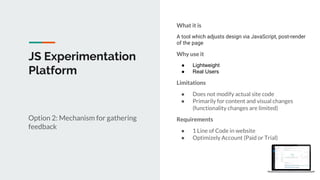
JS Experimentation
Platform
Option 2: Mechanism for gathering
feedback
What it is
A tool which adjusts design via JavaScript, post-render
of the page
Why use it
● Lightweight
● Real Users
Limitations
● Does not modify actual site code
● Primarily for content and visual changes
(functionality changes are limited)
Requirements
● 1 Line of Code in website
● Optimizely Account (Paid or Trial)
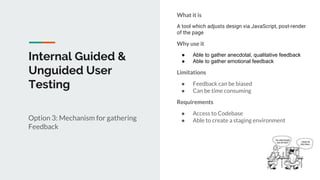
Internal Guided &
Unguided User
Testing
Option 3: Mechanism for gathering
Feedback
What it is
A tool which adjusts design via JavaScript, post-render
of the page
Why use it
● Able to gather anecdotal, qualitative feedback
● Able to gather emotional feedback
Limitations
● Feedback can be biased
● Can be time consuming
Requirements
● Access to Codebase
● Able to create a staging environment
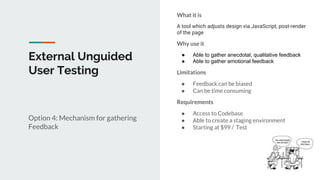
External Unguided
User Testing
Option 4: Mechanism for gathering
Feedback
What it is
A tool which adjusts design via JavaScript, post-render
of the page
Why use it
● Able to gather anecdotal, qualitative feedback
● Able to gather emotional feedback
Limitations
● Feedback can be biased
● Can be time consuming
Requirements
● Access to Codebase
● Able to create a staging environment
● Starting at $99 / Test

Hypothesis driven development

  • 1.
    Hypothesis Driven Development Small Experimentsto Validate the New Strategy, Demonstrate Concrete Action Items, Forecast ROI
  • 3.
    Define the Hypothesis Step 1of 6 (for each experiment) We believe <this capability> Will result in <this outcome> We will have confidence to proceed when <we see this measurable signal> Seamless Teamwork Customer Centered Experiment
  • 4.
    Design the Solution Step 2of 6 Lightweight Docs Lightweight Design
  • 5.
    Build Step 3 of6 Together...
  • 6.
    Test Step 4 of6 Test with Real Users
  • 7.
    Controlled Release Step 5of 6 Gather Facts
  • 8.
    Analytics & Feedback Step 6of 6 Fact Based Decision
  • 9.
    What do weneed for testing?
  • 10.
    Feature Flags Option 1:Mechanism for gathering feedback What it is A technique to turn some functionality of your application off, via configuration, without deploying new code Why use it Efficiently and seamlessly manage the [Dev]-[Test]-[ControlledRelease] lifecycle We are engaging in actual development so we can address all three outcomes at once (engagement, flexibility, cost) Real Users Requirements ● Access to Codebase ● Codebase must be capable of supporting it (needs analysis) ● Able to create a staging environment
  • 11.
    JS Experimentation Platform Option 2:Mechanism for gathering feedback What it is A tool which adjusts design via JavaScript, post-render of the page Why use it ● Lightweight ● Real Users Limitations ● Does not modify actual site code ● Primarily for content and visual changes (functionality changes are limited) Requirements ● 1 Line of Code in website ● Optimizely Account (Paid or Trial)
  • 12.
    Internal Guided & UnguidedUser Testing Option 3: Mechanism for gathering Feedback What it is A tool which adjusts design via JavaScript, post-render of the page Why use it ● Able to gather anecdotal, qualitative feedback ● Able to gather emotional feedback Limitations ● Feedback can be biased ● Can be time consuming Requirements ● Access to Codebase ● Able to create a staging environment
  • 13.
    External Unguided User Testing Option4: Mechanism for gathering Feedback What it is A tool which adjusts design via JavaScript, post-render of the page Why use it ● Able to gather anecdotal, qualitative feedback ● Able to gather emotional feedback Limitations ● Feedback can be biased ● Can be time consuming Requirements ● Access to Codebase ● Able to create a staging environment ● Starting at $99 / Test