Semantic Repository of
Things
Pratik Desai, Ph.D.
pratiK@osiot.org
Open Source Internet of Things (OSIOT)
Pre-Hackathon Project Proposal
www.osiot.org
Why?
• Standardization of data annotation model for “Things”.
• Interoperability in open horizontal platform.
• Provide Graph search on “Thing” database.
• Supplement IoT-toolkit.
www.osiot.org
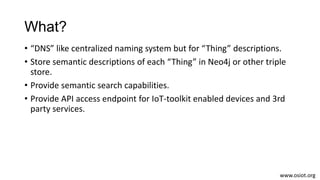
What?
• “DNS” like centralized naming system but for “Thing” descriptions.
• Store semantic descriptions of each “Thing” in Neo4j or other triple
store.
• Provide semantic search capabilities.
• Provide API access endpoint for IoT-toolkit enabled devices and 3rd
party services.
www.osiot.org
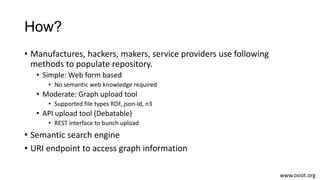
How?
• Manufactures, hackers, makers, service providers use following
methods to populate repository.
• Simple: Web form based
• No semantic web knowledge required
• Moderate: Graph upload tool
• Supported file types RDF, json-ld, n3
• API upload tool (Debatable)
• REST interface to bunch upload
• Semantic search engine
• URI endpoint to access graph information
www.osiot.org
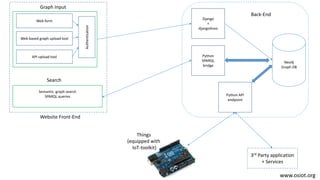
Semantic graph search
SPARQL queries
Web form
Web based graph upload tool
API upload tool
Authentication
3rd Party application
+ Services
Neo4j
Graph DB
Django
+
django4neo
Python
SPARQL
bridge
Python API
endpoint
Graph Input
Search
Website Front-End
Things
(equipped with
IoT-toolkit)
Back-End
www.osiot.org
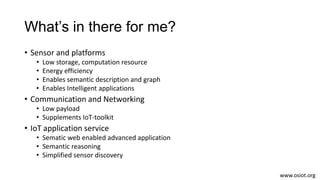
What’s in there for me?
• Sensor and platforms
• Low storage, computation resource
• Energy efficiency
• Enables semantic description and graph
• Enables Intelligent applications
• Communication and Networking
• Low payload
• Supplements IoT-toolkit
• IoT application service
• Sematic web enabled advanced application
• Semantic reasoning
• Simplified sensor discovery
www.osiot.org

Semantic repository of things

  • 1.
    Semantic Repository of Things PratikDesai, Ph.D. pratiK@osiot.org Open Source Internet of Things (OSIOT) Pre-Hackathon Project Proposal www.osiot.org
  • 2.
    Why? • Standardization ofdata annotation model for “Things”. • Interoperability in open horizontal platform. • Provide Graph search on “Thing” database. • Supplement IoT-toolkit. www.osiot.org
  • 3.
    What? • “DNS” likecentralized naming system but for “Thing” descriptions. • Store semantic descriptions of each “Thing” in Neo4j or other triple store. • Provide semantic search capabilities. • Provide API access endpoint for IoT-toolkit enabled devices and 3rd party services. www.osiot.org
  • 4.
    How? • Manufactures, hackers,makers, service providers use following methods to populate repository. • Simple: Web form based • No semantic web knowledge required • Moderate: Graph upload tool • Supported file types RDF, json-ld, n3 • API upload tool (Debatable) • REST interface to bunch upload • Semantic search engine • URI endpoint to access graph information www.osiot.org
  • 5.
    Semantic graph search SPARQLqueries Web form Web based graph upload tool API upload tool Authentication 3rd Party application + Services Neo4j Graph DB Django + django4neo Python SPARQL bridge Python API endpoint Graph Input Search Website Front-End Things (equipped with IoT-toolkit) Back-End www.osiot.org
  • 6.
    What’s in therefor me? • Sensor and platforms • Low storage, computation resource • Energy efficiency • Enables semantic description and graph • Enables Intelligent applications • Communication and Networking • Low payload • Supplements IoT-toolkit • IoT application service • Sematic web enabled advanced application • Semantic reasoning • Simplified sensor discovery www.osiot.org