Why Open Access to Bibliographic
        Metadata Matters,
 for Libraries and for the World


 Open Access and the Changing Role of Libraries, 2010-08-09

            Anders Söderbäck, National Library of Sweden


                                                              www.kb.se
Establishing open access as a worthwhile
procedure ideally requires the active
commitment of each and every individual
producer of scientific knowledge and holder of
cultural heritage. Open access contributions
include original scientific research results, raw
data and metadata, source materials, digital
representations of pictorial and graphical
materials and scholarly multimedia material.
                         - Berlin Declaration on Open Access


                                                     www.kb.se
Establishing open access as a worthwhile
procedure ideally requires the active
commitment of each and every individual
producer of scientific knowledge and holder of
cultural heritage. Open access contributions
include original scientific research results, raw
data and metadata, source materials, digital
representations of pictorial and graphical
materials and scholarly multimedia material.
                         - Berlin Declaration on Open Access


                                                     www.kb.se
Establishing open access as a worthwhile
procedure ideally requires the active
commitment of each and every individual
producer of scientific knowledge and holder of
cultural heritage. Open access contributions
include original scientific research results, raw
data and metadata, source materials, digital
representations of pictorial and graphical
materials and scholarly multimedia material.
                         - Berlin Declaration on Open Access


                                                     www.kb.se
Drivers for Open Access


• Idealistic (access, research, innovation...)
• Materialistic (law, economy...)


                                                 www.kb.se
Information wants to be free, because the cost of
getting it out is getting lower and lower all the time.


                                 - Stewart Brand


                                                          www.kb.se
Information wants to be expensive, because it’s so
valuable. The right information in the right place just
changes your life.

                                - Stewart Brand


                                                          www.kb.se
1968
Henriette Avram invents the MARC-
record...
                              www.kb.se
LIBRIS - Union Catalogue for Swedish
               Research Libraries
• Since 1970
• Cooperation
• Currently maintained and developed by the National
  Library
• Public financed
• Voluntary participation


                                                 www.kb.se
LIBRIS - Union Catalogue for Swedish
                 Research Libraries
•   180 libraries
•   6,5 million bibliographic records
•   20 million holdings
•   Online Public Access (for humans) since 1997
•   Open (or semi-open) bibliographic records since 1997

• No circulation!
• Several methods for exporting data to libraries


                                                    www.kb.se
1989
Tim Berners-Lee invents the World
Wide Web...
                               www.kb.se
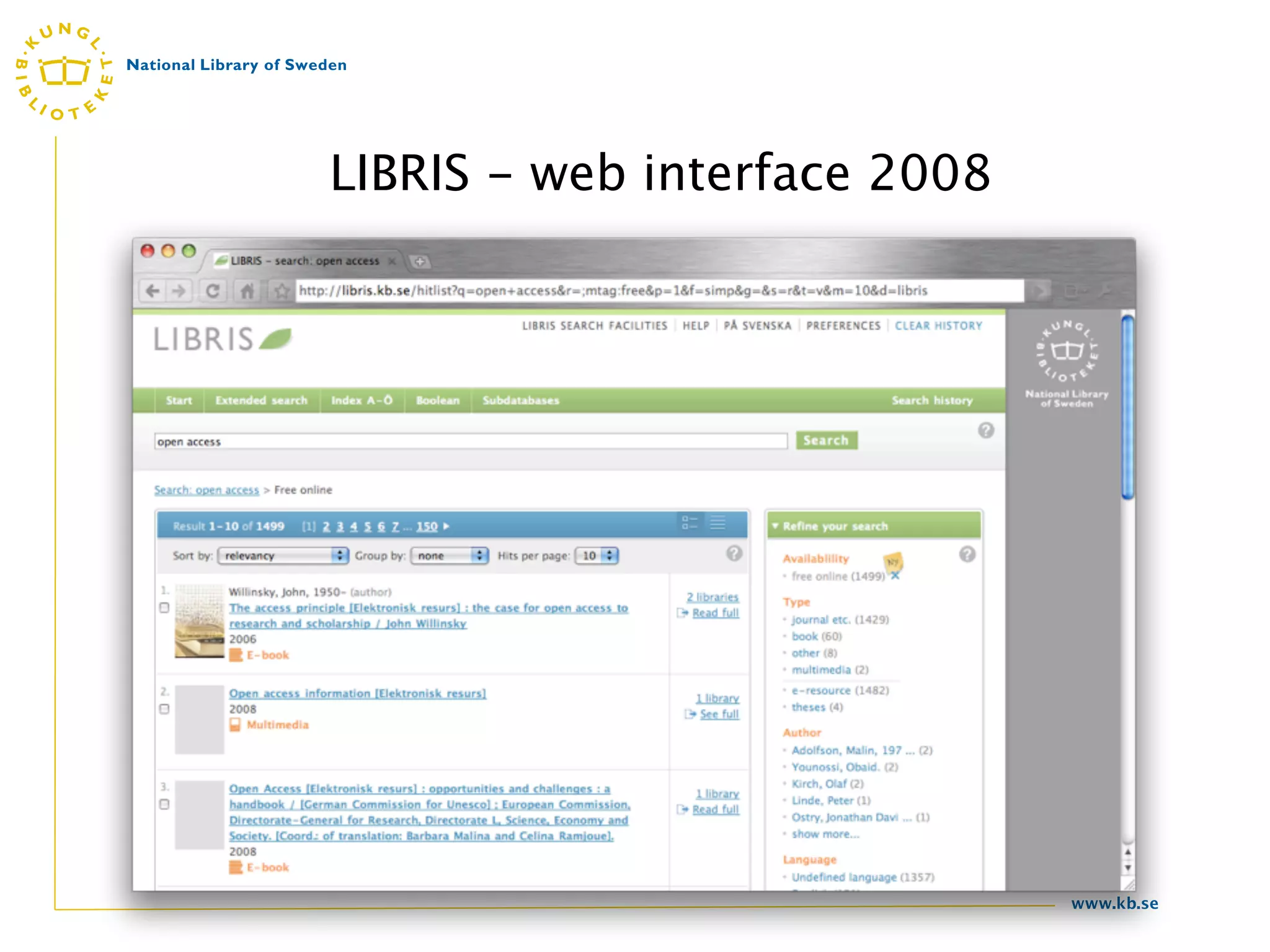
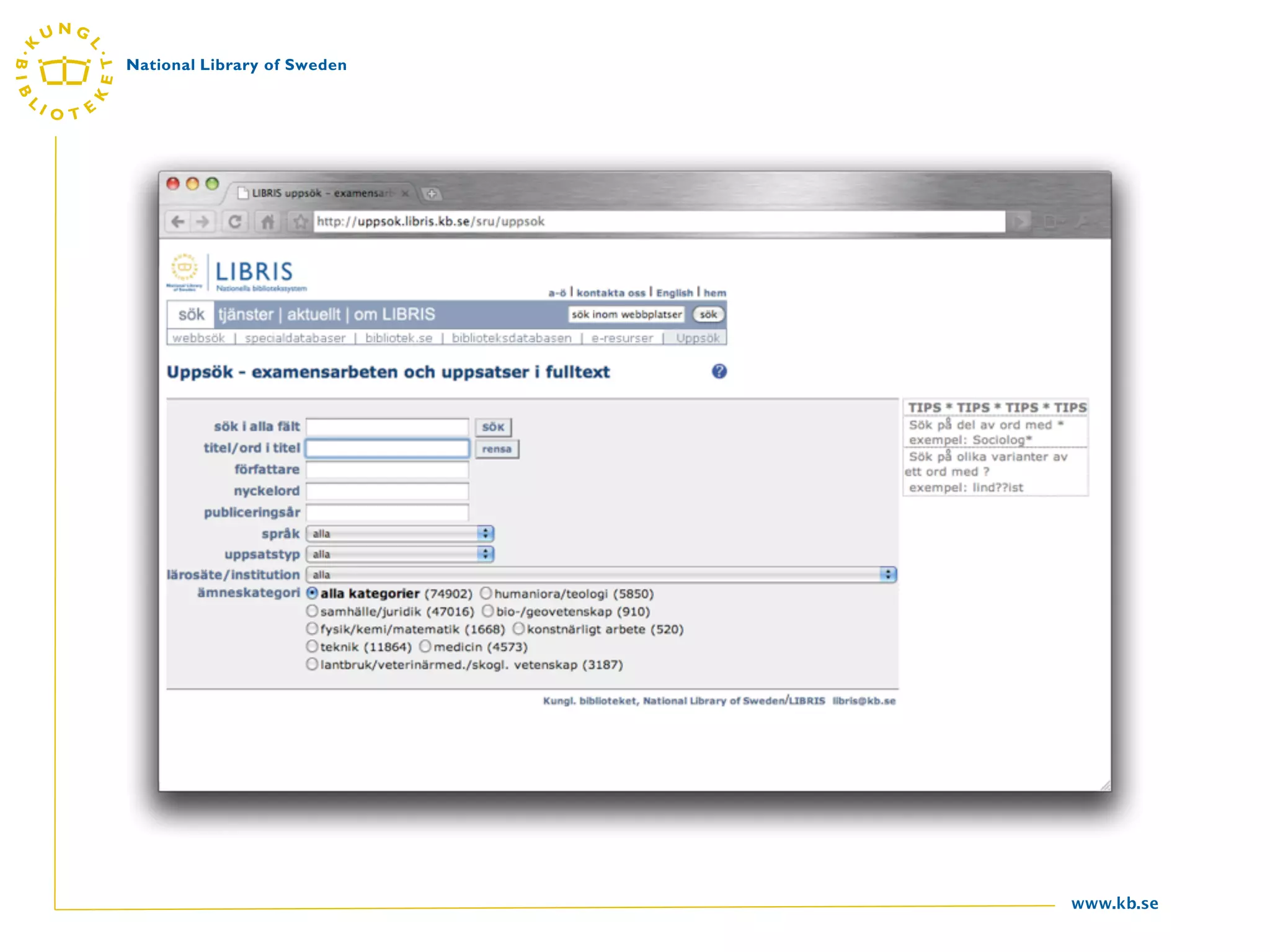
LIBRIS - web interface 2008


                              www.kb.se
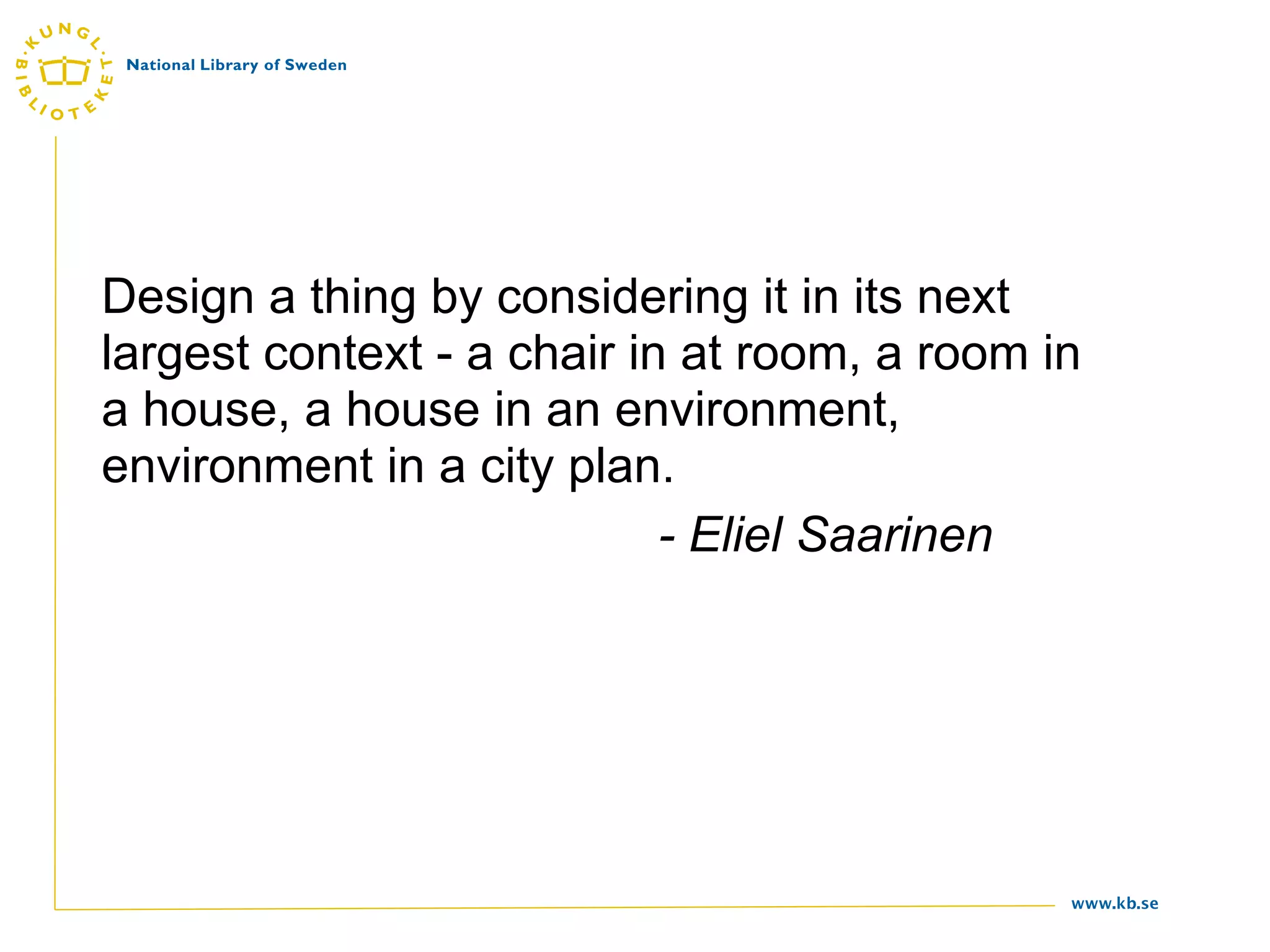
Design a thing by considering it in its next
largest context - a chair in at room, a room in
a house, a house in an environment,
environment in a city plan.
                            - Eliel Saarinen


                                              www.kb.se
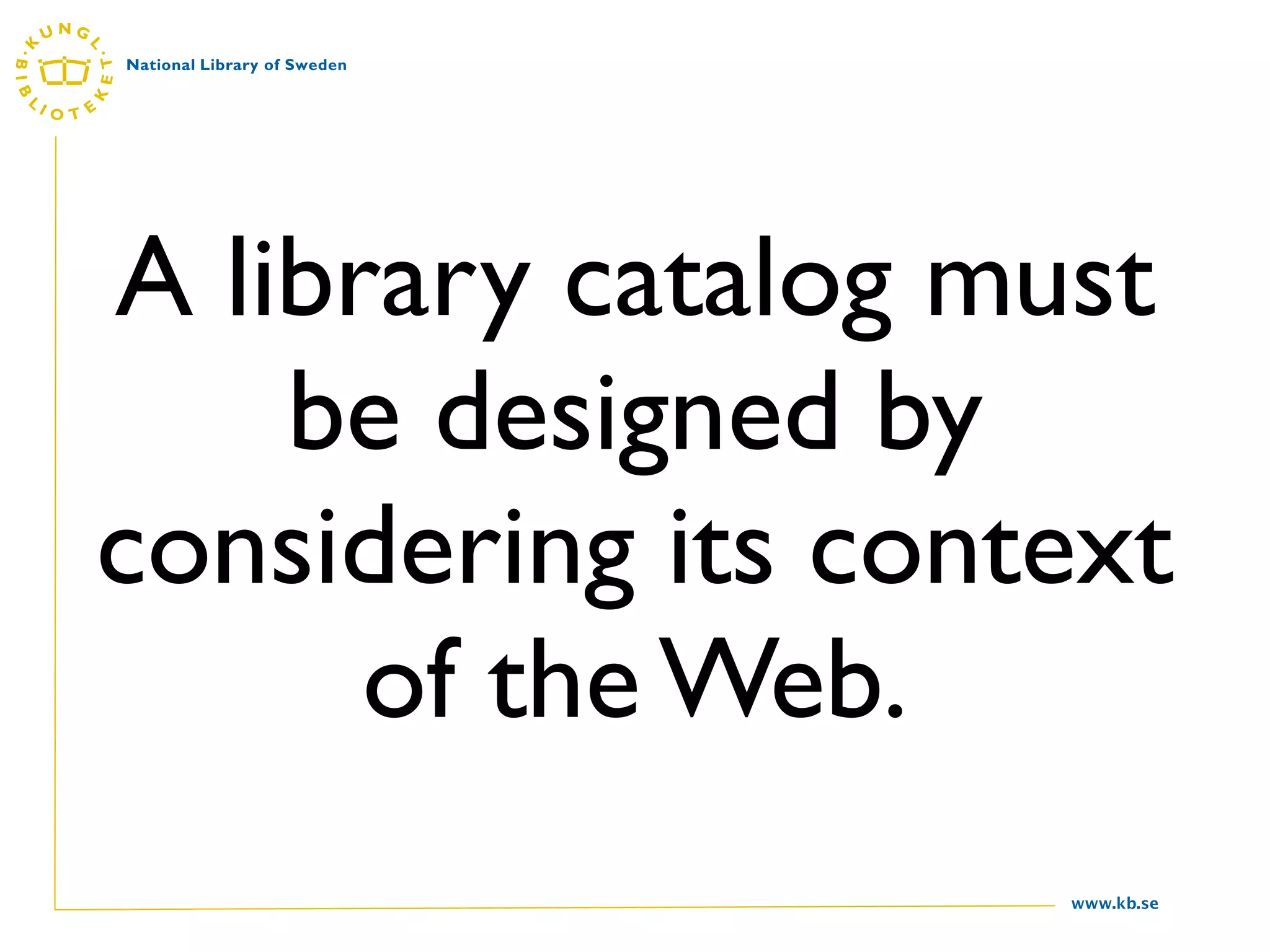
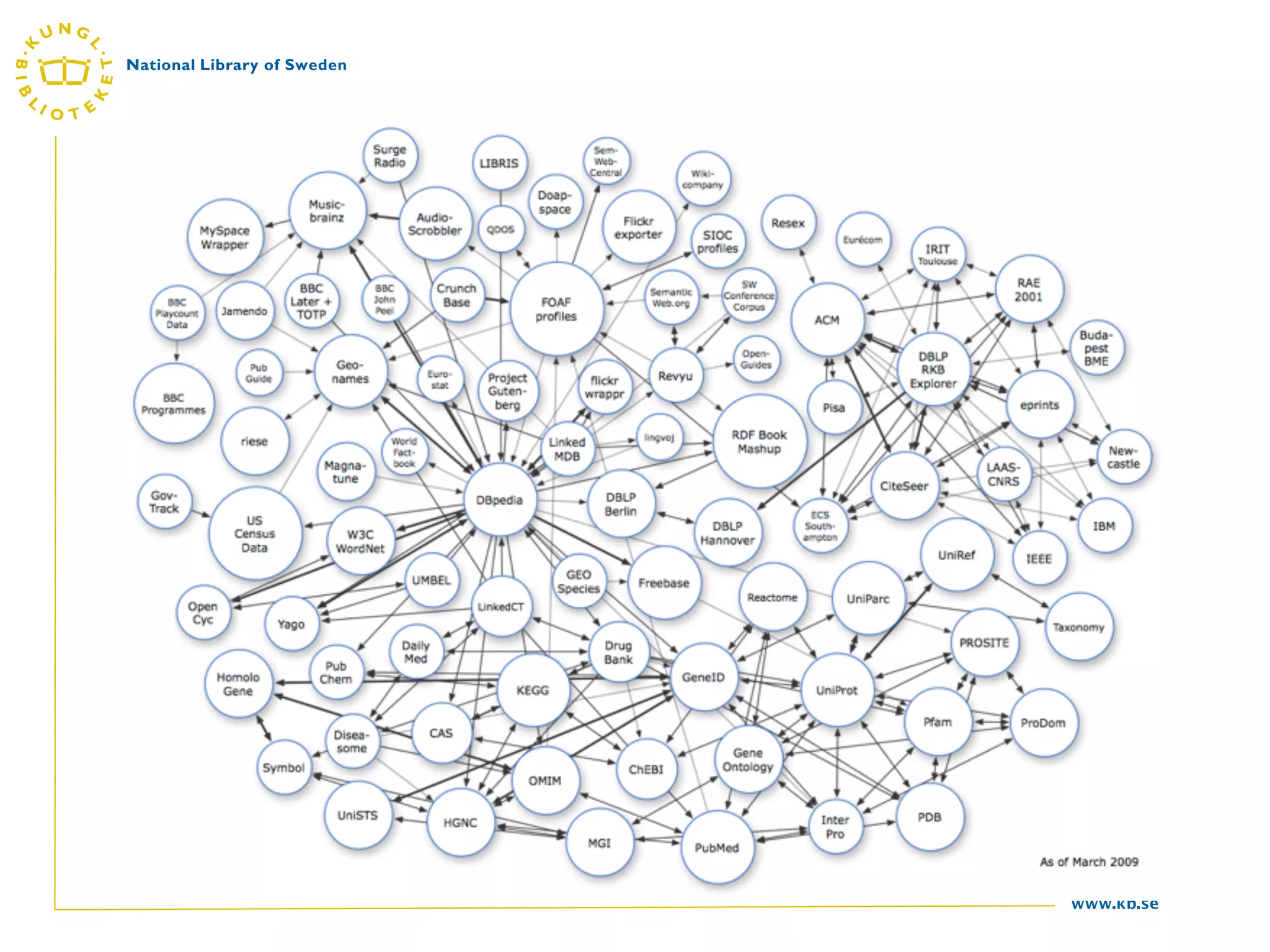
A library catalog must
    be designed by
considering its context
      of the Web.
                    www.kb.se
www.kb.se
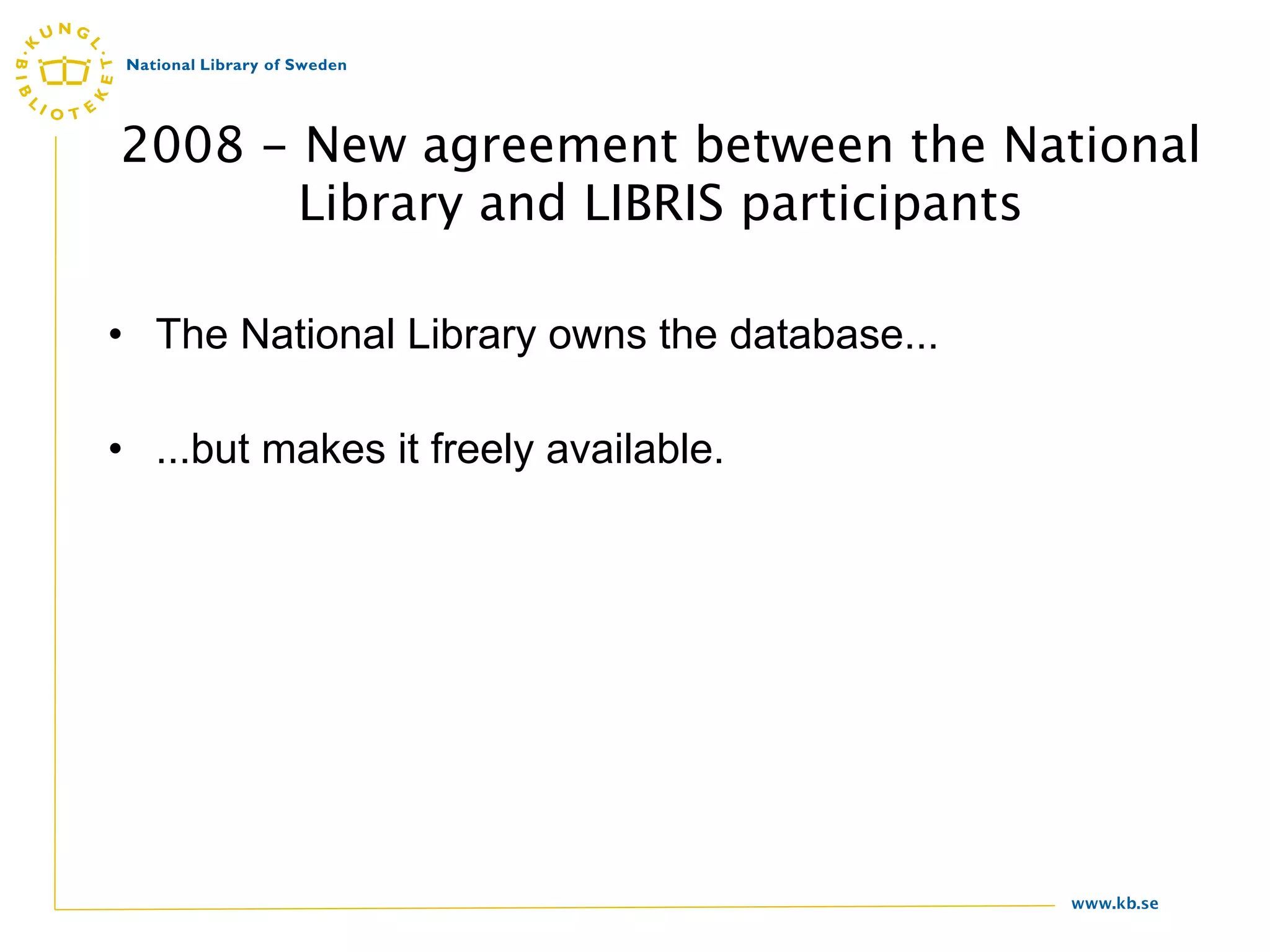
2008 - New agreement between the National
       Library and LIBRIS participants

• The National Library owns the database...


                                              www.kb.se
2008 - New agreement between the National
       Library and LIBRIS participants

• The National Library owns the database...

• ...but makes it freely available.


                                              www.kb.se
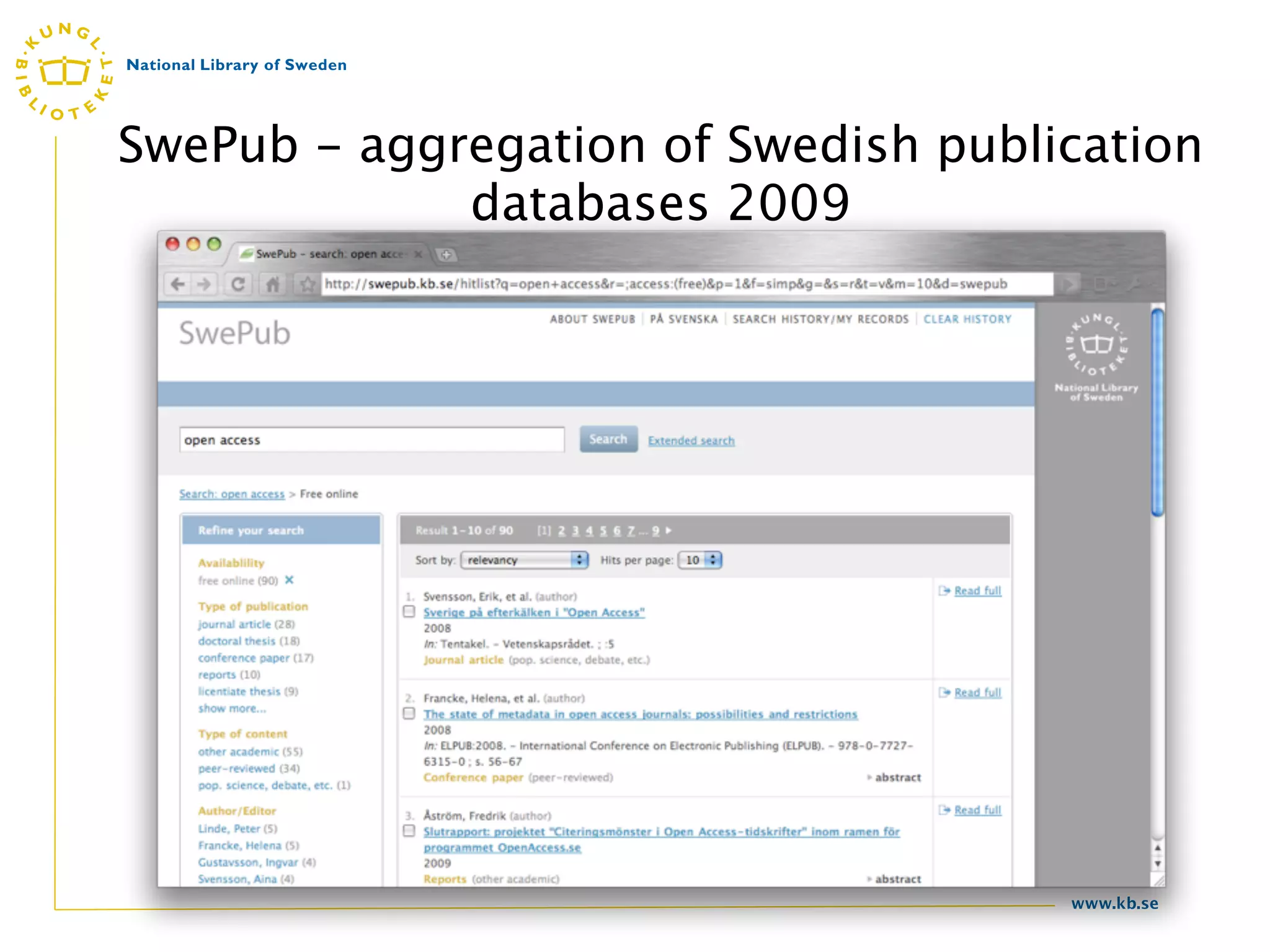
SwePub - aggregation of Swedish publication
             databases 2009


                                     www.kb.se
www.kb.se
www.kb.se
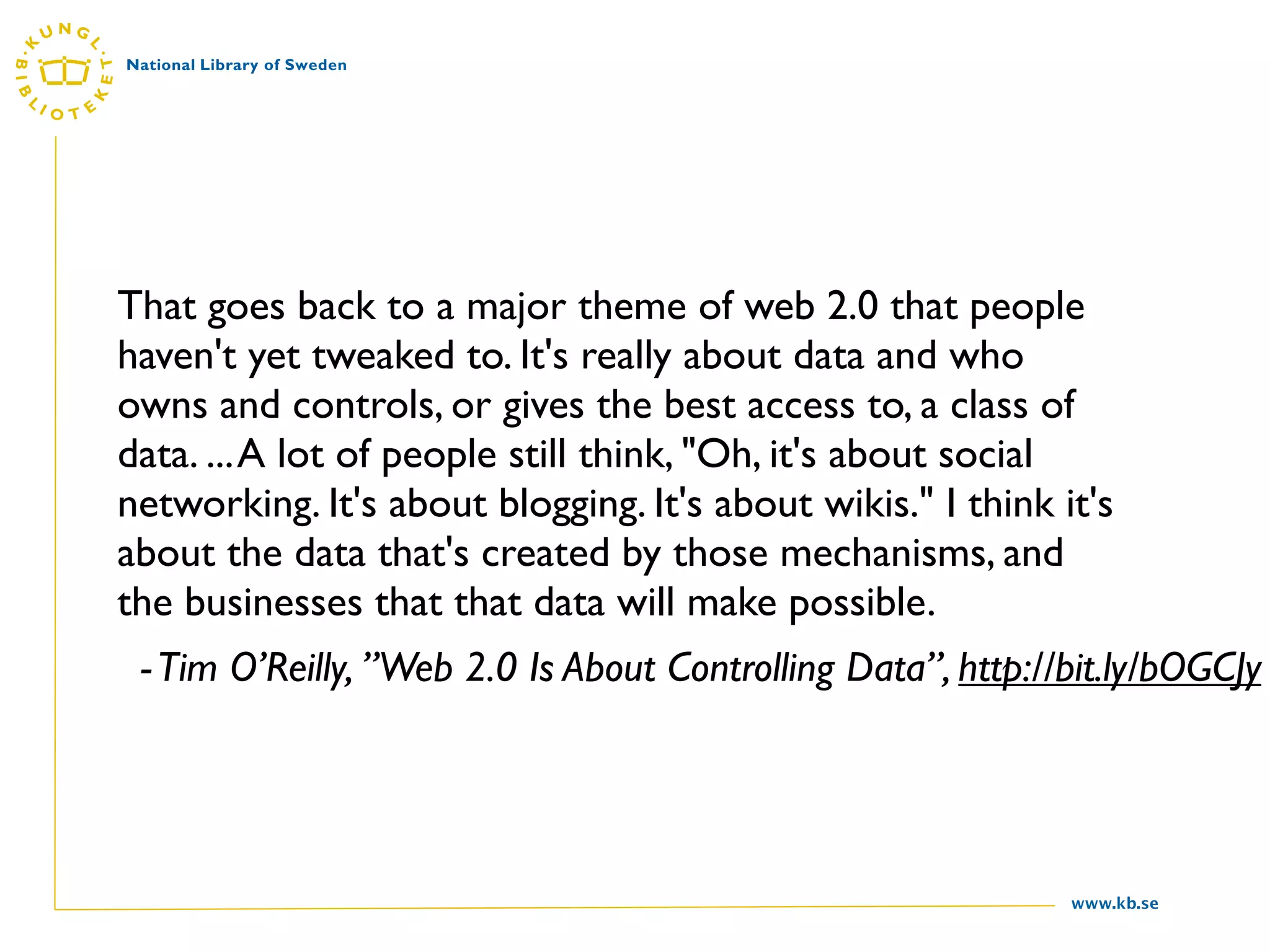
That goes back to a major theme of web 2.0 that people
haven't yet tweaked to. It's really about data and who
owns and controls, or gives the best access to, a class of
data. ... A lot of people still think, "Oh, it's about social
networking. It's about blogging. It's about wikis." I think it's
about the data that's created by those mechanisms, and
the businesses that that data will make possible.
 - Tim O’Reilly, ”Web 2.0 Is About Controlling Data”, http://bit.ly/bOGCJy


                                                             www.kb.se
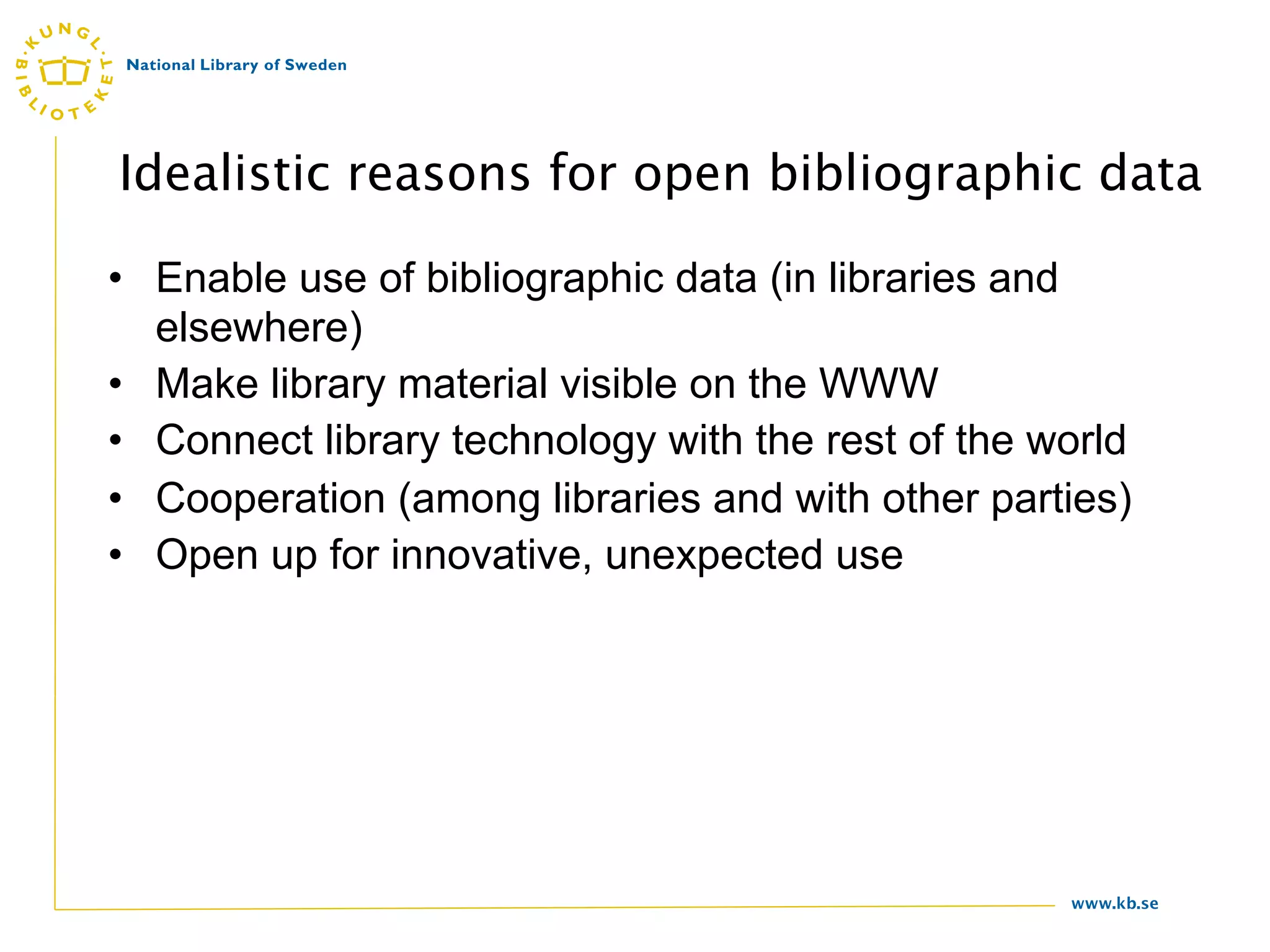
Idealistic reasons for open bibliographic data

• Enable use of bibliographic data (in libraries and
  elsewhere)
• Make library material visible on the WWW
• Connect library technology with the rest of the world
• Cooperation (among libraries and with other parties)
• Open up for innovative, unexpected use


                                                   www.kb.se
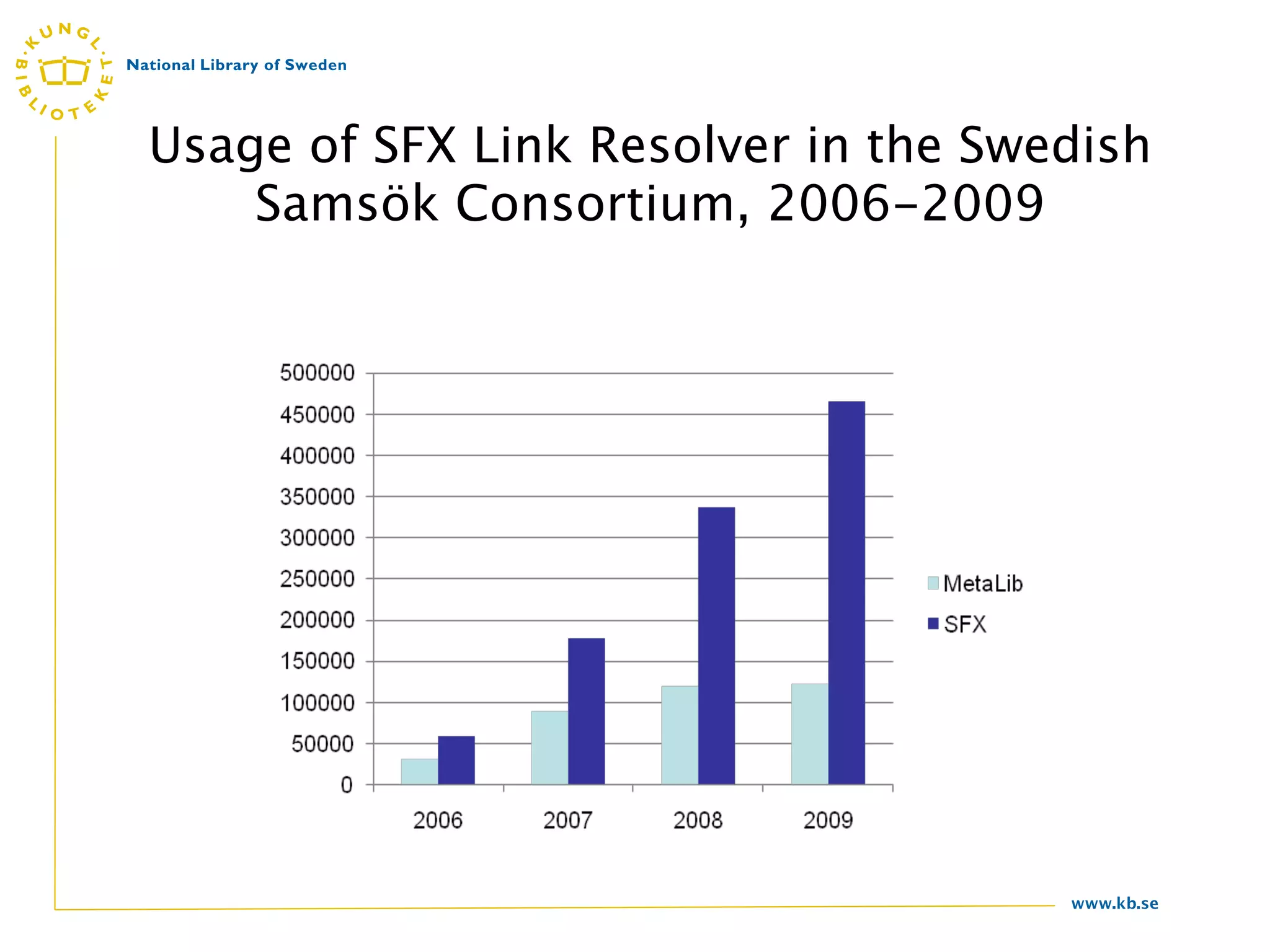
Usage of SFX Link Resolver in the Swedish
    Samsök Consortium, 2006-2009


                                     www.kb.se
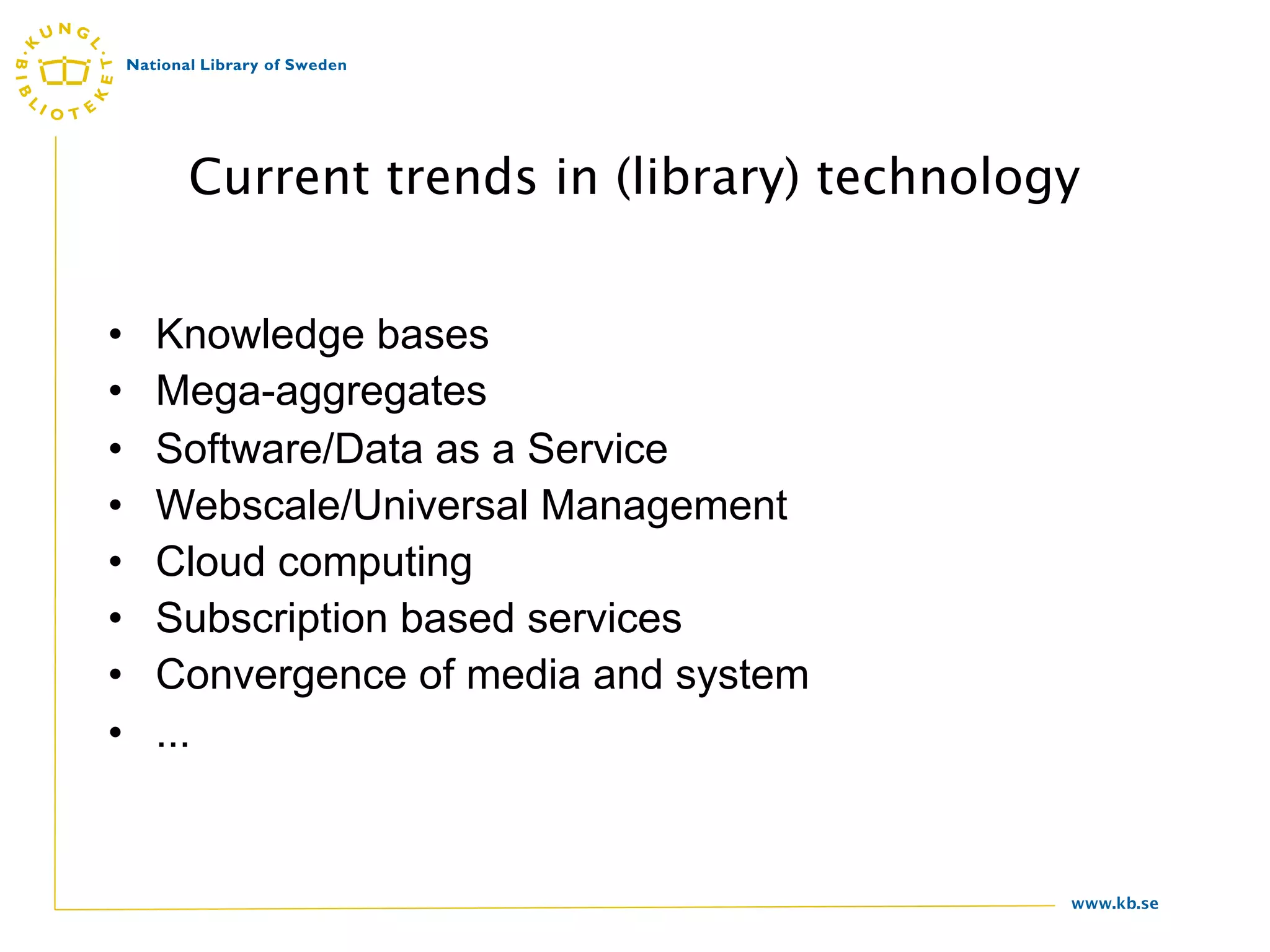
Current trends in (library) technology


•   Knowledge bases
•   Mega-aggregates
•   Software/Data as a Service
•   Webscale/Universal Management
•   Cloud computing
•   Subscription based services
•   Convergence of media and system
•   ...


                                          www.kb.se
The cloud is currently a question, not an
answer.

                    - Lorcan Dempsey, OCLC


                                            www.kb.se
The Internet business ecosystem can thus be seen
as a competition to establish monopolies over
various classes of data. ... [Y]ou have to make sure
that public data remains public!
          -Tim O’Reilly, ”Government as Platform”, http://bit.ly/a7gxrM


                                                            www.kb.se
Materialistic reasons for open bibliographic data


 • Avoid monopolies on aggregation
 • Avoid legal gridlocks
 • Enable the idealistic reasons for open bibliographic
   data
 • Many eggs can be put in many baskets


                                                    www.kb.se
Closing questions


• Who will be the owner of library infrastructure?
• What about non OA-resources?
• Is the big question legal, economical, technical or
  organizational? Or all of this at the same time?
• Do we risk a ”system crisis”?


                                                    www.kb.se
Don’t let the capitalists rip off your
culture and sell it back to you!
                          - Old Hippie Saying


                                           www.kb.se
Thanks!


anders.soderback@kb.se


                         www.kb.se

Why Open Access to Bibliographic Metadata Matters

  • 1.
    Why Open Accessto Bibliographic Metadata Matters, for Libraries and for the World Open Access and the Changing Role of Libraries, 2010-08-09 Anders Söderbäck, National Library of Sweden www.kb.se
  • 2.
    Establishing open accessas a worthwhile procedure ideally requires the active commitment of each and every individual producer of scientific knowledge and holder of cultural heritage. Open access contributions include original scientific research results, raw data and metadata, source materials, digital representations of pictorial and graphical materials and scholarly multimedia material. - Berlin Declaration on Open Access www.kb.se
  • 3.
    Establishing open accessas a worthwhile procedure ideally requires the active commitment of each and every individual producer of scientific knowledge and holder of cultural heritage. Open access contributions include original scientific research results, raw data and metadata, source materials, digital representations of pictorial and graphical materials and scholarly multimedia material. - Berlin Declaration on Open Access www.kb.se
  • 4.
    Establishing open accessas a worthwhile procedure ideally requires the active commitment of each and every individual producer of scientific knowledge and holder of cultural heritage. Open access contributions include original scientific research results, raw data and metadata, source materials, digital representations of pictorial and graphical materials and scholarly multimedia material. - Berlin Declaration on Open Access www.kb.se
  • 5.
    Drivers for OpenAccess • Idealistic (access, research, innovation...) • Materialistic (law, economy...) www.kb.se
  • 6.
    Information wants tobe free, because the cost of getting it out is getting lower and lower all the time. - Stewart Brand www.kb.se
  • 7.
    Information wants tobe expensive, because it’s so valuable. The right information in the right place just changes your life. - Stewart Brand www.kb.se
  • 8.
    1968 Henriette Avram inventsthe MARC- record... www.kb.se
  • 9.
    LIBRIS - UnionCatalogue for Swedish Research Libraries • Since 1970 • Cooperation • Currently maintained and developed by the National Library • Public financed • Voluntary participation www.kb.se
  • 10.
    LIBRIS - UnionCatalogue for Swedish Research Libraries • 180 libraries • 6,5 million bibliographic records • 20 million holdings • Online Public Access (for humans) since 1997 • Open (or semi-open) bibliographic records since 1997 • No circulation! • Several methods for exporting data to libraries www.kb.se
  • 11.
    1989 Tim Berners-Lee inventsthe World Wide Web... www.kb.se
  • 12.
    LIBRIS - webinterface 2008 www.kb.se
  • 13.
    Design a thingby considering it in its next largest context - a chair in at room, a room in a house, a house in an environment, environment in a city plan. - Eliel Saarinen www.kb.se
  • 14.
    A library catalogmust be designed by considering its context of the Web. www.kb.se
  • 15.
  • 16.
    2008 - Newagreement between the National Library and LIBRIS participants • The National Library owns the database... www.kb.se
  • 17.
    2008 - Newagreement between the National Library and LIBRIS participants • The National Library owns the database... • ...but makes it freely available. www.kb.se
  • 18.
    SwePub - aggregationof Swedish publication databases 2009 www.kb.se
  • 19.
  • 20.
  • 21.
    That goes backto a major theme of web 2.0 that people haven't yet tweaked to. It's really about data and who owns and controls, or gives the best access to, a class of data. ... A lot of people still think, "Oh, it's about social networking. It's about blogging. It's about wikis." I think it's about the data that's created by those mechanisms, and the businesses that that data will make possible. - Tim O’Reilly, ”Web 2.0 Is About Controlling Data”, http://bit.ly/bOGCJy www.kb.se
  • 22.
    Idealistic reasons foropen bibliographic data • Enable use of bibliographic data (in libraries and elsewhere) • Make library material visible on the WWW • Connect library technology with the rest of the world • Cooperation (among libraries and with other parties) • Open up for innovative, unexpected use www.kb.se
  • 23.
    Usage of SFXLink Resolver in the Swedish Samsök Consortium, 2006-2009 www.kb.se
  • 24.
    Current trends in(library) technology • Knowledge bases • Mega-aggregates • Software/Data as a Service • Webscale/Universal Management • Cloud computing • Subscription based services • Convergence of media and system • ... www.kb.se
  • 25.
    The cloud iscurrently a question, not an answer. - Lorcan Dempsey, OCLC www.kb.se
  • 26.
    The Internet businessecosystem can thus be seen as a competition to establish monopolies over various classes of data. ... [Y]ou have to make sure that public data remains public! -Tim O’Reilly, ”Government as Platform”, http://bit.ly/a7gxrM www.kb.se
  • 27.
    Materialistic reasons foropen bibliographic data • Avoid monopolies on aggregation • Avoid legal gridlocks • Enable the idealistic reasons for open bibliographic data • Many eggs can be put in many baskets www.kb.se
  • 28.
    Closing questions • Whowill be the owner of library infrastructure? • What about non OA-resources? • Is the big question legal, economical, technical or organizational? Or all of this at the same time? • Do we risk a ”system crisis”? www.kb.se
  • 29.
    Don’t let thecapitalists rip off your culture and sell it back to you! - Old Hippie Saying www.kb.se
  • 30.