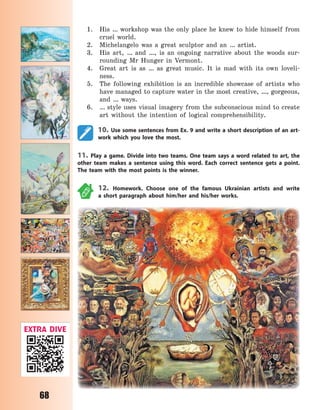
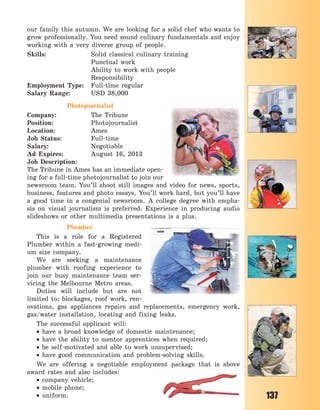
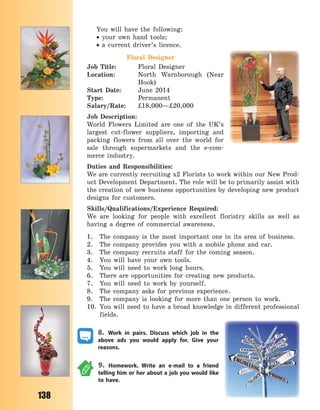
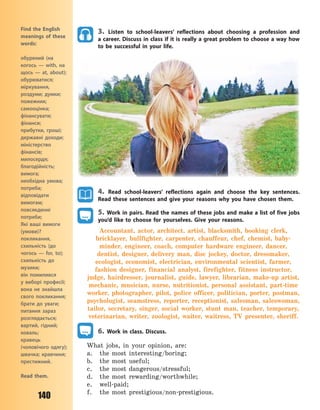
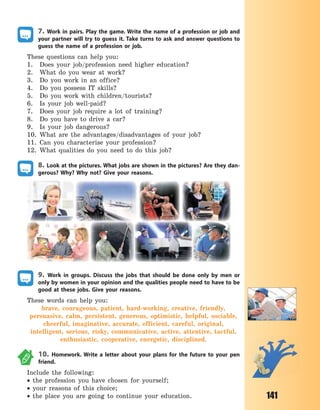
Право для безоплатного розміщення підручника в мережі Інтернет має
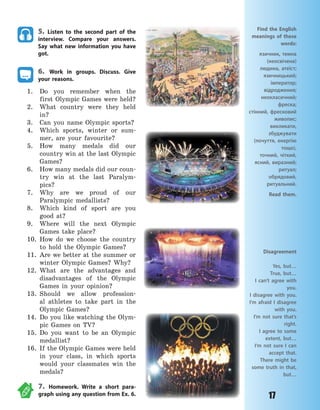
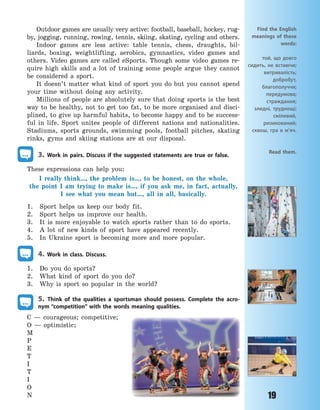
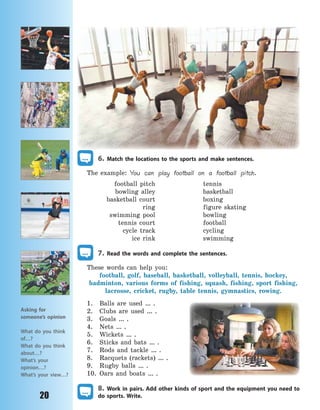
Міністерство освіти і науки України http://mon.gov.ua/ та Інститут модернізації змісту освіти https://imzo.gov.ua
10
В. М. БУРЕНКО
АНГЛІЙСЬКА МОВА
(10-й рік навчання, рівень стандарту)
ПІДРУЧНИК ДЛЯ 10 КЛАСУ
ЗАКЛАДІВ ЗАГАЛЬНОЇ СЕРЕДНЬОЇ ОСВІТИ
VALENTYNA BURENKO
ENGLISH
(Year 10, standard level)
A TEXTBOOK FOR THE TENTH FORM OF SECONDARY SCHOOLS
Рекомендовано
Міністерством освіти і науки України
Харків
Видавництво «Ранок»
2018
Право для безоплатного розміщення підручника в мережі Інтернет має
Міністерство освіти і науки України http://mon.gov.ua/ та Інститут модернізації змісту освіти https://imzo.gov.ua
УДК 811.111(075.3)
Б91
Рекомендовано Міністерством освіти і науки України
(наказ Міністерства освіти і науки України від 31.05.2018 № 551)
Видано за рахунок державних коштів. Продаж заборонено
Burenko, Valentyna
English (Year 10, standard level) : a textbook for the tenth form of secondary schools  /
Valentyna Burenko. — Kharkiv: PH «Ranok», 2018. — 208 p. : ill.
Буренко В. М.
Б91 Англійська мова  (10-й рік навчання, рівень стандарту)  : підруч. для 10 кл. закл. за-
гальн. середн. освіт. / В. М. Буренко. — Харків : Вид-во «Ранок», 2018. — 208 с. : іл.
ISBN 978-617-09-4352-1
УДК 811.111(075.3)
Інтернет-підтримка
Електронні матеріали до підручника
розміщено на сайті
interactive.ranok.com.ua
© В. М. Буренко, 2018
ISBN 978-617-09-4352-1 © ТОВ Видавництво «Ранок», 2018
Право для безоплатного розміщення підручника в мережі Інтернет має
Міністерство освіти і науки України http://mon.gov.ua/ та Інститут модернізації змісту освіти https://imzo.gov.ua
3
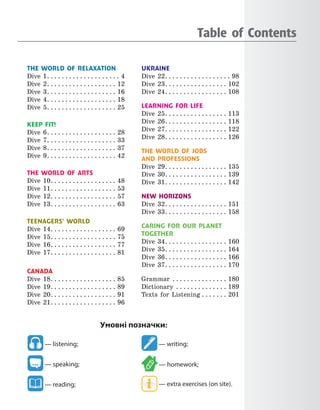
Table of Contents
THE WORLD OF RELAXATION
Dive 1. . . . . . . . . . . . . . . . . . . . 4
Dive 2. . . . . . . . . . . . . . . . . . . 12
Dive 3. . . . . . . . . . . . . . . . . . . 16
Dive 4. . . . . . . . . . . . . . . . . . . 18
Dive 5. . . . . . . . . . . . . . . . . . . 25
KEEP FIT!
Dive 6. . . . . . . . . . . . . . . . . . . 28
Dive 7. . . . . . . . . . . . . . . . . . . 33
Dive 8. . . . . . . . . . . . . . . . . . . 37
Dive 9. . . . . . . . . . . . . . . . . . . 42
THE WORLD OF ARTS
Dive 10. . . . . . . . . . . . . . . . . . 48
Dive 11. . . . . . . . . . . . . . . . . . 53
Dive 12. . . . . . . . . . . . . . . . . . 57
Dive 13. . . . . . . . . . . . . . . . . . 63
TEENAGERS’ WORLD
Dive 14. . . . . . . . . . . . . . . . . . 69
Dive 15. . . . . . . . . . . . . . . . . . 75
Dive 16. . . . . . . . . . . . . . . . . . 77
Dive 17. . . . . . . . . . . . . . . . . . 81
CANADA
Dive 18. . . . . . . . . . . . . . . . . . 85
Dive 19. . . . . . . . . . . . . . . . . . 89
Dive 20. . . . . . . . . . . . . . . . . . 91
Dive 21. . . . . . . . . . . . . . . . . . 96
UKRAINE
Dive 22. . . . . . . . . . . . . . . . . . 98
Dive 23. . . . . . . . . . . . . . . . . 102
Dive 24. . . . . . . . . . . . . . . . . 108
LEARNING FOR LIFE
Dive 25. . . . . . . . . . . . . . . . . 113
Dive 26. . . . . . . . . . . . . . . . . 118
Dive 27. . . . . . . . . . . . . . . . . 122
Dive 28. . . . . . . . . . . . . . . . . 126
THE WORLD OF JOBS
AND PROFESSIONS
Dive 29. . . . . . . . . . . . . . . . . 135
Dive 30. . . . . . . . . . . . . . . . . 139
Dive 31. . . . . . . . . . . . . . . . . 142
NEW HORIZONS
Dive 32. . . . . . . . . . . . . . . . . 151
Dive 33. . . . . . . . . . . . . . . . . 158
CARING FOR OUR PLANET
TOGETHER
Dive 34. . . . . . . . . . . . . . . . . 160
Dive 35. . . . . . . . . . . . . . . . . 164
Dive 36. . . . . . . . . . . . . . . . . 166
Dive 37. . . . . . . . . . . . . . . . . 170
Grammar . . . . . . . . . . . . . . . 180
Dictionary . . . . . . . . . . . . . . 189
Texts for Listening . . . . . . . 201
Умовні позначки:
— listening;
— speaking;
— reading;
— writing;
— homework;
— extra exercises (on site).
Право для безоплатного розміщення підручника в мережі Інтернет має
Міністерство освіти і науки України http://mon.gov.ua/ та Інститут модернізації змісту освіти https://imzo.gov.ua
4
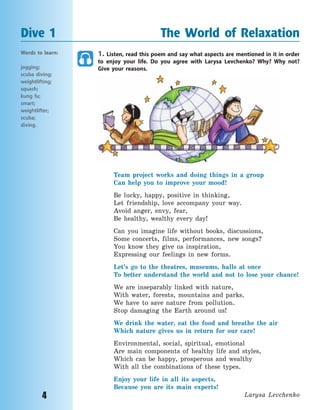
1. Listen, read this poem and say what aspects are mentioned in it in order
to enjoy your life. Do you agree with Larysa Levchenko? Why? Why not?
Give your reasons.
Team project works and doing things in a group
Can help you to improve your mood!
Be lucky, happy, positive in thinking,
Let friendship, love accompany your way.
Avoid anger, envy, fear,
Be healthy, wealthy every day!
Can you imagine life without books, discussions,
Some concerts, films, performances, new songs?
You know they give us inspiration,
Expressing our feelings in new forms.
Let’s go to the theatres, museums, halls at once
To better understand the world and not to lose your chance!
We are inseparably linked with nature,
With water, forests, mountains and parks.
We have to save nature from pollution.
Stop damaging the Earth around us!
We drink the water, eat the food and breathe the air
Which nature gives us in return for our care!
Environmental, social, spiritual, emotional
Are main components of healthy life and styles,
Which can be happy, prosperous and wealthy
With all the combinations of these types.
Enjoy your life in all its aspects,
Because you are its main experts!
Larysa Levchenko
Dive 1 The World of Relaxation
Words to learn:
jogging;
scuba diving;
weightlifting;
squash;
kung fu;
smart;
weightlifter;
scuba;
diving.
Право для безоплатного розміщення підручника в мережі Інтернет має
Міністерство освіти і науки України http://mon.gov.ua/ та Інститут модернізації змісту освіти https://imzo.gov.ua
5
2. Listen, read the words and their definitions, translate them and make
some sentences with these words.
1. jogging [`d45g8] n the activity of running slowly as a form of ex-
ercise
2. scuba diving ['sku:b3 dav8] n the activity or sport of swimming underwater
using special breathing equipment
3. weightlifting ['wetlft8] n the activity or sport of lifting heavy objects
4. squash [skw56] n a game for two or four players using rackets
and a small rubber ball
5. kung fu [~k28 `fu:] n a Chinese system of fighting without weapons
6. smart [sm%:t] adj intelligent; fashionable; quick
3. Work in groups. Which of these activities do you do with your friends?
Put them in order from 1 to 10. 1  — never, 10  — always.
go to the cinema watch live music
go out for a coffee go for a pizza
go dancing go to a bar
have dinner in restaurants go to the theatre/cinema
go to a karaoke bar go for a walk
4. Put the activities into the correct columns.
fishing, yoga, squash, skiing, aerobics, reading, jogging,
swimming, hunting, dancing, chess, photos, gardening, football,
scuba diving, shopping, sailing, surfing, computer games, parachute
jumping, cycling, weightlifting, kung fu, painting, tennis, cooking,
DIY, photography, a musical instrument
PLAY GO DO OTHER VERB
fishing
5. Work in groups. Present your findings to the class.
Find someone who…
a. often goes to the theatre/cinema.
b. would like to go for a coffee after classes.
c. is going on holiday soon.
d. is going out on Sunday night.
e. usually goes home immediately after school.
f. does sports regularly.
g. hates going shopping.
h. likes going dancing at the weekend.
i. sometimes has difficulty in going to sleep.
j. usually goes for a walk with friends.
Find the English
meanings of these
words:
біг підтюпцем;
підводне плавання
з дихальним
апаратом;
стрибки у воду;
водолазна справа;
важка атлетика;
важкоатлет;
штангіст;
гра в м’яч;
кунг-фу, вид
китайської
боротьби;
кмітливий;
здібний;
розумний.
Read them.
Expressing opinions
In my opinion,…
In my view,…
I think (that)…
Personally, I think…
From my point of
view…
I’m not sure (if,
about)…
I don’t have a
definite opinion
about that.
As I see you…
As I see it,…
I don’t think…
Право для безоплатного розміщення підручника в мережі Інтернет має
Міністерство освіти і науки України http://mon.gov.ua/ та Інститут модернізації змісту освіти https://imzo.gov.ua
6
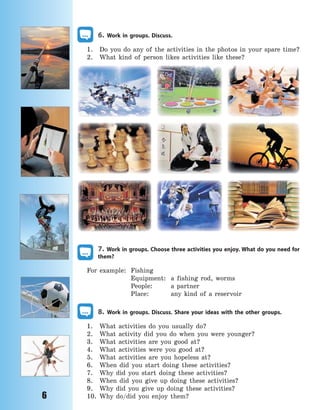
6. Work in groups. Discuss.
1. Do you do any of the activities in the photos in your spare time?
2. What kind of person likes activities like these?
7. Work in groups. Choose three activities you enjoy. What do you need for
them?
For example: Fishing
Equipment: a fishing rod, worms
People: a partner
Place: any kind of a reservoir
8. Work in groups. Discuss. Share your ideas with the other groups.
1. What activities do you usually do?
2. What activity did you do when you were younger?
3. What activities are you good at?
4. What activities were you good at?
5. What activities are you hopeless at?
6. When did you start doing these activities?
7. Why did you start doing these activities?
8. When did you give up doing these activities?
9. Why did you give up doing these activities?
10. Why do/did you enjoy them?
Право для безоплатного розміщення підручника в мережі Інтернет має
Міністерство освіти і науки України http://mon.gov.ua/ та Інститут модернізації змісту освіти https://imzo.gov.ua
7
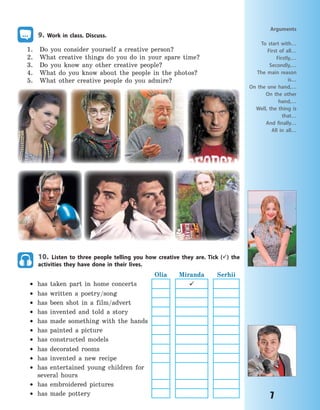
9. Work in class. Discuss.
1. Do you consider yourself a creative person?
2. What creative things do you do in your spare time?
3. Do you know any other creative people?
4. What do you know about the people in the photos?
5. What other creative people do you admire?
10. Listen to three people telling you how creative they are. Tick () the
activities they have done in their lives.
Olia Miranda Serhii
 has taken part in home concerts 
 has written a poetry/song
 has been shot in a film/advert
 has invented and told a story
 has made something with the hands
 has painted a picture
 has constructed models
 has decorated rooms
 has invented a new recipe
 has entertained young children for
several hours
 has embroidered pictures
 has made pottery
Arguments
To start with…
First of all…
Firstly,…
Secondly,…
The main reason
is…
On the one hand,…
On the other
hand,…
Well, the thing is
that…
And finally…
All in all…
Право для безоплатного розміщення підручника в мережі Інтернет має
Міністерство освіти і науки України http://mon.gov.ua/ та Інститут модернізації змісту освіти https://imzo.gov.ua
8
Words to learn:
devoted;
industrious;
inimitable;
unselfish.
SPOT ON WRITING TIPS
A Book Review
A book review is a short description to inform readers of a magazine
or website, etc. about a book you’ve read. Present tenses are usually
used as well as a variety of adjectives to make your description more
specific and interesting.
A review usually includes:
 an introduction giving background information about the book, e.g.
the title, type of the book, the name of the author;
 a main body consisting of two paragraphs, one presenting the main
points of the plot and the other with general comments on the plot,
the main characters, the beginning/ending, etc.;
 a conclusion in which you recommend/don’t recommend the book,
giving reasons.
Useful Hints
The main information on review:
 The book/novel was written by…
 It is … (e.g. a love story).
 The book tells the story of…
 The action takes place in…/during…
 The setting of the story is…
 The story is based on a true story/the author’s own experience.
 The text is (can be) divided into … parts.
Language and style:
 The author’s style is concrete/emphatic/naturalistic/rich in colour
contrasts, etc.
 The author has an eye for details and typical situations.
 The language in this text is quite formal/informal/bookish/rich in
terms borrowed from the sphere of art (philosophy, literary criti-
cism)/close to the language of real life/full of colloquialisms.
To acquaint readers with the main heroes:
 The main/minor characters in this story are…
 I would describe her/him as…
 She/he seems to be … (stupid/boring/lazy/hard-working/honest/dis-
honest/careless, etc.) because…
Comments on the main changes and the development of the events:
 The story begins…/is about…
 The plot is … (boring/thrilling, etc.).
Право для безоплатного розміщення підручника в мережі Інтернет має
Міністерство освіти і науки України http://mon.gov.ua/ та Інститут модернізації змісту освіти https://imzo.gov.ua
9
11. Listen, read the words and their definitions, translate them and make
some sentences with these words.
1. devoted [d`v3td] to smb/smth adj having great love for smb or smth and be-
ing loyal to them
2. industrious [n`d2stri3s] adj hard-working
3. inimitable [`nmt3bl] adj too good for anyone else to copy with the
same effect
4. unselfish [2n`self6] adj caring about others, not just about oneself
12. Read children’s book reviews and write your own review about the
book you have read recently for a teen’s newspaper.
There are different ways of relaxation: reading books, doing sports,
cooking, going shopping, playing computer games, going for walks
and lots more. But in my opinion the best way of relaxation is read-
ing books.
Suggested Answer
It is necessary to mention that a book is one of the greatest won-
ders in the world. It gives us a unique chance to link up with authors
who lived hundreds and thousands of years ago. Thanks to books we
can talk to people who lived in different ages and countries. Through
reading books we can hear their voices, thoughts and feelings.
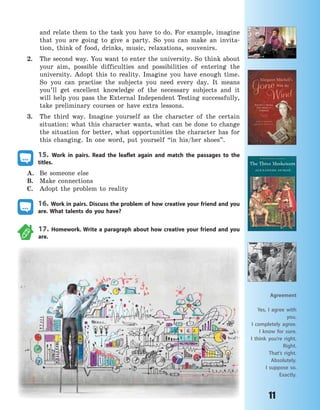
I have read Duma’s novel “D’Artagnan and Three Musketeers”
which is well-known throughout the world. It is an inimitable histor-
ical novel. It describes France in the Middle Ages. It shows us the
relations between France and England.
Alexander Duma was a great master of realistic details. We can
learn a lot about the life of people at that time. The book has an
original plot. All chapters in this novel are very exciting.
The main hero in this novel is D’Artagnan. He is courageous,
strong, and clever. He performs heroic deeds. He is a devoted friend.
Find the English
meanings of these
words:
відданий;
працьовитий;
неповторний;
неегоїстичний;
безкорисний.
Read them.
 The turning point in the story is … when…
 The focus/emphasis is on the nature of their relationship/the prob-
lem of…
 The beginning/ending is (not) surprising (at all).
Opinion and recommendations:
 It’s boring to read.
 I find the story great/interesting/exciting/terrific/sad/awful/funny.
 My point of view is that…
 My first impression was … but later…
 I liked/enjoyed it. I didn’t enjoy it because…
Право для безоплатного розміщення підручника в мережі Інтернет має
Міністерство освіти і науки України http://mon.gov.ua/ та Інститут модернізації змісту освіти https://imzo.gov.ua
10
He and his friends like adventures. They are industrious, kind-heart-
ed, and unselfish. They are always willing to be helpful.
Summing it up, books are the surest way to bring nations togeth-
er. I have read “D’Artagnan and Three Musketeers” from cover to
cover. In my opinion, the book is worth reading.
Books on the Screen and on Stage
Many popular novels and stories have been adapted for the thea-
tre, television, and films. Not all screen and stage adaptations are
successful. Some of them add to the popularity of the book. Others
can only spoil your impressions of it. Brilliant actors and actresses
have appeared in the films based on works of literature.
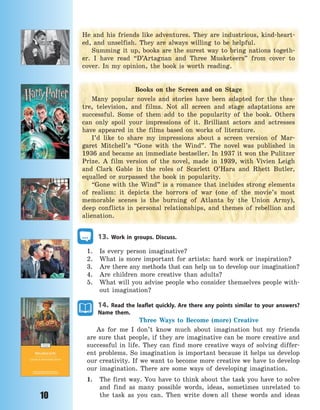
I’d like to share my impressions about a screen version of Mar-
garet Mitchell’s “Gone with the Wind”. The novel was published in
1936 and became an immediate bestseller. In 1937 it won the Pulitzer
Prize. A film version of the novel, made in 1939, with Vivien Leigh
and Clark Gable in the roles of Scarlett O’Hara and Rhett Butler,
equalled or surpassed the book in popularity.
“Gone with the Wind” is a romance that includes strong elements
of realism: it depicts the horrors of war (one of the movie’s most
memorable scenes is the burning of Atlanta by the Union Army),
deep conflicts in personal relationships, and themes of rebellion and
alienation.
13. Work in groups. Discuss.
1. Is every person imaginative?
2. What is more important for artists: hard work or inspiration?
3. Are there any methods that can help us to develop our imagination?
4. Are children more creative than adults?
5. What will you advise people who consider themselves people with-
out imagination?
14. Read the leaflet quickly. Are there any points similar to your answers?
Name them.
Three Ways to Become (more) Creative
As for me I don’t know much about imagination but my friends
are sure that people, if they are imaginative can be more creative and
successful in life. They can find more creative ways of solving differ-
ent problems. So imagination is important because it helps us develop
our creativity. If we want to become more creative we have to develop
our imagination. There are some ways of developing imagination.
1. The first way. You have to think about the task you have to solve
and find as many possible words, ideas, sometimes unrelated to
the task as you can. Then write down all these words and ideas
Право для безоплатного розміщення підручника в мережі Інтернет має
Міністерство освіти і науки України http://mon.gov.ua/ та Інститут модернізації змісту освіти https://imzo.gov.ua
11
and relate them to the task you have to do. For example, imagine
that you are going to give a party. So you can make an invita-
tion, think of food, drinks, music, relaxations, souvenirs.
2. The second way. You want to enter the university. So think about
your aim, possible difficulties and possibilities of entering the
university. Adopt this to reality. Imagine you have enough time.
So you can practise the subjects you need every day. It means
you’ll get excellent knowledge of the necessary subjects and it
will help you pass the External Independent Testing successfully,
take preliminary courses or have extra lessons.
3. The third way. Imagine yourself as the character of the certain
situation: what this character wants, what can be done to change
the situation for better, what opportunities the character has for
this changing. In one word, put yourself “in his/her shoes”.
15. Work in pairs. Read the leaflet again and match the passages to the
titles.
A. Be someone else
B. Make connections
C. Adopt the problem to reality
16. Work in pairs. Discuss the problem of how creative your friend and you
are. What talents do you have?
17. Homework. Write a paragraph about how creative your friend and you
are.
Agreement
Yes, I agree with
you.
I completely agree.
I know for sure.
I think you’re right.
Right.
That’s right.
Absolutely.
I suppose so.
Exactly.
Право для безоплатного розміщення підручника в мережі Інтернет має
Міністерство освіти і науки України http://mon.gov.ua/ та Інститут модернізації змісту освіти https://imzo.gov.ua
12
Dive 2 The World of Relaxation
1. Work in class. Discuss.
1. Which of these trade marks do you recognise?
2. Do you buy things which have a logo on them? Why/Why not?
3. What are your favourite brands?
4. Do you often go to sales?
5. Do you consider yourself a shopaholic?
6. Is shopping a way of relaxation too, in your opinion?
2. Listen, read the words and their definitions, translate them and make
some sentences with these words.
1. to max (smth) out [m0ks] v to reach the limit at which nothing more is possi-
ble
2. pants [p0nts] n (BrE) knickers; (NAmE) trousers
3. shopaholic [~65p3`h5lk] n a person who enjoys shopping very much and
spends too much money and time going shopping
4. shopaholism [~65p3`h5lzm] n an activity concerning senseless purchases; addic-
tion to shopping
5. expense [k`spens] n the money that you spend on smth
6. consequence [`k5nskw3ns] n effect; result
7. to obsess [3b`ses] v to completely fill your mind so that you cannot
think of anything else, in a way that is not normal
Words to learn:
to obsess;
to max (smth) out;
pants;
shopaholic;
shopaholism;
expense;
consequence;
at my expense;
incidental expenses;
a person of
consequence;
in consequence of.
Expressing opinions
In my opinion,…
In my view,…
I think (that)…
Personally, I think…
From my point of
view…
I’m not sure (if,
about)…
I don’t have a
definite opinion
about that.
As I see you…
As I see it,…
I don’t think…
Право для безоплатного розміщення підручника в мережі Інтернет має
Міністерство освіти і науки України http://mon.gov.ua/ та Інститут модернізації змісту освіти https://imzo.gov.ua
13
3. Work in groups. Listen to the first part of the talk between Agony Aunt
and Jenefier. Answer the questions.
1. What kind of problem does she have?
2. What would you recommend to a person like this?
4. Listen to the second part of the talk. Compare Agony Aunt’s advice and
yours.
5. Work in groups. Discuss.
1. Have you ever wanted to buy anything that you’ve seen in a film
or on TV?
2. Are you influenced by clothes that celebrities wear?
6. Match the words to their definitions and opposites.
7. Work individually. Read the text. For each of the empty
spaces (1—8) choose the correct words from Ex. 6 (not all
the words are used).
8. Work in groups. Discuss. What/Who can persuade you to buy things?
Asking for
someone’s opinion
What do you think
of…?
What do you think
about…?
What’s your
opinion…?
What’s your view…?
Find the English
meanings of these
words:
найвища міра
стягнення;
BrE розм.
бриджі,
спортивні штани;
шопоголік;
витрати;
за мій рахунок,
моїм коштом;
непередбачені
витрати;
наслідок;
впливова (поважна)
особа;
в результаті,
внаслідок чогось,
завдяки чомусь;
заволодівати
розумом, не давати
спокою;
гнітити (про ідею,
страх тощо).
Read them.
FOCUS ON GRAMMAR
An embedded question is a question that is included in another sentence.
Question Embedded Question
What is your name? Can you tell me what your name is?
What foreign language does
your sister speak perfectly?
Do you know what foreign language
your sister speaks perfectly?
What university is his
brother going to enter?
I don’t know what university his
brother is going to enter.
Notice the shift in the verb when you embed an information question.
Use normal sentence order, not question order with embedded questions.
Note: If the embedding question is included in a question, it is fol-
lowed by a question mark. If it is in a statement, use a period.
Embedded Yes/No Questions
Use if or whether to embed questions that are answered with yes or no.
Question Embedded Yes/No Question
Are you hungry,
Olia?
I asked Olia if she was hungry.
Is she doing her
homework?
I don’t know whether she is doing her homework.
I don’t know whether she is doing her homework
or not.
Extra exercises
Право для безоплатного розміщення підручника в мережі Інтернет має
Міністерство освіти і науки України http://mon.gov.ua/ та Інститут модернізації змісту освіти https://imzo.gov.ua
14
Were you
at school
yesterday?
You didn’t tell me whether you were at school
yesterday.
You didn’t tell me whether you were at school
yesterday or not.
Notice that if is usually used with only one alternative:
I asked Olia if she was hungry.
Will you ask your friend if he wants to go for a walk with us?
Whether usually provides more than one alternative.
I don’t know whether he wants to go for a walk.
I don’t know whether he wants to go for a walk or not.
He didn’t tell me whether he wanted to go for a walk.
He didn’t tell me whether he wanted to go for a walk or not.
The same is true in information questions:
Question Embedded Question
Do you need the blue
pencil or the yellow one?
I don’t know whether you need the
blue pencil or the yellow one.
Is your friend, Jack, going
to visit Ukraine or stay in
London in summer?
My father asked whether my friend,
Jack, was going to visit Ukraine or
stay in London in summer.
Using an infinitive after the question word in an embedded question.
Question Embedded Question
How does your grandmother
phone you to London?
My grandmother doesn’t know
how to phone me to London.
Should I do my homework
now or a little bit later?
I don’t know whether to do my
homework now or a little bit later.
Where should we meet your
friend after lessons?
Ask your friend where to meet
him after lessons?
Indirect Questions
Indirect questions are like indirect speech. When a question is in the
present tense, it is in the past tense when it is embedded in a sen-
tence. If it is in the past, it must be in the Past Perfect when it is
embedded in a sentence.
Question Embedded Question
Do you like English? He asked me if I liked English.
Did you like to learn
English at the age of seven?
He asked me if I had liked to learn
English at the age of seven.
Право для безоплатного розміщення підручника в мережі Інтернет має
Міністерство освіти і науки України http://mon.gov.ua/ та Інститут модернізації змісту освіти https://imzo.gov.ua
15
9. I have a friend who is going to London this summer. Here are the begin-
nings of the sentences and the questions I have asked him. Make sentences
with embedded questions.
1. I’d like to know… Who are you going to go to London with?
I’d like to know who you are going to go to London with.
2. Do you know… How long are you going to stay in Lon-
don?
3. I’d like to know… What is the best way of getting to Lon-
don in your opinion?
4. Do you know… Where are you going to live in London?
5. I want to ask you… Have you got any friends in London?
6. I’d like to know… Have you made plane reservations?
7. I’ll ask you… Do you have enough currency to live in
London?
8. My sister wants to know… Do you speak English?
9. Tell me… Do the members of your family speak
foreign languages?
10. I wonder… What places of interest do you want to
see?
10. My friend Oleh went to a job interview at school. I asked him what the
interviewer had asked him. Make sentences with embedded questions.
1. She asked me… What is your name?
She asked me what my name was.
2. She asked… What university did you graduate from?
3. She wanted to know… Do you like to work with children?
4. She asked… Why did you decide to become a teach-
er of English?
5. She kept asking… Do you know how to plan lessons?
6. She even asked me… What do you like to do in your free time?
7. She asked… What are you interested in?
8. She wanted to know… Why did you decide to change your
place of work?
9. She asked… How much money did you earn at your
last job?
10. It was interesting What would you like
for her to know… to change at school?
11. Make sentences with embedded questions.
12. Homework. Write a paragraph about shopping. Is shopping really
a  way of spending free time? Give your reasons.
Extra exercise
Право для безоплатного розміщення підручника в мережі Інтернет має
Міністерство освіти і науки України http://mon.gov.ua/ та Інститут модернізації змісту освіти https://imzo.gov.ua
16
1. Read this quotation and say if it is really important for a team to play
as a  whole. Give your reasons.
The way a team plays as a whole determines its success.
You may have the greatest bunch of individual stars in the world,
but if they don’t play together, the club won’t be worth a dime.
Babe Ruth
2. Listen, read the words and their definitions, translate them and make
some sentences with these words.
1. pagan [`peg3n] n a person who doesn’t hold religious beliefs of
the world’s main religions and doesn’t believe
in Christianity
2. emperor [`emp3r3(r)] n the ruler of an empire
3. revival [r`vavl] n an improvement of smth; the process of smth
becoming popular again
4. neoclassical [~ni:3`kl0skl] adj used to describe the style of music, art,
literature, architecture, etc. based on the
style of ancient Greece or Rome
5. mural [`mj3r3l] n a painting done on the wall
6. ambience (ambiance) [`0mbi3ns] n the atmosphere of a place
7. to arouse [3`raz] v to make smb feel more active and start doing
smth
8. precise [pr`sas] adj exact, clear and accurate
9. ritual [`rt6u3l] n a series of actions that are performed in the
same way and done regularly
3. Work in groups. Discuss.
1. What was the location of the first Olympic
Games?
2. What was the year and location of the first
modern Olympic Games?
3. Who was their organiser?
4. Listen to the first part of the interview and check your answers.
Dive 3 The World of Relaxation
Words to learn:
neoclassical;
pagan;
emperor;
mural;
to arouse;
precise;
ritual;
revival
of learning;
revival;
mural painting.
Apologising
I’m sorry for my
mistake.
I’m sorry for being
late.
I’m really sorry.
I’m awfully sorry.
I apologise.
Право для безоплатного розміщення підручника в мережі Інтернет має
Міністерство освіти і науки України http://mon.gov.ua/ та Інститут модернізації змісту освіти https://imzo.gov.ua
17
Disagreement
Yes, but…
True, but…
I can’t agree with
you.
I disagree with you.
I’m afraid I disagree
with you.
I’m not sure that’s
right.
I agree to some
extent, but…
I’m not sure I can
accept that.
There might be
some truth in that,
but…
5. Listen to the second part of the
interview. Compare your answers.
Say what new information you have
got.
6. Work in groups. Discuss. Give
your reasons.
1. Do you remember when the
first Olympic Games were held?
2. What country were they held
in?
3. Can you name Olympic sports?
4. Which sports, winter or sum-
mer, are your favourite?
5. How many medals did our
country win at the last Olympic
Games?
6. How many medals did our coun-
try win at the last Paralym-
pics?
7. Why are we proud of our
Paralympic medallists?
8. Which kind of sport are you
good at?
9. Where will the next Olympic
Games take place?
10. How do we choose the country
to hold the Olympic Games?
11. Are we better at the summer or
winter Olympic Games? Why?
12. What are the advantages and
disadvantages of the Olympic
Games in your opinion?
13. Should we allow profession-
al athletes to take part in the
Olympic Games?
14. Do you like watching the Olym-
pic Games on TV?
15. Do you want to be an Olympic
medallist?
16. If the Olympic Games were held
in your class, in which sports
would your classmates win the
medals?
7. Homework. Write a short para-
graph using any question from Ex. 6.
Find the English
meanings of these
words:
язичник, темна
(неосвічена)
людина, атеїст;
язичницький;
імператор;
відродження;
неокласичний;
фреска;
стінний, фресковий
живопис;
викликати,
збуджувати
(почуття, енергію
тощо),
точний, чіткий,
ясний, виразний;
ритуал;
обрядовий,
ритуальний.
Read them.
Право для безоплатного розміщення підручника в мережі Інтернет має
Міністерство освіти і науки України http://mon.gov.ua/ та Інститут модернізації змісту освіти https://imzo.gov.ua
18
1. Listen, read the words and their definitions, translate them and make
some sentences with these words.
1. sedentary [`sedntri] adj (about activities, work, etc.) spending a lot of
time sitting, not moving
2. endurance [n`dj3r3ns] n the ability to continue doing smth for a  long
time
3. misery [`mzeri] n suffering of the body or mind
4. hardships [`h%:d6ps] n difficult and unpleasant situations
5. adventurous [3d`vent63r3s] adj (about a person) enjoying being in new exciting
situations
2. Read the text and say if sport really plays an important role in our life.
Give your reasons.
The Role of Sports in Our Life
It is needless to say that sport plays an important role in our life.
They say, “A healthy nation is a wealthy nation”.
Sports make us healthy, provide a sense of relaxation in a life of
routine marked by miseries and hardships.
Taking into consideration that children in the modern world lead
a sedentary lifestyle because of the invention of different gadgets we
can’t stop talking about sports. Children spend their time without
doing any activity though sports can help them improve their mental
strength and physical endurance capacity in order to take on bigger
challenges of life.
If we do sports we become active, creative, sportive, dashing, dar-
ing and adventurous, capable to meet challenges in future life. Mod-
ern sports are considered to be wonderful options to make our career,
too. The great educational value of sports and games is to provide
stimulation for study and hard work.
For centuries, sports culture has influenced society and people’s
lives on many levels. One of the most effective ways to ensure healthy
growth of body and mind is to make pupils, students and young men
and women take an active part in sports. As it is the aim of the all-
round development of their personalities and the future of nation. And
nowadays our life must become impossible without sports and games.
Millions of people around the world, young and old, are fond of
sports and games. There are summer and winter kinds of sport, out-
door and indoor games and even electronic sports.
Some people like sport and participate in it as amateurs. They
don’t take part in competitions, they just fill their everyday life with
physical activity because they enjoy it.
Professional sport requires a lot of time, efforts and participation
in competitions.
Dive 4 The World of Relaxation
Words to learn:
sedentary;
endurance;
misery;
hardships;
adventurous.
Право для безоплатного розміщення підручника в мережі Інтернет має
Міністерство освіти і науки України http://mon.gov.ua/ та Інститут модернізації змісту освіти https://imzo.gov.ua
19
Outdoor games are usually very active: football, baseball, hockey, rug-
by, jogging, running, rowing, tennis, skiing, skating, cycling and others.
Indoor games are less active: table tennis, chess, draughts, bil-
liards, boxing, weightlifting, aerobics, gymnastics, video games and
others. Video games are called eSports. Though some video games re-
quire high skills and a lot of training some people argue they cannot
be considered a sport.
It doesn’t matter what kind of sport you do but you cannot spend
your time without doing any activity.
Millions of people are absolutely sure that doing sports is the best
way to be healthy, not to get too fat, to be more organised and disci-
plined, to give up harmful habits, to become happy and to be success-
ful in life. Sport unites people of different nations and nationalities.
Stadiums, sports grounds, swimming pools, football pitches, skating
rinks, gyms and skiing stations are at our disposal.
3. Work in pairs. Discuss if the suggested statements are true or false.
These expressions can help you:
I really think…, the problem is…, to be honest, on the whole,
the  point I am trying to make is…, if you ask me, in fact, actually,
I  see what you mean but…, all in all, basically.
1. Sport helps us keep our body fit.
2. Sport helps us improve our health.
3. It is more enjoyable to watch sports rather than to do sports.
4. A lot of new kinds of sport have appeared recently.
5. In Ukraine sport is becoming more and more popular.
4. Work in class. Discuss.
1. Do you do sports?
2. What kind of sport do you do?
3. Why is sport so popular in the world?
5. Think of the qualities a sportsman should possess. Complete the acro-
nym “competition” with the words meaning qualities.
C  — courageous; competitive;
O  — optimistic;
M
P
E
T
I
T
I
O
N
Find the English
meanings of these
words:
той, що довго
сидить, не встаючи;
витривалість;
добробут,
благополуччя;
передумова;
страждання;
злидні, труднощі;
сміливий,
ризикований;
сквош, гра в м’яч.
Read them.
Право для безоплатного розміщення підручника в мережі Інтернет має
Міністерство освіти і науки України http://mon.gov.ua/ та Інститут модернізації змісту освіти https://imzo.gov.ua
20
6. Match the locations to the sports and make sentences.
The example: You can play football on a football pitch.
football pitch tennis
bowling alley basketball
basketball court boxing
ring figure skating
swimming pool bowling
tennis court football
cycle track cycling
ice rink swimming
7. Read the words and complete the sentences.
These words can help you:
football, golf, baseball, basketball, volleyball, tennis, hockey,
badminton, various forms of fishing, squash, fishing, sport fishing,
lacrosse, cricket, rugby, table tennis, gymnastics, rowing.
1. Balls are used … .
2. Clubs are used … .
3. Goals … .
4. Nets … .
5. Wickets … .
6. Sticks and bats … .
7. Rods and tackle … .
8. Racquets (rackets) … .
9. Rugby balls … .
10. Oars and boats … .
8. Work in pairs. Add other kinds of sport and the equipment you need to
do sports. Write.
Asking for
someone’s opinion
What do you think
of…?
What do you think
about…?
What’s your
opinion…?
What’s your view…?
Право для безоплатного розміщення підручника в мережі Інтернет має
Міністерство освіти і науки України http://mon.gov.ua/ та Інститут модернізації змісту освіти https://imzo.gov.ua
21
9. Read the text and say what it is about. Why do you think it was really
amazing to watch the Tour de France?
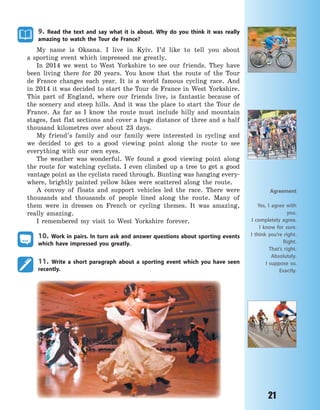
My name is Oksana. I live in Kyiv. I’d like to tell you about
a  sporting event which impressed me greatly.
In 2014 we went to West Yorkshire to see our friends. They have
been living there for 20 years. You know that the route of the Tour
de France changes each year. It is a world famous cycling race. And
in 2014 it was decided to start the Tour de France in West Yorkshire.
This part of England, where our friends live, is fantastic because of
the scenery and steep hills. And it was the place to start the Tour de
France. As far as I know the route must include hilly and mountain
stages, fast flat sections and cover a huge distance of three and a half
thousand kilometres over about 23 days.
My friend’s family and our family were interested in cycling and
we decided to get to a good viewing point along the route to see
everything with our own eyes.
The weather was wonderful. We found a good viewing point along
the route for watching cyclists. I even climbed up a tree to get a good
vantage point as the cyclists raced through. Bunting was hanging every-
where, brightly painted yellow bikes were scattered along the route.
A convoy of floats and support vehicles led the race. There were
thousands and thousands of people lined along the route. Many of
them were in dresses on French or cycling themes. It was amazing,
really amazing.
I remembered my visit to West Yorkshire forever.
10. Work in pairs. In turn ask and answer questions about sporting events
which have impressed you greatly.
11. Write a short paragraph about a sporting event which you have seen
recently.
Agreement
Yes, I agree with
you.
I completely agree.
I know for sure.
I think you’re right.
Right.
That’s right.
Absolutely.
I suppose so.
Exactly.
Право для безоплатного розміщення підручника в мережі Інтернет має
Міністерство освіти і науки України http://mon.gov.ua/ та Інститут модернізації змісту освіти https://imzo.gov.ua
22
SPOT ON WRITING TIPS
Filling in Forms
There are many times when you are asked to fill in a form.
For example:
 applying for a passport;
 applying for a driving licence;
 applying to join a library or club;
 applying for a job;
 giving information like in the census form.
Useful Hints
BE CAREFUL
Be careful about following instructions on
your application. Read the form carefully
before you write anything.
BE NEAT
Print or write clearly so that your application
can be read easily. Use a black or blue ink pen.
BE CERTAIN
Before you begin to fill in the blanks, read
everything on the application carefully. After
you complete the form, read it again to ensure
no information is missing.
BE PREPARED
It is good to keep all the information you
might need together so you can find your
personal details quickly and easily. By having
all the information about yourself ready ahead
of time, you will be complete and accurate.
Make a copy of the form so that if you make
a mistake you can start again. You can always
ask for an extra form to practise on.
BE ALERT
If there is something on the form you do not
understand, ask for help.
BE COMPLETE
Answer every question. If a question does
not apply to you, write “Does not apply”.
Remember, however, you do not have to answer
illegal questions on applications or interviews.
BE CORRECT
Watch your spelling, grammar, and
punctuation.
BE THOROUGH
Describe all your skills and abilities. Indicate
any licences you may have.
BE ACCURATE
Make certain all information is correct. Check
dates, telephone numbers, and addresses for
accuracy.
Once you get used to filling in forms they will all become easier!
Анкету для
заповнення можна
завантажити
на  сайті.
Право для безоплатного розміщення підручника в мережі Інтернет має
Міністерство освіти і науки України http://mon.gov.ua/ та Інститут модернізації змісту освіти https://imzo.gov.ua
23
Some Words that Are Used in Forms
Sometimes forms use different words to ask the same thing.
First name: Max
This can also be asked as Christian Name or Forename.
Surname: Wilson
This can also be called Last Name or Family Name.
Be careful! Some forms ask you to put your surname first.
Address: This is where you live.
12, Hawthorn Rd., Wrexham, Cheshire
You might be asked to write it out on separate lines.
Title: Mr, Mrs, Miss, Ms.
Mr is used for all men. Mr Max Wilson
Mrs is used for a married woman. Mrs Elaine Wilson
Miss is used for a single woman. Miss Elaine Wilson
All women can use Ms. Ms Elaine Wilson
They can be married or single.
Telephone/Phone: 01-234567
Contact Number: This is how you can be reached most easily.
It could be a Work Number or a Daytime Number (where you are
during the day) or your Mobile Number.
Marital Status: You may be asked to put a √ in a box to show the one
that is right for you.
Married Widowed Separated Single Divorced
Are you a male or female?
Sex and Gender mean the same thing. Your sex or gender is whether
you are a man or woman, male or female.
Sex: Male Female
Gender: Male Female
Dependants: People who are relying on you to provide for them.
Do-it-yourself:
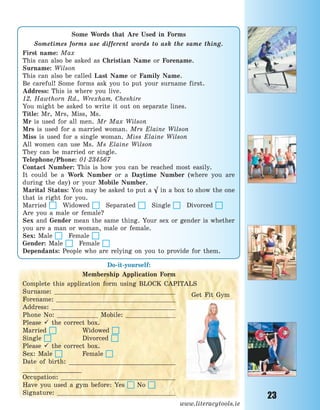
Membership Application Form
Complete this application form using BLOCK CAPITALS
Surname:
Forename:
Address:
Phone No: Mobile:
Please  the correct box.
Married Widowed
Single Divorced
Please  the correct box.
Sex: Male Female
Date of birth: _____________________________
________________
Occupation:
Have you used a gym before: Yes No
Signature:
www.literacytools.ie
Get Fit Gym
Право для безоплатного розміщення підручника в мережі Інтернет має
Міністерство освіти і науки України http://mon.gov.ua/ та Інститут модернізації змісту освіти https://imzo.gov.ua
24
12. Listen, read the words and
their definitions, translate them
and make some sentences with
these words.
13. Read the text and decide if
the suggested sentences are true,
false or not stated.
14. Read the text. For each of the
empty spaces (1—8) choose the
correct answers (A, B, C or D).
15. Read the text. For each of the
empty spaces (1—8) choose the
correct answers (A, B, C or D).
16. Write back an e-mail to your pen friend who has written to you and
answer his/her 3 questions. The part of it is given below.
…Yesterday our teacher asked us to stay after classes. A basket-
ball star came to us to talk about sport in everyday life. The way
he spoke about being a teenager was funny. He said he didn’t like
getting up early!...
 When do you get up in the morning?
 What do you do to keep fit?
 Would you like to do sports, why?
17. Write back a letter to your English-speaking pen friend and answer his/
her 3 questions. The part of it is given below.
…As you know, I am a tennis club member. I go there regularly
but my best friend doesn’t want to do any sport…
 Should people do sports, why?
 What sports do you like?
 What do you do in your PE lessons?
18. Homework. A teen magazine has asked its readers to write short infor-
mation on how teenagers do sports. Use the plan below to help you.
 What sports are the most popular with teenagers in our country?
 Why do teenagers often do extreme sports?
 What kind of sport is your favourite?
Extra exercises
Право для безоплатного розміщення підручника в мережі Інтернет має
Міністерство освіти і науки України http://mon.gov.ua/ та Інститут модернізації змісту освіти https://imzo.gov.ua
25
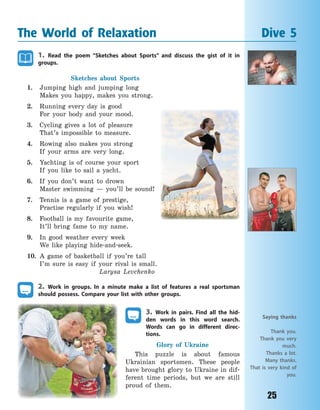
1. Read the poem “Sketches about Sports” and discuss the gist of it in
groups.
Sketches about Sports
1. Jumping high and jumping long
Makes you happy, makes you strong.
2. Running every day is good
For your body and your mood.
3. Cycling gives a lot of pleasure
That’s impossible to measure.
4. Rowing also makes you strong
If your arms are very long.
5. Yachting is of course your sport
If you like to sail a yacht.
6. If you don’t want to drown
Master swimming  — you’ll be sound!
7. Tennis is a game of prestige,
Practise regularly if you wish!
8. Football is my favourite game,
It’ll bring fame to my name.
9. In good weather every week
We like playing hide-and-seek.
10. A game of basketball if you’re tall
I’m sure is easy if your rival is small.
Larysa Levchenko
2. Work in groups. In a minute make a list of features a real sportsman
should possess. Compare your list with other groups.
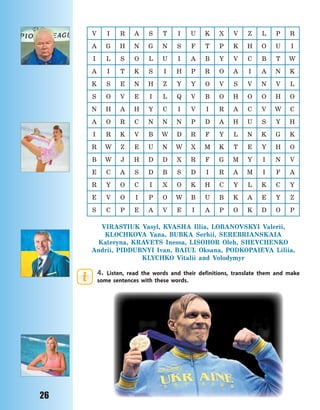
3. Work in pairs. Find all the hid-
den words in this word search.
Words can go in different direc-
tions.
Glory of Ukraine
This puzzle is about famous
Ukrainian sportsmen. These people
have brought glory to Ukraine in dif-
ferent time periods, but we are still
proud of them.
The World of Relaxation Dive 5
Saying thanks
Thank you.
Thank you very
much.
Thanks a lot.
Many thanks.
That is very kind of
you.
Право для безоплатного розміщення підручника в мережі Інтернет має
Міністерство освіти і науки України http://mon.gov.ua/ та Інститут модернізації змісту освіти https://imzo.gov.ua
26
V I R A S T I U K X V Z L P R
A G H N G N S F T P K H O U I
I L S O L U I A B Y V C B T W
A I T K S I H P R O A I A N K
K S E N H Z Y Y O V S V N V L
S O V E I L Q V B O H O O H O
N H A H Y C I V I R A C V W C
A O R C N N N P D A H U S Y H
I R K V B W D R F Y L N K G K
R W Z E U N W X M K T E Y H O
B W J H D D X R F G M Y I N V
E C A S D B S D I R A M I F A
R Y O C I X O K H C Y L K C Y
E V O I P O W B U B K A E Y Z
S C P E A V E I A P O K D O P
VIRASTIUK Vasyl, KVASHA Illia, LOBANOVSKYI Valerii,
KLOCHKOVA Yana, BUBKA Serhii, SEREBRIANSKAIA
Kateryna, KRAVETS Inessa, LISOHOR Oleh, SHEVCHENKO
Andrii, PIDDUBNYI Ivan, BAIUL Oksana, PODKOPAIEVA Liliia,
KLYCHKO Vitalii and Volodymyr
4. Listen, read the words and their definitions, translate them and make
some sentences with these words.
Право для безоплатного розміщення підручника в мережі Інтернет має
Міністерство освіти і науки України http://mon.gov.ua/ та Інститут модернізації змісту освіти https://imzo.gov.ua
27
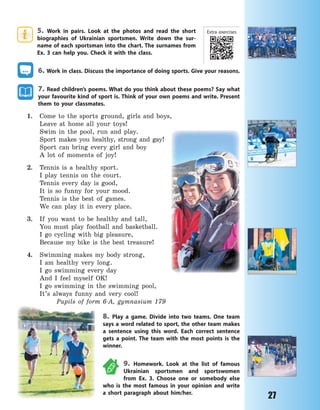
5. Work in pairs. Look at the photos and read the short
biographies of Ukrainian sportsmen. Write down the sur-
name of each sportsman into the chart. The surnames from
Ex. 3 can help you. Check it with the class.
6. Work in class. Discuss the importance of doing sports. Give your reasons.
7. Read children’s poems. What do you think about these poems? Say what
your favourite kind of sport is. Think of your own poems and write. Present
them to your classmates.
1. Come to the sports ground, girls and boys,
Leave at home all your toys!
Swim in the pool, run and play.
Sport makes you healthy, strong and gay!
Sport can bring every girl and boy
A lot of moments of joy!
2. Tennis is a healthy sport.
I play tennis on the court.
Tennis every day is good,
It is so funny for your mood.
Tennis is the best of games.
We can play it in every place.
3. If you want to be healthy and tall,
You must play football and basketball.
I go cycling with big pleasure,
Because my bike is the best treasure!
4. Swimming makes my body strong,
I am healthy very long.
I go swimming every day
And I feel myself OK!
I go swimming in the swimming pool,
It’s always funny and very cool!
Pupils of form 6-A, gymnasium 179
8. Play a game. Divide into two teams. One team
says a word related to sport, the other team makes
a sentence using this word. Each correct sentence
gets a  point. The team with the most points is the
winner.
9. Homework. Look at the list of famous
Ukrainian sportsmen and sportswomen
from Ex. 3. Choose one or somebody else
who is the most famous in your opinion and write
a short paragraph about him/her.
Extra exercises
Право для безоплатного розміщення підручника в мережі Інтернет має
Міністерство освіти і науки України http://mon.gov.ua/ та Інститут модернізації змісту освіти https://imzo.gov.ua
P
28
1. Work in class. Discuss.
1. Do you like to eat?
2. The cuisine of what country do you prefer?
3. Have you ever participated in any kind of food festival?
4. Where was it?
5. Who were you with?
6. Did you like it?
7. Is cooking really a way of spending free time?
2. Work in groups. Read the poem “I Eat to Live” by Larysa Levchenko and
discuss the author’s words, “I eat to live, succeed in life, be healthy, prosper-
ous and strong”. Do you agree with Larysa? Why? Why not? Give your reasons.
I Eat to Live
I eat to live, succeed in life,
Be healthy, prosperous and strong.
Good eating habits help survive,
Be active for a long.
I am a healthy eater,
Have meals four times a day,
Because it gives me energy
And makes me feel OK!
There are four groups of healthy food,
And making combinations,
We can enjoy eggs, yoghurt, fruit,
Without hesitation.
The people are what they eat.
And I agree with being said:
A balanced diet indeed
Must be my daily healthy bread!
Larysa Levchenko
3. Listen, read the words and their definitions, translate them and make
some sentences with these words.
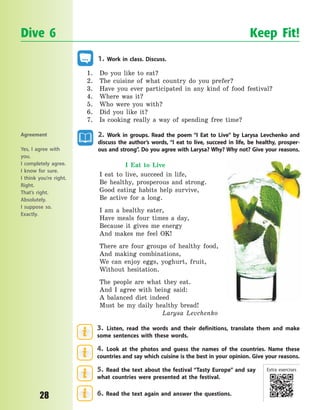
4. Look at the photos and guess the names of the countries. Name these
countries and say which cuisine is the best in your opinion. Give your reasons.
5. Read the text about the festival “Tasty Europe” and say
what countries were presented at the festival.
6. Read the text again and answer the questions.
Dive 6 Keep Fit!
Agreement
Yes, I agree with
you.
I completely agree.
I know for sure.
I think you’re right.
Right.
That’s right.
Absolutely.
I suppose so.
Exactly.
Extra exercises
Право для безоплатного розміщення підручника в мережі Інтернет має
Міністерство освіти і науки України http://mon.gov.ua/ та Інститут модернізації змісту освіти https://imzo.gov.ua
29
7. Work in class. Discuss.
1. Do you often go to fast-food restaurants?
2. Do you find the food there tasty?
3. Have you ever heard about the harm which they can cause to
your health?
FOCUS ON GRAMMAR
Defining and Non-defining Clauses
There are two types of relative clauses: defining and non-defining.
We use defining relative clauses to say exactly what person or thing
you are talking about in order to give essential information. We can-
not remove the relative clause as the sentence doesn’t make any sense
without it.
We use who or whose in relative clauses to talk about people;
which — to talk about things;
where — to talk about places;
why — to talk about reasons;
when — to talk about time.
That can be used instead of which, who, when, why.
The boy who you saw yesterday was my friend.
She showed me the place where she worked.
The bag which you see belongs to my sister.
There are several reasons why we can’t meet you.
He was the only pupil in our class that got 200 points for testing in
English.
That is used after: it’s, it was etc.; the words only, every, all; and
a  superlative.
It’s the best school that you can find in Kyiv.
He’s the only person that I can ask to help me.
I believed every word that my father said.
Право для безоплатного розміщення підручника в мережі Інтернет має
Міністерство освіти і науки України http://mon.gov.ua/ та Інститут модернізації змісту освіти https://imzo.gov.ua
P
30
8. Listen, read the words and their definitions, translate them and make
some sentences with these words.
9. Read the text and arrange the passages in the correct order.
10. Read the text again and decide if the suggested state-
ments are true or false. Correct the false statements. Then
find relative clauses in the text, read them and translate.
11. Complete the sentences using relative clauses. Use who and which.
1. A Scot is a person… (live in Scotland).
2. Nessie is a monster… (live in Loch Ness).
3. A fridge is a thing… (keep food cool).
4. A DJ is someone… (play music in a disco).
5. A bee is an insect… (make honey).
6. A lemon is a fruit… (be yellow and sour).
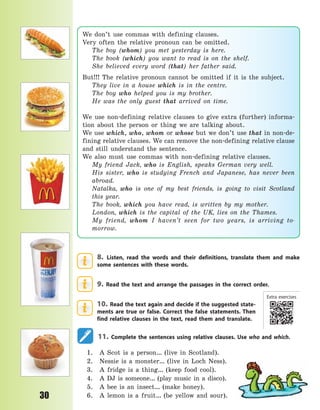
We don’t use commas with defining clauses.
Very often the relative pronoun can be omitted.
The boy (whom) you met yesterday is here.
The book (which) you want to read is on the shelf.
She believed every word (that) her father said.
But!!! The relative pronoun cannot be omitted if it is the subject.
They live in a  house which is in the centre.
The boy who helped you is my brother.
He was the only guest that arrived on time.
We use non-defining relative clauses to give extra (further) informa-
tion about the person or thing we are talking about.
We use which, who, whom or whose but we don’t use that in non-de-
fining relative clauses. We can remove the non-defining relative clause
and still understand the sentence.
We also must use commas with non-defining relative clauses.
My friend Jack, who is English, speaks German very well.
His sister, who is studying French and Japanese, has never been
abroad.
Natalka, who is one of my best friends, is going to visit Scotland
this year.
The book, which you have read, is written by my mother.
London, which is the capital of the UK, lies on the Thames.
My friend, whom I haven’t seen for two years, is arriving to-
morrow.
Extra exercises
Право для безоплатного розміщення підручника в мережі Інтернет має
Міністерство освіти і науки України http://mon.gov.ua/ та Інститут модернізації змісту освіти https://imzo.gov.ua
31
7. A watch is a thing… (tell the time).
8. A ferry is a means of conveyance… (carry people across the water).
9. A shop assistant is someone… (work in a shop).
10. A key is a thing… (can open and lock doors).
12. Combine the sentences using relative clauses. Use relative pronouns
only where necessary. Note that you have to use commas in some of the
sentences.
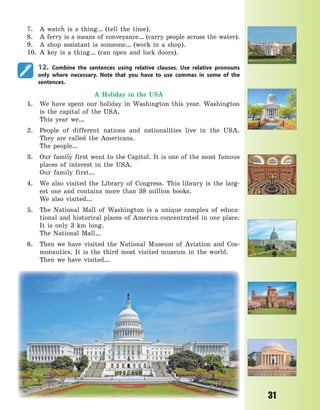
A Holiday in the USA
1. We have spent our holiday in Washington this year. Washington
is the capital of the USA.
This year we…
2. People of different nations and nationalities live in the USA.
They are called the Americans.
The people…
3. Our family first went to the Capitol. It is one of the most famous
places of interest in the USA.
Our family first…
4. We also visited the Library of Congress. This library is the larg-
est one and contains more than 38 million books.
We also visited…
5. The National Mall of Washington is a unique complex of educa-
tional and historical places of America concentrated in one place.
It is only 3 km long.
The National Mall…
6. Then we have visited the National Museum of Aviation and Cos-
monautics. It is the third most visited museum in the world.
Then we have visited…
Право для безоплатного розміщення підручника в мережі Інтернет має
Міністерство освіти і науки України http://mon.gov.ua/ та Інститут модернізації змісту освіти https://imzo.gov.ua
P
32
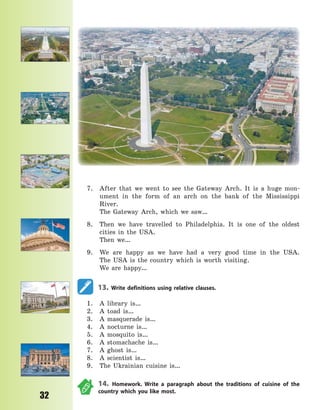
7. After that we went to see the Gateway Arch. It is a huge mon-
ument in the form of an arch on the bank of the Mississippi
River.
The Gateway Arch, which we saw…
8. Then we have travelled to Philadelphia. It is one of the oldest
cities in the USA.
Then we…
9. We are happy as we have had a very good time in the USA.
The  USA is the country which is worth visiting.
We are happy…
13. Write definitions using relative clauses.
1. A library is…
2. A toad is…
3. A masquerade is…
4. A nocturne is…
5. A mosquito is…
6. A stomachache is…
7. A ghost is…
8. A scientist is…
9. The Ukrainian cuisine is…
14. Homework. Write a paragraph about the traditions of cuisine of the
country which you like most.
Право для безоплатного розміщення підручника в мережі Інтернет має
Міністерство освіти і науки України http://mon.gov.ua/ та Інститут модернізації змісту освіти https://imzo.gov.ua
33
1. Work in pairs. Discuss the problem of being overweight or obese. What
food makes people obese or overweight?
2. Listen, read the words and their definitions, translate them and make
some sentences with these words.
1. parsley [`p%:sli] n a plant with curly green leaves used in cooking
as a herb or to decorate food
2. dill [dl] n a plant whose leaves and seeds have a strong
taste and are used in cooking as a herb
3. garlic [`g%:lk] n a vegetable with a very strong taste and smell
used in cooking
4. sorrel [`s5r3l] n a plant with bitter leaves used in cooking as a
herb
5. to chop [t65p] v to cut smth into pieces
6. cottage cheese [~k5td4 `t6i:z] n soft white cheese
7. pancake [`p0nkek] n a thin flat round cake made from a mixture of
flour, eggs and milk that is fried on both sides
8. beverage [`bev3rd4] n any type of drink, except water
9. prune [pru:n] n a dried plum
10. overweight [~3v3`wet] adj too heavy and fat (about people)
11. junk [d428k] n things that are considered useless or of little
value
12. obese [3`bi:s] adj (about people) very fat
3. Read the newspaper article about unhealthy food. Some parts of the
text are missed. Choose from the list (A—H) the most appropriate parts for
each of the empty spaces (1—5) in the text. There are three extra parts you
don’t need to use.
A about staying healthy
B to drink water
C fast food
D even obese
E becoming more overweight
F too much fat and sugar
G costs much
H junk food
Junk Food
One of the most important tasks is the task of bringing up a
healthy generation. The problem is that children are …(1)
. If children
weigh too much, they are less productive and have problems with
their health.
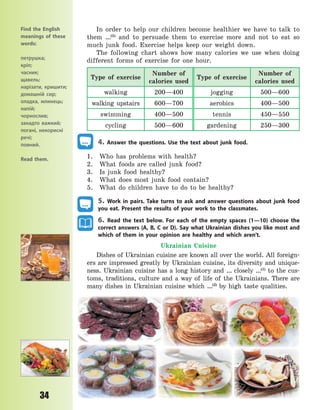
Junk food makes people overweight. Chips, soda, sweets, chocolate,
fast food and sugary snacks are called …(2)
. Junk food isn’t healthy
for people. Most junk food contains …(3)
. But teenagers and children
like eating junk food. So, they can become overweight or …(4)
.
Keep Fit! Dive 7
Words to learn:
parsley;
dill;
garlic;
sorrel;
to chop;
cottage cheese;
pancake;
beverage;
prune;
overweight;
junk;
obese.
Право для безоплатного розміщення підручника в мережі Інтернет має
Міністерство освіти і науки України http://mon.gov.ua/ та Інститут модернізації змісту освіти https://imzo.gov.ua
P
34
In order to help our children become healthier we have to talk to
them …(5)
and to persuade them to exercise more and not to eat so
much junk food. Exercise helps keep our weight down.
The following chart shows how many calories we use when doing
different forms of exercise for one hour.
Type of exercise
Number of
calories used
Type of exercise
Number of
calories used
walking 200—400 jogging 500—600
walking upstairs 600—700 aerobics 400—500
swimming 400—500 tennis 450—550
cycling 500—600 gardening 250—300
4. Answer the questions. Use the text about junk food.
1. Who has problems with health?
2. What foods are called junk food?
3. Is junk food healthy?
4. What does most junk food contain?
5. What do children have to do to be healthy?
5. Work in pairs. Take turns to ask and answer questions about junk food
you eat. Present the results of your work to the classmates.
6. Read the text below. For each of the empty spaces (1—10) choose the
correct answers (A, B, C or D). Say what Ukrainian dishes you like most and
which of them in your opinion are healthy and which aren’t.
Ukrainian Cuisine
Dishes of Ukrainian cuisine are known all over the world. All foreign-
ers are impressed greatly by Ukrainian cuisine, its diversity and unique-
ness. Ukrainian cuisine has a long history and … closely …(1)
to the cus-
toms, traditions, culture and a way of life of the Ukrainians. There are
many dishes in Ukrainian cuisine which …(2)
by high taste qualities.
Find the English
meanings of these
words:
петрушка;
кріп;
часник;
щавель;
нарізати, кришити;
домашній сир;
оладка, млинець;
напій;
чорнослив;
занадто важкий;
погані, некорисні
речі;
повний.
Read them.
Право для безоплатного розміщення підручника в мережі Інтернет має
Міністерство освіти і науки України http://mon.gov.ua/ та Інститут модернізації змісту освіти https://imzo.gov.ua
35
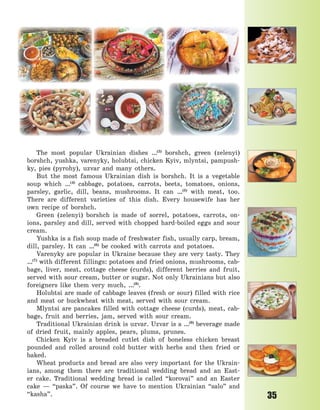
The most popular Ukrainian dishes …(3)
borshch, green (zelenyi)
borshch, yushka, varenyky, holubtsi, chicken Kyiv, mlyntsi, pampush-
ky, pies (pyrohy), uzvar and many others.
But the most famous Ukrainian dish is borshch. It is a vegetable
soup which …(4)
cabbage, potatoes, carrots, beets, tomatoes, onions,
parsley, garlic, dill, beans, mushrooms. It can …(5)
with meat, too.
There are different varieties of this dish. Every housewife has her
own recipe of borshch.
Green (zelenyi) borshch is made of sorrel, potatoes, carrots, on-
ions, parsley and dill, served with chopped hard-boiled eggs and sour
cream.
Yushka is a fish soup made of freshwater fish, usually carp, bream,
dill, parsley. It can …(6)
be cooked with carrots and potatoes.
Varenyky are popular in Ukraine because they are very tasty. They
…(7)
with different fillings: potatoes and fried onions, mushrooms, cab-
bage, liver, meat, cottage cheese (curds), different berries and fruit,
served with sour cream, butter or sugar. Not only Ukrainians but also
foreigners like them very much, …(8)
.
Holubtsi are made of cabbage leaves (fresh or sour) filled with rice
and meat or buckwheat with meat, served with sour cream.
Mlyntsi are pancakes filled with cottage cheese (curds), meat, cab-
bage, fruit and berries, jam, served with sour cream.
Traditional Ukrainian drink is uzvar. Uzvar is a …(9)
beverage made
of dried fruit, mainly apples, pears, plums, prunes.
Chicken Kyiv is a breaded cutlet dish of boneless chicken breast
pounded and rolled around cold butter with herbs and then fried or
baked.
Wheat products and bread are also very important for the Ukrain-
ians, among them there are traditional wedding bread and an East-
er cake. Traditional wedding bread is called “korovai” and an Easter
cake  — “paska”. Of course we have to mention Ukrainian “salo” and
“kasha”.
Право для безоплатного розміщення підручника в мережі Інтернет має
Міністерство освіти і науки України http://mon.gov.ua/ та Інститут модернізації змісту освіти https://imzo.gov.ua
P
36
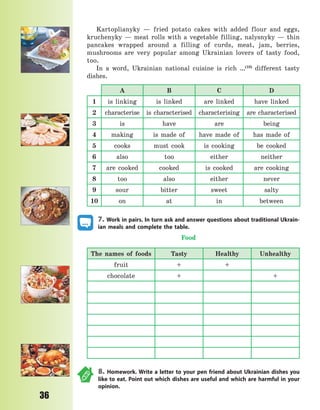
Kartoplianyky  — fried potato cakes with added flour and eggs,
kruchenyky  — meat rolls with a vegetable filling, nalysnyky  — thin
pancakes wrapped around a filling of curds, meat, jam, berries,
mushrooms are very popular among Ukrainian lovers of tasty food,
too.
In a word, Ukrainian national cuisine is rich …(10)
different tasty
dishes.
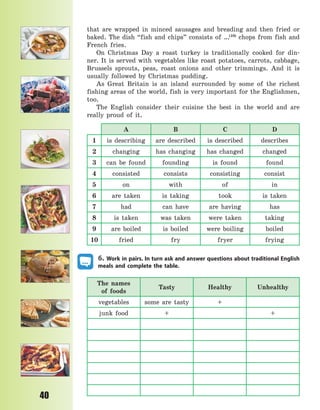
A B C D
1 is linking is linked are linked have linked
2 characterise is characterised characterising are characterised
3 is have are being
4 making is made of have made of has made of
5 cooks must cook is cooking be cooked
6 also too either neither
7 are cooked cooked is cooked are cooking
8 too also either never
9 sour bitter sweet salty
10 on at in between
7. Work in pairs. In turn ask and answer questions about traditional Ukrain-
ian meals and complete the table.
Food
The names of foods Tasty Healthy Unhealthy
fruit + +
chocolate + +
8. Homework. Write a letter to your pen friend about Ukrainian dishes you
like to eat. Point out which dishes are useful and which are harmful in your
opinion.
Право для безоплатного розміщення підручника в мережі Інтернет має
Міністерство освіти і науки України http://mon.gov.ua/ та Інститут модернізації змісту освіти https://imzo.gov.ua
37
1. Work in class. Read these sentences and discuss. “I eat to live”, “I like
to eat”. What is the difference between these two sentences? Give your rea-
sons.
2. Listen, read the words and their definitions, translate them and make
some sentences with these words.
1. decade [`deked; d`ked] n a period of ten years
2. omelette [`5ml3t] n a hot dish of mixed fried eggs
3. substantial [s3b`st0n6l] adj considerable; important
4. cereal [`s3ri3l] n food made from the grain of cereals
5. prawn [pr5:n] n a shellfish with a tail and ten legs
6. scone [sk5n; sk3n] n a small round cake often eaten with jam, cream
or butter on it
7. pastry [`pestri] n a mixture of flour, fat and milk or water and
baked for pies
8. ginger [`d4nd43(r)] n a plant used in cooking as a spice
9. cinnamon [`sn3m3n] n the inner bark of a SE Asian tree used in cook-
ing as a spice
10. casserole [`k0s3r3l] n a hot dish made with meat, vegetables, etc.
11. pasty [`pesti] n a small meat or vegetable pie
12. sodium [`s3di3m] n (symb Na) a chemical element
13. potassium [p3`t0si3m] n (symb K) a chemical element
14. calcium [`k0lsi3m] n (symb Ca) a chemical element
15. sprout [sprat] n a new part growing on a plant
3. Read the text and say if the food you eat is healthy.
Vitamins, calcium, sodium, potassium and other minerals are very
important for us.
Vitamins:
C is very good for our teeth and bones. It is found in lemons, or-
anges, currants and broccoli.
E is very important for our skin. It is found in broccoli, cereals,
nuts and lettuce.
A is good for our eyes. It is found in fish, fruit, carrots and broc-
coli.
D is important for our bones. It is found in eggs, cheese, milk and
butter.
Calcium is good for bones and teeth. It is found in yoghurt, cheese,
milk.
Sodium helps us keep the right amount of water in our bodies.
It  can be found in cheese, seafood and salt.
Potassium is important for our muscles, heart and nerves. It can
be found in meat, bananas, raisins and dried apricots.
Keep Fit! Dive 8
Words to learn:
decade;
omelette;
substantial;
cereal;
prawn;
scone;
pastry;
ginger;
cinnamon;
casserole;
pasty;
sodium;
potassium;
calcium;
sprout.
Право для безоплатного розміщення підручника в мережі Інтернет має
Міністерство освіти і науки України http://mon.gov.ua/ та Інститут модернізації змісту освіти https://imzo.gov.ua
P
38
4. Work in groups. Discuss what food is good for you and why, and what
food is bad for you and why. Give your reasons. Present the results of your
discussion to the class.
These words can help you:
healthy, unhealthy, useful, harmful, tasty, sweet, acid, salty, bitter,
horrible, disgusting, spicy, fatty, important, good, bad, bones, teeth,
eyes, muscles, nerves, skin, legs, hands, to grow, to be strong and
healthy, to do sports, to exercise, junk food, vegetables, fruit, grain,
vitamins, minerals.
5. Read the text below. For each of the empty spaces (1—10) choose the
correct answers (A, B, C or D). Say what English dishes you like most.
English Cuisine
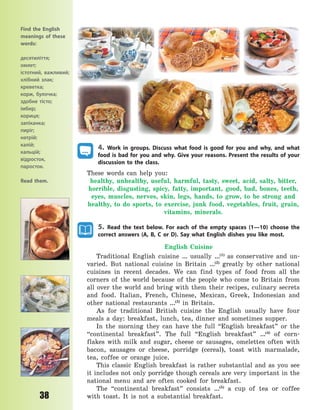
Traditional English cuisine … usually …(1)
as conservative and un-
varied. But national cuisine in Britain …(2)
greatly by other national
cuisines in recent decades. We can find types of food from all the
corners of the world because of the people who come to Britain from
all over the world and bring with them their recipes, culinary secrets
and food. Italian, French, Chinese, Mexican, Greek, Indonesian and
other national restaurants …(3)
in Britain.
As for traditional British cuisine the English usually have four
meals a day: breakfast, lunch, tea, dinner and sometimes supper.
In the morning they can have the full “English breakfast” or the
“continental breakfast”. The full “English breakfast” …(4)
of corn-
flakes with milk and sugar, cheese or sausages, omelettes often with
bacon, sausages or cheese, porridge (cereal), toast with marmalade,
tea, coffee or orange juice.
This classic English breakfast is rather substantial and as you see
it includes not only porridge though cereals are very important in the
national menu and are often cooked for breakfast.
The “continental breakfast” consists …(5)
a cup of tea or coffee
with toast. It is not a substantial breakfast.
Find the English
meanings of these
words:
десятиліття;
омлет;
істотний, важливий;
хлібний злак;
креветка;
корж, булочка;
здобне тісто;
імбир;
кориця;
запіканка;
пиріг;
натрій;
калій;
кальцій;
відросток,
паросток.
Read them.
Право для безоплатного розміщення підручника в мережі Інтернет має
Міністерство освіти і науки України http://mon.gov.ua/ та Інститут модернізації змісту освіти https://imzo.gov.ua
39
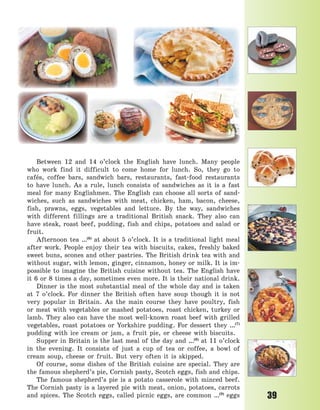
Between 12 and 14 o’clock the English have lunch. Many people
who work find it difficult to come home for lunch. So, they go to
cafés, coffee bars, sandwich bars, restaurants, fast-food restaurants
to have lunch. As a rule, lunch consists of sandwiches as it is a fast
meal for many Englishmen. The English can choose all sorts of sand-
wiches, such as sandwiches with meat, chicken, ham, bacon, cheese,
fish, prawns, eggs, vegetables and lettuce. By the way, sandwiches
with different fillings are a traditional British snack. They also can
have steak, roast beef, pudding, fish and chips, potatoes and salad or
fruit.
Afternoon tea …(6)
at about 5 o’clock. It is a traditional light meal
after work. People enjoy their tea with biscuits, cakes, freshly baked
sweet buns, scones and other pastries. The British drink tea with and
without sugar, with lemon, ginger, cinnamon, honey or milk. It is im-
possible to imagine the British cuisine without tea. The English have
it 6 or 8 times a day, sometimes even more. It is their national drink.
Dinner is the most substantial meal of the whole day and is taken
at 7 o’clock. For dinner the British often have soup though it is not
very popular in Britain. As the main course they have poultry, fish
or meat with vegetables or mashed potatoes, roast chicken, turkey or
lamb. They also can have the most well-known roast beef with grilled
vegetables, roast potatoes or Yorkshire pudding. For dessert they …(7)
pudding with ice cream or jam, a fruit pie, or cheese with biscuits.
Supper in Britain is the last meal of the day and …(8)
at 11 o’clock
in the evening. It consists of just a cup of tea or coffee, a bowl of
cream soup, cheese or fruit. But very often it is skipped.
Of course, some dishes of the British cuisine are special. They are
the famous shepherd’s pie, Cornish pasty, Scotch eggs, fish and chips.
The famous shepherd’s pie is a potato casserole with minced beef.
The Cornish pasty is a layered pie with meat, onion, potatoes, carrots
and spices. The Scotch eggs, called picnic eggs, are common …(9)
eggs
Право для безоплатного розміщення підручника в мережі Інтернет має
Міністерство освіти і науки України http://mon.gov.ua/ та Інститут модернізації змісту освіти https://imzo.gov.ua
P
40
that are wrapped in minced sausages and breading and then fried or
baked. The dish “fish and chips” consists of …(10)
chops from fish and
French fries.
On Christmas Day a roast turkey is traditionally cooked for din-
ner. It is served with vegetables like roast potatoes, carrots, cabbage,
Brussels sprouts, peas, roast onions and other trimmings. And it is
usually followed by Christmas pudding.
As Great Britain is an island surrounded by some of the richest
fishing areas of the world, fish is very important for the Englishmen,
too.
The English consider their cuisine the best in the world and are
really proud of it.
A B C D
1 is describing are described is described describes
2 changing has changing has changed changed
3 can be found founding is found found
4 consisted consists consisting consist
5 on with of in
6 are taken is taking took is taken
7 had can have are having has
8 is taken was taken were taken taking
9 are boiled is boiled were boiling boiled
10 fried fry fryer frying
6. Work in pairs. In turn ask and answer questions about traditional English
meals and complete the table.
The names
of  foods
Tasty Healthy Unhealthy
vegetables some are tasty +
junk food + +
Право для безоплатного розміщення підручника в мережі Інтернет має
Міністерство освіти і науки України http://mon.gov.ua/ та Інститут модернізації змісту освіти https://imzo.gov.ua
41
7. Work in groups. Compare English and Ukrainian meals. Complete the ta-
bles. Add your variants of English and Ukrainian meals.
English Meals
Breakfast Lunch Dinner Supper
bowl of
cornflakes
and a cup of
tea
a sandwich
and a glass
of juice
— meat or fish and
vegetables;
— pudding;
— a cup of tea or coffee
a sandwich
and orange
juice
Ukrainian Meals
Breakfast Lunch Dinner Supper
8. Work in pairs. Read the recipe of pizza. Think of the recipe of your fa-
vourite pizza and its topping. Present it to your classmates.
Pizza Recipe. Topping
100g of flour
25g of butter
a pinch of salt
2 tablespoons of milk
2 tomatoes
50g of cheese
(other toppings: mushrooms,
carrots, eggs, chicken meat, ham,
sausage, olives)
1. Put the flour and salt into a bowl.
2. Cut the butter into small pieces and mix in with the flour.
3. Add some milk and mix a dough.
4. Oil the pan.
5. Put the dough onto the oiled pan.
6. Put the topping on the dough  — grated cheese, sliced tomatoes and
mayonnaise.
7. Bake for about 15 minutes in a hot oven.
8. Enjoy your pizza.
9. Play a game. Divide into two teams. One team says a word related to English
and Ukrainian cuisine, the other team makes a sentence using this word. Each cor-
rect sentence gets a point. The team with the most points is the winner.
10. Homework. Write a recipe of your favourite dish.
Responding to
thanks
Not at all.
No problem.
That’s OK.
My pleasure.
It’s a pleasure.
Don’t mention it.
Any time.
You’re welcome.
Право для безоплатного розміщення підручника в мережі Інтернет має
Міністерство освіти і науки України http://mon.gov.ua/ та Інститут модернізації змісту освіти https://imzo.gov.ua
P
42
1. Work in pairs. Discuss. Do you agree with the statements below?
1. We should eat at least five different vegetables or fruits a day.
2. Fresh vegetables contain more vitamins than frozen or cooked
ones.
3. Potatoes contain vitamin C.
4. Fruit juice contains as much fibre as fruit.
5. Nuts and beans are a source of protein.
6. Calcium is found in dairy products.
7. A well-balanced diet includes food like bread, pasta, cereals, ba-
nanas and rice.
8. Chocolate is bad for you.
2. Work in groups. Discuss. How much of the food mentioned in Ex. 1 do
you eat?
1. Do you like cooking when you have free time?
2. Isn’t it a good idea of spending free time?
Dive 9 Keep Fit!
Disagreement
Yes, but…
True, but…
I can’t agree with
you.
I disagree with you.
I’m afraid I disagree
with you.
I’m not sure that’s
right.
I agree to some
extent, but…
I’m not sure I can
accept that.
There might be
some truth in that,
but…
Право для безоплатного розміщення підручника в мережі Інтернет має
Міністерство освіти і науки України http://mon.gov.ua/ та Інститут модернізації змісту освіти https://imzo.gov.ua
43
FOCUS ON GRAMMAR
Direct Speech
If we want to report what someone has said we have to repeat his/her
words. Saying what someone has said is called direct speech.
1. “Where have you been, Jack?” she asked.
2. He said, “I know nothing about her. I haven’t seen her for ages”.
Indirect Speech
Instead of repeating someone’s words we can say what he/she has said.
1. She asked Jack where he had been.
2. He said that he knew nothing about her as he hadn’t seen her for ages.
Such sentences are called Indirect Speech or Reported Speech.
If the reporting verb is in the present there is no change in the re-
ported clause.
1. He asks, “What are you going to do after classes?”
He asks what we are going to do after classes.
2. She says, “I live in Kyiv”.
She says she lives in Kyiv.
3. I say, “I like music very much”.
I say (that) I like music very much.
If the reporting verb is in the past we have to change the verb in the
reported clause.
Direct Speech Indirect Speech
Present Simple
She said, “I read books every
day”.
› Past Simple
She said she read books every
day.
Present Continuous
She said, “I am reading
a  book now”.
› Past Continuous
She said she was reading
a  book at that time.
Present Perfect Simple
She said, “I’ve read an
interesting book”.
› Past Perfect Simple
She said she had read an
interesting book.
Present Perfect Continuous
She said, “I’ve been reading
this book for a month”.
› Past Perfect Continuous
She said she had been reading
that book for a month.
Past Simple
She said, “I read the book
yesterday”.
› Past Perfect Simple
She said she had read the book
the day before.
Past Continuous
She said, “I was reading
a  book at 5 o’clock yesterday”.
› Past Perfect Continuous
She said she had been reading
a book at 5 o’clock the day
before.
Право для безоплатного розміщення підручника в мережі Інтернет має
Міністерство освіти і науки України http://mon.gov.ua/ та Інститут модернізації змісту освіти https://imzo.gov.ua
P
44
Direct Speech Indirect Speech
Past Perfect
She said, “I had already read
the book”.
› Past Perfect
She said she had already read
the book. No change
Past Perfect Continuous
She said, “I’d already been
reading a book for two
hours”.
› Past Perfect Continuous
She said she had already been
reading a book for two hours.
No change
Future Simple
She said, “I’ll read this book
tomorrow”.
› Future in the Past
She said she would read that
book the next day.
Future Continuous
She said, “I will be reading a
book at 2 o’clock tomorrow”.
› Future Continuous in the Past
She said she would be reading
a book at 2 o’clock the
following day.
Future Perfect
She said, “I’ll have read this
book by 2 o’clock tomorrow”.
› Future Perfect in the Past
She said she would have read
that book by 2 o’clock the day
after.
Modal changes:
Direct Speech Indirect Speech
can
She said, “I can read English
books”.
› could
She said she could read
English books.
must
They said, “We must read
English books”.
› had to, were to, should
They said they had to (were
to, should) read English books.
mustn’t
They said, “We mustn’t read
these books”.
› didn’t have to, were not to,
shouldn’t
They said they didn’t have to
(were not to, shouldn’t) read
those books.
may
She said, “You may read this
book”.
› might
She said they might read that
book.
shall
She asked me, “Shall we read
today?”
› should
She asked me if we should
read that day.
Note  — The words could, would, should, might and ought to don’t
change.
Право для безоплатного розміщення підручника в мережі Інтернет має
Міністерство освіти і науки України http://mon.gov.ua/ та Інститут модернізації змісту освіти https://imzo.gov.ua
45
Time and Place Changes
here there
today that day
tomorrow the next day, the day after, the following day
the next week/
year/month, etc.
the following week/year/month, etc.
the week/year/month, etc. after
last week/year/
month, etc.
the previous week/year/month, etc.
the week/year/month, etc. before
yesterday the previous day, the day before
at the moment at that moment
now then, at that time
ago before, earlier, previously
these those
Note! We do not have to change time phrases and words if the infor-
mation is still true “at the moment” of speaking or writing.
“My name is Olia”, she said. She said her name was Olia.
or She said her name is Olia.
We make the same changes with reported questions as we do with
reported speech without using the question marks or question forms.
If questions begin with the verbs to have, to be, to do or modals we
use the conjunctions if or whether.
If questions begin with who, which, when, what, where, why, how
we don’t use the conjunctions if or whether.
Direct Speech Indirect Speech
She asked, “Do you speak
English?”
› She asked if (whether) I spoke
English.
“Can you play the piano,
Jim”, she asked.
› She asked if (whether) Jim
could play the piano.
“Are you interested in sport?”
Oleh asked.
› Oleh asked if (whether) I was
interested in sport.
“What university are
you going to enter after
graduation from the college?”
asked my friend.
› My friend asked me what
university I was going to
enter after graduation from
the college.
“Where are you going?” I
asked my sister.
› I asked my sister where she
was going.
She asked, “What language do
you speak?”
› She asked what language I
spoke.
Право для безоплатного розміщення підручника в мережі Інтернет має
Міністерство освіти і науки України http://mon.gov.ua/ та Інститут модернізації змісту освіти https://imzo.gov.ua
P
46
Reported Commands and Requests
Direct Speech Commands Indirect Speech
“Stop talking, students!” said
the teacher.
› The teacher asked students to
stop talking.
The teacher told students to
stop talking.
My mother said to me,
“Switch off the TV”.
› My mother told me to switch
off the TV.
He said, “Don’t cry, Jack!” › He told Jack not to cry.
Requests
“Will you help me with my
homework?” asked my friend.
My friend asked me to help him
with his homework.
“Could you put these plates on
the table?” Mum said.
Mum asked me to put the
plates on the table.
“Will you clean your room at
last?” asked my mother.
My mother told me to clean the
room as quick as possible.
The most common reporting verbs used in indirect speech are: say,
tell, ask. There are many other reporting verbs we can use in indirect
speech. They are: accuse, agree, advise, apologise, beg, command,
cry, claim, deny, explain, complain, instruct, invite, order, offer,
promise, refuse, reply, respond, shout, suggest, think, whisper.
Using them properly you can make what you say much more interest-
ing and informative.
For example:
He asked me to go to the theatre with him.
He invited me to the theatre.
He begged me to go to the theatre.
He ordered me to go to the theatre.
He advised me to go to the theatre.
He suggested I should go to the theatre.
Use of that in reported speech
In reported speech, the word that is often used.
For example: He told me that he lived in Odesa.
However, that is optional.
For example: He told me he lived in Odesa.
!Note  — That is never used in questions, instead we often use if.
For example: He asked me if I would come to the party.
Право для безоплатного розміщення підручника в мережі Інтернет має
Міністерство освіти і науки України http://mon.gov.ua/ та Інститут модернізації змісту освіти https://imzo.gov.ua
47
3. Look at the photos. Name these television personalities who transform the pop-
ularity of the Ukrainian cuisine and teach us to cook.
4. Work in class. Read the text and discuss. Are these programmes popular
in Ukraine? Why/Why not?
Unlike Western culture, where it is fashionable to invite friends to
a  restaurant for a meal, the Ukrainians ask their friends to come to
their home, where a meal is a show of honour for their guests. They say
if you know what a pleasure it was to watch the guests tasting their
food. So, our television personalities pick up recipes, adapt them, cook
these dishes, taste them and then tell us in order to help in our cooking.
If people cook with love then the process of cooking will be trans-
formed into art. Can creativity make bored? So, it is not possible to
teach to cook a person who doesn’t get any pleasure from it.
5. Work in class. Discuss. Is cooking an interesting way of spending your
free time?
6. Answer the questions. Linda, an American journalist, has come to your
class. She wants to know as much as possible about Ukrainian cuisine.
1. Is Ukrainian cuisine rich in tasty dishes?
2. What are the most popular Ukrainian dishes in your opinion? Why?
3. What are your favourite dishes? Why?
4. Can you cook Ukrainian dishes?
5. Do you like cooking?
6. Are there any dishes that you do not like cooking?
7. Did you cook anything when you were younger?
8. At what age did you cook your first dish?
7. Transform Linda’s questions into indirect ones. “Focus on Grammar” can
help you.
The example: Linda asked if Ukrainian cuisine was rich in tasty dishes.
8. Pop quiz. What do you know about yourself?
9. Homework. Write a recipe of your favourite Ukrainian
dish.
Extra exercise
Право для безоплатного розміщення підручника в мережі Інтернет має
Міністерство освіти і науки України http://mon.gov.ua/ та Інститут модернізації змісту освіти https://imzo.gov.ua
48
1. Read the quotation and the proverb and say if art really requires cour-
age and practical experience.
All art requires courage.
Anne Tucker
If you fail to practise your art, it will soon disappear.
German proverb
2. Look at the pictures. How do you think they relate to our today’s lesson?
Dive 10 The World of Arts
Words to learn:
collage;
intriguing;
off-putting;
fabulous;
nicety;
notion;
to entice;
incompatible;
to freelance;
maggot;
violence;
vintage;
naked;
to have no notion
of smth;
incompatible with
reason;
to have a maggot in
one’s head (brain).
Право для безоплатного розміщення підручника в мережі Інтернет має
Міністерство освіти і науки України http://mon.gov.ua/ та Інститут модернізації змісту освіти https://imzo.gov.ua
49
3. Listen, read the words and their definitions, translate them and make
some sentences with these words.
1. fabulous [`f0bj3l3s] adj mythical; fairy-tale; legendary; (informal) ex-
tremely good
2. violence [`va3l3ns] n physical or emotional energy and force; cruelty
3. intriguing [n`tri:g8] adj very interesting because of being unusual
4. off-putting [~5:f`pt8] adj unpleasant
5. notion [`n36n] n an idea or an understanding of smth
6. to entice [n`tas] v to persuade smb to do smth; to lure
7. collage [`k5l%:4] n the art of making a picture by sticking pieces
of coloured cloth, paper, photos onto a surface
8. incompatible [~8k3m`p0t3bl] adj when two things, ideas, etc. are not possible
together because of basic differences
9. to freelance [`fri:l%:ns] v to earn money by selling your work to diffe-
rent organisations
10. maggot [`m0g3t] n a small creature like a short worm, a young
form of a fly; fantastic, freakish or strange
idea
11. vintage [`vntd4] adj typical of a period in the past
12. nicety [`nas3ti] n the quality of being very careful and detailed
about smth
13. naked [`nekd] adj not hidden; bare; helpless
Find the English
meanings of these
words:
вигаданий,
казковий,
неймовірний;
сила;
несамовитість;
шаленість, лють;
жорстокість;
який інтригує,
захопливий,
цікавий;
огидний;
неприємний;
поняття, уявлення,
думка;
точка зору, ідея;
не мати уявлення
про щось;
захоплювати,
заманювати;
колаж;
несумісний,
несполучний (with);
який суперечить
здоровому глузду;
працювати не
за наймом,
бути вільним
художником, розм.
діяти на свій страх
і ризик;
примха, дивацтво,
примхлива людина,
дивак;
бути примхливим;
мати чудацтво;
старовинний;
застарілий;
точність,
вишуканість;
явний;
неприхований,
очевидний.
Read them.
Право для безоплатного розміщення підручника в мережі Інтернет має
Міністерство освіти і науки України http://mon.gov.ua/ та Інститут модернізації змісту освіти https://imzo.gov.ua
50
Arguments
To start with…
First of all…
Firstly,…
Secondly,…
The main reason
is…
On the one hand,…
On the other
hand,…
Well, the thing is
that…
And finally…
All in all…
4. Match these expressions to the pictures from Ex. 2. What pictures do you
consider to be art? Give your reasons.
 a tattoo on different parts of the body
 surgical instruments shown as a part of
an exhibition
 a display of fireworks
 walls with graffiti
 a painting of circles, triangles and squares
 ornaments on pots and jugs
 an advert on leaflets
 a comic book
 a childish painting
 a portrait
 a still life
 a landscape
5. Work in groups. Discuss what forms of art you like and don’t like.
6. Work in pairs. Discuss. What is the purpose of art? Put the purposes in
order of their importance: 1 — the most important, 6 — the least important.
to delight people with enjoyment and amusement
to express political views
to make money
to entertain and make people laugh
to cause different/conflicting emotions
to reflect society/life
7. Work in groups. Name any examples of works of art that achieve some
of the aims from Ex. 6.
8. Read the leaflet. What is advertising? What category of people is it aimed at?
This Week Fabulous Art Works by Modern Sculptors
Hidden violence is exemplified by this sculpture by Eko Nugroho,
part of the Under the Shadow exhibition at Pekin Fine Arts in Bei-
jing. See the rest of the week at Art MoCo after the jump.
Eko Nugroho Joseph BarbacciaKelly McCallum Mariana Monteagudo
Право для безоплатного розміщення підручника в мережі Інтернет має
Міністерство освіти і науки України http://mon.gov.ua/ та Інститут модернізації змісту освіти https://imzo.gov.ua
51
Silvia B. is a Dutch artist whose sculp-
tures are a fascinating mix of graphically in-
triguing and visually off-putting. Silvia  B.
plays with established notions of beauty
with her models of females and males us-
ing unusual materials in order to make the
works as attractive as possible, to entice the
viewer to look more closely and then become
disturbed. Once this is achieved one must question the reasons for the
discomfort. More Silvia  B. tomorrow.
Sequins and polystyrene are unusual partners, but come together
in the abstract sculptures of Joseph Barbaccia.
Kelly McCallum combines Victorian taxidermy with gold-plated
maggots. Don’t miss it.
Venezuelan artist Mariana Monteagudo’s latest ceramic dolls wear
blue masks, black ears and stare with great big eyes. See the rest of
the week at Art MoCo.
Collage. Art of Combining Incompatible
Laura Breitman uses thousands of tiny pieces of fabric to create
collages based on photography.
Ann Marshall covers collage territory by integrating portraits with
dreamy textures to lend a vintage feel to girls of all ages.
The week ends on a surprising note as we contemplate the red on-
ion as a true object of beauty, thanks to Sarah Greene Reed.
Photography Is the Art of not Pushing the Button
Frank Horvat worked in advertising and freelanced for magazines.
He has worked as a photojournalist, spent many years shooting fash-
ion for Elle, Glamour, Vogue, Harper’s Bazaar and in advertising.
He has had many personal photographic projects and has published
28 books. The work displayed on this exhibition shows what amazing
range he has as a documentary, fashion, nature, creative photogra-
pher with an interesting photographic journey.
“Why Do I Need Feet, if I Have Wings to Fly?”
There is a special atmosphere in this place, in the house where Fri-
da Kahlo was born, where she lived as an artist, married to an artist,
and where she spent her last days. Behind these tall blue walls, the
Silvia B.
Laura Breitman Ann Marshall Sarah Greene Reed
Право для безоплатного розміщення підручника в мережі Інтернет має
Міністерство освіти і науки України http://mon.gov.ua/ та Інститут модернізації змісту освіти https://imzo.gov.ua
52
artist has created a world of her own, and the creative spirit of the fa-
mous Latin American artist vibrates in the house. Frida’s paintings on
the walls, those ordinary things have made up the everyday life of this
woman, a family, and the friends surrounding the couple Kahlo-Rivera.
The Blue House is a house, a place where things tell us a story and
invite us to take a walk along its rooms, its corridors, and its patios.
9. Read the leaflet again. Answer the questions.
Which exhibition(s) is/are the most suitable for a person who likes:
a. to debate about art?
b. to be astonished with the nicety of art?
c. to see the work of a single artist?
d. art objects made of different materials?
e. to see the naked beauty of our life?
10. Find and read nouns, verbs and adjectives in the leaflet which mean the following:
 the qualities that make someone live the way they do, and make
them different from other people;
 to persuade someone to do something or go somewhere, usually by
offering them something that they want;
 old, but high quality;
 the art of filling the skins of dead animals, birds, or fish with
a  special material so that they look as though they are alive;
 to be a very typical example of something;
 extremely interesting;
 a small creature like a worm that is the young form of a fly and
lives in decaying food, flesh;
 something that is very interesting because it is strange, mysterious,
or unexpected;
 an idea, belief, or opinion;
 to take photographs or make a film of something.
11. Work in class. Discuss. What exhibition would you like to go to? Give
your reasons.
12. Homework. Write an e-mail to a friend telling him or her about an ex-
hibition you have seen. Give your impressions of it, using some of the ex-
pressions above.
The Blue House Frank HorvatFrida Kahlo
Право для безоплатного розміщення підручника в мережі Інтернет має
Міністерство освіти і науки України http://mon.gov.ua/ та Інститут модернізації змісту освіти https://imzo.gov.ua
53
The World of Arts Dive 11
Words to learn:
drawing;
study;
illustration;
landscape;
nude;
poster;
fresco;
sketch;
still life;
oil painting;
the nude.
Responding to
thanks
Not at all.
No problem.
That’s OK.
My pleasure.
It’s a pleasure.
Don’t mention it.
Any time.
You’re welcome.
1. Read these quotations and say what you think about the gist of them.
Is it really so as these great persons say? Can artists really send light into
the darkness of hearts?
Every child is an artist. The problem is how to remain an artist
once we grow up.
Pablo Picasso
To send light into the darkness of men’s hearts — such is the
duty of the artist.
Robert Schumann
Painting is poetry that is seen rather than felt, and poetry is
painting that is felt rather than seen.
Leonardo da Vinci
2. Work in groups. Name words that relate to art and present to the class.
The members of the group who have named the most of the words are the
winners.
3. Listen, read the words and their definitions, translate them and make
some sentences with these words.
1. drawing [`dr1:8] n a picture made using a pen or pencil
2. illustration [~l3`stre6n] n a drawing or picture in a book, magazine, etc.
3. landscape [`l0ndskep] n a painting of a view of the countryside
4. fresco [`fresk3] n a picture that is painted on a wall while the plaster
is wet
5. oil painting [`1l pent8] n a picture painted in oil colours
6. nude [nju:d] n a work of art consisting of a naked human figure
7. poster [`p3st3(r)] n a placard
8. sketch [sket6] n a small picture that is drawn quickly and does not
have many details
9. still life [~stl `laf] n the art of painting arrangements of flowers, fruit,
etc.
10. study [`st2di] n a drawing or painting of smth for practice or be-
fore doing a larger picture
4. Match the kinds of painting to the definitions and pictures.
Drawing
a very large picture or photograph printed on paper,
which you put on a wall for decoration
Sketch a picture painted in oil colours
Illustration
the art of drawing arrangements of objects, for
example, flowers or fruit
Poster a painting made on a wall while the plaster is still wet
Право для безоплатного розміщення підручника в мережі Інтернет має
Міністерство освіти і науки України http://mon.gov.ua/ та Інститут модернізації змісту освіти https://imzo.gov.ua
54
Portrait a picture of someone without any clothes on
Landscape a picture that has been drawn using a pen or pencil
Nude a painting, drawing, or photograph of a person
Oil
painting
a small detailed drawing, especially one which is done
in order to prepare for a larger picture, or as part of
a  series of drawings of the same kind of subjects
Fresco
a picture in a book, which shows people or events that
have been mentioned in the book
Still life
a painting or photograph showing an area of the
countryside
Study
a picture consisting of a few lines drawn quickly with
a  pen or pencil
5. Work in groups. Discuss.
1. Why do you think people will buy pictures?
2. Who do you think an art dealer is?
3. Are there any artists whose works you admire?
4. What pictures by your favourite artist would you like to buy?
5. What would you do if you didn’t have enough money to buy a pic-
ture you liked?
6. Listen to the text and answer the questions.
1. What solution did the art dealer Mrs Tanguy find to sell the picture?
2. Was the solution right?
Expressing opinions
In my opinion,…
In my view,…
I think (that)…
Personally, I think…
From my point of
view…
I’m not sure (if,
about)…
I don’t have a
definite opinion
about that.
As I see you…
As I see it,…
I don’t think…
Find the English
meanings of these
words:
малюнок;
зображення;
ілюстрування;
ландшафт;
пейзаж, пейзажний
живопис;
фреска, фресковий
живопис;
картина,
намальована
олійними фарбами,
малювання
олійними фарбами;
оголена постать
(у  скульптурі
тощо);
оголене тіло,
оголеність;
афіша,
плакат;
ескіз;
замальовка; абрис;
натюрморт;
мист. етюд,
ескіз;
начерк.
Read them.
Право для безоплатного розміщення підручника в мережі Інтернет має
Міністерство освіти і науки України http://mon.gov.ua/ та Інститут модернізації змісту освіти https://imzo.gov.ua
55
7. Decide if the suggested statements are true or
false. Correct the false statements.
1. The picture was painted by a famous French
artist.
2. The picture was for sale.
3. The price was too high for the customer.
4. Mr Tanguy didn’t want to sell the picture.
5. Apples were painted on it.
6. The customer wasn’t ready to buy the picture at all at first.
7. Mr Tanguy made a decision to sell an apple to the customer.
8. An apple was cut from the picture and given to the buyer.
9. Everybody was satisfied with the result of the deal.
10. Madame Tanguy’s advice is to take anything they can get for it.
8. Work in groups. Role-play the situation at the art dealer’s.
9. Read this quotation, discuss and say if such business is art, if not then
why not. Give your reasons.
Being good in business is the most fascinating kind of art. Making
money is art and working is art and good business is the best art.
Andy Warhol
10. Work in groups. Listen to the employee of the art gallery, Olesia Para-
di, who is making a presentation to the director of the art gallery and his
colleagues. Olesia thinks that artist Olena Krasylnykova would be a good
choice for an exhibition. Listen to Part 1 and answer the questions.
1. What does O. Krasylnykova do?
2. What basic facts is Olesia going to talk about?
3. Is O. Krasylnykova a newcomer in the world of art?
4. What city has she lived and worked in?
5. Who does she share her knowledge with?
11. Work in pairs. Put Olesia’s key points in order.
the artist’s personality/reputation
the basic information
students’ and their parents’ reviews
the artist’s style of painting
12. Now listen to Part 2 of the presentation and answer the questions.
1. What method does Olena use in her painting?
2. What are her works about?
3. What do students and their parents say about her as a teacher?
4. What personality is Olena?
5. What is her contribution to the personal development of each child?
Words to learn:
ardent;
etching;
sepia;
to imbue;
honorary;
to embody.
Право для безоплатного розміщення підручника в мережі Інтернет має
Міністерство освіти і науки України http://mon.gov.ua/ та Інститут модернізації змісту освіти https://imzo.gov.ua
56
13. Work in groups. Discuss art forms which mostly influence young peo-
ple today and how young people influence our society.
Find the English
meanings of these
words:
гарячий, палкий;
гравюра, травлення
на металі;
сепія (фарба);
наповнювати,
надихати (чимсь  —
with);
почесний;
здійснювати,
втілювати.
Read them.
SPOT ON WRITING TIPS
Note-taking
Note-taking is a skill that can help you do well in all your school-
work. Here are some tips on how to take good notes.
Write down key facts. Write down the most important points.
Compare. Keep your notes handy when you’re doing your homework.
Compare what you wrote with what you’ve heard/read — you can add
to your notes.
Organise. Keep notes for each subject in one place so you can find
everything easily when the time for a test comes.
Note-taking gives your mind a chance to absorb the material it needs
to learn.
14. Listen, read the words and their definitions, translate them and make
some sentences with these words.
1. ardent [`%:dnt] adj (written) very enthusiastic; passionate
2. etching [`et68] n the art of making pictures on metal or glass
3. sepia [`si:p3] n a reddish-brown colour
4. to imbue [m`bju:] v to fill smb or smth with strong feelings
5. honorary [`5n3r3ri:] adj given as an honour
6. to embody [m`b5di] v to express an idea or a quality
15. Your teacher has asked you to write a brief note about your excursion
to the Museum of Ukrainian Art.
Suggested Answer
Last week we visited the Museum of Ukrainian Art and got ac-
quainted with the works and life of Tetiana Yablonska.
Tetiana Yablonska contributed a lot to the development of
Ukrainian pictorial art. Her creative work is an entire epoch in
Ukrainian culture. In her works she embodied ardent love of her
native land. Yablonska’s heritage is indeed universal: portraits,
landscapes, genre compositions, etc. Her works are executed in the
technique of etching, sepia and pencil, watercolours and oil.
Imbued with deep humanism and excellent in form and technique
Yablonska’s art heritage is immortal, it will live through ages.
Yablonska was awarded the honorary title “Artist of the Year”
(UNESCO) in 1997, “Woman of the Year” (International Biography
Centre, Cambridge) in 2000. She was the winner of the Shevchen-
ko State Prize of Ukraine (1998). She also received the highest
state award of our country  — the title “Hero of Ukraine” (2001).
16. Homework. Make a presentation of your favourite artist.
Право для безоплатного розміщення підручника в мережі Інтернет має
Міністерство освіти і науки України http://mon.gov.ua/ та Інститут модернізації змісту освіти https://imzo.gov.ua
57
1. Read the quotation and say if painting is really easy.
Painting is easy when you don’t know how, but very
difficult when you do.
Edgar Degas
2. Work in pairs. Match these words to their definitions.
Artefact
an object that is made by a person, especially
smth of historical or cultural interest
Impressionist
someone whose job is to take tourists to a
place and show them around
Sculptor
someone who draws funny drawings of
people that make them look silly
Painter of seascapes
someone who is very skilled at creating and
sewing costumes for actors
Portraitist
someone who draws a short film that is
made by photographing a series of drawings
Guide someone who paints pictures
Art historian someone who makes sculptures
Painter
someone who takes photographs, especially
as a professional or as an artist
Artist
someone who uses impressionism in the
paintings or music that they produce
Art thief
a person whose job is to take care of the
clothes that actors wear on the stage
Caricaturist
someone who creates a painting, drawing, or
photograph of a person
Cartoonist
someone whose job is to make plans or
patterns for clothes, furniture, equipment, etc.
Decorator
someone who draws a fight between opposing
armies, groups of ships, groups of people,
etc., especially one that is part of a larger war
Photographer someone who draws pictures of the sea
Fashion designer someone who studies the history of art
Painter of battle pieces a person who steals works of art
Wardrobe master
someone who paints houses and puts paper
on the walls as their job
The World of Arts Dive 12
Words to learn:
contemporary;
to immerse;
institution;
renovation;
to undergo;
to implement;
varied;
charitable
institution;
he underwent much
suffering;
varied opinions;
he underwent
a  great change.
Apologising
I’m sorry for my
mistake.
I’m sorry for being
late.
I’m really sorry.
I’m awfully sorry.
I apologise.
Право для безоплатного розміщення підручника в мережі Інтернет має
Міністерство освіти і науки України http://mon.gov.ua/ та Інститут модернізації змісту освіти https://imzo.gov.ua
58
Find the English
meanings of these
words:
сучасний;
занурювати,
поглинати, займати
(увагу);
виконувати,
здійснювати,
забезпечувати
виконання,
втілення в життя;
організація,
установа;
благодійна
установа;
відбудова;
реконструкція,
оновлення,
лагодження;
зазнавати, зносити,
переносити;
він багато
страждав;
різний,
різноманітний,
який змінюється;
нерівний;
найрізноманітніші
думки.
Read them.
3. Work in groups. Discuss.
1. What capitals of art do you know?
2. What art galleries are they famous for?
3. What kind of art do they represent?
4. Which one have you ever visited?
4. Read the ads of the most famous world
art galleries and complete the table.
The Prado Museum in Spain
The Prado Museum in Spain is re-
nowned as being the largest art gallery
in the world. It also exhibits sculptures,
drawings, coins and other works of art,
but undoubtedly it is famous for its
large collection of paintings which has
given it worldwide fame. It houses more than 8,600 paintings, though
they exhibit less than 2,000 because of lack of space available.
(www.spanisharts.com)
Museum Galleria Borghese in Rome
Villa Borghese
Drawn from the collection assembled
by Cardinal Scipione Borghese in the late
16th
and early 17th
centuries, the Borghese
Gallery includes major works by Raphael,
Rubens, Titian, Caravaggio, Bernini, An-
tonello da Messina and Canova.
Housed in the summerhouse of the
Villa Borghese, which was built between 1613 and 1616, the collection
was purchased by the state with the villa and its contents in 1902. Re-
cently reopened following a 14-year renovation programme, the archi-
tecture and decoration of the gallery create the perfect setting for the
magnificent paintings and sculptures.
(www.rome-galleries.com)
National  Portrait  Gallery in London
A very large collection of portraits includes a superb set of Kings,
Queens and other famous historical figures. The Tudor portrait gal-
lery is one of tourists’ favourite
galleries, right next door to the
National Gallery. The ground and
top floors are the best — the end-
less collection of Victorian Prime
Ministers. We can have a cup of
coffee at the restaurant, too.
(www.londontourist.org)
Право для безоплатного розміщення підручника в мережі Інтернет має
Міністерство освіти і науки України http://mon.gov.ua/ та Інститут модернізації змісту освіти https://imzo.gov.ua
59
The Louvre in Paris: a Rich Past, an Ambitious Future
“Open to all since 1793”: from the outset, the Louvre has embodied
the concept of a truly “universal” institution. Universal in the scope of
its collections, it is also universal in its appeal to some 6 million visitors
every year. Innovations have been rooted in the museum for 200 years.
The principle responsibility of the Louvre is to conserve, protect,
restore, and develop France’s national art treasures, from the early
royal collections to the most recent acquisitions. In carrying out this
task, the museum’s scientific and academic staff displays steadfast
commitment and universally recognised professionalism.
The priceless art works housed in the Louvre are held for the ben-
efit of present and future generations. Hence the vital importance of
the museum’s mission is to make these works available to the greatest
possible number of people, from France and all over the world.
(www.saatchigallery.com/museums/museum-profile/
Musée+Du+Louvre/98.html)
Dresden Art Gallery: Albertinum  —
Brühl’s Terrace, Dresden, Germany
Dresden’s Albertinum is home
to a museum with four themed
sections. The Gemäldegalerie Neu-
er Meister is where you will find
19th
and 20th
century art works by
artists such as Degas, Dix, Manet,
Monet, Richter and Van Gogh. The
Grünes Gewölbe meanwhile boasts
Europe’s largest collection of royal treasures, the Skulpturensamm-
lung is home to a large collection of sculptures, and the Münzkabinett
features some 300,000 artefacts, among which there are coins, med-
als, banknotes and historical bonds.
(www.world-guides.com/europe/germany/saxony/dresden/
dresden_art_galleries.html)
City Name of the gallery Art works represented there Is famous for
Право для безоплатного розміщення підручника в мережі Інтернет має
Міністерство освіти і науки України http://mon.gov.ua/ та Інститут модернізації змісту освіти https://imzo.gov.ua
60
5. Work in class. Discuss.
1. What is the most famous art centre in
Ukraine?
2. What do you know about the Pinchuk
Art Centre?
3. What is it famous for?
4. What is its history?
5. What’s its aim?
6. What famous people have presented their
works in it so far?
6. Listen, read the words and their definitions, translate them and make
some sentences with these words.
1. contemporary [k3n`tempr3ri] adj belonging to the present time
2. to immerse [`m-:s] v to put smth deep into a liquid so that it is com-
pletely covered
3. to implement [`mplment] v to take actions or make changes that you have
officially decided to happen; to carry out
4. institution [~nst`tju:6n] n a large organisation that has a particular kind
of work or purpose
5. renovation [~ren3`ve6n] v repair to a building or old furniture so that it
is in good condition again
6. to undergo [~2nd3`g3] v to have an unpleasant experience, etc.
7. varied [`ve3rid] adj consisting of or including many different kinds
of things or people, especially in a way that
seems interesting
7. Read the article, check your ideas and complete the sentences.
The Pinchuk Art Centre is an institution implemented by the Victor
Pinchuk Foundation in the realm of culture. It is one of the largest
centres for contemporary art in Eastern Europe. The key mission of the
centre is to modernise the Ukrainian artistic scene and to promote the
development of a new generation of
Ukrainian artists. The centre presents
a variety of exhibitions of leading in-
ternational and Ukrainian artists. Ad-
ditionally, the art centre organises var-
ied educational programmes and is a
platform for support for other cultural
projects.
The centre is located in Kyiv’s
historic architectural complex of Be-
sarabka that underwent a major ren-
ovation at the beginning of the 21st
century. Both architectural and in-
terior design for the art centre was
Право для безоплатного розміщення підручника в мережі Інтернет має
Міністерство освіти і науки України http://mon.gov.ua/ та Інститут модернізації змісту освіти https://imzo.gov.ua
61
developed by a French architect, Philippe Chiambaretta. The art cen-
tre occupies six floors, with exhibition spaces on four floors, a video
lounge and a café on the top floor. The total area of the exhibition
centre is over 4000 sq. metres.
Since the opening day on the 16th
of September 2006, the art cen-
tre has become a favourite spot for young Ukrainians, city-dwellers
and numerous international visitors to Ukraine’s capital. With free-
of-charge entrance, the centre provides an outstanding opportunity to
become immersed in the best contemporary art. With the art centre,
Kyiv has become a new destination point for global contemporary art.
To the date, the centre has presented nine major exhibitions:
 “New Space”, an opening exhibition by various international and
Ukrainian artists;
 “Generations.UsA”, a group show with 20 young Ukrainian and
American artists;
 “Vik Muniz: A Survey”, an exhibition by the well-known Brazil-
ian artist Vik Muniz;
 “An Instinctive Eye”, a selection of contemporary photography
from the Sir Elton John Collection;
 “REFLECTION”, an exhibition with recent acquisitions including
artists such as: Serhii Bratkov, Antony Gormlei, Andreas Gur-
skii, Damien Hirst, Jeff Koons and Takashi Murakami;
 “Mariko Mori: Oneness”, a large-scale exhibition by a Japanese
artist, Mariko  Mori;
 “Paul McCartney  — Paintings”, a survey exhibition of paintings
by Sir Paul McCartney; 
 “Rhine on the Dnipro: Julia Stoschek Collection/Andreas Gur-
skii”, a thematic video art exhibition with 17 international art-
ists and major one-person photography exhibition;
 Exhibition of the British artist Sam Taylor-Wood.
(www.pinchukartcentre.org)
1. The art centre is … .
2. It  is  one of  the largest centres
for … .
3. The centre presents a  variety
of  exhibitions of  leading … .
4. The  centre organises varied … .
5. It is  located in  Kyiv’s historic
architectural complex of … .
6. The  centre provides an out-
standing opportunity to become
immersed in  the best … .
7. The centre has presented … ma-
jor exhibitions.
8. Work in class. Discuss. What exhibitions have you been to? Which one
would you like to go to?
Право для безоплатного розміщення підручника в мережі Інтернет має
Міністерство освіти і науки України http://mon.gov.ua/ та Інститут модернізації змісту освіти https://imzo.gov.ua
62
9. Work in groups. Discuss. What way do art lovers get masterpieces for
their collections? Choose from the words below.
art market, art salon, flea market, auction,
inherit, steal, exchange, outbidding
Which way do you find the easiest/the hardest?
10. Listen, read the words and their definitions, translate
them and make some sentences with these words.
11. Work in pairs. Read the text and decide if the suggest-
ed statements are true or false. Correct the false state-
ments.
12. A teen magazine has asked its readers to share the ideas on visiting
a  museum. Use the plan below to help you.
 What do people need museums for?
 What museum have you recently visited?
 What impressed you most of all?
13. Homework. Write a paragraph describing the art gallery which you
have been to recently or you have read about.
Salvador Dali.
The Persistence of  Memory
Paul Gauguin.
Still Life with Fruit and Lemons
Claude Monet. Madame
Monet in a Japanese Kimono
Henri Matisse.
Reading Girl in White
and Yellow
Paul Gauguin.
Girl in Front of Open
Window
Extra exercises
Право для безоплатного розміщення підручника в мережі Інтернет має
Міністерство освіти і науки України http://mon.gov.ua/ та Інститут модернізації змісту освіти https://imzo.gov.ua
63
1. Read the quotations and say if art is really important in our life and
reminds us that we have souls.
Life beats down and crushes the soul and art reminds you that
you have one.
Stella Adler
What art offers is space — a certain breathing room for the spirit.
John Updike
2. Work in pairs. Discuss.
Art is not something extraordinary and difficult.
Some of it could have been done by young children.
3. Listen, read the words and their definitions, translate them and make
some sentences with these words.
1. whimsy [`wmzi] n caprice; imagination
2. temple [`templ] n church
3. to squeeze [skwi:z] v to press smth firmly
4. spiteful [`spatfl] adj wicked; hateful; mean
5. acknowledged [3k`n5ld4d] adj recognised
6. lush [l26] adj wild; bushy; colourful
7. bounty [`banti] n generosity
8. flavour [`flev3(r)] n fragrance; pleasant smell
9. contemplative [k3n`templ3tv] adj thoughtful
10. tangibility [~t0nd43`bl3ti] n reality
4. Work in groups.
Group A reads about Serhii Paradzhanov.
Group B reads about Valentyna Tsvetkova.
After reading the text say who:
a. lived in the country of birth;
b. didn’t complete his/her education;
c. was in prison;
d. was influenced by the place he/she
lived;
e. combined different elements in his/
her work;
f. was an artist as a hobby;
g. was a strange and unpredictable per-
son;
h. was loved by many people.
The World of Arts Dive 13
Words to learn:
temple;
to squeeze;
tangibility;
spiteful;
acknowledged;
lush;
whimsy;
bounty;
flavour;
contemplative;
bounty of nature.
Право для безоплатного розміщення підручника в мережі Інтернет має
Міністерство освіти і науки України http://mon.gov.ua/ та Інститут модернізації змісту освіти https://imzo.gov.ua
64
Serhii Paradzhanov. The Artist and Filmmaker
“I’m not a professional and don’t claim it.
My exhibition is not a hobby but a necessity of
my profession. I’m a director. I studied from
the great masters Savchenko and Dovzhenko,
I  began to paint, make collages, attach tex-
ture, look for some plastique.”
Serhii Paradzhanov was born on January
9, 1924 in Tiflis (Tbilisi) in the family of an
antique dealer. In 1942, Serhii finished sec-
ondary school and became a student at the
Tbilisi Institute of Railway Engineers. Howev-
er, it was less than a year when he understood
that he had acted recklessly  — and “love for
art prevailed”. So he brought his documents
to VGIK, at the cinematography department.
Serhii Paradzhanov made his wife partici-
pate in his whimsies and hoaxes. He insisted
that she should peel apples in some unusual
way, put the cup on the table in another di-
rection and place meatballs into the dish in a
special way.
Serhii Paradzhanov invented and made up his life in
the same strange way as he drew, created collages or
puppets, wrote scripts and made films.
Karen Kalantar
His creative life knew no pause, it was so intense that his imagi-
nation continued to “produce a product” and between his professional
art he had moments when he was just communicating with people.
Someone knew Paradzhanov the man, someone Paradzhanov  the art-
ist, but it was only one  — Paradzhanov  the creator of the fictional
world of beauty.
In the temple of cinema there are images, light
and reality. Serhii Paradzhanov was the master of that
temple…
Jean-Luc Godard
In all prison camps where Paradzhanov was,
he fulfilled the orders of prisoners. He drew for
people, who were waiting at large, the portraits
of their sweethearts, created collages.
One day he picked up yoghurt lid and squeezed
a portrait of Pushkin with a nail on it.
The prisoners finding that “medallion” played
him a spiteful trick, but didn’t take the thing
away. A decade later, this “medallion” came to
Find the English
meanings of these
words:
примха; чудацтво;
фантазія; уява;
примхливий;
робити відбиток;
видавлювати;
вижимати;
злобний, злісний;
уїдливий,
дошкульний;
визнаний;
буйний, пишний
(про рослинність);
квітчастий;
щедрість; щедрий
подарунок; дар;
дари природи;
храм; церква;
аромат; приємний
запах (смак);
особливість;
задумливий,
замислений;
споглядальний;
відчутність;
реальність.
Read them.
Право для безоплатного розміщення підручника в мережі Інтернет має
Міністерство освіти і науки України http://mon.gov.ua/ та Інститут модернізації змісту освіти https://imzo.gov.ua
65
the director Federico Fellini, and he poured out the silver medal,
which has been awarded to the best film at the festival in Rimini
since then.
Flowers of Creativity by Valentyna Tsvetkova
“The main thing for me in painting  is to transmit light, aroma,
air, which give life to every simple living thing, the condition of the
motive, the beauty of our nature.”
Today we would like to draw your
eyes to the works of one of the most
interesting artists of the Crimea  —
Valentyna Tsvetkova.
When you hear this name, imme-
diately bright, like nothing on earth,
artistic images of the Crimean region
appear before your eyes, created by
this powerful and original artist.
In 2007 Valentyna passed away. The artist was born in Astrakhan
in 1917 and graduated from the Astrakhan art school. As a student,
Valentyna at first visited the southern coast of the Crimea.
The beauty and originality of the southern nature, plenty of light,
sun, vivid colour contrasts had such a strong influence on the young
artist that she decided to remain permanently in the Crimea and lived
in Yalta.
Valia loved to write from the balcony of her studio, which offers
a view of the mountains, as well as the sea. We often gathered there
for a cup of coffee, admiring the panorama.
Larysa Cherikchi
In the 1930—1940s she worked mostly in the genre of portraits.
But the artist didn’t develop as a por-
traitist. She was carried away by other
artistic forms and genres.
Still lifes and landscapes became
dominant for her. And exactly in this
direction, she reached considerable
success. By becoming an acknowledged
master Valentyna had the opportunity
to travel extensively around the world.
Since 1965 she participated in inter-
national exhibitions (France, Canada).
Valentyna was considered as one of the
best artists of Ukraine in the field of
still lifes.
The branches of the trees in spring,
filled with light, transparent air, lush
lilac blossoms, filled with spring mois-
ture, autumn bounty: peaches, grapes,
Право для безоплатного розміщення підручника в мережі Інтернет має
Міністерство освіти і науки України http://mon.gov.ua/ та Інститут модернізації змісту освіти https://imzo.gov.ua
66
as if they had imbibed the sun’s heat — sounds
like a hymn to fertile native land.
I, as a person who has a lot of works
painted by Valentyna, can confidently say that
the bright, sonorous colour of her canvases
finds a rapid response and refreshes the soul
like pure spring water.
Valentyna Shevchenko
Written by avid juicy brush strokes, they
acquire a special vitality, tangibility, make us
feel unique flavours of spring, summer, au-
tumn. In 1985 the artist was awarded the title
People’s Artist of Ukraine.
5. Tell the classmates from another group
about the artist you have read about using
Ex.  4 as a plan.
6. Work in groups. Discuss. What picture do
you like the most? Why? Would you like to go
to the artists’ exhibition? Why/Why not?
FOCUS ON GRAMMAR
Adjectives can be GRADABLE and NON-GRADABLE.
Adjectives describe a quality that something possesses. To describe,
for example, variations in temperature we can use hot or cold, which
are GRADABLE ADJECTIVES.
But to describe the limits (maximum or minimum level) of temperature
we use boiling or freezing, which are NON-GRADABLE ADJECTIVES.
Gradable adjectives can be used in the comparative and superlative
forms or with words like “very” or “less”. Non-gradable adjectives
can’t be used in the comparative and superlative forms or with words
like “very” or “less”.
Non-
gradable
Gradable Gradable
Non-
gradable
tiny
excellent
boiling
small
good
warm/hot
Size
Good/Bad
Temperature
big
bad
cold
enormous
terrible
freezing
Some other GRADABLE and NON-GRADABLE forms are
tired, exhausted, upset, devastated, angry, furious, unusual, unique,
hungry, starving, important, essential, interesting, fascinating.
Право для безоплатного розміщення підручника в мережі Інтернет має
Міністерство освіти і науки України http://mon.gov.ua/ та Інститут модернізації змісту освіти https://imzo.gov.ua
67
7. Read these adjectives. Put them in pairs with the adjectives of similar
meanings.
good, unique, excellent, essential, unusual, important, angry, bad, big,
cold, devastated, enormous, exhausted, fascinating, freezing, furious,
hungry, interesting, small, starving, terrible, tiny, tired, upset
8. Divide the adjectives from Ex. 7 into two columns.
GRADABLE NON-GRADABLE
9. Look at the list of adjectives below. Check any new word in a dictionary.
Complete the sentences with some of them.
unique, expressive, soothing, calm, inspiring, decorative,
contemplative, fanciful, passionate, emotional, mesmerising,
decadent, irrational, poetic, awe-striking, personal, meditative,
special, surrealistic
Adverbs make adjectives stronger or weaker. Some adverbs can only
be used with either gradable or non-gradable adjectives.
Use with gradable
adjectives
Use with non-
gradable adjectives
Use with both gradable
and non-gradable adjectives
very
extremely
a bit
slightly
absolutely
completely
totally
really
The sea was very cold.
The diamond in the ring he presented to her was extremely small.
The air was absolutely boiling.
We were really hungry and really exhausted at the end of the filming
day.
Право для безоплатного розміщення підручника в мережі Інтернет має
Міністерство освіти і науки України http://mon.gov.ua/ та Інститут модернізації змісту освіти https://imzo.gov.ua
68
1. His … workshop was the only place he knew to hide himself from
cruel world.
2. Michelangelo was a great sculptor and an … artist.
3. His art, … and …, is an ongoing narrative about the woods sur-
rounding Mr Hunger in Vermont.
4. Great art is as … as great music. It is mad with its own loveli-
ness.
5. The following exhibition is an incredible showcase of artists who
have managed to capture water in the most creative, …, gorgeous,
and … ways.
6. … style uses visual imagery from the subconscious mind to create
art without the intention of logical comprehensibility.
10. Use some sentences from Ex. 9 and write a short description of an art-
work which you love the most.
11. Play a game. Divide into two teams. One team says a word related to art, the
other team makes a sentence using this word. Each correct sentence gets a point.
The team with the most points is the winner.
12. Homework. Choose one of the famous Ukrainian artists and write
a  short paragraph about him/her and his/her works.
EXTRA DIVE
Право для безоплатного розміщення підручника в мережі Інтернет має
Міністерство освіти і науки України http://mon.gov.ua/ та Інститут модернізації змісту освіти https://imzo.gov.ua
69
1. Listen, read and name the rules and regulations which you like and dis-
like. Do you like to keep to the rules? What is the difference between the
modern rules and the rules of the last century?
Rules and Regulations
A short direction
To avoid dejection.
Learn well your grammar,
And never stammer.
Write well and neatly,
And sing most sweetly.
Be enterprising,
Love early rising.
Go walk of six miles,
And have ready quick smiles.
Drink tea, not coffee,
Never eat toffy.
Eat bread with butter,
And never stutter.
Don’t waste your money,
Abstain from honey.
Shut doors behind you,
(Don’t slam them, mind you.)
Drink beer, not porter.
Don’t enter the water
Till to swim you are able.
Sit close to the table.
Take care of a candle.
Shut the door by the handle.
Don’t push with your shoulder
Until you are older.
Lose not a button.
Refuse cold mutton.
If you are able,
Don’t have a stable
With any mangers.
Be rude to strangers.
Moral: Behave.
Lewis Carroll
Teenagers’ World Dive 14
Words to learn:
responsibility;
ridiculous;
selfish;
careful;
horrendous;
pressure;
consent;
to accept
(to  assume,
to take)
a responsibility;
don’t be ridiculous;
to win (to obtain)
smb’s consent.
Право для безоплатного розміщення підручника в мережі Інтернет має
Міністерство освіти і науки України http://mon.gov.ua/ та Інститут модернізації змісту освіти https://imzo.gov.ua
70
1. dejection [d`d4ek6n] n пригнічений настрій; смуток; пригніченість
2. to stammer [`st0m3(r)] v заїкатися
3. neatly [`ni:tli] adv чисто; акуратно; чітко
4. enterprising [`ent3praz8] adj ініціативний; енергійний
5. toffy [`t5fi] n тофі, цукерки (на зразок ірису)
6. to stutter [`st2t3(r)] v затинатися, говорити невпевнено
7. to abstain [3b`sten] v утримуватися, стримуватися від
8. to slam [sl0m] v грюкати, стукати
9. stable [`stebl] n стайня, конюшня
10. manger [`mend43(r)] n ясла; годівниця
2. Work in class. Discuss if teenagers have any problems.
3. Listen, read the words and their definitions, translate them and make
some sentences with these words.
1. responsibility [r~sp5ns3`bl3ti] n a duty to take care of smb or to help
2. ridiculous [r`dkjul3s] adj absurd; very silly
3. selfish [`self6] adj caring only about oneself rather than smb else
4. careful [`ke3fl] adj attentive; giving a lot of attention to details
5. horrendous [h5`rend3s] adj very terrible; extremely unpleasant
6. pressure [`pre63(r)] n difficulties and feelings of anxiety that are
caused by the need to behave in a particular
way
7. consent [k3n`sent] n permission to do smth
4. Human life is divided into some age
periods. Look at these figures and read
the words. Match the words to the fig-
ures to mark these periods.
0—3 old age
4—13 middle age
14—19 babyhood
20—44 childhood
45—60 adulthood
61—… teenage
Say which period you belong to
and which period is the best in
human life in your opinion and
why.
5. Work in class. Discuss if it is
easy to be a teenager nowadays.
Find the English
meanings of these
words:
відповідальність,
обов’язок,
зобов’язання;
взяти на себе
відповідальність;
сміховинний,
смішний,
безглуздий;
обурливий;
образливий;
не робіть із себе
посміховисько;
егоїстичний,
себелюбний;
дбайливий,
уважний,
турботливий;
старанний,
ретельний;
акуратний, точний;
обережний,
обачний;
страхітливий,
який вселяє жах.
Read them.
Право для безоплатного розміщення підручника в мережі Інтернет має
Міністерство освіти і науки України http://mon.gov.ua/ та Інститут модернізації змісту освіти https://imzo.gov.ua
71
6. Read these statements and complete the table.
Teens
Agree if it
is right in
your opinion
Disagree if it
isn’t right in
your opinion
 don’t have money
 have a lot of pressure: parents,
teachers, exams, etc.
 have their parents’ entire love and
attention
 don’t have a lot of responsibilities and
duties
 have plenty of free time
 can earn money
 may have a part-time job
 can have mobile telephones
 can’t work
 can’t drive cars until 18
 don’t have many health problems
 can’t get married without their parents’
consent
 under 16 cannot give consent to medical
treatment
 have to win their parents’ consent to do
what they want
 can’t do what they want
 can’t drink in pubs
 can play loud music
 have chances to try new exciting
experiences
 can love pets
 can have boyfriends or girlfriends
 wear clothes they like
 don’t understand their parents
 are strong, young, smart and talented
 may persuade adults to agree with them
 experiment with their hairstyles,
clothes, diet, music
 face many problems
 can form themselves as personalities
 can be useful to society
 can get good secondary education
 can solve their problems
 can be successful
 can be happy: love, success, career are
in front of them
 can learn to live among people
Право для безоплатного розміщення підручника в мережі Інтернет має
Міністерство освіти і науки України http://mon.gov.ua/ та Інститут модернізації змісту освіти https://imzo.gov.ua
72
7. Work in groups. Discuss what teenagers’ responsibilities and problems
have not been mentioned in the table. Present your ideas to the class.
8. Read the text and complete the sentences.
Is It Easy to Be a Teenager Nowadays?
It isn’t easy to be a teenager today, is it? Very often teenagers
say, “Our parents and teachers don’t understand us at all. They don’t
hear us. Maybe these are differences between some representatives of
generations in their attitude to life that cause the lack of understand-
ing with each other”.
According to the “older generation”, teenagers are rude, lazy, they
wear ridiculous clothes, they spend their time listening to horrendous
noises which they consider to be music, they lie, they think only about
entertainments, they are selfish and greedy.
Others are sure that teenagers are constructive, smart, hard-work-
ing, talented, careful and that they spend a lot of time thinking about
their future, their career, their families, friends and their hobbies.
In fact, the majority of young people are polite, open and friendly.
Of course teenagers have problems and there is much stress in
their life. But who doesn’t have problems nowadays? It’s a difficult
time for them as finishing school is the beginning of their indepen-
dent lives, and there is much stress in teens’ life.
1. Isn’t it easy…?
2. Very often teenagers say…
3. Some of the representatives of the “older generation” say that
teenagers…
4. Others are sure that teenagers…
5. In fact, the majority of young people…
6. Of course teenagers have…
7. It is a difficult time…
9. Work in pairs or in small groups. Discuss the stresses in your lives. Pres-
ent your ideas to the class and complete the mind map.
Stress in teen life Money
Problems at school
Computer addiction
Asking for
clarification
Sorry, what do you
mean?
Does it mean…?
Do you mean…?
Can you repeat that,
please?
Would you mind
repeating that,
please?
Can you say it
again, please?
Sorry, I didn’t quite
catch that.
Could you repeat
that more slowly,
please?
Право для безоплатного розміщення підручника в мережі Інтернет має
Міністерство освіти і науки України http://mon.gov.ua/ та Інститут модернізації змісту освіти https://imzo.gov.ua
73
10. Listen, read the words and their definitions, translate them and make
some sentences with these words.
1. to alienate [`el3net] v to make smb less friendly or sympathetic towards you
2. detention [d`ten6n] n the state of being kept in a place, for example, a pris-
on; the punishment of being kept at school after classes
3. faked [fekt] adj appearing to be smth it is not
4. to hang about [h08] v to wait not doing very much; to stay near a  place not
doing very much
Words to learn:
to alienate;
detention;
faked;
to hang about;
hardship.
SPOT ON WRITING TIPS
Composition writing
In a composition, it is easier to write about what you believe in.
Write this in ‘first person’  — ‘I’ (like you are talking) to ‘second
person’  — ‘you’ (a person you are speaking to).
Introduction:
In the introduction the topic is described, the issue or problem is
summarised, and your argument is presented.
The “rule of five” or the “five-paragraph format”
Introduction
Paragraph 1
State the topic (summary of the topic without giving your opinion).
Main body
Paragraph 2
Arguments for and justifications, examples, and/or reasons.
Paragraph 3, 4
Arguments against and justifications, examples, and/or reasons.
Conclusion
Final Paragraph
Balanced consideration/your opinion, direct or indirect.
Conclusion (for all but poetry):
This simply wraps up what you have said in your composition. It can
basically restate what you said in your introduction. If your composi-
tion is longer, you can sum up your main points. Try to phrase them
a little differently so it will not sound repetitive.
Useful Hints
Useful expressions and linking words/phrases
 To list points: Firstly, First of all, In the first place, To begin/start
with, Secondly, Thirdly, Finally
 To list advantages: One/Another/A further/An additional (major)
advantage of … is… , The main/greatest/first advantage of … is…
Право для безоплатного розміщення підручника в мережі Інтернет має
Міністерство освіти і науки України http://mon.gov.ua/ та Інститут модернізації змісту освіти https://imzo.gov.ua
74
11. A teen magazine has asked its readers to share their ideas on youth
and subcultures. Use the plan below to help you.
 What is “subculture”?
 What hardships do teenagers experience?
 How do teens try to express themselves?
Suggested Answer
(Danylo Ulianitskyi)
To begin with, “subculture” is a particular group of people within
a society whose behaviour and customs are often disapproved of by
most people (for example, emos and goths). Speaking about young
people, they adopt subcultures, as they want to separate themselves
from others.
In my opinion, students turn to different subcultures after hav-
ing a hard time at school or because they feel alienated and look for
a way to express themselves.
These are just some items in teenagers’ list of hardships. On the
one hand, teenagers think that nobody understands them. For example,
it is generally hard for young people to deal with their parents, who
control their life, and be financially independent. I believe that young
people consider that it is good to hide secrets from their parents.
On the other hand, young people are sure that they do not have
faked friends. Moreover, students and youngsters believe that it is
just usual to hang about in the streets looking for troubles and that
school is a whole detention. Apart from this, it is sometimes chal-
lenging for students to make their own choice, not to use slang talk-
ing to parents and teachers, to deal with a girlfriend or a boyfriend.
All things considered, it is my strong belief that teenagers try
to express themselves in all possible ways. They try to be really
unique. In their opinion, it can be possible being a part of a sub-
culture.
12. Homework. Choose the most urgent problem for you and think of pos-
sible variants of solving it. Write your ideas.
Find the English
meanings of these
words:
відштовхувати;
затримання;
підроблений,
удаваний;
вештатися;
злидні, труднощі.
Read them.
 To list disadvantages: One/Another/A further/An additional (ma-
jor) advantage/drawback of… The main/greatest/most serious/first
disadvantage/drawback of… Another negative aspect of…
 To add more points to the same topic: In addition (to this), further-
more, moreover, besides, apart from, what is more, as well as, not to
mention (the fact) that, also, not only … but also/as well, both … and,
There is another side to the issue/question/argument of…
 Conclusion expressing opinion directly: In conclusion, On balance,
All things considered, Taking everything into account/consideration,
To conclude, To sum up, All in all
Право для безоплатного розміщення підручника в мережі Інтернет має
Міністерство освіти і науки України http://mon.gov.ua/ та Інститут модернізації змісту освіти https://imzo.gov.ua
75
1. Listen, read and say if it is really impossible for the young and the old
to live in peace and harmony.
Age and Youth
Crabbed Age and Youth
Cannot live together:
Youth is full of pleasance,
Age is full of care.
Youth’s like summer morn,
Age’s like winter bare.
Youth is full of sport,
Age’s breath is short!
Youth is nimble. Age is lame.
Youth is hot and bold,
Age is weak and cold.
Youth is wild and Age is tame.
Youth, I do adore thee!
(William Shakespeare)
1. crabbed [`kr0bd] adj бурхливий, дратівливий
2. morn [m1:n] n morning  — ранок
3. nimble [`nmbl] adj моторний, спритний, рухливий
4. lame [lem] adj кульгавий, покалічений; кволий, слабкий
5. bold [b3ld] adj хоробрий; відважний, зухвалий
6. tame [tem] adj приручений; приборканий; покірний; пасивний
2. Work in pairs. Name the main reasons of misunderstanding between
children and parents, who love their children most.
3. Complete the sentences using the idioms.
4. Answer the questions.
5. Work in pairs. Ask your partner any questions using the
idioms.
6. Make as many sentences as you can using the idioms.
Write.
7. Listen, read the words and their definitions, translate them and make
some sentences with these words.
1. helpful [`helpfl] adj useful
2. smart [`sm%:t] adj bright; clever; neat; ingenious
3. careful [`ke3fl] adj cautious; painstaking
4. talented [`t0l3ntd] adj gifted
5. hard-working [~h%:d`w-:k8] adj working with care and energy
Teenagers’ World Dive 15
Words to learn:
helpful;
smart;
careful;
talented;
hard-working;
selfish;
greedy;
skinny;
active;
polite;
to do the polite;
open;
open market;
open to the public;
to be open with
smb;
free;
friendly;
urgent;
rude;
lazy;
successful;
happy;
to be friendly with
smb;
Friendly Society;
urgent order;
urgent question;
in urgent need of
help;
in rude health;
rude awakening;
to be successful in
smth;
he is successful in
everything;
to be as happy as
a bird on the tree
(to be as happy as
a king);
happy
circumstances.
Extra exercises
Право для безоплатного розміщення підручника в мережі Інтернет має
Міністерство освіти і науки України http://mon.gov.ua/ та Інститут модернізації змісту освіти https://imzo.gov.ua
76
6. selfish [`self6] adj egoistic
7. greedy [`gri:di] adj avid; mean
8. skinny [`skni] adj very thin
9. active [`0ktv] adj energetic; effective
10. polite [p3`lat] adj well brought up; courteous
11. open [`3p3n] adj not closed; public; not confined
12. free [fri:] adj not busy; independent
13. friendly [`frendli] adj amicable; favourable
14. urgent [`-:d43nt] adj very important; pressing
15. rude [ru:d] adj impolite; primitive; cruel
16. lazy [`lezi] adj idle; torpid
17. successful [s3k`sesfl] adj lucky; achieving aims
18. happy [`h0pi] adj lucky; successful; satisfied; favourable
19. independent [~nd`pend3nt] adj sovereign; free; self-sufficient
20. constructive [k3n`str2ktv] adj creative; having a useful and helpful effect
21. ignorant [`gn3r3nt] adj uncouth; uneducated
22. serious [`s3ri3s] adj dangerous; important
8. Work in small groups. Discuss what it means to be a teenager. Use the
idioms. Present your ideas to the class.
9. Read these examples and give your own variants, as many as you can.
Write.
1. Being a child is being naughty.
Being a child is…
2. Being a teenager is taking a lot of exams.
Being a teenager is…
3. Being a parent means to love children.
Being a parent means…
4. Teenagers should be patient while communicating with their parents.
Teenagers should…
5. Parents should help their children to find their own way in life.
Parents should…
10. Describe any teenager you know.
These words can help you:
helpful, smart, careful, talented, hard-
working, selfish, greedy, skinny, active,
polite, open, free, friendly, urgent, rude,
lazy, successful, happy, independent,
constructive, ridiculous, ignorant, serious.
11. Describe one of your classmates and
ask them to guess who it is.
12. Homework. Write a short story about
your best friend for a school newspaper.
Find the English
meanings of these
words:
корисний;
кмітливий;
охайний;
дбайливий;
талановитий;
працелюбний;
егоїстичний,
жадібний;
худючий;
активний, діяльний;
ввічливий;
люб’язний;
поводитися
ввічливо;
відкритий;
вільний ринок;
відкрито для
публіки;
бути відвертим із
кимось;
безкоштовний;
дружній;
бути у дружніх
стосунках із кимсь;
товариство
взаємодопомоги;
вкрай необхідний;
термінове
замовлення;
нагальне питання;
потребувати
негайної допомоги;
грубий;
глибоке
розчарування;
ледачий;
успішний, вдалий;
мати успіх
у  чомусь;
щасливий;
бути безмежно
щасливим;
сприятливі умови
(обставини).
Read them.
Право для безоплатного розміщення підручника в мережі Інтернет має
Міністерство освіти і науки України http://mon.gov.ua/ та Інститут модернізації змісту освіти https://imzo.gov.ua
77
1. Read and say if you agree with these quotations. Give your reasons.
Sharing dark thoughts with a friend lightens your heart and
turns night into day.
True friends delight in each other’s successes and support each
other in times of sorrow.
Make friends by being true. Keep them by being loyal.
Friends are like precious gems; treasure them and they will
sparkle.
1. to delight [d`lat] v захоплюватися, утішатися
2. loyal [`l13l] adj вірний, відданий
3. gem [d4em] n коштовний камінь, перлина
4. to sparkle [`sp%:kl] v іскритися, виблискувати
5. to treasure [`tre43(r)] v високо цінувати; to treasure one’s friend-
ship  — високо цінувати чиюсь дружбу
6. to lighten [`latn] v освітлювати, давати полегшення; підносити
настрій
2. Work in pairs. Read the poem and choose the key sentence, present it to
your classmates. Give your reasons.
Teenagers
Teenagers from the lands of ice and snow,
Teenagers from the lands where tropical fruits grow,
Teenagers from the deserts that never see rain,
Teenagers from the lands of the golden grain.
Teenagers from all lands who love to dance and sing
Come and join hands in the friendly ring.
Teenagers’ World Dive 16
f
r
i
e
n
d
f
r
i
e
n
d
s
f
r
i
e
n
d
s
h
i
p
Право для безоплатного розміщення підручника в мережі Інтернет має
Міністерство освіти і науки України http://mon.gov.ua/ та Інститут модернізації змісту освіти https://imzo.gov.ua
78
3. Work in groups. Discuss these statements about friendship. Present your
ideas to the class.
1. Real friends should have everything in common.
2. When my friend is in trouble it is better to leave him or her alone
and not to bother him or her by visits.
3. Is it real friendship if your friend cannot say exactly what you
are? Anybody can say nice pleasant things but only a true friend
can say unpleasant things to you.
4. There is no work so delightful as work you do for your friend.
4. Listen, read the words and their definitions, translate them and make
some sentences with these words.
1. generous [`d4en3r3s] adj kind, ready to give more than it is necessary
2. idle [`adl] adj lazy; not working hard
3. self-confident [~self`k5nfd3nt] adj self-assured
4. self-centred [~self`sent3d] adj thinking only about himself or herself and
not about other people
5. self-reliant [~selfr`la3nt] adj independent, able to do things without any
help
6. cowardly [`ka3dli] adj not brave, not having courage to do smth
Право для безоплатного розміщення підручника в мережі Інтернет має
Міністерство освіти і науки України http://mon.gov.ua/ та Інститут модернізації змісту освіти https://imzo.gov.ua
79
5. Match the words.
6. Divide in two columns the qualities you hate and the
qualities you would like to develop in yourself and see in
your friends.
Honest, generous, noble, lazy, courageous, exact, modest, cowardly,
boastful, mean, brave, idle, greedy, funny, heartless, cruel, dishonest,
selfish, unselfish, hard-working, kind, rigorous, selfless, self-reliant,
self-denying, careless, careful, helpful, self-confident, conceited, self-
centred, lazy, calm, daring, easy-going, fair, friendly, devoted.
7. Work in pairs. Describe one of
your best friends and ask your
partner to guess who it is.
8. Work in groups. Discuss the
problem how you understand
friendship.
9. Make a list of qualities you’d
like to possess.
f
r
i
e
n
d
f
r
i
e
n
d
f
r
i
e
n
d
s
Words to learn:
self-centred;
generous;
idle;
self-confident;
self-reliant;
cowardly.
FOCUS ON GRAMMAR
USED TO, WOULD, TO BE USED TO, TO GET USED TO
Used to expresses habits and states particularly in the distant past
that no longer exists.
1. When I was small my parents and I used to go for walks on Sat-
urdays and Sundays.
2. It used to seem strange to be able to communicate over long dis-
tances.
3. We used to live in France many years ago.
Would expresses past habits particularly in the distant past. It can
also be used with a continuous infinitive when we refer to a habit
involving actions in progress.
1. When I was a child I would rely on my parents.
2. My friend is a fanatic of computers. Whenever I came to see her
she would usually be playing on the computer.
To be used to refers to a situation that is now familiar or no longer
strange.
Now it isn’t strange to communicate over long distances, everyone is
used to it.
To get used to expresses the process of becoming familiar with a sit-
uation and is the same as to be accustomed to. It can be followed by
a noun or a gerund.
It is surprising how quickly my grandmother got used to sending
messages by mobile.
Extra exercise
Право для безоплатного розміщення підручника в мережі Інтернет має
Міністерство освіти і науки України http://mon.gov.ua/ та Інститут модернізації змісту освіти https://imzo.gov.ua
80
10. Complete the sentences using: used to, would, got used to or to be
used to.
1. Whenever I saw you, you … usually be listening to music.
2. As far as I remember, when I came to your house, Jane, your
small brother … usually be playing computer games.
3. When a child he … play football, didn’t he?
4. When she was small she … sleep much and didn’t like to get up
early.
5. In the afternoons he … go to the river to swim.
6. We … normally spend our summer holidays in the country.
7. When a schoolgirl she … eat a lot of cakes.
8. At first people were afraid of travelling by plane but now every-
one … it.
9. Earlier my grandfather never used any gadgets but now he …
sending messages by mobile, getting information using computers
or even playing computer games.
10. I am not quite as sure as I … be.
11. I was happy when we … go to the Black Sea every summer.
12. Your friend never … be so good at Maths, did she?
13. In the 20th
century people … use pens to write with.
14. Our parents … often take us to the seaside as children.
15. He never … enjoy learning English but now he’s starting to.
11. Work in pairs. Take turns to ask and answer questions about things
you used to do as children.
12. Homework. You’ve read an article where parents say that teenagers
enjoy too much freedom nowadays and it is a great problem. Write an arti-
cle for a magazine for young people. Think of the title of your article.
In an article you:
 say why you are writing;
 describe advantages and disadvantages of having freedom;
 pay attention to the ways of improving relationship between parents
and teenagers; don’t forget about the role of real friends in the re-
lationship with parents.
Saying thanks
Thank you.
Thank you very
much.
Thanks a lot.
Many thanks.
That is very kind of
you.
Find the English
meanings of these
words:
великодушний;
благородний;
щедрий;
ледачий;
бездіяльний;
самовпевнений;
егоцентричний;
зайнятий самим
собою;
упевнений у собі;
боягузливий,
боязкий;
легкодухий.
Read them.
Право для безоплатного розміщення підручника в мережі Інтернет має
Міністерство освіти і науки України http://mon.gov.ua/ та Інститут модернізації змісту освіти https://imzo.gov.ua
81
1. Listen, read and think about the quotation.
Daddy, what if I stopped loving you,
What would happen then?*
The song by Bobby Bare
2. Work in class. Discuss if it is really so terrible when chil-
dren stop loving their parents.
3. Read the text and complete it with the sentences. There
are two sentences you do not need to use.
* Повну версію пісні
можна завантажити
на  сайті.
Teenagers’ World Dive 17
Words to learn:
independent;
to cope;
to cope with;
to cope with all
difficulties.
FOCUS ON GRAMMAR
We use the Present Perfect Continuous:
1. for an action which started in the past and lasted for some time
with a result in the present. She is very tired. She has been work-
ing all day.
2. for an action which started in the past and continues up to the
present. My daughter has been talking on the phone for an hour.
3. for expressing anger or irritation. She has been hanging out with
her friends after school. (The father is irritated).
The Present Perfect Continuous is used with the following time ex-
pressions: since, lately, recently, for, how long.
We use the Past Perfect Continuous:
1. for an action which started and finished in the past before an-
other action. He had been learning English for two years before
he passed his exam.
2. for an action which lasted for some time in the past with a vis-
ible result. My friend had to go to the concert with me, but her
mother didn’t allow her. She was very upset. She had been pre-
paring for the concert for an hour.
I had been preparing for a test for 6 hours, so I felt exhausted.
The Past Perfect Continuous is used with the following time expres-
sions: for, since, until, how long, before.
We use the Future Perfect Continuous to emphasise the duration of
an action to a certain time in the future.
By the end of next year we will have been learning English for ten years.
The Future Perfect Continuous is used with the following time ex-
pressions: by … for…
Extra exercises
Право для безоплатного розміщення підручника в мережі Інтернет має
Міністерство освіти і науки України http://mon.gov.ua/ та Інститут модернізації змісту освіти https://imzo.gov.ua
82
Find the English
meanings of these
words:
незалежний;
самостійний;
значний;
неупереджений;
мати змогу, бути
спроможним
(зробити щось);
дозволяти собі;
справитися;
подолати,
перебороти;
подолати усі
труднощі.
Read them.
4. Listen to the dialogues. Find the sentences with verbs in the Present
Perfect Continuous and the Past Perfect Continuous and translate them. Say
if there are some problems in these teenagers’ families.
5. Work in groups. Look through the teenagers’ problems. Add some more
problems which aren’t mentioned here. Choose the most important prob-
lems in your opinion and discuss. Present the results of your discussion to
the classmates.
These expressions can help you:
 To deal with difficulties at school.
 To choose a profession or a job.
 To blame for almost everything because we are teenagers.
 To live with divorced parents.
 To try to deal with parents who don’t want to understand me and
find time to listen to my comments but try to control my life.
 To be financially independent.
 To be old enough to make our own choice.
 Studying at school isn’t the only
thing I have to do.
 I don’t want my parents to use
threats. I want to be respected by
them. Their words can hurt me re-
ally badly and I have feelings, too.
 Not to use slang talking to parents
and teachers.
 I want my parents to respect my
friends.
6. Work in pairs. Think of your own dialogues about teenagers’ problems
and act them out.
7. Work in pairs. Discuss and make a list of things that are likely to cause
conflict between parents and their children. Present it to the classmates.
8. Work in class. Discuss these lists of things that are likely to cause con-
flicts, agree or disagree with them.
Responding to
thanks
Not at all.
No problem.
That’s OK.
My pleasure.
It’s a pleasure.
Don’t mention it.
Any time.
You’re welcome.
Право для безоплатного розміщення підручника в мережі Інтернет має
Міністерство освіти і науки України http://mon.gov.ua/ та Інститут модернізації змісту освіти https://imzo.gov.ua
83
9. Work in groups. Read the essays concerning the topic “generation gap”
which are written by pupils of the Ukrainian college named after V.  O.  Su-
khomlynskyi, discuss and say what these essays have in common. Do you
agree with these pupils? Present the result of your discussion to the classmates.
Generation Gap
One of the biggest problems in social life is a generation gap. And
nowadays this problem is growing more and more serious each day.
Why is this problem so burning in our time?
First of all, because now a lot of people think that their parents
can’t help them. But very often it is wrong. In my opinion our moth-
ers and fathers want only the best for us, their children.
Of course, sometimes our families really can’t understand us but
I think that it is all because of different ways of thinking and a little bit
different lifestyles. But our parents should help us even if they don’t like
the situation which has happened. Maybe if they try to understand their
child better, the generation gap problem will not disturb their family.
To sum up, I must say that I am really a  very happy person be-
cause I have good relations with all my family, especially with my
mother. I know exactly that she will always help me more than any-
body else in the world!
Katia, form 10-A
I think that problems between teenagers and their parents are very
serious. Many children think that their parents don’t understand them
or spend enough time with them. And they begin to attract attention
to themselves. Teenagers have many ways to do that. Sometimes they
not only behave badly but can even go away from home. Now parents
are afraid of these problems. They understand that these problems will
destroy their children’s future. But teenagers always have so many
problems and things they cannot cope with themselves. Teenagers
learn to make friends, to live alongside with different people, to think
about themselves and their future. If teen-
agers have some difficulties they turn to
their friends for help (not to their parents)
because they know that they will never
make fun of their troubles and won’t leave
them alone. But sometimes there are situ-
ations when we need our parents’ help and
then they become the most intimate people.
Maybe it is very important for our parents
to remember that they were teenagers, too
and they had the same problems as we have.
I think suppression between generations
is not a right thing. Maybe we should speak
about it, and then together we will find
a  way to settle this problem.
Natalia, form 10-G
Право для безоплатного розміщення підручника в мережі Інтернет має
Міністерство освіти і науки України http://mon.gov.ua/ та Інститут модернізації змісту освіти https://imzo.gov.ua
84
At the age of 16—18 young people can take on most of the rights
and responsibilities of adulthood. Before this teenagers go through the
period of adolescence and most of them experience conflicts at that
time. Sometimes teenagers’ interests and values are different from
those of their parents. That sets a conflict between the generations.
At  this period of their life teenagers face a number of problems like
difficulties in their relationship with parents or problems at school, and
many others. It is exactly at that age that young people need a  piece
of advice or help. Considering all that teenagers cannot talk to par-
ents frankly. Different TV programmes and magazines for the young
come to their rescue. Also in case of need you can dial the “telephone
number of trust”. But this is not the way out. Parents should help
their children and find the right approach to them to make everything
clear. Being able to view the problems more rationally, they should try
to do their best to resolve them. A family is like a warm nest where
everybody can find comfort. We need to learn to talk over problems
in our family. And if we are able to do it everything will be all right.
As long as generations exist a gap will be up to date and I firmly
believe that adolescence could be regarded as some kind of illness and
parents should only wait till their children grow up. “What can’t be
cured must be endured.”
We, young people, often think that we are the hub of the universe
but it is only because we want to prove our importance in this life.
In addition I could suggest that our parents don’t have to plunge
into the problem, but have to wait for some period and let their children
try to find some democratic way out of the situation. And it would be
better to follow the proverb: “Bad peace is better than a good quarrel”.
Valentyna, form 10-G
10. Complete this mind map and say what is the most important for you.
happiness
Youth is
associated
with
love
11. Homework. Read these quotations, choose the quotation you like most
and write what you have to do to be happy.
Any happiness consists of courage and labour. (H. Balzac)
Everyone is a blacksmith of his happiness. (Appius Claudius Caecus)
You need only three things to be happy: healthy body,
free spirit and clean heart. (Unknown author)
Happiness is only there where we are loved, where we are believed
in. (M. Lermontov)
Право для безоплатного розміщення підручника в мережі Інтернет має
Міністерство освіти і науки України http://mon.gov.ua/ та Інститут модернізації змісту освіти https://imzo.gov.ua
85
1. Answer the questions.
1. What do you know about Canada?
2. What is the capital of Canada?
3. What languages do the Canadians speak?
4. Have you ever been to Canada?
5. Do you want to get any information about Canada?
6. Would you like to visit Canada?
2. Look at the map of Canada and mark all the towns, cities, rivers, lakes, moun-
tains you know.
3. Read the text and say what it is about.
Canada is a country occupying most of the northern half of the
North American continent, extending from the Atlantic Ocean in
the east to the Pacific Ocean in the west and northward to the Arc-
tic Ocean. It is the world’s second largest country by total area of
9,984,670 km2
and its common border with the United States to the
south and northwest is the longest in the world. Canada is slight-
ly larger than the United States of America, its southern neighbour,
and nearly 1,2 times larger than Australia and more than 40 times
larger than the UK.
History of Canada Dive 18
Право для безоплатного розміщення підручника в мережі Інтернет має
Міністерство освіти і науки України http://mon.gov.ua/ та Інститут модернізації змісту освіти https://imzo.gov.ua
86
The land occupied by Canada was inhabited for millennia by various
groups of aboriginal people. In the late 15th
and 16th
centuries, British
and French expeditions explored Canada and later settled along the At-
lantic coast. In 1497 John Cabot explored Canada’s Atlantic coast for
England, followed by Jacques Cartier in 1534 for France. French ex-
plorer Samuel de Champlain arrived in 1603 and founded the first per-
manent European settlements at Port Royal in 1605 and Quebec City
in 1608. Among French colonists of New France, the Canadians settled
the Saint Lawrence River valley, while French fur traders and Catholic
missionaries explored the Great Lakes, Hudson Bay, and the Mississip-
pi watershed to Louisiana. The French and Iroquois Wars broke down
control of the fur trade. The English established fishing outposts in
Newfoundland around 1610 and colonised the Thirteen Colonies to the
south. And France ceded to Britain nearly all of its colonies in North
America in 1763 after the Seven Years’ War.
Provinces and Territories
July 1, 1867 is Canada’s birthday. Canada is a federation which con-
sists of ten provinces and three territories; in turn, these may be grouped
into regions. Western Canada consists of British Columbia, the country’s
third largest in both area and population province and the three Prairie
Provinces (Alberta, Saskatchewan, and Manitoba). About 17 % of the
Canadians live in these three provinces, which occupy about the fifth
part of the country. Central Canada consists of Quebec and Ontario. At-
lantic Canada consists of the three Maritime Provinces (New Brunswick,
Prince Edward Island, and Nova Scotia), along with Newfoundland and
Labrador. Eastern Canada refers to Central Canada and Atlantic Canada
together. Three territories (Yukon, Northwest Territories, and Nunavut)
make up Northern Canada. Provinces have more autonomy than territo-
ries. Each has its own provincial or territorial symbols.
Nunavut is the largest and newest federal territory of Canada;
it was separated officially from the Northwest Territories on April
1, 1999 via the Nunavut Act and the Nunavut Land Claims Agree-
ment Act, though the actual boundaries had been established in 1993.
The creation of Nunavut  — meaning “our land” in Inuktitut  — had
changed Canada’s map since the incorporation of the new province of
Newfoundland in 1949.
Nunavut comprises a major portion of Northern Canada, and most
of the Canadian Arctic Archipelago, making it the fifth largest coun-
try subdivision in the world. The capital Iqaluit (formerly “Frobisher
Bay”) on Baffin Island in the east was chosen by the 1995 capital
plebiscite. Nunavut also includes Ellesmere Island to the north, as
well as the eastern and southern portions of Victoria Island in the
west and Akimiski Island in James Bay to the far south. Nunavut is
the second least populated and the geographically largest of the prov-
inces and territories of Canada. It has a population of 35,944, mostly
Inuit, spread over an area of the size of Western Europe. The popu-
lation density is 0,02 persons per square kilometre, one of the lowest
Право для безоплатного розміщення підручника в мережі Інтернет має
Міністерство освіти і науки України http://mon.gov.ua/ та Інститут модернізації змісту освіти https://imzo.gov.ua
87
in the world. Nunavut is also home to the northernmost permanently
inhabited place in the world, Alert. If Nunavut were a country, it
would rank 15th
in area.
1. to extend [k`stend] v простягатися, тягтися
2. northward [`n1:7w3d] adv на північ, у північному напрямку
3. aboriginal [~0b3`rd43nl] adj корінний, місцевий
4. permanent [`p-:m3n3nt] adj постійний, незмінний
5. settlement [`setlm3nt] n поселення; селище
6. Quebec [kw`bek] n геогр. н. Квебек (провінція і місто Канади)
7. the Saint Lawrence [sent `l1:r3ns] n геогр. н. ріка Святого Лаврентія
8. fur [f-:(r)] n хутро
9. missionary [`m63nri] n місіонер; посланець; adj місіонерський
10. watershed [`w1:t363d] n геол. басейн (річки)
11. Iroquois [`r3kw1z] n (pl. без змін) ірокези; ірокез; ірокезка
12. to break down [brek dan] v зруйнувати
13. fishing [`f68] adj рибальський
14. outpost [`atp3st] n аванпост; віддалене селище (поселення);
застава
15. Newfoundland [~nju:f3ndl3nd] n геогр. н. острів Ньюфаундленд
16. to cede [si:d] v здавати, віддавати (територію)
17. federation [~fed3`re6n] n федерація, союз
18. province [`pr5vns] n область, провінція
19. territory [`ter3tri] n територія (адміністративна одиниця, яка
не має прав штату або провінції)
20. British Columbia геогр. н. Британська Колумбія (провінція
[~brt6 k3`l2mbi3] n Канади)
21. Alberta [0l`b-:t3] n геогр. н. Альберта (провінція Канади)
22. Saskatchewan [s3`sk0t63w3n] n геогр. н. Саскачеван (ріка і провінція
Канади)
23. Manitoba [~m0n`t3b3] n геогр. н. Манітоба (провінція та озеро
Канади)
24. Ontario [5n`te3ri3] n геогр. н. Онтаріо (провінція Канади)
25. New Brunswick [~nju: `br2nzwk] n геогр. н. Нью-Брансуік (провінція Канади)
26. Prince Edward Island геогр. н. Острів Принца Едуарда (провінція
[~prns `edw3d al3nd] n Канади)
27. Nova Scotia [~n3v3 `sk363] n геогр. н. Нова Шотландія (провінція
Канади)
28. Labrador [`l0br3d1:r] n геогр. н. північна частина канадської
провінції Ньюфаундленд і Лабрадор
29. Yukon Territory [`ju:k5n `ter3tri] n геогр. н. Територія Юкон
30. Northwest Territories геогр. н. Північно-Західні
[~n1:7west `ter3trz] n території
31. Nunavut [`nu:n3vut] n геогр. н. Територія Нунавут
32. boundary [`bandri] n кордон, межа; land boundaries  — сухо-
путні кордони
33. northernmost [`n1:93nm3st] adj найпівнічніший
Право для безоплатного розміщення підручника в мережі Інтернет має
Міністерство освіти і науки України http://mon.gov.ua/ та Інститут модернізації змісту освіти https://imzo.gov.ua
88
4. Read the text again and complete the sentences.
1. Canada occupies most … and extends…
2. It is the world’s second…
3. Canada is … larger…
4. In the 15th
century…
5. In 1497 John Cabot…
6. In 1605 the first … and in 1608…
7. July 1, 1867 is...
8. Canada consists of…
9. Western Canada consists of…
10. About 17 % of the Canadians…
11. Central Canada consists…
12. Atlantic Canada consists…
13. Northern Canada consists…
14. Eastern Canada refers to…
15. Nunavut is the…
16. Nunavut is the least…
17. It has a population…
18. Its population density is one of…
5. Answer the questions.
1. What territory does Canada occupy?
2. What country is it?
3. What countries are smaller than Canada?
4. When was the first permanent European settlement established?
5. Who founded the first settlement?
6. What provinces and territories is Canada divided into?
7. When is Canada’s birthday?
8. What do you know about the Atlantic Provinces?
Право для безоплатного розміщення підручника в мережі Інтернет має
Міністерство освіти і науки України http://mon.gov.ua/ та Інститут модернізації змісту освіти https://imzo.gov.ua
89
1. Read the text and say what it is about.
Canada combines a federal form of gov-
ernment with the Cabinet of Ministers.
1.
Parliament consists of the Crown, the
elected House of Commons, and the appoint-
ed Senate. Each Member of the Parliament in the House of Commons
is elected by simple plurality, only a voter must be at least 19 in Brit-
ish Columbia and 18 in other provinces.
2.
The House of Commons consists of 338 members elected by the
people and the Senate consists of 105 members appropriated by the
governor. The Prime Minister and all members of the Cabinet are
usually members of the House of Commons. Ministers are responsible
for all their actions to the House of Commons. Five parties had rep-
resentatives elected to the federal parliament in the 2015 elections:
the Liberal Party of Canada (governing party), the Conservative Party
of Canada (official opposition), the New Democratic Party (NDP), the
Bloc Québécois and the Green Party of Canada.
Canada is also a constitutional monarchy, with the Crown acting
as a symbolic or ceremonial executive. Queen Elizabeth II of the Unit-
ed Kingdom is the ceremonial executive of most of the monarch’s cer-
emonial rules.
3.
The Prime Minister directs the government. The political execu-
tive consists of the Prime Minister (head of the government) and the
Cabinet and carries out the day-to-day decisions of the government.
The Prime Minister is normally the leader of the party that holds the
confidence of the House of Commons.
The Prime Minister’s Cabinet is one of the most powerful institu-
tions in the government, initiating most legislation for parliamentary
approval. The Crown formally approves parliamentary legislation and
the Prime Minister’s appointments. The leader of the party with the
second most seats usually becomes the leader of the opposition that
keeps the government in check.
Canada is a member of the Commonwealth of Nations.
4.
1. the Crown [kran] n монарх; король; королева
2. to elect [`lekt] v вибирати; обирати; робити вибір
3. to appoint [3`p1nt] v призначати; затверджувати
Government and Politics Dive 19
Право для безоплатного розміщення підручника в мережі Інтернет має
Міністерство освіти і науки України http://mon.gov.ua/ та Інститут модернізації змісту освіти https://imzo.gov.ua
90
4. appointed [3`p1ntd] adj призначений; затверджений, визначений
5. plurality [pl3`r0l3ti] n більшість голосів
6. voter [`v3t3(r)] n виборець; учасник голосування
7. to vote [v3t] v голосувати (за  — for; проти  — against)
8. to appropriate [3`pr3priet] v призначити
9. monarchy [`m5n3ki] n монархія
10. monarch [`m5n3k] n монарх, цар
11. ceremonial [~ser`m3ni3l] adj формальний; протокольний; церемоніальний
12. executive [g`zekj3tv] adj виконавчий; урядовий; the executive head of
the nation  — голова уряду; the executive  —
виконавча влада
13. confidence [`k5nfd3ns] n довіра
14. legislation [~led4s`le6n] n законодавство, законодавча діяльність; закони
15. parliamentary [~p%:l3`mentri] adj парламентський; ухвалений у парламенті
16. to keep in check v контролювати
17. the Commonwealth співдружність; федерація; the Commonwealth
[`k5m3nwel7] n of Nations  — співдружність (союз) Націй
18. to apportion [3`p1:6n] v розподіляти, пропорційно ділити; відводити
19. the Governor General генерал-губернатор
[~g2v3n3 `d4en3r3l] n
20. self-governing [~self`g2v3n8] adj самоврядний
21. equal [`i:kw3l] adj рівний
2. Read the text again and match the passages (1—4) to the statements
(A—F). There are two statements you do not need to use.
A. She is the official head of the state, but the Governor General
acts as her representative and performs most of the monarch’s
ceremonial rules.
B. Canada has a parliamentary government with strong democratic
traditions.
C. Canada is independent, self-governing, equal among all other nations.
D. He has been to Canada three times since 2005.
E. The Members of the Senate, whose seats are apportioned on a re-
gional basis, are chosen by the Prime Minister and formally ap-
pointed by the Governor General and serve until age 75.
F. I’d like to visit Canada next year.
3. Read the text again and find out the English equivalents of these words
and word expressions. Read them aloud.
Канада поєднує, парламентський уряд, сильні демократичні
традиції, палата громад, сенат, призначений, призначення
прем’єр-міністра, кабінет міністрів, виборець, члени сенату
обираються прем’єр-міністром, працюють до 75 років,
конституційна монархія, консервативна партія, ліберальна
партія, нова демократична партія, користується довірою палати
громад, виконавча влада, законодавча діяльність, міністри несуть
відповідальність за свої дії перед палатою громад, незалежний
і самоврядований, церемоніальні ролі, генерал-губернатор,
більшість голосів, обирати, контролювати, союз, голосувати.
Право для безоплатного розміщення підручника в мережі Інтернет має
Міністерство освіти і науки України http://mon.gov.ua/ та Інститут модернізації змісту освіти https://imzo.gov.ua
91
1. Read the text and say what it is about.
The northern parts of Sas-
katchewan, Manitoba, Ontario,
and Quebec, as well as most of
Labrador, the mainland por-
tions of the province of New-
foundland and Labrador, are
located on a vast rock base
known as the Canadian Shield.
The shield mostly consists of
eroded hilly terrain and con-
tains many important rivers
used for hydroelectric production, particularly in northern Quebec and
Ontario. The shield also encloses an area of wetlands, the Hudson Bay
lowlands. Some particular regions of the shield are referred to moun-
tain ranges. They include the Torngat and Laurentian Mountains.
The shield was originally an area of very large mountains (about
12,000  metres) with much volcanic activity, but over the millennia
the area was eroded to its current topographic appearance of rela-
tively low relief. It contains some of the most ancient volcanoes on
Earth. It has over 150 volcanic belts (now deformed and eroded down
to nearly flat plains) that range from 600 to 1,200 million years old.
Many of Canada’s major ore deposits are associated with Precam-
brian volcanoes.
The rocks that now form the surface of the shield were once far
below the Earth’s surface.
Although these mountains are now heavily eroded, many large moun-
tains still exist in Canada’s far north and are called the Arctic Cordil-
lera. This is a vast deeply dissected mountain range, stretching from
The Canadian Shield Dive 20
Archaean Shield, Eastern Canada
Право для безоплатного розміщення підручника в мережі Інтернет має
Міністерство освіти і науки України http://mon.gov.ua/ та Інститут модернізації змісту освіти https://imzo.gov.ua
92
northernmost Ellesmere Island to the northernmost tip of Labrador. The
range’s highest peak is Nunavut’s Barbeau Peak at 2,616  metres above
sea level. Precambrian rock is the major component of the bedrock.
The Canadian Shield is part of an ancient continent called Arctica,
which was formed about 2,5 billion years ago. It was split into Green-
land, Scotland, Siberia, East Antarctica and is now roughly situated
in the Arctic around the current North Pole.
1. shield [6i:ld] n щит
2. mainland [`menl3nd] n материк; найбільший острів (архіпелагу)
3. portion [`p1:6n] n частина, частка; наділ
4. eroded [`r3dd] adj геол. розмитий; вивітрений
5. terrain [`teren] n територія, район; місцевість
6. to enclose [n`kl3z] v оточувати; обрамляти; обгороджувати;
замикати
7. relatively [`rel3tvli] adv досить; відповідно; відносно; relatively
speaking  — власне кажучи, загалом
8. relief [r`li:f] n геол. рельєф
9. belt [belt] n зона, район; смуга
10. Precambrian [pri:`k0mbri3n] adj геол. докембрійський
11. dissected [d`sektd] adj геол. розрізаний; посічений, поритий
12. bedrock [`bedr5k] n геол. бедрок; корінна (підстилювальна)
порода; скельна основа
2. Answer the questions.
1. What is the Canadian Shield?
2. What does it consist of?
3. What does it enclose?
4. What was the shield originally?
5. What is the highest peak of the Arc-
tic Cordillera?
6. What is the Canadian Shield part of?
Право для безоплатного розміщення підручника в мережі Інтернет має
Міністерство освіти і науки України http://mon.gov.ua/ та Інститут модернізації змісту освіти https://imzo.gov.ua
93
3. Read the text and say what it is about.
Permafrost tundra includes vast areas of northern Canada.
1.
The soil is frozen from 25—90 cm down there, and it is impossible
for trees to grow. Instead, bare and sometimes rocky land can only
support low growing plants such as moss, heath, and lichen. There
are two main seasons, winter and summer, in the polar tundra areas.
2.
During the summer, temperatures rise somewhat, and the top lay-
er of the permafrost melts, leaving the ground very soggy.
3.
Generally daytime temperatures during the summer rise to about
12  C but can often drop to 3  C or even below freezing.
The tundra is a very windy area, with winds often blowing up-
wards of 48—97  km/h. During the summer, the permafrost thaws
just enough to let plants grow and reproduce, but because the ground
below this is frozen, the water cannot sink any lower, and so lakes
and marshes are found everywhere during the summer months. Al-
though precipitation is light, evaporation is also relatively minimal.
4.
There are also a few fish species such as the flatfish.
5.
Due to the harsh climate of the Arctic tundra, regions of this kind
have seen little human activity, even though they are sometimes rich
in natural resources such as oil and uranium.
Право для безоплатного розміщення підручника в мережі Інтернет має
Міністерство освіти і науки України http://mon.gov.ua/ та Інститут модернізації змісту освіти https://imzo.gov.ua
94
6.
The melting of the permafrost in a given area could radically
change which species can survive there.
1. permafrost [`p-:m3fr5st] n вічна мерзлота (ґрунту)
2. moss [m5s] n бот. мох; плаун; торфове болото; v заростати
мохом
3. heath [hi:7] n верес; пустище; болотиста місцевість, поросла
вересом
4. lichen [`lak3n; lt63n] n бот. лишайник
5. soggy [`s5gi] adj болотистий, сирий, вогкий; просочений водою
6. upwards [`2pw3dz] adv більше; upwards of  — понад; приблизно,
близько
7. to thaw [71:] v танути; відтавати; the ice has thawed  — лід
розтав; n відлига; танення
8. marsh [m%:6] n болото, драговина, мочарі
9. precipitation [pr~sp`te6n] n опади
10. evaporation [~v0p3`re6n] n випаровування; перетворення на пару;
усихання
11. flatfish [`fl0tf6] n зоол. камбала
12. harsh [h%:6] adj грубий; жорсткий; брутальний (про вислови
тощо); різкий; harsh climate — суворий клімат
13. uranium [ju`reni3m] n хім. уран
14. stark [st%:k] adj задубілий; захололий; голий, безплідний,
пустельний
15. bog [b5g] n трясовина
16. notable [`n3t3bl] adj значний (за кількістю); помітний
17. caribou [`k0rbu:] n зоол. карибу, канадський олень (pl. caribou)
18. musk ox [`m2sk 5ks] n зоол. мускусний бик (вівцебик)
19. arctic hare [`%:ktk he3] n зоол. полярний заєць
20. arctic fox [`%:ktk f5ks] n зоол. песець
21. snowy owl [`sn3i al] n орн. біла (полярна) сова
22. lemming [`lem8] n зоол. лемінг
23. to dip [dp] v опускатися
24. mammal [`m0ml] n зоол. ссавець
Право для безоплатного розміщення підручника в мережі Інтернет має
Міністерство освіти і науки України http://mon.gov.ua/ та Інститут модернізації змісту освіти https://imzo.gov.ua
95
4. Read the text again and match the passages (1—6) to the statements
(A—I). There are three statements you do not need to use.
A. A severe threat to the tundras, specifically to the permafrost, is
global warming.
B. The Arctic tundra is a vast area of stark landscape and is frozen
too much.
C. The tundra is covered in marshes, lakes, bogs and streams during
the warm months.
D. As for me I don’t like tundra, I prefer the Black Sea.
E. The forests are very important for any country.
F. The notable animals in the Arctic tundra include caribou, musk
oxes, arctic hares, arctic foxes, snowy owls, lemmings and polar
bears (only the extreme north).
G. During the winter it is very cold and dark, with the average tem-
perature around –28  C, sometimes dipping as low as –50  C.
H. 1,700 species of plants and only 48 land mammals can be found,
although thousands of insects and birds migrate there each year
to marshes.
I. It is rather warm in summer and it isn’t too cold in winter.
5. Complete the table.
The average
winter
temperature
The average
summer
temperature
The tundra
is covered
in
The main
growing
plants
The notable
animals of
tundra
Право для безоплатного розміщення підручника в мережі Інтернет має
Міністерство освіти і науки України http://mon.gov.ua/ та Інститут модернізації змісту освіти https://imzo.gov.ua
96
1. Read the text and say what it is about.
The Canadian Holidays
There are official and unof-
ficial holidays in Canada. New
Year’s Day, Good Friday (Easter),
Easter Monday, Victoria Day, Can-
ada Day, Civic Day, Labour Day,
Thanksgiving Day, Remembrance
Day, Christmas Day, Boxing Day
are celebrated on the federal level.
These are official holidays.
Valentine’s Day, Mother’s Day,
St  Patrick’s Day, Halloween are
not official holidays but are celebrated nationwide. There are some
more holidays such as St George’s Day, National Aboriginal Day, Is-
lander Day and others.
Thanksgiving Day is a public holiday in the USA and Canada, orig-
inally to give thanks to God for the harvest and health. In Canada
Thanksgiving Day started as a civic holiday in April 1872, to cele-
brate the recovery of the Prince of Wales from a serious illness. In
1879 it was made an official national holiday of the country.
Remembrance Day is a federal statutory holiday observed in al-
most all the Canadian territories and provinces, except Nova Sco-
tia, Ontario, Quebec and Manitoba. About 100,000 Canadian soldiers
died in the First and Second World Wars. These soldiers killed in
wars are remembered in ceremonies and church services. The official
commemoration ceremony is held at the National War Memorial in
Ottawa.
Victoria Day has been celebrated as an official holiday since 1845
and serves as the informal start of summer in Canada. This day is
the celebration of Queen
Victoria’s birthday and is
marked with parades and
fireworks.
Canada Day marks the
date when Canada, New
Brunswick and Nova Scotia
were joined into one coun-
try, a Dominion of the Brit-
ish Empire. July 1st
is the
date of the ratification of
the country’s constitution
in 1867. Since that time
Dive 21 The Canadian Holidays
Право для безоплатного розміщення підручника в мережі Інтернет має
Міністерство освіти і науки України http://mon.gov.ua/ та Інститут модернізації змісту освіти https://imzo.gov.ua
97
Canada Day has been celebrated with parades, fireworks, concerts and
other events. As a rule a member of the British Royal Family partic-
ipates in the festivities in Ottawa.
New Year’s Day, Christmas, Good Friday, Easter, Family Day,
Boxing Day, Labour Day are celebrated in Canada, too.
1. civic [`svk] adj relating to a city or town or to the people living
there; municipal
2. thanksgiving [~708ks`gv8] n подяка; Thanksgiving Day  — День подяки
3. remembrance [r`membr3ns] n пам’ять; спогад, згадка; Remembrance Day  —
іст. День пам’яті загиблих під час першої
світової війни; Remembrance Sunday  — церк.
поминальна неділя
4. boxing [`b5ks8] n бокс; упаковка; professional (amateur) box-
ing  — професіональний (аматорський) бокс;
Boxing Day  — День подарунків (другий день
Різдва, коли люди одержують подарунки)
5. islander [`al3nd3(r)] n остров’янин, мешканець острова
6. statutory [`st0t63tri] adj юр. установлений законом; який відповідає
законові
7. except [k`sept] prep за винятком, крім
8. ratification [~r0tf`ke6n] n юр. затвердження; дозвіл; ратифікація; to be
subject to ratification — підлягати ратифікації
2. Compare the holidays of Canada and Ukraine. Say which country is rich-
er in holidays. Give your reasons.
EXTRA DIVE
Право для безоплатного розміщення підручника в мережі Інтернет має
Міністерство освіти і науки України http://mon.gov.ua/ та Інститут модернізації змісту освіти https://imzo.gov.ua
98
1. Work in class. Discuss.
1. What is justice in your opinion?
2. What does life in a democratic, sovereign, independent, jural and
social state mean for you?
2. Listen, read the words and their definitions, translate them and make
some sentences with these words.
1. multiparty [~m2lt`p%:ti] adj involving several different political parties
2. executive [g`zekj3tv] adj having the power to put important laws into effect
3. legislative [`led4sl3tv] adj connected with the act of making and passing laws
4. judicial [d4u:`d6l] adj connected with a court of law or legal judgement
5. court [k1:t] n the place where legal trials take place and where
crimes are judged
6. multitude [`m2lttju:d] n an extremely large number of people or smth
7. statehood [`stethd] n the fact of being an independent country
8. jural [`d43r3l] adj legal; a position in which you have more power,
authority
9. to envisage [n`vzd4] v to imagine what will happen in the future
10. integral [`ntgr3l] adj being an essential part of smth
11. inviolable [n`va3l3bl] adj that must be respected and not destroyed
12. integrity [n`tegr3ti] n the quality of being honest
13. adherence [3d`h3r3ns] n the fact of behaving according to a particular rule
14. suffrage [`s2frd4] n the right to vote in political elections
3. Read the text below. For each of the empty spaces (1—8) choose the
correct answers (A, B, C or D).
The Political System of Ukraine
Ukraine is a presidential representative democratic republic with
a  multiparty system. On August 24, 1991, Ukraine proclaimed its
…(1)
and during the referendum held on December 1, 1991, the
Ukrainian people …(2)
their choice of independent development. Ex-
ecutive power is conducted by the Government and the President.
Legislative power belongs to Verkhovna Rada (the Ukrainian Parlia-
ment). Leonid Kravchuk was elected the first president of independ-
ent Ukraine.
Ukraine faced a multitude of very difficult tasks which had to be
solved within a short period of time, such as the building of a new …(3)
system, new statehood principles, a new system of national security
and …(4)
. The Ukrainian Constitution was adopted in 1996. According
to the Constitution Ukraine is a sovereign, independent, democratic,
jural state and the main task of this state is to …(5)
and promote hu-
man rights and freedoms.
Dive 22 Ukraine
Words to learn:
multiparty;
executive;
legislative;
judicial;
court;
multitude;
statehood;
jural;
to envisage;
integral;
inviolable;
integrity;
adherence;
suffrage.
Право для безоплатного розміщення підручника в мережі Інтернет має
Міністерство освіти і науки України http://mon.gov.ua/ та Інститут модернізації змісту освіти https://imzo.gov.ua
99
The Constitution envisages the principles of the political, economic
and ideological diversity of social life. State power is divided into the le-
gislative, executive and judicial branches acting within their competence.
Ukraine is a unitary state, and its territory is integral and inviola-
ble. The state has a single citizenship. The state language of Ukraine
is Ukrainian.
The Constitution of Ukraine designates the President as the Head
of the State acting on its behalf. The President is also a guarantor of
civil and human rights and freedoms, national sovereignty, territorial
integrity, adherence to the Constitution. The President is elected by
the citizens of Ukraine every five years on the basis of equal and di-
rect universal suffrage through a secret vote.
The only …(6)
body of Ukraine is the Parliament (Verkhovna Rada).
Ukrainian citizens elect delegates to Verkhovna Rada every five years.
Deputies are elected at single-mandate constituencies (this kind of
elections may be rejected) and at multi-mandate national constituen-
cies from the lists of candidates coming from political parties or their
election blocks. The range of Ukrainian political parties reflects Euro-
pean traditions. These parties are the Green Party, Republican Party,
Democratic Party, Peasant-Democratic Party, Christian-Democratic
Party, For Life Party, Socialist Party and others.
Verkhovna Rada …(7)
of 450 deputies. Deputies have the right to
unite into special groups that are named factions. These factions con-
sist of deputies who share the same or similar views of national, so-
cial and economic development. The Constitution of the country es-
tablishes the power of Ukrainian deputies.
Since 1996 Ukraine’s political landscape has changed greatly. We
will mention only one of the last changes.
In 2016 Verkhovna Rada adopted major amendments to Ukrainian
legislation as a part of long-awaited …(8)
reform. Changes were de-
signed to prevent corruption in the court system of Ukraine:
Find the English
meanings of these
words:
багатопартійний;
виконавчий;
законодавчий;
судовий;
суд, судове
засідання;
велика кількість;
державність;
правовий,
юридичний;
передбачати;
невід’ємний;
непорушний,
недоторканний;
чесність,
строге дотримання
(правил);
виборче право.
Read them.
Право для безоплатного розміщення підручника в мережі Інтернет має
Міністерство освіти і науки України http://mon.gov.ua/ та Інститут модернізації змісту освіти https://imzo.gov.ua
100
1. Simplification of the court system. The reform of the court system
involves transition from a four-level court system to a three-level
one, which is composed of courts of original jurisdiction, courts
of appeal and the newly established Supreme Court.
2. Excluding the political component when deciding whether to
sanction the arrest or detention of a judge. From now on, only
the High Council of Justice, not Verkhovna Rada, can authorise
an arrest or detention, except for detentions of judges during or
immediately after committing a serious or grave crime. That also
means that judges do not have full immunity anymore.
3. Implementation of advocate monopoly. Only the attorneys will be
entitled to represent clients in Ukrainian courts, subject to a few
limitations.
4. A new procedure for appointment of judges. Judges are appointed
to office by the President upon the recommendation of the High
Council of Justice for an unlimited term.
A B C D
1 independent independently independence independing
2 confirm confirmation confirmative confirmed
3 political policy politics politically
4 defender defence defend defenceless
5 established establisher establish establishment
6 legislative legislate legislation legislator
7 consisting is consisting consisted consists
8 judicial judicature judicially judication
4. Answer the questions.
1. What country is Ukraine?
2. When was the independence of Ukraine proclaimed?
3. Who was the first president of Ukraine?
4. What tasks did Ukraine face after independence was proclaimed?
5. When was the Ukrainian Constitution adopted?
6. What is the main task of our state according to the Constitution?
7. What branches is state power divided into?
8. What is the state language of Ukraine?
9. What does the president guarantee?
10. How are deputies elected to Verkhovna Rada?
11. What parties are there in Ukraine?
12. What do they reflect?
13. How are special groups of deputies named?
Право для безоплатного розміщення підручника в мережі Інтернет має
Міністерство освіти і науки України http://mon.gov.ua/ та Інститут модернізації змісту освіти https://imzo.gov.ua
101
5. Read the poem written by Vasyl Symonen-
ko and discuss the questions.
1. Do we have to protect our Motherland
in your opinion?
2. Is it possible to choose your Mother-
land in your opinion?
Ukraine
You may choose a friend and a brother
But you can never choose your native land!
You may choose everything in the world
But you can never choose your Motherland!
Beautiful, generous is your native land.
And the language is like a nightingale’s.
Love, respect and take care of everything
That is called Ukraine!
6. Work in groups. Discuss if all the Ukrainians love and respect our Moth-
erland. What do you think? If not, why?
7. Homework. You know that Ukraine is inhabited by representatives of dif-
ferent nations, nationalities and ethnic minorities. Describe people living in
Ukraine and tell about culture and traditions of these ethnic minorities.
These words can help you:
the Jews, the Germans, the Byelorussians, the Russians,
the  Moldavians, the Rumanians, the Armenians, the Tatars,
the  Poles, the Greeks, the Hungarians, the Romanis, the Bulgarians,
the Georgians, the Chinese, the Vietnamese; hard-working, kind-
hearted, friendly, hospitable, brave, ready for self-sacrifice, generous,
honest, romantic, sympathetic, sensible, cheerful, conceited, sociable,
pessimistic, adventurous, witty, passionate, impatient, reckless.
Право для безоплатного розміщення підручника в мережі Інтернет має
Міністерство освіти і науки України http://mon.gov.ua/ та Інститут модернізації змісту освіти https://imzo.gov.ua
102
1. Listen, read the words and their definitions, translate them and make
some sentences with these words.
1. to represent [~repr`zent] v to have been elected to speak or act, especially
having an official position
2. appointment [3`p1ntm3nt] n the act of choosing a person for a job or posi-
tion
3. to appoint [3`p1nt] v to choose smb for a job or position
4. to nominate [`n5mnet] v to suggest that smb should be chosen for a  po-
sition, role, etc.
5. foreign affairs [`f5rn 3`fe3z] n events that are of political importance or public
interest
6. collegiate [k3`l³:d4³3t] adj relating to a college or university and students
7. body [`b5d³] n a group of people who work or act together for
an official purpose
8. corruption [k3`r2p6n] n dishonest or illegal behaviour, especially of peo-
ple in authority
2. Read the text below. For each of the empty spaces (1—7) choose the
correct answers (A, B, C or D).
The Government of Ukraine
The highest body of the state executive power of Ukraine is rep-
resented by the Cabinet of Ministers. The Cabinet of Ministers was
formed in 1991. The Cabinet is a collegiate body consisting of the
Cabinet’s presidium composed of five members and several ministries
that are represented by their ministers.
Its actions are based on the Ukrainian Constitution which describes
functions and duties of the Cabinet of Ministers, laws of Ukraine and
…(1)
orders.
The Presidium of the Cabinet of Ministers consists of:
 Vice Prime Ministers;
 First Vice Prime Ministers;
 the Prime Minister.
The President of the country …(2)
the Prime Minister but the can-
didature has to be approved by the Parliament. The Prime Minister
nominates candidates to the Cabinet of Ministers and they also have
to …(3)
by the Parliament (Verkhovna Rada), except the Ministers of
Foreign Affairs and of Defence. These two
ministers are nominated by the President.
The Government is …(4)
to Verkhovna Rada
of Ukraine and reports …(5)
it. The Prime
Minister and his or her Cabinet could be dis-
missed only by Verkhovna Rada though for-
merly the President could dismiss the entire
Cabinet of Ministers …(6)
at any time.
Dive 23 Ukraine
Words to learn:
to represent;
appointment;
to appoint;
to nominate;
foreign affairs;
collegiate;
body;
corruption.
Право для безоплатного розміщення підручника в мережі Інтернет має
Міністерство освіти і науки України http://mon.gov.ua/ та Інститут модернізації змісту освіти https://imzo.gov.ua
103
Nowadays a great problem of Ukrainian society is corruption. It has
interfered into almost all spheres of life. It is becoming more and
more widespread not taking into account different restrictions and
punishments. Corruption …(7)
in the police, in the juridical sphere, in
the government, in the parliament, in the public sector, in the health
care and other branches. It is a great danger for our country.
A B C D
1 presidential presidency president presiding
2 appointable appoints appointed appointment
3 be approved was approved approved approvement
4 responsibility responder response responsible
5 at under to on
6 unilateral unilaterally unilingual unideally
7 exist existed exists existent
3. Read the text again and complete the sentences.
1. The highest body of … .
2. The Cabinet of Ministers was … .
3. It consists of … .
4. Its actions are based … .
5. The President of the country appoints … .
6. Candidates to the Cabinet of Ministers are nominated … .
7. The ministers of Foreign Affairs and of Defence are nominated … .
8. The Government is responsible … .
9. A great problem of Ukrainian society … .
Test Yourself: Content Focus.
1. What do you know about the political system and Government of
Ukraine?
2. What way does their work influence the development of our country?
Find the English
meanings of these
words:
представляти;
призначення;
призначати
(на пост),
затверджувати;
пропонувати
(кандидата),
висувати;
міжнародні
відносини, галузь
зовнішньої
політики;
студентський,
університетський;
орган, товариство,
асоціація;
продажність,
корупція.
Read them.
Право для безоплатного розміщення підручника в мережі Інтернет має
Міністерство освіти і науки України http://mon.gov.ua/ та Інститут модернізації змісту освіти https://imzo.gov.ua
104
Discussion Points
Speak about the political system and the Government of Ukraine using these patterns.
Ukraine
State power
The
Constitution
The President
The President
The Parliament
(Verkhovna
Rada)
The
Government
The Cabinet of
Ministers
The Ukrainian
political parties
They
is
is
envisages
designates
establishes
describes
is
appoints
nominates
is
consists
is
is
reflect
are
a) a presidential representative
democratic republic with a
multiparty system.
b) a sovereign, independent,
democratic jural state.
c) a unitary state and its territory is
integral and inviolable.
d) divided into the legislative,
executive and judicial branches
acting within their competence.
e) the principles of the political,
economic, and ideological diversity
of social life.
f) the President as the Head of the
state acting on its behalf.
g) the power of Ukrainian deputies.
h) the functions and duties of the
Cabinet of Ministers, laws of
Ukraine and presidential orders.
i) a guarantor of civil and human
rights and freedoms, national
sovereignty, territorial integrity,
adherence to the Constitution.
j) elected by the citizens of Ukraine
every 5 years on the basis of
equal and direct universal suffrage
through a secret vote.
k) the Prime Minister.
l) the Ministers of Foreign Affairs
and of Defence.
m) the only legislative body of Ukraine.
n) of 450 deputies. Deputies have the
right to unite into special groups
that are named factions.
o) responsible to Verkhovna Rada of
Ukraine and reports to it.
p) the highest body of the state
executive power of Ukraine.
q) a collegiate body consisting of the
Cabinet’s presidium and several
ministries.
r) European traditions.
s) the Green Party, Republican Party,
Democratic Party, For Life Party,
Socialist Party and others.
Words to learn:
iron;
iron ore;
sulphur;
uranium;
manganese;
granite;
marble;
sandstone.
Право для безоплатного розміщення підручника в мережі Інтернет має
Міністерство освіти і науки України http://mon.gov.ua/ та Інститут модернізації змісту освіти https://imzo.gov.ua
105
4. Work in class. Discuss.
1. What is a great problem of Ukrainian society? How can it be solved?
2. What do we have to do to live in a powerful, rich and happy state?
5. Listen, read the words and their definitions, translate them and make
some sentences with these words.
1. iron [`a3n] n a chemical element; hard strong metal
2. iron ore [`a3n 1:(r)] n rock, earth, etc. from which metal can be obtained
3. sulphur [`s2lf3(r)] n a chemical element that produces a strong un-
pleasant smell when it burns
4. uranium [j`reni3m] n a radioactive metal
5. manganese [`m08g3ni:z] n a chemical element that is used in making glass
and steel
6. granite [`gr0nt] n a type of hard grey stone
7. marble [`m%:bl] n a type of hard white stone which is used in build-
ing and for making statues
8. sandstone [`s0ndst3n] n a type of stone formed of grains of sand tightly
pressed together
6. Pupils from Kyiv schools were asked to write short stories about the nat-
ural wealth of Ukraine. Read them and say what they have in common.
1. I live in Ukraine. It is a sovereign state with its own territory, its
bodies of state and power, government, national emblem, state flag
and anthem. It borders on Russia, Byelorussia, Moldova, Poland, Slo-
vakia, Hungary and Romania. Ukraine is one of the largest European
countries. It covers an area of about 604,000 square kilometres.
Ukraine is considered to be a land of remarkable beauty. Most
of Ukraine is flat and mountains take up only 3 % of its territory.
Ukraine is a developed industrial and agricultural country.
It is rich in iron ore, coal, natural gas, oil, salt, sulphur, rare met-
als, uranium, manganese and different minerals.
Ukraine has such branches of industry as metallurgy, machine-build-
ing, power industry, chemical industry and agriculture. Scientists of
Ukraine make their contributions of important discoveries and inven-
tions to the world science.
Find the English
meanings of these
words:
залізо;
залізна руда;
сірка;
уран;
марганець;
граніт;
мармур;
піщаник.
Read them.
Право для безоплатного розміщення підручника в мережі Інтернет має
Міністерство освіти і науки України http://mon.gov.ua/ та Інститут модернізації змісту освіти https://imzo.gov.ua
106
Ukraine has a rich historical and cultural heritage. There are many
higher educational establishments, theatres, libraries, museums, art
galleries in Ukraine. It is also famous for many outstanding writers,
poets and musicians.
Hard-working, kind-hearted, friendly, hospitable, brave, generous
people, ready for self-sacrifice, are real wealth of Ukraine.
Ukraine is the best country of the world to live in.
2. My Motherland is Ukraine. It is a sovereign, democratic state.
Ukraine is one of the largest countries in Eastern Europe. Many peo-
ple of different nations and nationalities inhabit it.
The territory of Ukraine is mostly flat. Like any other countries
in the world Ukraine has big cities: Kyiv, Kharkiv, Odesa, Dnipro,
Lviv, Kherson and others. Western Ukraine with its Carpathians with
their unique nature, culture and legends is known all over the world.
We, Ukrainian people, love our country though life in Ukraine has
never been easy. Ukrainian people have always been devoted to their
Motherland fighting for peace and independence on their land.
Ukraine is rich in natural resources such as iron ore, coal, building
materials: wood, granite, marble, sandstone, different minerals. Due
to the favourable climatic conditions Ukraine grows wheat and corn,
all kinds of fruit and vegetables. The country also produces different
goods: modern supersonic airliners, ships, TV sets, computers, lorries
and buses, grain harvesters and other goods.
Now Ukraine is looking for its place among free countries in the
world. We are recognised by almost all states of the world.
7. Listen, read the words and their definitions, translate them and make
some sentences with these words.
1. nickel [`nkl] n a chemical element; a hard silver-white metal
2. deposit [d`p5zt] n a layer of a substance that has formed naturally
underground
3. mercury [`m-:kj3ri] n a poisonous silver-white liquid metal, used in
thermometers
Words to learn:
nickel;
deposit;
mercury.
Право для безоплатного розміщення підручника в мережі Інтернет має
Міністерство освіти і науки України http://mon.gov.ua/ та Інститут модернізації змісту освіти https://imzo.gov.ua
107
8. Read the text and say what it is about.
The Natural Wealth of Ukraine
Ukraine is rich in natural resources: sulphur, coal, iron ore, nickel,
manganese, uranium, building materials, mercury ore. The reserves of
sulphur and mercury ore are ones of the largest in the world. Ukraine
has more than 5 % of the world’s reserves of iron ore.
There are also oil and natural gas deposits but their reserves aren’t
large but coal deposits are large in our country. Coal is mined in the
Donetsk and Lviv-Volyn basins. The Donetsk basin is located on the
territory of Donetsk and Luhansk regions. Donetsk and Luhansk re-
gions are the largest industrial and mining-metallurgical complexes
of Europe.
Uranium ore is mined in Dnipro and Kropyvnytskyi regions.
Ukraine is also rich in building materials  — wood, chalk, granite,
marble, marl, sandstone. The largest reserves of granite are found in
Zhytomyr region. The largest deposits of oil are concentrated in Pol-
tava, Sumy, Chernihiv regions.
The largest industrial cities of Ukraine are Kyiv, Dnipro, Kharkiv,
Donetsk, Luhansk, Odesa, Mykolaiv, Kherson and other cities.
Heavy industry, light industry, agriculture and other industries
are developed in Ukraine.
9. Work in groups. Discuss.
1. What natural resources is Ukraine rich in?
2. What reserves are the largest in the world?
3. What regions are the most important for Ukraine?
4. What is your native region rich in?
10. Homework. Find information about the natural resources in the place
you live in, write a paragraph and present it to your classmates.
Find the English
meanings of these
words:
нікель;
родовище;
ртуть.
Read them.
Asking for
someone’s opinion
What do you think
of…?
What do you think
about…?
What’s your
opinion…?
What’s your view…?
Право для безоплатного розміщення підручника в мережі Інтернет має
Міністерство освіти і науки України http://mon.gov.ua/ та Інститут модернізації змісту освіти https://imzo.gov.ua
108
1. Look at these pictures. How do you think they relate to the topic of today’s
lesson? Name them.
2. Listen, read the words and their definitions, translate them and make
some sentences with these words.
1. prosperity [pr5`sper3ti] n the state of being successful, especially finan-
cially
2. token [`t3k3n] n smth that is a symbol of a feeling, an event, etc.
3. to conjure [`k2nd43(r)] v to do clever tricks as if by magic
4. recovery [r`k2v3ri] n the process of becoming well again after an
illness
5. descent [d`sent] n an action of coming or going down
6. the Resurrection [~rez3`rek6n] n the time when Jesus Christ returned to life again
after his death
7. fragrant [`fregr3nt] adj having a pleasant smell
8. enigmatic [~eng`m0tk] adj mysterious and difficult to understand
9. to signify [`sgnfa] v to mean smth
10. solstice [`s5lsts] n the time when the sun reaches its highest or low-
est point in the sky at midday
11. bonfire [`b5nfa3(r)] n a large outdoor fire as part of a celebration
12. wreath [ri:7] n a circle of flowers or leaves worn on the head
13. ritual [`rt6u3l] n a series of actions that are carried as part of a
religious ceremony
14. treaty [`tri:ti] n a formal agreement between two countries (or
more countries)
3. Read the text and name the holidays.
Religious and State Holidays in Ukraine
There are a lot of different holidays in Ukraine that symbolise
beauty, heartiness, and joy of living. They are celebrated every year.
Dive 24 Ukraine
Words to learn:
prosperity;
token;
to conjure;
recovery;
descent;
the Resurrection;
fragrant;
enigmatic;
to signify;
solstice;
bonfire;
wreath;
ritual;
treaty.
Право для безоплатного розміщення підручника в мережі Інтернет має
Міністерство освіти і науки України http://mon.gov.ua/ та Інститут модернізації змісту освіти https://imzo.gov.ua
109
Festivals and celebrations that embody
the soul of the people, national charac-
teristics and traditions of the Ukrain-
ians occupy an important place in our
life. They provide the opportunity to re-
lax and to get inspiration.
One of the most favourite holidays in
Ukraine is New Year’s Day. New Year
celebrations are a tradition in many coun-
tries of the world including Ukraine. This
holiday is closely connected with folk fes-
tivals and various national games. When
the clock strikes midnight, people open
bottles of champagne and raise a toast.
They congratulate each other as the clock
strikes 12 times and predict their for-
tunes on this night. The tradition of pre-
dicting fortunes is very popular especial-
ly among young people. It is a wonderful
holiday and one of the brightest events.
Christmas is celebrated on the 7th
of
January. A traditional Christmas dish
is kutia. Kutia is the main dish among
12 dishes for Holy Supper. Adults and
children are looking forward to Christ-
mas celebration which brings joy, fun
and hope for a better future. The peri-
od from the 7th
until 14th
of January is
Saint Christmas Week. During this week
people go from one house to another,
sing songs, wish good health, prosperi-
ty, happy life. We call such an activity
“koliaduvannia” and “shchedruvannia”
and songs “koliadky” and “shchedrivky”.
Those who sing songs and greet you get
sweets, food, drinks or whatever you
have as a token of appreciation. Children
like to wish happiness, health, prosperity
spreading seeds: wheat or other grains,
getting sweets, food or money in return.
Spreading of seeds is called “posivannia”.
On the 19th
of January an important
religious holiday called Epiphany is cel-
ebrated. Epiphany has come to Ukraine
with Christianity. The magical abilities
of holy water include conjuring of evil
from the house and giving a patient re-
covery from diseases.
Find the English
meanings of these
words:
успіх, процвітання;
символ;
чаклувати,
показувати фокуси;
одужання,
зцілення;
зниження, падіння;
Воскресіння;
ароматний,
запашний;
таємничий,
загадковий;
означати;
сонцестояння;
багаття (з нагоди
якогось свята);
вінок;
церемонія;
угода, договір.
Read them.
Право для безоплатного розміщення підручника в мережі Інтернет має
Міністерство освіти і науки України http://mon.gov.ua/ та Інститут модернізації змісту освіти https://imzo.gov.ua
110
Easter is one of the greatest and
brightest spring holidays. Easter doesn’t
have a certain date of celebration. It is
always celebrated on Sunday in April or
May. This day is associated with many in-
teresting customs and traditions: colour-
ed eggs (pysanky), Easter cakes (pasky),
greetings and religious ceremonies.
On Easter night people go to
churches. They usually take with them
Easter cakes, painted eggs, bottles of
wine and some food to be sprinkled
with sacred water which is believed to
give strong healing powers. They greet
each other with the words “Khrystos
Voskres!” (Christ is arisen) and answer
“Voistynu Voskres!” (Truly arisen). Af-
ter coming home they continue the cel-
ebration with food and drinks. Easter
is a family holiday, so all the members
of the family have to gather around the
Easter table. It means that the family
will stay together the whole year.
Holy Trinity Day (Sviata Troitsia)
is dedicated to the descent of the Holy
Spirit upon the Apostles on the 50th
day
after the Resurrection of Christ. Holy
Trinity Day is a very important reli-
gious holiday in Ukraine. This holiday
is often called Green Sunday. On  this
day people decorate their houses, flats
with branches, flowers and fragrant
herbs as plants are a symbol of life. By
this time everything is in blossom and
nature finally wakes up.
In July the ancient holiday of Ivan
Kupala Day (midsummer) is celebrat-
ed. It is one of the great and enigmat-
ic holidays signifying a celebration in
honour of the God of the Sun. It is be-
lieved that during this time of summer
solstice, the Sun is the strongest before
turning to winter. They say that the
Sun is celebrating its victory over dark
forces. This day is associated with wa-
ter, fire and herbs: bonfires, wreaths,
bathing. Kupalski fires symbolise a cult
of the Sun. Kupalska water is a symbol
Право для безоплатного розміщення підручника в мережі Інтернет має
Міністерство освіти і науки України http://mon.gov.ua/ та Інститут модернізації змісту освіти https://imzo.gov.ua
111
of healing power. A fern is a symbol of a happy future. Magic Ivanivska
dew provides beauty and love and the Kupala tree denotes happiness and
fertility. The Kupalski rituals are highly symbolic. The main Kupalski
ceremonies take place in the night of 6—7 July. It is a special night.
Ukrainian Unity Day (Den Sobornosti) is an important historical
event in Ukraine. In 1919 Eastern and Western Ukraine were united
on the 22nd
of January. The “Treaty of Unity” between two Ukraines
was signed and the unity of all Ukrainian lands was proclaimed on
Sofiivska Square in Kyiv. Den Sobornosti is a symbol of territorial
and spiritual unity of Ukraine as a unified sovereign state.
Victory Day is a holiday of joy and sorrow. It is celebrated on
the 9th
of May. Millions of people gave their lives during the Sec-
ond World War for peace and happiness. The eternal memory of those
who were killed will last forever throughout the generations. Veterans
gather together to remember those who fought for freedom and de-
fended their country. This day is to remind us about terrible human
mistakes of the past, too, and to prevent them in the future.
On the 28th
of June we celebrate Constitution Day. On this day in
1996 the Constitution of independent Ukraine was adopted. Accord-
ing to the Constitution Ukraine is a sovereign, independent, demo-
cratic, jural state the main task of which is to establish and promote
human rights and freedoms. Fireworks, various concerts and musical
events take place throughout the country.
Independence Day is celebrated on the 24th
of August. Independence
Day is the largest state holiday in Ukraine, which commemorates the
adoption of the “Declaration of Sovereignty” of Ukraine in 1991. It is
celebrated with impressive fireworks, numerous exciting concert pro-
grammes in national style, exhibitions, fairs, wonderful festive feasts,
games, different dishes of national Ukrainian cuisine and other enter-
tainments. Independence Day is a national holiday which marks the
unity, strength of will and spirit of Ukrainian people.
International Women’s Day is considered the first spring holiday
in Ukraine. It is celebrated on the 8th
of March. For some people it is
Право для безоплатного розміщення підручника в мережі Інтернет має
Міністерство освіти і науки України http://mon.gov.ua/ та Інститут модернізації змісту освіти https://imzo.gov.ua
112
a day dedicated to women’s rights, for others it is a day celebrating
womanhood. It is the brightest day of all women. We celebrate it with
public meetings, concerts. March 8th
is the holiday when we congratu-
late our mothers, sisters, grandmothers, daughters, wives, girlfriends
with flowers and presents for all they do for us.
The Day of Knowledge is the holiday of joy and happiness.
We  celebrate it on the 1st
of September. This holiday is for millions
of pupils, students, their parents, grandparents and teachers. It is
the holiday of the first bells, bunches of flowers, white ribbons and
the traditional lessons of peace. The Day of Knowledge is the holi-
day of youth and future. It marks the official start of the academic
year in all the educational institutions of our country.
The 14th
of February is Saint Valentine’s Day. It is very popular in
Ukraine. It is the holiday of love and friendship. We send Valentine
cards, flowers, sweets to people we love. It is perfect time to show all
your love presenting beloved people with charming gifts and romantic
poems.
4. Work in pairs. Read the text again, choose the holiday you like most and
tell your partner about it.
5. Work in pairs. Match the dates to the holidays. Add some more holidays which
have not been mentioned yet. Write.
1. The 1st
of April a) World Environment Protection Day
2. The 13th
of May b) Teacher’s Day
3. The 14th
of January c) the Day of Medical Workers
4. The 3rd
weekend of May d) Old Calendar New Year
5. The 22nd
of June e) Europe Day
6. The first Sunday of October f) the Day of Sorrow and Remem-
brance of Victims of War
7. The 24th
of June g) Fool Day (the Day of Laughter)
8. The last Sunday of May h) Kyiv Day
9. The 5th
of June i) International Child Protection Day
10. The 1st
of June j) Youth Day
11. The 3rd
Sunday of June k) Mother’s Day
6. Work in groups. Choose your favourite holidays and discuss the ways of
celebrating these holidays in your families. Present the results of your dis-
cussion to the classmates.
7. Work in groups. At first read the Valentine cards. Then
give your ideas of celebrating Valentine’s Day. Make your
own Valentine cards and present the results of your work
to the class. Remember, Valentine cards have to be romantic and
humorous.
8. Homework. Describe your favourite holiday. Give your reasons why this
holiday is your favourite one.
Asking for
someone’s opinion
What do you think
of…?
What do you think
about…?
What’s your
opinion…?
What’s your view…?
Extra exercise
Право для безоплатного розміщення підручника в мережі Інтернет має
Міністерство освіти і науки України http://mon.gov.ua/ та Інститут модернізації змісту освіти https://imzo.gov.ua
113
1. Say what comes to your mind when you hear the word “education” and
see these pictures. Share your ideas and develop the mind map.
Education
knowledge
 


 
 
2. Read these quotations, discuss and say if the fate of a country really
depends upon the education of its people.
Upon the education of the people of this country, the fate of
this country depends.
Benjamin Disraeli
Education is a progressive discovery of our own ignorance.
Will Durant
3. Listen, read the words and their definitions, translate them and make
some sentences with these words.
1. fate [fet] n the things that happen to smb or smth; destiny
2. ignorance [`gn3r3ns] n a lack of knowledge or information about smth
3. to attach [3`t0t6] v to join smb for a time; to connect smth to
smth
4. scholar [`sk5l3(r)] n a person who knows much
5. etiquette [`etket; `etk3t] n the formal rules of polite behaviour
6. accomplishment [3`k2mpl6m3nt] n achievement
7. catechism [`k0t3kz3m] n a set of questions and answers to teach people
the Christian religion
8. well-to-do [~welt3`du:] adj rich; wealthy
9. graces [gresz] n ways of polite behaving
10. charity [`t60r3ti] n an organisation that helps people in need
Learning for Life Dive 25
Words to learn:
fate;
ignorance;
to attach;
scholar;
etiquette;
accomplishment;
catechism;
to leave smb to his
fate;
to tempt fate;
no flying from fate;
the fated city;
to attach oneself;
she attached herself
to the new arrivals;
a distinguished
(well-known)
scholar;
etiquettes;
accomplishments;
well-to-do;
graces;
charity;
nursery school;
primary school;
secondary school;
compulsory;
with a good grace;
Grace;
Your Grace;
charity school;
compulsory
education.
Право для безоплатного розміщення підручника в мережі Інтернет має
Міністерство освіти і науки України http://mon.gov.ua/ та Інститут модернізації змісту освіти https://imzo.gov.ua
114
11. nursery school [`n-:s3ri sku:l] n a school for children between the ages of
about three and five (the UK), three and six
(Ukraine)
12. primary school [`pram3ri sku:l] n a school for children between the ages of five
and eleven (the UK), six and ten (Ukraine)
13. secondary school [`sek3ndri sku:l] n a school for children between the ages of 11
and 16 or 18 (the UK), 10 and 17 (Ukraine)
14. compulsory [k3m`p2ls3ri] adj that must be done because of a law or rule
4. Read the text about the history of Britain’s educational system and com-
plete the table.
The History of Education and Education System of Great Britain
In the 12th
—14th
centuries schools were attached to monasteries
and churches to educate clerics and scholars as well as monks, nuns
and priests. Education wasn’t controlled by the state.
There were chantry schools for boys from poor families where
beating was highly recommended, song schools and almonry schools
for the sons of those whose relatives were connected with the reli-
gion and in these schools beating was not recommended. After these
schools the young men knew alphabet, could sing religious songs and
read in Latin and English.
At the same time preparatory and grammar fee-paying schools
for the sons of merchants existed. In preparatory schools boys were
taught reading and writing in Latin and English sufficient for en-
tering a school. After graduating from grammar school a young man
knew Latin Grammar, could translate from English into Latin and
take part in debates in Latin.
Future monarchs, the sons of noblemen were educated at home.
They were taught military arts and court etiquette so the school-leav-
ers had some military skills and skills in courty accomplishments.
During the 12th
—14th
centuries Oxford and Cambridge Universities
were also founded.
In the 15th
—16th
centuries infant
schools for the sons of merchants,
skilled craftsmen and squires appeared.
The boys were taught reading, writing
and catechism. They had to read and
write in English. The teachers were very
strict and beating was the best way to
make children learn, they thought.
There were grammar and public
schools for the sons of tradesmen and
craftsmen where children were taught
not only Latin and Divinity, but also
Greek, Arithmetic and Music. So pupils
spoke and wrote in Latin, wrote poems
and essays in Latin, they even knew
some passages from the Bible by heart.
Find the English
meanings of these
words:
доля; жереб; талан;
залишити когось на
призволяще;
спокушати долю;
присл. долі не
минути;
приречене місто;
необізнаність;
прикріпляти;
призначати;
приєднатися;
вона приєдналася
до щойно
прибулих;
учений; учень,
школяр; дуже
освічена людина;
видатний учений;
етикет, церемоніал;
правила поведінки
на людях;
гарні манери;
професійна етика;
досягнення;
виконання;
достоїнства;
вихованість;
низка запитань
і  відповідей;
багатий, заможний;
квітучий;
грація,
витонченість;
світлість, милість
(форма звертання
до герцога тощо);
Ваша світлість;
доброзичливість;
благодійна школа;
дитячий садок;
початкова школа;
середня школа;
обов’язковий;
обов’язкова освіта.
Read them.
Oxford University
Cambridge University
Право для безоплатного розміщення підручника в мережі Інтернет має
Міністерство освіти і науки України http://mon.gov.ua/ та Інститут модернізації змісту освіти https://imzo.gov.ua
115
At parochial schools the boys
were taught Reading, Writing and
a bit of Latin. These schools were
for boys from poor families.
Special attention was paid to
girls. Although girls did not attend
schools but in well-to-do families
they were taught to read, write and
do sums as it was considered that
it was more important for a girl to
know housewifery than Latin.
Future monarchs, the sons of noblemen were taught at home un-
der the supervision of a knight. Education was aimed at teaching the
military arts, court etiquette and social graces, reading and writing
in Latin, sports.
New schools were founded: Westminster School, St Paul’s School
and the Merchant Taylors’ public school in London, Rugby School in
Yorkshire, Harrow School in Middlesex and others.
In the 17th
century boys from poor families got their education at
parochial and charity schools. They were taught Reading, Writing,
Arithmetic and Religion. The sons of tradesmen and craftsmen got
classical education at grammar schools.
Boys from wealthy families were educated at public schools. They
were taught Latin, Greek, Sports and Religion.
There were schools for girls from well-to-do families. They were
taught Dancing, Music, Painting and Singing, Writing and Account-
ing and only some of those schools included Latin, Greek, Italian,
French, Spanish, Hebrew, Philosophy.
In the 20th
century new grammar schools, secondary modern
schools, secondary technical schools, comprehensive schools which
combined grammar and secondary modern schools under one roof
were founded. All children of school age (5—16) in state schools had
to study English, Maths, Science, Technology, History, Geography,
Music, Art, Physical Education and a foreign language.
Nowadays the law states that full time education is compulsory for
all children between the ages of 5 to 16. At different stages schooling
is represented by nursery, primary and secondary schools. Further ed-
ucation is non-compulsory and can be taken at further education col-
leges or higher educational institutions.
The 12th
—14th
centuries
Schools For whom
Children were
taught
Education
chantry schools
almonry schools
boys from poor
families
Home education
Westminster School
Право для безоплатного розміщення підручника в мережі Інтернет має
Міністерство освіти і науки України http://mon.gov.ua/ та Інститут модернізації змісту освіти https://imzo.gov.ua
116
5. Work in groups. Discuss the history of education in the UK.
6. Listen to the interview of pupils from Kyiv schools with journalist Mark
Darcy from England about the UK education system. Say if the education
system of the UK differs greatly from that of Ukraine.
7. Work in groups. Read the interview again and think of questions you
can ask to get more information about the UK education system. Write
them down. Present them to your classmates.
8. Read the text and decide if the suggested statements are true or false.
Every year a lot of people come to Great Britain to learn English.
They expect to find a pleasant stay there and come back with better
knowledge of English.
That’s why choosing a language school is very important. How to
make the right choice?
First of all, try to learn about teachers’ qualification. They should
know what students need to learn, and be able to help them learn it.
Moreover, a school should provide students with necessary material
and the latest methodological and technological developments.
The most important question is accommodation. A good school al-
ways pays serious attention to this matter. Not less important is that
the school must provide a comfortable place for students to communi-
cate, offering them meals, coffee, etc. Some schools even have a café
for socialising among students and staff.
The final way in which schools can help students is by making sure
that they enjoy themselves outside school time. In addition, it is part
of school’s responsibilities to inform students about places to see in
the city.
1. A good language school must provide students with qualified and
capable teachers.
2. Students should be graded into groups of similar language ability.
3. Schools have to provide students with accommodation.
4. Schools have to offer students comfortable places for recreation.
5. A school should arrange parties, excursions, entertainments.
9. Read the text. Choose one of the answers A, B or C.
Every year adults from all over the United Kingdom spend a week-
end in one of further education colleges in Birmingham. While there,
they’re taught Spanish by native speakers in an informal environ-
ment. All the students have a basic grounding in the language; nev-
ertheless, it’s an intensive course requiring thorough concentration.
Students are expected to speak the language all the time. Students
are even encouraged to speak it during their lunch break.
Asking for
clarification
Sorry, what do you
mean?
Does it mean…?
Do you mean…?
Can you repeat that,
please?
Would you mind
repeating that,
please?
Can you say it
again, please?
Sorry, I didn’t quite
catch that.
Could you repeat
that more slowly,
please?
Apologising
I’m sorry for my
mistake.
I’m sorry for being
late.
I’m really sorry.
I’m awfully sorry.
I apologise.
Право для безоплатного розміщення підручника в мережі Інтернет має
Міністерство освіти і науки України http://mon.gov.ua/ та Інститут модернізації змісту освіти https://imzo.gov.ua
117
Many of the students have cho-
sen to learn Spanish because they
believe a second language will im-
prove their career prospects; oth-
ers simply want to make themselves
understood while on holiday. The
course includes a great deal of con-
versation, focusing on practical sit-
uations like going to a restaurant,
travelling on a bus or train and oth-
er things that such students need.
Its organisers believe that more people are enrolling because they
find its approach both useful and relaxing. Students become less em-
barrassed, they say, and they then become more and more used to
hearing themselves speaking the language and less anxious about mak-
ing mistakes. They become self-motivated and continue their learning
after they leave the centre.
Many students claim that by completing the course, they develop
a greater appreciation of Spanish traditions and culture. They gain
confidence in the use of Spanish and this is a tremendous help to
holidaymakers or anyone else going to Spain for any purpose.
1. The college’s weekend course is for…
A. children.
B. people of all ages.
C. grown-ups.
2. Those who sign up for the course…
A. are beginners.
B. have some basic knowledge of Spanish.
C. speak fluent Spanish.
3. In class students…
A. speak their native language.
B. speak Spanish.
C. speak both languages.
4. Students learn Spanish…
A. to appreciate Spanish traditions and culture.
B. to improve grammar and vocabulary.
C. to communicate in the language both for business and pleasure.
5. The atmosphere at the lessons is…
A. easy-going.
B. embarrassing.
C. formal.
10. Homework. Find information about the history of the education system
of Ukraine and present it to your classmates.
Harrow school in Middlesex
Право для безоплатного розміщення підручника в мережі Інтернет має
Міністерство освіти і науки України http://mon.gov.ua/ та Інститут модернізації змісту освіти https://imzo.gov.ua
118
1. Read these quotations, discuss and decide if you agree with them or
disagree. Give your reasons.
Education makes people easy to lead, but difficult to drive; easy
to govern, but impossible to enslave.
Henry Peter Brougham
The great aim of education is not knowledge but action.
Herbert Spencer
Knowledge is power, light and wealth.
Unknown author
Education’s purpose is to replace an empty mind with an open one.
Malcolm Forbes
2. Listen, read the words and their definitions, translate them and make
some sentences with these words.
1. to enslave [n`slev] v to make smb a slave
2. to replace [r`ples] v to take the place of smth; to provide a substitute
3. deaf [def] adj unable to hear anything or very well
4. dumb [d2m] adj unable to speak or refusing to speak
5. to function [`f28k6n] v to operate; to work in a proper way
6. environment [n`var3nm3nt] n the conditions of the development of smb or
smth
7. open-minded receptive; willing to think about different
[~3p3n`mandd] adj ideas, to think about getting new information
8. wise [waz] adj prudent; having knowledge and experience;
clever
3. Work in groups. At first answer the questions, then develop the mind
map.
1. What does an educated per-
son mean for you?
2. Does he or she have to
possess deep knowledge in
everything?
3. What is the word “knowl-
edge” associated with?
4. Do you think that only a
school is a source of infor-
mation? What about other
sources?
5. What do you have to know
perfectly in order to get
higher education abroad?
Dive 26 Learning for Life
Words to learn:
to enslave;
to replace;
deaf;
dumb;
to function;
environment;
open-minded;
wise;
deaf to advice;
deaf and dumb;
to carry out
(to perform) one’s
daily functions;
to get (to grow)
wiser;
it would not be
wise to do it.
Knowledge 


 
 
a teacher
Право для безоплатного розміщення підручника в мережі Інтернет має
Міністерство освіти і науки України http://mon.gov.ua/ та Інститут модернізації змісту освіти https://imzo.gov.ua
119
4. Read the letters of pupils from Kyiv lyceum, discuss them and say what
these letters have in common in your opinion.
Dear Alice,
It has been so wonderful to hear
from you! You are interested in my
future plans. You ask me about the
role English plays in our country.
All right.
From the biblical legend of the
Babylon tower everybody knows
that God punished people so that
they spoke different languages. For
many years nations couldn’t com-
municate with each other but soon they came to a decision. English
is known to be the most popular foreign language all over the world.
English is taught almost in all countries as a second language and in
our country, too. English is a language that we need to know.
With the help of English our life becomes easier. We can travel
around the world without problems because we know that wherever
we go we can communicate with other people there as a great part of
the population will surely speak this popular language.
As we know English is the language of business. So we can com-
municate without any problems and have a partnership all over the
world. In order to get a good job now employers demand knowledge
of English.
Mass media and show business are also strong-
ly connected with English. A lot of films, videos,
songs, books are written in English. Such great
mass media events as MTV Music Awards, Euro-
vision are held in this language.
England is known to be an educational centre all over the world.
Oxford, Cambridge are among the top 10 universities in the world.
That is why learning this foreign language can help us get an excel-
lent opportunity to get a good education.
As you know a lot of outstanding writers, painters, scientists were
born in Great Britain. So if you learn English language you will be
able to study their original works.
Thanks to all these points we understand that knowing English
is very important for us. If we don’t know English we can consid-
er ourselves deaf and dumb. But I don’t want to be deaf and dumb
and I work hard to learn English
at our Kyivo-Pecherskyi Lyceum
№  171 “Leader” and our teacher
Zoia Zelenska helps us in it.
I want to be an interpreter.
With my best wishes,
Chrystyna
Find the English
meanings of these
words:
поневолювати;
робити рабом
(забобонів тощо);
заміняти;
відновлювати;
поповнювати;
глухий, глухуватий;
який не бажає
(відмовляється)
слухати
(прислухатися);
глухий до порад;
глухонімий;
діяти;
функціонувати;
виконувати
щоденні службові
обов’язки;
навколишнє
оточення
(середовище);
з широким
кругозором
(світоглядом);
неупереджений;
сприйнятливий;
мудрий; хитрий;
розумний;
розсудливий;
порозумнішати;
набратися
життєвого досвіду;
я не раджу вам це
робити.
Read them.
Право для безоплатного розміщення підручника в мережі Інтернет має
Міністерство освіти і науки України http://mon.gov.ua/ та Інститут модернізації змісту освіти https://imzo.gov.ua
120
Dear Tom,
I haven’t heard from you
for ages. How are you? Are you
fine? Have you decided what you
are going to be? And what about
the place of education?
Everybody has the problem of
choosing the place of education.
Traditionally, in our country the
majority of people study at uni-
versities. Nowadays it is very
popular to study abroad. It is
considered to be prestigious. But,
of course, there are some advan-
tages and disadvantages of it.
The most important advantage of
studying abroad is high-quality
education. In Europe and in the
USA there are many universities with good traditions of education,
which have been followed by a lot of students for centuries. These
universities take care of their teaching staff. Only the best professors
work there. Another advantage is connected with future work search-
ing, with a foreign university degree many companies would like to
see you in their offices. Also after studying abroad you will speak
English fluently. All this gives you a chance to find the best work.
Good education can help to achieve economic success.
On the other hand there are some disadvantages. The most impor-
tant drawback is the high price of education and living abroad. Few
people can afford such expense. Another disadvantage is the difficul-
ties of studies, in particular the language problem for foreign stu-
dents. All the subjects are not taught in their native language. Fur-
thermore, living and studying abroad make you solve your problems
on your own. It is very hard especially for young people.
Taking all this into account you have to decide where to study.
But keep in mind that good education is the key to success!
As for me my English is wonderful. I’m a pupil of Kyivo-Pecher-
skyi Lyceum № 171 “Leader” and our teacher Zoia Zelenska has been
doing her best to deepen my knowledge of English.
I hope I’ll be successful in studying abroad.
My best wishes,
Tamara
5. Listen to the interview with Kyiv teachers and pupils and answer the
questions. Journalist Mary Smith from London wants to know as much as
possible about the system of education in Ukraine and about the learning
of English at schools.
1. What can you say about the system of education in Ukraine?
2. What does the system of education in Ukraine include?
Право для безоплатного розміщення підручника в мережі Інтернет має
Міністерство освіти і науки України http://mon.gov.ua/ та Інститут модернізації змісту освіти https://imzo.gov.ua
121
3. Is preschool education compulsory in Ukraine?
4. At what age do children go to nursery schools or kindergartens?
5. What are they taught there?
6. Is secondary education compulsory in Ukraine?
7. What types of schools are there in Ukraine?
8. Are there private gymnasiums, lyceums, colleges and internation-
al schools?
9. What do pupils do after finishing the 9th
and the 11th
forms?
10. When do pupils start learning foreign languages in Ukraine?
11. What languages are learned in Ukraine?
12. Is it possible to learn three foreign languages in the 1st
form?
13. What are the main foreign languages?
14. What language is spoken all over the world?
6. Work in pairs. Discuss the advantages of learning foreign languages.
7. Do a class survey. Find out the classmates who consider English to be
the most important language in the world and those who don’t.
8. Work in groups. Think of the advantages of having perfect command of
any foreign language. Present your ideas to the class.
9. Homework. Write an article for a magazine “Language and Culture”
about one of the most important languages in the world in your opinion.
Expressing opinions
In my opinion,…
In my view,…
I think (that)…
Personally, I think…
From my point of
view…
I’m not sure (if,
about)…
I don’t have a
definite opinion
about that.
As I see you…
As I see it,…
I don’t think…
Право для безоплатного розміщення підручника в мережі Інтернет має
Міністерство освіти і науки України http://mon.gov.ua/ та Інститут модернізації змісту освіти https://imzo.gov.ua
122
Dive 27 Learning for Life
1. Read the quotations and proverbs, discuss and say if it is really so im-
portant to be good teachers and inspire pupils with a desire to learn.
A teacher affects eternity; he can never tell where his influence stops.
Henry Brooks Adams
A wise teacher makes learning a joy.
Traditional proverb
A gifted teacher is as rare as a gifted doctor and makes far less money.
Teacher’s quote
A teacher who is attempting to teach without inspiring the pupil
with a desire to learn is hammering on cold iron.
Horace Mann
Acquire new knowledge whilst thinking over the old and you may
become a teacher of others.
Confucius
2. Listen, read the words and their definitions, translate them and make
some sentences with these words.
1. gifted [`gftd] adj capable; talented; having a lot of natural ability
2. to affect [3`fekt] v to influence; to trouble; to harm
3. to inspire [n`spa3(r)] v to stimulate; to encourage; to inflame
4. desire [d`za3(r)] n a strong wish; passion
5. to hammer [`h0m3(r)] v to hit smth with a hammer; to nail; to forge
6. to acquire [3`kwa3(r)] v to master; to overcome; to gain smth by one’s
own efforts, ability
7. headmaster [~hed`m%:st3(r)] n a teacher who is in charge of a school
8. newcomer [`nju:k2m3] n a person who has recently arrived in a place or
recently started a particular activity
9. approach [3`pr3t6] n a method of dealing with a problem or a situa-
tion
10. challenge [`t60l3nd4] n a difficult task that tests smb’s ability or skill
11. to enrol [n`r3l] v to join a course, a school, etc.; (AmE) — to en-
roll
3. Work in groups. Read the text. Nadiia Tymoshyk, the deputy headmaster
and teacher of English in school № 155 tells teachers about her school and
her colleagues. Discuss and say if it is interesting to work and study at this
school. Give your reasons. Present your ideas to the classmates.
School 155 has specialised in teaching English for quite a long
period of time. There are traditions which are observed by different
generations of teachers. Newcomers try to adopt their previous meth-
ods bringing at the same time new approaches in.
Words to learn:
gifted;
to affect;
to inspire;
desire;
to hammer;
to acquire;
headmaster;
newcomer;
approach;
challenge;
to enrol;
to affect the
interest;
at your desire;
to get one’s desire.
Agreement
Yes, I agree with
you.
I completely agree.
I know for sure.
I think you’re right.
Right.
That’s right.
Absolutely.
I suppose so.
Exactly.
Право для безоплатного розміщення підручника в мережі Інтернет має
Міністерство освіти і науки України http://mon.gov.ua/ та Інститут модернізації змісту освіти https://imzo.gov.ua
123
Just speaking English has never been the main goal for our school.
We have always tried to encourage our pupils to be competitive citi-
zens of European community. It’s not a secret that many school-leav-
ers enrol into European and American universities so they need Eng-
lish “not for English’s sake” but as a tool to get knowledge of other
subjects and to become successful people in future. We try to provide
our pupils with skills and abilities necessary for this.
Of course, here we speak about pupils of high school, as junior pu-
pils just get basic knowledge which will enable them to master their
skills in future. Senior pupils, eleventh-graders in particular, face
quite a challenge on their path to success. High school teachers of
English (George Kostyliov, Nadiia Tymoshyk, Svitlana Tovpeko, Olha
Kostyliova, Lidiia Fediaieva, Oksana Bratel, Daria Yurieva, Iryna Bon-
darenko, Victoriia Hryshchenko, Alla Andrushchak, Nataliia Ostapo-
va) try their best to give pupils not only knowledge of grammar, pro-
nunciation, phonetics but also to teach them to use the information
they get from other sources, while learning other subjects, to find an-
swers to different questions and ways out of different situations. Our
pupils are taught to write different kinds of e-mails, letters, essays,
speak on diverse topics, develop situations which can even be far from
true-to-life ones. But what is more, we try to teach them to be con-
fident in their knowledge, to be able to stand up for their points of
view, to express themselves freely. At the same time we teach them
to be tolerant, patient, to respect opinions and thoughts of others.
As all the pupils of their age they have to write different tests
which show the way they know grammar, memorise vocabulary. They
also have to show their ability to work with new texts, to listen and
to comprehend what has been heard.
Our pupils often amaze us issuing wall newspapers, decoding words,
compiling crosswords, reciting poems, singing songs and giving per-
formances during our “His Majesty English” week. That’s the time
they have to impress us with their abilities to accumulate everything
which has been learned and to create something of their own.
All in all being a pupil of school 155 is quite a challenge but time
and practice show it is worth trying!
Nadiia Tymoshyk,
deputy headmaster, teacher of English, school 155
Find the English
meanings of these
words:
здібний,
талановитий;
впливати,
діяти (на щось);
зворушувати,
шкодити; удавати;
зачіпати інтереси;
вселяти; надихати,
запалювати;
навіювати;
(палке) бажання;
пристрасть;
побажання;
відповідно до
вашого побажання;
добитися
здійснення своєй
мрії;
забивати молотком;
прибивати;
кувати; карбувати;
уперто працювати
(над чимсь  —
at); набувати;
одержувати;
оволодівати;
директор школи;
виклик; сумнів;
претензія;
вносити до списку;
реєструвати;
записувати(ся);
новоприбулий;
незнайомий;
підхід;
позиція, концепція.
Read them.
Право для безоплатного розміщення підручника в мережі Інтернет має
Міністерство освіти і науки України http://mon.gov.ua/ та Інститут модернізації змісту освіти https://imzo.gov.ua
124
4. Work in groups. Read the pupils’ articles for a magazine. The articles are
written by pupils of language school № 155. They write about their school
life. Discuss and say what these articles have in common.
What do you think? Are the pupils happy? Present your ideas to
the classmates.
5. Work in pairs. Read the articles again and write articles
about your school, teachers and your school life for a mag-
azine.
6. Work in groups. Think of your favourite teachers at school. Present your
ideas to the class and ask your classmates to guess who you are talking
about.
These questions can help you:
1. What do they look like?
2. What clothes do they usually wear?
3. Are they strict or easy-going?
4. What subjects do they teach?
5. What do you do at their lessons?
6. What is special about your favourite teacher?
7. Listen, read the words and their definitions, translate them and make
some sentences with these words.
1. to cancel [`k0nsl] v to decide that smth arranged earlier will not
now take place
2. exaggeration [g~z0d43`re6n] n a statement that makes smth seem larger,
better, etc. than it really is
3. to cope [k3p] with smth v to manage; to deal successfully with smth
4. assessment [3`sesm3nt] n evaluation
5. co-educational [~k3ed4u`ke6nl] adj having boys and girls being taught together
8. Work in pairs. Read the pupil’s story about problems at her school and
discuss if school is really like stairs to adult life. Do you agree with her?
It is necessary to say that some people like school, others do not.
People of different ages always have something to say about school.
For some children school plays the most important educational role in
life. For others it is a second home where a pupil spends about half
a  day. As for me, my school is a whole period in our life.
However, it is a well-known fact that pupils are not fond of
everything which is connected with school. As for me, I would like to
change something in my school, too. The problem is that not all class-
rooms are equipped with necessary gadgets. For example, there are no
computers, printers, interactive boards, TV  sets, tape recorders, etc.
in all our classes. In addition, many people think that school should
develop both knowledge of arts and sciences in pupils’ minds, but un-
fortunately, at our school more time is devoted to sciences. Moreo-
ver, if we have to write any essays, we should not write just what we
think, but what is written in examples. I think it is not good because
that way we cannot learn how to express our own opinion. I also wish
Words to learn:
to cancel;
exaggeration;
to cope;
assessment;
co-educational.
Extra exercises
Право для безоплатного розміщення підручника в мережі Інтернет має
Міністерство освіти і науки України http://mon.gov.ua/ та Інститут модернізації змісту освіти https://imzo.gov.ua
125
to cancel the rule to wear school uniform, because it does not allow
me to show how I feel wearing clothes that I like.
Making a conclusion, I would like to mention that it would not
be an exaggeration to say that school is like stairs to adult life with
its adult problems and responsibility. No doubt, that we should know
how to solve our problems and cope with difficult tasks and school
teaches us how to do it.
9. Work in pairs. Read Mariia’s letter and say what Mariia’s school and yours
have in common.
Dear Sandra,
It’s been ages since I’ve heard from you. Sorry, I’ve taken so long
to put pen to paper. Hope to contact you via Skype.
Anyway, I’ve finally got some free time, so I thought I’d drop you
a line and tell you about my school. You know that there’re different
types of schools in the world. There is a school for boys or girls only.
A boarding school’s a school where pupils study and live. A co-educa-
tional school is a school for both boys and girls.
I attend a co-educational school. I study different subjects at school.
My favourite subjects are English and Maths. I attend school five days
a week. I have seven lessons a day at school. Our classes start at 8:30
a.m. and end at 3:15 p.m. There’re sections and clubs for badminton,
drawing, dances, handicraft, arts and crafts work at our school. But
I  don’t attend any clubs because I haven’t got any free time.
Actually, pupils study 11 years in Ukrainian secondary school.
In our country we have standardised exams for pupils. I think they are
a good assessment for how well a pupil is learning. But what is more
important to me is the results of teachers’ evaluation. At the end of
the 11th
form pupils pass the EIT in the Ukrainian language, English
and Mathematics or History. After graduating from school, pupils get
the Certificate of Secondary Education. They may pass 1—2 exams of
the EIT more in different subjects. The results of the EIT allow pupils
to enter any university without taking separate entrance exams. But
I  haven’t thought about my further education at a university yet.
Well, keep in touch!
Love,
Mariia
10. Homework. Write an essay about your school.
Find the English
meanings of these
words:
скасовувати;
перебільшення;
упоратися з чимсь;
оцінювання;
школа зі спільним
навчанням для
хлопчиків та дівчат.
Read them.
Право для безоплатного розміщення підручника в мережі Інтернет має
Міністерство освіти і науки України http://mon.gov.ua/ та Інститут модернізації змісту освіти https://imzo.gov.ua
126
1. Listen to the poem. Read it and discuss in class. Comment on the statements.
When God Created Teachers
When God created teachers,
He gave us special friends
To help us understand His world
And truly comprehend
The beauty and the wonder
Of everything we see,
And become a better person
With each discovery.
By Kevin William Huff
1. A teacher is a holder of spirituality and ethnics.
2. Teachers carry out a special civil mission — teaching a young
generation.
3. Their experience and knowledge help pupils become successful in life.
2. Listen, read the words and their definitions, translate them and make
some sentences with these words.
1. spirituality [~sprt6u`0l3ti] n the state of being concerned with spiritual mat-
ters; inspiration
2. mission [`m6n] n a particular task or duty performed by an indi-
vidual or a group of people
3. to comprehend [~k5mpr`hend] v to understand
4. up-to-date [~2pt3`det] adj modern; fashionable
5. joyful [`d41fl] adj satisfied; happy
6. stylish [`stal6] adj fashionable; elegant
7. to treat [tri:t] v to behave in a certain way
8. bamboo [~b0m`bu:] n a tall tropical plant of the grass family
9. bare [be3(r)] adj without any clothes
10. to bear [be3(r)] v to stand
11. prohibition [~pr3h`b6n] n the act of stopping smth from being done or
used by law
12. useless [`ju:sl3s] adj not useful
13. bully [`bli] n a person who frightens or hurts weaker people
14. to merit [`mert] v to deserve
15. schooling [`sku:l8] n the education you receive at school
16. curriculum [k3`rkj3l3m] the subjects that are taught in a school, college,
(pl. curricula) n gymnasium, etc.
17. robotics [r3`b5tks] n the science of designing and operating robots
3. The pupils of gymnasium № 86 “Consul” are sure that “A good teacher is
someone who is still a student inside”. Discuss and say if a teacher who is
still a student inside is really a good teacher. Give your reasons.
Dive 28 Learning for Life
Words to learn:
spirituality;
mission;
to comprehend;
up-to-date;
joyful;
stylish;
to treat;
bamboo;
bare;
to be joyful;
a coat of stylish cut;
to treat smb like
a  dog;
bare feet;
to believe smth on
smb’s bare word;
bare possibility;
to bear;
prohibition;
useless;
bully;
to merit;
schooling;
curriculum;
useless attempts;
a bully is always
a  coward;
to merit a reward;
he did not get
much schooling.
Право для безоплатного розміщення підручника в мережі Інтернет має
Міністерство освіти і науки України http://mon.gov.ua/ та Інститут модернізації змісту освіти https://imzo.gov.ua
127
4. Work in groups. Read the survey by pupils of gymnasium №  86 “Consul”.
They are sure that their gymnasium is one of the best schools in Ukraine and
great teachers work at their gymnasium. Discuss and answer the questions.
What Makes a Good Teacher
(according to the survey)
1. An up-to-date teacher:
 should be joyful  — 80  %;
 can explain the lesson well  — 65  %;
 should be kind  — 50  %;
 shouldn’t give students homework  — 50  %;
 should be stylish  — 42,5  %;
 should treat pupils with respect  — 42  %.
2. These things are in teachers’ bags:
 a lipstick, a mascara, a powder  — 60  %;
 a sedative  — 55  %;
 textbooks and exercise books  — 30  %;
 an iron rod which helps at the lessons  — 7,5  %.
3. What a teacher usually does in his/her free time:
 corrects mistakes in pupils’ workbooks  — 50  %;
 meets colleagues to chat about school events  — 37  %;
 brings up own children  — 35  %;
 calls pupils’ parents  — 20  %.
1. Does an up-to-date teacher have to be joyful?
2. Does a teacher have to explain the lesson well?
3. How does a teacher have to treat pupils?
4. What do you think? Does a teacher have to correct pupils’ mis-
takes in his/her free time? Give your reasons.
5. Does a teacher have to call pupils’ parents? Give your reasons.
6. What do teachers have to have in their bags in your opinion?
7. And what do you think about punishment at schools? Give your
reasons.
5. Work in groups. Read the text about the history of punishment at
schools and about punishment nowadays. Discuss and decide if it is neces-
sary to punish pupils at schools or not. Give your reasons. Present your
ideas to the classmates.
In the UK pupils of a grammar school can be removed from the
classroom for a while, in some cases even from school, kept in class
during break time or in school after a school day, not allowed to join
in school activities and some more.
In China students’ fingers were beaten with a bamboo twig. Slavic
children were beaten with a birch stick or a bunch of birch sticks or
bullies were put on spilled peas down on their bare knees and had to
bear it for hours.
Find the English
meanings of these
words:
духовність;
духовне начало;
місія, покликання;
зрозуміти;
охоплювати;
сучасний;
веселий;
стильний;
елегантний;
пальто модного
покрою (фасону);
ставитися;
погано поводитися
з  кимсь;
бот. бамбук;
голий, оголений;
босі ноги;
порожній;
повірити комусь на
слово;
мінімальна
можливість;
терпіти,
витримувати;
заборона;
даремний, марний;
марні спроби;
задирака, причепа;
задирака завжди
боягуз;
заслуговувати;
бути гідним
(чогось);
бути гідним
похвали;
освіта, шкільне
навчання;
він малоосвічена
людина;
курс навчання;
навчальний план;
розклад.
Read them.
%;
Право для безоплатного розміщення підручника в мережі Інтернет має
Міністерство освіти і науки України http://mon.gov.ua/ та Інститут модернізації змісту освіти https://imzo.gov.ua
128
In Namibia children had to stay under
a tree with a vespiary inside its trunk. They
are punished in the same way even nowa-
days in spite of prohibition by the Ministry
of Education.
In Liberia children are beaten with a
whip. In Pakistan, if there is a two-minute
delay to school, children have to read Koran
for the next eight hours.
In Nepal girls are considered to be ut-
terly useless creatures. And boys who are
guilty of something are dressed up in girls’
clothes and are forced to wear these clothes
for five days. It is the most terrible punishment for boys in Nepal.
6. Work in groups. Discuss the problems of bullies’ punishing and rewards at
schools. Present your ideas to the classmates.
7. Work in class. Discuss.
1. What it means to be a “bully”.
2. If there are bullies in your school.
3. The words which are associated with
a  “bully” “punishment”.
4. The ways of punishing a bully.
5. The ways of stopping a bully.
6. The rewards at schools.
These words and expressions can help you:
trips to places of interest, points, unmanaged free time, choosing
activities, certificates, certificates of merit, to merit a reward, merited,
to praise, not to be cheeky, to push smb into a puddle, to extort
money (from), to fight (with), to hurt someone smaller and weaker,
to  shout cruel things at someone, to offend, to beat, to betray.
8. Read the text about the systems of education of the USA and the UK
and complete the table.
The System of Education of the USA
Schooling is compulsory for all children in the United States but
the age range for which school attendance is required varies from state
to state and there is no single system of education in the USA  —
each state has its own system. In most states children begin elemen-
tary education with kindergarten at the age of five to six and finish
secondary education with the 12th
grade at the age of 18.
Each year of school is called a “grade”. Elementary school includes
the first, second, third, fourth, and fifth grade where basic subjects
are taught.
Asking for
someone’s opinion
What do you think
of…?
What do you think
about…?
What’s your
opinion…?
What’s your view…?
Princeton
Harvard
Yale
Право для безоплатного розміщення підручника в мережі Інтернет має
Міністерство освіти і науки України http://mon.gov.ua/ та Інститут модернізації змісту освіти https://imzo.gov.ua
129
The curriculum within public ele-
mentary education is determined by
individual school districts. A school
district selects curriculum guides
and textbooks that are reflective of a
state’s learning standards for a given
grade level. But the main thing is No
Child Left Behind. Learning standards
usually include maths, social studies,
science, physical development, the fine arts and other subjects. Social
studies (history, geography), science vary widely.
Middle school and junior high school are between elementary school
and senior high school. Middle school includes the sixth, seventh and
eighth grade and junior high school includes the ninth grade.
At senior high school or high school students take a broad variety
of classes without special emphasis on any particular subject.
Curricula vary widely in quality and rigidity in states. Some states
consider 60 points (on a 100-point scale), some — 65 points, others —
75 points to be a passing grade.
Many high schools offer a wide variety of elective courses except
required subjects in the United States.
Common types of electives include:
 visual arts (painting, drawing, photography, etc.);
 performing arts (chorus, dance, drama, etc.);
 technology education (metalworking, woodworking, robotics, etc.);
 computers (programming, graphic design, etc.);
 foreign languages (French, Spanish, German, Italian, Latin, Chi-
nese, Greek, Japanese, Arabic);
 athletics (football, baseball, basketball, ice hockey, boxing, etc.);
 publishing (newspaper, magazine, journalism).
There are many high schools which provide Advanced Placement
(AP) or International Baccalaureate (IB) courses. AP or IB courses
are usually taken during the 11th
or 12th
grade of high school.
Institutions of higher learning supported by public funds are not
absolutely free. The state colleges and universities charge a fee for
tuition or registration. This fee is higher for those who come from
outside the state.
Usually there is no admission ex-
amination required by a state univer-
sity for those who have finished high
school within the state. But private
colleges and universities, especially
the larger, well-known ones such as
Harvard, Princeton and Yale, have
rigid scholastic requirements for en-
trance, including an examination.
Право для безоплатного розміщення підручника в мережі Інтернет має
Міністерство освіти і науки України http://mon.gov.ua/ та Інститут модернізації змісту освіти https://imzo.gov.ua
130
About 3  % of all children are educated at home because their par-
ents select moral or religious reasons for home schooling.
But under the No Child Left Behind Act all American states must
test students in public schools statewide to ensure that they have
achieved the desired level of minimum education, such as the Re-
gents Examinations in New York, the Florida Comprehensive Assess-
ment Test (FCAT) and the Massachusetts Comprehensive Assessment
System (MCAS). Students who have been educated at home or in pri-
vate schools are not included. According to the act students must also
show some improvement each year.
The System of Education of the UK
Up to the age of 16 schooling is compulsory for all children in
the UK. British children start learning at the age of 5 but there are
some free nursery schools where children start learning before that
age. Children must stay at school from the age of 5 until they are 16.
Many of them take final examination at the age of 18.
There are different types of state secondary schools in the UK:
grammar schools, technical schools, comprehensive schools, public
schools, boarding schools.
Primary schools are usually divided into infant schools for chil-
dren aged five to seven and junior schools for children aged 7 to 11.
When children are 11 years old they go to secondary schools and
take General Certificate of Secondary Education exams (GCSE) at the
age of 16. They are the official exams after which pupils can leave
school. But if they want to stay on they study for another two years
and take Advanced Level (A-Levels) exams at the age of 18. They ei-
ther stay at school or go to a sixth-form college for students aged
between 16 and 18 or a technical college where students can learn
the practical skills they need to do a job, for example, in computing,
metalwork or building and then they can try to get into university.
Grammar schools are for children aged between 11 and 18 who
have to pass an entrance examination to be allowed to go there. These
schools are very popular because they offer a good academic education.
Eton College
St James’ school
Право для безоплатного розміщення підручника в мережі Інтернет має
Міністерство освіти і науки України http://mon.gov.ua/ та Інститут модернізації змісту освіти https://imzo.gov.ua
131
Public private schools for
children aged between 13 and
18 whose parents pay for their
education are very expensive.
These schools usually have good
academic standards and are at-
tended by children from the
upper class. The most famous
ones are Eton College for boys,
St James’ school for girls and
Harrow. Most public schools are
boarding schools at which pupils
live as well as study.
British schools besides ordinary classes offer a lot of after-school
clubs and different trips. After-school clubs include art and craft
clubs, sports and religious clubs and many others.
After getting secondary education pupils can enter higher education-
al establishments or colleges. There are over 160 universities in Great
Britain. They are divided into three types: the old universities, such
as Oxford, Cambridge, Edinburgh, the universities of the 19th
century,
such as London and Manchester universities, and the new universities.
Full courses of study offer the degree of Bachelor of Art or Science.
Most degree courses at universities last three years. Language courses
last four years, medicine and dentistry courses five to seven years.
Students may receive grants from the Local Education Authority
to help pay for books, transport, food and accommodation. This grant
depends on the income of their parents.
University life is considered “an experience”. Exams are competi-
tive, social life is excellent with a lot of clubs, parties, concerts, bars,
and living away from home is also an important experience.
The systems of education in Ukraine, the UK and the USA
Country
Types of
schools
Children’s
age
Similarities Differences
Ukraine
the UK
the USA
9. Work in class. Discuss. Give your reasons.
1. What you like and dislike in the systems of education in the UK
and the USA.
2. What you like and dislike in the system of education in our country.
3. What you’d like to change in the system of education in our
country if you could.
4. If the system of education in Ukraine is one of the best in the world.
5. If higher education should be free or fee-paying.
Harrow School
Donaldson’s School, Edinburgh
The University
of  Manchester
Cambridge
Право для безоплатного розміщення підручника в мережі Інтернет має
Міністерство освіти і науки України http://mon.gov.ua/ та Інститут модернізації змісту освіти https://imzo.gov.ua
132
6. What differences and similarities are in the systems of education
in Ukraine, the UK and the USA.
7. The advantages and disadvantages of being educated at home with
the help of your parents if it is possible.
8. Out-of-class activities in your school.
9. The most popular free time activities among Ukrainian teenagers.
10. What good and bad points of wearing school uniform are.
11. The knowledge of English is of special importance nowadays.
10. Read Anna’s letter to her pen friend
in London and complete the sentences.
Dear Mary,
How are you? I hope you are fine. I’m
happy to hear from you. You asked me
about my future plans and my English in
your last letter. OK. Taking into consid-
eration that English is an international
language and more that 1,5 billion people speak English it is of special
importance nowadays. One of the characteristic features of our modern
life in Ukraine is a great interest in studying English because if we want
to get a good education and an interesting well-paid job in future, in
other words, to be successful in life we have to know English perfectly.
It goes without saying that knowledge of foreign languages opens
many doors before us and gives a lot of opportunities and advantages.
By the way, English has become a part of youth culture all over the
world and in our country, too.
It is an official language of international organizations such as
NATO, UNESCO, the United Nations Organization. More than 80  %
of information (scientific, commercial, etc.) is given in English.
Knowledge of English will help us enjoy foreign literature, com-
municate with native speakers, listen to BBC news and songs, watch
foreign films. It will give us an opportunity to get any information
using the Internet. We know for sure that a new language is a new
world. All foreign languages are worth learning but English most of
all in order to be educated and intelligent people.
As for me I work hard to speak English fluently. I haven’t decided
yet what I’m going to be. But I know my future profession will be
connected with English: an interpreter, a journalist or a translator.
God knows! But it doesn’t matter, the main thing is English. Live
and see. So in short, I’m looking forward to hearing from you.
Lots of love,
Anna
1. English is … .
2. More than … people speak English.
3. If we want to be successful in life we have to know … perfectly.
4. More than … of information is given in English.
5. All foreign languages … .
Oxford
Borys Hrinchenko Kyiv
University
Право для безоплатного розміщення підручника в мережі Інтернет має
Міністерство освіти і науки України http://mon.gov.ua/ та Інститут модернізації змісту освіти https://imzo.gov.ua
133
SPOT ON WRITING TIPS
Writing essays making suggestions
We usually write an essay making suggestions in a formal or semi-for-
mal style.
 The first paragraph states the problem. We present the problem
and its causes.
 The main body paragraphs present our suggestions in separate par-
agraphs, together with possible results or consequences.
We should link our ideas using appropriate linking words.
 The last paragraph summarises our opinion.
To make a piece of writing more interesting to the reader, use certain
techniques to start or end it such as:
 addressing the reader directly. If you want to help the environment,
there are a lot of things that you can do;
 using a quotation (a sentence/phrase from a book, a play, etc.);
 using a rhetorical question (a question that makes a statement
rather than expecting an answer).
Kyiv Mohyla University
Taras Shevchenko
National University
of  Kyiv
National Technical
University of Ukraine
«Kyiv Polytechnic
Institute» (NTUU «KPI»)
Useful Hints
We use linkers to organise our ideas:
To list/add points: Firstly, First of all, To start/begin with, Secondly,
Finally, In addition, Furthermore, Moreover
To introduce/list advantages: The first/Another advantage of…, One
point in favour of…, Some people feel/argue that…, Without a doubt/
Certainly there are many arguments…
To introduce/list disadvantages: The first/main/One/Another disad-
vantage of…, One argument against … is that…, Some/Many people
are against … because…
To introduce examples/justifications: For example/instance, such as,
like, because, as, since, as a result, therefore, etc.
To show contrast: On the other hand, However, In contrast, Although,
Even though
To conclude: In conclusion, To conclude/sum up, All in all, Finally,
Taking everything into account
To give your opinion: I think/believe that…, I am strongly/totally
in favour of…, In my opinion/view, I am strongly/totally against…,
It  seems/appears to me that…
Право для безоплатного розміщення підручника в мережі Інтернет має
Міністерство освіти і науки України http://mon.gov.ua/ та Інститут модернізації змісту освіти https://imzo.gov.ua
134
11. Work in class. Discuss the problem of exam stress. How can you avoid
stress before exams?
These words and expressions can help you:
to begin with, all in all, firstly, secondly, organised, confident,
to  make a study timetable, to eat healthy food, to get enough sleep,
to relax, to take short breaks, to concentrate better when studying,
to get help from your friends or teachers.
12. Write an essay “How to avoid stress before exams?” for your school
newspaper.
Suggested Answer
It is necessary to say that school plays the most important ed-
ucational role in the life of any person. In our school we study
many different subjects. Some of them cause constant stress.
Exam stress is normal, but it can get out of control and make you
unwell. What can you do about exam stress? If you want to know
how to avoid stress before exams, you should follow some simple
rules.
To begin with, you must start studying ahead of time. It helps
you be prepared. Firstly, take short breaks. You may keep energy
during the day. It is also important to make a study timetable and
stick to it. As a result, you will feel more organised and confident
that you have time to prepare well for your exams.
Secondly, you should take good care of yourself by eating
healthy food, getting enough sleep and taking regular breaks to
relax. Consequently, your body and mind will stay healthy and you
will be able to concentrate better when studying.
If you want you can study with friends. We help each other
when something goes wrong. Some people might find this useful
as they can discuss any problems that come up.
All in all, I think exam stress can be a major problem. How-
ever, if you are organised and healthy and get help from others,
exam stress will never be a problem for you again.
13. Play a game. Divide into two teams. One team says a word related to educa-
tion, the other team makes a sentence using this word. Each correct sentence gets
a point. The team with the most points is the winner.
14. Homework. Write a letter to your pen friend about the importance of
learning English.
Include the following:
 what languages are learned at your school;
 what the most important aspects of learning English are;
 why it is necessary to learn English;
 the ways of improving the knowledge of English.
University of  Edinburgh
Ivan Franko National
University of Lviv
National Technical
University “Kharkiv
Polytechnic Institute”
Vasyl Karazin Kharkiv
National University
Право для безоплатного розміщення підручника в мережі Інтернет має
Міністерство освіти і науки України http://mon.gov.ua/ та Інститут модернізації змісту освіти https://imzo.gov.ua
135
1. Look at the pictures. How do you think they relate to our today’s lesson?
2. Listen, read the words and their definitions, translate them and make
some sentences with these words.
1. job [d45b] n work which is paid regularly or a particular
piece of work you have to do
2. profession [pr3`fe6n] n a job that needs a high level of education,
a  special training or skills
3. personal assistant a person who works as a helper or a secretary
[~p-:s3nl 3`sst3nt] n for one person
4. nutritionist [nju`tr63nst] n a dietitian
5. seamstress (old-fashioned) a woman who sews and makes
[`si:mstr3s; `semstr3s] n clothes
6. chauffeur [`63f3(r)] n фр. a driver, especially for rich and important
persons
7. chef [6ef] n фр. the most senior cook in a restaurant, etc.
8. fashion designer a person who plans and draws fancy stylish
[`f06n dzan3(r)] n clothes
9. fitness [`ftn3s] n the state of being healthy and strong
10. TV presenter [pr`zent3(r)] n an announcer
The World of Jobs and Professions Dive 29
Words to learn:
job;
to job;
profession;
personal assistant;
nutritionist;
seamstress;
chauffeur;
chef;
fashion designer;
fitness;
TV presenter;
to cultivate;
sheriff;
negotiable;
congenial;
out of a job;
bad job;
to make a bad
(good) job;
a teacher by
profession;
profession of
farming.
Право для безоплатного розміщення підручника в мережі Інтернет має
Міністерство освіти і науки України http://mon.gov.ua/ та Інститут модернізації змісту освіти https://imzo.gov.ua
136
11. to cultivate [`k2ltvet] v to work on developing particular qualities and skills
12. sheriff [`6erf] n an elected officer who is responsible for keeping law
and order in a county
13. negotiable [n`g363bl] adj that you can discuss or change before you make
a  decision
14. congenial [k3n`d4i:ni3l] adj (formal) pleasant to spend time because of interests
and character
3. Work in groups. Read the names of jobs and professions and discuss the
questions.
Plumber, model, journalist, lawyer, teacher, musician, TV presenter,
personal assistant, sales manager, chef, nutritionist, seamstress,
sheriff, fitness instructor, chauffeur, fashion designer, vet, florist,
police officer, guide, dogs’ trainer.
1. How important or useful do you think these jobs and professions are?
2. Is it popular to choose these jobs and professions in our country?
3. Are people paid much for these jobs in our country?
4. Do you think they should be paid more or less money? Why?
4. Listen to the interview with five people talking about their jobs. Match
the speakers to the jobs from Ex. 1.
5. Listen again and answer the questions.
1. Who of these people says that people often confuse his/her work
with another one?
2. Who of these people got a special education?
3. Who of these people tells the history of his/her job?
4. Who of these people made a choice about future career in childhood?
5. Who of these people enjoys his/her career a lot?
6. Who of these people had a long way to the top?
7. Who of these people has to work a lot with filling in papers?
8. Who of these people runs his/her own business?
9. Who of these people has to deal with difficult people?
10. Who of these people has a lot of duties and responsibilities?
6. Work in groups. Discuss which of these jobs you would like to do. Which
wouldn’t you like to do? Why?
7. Read the job advertisements and think of the job
you would apply for. Match the statements to the jobs.
Chef
Company: Abacus Restaurant
Job Category: Chef
Job Description:
We are recruiting for the autumn/winter season
good people with great cooking skills to join our
team. We will be opening the 5th
restaurant in
Find the English
meanings of these
words:
праця, робота,
заняття, служба;
без роботи;
безнадійна справа;
погано (добре)
виконати роботу;
фах, професія;
ремесло;
учитель за фахом;
заняття сільським
господарством;
персональний
(власний) помічник;
дієтолог, дієтлікар;
швачка;
фр. шофер, водій;
фр. шеф-кухар;
дизайнер модного
(стильного) одягу;
витривалість;
добрий стан
здоров’я;
диктор;
розвивати;
шериф;
близький.
Read them.
Disagreement
Yes, but…
True, but…
I can’t agree with
you.
I disagree with you.
I’m afraid I disagree
with you.
I’m not sure that’s
right.
I agree to some
extent, but…
I’m not sure I can
accept that.
There might be
some truth in that,
but…
Право для безоплатного розміщення підручника в мережі Інтернет має
Міністерство освіти і науки України http://mon.gov.ua/ та Інститут модернізації змісту освіти https://imzo.gov.ua
137
our family this autumn. We are looking for a solid chef who wants to
grow professionally. You need sound culinary fundamentals and enjoy
working with a very diverse group of people.
Skills: Solid classical culinary training
Punctual work
Ability to work with people
Responsibility
Employment Type: Full-time regular
Salary Range: USD 38,000
Photojournalist
Company: The Tribune
Position: Photojournalist
Location: Ames
Job Status: Full-time
Salary: Negotiable
Ad Expires: August 16, 2013
Job Description:
The Tribune in Ames has an immediate open-
ing for a full-time photojournalist to join our
newsroom team. You’ll shoot still images and video for news, sports,
business, features and photo essays. You’ll work hard, but you’ll have
a good time in a congenial newsroom. A  college degree with empha-
sis on visual journalism is preferred. Experience in producing audio
slideshows or other multimedia presentations is a plus.
Plumber
This is a role for a Registered
Plumber within a fast-growing medi-
um size company.
We are seeking a maintenance
plumber with roofing experience to
join our busy maintenance team ser-
vicing the Melbourne Metro areas.
Duties will include but are not
limited to: blockages, roof work, ren-
ovations, gas appliances repairs and replacements, emergency work,
gas/water installation, locating and fixing leaks.
The successful applicant will:
 have a broad knowledge of domestic maintenance;
 have the ability to mentor apprentices when required;
 be self-motivated and able to work unsupervised;
 have good communication and problem-solving skills.
We are offering a negotiable employment package that is above
award rates and also includes:
 company vehicle;
 mobile phone;
 uniform.
Право для безоплатного розміщення підручника в мережі Інтернет має
Міністерство освіти і науки України http://mon.gov.ua/ та Інститут модернізації змісту освіти https://imzo.gov.ua
138
You will have the following:
 your own hand tools;
 a current driver’s licence.
Floral Designer
Job Title: Floral Designer
Location: North Warnborough (Near
Hook)
Start Date: June 2014
Type: Permanent
Salary/Rate: £18,000—£20,000
Job Description:
World Flowers Limited are one of the UK’s
largest cut-flower suppliers, importing and
packing flowers from all over the world for
sale through supermarkets and the e-com-
merce industry.
Duties and Responsibilities:
We are currently recruiting x2 Florists to work within our New Prod-
uct Development Department. The role will be to primarily assist with
the creation of new business opportunities by developing new product
designs for customers.
Skills/Qualifications/Experience Required:
We are looking for people with excellent floristry skills as well as
having a degree of commercial awareness.
1. The company is the most important one in its area of business.
2. The company provides you with a mobile phone and car.
3. The company recruits staff for the coming season.
4. You will have your own tools.
5. You will need to work long hours.
6. There are opportunities for creating new products.
7. You will need to work by yourself.
8. The company asks for previous experience.
9. The company is looking for more than one person to work.
10. You will need to have a broad knowledge in different professional
fields.
8. Work in pairs. Discuss which job in the
above ads you would apply for. Give your
reasons.
9. Homework. Write an e-mail to a friend
telling him or her about a job you would like
to have.
Право для безоплатного розміщення підручника в мережі Інтернет має
Міністерство освіти і науки України http://mon.gov.ua/ та Інститут модернізації змісту освіти https://imzo.gov.ua
139
1. Read these quotations. Discuss and answer the question. Is it really ne-
cessary to learn day by day, year by year in order to be successful in life?
Give your reasons.
Learning is what most adults will do for a living in the 21st
century.
S. J. Perelman
You must learn day by day, year by year to broaden
your horizon. The more things you love, the more you are
interested in, the more you enjoy, the more you are indignant
about, the more you have left when anything happens.
Ethel Barrymore
2. Listen, read the words and their definitions, translate them and make
some sentences with these words.
1. indignant [n`dgn3nt] adj showing anger and surprise because of a situa-
tion you don’t like
2. reflection [r`flek6n] n smb’s written or spoken thoughts about a par-
ticular subject or topic
3. firefighter [`fa3fat3(r)] n a person whose job is to put out fires
4. self-appraisal [~self3`prezl] n a process of judging your own achievements or
work
5. finance the study of the management and use of money;
[`fan0ns; fa`n0ns; f`n0ns] n money used to run a business, a project
6. charity [`t60r3ti] n an organisation which helps people who are in
need
7. requirement [r`kwa3m3nt] n (usually requirements) smth that we want, need
or must have in order to do smth else
8. vocation [v3`ke6n] n a type of work or way of life that is especially
suitable for you; calling
9. consideration [k3n~sd3`re6n] n the process of thinking carefully about smth
10. IT [~a`ti:] n the study and use of electronic processes and
equipment (abbr. for “information technology”)
11. worthwhile [~w-:7`wal] adj important, interesting, enjoyable
12. prestigious [pre`std43s] adj (usually before a noun) respected because of im-
portance and high quality
13. blacksmith [`bl0ksm7] n (also smith) a person whose job is to make and
repair iron things
14. tailor [`tel3(r)] n a person whose job is to make men’s clothes,
especially for individual customers
15. dressmaker [`dresmek3(r)] n a person whose job is to make women’s clothes,
especially as a job
The World of Jobs and Professions Dive 30
Words to learn:
indignant;
reflection;
firefighter;
self-appraisal;
to finance;
charity;
requirement;
vocation;
to be indignant;
reflections;
finances;
the finances of
a  state;
Ministry of Finance;
charities;
to meet the
requirements;
the daily
requirements;
What are your
requirements?
vocation for music;
he mistook his
vocation;
she missed her
vocation;
consideration;
worthwhile;
prestigious;
blacksmith;
tailor;
dressmaker;
to take into
consideration;
the question is now
under consideration.
Право для безоплатного розміщення підручника в мережі Інтернет має
Міністерство освіти і науки України http://mon.gov.ua/ та Інститут модернізації змісту освіти https://imzo.gov.ua
140
3. Listen to school-leavers’ reflections about choosing a profession and
a career. Discuss in class if it is really a great problem to choose a way how
to be successful in your life.
4. Read school-leavers’ reflections again and choose the key sentences.
Read these sentences and give your reasons why you have chosen them.
5. Work in pairs. Read the names of these jobs and make a list of five jobs
you’d like to choose for yourselves. Give your reasons.
Accountant, actor, architect, artist, blacksmith, booking clerk,
bricklayer, bullfighter, carpenter, chauffeur, chef, chemist, baby-
minder, engineer, coach, computer hardware engineer, dancer,
dentist, designer, delivery man, disc jockey, doctor, dressmaker,
ecologist, economist, electrician, environmental scientist, farmer,
fashion designer, financial analyst, firefighter, fitness instructor,
judge, hairdresser, journalist, guide, lawyer, librarian, make-up artist,
mechanic, musician, nurse, nutritionist, personal assistant, part-time
worker, photographer, pilot, police officer, politician, porter, postman,
psychologist, seamstress, reporter, receptionist, salesman, saleswoman,
tailor, secretary, singer, social worker, stunt man, teacher, temporary,
veterinarian, writer, zoologist, waiter, waitress, TV presenter, sheriff.
6. Work in class. Discuss.
What jobs, in your opinion, are:
a. the most interesting/boring;
b. the most useful;
c. the most dangerous/stressful;
d. the most rewarding/worthwhile;
e. well-paid;
f. the most prestigious/non-prestigious.
Find the English
meanings of these
words:
обурений (на
когось  — with, на
щось  — at, about);
обурюватися;
міркування,
роздуми; думки;
пожежник;
самооцінка;
фінансувати;
фінанси;
прибутки, гроші;
державні доходи;
міністерство
фінансів;
милосердя;
благодійність;
вимога;
необхідна умова;
потреба;
відповідати
вимогам;
повсякденні
потреби;
Які ваші вимоги
(умови)?
покликання,
схильність (до
чогось  — for, to);
схильність до
музики;
він помилився
у  виборі професії;
вона не знайшла
свого покликання;
брати до уваги;
питання зараз
розглядається;
вартий, гідний;
коваль;
кравець
(чоловічого одягу);
швачка; кравчиня;
престижний.
Read them.
Право для безоплатного розміщення підручника в мережі Інтернет має
Міністерство освіти і науки України http://mon.gov.ua/ та Інститут модернізації змісту освіти https://imzo.gov.ua
141
7. Work in pairs. Play the game. Write the name of a profession or job and
your partner will try to guess it. Take turns to ask and answer questions to
guess the name of a profession or job.
These questions can help you:
1. Does your job/profession need higher education?
2. What do you wear at work?
3. Do you work in an office?
4. Do you possess IT skills?
5. Do you work with children/tourists?
6. Is your job well-paid?
7. Does your job require a lot of training?
8. Do you have to drive a car?
9. Is your job dangerous?
10. What are the advantages/disadvantages of your job?
11. Can you characterise your profession?
12. What qualities do you need to do this job?
8. Look at the pictures. What jobs are shown in the pictures? Are they dan-
gerous? Why? Why not? Give your reasons.
9. Work in groups. Discuss the jobs that should be done only by men or
only by women in your opinion and the qualities people need to have to be
good at these jobs. Give your reasons.
These words can help you:
brave, courageous, patient, hard-working, creative, friendly,
persuasive, calm, persistent, generous, optimistic, helpful, sociable,
cheerful, imaginative, accurate, efficient, careful, original,
intelligent, serious, risky, communicative, active, attentive, tactful,
enthusiastic, cooperative, energetic, disciplined.
10. Homework. Write a letter about your plans for the future to your pen
friend.
Include the following:
 the profession you have chosen for yourself;
 your reasons of this choice;
 the place you are going to continue your education.
Право для безоплатного розміщення підручника в мережі Інтернет має
Міністерство освіти і науки України http://mon.gov.ua/ та Інститут модернізації змісту освіти https://imzo.gov.ua
142
1. Listen and read. Say which job is the most dangerous and which ones
are the most noble in your opinion. Discuss the usefulness of the rest of the
jobs and trades. Think of your own poem.
Tarry Breilor is a tailor, he makes men’s suits and shirts.
Marry Loctor is a doctor, she comes to treat you when it hurts.
Johnny Dalmer is a farmer, he’s got cows, horses and sheep.
Kitty Bitter is a sitter, she looks after kids when they’re asleep.
Katrin Feasher is a teacher, she teaches English, German and Greek.
Ronny Rummer is a plumber, he comes to help us when we’ve got
a  leak.
Bonny Crentist is a dentist, she keeps our teeth clean and white.
Peter Prireman is a fireman, he always comes when there’s a fire
to  fight.
2. Listen, read the words and their definitions, translate them and make
some sentences with these words.
1. social [`s36l] adj (only before a noun) connected with
people’s activities
2. communication [`k3~mju:n`ke6n] n people’s activity of expressing feel-
ings, ideas or sending information
3. interpersonal [~nt3`p-:s3nl] adj (only before a noun) connected with
relationships between people
4. cooperative (co-operative) [k3`5p3r3tv] adj working together with other persons
to achieve an aim
5. enthusiastic [n~7ju:z`0stk] adj showing a lot of interest and excite-
ment about smb/smth or about doing
smth
6. to apply [3`pla] v to make a request for a job, a place at
college, university, etc.
3. Read the advertisements, choose the job you’d like to have and give
your reasons why you have chosen it.
1) Tourist Company is looking for full-time waiters/waitresses on a cruise
liner.
All you need is fluency in English
and one more language, commu-
nication and interpersonal skills
and the desire to work.
You’ll have a chance to earn up
to $  3,000 per month.
Please fax your CV in English to
(910) 245-05-203
or e-mail cam@shortmail.com
Dive 31 The World of Jobs and Professions
Words to learn:
social;
interpersonal;
communication;
cooperative;
enthusiastic;
to apply;
social character;
interpersonal skills;
in a cooperative
spirit;
to be enthusiastic
about smth;
to apply for aid;
to apply for the
position.
Право для безоплатного розміщення підручника в мережі Інтернет має
Міністерство освіти і науки України http://mon.gov.ua/ та Інститут модернізації змісту освіти https://imzo.gov.ua
143
2) Wanted: Secretary for a new office in Paris.
An applicant must be a native speaker of French, speak, read, write
Ukrainian and be good at IT.
For more information call (944-25-80)
3) Teacher required for a summer camp with girls (ages 12—14)
Position: Teacher of English and German
Location: Beaumont Camp
Requirements: Excellent English and German
Social and communication skills
Good IT knowledge
Teaching experience preferred
Responsible, cooperative and enthusiastic
Please write brief details of your qualifications and experience to Mrs
Smith, International Employment Agency 10 Green Street London w9c
3B1
A telephone interview and a face-to-face interview in Kyiv will be required.
Find the English
meanings of these
words:
суспільний;
громадський;
компанійський,
дружній;
товариський;
товариська людина;
міжособистий;
міжособисті
навички;
спілкування,
зв’язок; передача
повідомлення
(новин тощо);
звістка, інформація;
спільний,
об’єднаний;
який бере участь
у  спільній роботі;
кооперативний;
у  дусі співпраці;
сповнений
ентузіазму;
захоплений;
безтямний;
захоплюватися
чимсь;
звертатися з
проханням,
проcити
(про щось);
подавати заяву;
звернутись із
проханням про
допомогу;
подавати заяву про
зарахування на
посаду.
Read them.
SPOT ON WRITING A CV
Tips on writing a successful CV
A curriculum vitae, CV, is a short form containing a summary of
a  person’s experience — education, qualification, skills and employ-
ment history — in order to gain a job.
Get the basics right
There are some common sections you should cover. These include:
personal and contact information; education and qualifications; work
history and/or experience; relevant skills to the job; one’s own in-
terests, achievements or hobbies; and some references.
Presentation is a  key
A successful CV is always carefully and clearly presented. The layout
should always be clean and well structured.
Keep things short
Create a  unique CV for every job you apply for.
Don’t forget to mention key skills that can help you to stand out
from the crowd. These could include: communication skills; comput-
er skills; team working; problem solving or even speaking a  foreign
language.
Interests
Highlight the things that show off skills you’ve gained and employers
look for.
Include references
If you’ve never worked before you’re OK to use a  teacher or tutor as
a  referee. Try to include two if you can.
Keep your CV updated
Право для безоплатного розміщення підручника в мережі Інтернет має
Міністерство освіти і науки України http://mon.gov.ua/ та Інститут модернізації змісту освіти https://imzo.gov.ua
144
4. Read the text below. Complete the curriculum vitae using these words: uni-
versity, travelling, degree, librarian assistant, interests, shop, grades, waitress.
Curriculum Vitae
General data:
Name Ann Black
Date of Birth 15/12/1985
Home Address 13, Hawthorn Road, Chester
Telephone +44 1244 552 35 98
E-mail annb@gmail.com
Education:
2003—2008
…(1)
in French and German
…(2)
of Cuningham, Britain
2000—2002
Chester College
Exam subjects and …(3)
: French (A), Literature (B),
German (A)
Work Experience:
2008—2009 …(4)
, Chester College
2007
…(5)
, Burger King, Chester
…(6)
assistant, SunBay supermarket, Chester
Competences:
 Languages: English  — native, French, German  — fluent
 Computer Knowledge: Advanced user
 Office Equipment: Fax, xerox, printer, scanner
 Driver’s Licence: Category “B”
Personal Qualities:
 Responsibility and cooperativeness
 Ability to perform a great amount of work
 Loyal, easily communicative, teamwork-oriented
 Easily adaptive, swift learning
Hobbies and …(7)
 Music, fashion and …(8)
5. Study Useful Advice.
social worker
veterinarian
musician
dancer
hairdresser
Useful Advice
1. Write your answers in CAPITAL LETTERS.
2. Don’t translate foreign address.
3. Answer all the questions.
4. If you don’t need to write an answer, write n/a (not applicable).
5. Be careful with your spelling.
6. Always sign and date the form.
7. Give truthful information.
Право для безоплатного розміщення підручника в мережі Інтернет має
Міністерство освіти і науки України http://mon.gov.ua/ та Інститут модернізації змісту освіти https://imzo.gov.ua
145
6. Read Tom’s application form and say if it is written correctly.
APPLICATION FORM
DUNHILL Ltd.
POSITION APPLIED FOR
Title: DELIVERY DRIVER
PERSONAL INFORMATION
Surname: Tom First Name: Smith
Address for Correspondence: 102 Linden Street,
Hampshire, HM1 8BP
Home Phone Number: 0204 677 5540
E-mail Address: tom_s@gmail.com
Age: ___ 16—18 ___ 19—21 ___ 21 over
Date of Birth: 3 MARCH 1994
How did you hear about this job? X Web Page
Newspaper
EDUCATION
Name of School:
Dates:
Exams taken:
OTHER SKILLS:
EMPLOYMENT HISTORY
Dates: From: 2011 To: now
Position: Cashier
X Full-Time ___ Part-Time
Company Name/Address: Haltom Market, London
I certify that the above information is correct.
SIGNATURE: Tom Smith DATE: _______________
7. Work in pairs. Act out a job interview.
These expressions can help you:
Thanks for coming. Please, sit down. Please, take a seat. Hello!
Thank you, sir. I’d very much appreciate…, could you tell me…, what
is…, what are…, would you mind…, would you be able to…, are you
enthusiastic…, why do you…, to be good at…, to be an experienced
(vet, …), to be a highly qualified specialist, a tiring job, a dangerous
job, etc., to be successful..., to enjoy working with..., to pay much
chauffeur
accountant
blacksmith
pilot
financial analyst
Право для безоплатного розміщення підручника в мережі Інтернет має
Міністерство освіти і науки України http://mon.gov.ua/ та Інститут модернізації змісту освіти https://imzo.gov.ua
146
attention to..., flexible working hours, good social skills, it seems
a  better choice because..., I’d prefer the job..., it doesn’t sound very
suitable for me because..., sounds very suitable for me because... .
These questions can help you:
1. Why do you want to work for our company?
2. What does the occupation of a system administrator require?
3. Does this job require a lot of training?
4. Is it dangerous?
5. How long have you been working for an oil company?
6. What qualifications do you have?
7. What is the salary of a junior school teacher in Britain?
8. Why do you think you’d be good at this job?
9. When would you be able to start?
10. Are there any questions you would like to ask?
11. Do you like teaching others?
12. Have you ever been responsible for a team of students before?
13. Why do you want this job?
14. What do you want to do in the future?
15. Have you got higher education?
16. What special skills do you have?
17. Are you good at IT?
18. Have you ever lived in a foreign country?
19. Will you tell us a bit about yourself?
20. What are your hobbies?
21. How much money can I earn per month?
22. Can you, please, call me back?
23. What do you know about advantages and disadvantages of this
job?
24. Why aren’t you satisfied with your present job?
25. Do you know what you will be responsible for?
26. Does my job require higher education?
singer
architect
chemist
waitress
make-up artist
Право для безоплатного розміщення підручника в мережі Інтернет має
Міністерство освіти і науки України http://mon.gov.ua/ та Інститут модернізації змісту освіти https://imzo.gov.ua
147
8. Read the text “My Future Profession” and discuss. Say what you think
about the profession of a teacher. Do you agree with Tania that the profes-
sion of a teacher is the most noble and honourable one.
Hi! I’m Tania. I live in Kyiv. I’m a school-leav-
er. I want to tell you about my choice. You
know, of course, there are a lot of interesting
professions in our country. But I’m sure the
main thing is that the profession which has been
chosen by a person must make this person the
happiest one and suit his/her abilities the best.
This year as I’m a school-leaver it is very important for me to
make the right choice of a profession. My parents and school teachers
helped me to choose my future profession.
I don’t know your opinion but I think the profession of a teacher
is the most noble and honourable one though it is the most difficult,
too. In order to become a really good teacher I must be well educated
and well informed. My future profession requires great responsibility,
social communication, IT skills and lots more. As I’m going to be an
English teacher I must know English perfectly.
I know I must work hard to enter university. I’m sure that ex-
cellent knowledge of my favourite subjects: English, Ukrainian and
History will help me to pass External Independent Testing successful-
ly and to continue my studies at Borys Hrinchenko Kyiv University.
After graduating from university I’ll help my future pupils become
educated and intelligent people. I’ll give them inspiration and hope.
I’ll teach them to become successful people as they grow. I know for
sure they won’t be bored and tired at my lessons.
9. Read Mariia’s letter and say what you think about the profession of a re-
porter.
Dear Sandra,
Sorry, I’ve taken so long to put pen to paper, but I know that
you aren’t offended. Hope to contact you via Skype.
Anyway, I’ve finally got some free time, so I thought I’d drop
you a line. In your last letter you wrote about your career plans.
You said you wanted to become a reporter. To become a good re-
porter, you should be sociable and get along well with various peo-
ple. You must also know foreign languages.
On the one hand this job will be very interesting for you if you
want to work with people. It’s so great to interview interesting
and famous people: politicians, actors and musicians. You’ll travel
a lot across the world and see different countries and places.
On the other hand, it can be difficult not to have a permanent
workplace. And sometimes the essays that you’ll write can be about
something you aren’t interested in.
Looking forward to hearing from you!
Love,
Mariia
reporter
nutritionist
electrician
guide
bullfighter
Право для безоплатного розміщення підручника в мережі Інтернет має
Міністерство освіти і науки України http://mon.gov.ua/ та Інститут модернізації змісту освіти https://imzo.gov.ua
148
10. Your teacher has asked you to
write a short note about the necessity
of English for your future career.
Use the plan below to help you:
 What are you going to be?
 Do you think English will be neces-
sary for your future career, why?
 What do you do to learn the lan-
guage better?
dentist
disc jockey
dressmaker
firefighter
mechanic
FOCUS ON GRAMMAR
Conditionals
Type 0 Conditionals
I. The zero conditionals are used to express something which is al-
ways true. We use the Present Simple in the main clause and in the
if-clause.
1. If it snows, the roads get dangerous.
2. Flowers die if we do not water them.
3. Woollen clothes shrink if we wash them in hot water.
4. If we cook meat, it shrinks.
When the if-clause comes before the main clause, we use comma,
when the main clause comes before the if-clause, then no comma is
necessary.
Type 1 Conditionals
II. The first conditionals are used to express real or very proba-
ble situations in the present or future. We use the Present Tenses
(the  Present Simple, the Present Continuous, the Present Perfect,
the  Present Perfect Continuous) in the if-clause and the Future Sim-
ple, the Imperative Mood or can, may, must, might, should, could  +
the Present Bare Infinitive in the main clause.
1. If you are a rich man, what will you do?
2. If you want to have a good time, go to the Black Sea.
3. You’ll pass External Independent Testing successfully if you work
hard.
4. If I have time, I’ll help you with your project.
5. If the weather is fine, we’ll go for a walk.
We use if when we want to show that something might happen and
we use when to show that something will definitely happen.
1. If he returns home, he will help you. (He might come.)
2. When he returns home, he will help you. (It is certain that he will
return home.)
Type 2 Conditionals
III. The second conditionals are used to express imaginary situa-
tions which are unlikely to happen in the present or future. We use
Право для безоплатного розміщення підручника в мережі Інтернет має
Міністерство освіти і науки України http://mon.gov.ua/ та Інститут модернізації змісту освіти https://imzo.gov.ua
149
the Past Simple or the Past Continuous in the if-clause and would,
could, might + the Present Bare Infinitive in the main clause.
1. If I won money, I would go to London.
2. If you spoke English fluently, you could get a better job.
3. You would enter university if you passed External Independent
Testing successfully.
4. If I were you, I wouldn’t travel alone.
5. I wouldn’t be so tired if you helped me about the house.
We can form conditionals by using not only if and when but also till,
until, after, before, suppose, provided that, even if. We can also form
the first conditional by using the word unless.
1. Unless you help me, I won’t finish my project today. (If you don’t
help me, …) The first conditional.
2. Suppose you were ill, what would you do? (If you were ill, …)
The  second conditional.
3. She wouldn’t help him even if he asked her for help. The second
conditional.
We can use were instead of was for all persons in the if-clause of
the second conditionals. We use if I were you when we want to give
advice.
1. If I were you, I would get this job.
2. If I were you, I wouldn’t go abroad.
3. If I were you, I would enter university after school.
4. If she was/were younger, she could be a model.
5. If he was/were at home, he would help you.
6. If she was/were more serious, she would never travel in the moun-
tains alone.
seamstress
fashion designer
bricklayer
judge
fitness instructor
receptionist
11. Put the verbs in brackets into the correct tense.
1. Your parents will be happy to hear from you if you … (phone)
them.
2. If he … (pass) External Independent Testing, he will enter university.
3. If you … (be) well educated and well informed, you would get
a  better job.
4. If you determine correct goals, you … (achieve) them.
5. If we mix yellow and blue, we … (get) green.
6. If I go to her birthday party, I … (buy) her a present.
7. If you don’t water flowers, they … die.
8. If the weather … (be) fine, I’ll go for a walk.
9. If the weather … (be) fine, I would go hiking but the weather was
rainy.
10. I … (not help) him even if he asked me to.
11. If it rained tomorrow, it … (be) good for my flowers.
12. If I … (know) her address, I would give it to you.
Право для безоплатного розміщення підручника в мережі Інтернет має
Міністерство освіти і науки України http://mon.gov.ua/ та Інститут модернізації змісту освіти https://imzo.gov.ua
150
13. I could get this job if I … (have) a degree.
14. If you … (not belong) to a union, you wouldn’t get a job.
15. If you were a president, what … you … (do) for your country?
16. If he worked hard, he … (not make) so many mistakes.
17. If I … (buy) tickets, we’ll go to the Opera House.
18. If you throw something, it … (fall) on the ground.
19. If he doesn’t touch the iron, he … (not burn) his hand.
20. If you want, we … (go) for a walk.
21. If you want, I … (give) you some recommendations how to get
this job.
22. If you … (be) a personality, you will be successful in life.
12. Work in groups. Choose 3—4 jobs (professions) for each definition giv-
en below. Discuss and give your reasons why you think so. Present your list
of jobs to your classmates.
1. This job is very dangerous.
2. This job is very hard.
3. This job is prestigious.
4. This job needs communication skills.
5. This job is well paid.
6. This job is very necessary.
13. Play a game. Do you know what personality you are? Do you know
much about your star signs? Take sheets of paper, write down 3 qualities
you have, mix them up and put together. In turn, one of you takes any
sheet of paper and reads aloud the qualities written on it, the rest try to
guess who it is.
14. Do this test. Perhaps, taking into consideration your
personal qualities according to your star sign and the result
of the test, you will be able to choose the right profession
or job you’ll be successful in.
15. Homework. Write a letter to your English-speaking friend about your
future plans.
Use the plan below to help you:
 What career would you like to follow and why?
 If you haven’t decided yet, what ideas have you had?
 Are there any jobs that you think are the most important? Why?psychologist
miner
salesman
stunt man
Arguments
To start with…
First of all…
Firstly,…
Secondly,…
The main reason
is…
On the one hand,…
On the other
hand,…
Well, the thing is
that…
And finally…
All in all…
Extra exercises
Право для безоплатного розміщення підручника в мережі Інтернет має
Міністерство освіти і науки України http://mon.gov.ua/ та Інститут модернізації змісту освіти https://imzo.gov.ua
151
1. Listen, read the words and their definitions, translate them and make
some sentences with these words.
1. workstation [`w-:k~ste6n] n the desk and computer at which a person works
2. desktop computer (also desktop) a computer with a keyboard, screen
[~deskt5p k3m`pju:t3(r)] n and main processing unit that fits on a desk
3. laptop [`l0pt5p] n a small computer that can work with a battery and
be easily carried
4. notebook [`n3tbk] n (also notebook computer) a very small computer
that we can carry with us and use anywhere
5. personal computer abbr. PC a small computer that is designed for one
[~p-:s3nl k3m`pju:t3(r)] n person to use at work or at home
6. mainframe [`menfrem] n (also mainframe computer) a large powerful com-
puter, usually the centre of a network and shared
by many users
7. network [`netw-:k] n a number of computers and other devices that are
connected together so that equipment and informa-
tion can be shared
8. microcomputer a small computer that contains a microprocessor
[`makr3k3m~pju:t3(r)] n
9. minicomputer a computer that is smaller and slower than
[`mnk3m~pju:t3(r)] n a mainframe but larger and faster than a micro-
computer
10. to store [st1:(r)] v to keep information or facts in a computer or in
your brain to use later
11. to retrieve [r`tri:v] v to find and get back data or information that has
been stored in the memory of a computer
12. to process [`pr3ses] v to perform a series of operations on data in a com-
puter
13. high-tech [~ha`tek] adj (also hi-tech) (informal) using the most modern
technologies
14. wicked [`wkd] adj mischievous; dangerous, harmful or powerful; mor-
ally bad
15. to … extent [k`stent] n used to show how far smth is true or how great
effect it has
New Horizons Dive 32
Words to learn:
workstation;
desktop computer;
laptop;
notebook;
personal computer;
mainframe;
network;
microcomputer;
minicomputer;
to store;
to retrieve;
to process;
high-tech;
wicked;
to … extent.
Право для безоплатного розміщення підручника в мережі Інтернет має
Міністерство освіти і науки України http://mon.gov.ua/ та Інститут модернізації змісту освіти https://imzo.gov.ua
152
2. Read the text and complete the sentences.
Our century is the century of the newest technologies. We can’t
imagine our fascinating and challenging world without information
technologies. Computers, mobile phones and other electronic gadgets
have become part of our daily life giving us fantastic means of com-
municating, exploring, helping in everything we do. We use them at
home and at work.
The computer is the most important device for us because it is a
source of education, communication and entertainment. It can per-
form many different functions in our daily life. It can store, retrieve
and process data, type documents, send e-mails, play games, create
presentations and videos and do lots more.
There are different types of computers. They are workstations,
desktop computers (desktops), laptop computers (laptops), notebook
computers (notebooks), mainframe computers (mainframes), gaming
computers, netbooks, microcomputers, minicomputers, personal com-
puters of two main styles (PC and Mac) and others. PC and Mac are
fully functional computers but they have a different look, feel and
include different operating systems. Tablet computers (tablets) are
handheld computers and they use a touch-sensitive screen for typing
and navigation, for example, the iPad. Smartphones can do a lot of
things as computers, including browsing the Internet.
Using computers we can get all sorts of information from the In-
ternet, debate urgent problems with other Internet users online if we
enter the chat room. By the way, the Wikipedia website is the first
place to look for many things, phenomena and well-known people.
Many people around the world use the Internet not only for getting
information but also for giving information about themselves to make
friends. They can do it on websites like MySpace.
Today computers are used by bankers and scientists, telephone op-
erators and police, doctors and engineers, teachers and weather fore-
casters, students, housewives and schoolchildren, the young and the
old, millions and millions of people.
It goes without saying that computers are necessary and useful.
They make our job and studies easier, communication more comfort-
able and rapid, our life more convenient. Modern technologies have
changed our lifestyle and the way we live greatly. We can’t imagine
our life without mobile phones either.
Using mobile phones we make calls, send texts, take pictures, lis-
ten to music, play computer games and lots more. When we travel or
are alone we feel safer with mobile phones.
Using modern technologies we can work longer, harder and even
carry on working when we get home. We make our lives easier.
But modern technologies have not only advantages but disadvan-
tages as well. Mobile phones and computers can have a bad influence
on people’s health, especially children. We often use mobile phones to
Find the English
meanings of these
words:
робоча станція;
настільний
комп’ютер;
невеликий
портативний
комп’ютер;
маленький
портативний
комп’ютер;
персональний
комп’ютер;
електронна
обчислювальна
машина, ЕОМ;
сітка, мережа;
мікрокомп’ютер;
міні-комп’ютер;
зберігати,
накопичувати;
відновлювати
в  пам’яті;
обробляти;
високотехнологіч-
ний;
неприємний;
негарний, злий;
ступінь, міра.
Read them.
Право для безоплатного розміщення підручника в мережі Інтернет має
Міністерство освіти і науки України http://mon.gov.ua/ та Інститут модернізації змісту освіти https://imzo.gov.ua
153
make calls while we are driving and roads
become more dangerous for us.
People can waste their time when they
are much addicted to playing different
games on a computer or mobile phone.
When children play wicked games they be-
come aggressive and stupid.
The old and young forget about sports,
theatres, libraries, friends. They become
lazy and even can fall ill. In order to make
our life longer, healthier and happier we
have to do sports, go for walks, eat healthy
food, go to the theatres, meet with friends.
We mustn’t get too dependent on all these
gadgets.
But nevertheless taking into consideration that science is develop-
ing rapidly we must start learning today to be ready to live in our
computerised, nuclear and supersonic age.
1. Our century … .
2. We can’t imagine our … .
3. Modern gadgets have become … .
4. The computer is the most … .
5. It can … .
6. There are different types of computers: … .
7. Using computers we can … .
8. Computers are used … .
9. Using mobile phones we … .
10. Modern technologies have disadvantages, too. They are … .
11. But taking into consideration the development of science … .
3. Listen, read and choose the odd words that don’t refer to computers in
your opinion. Write down the words that refer to computers and add some
more.
House, mouse, scanner, yard, speakers, printer, software, hardware,
computer, motherboard, light, hard disc, hard drive, monitor, film,
theatre, screen, run, CD-ROM, keyboard, CPU (microprocessor), mem-
ory (RAM), keyboard, machine, robot, key, mouse mat, floppy disc,
concert, DVD-ROM, DVD, pass-
word, road, files, e-mail, data,
storage (hard disc or SSD), com-
plex, school, reporter, children,
space, vegetables, fruit, the In-
ternet, program, laptop, desktop,
gadget, PC, Mac, icon, optical disc
drive, display, trees, windows,
external devices, microprocessor
chip, microphone, system unit.
Право для безоплатного розміщення підручника в мережі Інтернет має
Міністерство освіти і науки України http://mon.gov.ua/ та Інститут модернізації змісту освіти https://imzo.gov.ua
154
4. Read these statements about the Internet safety rules and say if they
are true or false in your opinion. Discuss them with your classmates.
1. Users should think carefully when they create an e-mail address
or a username.
2. Users should also never give out personal information online.
3. If you want to stay safe, use the Internet to keep friendships on-
line. In this way you will be protected from inappropriate material.
4. Despite the fact that the Internet’s a great invention of the 20th
century, it’s fraught with potential safety problems.
5. If you have any doubts about whether a comment or photo is ap-
propriate for public viewing, don’t post it.
6. Don’t post pictures of your checks or credit cards on the Inter-
net.
7. Don’t post your address or phone number on the Internet.
5. Work in class. Discuss.
1. What are the most important new technologies for solving world
problems in your opinion?
2. How is digital learning going to change schools and education?
3. To what extent is the development of new technologies having a
negative effect?
4. How will new technologies change our lives in 25 years?
5. Do social media and the Internet make the world bigger or small-
er? And how?
6. Do social media and the Inter-
net make the world better or
worse? And how?
7. Should there be regulation of
sites such as Wikipedia which
provide information that is not
necessarily credible?
8. Are blogs better than books?
9. Is using technology for enter-
tainment a bad thing? Why?
10. Is it a problem that comput-
ers will soon be able to think?
Why?
Право для безоплатного розміщення підручника в мережі Інтернет має
Міністерство освіти і науки України http://mon.gov.ua/ та Інститут модернізації змісту освіти https://imzo.gov.ua
155
6. Imagine that you are a member of a new club  — “Stay safe when using
the Internet”. Prepare an Internet page describing your club.
Include the following:
 why and when the club started;
 information which can be found on the club website;
 who can join the club.
7. Read the text with a pupil’s opinion about mass media. Discuss in class
if you agree with it.
Modern life is easy and fun. We have all the amenities. We do not
need to go to the movies, because we have big TVs at home. Children
have cell phones with large displays. Modern technology is useful
and convenient. In my opinion, the Internet is the most comfortable
thing. Computers are also an important invention, but the Internet
is better than any other type of information. Originally, the Internet
was a military experiment in the USA of 60s. But soon it became
clear that everyone in the world can use it.
Everybody knows that the Internet is a global computer network,
which embraces hundreds of millions of users all over the world. The
Internet has already entered our ordinary life. It’s hard to imagine
our lives without the Internet nowadays. It has become an important
part of every person’s life. It is clear that the accurate number of
users can be counted fairly approximately, nobody knows exactly how
many people use the Internet today, because there are hundreds of
millions of users and their number is growing.
Nowadays, no one can deny the importance of the Internet. Sit-
ting in front of a computer, clicking a mouse, you can shop, down-
load many interesting films, books, read news about a subject which
is interesting for you, play computer games with other players, chat
and send mails to your friends. The Internet has drastically changed
everything. Since the Internet appeared, many other media sources
have become unnecessary. You can find the information you’re look-
ing for in 5 seconds. It is very convenient for students, professionals,
experts and all the other people. On the one hand, it’s great to have
everything right here online, on the other hand, it’s a shame that
people have stopped reading paper books and newspapers. Nowadays,
the most popular Internet service is e-mail. Most of the people use the
network only for sending and receiving e-mail messages. They can do
it whether they are at home or in Internet clubs or at work. With the
help of the Internet people from
different parts of the planet can
communicate with each other
and share information without
leaving their home. It has be-
come easier to meet like-minded
people from all over the world
and become friends with them.
Право для безоплатного розміщення підручника в мережі Інтернет має
Міністерство освіти і науки України http://mon.gov.ua/ та Інститут модернізації змісту освіти https://imzo.gov.ua
156
There are many different Internet competitions in different sub-
jects which give students the opportunity to participate even in inter-
national competitions. Thanks to the Internet, people can quickly sell,
advertise and share knowledge, ideas, and personal feelings. People
enter the world of virtual reality to avoid everyday problems. In spite
of all the good sides that the Internet has, there are some drawbacks.
First of all, they are viruses, which can be very dangerous for any
computer. That’s why it’s good to have reliable anti-virus software
installed. Another minus is violent content. There is a lot of violence
and cruelty online. People are suffering from inappropriate informa-
tion on the Internet, because it is very hard to control information
from the Internet. Although the Internet offers us a large amount of
information, its reliability is dubious because untrue news stories can
be posted and cause confusion to many people. It is very difficult for
us to find out what websites are reliable and what are not. Also you
can get blackmail or spam. I think that the Internet becomes a way
of a person’s lifestyle and it is very harmful for our health. Many
teenagers spend a lot of time sitting at computers and spoiling their
eyes. I don’t mean that I am against the Internet, but it should have
reasonable limits.
8. Write a short paragraph about your attitude to mass media.
SPOT ON WRITING TIPS
Writing for-and-against essays
For-and-against essays present the advantages and disadvantages of
a  topic. They normally consist of:
 an introduction presenting the topic without giving an opinion;
 a main body presenting the points for and against the issue in
separate paragraphs. Each argument is supported with justifications
and examples. Each paragraph should start with a topic sentence that
summarises the main idea of the paragraph;
 a conclusion presenting the writer’s opinion or giving a balanced
consideration of the topic.
For-and-against essays are written in a formal, impersonal style so
short sentences, colloquial expressions and idioms are avoided.
Useful Hints
Making points: Many people feel that…, First and foremost, It is wide-
ly believed that…, It would be ideal if…, Another argument in favour
of … is…, It is clear from the facts that…, The benefits of … outweigh
the disadvantages. On the whole, I think… .
Contrasting points: On the other hand…, Other people think…, An
opposing argument is… .
Право для безоплатного розміщення підручника в мережі Інтернет має
Міністерство освіти і науки України http://mon.gov.ua/ та Інститут модернізації змісту освіти https://imzo.gov.ua
157
9. Homework. Mr Brown, the Utah University Dean, has asked you to write
about the role of science. Write a for-and-against essay and answer his
questions.
1. How do technological advances affect our life?
2. What role do some of the greatest technological achievements play?
Suggested Answer
It is widely believed that the 21st
century is the century of the
newest technologies. Every day a new gadget is invented or an old
one is improved. People in the modern world cannot imagine their
lives without machines because they make our job and studies easier,
communication more comfortable and rapid.
On the one hand, high-tech gadgets make our life easier and more
pleasant. It means that we can use them in different areas such as educa-
tion, communication and transport and, of course, we use them at home.
A voice-activated remote control uses your voice to operate video, a DVD
player or TV, which is perfect for families. Modern iPads and iPods ena-
ble you to write texts and take pictures of very high quality. Household
gadgets save energy and time; they grate, mix, cut or warm up food, do
all kinds of dirty and hard work which are needed by families.
Needless to say that most teens use a computer nowadays. With the
help of a computer all children store songs and sing along, make and
receive calls, film parties and interesting moments of their life, take
and show photos to friends or read electronic books. Furthermore, the
Internet allows them to chat with friends, find help with homework,
do research and find out the latest news. The Internet helps do online
shopping, surf the net and find all you need in just a few minutes
and store the information on the hard drive of the computer.
On the other hand, sometimes children and grown-ups cannot do a
simple work without the help of gadgets and rely on them too much.
No doubt that children are getting a bit too dependent on computers.
One should mention that modern gadgets are creating more stress for
people. In addition, the Internet can be dangerous because of hackers
who can get into our computer and steal personal information.
Summing it up, it would not be an exaggeration to mention that
modern gadgets are really useful and necessary and make our lives
easier and more interesting. At the same time they have their nega-
tive aspects as well. It is up to you.
Giving opinions: I personally feel that…, I find it hard to see why…, I
certainly don’t believe that…, It is difficult to believe that…, I object
to the cloning of animals.
Organising and linking your ideas: First of all, Secondly, In addition,
Moreover, Furthermore, So, As a result, Therefore, However, On the
one hand, On the other hand, On the whole, While it is true to say,
Finally, To summarise, In conclusion.
Право для безоплатного розміщення підручника в мережі Інтернет має
Міністерство освіти і науки України http://mon.gov.ua/ та Інститут модернізації змісту освіти https://imzo.gov.ua
158
1. Work in class. Discuss. Do you agree with Albert Einstein?
Imagination is more important than knowledge, as imagination
embraces the world.
Albert Einstein
2. Work in groups. Discuss.
1. Why have humans been obsessed with flight since their earliest
history?
2. What aircraft can you name?
3. What were the stages of developing an aircraft?
4. Who are the people in the pictures?
5. What do you know about their lives?
Leonardo da Vinci
the Wright brothers
Sir George Cayleythe Montgolfier brothers
Hero of Alexandria Icarus
3. Listen, read the words and their definitions, translate them and make
some sentences with these words.
1. workaholic [~w-:k3`h5lk] n (informal) a person who works very hard and can-
not stop working and do other things
2. holidaymaker a person who visits any place on holiday
[`h5l3demek3(r)] n
3. surgical [`s-:d4k3l] adj relating to medical operations
4. forerunner [`f1:r2n3(r)] n a person or thing that came before and influenced
smth or smb
5. deliberate [d`lb3r3t] adj careful
Dive 33 New Horizons
Words to learn:
sheer;
holidaymaker;
sheer waste of time;
forerunner;
supernatural;
surgical;
deliberate;
shrub;
glider;
the supernatural;
the supernaturals;
It was a sheer luck.
Право для безоплатного розміщення підручника в мережі Інтернет має
Міністерство освіти і науки України http://mon.gov.ua/ та Інститут модернізації змісту освіти https://imzo.gov.ua
159
6. supernatural involving magic or gods and cannot be explained
[~su:p3`n0t6r3l] adj by the laws of science
7. shrub [6r2b] n bush
8. sheer [63(r)] adj utter
9. glider [`glad3(r)] n a light aircraft that flies without an engine
4. Listen to the first part of the interview with Professor Flugtag of the
science programme “Humans Try to Fly like Birds” and match the portraits
of these famous people to the aircraft they constructed.
5. Work individually. Listen to the first part of the interview again and
complete the chart.
Name Time period Innovation in aircraft building
Hero of Alexandria
Leonardo da Vinci
the Montgolfier brothers
Sir George Cayley
the Wright brothers
6. Work in pairs. Before listening to the second part of the radio pro-
gramme discuss if the suggested statements are true or false.
1. Little Petro took an interest in planes since an early age.
2. Petro Balabuiev had a long life.
3. It took him some time to make his career choice.
4. He met his future wife by sheer luck.
5. He fell in love with her.
6. He did not do a hand’s turn.
7. He used to pay a visit to his relatives during his summer holidays.
8. Borshch was his favourite dish.
9. The collapse of the Soviet Union affected all his team and him as well.
10. Petro Balabuiev was a healthy man who died peacefully in his bed.
7. Listen to the second part of the interview with Petro Balabuiev’s wife
Raisa of the radio programme and check whether you were right or wrong.
8. Work in groups. Discuss.
1. What famous Ukrainian scientists do you know?
2. What are they famous for?
3. What do you know about their lives?
9. Play a game. Divide into two teams. One team says a word related to science, the
other team makes a sentence using this word. Each correct sentence gets a  point.
The team with the most points is the winner.
10. Homework. Choose one of the famous Ukrainian scientists and write a
short paragraph about him or her.
Find the English
meanings of these
words:
екскурсант, турист,
відпускник,
курортник;
хірургічний;
попередник,
провісник,
передвісник;
обережний,
обачний,
обдуманий,
зважений;
щось надприродне;
надприродні
явища;
надприродна
істота;
надприродний,
божественний,
незвичайний,
екстраординарний;
кущ, чагарник;
справжній,
цілковитий,
абсолютний;
абсолютне
марнування часу;
Це був щасливий
випадок;
планер.
Read them.
EXTRA DIVE
Право для безоплатного розміщення підручника в мережі Інтернет має
Міністерство освіти і науки України http://mon.gov.ua/ та Інститут модернізації змісту освіти https://imzo.gov.ua
160
1. Read the proverbs and say what you think about the gist of these proverbs.
Only when the last tree has died and the last river has been
poisoned and the last fish has been caught will we realise we
cannot eat money?
Cree Indian proverb
We do not inherit the Earth from our ancestors, we borrow it
from our children.
Native American proverb
2. Look at the pictures. How do you think they relate to our today’s lesson?
Dive 34 Caring for Our Planet Together
Words to learn:
to damage;
ancestor;
to borrow;
creature comforts;
to interfere;
emission;
to inherit;
to protect;
habitat;
creature;
to interfere in (with)
smb’s affairs;
good creature;
a son inherits from
his father.
Право для безоплатного розміщення підручника в мережі Інтернет має
Міністерство освіти і науки України http://mon.gov.ua/ та Інститут модернізації змісту освіти https://imzo.gov.ua
161
3. Listen, read the words and their definitions, translate them and make
some sentences with these words.
1. ancestor [`0nsest3(r)] n a person in our family who lived a long time ago
2. to borrow [`b5r3] v to take smth from smb and use it and then re-
turn it to them at a later time
3. to interfere to try to influence smb or smth (a situation) that
[~nt3`f3(r)] in smth v does not concern you, in a way that annoys other
people
4. interference [~nt3`f3r3ns] n an act of influencing or changing smth that caus-
es annoyance
5. creature [`kri:t63(r)] n a living thing, a person
6. pest [pest] n an animal or insect that destroys plants or food, etc.
7. emission [`m6n] n gas, heat, etc. that is sent out into the air
8. to inherit to receive property, etc. from smb when they die
[n`hert] smth from smb v
9. to damage [`d0md4] v to harm or spoil smth
10. to protect [pr3`tekt] smb/smth to make sure that smth or smb is not harmed,
from/against smth v damaged, etc.
11. habitat [`h0bt0t] n the place where particular types of animals and
plants are normally found
4. Read the text and say what it is about.
Ecological Problems
Since ancient times nature has served man being the source of
life. For thousands of years people lived in harmony with the envi-
ronment. But with the development of civilisation man’s interference
in nature began to increase.
The development of industry has had a bad influence on the na-
ture of the whole world. Coal industries, metallurgical and chemical
plants, power plants are major sources of uncontrolled emissions of
different harmful substances. More and more industrial enterprises
appear all over the world polluting the air we breathe, the water we
drink, the land we live on. When chemicals called sulphates mix with
clouds, acid rains fall and harm lakes, rivers, plants and creatures.
Chemicals which are called pesticides are sprayed on crops to pro-
tect them from pests. These pesticides can be found in our food and
it can cause health problems  — especially for kids.
By the way today the biggest polluter is the car. Every year the
number of cars is increasing filling the air with exhaust fumes. And
it is very dangerous as it damages people’s health, too.
Because of air pollution the weath-
er has been changing. It becomes hot-
ter. There are a lot of other ecological
problems and in order to solve them
it is necessary to combine people’s ef-
forts. We must take care of nature for
ourselves and future generations.
Find the English
meanings of these
words:
предок, прабатько,
прародитель;
позичати
(у  когось  — of,
from);
брати на певний
час;
втручатися,
вторгатися (у чиїсь
справи  — in, with);
шкодити, завдавати
шкоди, збитків;
пошкоджувати;
псувати;
творіння;
створіння, жива
істота;
людина;
добра душа;
земні блага;
виділення
(тепла тощо);
випромінювання,
випускання;
успадковувати;
одержувати,
(діставати)
у  спадщину;
бути спадкоємцем;
син є спадкоємцем
батька;
захищати
(від  — from,
проти  — against);
охороняти;
запобігати,
відвертати;
біол. природне
середовище;
місце поширення
(тварин, рослин).
Read them.
Право для безоплатного розміщення підручника в мережі Інтернет має
Міністерство освіти і науки України http://mon.gov.ua/ та Інститут модернізації змісту освіти https://imzo.gov.ua
162
5. Read the text again and complete the sentences.
1. For thousands of years people lived … .
2. But with the development of civilisation … .
3. Major sources of uncontrolled emissions of different harmful sub-
stances are … .
4. They pollute the air we … .
5. The biggest polluter is … because … .
6. In order to solve ecological problems we … .
6. Work in groups. Discuss which ecological problem/problems is/are the
most serious in your opinion.
7. Work in pairs. Find out a way of improving the ecological situation. Then
discuss in class.
8. Read the text and decide if the suggested statements are true or false.
It Is Interesting to Know
Do you know that bees are one of the most important species of
insects on our planet? Do you know that there are three kinds of bees
in a hive  — the queen, the workers and the drones?
It goes without saying that there are a lot of different species of
insects in the world and they are important but bees are the most im-
portant ones. Can you imagine our life without vegetables, fruit, hon-
ey, flowers and lots more? It’s really difficult to imagine our modern
life without these things. When we speak about it we mean bees.
Bees first appeared on Earth millions of years ago. And now there
are thousands of bee species around the world. They gather nectar and
pollinate thousands of species of plants. These plants are important
not only for agriculture, medicine but for many birds and animals.
Agreement
Yes, I agree with
you.
I completely agree.
I know for sure.
I think you’re right.
Right.
That’s right.
Absolutely.
I suppose so.
Exactly.
Право для безоплатного розміщення підручника в мережі Інтернет має
Міністерство освіти і науки України http://mon.gov.ua/ та Інститут модернізації змісту освіти https://imzo.gov.ua
163
Nowadays these tiny workers are in danger. Modern farming has
changed their habitat. It means that particular types of animals and
plants which are important for bees aren’t found there as many of
them have disappeared. Then farmers spray pesticides on crops and
flowers to protect them from pests and bees are killed by diseases
because of poisonous pollen.
They say “No bees, no pollination, no plants, no animals, no hu-
mans”. So not only bees are in danger but we are as well.
1. There are a lot of different species of insects in the world.
2. Bees aren’t so important as other insects.
3. Bees first appeared on Earth thousands years ago.
4. They pollinate plants which are important for our life.
5. Though modern farming has changed their habitat and pollen is
poisonous, bees aren’t in danger.
6. If bees disappear, our life will be in danger.
9. Work in pairs. Ask and answer questions about insects and animals
which are important for our life.
This example can help you:
What animals are important for us?
Frogs.
Why?
Because they eat mosquitoes.
10. Homework. Find interesting information about animals, insects, plants
or birds, do a project and present it in class.
Право для безоплатного розміщення підручника в мережі Інтернет має
Міністерство освіти і науки України http://mon.gov.ua/ та Інститут модернізації змісту освіти https://imzo.gov.ua
164
1. Read the proverbs and discuss in class.
Cheat the Earth and the Earth will cheat you.
Chinese proverb
Treat the Earth well. It was not given to you by your parents,
it was loaned to you by your children.
Kenyan proverb
2. Listen, read the words and their definitions, translate them and make
some sentences with these words.
1. to cheat [t6i:t] v to make smb believe smth which is not true
2. to treat [tri:t] v to behave in a particular way towards smb/
smth
3. degradation [~degr3`de6n] n the process of smth being damaged or made
worse
4. biodiversity [~ba3da`v-:s3ti] n a large number of different kinds of plants and
animals which make a balanced environment
5. to affect [3`fekt] v to produce a change in smb or smth
6. to alter [`1:lt3(r)] v to make smb or smth different
7. pollutant [p3`lu:t3nt] n a substance that pollutes smth, especially air
and water
8. destruction [d`str2k6n] n the process of destroying smth
3. Work in pairs. Think of three most important environmental problems in your
opinion. Write them down. Present them to your classmates. Discuss.
4. Read the statements and decide if
they are true or false.
1. Pollution is the degradation of
natural environment.
2. Pollution can have terrible con-
sequences for biodiversity, people
and the planet where they live.
3. Pollutants from industries and
transport negatively affect the
air.
4. The Earth is getting hotter. The
weather is altering because of the
greenhouse effect.
5. The ozone layer doesn’t protect
us from dangerous ultraviolet ra-
diation from the sun.
Dive 35 Caring for Our Planet Together
Words to learn:
to cheat;
cheat;
to treat;
biodiversity;
destruction;
to affect;
pollutant;
to treat smb like
(as) a dog;
degradation;
to alter;
to alter one’s mind.
Disagreement
Yes, but…
True, but…
I can’t agree with
you.
I disagree with you.
I’m afraid I disagree
with you.
I’m not sure that’s
right.
I agree to some
extent, but…
I’m not sure I can
accept that.
There might be
some truth in that,
but…
Право для безоплатного розміщення підручника в мережі Інтернет має
Міністерство освіти і науки України http://mon.gov.ua/ та Інститут модернізації змісту освіти https://imzo.gov.ua
165
5. Work in groups. Look at the table, discuss and write down the solutions
to these problems.
Problems Solutions
destruction of
habitat
 to take care of nature
 to plant trees, bushes and flowers
 to protect jungles and forests
 not to cut down trees
 to give financial support in order to preserve nature
 to clean the territories near our houses
air pollution
water pollution
ground pollution
6. Read and guess what it is to know if you are an admirer of the beauty
of nature.
These words can help you:
a daffodil, a fir tree, a lilac, a birch, a sunflower, a  water-lily,
a  chrysanthemum.
1. This plant is one of the group of trees in North America, Europe
and Northern Asia. Its bark is usually white and black. This tree
takes an important place in the culture of Slavs and these trees
are rather numerous in Ukraine.
2. This plant is famous in agriculture. It’s rather big. It has black
seeds. People usually make oil of its seeds. These plants are famous
for their yellow flowers which turn in the direction of the sun. They
also look like the sun.
3. This is a bush. Every spring its branches are covered with small
white, pink, violet or purple flowers. These bushes form amazing,
sweet-smelling spring wonders.
4. This plant is green all year round. It grows in forests and has
a  special smell. It is useful to breathe in the forests where these
trees grow. This tree is a symbol of happiness and can be found
on Christmas and New Year in many, many houses.
5. This plant is a spring flower. It is white or yellow. It has thin long
leaves. It is very beautiful and smells sweet. It is grown in gardens.
6. This plant is a flower. It is very unusual and wonderful. Its leaves
are large and round. Its flowers are big and white. You won’t find
this flower in a forest, field or garden. These flowers grow in the
water of quiet rivers or lakes and frogs like to sit on their leaves.
7. This plant is a flower. Gardens are bright with these coloured flow-
ers every autumn. They are different in size and colour. They have
a very strong and pleasant smell. This flower is a symbol of Japan.
7. Homework. Write a short paragraph “The beauty of nature is in danger”.
Find the English
meanings of these
words:
обманювати;
шахраювати;
обдурювати;
збивати
з  пантелику;
шахрайство,
обман; шахрай,
пройдисвіт;
обманщик;
самозванець;
поводитися,
ставитися;
погано поводитись
із кимсь;
виродження,
погіршення,
занепад;
ослаблення;
деградація;
біорізноманіття,
біорізноманітність;
біорізновидність;
впливати, діяти (на
щось), шкодити,
завдавати шкоди;
уражати (про
хворобу);
змінювати(ся);
міняти;
видозмінювати;
передумати,
прийняти інше
рішення;
забрудник;
руйнування,
знищення,
розорення;
крах, загибель.
Read them.
Право для безоплатного розміщення підручника в мережі Інтернет має
Міністерство освіти і науки України http://mon.gov.ua/ та Інститут модернізації змісту освіти https://imzo.gov.ua
166
1. Listen, read the words and their definitions, translate them and make
some sentences with these words.
1. disaster [d`z%:st3(r)] n a very bad accident
2. earthquake [`-:7kwek] n a sudden, violent shaking of the earth’s surface
3. cyclone [`sakl3n] n a terrible tropical storm with strong winds
moving in a circle
4. hurricane [`h2rk3n] n a terrible storm with very strong winds
5. typhoon [ta`fu:n] n a violent tropical storm with very strong winds
6. flood [fl2d] n a large amount of water covering an area
7. tsunami [tsu:`n%mi] n an extremely large wave in the sea caused by an
earthquake or smth else
8. mudslide [`m2dslad] n a large amount of mud sliding down a mountain
9. avalanche [`0v3l%:nt6] n a large amount of snow, ice and rock falling
down the side of a mountain
10. blast [bl%:st] n an explosion
11. path [p%:7] n the space in front of smth as it moves
12. susceptible [s3`sept3bl] adj to be influenced or affected by smb or smth
13. anxiety [08`za3ti] n the state of feeling nervous
14. disorder [ds`1:d3(r)] n a mental or physical illness that prevents the
body from working properly
15. migraine a very severe type of headache
[`mi:gren; `magren] n
16. drought [drat] n a long period of time with no rain
17. tornado [t1:`ned3] n a violent storm with very strong winds which
move in a circle
2. Read the text below. For each of the empty spaces (1—9) choose the
correct answers (A, B, C or D).
Natural Disasters
Natural disasters are very dangerous for the Earth and the lives
of people. There are different types of natural disasters that can hap-
pen. They are earthquakes, hurricanes, typhoons, cyclones, tsunamis,
floods, avalanches, mudslides, volcanic eruptions, droughts, fires.
These disasters can …(1)
everything in their path.
Earthquakes are caused by tectonic plates when they rub against
each other or mine blasts or nuclear tests carried out by people.
Hurricanes, typhoons, cyclones are the weather phenomena where
large storms …(2)
in circles and reach a wind speed of over 74 miles per
hour. The storm which …(3)
in the Atlantic
and northern Pacific is called a hurricane.
The storm which happens …(4)
the northwest-
ern part of the Pacific is called a typhoon.
The storm which happens in the southwest-
ern part of the Pacific and the Indian Ocean
is called a cyclone.
Dive 36 Caring for Our Planet Together
Words to learn:
disaster;
earthquake;
cyclone;
hurricane;
typhoon;
flood;
tsunami;
mudslide;
avalanche;
blast;
path;
susceptible;
anxiety;
disorder;
migraine;
drought;
tornado.
Право для безоплатного розміщення підручника в мережі Інтернет має
Міністерство освіти і науки України http://mon.gov.ua/ та Інститут модернізації змісту освіти https://imzo.gov.ua
167
A tsunami is caused by either an underwater earthquake or vol-
canic eruption. Its huge waves as high as 100 feet destroy everything
in its path, too.
A flood is an overflow of water that …(5)
the earth. A severe flood can
ruin everything. People also can …(6)
away with the flood and be drowned.
A mudslide is a liquid mass of dirt and ground sliding down a
mountain. It is caused by cutting down trees. It is very difficult to
get out if you get caught …(7)
in it.
An avalanche is a large amount of snow, ice or rock falling rapidly
down the side of a mountain. Avalanches can bury everything met in
their path.
Fires and volcanic eruptions are very dangerous, too. They de-
stroy the natural habitat of animals, the homes of people …(8)
families
homeless. People can be washed away, left under destroyed buildings
or burnt in the fire.
Natural disasters influence greatly economy, the physical and mental
health of people, can bring infectious diseases and lots more. After nat-
ural disasters people who are …(9)
get a lot of stress and psychological
trauma. They become depressed and an anxiety disorder can be developed.
They are often in a very bad mood. They sometimes cannot even work.
The government have to spend a great deal of money to reconstruct
areas that were effected by natural disasters in order to help people.
By the way, the weather and the climate influence human lives
in many aspects: economical, social, physical, and ecological spheres.
Changes in weather and climate influence infectious diseases spread-
ing among people. They lead to malnutrition, diarrhoea and respira-
tory diseases. These changes threaten our health through the food we
eat, the air we breathe, the water we drink. Such pollution can have
terrible consequences for people.
It means headaches, migraines, low energy, muscle weakness,
sleepiness, breathing problems, colds, great pain sensitivity, dry skin
and more serious diseases: cancer, pneumonia and others.
What to do to be healthy?
To protect nature.
To eat healthy food: fresh fruit, vegetables, berries, fish, brown rice
or grain, poultry, diary products, etc.
To do sports.
To go for walks.
To sleep about 8—9 hours each night.
Find the English
meanings of these
words:
катастрофа;
землетрус;
циклон;
ураган;
тайфун;
повінь;
цунамі;
обвал, зсув;
сніговий обвал,
лавина;
вибух;
шлях, курс;
вразливий;
неспокій, тривога;
непорядок, безлад;
мігрень;
засуха, посуха;
смерч, торнадо.
Read them.
Право для безоплатного розміщення підручника в мережі Інтернет має
Міністерство освіти і науки України http://mon.gov.ua/ та Інститут модернізації змісту освіти https://imzo.gov.ua
168
To air the flat.
To avoid stimulants such as chocolate, coffee, especially in the evening.
Not to smoke.
Not to eat junk and fat food.
Not to play computer games day and night.
A B C D
1 destroyed destroy destroying destroys
2 swirling have swirl swirl swirls
3 happens is happening have happened happened
4 at under on in
5 had covered covers covering cover
6 is washed be washed are washed washing
7 out on in up
8 leaving left leave has left
9 susceptivity susception susceptibility susceptible
3. Read the text again and complete the sentences.
1. There are different types of natural … .
2. Earthquakes are caused … .
3. Hurricanes, typhoons, cyclones are … .
4. A tsunami is … .
5. A flood is … .
6. A mudslide is … .
7. An avalanche is … .
8. Fires and volcanic eruptions … .
9. Natural disasters influence … .
10. Changes in weather and climate … .
11. These changes threaten … .
Право для безоплатного розміщення підручника в мережі Інтернет має
Міністерство освіти і науки України http://mon.gov.ua/ та Інститут модернізації змісту освіти https://imzo.gov.ua
169
4. Read the names of these disasters. Say which of these disasters are nat-
ural and which ones are caused by human errors.
Avalanche, cyclone, hurricane, typhoon, mudslide, flood, drought,
tsunami, tornado, plane crash, earthquake, flood, volcanic eruption,
shipwreck, fire, nuclear explosion.
5. Work in class. Discuss.
1. Do you study the problems of nature protection at any of your
school lessons?
2. What should be done to attract more public attention to environ-
mental problems?
3. What should be done to stop the danger of environmental disas-
ters?
4. What do you know about the disasters which have happened this
year in our country?
6. Work in groups. Discuss the pessimistic and optimistic points of view on
ecological problems of the planet.
7. Homework. Write a paragraph expressing your point of view (optimistic
or pessimistic) on the ecological problems in the place where you live.
Право для безоплатного розміщення підручника в мережі Інтернет має
Міністерство освіти і науки України http://mon.gov.ua/ та Інститут модернізації змісту освіти https://imzo.gov.ua
170
1. Work in pairs. Read the proverbs, discuss them and say if the Earth is
really dearer than gold.
The Earth is dearer than gold.
Estonian proverb
Regard Heaven as your father, Earth as your mother and all the
things as your brothers and sisters.
Native American proverb
2. Listen, read the words and their definitions, translate them and make
some sentences with these words.
1. uncrowded [2n`kradd] adj not full of people
2. heaven (Heaven) [`hevn(z)] n (is used without the) the home of God in some reli-
gions and the place where good people go after their
death
3. to reduce [r`dju:s] v to make smth less or smaller
4. fertiliser [`f-:t3laz3(r)] n a substance which is added to soil to make plants
grow well
5. surroundings [s3`rand8z] n environment
6. automobile [`1:t3m3bi:l] n a car
7. concerned [k3n`s-:nd] worried about smth
(about/for smth) adj
8. to endanger [n`dend43(r)] v to put into a situation in which smb or smth could
be harmed or damaged
9. to uproot [~2p`ru:t] v to pull a tree, bush, plant, etc. out of the ground
10. livestock [`lavst5k] n cows, horses, sheep, etc., the animals kept on a farm
11. devastating [`dev3stet8] adj causing damage, destruction, problems, etc.
3. Read the article about pollution of our planet. Match the passages (1—4)
to the statements (A—E). There is one statement you do not need to use.
Then say what environmental problems people are concerned about.
1.
People have always polluted their surroundings, but until now pol-
lution was not such a serious problem. People lived in uncrowded ru-
ral areas and did not use different machines. With the development of
crowded industrial cities the problem has become more serious. Auto-
mobiles and other new inventions make pollution worse.
2.
Air, water, and ground are necessary for existence of all living
creatures. Polluted air can cause diseases and even death, polluted
water kills fish and other marine creatures and on polluted soil food
cannot be grown. In addition, environmental pollution damages the
natural beauty of our planet.
Dive 37 Caring for Our Planet Together
Words to learn:
uncrowded;
heaven (Heaven);
to reduce;
fertiliser;
surroundings;
automobile;
concerned;
to endanger;
to uproot;
livestock;
devastating;
the will of Heaven;
justice of Heaven;
Heaven forbid!;
uncrowded district;
an animal
in its proper
surroundings;
concerned (about/
with smth);
to uproot smb from
his or her home;
He was brought
up in cultured
surroundings.
Право для безоплатного розміщення підручника в мережі Інтернет має
Міністерство освіти і науки України http://mon.gov.ua/ та Інститут модернізації змісту освіти https://imzo.gov.ua
171
3.
Pollution is a complicated and serious problem. Automobiles are
polluting the air day and night but they provide transportation for
people. Factories and plants pollute the air and the water but they
provide jobs for people and produce necessary goods. Fertilisers and
pesticides are important for growing crops but they can ruin soil.
4.
Thus people would have to stop using many useful things if they
wanted to end pollution immediately.
Most people do not want that of course. But pollution can be re-
duced gradually. Scientists and engineers can find ways to reduce pol-
lution from automobiles and factories. The government can pass the
laws that will make enterprises take measures to reduce pollution.
Individuals and groups of people can work together to stop polluting
activities. By the way, we might be concerned about litter, noise, lack
of trees in the area we live in.
A. Pollution is not only a serious problem but also a complicated one.
B. I am not an ecologist but I am sure it is necessary to stop pollut-
ing our planet immediately.
C. Nowadays the problem of polluting the Earth has become more
serious and important.
D. Environmental pollution not only causes different diseases and
even death but also damages the natural beauty of the planet.
E. We can do a lot to reduce the pollution of our Earth.
4. Work in pairs. Complete the sentences and present them to your classmates.
1. If we don’t reduce pollution of the air, we will … .
2. If we use clean energy, we … .
3. If people don’t stop cutting down trees, … .
4. If farmers use more fertilisers and pesticides, … .
5. If we plant trees, bushes and
flowers,  …  .
6. If we use recycled paper and glass, … .
7. If we keep polluting our planet, … .
8. If we say no to the use of fur, … .
9. If we don’t waste so much paper, … .
10. If the government doesn’t pass the laws
that … .
11. If the climate gets hotter, … .
12. If people don’t stop killing ani-
mals,  … .
13. If we take care of animals and
plants,  … .
14. If we take care of biosphere re-
serves,  ...  .
Find the English
meanings of these
words:
провидіння, Бог;
воля Божа;
суд Божий;
Борони боже!;
непереповнений
(публікою);
малозаселений
район;
знижувати;
зменшувати;
(мінеральне)
добриво;
околиці;
середовище;
оточення;
тварина
в  природних
умовах;
він виховувався
в культурному
середовищі;
автомобіль;
який має
відношення,
причетний (до
чогось);
зацікавлений;
зайнятий (чимсь),
занепокоєний;
піддавати
небезпеці;
погрожувати;
викорінювати;
силоміць
виселяти з місця
проживання;
вигнати когось із
дому;
домашня худоба;
спустошений,
розорений.
Read them.
Право для безоплатного розміщення підручника в мережі Інтернет має
Міністерство освіти і науки України http://mon.gov.ua/ та Інститут модернізації змісту освіти https://imzo.gov.ua
172
5. Read the article about the Askania-Nova Nature Reserve and
complete the sentences.
Askania-Nova
Askania-Nova is a Ukrainian National Nature Reserve,
one of the most famous reserves in our country. The Aska-
nia-Nova Nature Reserve occupies an area of about 34,000
hectares and is situated in the steppes in Kherson oblast.
It consists of the virgin steppe, the dendrological park and
the local zoo. This reserve is also a research centre.
Hundreds of species of plants, animals, birds, insects and
even some species of snakes can be found there. In  spring
the reserve looks like a coloured carpet: feather grass, tu-
lips, camomiles, carnations, peonies, violets, and a lot of
other flowers can be seen everywhere. Zebras, roe deer,
foxes, ground squirrels, hares, ostriches, emus, cranes and
many other animals live there. Some species of animals are
rare kept in a zoo. Many species of plants, animals and birds
are considered to be rare or have entered the Red Book of
endangered species. All these species of plants, animals and
birds are under the protection of the state.
The Askania-Nova Reserve is really one of the wonders
of Ukraine and of course it needs the government’s support
and people’s care in order to preserve its flora and fauna.
And it goes without saying it is worth visiting if you want
to watch wildlife and admire the beauty of nature.
1. Askania-Nova is … .
2. It occupies … .
3. It is situated … .
4. Hundreds of species of … .
5. Many species of plants, animals and birds are … .
6. All these species are … .
7. The Askania-Nova Reserve needs … .
8. It is worth … .
6. Work in groups. Ask and answer questions about the re-
serves you have visited and reserves you’d like to visit.
7. Work in groups. First read these pieces of advice. Then dis-
cuss the problem of preserving nature, especially when you
go to the country. And think of your own rules of behaviour
in the countryside. Present your ideas to the classmates. Choose the
best ones.
1. Respect people who live and work in the countryside.
2. Protect wildlife. Don’t contaminate natural places.
Never uproot plants, be careful with wild birds and
animals to protect them.
3. Keep all water sources clean.
Право для безоплатного розміщення підручника в мережі Інтернет має
Міністерство освіти і науки України http://mon.gov.ua/ та Інститут модернізації змісту освіти https://imzo.gov.ua
173
4. Don’t throw litter. Put your litter in a bag and take it home as
it is dangerous for people, livestock and wildlife. Leave the coun-
tryside clean.
5. Be careful with fire. Fires can ruin nature. Never throw used
matches and cigarettes out of a car window. Put out your fire
before leaving natural places.
6. Don’t make unnecessary noise. The countryside needs peace and qui-
et. Your noise may annoy people and frighten wild animals and birds.
7. Think of your personal safety. Never go to the countryside alone.
Think of the suitable clothing and footwear.
8. Do the environmental protection quiz and you’ll know if
you are a nature lover.
9. Listen to Mila Yovovich and say what she is worried
about.
10. Work in groups. Read the pupils’ projects about environmental prob-
lems, discuss and choose the best one in your opinion. Present your choice
to your classmates. Give your reasons why you have chosen this project.
Dear friends!
It’s not a secret that nowadays ecology plays an important role
in our life. But its importance has been understood quite recently,
that’s why our relationship with nature is on the blink.
Due to this, measures that should be taken have to be quick and
radical. And one of the best steps to be made is to change people’s
minds and thoughts about this problem.
We had been thinking a lot about the
project to participate in at school before we
chose “Celebrities protect the environment”.
We believe that one of the ways to attract
people’s attention to the ecological problems
is to look at the celebrities who protect na-
ture as an example for others because they
are a big part of the country’s and world’s
social life. Finally, a person seeing celebrities
showing their respect to nature will have a
reason to follow them (their example).
Unfortunately, a lot of people on our planet think that solving of
the environmental problems doesn’t depend on them and, therefore,
do nothing. But, as we can see from our project, everybody should
start with himself/herself. Everybody can bring some solution to the
problem. And that’s why the project was started to bring this idea to
ordinary people through the activities and ideas of celebrities.
It’s high time to understand that we are not passengers on the
spaceship Earth, we are all crew.
Roman Matios, Anna Korniichenko
Form 9C, IRL 51
Asking for
someone’s opinion
What do you think
of…?
What do you think
about…?
What’s your
opinion…?
What’s your view…?
Extra exercise
Право для безоплатного розміщення підручника в мережі Інтернет має
Міністерство освіти і науки України http://mon.gov.ua/ та Інститут модернізації змісту освіти https://imzo.gov.ua
174
Some years ago the ASP net UNESCO Centre of IRL № 51 joined
the “Green Pack” project within the framework of the programme of
ecological education for sustainable development.
At the moment the pupils of IRL № 51 are taking an active part
in the project that embraces a lot of aspects, which belong to ecology
and education. The ideas of the individual and group projects within
the framework of the “Green Pack” project are countless.
Our group is working on the topic “Celebrities protect the envi-
ronment”.
We have found out that there are a lot of organisations that do
their best to save life on the Earth. The aim of Greenpeace, for exam-
ple, is to protect wildlife from toxic waste, nuclear tests.
The general aim of “Friends of the Earth” is to conserve the plan-
et’s resources and reduce pollution. The main campaigning issues of
the FoE are:
 the protection of all animals and plants in danger of extinction;
 to stop the destruction of wildlife and habitats;
 a programme of energy conservation measures, etc.
The “Green Pack”, as the coordinators of the project say, “em-
phasises the teaching of new values and new models of behaviour at
school, at home and in society, and also encourages students to take a
proactive approach to the environmental and development challenges
facing societies today”.
In the course of our researches under the supervision of our teach-
er Nataliia Zaichenko we have learnt that there are numerous active-
ly involved actors, actresses, singers and politicians worldwide. They
are known for their dedication to environmentally sustainable living.
Unlike the usual stereotype of famous people, they plant trees, use
Право для безоплатного розміщення підручника в мережі Інтернет має
Міністерство освіти і науки України http://mon.gov.ua/ та Інститут модернізації змісту освіти https://imzo.gov.ua
175
offsets for carbon-neutral travel, are mindful of choosing beneficial
products, like those that contain recycled materials.
We have interviewed several Ukrainian celebrities and understood
that they do set a good example for us. To conclude, we’d like to say
that we live on a very beautiful planet and it is very rich in resources.
The bright blue colour of the sky, fresh, crystal clear mountain lake
water, rich greenery of mountain slopes, wild flowers, picturesque
views  — all this scenery fills us with admiration.
But millions of chimneys, cars, buses, trucks all over the world,
exhaust fumes and harmful substances in the atmosphere poison our
Earth. These poisonous substances pollute everything: air, land, wa-
ter, birds and animals, people. So, it is usually hard to breathe in
large cities, where there are lots of plants and factories. Everything
there is covered with soot and dirt. Millions of trees are cut down
every year. Billions of animals lose their habitats.
We must stop these devastating processes! We don’t have any
right to ignore them. We can grow plants and trees, purify water,
recycle waste, use alternative sources of energy and encourage the use
of public transport.
We should start urgent environmental campaigns in order to pre-
serve the environment! Join us and try to do everything possible to
reduce environmental pollution if not to stop it.
Yuliia Ivanchova, Mariia Ivchenko, Bohdana Maistruk
Form 9C, IRL № 51
11. Work in pairs. Discuss.
1. The main threats to the environment today.
2. What you do to protect the environment.
3. The problems your city (village) is facing.
4. What you do to stop polluting of your city
(village).
12. Work in class. Discuss.
1. Do you agree that we live on a contaminated planet? Do we live
healthier lives than ever before in human history? What do you
think?
2. Do you think it is possible to live in a world that is both green
and industrialised?
3. Do you agree that environmental problems are connected only
with the economy?
4. Which is more important in your opinion  — the standard of liv-
ing or protecting of our Earth?
5. What do you think of the system of fines when you throw litter
in the streets, in the yards, in parks and squares, in the country-
side, near rivers and lakes? Do you agree to pay fines?
6. Is it possible to combine modern technologies and the clear sky,
pure water and air?
Asking for
clarification
Sorry, what do you
mean?
Does it mean…?
Do you mean…?
Can you repeat that,
please?
Would you mind
repeating that,
please?
Can you say it
again, please?
Sorry, I didn’t quite
catch that.
Could you repeat
that more slowly,
please?
Право для безоплатного розміщення підручника в мережі Інтернет має
Міністерство освіти і науки України http://mon.gov.ua/ та Інститут модернізації змісту освіти https://imzo.gov.ua
176
SPOT ON WRITING TIPS
Opinion essay
Introduction
State the topic/problem; you may ask a question or start with a quo-
tation; state your opinion.
Main body
Each paragraph should present a separate viewpoint supported by
your reason, another paragraph should present the opposing view-
point.
Conclusion
You restate your opinion using different words.
Useful Hints
Introduction
Is too much emphasis placed on…? Nowadays, we are often told…,
Every day…, There is no doubt that…, Over the past few years, …,
Are you among those who…?, Why has … become …?, The British
poet … once said that “…”, There are various facts that support this
opinion.
 To express opinion: In my opinion…, I believe…, It seems to me…,
The way I see it…
Main Body
 To list points: In the first place…, First of all…, To start with…,
To  begin with…, Secondly…, Thirdly…, Finally…, Last but not least…
 To add more points to the same topic: What is more…, Moreover…,
Furthermore…, In addition to this…, Besides…, Apart from this…
 To introduce contrasting viewpoints: It is argued that…, People
argue that…, Opponents of this view say…, There are people who op-
pose…, Contrary to what most believe…
 To introduce examples: for example..., for instance…, such as…,
in  particular…
Conclusion
To sum up, All in all, All things considered, On the whole, In conclu-
sion, Taking everything into account/as was previously stated…, All
in all, I still feel that the benefits of … outweigh the disadvantages…
Право для безоплатного розміщення підручника в мережі Інтернет має
Міністерство освіти і науки України http://mon.gov.ua/ та Інститут модернізації змісту освіти https://imzo.gov.ua
177
13. Comment on the following statement: “Our Earth is in danger. Unless
we do something to help, things only get worse. What can we do to start
being part of a solution?”
Suggested Answer
What I Am Going to Do to Protect the Environment
There is no doubt that the Earth is our home and there is a great
number of different rare animals on the planet. Moreover, nature
gives people a lot of things they need in their life, shelter and food,
farmland to grow vegetables and fruit, earth full of coal, iron ore and
mineral resources, rivers, lakes, seas and oceans full of fish, oil and
gas to make machines move, and of course beauty to admire.
To begin with, many years ago people lived in harmony with their
environment, but now the situation is quite different. Many parts of
our world are crowded, especially wastes from factories, electric pow-
er stations and heavy industry, are very dangerous. So, our planet is
in danger.
In addition to this the climate is changing, getting hotter and hot-
ter, creatures are dying out, and animals are losing their natural hab-
itats, the sea and the air are filthy. People cut down too many trees;
they poison water, air and land.
In my opinion, people can do a lot to start being part of a solution.
We can separate our rubbish and take it to a recycling centre. We all
know that humans can live without the air only a few minutes, how-
ever, people continue polluting the air. Everyone knows that people
cannot live without water. We need water to cook, wash up, and enjoy
swimming because water means life, but we waste millions of litres
of water watering plants, taking baths, washing cars. In my opinion,
people should ban cars from city centres and use public transport to
make the air cleaner. We should take showers instead of baths to use
less water.
For instance, governments should pass a law to stop factories from
dumping waste into the sea, make factories responsible for air and
water pollution. We can also help our environment when we are at
home. For example, I try to print documents on recycled paper, copy
and print on both sides of a sheet of paper. I switch the lights off
when I leave a room, use low-energy bulbs, because saving a little
energy every day can really pro-
tect the environment.
As it is stated, our planet is
full of beauty and if we contin-
ue polluting, it can turn into a
dirty world without any fresh
air, clean water, full of terrible
diseases. So, we should do all
what we can to help our envi-
ronment.
Право для безоплатного розміщення підручника в мережі Інтернет має
Міністерство освіти і науки України http://mon.gov.ua/ та Інститут модернізації змісту освіти https://imzo.gov.ua
178
14. Work in groups. Think of ways of improving the ecological situation in
your country and complete the table.
Suggestions Results
1. If we plant more trees, bushes and
flowers, …
2. …
3. …
4. …
5. …
we’ll…
15. Project work. Work in groups and suggest ways of improving the eco-
logical situation in your city (village). Give your reasons.
These words and expressions can help you:
(not) to cut down trees, (not) to pollute the Dnipro and other rivers
with chemicals from factories, (not) to pour industrial and domestic
waste into a river or lake, to  improve public transport, to reduce
traffic pollution, to walk or cycle more, to  waste less water, to
reduce plastic pollution, to put filters on chimneys, to  recycle paper
and glass, to stop the destruction of habitats, not to cut down trees
to make space for more buildings, not to drop litter everywhere,
to use much less paper, to save electricity, to turn off your TV or
computer at night, to plant trees, bushes and flowers, to make our
world healthier and more beautiful, to take care of wildlife, to pay
fines, to face serious problems, to suffer from breathing problems
and stomach diseases, to use clean energy, to reduce the use of salt
for cleaning streets in winter, to stop polluting yards, streets, parks
and squares, to turn off electrical appliances when you aren’t using
them, to put bins on every street corner, to create more parks,
to  save our planet, a problem of traffic jams.
16. Work in groups. Imagine that you are designers at an ecological company
which produces different things: clothes, toys, crockery. Think of words you can
write on these things in order to remind people about ecological problems.
17. Play a game. Divide into two teams. One team says a word related to ecolo-
gy, the other team makes a sentence using this word. Each correct sentence gets
a  point. The team with the most points is the winner.
18. Project work “Our planet is our home”.
Include the following:
 the most serious ecological problems nowadays;
 what should be done to stop polluting and to save our planet.
Apologising
I’m sorry for my
mistake.
I’m sorry for being
late.
I’m really sorry.
I’m awfully sorry.
I apologise.
Право для безоплатного розміщення підручника в мережі Інтернет має
Міністерство освіти і науки України http://mon.gov.ua/ та Інститут модернізації змісту освіти https://imzo.gov.ua
179
19. Homework. Read the poem which was written by Ruslana Tepliakova,
a  teacher of English. Think of your own poem and write. Present it to your
classmates.
IF ONLY WE COULD UNDERSTAND
If only we could understand,
If only we could feel,
That is in danger our land,
That people’s actions kill.
The flowers fade away and trees
Are cut down to the roots.
I beg you, people, listen, please,
Save our nature’s woods.
The insects, animals and birds
Are hunted, poached and killed.
“Who is to blame?” is often heard
That can be spread by wind.
If only we could understand,
If only we could hear
That is in danger our land
Though we are standing near.
Love nature, animals and birds,
Take care of all species.
You must remember all these words
And will come true your wishes.
It’s up to you, it’s up to me
To live in peaceful beauty.
I want you feel, I want you see,
Remember, it’s your duty!
Право для безоплатного розміщення підручника в мережі Інтернет має
Міністерство освіти і науки України http://mon.gov.ua/ та Інститут модернізації змісту освіти https://imzo.gov.ua
180
Grammar Reported Commands and Requests
We form reported commands and requests with verb + person + to-in-
finitive.
Dr Monday told the listeners to avoid chocolate and coffee.
We often use tell to report commands.
“Go to bed on time”, said Dr Monday.
Dr Monday told the teenagers to go to bed on time.
We usually use ask to report requests.
“Please, sleep in a  cool room.”
He asked us to sleep in a  cool room.
For negative requests and commands, we use not before the to-infinitive.
“Don’t eat too much before going to bed.”
He asked us not to eat much before going to bed.
! We do not use that to report a  command or request.
! We do not use say to report a  command.
Grammar Advice
Words frequently used with advice.
Adjectives: medical, practical, professional, expert.
Verbs: ask for, follow, give, get, ignore, need, offer, want, take, accept,
receive.
Ways of giving advice.
If you want to give friendly advice use: you should; why don’t you;
if  I  were you; you ought to.
If you want to give stronger advice use: you’d better.
If you want to give advice based on your own experience use: take it
from me.
Grammar Past Tenses
The Past Simple
We use the Past Simple for actions which happened at a  definite time
in the past.
The American Civil War began in 1861.
An English archaeologist Howard Carter went to Egypt in 1891.
Carter got his first glimpse of the sarcophagus of Tutankhamun on
the 16th
of February, 1923.
Право для безоплатного розміщення підручника в мережі Інтернет має
Міністерство освіти і науки України http://mon.gov.ua/ та Інститут модернізації змісту освіти https://imzo.gov.ua
181
We use the Past Simple for actions which began and finished in the past.
He worked for a  firm two years ago.
When did you graduate from the university?
I bought this book a  week ago.
We use the Past Simple for actions which happened immediately one
after another in the past.
He entered the room, took off his coat, washed his hands and had
dinner.
We packed our things, took the suitcases and went to the airport.
We use the Past Simple for actions which happened in the past and can-
not be repeated.
The Eleven Southern slave states declared their secession from the
US and formed the Confederate States of America (the Confederacy).
Yana Klochkova won a  lot of medals when she went swimming.
We use the Past Simple to talk about actions which were performed by
people who aren’t alive.
O.  Henry wrote a  lot of short stories.
M.  Twain wrote this book.
We use the Past Simple with the following time expressions: two days
ago, etc., in 2001, etc., yesterday, some days ago, then, last week/night/
month/ year, on Monday, etc.
The Past Continuous
We use the Past Continuous for past actions which were in progress
when other actions interrupted them.
When I saw him he was playing football.
When I came home they were listening to music.
We use the Past Continuous for actions which were in progress at a defi-
nite time in the past.
They were doing their homework at 4 o’clock yesterday.
— What were you doing two hours ago? — I was playing computer
games.
We use the Past Continuous with the following time expressions: while,
all morning, all day, etc.
The Past Perfect
We use the Past Perfect for actions which happened before other past
actions or by a  definite time in the past.
When my parents came home I had already cooked dinner.
I had finished my article by 2 o’clock yesterday.
We use the Past Perfect with reported speech in the past.
My sister said she had lost her wallet.
My brother knew he had behaved badly.
Право для безоплатного розміщення підручника в мережі Інтернет має
Міністерство освіти і науки України http://mon.gov.ua/ та Інститут модернізації змісту освіти https://imzo.gov.ua
182
We also use the Past Perfect after a  mistaken assumption in the past.
I was sure she had done her homework, but she had not.
They were sure he had learned English but they were mistaken.
We use the Past Perfect with the following time expressions: already,
before, for, since, till/until, by the time, never, etc.
The Past Perfect Continuous
We use the Past Perfect Continuous to emphasise the duration of a  con-
tinuous activity which happened in the past before another action began.
The ground was covered with snow because it had been snowing all night.
He had been playing computer games for two hours when his friends
came to see him.
We use the Past Perfect Continuous to express expectations and wishes
in the past.
She had been waiting for their coming the whole day yesterday.
The old man had been expecting his son to arrive yesterday but
everything was in vain.
We use the Past Perfect Continuous with the following time expressions:
how long, before, for, since, until, etc.
Grammar Future Tenses
The Future Simple
We use the Future Simple for actions, situations or events which will
definitely happen in the future and we cannot control them.
I don’t know when my dress will be ready.
The temperature will be 35 C tomorrow.
My brother will be 16 next month.
We use the Future Simple for predictions about the future.
I’m afraid he’ll be late for the meeting.
— Have you finished your project? — Not yet. But I’m sure I’ll finish
it tomorrow.
— What are you going to do after classes? — I don’t know. Perhaps
I’ll go shopping.
We use the Future Simple for promises, offers, requests, warnings,
threats and hopes.
I’ll help you about the house.
Will you help me with my homework?
I hope you’ll be on time at school.
We use the Future Simple with the following time expressions: tomor-
row, the day after tomorrow, next week, next month, next year, etc.,
soon, in a  week, in a  month, in a  year, in three days, tonight, etc.
Право для безоплатного розміщення підручника в мережі Інтернет має
Міністерство освіти і науки України http://mon.gov.ua/ та Інститут модернізації змісту освіти https://imzo.gov.ua
183
The Future Continuous
We use the Future Continuous for actions which will be in progress at
a  stated future time.
At 3 o’clock tomorrow we’ll be taking photos in a park.
Don’t phone me in the morning tomorrow, I’ll be doing my homework.
We use the Future Continuous for actions which will happen in the fu-
ture as the result of an arrangement.
I’ll be meeting with my friends later and we’ll go for a  walk.
We use the Future Continuous when we want to ask about someone’s
plans for the near future.
What will you be doing after classes?
Will you be writing an article tomorrow? I’d like to invite you to the
museum.
We use the Future Continuous with the following time expressions:
at  2  o’clock, etc., next week, etc., this time next week, all day tomor-
row, from two till four, from now, soon, tomorrow at this time.
The Future Perfect
We use the Future Perfect for actions which will be finished before
a  stated future time.
We’ll have done our homework by 8 o’clock in order to watch a  new
film on TV.
She won’t have finished her project till 6 o’clock.
We use the Future Perfect with the following time expressions: before,
by, till, until, by … o’clock, by then.
The time expressions until and till are only used in negative sentences.
The Future Perfect Continuous
We use the Future Perfect Continuous to emphasise the duration of ac-
tions by a  certain time in the future.
He will have been working for 30 years at school by 2020.
She will have been cleaning the house for 3 hours by the time you
come back home.
We use the Future Perfect Continuous with the following time expres-
sions: by ..., for.
The Future-in-the-Past
The Future-in-the-Past is used in stories about the past at the moment
of speaking concerning future times. Instead of shall and will we use
should or would but should is used rarely.
He said he would learn Spanish.
They were sure they would finish their work.
Will you …? Shall we/I …?
We use will you …? to make a request or give an order.
Право для безоплатного розміщення підручника в мережі Інтернет має
Міністерство освіти і науки України http://mon.gov.ua/ та Інститут модернізації змісту освіти https://imzo.gov.ua
184
Will you give an order?
Will you stop crying?
We use shall I/we …? to make a suggestion, an offer or ask for instruc-
tions or suggestions.
Shall we go for a walk tonight? (a suggestion)
Shall I help you with your homework? (an offer)
Shall I read this text? (asking for instructions)
Shall we translate? (asking for instructions)
Grammar Be Going to
We use be going to for ambitions, plans or intentions in the future.
I’m going to be an interpreter after graduating from the university.
I’m going to enter the institute after school.
We use be going to for actions we have already arranged to do in the
near future.
We are going to go to London next summer.
She is going to have a  party on Sunday.
We use be going to for predictions when we are sure that something will
happen in the near future.
Look! It is going to snow.
Look at her! She is going to climb the rock.
Grammar The Gerund or the -ing Form
The Gerund is the -ing form of an English verb.
It is used as a  noun in various syntactic functions.
As a  subject:
Cycling is her favourite hobby.
As an object:
She avoided answering these questions.
As an attribute:
What is the use of writing this letter?
As a  predicative:
Our aim is learning foreign languages.
The -ing form is used after like, dislike, enjoy, love, prefer, hate to ex-
press general preferences.
I hate climbing rocks.
He likes doing sports.
She likes reading.
Право для безоплатного розміщення підручника в мережі Інтернет має
Міністерство освіти і науки України http://mon.gov.ua/ та Інститут модернізації змісту освіти https://imzo.gov.ua
185
It is also used after such verbs: appreciate, admit, avoid, anticipate,
continue, consider, discuss, delay, deny, excuse, escape, forgive, finish,
fancy, imagine, involve, practise, keep, lose, mind, miss, mention, pre-
vent, waste, postpone, recollect, report, resist, risk, recall, save, stand,
spend, suggest, understand, etc. and expressions such as it’s no use,
what’s the use of, it’s no good, it’s good, it’s worth, it’s not worth,
can’t stand, can’t help, have trouble, have difficulty in, there’s no
point in.
Would you mind opening the window?
It is worth going to the theatre.
The -ing form is used after the preposition “to” with such verbs and
expressions as: look forward to, get round to, be used to, in addition
to and after prepositions such as: without, before, after, on, upon, in,
by, of.
I’m looking forward to seeing you soon.
He was used to going for walks in the evenings.
After finishing school she is going to enter a university.
Think before doing something.
It goes without saying that we’ll do this work.
We don’t use the -ing form after such verbs as: see, watch, hear, listen to,
notice, feel, let, make, help, had better, would like, would prefer, would
rather, agree, appear, expect, hope, promise, plan, refuse, wonder, mod-
al verbs and the verbs ask, learn, find out, explain, decide, want to
know when they are followed by question words.
She helped me (to) write a  letter.
I saw them talk to the teacher.
I would like to go to the Black Sea.
Grammar Phrasal and Prepositional Verbs
There are phrasal and prepositional verbs. Phrasal verbs consist of verbs
and adverbs (to put on, to take off, to carry on, to leave out).
There are two kinds of phrasal verbs. One group of verbs has no object,
the other group of verbs has an object.
Phrasal verbs without an object:
It’s high time to get up.
Come in! I’m waiting for you.
Go away! I’m angry with you.
Phrasal verbs with an object:
Fill in this form, please.
Turn on the light.
I think you have to give up smoking cigarettes.
If the object is a noun, adverbs do not usually come between the verb
and a noun.
Put on your coat. It is cold today.
Право для безоплатного розміщення підручника в мережі Інтернет має
Міністерство освіти і науки України http://mon.gov.ua/ та Інститут модернізації змісту освіти https://imzo.gov.ua
186
But if the object is a pronoun, it must come before the adverb.
Put it on. It is cold today.
We can often replace phrasal verbs with one word.
She has given up smoking.
She has stopped smoking.
We usually can form phrasal verbs using these verbs and adverbs of
place.
Verbs: to ask, to be, to blow, to break, to bring, to come, to carry, to fall,
to  find, to get, to give, to go, to grow, to keep, to let, to look, to make,
to put, to run, to set, to take, to turn.
Adverbs: about, across, along, around, away, back, by, down, forward,
in, off, on, out, over, through, under, up.
Mind! These adverbs can also be prepositions and can be used to form
prepositional verbs.
Prepositional verbs are used as the terms for idioms. Prepositional verbs
are formed of verbs and prepositions: to add to, to agree with, to apply
for, to ask for, to belong to, to care for, to deal with, to insist on, to lis-
ten to, to  look after, to look for, to refer to, to rely on, to take after.
He takes after his father.
They are listening to her carefully.
I agree with you.
This article deals with economic problems.
We can also use prepositional verbs at the end of sentences.
Who are you listening to?
She doesn’t know who the bag belongs to.
What job are you looking for?
Have these books been paid for?
Право для безоплатного розміщення підручника в мережі Інтернет має
Міністерство освіти і науки України http://mon.gov.ua/ та Інститут модернізації змісту освіти https://imzo.gov.ua
187
Таблиця неправильних дієслів
Infinitive Past Simple Past Participle
be (бути) was, were been
become (ставати) became become
begin (починати) began begun
blow (дути) blew blown
break (ламати) broke broken
bring (приносити) brought brought
build (будувати) built built
buy (купувати) bought bought
catch (ловити) caught caught
choose (вибирати) chose chosen
соmе (приходити) came come
cost (коштувати) cost cost
cut (різати) cut cut
do (робити) did done
draw (малювати; тягнути) drew drawn
drink (пити) drank drunk
drive (водити авто) drove driven
eat (їсти) ate eaten
fall (падати) fell fallen
feel (почуватися) felt felt
fight (боротися) fought fought
find (знаходити) found found
fly (літати) flew flown
forget (забувати) forgot forgotten
get (досягати) got got
give (давати) gave given
go (ходити) went gone
grow (рости) grew grown
have (мати) had had
hear (чути) heard heard
hold (тримати) held held
hurt (ранити) hurt hurt
keep (тримати) kept kept
know (знати) knew known
lay (класти) laid laid
leave (залишати) left left
let (дозволяти) let let
Право для безоплатного розміщення підручника в мережі Інтернет має
Міністерство освіти і науки України http://mon.gov.ua/ та Інститут модернізації змісту освіти https://imzo.gov.ua
188
Infinitive Past Simple Past Participle
lie (лежати) lay lain
light (запалювати) lit, lighted lit, lighted
lose (губити) lost lost
make (робити) made made
mean (значити) meant meant
meet (зустрічати) met met
pay (платити) paid paid
put (класти) put put
read (читати) read read
ride (їхати верхи) rode ridden
ring (дзвонити) rang rung
rise (підніматися) rose risen
run (бігти) ran run
say (говорити) said said
see (бачити) saw seen
sell (продавати) sold sold
send (посилати) sent sent
show (показувати) showed shown
shut (зачиняти) shut shut
sing (співати) sang sung
sit (сидіти) sat sat
sleep (спати) slept slept
speak (говорити) spoke spoken
spend (витрачати) spent spent
stand (стояти) stood stood
stick (втикати, встромляти) stuck stuck
strike (ударяти) struck struck, stricken
swim (плавати) swam swum
take (брати) took taken
teach (навчати) taught taught
tell (розповідати) told told
think (думати) thought thought
throw (кидати) threw thrown
understand (розуміти) understood understood
wake (прокидатися) woke, waked woken, waked
wear (носити) wore worn
win (вигравати) won won
write (писати) wrote written
Право для безоплатного розміщення підручника в мережі Інтернет має
Міністерство освіти і науки України http://mon.gov.ua/ та Інститут модернізації змісту освіти https://imzo.gov.ua
189
accompany-brief Dictionary
A
accompany [3`k2mp3ni] v супроводжувати
accomplishment [3`k2mpl6m3nt] n досягнення,
виконання, завершення; accomplishments —
достоїнства, досконалість, освіченість, вихо-
ваність, гарні манери, зовнішній лоск
accurate [`0kj3r3t] adj точний, правильний
acknowledged [3k`n5ld4d] adj визнаний
acquisition [~0kw`z6n] n здобуття; придбання
admission [3d`m6n] n доступ; вхід; admission
free — вхід безплатний (безкоштовний)
admit [3d`mt] v визнавати; допускати; припуска-
ти; поступатися; погоджуватися; дозволяти
adolescence [~0d3`lesns] n юність, юнацтво, юнь
adopt [3`d5pt] v приймати
advance [3d`v%:ns] n просування вперед; успіх,
прогрес
afford [3`f1:d] v мати змогу, бути спроможним
albeit [~1:l`bi:t] conj поет. хоч, проте, однак, але
alienate [`eli3net] v віддаляти, робити чужим; від-
вертати, примушувати відвернутися
alienation [~eli3`ne6n] n відчужування, збайдужен-
ня, охолодження (почуттів), віддалення
allround [~1:l`rand] adj багатобічний, багатосторон-
ній; різнобічний; всебічний, всесторонній
almonry [`%:m3nri] n іст. місце роздачі милостині
alter [`1:lt3(r)] v змінювати; переробляти; міня-
ти; видозмінювати; змінюватися; вносити
зміни
appeal [3`pi:l] n звернення, прохання; привабли-
вість, чарівність
appliance [3`pla3ns] n пристосування, прилад, при-
стрій; електричний побутовий прилад
applicable [`0plk3bl] adj застосований, придатний;
відповідний, підхожий (до — to)
apply [3`pla] v звертатися з проханням, просити
(про щось); подавати заяву
appoint [3`p1nt] v призначати; затверджувати (на
посаді); вирішувати; зважувати
appointment [3`p1ntm3nt] n зустріч, побачення;
призначення (на посаду); посада, місце
apprentice [3`prents] v віддавати в науку (до май-
стра); n учень; новачок, початківець
approaches [3`pr3t6z] n підходи, спроби; підсту-
пи
approximately [3`pr5ksm3tli] adv приблизно, майже
arouse [3`raz] v викликати, збуджувати (почуття,
енергію тощо); розбуджувати
assemble [3`sembl] v збирати; тех. монтувати,
складати
assessment [3`sesm3nt] n оцінювання
associate [3`s36et] v асоціювати; пов’язувати
attach [3`t0t6] v прикріпляти, приєднувати, зв’я-
зувати; призначати, приписувати; надавати
available [3`vel3bl] adj доступний; наявний
avid [`0vd] adj жадібний, пожадливий; який жа-
дає, прагне (до — of, for)
avoid [3`v1d] v уникати; триматися осторонь
B
background [`b0kgrand] n фон; музичний супро-
від; освіта; задній план; тло; підоснова
balanced [`b0l3nst] adj урівноважений; спокійний;
обміркований; гармонійний, збалансований
band [b0nd] n пояс; смуга; пасок; v об’єднувати;
організовуватися; збиратися
bare [be3(r)] adj голий, оголений; розкритий; по-
рожній; неприкрашений; bare feet — босі
ноги
bark [b%:k] n кора; луб
basin [`besn] n басейн (ріки, моря); резервуар; во-
дойма; ставок
bear [be3(r)] v терпіти, зносити, витримувати
betray [b`tre] v зраджувати; ставати зрадником;
учинити зраду; обманювати; спокушати
biodiversity [~ba3da`v-:s3ti] n біорізноманіття;
біорізноманітність; біорізновидність
birch [b-:t6] n бот. береза; різка; човник з березо-
вої кори; v бити різкою
blacksmith [`bl0ksm7] (також smith) n коваль;
blame [blem] v звинувачувати; обвинувачувати
blast [bl%:st] n вибух; v висаджувати в повітря;
знищувати, руйнувати (плани, надії)
blossom [`bl5s3m] n цвіт, цвітіння; квітка
boast (of, about) [b3st] v пишатися, гордитися; ви-
хвалятися; чванитися; хвастати
boastful [`b3stfl] adj хвастовитий; хвалькуватий
border [`b1:d3(r)] n кордон, межа
borrow [`b5r3] v позичати (у когось — of, from);
брати на певний час
bounty [`banti] n щедрість; щедрий подарунок
brave [brev] adj хоробрий, сміливий; чудовий
breeding [`bri:d8] n розмноження; розведення
(тварин, птиці); виховання, освіта
brief [bri:f] adj недовгий, короткий; стислий
Право для безоплатного розміщення підручника в мережі Інтернет має
Міністерство освіти і науки України http://mon.gov.ua/ та Інститут модернізації змісту освіти https://imzo.gov.ua
190
Dictionary brush-curriculum
brush [br26] n пензель; майстерність, стиль худож-
ника; легкий дотик
bully [`buli] n хуліган; задирака, причепа
bunch [b2nt6] n в’язка, пучок, жмуток; a bunch of
flowers — букетик квітів
C
calm [k%:m] adj тихий, мирний; незворушний;
спокійний
capture [`k0pt63(r)] v захопити; привернути (ува-
гу); привабити
carbon [`k%:b3n] n хім. вуглець
careful [`ke3fl] adj дбайливий, турботливий; ста-
ранний; акуратний; обережний; ретельний
careless [`ke3l3s] adj недбалий, неуважний
carry on [`k0ri] v займатися (чимсь); продовжу-
вати
census [`sens3s] n перепис (населення тощо)
chantry [`t6%:ntri] n каплиця
charitable [`t60r3t3bl] adj добродійний; філантро-
пічний; милосердний; щедрий
charity [`t60r3ti] n милосердя; чутність, співчуття;
благодійність
charm [t6%:m] n чари; чарівність, привабливість
charming [`t6%:m8] adj чарівний; чудовий
cheat [t6i:t] v обманювати; шахраювати; дурити;
n шахрайство, обман; шахрай
civilisation [~sv3la`ze6n] n цивілізація; цивілізова-
ність; культура; цивілізований світ
claim [klem] v вимагати; претендувати (на щось);
амер. твердити, заявляти
collage [`k5l%:4] n колаж
commemorate [k3`mem3ret] v святкувати; ознаме-
новувати
complicated [`k5mplketd] adj складний, важкий
для розуміння; ускладнений (чимсь)
comply [k3m`pla] v виконувати (щось — with);
підкорятися чомусь (with)
comprehend [~k5mpr`hend] v зрозуміти, збагнути;
охоплювати, містити в собі
comprehensibility [~k5mprhens3`bl3ti] n зрозумілість
concentrated [`k5nsntretd] adj зосереджений,
сконцентрований
concept [`k5nsept] n ідея, загальне уявлення; кон-
цепція; поняття
concern [k3n`s-:n] n занепокоєння, турбота, триво-
га; v стосуватися, мати відношення
concerned [k3n`s-:nd] (about/for smth) adj який
має відношення, причетний (до чогось);
concerned (about/with smth) — зацікавле-
ний, зайнятий (чимсь), занепокоєний
confine [k3n`fan] v обмежувати
congenial [k3n`d4i:ni3l] adj (with, to) близький, під-
хожий; сприятливий; споріднений
consent [k3n`sent] n згода; дозвіл; v погоджувати-
ся, давати згоду; дозволяти, давати дозвіл
consequence [`k5nskw3ns] n наслідок; результат;
висновок; значення; важливість
conserve [k3n`s-:v] v зберігати; консервувати
consideration [k3n~sd3`re6n] n міркування; увага,
запобігливість, важливість, значність
contaminate [k3n`t0mnet] v забруднювати, псува-
ти, заражати, спотворювати; погано впливати
contaminated [k3n`t0mnetd] adj забруднений,
заражений; contaminated zone — заражена
зона
contemplate [`k5nt3mplet] v споглядати; мірку-
вати; мати намір, збиратися; очікувати,
розраховувати; пильно розглядати
contemplative [k5n`templ3tv] adj задумливий, за-
мислений; споглядальний
contemporary [k3n`tempr3ri] n сучасник; ровесник,
одноліток; adj сучасний; одного віку
contribution [~k5ntr`bju:6n] n пожертвування; вне-
сок; співпраця (в газеті тощо); сприяння
conveyance [k3n`ve3ns] n перевезення, доставка;
транспортування
cooperative (co-operative) [k3`5p3r3tv] adj (usually
before a noun) спільний, об’єднаний
courageous [k3`red43s] adj сміливий, відважний,
хоробрий, мужній, безстрашний
court [k1:t] n двір; подвір’я; спорт. корт, майдан-
чик для гри в теніс; суд
cover [`k2v3(r)] v охоплювати, містити в собі; амер.
розм. давати в пресу матеріал (репортаж)
cowardly [`ka3dli] adj боягузливий; легкодухий
craft [kr%:ft] n ремесло; умілість; майстерність
creature [`kri:t63(r)] n творіння, жива істота; лю-
дина, тварина
crop [kr5p] n урожай; сільськогосподарська куль-
тура
cruel [kr3l] adj жорстокий, безжалісний
current [`k2r3nt] adj сучасний; поточний
curriculum [k3`rkj3l3m] n курс навчання; навчаль-
ний план, програма; розклад
Право для безоплатного розміщення підручника в мережі Інтернет має
Міністерство освіти і науки України http://mon.gov.ua/ та Інститут модернізації змісту освіти https://imzo.gov.ua
191
damage-equipment Dictionary
D
damage [`d0md4] v завдати шкоди (збитків); по-
шкоджувати; псувати
daring [`de3r8] adj сміливий, відважний, без-
страшний; завзятий
deaf [def] adj глухий, глухуватий, який не бажає
(відмовляється) слухати (прислухатися)
debate [d`bet] n дискусія, дебати; полеміка
debt [det] n борг; зобов’язання
decay [d`ke] n занепад, розлад, розпад; руйнуван-
ня, псування
decaying [d`ke8] adj який загниває, гниє
defend [d`fend] v захищати, обороняти; охороня-
ти; відстоювати, підтримувати (думку тощо)
defender [d`fend3(r)] n захисник; борець (за — of)
degradation [~degr3`de6n] n виродження, погіршен-
ня, занепад; ослаблення; деградація
delay [d`le] n затримка, зволікання, відкладання;
v затримувати; відкладати, переносити
deliberate [d`lb3ret] v обмірковувати; зважувати;
adj обережний; обдуманий, зважений
delight [d`lat] v захоплювати, тішити, приносити
насолоду
delightful [d`latfl] adj чудовий, чарівний
deny [d`na] v заперечувати; відмовляти
descent [d`sent] n походження, джерело, родовід
destroy [d`str1] v руйнувати, ламати
destruction [d`str2k6n] n руйнування, знищення
detention [d`ten6n] n вимушена затримка; арешт
determine [d`t-:mn] v визначати; спонукати; зва-
жуватися, вирішувати
determined [d`t-:mnd] adj рішучий; непохитний
devastated [`dev3stetd] adj спустошений
device [d`vas] n пристрій, механізм, прилад, апа-
рат; винахід, вигадка; план, проект
devoted [d`v3td] adj відданий, вірний
disaster [d`z%:st3(r)] n лихо, біда, нещастя; ката-
строфа
disgusting [ds`g2st8] adj огидний, відразливий
dishonest [ds`5nst] adj нечесний; непорядний
display [d`sple] n показ, демонстрація
distract [d`str0kt] v відволікати, відвертати
disturb [d`st-:b] v виводити зі стану спокою; хви-
лювати, тривожити; завдавати клопоту
disturbed [d`st-:bd] adj схвильований, збентеже-
ний, стурбований
DIY [~di:a`wa] n (abbr. for do-it-yourself) самостій-
не виконання якої-небудь дії
dough [d3] n тісто, паста, густа маса
drone [dr3n] n ент. трутень; перен. дармоїд;
v байдикувати; жити за чужий рахунок
drought [drat] n посуха, засуха; посушливість
dumb [d2m] adj німий; мовчазний; неговіркий
dumbbell [`d2mbel] n спорт. гантель; гиря
E
eagerly [`i:g3li] adv палко; нетерпляче; жадібно
earthquake [`-:7kwek] n землетрус; потрясіння
easy-going [~i:z`g38] adj добродушно-веселий
effect [`fekt] n дія, вплив, наслідок, результат
efficient [`f6nt] adj ефективний; умілий; обізна-
ний (у своїй справі), продуктивний
elective [`lektv] n амер. факультативна дисципліна
(у школі, коледжі); adj амер. факультатив-
ний, необов’язковий
embody [m`b5di] v втілювати в життя; здійснюва-
ти; реалізовувати
embrace [m`bres] v охоплювати; містити в собі,
включати; використовувати; скористатися
emission [`m6n] n виділення тепла тощо; випромі-
нювання, випускання
emphasis [`emf3ss] n наголос
empire [`empa3(r)] n імперія
employee [m`pl1i:] n працівник; робітник
employer [m`pl13(r)] n наймач, роботодавець
encourage [n`k2rd4] v підбадьорювати; надихати;
підтримувати; заохочувати
endanger [n`dend43(r)] v піддавати небезпеці; ста-
вити під загрозу; погрожувати; ризикувати
endure [n`dju3(r)] v витримати; терпіти; ставитися
терпляче; виживати; стійко триматися
enjoyable [n`d413bl] adj приємний; який дає на-
солоду (задоволення)
enslave [n`slev] v поневолювати; підкоряти
ensure (insure) [n`63(r); in`61:(r)] v забезпечувати;
гарантувати
enterprise [`ent3praz] n діловитість; ініціативність;
підприємливість; підприємство; завод
entice [n`tas] v спокушати, зваблювати; захоплю-
вати; заманювати
entire [n`ta3(r)] adj цілий, повний, весь
envy [`envi] n заздрість (до — of, at); out of envy —
через заздрість; v заздрити
equipment [`kwpm3nt] n устаткування, обладнан-
ня, оснащення; приладдя, апаратура
Право для безоплатного розміщення підручника в мережі Інтернет має
Міністерство освіти і науки України http://mon.gov.ua/ та Інститут модернізації змісту освіти https://imzo.gov.ua
192
Dictionary eruption-freewheeling
eruption [`r2p6n] n виверження (вулкана тощо);
спалах (епідемії); перен. вибух (сміху тощо)
essential [`sen6l] adj неодмінний; необхідний; ос-
новний, суттєвий, повний; цілковитий
establishment [`st0bl6m3nt] n створення; заклад;
науково-дослідна організація; the Establish-
ment — правлячі кола, панівна верхівка
eternal [`t-:nl] adj вічний; непорушний
eternity [`t-:n3ti] n вічність, вічне життя
etiquette [`etket; `etk3t] n етикет, правила пове-
дінки на людях; гарні манери
exact [g`z0kt] adj точний, суворий
exchange [ks`t6end4] v обмінювати(ся), міняти(ся);
n обмін; to make an exchange — обміняти(-
ся)
exciting [k`sat8] adj захопливий; зворушливий
execute [`ekskju:t] v виконувати; страчувати
exhaust fumes [g`z5:st `fju:mz] n вихлопні гази
expense [k`spens] n витрата, витрати; кошт
experience [k`sp3ri3ns] n досвід; стаж
experienced [k`sp3ri3nst] adj досвідчений
expert [`eksp-:t] n спеціаліст, фахівець; знавець,
експерт; adj досвідчений, обізнаний
explode [k`spl3d] v вибухати; руйнувати; висад-
жувати в повітря; розпускатися (про квіти)
explosion [k`spl34n] n вибух; volcanic explosion —
виверження вулкана
expressive [k`spresv] adj виразний; експресив-
ний
external [k`st-:nl] adj зовнішній; сторонній
extinction [k`st8k6n] n вимирання
extort [k`st1:t] v виривати (силою); видирати; ви-
магати; здирати (гроші)
extraordinary [k`str1:dnri] adj незвичайний; видат-
ний; екстраординарний; дивовижний
extremely [k`stri:mli] adv конче, надто; украй; над-
звичайно
F
fabric [`f0brk] n тканина, крам, матеріал; виріб,
фабрикат; споруда; будова
fabulous [`f0bj3l3s] adj казковий; неймовірний,
приголомшливий; вигаданий
fail [fel] v підводити; не справдити надій
fair [fe3(r)] adj білявий; чесний, справедливий
fairly [`fe3li] adv досить, абсолютно; відповідним
чином; певною мірою; цілком; явно
fame [fem] n слава, популярність
familiar [f3`mli3(r)] adj добре знайомий; звичний,
звичайний
fanciful [`f0nsfl] adj примхливий; вередливий;
фантастичний, нереальний; дивний
fascinating [`f0snet8] adj чарівний; принадний
fate [fet] n доля, фатум; жереб; талан; загибель
feature [`fi:t63(r)] v характеризуватися; відрізняти-
ся; бути представленим
ferry [`feri] n пором; переправа (перевіз) через річ-
ку
fertile [`f-:tal] adj родючий; багатий
fertiliser [`f-:t3laz3(r)] n (мінеральне) добриво; удо-
брювач
field [fi:ld] n галузь, поле (сфера) діяльності
filling [`fl8] n начинка, фарш, наповнення
finance [`fan0ns; fa`n0ns; f`n0ns] v фінансувати;
продавати в кредит; n finances — фінанси;
прибутки; гроші
financial [fa`n0n6l; f`n0n6l] adj фінансовий; розм.
матеріально забезпечений
fine [fan] n штраф; пеня
fit [ft] adj підхожий, відповідний; належний,
здоровий, бадьорий; пристосований; v при-
стосовувати; прилагоджувати; приміряти
fix [fks] v лагодити, ремонтувати; укріплювати
flame [flem] n полум’я; яскраве світло, сяйво
flash [fl06] n спалах, вибух (почуттів); мить
flavour [`flev3(r)] n аромат; приємний запах
flea [fli:] n ент. блоха; a flea market — барахолка
(базар)
fledgling (fledgeling) [`fled4l8] n оперене пташеня,
перен. недосвідчений (зелений) юнак
flesh [fle6] n м’ясо; тіло; плоть; м’якоть
fluent [flu:3nt] adj швидкий, невимушений;
to speak fluent English — вільно розмовля-
ти англійською
fluently [`flu:3ntli] adv плавно, гладко; вільно,
швидко; невимушено (говорити, читати)
forbid [f3`bd] (past forbade, forbad; p.p. forbidden)
v забороняти; перешкоджати
forerunner [`f1:r2n3(r)] n попередник; провісник
foundation [fan`de6n] n основа; організація, фонд
franc [fr08k] n франк
free [fri:] adj вільний; незалежний; відкритий
freelance [`fri:l%:ns] v працювати не за наймом;
бути вільним художником
freewheeling [~fri:`wi:l8] adj вільний; нескутий
Право для безоплатного розміщення підручника в мережі Інтернет має
Міністерство освіти і науки України http://mon.gov.ua/ та Інститут модернізації змісту освіти https://imzo.gov.ua
193
fresco-implement Dictionary
fresco [`fresk3] (pl. frescoes) n фреска; фресковий
живопис
fume [fju:m] (fumes) n дим; кіптява; пара
function [`f28k6n] v працювати; діяти, функціону-
вати; n функція, призначення
G
gadget [`g0d4t] n розм. нове пристосування; при-
стрій; технічна новинка
gain [gen] n користь; нажива; gains — доходи,
прибуток; v досягати; набирати ваги; вигра-
вати; здобувати; добитися; діставати
gem [d4em] n коштовний камінь, перлина
gene [d4i:n] n біол. ген
generosity [~d43n3`r5s3ti] n великодушність; благо-
родство; шляхетність; щедрість
generous [`d4en3r3s] adj великодушний; благород-
ний, шляхетний; щедрий
glide [glad] n ав. планерування, плавний спуск
glider [`glad3(r)] n ав. планер
govern [`g2vn] v керувати, правити, управляти;
спрямовувати; визначати
grace [gres] n грація, витонченість; привабли-
вість; принадна риса; доброчесність
gradually [`gr0d4u3li; `gr0dju3li] adv поступово; по-
слідовно; помалу; потроху
granite [`gr0nt] n мін. граніт
greedy [`gri:di] adj жадібний; ненажерливий; який
прагне, жадає, жадний
greenhouse effect [`gri:nhas fekt] n теплична дія,
тепличний наслідок
guilty [`glti] adj винний, винуватий (у чомусь —
of); злочинний
H
habitat [`h0bt0t] n біол. природне середовище;
місце поширення (тварин, рослин)
happen [`h0p3n] v відбуватися; траплятися
hardships [`h%:d6ps] n труднощі; неприємності
hardware [`h%:dwe3(r)] n залізні (металеві) вироби;
комп. апаратні засоби
harm [h%:m] v завдавати шкоди, шкодити
heartless [`h%:tl3s] adj безсердечний, бездушний;
безжалісний; жорстокий; легкодухий
height [hat] n вершина; висота; височина; найви-
щий ступінь
heritage [`hertd4] n спадщина, спадок; наслідок,
результат; традиція
hidden [`hdn] adj прихований; таємний
hide [had] (hid, hidden) v ховати; приховувати
high-quality [~ha`kw5lti] adj високоякісний
hire [`ha3(r)] v наймати; брати в найми
hired [`ha3d] adj найманий
hoax [h3ks] n містифікація; трюк; розіграш; об-
ман, обдурювання
holidaymaker [`h5l3demek3(r)] n екскурсант; ту-
рист; відпускник; курортник
honest [`5nst] adj чесний; правдивий; відвертий
honourable [`5n3r3bl] adj чесний, благородний;
шановaний; достойний; Honourable — вель-
мишановний; високоповажний
horizon [h3`razn] n горизонт; обрій; кругозір
horrendous [h5`rend3s] adj страхітливий, жахли-
вий; який вселяє жах
household [`hash3ld] adj домашній; господар-
ський
housewife [`haswaf] n домашня господарка; го-
сподиня; хазяйка; хазяйка дому
housewifery [`haswaf3ri] n домашнє (хатнє) госпо-
дарство, домоведення
however [ha`ev3(r)] conj проте, однак; незважаю-
чи на це
hugely [`hju:d4li] adv дуже, страшенно, надзвичай-
но
human [`hju:m3n] n людина; людська істота; the
human — людство; human being — людина;
human rights — права людини
hurricane [`h2rk3n] n ураган; тропічний циклон
I
identifiable [a~dent`fa3bl] adj який піддається
розпізнанню; який ототожнюється
idle [`adl] adj ледачий; бездіяльний
ignorance [`gn3r3ns] n неуцтво, неосвіченість; не-
знання, необізнаність, непоінформованість
ignorant [`gn3r3nt] adj неосвічений; необізнаний;
нетямущий; який не знає
illegal [`li:gl] adj незаконний; заборонений
imbibe [m`bab] v убирати, усмоктувати; поглина-
ти; вдихати
immerse [`m-:s] v занурювати; поглинати
implement [`mplment] v виконувати, здійснювати;
забезпечувати виконання, втілення в життя
Право для безоплатного розміщення підручника в мережі Інтернет має
Міністерство освіти і науки України http://mon.gov.ua/ та Інститут модернізації змісту освіти https://imzo.gov.ua
194
Dictionary impressionist-literally
impressionist [m`pre63nst] n мист. імпресіоніст
include [n`klu:d] v містити в собі; мати в своєму
складі; включати до складу
incompatible [~nk3m`p0t3bl] adj несумісний; неспо-
лучний (with)
incredible [n`kred3bl] adj неправдоподібний; розм.
дивовижний, неймовірний; приголомшли-
вий
independent [~nd`pend3nt] adj незалежний
indignant [n`dgn3nt] adj обурений (на когось —
with, на щось — at, about)
inherit [n`hert] v устаткувати; одержати, дістава-
ти у спадщину; бути спадкоємцем
innovation [~n3`ve6n] n нововведення
insect [`nsekt] n комаха
inseparably [n`sepr3bli] adv невіддільно; нерозділь-
но; нерозривно; нерозлучно
inspiration [~nsp3`re6n] n натхнення; духовне під-
несення; надихання
inspiring [n`spa3r8] adj який надихає, запалює
installation [~nst3`le6n] n встановлення; розміщен-
ня; монтаж; складення
intelligent [n`teld43nt] adj розумний, тямущий;
досвідчений, обізнаний
interfere [~nt3`f3(r)] v втручатися, вторгатися
(у чиїсь справи — in, with); заважати, бути
перешкодою (комусь — with); шкодити; на-
бридати, надокучати
interference [~nt3`f3r3ns] n втручання (in, with);
перешкода, завада
interlace [~nt3`les] v переплітати(ся), сплітати(ся),
з’єднувати(ся); чергувати(ся)
interpersonal [~nt3`p-:s3nl] adj (only before a noun)
міжособистий; interpersonal skills — міжо-
собисті навички
interpreter [n`t-:prt3(r)] n перекладач (усний),
тлумач
interview [`nt3vju:] n інтерв’ю; to obtain an inter-
view — одержати інтерв’ю
interviewer [`nt3vju:3(r)] n інтерв’юер; журналіст,
який бере інтерв’ю
introduce [~ntr3`dju:s] v вводити; впроваджувати;
представляти (когось); знайомити
involve [n`v5lv] v містити в собі; мати на увазі;
спричинювати, викликати, призводити, мати
наслідком; припускати (наявність чогось)
irrational [`r063nl] adj нерозумний; нелогічний;
який суперечить здоровому глузду
J
jet [d4et] n струмінь (води, пари тощо); потік;
steam jet — струмінь пари; інжектор
job [d45b] n праця, робота; заняття, служба, міс-
це служби; завдання
jogging [`d45g8] n спорт. біг підтюпцем
joy [d41] n радість; утіха; задоволення
joyful [`d41fl] adj радісний; щасливий; задоволе-
ний, веселий; to be joyful — радіти
judge [d42d4] n суддя; арбітр; експерт
judgement [`d42d4m3nt] n критика, засудження;
оцінка, судження, погляд
juicy [`d4u:si] adj соковитий; розм. колоритний;
принадний; чудовий, першокласний
jungle [`d428gl] n джунглі; густий ліс, хащі
junk [d428k] n погані некорисні речі, їжа; мотлох;
кусок; шматок
justify [`d42stfa] v виправдовувати; підтверджувати
K
keen [ki:n] adj гострий; пристрасний; енергійний;
to be keen on smth — палко захоплюватися
чимсь; дуже любити щось
knight [nat] n лицар, рицар; витязь
knowledgeable [`n5ld43bl] adj розм. добре обізна-
ний; розумний
kung fu [~k28 `fu:] n кунгфу
L
labour [`leb3(r)] n праця, робота; робітничий клас;
v докладати зусиль; працювати, трудитися;
добиватися
lame [lem] adj кульгавий, покалічений; слабкий
landscape [`l0ndskep] n ландшафт; пейзаж
laptop [`l0pt5p] n маленький комп’ютер
lawyer [`l1:j3(r)] n юрист, адвокат
layer [`le3(r); `le3(r)] n шар, пласт, нашарування
lead (led, led) [li:d] v призводити (до чогось); спри-
чинювати (щось)
leak [li:k] n теча; витік (рідини, газу)
liberate [`lb3ret] v визволяти, звільняти; відпу-
скати (на волю)
lid [ld] n кришка; ковпак; повіка
lilac [`lal3k] n бот. бузок; adj бузковий
literally [`lt3r3li] adv буквально, дослівно; без пе-
ребільшення
Право для безоплатного розміщення підручника в мережі Інтернет має
Міністерство освіти і науки України http://mon.gov.ua/ та Інститут модернізації змісту освіти https://imzo.gov.ua
195
livestock-nutritionist Dictionary
livestock [`lavst5k] n домашня худоба
living [`lv8] n засоби для існування; харчі, хар-
чування; to make a living — заробляти на
життя
loan [l3n] v давати у позичку, позичати (комусь)
location [l3`ke6n] n розташування; розміщення
lounge [`land4] n затишна кімната; вітальня
loveliness [`l2vlin3s] n краса, чарівність
loyal [`l13l] adj вірний, відданий
lush [l26] adj буйний, пишний (про рослинність);
квітчастий
M
maggot [`m0g3t] n ент. личинка; примха, дива-
цтво; примхлива людина; дивак
maintenance [`ment3n3ns] n підтримання; збере-
ження; тех. догляд; ремонт; матеріально-
технічне забезпечення; експлуатація
major [`med43(r)] adj головний; важливий
make-up [`mek2p] n грим, косметика; аксесуари;
а make-up artist — гример
manage [`m0nd4] v керувати, управляти, завіду-
вати; очолювати, справитися
management [`m0nd4m3nt] n управління, керу-
вання; уміння поводитися, справлятися
manager [`m0nd43(r)] n менеджер; керівник; за-
відувач, директор; хазяїн
marine [m3`ri:n] n морський флот; солдат морської
піхоти; adj морський
mascara [m0`sk%:r3] n фарба, туш для вій і брів
mascot [`m0sk3t; `m0sk5t] n талісман; людина (річ),
яка приносить щастя
masterpiece [`m%:st3pi:s] n шедевр
matter [`m0t3(r)] n речовина, матеріал; зміст (кни-
ги); суть, предмет (обговорення тощо)
mean [mi:n] adj жалюгідний; нечесний, огидний;
v (meant, meant) мати намір; означати
meaningful [`mi:n8fl] adj виразний; багатозначний;
значущий; змістовний
measure [`me43(r)] v міряти, вимірювати; зніма-
ти мірку; n міра; одиниця виміру; захід;
to take measures — вживати заходів
meditative [`medt3tv] adj замислений
medium [`mi:di3m] (pl. media, mediums) n засіб;
спосіб, матеріал
merchant [`m-:t63nt] n купець, (оптовий) торговець;
adj — торговий, торговельний; комерційний
merit [`mert] v заслуговувати (щось), бути гідним
(чогось)
mesmerising [`mezm3raz8] adj який зачаровує;
який гіпнотизує
metallurgical [~met3`l-:d4kl] adj металургійний
mission [`m6n] n місія, покликання; мета життя
modest [`m5dst] adj скромний; стриманий
moisture [`m1st63(r)] n вологість, вогкість; волога
monk [m28k] n чернець, монах
moral [`m5r3l] n мораль, повчання; morals — зви-
чаї, норми моральної поведінки; моральність
motto [`m5t3] n (pl. mottoes) девіз, гасло; епі-
граф
mount [mant] v підніматися, сходити, залізати;
установлювати, монтувати
mow [m3] (mowed, mown) v косити, жати
mud [m2d] n бруд, грязь; мул
mural [`mju3r3l] n фреска; adj стінний; mural
painting — фресковий живопис
myth [m7] n міф; вигадана особа; нереальна річ
N
nail [nel] n ніготь; кіготь; цвях; v забивати цвя-
хи; прибивати (цвяхами)
naked [`nekd] adj оголений; явний; неприхова-
ний, очевидний
nationwide [~ne6n`wad] adj загальнонаціональний;
всенародний
nearly [`n3li] adv майже, мало не; близько
neoclassical [~ni:3`kl0skl] adj неокласичний
newcomer [`nju:k2m3(r)] n новоприбулий; приїж-
джий; нова людина (у даній місцевості)
newsroom [`nju:zrm] n читальний зал (з періоди-
кою); амер. відділ новин
nicety [`nas3ti] n точність, чіткість, пунктуаль-
ність; старанність; обережність; вишуканість
noble [`n3bl] adj благородний, шляхетний;
славний, чудовий; знатний; величний, ве-
личавий
notion [`n36n] n поняття, уявлення; думка; по-
гляд; ідея
nuclear [`nju:kli3(r)] adj фіз. ядерний; nuclear
explosion — ядерний вибух
nude [nju:d] n оголена постать (в скульптурі то-
що); the nude — оголене тіло; оголеність
nun [n2n] n черниця, монахиня
nutritionist [nju`tr63nst] n дієтолог, дієтлікар
Право для безоплатного розміщення підручника в мережі Інтернет має
Міністерство освіти і науки України http://mon.gov.ua/ та Інститут модернізації змісту освіти https://imzo.gov.ua
196
Dictionary obese-pressure
O
obese [3`bi:s] adj товстий, огрядний; гладкий,
ожирілий
obsess [3b`ses] v заволодівати розумом; не давати
спокою; гнітити (про ідею, страх тощо)
obtain [3b`ten] v одержувати, діставати, здобувати
occupational [~5kju`pe63nl] adj професійний
offend [3`fend] v ображати, кривдити
offender [3`fend3(r)] n кривдник; юр. правопоруш-
ник, злочинець
on the blink амер. у поганому стані
once [w2ns] adv колись, одного разу
open [`3p3n] adj відкритий, відчинений; доступ-
ний; необмежений; щедрий, відвертий
open-minded [~3p3n`mandd] adj з широким кру-
гозором (світоглядом); неупереджений
option [`5p6n] n вибір; предмет вибору
original [3`rd43nl] adj справжній; незвичайний
originally [3`rd4n3li] adj спочатку; за походженням
outbid [~at`bd] (outbid; outbid) v перебивати ціну;
запропонувати вищу ціну
outcome [`atk2m] n результат; наслідок; вихід
outset [`atset] n початок, початковий етап; from
the (very) outset — з самого початку
overcome [~3v3`k2m] (overcame, overcome) v подо-
лати, побороти; перемогти; пересилити
overweight [`3v3wet] n надлишкова вага; to over-
weight — перевантажувати, обтяжувати
P
pagan [`peg3n] n язичник; темна (неосвічена) лю-
дина; перен. атеїст; adj язичницький
parachute [`p0r36u:t] n парашут
partial [`p%:6l] adj частковий, неповний
partially [`p%:63li] adv частково, упереджено
part-time [~p%:t`tam] n неповний робочий день
pass [p%:s] v проходити; проїздити; затверджува-
ти, ухвалювати (закон тощо)
passionate [`p063n3t] adj пристрасний, палкий; не-
самовитий; невгамовний; запальний
patient [`pe6nt] adj терплячий; наполегливий;
n пацієнт, хворий
pattern [`p0tn] n зразок, взірець, приклад; модель,
форма, шаблон; викрійка; малюнок, візеру-
нок; спосіб (життя); манера (поведінки)
pause [p5:z] n пауза
peace [pi:s] n мир; спокій; порядок
peel [pi:l] v знімати шкірку; чистити
per [p3(r)] prep за, на; per week — за тиждень;
per day — за день
perform [p3`f1:m] v виконувати; здійснювати
performance [p3`f1:m3ns] n тех. робота (машини);
експлуатаційні властивості
permanent [`p-:m3n3nt] adj постійний, незмінний;
довгочасний
permanently [`p-:m3n3ntli] adv постійно, безперерв-
но, перманентно
persist [p3`sst] v наполягати; наполегливо продов-
жувати; вистояти; уперто наполягати
persistence [p3`sst3ns] n наполегливість, упертість;
стійкість; витривалість; постійність
persistent [p3`sst3nt] adj наполегливий, упертий
persuade [p3`swed] v умовляти; переконувати; від-
мовляти (від чогось — from, out of)
persuasive [p3`swesv] adj переконливий
pest [pest] n сільськогосподарський шкідник,
шкідлива комаха, паразит
pesticide [`pestsad] n с.г. пестицид; засіб боротьби
зі шкідниками
piece [pi:s] n окремий предмет, річ; картина; твір
мистецтва
pinch [pnt6] n щипок; щипка; пучка (солі тощо)
plaster [`pl%:st3(r)] n штукатурка
plated [`pletd] adj гальванізований
poison [`p1zn] n отрута; перен. згубний вплив;
v отруювати; заражати, нівечити
polar [`p3l3(r)] adj полярний
polite [p3`lat] adj ввічливий, чемний; люб’язний;
добре вихований; вишуканий
pollen [`p5l3n] n квітковий пилок
pollinate [`p5l3net] v бот. запилювати
pollutant [p3`lu:t3nt] n забрудник
pollute [p3`lu:t] v забруднювати; поганити
pollution [p3`lu:6n] n забруднення; опоганення
polystyrene [~p5l`stari:n] n хім. полістирол
pour [p1:(r)] v лити; наливати
power plant [`p33(r) pla:nt] n AmE електростан-
ція, силова установка
praise [prez] v хвалити; прославляти; звеличувати
precipitation [pr~sp`te6n] n опади; повалення;
скинення; стрімке падіння; прискорення
precise [pr`sas] adj точний; певний; виразний
preserve [pr`z-:v] v берегти, оберігати; охороняти
pressure [`pre63(r)] n вплив; натиск; утруднення;
скрутні обставини; тех. пресування
Право для безоплатного розміщення підручника в мережі Інтернет має
Міністерство освіти і науки України http://mon.gov.ua/ та Інститут модернізації змісту освіти https://imzo.gov.ua
197
prevent-rewarding Dictionary
prevent [pr`vent] v відвертати; перешкоджати; за-
важати; не допускати
priest [pri:st] n священик, священнослужитель
profession [pr3`fe6n] n фах, професія; рід занять;
ремесло; by profession — за фахом
prohibition [~pr3h`b6n] n заборона
prosperous [`pr5sp3r3s] adj квітучий, успішний; ба-
гатий, заможний
protect [pr3`tekt] v захищати (від — from, проти —
against); охороняти; запобігати, відвертати
protection [pr3`tek6n] n захист, охорона
provide [pr3`vad] v забезпечувати (чимось — with);
надавати; подавати; передбачати (щось —
for)
psychologist [sa`k5l3d4st] n психолог
purchase [`p-:t63s] v купувати; закуповувати
pure [pju3(r)] adj чистий; правдивий, чесний
Q
qualification [~kw5lf`ke6n] n кваліфікація; підго-
товленість, придатність; особлива властивість
quality [`kw5l3ti] n якість; висока якість; позитивна
риса; сорт, гатунок; of good quality — висо-
косортний
quotation [kw3`te6n] n цитата; цитування
quote [kw3t] n розм. цитата; v цитувати
R
radiation [~red`e6n] n радіація, випромінювання
radioactive [~red3`0ktv] adj радіоактивний
raise [rez] v збирати; добувати (гроші)
range [rend4] n сфера, зона; коло; арена; a wide
range of interests — широке коло інтересів
rank [r08k] v ставити в ряд, класифікувати; від-
носити до певної категорії; давати оцінку
realm [relm] n сфера, галузь; королівство; дер-
жава
reasonable [`ri:zn3bl] adj розумний; обґрунтований;
поміркований, прийнятний, допустимий
rebellion [r`beli3n] n відверта непокора; опір; про-
тидія; протест
reconstruct [~ri:k3n`str2kt] v перебудовувати; рекон-
струювати
recruit [r`kru:t] v поповнювати (ряди); вербувати;
набирати (молодих спеціалістів)
recycle [~ri:`sakl] v перероблювати
reduce [r`dju:s] v знижувати; зменшувати; скоро-
чувати; примушувати; відновлювати
reduced [r`dju:st] adj зменшений; скорочений;
знижений; скудний, ослаблий
refer (to) [r`f-:(r)] v мати на увазі; адресувати; по-
силати(ся); довідуватися
reference [`refr3ns] n посилання (на когось, щось —
to); зв’язок, натяк
reflection [r`flek6n] n міркування, роздуми
regard [r`g%:d] n увага, піклування, турбота; пова-
га; in regard to — щодо, відносно, стосовно;
v розглядати; поважати
relative [`rel3tv] adj відносний, умовний; a relative
pronoun — відносний займенник
relevant [`rel3v3nt] adj доречний; юр. який має від-
ношення до справи (to)
rely (on, upon) [r`la] v покладатися (на когось, на
щось)
remind [r`mand] v нагадувати; to remind smb of
smb (smth) — нагадувати комусь про ко-
гось (про щось), нагадувати комусь когось
(щось)
remove [r`mu:v] v забирати, виносити; знімати
renovation [~ren3`ve6n] n відбудова; реконструкція;
оновлення; освіження; лагодження
replace [r`ples] v ставити (класти) назад (на міс-
це); заміняти, заміщати; відновлювати
require [r`kwa3(r)] v вимагати; потребувати
requirement [r`kwa3m3nt] n вимога; необхідна
умова; потреба
rescue [`reskju:] v рятувати; визволяти, звільняти
resignation [~rezg`ne6n] n відставка
responsibility [r~sp5ns3`bl3ti] n відповідальність;
обов’язок, зобов’язання; надійність; to take
(to assume, to accept) a responsibility — взя-
ти на себе відповідальність
responsible [r`sp5ns3bl] adj відповідальний; на-
дійний, гідний довіри; to be responsible for
smth — бути відповідальним за щось
restore [r`st1:(r)] v повертати; відновлювати; рес-
таврувати, відбудовувати; відроджувати
restriction [r`strk6n] n обмеження, застереження
retirement [r`ta3m3nt] n відставка; вихід у від-
ставку (на пенсію)
review [r`vju:] v розглядати; перевіряти
revival [r`vavl] v відродження
reward [r`w1:d] n нагорода, винагорода
rewarding [r`w1:d8] adj який винагороджує
Право для безоплатного розміщення підручника в мережі Інтернет має
Міністерство освіти і науки України http://mon.gov.ua/ та Інститут модернізації змісту освіти https://imzo.gov.ua
198
Dictionary ridiculous-solution
ridiculous [r`dkj3l3s] adj сміховинний, смішний;
безглуздий; обурливий; образливий
rigid [`rd4d] adj жорсткий; твердий
rigidity [r`d4d3ti] n жорсткість; твердість; стій-
кість; міцність; непохитність; суворість
ritual [`rt63l] n ритуал; adj обрядовий
root [ru:t] v впроваджувати; приковувати
rude [ru:d] adj грубий; неввічливий, невихований;
некультурний; дикий; лютий; бурхливий (про
море); сильний, різкий (про вітер)
S
sacrifice [`s0krfas] v жертвувати
safety [`sefti] n безпека; public safety — громадсь-
ка безпека; with safety — без ризику
salary [`s0l3ri] n платня, плата, оклад; monthly
salary — щомісячна платня
salon [`s0l5n] n фр. салон; виставковий зал; ви-
ставка творів мистецтва
satisfying [`s0tsfa8] adj який дає задоволення
scatter [`sk0t3(r)] v розсипати, розкидати; розсію-
вати; розвіювати; насипати; обсипати
scene [si:n] n вид, краєвид, пейзаж; видовище;
сцена; пригода; місце дії; середовище
scholar [`sk5l3(r)] n учений, учень, дуже освічена
людина, розм. грамотій
scope [sk3p] n рамки, межі; масштаб, сфера,
поле (діяльності); можливість, простір
script [skrpt] n почерк; сценарій; кіносценарій;
v писати сценарій (для кіно, радіо, телеба-
чення)
scuba [`sku:b3] n підводне плавання з дихальним
апаратом
sedentary [`sedntri] adj сидячий, малорухомий;
to lead a sedentary life — вести сидячий
спосіб життя
self-appraisal [~self3`prezl] n самооцінка
self-centred [~self`sent3d] adj егоцентричний; зайня-
тий самим собою
self-confident [~self`k5nfd3nt] adj самовпевнений
self-denying [~selfd`na8] adj який жертвує своїми
інтересами
self-reliant [~selfr`la3nt] adj упевнений у собі
selfish [`self6] adj егоїстичний, себелюбний;
selfless [`selfl3s] adj самовідданий, безкорисливий
senior [`si:ni3(r)] n старий; літня людина; adj стар-
ший (за віком)
sense [sens] n чуття; відчуття; здоровий глузд;
сенс, значення, смисл
sequin [`si:kwn] n блискітка на сукні
series [`s3ri:z] n (pl. без змін) серія, випуск, комп-
лект; ряд, низка
service [`s-:vs] n послуга; обслуговування
set [set] n комплект; колекція; система; ряд, се-
рія
setting [`set8] n декорація; навколишня обстанов-
ка; фон, тло; художнє оформлення
settle [`setl] v вирішувати; улагоджувати
sew [s3] (sewed, sewn) v шити; зашивати
sewing [`s38] n шиття; sewings — нитки
shape [6ep] n форма, обрис; певна форма, поря-
док
share [6e3(r)] v ділити; поділяти; ділитися
sheer [63(r)] adj справжній; істинний; цілкови-
тий, абсолютний; прозорий, легкий (про
тканини)
shelter [`6elt3(r)] n притулок; захисток; приют;
v дати притулок
shipwreck [`6prek] n корабельна аварія
shoot (shot, shot) [6u:t] v кін. знімати
shooting [`6u:t8] n кін. знімання; зйомка
shopaholic [~65p3`h5lk] n шопоголік
shout [6at] v кричати; to shout at smb — кричати
на когось
showcase [`63kes] n вітрина
shrink [6r8k] (shrank, shrunk; shrunk, shrunk)
v зсідатися, збігатися (про тканину); стиска-
тися, давати усадку, морщитися
shrub [6r2b] n кущ; чагарник
similar [`sm3l3(r)] adj схожий; відповідний
single [`s8gl] adj одиночний; самотній; неодруже-
ний; незаміжня
sketch [sket6] n ескіз; замальовка; абрис
skill [skl] n уміння; досвід; майстерність
skinny [`skni] adj худючий; шкіряний; скупий
smart [sm%:t] adj кмітливий; здібний; розумний;
винахідливий; охайний; елегантний
social [`s36l] adj суспільний; громадський; соці-
альний; дружній; товариський; світський
soil [s1l] n земля; ґрунт; poor soil — неродючий
ґрунт; rich soil — родючий ґрунт
solid [`s5ld] adj постійний; солідний; серйозний
solstice [`s5lsts] n астр. сонцестояння
solution [s3`lu:6n] n вирішення; розв’язання (про-
блеми)
Право для безоплатного розміщення підручника в мережі Інтернет має
Міністерство освіти і науки України http://mon.gov.ua/ та Інститут модернізації змісту освіти https://imzo.gov.ua
199
soot-twig Dictionary
soot [sut] n сажа, кіптява
soothing [`su:98] adj заспокійливий, утішний
sound [sand] v звучати, здаватися; стосуватися
source [s1:s] n джерело; основа, початок; пер-
шопричина
sparkle [`sp%:kl] n іскорка; проблиск; блиск, ви-
блискування; v іскритися, виблискувати
species [`spi:6i:z] n (pl. без змін) рід, порода; вид
spicy [`spasi] adj змішаний зі спеціями; пряний
spill [spl] n розлиття; пролиття; розсипання
spilled [`spld] adj розсипаний; розлитий
spirit [`sprt] n дух; душа; особистість; моральна
сила, енергія, рішучість; хоробрість
spiritual [`sprt63l] adj духовний; розумовий; під-
несений; святий, релігійний
spirituality [~sprt6u`0l3ti] n духовність, духовне на-
чало, одухотвореність
spiteful [`spatfl] adj злобний, злісний
split (split, split) [splt] v розподіляти (звич. — up),
ділити на частини
spoil [sp1l] (spoiled, spoiled; spoilt, spoilt) v псу-
вати, зіпсувати
square [skwe3(r)] n квадрат; квартал (у місті); пло-
ща; adj квадратний
squash [skw56] n гра в м’яч; м’ягкий гумовий м’яч
squeeze [skwi:z] v робити відбиток; видавлювати;
вижимати
stability [st3`bl3ti] n стійкість; стан рівноваги
statistics [st3`tstks] n pl. (вживати як sing.) ста-
тистика; статистичні дані
steadfast [`stedf%:st] adj міцний, твердий, стійкий;
непохитний
steal [sti:l] (stole, stolen) v красти; n крадіжка;
крадене майно
steam [sti:m] n (водяна) пара
steel [sti:l] adj стальний, сталевий; n сталь
store [st1:(r)] v постачати; наповнювати; запасати;
накопичувати; уміщувати
stream [stri:m] v литися; текти; n струмок
strength [stre87] n сила
striking [`strak8] adj дивовижний, разючий
stroke [str3k] n змах, помах; окремий рух; при-
йом; штрих, мазок
subconscious [~s2b`k5n63s] adj підсвідомий
subculture [`s2bk2lt63(r)] n субкультура
submarine [`s2bm3ri:n; ~s2bm3`ri:n] n підводний чо-
вен; adj підводний
substance [`s2bst3ns] n речовина, матеріал
suffer [`s2f3(r)] v страждати (від чогось)
suggest [s3`d4est] v пропонувати
suit [sju:t; su:t] v влаштовувати; задовольняти; від-
повідати вимогам; підходити, годитися
supernatural [~sju:p3`n0t6r3l; ~su:p3`n0t6r3l] n щось
надприродне; adj надприродний; незвичай-
ний, екстраординарний
surpass [s3`p%:s] v перевершувати; переважати;
випереджати, брати гору; to surpass all
expectations — перевершити всі сподівання
surrealistic [s3~ri:3`lstk] adj мист. сюрреалістичний
surroundings [s3`rand8z] n околиці, середовище,
оточення
sustainable [s3`sten3bl] adj який підтримує, під-
кріплює
swallow [`sw5l3] v ковтати; проковтувати; стерпі-
ти, проковтнути (образу тощо)
swift [swft] adj швидкий
T
tackle [`t0kl] n рибальські снасті
take on [tek] v приймати, брати (на роботу); на-
бувати; брати додатково
tame [tem] adj приручений; покірний
tangibility [~t0nd43`bl3ti] n відчутність; реальність
taxidermy [`t0ksd-:mi] n набивання опудал
temple [`templ] n храм; церква
temporary [`tempr3ri] adj тимчасовий
texture [`tekst63(r)] n текстура; структура
thief [7i:f] n (pl. thieves) злодій; розм. негідник
threat [7ret] n загроза, погроза; небезпека
threaten [`7retn] v загрожувати; грозити; погрожу-
вати; бути загрозою
tiny [`tani] adj дуже маленький; крихітний
tip [tp] n натяк, порада
tolerant [`t5l3r3nt] adj терпимий; толерантний
total [`t3tl] adj повний, абсолютний, цілковитий
transparent [tr0ns`p0r3nt] adj прозорий; який про-
свічується; ясний
treasure [`tre43(r)] v високо цінувати
treat [tri:t] v поводитися, ставитися; пригощати
trial [`tra3l] n випробування; переживання; судо-
вий розгляд
trick [trk] n хитрість; фокус, трюк; спритність
trunk [tr28k] n стовбур (дерева, нерва); тулуб; ма-
гістраль; хобот (слона)
twig [twg] n гілочка, галузка, лозинка
Право для безоплатного розміщення підручника в мережі Інтернет має
Міністерство освіти і науки України http://mon.gov.ua/ та Інститут модернізації змісту освіти https://imzo.gov.ua
200
Dictionary ultraviolet-youth
U
ultraviolet [~2ltr3`va3l3t] adj ультрафіолетовий (про
опромінення); (abbr. UV)
uncrowded [2n`kradd] adj непереповнений (публі-
кою)
undoubtedly [2n`datdli] adv безумовно, безпечно
unique [ju`ni:k] adj унікальний, єдиний у своєму
роді; особливий; винятковий
uniqueness [ju`ni:kn3s] n незвичайність; особли-
вість; унікальність
universe [`ju:nv-:s] n світ, всесвіт; земля; космос
unlikely [2n`lakli] adj неправдоподібний, малоймо-
вірний; adv навряд чи, навряд щоб
unpredictable [~2npr`dkt3bl] adj непередбачуваний
uproot [~2p`ru:t] v виривати з коренем, викоріню-
вати; силоміць виселяти з місця проживання
upset [2p`set] adj стривожений, засмучений
up-to-date [~2pt3`det] adj сучасний, який відпові-
дає сучасним вимогам, розуміється у справі
urgent [`-:d43nt] adj терміновий, невідкладний;
негайний; вкрай необхідний
V
valuable [`v0lju3bl] adj цінний; корисний
vantage [`va:ntd4] n перевага; вигода
vary [`ve3ri] v міняти(ся), змінювати(ся), відрізня-
тися; різнитися; різноманітити
vast [v%:st] adj широкий; безкраїй, безмежний;
величезний; vast space — безмежний простір
vibrate [va`bret] v вібрувати; тремтіти (від — to,
at, with); поет. звучати; бриніти
victim [`vktm] n жертва; victim of an accident —
жертва нещасного випадку
view [vju:] n погляд; думка; судження
vintage [`vntd4] adj старовинний; застарілий
violence [`va3l3ns] n лють, жорстокість, сила; не-
самовитість; скривдження; ображення
violent [`va3l3nt] adj несамовитий; шалений; не-
стямний; лютий; відчайдушний; різкий
vital [`vatl] adj життєвий; вкрай необхідний
vitality [va`t0l3ti] n життєвість, життєздатність;
життєва сила; енергія, енергійність
vivid [`vvd] adj яскравий; чіткий, ясний
vocation [v3`ke6n] n покликання, схильність (до
чогось — for, to); професія
W
waste [west] n відходи
weakness [`wi:kn3s] n слабкість, кволість; тендіт-
ність; схильність (до чогось — for)
well-to-do [~welt3`du:] n the well-to-do — багаті
(заможні, забезпечені) верстви суспільства;
adj багатий, заможний; квітучий
whimsy [`wmzi] n примха; чудацтво; каприз; фан-
тазія; уява; adj примхливий
whip [wp] n батіг; хлист, прут; хворостина;
v лупцювати; батожити; гостро критикува-
ти
wildlife [`waldlaf] n жива природа; тварини (пта-
хи, риби) у природному середовищі
will [wl] n воля, сила волі; бажання; хотіння;
енергія, ентузіазм; with a will — енергійно
wise [waz] adj мудрий; хитрий; розсудливий
worth [w-:7] n цінність, значення; важливість;
гідність; adj вартий; який має вартість
(ціну)
worthless [`w-:7l3s] adj нічого не вартий; який не
має ніякої вартості; нікудишній
Y
youngster [`j28st3(r)] n хлопець, хлопчик, хлопчак;
юнак; the youngsters — молодь, підлітки
youth [ju:7] n юнак; молода істота; молодь
Право для безоплатного розміщення підручника в мережі Інтернет має
Міністерство освіти і науки України http://mon.gov.ua/ та Інститут модернізації змісту освіти https://imzo.gov.ua
201
DIVE 1
10. Listen to three people telling you how creative they are.
Tick (√) the activities they have done in their lives.
Olia (age 15)
A lot of my friends find me a very creative person.
In fact I’ve done different things during my life: danc-
ing, singing in a choir, floristic design, learning French
and Italian.
When I was just in the nursery school I was fond of
painting. Of course, many children enjoy painting at this
age and I wasn’t an exception.
But my mum decided to develop this side of my personal-
ity and I started to visit different art schools. The teach-
ers, of course, were different and it helped me to create
my works in different styles. Now I’m studying at Olena
Krasylnykova’s art school. An absolutely unique method
is used here and you can’t find anything like this in any
other schools.
Being very interested in music I asked my mum to take
me to the music school when I was nine. Since then I’ve
been playing two musical instruments  — the piano and
the saxophone. To tell the truth, it’s hard work but I like
it. I’ve also been shot in several ads. And once I’ve made
pottery at the Sorochynska Fair in Myrhorod, it was
great fun. In fact, all my life is great fun and full of
enjoyment.
Miranda (age 38)
Look around. What can you see? You’ll say paints, glue,
paper cuttings, well, all this is true of course. But look
at the walls — flowers, butterflies, caterpillars and other
insects. You’d like to ask who’s made all these things. I’ll
answer my kids and me. In fact, I’ve got five charming,
loving and smart kids. Ha, the life isn’t a piece of cake,
but we’re a very, very friendly family. Each of my five
kids has his or her own hobby, but there are things that
all like doing. For example, to decorate rooms, we’ve al-
ready decorated the twins’ room and the youngest girl’s
room. Next week it’s time for the elder children.
And our favourite pastime is home concerts. Our chil-
dren adore them. I play the piano, my husband plays the
guitar, some children sing, the others dance. It’s a fan-
tastic show and entertainment. We love it.
Serhii (age 25)
Well, I’ve always been keen on different constructions.
Since I’ve remembered myself I’ve always been interested
in different kinds of hardware, bolts, screws, keys, etc.
When I was seven I found an old phone and dissembled
it. I tried to assemble it but unfortunately, while I was
untwisting it I lost some details. My parents noticed my
interest in that and I was brought to a club called “Ju-
nior Technician”. There were mainly boys but two girls
also visited it. We were taught to construct models of
ships, planes, submarines, rockets. And just imagine,
everything worked!
DIVE 2
3. Work in groups. Listen to the first part of the talk be-
tween Agony Aunt and Jenefier. Answer the questions.
Agony Aunt: Good evening. The topic of our today’s
programme is “Shopaholic  — Myth or Reality?” And our
first visitor is Jenefier. Hi, Jenefier. So, tell us why you
are here?
Jenefier: Good evening. I have to admit I am obsessed
with spending money and shopping.
Agony Aunt: How long have you been this way?
Jenefier: Well, everything started when I was about 17.
I  am 31 years old now. I  don’t know how to stop.
Agony Aunt: Are you married?
Jenefier: Yes, I am married for the third time, and I have
four children. I work, and I have child support, but every
month I don’t have any money.
Agony Aunt: What does your husband do in this case?
Jenefier: My husband pays all of our bills and all other
expenses.
Agony Aunt: Have you tried to administrate your ex-
penses?
Jenefier: To tell the truth, no. Because every credit card
I have is maxed out. And yesterday I wrote three checks
that I knew the bank would not clear.
Agony Aunt: You’ve told us you work. Doesn’t it help
to distract your attention to something more important
than shopping?
Jenefier: Well, when I am at work, I think of going to
buy things. When I am at home, I think of things we
need and I must go and get them. I have 147 pairs of
pants. That is only a tiny amount compared to what
I  buy for others. Please, if you have any advice for me,
or anyone has, I really need help. I don’t want to live like
this any more and I just need some advice. It all sounds
silly but I have a real problem. Please help. Thank you.
4. Listen to the second part of the talk. Compare Agony
Aunt’s advice and yours.
Agony Aunt: Dear Jenefier! Thank you for your visit.
No, it doesn’t sound silly at all. It sounds awful, and
I  have great sympathy for you. What you describe is
called shopaholism. It’s a recognised addiction, and like
other addictions, it’s hard to break. Hard, but not impos-
sible. You have two choices.
I invite you to take time to sit down with a pen and pa-
per and make two lists. One of them is headed “Continu-
ing as a shopaholic” and the other is “Life where I shop
only for basic physical needs”. For each of your lists you
have 3 columns, headed “Good points”, “Bad points” and
“Consequences”. Think thoroughly about them, includ-
ing the scary consequences because most shopaholics are
impulsive and haven’t stopped to think about the reality
of the outcome. The only clue I offer is that the conse-
quences of continuing as a shopaholic include debt, lying
to friends and family, a possible bad relationship in the
Texts for Listening
Право для безоплатного розміщення підручника в мережі Інтернет має
Міністерство освіти і науки України http://mon.gov.ua/ та Інститут модернізації змісту освіти https://imzo.gov.ua
202
family, and what your kids might feel about it. Do you
want them to grow up as shopaholics, too?
And to you, dear listener, I’d like to remind that we of-
fer online meetings as well as face-to-face ones. A debt
consulting agency could be useful, too.
I hope this gives you a good starting point. I wish you
courage on your journey towards a satisfying, enjoyable
and balanced life. You can overcome this bad habit and if
you promise yourself, you will.
DIVE 3
4. Listen to the first part of the interview and check your
answers.
Mr Heraclitus: Hello, class. As you know in 2016 the whole
world was eagerly waiting for the greatest sport event  —
the Summer Olympic Games in Rio de Janeiro, Brazil. But
when and where did the first Olympic Games start?
Misha: At the History lessons we were told that accord-
ing to legend, the ancient Olympic Games were found-
ed by Heracles, the son of Zeus. Yet the first Olympic
Games were held in 776 BC.
Mr Heraclitus: Absolutely right, though it is generally
believed that the Games had been going on for many
years already. And at these Olympic Games, a naked run-
ner, Coroebus (a cook from Elis), won the sole event at
the Olympiad, a run of approximately 192 metres. This
made Coroebus the very first Olympic champion in histo-
ry. But what happened to the Games in 393 AD?
Tim: The ancient Olympic Games continued to be played
every four years for nearly 1200 years. But in 393 AD,
the Roman emperor Theodosius I, a Christian, abolished
the Games because of their pagan influences.
Mr Heraclitus: But approximately 1500 years later, a young
Frenchman began their revival. What was his name?
Sophiia: His name was Pierre de Coubertin. He is now
known as a renovator. He was a French aristocrat.
Mr Heraclitus: He was. But, unfortunately, Coubertin’s
attempt to get France interested in sports was not met
with enthusiasm. But he didn’t give up and in 1890, he
organised and founded a sports organisation, the Union
des Sociétés Francaises de Sports Athlétiques (USFSA).
Olha: Two years later, Coubertin organised a meet-
ing with 79 delegates who represented nine countries.
He  gathered these delegates in an auditorium that was
decorated with neoclassical murals and similar additional
points of ambiance. At this meeting, Coubertin eloquent-
ly spoke of the revival of the Olympic Games. This time,
Coubertin aroused interest.
(www.slideplayer.com/slide/10131458/)
5. Listen to the second part of the interview. Compare your
answers. Say what new information you have got.
Mr Heraclitus: But what Olympic symbols do you know?
And which of them were introduced by Pierre de Coubertin?
Sophiia: I’ve read that the Olympic rings are one of the
most easily identifiable signs in the world, and everyone
immediately associates them with the Olympic Games.
Mr Heraclitus: That’s true. What exactly he said about it
was: “The Olympic flag has a white background, with five
interlaced rings in the centre: blue, yellow, black, green
and red. This design is symbolic; it represents the five
continents of the world, united by the Olympiad, while
the six colours are those that appear on all the national
flags of the world at the present time”. That was in 1912.
Olha: Another one is a motto. The motto is a phrase which
sums up a life philosophy or a code of conduct to follow.
The Olympic motto is made up of three Latin words:
CITIUS  — ALTIUS  — FORTIUS
Which means:
FASTER  — HIGHER  — STRONGER
Mykhailo: And don’t forget about the Olympic torch,
which is one of the best-known features of the Games.
Mr Heraclitus: A very precise ritual is followed in regard
to the lighting of the flame, the relay route it follows
and the arrival of the flame at the stadium. An honour
to carry the Olympic flame at the Olympic Games is given
to the best people. We must be proud of our torchbearers.
But what gives the most excitement to the game? What
cheers the sportsmen and entertains fans?
Sophiia: I know, it’s a mascot.
Mr Heraclitus: Yes, it is. But we’ll come back to mas-
cots later. And now, my next question is  — what were
sportsmen awarded with in the past and what are they
rewarded with now?
Tim: At the first modern Games in Athens in 1896, win-
ners were rewarded with an olive wreath and a silver
medal. Gold, silver and bronze medals were not awarded
until 1904. From 1928 the medals were standardised.
Mr Heraclitus: Today we’ve learnt a lot about the Olym-
pic Games and their symbols.
DIVE 11
6. Listen to the text and answer the questions.
At the Art Dealer’s
The little bell on the front door jingled. A stranger
walked in. “That picture you have in the window,” he
said. “That still life. Who is it by?”
“Paul Cezanne.”
“Cezanne? I have never heard of him. Is it for sale?”
“Ah, no, alas, it is already…”
Madame Tanguy saw her chance. She quickly rose from
the chair, threw off her apron, pushed Tanguy out of the
way and ran up to the man eagerly.
“But of course it is for sale. It is a beautiful still life,
isn’t it, Monsieur? Have you ever seen such apples be-
fore? We’ll sell it to you cheap if you admire it.”
“How much?”
“How much, Tanguy?” asked Madame Tanguy raising her
voice. Tanguy swallowed hard.
“Three hundred…”
“Tanguy!”
“Two hundred…”
“Tanguy!”
“Well, one hundred francs!”
“A hundred francs? I wonder…” said the stranger. “For
an unknown painter… I’m afraid that’s too expensive.
I  don’t think I can afford it. I was only prepared to
spend about twenty-five.”
The canvas was immediately taken out of the window and
put before the customer.
Право для безоплатного розміщення підручника в мережі Інтернет має
Міністерство освіти і науки України http://mon.gov.ua/ та Інститут модернізації змісту освіти https://imzo.gov.ua
203
“See, Monsieur, it is a big picture. There are four ap-
ples. Four apples are a hundred francs. You only want
to spend twenty-five. Then why not to take one apple?
The  price is only twenty-five francs.”
When the price was mentioned the man began to study
the canvas with new interest. “Yes, that’s all right. Just
cut this apple from the canvas and I’ll take it.”
Madam Tanguy hurried to her apartment and returned
with a pair of scissors. The end apple was cut off,
wrapped in a piece of paper and handed to the man.
He  paid the money and walked out with the canvas un-
der his arm. The spoiled masterpiece lay on the counter.
“My favourite Cezanne,” cried Tanguy unhappy. “I’ll
miss it so! I put it in the window. I wanted people to see
it for a moment and go away happy.”
Madam Tanguy interrupted him. “Next time someone
wants a Cezanne and hasn’t much money, sell him an ap-
ple. Take anything you can get for it. They are worthless
anyway; he has painted so many of them. ”
(after “Lust for Life” by Irving Stone)
10. Work in groups. Listen to the employee of the art gal-
lery, Olesia Paradi, who is making a presentation to the
director of the art gallery and his colleagues. Olesia thinks
that artist Olena Krasylnykova would be a good choice for
an exhibition. Listen to Part 1 and answer the questions.
Part 1
Good afternoon, ladies and gentlemen, I hope you enjoyed
your coffee break. I’m going to talk to you now about Ole-
na Krasylnykova, as I think she could be the artist we’re
looking for for one of our exhibitions. First, I’ll give you
a few basic facts about her. Then, I’ll talk about her style
of painting. After that, I’ll mention some reviews she’s
received. Finally, I’ll describe what a person she is. I’ve
got some photos of her work. You can look at them. And,
please, feel free to ask me any questions you wish.
You surely have heard of Olena Krasylnykova. Well, she
isn’t a newcomer in our world but it doesn’t make her
less exciting and her works less impressive. Let me give
some basic information about her. She’s Ukrainian, she’s
about 50. She has lived and worked here, in Kyiv. She’s
married to a Ukrainian businessman. She’s devoted all
her life to painting and the most amazing is she shares
her knowledge with her students in her personal art
school.
12. Now listen to Part 2 of the presentation and answer the
questions.
Part 2
So, I’ve told you a bit about her, I’ve given a few basic
facts. As for her style of painting, she paints mainly still
lifes using watercolours, with the method of light and
shade to create her paintings. Her paintings are really
beautiful, full of colours and life. Some of her works re-
mind me of French impressionist painters.
Right, that’s all I’d like to say about her style. What do
her students and students’ parents say about her? Well,
her students adore her as a teacher, she helps them to re-
alise their boldest and most incredible desires. Students’
parents say that she opens a new, fantastic and mysteri-
ous world of beauty and harmony to their children.
Speaking about her personality and reputation, well, I’ve
met her several times. I have to say that she’s impressed
me greatly with her tolerance and charm. She’s extreme-
ly knowledgeable, and not just about art. Now you know
a bit about what kind of person she is.
To sum up, I’d like to say that she’s just the right per-
son for our exhibition we are looking for.
DIVE 17
4. Listen to the dialogues. Find the sentences with verbs in
the Present Perfect Continuous and the Past Perfect Contin-
uous and translate them. Say if there are some problems in
these teenagers’ families.
I
Daughter: (over the telephone) Oh! Yes! It was great! The
party was very nice. I enjoyed every minute of it! No, he
came later, but I didn’t like his haircut. Yes… hm… yes,
I don’t know… Do you think it’s OK? Mm…
Father: My darling, I’m waiting for a phone call from my
office.
Daughter: Yes, I’ll go to the concert by all means.
Father: Don’t you hear what I say? Stop talking, please!
Mother: Have you heard? You have been talking on the
phone for an hour. Dad has already told you four times
to hang up!
Daughter: Why are you shouting at me? I need to talk
and you…
II
Mother: Where is Irene?
Father: She’s still watching TV.
Mother: Is she? How long has she been watching TV?
Father: God knows. When I came home she was watching
TV.
III
Mother: Why are you so late? What have you been doing?
Son: I’m sorry. I have been playing football.
Daughter: And I have been preparing for a test with my
friends. But we’ll help you, Mummy, to lay the table.
Mother: OK.
IV
Jane: Are you still busy?
Tracy: Yes. I have been reading this article for an hour
and I still haven’t finished yet.
V
Oksana: I didn’t see you yesterday. Where were you?
Olha: Oh, I had been cleaning the house all day. I’m so
tired.
Oksana: It’s a pity.
VI
Son: What time do I have to be at home?
Father: Not too late, darling.
Son: What do you mean saying not too late?
Father: I’d like you to be back at 11 o’clock. It’s late enough.
Son: Oh, Dad. There’ll be no time for anything if I leave
so early.
Право для безоплатного розміщення підручника в мережі Інтернет має
Міністерство освіти і науки України http://mon.gov.ua/ та Інститут модернізації змісту освіти https://imzo.gov.ua
204
Father: Last time you had been walking with your friends
all the night. So, you have to be at home at 11.
Son: But, Dad, I…
Father: Stop talking. At 11 o’clock.
DIVE 25
6. Listen to the interview of pupils from Kyiv schools with
journalist Mark Darcy from England about the UK education
system. Say if the education system of the UK differs greatly
from that of Ukraine.
Pupil 1: What does the UK education system include?
Mark: It includes preschool education, primary educa-
tion, secondary education (including GCSEs and equiva-
lents), post-16 education (including A-Levels exams and
equivalents), post-18 education and general education.
Pupil 2: What do GCSE and A-Levels exams mean?
Mark: The General Certificate of Secondary Education
(GCSE) is an official exam after which a pupil can leave
school and after A-Levels exams a pupil can try to get
into university.
Pupil 3: Is the UK education system supported in the
country?
Mark: Oh, yes. The UK education system is supported by
a number of government departments, sponsored agen-
cies and other organisations, for example, the Depart-
ment for Children, Schools and Families, the Department
for Innovation, Universities and Skills, the Department
for Business, Innovation and Skills.
Pupil 4: What age do children start their preschool ed-
ucation at?
Mark: Many children start their education at the age of
three or four at a nursery school or in the nursery class
at a primary school.
Pupil 5: And when do children go to primary school?
Mark: They go to primary school at the age of five and at
the age of 11 they move to secondary school or college.
Pupil 6: What do pupils do after completing compulsory
education?
Mark: All UK secondary schools teach pupils at least un-
til the age of 16 and prepare them for GCSEs or equiv-
alent qualifications and after completing compulsory ed-
ucation at the age of 16, pupils may legally leave school
and start work or go on to study at A-Levels or equiv-
alent qualifications as sixth-form students in a school,
college or college of further education.
Sixth-formers usually finish their secondary education at
the age of 18 with A-Levels or equivalent qualifications,
then go on to study at higher education level. I  mean
universities, colleges and institutes offering studies at
degree level and higher.
Pupil 7: Are there many universities in the UK?
Mark: Oh, of course. There are 168 universities and more
than 700 higher education colleges and other institutions
in the UK. They offer a wide range of courses, most of
which lead to degrees or equivalent qualifications, or
postgraduate qualifications.
Pupil 8: And what about private schools? Are there any
in the UK?
Mark: Yes, there are. Private or independent schools also
exist in primary and secondary education but they must
register with the relevant education authority in the UK
and comply with certain minimum standards. There are also
independent further education colleges which offer a wide
range of programmes, including English language courses,
some GCSEs, A-Levels and other equivalents, work-based
courses, access courses and some degree courses.
Pupil 9: Thank you. Now we know much about the UK
education system.
Mark: You are welcome. Your English has impressed me
greatly. Bye-bye.
DIVE 26
5. Listen to the interview with Kyiv teachers and pupils and
answer the questions. Journalist Mary Smith from London
wants to know as much as possible about the system of edu-
cation in Ukraine and about the learning of English at schools.
Mary: Thank you for your agreeing to help me.
Teachers and pupils: You are welcome.
Mary: What can you say about the system of education
in Ukraine?
Teacher 1: The system of education in Ukraine is consid-
ered to be one of the best in the world.
Mary: What does the system of education include?
Teacher 1: It includes preschool education, primary edu-
cation, secondary education, extra-school education, vo-
cational technical education, higher education, self-edu-
cation and in-service teacher training.
Mary: Is preschool education compulsory in Ukraine?
Teacher 2: No, it isn’t. And we have to pay fees for it.
Most parents take their children to nursery schools or kin-
dergartens at the age of three or to private schools even
at the age of one and a half, where children eat, sleep and
play up to the age of four or five and are taught arithme-
tic, reading, writing and foreign languages.
Mary: And what about secondary education? Is it com-
pulsory?
Teacher 2: Yes, secondary education is compulsory and is
free in state schools and fee-paying in private ones.
Mary: What types of schools are there in Ukraine?
Teacher 1: There are different types of schools in Ukraine:
gymnasiums, lyceums, colleges, language schools, second-
ary schools, primary schools, schools with a technical,
mathematical, computer, law, sport, arts and pedagogi-
cal slant. There are also private gymnasiums, lyceums,
colleges and international schools.
Mary: Where can pupils get higher education?
Teacher 2: After finishing the 9th
form pupils can go on
to a vocational school which offers programmes of aca-
demic subjects and a programme of training in the tech-
nical field or continue studying at school, gymnasiums,
lyceums or colleges.
After finishing the 11th
form of a secondary school, a ly-
ceum or a gymnasium pupils can enter institutes or uni-
versities to get higher education.
Mary: And what about foreign languages? When do you
start learning foreign languages?
Pupil 1: We start learning foreign languages from the 1st
form. The main languages are English, German, French
and Spanish. But there are schools where Italian, Polish,
Chinese and other languages are learned.
Pupil 2: I’d like to say some more words. There are schools
where three foreign languages are learned in the 1st
form:
English, German and French. It’s great in my opinion.
Право для безоплатного розміщення підручника в мережі Інтернет має
Міністерство освіти і науки України http://mon.gov.ua/ та Інститут модернізації змісту освіти https://imzo.gov.ua
205
Pupil 3: By the way, languages are a great additional
source to be more intelligent, open-minded and wise.
Pupil 4: But in my school English is taught in a way that
provides us with the ability to function in any environ-
ment  — educational, business or economical. My school
helps me achieve my dreams and aims in life.
DIVE 29
4. Listen to the interview with five people talking about
their jobs. Match the speakers to the jobs from Ex.  1.
Martha, 24
I make my living through sewing. Before being accepted as
a full member of a fashion design company I was appren-
ticed to a more experienced seamstress for several years.
Sewing is one of the oldest human arts.
In order to become an experienced seamstress, maths
and textile science are two useful skills. A fashion de-
sign company may also require a degree in arts, textile
design, or fashion. We bring their patterns to life, with
an eye to using fabric efficiently and creating a pattern
which can be replicated.
The important role of the seamstress in clothing design
means that many people wear the work of a seamstress
and I’m proud of being privy to it, albeit indirectly.
Jill and Josh, 35, twins
Jill: We always loved animals.
Josh: Yes, our parents were always sure that we’d be-
come vets.
Jill: I remember one story when Josh brought home five
absolutely helpless puppies. Where their mother had
gone we didn’t know and we started taking care of them.
Josh: Our parents were desperate, the puppies put the
house upside down and they chewed everything they man-
aged to reach: shoes, books, furniture, just everything.
Jill: We didn’t know what the end of this would have
been if my father hadn’t laid down his conditions that
we had to do something with it. And since then Josh had
a  calling for training dogs.
Josh: Yes, I started reading a lot of books on this top-
ic. We even visited charity pet care organisations sever-
al times and worked there during our summer holidays.
Now I have a company of my own. We have been expertly
breeding and training guide dogs for more than 15 years,
providing many thousands for blind and partially  blind
people of all ages and from all walks of life.
Jill: And as you can guess I went to the vet academy.
Well, our jobs demand a lot of intellectual, emotional
and physical energy. We both work very hard for long
hours, and we must constantly deal not only with dif-
ficult animals but also with difficult people. It is defi-
nitely rewarding work, though. We get a great deal of
satisfaction from helping people and their pets.
Shone, 42
If you have chosen your career on TV, the main thing
that should be remembered  is that you are the final link
between a programme’s subject or message and viewers.
The jobs vary wildly but there are certain characteristics
and abilities they share.
When I’m asked what qualities you need to be able to do
the job, I always recommend to be a natural communi-
cator. You certainly don’t have to look like a supermod-
el, but how you present yourself is important  — TV is
a visual medium and you will be on display. An ability to
memorise and recall facts, figures and storylines is inval-
uable — this can be cultivated and developed quite easily.
I started my career path as a TV news reporter on local
radio more than 20 years ago. Of course, I studied jour-
nalism at university and sent my essays to local newspa-
pers from time to time. Lately I have become a presenter
of programmes with specific subjects and had an expertise
in that subject  — from health issues to interior design.
Financial rewards vary hugely, too. From nothing to
a  hundred pounds a day for a fledgling presenter report-
ing into a satellite programme, to many thousands a day
for “big names”. I love it.
(www.startintv.com/jobs/tv-presenter.php)
Thomas, 55
Many people often confuse the jobs of a sheriff and po-
lice officer. Though many of the duties of a police officer
also fall on a sheriff, sheriffs have additional responsi-
bilities, especially in areas of leadership. Also, police
officers are usually confined to the city they work in,
while a sheriff can enforce law throughout the county
and many throughout their entire state. A sheriff is also
an elected official, while police officers and deputies are
hired or chosen by the city or a sheriff.
As a sheriff, much of the workday is spent on regular
duties. These duties can include preserving the peace, as-
sisting during emergencies and disasters, traffic control,
investigating traffic accidents, crowd control, arresting
law offenders and investigating criminal activity.
Sheriffs may also spend much of their workday review-
ing documents and reports. Any law enforcement offi-
cial’s workday usually begins and ends with paperwork.
This is no different for a sheriff. Sheriffs are responsi-
ble for filling out paperwork for just about every duty
they perform during the day. Whether they are serving
a warrant or performing an investigation, sheriffs must
keep detailed reports to insure that everything was done
correctly and that there is always a paper trail.
A sheriff’s day may also occasionally involve public edu-
cation. This duty may vary but can include public speak-
ing, public service announcements or working closely
with local schools to teach students about law enforce-
ment and violence prevention.
DIVE 30
3. Listen to school-leavers’ reflections about choosing a pro-
fession and a  career. Discuss in class if it is really a great
problem to choose a  way how to be successful in your life.
Olha
Choosing a Profession
One of the most difficult problems a young person faces
is choosing a profession or a job.
There are individuals, of course, who from the time they
are six “know” that they want to be doctors or pilots or
firefighters but the majority of us have difficulties in
making up our minds as for choosing jobs or professions.
Право для безоплатного розміщення підручника в мережі Інтернет має
Міністерство освіти і науки України http://mon.gov.ua/ та Інститут модернізації змісту освіти https://imzo.gov.ua
206
Choosing a profession takes much time as there are a lot
of things we have to think about while we try to decide
what we’d like to do.
Of course we can talk over our ideas with family members,
school teachers or friends who are always ready to listen
to us and give some advice. But even if we get other peo-
ple involved in helping us make a decision, self-appraisal
is an important part of the decision-making process.
There are many interesting and useful professions and it
isn’t an easy task to choose the right one.
I’d like to work in the field of economics or business.
To become a good specialist in economics and business
we must know many sciences such as business econom-
ics, finances and credits, statistics, history of economic
theory and philosophy, mathematics, as well as economic
management, trade business and, of course, marketing,
which is a modern philosophy of business.
It is necessary to be a skilful user of computers and to
speak at least one foreign language, I think English, as
it is the most popular language of international business
communication.
If you speak English, you’ll be able to follow business de-
velopment in the world listening to the radio and watch-
ing TV news, reading newspapers and magazines or asso-
ciating with business partners abroad.
If I pass my entrance exams successfully and enter universi-
ty, I’ll try to do my best to be successful in life and to jus-
tify my parents’ hopes. There’s a surprisingly wide range
of jobs and professions in the financial world. After grad-
uating from university I can work for a big international
company, run my own company, write about economics as
a financial journalist, run my own international business
research agency, raise money for charities and lots more.
Viktor
Choosing a Career
Many people start looking for a job before thinking over
their occupational aims. But at first you have to define
what your requirements for the career are.
This involves taking into consideration a realistic view of
your strengths and weaknesses. You have to know wheth-
er you can do things which you do not like but they are
necessary to achieve your aims and you must answer
some important questions.
 What sort of life do you want to live?
 Do you want to live in the country or in the town?
 Is leisure time of great importance for you?
 Is a salary the most important for you?
 Do you like working alone or with other persons?
 Do you want to be an organiser of other people’s ac-
tivities?
 Do you want to develop new ideas and initiate changes?
As for me I have made up my mind to be an engineer.
I know this profession isn’t popular. But as my parents
are engineers they have influenced my choice greatly. My
choice of this profession has not come as a sudden flash.
I think that nowadays this profession will be of great
need and importance for our country. To be a good
specialist it is necessary to be persistent, to have good
knowledge of science and foreign languages, not to mis-
take vocation. I  hope my abilities combined with knowl-
edge will help me succeed in my work.
DIVE 33
4. Listen to the first part of the interview with Professor
Flugtag of the science programme “Humans Try to Fly like
Birds” and match the portraits of these famous people to
the aircraft they constructed.
Presenter: For many centuries, humans have tried to fly
just like birds and have studied the flight of birds. And
today there is a special guest in our studio, professor Flug-
tag. So, professor, where did the history of flight start?
Professor Flugtag: The discovery of the kite that could fly
in the air by Chinese started humans thinking about fly-
ing. Kites have been important for the invention of flight
as they were the forerunners to balloons and gliders. As
you have mentioned being like a bird attracted people.
Presenter: But who was that first  — who made an at-
tempt to take wings?
Professor Flugtag: The ancient Greek engineer, Hero of
Alexandria, worked with air pressure and steam to create
sources of power. He is often described as Icarus but he
didn’t use wings made of feathers or light weight wood
that were attached to arms to test their ability to fly. In
his work he used jets of steam to create rotary motion.
Hero mounted a sphere on top of a water kettle. A fire
below the kettle turned the water into steam, and the gas
travelled through pipes to the sphere. Two L-shaped tubes
on opposite sides of the sphere allowed the gas to escape,
which gave a thrust to the sphere that caused it to rotate.
Presenter: The person who made the first real studies of
flight was Leonardo da Vinci in the 1480s.
Professor Flugtag: It’s absolutely true. He had over 100
drawings that illustrated his theories on birds and me-
chanical flight. But the ornithopter flying machine was
never actually created. It was a design that Leonardo da
Vinci created to show how man could fly.
Presenter: And the modern helicopter is based on this
concept. Leonardo da Vinci’s notebooks on flight were
reexamined in the 19th
century by aviation pioneers. But
we’ll come to them in a while.
As you know, not only individual people worked on cre-
ating an aircraft but even whole families. Such as broth-
ers Joseph-Michel and Jacques-Etienne Montgolfier, who
were the inventors of the first hot-air balloon. They used
smoke from a fire to blow hot air into a silk bag. The
silk bag was attached to a basket. The hot air then rose
and allowed the balloon to be lighter than air.
In 1783, the first passengers in the colourful balloon
were a sheep, rooster and duck. It climbed to a height of
about 6,000 feet and travelled more than one mile.
Professor Flugtag: And after this first success, the broth-
ers began to send men up in hot-air balloons. The first
manned flight was on November 21, 1783, the passengers
were Jean-Francois Pilatre de Rozier and Francois Laurent.
Presenter: And two more names should be mentioned  —
Sir George Cayley who is considered the father of aero-
dynamics. He changed the shape of wings and designed
a tail for gliders to help with stability. And the Wright
brothers.
Professor Flugtag: Speaking about Orville Wright and
Wilbur Wright we have to mention that they were very
deliberate in their quest of flight. First, they spent many
Право для безоплатного розміщення підручника в мережі Інтернет має
Міністерство освіти і науки України http://mon.gov.ua/ та Інститут модернізації змісту освіти https://imzo.gov.ua
207
years learning about all the early developments of flight.
They completed detailed research of what other early in-
ventors had done. They read all the literature that had
been published up to that time.
Presenter: And then, they began to test the early theo-
ries with balloons and kites.
Professor Flugtag: Yes, they began to test different
shapes that would fly. The Wright brothers designed and
used a wind tunnel to test the shapes of wings and the
tails of gliders. In 1899 the Wright brothers designed
their first aircraft: a small biplane. Over the next three
years the brothers flew numerous test glides.
Presenter: And on December 17, 1903 it was the first
successful powered piloted flight in history.
And we’ll come back to the studio in a few minutes after
a short advertisement…
(https://www.thoughtco.com/
history-of-flight-gliders-jet-engines-4074326)
7. Listen to the second part of the interview with Petro
Balabuiev’s wife Raisa of the radio programme and check
whether you were right or wrong.
Presenter: How did everything start for him?
Raisa Balabuieva: One day after the war, not far from
the village where Petro Balabuiev lived an aircraft land-
ed. The teenager took the vehicle as something supernat-
ural. At that time he knew nothing about aircraft.
At first, Petro wanted to be a geologist, and then he was
going to enter the shipbuilding university. But thinking
that not the gods make pots, he brought his documents to
Kharkiv Aviation Institute. There he met his future wife.
It was me.
Presenter: Where did your husband want to rest after his
retirement?
Raisa Balabuieva: In our summer cottage in Poltava re-
gion in Shyshaky. Petrо Vasyliovych liked everything to be
beautiful. When he came to the cottage, he got on a  mi-
ni-tractor and mowed the lawn. He loved to plant trees in
our small garden, there were only six apple, cherry and
pear trees. The rest of the area was planted with chest-
nuts, oaks and shrubs by my husband. He wanted to create
a fountain in this mini-park to rest there after retirement.
Presenter: Could the chief designer fix a roof or hammer
a nail?
Raisa Balabuieva: Yes, he could do a lot. But he had lack
of free time  — his work was always in the first place.
Petro was a true workaholic and a very good organiser.
Our company (“Antonov” Aeronautical Scientific-Tech-
nical Complex) always helped the hospitals named after
Amosov and Shalimov, Institute of Orthopaedics to buy
surgical instruments, medical equipment and so on.
Presenter: How did your family use to spend holidays?
Raisa Balabuieva: When the children, Iryna and Maxym,
were small we used to go to the sea every summer. Six
or seven times we went to the Caucasus as freewheeling
holidaymakers. My husband loved to travel by car.
Presenter: What dish did you cook for your husband
most often?
Raisa Balabuieva: Borshch. He could have some drink
with friends eating it. Most of all  — with work col-
leagues. My husband called them “my team”.
We didn’t go to restaurants. Petro never celebrated his
birthday and even his 70th
birthday in 2001 was not an
exception.
Presenter: In his interview to the newspaper “Facts” Pet-
ro Vasyliovych remembered that literally liberated you
from a Spanish guy.
Raisa Balabuieva: I met Petro when we both were stu-
dents. But it was just friendship. He could call me,
“Raia, let’s go for a walk. The street is so beautiful, it’s
the first snow!” I put aside the drawings, and we went
for a walk. No kisses, no hugs: I had my love, he had
his one.
In 1954, Oleh Konstantynovych Antonov recruited young
specialists for his constructing bureau in Kyiv. Part of our
graduates were sent to Kyiv. And it was here that Petro
fought my admirers. And we got married in 1956. Petro
was a very good husband and father. Of course, he came
home late and left early and our children didn’t get enough
of his attention but he tried to give them every free minute.
Presenter: The disintegration of the Soviet Union was
a painful blow to the Ukrainian aircraft construction,
wasn’t it?
Raisa Balabuieva: Petro Vasyliovych couldn’t believe that
the Soviet Union would ever collapse. When Oleh An-
tonov was the leader of the constructing bureau money
for new aircraft wasn’t spared. We only designed planes
and according to our drawings people worked in the air-
craft factory. And then suddenly, there was no money,
planes weren’t wanted. Many professionals left the cor-
poration for “Boeing”.
Presenter: After resignation Petro Balabuiev had lived
only two years. Maybe the genes should be blamed?
Raisa Balabuieva: Genes had nothing to do with it. Pet-
ro’s mother was from the family of long-livers, she lived
up to 91. And his grandmother on his mother’s side died
at the age of 96. My husband used to say: “I will also
live a long life”.
Presenter: Did your husband know about his cancer?
Raisa Balabuieva: No, but I think he guessed. My hus-
band was always healthy. He never went to work without
doing his morning exercises. There are still his dumb-
bells in the house. And you can see how it happened...
After surgical treatment we went to the country. My
husband had put on eight kilos! He was feeling very
good! I tried to keep my spirits up with all my strength.
Once we were sitting on a bench and staring at the stars.
Petro said: “One day we will become old and move to the
country and in the evenings Volopas will shine for us”.
He wanted to live peacefully…
DIVE 37
9. Listen to Mila Yovovich and say what she is worried about.
Hi, I am Mila Yovovich. I am worried about the planet
we live on very much.
I personally believe that if we all say no to the use of
fur and animal skin we’ll protect the species of animals
which are in danger of extinction.
And one more thing I always do and teach my friends and
family to do is to recycle the old magazines, newspapers and
catalogues, because doing it, we can help save the forests.
Право для безоплатного розміщення підручника в мережі Інтернет має
Міністерство освіти і науки України http://mon.gov.ua/ та Інститут модернізації змісту освіти https://imzo.gov.ua
Відомості про користування підручником
№
з/п
Прізвище та ім’я
учня/учениці
Навчаль-
ний рік
Стан підручника
на початку
року
наприкінці
року
1
2
3
4
5
Навчальне видання
БУРЕНКО Валентина Миколаївна
«АНГЛІЙСЬКА МОВА (10-й рік навчання, рівень стандарту)»
підручник для 10 класу закладів загальної середньої освіти
Рекомендовано Міністерством освіти і науки України
Видано за рахунок державних коштів. Продаж заборонено
Редактор С. А. Зіміна.
Технічний редактор С. Я. Захарченко.
Комп’ютерна верстка С. О. Петрачков.
Художнє оформлення М. А. Назаренко, В. І. Труфен.
Коректор Н. В. Красна.
В оформленні підручника використані зображення,
розміщені в мережі Інтернет для вільного використання.
Підписано до друку 17.07.2018. Формат 84×108/16. Папір офсетний.
Гарнітура Шкільна. Друк офсетний. Ум. друк. арк. 21,84. Обл.-вид. арк. 21.
Тираж 26655 прим. Зам. № 0608-2018
ТОВ Видавництво «Ранок»,
вул. Кібальчича, 27, к. 135, м. Харків, 61071.
Свідоцтво суб’єкта видавничої справи ДК № 5215 від 22.09.2016.
Адреса редакції: вул. Космічна, 21а, м. Харків, 61145.
E-mail:offi ce@ranok.com.ua. Тел. (057) 701-11-22, 719-48-65, тел./факс (057) 719-58-67.
Надруковано у друкарні ТОВ «ТРІАДА-ПАК»,
пров. Сімферопольський, 6, Харків, 61052.
Свідоцтво суб’єкта видавничої справи ДК № 5340 від 15.05.2017.
Тел. +38 (057) 703-12-21. Е-mail: sale@triada.kharkov.ua
Право для безоплатного розміщення підручника в мережі Інтернет має
Міністерство освіти і науки України http://mon.gov.ua/ та Інститут модернізації змісту освіти https://imzo.gov.ua
Право для безоплатного розміщення підручника в мережі Інтернет має
Міністерство освіти і науки України http://mon.gov.ua/ та Інститут модернізації змісту освіти https://imzo.gov.ua

1

  • 1.
    Право для безоплатногорозміщення підручника в мережі Інтернет має Міністерство освіти і науки України http://mon.gov.ua/ та Інститут модернізації змісту освіти https://imzo.gov.ua
  • 2.
    10 В. М. БУРЕНКО АНГЛІЙСЬКАМОВА (10-й рік навчання, рівень стандарту) ПІДРУЧНИК ДЛЯ 10 КЛАСУ ЗАКЛАДІВ ЗАГАЛЬНОЇ СЕРЕДНЬОЇ ОСВІТИ VALENTYNA BURENKO ENGLISH (Year 10, standard level) A TEXTBOOK FOR THE TENTH FORM OF SECONDARY SCHOOLS Рекомендовано Міністерством освіти і науки України Харків Видавництво «Ранок» 2018 Право для безоплатного розміщення підручника в мережі Інтернет має Міністерство освіти і науки України http://mon.gov.ua/ та Інститут модернізації змісту освіти https://imzo.gov.ua
  • 3.
    УДК 811.111(075.3) Б91 Рекомендовано Міністерствомосвіти і науки України (наказ Міністерства освіти і науки України від 31.05.2018 № 551) Видано за рахунок державних коштів. Продаж заборонено Burenko, Valentyna English (Year 10, standard level) : a textbook for the tenth form of secondary schools  / Valentyna Burenko. — Kharkiv: PH «Ranok», 2018. — 208 p. : ill. Буренко В. М. Б91 Англійська мова  (10-й рік навчання, рівень стандарту)  : підруч. для 10 кл. закл. за- гальн. середн. освіт. / В. М. Буренко. — Харків : Вид-во «Ранок», 2018. — 208 с. : іл. ISBN 978-617-09-4352-1 УДК 811.111(075.3) Інтернет-підтримка Електронні матеріали до підручника розміщено на сайті interactive.ranok.com.ua © В. М. Буренко, 2018 ISBN 978-617-09-4352-1 © ТОВ Видавництво «Ранок», 2018 Право для безоплатного розміщення підручника в мережі Інтернет має Міністерство освіти і науки України http://mon.gov.ua/ та Інститут модернізації змісту освіти https://imzo.gov.ua
  • 4.
    3 Table of Contents THEWORLD OF RELAXATION Dive 1. . . . . . . . . . . . . . . . . . . . 4 Dive 2. . . . . . . . . . . . . . . . . . . 12 Dive 3. . . . . . . . . . . . . . . . . . . 16 Dive 4. . . . . . . . . . . . . . . . . . . 18 Dive 5. . . . . . . . . . . . . . . . . . . 25 KEEP FIT! Dive 6. . . . . . . . . . . . . . . . . . . 28 Dive 7. . . . . . . . . . . . . . . . . . . 33 Dive 8. . . . . . . . . . . . . . . . . . . 37 Dive 9. . . . . . . . . . . . . . . . . . . 42 THE WORLD OF ARTS Dive 10. . . . . . . . . . . . . . . . . . 48 Dive 11. . . . . . . . . . . . . . . . . . 53 Dive 12. . . . . . . . . . . . . . . . . . 57 Dive 13. . . . . . . . . . . . . . . . . . 63 TEENAGERS’ WORLD Dive 14. . . . . . . . . . . . . . . . . . 69 Dive 15. . . . . . . . . . . . . . . . . . 75 Dive 16. . . . . . . . . . . . . . . . . . 77 Dive 17. . . . . . . . . . . . . . . . . . 81 CANADA Dive 18. . . . . . . . . . . . . . . . . . 85 Dive 19. . . . . . . . . . . . . . . . . . 89 Dive 20. . . . . . . . . . . . . . . . . . 91 Dive 21. . . . . . . . . . . . . . . . . . 96 UKRAINE Dive 22. . . . . . . . . . . . . . . . . . 98 Dive 23. . . . . . . . . . . . . . . . . 102 Dive 24. . . . . . . . . . . . . . . . . 108 LEARNING FOR LIFE Dive 25. . . . . . . . . . . . . . . . . 113 Dive 26. . . . . . . . . . . . . . . . . 118 Dive 27. . . . . . . . . . . . . . . . . 122 Dive 28. . . . . . . . . . . . . . . . . 126 THE WORLD OF JOBS AND PROFESSIONS Dive 29. . . . . . . . . . . . . . . . . 135 Dive 30. . . . . . . . . . . . . . . . . 139 Dive 31. . . . . . . . . . . . . . . . . 142 NEW HORIZONS Dive 32. . . . . . . . . . . . . . . . . 151 Dive 33. . . . . . . . . . . . . . . . . 158 CARING FOR OUR PLANET TOGETHER Dive 34. . . . . . . . . . . . . . . . . 160 Dive 35. . . . . . . . . . . . . . . . . 164 Dive 36. . . . . . . . . . . . . . . . . 166 Dive 37. . . . . . . . . . . . . . . . . 170 Grammar . . . . . . . . . . . . . . . 180 Dictionary . . . . . . . . . . . . . . 189 Texts for Listening . . . . . . . 201 Умовні позначки: — listening; — speaking; — reading; — writing; — homework; — extra exercises (on site). Право для безоплатного розміщення підручника в мережі Інтернет має Міністерство освіти і науки України http://mon.gov.ua/ та Інститут модернізації змісту освіти https://imzo.gov.ua
  • 5.
    4 1. Listen, readthis poem and say what aspects are mentioned in it in order to enjoy your life. Do you agree with Larysa Levchenko? Why? Why not? Give your reasons. Team project works and doing things in a group Can help you to improve your mood! Be lucky, happy, positive in thinking, Let friendship, love accompany your way. Avoid anger, envy, fear, Be healthy, wealthy every day! Can you imagine life without books, discussions, Some concerts, films, performances, new songs? You know they give us inspiration, Expressing our feelings in new forms. Let’s go to the theatres, museums, halls at once To better understand the world and not to lose your chance! We are inseparably linked with nature, With water, forests, mountains and parks. We have to save nature from pollution. Stop damaging the Earth around us! We drink the water, eat the food and breathe the air Which nature gives us in return for our care! Environmental, social, spiritual, emotional Are main components of healthy life and styles, Which can be happy, prosperous and wealthy With all the combinations of these types. Enjoy your life in all its aspects, Because you are its main experts! Larysa Levchenko Dive 1 The World of Relaxation Words to learn: jogging; scuba diving; weightlifting; squash; kung fu; smart; weightlifter; scuba; diving. Право для безоплатного розміщення підручника в мережі Інтернет має Міністерство освіти і науки України http://mon.gov.ua/ та Інститут модернізації змісту освіти https://imzo.gov.ua
  • 6.
    5 2. Listen, readthe words and their definitions, translate them and make some sentences with these words. 1. jogging [`d45g8] n the activity of running slowly as a form of ex- ercise 2. scuba diving ['sku:b3 dav8] n the activity or sport of swimming underwater using special breathing equipment 3. weightlifting ['wetlft8] n the activity or sport of lifting heavy objects 4. squash [skw56] n a game for two or four players using rackets and a small rubber ball 5. kung fu [~k28 `fu:] n a Chinese system of fighting without weapons 6. smart [sm%:t] adj intelligent; fashionable; quick 3. Work in groups. Which of these activities do you do with your friends? Put them in order from 1 to 10. 1  — never, 10  — always. go to the cinema watch live music go out for a coffee go for a pizza go dancing go to a bar have dinner in restaurants go to the theatre/cinema go to a karaoke bar go for a walk 4. Put the activities into the correct columns. fishing, yoga, squash, skiing, aerobics, reading, jogging, swimming, hunting, dancing, chess, photos, gardening, football, scuba diving, shopping, sailing, surfing, computer games, parachute jumping, cycling, weightlifting, kung fu, painting, tennis, cooking, DIY, photography, a musical instrument PLAY GO DO OTHER VERB fishing 5. Work in groups. Present your findings to the class. Find someone who… a. often goes to the theatre/cinema. b. would like to go for a coffee after classes. c. is going on holiday soon. d. is going out on Sunday night. e. usually goes home immediately after school. f. does sports regularly. g. hates going shopping. h. likes going dancing at the weekend. i. sometimes has difficulty in going to sleep. j. usually goes for a walk with friends. Find the English meanings of these words: біг підтюпцем; підводне плавання з дихальним апаратом; стрибки у воду; водолазна справа; важка атлетика; важкоатлет; штангіст; гра в м’яч; кунг-фу, вид китайської боротьби; кмітливий; здібний; розумний. Read them. Expressing opinions In my opinion,… In my view,… I think (that)… Personally, I think… From my point of view… I’m not sure (if, about)… I don’t have a definite opinion about that. As I see you… As I see it,… I don’t think… Право для безоплатного розміщення підручника в мережі Інтернет має Міністерство освіти і науки України http://mon.gov.ua/ та Інститут модернізації змісту освіти https://imzo.gov.ua
  • 7.
    6 6. Work ingroups. Discuss. 1. Do you do any of the activities in the photos in your spare time? 2. What kind of person likes activities like these? 7. Work in groups. Choose three activities you enjoy. What do you need for them? For example: Fishing Equipment: a fishing rod, worms People: a partner Place: any kind of a reservoir 8. Work in groups. Discuss. Share your ideas with the other groups. 1. What activities do you usually do? 2. What activity did you do when you were younger? 3. What activities are you good at? 4. What activities were you good at? 5. What activities are you hopeless at? 6. When did you start doing these activities? 7. Why did you start doing these activities? 8. When did you give up doing these activities? 9. Why did you give up doing these activities? 10. Why do/did you enjoy them? Право для безоплатного розміщення підручника в мережі Інтернет має Міністерство освіти і науки України http://mon.gov.ua/ та Інститут модернізації змісту освіти https://imzo.gov.ua
  • 8.
    7 9. Work inclass. Discuss. 1. Do you consider yourself a creative person? 2. What creative things do you do in your spare time? 3. Do you know any other creative people? 4. What do you know about the people in the photos? 5. What other creative people do you admire? 10. Listen to three people telling you how creative they are. Tick () the activities they have done in their lives. Olia Miranda Serhii  has taken part in home concerts   has written a poetry/song  has been shot in a film/advert  has invented and told a story  has made something with the hands  has painted a picture  has constructed models  has decorated rooms  has invented a new recipe  has entertained young children for several hours  has embroidered pictures  has made pottery Arguments To start with… First of all… Firstly,… Secondly,… The main reason is… On the one hand,… On the other hand,… Well, the thing is that… And finally… All in all… Право для безоплатного розміщення підручника в мережі Інтернет має Міністерство освіти і науки України http://mon.gov.ua/ та Інститут модернізації змісту освіти https://imzo.gov.ua
  • 9.
    8 Words to learn: devoted; industrious; inimitable; unselfish. SPOTON WRITING TIPS A Book Review A book review is a short description to inform readers of a magazine or website, etc. about a book you’ve read. Present tenses are usually used as well as a variety of adjectives to make your description more specific and interesting. A review usually includes:  an introduction giving background information about the book, e.g. the title, type of the book, the name of the author;  a main body consisting of two paragraphs, one presenting the main points of the plot and the other with general comments on the plot, the main characters, the beginning/ending, etc.;  a conclusion in which you recommend/don’t recommend the book, giving reasons. Useful Hints The main information on review:  The book/novel was written by…  It is … (e.g. a love story).  The book tells the story of…  The action takes place in…/during…  The setting of the story is…  The story is based on a true story/the author’s own experience.  The text is (can be) divided into … parts. Language and style:  The author’s style is concrete/emphatic/naturalistic/rich in colour contrasts, etc.  The author has an eye for details and typical situations.  The language in this text is quite formal/informal/bookish/rich in terms borrowed from the sphere of art (philosophy, literary criti- cism)/close to the language of real life/full of colloquialisms. To acquaint readers with the main heroes:  The main/minor characters in this story are…  I would describe her/him as…  She/he seems to be … (stupid/boring/lazy/hard-working/honest/dis- honest/careless, etc.) because… Comments on the main changes and the development of the events:  The story begins…/is about…  The plot is … (boring/thrilling, etc.). Право для безоплатного розміщення підручника в мережі Інтернет має Міністерство освіти і науки України http://mon.gov.ua/ та Інститут модернізації змісту освіти https://imzo.gov.ua
  • 10.
    9 11. Listen, readthe words and their definitions, translate them and make some sentences with these words. 1. devoted [d`v3td] to smb/smth adj having great love for smb or smth and be- ing loyal to them 2. industrious [n`d2stri3s] adj hard-working 3. inimitable [`nmt3bl] adj too good for anyone else to copy with the same effect 4. unselfish [2n`self6] adj caring about others, not just about oneself 12. Read children’s book reviews and write your own review about the book you have read recently for a teen’s newspaper. There are different ways of relaxation: reading books, doing sports, cooking, going shopping, playing computer games, going for walks and lots more. But in my opinion the best way of relaxation is read- ing books. Suggested Answer It is necessary to mention that a book is one of the greatest won- ders in the world. It gives us a unique chance to link up with authors who lived hundreds and thousands of years ago. Thanks to books we can talk to people who lived in different ages and countries. Through reading books we can hear their voices, thoughts and feelings. I have read Duma’s novel “D’Artagnan and Three Musketeers” which is well-known throughout the world. It is an inimitable histor- ical novel. It describes France in the Middle Ages. It shows us the relations between France and England. Alexander Duma was a great master of realistic details. We can learn a lot about the life of people at that time. The book has an original plot. All chapters in this novel are very exciting. The main hero in this novel is D’Artagnan. He is courageous, strong, and clever. He performs heroic deeds. He is a devoted friend. Find the English meanings of these words: відданий; працьовитий; неповторний; неегоїстичний; безкорисний. Read them.  The turning point in the story is … when…  The focus/emphasis is on the nature of their relationship/the prob- lem of…  The beginning/ending is (not) surprising (at all). Opinion and recommendations:  It’s boring to read.  I find the story great/interesting/exciting/terrific/sad/awful/funny.  My point of view is that…  My first impression was … but later…  I liked/enjoyed it. I didn’t enjoy it because… Право для безоплатного розміщення підручника в мережі Інтернет має Міністерство освіти і науки України http://mon.gov.ua/ та Інститут модернізації змісту освіти https://imzo.gov.ua
  • 11.
    10 He and hisfriends like adventures. They are industrious, kind-heart- ed, and unselfish. They are always willing to be helpful. Summing it up, books are the surest way to bring nations togeth- er. I have read “D’Artagnan and Three Musketeers” from cover to cover. In my opinion, the book is worth reading. Books on the Screen and on Stage Many popular novels and stories have been adapted for the thea- tre, television, and films. Not all screen and stage adaptations are successful. Some of them add to the popularity of the book. Others can only spoil your impressions of it. Brilliant actors and actresses have appeared in the films based on works of literature. I’d like to share my impressions about a screen version of Mar- garet Mitchell’s “Gone with the Wind”. The novel was published in 1936 and became an immediate bestseller. In 1937 it won the Pulitzer Prize. A film version of the novel, made in 1939, with Vivien Leigh and Clark Gable in the roles of Scarlett O’Hara and Rhett Butler, equalled or surpassed the book in popularity. “Gone with the Wind” is a romance that includes strong elements of realism: it depicts the horrors of war (one of the movie’s most memorable scenes is the burning of Atlanta by the Union Army), deep conflicts in personal relationships, and themes of rebellion and alienation. 13. Work in groups. Discuss. 1. Is every person imaginative? 2. What is more important for artists: hard work or inspiration? 3. Are there any methods that can help us to develop our imagination? 4. Are children more creative than adults? 5. What will you advise people who consider themselves people with- out imagination? 14. Read the leaflet quickly. Are there any points similar to your answers? Name them. Three Ways to Become (more) Creative As for me I don’t know much about imagination but my friends are sure that people, if they are imaginative can be more creative and successful in life. They can find more creative ways of solving differ- ent problems. So imagination is important because it helps us develop our creativity. If we want to become more creative we have to develop our imagination. There are some ways of developing imagination. 1. The first way. You have to think about the task you have to solve and find as many possible words, ideas, sometimes unrelated to the task as you can. Then write down all these words and ideas Право для безоплатного розміщення підручника в мережі Інтернет має Міністерство освіти і науки України http://mon.gov.ua/ та Інститут модернізації змісту освіти https://imzo.gov.ua
  • 12.
    11 and relate themto the task you have to do. For example, imagine that you are going to give a party. So you can make an invita- tion, think of food, drinks, music, relaxations, souvenirs. 2. The second way. You want to enter the university. So think about your aim, possible difficulties and possibilities of entering the university. Adopt this to reality. Imagine you have enough time. So you can practise the subjects you need every day. It means you’ll get excellent knowledge of the necessary subjects and it will help you pass the External Independent Testing successfully, take preliminary courses or have extra lessons. 3. The third way. Imagine yourself as the character of the certain situation: what this character wants, what can be done to change the situation for better, what opportunities the character has for this changing. In one word, put yourself “in his/her shoes”. 15. Work in pairs. Read the leaflet again and match the passages to the titles. A. Be someone else B. Make connections C. Adopt the problem to reality 16. Work in pairs. Discuss the problem of how creative your friend and you are. What talents do you have? 17. Homework. Write a paragraph about how creative your friend and you are. Agreement Yes, I agree with you. I completely agree. I know for sure. I think you’re right. Right. That’s right. Absolutely. I suppose so. Exactly. Право для безоплатного розміщення підручника в мережі Інтернет має Міністерство освіти і науки України http://mon.gov.ua/ та Інститут модернізації змісту освіти https://imzo.gov.ua
  • 13.
    12 Dive 2 TheWorld of Relaxation 1. Work in class. Discuss. 1. Which of these trade marks do you recognise? 2. Do you buy things which have a logo on them? Why/Why not? 3. What are your favourite brands? 4. Do you often go to sales? 5. Do you consider yourself a shopaholic? 6. Is shopping a way of relaxation too, in your opinion? 2. Listen, read the words and their definitions, translate them and make some sentences with these words. 1. to max (smth) out [m0ks] v to reach the limit at which nothing more is possi- ble 2. pants [p0nts] n (BrE) knickers; (NAmE) trousers 3. shopaholic [~65p3`h5lk] n a person who enjoys shopping very much and spends too much money and time going shopping 4. shopaholism [~65p3`h5lzm] n an activity concerning senseless purchases; addic- tion to shopping 5. expense [k`spens] n the money that you spend on smth 6. consequence [`k5nskw3ns] n effect; result 7. to obsess [3b`ses] v to completely fill your mind so that you cannot think of anything else, in a way that is not normal Words to learn: to obsess; to max (smth) out; pants; shopaholic; shopaholism; expense; consequence; at my expense; incidental expenses; a person of consequence; in consequence of. Expressing opinions In my opinion,… In my view,… I think (that)… Personally, I think… From my point of view… I’m not sure (if, about)… I don’t have a definite opinion about that. As I see you… As I see it,… I don’t think… Право для безоплатного розміщення підручника в мережі Інтернет має Міністерство освіти і науки України http://mon.gov.ua/ та Інститут модернізації змісту освіти https://imzo.gov.ua
  • 14.
    13 3. Work ingroups. Listen to the first part of the talk between Agony Aunt and Jenefier. Answer the questions. 1. What kind of problem does she have? 2. What would you recommend to a person like this? 4. Listen to the second part of the talk. Compare Agony Aunt’s advice and yours. 5. Work in groups. Discuss. 1. Have you ever wanted to buy anything that you’ve seen in a film or on TV? 2. Are you influenced by clothes that celebrities wear? 6. Match the words to their definitions and opposites. 7. Work individually. Read the text. For each of the empty spaces (1—8) choose the correct words from Ex. 6 (not all the words are used). 8. Work in groups. Discuss. What/Who can persuade you to buy things? Asking for someone’s opinion What do you think of…? What do you think about…? What’s your opinion…? What’s your view…? Find the English meanings of these words: найвища міра стягнення; BrE розм. бриджі, спортивні штани; шопоголік; витрати; за мій рахунок, моїм коштом; непередбачені витрати; наслідок; впливова (поважна) особа; в результаті, внаслідок чогось, завдяки чомусь; заволодівати розумом, не давати спокою; гнітити (про ідею, страх тощо). Read them. FOCUS ON GRAMMAR An embedded question is a question that is included in another sentence. Question Embedded Question What is your name? Can you tell me what your name is? What foreign language does your sister speak perfectly? Do you know what foreign language your sister speaks perfectly? What university is his brother going to enter? I don’t know what university his brother is going to enter. Notice the shift in the verb when you embed an information question. Use normal sentence order, not question order with embedded questions. Note: If the embedding question is included in a question, it is fol- lowed by a question mark. If it is in a statement, use a period. Embedded Yes/No Questions Use if or whether to embed questions that are answered with yes or no. Question Embedded Yes/No Question Are you hungry, Olia? I asked Olia if she was hungry. Is she doing her homework? I don’t know whether she is doing her homework. I don’t know whether she is doing her homework or not. Extra exercises Право для безоплатного розміщення підручника в мережі Інтернет має Міністерство освіти і науки України http://mon.gov.ua/ та Інститут модернізації змісту освіти https://imzo.gov.ua
  • 15.
    14 Were you at school yesterday? Youdidn’t tell me whether you were at school yesterday. You didn’t tell me whether you were at school yesterday or not. Notice that if is usually used with only one alternative: I asked Olia if she was hungry. Will you ask your friend if he wants to go for a walk with us? Whether usually provides more than one alternative. I don’t know whether he wants to go for a walk. I don’t know whether he wants to go for a walk or not. He didn’t tell me whether he wanted to go for a walk. He didn’t tell me whether he wanted to go for a walk or not. The same is true in information questions: Question Embedded Question Do you need the blue pencil or the yellow one? I don’t know whether you need the blue pencil or the yellow one. Is your friend, Jack, going to visit Ukraine or stay in London in summer? My father asked whether my friend, Jack, was going to visit Ukraine or stay in London in summer. Using an infinitive after the question word in an embedded question. Question Embedded Question How does your grandmother phone you to London? My grandmother doesn’t know how to phone me to London. Should I do my homework now or a little bit later? I don’t know whether to do my homework now or a little bit later. Where should we meet your friend after lessons? Ask your friend where to meet him after lessons? Indirect Questions Indirect questions are like indirect speech. When a question is in the present tense, it is in the past tense when it is embedded in a sen- tence. If it is in the past, it must be in the Past Perfect when it is embedded in a sentence. Question Embedded Question Do you like English? He asked me if I liked English. Did you like to learn English at the age of seven? He asked me if I had liked to learn English at the age of seven. Право для безоплатного розміщення підручника в мережі Інтернет має Міністерство освіти і науки України http://mon.gov.ua/ та Інститут модернізації змісту освіти https://imzo.gov.ua
  • 16.
    15 9. I havea friend who is going to London this summer. Here are the begin- nings of the sentences and the questions I have asked him. Make sentences with embedded questions. 1. I’d like to know… Who are you going to go to London with? I’d like to know who you are going to go to London with. 2. Do you know… How long are you going to stay in Lon- don? 3. I’d like to know… What is the best way of getting to Lon- don in your opinion? 4. Do you know… Where are you going to live in London? 5. I want to ask you… Have you got any friends in London? 6. I’d like to know… Have you made plane reservations? 7. I’ll ask you… Do you have enough currency to live in London? 8. My sister wants to know… Do you speak English? 9. Tell me… Do the members of your family speak foreign languages? 10. I wonder… What places of interest do you want to see? 10. My friend Oleh went to a job interview at school. I asked him what the interviewer had asked him. Make sentences with embedded questions. 1. She asked me… What is your name? She asked me what my name was. 2. She asked… What university did you graduate from? 3. She wanted to know… Do you like to work with children? 4. She asked… Why did you decide to become a teach- er of English? 5. She kept asking… Do you know how to plan lessons? 6. She even asked me… What do you like to do in your free time? 7. She asked… What are you interested in? 8. She wanted to know… Why did you decide to change your place of work? 9. She asked… How much money did you earn at your last job? 10. It was interesting What would you like for her to know… to change at school? 11. Make sentences with embedded questions. 12. Homework. Write a paragraph about shopping. Is shopping really a  way of spending free time? Give your reasons. Extra exercise Право для безоплатного розміщення підручника в мережі Інтернет має Міністерство освіти і науки України http://mon.gov.ua/ та Інститут модернізації змісту освіти https://imzo.gov.ua
  • 17.
    16 1. Read thisquotation and say if it is really important for a team to play as a  whole. Give your reasons. The way a team plays as a whole determines its success. You may have the greatest bunch of individual stars in the world, but if they don’t play together, the club won’t be worth a dime. Babe Ruth 2. Listen, read the words and their definitions, translate them and make some sentences with these words. 1. pagan [`peg3n] n a person who doesn’t hold religious beliefs of the world’s main religions and doesn’t believe in Christianity 2. emperor [`emp3r3(r)] n the ruler of an empire 3. revival [r`vavl] n an improvement of smth; the process of smth becoming popular again 4. neoclassical [~ni:3`kl0skl] adj used to describe the style of music, art, literature, architecture, etc. based on the style of ancient Greece or Rome 5. mural [`mj3r3l] n a painting done on the wall 6. ambience (ambiance) [`0mbi3ns] n the atmosphere of a place 7. to arouse [3`raz] v to make smb feel more active and start doing smth 8. precise [pr`sas] adj exact, clear and accurate 9. ritual [`rt6u3l] n a series of actions that are performed in the same way and done regularly 3. Work in groups. Discuss. 1. What was the location of the first Olympic Games? 2. What was the year and location of the first modern Olympic Games? 3. Who was their organiser? 4. Listen to the first part of the interview and check your answers. Dive 3 The World of Relaxation Words to learn: neoclassical; pagan; emperor; mural; to arouse; precise; ritual; revival of learning; revival; mural painting. Apologising I’m sorry for my mistake. I’m sorry for being late. I’m really sorry. I’m awfully sorry. I apologise. Право для безоплатного розміщення підручника в мережі Інтернет має Міністерство освіти і науки України http://mon.gov.ua/ та Інститут модернізації змісту освіти https://imzo.gov.ua
  • 18.
    17 Disagreement Yes, but… True, but… Ican’t agree with you. I disagree with you. I’m afraid I disagree with you. I’m not sure that’s right. I agree to some extent, but… I’m not sure I can accept that. There might be some truth in that, but… 5. Listen to the second part of the interview. Compare your answers. Say what new information you have got. 6. Work in groups. Discuss. Give your reasons. 1. Do you remember when the first Olympic Games were held? 2. What country were they held in? 3. Can you name Olympic sports? 4. Which sports, winter or sum- mer, are your favourite? 5. How many medals did our country win at the last Olympic Games? 6. How many medals did our coun- try win at the last Paralym- pics? 7. Why are we proud of our Paralympic medallists? 8. Which kind of sport are you good at? 9. Where will the next Olympic Games take place? 10. How do we choose the country to hold the Olympic Games? 11. Are we better at the summer or winter Olympic Games? Why? 12. What are the advantages and disadvantages of the Olympic Games in your opinion? 13. Should we allow profession- al athletes to take part in the Olympic Games? 14. Do you like watching the Olym- pic Games on TV? 15. Do you want to be an Olympic medallist? 16. If the Olympic Games were held in your class, in which sports would your classmates win the medals? 7. Homework. Write a short para- graph using any question from Ex. 6. Find the English meanings of these words: язичник, темна (неосвічена) людина, атеїст; язичницький; імператор; відродження; неокласичний; фреска; стінний, фресковий живопис; викликати, збуджувати (почуття, енергію тощо), точний, чіткий, ясний, виразний; ритуал; обрядовий, ритуальний. Read them. Право для безоплатного розміщення підручника в мережі Інтернет має Міністерство освіти і науки України http://mon.gov.ua/ та Інститут модернізації змісту освіти https://imzo.gov.ua
  • 19.
    18 1. Listen, readthe words and their definitions, translate them and make some sentences with these words. 1. sedentary [`sedntri] adj (about activities, work, etc.) spending a lot of time sitting, not moving 2. endurance [n`dj3r3ns] n the ability to continue doing smth for a  long time 3. misery [`mzeri] n suffering of the body or mind 4. hardships [`h%:d6ps] n difficult and unpleasant situations 5. adventurous [3d`vent63r3s] adj (about a person) enjoying being in new exciting situations 2. Read the text and say if sport really plays an important role in our life. Give your reasons. The Role of Sports in Our Life It is needless to say that sport plays an important role in our life. They say, “A healthy nation is a wealthy nation”. Sports make us healthy, provide a sense of relaxation in a life of routine marked by miseries and hardships. Taking into consideration that children in the modern world lead a sedentary lifestyle because of the invention of different gadgets we can’t stop talking about sports. Children spend their time without doing any activity though sports can help them improve their mental strength and physical endurance capacity in order to take on bigger challenges of life. If we do sports we become active, creative, sportive, dashing, dar- ing and adventurous, capable to meet challenges in future life. Mod- ern sports are considered to be wonderful options to make our career, too. The great educational value of sports and games is to provide stimulation for study and hard work. For centuries, sports culture has influenced society and people’s lives on many levels. One of the most effective ways to ensure healthy growth of body and mind is to make pupils, students and young men and women take an active part in sports. As it is the aim of the all- round development of their personalities and the future of nation. And nowadays our life must become impossible without sports and games. Millions of people around the world, young and old, are fond of sports and games. There are summer and winter kinds of sport, out- door and indoor games and even electronic sports. Some people like sport and participate in it as amateurs. They don’t take part in competitions, they just fill their everyday life with physical activity because they enjoy it. Professional sport requires a lot of time, efforts and participation in competitions. Dive 4 The World of Relaxation Words to learn: sedentary; endurance; misery; hardships; adventurous. Право для безоплатного розміщення підручника в мережі Інтернет має Міністерство освіти і науки України http://mon.gov.ua/ та Інститут модернізації змісту освіти https://imzo.gov.ua
  • 20.
    19 Outdoor games areusually very active: football, baseball, hockey, rug- by, jogging, running, rowing, tennis, skiing, skating, cycling and others. Indoor games are less active: table tennis, chess, draughts, bil- liards, boxing, weightlifting, aerobics, gymnastics, video games and others. Video games are called eSports. Though some video games re- quire high skills and a lot of training some people argue they cannot be considered a sport. It doesn’t matter what kind of sport you do but you cannot spend your time without doing any activity. Millions of people are absolutely sure that doing sports is the best way to be healthy, not to get too fat, to be more organised and disci- plined, to give up harmful habits, to become happy and to be success- ful in life. Sport unites people of different nations and nationalities. Stadiums, sports grounds, swimming pools, football pitches, skating rinks, gyms and skiing stations are at our disposal. 3. Work in pairs. Discuss if the suggested statements are true or false. These expressions can help you: I really think…, the problem is…, to be honest, on the whole, the  point I am trying to make is…, if you ask me, in fact, actually, I  see what you mean but…, all in all, basically. 1. Sport helps us keep our body fit. 2. Sport helps us improve our health. 3. It is more enjoyable to watch sports rather than to do sports. 4. A lot of new kinds of sport have appeared recently. 5. In Ukraine sport is becoming more and more popular. 4. Work in class. Discuss. 1. Do you do sports? 2. What kind of sport do you do? 3. Why is sport so popular in the world? 5. Think of the qualities a sportsman should possess. Complete the acro- nym “competition” with the words meaning qualities. C  — courageous; competitive; O  — optimistic; M P E T I T I O N Find the English meanings of these words: той, що довго сидить, не встаючи; витривалість; добробут, благополуччя; передумова; страждання; злидні, труднощі; сміливий, ризикований; сквош, гра в м’яч. Read them. Право для безоплатного розміщення підручника в мережі Інтернет має Міністерство освіти і науки України http://mon.gov.ua/ та Інститут модернізації змісту освіти https://imzo.gov.ua
  • 21.
    20 6. Match thelocations to the sports and make sentences. The example: You can play football on a football pitch. football pitch tennis bowling alley basketball basketball court boxing ring figure skating swimming pool bowling tennis court football cycle track cycling ice rink swimming 7. Read the words and complete the sentences. These words can help you: football, golf, baseball, basketball, volleyball, tennis, hockey, badminton, various forms of fishing, squash, fishing, sport fishing, lacrosse, cricket, rugby, table tennis, gymnastics, rowing. 1. Balls are used … . 2. Clubs are used … . 3. Goals … . 4. Nets … . 5. Wickets … . 6. Sticks and bats … . 7. Rods and tackle … . 8. Racquets (rackets) … . 9. Rugby balls … . 10. Oars and boats … . 8. Work in pairs. Add other kinds of sport and the equipment you need to do sports. Write. Asking for someone’s opinion What do you think of…? What do you think about…? What’s your opinion…? What’s your view…? Право для безоплатного розміщення підручника в мережі Інтернет має Міністерство освіти і науки України http://mon.gov.ua/ та Інститут модернізації змісту освіти https://imzo.gov.ua
  • 22.
    21 9. Read thetext and say what it is about. Why do you think it was really amazing to watch the Tour de France? My name is Oksana. I live in Kyiv. I’d like to tell you about a  sporting event which impressed me greatly. In 2014 we went to West Yorkshire to see our friends. They have been living there for 20 years. You know that the route of the Tour de France changes each year. It is a world famous cycling race. And in 2014 it was decided to start the Tour de France in West Yorkshire. This part of England, where our friends live, is fantastic because of the scenery and steep hills. And it was the place to start the Tour de France. As far as I know the route must include hilly and mountain stages, fast flat sections and cover a huge distance of three and a half thousand kilometres over about 23 days. My friend’s family and our family were interested in cycling and we decided to get to a good viewing point along the route to see everything with our own eyes. The weather was wonderful. We found a good viewing point along the route for watching cyclists. I even climbed up a tree to get a good vantage point as the cyclists raced through. Bunting was hanging every- where, brightly painted yellow bikes were scattered along the route. A convoy of floats and support vehicles led the race. There were thousands and thousands of people lined along the route. Many of them were in dresses on French or cycling themes. It was amazing, really amazing. I remembered my visit to West Yorkshire forever. 10. Work in pairs. In turn ask and answer questions about sporting events which have impressed you greatly. 11. Write a short paragraph about a sporting event which you have seen recently. Agreement Yes, I agree with you. I completely agree. I know for sure. I think you’re right. Right. That’s right. Absolutely. I suppose so. Exactly. Право для безоплатного розміщення підручника в мережі Інтернет має Міністерство освіти і науки України http://mon.gov.ua/ та Інститут модернізації змісту освіти https://imzo.gov.ua
  • 23.
    22 SPOT ON WRITINGTIPS Filling in Forms There are many times when you are asked to fill in a form. For example:  applying for a passport;  applying for a driving licence;  applying to join a library or club;  applying for a job;  giving information like in the census form. Useful Hints BE CAREFUL Be careful about following instructions on your application. Read the form carefully before you write anything. BE NEAT Print or write clearly so that your application can be read easily. Use a black or blue ink pen. BE CERTAIN Before you begin to fill in the blanks, read everything on the application carefully. After you complete the form, read it again to ensure no information is missing. BE PREPARED It is good to keep all the information you might need together so you can find your personal details quickly and easily. By having all the information about yourself ready ahead of time, you will be complete and accurate. Make a copy of the form so that if you make a mistake you can start again. You can always ask for an extra form to practise on. BE ALERT If there is something on the form you do not understand, ask for help. BE COMPLETE Answer every question. If a question does not apply to you, write “Does not apply”. Remember, however, you do not have to answer illegal questions on applications or interviews. BE CORRECT Watch your spelling, grammar, and punctuation. BE THOROUGH Describe all your skills and abilities. Indicate any licences you may have. BE ACCURATE Make certain all information is correct. Check dates, telephone numbers, and addresses for accuracy. Once you get used to filling in forms they will all become easier! Анкету для заповнення можна завантажити на  сайті. Право для безоплатного розміщення підручника в мережі Інтернет має Міністерство освіти і науки України http://mon.gov.ua/ та Інститут модернізації змісту освіти https://imzo.gov.ua
  • 24.
    23 Some Words thatAre Used in Forms Sometimes forms use different words to ask the same thing. First name: Max This can also be asked as Christian Name or Forename. Surname: Wilson This can also be called Last Name or Family Name. Be careful! Some forms ask you to put your surname first. Address: This is where you live. 12, Hawthorn Rd., Wrexham, Cheshire You might be asked to write it out on separate lines. Title: Mr, Mrs, Miss, Ms. Mr is used for all men. Mr Max Wilson Mrs is used for a married woman. Mrs Elaine Wilson Miss is used for a single woman. Miss Elaine Wilson All women can use Ms. Ms Elaine Wilson They can be married or single. Telephone/Phone: 01-234567 Contact Number: This is how you can be reached most easily. It could be a Work Number or a Daytime Number (where you are during the day) or your Mobile Number. Marital Status: You may be asked to put a √ in a box to show the one that is right for you. Married Widowed Separated Single Divorced Are you a male or female? Sex and Gender mean the same thing. Your sex or gender is whether you are a man or woman, male or female. Sex: Male Female Gender: Male Female Dependants: People who are relying on you to provide for them. Do-it-yourself: Membership Application Form Complete this application form using BLOCK CAPITALS Surname: Forename: Address: Phone No: Mobile: Please  the correct box. Married Widowed Single Divorced Please  the correct box. Sex: Male Female Date of birth: _____________________________ ________________ Occupation: Have you used a gym before: Yes No Signature: www.literacytools.ie Get Fit Gym Право для безоплатного розміщення підручника в мережі Інтернет має Міністерство освіти і науки України http://mon.gov.ua/ та Інститут модернізації змісту освіти https://imzo.gov.ua
  • 25.
    24 12. Listen, readthe words and their definitions, translate them and make some sentences with these words. 13. Read the text and decide if the suggested sentences are true, false or not stated. 14. Read the text. For each of the empty spaces (1—8) choose the correct answers (A, B, C or D). 15. Read the text. For each of the empty spaces (1—8) choose the correct answers (A, B, C or D). 16. Write back an e-mail to your pen friend who has written to you and answer his/her 3 questions. The part of it is given below. …Yesterday our teacher asked us to stay after classes. A basket- ball star came to us to talk about sport in everyday life. The way he spoke about being a teenager was funny. He said he didn’t like getting up early!...  When do you get up in the morning?  What do you do to keep fit?  Would you like to do sports, why? 17. Write back a letter to your English-speaking pen friend and answer his/ her 3 questions. The part of it is given below. …As you know, I am a tennis club member. I go there regularly but my best friend doesn’t want to do any sport…  Should people do sports, why?  What sports do you like?  What do you do in your PE lessons? 18. Homework. A teen magazine has asked its readers to write short infor- mation on how teenagers do sports. Use the plan below to help you.  What sports are the most popular with teenagers in our country?  Why do teenagers often do extreme sports?  What kind of sport is your favourite? Extra exercises Право для безоплатного розміщення підручника в мережі Інтернет має Міністерство освіти і науки України http://mon.gov.ua/ та Інститут модернізації змісту освіти https://imzo.gov.ua
  • 26.
    25 1. Read thepoem “Sketches about Sports” and discuss the gist of it in groups. Sketches about Sports 1. Jumping high and jumping long Makes you happy, makes you strong. 2. Running every day is good For your body and your mood. 3. Cycling gives a lot of pleasure That’s impossible to measure. 4. Rowing also makes you strong If your arms are very long. 5. Yachting is of course your sport If you like to sail a yacht. 6. If you don’t want to drown Master swimming  — you’ll be sound! 7. Tennis is a game of prestige, Practise regularly if you wish! 8. Football is my favourite game, It’ll bring fame to my name. 9. In good weather every week We like playing hide-and-seek. 10. A game of basketball if you’re tall I’m sure is easy if your rival is small. Larysa Levchenko 2. Work in groups. In a minute make a list of features a real sportsman should possess. Compare your list with other groups. 3. Work in pairs. Find all the hid- den words in this word search. Words can go in different direc- tions. Glory of Ukraine This puzzle is about famous Ukrainian sportsmen. These people have brought glory to Ukraine in dif- ferent time periods, but we are still proud of them. The World of Relaxation Dive 5 Saying thanks Thank you. Thank you very much. Thanks a lot. Many thanks. That is very kind of you. Право для безоплатного розміщення підручника в мережі Інтернет має Міністерство освіти і науки України http://mon.gov.ua/ та Інститут модернізації змісту освіти https://imzo.gov.ua
  • 27.
    26 V I RA S T I U K X V Z L P R A G H N G N S F T P K H O U I I L S O L U I A B Y V C B T W A I T K S I H P R O A I A N K K S E N H Z Y Y O V S V N V L S O V E I L Q V B O H O O H O N H A H Y C I V I R A C V W C A O R C N N N P D A H U S Y H I R K V B W D R F Y L N K G K R W Z E U N W X M K T E Y H O B W J H D D X R F G M Y I N V E C A S D B S D I R A M I F A R Y O C I X O K H C Y L K C Y E V O I P O W B U B K A E Y Z S C P E A V E I A P O K D O P VIRASTIUK Vasyl, KVASHA Illia, LOBANOVSKYI Valerii, KLOCHKOVA Yana, BUBKA Serhii, SEREBRIANSKAIA Kateryna, KRAVETS Inessa, LISOHOR Oleh, SHEVCHENKO Andrii, PIDDUBNYI Ivan, BAIUL Oksana, PODKOPAIEVA Liliia, KLYCHKO Vitalii and Volodymyr 4. Listen, read the words and their definitions, translate them and make some sentences with these words. Право для безоплатного розміщення підручника в мережі Інтернет має Міністерство освіти і науки України http://mon.gov.ua/ та Інститут модернізації змісту освіти https://imzo.gov.ua
  • 28.
    27 5. Work inpairs. Look at the photos and read the short biographies of Ukrainian sportsmen. Write down the sur- name of each sportsman into the chart. The surnames from Ex. 3 can help you. Check it with the class. 6. Work in class. Discuss the importance of doing sports. Give your reasons. 7. Read children’s poems. What do you think about these poems? Say what your favourite kind of sport is. Think of your own poems and write. Present them to your classmates. 1. Come to the sports ground, girls and boys, Leave at home all your toys! Swim in the pool, run and play. Sport makes you healthy, strong and gay! Sport can bring every girl and boy A lot of moments of joy! 2. Tennis is a healthy sport. I play tennis on the court. Tennis every day is good, It is so funny for your mood. Tennis is the best of games. We can play it in every place. 3. If you want to be healthy and tall, You must play football and basketball. I go cycling with big pleasure, Because my bike is the best treasure! 4. Swimming makes my body strong, I am healthy very long. I go swimming every day And I feel myself OK! I go swimming in the swimming pool, It’s always funny and very cool! Pupils of form 6-A, gymnasium 179 8. Play a game. Divide into two teams. One team says a word related to sport, the other team makes a sentence using this word. Each correct sentence gets a  point. The team with the most points is the winner. 9. Homework. Look at the list of famous Ukrainian sportsmen and sportswomen from Ex. 3. Choose one or somebody else who is the most famous in your opinion and write a short paragraph about him/her. Extra exercises Право для безоплатного розміщення підручника в мережі Інтернет має Міністерство освіти і науки України http://mon.gov.ua/ та Інститут модернізації змісту освіти https://imzo.gov.ua
  • 29.
    P 28 1. Work inclass. Discuss. 1. Do you like to eat? 2. The cuisine of what country do you prefer? 3. Have you ever participated in any kind of food festival? 4. Where was it? 5. Who were you with? 6. Did you like it? 7. Is cooking really a way of spending free time? 2. Work in groups. Read the poem “I Eat to Live” by Larysa Levchenko and discuss the author’s words, “I eat to live, succeed in life, be healthy, prosper- ous and strong”. Do you agree with Larysa? Why? Why not? Give your reasons. I Eat to Live I eat to live, succeed in life, Be healthy, prosperous and strong. Good eating habits help survive, Be active for a long. I am a healthy eater, Have meals four times a day, Because it gives me energy And makes me feel OK! There are four groups of healthy food, And making combinations, We can enjoy eggs, yoghurt, fruit, Without hesitation. The people are what they eat. And I agree with being said: A balanced diet indeed Must be my daily healthy bread! Larysa Levchenko 3. Listen, read the words and their definitions, translate them and make some sentences with these words. 4. Look at the photos and guess the names of the countries. Name these countries and say which cuisine is the best in your opinion. Give your reasons. 5. Read the text about the festival “Tasty Europe” and say what countries were presented at the festival. 6. Read the text again and answer the questions. Dive 6 Keep Fit! Agreement Yes, I agree with you. I completely agree. I know for sure. I think you’re right. Right. That’s right. Absolutely. I suppose so. Exactly. Extra exercises Право для безоплатного розміщення підручника в мережі Інтернет має Міністерство освіти і науки України http://mon.gov.ua/ та Інститут модернізації змісту освіти https://imzo.gov.ua
  • 30.
    29 7. Work inclass. Discuss. 1. Do you often go to fast-food restaurants? 2. Do you find the food there tasty? 3. Have you ever heard about the harm which they can cause to your health? FOCUS ON GRAMMAR Defining and Non-defining Clauses There are two types of relative clauses: defining and non-defining. We use defining relative clauses to say exactly what person or thing you are talking about in order to give essential information. We can- not remove the relative clause as the sentence doesn’t make any sense without it. We use who or whose in relative clauses to talk about people; which — to talk about things; where — to talk about places; why — to talk about reasons; when — to talk about time. That can be used instead of which, who, when, why. The boy who you saw yesterday was my friend. She showed me the place where she worked. The bag which you see belongs to my sister. There are several reasons why we can’t meet you. He was the only pupil in our class that got 200 points for testing in English. That is used after: it’s, it was etc.; the words only, every, all; and a  superlative. It’s the best school that you can find in Kyiv. He’s the only person that I can ask to help me. I believed every word that my father said. Право для безоплатного розміщення підручника в мережі Інтернет має Міністерство освіти і науки України http://mon.gov.ua/ та Інститут модернізації змісту освіти https://imzo.gov.ua
  • 31.
    P 30 8. Listen, readthe words and their definitions, translate them and make some sentences with these words. 9. Read the text and arrange the passages in the correct order. 10. Read the text again and decide if the suggested state- ments are true or false. Correct the false statements. Then find relative clauses in the text, read them and translate. 11. Complete the sentences using relative clauses. Use who and which. 1. A Scot is a person… (live in Scotland). 2. Nessie is a monster… (live in Loch Ness). 3. A fridge is a thing… (keep food cool). 4. A DJ is someone… (play music in a disco). 5. A bee is an insect… (make honey). 6. A lemon is a fruit… (be yellow and sour). We don’t use commas with defining clauses. Very often the relative pronoun can be omitted. The boy (whom) you met yesterday is here. The book (which) you want to read is on the shelf. She believed every word (that) her father said. But!!! The relative pronoun cannot be omitted if it is the subject. They live in a  house which is in the centre. The boy who helped you is my brother. He was the only guest that arrived on time. We use non-defining relative clauses to give extra (further) informa- tion about the person or thing we are talking about. We use which, who, whom or whose but we don’t use that in non-de- fining relative clauses. We can remove the non-defining relative clause and still understand the sentence. We also must use commas with non-defining relative clauses. My friend Jack, who is English, speaks German very well. His sister, who is studying French and Japanese, has never been abroad. Natalka, who is one of my best friends, is going to visit Scotland this year. The book, which you have read, is written by my mother. London, which is the capital of the UK, lies on the Thames. My friend, whom I haven’t seen for two years, is arriving to- morrow. Extra exercises Право для безоплатного розміщення підручника в мережі Інтернет має Міністерство освіти і науки України http://mon.gov.ua/ та Інститут модернізації змісту освіти https://imzo.gov.ua
  • 32.
    31 7. A watchis a thing… (tell the time). 8. A ferry is a means of conveyance… (carry people across the water). 9. A shop assistant is someone… (work in a shop). 10. A key is a thing… (can open and lock doors). 12. Combine the sentences using relative clauses. Use relative pronouns only where necessary. Note that you have to use commas in some of the sentences. A Holiday in the USA 1. We have spent our holiday in Washington this year. Washington is the capital of the USA. This year we… 2. People of different nations and nationalities live in the USA. They are called the Americans. The people… 3. Our family first went to the Capitol. It is one of the most famous places of interest in the USA. Our family first… 4. We also visited the Library of Congress. This library is the larg- est one and contains more than 38 million books. We also visited… 5. The National Mall of Washington is a unique complex of educa- tional and historical places of America concentrated in one place. It is only 3 km long. The National Mall… 6. Then we have visited the National Museum of Aviation and Cos- monautics. It is the third most visited museum in the world. Then we have visited… Право для безоплатного розміщення підручника в мережі Інтернет має Міністерство освіти і науки України http://mon.gov.ua/ та Інститут модернізації змісту освіти https://imzo.gov.ua
  • 33.
    P 32 7. After thatwe went to see the Gateway Arch. It is a huge mon- ument in the form of an arch on the bank of the Mississippi River. The Gateway Arch, which we saw… 8. Then we have travelled to Philadelphia. It is one of the oldest cities in the USA. Then we… 9. We are happy as we have had a very good time in the USA. The  USA is the country which is worth visiting. We are happy… 13. Write definitions using relative clauses. 1. A library is… 2. A toad is… 3. A masquerade is… 4. A nocturne is… 5. A mosquito is… 6. A stomachache is… 7. A ghost is… 8. A scientist is… 9. The Ukrainian cuisine is… 14. Homework. Write a paragraph about the traditions of cuisine of the country which you like most. Право для безоплатного розміщення підручника в мережі Інтернет має Міністерство освіти і науки України http://mon.gov.ua/ та Інститут модернізації змісту освіти https://imzo.gov.ua
  • 34.
    33 1. Work inpairs. Discuss the problem of being overweight or obese. What food makes people obese or overweight? 2. Listen, read the words and their definitions, translate them and make some sentences with these words. 1. parsley [`p%:sli] n a plant with curly green leaves used in cooking as a herb or to decorate food 2. dill [dl] n a plant whose leaves and seeds have a strong taste and are used in cooking as a herb 3. garlic [`g%:lk] n a vegetable with a very strong taste and smell used in cooking 4. sorrel [`s5r3l] n a plant with bitter leaves used in cooking as a herb 5. to chop [t65p] v to cut smth into pieces 6. cottage cheese [~k5td4 `t6i:z] n soft white cheese 7. pancake [`p0nkek] n a thin flat round cake made from a mixture of flour, eggs and milk that is fried on both sides 8. beverage [`bev3rd4] n any type of drink, except water 9. prune [pru:n] n a dried plum 10. overweight [~3v3`wet] adj too heavy and fat (about people) 11. junk [d428k] n things that are considered useless or of little value 12. obese [3`bi:s] adj (about people) very fat 3. Read the newspaper article about unhealthy food. Some parts of the text are missed. Choose from the list (A—H) the most appropriate parts for each of the empty spaces (1—5) in the text. There are three extra parts you don’t need to use. A about staying healthy B to drink water C fast food D even obese E becoming more overweight F too much fat and sugar G costs much H junk food Junk Food One of the most important tasks is the task of bringing up a healthy generation. The problem is that children are …(1) . If children weigh too much, they are less productive and have problems with their health. Junk food makes people overweight. Chips, soda, sweets, chocolate, fast food and sugary snacks are called …(2) . Junk food isn’t healthy for people. Most junk food contains …(3) . But teenagers and children like eating junk food. So, they can become overweight or …(4) . Keep Fit! Dive 7 Words to learn: parsley; dill; garlic; sorrel; to chop; cottage cheese; pancake; beverage; prune; overweight; junk; obese. Право для безоплатного розміщення підручника в мережі Інтернет має Міністерство освіти і науки України http://mon.gov.ua/ та Інститут модернізації змісту освіти https://imzo.gov.ua
  • 35.
    P 34 In order tohelp our children become healthier we have to talk to them …(5) and to persuade them to exercise more and not to eat so much junk food. Exercise helps keep our weight down. The following chart shows how many calories we use when doing different forms of exercise for one hour. Type of exercise Number of calories used Type of exercise Number of calories used walking 200—400 jogging 500—600 walking upstairs 600—700 aerobics 400—500 swimming 400—500 tennis 450—550 cycling 500—600 gardening 250—300 4. Answer the questions. Use the text about junk food. 1. Who has problems with health? 2. What foods are called junk food? 3. Is junk food healthy? 4. What does most junk food contain? 5. What do children have to do to be healthy? 5. Work in pairs. Take turns to ask and answer questions about junk food you eat. Present the results of your work to the classmates. 6. Read the text below. For each of the empty spaces (1—10) choose the correct answers (A, B, C or D). Say what Ukrainian dishes you like most and which of them in your opinion are healthy and which aren’t. Ukrainian Cuisine Dishes of Ukrainian cuisine are known all over the world. All foreign- ers are impressed greatly by Ukrainian cuisine, its diversity and unique- ness. Ukrainian cuisine has a long history and … closely …(1) to the cus- toms, traditions, culture and a way of life of the Ukrainians. There are many dishes in Ukrainian cuisine which …(2) by high taste qualities. Find the English meanings of these words: петрушка; кріп; часник; щавель; нарізати, кришити; домашній сир; оладка, млинець; напій; чорнослив; занадто важкий; погані, некорисні речі; повний. Read them. Право для безоплатного розміщення підручника в мережі Інтернет має Міністерство освіти і науки України http://mon.gov.ua/ та Інститут модернізації змісту освіти https://imzo.gov.ua
  • 36.
    35 The most popularUkrainian dishes …(3) borshch, green (zelenyi) borshch, yushka, varenyky, holubtsi, chicken Kyiv, mlyntsi, pampush- ky, pies (pyrohy), uzvar and many others. But the most famous Ukrainian dish is borshch. It is a vegetable soup which …(4) cabbage, potatoes, carrots, beets, tomatoes, onions, parsley, garlic, dill, beans, mushrooms. It can …(5) with meat, too. There are different varieties of this dish. Every housewife has her own recipe of borshch. Green (zelenyi) borshch is made of sorrel, potatoes, carrots, on- ions, parsley and dill, served with chopped hard-boiled eggs and sour cream. Yushka is a fish soup made of freshwater fish, usually carp, bream, dill, parsley. It can …(6) be cooked with carrots and potatoes. Varenyky are popular in Ukraine because they are very tasty. They …(7) with different fillings: potatoes and fried onions, mushrooms, cab- bage, liver, meat, cottage cheese (curds), different berries and fruit, served with sour cream, butter or sugar. Not only Ukrainians but also foreigners like them very much, …(8) . Holubtsi are made of cabbage leaves (fresh or sour) filled with rice and meat or buckwheat with meat, served with sour cream. Mlyntsi are pancakes filled with cottage cheese (curds), meat, cab- bage, fruit and berries, jam, served with sour cream. Traditional Ukrainian drink is uzvar. Uzvar is a …(9) beverage made of dried fruit, mainly apples, pears, plums, prunes. Chicken Kyiv is a breaded cutlet dish of boneless chicken breast pounded and rolled around cold butter with herbs and then fried or baked. Wheat products and bread are also very important for the Ukrain- ians, among them there are traditional wedding bread and an East- er cake. Traditional wedding bread is called “korovai” and an Easter cake  — “paska”. Of course we have to mention Ukrainian “salo” and “kasha”. Право для безоплатного розміщення підручника в мережі Інтернет має Міністерство освіти і науки України http://mon.gov.ua/ та Інститут модернізації змісту освіти https://imzo.gov.ua
  • 37.
    P 36 Kartoplianyky  — friedpotato cakes with added flour and eggs, kruchenyky  — meat rolls with a vegetable filling, nalysnyky  — thin pancakes wrapped around a filling of curds, meat, jam, berries, mushrooms are very popular among Ukrainian lovers of tasty food, too. In a word, Ukrainian national cuisine is rich …(10) different tasty dishes. A B C D 1 is linking is linked are linked have linked 2 characterise is characterised characterising are characterised 3 is have are being 4 making is made of have made of has made of 5 cooks must cook is cooking be cooked 6 also too either neither 7 are cooked cooked is cooked are cooking 8 too also either never 9 sour bitter sweet salty 10 on at in between 7. Work in pairs. In turn ask and answer questions about traditional Ukrain- ian meals and complete the table. Food The names of foods Tasty Healthy Unhealthy fruit + + chocolate + + 8. Homework. Write a letter to your pen friend about Ukrainian dishes you like to eat. Point out which dishes are useful and which are harmful in your opinion. Право для безоплатного розміщення підручника в мережі Інтернет має Міністерство освіти і науки України http://mon.gov.ua/ та Інститут модернізації змісту освіти https://imzo.gov.ua
  • 38.
    37 1. Work inclass. Read these sentences and discuss. “I eat to live”, “I like to eat”. What is the difference between these two sentences? Give your rea- sons. 2. Listen, read the words and their definitions, translate them and make some sentences with these words. 1. decade [`deked; d`ked] n a period of ten years 2. omelette [`5ml3t] n a hot dish of mixed fried eggs 3. substantial [s3b`st0n6l] adj considerable; important 4. cereal [`s3ri3l] n food made from the grain of cereals 5. prawn [pr5:n] n a shellfish with a tail and ten legs 6. scone [sk5n; sk3n] n a small round cake often eaten with jam, cream or butter on it 7. pastry [`pestri] n a mixture of flour, fat and milk or water and baked for pies 8. ginger [`d4nd43(r)] n a plant used in cooking as a spice 9. cinnamon [`sn3m3n] n the inner bark of a SE Asian tree used in cook- ing as a spice 10. casserole [`k0s3r3l] n a hot dish made with meat, vegetables, etc. 11. pasty [`pesti] n a small meat or vegetable pie 12. sodium [`s3di3m] n (symb Na) a chemical element 13. potassium [p3`t0si3m] n (symb K) a chemical element 14. calcium [`k0lsi3m] n (symb Ca) a chemical element 15. sprout [sprat] n a new part growing on a plant 3. Read the text and say if the food you eat is healthy. Vitamins, calcium, sodium, potassium and other minerals are very important for us. Vitamins: C is very good for our teeth and bones. It is found in lemons, or- anges, currants and broccoli. E is very important for our skin. It is found in broccoli, cereals, nuts and lettuce. A is good for our eyes. It is found in fish, fruit, carrots and broc- coli. D is important for our bones. It is found in eggs, cheese, milk and butter. Calcium is good for bones and teeth. It is found in yoghurt, cheese, milk. Sodium helps us keep the right amount of water in our bodies. It  can be found in cheese, seafood and salt. Potassium is important for our muscles, heart and nerves. It can be found in meat, bananas, raisins and dried apricots. Keep Fit! Dive 8 Words to learn: decade; omelette; substantial; cereal; prawn; scone; pastry; ginger; cinnamon; casserole; pasty; sodium; potassium; calcium; sprout. Право для безоплатного розміщення підручника в мережі Інтернет має Міністерство освіти і науки України http://mon.gov.ua/ та Інститут модернізації змісту освіти https://imzo.gov.ua
  • 39.
    P 38 4. Work ingroups. Discuss what food is good for you and why, and what food is bad for you and why. Give your reasons. Present the results of your discussion to the class. These words can help you: healthy, unhealthy, useful, harmful, tasty, sweet, acid, salty, bitter, horrible, disgusting, spicy, fatty, important, good, bad, bones, teeth, eyes, muscles, nerves, skin, legs, hands, to grow, to be strong and healthy, to do sports, to exercise, junk food, vegetables, fruit, grain, vitamins, minerals. 5. Read the text below. For each of the empty spaces (1—10) choose the correct answers (A, B, C or D). Say what English dishes you like most. English Cuisine Traditional English cuisine … usually …(1) as conservative and un- varied. But national cuisine in Britain …(2) greatly by other national cuisines in recent decades. We can find types of food from all the corners of the world because of the people who come to Britain from all over the world and bring with them their recipes, culinary secrets and food. Italian, French, Chinese, Mexican, Greek, Indonesian and other national restaurants …(3) in Britain. As for traditional British cuisine the English usually have four meals a day: breakfast, lunch, tea, dinner and sometimes supper. In the morning they can have the full “English breakfast” or the “continental breakfast”. The full “English breakfast” …(4) of corn- flakes with milk and sugar, cheese or sausages, omelettes often with bacon, sausages or cheese, porridge (cereal), toast with marmalade, tea, coffee or orange juice. This classic English breakfast is rather substantial and as you see it includes not only porridge though cereals are very important in the national menu and are often cooked for breakfast. The “continental breakfast” consists …(5) a cup of tea or coffee with toast. It is not a substantial breakfast. Find the English meanings of these words: десятиліття; омлет; істотний, важливий; хлібний злак; креветка; корж, булочка; здобне тісто; імбир; кориця; запіканка; пиріг; натрій; калій; кальцій; відросток, паросток. Read them. Право для безоплатного розміщення підручника в мережі Інтернет має Міністерство освіти і науки України http://mon.gov.ua/ та Інститут модернізації змісту освіти https://imzo.gov.ua
  • 40.
    39 Between 12 and14 o’clock the English have lunch. Many people who work find it difficult to come home for lunch. So, they go to cafés, coffee bars, sandwich bars, restaurants, fast-food restaurants to have lunch. As a rule, lunch consists of sandwiches as it is a fast meal for many Englishmen. The English can choose all sorts of sand- wiches, such as sandwiches with meat, chicken, ham, bacon, cheese, fish, prawns, eggs, vegetables and lettuce. By the way, sandwiches with different fillings are a traditional British snack. They also can have steak, roast beef, pudding, fish and chips, potatoes and salad or fruit. Afternoon tea …(6) at about 5 o’clock. It is a traditional light meal after work. People enjoy their tea with biscuits, cakes, freshly baked sweet buns, scones and other pastries. The British drink tea with and without sugar, with lemon, ginger, cinnamon, honey or milk. It is im- possible to imagine the British cuisine without tea. The English have it 6 or 8 times a day, sometimes even more. It is their national drink. Dinner is the most substantial meal of the whole day and is taken at 7 o’clock. For dinner the British often have soup though it is not very popular in Britain. As the main course they have poultry, fish or meat with vegetables or mashed potatoes, roast chicken, turkey or lamb. They also can have the most well-known roast beef with grilled vegetables, roast potatoes or Yorkshire pudding. For dessert they …(7) pudding with ice cream or jam, a fruit pie, or cheese with biscuits. Supper in Britain is the last meal of the day and …(8) at 11 o’clock in the evening. It consists of just a cup of tea or coffee, a bowl of cream soup, cheese or fruit. But very often it is skipped. Of course, some dishes of the British cuisine are special. They are the famous shepherd’s pie, Cornish pasty, Scotch eggs, fish and chips. The famous shepherd’s pie is a potato casserole with minced beef. The Cornish pasty is a layered pie with meat, onion, potatoes, carrots and spices. The Scotch eggs, called picnic eggs, are common …(9) eggs Право для безоплатного розміщення підручника в мережі Інтернет має Міністерство освіти і науки України http://mon.gov.ua/ та Інститут модернізації змісту освіти https://imzo.gov.ua
  • 41.
    P 40 that are wrappedin minced sausages and breading and then fried or baked. The dish “fish and chips” consists of …(10) chops from fish and French fries. On Christmas Day a roast turkey is traditionally cooked for din- ner. It is served with vegetables like roast potatoes, carrots, cabbage, Brussels sprouts, peas, roast onions and other trimmings. And it is usually followed by Christmas pudding. As Great Britain is an island surrounded by some of the richest fishing areas of the world, fish is very important for the Englishmen, too. The English consider their cuisine the best in the world and are really proud of it. A B C D 1 is describing are described is described describes 2 changing has changing has changed changed 3 can be found founding is found found 4 consisted consists consisting consist 5 on with of in 6 are taken is taking took is taken 7 had can have are having has 8 is taken was taken were taken taking 9 are boiled is boiled were boiling boiled 10 fried fry fryer frying 6. Work in pairs. In turn ask and answer questions about traditional English meals and complete the table. The names of  foods Tasty Healthy Unhealthy vegetables some are tasty + junk food + + Право для безоплатного розміщення підручника в мережі Інтернет має Міністерство освіти і науки України http://mon.gov.ua/ та Інститут модернізації змісту освіти https://imzo.gov.ua
  • 42.
    41 7. Work ingroups. Compare English and Ukrainian meals. Complete the ta- bles. Add your variants of English and Ukrainian meals. English Meals Breakfast Lunch Dinner Supper bowl of cornflakes and a cup of tea a sandwich and a glass of juice — meat or fish and vegetables; — pudding; — a cup of tea or coffee a sandwich and orange juice Ukrainian Meals Breakfast Lunch Dinner Supper 8. Work in pairs. Read the recipe of pizza. Think of the recipe of your fa- vourite pizza and its topping. Present it to your classmates. Pizza Recipe. Topping 100g of flour 25g of butter a pinch of salt 2 tablespoons of milk 2 tomatoes 50g of cheese (other toppings: mushrooms, carrots, eggs, chicken meat, ham, sausage, olives) 1. Put the flour and salt into a bowl. 2. Cut the butter into small pieces and mix in with the flour. 3. Add some milk and mix a dough. 4. Oil the pan. 5. Put the dough onto the oiled pan. 6. Put the topping on the dough  — grated cheese, sliced tomatoes and mayonnaise. 7. Bake for about 15 minutes in a hot oven. 8. Enjoy your pizza. 9. Play a game. Divide into two teams. One team says a word related to English and Ukrainian cuisine, the other team makes a sentence using this word. Each cor- rect sentence gets a point. The team with the most points is the winner. 10. Homework. Write a recipe of your favourite dish. Responding to thanks Not at all. No problem. That’s OK. My pleasure. It’s a pleasure. Don’t mention it. Any time. You’re welcome. Право для безоплатного розміщення підручника в мережі Інтернет має Міністерство освіти і науки України http://mon.gov.ua/ та Інститут модернізації змісту освіти https://imzo.gov.ua
  • 43.
    P 42 1. Work inpairs. Discuss. Do you agree with the statements below? 1. We should eat at least five different vegetables or fruits a day. 2. Fresh vegetables contain more vitamins than frozen or cooked ones. 3. Potatoes contain vitamin C. 4. Fruit juice contains as much fibre as fruit. 5. Nuts and beans are a source of protein. 6. Calcium is found in dairy products. 7. A well-balanced diet includes food like bread, pasta, cereals, ba- nanas and rice. 8. Chocolate is bad for you. 2. Work in groups. Discuss. How much of the food mentioned in Ex. 1 do you eat? 1. Do you like cooking when you have free time? 2. Isn’t it a good idea of spending free time? Dive 9 Keep Fit! Disagreement Yes, but… True, but… I can’t agree with you. I disagree with you. I’m afraid I disagree with you. I’m not sure that’s right. I agree to some extent, but… I’m not sure I can accept that. There might be some truth in that, but… Право для безоплатного розміщення підручника в мережі Інтернет має Міністерство освіти і науки України http://mon.gov.ua/ та Інститут модернізації змісту освіти https://imzo.gov.ua
  • 44.
    43 FOCUS ON GRAMMAR DirectSpeech If we want to report what someone has said we have to repeat his/her words. Saying what someone has said is called direct speech. 1. “Where have you been, Jack?” she asked. 2. He said, “I know nothing about her. I haven’t seen her for ages”. Indirect Speech Instead of repeating someone’s words we can say what he/she has said. 1. She asked Jack where he had been. 2. He said that he knew nothing about her as he hadn’t seen her for ages. Such sentences are called Indirect Speech or Reported Speech. If the reporting verb is in the present there is no change in the re- ported clause. 1. He asks, “What are you going to do after classes?” He asks what we are going to do after classes. 2. She says, “I live in Kyiv”. She says she lives in Kyiv. 3. I say, “I like music very much”. I say (that) I like music very much. If the reporting verb is in the past we have to change the verb in the reported clause. Direct Speech Indirect Speech Present Simple She said, “I read books every day”. › Past Simple She said she read books every day. Present Continuous She said, “I am reading a  book now”. › Past Continuous She said she was reading a  book at that time. Present Perfect Simple She said, “I’ve read an interesting book”. › Past Perfect Simple She said she had read an interesting book. Present Perfect Continuous She said, “I’ve been reading this book for a month”. › Past Perfect Continuous She said she had been reading that book for a month. Past Simple She said, “I read the book yesterday”. › Past Perfect Simple She said she had read the book the day before. Past Continuous She said, “I was reading a  book at 5 o’clock yesterday”. › Past Perfect Continuous She said she had been reading a book at 5 o’clock the day before. Право для безоплатного розміщення підручника в мережі Інтернет має Міністерство освіти і науки України http://mon.gov.ua/ та Інститут модернізації змісту освіти https://imzo.gov.ua
  • 45.
    P 44 Direct Speech IndirectSpeech Past Perfect She said, “I had already read the book”. › Past Perfect She said she had already read the book. No change Past Perfect Continuous She said, “I’d already been reading a book for two hours”. › Past Perfect Continuous She said she had already been reading a book for two hours. No change Future Simple She said, “I’ll read this book tomorrow”. › Future in the Past She said she would read that book the next day. Future Continuous She said, “I will be reading a book at 2 o’clock tomorrow”. › Future Continuous in the Past She said she would be reading a book at 2 o’clock the following day. Future Perfect She said, “I’ll have read this book by 2 o’clock tomorrow”. › Future Perfect in the Past She said she would have read that book by 2 o’clock the day after. Modal changes: Direct Speech Indirect Speech can She said, “I can read English books”. › could She said she could read English books. must They said, “We must read English books”. › had to, were to, should They said they had to (were to, should) read English books. mustn’t They said, “We mustn’t read these books”. › didn’t have to, were not to, shouldn’t They said they didn’t have to (were not to, shouldn’t) read those books. may She said, “You may read this book”. › might She said they might read that book. shall She asked me, “Shall we read today?” › should She asked me if we should read that day. Note  — The words could, would, should, might and ought to don’t change. Право для безоплатного розміщення підручника в мережі Інтернет має Міністерство освіти і науки України http://mon.gov.ua/ та Інститут модернізації змісту освіти https://imzo.gov.ua
  • 46.
    45 Time and PlaceChanges here there today that day tomorrow the next day, the day after, the following day the next week/ year/month, etc. the following week/year/month, etc. the week/year/month, etc. after last week/year/ month, etc. the previous week/year/month, etc. the week/year/month, etc. before yesterday the previous day, the day before at the moment at that moment now then, at that time ago before, earlier, previously these those Note! We do not have to change time phrases and words if the infor- mation is still true “at the moment” of speaking or writing. “My name is Olia”, she said. She said her name was Olia. or She said her name is Olia. We make the same changes with reported questions as we do with reported speech without using the question marks or question forms. If questions begin with the verbs to have, to be, to do or modals we use the conjunctions if or whether. If questions begin with who, which, when, what, where, why, how we don’t use the conjunctions if or whether. Direct Speech Indirect Speech She asked, “Do you speak English?” › She asked if (whether) I spoke English. “Can you play the piano, Jim”, she asked. › She asked if (whether) Jim could play the piano. “Are you interested in sport?” Oleh asked. › Oleh asked if (whether) I was interested in sport. “What university are you going to enter after graduation from the college?” asked my friend. › My friend asked me what university I was going to enter after graduation from the college. “Where are you going?” I asked my sister. › I asked my sister where she was going. She asked, “What language do you speak?” › She asked what language I spoke. Право для безоплатного розміщення підручника в мережі Інтернет має Міністерство освіти і науки України http://mon.gov.ua/ та Інститут модернізації змісту освіти https://imzo.gov.ua
  • 47.
    P 46 Reported Commands andRequests Direct Speech Commands Indirect Speech “Stop talking, students!” said the teacher. › The teacher asked students to stop talking. The teacher told students to stop talking. My mother said to me, “Switch off the TV”. › My mother told me to switch off the TV. He said, “Don’t cry, Jack!” › He told Jack not to cry. Requests “Will you help me with my homework?” asked my friend. My friend asked me to help him with his homework. “Could you put these plates on the table?” Mum said. Mum asked me to put the plates on the table. “Will you clean your room at last?” asked my mother. My mother told me to clean the room as quick as possible. The most common reporting verbs used in indirect speech are: say, tell, ask. There are many other reporting verbs we can use in indirect speech. They are: accuse, agree, advise, apologise, beg, command, cry, claim, deny, explain, complain, instruct, invite, order, offer, promise, refuse, reply, respond, shout, suggest, think, whisper. Using them properly you can make what you say much more interest- ing and informative. For example: He asked me to go to the theatre with him. He invited me to the theatre. He begged me to go to the theatre. He ordered me to go to the theatre. He advised me to go to the theatre. He suggested I should go to the theatre. Use of that in reported speech In reported speech, the word that is often used. For example: He told me that he lived in Odesa. However, that is optional. For example: He told me he lived in Odesa. !Note  — That is never used in questions, instead we often use if. For example: He asked me if I would come to the party. Право для безоплатного розміщення підручника в мережі Інтернет має Міністерство освіти і науки України http://mon.gov.ua/ та Інститут модернізації змісту освіти https://imzo.gov.ua
  • 48.
    47 3. Look atthe photos. Name these television personalities who transform the pop- ularity of the Ukrainian cuisine and teach us to cook. 4. Work in class. Read the text and discuss. Are these programmes popular in Ukraine? Why/Why not? Unlike Western culture, where it is fashionable to invite friends to a  restaurant for a meal, the Ukrainians ask their friends to come to their home, where a meal is a show of honour for their guests. They say if you know what a pleasure it was to watch the guests tasting their food. So, our television personalities pick up recipes, adapt them, cook these dishes, taste them and then tell us in order to help in our cooking. If people cook with love then the process of cooking will be trans- formed into art. Can creativity make bored? So, it is not possible to teach to cook a person who doesn’t get any pleasure from it. 5. Work in class. Discuss. Is cooking an interesting way of spending your free time? 6. Answer the questions. Linda, an American journalist, has come to your class. She wants to know as much as possible about Ukrainian cuisine. 1. Is Ukrainian cuisine rich in tasty dishes? 2. What are the most popular Ukrainian dishes in your opinion? Why? 3. What are your favourite dishes? Why? 4. Can you cook Ukrainian dishes? 5. Do you like cooking? 6. Are there any dishes that you do not like cooking? 7. Did you cook anything when you were younger? 8. At what age did you cook your first dish? 7. Transform Linda’s questions into indirect ones. “Focus on Grammar” can help you. The example: Linda asked if Ukrainian cuisine was rich in tasty dishes. 8. Pop quiz. What do you know about yourself? 9. Homework. Write a recipe of your favourite Ukrainian dish. Extra exercise Право для безоплатного розміщення підручника в мережі Інтернет має Міністерство освіти і науки України http://mon.gov.ua/ та Інститут модернізації змісту освіти https://imzo.gov.ua
  • 49.
    48 1. Read thequotation and the proverb and say if art really requires cour- age and practical experience. All art requires courage. Anne Tucker If you fail to practise your art, it will soon disappear. German proverb 2. Look at the pictures. How do you think they relate to our today’s lesson? Dive 10 The World of Arts Words to learn: collage; intriguing; off-putting; fabulous; nicety; notion; to entice; incompatible; to freelance; maggot; violence; vintage; naked; to have no notion of smth; incompatible with reason; to have a maggot in one’s head (brain). Право для безоплатного розміщення підручника в мережі Інтернет має Міністерство освіти і науки України http://mon.gov.ua/ та Інститут модернізації змісту освіти https://imzo.gov.ua
  • 50.
    49 3. Listen, readthe words and their definitions, translate them and make some sentences with these words. 1. fabulous [`f0bj3l3s] adj mythical; fairy-tale; legendary; (informal) ex- tremely good 2. violence [`va3l3ns] n physical or emotional energy and force; cruelty 3. intriguing [n`tri:g8] adj very interesting because of being unusual 4. off-putting [~5:f`pt8] adj unpleasant 5. notion [`n36n] n an idea or an understanding of smth 6. to entice [n`tas] v to persuade smb to do smth; to lure 7. collage [`k5l%:4] n the art of making a picture by sticking pieces of coloured cloth, paper, photos onto a surface 8. incompatible [~8k3m`p0t3bl] adj when two things, ideas, etc. are not possible together because of basic differences 9. to freelance [`fri:l%:ns] v to earn money by selling your work to diffe- rent organisations 10. maggot [`m0g3t] n a small creature like a short worm, a young form of a fly; fantastic, freakish or strange idea 11. vintage [`vntd4] adj typical of a period in the past 12. nicety [`nas3ti] n the quality of being very careful and detailed about smth 13. naked [`nekd] adj not hidden; bare; helpless Find the English meanings of these words: вигаданий, казковий, неймовірний; сила; несамовитість; шаленість, лють; жорстокість; який інтригує, захопливий, цікавий; огидний; неприємний; поняття, уявлення, думка; точка зору, ідея; не мати уявлення про щось; захоплювати, заманювати; колаж; несумісний, несполучний (with); який суперечить здоровому глузду; працювати не за наймом, бути вільним художником, розм. діяти на свій страх і ризик; примха, дивацтво, примхлива людина, дивак; бути примхливим; мати чудацтво; старовинний; застарілий; точність, вишуканість; явний; неприхований, очевидний. Read them. Право для безоплатного розміщення підручника в мережі Інтернет має Міністерство освіти і науки України http://mon.gov.ua/ та Інститут модернізації змісту освіти https://imzo.gov.ua
  • 51.
    50 Arguments To start with… Firstof all… Firstly,… Secondly,… The main reason is… On the one hand,… On the other hand,… Well, the thing is that… And finally… All in all… 4. Match these expressions to the pictures from Ex. 2. What pictures do you consider to be art? Give your reasons.  a tattoo on different parts of the body  surgical instruments shown as a part of an exhibition  a display of fireworks  walls with graffiti  a painting of circles, triangles and squares  ornaments on pots and jugs  an advert on leaflets  a comic book  a childish painting  a portrait  a still life  a landscape 5. Work in groups. Discuss what forms of art you like and don’t like. 6. Work in pairs. Discuss. What is the purpose of art? Put the purposes in order of their importance: 1 — the most important, 6 — the least important. to delight people with enjoyment and amusement to express political views to make money to entertain and make people laugh to cause different/conflicting emotions to reflect society/life 7. Work in groups. Name any examples of works of art that achieve some of the aims from Ex. 6. 8. Read the leaflet. What is advertising? What category of people is it aimed at? This Week Fabulous Art Works by Modern Sculptors Hidden violence is exemplified by this sculpture by Eko Nugroho, part of the Under the Shadow exhibition at Pekin Fine Arts in Bei- jing. See the rest of the week at Art MoCo after the jump. Eko Nugroho Joseph BarbacciaKelly McCallum Mariana Monteagudo Право для безоплатного розміщення підручника в мережі Інтернет має Міністерство освіти і науки України http://mon.gov.ua/ та Інститут модернізації змісту освіти https://imzo.gov.ua
  • 52.
    51 Silvia B. isa Dutch artist whose sculp- tures are a fascinating mix of graphically in- triguing and visually off-putting. Silvia  B. plays with established notions of beauty with her models of females and males us- ing unusual materials in order to make the works as attractive as possible, to entice the viewer to look more closely and then become disturbed. Once this is achieved one must question the reasons for the discomfort. More Silvia  B. tomorrow. Sequins and polystyrene are unusual partners, but come together in the abstract sculptures of Joseph Barbaccia. Kelly McCallum combines Victorian taxidermy with gold-plated maggots. Don’t miss it. Venezuelan artist Mariana Monteagudo’s latest ceramic dolls wear blue masks, black ears and stare with great big eyes. See the rest of the week at Art MoCo. Collage. Art of Combining Incompatible Laura Breitman uses thousands of tiny pieces of fabric to create collages based on photography. Ann Marshall covers collage territory by integrating portraits with dreamy textures to lend a vintage feel to girls of all ages. The week ends on a surprising note as we contemplate the red on- ion as a true object of beauty, thanks to Sarah Greene Reed. Photography Is the Art of not Pushing the Button Frank Horvat worked in advertising and freelanced for magazines. He has worked as a photojournalist, spent many years shooting fash- ion for Elle, Glamour, Vogue, Harper’s Bazaar and in advertising. He has had many personal photographic projects and has published 28 books. The work displayed on this exhibition shows what amazing range he has as a documentary, fashion, nature, creative photogra- pher with an interesting photographic journey. “Why Do I Need Feet, if I Have Wings to Fly?” There is a special atmosphere in this place, in the house where Fri- da Kahlo was born, where she lived as an artist, married to an artist, and where she spent her last days. Behind these tall blue walls, the Silvia B. Laura Breitman Ann Marshall Sarah Greene Reed Право для безоплатного розміщення підручника в мережі Інтернет має Міністерство освіти і науки України http://mon.gov.ua/ та Інститут модернізації змісту освіти https://imzo.gov.ua
  • 53.
    52 artist has createda world of her own, and the creative spirit of the fa- mous Latin American artist vibrates in the house. Frida’s paintings on the walls, those ordinary things have made up the everyday life of this woman, a family, and the friends surrounding the couple Kahlo-Rivera. The Blue House is a house, a place where things tell us a story and invite us to take a walk along its rooms, its corridors, and its patios. 9. Read the leaflet again. Answer the questions. Which exhibition(s) is/are the most suitable for a person who likes: a. to debate about art? b. to be astonished with the nicety of art? c. to see the work of a single artist? d. art objects made of different materials? e. to see the naked beauty of our life? 10. Find and read nouns, verbs and adjectives in the leaflet which mean the following:  the qualities that make someone live the way they do, and make them different from other people;  to persuade someone to do something or go somewhere, usually by offering them something that they want;  old, but high quality;  the art of filling the skins of dead animals, birds, or fish with a  special material so that they look as though they are alive;  to be a very typical example of something;  extremely interesting;  a small creature like a worm that is the young form of a fly and lives in decaying food, flesh;  something that is very interesting because it is strange, mysterious, or unexpected;  an idea, belief, or opinion;  to take photographs or make a film of something. 11. Work in class. Discuss. What exhibition would you like to go to? Give your reasons. 12. Homework. Write an e-mail to a friend telling him or her about an ex- hibition you have seen. Give your impressions of it, using some of the ex- pressions above. The Blue House Frank HorvatFrida Kahlo Право для безоплатного розміщення підручника в мережі Інтернет має Міністерство освіти і науки України http://mon.gov.ua/ та Інститут модернізації змісту освіти https://imzo.gov.ua
  • 54.
    53 The World ofArts Dive 11 Words to learn: drawing; study; illustration; landscape; nude; poster; fresco; sketch; still life; oil painting; the nude. Responding to thanks Not at all. No problem. That’s OK. My pleasure. It’s a pleasure. Don’t mention it. Any time. You’re welcome. 1. Read these quotations and say what you think about the gist of them. Is it really so as these great persons say? Can artists really send light into the darkness of hearts? Every child is an artist. The problem is how to remain an artist once we grow up. Pablo Picasso To send light into the darkness of men’s hearts — such is the duty of the artist. Robert Schumann Painting is poetry that is seen rather than felt, and poetry is painting that is felt rather than seen. Leonardo da Vinci 2. Work in groups. Name words that relate to art and present to the class. The members of the group who have named the most of the words are the winners. 3. Listen, read the words and their definitions, translate them and make some sentences with these words. 1. drawing [`dr1:8] n a picture made using a pen or pencil 2. illustration [~l3`stre6n] n a drawing or picture in a book, magazine, etc. 3. landscape [`l0ndskep] n a painting of a view of the countryside 4. fresco [`fresk3] n a picture that is painted on a wall while the plaster is wet 5. oil painting [`1l pent8] n a picture painted in oil colours 6. nude [nju:d] n a work of art consisting of a naked human figure 7. poster [`p3st3(r)] n a placard 8. sketch [sket6] n a small picture that is drawn quickly and does not have many details 9. still life [~stl `laf] n the art of painting arrangements of flowers, fruit, etc. 10. study [`st2di] n a drawing or painting of smth for practice or be- fore doing a larger picture 4. Match the kinds of painting to the definitions and pictures. Drawing a very large picture or photograph printed on paper, which you put on a wall for decoration Sketch a picture painted in oil colours Illustration the art of drawing arrangements of objects, for example, flowers or fruit Poster a painting made on a wall while the plaster is still wet Право для безоплатного розміщення підручника в мережі Інтернет має Міністерство освіти і науки України http://mon.gov.ua/ та Інститут модернізації змісту освіти https://imzo.gov.ua
  • 55.
    54 Portrait a pictureof someone without any clothes on Landscape a picture that has been drawn using a pen or pencil Nude a painting, drawing, or photograph of a person Oil painting a small detailed drawing, especially one which is done in order to prepare for a larger picture, or as part of a  series of drawings of the same kind of subjects Fresco a picture in a book, which shows people or events that have been mentioned in the book Still life a painting or photograph showing an area of the countryside Study a picture consisting of a few lines drawn quickly with a  pen or pencil 5. Work in groups. Discuss. 1. Why do you think people will buy pictures? 2. Who do you think an art dealer is? 3. Are there any artists whose works you admire? 4. What pictures by your favourite artist would you like to buy? 5. What would you do if you didn’t have enough money to buy a pic- ture you liked? 6. Listen to the text and answer the questions. 1. What solution did the art dealer Mrs Tanguy find to sell the picture? 2. Was the solution right? Expressing opinions In my opinion,… In my view,… I think (that)… Personally, I think… From my point of view… I’m not sure (if, about)… I don’t have a definite opinion about that. As I see you… As I see it,… I don’t think… Find the English meanings of these words: малюнок; зображення; ілюстрування; ландшафт; пейзаж, пейзажний живопис; фреска, фресковий живопис; картина, намальована олійними фарбами, малювання олійними фарбами; оголена постать (у  скульптурі тощо); оголене тіло, оголеність; афіша, плакат; ескіз; замальовка; абрис; натюрморт; мист. етюд, ескіз; начерк. Read them. Право для безоплатного розміщення підручника в мережі Інтернет має Міністерство освіти і науки України http://mon.gov.ua/ та Інститут модернізації змісту освіти https://imzo.gov.ua
  • 56.
    55 7. Decide ifthe suggested statements are true or false. Correct the false statements. 1. The picture was painted by a famous French artist. 2. The picture was for sale. 3. The price was too high for the customer. 4. Mr Tanguy didn’t want to sell the picture. 5. Apples were painted on it. 6. The customer wasn’t ready to buy the picture at all at first. 7. Mr Tanguy made a decision to sell an apple to the customer. 8. An apple was cut from the picture and given to the buyer. 9. Everybody was satisfied with the result of the deal. 10. Madame Tanguy’s advice is to take anything they can get for it. 8. Work in groups. Role-play the situation at the art dealer’s. 9. Read this quotation, discuss and say if such business is art, if not then why not. Give your reasons. Being good in business is the most fascinating kind of art. Making money is art and working is art and good business is the best art. Andy Warhol 10. Work in groups. Listen to the employee of the art gallery, Olesia Para- di, who is making a presentation to the director of the art gallery and his colleagues. Olesia thinks that artist Olena Krasylnykova would be a good choice for an exhibition. Listen to Part 1 and answer the questions. 1. What does O. Krasylnykova do? 2. What basic facts is Olesia going to talk about? 3. Is O. Krasylnykova a newcomer in the world of art? 4. What city has she lived and worked in? 5. Who does she share her knowledge with? 11. Work in pairs. Put Olesia’s key points in order. the artist’s personality/reputation the basic information students’ and their parents’ reviews the artist’s style of painting 12. Now listen to Part 2 of the presentation and answer the questions. 1. What method does Olena use in her painting? 2. What are her works about? 3. What do students and their parents say about her as a teacher? 4. What personality is Olena? 5. What is her contribution to the personal development of each child? Words to learn: ardent; etching; sepia; to imbue; honorary; to embody. Право для безоплатного розміщення підручника в мережі Інтернет має Міністерство освіти і науки України http://mon.gov.ua/ та Інститут модернізації змісту освіти https://imzo.gov.ua
  • 57.
    56 13. Work ingroups. Discuss art forms which mostly influence young peo- ple today and how young people influence our society. Find the English meanings of these words: гарячий, палкий; гравюра, травлення на металі; сепія (фарба); наповнювати, надихати (чимсь  — with); почесний; здійснювати, втілювати. Read them. SPOT ON WRITING TIPS Note-taking Note-taking is a skill that can help you do well in all your school- work. Here are some tips on how to take good notes. Write down key facts. Write down the most important points. Compare. Keep your notes handy when you’re doing your homework. Compare what you wrote with what you’ve heard/read — you can add to your notes. Organise. Keep notes for each subject in one place so you can find everything easily when the time for a test comes. Note-taking gives your mind a chance to absorb the material it needs to learn. 14. Listen, read the words and their definitions, translate them and make some sentences with these words. 1. ardent [`%:dnt] adj (written) very enthusiastic; passionate 2. etching [`et68] n the art of making pictures on metal or glass 3. sepia [`si:p3] n a reddish-brown colour 4. to imbue [m`bju:] v to fill smb or smth with strong feelings 5. honorary [`5n3r3ri:] adj given as an honour 6. to embody [m`b5di] v to express an idea or a quality 15. Your teacher has asked you to write a brief note about your excursion to the Museum of Ukrainian Art. Suggested Answer Last week we visited the Museum of Ukrainian Art and got ac- quainted with the works and life of Tetiana Yablonska. Tetiana Yablonska contributed a lot to the development of Ukrainian pictorial art. Her creative work is an entire epoch in Ukrainian culture. In her works she embodied ardent love of her native land. Yablonska’s heritage is indeed universal: portraits, landscapes, genre compositions, etc. Her works are executed in the technique of etching, sepia and pencil, watercolours and oil. Imbued with deep humanism and excellent in form and technique Yablonska’s art heritage is immortal, it will live through ages. Yablonska was awarded the honorary title “Artist of the Year” (UNESCO) in 1997, “Woman of the Year” (International Biography Centre, Cambridge) in 2000. She was the winner of the Shevchen- ko State Prize of Ukraine (1998). She also received the highest state award of our country  — the title “Hero of Ukraine” (2001). 16. Homework. Make a presentation of your favourite artist. Право для безоплатного розміщення підручника в мережі Інтернет має Міністерство освіти і науки України http://mon.gov.ua/ та Інститут модернізації змісту освіти https://imzo.gov.ua
  • 58.
    57 1. Read thequotation and say if painting is really easy. Painting is easy when you don’t know how, but very difficult when you do. Edgar Degas 2. Work in pairs. Match these words to their definitions. Artefact an object that is made by a person, especially smth of historical or cultural interest Impressionist someone whose job is to take tourists to a place and show them around Sculptor someone who draws funny drawings of people that make them look silly Painter of seascapes someone who is very skilled at creating and sewing costumes for actors Portraitist someone who draws a short film that is made by photographing a series of drawings Guide someone who paints pictures Art historian someone who makes sculptures Painter someone who takes photographs, especially as a professional or as an artist Artist someone who uses impressionism in the paintings or music that they produce Art thief a person whose job is to take care of the clothes that actors wear on the stage Caricaturist someone who creates a painting, drawing, or photograph of a person Cartoonist someone whose job is to make plans or patterns for clothes, furniture, equipment, etc. Decorator someone who draws a fight between opposing armies, groups of ships, groups of people, etc., especially one that is part of a larger war Photographer someone who draws pictures of the sea Fashion designer someone who studies the history of art Painter of battle pieces a person who steals works of art Wardrobe master someone who paints houses and puts paper on the walls as their job The World of Arts Dive 12 Words to learn: contemporary; to immerse; institution; renovation; to undergo; to implement; varied; charitable institution; he underwent much suffering; varied opinions; he underwent a  great change. Apologising I’m sorry for my mistake. I’m sorry for being late. I’m really sorry. I’m awfully sorry. I apologise. Право для безоплатного розміщення підручника в мережі Інтернет має Міністерство освіти і науки України http://mon.gov.ua/ та Інститут модернізації змісту освіти https://imzo.gov.ua
  • 59.
    58 Find the English meaningsof these words: сучасний; занурювати, поглинати, займати (увагу); виконувати, здійснювати, забезпечувати виконання, втілення в життя; організація, установа; благодійна установа; відбудова; реконструкція, оновлення, лагодження; зазнавати, зносити, переносити; він багато страждав; різний, різноманітний, який змінюється; нерівний; найрізноманітніші думки. Read them. 3. Work in groups. Discuss. 1. What capitals of art do you know? 2. What art galleries are they famous for? 3. What kind of art do they represent? 4. Which one have you ever visited? 4. Read the ads of the most famous world art galleries and complete the table. The Prado Museum in Spain The Prado Museum in Spain is re- nowned as being the largest art gallery in the world. It also exhibits sculptures, drawings, coins and other works of art, but undoubtedly it is famous for its large collection of paintings which has given it worldwide fame. It houses more than 8,600 paintings, though they exhibit less than 2,000 because of lack of space available. (www.spanisharts.com) Museum Galleria Borghese in Rome Villa Borghese Drawn from the collection assembled by Cardinal Scipione Borghese in the late 16th and early 17th centuries, the Borghese Gallery includes major works by Raphael, Rubens, Titian, Caravaggio, Bernini, An- tonello da Messina and Canova. Housed in the summerhouse of the Villa Borghese, which was built between 1613 and 1616, the collection was purchased by the state with the villa and its contents in 1902. Re- cently reopened following a 14-year renovation programme, the archi- tecture and decoration of the gallery create the perfect setting for the magnificent paintings and sculptures. (www.rome-galleries.com) National  Portrait  Gallery in London A very large collection of portraits includes a superb set of Kings, Queens and other famous historical figures. The Tudor portrait gal- lery is one of tourists’ favourite galleries, right next door to the National Gallery. The ground and top floors are the best — the end- less collection of Victorian Prime Ministers. We can have a cup of coffee at the restaurant, too. (www.londontourist.org) Право для безоплатного розміщення підручника в мережі Інтернет має Міністерство освіти і науки України http://mon.gov.ua/ та Інститут модернізації змісту освіти https://imzo.gov.ua
  • 60.
    59 The Louvre inParis: a Rich Past, an Ambitious Future “Open to all since 1793”: from the outset, the Louvre has embodied the concept of a truly “universal” institution. Universal in the scope of its collections, it is also universal in its appeal to some 6 million visitors every year. Innovations have been rooted in the museum for 200 years. The principle responsibility of the Louvre is to conserve, protect, restore, and develop France’s national art treasures, from the early royal collections to the most recent acquisitions. In carrying out this task, the museum’s scientific and academic staff displays steadfast commitment and universally recognised professionalism. The priceless art works housed in the Louvre are held for the ben- efit of present and future generations. Hence the vital importance of the museum’s mission is to make these works available to the greatest possible number of people, from France and all over the world. (www.saatchigallery.com/museums/museum-profile/ Musée+Du+Louvre/98.html) Dresden Art Gallery: Albertinum  — Brühl’s Terrace, Dresden, Germany Dresden’s Albertinum is home to a museum with four themed sections. The Gemäldegalerie Neu- er Meister is where you will find 19th and 20th century art works by artists such as Degas, Dix, Manet, Monet, Richter and Van Gogh. The Grünes Gewölbe meanwhile boasts Europe’s largest collection of royal treasures, the Skulpturensamm- lung is home to a large collection of sculptures, and the Münzkabinett features some 300,000 artefacts, among which there are coins, med- als, banknotes and historical bonds. (www.world-guides.com/europe/germany/saxony/dresden/ dresden_art_galleries.html) City Name of the gallery Art works represented there Is famous for Право для безоплатного розміщення підручника в мережі Інтернет має Міністерство освіти і науки України http://mon.gov.ua/ та Інститут модернізації змісту освіти https://imzo.gov.ua
  • 61.
    60 5. Work inclass. Discuss. 1. What is the most famous art centre in Ukraine? 2. What do you know about the Pinchuk Art Centre? 3. What is it famous for? 4. What is its history? 5. What’s its aim? 6. What famous people have presented their works in it so far? 6. Listen, read the words and their definitions, translate them and make some sentences with these words. 1. contemporary [k3n`tempr3ri] adj belonging to the present time 2. to immerse [`m-:s] v to put smth deep into a liquid so that it is com- pletely covered 3. to implement [`mplment] v to take actions or make changes that you have officially decided to happen; to carry out 4. institution [~nst`tju:6n] n a large organisation that has a particular kind of work or purpose 5. renovation [~ren3`ve6n] v repair to a building or old furniture so that it is in good condition again 6. to undergo [~2nd3`g3] v to have an unpleasant experience, etc. 7. varied [`ve3rid] adj consisting of or including many different kinds of things or people, especially in a way that seems interesting 7. Read the article, check your ideas and complete the sentences. The Pinchuk Art Centre is an institution implemented by the Victor Pinchuk Foundation in the realm of culture. It is one of the largest centres for contemporary art in Eastern Europe. The key mission of the centre is to modernise the Ukrainian artistic scene and to promote the development of a new generation of Ukrainian artists. The centre presents a variety of exhibitions of leading in- ternational and Ukrainian artists. Ad- ditionally, the art centre organises var- ied educational programmes and is a platform for support for other cultural projects. The centre is located in Kyiv’s historic architectural complex of Be- sarabka that underwent a major ren- ovation at the beginning of the 21st century. Both architectural and in- terior design for the art centre was Право для безоплатного розміщення підручника в мережі Інтернет має Міністерство освіти і науки України http://mon.gov.ua/ та Інститут модернізації змісту освіти https://imzo.gov.ua
  • 62.
    61 developed by aFrench architect, Philippe Chiambaretta. The art cen- tre occupies six floors, with exhibition spaces on four floors, a video lounge and a café on the top floor. The total area of the exhibition centre is over 4000 sq. metres. Since the opening day on the 16th of September 2006, the art cen- tre has become a favourite spot for young Ukrainians, city-dwellers and numerous international visitors to Ukraine’s capital. With free- of-charge entrance, the centre provides an outstanding opportunity to become immersed in the best contemporary art. With the art centre, Kyiv has become a new destination point for global contemporary art. To the date, the centre has presented nine major exhibitions:  “New Space”, an opening exhibition by various international and Ukrainian artists;  “Generations.UsA”, a group show with 20 young Ukrainian and American artists;  “Vik Muniz: A Survey”, an exhibition by the well-known Brazil- ian artist Vik Muniz;  “An Instinctive Eye”, a selection of contemporary photography from the Sir Elton John Collection;  “REFLECTION”, an exhibition with recent acquisitions including artists such as: Serhii Bratkov, Antony Gormlei, Andreas Gur- skii, Damien Hirst, Jeff Koons and Takashi Murakami;  “Mariko Mori: Oneness”, a large-scale exhibition by a Japanese artist, Mariko  Mori;  “Paul McCartney  — Paintings”, a survey exhibition of paintings by Sir Paul McCartney;   “Rhine on the Dnipro: Julia Stoschek Collection/Andreas Gur- skii”, a thematic video art exhibition with 17 international art- ists and major one-person photography exhibition;  Exhibition of the British artist Sam Taylor-Wood. (www.pinchukartcentre.org) 1. The art centre is … . 2. It  is  one of  the largest centres for … . 3. The centre presents a  variety of  exhibitions of  leading … . 4. The  centre organises varied … . 5. It is  located in  Kyiv’s historic architectural complex of … . 6. The  centre provides an out- standing opportunity to become immersed in  the best … . 7. The centre has presented … ma- jor exhibitions. 8. Work in class. Discuss. What exhibitions have you been to? Which one would you like to go to? Право для безоплатного розміщення підручника в мережі Інтернет має Міністерство освіти і науки України http://mon.gov.ua/ та Інститут модернізації змісту освіти https://imzo.gov.ua
  • 63.
    62 9. Work ingroups. Discuss. What way do art lovers get masterpieces for their collections? Choose from the words below. art market, art salon, flea market, auction, inherit, steal, exchange, outbidding Which way do you find the easiest/the hardest? 10. Listen, read the words and their definitions, translate them and make some sentences with these words. 11. Work in pairs. Read the text and decide if the suggest- ed statements are true or false. Correct the false state- ments. 12. A teen magazine has asked its readers to share the ideas on visiting a  museum. Use the plan below to help you.  What do people need museums for?  What museum have you recently visited?  What impressed you most of all? 13. Homework. Write a paragraph describing the art gallery which you have been to recently or you have read about. Salvador Dali. The Persistence of  Memory Paul Gauguin. Still Life with Fruit and Lemons Claude Monet. Madame Monet in a Japanese Kimono Henri Matisse. Reading Girl in White and Yellow Paul Gauguin. Girl in Front of Open Window Extra exercises Право для безоплатного розміщення підручника в мережі Інтернет має Міністерство освіти і науки України http://mon.gov.ua/ та Інститут модернізації змісту освіти https://imzo.gov.ua
  • 64.
    63 1. Read thequotations and say if art is really important in our life and reminds us that we have souls. Life beats down and crushes the soul and art reminds you that you have one. Stella Adler What art offers is space — a certain breathing room for the spirit. John Updike 2. Work in pairs. Discuss. Art is not something extraordinary and difficult. Some of it could have been done by young children. 3. Listen, read the words and their definitions, translate them and make some sentences with these words. 1. whimsy [`wmzi] n caprice; imagination 2. temple [`templ] n church 3. to squeeze [skwi:z] v to press smth firmly 4. spiteful [`spatfl] adj wicked; hateful; mean 5. acknowledged [3k`n5ld4d] adj recognised 6. lush [l26] adj wild; bushy; colourful 7. bounty [`banti] n generosity 8. flavour [`flev3(r)] n fragrance; pleasant smell 9. contemplative [k3n`templ3tv] adj thoughtful 10. tangibility [~t0nd43`bl3ti] n reality 4. Work in groups. Group A reads about Serhii Paradzhanov. Group B reads about Valentyna Tsvetkova. After reading the text say who: a. lived in the country of birth; b. didn’t complete his/her education; c. was in prison; d. was influenced by the place he/she lived; e. combined different elements in his/ her work; f. was an artist as a hobby; g. was a strange and unpredictable per- son; h. was loved by many people. The World of Arts Dive 13 Words to learn: temple; to squeeze; tangibility; spiteful; acknowledged; lush; whimsy; bounty; flavour; contemplative; bounty of nature. Право для безоплатного розміщення підручника в мережі Інтернет має Міністерство освіти і науки України http://mon.gov.ua/ та Інститут модернізації змісту освіти https://imzo.gov.ua
  • 65.
    64 Serhii Paradzhanov. TheArtist and Filmmaker “I’m not a professional and don’t claim it. My exhibition is not a hobby but a necessity of my profession. I’m a director. I studied from the great masters Savchenko and Dovzhenko, I  began to paint, make collages, attach tex- ture, look for some plastique.” Serhii Paradzhanov was born on January 9, 1924 in Tiflis (Tbilisi) in the family of an antique dealer. In 1942, Serhii finished sec- ondary school and became a student at the Tbilisi Institute of Railway Engineers. Howev- er, it was less than a year when he understood that he had acted recklessly  — and “love for art prevailed”. So he brought his documents to VGIK, at the cinematography department. Serhii Paradzhanov made his wife partici- pate in his whimsies and hoaxes. He insisted that she should peel apples in some unusual way, put the cup on the table in another di- rection and place meatballs into the dish in a special way. Serhii Paradzhanov invented and made up his life in the same strange way as he drew, created collages or puppets, wrote scripts and made films. Karen Kalantar His creative life knew no pause, it was so intense that his imagi- nation continued to “produce a product” and between his professional art he had moments when he was just communicating with people. Someone knew Paradzhanov the man, someone Paradzhanov  the art- ist, but it was only one  — Paradzhanov  the creator of the fictional world of beauty. In the temple of cinema there are images, light and reality. Serhii Paradzhanov was the master of that temple… Jean-Luc Godard In all prison camps where Paradzhanov was, he fulfilled the orders of prisoners. He drew for people, who were waiting at large, the portraits of their sweethearts, created collages. One day he picked up yoghurt lid and squeezed a portrait of Pushkin with a nail on it. The prisoners finding that “medallion” played him a spiteful trick, but didn’t take the thing away. A decade later, this “medallion” came to Find the English meanings of these words: примха; чудацтво; фантазія; уява; примхливий; робити відбиток; видавлювати; вижимати; злобний, злісний; уїдливий, дошкульний; визнаний; буйний, пишний (про рослинність); квітчастий; щедрість; щедрий подарунок; дар; дари природи; храм; церква; аромат; приємний запах (смак); особливість; задумливий, замислений; споглядальний; відчутність; реальність. Read them. Право для безоплатного розміщення підручника в мережі Інтернет має Міністерство освіти і науки України http://mon.gov.ua/ та Інститут модернізації змісту освіти https://imzo.gov.ua
  • 66.
    65 the director FedericoFellini, and he poured out the silver medal, which has been awarded to the best film at the festival in Rimini since then. Flowers of Creativity by Valentyna Tsvetkova “The main thing for me in painting  is to transmit light, aroma, air, which give life to every simple living thing, the condition of the motive, the beauty of our nature.” Today we would like to draw your eyes to the works of one of the most interesting artists of the Crimea  — Valentyna Tsvetkova. When you hear this name, imme- diately bright, like nothing on earth, artistic images of the Crimean region appear before your eyes, created by this powerful and original artist. In 2007 Valentyna passed away. The artist was born in Astrakhan in 1917 and graduated from the Astrakhan art school. As a student, Valentyna at first visited the southern coast of the Crimea. The beauty and originality of the southern nature, plenty of light, sun, vivid colour contrasts had such a strong influence on the young artist that she decided to remain permanently in the Crimea and lived in Yalta. Valia loved to write from the balcony of her studio, which offers a view of the mountains, as well as the sea. We often gathered there for a cup of coffee, admiring the panorama. Larysa Cherikchi In the 1930—1940s she worked mostly in the genre of portraits. But the artist didn’t develop as a por- traitist. She was carried away by other artistic forms and genres. Still lifes and landscapes became dominant for her. And exactly in this direction, she reached considerable success. By becoming an acknowledged master Valentyna had the opportunity to travel extensively around the world. Since 1965 she participated in inter- national exhibitions (France, Canada). Valentyna was considered as one of the best artists of Ukraine in the field of still lifes. The branches of the trees in spring, filled with light, transparent air, lush lilac blossoms, filled with spring mois- ture, autumn bounty: peaches, grapes, Право для безоплатного розміщення підручника в мережі Інтернет має Міністерство освіти і науки України http://mon.gov.ua/ та Інститут модернізації змісту освіти https://imzo.gov.ua
  • 67.
    66 as if theyhad imbibed the sun’s heat — sounds like a hymn to fertile native land. I, as a person who has a lot of works painted by Valentyna, can confidently say that the bright, sonorous colour of her canvases finds a rapid response and refreshes the soul like pure spring water. Valentyna Shevchenko Written by avid juicy brush strokes, they acquire a special vitality, tangibility, make us feel unique flavours of spring, summer, au- tumn. In 1985 the artist was awarded the title People’s Artist of Ukraine. 5. Tell the classmates from another group about the artist you have read about using Ex.  4 as a plan. 6. Work in groups. Discuss. What picture do you like the most? Why? Would you like to go to the artists’ exhibition? Why/Why not? FOCUS ON GRAMMAR Adjectives can be GRADABLE and NON-GRADABLE. Adjectives describe a quality that something possesses. To describe, for example, variations in temperature we can use hot or cold, which are GRADABLE ADJECTIVES. But to describe the limits (maximum or minimum level) of temperature we use boiling or freezing, which are NON-GRADABLE ADJECTIVES. Gradable adjectives can be used in the comparative and superlative forms or with words like “very” or “less”. Non-gradable adjectives can’t be used in the comparative and superlative forms or with words like “very” or “less”. Non- gradable Gradable Gradable Non- gradable tiny excellent boiling small good warm/hot Size Good/Bad Temperature big bad cold enormous terrible freezing Some other GRADABLE and NON-GRADABLE forms are tired, exhausted, upset, devastated, angry, furious, unusual, unique, hungry, starving, important, essential, interesting, fascinating. Право для безоплатного розміщення підручника в мережі Інтернет має Міністерство освіти і науки України http://mon.gov.ua/ та Інститут модернізації змісту освіти https://imzo.gov.ua
  • 68.
    67 7. Read theseadjectives. Put them in pairs with the adjectives of similar meanings. good, unique, excellent, essential, unusual, important, angry, bad, big, cold, devastated, enormous, exhausted, fascinating, freezing, furious, hungry, interesting, small, starving, terrible, tiny, tired, upset 8. Divide the adjectives from Ex. 7 into two columns. GRADABLE NON-GRADABLE 9. Look at the list of adjectives below. Check any new word in a dictionary. Complete the sentences with some of them. unique, expressive, soothing, calm, inspiring, decorative, contemplative, fanciful, passionate, emotional, mesmerising, decadent, irrational, poetic, awe-striking, personal, meditative, special, surrealistic Adverbs make adjectives stronger or weaker. Some adverbs can only be used with either gradable or non-gradable adjectives. Use with gradable adjectives Use with non- gradable adjectives Use with both gradable and non-gradable adjectives very extremely a bit slightly absolutely completely totally really The sea was very cold. The diamond in the ring he presented to her was extremely small. The air was absolutely boiling. We were really hungry and really exhausted at the end of the filming day. Право для безоплатного розміщення підручника в мережі Інтернет має Міністерство освіти і науки України http://mon.gov.ua/ та Інститут модернізації змісту освіти https://imzo.gov.ua
  • 69.
    68 1. His …workshop was the only place he knew to hide himself from cruel world. 2. Michelangelo was a great sculptor and an … artist. 3. His art, … and …, is an ongoing narrative about the woods sur- rounding Mr Hunger in Vermont. 4. Great art is as … as great music. It is mad with its own loveli- ness. 5. The following exhibition is an incredible showcase of artists who have managed to capture water in the most creative, …, gorgeous, and … ways. 6. … style uses visual imagery from the subconscious mind to create art without the intention of logical comprehensibility. 10. Use some sentences from Ex. 9 and write a short description of an art- work which you love the most. 11. Play a game. Divide into two teams. One team says a word related to art, the other team makes a sentence using this word. Each correct sentence gets a point. The team with the most points is the winner. 12. Homework. Choose one of the famous Ukrainian artists and write a  short paragraph about him/her and his/her works. EXTRA DIVE Право для безоплатного розміщення підручника в мережі Інтернет має Міністерство освіти і науки України http://mon.gov.ua/ та Інститут модернізації змісту освіти https://imzo.gov.ua
  • 70.
    69 1. Listen, readand name the rules and regulations which you like and dis- like. Do you like to keep to the rules? What is the difference between the modern rules and the rules of the last century? Rules and Regulations A short direction To avoid dejection. Learn well your grammar, And never stammer. Write well and neatly, And sing most sweetly. Be enterprising, Love early rising. Go walk of six miles, And have ready quick smiles. Drink tea, not coffee, Never eat toffy. Eat bread with butter, And never stutter. Don’t waste your money, Abstain from honey. Shut doors behind you, (Don’t slam them, mind you.) Drink beer, not porter. Don’t enter the water Till to swim you are able. Sit close to the table. Take care of a candle. Shut the door by the handle. Don’t push with your shoulder Until you are older. Lose not a button. Refuse cold mutton. If you are able, Don’t have a stable With any mangers. Be rude to strangers. Moral: Behave. Lewis Carroll Teenagers’ World Dive 14 Words to learn: responsibility; ridiculous; selfish; careful; horrendous; pressure; consent; to accept (to  assume, to take) a responsibility; don’t be ridiculous; to win (to obtain) smb’s consent. Право для безоплатного розміщення підручника в мережі Інтернет має Міністерство освіти і науки України http://mon.gov.ua/ та Інститут модернізації змісту освіти https://imzo.gov.ua
  • 71.
    70 1. dejection [d`d4ek6n]n пригнічений настрій; смуток; пригніченість 2. to stammer [`st0m3(r)] v заїкатися 3. neatly [`ni:tli] adv чисто; акуратно; чітко 4. enterprising [`ent3praz8] adj ініціативний; енергійний 5. toffy [`t5fi] n тофі, цукерки (на зразок ірису) 6. to stutter [`st2t3(r)] v затинатися, говорити невпевнено 7. to abstain [3b`sten] v утримуватися, стримуватися від 8. to slam [sl0m] v грюкати, стукати 9. stable [`stebl] n стайня, конюшня 10. manger [`mend43(r)] n ясла; годівниця 2. Work in class. Discuss if teenagers have any problems. 3. Listen, read the words and their definitions, translate them and make some sentences with these words. 1. responsibility [r~sp5ns3`bl3ti] n a duty to take care of smb or to help 2. ridiculous [r`dkjul3s] adj absurd; very silly 3. selfish [`self6] adj caring only about oneself rather than smb else 4. careful [`ke3fl] adj attentive; giving a lot of attention to details 5. horrendous [h5`rend3s] adj very terrible; extremely unpleasant 6. pressure [`pre63(r)] n difficulties and feelings of anxiety that are caused by the need to behave in a particular way 7. consent [k3n`sent] n permission to do smth 4. Human life is divided into some age periods. Look at these figures and read the words. Match the words to the fig- ures to mark these periods. 0—3 old age 4—13 middle age 14—19 babyhood 20—44 childhood 45—60 adulthood 61—… teenage Say which period you belong to and which period is the best in human life in your opinion and why. 5. Work in class. Discuss if it is easy to be a teenager nowadays. Find the English meanings of these words: відповідальність, обов’язок, зобов’язання; взяти на себе відповідальність; сміховинний, смішний, безглуздий; обурливий; образливий; не робіть із себе посміховисько; егоїстичний, себелюбний; дбайливий, уважний, турботливий; старанний, ретельний; акуратний, точний; обережний, обачний; страхітливий, який вселяє жах. Read them. Право для безоплатного розміщення підручника в мережі Інтернет має Міністерство освіти і науки України http://mon.gov.ua/ та Інститут модернізації змісту освіти https://imzo.gov.ua
  • 72.
    71 6. Read thesestatements and complete the table. Teens Agree if it is right in your opinion Disagree if it isn’t right in your opinion  don’t have money  have a lot of pressure: parents, teachers, exams, etc.  have their parents’ entire love and attention  don’t have a lot of responsibilities and duties  have plenty of free time  can earn money  may have a part-time job  can have mobile telephones  can’t work  can’t drive cars until 18  don’t have many health problems  can’t get married without their parents’ consent  under 16 cannot give consent to medical treatment  have to win their parents’ consent to do what they want  can’t do what they want  can’t drink in pubs  can play loud music  have chances to try new exciting experiences  can love pets  can have boyfriends or girlfriends  wear clothes they like  don’t understand their parents  are strong, young, smart and talented  may persuade adults to agree with them  experiment with their hairstyles, clothes, diet, music  face many problems  can form themselves as personalities  can be useful to society  can get good secondary education  can solve their problems  can be successful  can be happy: love, success, career are in front of them  can learn to live among people Право для безоплатного розміщення підручника в мережі Інтернет має Міністерство освіти і науки України http://mon.gov.ua/ та Інститут модернізації змісту освіти https://imzo.gov.ua
  • 73.
    72 7. Work ingroups. Discuss what teenagers’ responsibilities and problems have not been mentioned in the table. Present your ideas to the class. 8. Read the text and complete the sentences. Is It Easy to Be a Teenager Nowadays? It isn’t easy to be a teenager today, is it? Very often teenagers say, “Our parents and teachers don’t understand us at all. They don’t hear us. Maybe these are differences between some representatives of generations in their attitude to life that cause the lack of understand- ing with each other”. According to the “older generation”, teenagers are rude, lazy, they wear ridiculous clothes, they spend their time listening to horrendous noises which they consider to be music, they lie, they think only about entertainments, they are selfish and greedy. Others are sure that teenagers are constructive, smart, hard-work- ing, talented, careful and that they spend a lot of time thinking about their future, their career, their families, friends and their hobbies. In fact, the majority of young people are polite, open and friendly. Of course teenagers have problems and there is much stress in their life. But who doesn’t have problems nowadays? It’s a difficult time for them as finishing school is the beginning of their indepen- dent lives, and there is much stress in teens’ life. 1. Isn’t it easy…? 2. Very often teenagers say… 3. Some of the representatives of the “older generation” say that teenagers… 4. Others are sure that teenagers… 5. In fact, the majority of young people… 6. Of course teenagers have… 7. It is a difficult time… 9. Work in pairs or in small groups. Discuss the stresses in your lives. Pres- ent your ideas to the class and complete the mind map. Stress in teen life Money Problems at school Computer addiction Asking for clarification Sorry, what do you mean? Does it mean…? Do you mean…? Can you repeat that, please? Would you mind repeating that, please? Can you say it again, please? Sorry, I didn’t quite catch that. Could you repeat that more slowly, please? Право для безоплатного розміщення підручника в мережі Інтернет має Міністерство освіти і науки України http://mon.gov.ua/ та Інститут модернізації змісту освіти https://imzo.gov.ua
  • 74.
    73 10. Listen, readthe words and their definitions, translate them and make some sentences with these words. 1. to alienate [`el3net] v to make smb less friendly or sympathetic towards you 2. detention [d`ten6n] n the state of being kept in a place, for example, a pris- on; the punishment of being kept at school after classes 3. faked [fekt] adj appearing to be smth it is not 4. to hang about [h08] v to wait not doing very much; to stay near a  place not doing very much Words to learn: to alienate; detention; faked; to hang about; hardship. SPOT ON WRITING TIPS Composition writing In a composition, it is easier to write about what you believe in. Write this in ‘first person’  — ‘I’ (like you are talking) to ‘second person’  — ‘you’ (a person you are speaking to). Introduction: In the introduction the topic is described, the issue or problem is summarised, and your argument is presented. The “rule of five” or the “five-paragraph format” Introduction Paragraph 1 State the topic (summary of the topic without giving your opinion). Main body Paragraph 2 Arguments for and justifications, examples, and/or reasons. Paragraph 3, 4 Arguments against and justifications, examples, and/or reasons. Conclusion Final Paragraph Balanced consideration/your opinion, direct or indirect. Conclusion (for all but poetry): This simply wraps up what you have said in your composition. It can basically restate what you said in your introduction. If your composi- tion is longer, you can sum up your main points. Try to phrase them a little differently so it will not sound repetitive. Useful Hints Useful expressions and linking words/phrases  To list points: Firstly, First of all, In the first place, To begin/start with, Secondly, Thirdly, Finally  To list advantages: One/Another/A further/An additional (major) advantage of … is… , The main/greatest/first advantage of … is… Право для безоплатного розміщення підручника в мережі Інтернет має Міністерство освіти і науки України http://mon.gov.ua/ та Інститут модернізації змісту освіти https://imzo.gov.ua
  • 75.
    74 11. A teenmagazine has asked its readers to share their ideas on youth and subcultures. Use the plan below to help you.  What is “subculture”?  What hardships do teenagers experience?  How do teens try to express themselves? Suggested Answer (Danylo Ulianitskyi) To begin with, “subculture” is a particular group of people within a society whose behaviour and customs are often disapproved of by most people (for example, emos and goths). Speaking about young people, they adopt subcultures, as they want to separate themselves from others. In my opinion, students turn to different subcultures after hav- ing a hard time at school or because they feel alienated and look for a way to express themselves. These are just some items in teenagers’ list of hardships. On the one hand, teenagers think that nobody understands them. For example, it is generally hard for young people to deal with their parents, who control their life, and be financially independent. I believe that young people consider that it is good to hide secrets from their parents. On the other hand, young people are sure that they do not have faked friends. Moreover, students and youngsters believe that it is just usual to hang about in the streets looking for troubles and that school is a whole detention. Apart from this, it is sometimes chal- lenging for students to make their own choice, not to use slang talk- ing to parents and teachers, to deal with a girlfriend or a boyfriend. All things considered, it is my strong belief that teenagers try to express themselves in all possible ways. They try to be really unique. In their opinion, it can be possible being a part of a sub- culture. 12. Homework. Choose the most urgent problem for you and think of pos- sible variants of solving it. Write your ideas. Find the English meanings of these words: відштовхувати; затримання; підроблений, удаваний; вештатися; злидні, труднощі. Read them.  To list disadvantages: One/Another/A further/An additional (ma- jor) advantage/drawback of… The main/greatest/most serious/first disadvantage/drawback of… Another negative aspect of…  To add more points to the same topic: In addition (to this), further- more, moreover, besides, apart from, what is more, as well as, not to mention (the fact) that, also, not only … but also/as well, both … and, There is another side to the issue/question/argument of…  Conclusion expressing opinion directly: In conclusion, On balance, All things considered, Taking everything into account/consideration, To conclude, To sum up, All in all Право для безоплатного розміщення підручника в мережі Інтернет має Міністерство освіти і науки України http://mon.gov.ua/ та Інститут модернізації змісту освіти https://imzo.gov.ua
  • 76.
    75 1. Listen, readand say if it is really impossible for the young and the old to live in peace and harmony. Age and Youth Crabbed Age and Youth Cannot live together: Youth is full of pleasance, Age is full of care. Youth’s like summer morn, Age’s like winter bare. Youth is full of sport, Age’s breath is short! Youth is nimble. Age is lame. Youth is hot and bold, Age is weak and cold. Youth is wild and Age is tame. Youth, I do adore thee! (William Shakespeare) 1. crabbed [`kr0bd] adj бурхливий, дратівливий 2. morn [m1:n] n morning  — ранок 3. nimble [`nmbl] adj моторний, спритний, рухливий 4. lame [lem] adj кульгавий, покалічений; кволий, слабкий 5. bold [b3ld] adj хоробрий; відважний, зухвалий 6. tame [tem] adj приручений; приборканий; покірний; пасивний 2. Work in pairs. Name the main reasons of misunderstanding between children and parents, who love their children most. 3. Complete the sentences using the idioms. 4. Answer the questions. 5. Work in pairs. Ask your partner any questions using the idioms. 6. Make as many sentences as you can using the idioms. Write. 7. Listen, read the words and their definitions, translate them and make some sentences with these words. 1. helpful [`helpfl] adj useful 2. smart [`sm%:t] adj bright; clever; neat; ingenious 3. careful [`ke3fl] adj cautious; painstaking 4. talented [`t0l3ntd] adj gifted 5. hard-working [~h%:d`w-:k8] adj working with care and energy Teenagers’ World Dive 15 Words to learn: helpful; smart; careful; talented; hard-working; selfish; greedy; skinny; active; polite; to do the polite; open; open market; open to the public; to be open with smb; free; friendly; urgent; rude; lazy; successful; happy; to be friendly with smb; Friendly Society; urgent order; urgent question; in urgent need of help; in rude health; rude awakening; to be successful in smth; he is successful in everything; to be as happy as a bird on the tree (to be as happy as a king); happy circumstances. Extra exercises Право для безоплатного розміщення підручника в мережі Інтернет має Міністерство освіти і науки України http://mon.gov.ua/ та Інститут модернізації змісту освіти https://imzo.gov.ua
  • 77.
    76 6. selfish [`self6]adj egoistic 7. greedy [`gri:di] adj avid; mean 8. skinny [`skni] adj very thin 9. active [`0ktv] adj energetic; effective 10. polite [p3`lat] adj well brought up; courteous 11. open [`3p3n] adj not closed; public; not confined 12. free [fri:] adj not busy; independent 13. friendly [`frendli] adj amicable; favourable 14. urgent [`-:d43nt] adj very important; pressing 15. rude [ru:d] adj impolite; primitive; cruel 16. lazy [`lezi] adj idle; torpid 17. successful [s3k`sesfl] adj lucky; achieving aims 18. happy [`h0pi] adj lucky; successful; satisfied; favourable 19. independent [~nd`pend3nt] adj sovereign; free; self-sufficient 20. constructive [k3n`str2ktv] adj creative; having a useful and helpful effect 21. ignorant [`gn3r3nt] adj uncouth; uneducated 22. serious [`s3ri3s] adj dangerous; important 8. Work in small groups. Discuss what it means to be a teenager. Use the idioms. Present your ideas to the class. 9. Read these examples and give your own variants, as many as you can. Write. 1. Being a child is being naughty. Being a child is… 2. Being a teenager is taking a lot of exams. Being a teenager is… 3. Being a parent means to love children. Being a parent means… 4. Teenagers should be patient while communicating with their parents. Teenagers should… 5. Parents should help their children to find their own way in life. Parents should… 10. Describe any teenager you know. These words can help you: helpful, smart, careful, talented, hard- working, selfish, greedy, skinny, active, polite, open, free, friendly, urgent, rude, lazy, successful, happy, independent, constructive, ridiculous, ignorant, serious. 11. Describe one of your classmates and ask them to guess who it is. 12. Homework. Write a short story about your best friend for a school newspaper. Find the English meanings of these words: корисний; кмітливий; охайний; дбайливий; талановитий; працелюбний; егоїстичний, жадібний; худючий; активний, діяльний; ввічливий; люб’язний; поводитися ввічливо; відкритий; вільний ринок; відкрито для публіки; бути відвертим із кимось; безкоштовний; дружній; бути у дружніх стосунках із кимсь; товариство взаємодопомоги; вкрай необхідний; термінове замовлення; нагальне питання; потребувати негайної допомоги; грубий; глибоке розчарування; ледачий; успішний, вдалий; мати успіх у  чомусь; щасливий; бути безмежно щасливим; сприятливі умови (обставини). Read them. Право для безоплатного розміщення підручника в мережі Інтернет має Міністерство освіти і науки України http://mon.gov.ua/ та Інститут модернізації змісту освіти https://imzo.gov.ua
  • 78.
    77 1. Read andsay if you agree with these quotations. Give your reasons. Sharing dark thoughts with a friend lightens your heart and turns night into day. True friends delight in each other’s successes and support each other in times of sorrow. Make friends by being true. Keep them by being loyal. Friends are like precious gems; treasure them and they will sparkle. 1. to delight [d`lat] v захоплюватися, утішатися 2. loyal [`l13l] adj вірний, відданий 3. gem [d4em] n коштовний камінь, перлина 4. to sparkle [`sp%:kl] v іскритися, виблискувати 5. to treasure [`tre43(r)] v високо цінувати; to treasure one’s friend- ship  — високо цінувати чиюсь дружбу 6. to lighten [`latn] v освітлювати, давати полегшення; підносити настрій 2. Work in pairs. Read the poem and choose the key sentence, present it to your classmates. Give your reasons. Teenagers Teenagers from the lands of ice and snow, Teenagers from the lands where tropical fruits grow, Teenagers from the deserts that never see rain, Teenagers from the lands of the golden grain. Teenagers from all lands who love to dance and sing Come and join hands in the friendly ring. Teenagers’ World Dive 16 f r i e n d f r i e n d s f r i e n d s h i p Право для безоплатного розміщення підручника в мережі Інтернет має Міністерство освіти і науки України http://mon.gov.ua/ та Інститут модернізації змісту освіти https://imzo.gov.ua
  • 79.
    78 3. Work ingroups. Discuss these statements about friendship. Present your ideas to the class. 1. Real friends should have everything in common. 2. When my friend is in trouble it is better to leave him or her alone and not to bother him or her by visits. 3. Is it real friendship if your friend cannot say exactly what you are? Anybody can say nice pleasant things but only a true friend can say unpleasant things to you. 4. There is no work so delightful as work you do for your friend. 4. Listen, read the words and their definitions, translate them and make some sentences with these words. 1. generous [`d4en3r3s] adj kind, ready to give more than it is necessary 2. idle [`adl] adj lazy; not working hard 3. self-confident [~self`k5nfd3nt] adj self-assured 4. self-centred [~self`sent3d] adj thinking only about himself or herself and not about other people 5. self-reliant [~selfr`la3nt] adj independent, able to do things without any help 6. cowardly [`ka3dli] adj not brave, not having courage to do smth Право для безоплатного розміщення підручника в мережі Інтернет має Міністерство освіти і науки України http://mon.gov.ua/ та Інститут модернізації змісту освіти https://imzo.gov.ua
  • 80.
    79 5. Match thewords. 6. Divide in two columns the qualities you hate and the qualities you would like to develop in yourself and see in your friends. Honest, generous, noble, lazy, courageous, exact, modest, cowardly, boastful, mean, brave, idle, greedy, funny, heartless, cruel, dishonest, selfish, unselfish, hard-working, kind, rigorous, selfless, self-reliant, self-denying, careless, careful, helpful, self-confident, conceited, self- centred, lazy, calm, daring, easy-going, fair, friendly, devoted. 7. Work in pairs. Describe one of your best friends and ask your partner to guess who it is. 8. Work in groups. Discuss the problem how you understand friendship. 9. Make a list of qualities you’d like to possess. f r i e n d f r i e n d f r i e n d s Words to learn: self-centred; generous; idle; self-confident; self-reliant; cowardly. FOCUS ON GRAMMAR USED TO, WOULD, TO BE USED TO, TO GET USED TO Used to expresses habits and states particularly in the distant past that no longer exists. 1. When I was small my parents and I used to go for walks on Sat- urdays and Sundays. 2. It used to seem strange to be able to communicate over long dis- tances. 3. We used to live in France many years ago. Would expresses past habits particularly in the distant past. It can also be used with a continuous infinitive when we refer to a habit involving actions in progress. 1. When I was a child I would rely on my parents. 2. My friend is a fanatic of computers. Whenever I came to see her she would usually be playing on the computer. To be used to refers to a situation that is now familiar or no longer strange. Now it isn’t strange to communicate over long distances, everyone is used to it. To get used to expresses the process of becoming familiar with a sit- uation and is the same as to be accustomed to. It can be followed by a noun or a gerund. It is surprising how quickly my grandmother got used to sending messages by mobile. Extra exercise Право для безоплатного розміщення підручника в мережі Інтернет має Міністерство освіти і науки України http://mon.gov.ua/ та Інститут модернізації змісту освіти https://imzo.gov.ua
  • 81.
    80 10. Complete thesentences using: used to, would, got used to or to be used to. 1. Whenever I saw you, you … usually be listening to music. 2. As far as I remember, when I came to your house, Jane, your small brother … usually be playing computer games. 3. When a child he … play football, didn’t he? 4. When she was small she … sleep much and didn’t like to get up early. 5. In the afternoons he … go to the river to swim. 6. We … normally spend our summer holidays in the country. 7. When a schoolgirl she … eat a lot of cakes. 8. At first people were afraid of travelling by plane but now every- one … it. 9. Earlier my grandfather never used any gadgets but now he … sending messages by mobile, getting information using computers or even playing computer games. 10. I am not quite as sure as I … be. 11. I was happy when we … go to the Black Sea every summer. 12. Your friend never … be so good at Maths, did she? 13. In the 20th century people … use pens to write with. 14. Our parents … often take us to the seaside as children. 15. He never … enjoy learning English but now he’s starting to. 11. Work in pairs. Take turns to ask and answer questions about things you used to do as children. 12. Homework. You’ve read an article where parents say that teenagers enjoy too much freedom nowadays and it is a great problem. Write an arti- cle for a magazine for young people. Think of the title of your article. In an article you:  say why you are writing;  describe advantages and disadvantages of having freedom;  pay attention to the ways of improving relationship between parents and teenagers; don’t forget about the role of real friends in the re- lationship with parents. Saying thanks Thank you. Thank you very much. Thanks a lot. Many thanks. That is very kind of you. Find the English meanings of these words: великодушний; благородний; щедрий; ледачий; бездіяльний; самовпевнений; егоцентричний; зайнятий самим собою; упевнений у собі; боягузливий, боязкий; легкодухий. Read them. Право для безоплатного розміщення підручника в мережі Інтернет має Міністерство освіти і науки України http://mon.gov.ua/ та Інститут модернізації змісту освіти https://imzo.gov.ua
  • 82.
    81 1. Listen, readand think about the quotation. Daddy, what if I stopped loving you, What would happen then?* The song by Bobby Bare 2. Work in class. Discuss if it is really so terrible when chil- dren stop loving their parents. 3. Read the text and complete it with the sentences. There are two sentences you do not need to use. * Повну версію пісні можна завантажити на  сайті. Teenagers’ World Dive 17 Words to learn: independent; to cope; to cope with; to cope with all difficulties. FOCUS ON GRAMMAR We use the Present Perfect Continuous: 1. for an action which started in the past and lasted for some time with a result in the present. She is very tired. She has been work- ing all day. 2. for an action which started in the past and continues up to the present. My daughter has been talking on the phone for an hour. 3. for expressing anger or irritation. She has been hanging out with her friends after school. (The father is irritated). The Present Perfect Continuous is used with the following time ex- pressions: since, lately, recently, for, how long. We use the Past Perfect Continuous: 1. for an action which started and finished in the past before an- other action. He had been learning English for two years before he passed his exam. 2. for an action which lasted for some time in the past with a vis- ible result. My friend had to go to the concert with me, but her mother didn’t allow her. She was very upset. She had been pre- paring for the concert for an hour. I had been preparing for a test for 6 hours, so I felt exhausted. The Past Perfect Continuous is used with the following time expres- sions: for, since, until, how long, before. We use the Future Perfect Continuous to emphasise the duration of an action to a certain time in the future. By the end of next year we will have been learning English for ten years. The Future Perfect Continuous is used with the following time ex- pressions: by … for… Extra exercises Право для безоплатного розміщення підручника в мережі Інтернет має Міністерство освіти і науки України http://mon.gov.ua/ та Інститут модернізації змісту освіти https://imzo.gov.ua
  • 83.
    82 Find the English meaningsof these words: незалежний; самостійний; значний; неупереджений; мати змогу, бути спроможним (зробити щось); дозволяти собі; справитися; подолати, перебороти; подолати усі труднощі. Read them. 4. Listen to the dialogues. Find the sentences with verbs in the Present Perfect Continuous and the Past Perfect Continuous and translate them. Say if there are some problems in these teenagers’ families. 5. Work in groups. Look through the teenagers’ problems. Add some more problems which aren’t mentioned here. Choose the most important prob- lems in your opinion and discuss. Present the results of your discussion to the classmates. These expressions can help you:  To deal with difficulties at school.  To choose a profession or a job.  To blame for almost everything because we are teenagers.  To live with divorced parents.  To try to deal with parents who don’t want to understand me and find time to listen to my comments but try to control my life.  To be financially independent.  To be old enough to make our own choice.  Studying at school isn’t the only thing I have to do.  I don’t want my parents to use threats. I want to be respected by them. Their words can hurt me re- ally badly and I have feelings, too.  Not to use slang talking to parents and teachers.  I want my parents to respect my friends. 6. Work in pairs. Think of your own dialogues about teenagers’ problems and act them out. 7. Work in pairs. Discuss and make a list of things that are likely to cause conflict between parents and their children. Present it to the classmates. 8. Work in class. Discuss these lists of things that are likely to cause con- flicts, agree or disagree with them. Responding to thanks Not at all. No problem. That’s OK. My pleasure. It’s a pleasure. Don’t mention it. Any time. You’re welcome. Право для безоплатного розміщення підручника в мережі Інтернет має Міністерство освіти і науки України http://mon.gov.ua/ та Інститут модернізації змісту освіти https://imzo.gov.ua
  • 84.
    83 9. Work ingroups. Read the essays concerning the topic “generation gap” which are written by pupils of the Ukrainian college named after V.  O.  Su- khomlynskyi, discuss and say what these essays have in common. Do you agree with these pupils? Present the result of your discussion to the classmates. Generation Gap One of the biggest problems in social life is a generation gap. And nowadays this problem is growing more and more serious each day. Why is this problem so burning in our time? First of all, because now a lot of people think that their parents can’t help them. But very often it is wrong. In my opinion our moth- ers and fathers want only the best for us, their children. Of course, sometimes our families really can’t understand us but I think that it is all because of different ways of thinking and a little bit different lifestyles. But our parents should help us even if they don’t like the situation which has happened. Maybe if they try to understand their child better, the generation gap problem will not disturb their family. To sum up, I must say that I am really a  very happy person be- cause I have good relations with all my family, especially with my mother. I know exactly that she will always help me more than any- body else in the world! Katia, form 10-A I think that problems between teenagers and their parents are very serious. Many children think that their parents don’t understand them or spend enough time with them. And they begin to attract attention to themselves. Teenagers have many ways to do that. Sometimes they not only behave badly but can even go away from home. Now parents are afraid of these problems. They understand that these problems will destroy their children’s future. But teenagers always have so many problems and things they cannot cope with themselves. Teenagers learn to make friends, to live alongside with different people, to think about themselves and their future. If teen- agers have some difficulties they turn to their friends for help (not to their parents) because they know that they will never make fun of their troubles and won’t leave them alone. But sometimes there are situ- ations when we need our parents’ help and then they become the most intimate people. Maybe it is very important for our parents to remember that they were teenagers, too and they had the same problems as we have. I think suppression between generations is not a right thing. Maybe we should speak about it, and then together we will find a  way to settle this problem. Natalia, form 10-G Право для безоплатного розміщення підручника в мережі Інтернет має Міністерство освіти і науки України http://mon.gov.ua/ та Інститут модернізації змісту освіти https://imzo.gov.ua
  • 85.
    84 At the ageof 16—18 young people can take on most of the rights and responsibilities of adulthood. Before this teenagers go through the period of adolescence and most of them experience conflicts at that time. Sometimes teenagers’ interests and values are different from those of their parents. That sets a conflict between the generations. At  this period of their life teenagers face a number of problems like difficulties in their relationship with parents or problems at school, and many others. It is exactly at that age that young people need a  piece of advice or help. Considering all that teenagers cannot talk to par- ents frankly. Different TV programmes and magazines for the young come to their rescue. Also in case of need you can dial the “telephone number of trust”. But this is not the way out. Parents should help their children and find the right approach to them to make everything clear. Being able to view the problems more rationally, they should try to do their best to resolve them. A family is like a warm nest where everybody can find comfort. We need to learn to talk over problems in our family. And if we are able to do it everything will be all right. As long as generations exist a gap will be up to date and I firmly believe that adolescence could be regarded as some kind of illness and parents should only wait till their children grow up. “What can’t be cured must be endured.” We, young people, often think that we are the hub of the universe but it is only because we want to prove our importance in this life. In addition I could suggest that our parents don’t have to plunge into the problem, but have to wait for some period and let their children try to find some democratic way out of the situation. And it would be better to follow the proverb: “Bad peace is better than a good quarrel”. Valentyna, form 10-G 10. Complete this mind map and say what is the most important for you. happiness Youth is associated with love 11. Homework. Read these quotations, choose the quotation you like most and write what you have to do to be happy. Any happiness consists of courage and labour. (H. Balzac) Everyone is a blacksmith of his happiness. (Appius Claudius Caecus) You need only three things to be happy: healthy body, free spirit and clean heart. (Unknown author) Happiness is only there where we are loved, where we are believed in. (M. Lermontov) Право для безоплатного розміщення підручника в мережі Інтернет має Міністерство освіти і науки України http://mon.gov.ua/ та Інститут модернізації змісту освіти https://imzo.gov.ua
  • 86.
    85 1. Answer thequestions. 1. What do you know about Canada? 2. What is the capital of Canada? 3. What languages do the Canadians speak? 4. Have you ever been to Canada? 5. Do you want to get any information about Canada? 6. Would you like to visit Canada? 2. Look at the map of Canada and mark all the towns, cities, rivers, lakes, moun- tains you know. 3. Read the text and say what it is about. Canada is a country occupying most of the northern half of the North American continent, extending from the Atlantic Ocean in the east to the Pacific Ocean in the west and northward to the Arc- tic Ocean. It is the world’s second largest country by total area of 9,984,670 km2 and its common border with the United States to the south and northwest is the longest in the world. Canada is slight- ly larger than the United States of America, its southern neighbour, and nearly 1,2 times larger than Australia and more than 40 times larger than the UK. History of Canada Dive 18 Право для безоплатного розміщення підручника в мережі Інтернет має Міністерство освіти і науки України http://mon.gov.ua/ та Інститут модернізації змісту освіти https://imzo.gov.ua
  • 87.
    86 The land occupiedby Canada was inhabited for millennia by various groups of aboriginal people. In the late 15th and 16th centuries, British and French expeditions explored Canada and later settled along the At- lantic coast. In 1497 John Cabot explored Canada’s Atlantic coast for England, followed by Jacques Cartier in 1534 for France. French ex- plorer Samuel de Champlain arrived in 1603 and founded the first per- manent European settlements at Port Royal in 1605 and Quebec City in 1608. Among French colonists of New France, the Canadians settled the Saint Lawrence River valley, while French fur traders and Catholic missionaries explored the Great Lakes, Hudson Bay, and the Mississip- pi watershed to Louisiana. The French and Iroquois Wars broke down control of the fur trade. The English established fishing outposts in Newfoundland around 1610 and colonised the Thirteen Colonies to the south. And France ceded to Britain nearly all of its colonies in North America in 1763 after the Seven Years’ War. Provinces and Territories July 1, 1867 is Canada’s birthday. Canada is a federation which con- sists of ten provinces and three territories; in turn, these may be grouped into regions. Western Canada consists of British Columbia, the country’s third largest in both area and population province and the three Prairie Provinces (Alberta, Saskatchewan, and Manitoba). About 17 % of the Canadians live in these three provinces, which occupy about the fifth part of the country. Central Canada consists of Quebec and Ontario. At- lantic Canada consists of the three Maritime Provinces (New Brunswick, Prince Edward Island, and Nova Scotia), along with Newfoundland and Labrador. Eastern Canada refers to Central Canada and Atlantic Canada together. Three territories (Yukon, Northwest Territories, and Nunavut) make up Northern Canada. Provinces have more autonomy than territo- ries. Each has its own provincial or territorial symbols. Nunavut is the largest and newest federal territory of Canada; it was separated officially from the Northwest Territories on April 1, 1999 via the Nunavut Act and the Nunavut Land Claims Agree- ment Act, though the actual boundaries had been established in 1993. The creation of Nunavut  — meaning “our land” in Inuktitut  — had changed Canada’s map since the incorporation of the new province of Newfoundland in 1949. Nunavut comprises a major portion of Northern Canada, and most of the Canadian Arctic Archipelago, making it the fifth largest coun- try subdivision in the world. The capital Iqaluit (formerly “Frobisher Bay”) on Baffin Island in the east was chosen by the 1995 capital plebiscite. Nunavut also includes Ellesmere Island to the north, as well as the eastern and southern portions of Victoria Island in the west and Akimiski Island in James Bay to the far south. Nunavut is the second least populated and the geographically largest of the prov- inces and territories of Canada. It has a population of 35,944, mostly Inuit, spread over an area of the size of Western Europe. The popu- lation density is 0,02 persons per square kilometre, one of the lowest Право для безоплатного розміщення підручника в мережі Інтернет має Міністерство освіти і науки України http://mon.gov.ua/ та Інститут модернізації змісту освіти https://imzo.gov.ua
  • 88.
    87 in the world.Nunavut is also home to the northernmost permanently inhabited place in the world, Alert. If Nunavut were a country, it would rank 15th in area. 1. to extend [k`stend] v простягатися, тягтися 2. northward [`n1:7w3d] adv на північ, у північному напрямку 3. aboriginal [~0b3`rd43nl] adj корінний, місцевий 4. permanent [`p-:m3n3nt] adj постійний, незмінний 5. settlement [`setlm3nt] n поселення; селище 6. Quebec [kw`bek] n геогр. н. Квебек (провінція і місто Канади) 7. the Saint Lawrence [sent `l1:r3ns] n геогр. н. ріка Святого Лаврентія 8. fur [f-:(r)] n хутро 9. missionary [`m63nri] n місіонер; посланець; adj місіонерський 10. watershed [`w1:t363d] n геол. басейн (річки) 11. Iroquois [`r3kw1z] n (pl. без змін) ірокези; ірокез; ірокезка 12. to break down [brek dan] v зруйнувати 13. fishing [`f68] adj рибальський 14. outpost [`atp3st] n аванпост; віддалене селище (поселення); застава 15. Newfoundland [~nju:f3ndl3nd] n геогр. н. острів Ньюфаундленд 16. to cede [si:d] v здавати, віддавати (територію) 17. federation [~fed3`re6n] n федерація, союз 18. province [`pr5vns] n область, провінція 19. territory [`ter3tri] n територія (адміністративна одиниця, яка не має прав штату або провінції) 20. British Columbia геогр. н. Британська Колумбія (провінція [~brt6 k3`l2mbi3] n Канади) 21. Alberta [0l`b-:t3] n геогр. н. Альберта (провінція Канади) 22. Saskatchewan [s3`sk0t63w3n] n геогр. н. Саскачеван (ріка і провінція Канади) 23. Manitoba [~m0n`t3b3] n геогр. н. Манітоба (провінція та озеро Канади) 24. Ontario [5n`te3ri3] n геогр. н. Онтаріо (провінція Канади) 25. New Brunswick [~nju: `br2nzwk] n геогр. н. Нью-Брансуік (провінція Канади) 26. Prince Edward Island геогр. н. Острів Принца Едуарда (провінція [~prns `edw3d al3nd] n Канади) 27. Nova Scotia [~n3v3 `sk363] n геогр. н. Нова Шотландія (провінція Канади) 28. Labrador [`l0br3d1:r] n геогр. н. північна частина канадської провінції Ньюфаундленд і Лабрадор 29. Yukon Territory [`ju:k5n `ter3tri] n геогр. н. Територія Юкон 30. Northwest Territories геогр. н. Північно-Західні [~n1:7west `ter3trz] n території 31. Nunavut [`nu:n3vut] n геогр. н. Територія Нунавут 32. boundary [`bandri] n кордон, межа; land boundaries  — сухо- путні кордони 33. northernmost [`n1:93nm3st] adj найпівнічніший Право для безоплатного розміщення підручника в мережі Інтернет має Міністерство освіти і науки України http://mon.gov.ua/ та Інститут модернізації змісту освіти https://imzo.gov.ua
  • 89.
    88 4. Read thetext again and complete the sentences. 1. Canada occupies most … and extends… 2. It is the world’s second… 3. Canada is … larger… 4. In the 15th century… 5. In 1497 John Cabot… 6. In 1605 the first … and in 1608… 7. July 1, 1867 is... 8. Canada consists of… 9. Western Canada consists of… 10. About 17 % of the Canadians… 11. Central Canada consists… 12. Atlantic Canada consists… 13. Northern Canada consists… 14. Eastern Canada refers to… 15. Nunavut is the… 16. Nunavut is the least… 17. It has a population… 18. Its population density is one of… 5. Answer the questions. 1. What territory does Canada occupy? 2. What country is it? 3. What countries are smaller than Canada? 4. When was the first permanent European settlement established? 5. Who founded the first settlement? 6. What provinces and territories is Canada divided into? 7. When is Canada’s birthday? 8. What do you know about the Atlantic Provinces? Право для безоплатного розміщення підручника в мережі Інтернет має Міністерство освіти і науки України http://mon.gov.ua/ та Інститут модернізації змісту освіти https://imzo.gov.ua
  • 90.
    89 1. Read thetext and say what it is about. Canada combines a federal form of gov- ernment with the Cabinet of Ministers. 1. Parliament consists of the Crown, the elected House of Commons, and the appoint- ed Senate. Each Member of the Parliament in the House of Commons is elected by simple plurality, only a voter must be at least 19 in Brit- ish Columbia and 18 in other provinces. 2. The House of Commons consists of 338 members elected by the people and the Senate consists of 105 members appropriated by the governor. The Prime Minister and all members of the Cabinet are usually members of the House of Commons. Ministers are responsible for all their actions to the House of Commons. Five parties had rep- resentatives elected to the federal parliament in the 2015 elections: the Liberal Party of Canada (governing party), the Conservative Party of Canada (official opposition), the New Democratic Party (NDP), the Bloc Québécois and the Green Party of Canada. Canada is also a constitutional monarchy, with the Crown acting as a symbolic or ceremonial executive. Queen Elizabeth II of the Unit- ed Kingdom is the ceremonial executive of most of the monarch’s cer- emonial rules. 3. The Prime Minister directs the government. The political execu- tive consists of the Prime Minister (head of the government) and the Cabinet and carries out the day-to-day decisions of the government. The Prime Minister is normally the leader of the party that holds the confidence of the House of Commons. The Prime Minister’s Cabinet is one of the most powerful institu- tions in the government, initiating most legislation for parliamentary approval. The Crown formally approves parliamentary legislation and the Prime Minister’s appointments. The leader of the party with the second most seats usually becomes the leader of the opposition that keeps the government in check. Canada is a member of the Commonwealth of Nations. 4. 1. the Crown [kran] n монарх; король; королева 2. to elect [`lekt] v вибирати; обирати; робити вибір 3. to appoint [3`p1nt] v призначати; затверджувати Government and Politics Dive 19 Право для безоплатного розміщення підручника в мережі Інтернет має Міністерство освіти і науки України http://mon.gov.ua/ та Інститут модернізації змісту освіти https://imzo.gov.ua
  • 91.
    90 4. appointed [3`p1ntd]adj призначений; затверджений, визначений 5. plurality [pl3`r0l3ti] n більшість голосів 6. voter [`v3t3(r)] n виборець; учасник голосування 7. to vote [v3t] v голосувати (за  — for; проти  — against) 8. to appropriate [3`pr3priet] v призначити 9. monarchy [`m5n3ki] n монархія 10. monarch [`m5n3k] n монарх, цар 11. ceremonial [~ser`m3ni3l] adj формальний; протокольний; церемоніальний 12. executive [g`zekj3tv] adj виконавчий; урядовий; the executive head of the nation  — голова уряду; the executive  — виконавча влада 13. confidence [`k5nfd3ns] n довіра 14. legislation [~led4s`le6n] n законодавство, законодавча діяльність; закони 15. parliamentary [~p%:l3`mentri] adj парламентський; ухвалений у парламенті 16. to keep in check v контролювати 17. the Commonwealth співдружність; федерація; the Commonwealth [`k5m3nwel7] n of Nations  — співдружність (союз) Націй 18. to apportion [3`p1:6n] v розподіляти, пропорційно ділити; відводити 19. the Governor General генерал-губернатор [~g2v3n3 `d4en3r3l] n 20. self-governing [~self`g2v3n8] adj самоврядний 21. equal [`i:kw3l] adj рівний 2. Read the text again and match the passages (1—4) to the statements (A—F). There are two statements you do not need to use. A. She is the official head of the state, but the Governor General acts as her representative and performs most of the monarch’s ceremonial rules. B. Canada has a parliamentary government with strong democratic traditions. C. Canada is independent, self-governing, equal among all other nations. D. He has been to Canada three times since 2005. E. The Members of the Senate, whose seats are apportioned on a re- gional basis, are chosen by the Prime Minister and formally ap- pointed by the Governor General and serve until age 75. F. I’d like to visit Canada next year. 3. Read the text again and find out the English equivalents of these words and word expressions. Read them aloud. Канада поєднує, парламентський уряд, сильні демократичні традиції, палата громад, сенат, призначений, призначення прем’єр-міністра, кабінет міністрів, виборець, члени сенату обираються прем’єр-міністром, працюють до 75 років, конституційна монархія, консервативна партія, ліберальна партія, нова демократична партія, користується довірою палати громад, виконавча влада, законодавча діяльність, міністри несуть відповідальність за свої дії перед палатою громад, незалежний і самоврядований, церемоніальні ролі, генерал-губернатор, більшість голосів, обирати, контролювати, союз, голосувати. Право для безоплатного розміщення підручника в мережі Інтернет має Міністерство освіти і науки України http://mon.gov.ua/ та Інститут модернізації змісту освіти https://imzo.gov.ua
  • 92.
    91 1. Read thetext and say what it is about. The northern parts of Sas- katchewan, Manitoba, Ontario, and Quebec, as well as most of Labrador, the mainland por- tions of the province of New- foundland and Labrador, are located on a vast rock base known as the Canadian Shield. The shield mostly consists of eroded hilly terrain and con- tains many important rivers used for hydroelectric production, particularly in northern Quebec and Ontario. The shield also encloses an area of wetlands, the Hudson Bay lowlands. Some particular regions of the shield are referred to moun- tain ranges. They include the Torngat and Laurentian Mountains. The shield was originally an area of very large mountains (about 12,000  metres) with much volcanic activity, but over the millennia the area was eroded to its current topographic appearance of rela- tively low relief. It contains some of the most ancient volcanoes on Earth. It has over 150 volcanic belts (now deformed and eroded down to nearly flat plains) that range from 600 to 1,200 million years old. Many of Canada’s major ore deposits are associated with Precam- brian volcanoes. The rocks that now form the surface of the shield were once far below the Earth’s surface. Although these mountains are now heavily eroded, many large moun- tains still exist in Canada’s far north and are called the Arctic Cordil- lera. This is a vast deeply dissected mountain range, stretching from The Canadian Shield Dive 20 Archaean Shield, Eastern Canada Право для безоплатного розміщення підручника в мережі Інтернет має Міністерство освіти і науки України http://mon.gov.ua/ та Інститут модернізації змісту освіти https://imzo.gov.ua
  • 93.
    92 northernmost Ellesmere Islandto the northernmost tip of Labrador. The range’s highest peak is Nunavut’s Barbeau Peak at 2,616  metres above sea level. Precambrian rock is the major component of the bedrock. The Canadian Shield is part of an ancient continent called Arctica, which was formed about 2,5 billion years ago. It was split into Green- land, Scotland, Siberia, East Antarctica and is now roughly situated in the Arctic around the current North Pole. 1. shield [6i:ld] n щит 2. mainland [`menl3nd] n материк; найбільший острів (архіпелагу) 3. portion [`p1:6n] n частина, частка; наділ 4. eroded [`r3dd] adj геол. розмитий; вивітрений 5. terrain [`teren] n територія, район; місцевість 6. to enclose [n`kl3z] v оточувати; обрамляти; обгороджувати; замикати 7. relatively [`rel3tvli] adv досить; відповідно; відносно; relatively speaking  — власне кажучи, загалом 8. relief [r`li:f] n геол. рельєф 9. belt [belt] n зона, район; смуга 10. Precambrian [pri:`k0mbri3n] adj геол. докембрійський 11. dissected [d`sektd] adj геол. розрізаний; посічений, поритий 12. bedrock [`bedr5k] n геол. бедрок; корінна (підстилювальна) порода; скельна основа 2. Answer the questions. 1. What is the Canadian Shield? 2. What does it consist of? 3. What does it enclose? 4. What was the shield originally? 5. What is the highest peak of the Arc- tic Cordillera? 6. What is the Canadian Shield part of? Право для безоплатного розміщення підручника в мережі Інтернет має Міністерство освіти і науки України http://mon.gov.ua/ та Інститут модернізації змісту освіти https://imzo.gov.ua
  • 94.
    93 3. Read thetext and say what it is about. Permafrost tundra includes vast areas of northern Canada. 1. The soil is frozen from 25—90 cm down there, and it is impossible for trees to grow. Instead, bare and sometimes rocky land can only support low growing plants such as moss, heath, and lichen. There are two main seasons, winter and summer, in the polar tundra areas. 2. During the summer, temperatures rise somewhat, and the top lay- er of the permafrost melts, leaving the ground very soggy. 3. Generally daytime temperatures during the summer rise to about 12  C but can often drop to 3  C or even below freezing. The tundra is a very windy area, with winds often blowing up- wards of 48—97  km/h. During the summer, the permafrost thaws just enough to let plants grow and reproduce, but because the ground below this is frozen, the water cannot sink any lower, and so lakes and marshes are found everywhere during the summer months. Al- though precipitation is light, evaporation is also relatively minimal. 4. There are also a few fish species such as the flatfish. 5. Due to the harsh climate of the Arctic tundra, regions of this kind have seen little human activity, even though they are sometimes rich in natural resources such as oil and uranium. Право для безоплатного розміщення підручника в мережі Інтернет має Міністерство освіти і науки України http://mon.gov.ua/ та Інститут модернізації змісту освіти https://imzo.gov.ua
  • 95.
    94 6. The melting ofthe permafrost in a given area could radically change which species can survive there. 1. permafrost [`p-:m3fr5st] n вічна мерзлота (ґрунту) 2. moss [m5s] n бот. мох; плаун; торфове болото; v заростати мохом 3. heath [hi:7] n верес; пустище; болотиста місцевість, поросла вересом 4. lichen [`lak3n; lt63n] n бот. лишайник 5. soggy [`s5gi] adj болотистий, сирий, вогкий; просочений водою 6. upwards [`2pw3dz] adv більше; upwards of  — понад; приблизно, близько 7. to thaw [71:] v танути; відтавати; the ice has thawed  — лід розтав; n відлига; танення 8. marsh [m%:6] n болото, драговина, мочарі 9. precipitation [pr~sp`te6n] n опади 10. evaporation [~v0p3`re6n] n випаровування; перетворення на пару; усихання 11. flatfish [`fl0tf6] n зоол. камбала 12. harsh [h%:6] adj грубий; жорсткий; брутальний (про вислови тощо); різкий; harsh climate — суворий клімат 13. uranium [ju`reni3m] n хім. уран 14. stark [st%:k] adj задубілий; захололий; голий, безплідний, пустельний 15. bog [b5g] n трясовина 16. notable [`n3t3bl] adj значний (за кількістю); помітний 17. caribou [`k0rbu:] n зоол. карибу, канадський олень (pl. caribou) 18. musk ox [`m2sk 5ks] n зоол. мускусний бик (вівцебик) 19. arctic hare [`%:ktk he3] n зоол. полярний заєць 20. arctic fox [`%:ktk f5ks] n зоол. песець 21. snowy owl [`sn3i al] n орн. біла (полярна) сова 22. lemming [`lem8] n зоол. лемінг 23. to dip [dp] v опускатися 24. mammal [`m0ml] n зоол. ссавець Право для безоплатного розміщення підручника в мережі Інтернет має Міністерство освіти і науки України http://mon.gov.ua/ та Інститут модернізації змісту освіти https://imzo.gov.ua
  • 96.
    95 4. Read thetext again and match the passages (1—6) to the statements (A—I). There are three statements you do not need to use. A. A severe threat to the tundras, specifically to the permafrost, is global warming. B. The Arctic tundra is a vast area of stark landscape and is frozen too much. C. The tundra is covered in marshes, lakes, bogs and streams during the warm months. D. As for me I don’t like tundra, I prefer the Black Sea. E. The forests are very important for any country. F. The notable animals in the Arctic tundra include caribou, musk oxes, arctic hares, arctic foxes, snowy owls, lemmings and polar bears (only the extreme north). G. During the winter it is very cold and dark, with the average tem- perature around –28  C, sometimes dipping as low as –50  C. H. 1,700 species of plants and only 48 land mammals can be found, although thousands of insects and birds migrate there each year to marshes. I. It is rather warm in summer and it isn’t too cold in winter. 5. Complete the table. The average winter temperature The average summer temperature The tundra is covered in The main growing plants The notable animals of tundra Право для безоплатного розміщення підручника в мережі Інтернет має Міністерство освіти і науки України http://mon.gov.ua/ та Інститут модернізації змісту освіти https://imzo.gov.ua
  • 97.
    96 1. Read thetext and say what it is about. The Canadian Holidays There are official and unof- ficial holidays in Canada. New Year’s Day, Good Friday (Easter), Easter Monday, Victoria Day, Can- ada Day, Civic Day, Labour Day, Thanksgiving Day, Remembrance Day, Christmas Day, Boxing Day are celebrated on the federal level. These are official holidays. Valentine’s Day, Mother’s Day, St  Patrick’s Day, Halloween are not official holidays but are celebrated nationwide. There are some more holidays such as St George’s Day, National Aboriginal Day, Is- lander Day and others. Thanksgiving Day is a public holiday in the USA and Canada, orig- inally to give thanks to God for the harvest and health. In Canada Thanksgiving Day started as a civic holiday in April 1872, to cele- brate the recovery of the Prince of Wales from a serious illness. In 1879 it was made an official national holiday of the country. Remembrance Day is a federal statutory holiday observed in al- most all the Canadian territories and provinces, except Nova Sco- tia, Ontario, Quebec and Manitoba. About 100,000 Canadian soldiers died in the First and Second World Wars. These soldiers killed in wars are remembered in ceremonies and church services. The official commemoration ceremony is held at the National War Memorial in Ottawa. Victoria Day has been celebrated as an official holiday since 1845 and serves as the informal start of summer in Canada. This day is the celebration of Queen Victoria’s birthday and is marked with parades and fireworks. Canada Day marks the date when Canada, New Brunswick and Nova Scotia were joined into one coun- try, a Dominion of the Brit- ish Empire. July 1st is the date of the ratification of the country’s constitution in 1867. Since that time Dive 21 The Canadian Holidays Право для безоплатного розміщення підручника в мережі Інтернет має Міністерство освіти і науки України http://mon.gov.ua/ та Інститут модернізації змісту освіти https://imzo.gov.ua
  • 98.
    97 Canada Day hasbeen celebrated with parades, fireworks, concerts and other events. As a rule a member of the British Royal Family partic- ipates in the festivities in Ottawa. New Year’s Day, Christmas, Good Friday, Easter, Family Day, Boxing Day, Labour Day are celebrated in Canada, too. 1. civic [`svk] adj relating to a city or town or to the people living there; municipal 2. thanksgiving [~708ks`gv8] n подяка; Thanksgiving Day  — День подяки 3. remembrance [r`membr3ns] n пам’ять; спогад, згадка; Remembrance Day  — іст. День пам’яті загиблих під час першої світової війни; Remembrance Sunday  — церк. поминальна неділя 4. boxing [`b5ks8] n бокс; упаковка; professional (amateur) box- ing  — професіональний (аматорський) бокс; Boxing Day  — День подарунків (другий день Різдва, коли люди одержують подарунки) 5. islander [`al3nd3(r)] n остров’янин, мешканець острова 6. statutory [`st0t63tri] adj юр. установлений законом; який відповідає законові 7. except [k`sept] prep за винятком, крім 8. ratification [~r0tf`ke6n] n юр. затвердження; дозвіл; ратифікація; to be subject to ratification — підлягати ратифікації 2. Compare the holidays of Canada and Ukraine. Say which country is rich- er in holidays. Give your reasons. EXTRA DIVE Право для безоплатного розміщення підручника в мережі Інтернет має Міністерство освіти і науки України http://mon.gov.ua/ та Інститут модернізації змісту освіти https://imzo.gov.ua
  • 99.
    98 1. Work inclass. Discuss. 1. What is justice in your opinion? 2. What does life in a democratic, sovereign, independent, jural and social state mean for you? 2. Listen, read the words and their definitions, translate them and make some sentences with these words. 1. multiparty [~m2lt`p%:ti] adj involving several different political parties 2. executive [g`zekj3tv] adj having the power to put important laws into effect 3. legislative [`led4sl3tv] adj connected with the act of making and passing laws 4. judicial [d4u:`d6l] adj connected with a court of law or legal judgement 5. court [k1:t] n the place where legal trials take place and where crimes are judged 6. multitude [`m2lttju:d] n an extremely large number of people or smth 7. statehood [`stethd] n the fact of being an independent country 8. jural [`d43r3l] adj legal; a position in which you have more power, authority 9. to envisage [n`vzd4] v to imagine what will happen in the future 10. integral [`ntgr3l] adj being an essential part of smth 11. inviolable [n`va3l3bl] adj that must be respected and not destroyed 12. integrity [n`tegr3ti] n the quality of being honest 13. adherence [3d`h3r3ns] n the fact of behaving according to a particular rule 14. suffrage [`s2frd4] n the right to vote in political elections 3. Read the text below. For each of the empty spaces (1—8) choose the correct answers (A, B, C or D). The Political System of Ukraine Ukraine is a presidential representative democratic republic with a  multiparty system. On August 24, 1991, Ukraine proclaimed its …(1) and during the referendum held on December 1, 1991, the Ukrainian people …(2) their choice of independent development. Ex- ecutive power is conducted by the Government and the President. Legislative power belongs to Verkhovna Rada (the Ukrainian Parlia- ment). Leonid Kravchuk was elected the first president of independ- ent Ukraine. Ukraine faced a multitude of very difficult tasks which had to be solved within a short period of time, such as the building of a new …(3) system, new statehood principles, a new system of national security and …(4) . The Ukrainian Constitution was adopted in 1996. According to the Constitution Ukraine is a sovereign, independent, democratic, jural state and the main task of this state is to …(5) and promote hu- man rights and freedoms. Dive 22 Ukraine Words to learn: multiparty; executive; legislative; judicial; court; multitude; statehood; jural; to envisage; integral; inviolable; integrity; adherence; suffrage. Право для безоплатного розміщення підручника в мережі Інтернет має Міністерство освіти і науки України http://mon.gov.ua/ та Інститут модернізації змісту освіти https://imzo.gov.ua
  • 100.
    99 The Constitution envisagesthe principles of the political, economic and ideological diversity of social life. State power is divided into the le- gislative, executive and judicial branches acting within their competence. Ukraine is a unitary state, and its territory is integral and inviola- ble. The state has a single citizenship. The state language of Ukraine is Ukrainian. The Constitution of Ukraine designates the President as the Head of the State acting on its behalf. The President is also a guarantor of civil and human rights and freedoms, national sovereignty, territorial integrity, adherence to the Constitution. The President is elected by the citizens of Ukraine every five years on the basis of equal and di- rect universal suffrage through a secret vote. The only …(6) body of Ukraine is the Parliament (Verkhovna Rada). Ukrainian citizens elect delegates to Verkhovna Rada every five years. Deputies are elected at single-mandate constituencies (this kind of elections may be rejected) and at multi-mandate national constituen- cies from the lists of candidates coming from political parties or their election blocks. The range of Ukrainian political parties reflects Euro- pean traditions. These parties are the Green Party, Republican Party, Democratic Party, Peasant-Democratic Party, Christian-Democratic Party, For Life Party, Socialist Party and others. Verkhovna Rada …(7) of 450 deputies. Deputies have the right to unite into special groups that are named factions. These factions con- sist of deputies who share the same or similar views of national, so- cial and economic development. The Constitution of the country es- tablishes the power of Ukrainian deputies. Since 1996 Ukraine’s political landscape has changed greatly. We will mention only one of the last changes. In 2016 Verkhovna Rada adopted major amendments to Ukrainian legislation as a part of long-awaited …(8) reform. Changes were de- signed to prevent corruption in the court system of Ukraine: Find the English meanings of these words: багатопартійний; виконавчий; законодавчий; судовий; суд, судове засідання; велика кількість; державність; правовий, юридичний; передбачати; невід’ємний; непорушний, недоторканний; чесність, строге дотримання (правил); виборче право. Read them. Право для безоплатного розміщення підручника в мережі Інтернет має Міністерство освіти і науки України http://mon.gov.ua/ та Інститут модернізації змісту освіти https://imzo.gov.ua
  • 101.
    100 1. Simplification ofthe court system. The reform of the court system involves transition from a four-level court system to a three-level one, which is composed of courts of original jurisdiction, courts of appeal and the newly established Supreme Court. 2. Excluding the political component when deciding whether to sanction the arrest or detention of a judge. From now on, only the High Council of Justice, not Verkhovna Rada, can authorise an arrest or detention, except for detentions of judges during or immediately after committing a serious or grave crime. That also means that judges do not have full immunity anymore. 3. Implementation of advocate monopoly. Only the attorneys will be entitled to represent clients in Ukrainian courts, subject to a few limitations. 4. A new procedure for appointment of judges. Judges are appointed to office by the President upon the recommendation of the High Council of Justice for an unlimited term. A B C D 1 independent independently independence independing 2 confirm confirmation confirmative confirmed 3 political policy politics politically 4 defender defence defend defenceless 5 established establisher establish establishment 6 legislative legislate legislation legislator 7 consisting is consisting consisted consists 8 judicial judicature judicially judication 4. Answer the questions. 1. What country is Ukraine? 2. When was the independence of Ukraine proclaimed? 3. Who was the first president of Ukraine? 4. What tasks did Ukraine face after independence was proclaimed? 5. When was the Ukrainian Constitution adopted? 6. What is the main task of our state according to the Constitution? 7. What branches is state power divided into? 8. What is the state language of Ukraine? 9. What does the president guarantee? 10. How are deputies elected to Verkhovna Rada? 11. What parties are there in Ukraine? 12. What do they reflect? 13. How are special groups of deputies named? Право для безоплатного розміщення підручника в мережі Інтернет має Міністерство освіти і науки України http://mon.gov.ua/ та Інститут модернізації змісту освіти https://imzo.gov.ua
  • 102.
    101 5. Read thepoem written by Vasyl Symonen- ko and discuss the questions. 1. Do we have to protect our Motherland in your opinion? 2. Is it possible to choose your Mother- land in your opinion? Ukraine You may choose a friend and a brother But you can never choose your native land! You may choose everything in the world But you can never choose your Motherland! Beautiful, generous is your native land. And the language is like a nightingale’s. Love, respect and take care of everything That is called Ukraine! 6. Work in groups. Discuss if all the Ukrainians love and respect our Moth- erland. What do you think? If not, why? 7. Homework. You know that Ukraine is inhabited by representatives of dif- ferent nations, nationalities and ethnic minorities. Describe people living in Ukraine and tell about culture and traditions of these ethnic minorities. These words can help you: the Jews, the Germans, the Byelorussians, the Russians, the  Moldavians, the Rumanians, the Armenians, the Tatars, the  Poles, the Greeks, the Hungarians, the Romanis, the Bulgarians, the Georgians, the Chinese, the Vietnamese; hard-working, kind- hearted, friendly, hospitable, brave, ready for self-sacrifice, generous, honest, romantic, sympathetic, sensible, cheerful, conceited, sociable, pessimistic, adventurous, witty, passionate, impatient, reckless. Право для безоплатного розміщення підручника в мережі Інтернет має Міністерство освіти і науки України http://mon.gov.ua/ та Інститут модернізації змісту освіти https://imzo.gov.ua
  • 103.
    102 1. Listen, readthe words and their definitions, translate them and make some sentences with these words. 1. to represent [~repr`zent] v to have been elected to speak or act, especially having an official position 2. appointment [3`p1ntm3nt] n the act of choosing a person for a job or posi- tion 3. to appoint [3`p1nt] v to choose smb for a job or position 4. to nominate [`n5mnet] v to suggest that smb should be chosen for a  po- sition, role, etc. 5. foreign affairs [`f5rn 3`fe3z] n events that are of political importance or public interest 6. collegiate [k3`l³:d4³3t] adj relating to a college or university and students 7. body [`b5d³] n a group of people who work or act together for an official purpose 8. corruption [k3`r2p6n] n dishonest or illegal behaviour, especially of peo- ple in authority 2. Read the text below. For each of the empty spaces (1—7) choose the correct answers (A, B, C or D). The Government of Ukraine The highest body of the state executive power of Ukraine is rep- resented by the Cabinet of Ministers. The Cabinet of Ministers was formed in 1991. The Cabinet is a collegiate body consisting of the Cabinet’s presidium composed of five members and several ministries that are represented by their ministers. Its actions are based on the Ukrainian Constitution which describes functions and duties of the Cabinet of Ministers, laws of Ukraine and …(1) orders. The Presidium of the Cabinet of Ministers consists of:  Vice Prime Ministers;  First Vice Prime Ministers;  the Prime Minister. The President of the country …(2) the Prime Minister but the can- didature has to be approved by the Parliament. The Prime Minister nominates candidates to the Cabinet of Ministers and they also have to …(3) by the Parliament (Verkhovna Rada), except the Ministers of Foreign Affairs and of Defence. These two ministers are nominated by the President. The Government is …(4) to Verkhovna Rada of Ukraine and reports …(5) it. The Prime Minister and his or her Cabinet could be dis- missed only by Verkhovna Rada though for- merly the President could dismiss the entire Cabinet of Ministers …(6) at any time. Dive 23 Ukraine Words to learn: to represent; appointment; to appoint; to nominate; foreign affairs; collegiate; body; corruption. Право для безоплатного розміщення підручника в мережі Інтернет має Міністерство освіти і науки України http://mon.gov.ua/ та Інститут модернізації змісту освіти https://imzo.gov.ua
  • 104.
    103 Nowadays a greatproblem of Ukrainian society is corruption. It has interfered into almost all spheres of life. It is becoming more and more widespread not taking into account different restrictions and punishments. Corruption …(7) in the police, in the juridical sphere, in the government, in the parliament, in the public sector, in the health care and other branches. It is a great danger for our country. A B C D 1 presidential presidency president presiding 2 appointable appoints appointed appointment 3 be approved was approved approved approvement 4 responsibility responder response responsible 5 at under to on 6 unilateral unilaterally unilingual unideally 7 exist existed exists existent 3. Read the text again and complete the sentences. 1. The highest body of … . 2. The Cabinet of Ministers was … . 3. It consists of … . 4. Its actions are based … . 5. The President of the country appoints … . 6. Candidates to the Cabinet of Ministers are nominated … . 7. The ministers of Foreign Affairs and of Defence are nominated … . 8. The Government is responsible … . 9. A great problem of Ukrainian society … . Test Yourself: Content Focus. 1. What do you know about the political system and Government of Ukraine? 2. What way does their work influence the development of our country? Find the English meanings of these words: представляти; призначення; призначати (на пост), затверджувати; пропонувати (кандидата), висувати; міжнародні відносини, галузь зовнішньої політики; студентський, університетський; орган, товариство, асоціація; продажність, корупція. Read them. Право для безоплатного розміщення підручника в мережі Інтернет має Міністерство освіти і науки України http://mon.gov.ua/ та Інститут модернізації змісту освіти https://imzo.gov.ua
  • 105.
    104 Discussion Points Speak aboutthe political system and the Government of Ukraine using these patterns. Ukraine State power The Constitution The President The President The Parliament (Verkhovna Rada) The Government The Cabinet of Ministers The Ukrainian political parties They is is envisages designates establishes describes is appoints nominates is consists is is reflect are a) a presidential representative democratic republic with a multiparty system. b) a sovereign, independent, democratic jural state. c) a unitary state and its territory is integral and inviolable. d) divided into the legislative, executive and judicial branches acting within their competence. e) the principles of the political, economic, and ideological diversity of social life. f) the President as the Head of the state acting on its behalf. g) the power of Ukrainian deputies. h) the functions and duties of the Cabinet of Ministers, laws of Ukraine and presidential orders. i) a guarantor of civil and human rights and freedoms, national sovereignty, territorial integrity, adherence to the Constitution. j) elected by the citizens of Ukraine every 5 years on the basis of equal and direct universal suffrage through a secret vote. k) the Prime Minister. l) the Ministers of Foreign Affairs and of Defence. m) the only legislative body of Ukraine. n) of 450 deputies. Deputies have the right to unite into special groups that are named factions. o) responsible to Verkhovna Rada of Ukraine and reports to it. p) the highest body of the state executive power of Ukraine. q) a collegiate body consisting of the Cabinet’s presidium and several ministries. r) European traditions. s) the Green Party, Republican Party, Democratic Party, For Life Party, Socialist Party and others. Words to learn: iron; iron ore; sulphur; uranium; manganese; granite; marble; sandstone. Право для безоплатного розміщення підручника в мережі Інтернет має Міністерство освіти і науки України http://mon.gov.ua/ та Інститут модернізації змісту освіти https://imzo.gov.ua
  • 106.
    105 4. Work inclass. Discuss. 1. What is a great problem of Ukrainian society? How can it be solved? 2. What do we have to do to live in a powerful, rich and happy state? 5. Listen, read the words and their definitions, translate them and make some sentences with these words. 1. iron [`a3n] n a chemical element; hard strong metal 2. iron ore [`a3n 1:(r)] n rock, earth, etc. from which metal can be obtained 3. sulphur [`s2lf3(r)] n a chemical element that produces a strong un- pleasant smell when it burns 4. uranium [j`reni3m] n a radioactive metal 5. manganese [`m08g3ni:z] n a chemical element that is used in making glass and steel 6. granite [`gr0nt] n a type of hard grey stone 7. marble [`m%:bl] n a type of hard white stone which is used in build- ing and for making statues 8. sandstone [`s0ndst3n] n a type of stone formed of grains of sand tightly pressed together 6. Pupils from Kyiv schools were asked to write short stories about the nat- ural wealth of Ukraine. Read them and say what they have in common. 1. I live in Ukraine. It is a sovereign state with its own territory, its bodies of state and power, government, national emblem, state flag and anthem. It borders on Russia, Byelorussia, Moldova, Poland, Slo- vakia, Hungary and Romania. Ukraine is one of the largest European countries. It covers an area of about 604,000 square kilometres. Ukraine is considered to be a land of remarkable beauty. Most of Ukraine is flat and mountains take up only 3 % of its territory. Ukraine is a developed industrial and agricultural country. It is rich in iron ore, coal, natural gas, oil, salt, sulphur, rare met- als, uranium, manganese and different minerals. Ukraine has such branches of industry as metallurgy, machine-build- ing, power industry, chemical industry and agriculture. Scientists of Ukraine make their contributions of important discoveries and inven- tions to the world science. Find the English meanings of these words: залізо; залізна руда; сірка; уран; марганець; граніт; мармур; піщаник. Read them. Право для безоплатного розміщення підручника в мережі Інтернет має Міністерство освіти і науки України http://mon.gov.ua/ та Інститут модернізації змісту освіти https://imzo.gov.ua
  • 107.
    106 Ukraine has arich historical and cultural heritage. There are many higher educational establishments, theatres, libraries, museums, art galleries in Ukraine. It is also famous for many outstanding writers, poets and musicians. Hard-working, kind-hearted, friendly, hospitable, brave, generous people, ready for self-sacrifice, are real wealth of Ukraine. Ukraine is the best country of the world to live in. 2. My Motherland is Ukraine. It is a sovereign, democratic state. Ukraine is one of the largest countries in Eastern Europe. Many peo- ple of different nations and nationalities inhabit it. The territory of Ukraine is mostly flat. Like any other countries in the world Ukraine has big cities: Kyiv, Kharkiv, Odesa, Dnipro, Lviv, Kherson and others. Western Ukraine with its Carpathians with their unique nature, culture and legends is known all over the world. We, Ukrainian people, love our country though life in Ukraine has never been easy. Ukrainian people have always been devoted to their Motherland fighting for peace and independence on their land. Ukraine is rich in natural resources such as iron ore, coal, building materials: wood, granite, marble, sandstone, different minerals. Due to the favourable climatic conditions Ukraine grows wheat and corn, all kinds of fruit and vegetables. The country also produces different goods: modern supersonic airliners, ships, TV sets, computers, lorries and buses, grain harvesters and other goods. Now Ukraine is looking for its place among free countries in the world. We are recognised by almost all states of the world. 7. Listen, read the words and their definitions, translate them and make some sentences with these words. 1. nickel [`nkl] n a chemical element; a hard silver-white metal 2. deposit [d`p5zt] n a layer of a substance that has formed naturally underground 3. mercury [`m-:kj3ri] n a poisonous silver-white liquid metal, used in thermometers Words to learn: nickel; deposit; mercury. Право для безоплатного розміщення підручника в мережі Інтернет має Міністерство освіти і науки України http://mon.gov.ua/ та Інститут модернізації змісту освіти https://imzo.gov.ua
  • 108.
    107 8. Read thetext and say what it is about. The Natural Wealth of Ukraine Ukraine is rich in natural resources: sulphur, coal, iron ore, nickel, manganese, uranium, building materials, mercury ore. The reserves of sulphur and mercury ore are ones of the largest in the world. Ukraine has more than 5 % of the world’s reserves of iron ore. There are also oil and natural gas deposits but their reserves aren’t large but coal deposits are large in our country. Coal is mined in the Donetsk and Lviv-Volyn basins. The Donetsk basin is located on the territory of Donetsk and Luhansk regions. Donetsk and Luhansk re- gions are the largest industrial and mining-metallurgical complexes of Europe. Uranium ore is mined in Dnipro and Kropyvnytskyi regions. Ukraine is also rich in building materials  — wood, chalk, granite, marble, marl, sandstone. The largest reserves of granite are found in Zhytomyr region. The largest deposits of oil are concentrated in Pol- tava, Sumy, Chernihiv regions. The largest industrial cities of Ukraine are Kyiv, Dnipro, Kharkiv, Donetsk, Luhansk, Odesa, Mykolaiv, Kherson and other cities. Heavy industry, light industry, agriculture and other industries are developed in Ukraine. 9. Work in groups. Discuss. 1. What natural resources is Ukraine rich in? 2. What reserves are the largest in the world? 3. What regions are the most important for Ukraine? 4. What is your native region rich in? 10. Homework. Find information about the natural resources in the place you live in, write a paragraph and present it to your classmates. Find the English meanings of these words: нікель; родовище; ртуть. Read them. Asking for someone’s opinion What do you think of…? What do you think about…? What’s your opinion…? What’s your view…? Право для безоплатного розміщення підручника в мережі Інтернет має Міністерство освіти і науки України http://mon.gov.ua/ та Інститут модернізації змісту освіти https://imzo.gov.ua
  • 109.
    108 1. Look atthese pictures. How do you think they relate to the topic of today’s lesson? Name them. 2. Listen, read the words and their definitions, translate them and make some sentences with these words. 1. prosperity [pr5`sper3ti] n the state of being successful, especially finan- cially 2. token [`t3k3n] n smth that is a symbol of a feeling, an event, etc. 3. to conjure [`k2nd43(r)] v to do clever tricks as if by magic 4. recovery [r`k2v3ri] n the process of becoming well again after an illness 5. descent [d`sent] n an action of coming or going down 6. the Resurrection [~rez3`rek6n] n the time when Jesus Christ returned to life again after his death 7. fragrant [`fregr3nt] adj having a pleasant smell 8. enigmatic [~eng`m0tk] adj mysterious and difficult to understand 9. to signify [`sgnfa] v to mean smth 10. solstice [`s5lsts] n the time when the sun reaches its highest or low- est point in the sky at midday 11. bonfire [`b5nfa3(r)] n a large outdoor fire as part of a celebration 12. wreath [ri:7] n a circle of flowers or leaves worn on the head 13. ritual [`rt6u3l] n a series of actions that are carried as part of a religious ceremony 14. treaty [`tri:ti] n a formal agreement between two countries (or more countries) 3. Read the text and name the holidays. Religious and State Holidays in Ukraine There are a lot of different holidays in Ukraine that symbolise beauty, heartiness, and joy of living. They are celebrated every year. Dive 24 Ukraine Words to learn: prosperity; token; to conjure; recovery; descent; the Resurrection; fragrant; enigmatic; to signify; solstice; bonfire; wreath; ritual; treaty. Право для безоплатного розміщення підручника в мережі Інтернет має Міністерство освіти і науки України http://mon.gov.ua/ та Інститут модернізації змісту освіти https://imzo.gov.ua
  • 110.
    109 Festivals and celebrationsthat embody the soul of the people, national charac- teristics and traditions of the Ukrain- ians occupy an important place in our life. They provide the opportunity to re- lax and to get inspiration. One of the most favourite holidays in Ukraine is New Year’s Day. New Year celebrations are a tradition in many coun- tries of the world including Ukraine. This holiday is closely connected with folk fes- tivals and various national games. When the clock strikes midnight, people open bottles of champagne and raise a toast. They congratulate each other as the clock strikes 12 times and predict their for- tunes on this night. The tradition of pre- dicting fortunes is very popular especial- ly among young people. It is a wonderful holiday and one of the brightest events. Christmas is celebrated on the 7th of January. A traditional Christmas dish is kutia. Kutia is the main dish among 12 dishes for Holy Supper. Adults and children are looking forward to Christ- mas celebration which brings joy, fun and hope for a better future. The peri- od from the 7th until 14th of January is Saint Christmas Week. During this week people go from one house to another, sing songs, wish good health, prosperi- ty, happy life. We call such an activity “koliaduvannia” and “shchedruvannia” and songs “koliadky” and “shchedrivky”. Those who sing songs and greet you get sweets, food, drinks or whatever you have as a token of appreciation. Children like to wish happiness, health, prosperity spreading seeds: wheat or other grains, getting sweets, food or money in return. Spreading of seeds is called “posivannia”. On the 19th of January an important religious holiday called Epiphany is cel- ebrated. Epiphany has come to Ukraine with Christianity. The magical abilities of holy water include conjuring of evil from the house and giving a patient re- covery from diseases. Find the English meanings of these words: успіх, процвітання; символ; чаклувати, показувати фокуси; одужання, зцілення; зниження, падіння; Воскресіння; ароматний, запашний; таємничий, загадковий; означати; сонцестояння; багаття (з нагоди якогось свята); вінок; церемонія; угода, договір. Read them. Право для безоплатного розміщення підручника в мережі Інтернет має Міністерство освіти і науки України http://mon.gov.ua/ та Інститут модернізації змісту освіти https://imzo.gov.ua
  • 111.
    110 Easter is oneof the greatest and brightest spring holidays. Easter doesn’t have a certain date of celebration. It is always celebrated on Sunday in April or May. This day is associated with many in- teresting customs and traditions: colour- ed eggs (pysanky), Easter cakes (pasky), greetings and religious ceremonies. On Easter night people go to churches. They usually take with them Easter cakes, painted eggs, bottles of wine and some food to be sprinkled with sacred water which is believed to give strong healing powers. They greet each other with the words “Khrystos Voskres!” (Christ is arisen) and answer “Voistynu Voskres!” (Truly arisen). Af- ter coming home they continue the cel- ebration with food and drinks. Easter is a family holiday, so all the members of the family have to gather around the Easter table. It means that the family will stay together the whole year. Holy Trinity Day (Sviata Troitsia) is dedicated to the descent of the Holy Spirit upon the Apostles on the 50th day after the Resurrection of Christ. Holy Trinity Day is a very important reli- gious holiday in Ukraine. This holiday is often called Green Sunday. On  this day people decorate their houses, flats with branches, flowers and fragrant herbs as plants are a symbol of life. By this time everything is in blossom and nature finally wakes up. In July the ancient holiday of Ivan Kupala Day (midsummer) is celebrat- ed. It is one of the great and enigmat- ic holidays signifying a celebration in honour of the God of the Sun. It is be- lieved that during this time of summer solstice, the Sun is the strongest before turning to winter. They say that the Sun is celebrating its victory over dark forces. This day is associated with wa- ter, fire and herbs: bonfires, wreaths, bathing. Kupalski fires symbolise a cult of the Sun. Kupalska water is a symbol Право для безоплатного розміщення підручника в мережі Інтернет має Міністерство освіти і науки України http://mon.gov.ua/ та Інститут модернізації змісту освіти https://imzo.gov.ua
  • 112.
    111 of healing power.A fern is a symbol of a happy future. Magic Ivanivska dew provides beauty and love and the Kupala tree denotes happiness and fertility. The Kupalski rituals are highly symbolic. The main Kupalski ceremonies take place in the night of 6—7 July. It is a special night. Ukrainian Unity Day (Den Sobornosti) is an important historical event in Ukraine. In 1919 Eastern and Western Ukraine were united on the 22nd of January. The “Treaty of Unity” between two Ukraines was signed and the unity of all Ukrainian lands was proclaimed on Sofiivska Square in Kyiv. Den Sobornosti is a symbol of territorial and spiritual unity of Ukraine as a unified sovereign state. Victory Day is a holiday of joy and sorrow. It is celebrated on the 9th of May. Millions of people gave their lives during the Sec- ond World War for peace and happiness. The eternal memory of those who were killed will last forever throughout the generations. Veterans gather together to remember those who fought for freedom and de- fended their country. This day is to remind us about terrible human mistakes of the past, too, and to prevent them in the future. On the 28th of June we celebrate Constitution Day. On this day in 1996 the Constitution of independent Ukraine was adopted. Accord- ing to the Constitution Ukraine is a sovereign, independent, demo- cratic, jural state the main task of which is to establish and promote human rights and freedoms. Fireworks, various concerts and musical events take place throughout the country. Independence Day is celebrated on the 24th of August. Independence Day is the largest state holiday in Ukraine, which commemorates the adoption of the “Declaration of Sovereignty” of Ukraine in 1991. It is celebrated with impressive fireworks, numerous exciting concert pro- grammes in national style, exhibitions, fairs, wonderful festive feasts, games, different dishes of national Ukrainian cuisine and other enter- tainments. Independence Day is a national holiday which marks the unity, strength of will and spirit of Ukrainian people. International Women’s Day is considered the first spring holiday in Ukraine. It is celebrated on the 8th of March. For some people it is Право для безоплатного розміщення підручника в мережі Інтернет має Міністерство освіти і науки України http://mon.gov.ua/ та Інститут модернізації змісту освіти https://imzo.gov.ua
  • 113.
    112 a day dedicatedto women’s rights, for others it is a day celebrating womanhood. It is the brightest day of all women. We celebrate it with public meetings, concerts. March 8th is the holiday when we congratu- late our mothers, sisters, grandmothers, daughters, wives, girlfriends with flowers and presents for all they do for us. The Day of Knowledge is the holiday of joy and happiness. We  celebrate it on the 1st of September. This holiday is for millions of pupils, students, their parents, grandparents and teachers. It is the holiday of the first bells, bunches of flowers, white ribbons and the traditional lessons of peace. The Day of Knowledge is the holi- day of youth and future. It marks the official start of the academic year in all the educational institutions of our country. The 14th of February is Saint Valentine’s Day. It is very popular in Ukraine. It is the holiday of love and friendship. We send Valentine cards, flowers, sweets to people we love. It is perfect time to show all your love presenting beloved people with charming gifts and romantic poems. 4. Work in pairs. Read the text again, choose the holiday you like most and tell your partner about it. 5. Work in pairs. Match the dates to the holidays. Add some more holidays which have not been mentioned yet. Write. 1. The 1st of April a) World Environment Protection Day 2. The 13th of May b) Teacher’s Day 3. The 14th of January c) the Day of Medical Workers 4. The 3rd weekend of May d) Old Calendar New Year 5. The 22nd of June e) Europe Day 6. The first Sunday of October f) the Day of Sorrow and Remem- brance of Victims of War 7. The 24th of June g) Fool Day (the Day of Laughter) 8. The last Sunday of May h) Kyiv Day 9. The 5th of June i) International Child Protection Day 10. The 1st of June j) Youth Day 11. The 3rd Sunday of June k) Mother’s Day 6. Work in groups. Choose your favourite holidays and discuss the ways of celebrating these holidays in your families. Present the results of your dis- cussion to the classmates. 7. Work in groups. At first read the Valentine cards. Then give your ideas of celebrating Valentine’s Day. Make your own Valentine cards and present the results of your work to the class. Remember, Valentine cards have to be romantic and humorous. 8. Homework. Describe your favourite holiday. Give your reasons why this holiday is your favourite one. Asking for someone’s opinion What do you think of…? What do you think about…? What’s your opinion…? What’s your view…? Extra exercise Право для безоплатного розміщення підручника в мережі Інтернет має Міністерство освіти і науки України http://mon.gov.ua/ та Інститут модернізації змісту освіти https://imzo.gov.ua
  • 114.
    113 1. Say whatcomes to your mind when you hear the word “education” and see these pictures. Share your ideas and develop the mind map. Education knowledge         2. Read these quotations, discuss and say if the fate of a country really depends upon the education of its people. Upon the education of the people of this country, the fate of this country depends. Benjamin Disraeli Education is a progressive discovery of our own ignorance. Will Durant 3. Listen, read the words and their definitions, translate them and make some sentences with these words. 1. fate [fet] n the things that happen to smb or smth; destiny 2. ignorance [`gn3r3ns] n a lack of knowledge or information about smth 3. to attach [3`t0t6] v to join smb for a time; to connect smth to smth 4. scholar [`sk5l3(r)] n a person who knows much 5. etiquette [`etket; `etk3t] n the formal rules of polite behaviour 6. accomplishment [3`k2mpl6m3nt] n achievement 7. catechism [`k0t3kz3m] n a set of questions and answers to teach people the Christian religion 8. well-to-do [~welt3`du:] adj rich; wealthy 9. graces [gresz] n ways of polite behaving 10. charity [`t60r3ti] n an organisation that helps people in need Learning for Life Dive 25 Words to learn: fate; ignorance; to attach; scholar; etiquette; accomplishment; catechism; to leave smb to his fate; to tempt fate; no flying from fate; the fated city; to attach oneself; she attached herself to the new arrivals; a distinguished (well-known) scholar; etiquettes; accomplishments; well-to-do; graces; charity; nursery school; primary school; secondary school; compulsory; with a good grace; Grace; Your Grace; charity school; compulsory education. Право для безоплатного розміщення підручника в мережі Інтернет має Міністерство освіти і науки України http://mon.gov.ua/ та Інститут модернізації змісту освіти https://imzo.gov.ua
  • 115.
    114 11. nursery school[`n-:s3ri sku:l] n a school for children between the ages of about three and five (the UK), three and six (Ukraine) 12. primary school [`pram3ri sku:l] n a school for children between the ages of five and eleven (the UK), six and ten (Ukraine) 13. secondary school [`sek3ndri sku:l] n a school for children between the ages of 11 and 16 or 18 (the UK), 10 and 17 (Ukraine) 14. compulsory [k3m`p2ls3ri] adj that must be done because of a law or rule 4. Read the text about the history of Britain’s educational system and com- plete the table. The History of Education and Education System of Great Britain In the 12th —14th centuries schools were attached to monasteries and churches to educate clerics and scholars as well as monks, nuns and priests. Education wasn’t controlled by the state. There were chantry schools for boys from poor families where beating was highly recommended, song schools and almonry schools for the sons of those whose relatives were connected with the reli- gion and in these schools beating was not recommended. After these schools the young men knew alphabet, could sing religious songs and read in Latin and English. At the same time preparatory and grammar fee-paying schools for the sons of merchants existed. In preparatory schools boys were taught reading and writing in Latin and English sufficient for en- tering a school. After graduating from grammar school a young man knew Latin Grammar, could translate from English into Latin and take part in debates in Latin. Future monarchs, the sons of noblemen were educated at home. They were taught military arts and court etiquette so the school-leav- ers had some military skills and skills in courty accomplishments. During the 12th —14th centuries Oxford and Cambridge Universities were also founded. In the 15th —16th centuries infant schools for the sons of merchants, skilled craftsmen and squires appeared. The boys were taught reading, writing and catechism. They had to read and write in English. The teachers were very strict and beating was the best way to make children learn, they thought. There were grammar and public schools for the sons of tradesmen and craftsmen where children were taught not only Latin and Divinity, but also Greek, Arithmetic and Music. So pupils spoke and wrote in Latin, wrote poems and essays in Latin, they even knew some passages from the Bible by heart. Find the English meanings of these words: доля; жереб; талан; залишити когось на призволяще; спокушати долю; присл. долі не минути; приречене місто; необізнаність; прикріпляти; призначати; приєднатися; вона приєдналася до щойно прибулих; учений; учень, школяр; дуже освічена людина; видатний учений; етикет, церемоніал; правила поведінки на людях; гарні манери; професійна етика; досягнення; виконання; достоїнства; вихованість; низка запитань і  відповідей; багатий, заможний; квітучий; грація, витонченість; світлість, милість (форма звертання до герцога тощо); Ваша світлість; доброзичливість; благодійна школа; дитячий садок; початкова школа; середня школа; обов’язковий; обов’язкова освіта. Read them. Oxford University Cambridge University Право для безоплатного розміщення підручника в мережі Інтернет має Міністерство освіти і науки України http://mon.gov.ua/ та Інститут модернізації змісту освіти https://imzo.gov.ua
  • 116.
    115 At parochial schoolsthe boys were taught Reading, Writing and a bit of Latin. These schools were for boys from poor families. Special attention was paid to girls. Although girls did not attend schools but in well-to-do families they were taught to read, write and do sums as it was considered that it was more important for a girl to know housewifery than Latin. Future monarchs, the sons of noblemen were taught at home un- der the supervision of a knight. Education was aimed at teaching the military arts, court etiquette and social graces, reading and writing in Latin, sports. New schools were founded: Westminster School, St Paul’s School and the Merchant Taylors’ public school in London, Rugby School in Yorkshire, Harrow School in Middlesex and others. In the 17th century boys from poor families got their education at parochial and charity schools. They were taught Reading, Writing, Arithmetic and Religion. The sons of tradesmen and craftsmen got classical education at grammar schools. Boys from wealthy families were educated at public schools. They were taught Latin, Greek, Sports and Religion. There were schools for girls from well-to-do families. They were taught Dancing, Music, Painting and Singing, Writing and Account- ing and only some of those schools included Latin, Greek, Italian, French, Spanish, Hebrew, Philosophy. In the 20th century new grammar schools, secondary modern schools, secondary technical schools, comprehensive schools which combined grammar and secondary modern schools under one roof were founded. All children of school age (5—16) in state schools had to study English, Maths, Science, Technology, History, Geography, Music, Art, Physical Education and a foreign language. Nowadays the law states that full time education is compulsory for all children between the ages of 5 to 16. At different stages schooling is represented by nursery, primary and secondary schools. Further ed- ucation is non-compulsory and can be taken at further education col- leges or higher educational institutions. The 12th —14th centuries Schools For whom Children were taught Education chantry schools almonry schools boys from poor families Home education Westminster School Право для безоплатного розміщення підручника в мережі Інтернет має Міністерство освіти і науки України http://mon.gov.ua/ та Інститут модернізації змісту освіти https://imzo.gov.ua
  • 117.
    116 5. Work ingroups. Discuss the history of education in the UK. 6. Listen to the interview of pupils from Kyiv schools with journalist Mark Darcy from England about the UK education system. Say if the education system of the UK differs greatly from that of Ukraine. 7. Work in groups. Read the interview again and think of questions you can ask to get more information about the UK education system. Write them down. Present them to your classmates. 8. Read the text and decide if the suggested statements are true or false. Every year a lot of people come to Great Britain to learn English. They expect to find a pleasant stay there and come back with better knowledge of English. That’s why choosing a language school is very important. How to make the right choice? First of all, try to learn about teachers’ qualification. They should know what students need to learn, and be able to help them learn it. Moreover, a school should provide students with necessary material and the latest methodological and technological developments. The most important question is accommodation. A good school al- ways pays serious attention to this matter. Not less important is that the school must provide a comfortable place for students to communi- cate, offering them meals, coffee, etc. Some schools even have a café for socialising among students and staff. The final way in which schools can help students is by making sure that they enjoy themselves outside school time. In addition, it is part of school’s responsibilities to inform students about places to see in the city. 1. A good language school must provide students with qualified and capable teachers. 2. Students should be graded into groups of similar language ability. 3. Schools have to provide students with accommodation. 4. Schools have to offer students comfortable places for recreation. 5. A school should arrange parties, excursions, entertainments. 9. Read the text. Choose one of the answers A, B or C. Every year adults from all over the United Kingdom spend a week- end in one of further education colleges in Birmingham. While there, they’re taught Spanish by native speakers in an informal environ- ment. All the students have a basic grounding in the language; nev- ertheless, it’s an intensive course requiring thorough concentration. Students are expected to speak the language all the time. Students are even encouraged to speak it during their lunch break. Asking for clarification Sorry, what do you mean? Does it mean…? Do you mean…? Can you repeat that, please? Would you mind repeating that, please? Can you say it again, please? Sorry, I didn’t quite catch that. Could you repeat that more slowly, please? Apologising I’m sorry for my mistake. I’m sorry for being late. I’m really sorry. I’m awfully sorry. I apologise. Право для безоплатного розміщення підручника в мережі Інтернет має Міністерство освіти і науки України http://mon.gov.ua/ та Інститут модернізації змісту освіти https://imzo.gov.ua
  • 118.
    117 Many of thestudents have cho- sen to learn Spanish because they believe a second language will im- prove their career prospects; oth- ers simply want to make themselves understood while on holiday. The course includes a great deal of con- versation, focusing on practical sit- uations like going to a restaurant, travelling on a bus or train and oth- er things that such students need. Its organisers believe that more people are enrolling because they find its approach both useful and relaxing. Students become less em- barrassed, they say, and they then become more and more used to hearing themselves speaking the language and less anxious about mak- ing mistakes. They become self-motivated and continue their learning after they leave the centre. Many students claim that by completing the course, they develop a greater appreciation of Spanish traditions and culture. They gain confidence in the use of Spanish and this is a tremendous help to holidaymakers or anyone else going to Spain for any purpose. 1. The college’s weekend course is for… A. children. B. people of all ages. C. grown-ups. 2. Those who sign up for the course… A. are beginners. B. have some basic knowledge of Spanish. C. speak fluent Spanish. 3. In class students… A. speak their native language. B. speak Spanish. C. speak both languages. 4. Students learn Spanish… A. to appreciate Spanish traditions and culture. B. to improve grammar and vocabulary. C. to communicate in the language both for business and pleasure. 5. The atmosphere at the lessons is… A. easy-going. B. embarrassing. C. formal. 10. Homework. Find information about the history of the education system of Ukraine and present it to your classmates. Harrow school in Middlesex Право для безоплатного розміщення підручника в мережі Інтернет має Міністерство освіти і науки України http://mon.gov.ua/ та Інститут модернізації змісту освіти https://imzo.gov.ua
  • 119.
    118 1. Read thesequotations, discuss and decide if you agree with them or disagree. Give your reasons. Education makes people easy to lead, but difficult to drive; easy to govern, but impossible to enslave. Henry Peter Brougham The great aim of education is not knowledge but action. Herbert Spencer Knowledge is power, light and wealth. Unknown author Education’s purpose is to replace an empty mind with an open one. Malcolm Forbes 2. Listen, read the words and their definitions, translate them and make some sentences with these words. 1. to enslave [n`slev] v to make smb a slave 2. to replace [r`ples] v to take the place of smth; to provide a substitute 3. deaf [def] adj unable to hear anything or very well 4. dumb [d2m] adj unable to speak or refusing to speak 5. to function [`f28k6n] v to operate; to work in a proper way 6. environment [n`var3nm3nt] n the conditions of the development of smb or smth 7. open-minded receptive; willing to think about different [~3p3n`mandd] adj ideas, to think about getting new information 8. wise [waz] adj prudent; having knowledge and experience; clever 3. Work in groups. At first answer the questions, then develop the mind map. 1. What does an educated per- son mean for you? 2. Does he or she have to possess deep knowledge in everything? 3. What is the word “knowl- edge” associated with? 4. Do you think that only a school is a source of infor- mation? What about other sources? 5. What do you have to know perfectly in order to get higher education abroad? Dive 26 Learning for Life Words to learn: to enslave; to replace; deaf; dumb; to function; environment; open-minded; wise; deaf to advice; deaf and dumb; to carry out (to perform) one’s daily functions; to get (to grow) wiser; it would not be wise to do it. Knowledge        a teacher Право для безоплатного розміщення підручника в мережі Інтернет має Міністерство освіти і науки України http://mon.gov.ua/ та Інститут модернізації змісту освіти https://imzo.gov.ua
  • 120.
    119 4. Read theletters of pupils from Kyiv lyceum, discuss them and say what these letters have in common in your opinion. Dear Alice, It has been so wonderful to hear from you! You are interested in my future plans. You ask me about the role English plays in our country. All right. From the biblical legend of the Babylon tower everybody knows that God punished people so that they spoke different languages. For many years nations couldn’t com- municate with each other but soon they came to a decision. English is known to be the most popular foreign language all over the world. English is taught almost in all countries as a second language and in our country, too. English is a language that we need to know. With the help of English our life becomes easier. We can travel around the world without problems because we know that wherever we go we can communicate with other people there as a great part of the population will surely speak this popular language. As we know English is the language of business. So we can com- municate without any problems and have a partnership all over the world. In order to get a good job now employers demand knowledge of English. Mass media and show business are also strong- ly connected with English. A lot of films, videos, songs, books are written in English. Such great mass media events as MTV Music Awards, Euro- vision are held in this language. England is known to be an educational centre all over the world. Oxford, Cambridge are among the top 10 universities in the world. That is why learning this foreign language can help us get an excel- lent opportunity to get a good education. As you know a lot of outstanding writers, painters, scientists were born in Great Britain. So if you learn English language you will be able to study their original works. Thanks to all these points we understand that knowing English is very important for us. If we don’t know English we can consid- er ourselves deaf and dumb. But I don’t want to be deaf and dumb and I work hard to learn English at our Kyivo-Pecherskyi Lyceum №  171 “Leader” and our teacher Zoia Zelenska helps us in it. I want to be an interpreter. With my best wishes, Chrystyna Find the English meanings of these words: поневолювати; робити рабом (забобонів тощо); заміняти; відновлювати; поповнювати; глухий, глухуватий; який не бажає (відмовляється) слухати (прислухатися); глухий до порад; глухонімий; діяти; функціонувати; виконувати щоденні службові обов’язки; навколишнє оточення (середовище); з широким кругозором (світоглядом); неупереджений; сприйнятливий; мудрий; хитрий; розумний; розсудливий; порозумнішати; набратися життєвого досвіду; я не раджу вам це робити. Read them. Право для безоплатного розміщення підручника в мережі Інтернет має Міністерство освіти і науки України http://mon.gov.ua/ та Інститут модернізації змісту освіти https://imzo.gov.ua
  • 121.
    120 Dear Tom, I haven’theard from you for ages. How are you? Are you fine? Have you decided what you are going to be? And what about the place of education? Everybody has the problem of choosing the place of education. Traditionally, in our country the majority of people study at uni- versities. Nowadays it is very popular to study abroad. It is considered to be prestigious. But, of course, there are some advan- tages and disadvantages of it. The most important advantage of studying abroad is high-quality education. In Europe and in the USA there are many universities with good traditions of education, which have been followed by a lot of students for centuries. These universities take care of their teaching staff. Only the best professors work there. Another advantage is connected with future work search- ing, with a foreign university degree many companies would like to see you in their offices. Also after studying abroad you will speak English fluently. All this gives you a chance to find the best work. Good education can help to achieve economic success. On the other hand there are some disadvantages. The most impor- tant drawback is the high price of education and living abroad. Few people can afford such expense. Another disadvantage is the difficul- ties of studies, in particular the language problem for foreign stu- dents. All the subjects are not taught in their native language. Fur- thermore, living and studying abroad make you solve your problems on your own. It is very hard especially for young people. Taking all this into account you have to decide where to study. But keep in mind that good education is the key to success! As for me my English is wonderful. I’m a pupil of Kyivo-Pecher- skyi Lyceum № 171 “Leader” and our teacher Zoia Zelenska has been doing her best to deepen my knowledge of English. I hope I’ll be successful in studying abroad. My best wishes, Tamara 5. Listen to the interview with Kyiv teachers and pupils and answer the questions. Journalist Mary Smith from London wants to know as much as possible about the system of education in Ukraine and about the learning of English at schools. 1. What can you say about the system of education in Ukraine? 2. What does the system of education in Ukraine include? Право для безоплатного розміщення підручника в мережі Інтернет має Міністерство освіти і науки України http://mon.gov.ua/ та Інститут модернізації змісту освіти https://imzo.gov.ua
  • 122.
    121 3. Is preschooleducation compulsory in Ukraine? 4. At what age do children go to nursery schools or kindergartens? 5. What are they taught there? 6. Is secondary education compulsory in Ukraine? 7. What types of schools are there in Ukraine? 8. Are there private gymnasiums, lyceums, colleges and internation- al schools? 9. What do pupils do after finishing the 9th and the 11th forms? 10. When do pupils start learning foreign languages in Ukraine? 11. What languages are learned in Ukraine? 12. Is it possible to learn three foreign languages in the 1st form? 13. What are the main foreign languages? 14. What language is spoken all over the world? 6. Work in pairs. Discuss the advantages of learning foreign languages. 7. Do a class survey. Find out the classmates who consider English to be the most important language in the world and those who don’t. 8. Work in groups. Think of the advantages of having perfect command of any foreign language. Present your ideas to the class. 9. Homework. Write an article for a magazine “Language and Culture” about one of the most important languages in the world in your opinion. Expressing opinions In my opinion,… In my view,… I think (that)… Personally, I think… From my point of view… I’m not sure (if, about)… I don’t have a definite opinion about that. As I see you… As I see it,… I don’t think… Право для безоплатного розміщення підручника в мережі Інтернет має Міністерство освіти і науки України http://mon.gov.ua/ та Інститут модернізації змісту освіти https://imzo.gov.ua
  • 123.
    122 Dive 27 Learningfor Life 1. Read the quotations and proverbs, discuss and say if it is really so im- portant to be good teachers and inspire pupils with a desire to learn. A teacher affects eternity; he can never tell where his influence stops. Henry Brooks Adams A wise teacher makes learning a joy. Traditional proverb A gifted teacher is as rare as a gifted doctor and makes far less money. Teacher’s quote A teacher who is attempting to teach without inspiring the pupil with a desire to learn is hammering on cold iron. Horace Mann Acquire new knowledge whilst thinking over the old and you may become a teacher of others. Confucius 2. Listen, read the words and their definitions, translate them and make some sentences with these words. 1. gifted [`gftd] adj capable; talented; having a lot of natural ability 2. to affect [3`fekt] v to influence; to trouble; to harm 3. to inspire [n`spa3(r)] v to stimulate; to encourage; to inflame 4. desire [d`za3(r)] n a strong wish; passion 5. to hammer [`h0m3(r)] v to hit smth with a hammer; to nail; to forge 6. to acquire [3`kwa3(r)] v to master; to overcome; to gain smth by one’s own efforts, ability 7. headmaster [~hed`m%:st3(r)] n a teacher who is in charge of a school 8. newcomer [`nju:k2m3] n a person who has recently arrived in a place or recently started a particular activity 9. approach [3`pr3t6] n a method of dealing with a problem or a situa- tion 10. challenge [`t60l3nd4] n a difficult task that tests smb’s ability or skill 11. to enrol [n`r3l] v to join a course, a school, etc.; (AmE) — to en- roll 3. Work in groups. Read the text. Nadiia Tymoshyk, the deputy headmaster and teacher of English in school № 155 tells teachers about her school and her colleagues. Discuss and say if it is interesting to work and study at this school. Give your reasons. Present your ideas to the classmates. School 155 has specialised in teaching English for quite a long period of time. There are traditions which are observed by different generations of teachers. Newcomers try to adopt their previous meth- ods bringing at the same time new approaches in. Words to learn: gifted; to affect; to inspire; desire; to hammer; to acquire; headmaster; newcomer; approach; challenge; to enrol; to affect the interest; at your desire; to get one’s desire. Agreement Yes, I agree with you. I completely agree. I know for sure. I think you’re right. Right. That’s right. Absolutely. I suppose so. Exactly. Право для безоплатного розміщення підручника в мережі Інтернет має Міністерство освіти і науки України http://mon.gov.ua/ та Інститут модернізації змісту освіти https://imzo.gov.ua
  • 124.
    123 Just speaking Englishhas never been the main goal for our school. We have always tried to encourage our pupils to be competitive citi- zens of European community. It’s not a secret that many school-leav- ers enrol into European and American universities so they need Eng- lish “not for English’s sake” but as a tool to get knowledge of other subjects and to become successful people in future. We try to provide our pupils with skills and abilities necessary for this. Of course, here we speak about pupils of high school, as junior pu- pils just get basic knowledge which will enable them to master their skills in future. Senior pupils, eleventh-graders in particular, face quite a challenge on their path to success. High school teachers of English (George Kostyliov, Nadiia Tymoshyk, Svitlana Tovpeko, Olha Kostyliova, Lidiia Fediaieva, Oksana Bratel, Daria Yurieva, Iryna Bon- darenko, Victoriia Hryshchenko, Alla Andrushchak, Nataliia Ostapo- va) try their best to give pupils not only knowledge of grammar, pro- nunciation, phonetics but also to teach them to use the information they get from other sources, while learning other subjects, to find an- swers to different questions and ways out of different situations. Our pupils are taught to write different kinds of e-mails, letters, essays, speak on diverse topics, develop situations which can even be far from true-to-life ones. But what is more, we try to teach them to be con- fident in their knowledge, to be able to stand up for their points of view, to express themselves freely. At the same time we teach them to be tolerant, patient, to respect opinions and thoughts of others. As all the pupils of their age they have to write different tests which show the way they know grammar, memorise vocabulary. They also have to show their ability to work with new texts, to listen and to comprehend what has been heard. Our pupils often amaze us issuing wall newspapers, decoding words, compiling crosswords, reciting poems, singing songs and giving per- formances during our “His Majesty English” week. That’s the time they have to impress us with their abilities to accumulate everything which has been learned and to create something of their own. All in all being a pupil of school 155 is quite a challenge but time and practice show it is worth trying! Nadiia Tymoshyk, deputy headmaster, teacher of English, school 155 Find the English meanings of these words: здібний, талановитий; впливати, діяти (на щось); зворушувати, шкодити; удавати; зачіпати інтереси; вселяти; надихати, запалювати; навіювати; (палке) бажання; пристрасть; побажання; відповідно до вашого побажання; добитися здійснення своєй мрії; забивати молотком; прибивати; кувати; карбувати; уперто працювати (над чимсь  — at); набувати; одержувати; оволодівати; директор школи; виклик; сумнів; претензія; вносити до списку; реєструвати; записувати(ся); новоприбулий; незнайомий; підхід; позиція, концепція. Read them. Право для безоплатного розміщення підручника в мережі Інтернет має Міністерство освіти і науки України http://mon.gov.ua/ та Інститут модернізації змісту освіти https://imzo.gov.ua
  • 125.
    124 4. Work ingroups. Read the pupils’ articles for a magazine. The articles are written by pupils of language school № 155. They write about their school life. Discuss and say what these articles have in common. What do you think? Are the pupils happy? Present your ideas to the classmates. 5. Work in pairs. Read the articles again and write articles about your school, teachers and your school life for a mag- azine. 6. Work in groups. Think of your favourite teachers at school. Present your ideas to the class and ask your classmates to guess who you are talking about. These questions can help you: 1. What do they look like? 2. What clothes do they usually wear? 3. Are they strict or easy-going? 4. What subjects do they teach? 5. What do you do at their lessons? 6. What is special about your favourite teacher? 7. Listen, read the words and their definitions, translate them and make some sentences with these words. 1. to cancel [`k0nsl] v to decide that smth arranged earlier will not now take place 2. exaggeration [g~z0d43`re6n] n a statement that makes smth seem larger, better, etc. than it really is 3. to cope [k3p] with smth v to manage; to deal successfully with smth 4. assessment [3`sesm3nt] n evaluation 5. co-educational [~k3ed4u`ke6nl] adj having boys and girls being taught together 8. Work in pairs. Read the pupil’s story about problems at her school and discuss if school is really like stairs to adult life. Do you agree with her? It is necessary to say that some people like school, others do not. People of different ages always have something to say about school. For some children school plays the most important educational role in life. For others it is a second home where a pupil spends about half a  day. As for me, my school is a whole period in our life. However, it is a well-known fact that pupils are not fond of everything which is connected with school. As for me, I would like to change something in my school, too. The problem is that not all class- rooms are equipped with necessary gadgets. For example, there are no computers, printers, interactive boards, TV  sets, tape recorders, etc. in all our classes. In addition, many people think that school should develop both knowledge of arts and sciences in pupils’ minds, but un- fortunately, at our school more time is devoted to sciences. Moreo- ver, if we have to write any essays, we should not write just what we think, but what is written in examples. I think it is not good because that way we cannot learn how to express our own opinion. I also wish Words to learn: to cancel; exaggeration; to cope; assessment; co-educational. Extra exercises Право для безоплатного розміщення підручника в мережі Інтернет має Міністерство освіти і науки України http://mon.gov.ua/ та Інститут модернізації змісту освіти https://imzo.gov.ua
  • 126.
    125 to cancel therule to wear school uniform, because it does not allow me to show how I feel wearing clothes that I like. Making a conclusion, I would like to mention that it would not be an exaggeration to say that school is like stairs to adult life with its adult problems and responsibility. No doubt, that we should know how to solve our problems and cope with difficult tasks and school teaches us how to do it. 9. Work in pairs. Read Mariia’s letter and say what Mariia’s school and yours have in common. Dear Sandra, It’s been ages since I’ve heard from you. Sorry, I’ve taken so long to put pen to paper. Hope to contact you via Skype. Anyway, I’ve finally got some free time, so I thought I’d drop you a line and tell you about my school. You know that there’re different types of schools in the world. There is a school for boys or girls only. A boarding school’s a school where pupils study and live. A co-educa- tional school is a school for both boys and girls. I attend a co-educational school. I study different subjects at school. My favourite subjects are English and Maths. I attend school five days a week. I have seven lessons a day at school. Our classes start at 8:30 a.m. and end at 3:15 p.m. There’re sections and clubs for badminton, drawing, dances, handicraft, arts and crafts work at our school. But I  don’t attend any clubs because I haven’t got any free time. Actually, pupils study 11 years in Ukrainian secondary school. In our country we have standardised exams for pupils. I think they are a good assessment for how well a pupil is learning. But what is more important to me is the results of teachers’ evaluation. At the end of the 11th form pupils pass the EIT in the Ukrainian language, English and Mathematics or History. After graduating from school, pupils get the Certificate of Secondary Education. They may pass 1—2 exams of the EIT more in different subjects. The results of the EIT allow pupils to enter any university without taking separate entrance exams. But I  haven’t thought about my further education at a university yet. Well, keep in touch! Love, Mariia 10. Homework. Write an essay about your school. Find the English meanings of these words: скасовувати; перебільшення; упоратися з чимсь; оцінювання; школа зі спільним навчанням для хлопчиків та дівчат. Read them. Право для безоплатного розміщення підручника в мережі Інтернет має Міністерство освіти і науки України http://mon.gov.ua/ та Інститут модернізації змісту освіти https://imzo.gov.ua
  • 127.
    126 1. Listen tothe poem. Read it and discuss in class. Comment on the statements. When God Created Teachers When God created teachers, He gave us special friends To help us understand His world And truly comprehend The beauty and the wonder Of everything we see, And become a better person With each discovery. By Kevin William Huff 1. A teacher is a holder of spirituality and ethnics. 2. Teachers carry out a special civil mission — teaching a young generation. 3. Their experience and knowledge help pupils become successful in life. 2. Listen, read the words and their definitions, translate them and make some sentences with these words. 1. spirituality [~sprt6u`0l3ti] n the state of being concerned with spiritual mat- ters; inspiration 2. mission [`m6n] n a particular task or duty performed by an indi- vidual or a group of people 3. to comprehend [~k5mpr`hend] v to understand 4. up-to-date [~2pt3`det] adj modern; fashionable 5. joyful [`d41fl] adj satisfied; happy 6. stylish [`stal6] adj fashionable; elegant 7. to treat [tri:t] v to behave in a certain way 8. bamboo [~b0m`bu:] n a tall tropical plant of the grass family 9. bare [be3(r)] adj without any clothes 10. to bear [be3(r)] v to stand 11. prohibition [~pr3h`b6n] n the act of stopping smth from being done or used by law 12. useless [`ju:sl3s] adj not useful 13. bully [`bli] n a person who frightens or hurts weaker people 14. to merit [`mert] v to deserve 15. schooling [`sku:l8] n the education you receive at school 16. curriculum [k3`rkj3l3m] the subjects that are taught in a school, college, (pl. curricula) n gymnasium, etc. 17. robotics [r3`b5tks] n the science of designing and operating robots 3. The pupils of gymnasium № 86 “Consul” are sure that “A good teacher is someone who is still a student inside”. Discuss and say if a teacher who is still a student inside is really a good teacher. Give your reasons. Dive 28 Learning for Life Words to learn: spirituality; mission; to comprehend; up-to-date; joyful; stylish; to treat; bamboo; bare; to be joyful; a coat of stylish cut; to treat smb like a  dog; bare feet; to believe smth on smb’s bare word; bare possibility; to bear; prohibition; useless; bully; to merit; schooling; curriculum; useless attempts; a bully is always a  coward; to merit a reward; he did not get much schooling. Право для безоплатного розміщення підручника в мережі Інтернет має Міністерство освіти і науки України http://mon.gov.ua/ та Інститут модернізації змісту освіти https://imzo.gov.ua
  • 128.
    127 4. Work ingroups. Read the survey by pupils of gymnasium №  86 “Consul”. They are sure that their gymnasium is one of the best schools in Ukraine and great teachers work at their gymnasium. Discuss and answer the questions. What Makes a Good Teacher (according to the survey) 1. An up-to-date teacher:  should be joyful  — 80  %;  can explain the lesson well  — 65  %;  should be kind  — 50  %;  shouldn’t give students homework  — 50  %;  should be stylish  — 42,5  %;  should treat pupils with respect  — 42  %. 2. These things are in teachers’ bags:  a lipstick, a mascara, a powder  — 60  %;  a sedative  — 55  %;  textbooks and exercise books  — 30  %;  an iron rod which helps at the lessons  — 7,5  %. 3. What a teacher usually does in his/her free time:  corrects mistakes in pupils’ workbooks  — 50  %;  meets colleagues to chat about school events  — 37  %;  brings up own children  — 35  %;  calls pupils’ parents  — 20  %. 1. Does an up-to-date teacher have to be joyful? 2. Does a teacher have to explain the lesson well? 3. How does a teacher have to treat pupils? 4. What do you think? Does a teacher have to correct pupils’ mis- takes in his/her free time? Give your reasons. 5. Does a teacher have to call pupils’ parents? Give your reasons. 6. What do teachers have to have in their bags in your opinion? 7. And what do you think about punishment at schools? Give your reasons. 5. Work in groups. Read the text about the history of punishment at schools and about punishment nowadays. Discuss and decide if it is neces- sary to punish pupils at schools or not. Give your reasons. Present your ideas to the classmates. In the UK pupils of a grammar school can be removed from the classroom for a while, in some cases even from school, kept in class during break time or in school after a school day, not allowed to join in school activities and some more. In China students’ fingers were beaten with a bamboo twig. Slavic children were beaten with a birch stick or a bunch of birch sticks or bullies were put on spilled peas down on their bare knees and had to bear it for hours. Find the English meanings of these words: духовність; духовне начало; місія, покликання; зрозуміти; охоплювати; сучасний; веселий; стильний; елегантний; пальто модного покрою (фасону); ставитися; погано поводитися з  кимсь; бот. бамбук; голий, оголений; босі ноги; порожній; повірити комусь на слово; мінімальна можливість; терпіти, витримувати; заборона; даремний, марний; марні спроби; задирака, причепа; задирака завжди боягуз; заслуговувати; бути гідним (чогось); бути гідним похвали; освіта, шкільне навчання; він малоосвічена людина; курс навчання; навчальний план; розклад. Read them. %; Право для безоплатного розміщення підручника в мережі Інтернет має Міністерство освіти і науки України http://mon.gov.ua/ та Інститут модернізації змісту освіти https://imzo.gov.ua
  • 129.
    128 In Namibia childrenhad to stay under a tree with a vespiary inside its trunk. They are punished in the same way even nowa- days in spite of prohibition by the Ministry of Education. In Liberia children are beaten with a whip. In Pakistan, if there is a two-minute delay to school, children have to read Koran for the next eight hours. In Nepal girls are considered to be ut- terly useless creatures. And boys who are guilty of something are dressed up in girls’ clothes and are forced to wear these clothes for five days. It is the most terrible punishment for boys in Nepal. 6. Work in groups. Discuss the problems of bullies’ punishing and rewards at schools. Present your ideas to the classmates. 7. Work in class. Discuss. 1. What it means to be a “bully”. 2. If there are bullies in your school. 3. The words which are associated with a  “bully” “punishment”. 4. The ways of punishing a bully. 5. The ways of stopping a bully. 6. The rewards at schools. These words and expressions can help you: trips to places of interest, points, unmanaged free time, choosing activities, certificates, certificates of merit, to merit a reward, merited, to praise, not to be cheeky, to push smb into a puddle, to extort money (from), to fight (with), to hurt someone smaller and weaker, to  shout cruel things at someone, to offend, to beat, to betray. 8. Read the text about the systems of education of the USA and the UK and complete the table. The System of Education of the USA Schooling is compulsory for all children in the United States but the age range for which school attendance is required varies from state to state and there is no single system of education in the USA  — each state has its own system. In most states children begin elemen- tary education with kindergarten at the age of five to six and finish secondary education with the 12th grade at the age of 18. Each year of school is called a “grade”. Elementary school includes the first, second, third, fourth, and fifth grade where basic subjects are taught. Asking for someone’s opinion What do you think of…? What do you think about…? What’s your opinion…? What’s your view…? Princeton Harvard Yale Право для безоплатного розміщення підручника в мережі Інтернет має Міністерство освіти і науки України http://mon.gov.ua/ та Інститут модернізації змісту освіти https://imzo.gov.ua
  • 130.
    129 The curriculum withinpublic ele- mentary education is determined by individual school districts. A school district selects curriculum guides and textbooks that are reflective of a state’s learning standards for a given grade level. But the main thing is No Child Left Behind. Learning standards usually include maths, social studies, science, physical development, the fine arts and other subjects. Social studies (history, geography), science vary widely. Middle school and junior high school are between elementary school and senior high school. Middle school includes the sixth, seventh and eighth grade and junior high school includes the ninth grade. At senior high school or high school students take a broad variety of classes without special emphasis on any particular subject. Curricula vary widely in quality and rigidity in states. Some states consider 60 points (on a 100-point scale), some — 65 points, others — 75 points to be a passing grade. Many high schools offer a wide variety of elective courses except required subjects in the United States. Common types of electives include:  visual arts (painting, drawing, photography, etc.);  performing arts (chorus, dance, drama, etc.);  technology education (metalworking, woodworking, robotics, etc.);  computers (programming, graphic design, etc.);  foreign languages (French, Spanish, German, Italian, Latin, Chi- nese, Greek, Japanese, Arabic);  athletics (football, baseball, basketball, ice hockey, boxing, etc.);  publishing (newspaper, magazine, journalism). There are many high schools which provide Advanced Placement (AP) or International Baccalaureate (IB) courses. AP or IB courses are usually taken during the 11th or 12th grade of high school. Institutions of higher learning supported by public funds are not absolutely free. The state colleges and universities charge a fee for tuition or registration. This fee is higher for those who come from outside the state. Usually there is no admission ex- amination required by a state univer- sity for those who have finished high school within the state. But private colleges and universities, especially the larger, well-known ones such as Harvard, Princeton and Yale, have rigid scholastic requirements for en- trance, including an examination. Право для безоплатного розміщення підручника в мережі Інтернет має Міністерство освіти і науки України http://mon.gov.ua/ та Інститут модернізації змісту освіти https://imzo.gov.ua
  • 131.
    130 About 3  %of all children are educated at home because their par- ents select moral or religious reasons for home schooling. But under the No Child Left Behind Act all American states must test students in public schools statewide to ensure that they have achieved the desired level of minimum education, such as the Re- gents Examinations in New York, the Florida Comprehensive Assess- ment Test (FCAT) and the Massachusetts Comprehensive Assessment System (MCAS). Students who have been educated at home or in pri- vate schools are not included. According to the act students must also show some improvement each year. The System of Education of the UK Up to the age of 16 schooling is compulsory for all children in the UK. British children start learning at the age of 5 but there are some free nursery schools where children start learning before that age. Children must stay at school from the age of 5 until they are 16. Many of them take final examination at the age of 18. There are different types of state secondary schools in the UK: grammar schools, technical schools, comprehensive schools, public schools, boarding schools. Primary schools are usually divided into infant schools for chil- dren aged five to seven and junior schools for children aged 7 to 11. When children are 11 years old they go to secondary schools and take General Certificate of Secondary Education exams (GCSE) at the age of 16. They are the official exams after which pupils can leave school. But if they want to stay on they study for another two years and take Advanced Level (A-Levels) exams at the age of 18. They ei- ther stay at school or go to a sixth-form college for students aged between 16 and 18 or a technical college where students can learn the practical skills they need to do a job, for example, in computing, metalwork or building and then they can try to get into university. Grammar schools are for children aged between 11 and 18 who have to pass an entrance examination to be allowed to go there. These schools are very popular because they offer a good academic education. Eton College St James’ school Право для безоплатного розміщення підручника в мережі Інтернет має Міністерство освіти і науки України http://mon.gov.ua/ та Інститут модернізації змісту освіти https://imzo.gov.ua
  • 132.
    131 Public private schoolsfor children aged between 13 and 18 whose parents pay for their education are very expensive. These schools usually have good academic standards and are at- tended by children from the upper class. The most famous ones are Eton College for boys, St James’ school for girls and Harrow. Most public schools are boarding schools at which pupils live as well as study. British schools besides ordinary classes offer a lot of after-school clubs and different trips. After-school clubs include art and craft clubs, sports and religious clubs and many others. After getting secondary education pupils can enter higher education- al establishments or colleges. There are over 160 universities in Great Britain. They are divided into three types: the old universities, such as Oxford, Cambridge, Edinburgh, the universities of the 19th century, such as London and Manchester universities, and the new universities. Full courses of study offer the degree of Bachelor of Art or Science. Most degree courses at universities last three years. Language courses last four years, medicine and dentistry courses five to seven years. Students may receive grants from the Local Education Authority to help pay for books, transport, food and accommodation. This grant depends on the income of their parents. University life is considered “an experience”. Exams are competi- tive, social life is excellent with a lot of clubs, parties, concerts, bars, and living away from home is also an important experience. The systems of education in Ukraine, the UK and the USA Country Types of schools Children’s age Similarities Differences Ukraine the UK the USA 9. Work in class. Discuss. Give your reasons. 1. What you like and dislike in the systems of education in the UK and the USA. 2. What you like and dislike in the system of education in our country. 3. What you’d like to change in the system of education in our country if you could. 4. If the system of education in Ukraine is one of the best in the world. 5. If higher education should be free or fee-paying. Harrow School Donaldson’s School, Edinburgh The University of  Manchester Cambridge Право для безоплатного розміщення підручника в мережі Інтернет має Міністерство освіти і науки України http://mon.gov.ua/ та Інститут модернізації змісту освіти https://imzo.gov.ua
  • 133.
    132 6. What differencesand similarities are in the systems of education in Ukraine, the UK and the USA. 7. The advantages and disadvantages of being educated at home with the help of your parents if it is possible. 8. Out-of-class activities in your school. 9. The most popular free time activities among Ukrainian teenagers. 10. What good and bad points of wearing school uniform are. 11. The knowledge of English is of special importance nowadays. 10. Read Anna’s letter to her pen friend in London and complete the sentences. Dear Mary, How are you? I hope you are fine. I’m happy to hear from you. You asked me about my future plans and my English in your last letter. OK. Taking into consid- eration that English is an international language and more that 1,5 billion people speak English it is of special importance nowadays. One of the characteristic features of our modern life in Ukraine is a great interest in studying English because if we want to get a good education and an interesting well-paid job in future, in other words, to be successful in life we have to know English perfectly. It goes without saying that knowledge of foreign languages opens many doors before us and gives a lot of opportunities and advantages. By the way, English has become a part of youth culture all over the world and in our country, too. It is an official language of international organizations such as NATO, UNESCO, the United Nations Organization. More than 80  % of information (scientific, commercial, etc.) is given in English. Knowledge of English will help us enjoy foreign literature, com- municate with native speakers, listen to BBC news and songs, watch foreign films. It will give us an opportunity to get any information using the Internet. We know for sure that a new language is a new world. All foreign languages are worth learning but English most of all in order to be educated and intelligent people. As for me I work hard to speak English fluently. I haven’t decided yet what I’m going to be. But I know my future profession will be connected with English: an interpreter, a journalist or a translator. God knows! But it doesn’t matter, the main thing is English. Live and see. So in short, I’m looking forward to hearing from you. Lots of love, Anna 1. English is … . 2. More than … people speak English. 3. If we want to be successful in life we have to know … perfectly. 4. More than … of information is given in English. 5. All foreign languages … . Oxford Borys Hrinchenko Kyiv University Право для безоплатного розміщення підручника в мережі Інтернет має Міністерство освіти і науки України http://mon.gov.ua/ та Інститут модернізації змісту освіти https://imzo.gov.ua
  • 134.
    133 SPOT ON WRITINGTIPS Writing essays making suggestions We usually write an essay making suggestions in a formal or semi-for- mal style.  The first paragraph states the problem. We present the problem and its causes.  The main body paragraphs present our suggestions in separate par- agraphs, together with possible results or consequences. We should link our ideas using appropriate linking words.  The last paragraph summarises our opinion. To make a piece of writing more interesting to the reader, use certain techniques to start or end it such as:  addressing the reader directly. If you want to help the environment, there are a lot of things that you can do;  using a quotation (a sentence/phrase from a book, a play, etc.);  using a rhetorical question (a question that makes a statement rather than expecting an answer). Kyiv Mohyla University Taras Shevchenko National University of  Kyiv National Technical University of Ukraine «Kyiv Polytechnic Institute» (NTUU «KPI») Useful Hints We use linkers to organise our ideas: To list/add points: Firstly, First of all, To start/begin with, Secondly, Finally, In addition, Furthermore, Moreover To introduce/list advantages: The first/Another advantage of…, One point in favour of…, Some people feel/argue that…, Without a doubt/ Certainly there are many arguments… To introduce/list disadvantages: The first/main/One/Another disad- vantage of…, One argument against … is that…, Some/Many people are against … because… To introduce examples/justifications: For example/instance, such as, like, because, as, since, as a result, therefore, etc. To show contrast: On the other hand, However, In contrast, Although, Even though To conclude: In conclusion, To conclude/sum up, All in all, Finally, Taking everything into account To give your opinion: I think/believe that…, I am strongly/totally in favour of…, In my opinion/view, I am strongly/totally against…, It  seems/appears to me that… Право для безоплатного розміщення підручника в мережі Інтернет має Міністерство освіти і науки України http://mon.gov.ua/ та Інститут модернізації змісту освіти https://imzo.gov.ua
  • 135.
    134 11. Work inclass. Discuss the problem of exam stress. How can you avoid stress before exams? These words and expressions can help you: to begin with, all in all, firstly, secondly, organised, confident, to  make a study timetable, to eat healthy food, to get enough sleep, to relax, to take short breaks, to concentrate better when studying, to get help from your friends or teachers. 12. Write an essay “How to avoid stress before exams?” for your school newspaper. Suggested Answer It is necessary to say that school plays the most important ed- ucational role in the life of any person. In our school we study many different subjects. Some of them cause constant stress. Exam stress is normal, but it can get out of control and make you unwell. What can you do about exam stress? If you want to know how to avoid stress before exams, you should follow some simple rules. To begin with, you must start studying ahead of time. It helps you be prepared. Firstly, take short breaks. You may keep energy during the day. It is also important to make a study timetable and stick to it. As a result, you will feel more organised and confident that you have time to prepare well for your exams. Secondly, you should take good care of yourself by eating healthy food, getting enough sleep and taking regular breaks to relax. Consequently, your body and mind will stay healthy and you will be able to concentrate better when studying. If you want you can study with friends. We help each other when something goes wrong. Some people might find this useful as they can discuss any problems that come up. All in all, I think exam stress can be a major problem. How- ever, if you are organised and healthy and get help from others, exam stress will never be a problem for you again. 13. Play a game. Divide into two teams. One team says a word related to educa- tion, the other team makes a sentence using this word. Each correct sentence gets a point. The team with the most points is the winner. 14. Homework. Write a letter to your pen friend about the importance of learning English. Include the following:  what languages are learned at your school;  what the most important aspects of learning English are;  why it is necessary to learn English;  the ways of improving the knowledge of English. University of  Edinburgh Ivan Franko National University of Lviv National Technical University “Kharkiv Polytechnic Institute” Vasyl Karazin Kharkiv National University Право для безоплатного розміщення підручника в мережі Інтернет має Міністерство освіти і науки України http://mon.gov.ua/ та Інститут модернізації змісту освіти https://imzo.gov.ua
  • 136.
    135 1. Look atthe pictures. How do you think they relate to our today’s lesson? 2. Listen, read the words and their definitions, translate them and make some sentences with these words. 1. job [d45b] n work which is paid regularly or a particular piece of work you have to do 2. profession [pr3`fe6n] n a job that needs a high level of education, a  special training or skills 3. personal assistant a person who works as a helper or a secretary [~p-:s3nl 3`sst3nt] n for one person 4. nutritionist [nju`tr63nst] n a dietitian 5. seamstress (old-fashioned) a woman who sews and makes [`si:mstr3s; `semstr3s] n clothes 6. chauffeur [`63f3(r)] n фр. a driver, especially for rich and important persons 7. chef [6ef] n фр. the most senior cook in a restaurant, etc. 8. fashion designer a person who plans and draws fancy stylish [`f06n dzan3(r)] n clothes 9. fitness [`ftn3s] n the state of being healthy and strong 10. TV presenter [pr`zent3(r)] n an announcer The World of Jobs and Professions Dive 29 Words to learn: job; to job; profession; personal assistant; nutritionist; seamstress; chauffeur; chef; fashion designer; fitness; TV presenter; to cultivate; sheriff; negotiable; congenial; out of a job; bad job; to make a bad (good) job; a teacher by profession; profession of farming. Право для безоплатного розміщення підручника в мережі Інтернет має Міністерство освіти і науки України http://mon.gov.ua/ та Інститут модернізації змісту освіти https://imzo.gov.ua
  • 137.
    136 11. to cultivate[`k2ltvet] v to work on developing particular qualities and skills 12. sheriff [`6erf] n an elected officer who is responsible for keeping law and order in a county 13. negotiable [n`g363bl] adj that you can discuss or change before you make a  decision 14. congenial [k3n`d4i:ni3l] adj (formal) pleasant to spend time because of interests and character 3. Work in groups. Read the names of jobs and professions and discuss the questions. Plumber, model, journalist, lawyer, teacher, musician, TV presenter, personal assistant, sales manager, chef, nutritionist, seamstress, sheriff, fitness instructor, chauffeur, fashion designer, vet, florist, police officer, guide, dogs’ trainer. 1. How important or useful do you think these jobs and professions are? 2. Is it popular to choose these jobs and professions in our country? 3. Are people paid much for these jobs in our country? 4. Do you think they should be paid more or less money? Why? 4. Listen to the interview with five people talking about their jobs. Match the speakers to the jobs from Ex. 1. 5. Listen again and answer the questions. 1. Who of these people says that people often confuse his/her work with another one? 2. Who of these people got a special education? 3. Who of these people tells the history of his/her job? 4. Who of these people made a choice about future career in childhood? 5. Who of these people enjoys his/her career a lot? 6. Who of these people had a long way to the top? 7. Who of these people has to work a lot with filling in papers? 8. Who of these people runs his/her own business? 9. Who of these people has to deal with difficult people? 10. Who of these people has a lot of duties and responsibilities? 6. Work in groups. Discuss which of these jobs you would like to do. Which wouldn’t you like to do? Why? 7. Read the job advertisements and think of the job you would apply for. Match the statements to the jobs. Chef Company: Abacus Restaurant Job Category: Chef Job Description: We are recruiting for the autumn/winter season good people with great cooking skills to join our team. We will be opening the 5th restaurant in Find the English meanings of these words: праця, робота, заняття, служба; без роботи; безнадійна справа; погано (добре) виконати роботу; фах, професія; ремесло; учитель за фахом; заняття сільським господарством; персональний (власний) помічник; дієтолог, дієтлікар; швачка; фр. шофер, водій; фр. шеф-кухар; дизайнер модного (стильного) одягу; витривалість; добрий стан здоров’я; диктор; розвивати; шериф; близький. Read them. Disagreement Yes, but… True, but… I can’t agree with you. I disagree with you. I’m afraid I disagree with you. I’m not sure that’s right. I agree to some extent, but… I’m not sure I can accept that. There might be some truth in that, but… Право для безоплатного розміщення підручника в мережі Інтернет має Міністерство освіти і науки України http://mon.gov.ua/ та Інститут модернізації змісту освіти https://imzo.gov.ua
  • 138.
    137 our family thisautumn. We are looking for a solid chef who wants to grow professionally. You need sound culinary fundamentals and enjoy working with a very diverse group of people. Skills: Solid classical culinary training Punctual work Ability to work with people Responsibility Employment Type: Full-time regular Salary Range: USD 38,000 Photojournalist Company: The Tribune Position: Photojournalist Location: Ames Job Status: Full-time Salary: Negotiable Ad Expires: August 16, 2013 Job Description: The Tribune in Ames has an immediate open- ing for a full-time photojournalist to join our newsroom team. You’ll shoot still images and video for news, sports, business, features and photo essays. You’ll work hard, but you’ll have a good time in a congenial newsroom. A  college degree with empha- sis on visual journalism is preferred. Experience in producing audio slideshows or other multimedia presentations is a plus. Plumber This is a role for a Registered Plumber within a fast-growing medi- um size company. We are seeking a maintenance plumber with roofing experience to join our busy maintenance team ser- vicing the Melbourne Metro areas. Duties will include but are not limited to: blockages, roof work, ren- ovations, gas appliances repairs and replacements, emergency work, gas/water installation, locating and fixing leaks. The successful applicant will:  have a broad knowledge of domestic maintenance;  have the ability to mentor apprentices when required;  be self-motivated and able to work unsupervised;  have good communication and problem-solving skills. We are offering a negotiable employment package that is above award rates and also includes:  company vehicle;  mobile phone;  uniform. Право для безоплатного розміщення підручника в мережі Інтернет має Міністерство освіти і науки України http://mon.gov.ua/ та Інститут модернізації змісту освіти https://imzo.gov.ua
  • 139.
    138 You will havethe following:  your own hand tools;  a current driver’s licence. Floral Designer Job Title: Floral Designer Location: North Warnborough (Near Hook) Start Date: June 2014 Type: Permanent Salary/Rate: £18,000—£20,000 Job Description: World Flowers Limited are one of the UK’s largest cut-flower suppliers, importing and packing flowers from all over the world for sale through supermarkets and the e-com- merce industry. Duties and Responsibilities: We are currently recruiting x2 Florists to work within our New Prod- uct Development Department. The role will be to primarily assist with the creation of new business opportunities by developing new product designs for customers. Skills/Qualifications/Experience Required: We are looking for people with excellent floristry skills as well as having a degree of commercial awareness. 1. The company is the most important one in its area of business. 2. The company provides you with a mobile phone and car. 3. The company recruits staff for the coming season. 4. You will have your own tools. 5. You will need to work long hours. 6. There are opportunities for creating new products. 7. You will need to work by yourself. 8. The company asks for previous experience. 9. The company is looking for more than one person to work. 10. You will need to have a broad knowledge in different professional fields. 8. Work in pairs. Discuss which job in the above ads you would apply for. Give your reasons. 9. Homework. Write an e-mail to a friend telling him or her about a job you would like to have. Право для безоплатного розміщення підручника в мережі Інтернет має Міністерство освіти і науки України http://mon.gov.ua/ та Інститут модернізації змісту освіти https://imzo.gov.ua
  • 140.
    139 1. Read thesequotations. Discuss and answer the question. Is it really ne- cessary to learn day by day, year by year in order to be successful in life? Give your reasons. Learning is what most adults will do for a living in the 21st century. S. J. Perelman You must learn day by day, year by year to broaden your horizon. The more things you love, the more you are interested in, the more you enjoy, the more you are indignant about, the more you have left when anything happens. Ethel Barrymore 2. Listen, read the words and their definitions, translate them and make some sentences with these words. 1. indignant [n`dgn3nt] adj showing anger and surprise because of a situa- tion you don’t like 2. reflection [r`flek6n] n smb’s written or spoken thoughts about a par- ticular subject or topic 3. firefighter [`fa3fat3(r)] n a person whose job is to put out fires 4. self-appraisal [~self3`prezl] n a process of judging your own achievements or work 5. finance the study of the management and use of money; [`fan0ns; fa`n0ns; f`n0ns] n money used to run a business, a project 6. charity [`t60r3ti] n an organisation which helps people who are in need 7. requirement [r`kwa3m3nt] n (usually requirements) smth that we want, need or must have in order to do smth else 8. vocation [v3`ke6n] n a type of work or way of life that is especially suitable for you; calling 9. consideration [k3n~sd3`re6n] n the process of thinking carefully about smth 10. IT [~a`ti:] n the study and use of electronic processes and equipment (abbr. for “information technology”) 11. worthwhile [~w-:7`wal] adj important, interesting, enjoyable 12. prestigious [pre`std43s] adj (usually before a noun) respected because of im- portance and high quality 13. blacksmith [`bl0ksm7] n (also smith) a person whose job is to make and repair iron things 14. tailor [`tel3(r)] n a person whose job is to make men’s clothes, especially for individual customers 15. dressmaker [`dresmek3(r)] n a person whose job is to make women’s clothes, especially as a job The World of Jobs and Professions Dive 30 Words to learn: indignant; reflection; firefighter; self-appraisal; to finance; charity; requirement; vocation; to be indignant; reflections; finances; the finances of a  state; Ministry of Finance; charities; to meet the requirements; the daily requirements; What are your requirements? vocation for music; he mistook his vocation; she missed her vocation; consideration; worthwhile; prestigious; blacksmith; tailor; dressmaker; to take into consideration; the question is now under consideration. Право для безоплатного розміщення підручника в мережі Інтернет має Міністерство освіти і науки України http://mon.gov.ua/ та Інститут модернізації змісту освіти https://imzo.gov.ua
  • 141.
    140 3. Listen toschool-leavers’ reflections about choosing a profession and a career. Discuss in class if it is really a great problem to choose a way how to be successful in your life. 4. Read school-leavers’ reflections again and choose the key sentences. Read these sentences and give your reasons why you have chosen them. 5. Work in pairs. Read the names of these jobs and make a list of five jobs you’d like to choose for yourselves. Give your reasons. Accountant, actor, architect, artist, blacksmith, booking clerk, bricklayer, bullfighter, carpenter, chauffeur, chef, chemist, baby- minder, engineer, coach, computer hardware engineer, dancer, dentist, designer, delivery man, disc jockey, doctor, dressmaker, ecologist, economist, electrician, environmental scientist, farmer, fashion designer, financial analyst, firefighter, fitness instructor, judge, hairdresser, journalist, guide, lawyer, librarian, make-up artist, mechanic, musician, nurse, nutritionist, personal assistant, part-time worker, photographer, pilot, police officer, politician, porter, postman, psychologist, seamstress, reporter, receptionist, salesman, saleswoman, tailor, secretary, singer, social worker, stunt man, teacher, temporary, veterinarian, writer, zoologist, waiter, waitress, TV presenter, sheriff. 6. Work in class. Discuss. What jobs, in your opinion, are: a. the most interesting/boring; b. the most useful; c. the most dangerous/stressful; d. the most rewarding/worthwhile; e. well-paid; f. the most prestigious/non-prestigious. Find the English meanings of these words: обурений (на когось  — with, на щось  — at, about); обурюватися; міркування, роздуми; думки; пожежник; самооцінка; фінансувати; фінанси; прибутки, гроші; державні доходи; міністерство фінансів; милосердя; благодійність; вимога; необхідна умова; потреба; відповідати вимогам; повсякденні потреби; Які ваші вимоги (умови)? покликання, схильність (до чогось  — for, to); схильність до музики; він помилився у  виборі професії; вона не знайшла свого покликання; брати до уваги; питання зараз розглядається; вартий, гідний; коваль; кравець (чоловічого одягу); швачка; кравчиня; престижний. Read them. Право для безоплатного розміщення підручника в мережі Інтернет має Міністерство освіти і науки України http://mon.gov.ua/ та Інститут модернізації змісту освіти https://imzo.gov.ua
  • 142.
    141 7. Work inpairs. Play the game. Write the name of a profession or job and your partner will try to guess it. Take turns to ask and answer questions to guess the name of a profession or job. These questions can help you: 1. Does your job/profession need higher education? 2. What do you wear at work? 3. Do you work in an office? 4. Do you possess IT skills? 5. Do you work with children/tourists? 6. Is your job well-paid? 7. Does your job require a lot of training? 8. Do you have to drive a car? 9. Is your job dangerous? 10. What are the advantages/disadvantages of your job? 11. Can you characterise your profession? 12. What qualities do you need to do this job? 8. Look at the pictures. What jobs are shown in the pictures? Are they dan- gerous? Why? Why not? Give your reasons. 9. Work in groups. Discuss the jobs that should be done only by men or only by women in your opinion and the qualities people need to have to be good at these jobs. Give your reasons. These words can help you: brave, courageous, patient, hard-working, creative, friendly, persuasive, calm, persistent, generous, optimistic, helpful, sociable, cheerful, imaginative, accurate, efficient, careful, original, intelligent, serious, risky, communicative, active, attentive, tactful, enthusiastic, cooperative, energetic, disciplined. 10. Homework. Write a letter about your plans for the future to your pen friend. Include the following:  the profession you have chosen for yourself;  your reasons of this choice;  the place you are going to continue your education. Право для безоплатного розміщення підручника в мережі Інтернет має Міністерство освіти і науки України http://mon.gov.ua/ та Інститут модернізації змісту освіти https://imzo.gov.ua
  • 143.
    142 1. Listen andread. Say which job is the most dangerous and which ones are the most noble in your opinion. Discuss the usefulness of the rest of the jobs and trades. Think of your own poem. Tarry Breilor is a tailor, he makes men’s suits and shirts. Marry Loctor is a doctor, she comes to treat you when it hurts. Johnny Dalmer is a farmer, he’s got cows, horses and sheep. Kitty Bitter is a sitter, she looks after kids when they’re asleep. Katrin Feasher is a teacher, she teaches English, German and Greek. Ronny Rummer is a plumber, he comes to help us when we’ve got a  leak. Bonny Crentist is a dentist, she keeps our teeth clean and white. Peter Prireman is a fireman, he always comes when there’s a fire to  fight. 2. Listen, read the words and their definitions, translate them and make some sentences with these words. 1. social [`s36l] adj (only before a noun) connected with people’s activities 2. communication [`k3~mju:n`ke6n] n people’s activity of expressing feel- ings, ideas or sending information 3. interpersonal [~nt3`p-:s3nl] adj (only before a noun) connected with relationships between people 4. cooperative (co-operative) [k3`5p3r3tv] adj working together with other persons to achieve an aim 5. enthusiastic [n~7ju:z`0stk] adj showing a lot of interest and excite- ment about smb/smth or about doing smth 6. to apply [3`pla] v to make a request for a job, a place at college, university, etc. 3. Read the advertisements, choose the job you’d like to have and give your reasons why you have chosen it. 1) Tourist Company is looking for full-time waiters/waitresses on a cruise liner. All you need is fluency in English and one more language, commu- nication and interpersonal skills and the desire to work. You’ll have a chance to earn up to $  3,000 per month. Please fax your CV in English to (910) 245-05-203 or e-mail cam@shortmail.com Dive 31 The World of Jobs and Professions Words to learn: social; interpersonal; communication; cooperative; enthusiastic; to apply; social character; interpersonal skills; in a cooperative spirit; to be enthusiastic about smth; to apply for aid; to apply for the position. Право для безоплатного розміщення підручника в мережі Інтернет має Міністерство освіти і науки України http://mon.gov.ua/ та Інститут модернізації змісту освіти https://imzo.gov.ua
  • 144.
    143 2) Wanted: Secretaryfor a new office in Paris. An applicant must be a native speaker of French, speak, read, write Ukrainian and be good at IT. For more information call (944-25-80) 3) Teacher required for a summer camp with girls (ages 12—14) Position: Teacher of English and German Location: Beaumont Camp Requirements: Excellent English and German Social and communication skills Good IT knowledge Teaching experience preferred Responsible, cooperative and enthusiastic Please write brief details of your qualifications and experience to Mrs Smith, International Employment Agency 10 Green Street London w9c 3B1 A telephone interview and a face-to-face interview in Kyiv will be required. Find the English meanings of these words: суспільний; громадський; компанійський, дружній; товариський; товариська людина; міжособистий; міжособисті навички; спілкування, зв’язок; передача повідомлення (новин тощо); звістка, інформація; спільний, об’єднаний; який бере участь у  спільній роботі; кооперативний; у  дусі співпраці; сповнений ентузіазму; захоплений; безтямний; захоплюватися чимсь; звертатися з проханням, проcити (про щось); подавати заяву; звернутись із проханням про допомогу; подавати заяву про зарахування на посаду. Read them. SPOT ON WRITING A CV Tips on writing a successful CV A curriculum vitae, CV, is a short form containing a summary of a  person’s experience — education, qualification, skills and employ- ment history — in order to gain a job. Get the basics right There are some common sections you should cover. These include: personal and contact information; education and qualifications; work history and/or experience; relevant skills to the job; one’s own in- terests, achievements or hobbies; and some references. Presentation is a  key A successful CV is always carefully and clearly presented. The layout should always be clean and well structured. Keep things short Create a  unique CV for every job you apply for. Don’t forget to mention key skills that can help you to stand out from the crowd. These could include: communication skills; comput- er skills; team working; problem solving or even speaking a  foreign language. Interests Highlight the things that show off skills you’ve gained and employers look for. Include references If you’ve never worked before you’re OK to use a  teacher or tutor as a  referee. Try to include two if you can. Keep your CV updated Право для безоплатного розміщення підручника в мережі Інтернет має Міністерство освіти і науки України http://mon.gov.ua/ та Інститут модернізації змісту освіти https://imzo.gov.ua
  • 145.
    144 4. Read thetext below. Complete the curriculum vitae using these words: uni- versity, travelling, degree, librarian assistant, interests, shop, grades, waitress. Curriculum Vitae General data: Name Ann Black Date of Birth 15/12/1985 Home Address 13, Hawthorn Road, Chester Telephone +44 1244 552 35 98 E-mail annb@gmail.com Education: 2003—2008 …(1) in French and German …(2) of Cuningham, Britain 2000—2002 Chester College Exam subjects and …(3) : French (A), Literature (B), German (A) Work Experience: 2008—2009 …(4) , Chester College 2007 …(5) , Burger King, Chester …(6) assistant, SunBay supermarket, Chester Competences:  Languages: English  — native, French, German  — fluent  Computer Knowledge: Advanced user  Office Equipment: Fax, xerox, printer, scanner  Driver’s Licence: Category “B” Personal Qualities:  Responsibility and cooperativeness  Ability to perform a great amount of work  Loyal, easily communicative, teamwork-oriented  Easily adaptive, swift learning Hobbies and …(7)  Music, fashion and …(8) 5. Study Useful Advice. social worker veterinarian musician dancer hairdresser Useful Advice 1. Write your answers in CAPITAL LETTERS. 2. Don’t translate foreign address. 3. Answer all the questions. 4. If you don’t need to write an answer, write n/a (not applicable). 5. Be careful with your spelling. 6. Always sign and date the form. 7. Give truthful information. Право для безоплатного розміщення підручника в мережі Інтернет має Міністерство освіти і науки України http://mon.gov.ua/ та Інститут модернізації змісту освіти https://imzo.gov.ua
  • 146.
    145 6. Read Tom’sapplication form and say if it is written correctly. APPLICATION FORM DUNHILL Ltd. POSITION APPLIED FOR Title: DELIVERY DRIVER PERSONAL INFORMATION Surname: Tom First Name: Smith Address for Correspondence: 102 Linden Street, Hampshire, HM1 8BP Home Phone Number: 0204 677 5540 E-mail Address: tom_s@gmail.com Age: ___ 16—18 ___ 19—21 ___ 21 over Date of Birth: 3 MARCH 1994 How did you hear about this job? X Web Page Newspaper EDUCATION Name of School: Dates: Exams taken: OTHER SKILLS: EMPLOYMENT HISTORY Dates: From: 2011 To: now Position: Cashier X Full-Time ___ Part-Time Company Name/Address: Haltom Market, London I certify that the above information is correct. SIGNATURE: Tom Smith DATE: _______________ 7. Work in pairs. Act out a job interview. These expressions can help you: Thanks for coming. Please, sit down. Please, take a seat. Hello! Thank you, sir. I’d very much appreciate…, could you tell me…, what is…, what are…, would you mind…, would you be able to…, are you enthusiastic…, why do you…, to be good at…, to be an experienced (vet, …), to be a highly qualified specialist, a tiring job, a dangerous job, etc., to be successful..., to enjoy working with..., to pay much chauffeur accountant blacksmith pilot financial analyst Право для безоплатного розміщення підручника в мережі Інтернет має Міністерство освіти і науки України http://mon.gov.ua/ та Інститут модернізації змісту освіти https://imzo.gov.ua
  • 147.
    146 attention to..., flexibleworking hours, good social skills, it seems a  better choice because..., I’d prefer the job..., it doesn’t sound very suitable for me because..., sounds very suitable for me because... . These questions can help you: 1. Why do you want to work for our company? 2. What does the occupation of a system administrator require? 3. Does this job require a lot of training? 4. Is it dangerous? 5. How long have you been working for an oil company? 6. What qualifications do you have? 7. What is the salary of a junior school teacher in Britain? 8. Why do you think you’d be good at this job? 9. When would you be able to start? 10. Are there any questions you would like to ask? 11. Do you like teaching others? 12. Have you ever been responsible for a team of students before? 13. Why do you want this job? 14. What do you want to do in the future? 15. Have you got higher education? 16. What special skills do you have? 17. Are you good at IT? 18. Have you ever lived in a foreign country? 19. Will you tell us a bit about yourself? 20. What are your hobbies? 21. How much money can I earn per month? 22. Can you, please, call me back? 23. What do you know about advantages and disadvantages of this job? 24. Why aren’t you satisfied with your present job? 25. Do you know what you will be responsible for? 26. Does my job require higher education? singer architect chemist waitress make-up artist Право для безоплатного розміщення підручника в мережі Інтернет має Міністерство освіти і науки України http://mon.gov.ua/ та Інститут модернізації змісту освіти https://imzo.gov.ua
  • 148.
    147 8. Read thetext “My Future Profession” and discuss. Say what you think about the profession of a teacher. Do you agree with Tania that the profes- sion of a teacher is the most noble and honourable one. Hi! I’m Tania. I live in Kyiv. I’m a school-leav- er. I want to tell you about my choice. You know, of course, there are a lot of interesting professions in our country. But I’m sure the main thing is that the profession which has been chosen by a person must make this person the happiest one and suit his/her abilities the best. This year as I’m a school-leaver it is very important for me to make the right choice of a profession. My parents and school teachers helped me to choose my future profession. I don’t know your opinion but I think the profession of a teacher is the most noble and honourable one though it is the most difficult, too. In order to become a really good teacher I must be well educated and well informed. My future profession requires great responsibility, social communication, IT skills and lots more. As I’m going to be an English teacher I must know English perfectly. I know I must work hard to enter university. I’m sure that ex- cellent knowledge of my favourite subjects: English, Ukrainian and History will help me to pass External Independent Testing successful- ly and to continue my studies at Borys Hrinchenko Kyiv University. After graduating from university I’ll help my future pupils become educated and intelligent people. I’ll give them inspiration and hope. I’ll teach them to become successful people as they grow. I know for sure they won’t be bored and tired at my lessons. 9. Read Mariia’s letter and say what you think about the profession of a re- porter. Dear Sandra, Sorry, I’ve taken so long to put pen to paper, but I know that you aren’t offended. Hope to contact you via Skype. Anyway, I’ve finally got some free time, so I thought I’d drop you a line. In your last letter you wrote about your career plans. You said you wanted to become a reporter. To become a good re- porter, you should be sociable and get along well with various peo- ple. You must also know foreign languages. On the one hand this job will be very interesting for you if you want to work with people. It’s so great to interview interesting and famous people: politicians, actors and musicians. You’ll travel a lot across the world and see different countries and places. On the other hand, it can be difficult not to have a permanent workplace. And sometimes the essays that you’ll write can be about something you aren’t interested in. Looking forward to hearing from you! Love, Mariia reporter nutritionist electrician guide bullfighter Право для безоплатного розміщення підручника в мережі Інтернет має Міністерство освіти і науки України http://mon.gov.ua/ та Інститут модернізації змісту освіти https://imzo.gov.ua
  • 149.
    148 10. Your teacherhas asked you to write a short note about the necessity of English for your future career. Use the plan below to help you:  What are you going to be?  Do you think English will be neces- sary for your future career, why?  What do you do to learn the lan- guage better? dentist disc jockey dressmaker firefighter mechanic FOCUS ON GRAMMAR Conditionals Type 0 Conditionals I. The zero conditionals are used to express something which is al- ways true. We use the Present Simple in the main clause and in the if-clause. 1. If it snows, the roads get dangerous. 2. Flowers die if we do not water them. 3. Woollen clothes shrink if we wash them in hot water. 4. If we cook meat, it shrinks. When the if-clause comes before the main clause, we use comma, when the main clause comes before the if-clause, then no comma is necessary. Type 1 Conditionals II. The first conditionals are used to express real or very proba- ble situations in the present or future. We use the Present Tenses (the  Present Simple, the Present Continuous, the Present Perfect, the  Present Perfect Continuous) in the if-clause and the Future Sim- ple, the Imperative Mood or can, may, must, might, should, could  + the Present Bare Infinitive in the main clause. 1. If you are a rich man, what will you do? 2. If you want to have a good time, go to the Black Sea. 3. You’ll pass External Independent Testing successfully if you work hard. 4. If I have time, I’ll help you with your project. 5. If the weather is fine, we’ll go for a walk. We use if when we want to show that something might happen and we use when to show that something will definitely happen. 1. If he returns home, he will help you. (He might come.) 2. When he returns home, he will help you. (It is certain that he will return home.) Type 2 Conditionals III. The second conditionals are used to express imaginary situa- tions which are unlikely to happen in the present or future. We use Право для безоплатного розміщення підручника в мережі Інтернет має Міністерство освіти і науки України http://mon.gov.ua/ та Інститут модернізації змісту освіти https://imzo.gov.ua
  • 150.
    149 the Past Simpleor the Past Continuous in the if-clause and would, could, might + the Present Bare Infinitive in the main clause. 1. If I won money, I would go to London. 2. If you spoke English fluently, you could get a better job. 3. You would enter university if you passed External Independent Testing successfully. 4. If I were you, I wouldn’t travel alone. 5. I wouldn’t be so tired if you helped me about the house. We can form conditionals by using not only if and when but also till, until, after, before, suppose, provided that, even if. We can also form the first conditional by using the word unless. 1. Unless you help me, I won’t finish my project today. (If you don’t help me, …) The first conditional. 2. Suppose you were ill, what would you do? (If you were ill, …) The  second conditional. 3. She wouldn’t help him even if he asked her for help. The second conditional. We can use were instead of was for all persons in the if-clause of the second conditionals. We use if I were you when we want to give advice. 1. If I were you, I would get this job. 2. If I were you, I wouldn’t go abroad. 3. If I were you, I would enter university after school. 4. If she was/were younger, she could be a model. 5. If he was/were at home, he would help you. 6. If she was/were more serious, she would never travel in the moun- tains alone. seamstress fashion designer bricklayer judge fitness instructor receptionist 11. Put the verbs in brackets into the correct tense. 1. Your parents will be happy to hear from you if you … (phone) them. 2. If he … (pass) External Independent Testing, he will enter university. 3. If you … (be) well educated and well informed, you would get a  better job. 4. If you determine correct goals, you … (achieve) them. 5. If we mix yellow and blue, we … (get) green. 6. If I go to her birthday party, I … (buy) her a present. 7. If you don’t water flowers, they … die. 8. If the weather … (be) fine, I’ll go for a walk. 9. If the weather … (be) fine, I would go hiking but the weather was rainy. 10. I … (not help) him even if he asked me to. 11. If it rained tomorrow, it … (be) good for my flowers. 12. If I … (know) her address, I would give it to you. Право для безоплатного розміщення підручника в мережі Інтернет має Міністерство освіти і науки України http://mon.gov.ua/ та Інститут модернізації змісту освіти https://imzo.gov.ua
  • 151.
    150 13. I couldget this job if I … (have) a degree. 14. If you … (not belong) to a union, you wouldn’t get a job. 15. If you were a president, what … you … (do) for your country? 16. If he worked hard, he … (not make) so many mistakes. 17. If I … (buy) tickets, we’ll go to the Opera House. 18. If you throw something, it … (fall) on the ground. 19. If he doesn’t touch the iron, he … (not burn) his hand. 20. If you want, we … (go) for a walk. 21. If you want, I … (give) you some recommendations how to get this job. 22. If you … (be) a personality, you will be successful in life. 12. Work in groups. Choose 3—4 jobs (professions) for each definition giv- en below. Discuss and give your reasons why you think so. Present your list of jobs to your classmates. 1. This job is very dangerous. 2. This job is very hard. 3. This job is prestigious. 4. This job needs communication skills. 5. This job is well paid. 6. This job is very necessary. 13. Play a game. Do you know what personality you are? Do you know much about your star signs? Take sheets of paper, write down 3 qualities you have, mix them up and put together. In turn, one of you takes any sheet of paper and reads aloud the qualities written on it, the rest try to guess who it is. 14. Do this test. Perhaps, taking into consideration your personal qualities according to your star sign and the result of the test, you will be able to choose the right profession or job you’ll be successful in. 15. Homework. Write a letter to your English-speaking friend about your future plans. Use the plan below to help you:  What career would you like to follow and why?  If you haven’t decided yet, what ideas have you had?  Are there any jobs that you think are the most important? Why?psychologist miner salesman stunt man Arguments To start with… First of all… Firstly,… Secondly,… The main reason is… On the one hand,… On the other hand,… Well, the thing is that… And finally… All in all… Extra exercises Право для безоплатного розміщення підручника в мережі Інтернет має Міністерство освіти і науки України http://mon.gov.ua/ та Інститут модернізації змісту освіти https://imzo.gov.ua
  • 152.
    151 1. Listen, readthe words and their definitions, translate them and make some sentences with these words. 1. workstation [`w-:k~ste6n] n the desk and computer at which a person works 2. desktop computer (also desktop) a computer with a keyboard, screen [~deskt5p k3m`pju:t3(r)] n and main processing unit that fits on a desk 3. laptop [`l0pt5p] n a small computer that can work with a battery and be easily carried 4. notebook [`n3tbk] n (also notebook computer) a very small computer that we can carry with us and use anywhere 5. personal computer abbr. PC a small computer that is designed for one [~p-:s3nl k3m`pju:t3(r)] n person to use at work or at home 6. mainframe [`menfrem] n (also mainframe computer) a large powerful com- puter, usually the centre of a network and shared by many users 7. network [`netw-:k] n a number of computers and other devices that are connected together so that equipment and informa- tion can be shared 8. microcomputer a small computer that contains a microprocessor [`makr3k3m~pju:t3(r)] n 9. minicomputer a computer that is smaller and slower than [`mnk3m~pju:t3(r)] n a mainframe but larger and faster than a micro- computer 10. to store [st1:(r)] v to keep information or facts in a computer or in your brain to use later 11. to retrieve [r`tri:v] v to find and get back data or information that has been stored in the memory of a computer 12. to process [`pr3ses] v to perform a series of operations on data in a com- puter 13. high-tech [~ha`tek] adj (also hi-tech) (informal) using the most modern technologies 14. wicked [`wkd] adj mischievous; dangerous, harmful or powerful; mor- ally bad 15. to … extent [k`stent] n used to show how far smth is true or how great effect it has New Horizons Dive 32 Words to learn: workstation; desktop computer; laptop; notebook; personal computer; mainframe; network; microcomputer; minicomputer; to store; to retrieve; to process; high-tech; wicked; to … extent. Право для безоплатного розміщення підручника в мережі Інтернет має Міністерство освіти і науки України http://mon.gov.ua/ та Інститут модернізації змісту освіти https://imzo.gov.ua
  • 153.
    152 2. Read thetext and complete the sentences. Our century is the century of the newest technologies. We can’t imagine our fascinating and challenging world without information technologies. Computers, mobile phones and other electronic gadgets have become part of our daily life giving us fantastic means of com- municating, exploring, helping in everything we do. We use them at home and at work. The computer is the most important device for us because it is a source of education, communication and entertainment. It can per- form many different functions in our daily life. It can store, retrieve and process data, type documents, send e-mails, play games, create presentations and videos and do lots more. There are different types of computers. They are workstations, desktop computers (desktops), laptop computers (laptops), notebook computers (notebooks), mainframe computers (mainframes), gaming computers, netbooks, microcomputers, minicomputers, personal com- puters of two main styles (PC and Mac) and others. PC and Mac are fully functional computers but they have a different look, feel and include different operating systems. Tablet computers (tablets) are handheld computers and they use a touch-sensitive screen for typing and navigation, for example, the iPad. Smartphones can do a lot of things as computers, including browsing the Internet. Using computers we can get all sorts of information from the In- ternet, debate urgent problems with other Internet users online if we enter the chat room. By the way, the Wikipedia website is the first place to look for many things, phenomena and well-known people. Many people around the world use the Internet not only for getting information but also for giving information about themselves to make friends. They can do it on websites like MySpace. Today computers are used by bankers and scientists, telephone op- erators and police, doctors and engineers, teachers and weather fore- casters, students, housewives and schoolchildren, the young and the old, millions and millions of people. It goes without saying that computers are necessary and useful. They make our job and studies easier, communication more comfort- able and rapid, our life more convenient. Modern technologies have changed our lifestyle and the way we live greatly. We can’t imagine our life without mobile phones either. Using mobile phones we make calls, send texts, take pictures, lis- ten to music, play computer games and lots more. When we travel or are alone we feel safer with mobile phones. Using modern technologies we can work longer, harder and even carry on working when we get home. We make our lives easier. But modern technologies have not only advantages but disadvan- tages as well. Mobile phones and computers can have a bad influence on people’s health, especially children. We often use mobile phones to Find the English meanings of these words: робоча станція; настільний комп’ютер; невеликий портативний комп’ютер; маленький портативний комп’ютер; персональний комп’ютер; електронна обчислювальна машина, ЕОМ; сітка, мережа; мікрокомп’ютер; міні-комп’ютер; зберігати, накопичувати; відновлювати в  пам’яті; обробляти; високотехнологіч- ний; неприємний; негарний, злий; ступінь, міра. Read them. Право для безоплатного розміщення підручника в мережі Інтернет має Міністерство освіти і науки України http://mon.gov.ua/ та Інститут модернізації змісту освіти https://imzo.gov.ua
  • 154.
    153 make calls whilewe are driving and roads become more dangerous for us. People can waste their time when they are much addicted to playing different games on a computer or mobile phone. When children play wicked games they be- come aggressive and stupid. The old and young forget about sports, theatres, libraries, friends. They become lazy and even can fall ill. In order to make our life longer, healthier and happier we have to do sports, go for walks, eat healthy food, go to the theatres, meet with friends. We mustn’t get too dependent on all these gadgets. But nevertheless taking into consideration that science is develop- ing rapidly we must start learning today to be ready to live in our computerised, nuclear and supersonic age. 1. Our century … . 2. We can’t imagine our … . 3. Modern gadgets have become … . 4. The computer is the most … . 5. It can … . 6. There are different types of computers: … . 7. Using computers we can … . 8. Computers are used … . 9. Using mobile phones we … . 10. Modern technologies have disadvantages, too. They are … . 11. But taking into consideration the development of science … . 3. Listen, read and choose the odd words that don’t refer to computers in your opinion. Write down the words that refer to computers and add some more. House, mouse, scanner, yard, speakers, printer, software, hardware, computer, motherboard, light, hard disc, hard drive, monitor, film, theatre, screen, run, CD-ROM, keyboard, CPU (microprocessor), mem- ory (RAM), keyboard, machine, robot, key, mouse mat, floppy disc, concert, DVD-ROM, DVD, pass- word, road, files, e-mail, data, storage (hard disc or SSD), com- plex, school, reporter, children, space, vegetables, fruit, the In- ternet, program, laptop, desktop, gadget, PC, Mac, icon, optical disc drive, display, trees, windows, external devices, microprocessor chip, microphone, system unit. Право для безоплатного розміщення підручника в мережі Інтернет має Міністерство освіти і науки України http://mon.gov.ua/ та Інститут модернізації змісту освіти https://imzo.gov.ua
  • 155.
    154 4. Read thesestatements about the Internet safety rules and say if they are true or false in your opinion. Discuss them with your classmates. 1. Users should think carefully when they create an e-mail address or a username. 2. Users should also never give out personal information online. 3. If you want to stay safe, use the Internet to keep friendships on- line. In this way you will be protected from inappropriate material. 4. Despite the fact that the Internet’s a great invention of the 20th century, it’s fraught with potential safety problems. 5. If you have any doubts about whether a comment or photo is ap- propriate for public viewing, don’t post it. 6. Don’t post pictures of your checks or credit cards on the Inter- net. 7. Don’t post your address or phone number on the Internet. 5. Work in class. Discuss. 1. What are the most important new technologies for solving world problems in your opinion? 2. How is digital learning going to change schools and education? 3. To what extent is the development of new technologies having a negative effect? 4. How will new technologies change our lives in 25 years? 5. Do social media and the Internet make the world bigger or small- er? And how? 6. Do social media and the Inter- net make the world better or worse? And how? 7. Should there be regulation of sites such as Wikipedia which provide information that is not necessarily credible? 8. Are blogs better than books? 9. Is using technology for enter- tainment a bad thing? Why? 10. Is it a problem that comput- ers will soon be able to think? Why? Право для безоплатного розміщення підручника в мережі Інтернет має Міністерство освіти і науки України http://mon.gov.ua/ та Інститут модернізації змісту освіти https://imzo.gov.ua
  • 156.
    155 6. Imagine thatyou are a member of a new club  — “Stay safe when using the Internet”. Prepare an Internet page describing your club. Include the following:  why and when the club started;  information which can be found on the club website;  who can join the club. 7. Read the text with a pupil’s opinion about mass media. Discuss in class if you agree with it. Modern life is easy and fun. We have all the amenities. We do not need to go to the movies, because we have big TVs at home. Children have cell phones with large displays. Modern technology is useful and convenient. In my opinion, the Internet is the most comfortable thing. Computers are also an important invention, but the Internet is better than any other type of information. Originally, the Internet was a military experiment in the USA of 60s. But soon it became clear that everyone in the world can use it. Everybody knows that the Internet is a global computer network, which embraces hundreds of millions of users all over the world. The Internet has already entered our ordinary life. It’s hard to imagine our lives without the Internet nowadays. It has become an important part of every person’s life. It is clear that the accurate number of users can be counted fairly approximately, nobody knows exactly how many people use the Internet today, because there are hundreds of millions of users and their number is growing. Nowadays, no one can deny the importance of the Internet. Sit- ting in front of a computer, clicking a mouse, you can shop, down- load many interesting films, books, read news about a subject which is interesting for you, play computer games with other players, chat and send mails to your friends. The Internet has drastically changed everything. Since the Internet appeared, many other media sources have become unnecessary. You can find the information you’re look- ing for in 5 seconds. It is very convenient for students, professionals, experts and all the other people. On the one hand, it’s great to have everything right here online, on the other hand, it’s a shame that people have stopped reading paper books and newspapers. Nowadays, the most popular Internet service is e-mail. Most of the people use the network only for sending and receiving e-mail messages. They can do it whether they are at home or in Internet clubs or at work. With the help of the Internet people from different parts of the planet can communicate with each other and share information without leaving their home. It has be- come easier to meet like-minded people from all over the world and become friends with them. Право для безоплатного розміщення підручника в мережі Інтернет має Міністерство освіти і науки України http://mon.gov.ua/ та Інститут модернізації змісту освіти https://imzo.gov.ua
  • 157.
    156 There are manydifferent Internet competitions in different sub- jects which give students the opportunity to participate even in inter- national competitions. Thanks to the Internet, people can quickly sell, advertise and share knowledge, ideas, and personal feelings. People enter the world of virtual reality to avoid everyday problems. In spite of all the good sides that the Internet has, there are some drawbacks. First of all, they are viruses, which can be very dangerous for any computer. That’s why it’s good to have reliable anti-virus software installed. Another minus is violent content. There is a lot of violence and cruelty online. People are suffering from inappropriate informa- tion on the Internet, because it is very hard to control information from the Internet. Although the Internet offers us a large amount of information, its reliability is dubious because untrue news stories can be posted and cause confusion to many people. It is very difficult for us to find out what websites are reliable and what are not. Also you can get blackmail or spam. I think that the Internet becomes a way of a person’s lifestyle and it is very harmful for our health. Many teenagers spend a lot of time sitting at computers and spoiling their eyes. I don’t mean that I am against the Internet, but it should have reasonable limits. 8. Write a short paragraph about your attitude to mass media. SPOT ON WRITING TIPS Writing for-and-against essays For-and-against essays present the advantages and disadvantages of a  topic. They normally consist of:  an introduction presenting the topic without giving an opinion;  a main body presenting the points for and against the issue in separate paragraphs. Each argument is supported with justifications and examples. Each paragraph should start with a topic sentence that summarises the main idea of the paragraph;  a conclusion presenting the writer’s opinion or giving a balanced consideration of the topic. For-and-against essays are written in a formal, impersonal style so short sentences, colloquial expressions and idioms are avoided. Useful Hints Making points: Many people feel that…, First and foremost, It is wide- ly believed that…, It would be ideal if…, Another argument in favour of … is…, It is clear from the facts that…, The benefits of … outweigh the disadvantages. On the whole, I think… . Contrasting points: On the other hand…, Other people think…, An opposing argument is… . Право для безоплатного розміщення підручника в мережі Інтернет має Міністерство освіти і науки України http://mon.gov.ua/ та Інститут модернізації змісту освіти https://imzo.gov.ua
  • 158.
    157 9. Homework. MrBrown, the Utah University Dean, has asked you to write about the role of science. Write a for-and-against essay and answer his questions. 1. How do technological advances affect our life? 2. What role do some of the greatest technological achievements play? Suggested Answer It is widely believed that the 21st century is the century of the newest technologies. Every day a new gadget is invented or an old one is improved. People in the modern world cannot imagine their lives without machines because they make our job and studies easier, communication more comfortable and rapid. On the one hand, high-tech gadgets make our life easier and more pleasant. It means that we can use them in different areas such as educa- tion, communication and transport and, of course, we use them at home. A voice-activated remote control uses your voice to operate video, a DVD player or TV, which is perfect for families. Modern iPads and iPods ena- ble you to write texts and take pictures of very high quality. Household gadgets save energy and time; they grate, mix, cut or warm up food, do all kinds of dirty and hard work which are needed by families. Needless to say that most teens use a computer nowadays. With the help of a computer all children store songs and sing along, make and receive calls, film parties and interesting moments of their life, take and show photos to friends or read electronic books. Furthermore, the Internet allows them to chat with friends, find help with homework, do research and find out the latest news. The Internet helps do online shopping, surf the net and find all you need in just a few minutes and store the information on the hard drive of the computer. On the other hand, sometimes children and grown-ups cannot do a simple work without the help of gadgets and rely on them too much. No doubt that children are getting a bit too dependent on computers. One should mention that modern gadgets are creating more stress for people. In addition, the Internet can be dangerous because of hackers who can get into our computer and steal personal information. Summing it up, it would not be an exaggeration to mention that modern gadgets are really useful and necessary and make our lives easier and more interesting. At the same time they have their nega- tive aspects as well. It is up to you. Giving opinions: I personally feel that…, I find it hard to see why…, I certainly don’t believe that…, It is difficult to believe that…, I object to the cloning of animals. Organising and linking your ideas: First of all, Secondly, In addition, Moreover, Furthermore, So, As a result, Therefore, However, On the one hand, On the other hand, On the whole, While it is true to say, Finally, To summarise, In conclusion. Право для безоплатного розміщення підручника в мережі Інтернет має Міністерство освіти і науки України http://mon.gov.ua/ та Інститут модернізації змісту освіти https://imzo.gov.ua
  • 159.
    158 1. Work inclass. Discuss. Do you agree with Albert Einstein? Imagination is more important than knowledge, as imagination embraces the world. Albert Einstein 2. Work in groups. Discuss. 1. Why have humans been obsessed with flight since their earliest history? 2. What aircraft can you name? 3. What were the stages of developing an aircraft? 4. Who are the people in the pictures? 5. What do you know about their lives? Leonardo da Vinci the Wright brothers Sir George Cayleythe Montgolfier brothers Hero of Alexandria Icarus 3. Listen, read the words and their definitions, translate them and make some sentences with these words. 1. workaholic [~w-:k3`h5lk] n (informal) a person who works very hard and can- not stop working and do other things 2. holidaymaker a person who visits any place on holiday [`h5l3demek3(r)] n 3. surgical [`s-:d4k3l] adj relating to medical operations 4. forerunner [`f1:r2n3(r)] n a person or thing that came before and influenced smth or smb 5. deliberate [d`lb3r3t] adj careful Dive 33 New Horizons Words to learn: sheer; holidaymaker; sheer waste of time; forerunner; supernatural; surgical; deliberate; shrub; glider; the supernatural; the supernaturals; It was a sheer luck. Право для безоплатного розміщення підручника в мережі Інтернет має Міністерство освіти і науки України http://mon.gov.ua/ та Інститут модернізації змісту освіти https://imzo.gov.ua
  • 160.
    159 6. supernatural involvingmagic or gods and cannot be explained [~su:p3`n0t6r3l] adj by the laws of science 7. shrub [6r2b] n bush 8. sheer [63(r)] adj utter 9. glider [`glad3(r)] n a light aircraft that flies without an engine 4. Listen to the first part of the interview with Professor Flugtag of the science programme “Humans Try to Fly like Birds” and match the portraits of these famous people to the aircraft they constructed. 5. Work individually. Listen to the first part of the interview again and complete the chart. Name Time period Innovation in aircraft building Hero of Alexandria Leonardo da Vinci the Montgolfier brothers Sir George Cayley the Wright brothers 6. Work in pairs. Before listening to the second part of the radio pro- gramme discuss if the suggested statements are true or false. 1. Little Petro took an interest in planes since an early age. 2. Petro Balabuiev had a long life. 3. It took him some time to make his career choice. 4. He met his future wife by sheer luck. 5. He fell in love with her. 6. He did not do a hand’s turn. 7. He used to pay a visit to his relatives during his summer holidays. 8. Borshch was his favourite dish. 9. The collapse of the Soviet Union affected all his team and him as well. 10. Petro Balabuiev was a healthy man who died peacefully in his bed. 7. Listen to the second part of the interview with Petro Balabuiev’s wife Raisa of the radio programme and check whether you were right or wrong. 8. Work in groups. Discuss. 1. What famous Ukrainian scientists do you know? 2. What are they famous for? 3. What do you know about their lives? 9. Play a game. Divide into two teams. One team says a word related to science, the other team makes a sentence using this word. Each correct sentence gets a  point. The team with the most points is the winner. 10. Homework. Choose one of the famous Ukrainian scientists and write a short paragraph about him or her. Find the English meanings of these words: екскурсант, турист, відпускник, курортник; хірургічний; попередник, провісник, передвісник; обережний, обачний, обдуманий, зважений; щось надприродне; надприродні явища; надприродна істота; надприродний, божественний, незвичайний, екстраординарний; кущ, чагарник; справжній, цілковитий, абсолютний; абсолютне марнування часу; Це був щасливий випадок; планер. Read them. EXTRA DIVE Право для безоплатного розміщення підручника в мережі Інтернет має Міністерство освіти і науки України http://mon.gov.ua/ та Інститут модернізації змісту освіти https://imzo.gov.ua
  • 161.
    160 1. Read theproverbs and say what you think about the gist of these proverbs. Only when the last tree has died and the last river has been poisoned and the last fish has been caught will we realise we cannot eat money? Cree Indian proverb We do not inherit the Earth from our ancestors, we borrow it from our children. Native American proverb 2. Look at the pictures. How do you think they relate to our today’s lesson? Dive 34 Caring for Our Planet Together Words to learn: to damage; ancestor; to borrow; creature comforts; to interfere; emission; to inherit; to protect; habitat; creature; to interfere in (with) smb’s affairs; good creature; a son inherits from his father. Право для безоплатного розміщення підручника в мережі Інтернет має Міністерство освіти і науки України http://mon.gov.ua/ та Інститут модернізації змісту освіти https://imzo.gov.ua
  • 162.
    161 3. Listen, readthe words and their definitions, translate them and make some sentences with these words. 1. ancestor [`0nsest3(r)] n a person in our family who lived a long time ago 2. to borrow [`b5r3] v to take smth from smb and use it and then re- turn it to them at a later time 3. to interfere to try to influence smb or smth (a situation) that [~nt3`f3(r)] in smth v does not concern you, in a way that annoys other people 4. interference [~nt3`f3r3ns] n an act of influencing or changing smth that caus- es annoyance 5. creature [`kri:t63(r)] n a living thing, a person 6. pest [pest] n an animal or insect that destroys plants or food, etc. 7. emission [`m6n] n gas, heat, etc. that is sent out into the air 8. to inherit to receive property, etc. from smb when they die [n`hert] smth from smb v 9. to damage [`d0md4] v to harm or spoil smth 10. to protect [pr3`tekt] smb/smth to make sure that smth or smb is not harmed, from/against smth v damaged, etc. 11. habitat [`h0bt0t] n the place where particular types of animals and plants are normally found 4. Read the text and say what it is about. Ecological Problems Since ancient times nature has served man being the source of life. For thousands of years people lived in harmony with the envi- ronment. But with the development of civilisation man’s interference in nature began to increase. The development of industry has had a bad influence on the na- ture of the whole world. Coal industries, metallurgical and chemical plants, power plants are major sources of uncontrolled emissions of different harmful substances. More and more industrial enterprises appear all over the world polluting the air we breathe, the water we drink, the land we live on. When chemicals called sulphates mix with clouds, acid rains fall and harm lakes, rivers, plants and creatures. Chemicals which are called pesticides are sprayed on crops to pro- tect them from pests. These pesticides can be found in our food and it can cause health problems  — especially for kids. By the way today the biggest polluter is the car. Every year the number of cars is increasing filling the air with exhaust fumes. And it is very dangerous as it damages people’s health, too. Because of air pollution the weath- er has been changing. It becomes hot- ter. There are a lot of other ecological problems and in order to solve them it is necessary to combine people’s ef- forts. We must take care of nature for ourselves and future generations. Find the English meanings of these words: предок, прабатько, прародитель; позичати (у  когось  — of, from); брати на певний час; втручатися, вторгатися (у чиїсь справи  — in, with); шкодити, завдавати шкоди, збитків; пошкоджувати; псувати; творіння; створіння, жива істота; людина; добра душа; земні блага; виділення (тепла тощо); випромінювання, випускання; успадковувати; одержувати, (діставати) у  спадщину; бути спадкоємцем; син є спадкоємцем батька; захищати (від  — from, проти  — against); охороняти; запобігати, відвертати; біол. природне середовище; місце поширення (тварин, рослин). Read them. Право для безоплатного розміщення підручника в мережі Інтернет має Міністерство освіти і науки України http://mon.gov.ua/ та Інститут модернізації змісту освіти https://imzo.gov.ua
  • 163.
    162 5. Read thetext again and complete the sentences. 1. For thousands of years people lived … . 2. But with the development of civilisation … . 3. Major sources of uncontrolled emissions of different harmful sub- stances are … . 4. They pollute the air we … . 5. The biggest polluter is … because … . 6. In order to solve ecological problems we … . 6. Work in groups. Discuss which ecological problem/problems is/are the most serious in your opinion. 7. Work in pairs. Find out a way of improving the ecological situation. Then discuss in class. 8. Read the text and decide if the suggested statements are true or false. It Is Interesting to Know Do you know that bees are one of the most important species of insects on our planet? Do you know that there are three kinds of bees in a hive  — the queen, the workers and the drones? It goes without saying that there are a lot of different species of insects in the world and they are important but bees are the most im- portant ones. Can you imagine our life without vegetables, fruit, hon- ey, flowers and lots more? It’s really difficult to imagine our modern life without these things. When we speak about it we mean bees. Bees first appeared on Earth millions of years ago. And now there are thousands of bee species around the world. They gather nectar and pollinate thousands of species of plants. These plants are important not only for agriculture, medicine but for many birds and animals. Agreement Yes, I agree with you. I completely agree. I know for sure. I think you’re right. Right. That’s right. Absolutely. I suppose so. Exactly. Право для безоплатного розміщення підручника в мережі Інтернет має Міністерство освіти і науки України http://mon.gov.ua/ та Інститут модернізації змісту освіти https://imzo.gov.ua
  • 164.
    163 Nowadays these tinyworkers are in danger. Modern farming has changed their habitat. It means that particular types of animals and plants which are important for bees aren’t found there as many of them have disappeared. Then farmers spray pesticides on crops and flowers to protect them from pests and bees are killed by diseases because of poisonous pollen. They say “No bees, no pollination, no plants, no animals, no hu- mans”. So not only bees are in danger but we are as well. 1. There are a lot of different species of insects in the world. 2. Bees aren’t so important as other insects. 3. Bees first appeared on Earth thousands years ago. 4. They pollinate plants which are important for our life. 5. Though modern farming has changed their habitat and pollen is poisonous, bees aren’t in danger. 6. If bees disappear, our life will be in danger. 9. Work in pairs. Ask and answer questions about insects and animals which are important for our life. This example can help you: What animals are important for us? Frogs. Why? Because they eat mosquitoes. 10. Homework. Find interesting information about animals, insects, plants or birds, do a project and present it in class. Право для безоплатного розміщення підручника в мережі Інтернет має Міністерство освіти і науки України http://mon.gov.ua/ та Інститут модернізації змісту освіти https://imzo.gov.ua
  • 165.
    164 1. Read theproverbs and discuss in class. Cheat the Earth and the Earth will cheat you. Chinese proverb Treat the Earth well. It was not given to you by your parents, it was loaned to you by your children. Kenyan proverb 2. Listen, read the words and their definitions, translate them and make some sentences with these words. 1. to cheat [t6i:t] v to make smb believe smth which is not true 2. to treat [tri:t] v to behave in a particular way towards smb/ smth 3. degradation [~degr3`de6n] n the process of smth being damaged or made worse 4. biodiversity [~ba3da`v-:s3ti] n a large number of different kinds of plants and animals which make a balanced environment 5. to affect [3`fekt] v to produce a change in smb or smth 6. to alter [`1:lt3(r)] v to make smb or smth different 7. pollutant [p3`lu:t3nt] n a substance that pollutes smth, especially air and water 8. destruction [d`str2k6n] n the process of destroying smth 3. Work in pairs. Think of three most important environmental problems in your opinion. Write them down. Present them to your classmates. Discuss. 4. Read the statements and decide if they are true or false. 1. Pollution is the degradation of natural environment. 2. Pollution can have terrible con- sequences for biodiversity, people and the planet where they live. 3. Pollutants from industries and transport negatively affect the air. 4. The Earth is getting hotter. The weather is altering because of the greenhouse effect. 5. The ozone layer doesn’t protect us from dangerous ultraviolet ra- diation from the sun. Dive 35 Caring for Our Planet Together Words to learn: to cheat; cheat; to treat; biodiversity; destruction; to affect; pollutant; to treat smb like (as) a dog; degradation; to alter; to alter one’s mind. Disagreement Yes, but… True, but… I can’t agree with you. I disagree with you. I’m afraid I disagree with you. I’m not sure that’s right. I agree to some extent, but… I’m not sure I can accept that. There might be some truth in that, but… Право для безоплатного розміщення підручника в мережі Інтернет має Міністерство освіти і науки України http://mon.gov.ua/ та Інститут модернізації змісту освіти https://imzo.gov.ua
  • 166.
    165 5. Work ingroups. Look at the table, discuss and write down the solutions to these problems. Problems Solutions destruction of habitat  to take care of nature  to plant trees, bushes and flowers  to protect jungles and forests  not to cut down trees  to give financial support in order to preserve nature  to clean the territories near our houses air pollution water pollution ground pollution 6. Read and guess what it is to know if you are an admirer of the beauty of nature. These words can help you: a daffodil, a fir tree, a lilac, a birch, a sunflower, a  water-lily, a  chrysanthemum. 1. This plant is one of the group of trees in North America, Europe and Northern Asia. Its bark is usually white and black. This tree takes an important place in the culture of Slavs and these trees are rather numerous in Ukraine. 2. This plant is famous in agriculture. It’s rather big. It has black seeds. People usually make oil of its seeds. These plants are famous for their yellow flowers which turn in the direction of the sun. They also look like the sun. 3. This is a bush. Every spring its branches are covered with small white, pink, violet or purple flowers. These bushes form amazing, sweet-smelling spring wonders. 4. This plant is green all year round. It grows in forests and has a  special smell. It is useful to breathe in the forests where these trees grow. This tree is a symbol of happiness and can be found on Christmas and New Year in many, many houses. 5. This plant is a spring flower. It is white or yellow. It has thin long leaves. It is very beautiful and smells sweet. It is grown in gardens. 6. This plant is a flower. It is very unusual and wonderful. Its leaves are large and round. Its flowers are big and white. You won’t find this flower in a forest, field or garden. These flowers grow in the water of quiet rivers or lakes and frogs like to sit on their leaves. 7. This plant is a flower. Gardens are bright with these coloured flow- ers every autumn. They are different in size and colour. They have a very strong and pleasant smell. This flower is a symbol of Japan. 7. Homework. Write a short paragraph “The beauty of nature is in danger”. Find the English meanings of these words: обманювати; шахраювати; обдурювати; збивати з  пантелику; шахрайство, обман; шахрай, пройдисвіт; обманщик; самозванець; поводитися, ставитися; погано поводитись із кимсь; виродження, погіршення, занепад; ослаблення; деградація; біорізноманіття, біорізноманітність; біорізновидність; впливати, діяти (на щось), шкодити, завдавати шкоди; уражати (про хворобу); змінювати(ся); міняти; видозмінювати; передумати, прийняти інше рішення; забрудник; руйнування, знищення, розорення; крах, загибель. Read them. Право для безоплатного розміщення підручника в мережі Інтернет має Міністерство освіти і науки України http://mon.gov.ua/ та Інститут модернізації змісту освіти https://imzo.gov.ua
  • 167.
    166 1. Listen, readthe words and their definitions, translate them and make some sentences with these words. 1. disaster [d`z%:st3(r)] n a very bad accident 2. earthquake [`-:7kwek] n a sudden, violent shaking of the earth’s surface 3. cyclone [`sakl3n] n a terrible tropical storm with strong winds moving in a circle 4. hurricane [`h2rk3n] n a terrible storm with very strong winds 5. typhoon [ta`fu:n] n a violent tropical storm with very strong winds 6. flood [fl2d] n a large amount of water covering an area 7. tsunami [tsu:`n%mi] n an extremely large wave in the sea caused by an earthquake or smth else 8. mudslide [`m2dslad] n a large amount of mud sliding down a mountain 9. avalanche [`0v3l%:nt6] n a large amount of snow, ice and rock falling down the side of a mountain 10. blast [bl%:st] n an explosion 11. path [p%:7] n the space in front of smth as it moves 12. susceptible [s3`sept3bl] adj to be influenced or affected by smb or smth 13. anxiety [08`za3ti] n the state of feeling nervous 14. disorder [ds`1:d3(r)] n a mental or physical illness that prevents the body from working properly 15. migraine a very severe type of headache [`mi:gren; `magren] n 16. drought [drat] n a long period of time with no rain 17. tornado [t1:`ned3] n a violent storm with very strong winds which move in a circle 2. Read the text below. For each of the empty spaces (1—9) choose the correct answers (A, B, C or D). Natural Disasters Natural disasters are very dangerous for the Earth and the lives of people. There are different types of natural disasters that can hap- pen. They are earthquakes, hurricanes, typhoons, cyclones, tsunamis, floods, avalanches, mudslides, volcanic eruptions, droughts, fires. These disasters can …(1) everything in their path. Earthquakes are caused by tectonic plates when they rub against each other or mine blasts or nuclear tests carried out by people. Hurricanes, typhoons, cyclones are the weather phenomena where large storms …(2) in circles and reach a wind speed of over 74 miles per hour. The storm which …(3) in the Atlantic and northern Pacific is called a hurricane. The storm which happens …(4) the northwest- ern part of the Pacific is called a typhoon. The storm which happens in the southwest- ern part of the Pacific and the Indian Ocean is called a cyclone. Dive 36 Caring for Our Planet Together Words to learn: disaster; earthquake; cyclone; hurricane; typhoon; flood; tsunami; mudslide; avalanche; blast; path; susceptible; anxiety; disorder; migraine; drought; tornado. Право для безоплатного розміщення підручника в мережі Інтернет має Міністерство освіти і науки України http://mon.gov.ua/ та Інститут модернізації змісту освіти https://imzo.gov.ua
  • 168.
    167 A tsunami iscaused by either an underwater earthquake or vol- canic eruption. Its huge waves as high as 100 feet destroy everything in its path, too. A flood is an overflow of water that …(5) the earth. A severe flood can ruin everything. People also can …(6) away with the flood and be drowned. A mudslide is a liquid mass of dirt and ground sliding down a mountain. It is caused by cutting down trees. It is very difficult to get out if you get caught …(7) in it. An avalanche is a large amount of snow, ice or rock falling rapidly down the side of a mountain. Avalanches can bury everything met in their path. Fires and volcanic eruptions are very dangerous, too. They de- stroy the natural habitat of animals, the homes of people …(8) families homeless. People can be washed away, left under destroyed buildings or burnt in the fire. Natural disasters influence greatly economy, the physical and mental health of people, can bring infectious diseases and lots more. After nat- ural disasters people who are …(9) get a lot of stress and psychological trauma. They become depressed and an anxiety disorder can be developed. They are often in a very bad mood. They sometimes cannot even work. The government have to spend a great deal of money to reconstruct areas that were effected by natural disasters in order to help people. By the way, the weather and the climate influence human lives in many aspects: economical, social, physical, and ecological spheres. Changes in weather and climate influence infectious diseases spread- ing among people. They lead to malnutrition, diarrhoea and respira- tory diseases. These changes threaten our health through the food we eat, the air we breathe, the water we drink. Such pollution can have terrible consequences for people. It means headaches, migraines, low energy, muscle weakness, sleepiness, breathing problems, colds, great pain sensitivity, dry skin and more serious diseases: cancer, pneumonia and others. What to do to be healthy? To protect nature. To eat healthy food: fresh fruit, vegetables, berries, fish, brown rice or grain, poultry, diary products, etc. To do sports. To go for walks. To sleep about 8—9 hours each night. Find the English meanings of these words: катастрофа; землетрус; циклон; ураган; тайфун; повінь; цунамі; обвал, зсув; сніговий обвал, лавина; вибух; шлях, курс; вразливий; неспокій, тривога; непорядок, безлад; мігрень; засуха, посуха; смерч, торнадо. Read them. Право для безоплатного розміщення підручника в мережі Інтернет має Міністерство освіти і науки України http://mon.gov.ua/ та Інститут модернізації змісту освіти https://imzo.gov.ua
  • 169.
    168 To air theflat. To avoid stimulants such as chocolate, coffee, especially in the evening. Not to smoke. Not to eat junk and fat food. Not to play computer games day and night. A B C D 1 destroyed destroy destroying destroys 2 swirling have swirl swirl swirls 3 happens is happening have happened happened 4 at under on in 5 had covered covers covering cover 6 is washed be washed are washed washing 7 out on in up 8 leaving left leave has left 9 susceptivity susception susceptibility susceptible 3. Read the text again and complete the sentences. 1. There are different types of natural … . 2. Earthquakes are caused … . 3. Hurricanes, typhoons, cyclones are … . 4. A tsunami is … . 5. A flood is … . 6. A mudslide is … . 7. An avalanche is … . 8. Fires and volcanic eruptions … . 9. Natural disasters influence … . 10. Changes in weather and climate … . 11. These changes threaten … . Право для безоплатного розміщення підручника в мережі Інтернет має Міністерство освіти і науки України http://mon.gov.ua/ та Інститут модернізації змісту освіти https://imzo.gov.ua
  • 170.
    169 4. Read thenames of these disasters. Say which of these disasters are nat- ural and which ones are caused by human errors. Avalanche, cyclone, hurricane, typhoon, mudslide, flood, drought, tsunami, tornado, plane crash, earthquake, flood, volcanic eruption, shipwreck, fire, nuclear explosion. 5. Work in class. Discuss. 1. Do you study the problems of nature protection at any of your school lessons? 2. What should be done to attract more public attention to environ- mental problems? 3. What should be done to stop the danger of environmental disas- ters? 4. What do you know about the disasters which have happened this year in our country? 6. Work in groups. Discuss the pessimistic and optimistic points of view on ecological problems of the planet. 7. Homework. Write a paragraph expressing your point of view (optimistic or pessimistic) on the ecological problems in the place where you live. Право для безоплатного розміщення підручника в мережі Інтернет має Міністерство освіти і науки України http://mon.gov.ua/ та Інститут модернізації змісту освіти https://imzo.gov.ua
  • 171.
    170 1. Work inpairs. Read the proverbs, discuss them and say if the Earth is really dearer than gold. The Earth is dearer than gold. Estonian proverb Regard Heaven as your father, Earth as your mother and all the things as your brothers and sisters. Native American proverb 2. Listen, read the words and their definitions, translate them and make some sentences with these words. 1. uncrowded [2n`kradd] adj not full of people 2. heaven (Heaven) [`hevn(z)] n (is used without the) the home of God in some reli- gions and the place where good people go after their death 3. to reduce [r`dju:s] v to make smth less or smaller 4. fertiliser [`f-:t3laz3(r)] n a substance which is added to soil to make plants grow well 5. surroundings [s3`rand8z] n environment 6. automobile [`1:t3m3bi:l] n a car 7. concerned [k3n`s-:nd] worried about smth (about/for smth) adj 8. to endanger [n`dend43(r)] v to put into a situation in which smb or smth could be harmed or damaged 9. to uproot [~2p`ru:t] v to pull a tree, bush, plant, etc. out of the ground 10. livestock [`lavst5k] n cows, horses, sheep, etc., the animals kept on a farm 11. devastating [`dev3stet8] adj causing damage, destruction, problems, etc. 3. Read the article about pollution of our planet. Match the passages (1—4) to the statements (A—E). There is one statement you do not need to use. Then say what environmental problems people are concerned about. 1. People have always polluted their surroundings, but until now pol- lution was not such a serious problem. People lived in uncrowded ru- ral areas and did not use different machines. With the development of crowded industrial cities the problem has become more serious. Auto- mobiles and other new inventions make pollution worse. 2. Air, water, and ground are necessary for existence of all living creatures. Polluted air can cause diseases and even death, polluted water kills fish and other marine creatures and on polluted soil food cannot be grown. In addition, environmental pollution damages the natural beauty of our planet. Dive 37 Caring for Our Planet Together Words to learn: uncrowded; heaven (Heaven); to reduce; fertiliser; surroundings; automobile; concerned; to endanger; to uproot; livestock; devastating; the will of Heaven; justice of Heaven; Heaven forbid!; uncrowded district; an animal in its proper surroundings; concerned (about/ with smth); to uproot smb from his or her home; He was brought up in cultured surroundings. Право для безоплатного розміщення підручника в мережі Інтернет має Міністерство освіти і науки України http://mon.gov.ua/ та Інститут модернізації змісту освіти https://imzo.gov.ua
  • 172.
    171 3. Pollution is acomplicated and serious problem. Automobiles are polluting the air day and night but they provide transportation for people. Factories and plants pollute the air and the water but they provide jobs for people and produce necessary goods. Fertilisers and pesticides are important for growing crops but they can ruin soil. 4. Thus people would have to stop using many useful things if they wanted to end pollution immediately. Most people do not want that of course. But pollution can be re- duced gradually. Scientists and engineers can find ways to reduce pol- lution from automobiles and factories. The government can pass the laws that will make enterprises take measures to reduce pollution. Individuals and groups of people can work together to stop polluting activities. By the way, we might be concerned about litter, noise, lack of trees in the area we live in. A. Pollution is not only a serious problem but also a complicated one. B. I am not an ecologist but I am sure it is necessary to stop pollut- ing our planet immediately. C. Nowadays the problem of polluting the Earth has become more serious and important. D. Environmental pollution not only causes different diseases and even death but also damages the natural beauty of the planet. E. We can do a lot to reduce the pollution of our Earth. 4. Work in pairs. Complete the sentences and present them to your classmates. 1. If we don’t reduce pollution of the air, we will … . 2. If we use clean energy, we … . 3. If people don’t stop cutting down trees, … . 4. If farmers use more fertilisers and pesticides, … . 5. If we plant trees, bushes and flowers,  …  . 6. If we use recycled paper and glass, … . 7. If we keep polluting our planet, … . 8. If we say no to the use of fur, … . 9. If we don’t waste so much paper, … . 10. If the government doesn’t pass the laws that … . 11. If the climate gets hotter, … . 12. If people don’t stop killing ani- mals,  … . 13. If we take care of animals and plants,  … . 14. If we take care of biosphere re- serves,  ...  . Find the English meanings of these words: провидіння, Бог; воля Божа; суд Божий; Борони боже!; непереповнений (публікою); малозаселений район; знижувати; зменшувати; (мінеральне) добриво; околиці; середовище; оточення; тварина в  природних умовах; він виховувався в культурному середовищі; автомобіль; який має відношення, причетний (до чогось); зацікавлений; зайнятий (чимсь), занепокоєний; піддавати небезпеці; погрожувати; викорінювати; силоміць виселяти з місця проживання; вигнати когось із дому; домашня худоба; спустошений, розорений. Read them. Право для безоплатного розміщення підручника в мережі Інтернет має Міністерство освіти і науки України http://mon.gov.ua/ та Інститут модернізації змісту освіти https://imzo.gov.ua
  • 173.
    172 5. Read thearticle about the Askania-Nova Nature Reserve and complete the sentences. Askania-Nova Askania-Nova is a Ukrainian National Nature Reserve, one of the most famous reserves in our country. The Aska- nia-Nova Nature Reserve occupies an area of about 34,000 hectares and is situated in the steppes in Kherson oblast. It consists of the virgin steppe, the dendrological park and the local zoo. This reserve is also a research centre. Hundreds of species of plants, animals, birds, insects and even some species of snakes can be found there. In  spring the reserve looks like a coloured carpet: feather grass, tu- lips, camomiles, carnations, peonies, violets, and a lot of other flowers can be seen everywhere. Zebras, roe deer, foxes, ground squirrels, hares, ostriches, emus, cranes and many other animals live there. Some species of animals are rare kept in a zoo. Many species of plants, animals and birds are considered to be rare or have entered the Red Book of endangered species. All these species of plants, animals and birds are under the protection of the state. The Askania-Nova Reserve is really one of the wonders of Ukraine and of course it needs the government’s support and people’s care in order to preserve its flora and fauna. And it goes without saying it is worth visiting if you want to watch wildlife and admire the beauty of nature. 1. Askania-Nova is … . 2. It occupies … . 3. It is situated … . 4. Hundreds of species of … . 5. Many species of plants, animals and birds are … . 6. All these species are … . 7. The Askania-Nova Reserve needs … . 8. It is worth … . 6. Work in groups. Ask and answer questions about the re- serves you have visited and reserves you’d like to visit. 7. Work in groups. First read these pieces of advice. Then dis- cuss the problem of preserving nature, especially when you go to the country. And think of your own rules of behaviour in the countryside. Present your ideas to the classmates. Choose the best ones. 1. Respect people who live and work in the countryside. 2. Protect wildlife. Don’t contaminate natural places. Never uproot plants, be careful with wild birds and animals to protect them. 3. Keep all water sources clean. Право для безоплатного розміщення підручника в мережі Інтернет має Міністерство освіти і науки України http://mon.gov.ua/ та Інститут модернізації змісту освіти https://imzo.gov.ua
  • 174.
    173 4. Don’t throwlitter. Put your litter in a bag and take it home as it is dangerous for people, livestock and wildlife. Leave the coun- tryside clean. 5. Be careful with fire. Fires can ruin nature. Never throw used matches and cigarettes out of a car window. Put out your fire before leaving natural places. 6. Don’t make unnecessary noise. The countryside needs peace and qui- et. Your noise may annoy people and frighten wild animals and birds. 7. Think of your personal safety. Never go to the countryside alone. Think of the suitable clothing and footwear. 8. Do the environmental protection quiz and you’ll know if you are a nature lover. 9. Listen to Mila Yovovich and say what she is worried about. 10. Work in groups. Read the pupils’ projects about environmental prob- lems, discuss and choose the best one in your opinion. Present your choice to your classmates. Give your reasons why you have chosen this project. Dear friends! It’s not a secret that nowadays ecology plays an important role in our life. But its importance has been understood quite recently, that’s why our relationship with nature is on the blink. Due to this, measures that should be taken have to be quick and radical. And one of the best steps to be made is to change people’s minds and thoughts about this problem. We had been thinking a lot about the project to participate in at school before we chose “Celebrities protect the environment”. We believe that one of the ways to attract people’s attention to the ecological problems is to look at the celebrities who protect na- ture as an example for others because they are a big part of the country’s and world’s social life. Finally, a person seeing celebrities showing their respect to nature will have a reason to follow them (their example). Unfortunately, a lot of people on our planet think that solving of the environmental problems doesn’t depend on them and, therefore, do nothing. But, as we can see from our project, everybody should start with himself/herself. Everybody can bring some solution to the problem. And that’s why the project was started to bring this idea to ordinary people through the activities and ideas of celebrities. It’s high time to understand that we are not passengers on the spaceship Earth, we are all crew. Roman Matios, Anna Korniichenko Form 9C, IRL 51 Asking for someone’s opinion What do you think of…? What do you think about…? What’s your opinion…? What’s your view…? Extra exercise Право для безоплатного розміщення підручника в мережі Інтернет має Міністерство освіти і науки України http://mon.gov.ua/ та Інститут модернізації змісту освіти https://imzo.gov.ua
  • 175.
    174 Some years agothe ASP net UNESCO Centre of IRL № 51 joined the “Green Pack” project within the framework of the programme of ecological education for sustainable development. At the moment the pupils of IRL № 51 are taking an active part in the project that embraces a lot of aspects, which belong to ecology and education. The ideas of the individual and group projects within the framework of the “Green Pack” project are countless. Our group is working on the topic “Celebrities protect the envi- ronment”. We have found out that there are a lot of organisations that do their best to save life on the Earth. The aim of Greenpeace, for exam- ple, is to protect wildlife from toxic waste, nuclear tests. The general aim of “Friends of the Earth” is to conserve the plan- et’s resources and reduce pollution. The main campaigning issues of the FoE are:  the protection of all animals and plants in danger of extinction;  to stop the destruction of wildlife and habitats;  a programme of energy conservation measures, etc. The “Green Pack”, as the coordinators of the project say, “em- phasises the teaching of new values and new models of behaviour at school, at home and in society, and also encourages students to take a proactive approach to the environmental and development challenges facing societies today”. In the course of our researches under the supervision of our teach- er Nataliia Zaichenko we have learnt that there are numerous active- ly involved actors, actresses, singers and politicians worldwide. They are known for their dedication to environmentally sustainable living. Unlike the usual stereotype of famous people, they plant trees, use Право для безоплатного розміщення підручника в мережі Інтернет має Міністерство освіти і науки України http://mon.gov.ua/ та Інститут модернізації змісту освіти https://imzo.gov.ua
  • 176.
    175 offsets for carbon-neutraltravel, are mindful of choosing beneficial products, like those that contain recycled materials. We have interviewed several Ukrainian celebrities and understood that they do set a good example for us. To conclude, we’d like to say that we live on a very beautiful planet and it is very rich in resources. The bright blue colour of the sky, fresh, crystal clear mountain lake water, rich greenery of mountain slopes, wild flowers, picturesque views  — all this scenery fills us with admiration. But millions of chimneys, cars, buses, trucks all over the world, exhaust fumes and harmful substances in the atmosphere poison our Earth. These poisonous substances pollute everything: air, land, wa- ter, birds and animals, people. So, it is usually hard to breathe in large cities, where there are lots of plants and factories. Everything there is covered with soot and dirt. Millions of trees are cut down every year. Billions of animals lose their habitats. We must stop these devastating processes! We don’t have any right to ignore them. We can grow plants and trees, purify water, recycle waste, use alternative sources of energy and encourage the use of public transport. We should start urgent environmental campaigns in order to pre- serve the environment! Join us and try to do everything possible to reduce environmental pollution if not to stop it. Yuliia Ivanchova, Mariia Ivchenko, Bohdana Maistruk Form 9C, IRL № 51 11. Work in pairs. Discuss. 1. The main threats to the environment today. 2. What you do to protect the environment. 3. The problems your city (village) is facing. 4. What you do to stop polluting of your city (village). 12. Work in class. Discuss. 1. Do you agree that we live on a contaminated planet? Do we live healthier lives than ever before in human history? What do you think? 2. Do you think it is possible to live in a world that is both green and industrialised? 3. Do you agree that environmental problems are connected only with the economy? 4. Which is more important in your opinion  — the standard of liv- ing or protecting of our Earth? 5. What do you think of the system of fines when you throw litter in the streets, in the yards, in parks and squares, in the country- side, near rivers and lakes? Do you agree to pay fines? 6. Is it possible to combine modern technologies and the clear sky, pure water and air? Asking for clarification Sorry, what do you mean? Does it mean…? Do you mean…? Can you repeat that, please? Would you mind repeating that, please? Can you say it again, please? Sorry, I didn’t quite catch that. Could you repeat that more slowly, please? Право для безоплатного розміщення підручника в мережі Інтернет має Міністерство освіти і науки України http://mon.gov.ua/ та Інститут модернізації змісту освіти https://imzo.gov.ua
  • 177.
    176 SPOT ON WRITINGTIPS Opinion essay Introduction State the topic/problem; you may ask a question or start with a quo- tation; state your opinion. Main body Each paragraph should present a separate viewpoint supported by your reason, another paragraph should present the opposing view- point. Conclusion You restate your opinion using different words. Useful Hints Introduction Is too much emphasis placed on…? Nowadays, we are often told…, Every day…, There is no doubt that…, Over the past few years, …, Are you among those who…?, Why has … become …?, The British poet … once said that “…”, There are various facts that support this opinion.  To express opinion: In my opinion…, I believe…, It seems to me…, The way I see it… Main Body  To list points: In the first place…, First of all…, To start with…, To  begin with…, Secondly…, Thirdly…, Finally…, Last but not least…  To add more points to the same topic: What is more…, Moreover…, Furthermore…, In addition to this…, Besides…, Apart from this…  To introduce contrasting viewpoints: It is argued that…, People argue that…, Opponents of this view say…, There are people who op- pose…, Contrary to what most believe…  To introduce examples: for example..., for instance…, such as…, in  particular… Conclusion To sum up, All in all, All things considered, On the whole, In conclu- sion, Taking everything into account/as was previously stated…, All in all, I still feel that the benefits of … outweigh the disadvantages… Право для безоплатного розміщення підручника в мережі Інтернет має Міністерство освіти і науки України http://mon.gov.ua/ та Інститут модернізації змісту освіти https://imzo.gov.ua
  • 178.
    177 13. Comment onthe following statement: “Our Earth is in danger. Unless we do something to help, things only get worse. What can we do to start being part of a solution?” Suggested Answer What I Am Going to Do to Protect the Environment There is no doubt that the Earth is our home and there is a great number of different rare animals on the planet. Moreover, nature gives people a lot of things they need in their life, shelter and food, farmland to grow vegetables and fruit, earth full of coal, iron ore and mineral resources, rivers, lakes, seas and oceans full of fish, oil and gas to make machines move, and of course beauty to admire. To begin with, many years ago people lived in harmony with their environment, but now the situation is quite different. Many parts of our world are crowded, especially wastes from factories, electric pow- er stations and heavy industry, are very dangerous. So, our planet is in danger. In addition to this the climate is changing, getting hotter and hot- ter, creatures are dying out, and animals are losing their natural hab- itats, the sea and the air are filthy. People cut down too many trees; they poison water, air and land. In my opinion, people can do a lot to start being part of a solution. We can separate our rubbish and take it to a recycling centre. We all know that humans can live without the air only a few minutes, how- ever, people continue polluting the air. Everyone knows that people cannot live without water. We need water to cook, wash up, and enjoy swimming because water means life, but we waste millions of litres of water watering plants, taking baths, washing cars. In my opinion, people should ban cars from city centres and use public transport to make the air cleaner. We should take showers instead of baths to use less water. For instance, governments should pass a law to stop factories from dumping waste into the sea, make factories responsible for air and water pollution. We can also help our environment when we are at home. For example, I try to print documents on recycled paper, copy and print on both sides of a sheet of paper. I switch the lights off when I leave a room, use low-energy bulbs, because saving a little energy every day can really pro- tect the environment. As it is stated, our planet is full of beauty and if we contin- ue polluting, it can turn into a dirty world without any fresh air, clean water, full of terrible diseases. So, we should do all what we can to help our envi- ronment. Право для безоплатного розміщення підручника в мережі Інтернет має Міністерство освіти і науки України http://mon.gov.ua/ та Інститут модернізації змісту освіти https://imzo.gov.ua
  • 179.
    178 14. Work ingroups. Think of ways of improving the ecological situation in your country and complete the table. Suggestions Results 1. If we plant more trees, bushes and flowers, … 2. … 3. … 4. … 5. … we’ll… 15. Project work. Work in groups and suggest ways of improving the eco- logical situation in your city (village). Give your reasons. These words and expressions can help you: (not) to cut down trees, (not) to pollute the Dnipro and other rivers with chemicals from factories, (not) to pour industrial and domestic waste into a river or lake, to  improve public transport, to reduce traffic pollution, to walk or cycle more, to  waste less water, to reduce plastic pollution, to put filters on chimneys, to  recycle paper and glass, to stop the destruction of habitats, not to cut down trees to make space for more buildings, not to drop litter everywhere, to use much less paper, to save electricity, to turn off your TV or computer at night, to plant trees, bushes and flowers, to make our world healthier and more beautiful, to take care of wildlife, to pay fines, to face serious problems, to suffer from breathing problems and stomach diseases, to use clean energy, to reduce the use of salt for cleaning streets in winter, to stop polluting yards, streets, parks and squares, to turn off electrical appliances when you aren’t using them, to put bins on every street corner, to create more parks, to  save our planet, a problem of traffic jams. 16. Work in groups. Imagine that you are designers at an ecological company which produces different things: clothes, toys, crockery. Think of words you can write on these things in order to remind people about ecological problems. 17. Play a game. Divide into two teams. One team says a word related to ecolo- gy, the other team makes a sentence using this word. Each correct sentence gets a  point. The team with the most points is the winner. 18. Project work “Our planet is our home”. Include the following:  the most serious ecological problems nowadays;  what should be done to stop polluting and to save our planet. Apologising I’m sorry for my mistake. I’m sorry for being late. I’m really sorry. I’m awfully sorry. I apologise. Право для безоплатного розміщення підручника в мережі Інтернет має Міністерство освіти і науки України http://mon.gov.ua/ та Інститут модернізації змісту освіти https://imzo.gov.ua
  • 180.
    179 19. Homework. Readthe poem which was written by Ruslana Tepliakova, a  teacher of English. Think of your own poem and write. Present it to your classmates. IF ONLY WE COULD UNDERSTAND If only we could understand, If only we could feel, That is in danger our land, That people’s actions kill. The flowers fade away and trees Are cut down to the roots. I beg you, people, listen, please, Save our nature’s woods. The insects, animals and birds Are hunted, poached and killed. “Who is to blame?” is often heard That can be spread by wind. If only we could understand, If only we could hear That is in danger our land Though we are standing near. Love nature, animals and birds, Take care of all species. You must remember all these words And will come true your wishes. It’s up to you, it’s up to me To live in peaceful beauty. I want you feel, I want you see, Remember, it’s your duty! Право для безоплатного розміщення підручника в мережі Інтернет має Міністерство освіти і науки України http://mon.gov.ua/ та Інститут модернізації змісту освіти https://imzo.gov.ua
  • 181.
    180 Grammar Reported Commandsand Requests We form reported commands and requests with verb + person + to-in- finitive. Dr Monday told the listeners to avoid chocolate and coffee. We often use tell to report commands. “Go to bed on time”, said Dr Monday. Dr Monday told the teenagers to go to bed on time. We usually use ask to report requests. “Please, sleep in a  cool room.” He asked us to sleep in a  cool room. For negative requests and commands, we use not before the to-infinitive. “Don’t eat too much before going to bed.” He asked us not to eat much before going to bed. ! We do not use that to report a  command or request. ! We do not use say to report a  command. Grammar Advice Words frequently used with advice. Adjectives: medical, practical, professional, expert. Verbs: ask for, follow, give, get, ignore, need, offer, want, take, accept, receive. Ways of giving advice. If you want to give friendly advice use: you should; why don’t you; if  I  were you; you ought to. If you want to give stronger advice use: you’d better. If you want to give advice based on your own experience use: take it from me. Grammar Past Tenses The Past Simple We use the Past Simple for actions which happened at a  definite time in the past. The American Civil War began in 1861. An English archaeologist Howard Carter went to Egypt in 1891. Carter got his first glimpse of the sarcophagus of Tutankhamun on the 16th of February, 1923. Право для безоплатного розміщення підручника в мережі Інтернет має Міністерство освіти і науки України http://mon.gov.ua/ та Інститут модернізації змісту освіти https://imzo.gov.ua
  • 182.
    181 We use thePast Simple for actions which began and finished in the past. He worked for a  firm two years ago. When did you graduate from the university? I bought this book a  week ago. We use the Past Simple for actions which happened immediately one after another in the past. He entered the room, took off his coat, washed his hands and had dinner. We packed our things, took the suitcases and went to the airport. We use the Past Simple for actions which happened in the past and can- not be repeated. The Eleven Southern slave states declared their secession from the US and formed the Confederate States of America (the Confederacy). Yana Klochkova won a  lot of medals when she went swimming. We use the Past Simple to talk about actions which were performed by people who aren’t alive. O.  Henry wrote a  lot of short stories. M.  Twain wrote this book. We use the Past Simple with the following time expressions: two days ago, etc., in 2001, etc., yesterday, some days ago, then, last week/night/ month/ year, on Monday, etc. The Past Continuous We use the Past Continuous for past actions which were in progress when other actions interrupted them. When I saw him he was playing football. When I came home they were listening to music. We use the Past Continuous for actions which were in progress at a defi- nite time in the past. They were doing their homework at 4 o’clock yesterday. — What were you doing two hours ago? — I was playing computer games. We use the Past Continuous with the following time expressions: while, all morning, all day, etc. The Past Perfect We use the Past Perfect for actions which happened before other past actions or by a  definite time in the past. When my parents came home I had already cooked dinner. I had finished my article by 2 o’clock yesterday. We use the Past Perfect with reported speech in the past. My sister said she had lost her wallet. My brother knew he had behaved badly. Право для безоплатного розміщення підручника в мережі Інтернет має Міністерство освіти і науки України http://mon.gov.ua/ та Інститут модернізації змісту освіти https://imzo.gov.ua
  • 183.
    182 We also usethe Past Perfect after a  mistaken assumption in the past. I was sure she had done her homework, but she had not. They were sure he had learned English but they were mistaken. We use the Past Perfect with the following time expressions: already, before, for, since, till/until, by the time, never, etc. The Past Perfect Continuous We use the Past Perfect Continuous to emphasise the duration of a  con- tinuous activity which happened in the past before another action began. The ground was covered with snow because it had been snowing all night. He had been playing computer games for two hours when his friends came to see him. We use the Past Perfect Continuous to express expectations and wishes in the past. She had been waiting for their coming the whole day yesterday. The old man had been expecting his son to arrive yesterday but everything was in vain. We use the Past Perfect Continuous with the following time expressions: how long, before, for, since, until, etc. Grammar Future Tenses The Future Simple We use the Future Simple for actions, situations or events which will definitely happen in the future and we cannot control them. I don’t know when my dress will be ready. The temperature will be 35 C tomorrow. My brother will be 16 next month. We use the Future Simple for predictions about the future. I’m afraid he’ll be late for the meeting. — Have you finished your project? — Not yet. But I’m sure I’ll finish it tomorrow. — What are you going to do after classes? — I don’t know. Perhaps I’ll go shopping. We use the Future Simple for promises, offers, requests, warnings, threats and hopes. I’ll help you about the house. Will you help me with my homework? I hope you’ll be on time at school. We use the Future Simple with the following time expressions: tomor- row, the day after tomorrow, next week, next month, next year, etc., soon, in a  week, in a  month, in a  year, in three days, tonight, etc. Право для безоплатного розміщення підручника в мережі Інтернет має Міністерство освіти і науки України http://mon.gov.ua/ та Інститут модернізації змісту освіти https://imzo.gov.ua
  • 184.
    183 The Future Continuous Weuse the Future Continuous for actions which will be in progress at a  stated future time. At 3 o’clock tomorrow we’ll be taking photos in a park. Don’t phone me in the morning tomorrow, I’ll be doing my homework. We use the Future Continuous for actions which will happen in the fu- ture as the result of an arrangement. I’ll be meeting with my friends later and we’ll go for a  walk. We use the Future Continuous when we want to ask about someone’s plans for the near future. What will you be doing after classes? Will you be writing an article tomorrow? I’d like to invite you to the museum. We use the Future Continuous with the following time expressions: at  2  o’clock, etc., next week, etc., this time next week, all day tomor- row, from two till four, from now, soon, tomorrow at this time. The Future Perfect We use the Future Perfect for actions which will be finished before a  stated future time. We’ll have done our homework by 8 o’clock in order to watch a  new film on TV. She won’t have finished her project till 6 o’clock. We use the Future Perfect with the following time expressions: before, by, till, until, by … o’clock, by then. The time expressions until and till are only used in negative sentences. The Future Perfect Continuous We use the Future Perfect Continuous to emphasise the duration of ac- tions by a  certain time in the future. He will have been working for 30 years at school by 2020. She will have been cleaning the house for 3 hours by the time you come back home. We use the Future Perfect Continuous with the following time expres- sions: by ..., for. The Future-in-the-Past The Future-in-the-Past is used in stories about the past at the moment of speaking concerning future times. Instead of shall and will we use should or would but should is used rarely. He said he would learn Spanish. They were sure they would finish their work. Will you …? Shall we/I …? We use will you …? to make a request or give an order. Право для безоплатного розміщення підручника в мережі Інтернет має Міністерство освіти і науки України http://mon.gov.ua/ та Інститут модернізації змісту освіти https://imzo.gov.ua
  • 185.
    184 Will you givean order? Will you stop crying? We use shall I/we …? to make a suggestion, an offer or ask for instruc- tions or suggestions. Shall we go for a walk tonight? (a suggestion) Shall I help you with your homework? (an offer) Shall I read this text? (asking for instructions) Shall we translate? (asking for instructions) Grammar Be Going to We use be going to for ambitions, plans or intentions in the future. I’m going to be an interpreter after graduating from the university. I’m going to enter the institute after school. We use be going to for actions we have already arranged to do in the near future. We are going to go to London next summer. She is going to have a  party on Sunday. We use be going to for predictions when we are sure that something will happen in the near future. Look! It is going to snow. Look at her! She is going to climb the rock. Grammar The Gerund or the -ing Form The Gerund is the -ing form of an English verb. It is used as a  noun in various syntactic functions. As a  subject: Cycling is her favourite hobby. As an object: She avoided answering these questions. As an attribute: What is the use of writing this letter? As a  predicative: Our aim is learning foreign languages. The -ing form is used after like, dislike, enjoy, love, prefer, hate to ex- press general preferences. I hate climbing rocks. He likes doing sports. She likes reading. Право для безоплатного розміщення підручника в мережі Інтернет має Міністерство освіти і науки України http://mon.gov.ua/ та Інститут модернізації змісту освіти https://imzo.gov.ua
  • 186.
    185 It is alsoused after such verbs: appreciate, admit, avoid, anticipate, continue, consider, discuss, delay, deny, excuse, escape, forgive, finish, fancy, imagine, involve, practise, keep, lose, mind, miss, mention, pre- vent, waste, postpone, recollect, report, resist, risk, recall, save, stand, spend, suggest, understand, etc. and expressions such as it’s no use, what’s the use of, it’s no good, it’s good, it’s worth, it’s not worth, can’t stand, can’t help, have trouble, have difficulty in, there’s no point in. Would you mind opening the window? It is worth going to the theatre. The -ing form is used after the preposition “to” with such verbs and expressions as: look forward to, get round to, be used to, in addition to and after prepositions such as: without, before, after, on, upon, in, by, of. I’m looking forward to seeing you soon. He was used to going for walks in the evenings. After finishing school she is going to enter a university. Think before doing something. It goes without saying that we’ll do this work. We don’t use the -ing form after such verbs as: see, watch, hear, listen to, notice, feel, let, make, help, had better, would like, would prefer, would rather, agree, appear, expect, hope, promise, plan, refuse, wonder, mod- al verbs and the verbs ask, learn, find out, explain, decide, want to know when they are followed by question words. She helped me (to) write a  letter. I saw them talk to the teacher. I would like to go to the Black Sea. Grammar Phrasal and Prepositional Verbs There are phrasal and prepositional verbs. Phrasal verbs consist of verbs and adverbs (to put on, to take off, to carry on, to leave out). There are two kinds of phrasal verbs. One group of verbs has no object, the other group of verbs has an object. Phrasal verbs without an object: It’s high time to get up. Come in! I’m waiting for you. Go away! I’m angry with you. Phrasal verbs with an object: Fill in this form, please. Turn on the light. I think you have to give up smoking cigarettes. If the object is a noun, adverbs do not usually come between the verb and a noun. Put on your coat. It is cold today. Право для безоплатного розміщення підручника в мережі Інтернет має Міністерство освіти і науки України http://mon.gov.ua/ та Інститут модернізації змісту освіти https://imzo.gov.ua
  • 187.
    186 But if theobject is a pronoun, it must come before the adverb. Put it on. It is cold today. We can often replace phrasal verbs with one word. She has given up smoking. She has stopped smoking. We usually can form phrasal verbs using these verbs and adverbs of place. Verbs: to ask, to be, to blow, to break, to bring, to come, to carry, to fall, to  find, to get, to give, to go, to grow, to keep, to let, to look, to make, to put, to run, to set, to take, to turn. Adverbs: about, across, along, around, away, back, by, down, forward, in, off, on, out, over, through, under, up. Mind! These adverbs can also be prepositions and can be used to form prepositional verbs. Prepositional verbs are used as the terms for idioms. Prepositional verbs are formed of verbs and prepositions: to add to, to agree with, to apply for, to ask for, to belong to, to care for, to deal with, to insist on, to lis- ten to, to  look after, to look for, to refer to, to rely on, to take after. He takes after his father. They are listening to her carefully. I agree with you. This article deals with economic problems. We can also use prepositional verbs at the end of sentences. Who are you listening to? She doesn’t know who the bag belongs to. What job are you looking for? Have these books been paid for? Право для безоплатного розміщення підручника в мережі Інтернет має Міністерство освіти і науки України http://mon.gov.ua/ та Інститут модернізації змісту освіти https://imzo.gov.ua
  • 188.
    187 Таблиця неправильних дієслів InfinitivePast Simple Past Participle be (бути) was, were been become (ставати) became become begin (починати) began begun blow (дути) blew blown break (ламати) broke broken bring (приносити) brought brought build (будувати) built built buy (купувати) bought bought catch (ловити) caught caught choose (вибирати) chose chosen соmе (приходити) came come cost (коштувати) cost cost cut (різати) cut cut do (робити) did done draw (малювати; тягнути) drew drawn drink (пити) drank drunk drive (водити авто) drove driven eat (їсти) ate eaten fall (падати) fell fallen feel (почуватися) felt felt fight (боротися) fought fought find (знаходити) found found fly (літати) flew flown forget (забувати) forgot forgotten get (досягати) got got give (давати) gave given go (ходити) went gone grow (рости) grew grown have (мати) had had hear (чути) heard heard hold (тримати) held held hurt (ранити) hurt hurt keep (тримати) kept kept know (знати) knew known lay (класти) laid laid leave (залишати) left left let (дозволяти) let let Право для безоплатного розміщення підручника в мережі Інтернет має Міністерство освіти і науки України http://mon.gov.ua/ та Інститут модернізації змісту освіти https://imzo.gov.ua
  • 189.
    188 Infinitive Past SimplePast Participle lie (лежати) lay lain light (запалювати) lit, lighted lit, lighted lose (губити) lost lost make (робити) made made mean (значити) meant meant meet (зустрічати) met met pay (платити) paid paid put (класти) put put read (читати) read read ride (їхати верхи) rode ridden ring (дзвонити) rang rung rise (підніматися) rose risen run (бігти) ran run say (говорити) said said see (бачити) saw seen sell (продавати) sold sold send (посилати) sent sent show (показувати) showed shown shut (зачиняти) shut shut sing (співати) sang sung sit (сидіти) sat sat sleep (спати) slept slept speak (говорити) spoke spoken spend (витрачати) spent spent stand (стояти) stood stood stick (втикати, встромляти) stuck stuck strike (ударяти) struck struck, stricken swim (плавати) swam swum take (брати) took taken teach (навчати) taught taught tell (розповідати) told told think (думати) thought thought throw (кидати) threw thrown understand (розуміти) understood understood wake (прокидатися) woke, waked woken, waked wear (носити) wore worn win (вигравати) won won write (писати) wrote written Право для безоплатного розміщення підручника в мережі Інтернет має Міністерство освіти і науки України http://mon.gov.ua/ та Інститут модернізації змісту освіти https://imzo.gov.ua
  • 190.
    189 accompany-brief Dictionary A accompany [3`k2mp3ni]v супроводжувати accomplishment [3`k2mpl6m3nt] n досягнення, виконання, завершення; accomplishments — достоїнства, досконалість, освіченість, вихо- ваність, гарні манери, зовнішній лоск accurate [`0kj3r3t] adj точний, правильний acknowledged [3k`n5ld4d] adj визнаний acquisition [~0kw`z6n] n здобуття; придбання admission [3d`m6n] n доступ; вхід; admission free — вхід безплатний (безкоштовний) admit [3d`mt] v визнавати; допускати; припуска- ти; поступатися; погоджуватися; дозволяти adolescence [~0d3`lesns] n юність, юнацтво, юнь adopt [3`d5pt] v приймати advance [3d`v%:ns] n просування вперед; успіх, прогрес afford [3`f1:d] v мати змогу, бути спроможним albeit [~1:l`bi:t] conj поет. хоч, проте, однак, але alienate [`eli3net] v віддаляти, робити чужим; від- вертати, примушувати відвернутися alienation [~eli3`ne6n] n відчужування, збайдужен- ня, охолодження (почуттів), віддалення allround [~1:l`rand] adj багатобічний, багатосторон- ній; різнобічний; всебічний, всесторонній almonry [`%:m3nri] n іст. місце роздачі милостині alter [`1:lt3(r)] v змінювати; переробляти; міня- ти; видозмінювати; змінюватися; вносити зміни appeal [3`pi:l] n звернення, прохання; привабли- вість, чарівність appliance [3`pla3ns] n пристосування, прилад, при- стрій; електричний побутовий прилад applicable [`0plk3bl] adj застосований, придатний; відповідний, підхожий (до — to) apply [3`pla] v звертатися з проханням, просити (про щось); подавати заяву appoint [3`p1nt] v призначати; затверджувати (на посаді); вирішувати; зважувати appointment [3`p1ntm3nt] n зустріч, побачення; призначення (на посаду); посада, місце apprentice [3`prents] v віддавати в науку (до май- стра); n учень; новачок, початківець approaches [3`pr3t6z] n підходи, спроби; підсту- пи approximately [3`pr5ksm3tli] adv приблизно, майже arouse [3`raz] v викликати, збуджувати (почуття, енергію тощо); розбуджувати assemble [3`sembl] v збирати; тех. монтувати, складати assessment [3`sesm3nt] n оцінювання associate [3`s36et] v асоціювати; пов’язувати attach [3`t0t6] v прикріпляти, приєднувати, зв’я- зувати; призначати, приписувати; надавати available [3`vel3bl] adj доступний; наявний avid [`0vd] adj жадібний, пожадливий; який жа- дає, прагне (до — of, for) avoid [3`v1d] v уникати; триматися осторонь B background [`b0kgrand] n фон; музичний супро- від; освіта; задній план; тло; підоснова balanced [`b0l3nst] adj урівноважений; спокійний; обміркований; гармонійний, збалансований band [b0nd] n пояс; смуга; пасок; v об’єднувати; організовуватися; збиратися bare [be3(r)] adj голий, оголений; розкритий; по- рожній; неприкрашений; bare feet — босі ноги bark [b%:k] n кора; луб basin [`besn] n басейн (ріки, моря); резервуар; во- дойма; ставок bear [be3(r)] v терпіти, зносити, витримувати betray [b`tre] v зраджувати; ставати зрадником; учинити зраду; обманювати; спокушати biodiversity [~ba3da`v-:s3ti] n біорізноманіття; біорізноманітність; біорізновидність birch [b-:t6] n бот. береза; різка; човник з березо- вої кори; v бити різкою blacksmith [`bl0ksm7] (також smith) n коваль; blame [blem] v звинувачувати; обвинувачувати blast [bl%:st] n вибух; v висаджувати в повітря; знищувати, руйнувати (плани, надії) blossom [`bl5s3m] n цвіт, цвітіння; квітка boast (of, about) [b3st] v пишатися, гордитися; ви- хвалятися; чванитися; хвастати boastful [`b3stfl] adj хвастовитий; хвалькуватий border [`b1:d3(r)] n кордон, межа borrow [`b5r3] v позичати (у когось — of, from); брати на певний час bounty [`banti] n щедрість; щедрий подарунок brave [brev] adj хоробрий, сміливий; чудовий breeding [`bri:d8] n розмноження; розведення (тварин, птиці); виховання, освіта brief [bri:f] adj недовгий, короткий; стислий Право для безоплатного розміщення підручника в мережі Інтернет має Міністерство освіти і науки України http://mon.gov.ua/ та Інститут модернізації змісту освіти https://imzo.gov.ua
  • 191.
    190 Dictionary brush-curriculum brush [br26]n пензель; майстерність, стиль худож- ника; легкий дотик bully [`buli] n хуліган; задирака, причепа bunch [b2nt6] n в’язка, пучок, жмуток; a bunch of flowers — букетик квітів C calm [k%:m] adj тихий, мирний; незворушний; спокійний capture [`k0pt63(r)] v захопити; привернути (ува- гу); привабити carbon [`k%:b3n] n хім. вуглець careful [`ke3fl] adj дбайливий, турботливий; ста- ранний; акуратний; обережний; ретельний careless [`ke3l3s] adj недбалий, неуважний carry on [`k0ri] v займатися (чимсь); продовжу- вати census [`sens3s] n перепис (населення тощо) chantry [`t6%:ntri] n каплиця charitable [`t60r3t3bl] adj добродійний; філантро- пічний; милосердний; щедрий charity [`t60r3ti] n милосердя; чутність, співчуття; благодійність charm [t6%:m] n чари; чарівність, привабливість charming [`t6%:m8] adj чарівний; чудовий cheat [t6i:t] v обманювати; шахраювати; дурити; n шахрайство, обман; шахрай civilisation [~sv3la`ze6n] n цивілізація; цивілізова- ність; культура; цивілізований світ claim [klem] v вимагати; претендувати (на щось); амер. твердити, заявляти collage [`k5l%:4] n колаж commemorate [k3`mem3ret] v святкувати; ознаме- новувати complicated [`k5mplketd] adj складний, важкий для розуміння; ускладнений (чимсь) comply [k3m`pla] v виконувати (щось — with); підкорятися чомусь (with) comprehend [~k5mpr`hend] v зрозуміти, збагнути; охоплювати, містити в собі comprehensibility [~k5mprhens3`bl3ti] n зрозумілість concentrated [`k5nsntretd] adj зосереджений, сконцентрований concept [`k5nsept] n ідея, загальне уявлення; кон- цепція; поняття concern [k3n`s-:n] n занепокоєння, турбота, триво- га; v стосуватися, мати відношення concerned [k3n`s-:nd] (about/for smth) adj який має відношення, причетний (до чогось); concerned (about/with smth) — зацікавле- ний, зайнятий (чимсь), занепокоєний confine [k3n`fan] v обмежувати congenial [k3n`d4i:ni3l] adj (with, to) близький, під- хожий; сприятливий; споріднений consent [k3n`sent] n згода; дозвіл; v погоджувати- ся, давати згоду; дозволяти, давати дозвіл consequence [`k5nskw3ns] n наслідок; результат; висновок; значення; важливість conserve [k3n`s-:v] v зберігати; консервувати consideration [k3n~sd3`re6n] n міркування; увага, запобігливість, важливість, значність contaminate [k3n`t0mnet] v забруднювати, псува- ти, заражати, спотворювати; погано впливати contaminated [k3n`t0mnetd] adj забруднений, заражений; contaminated zone — заражена зона contemplate [`k5nt3mplet] v споглядати; мірку- вати; мати намір, збиратися; очікувати, розраховувати; пильно розглядати contemplative [k5n`templ3tv] adj задумливий, за- мислений; споглядальний contemporary [k3n`tempr3ri] n сучасник; ровесник, одноліток; adj сучасний; одного віку contribution [~k5ntr`bju:6n] n пожертвування; вне- сок; співпраця (в газеті тощо); сприяння conveyance [k3n`ve3ns] n перевезення, доставка; транспортування cooperative (co-operative) [k3`5p3r3tv] adj (usually before a noun) спільний, об’єднаний courageous [k3`red43s] adj сміливий, відважний, хоробрий, мужній, безстрашний court [k1:t] n двір; подвір’я; спорт. корт, майдан- чик для гри в теніс; суд cover [`k2v3(r)] v охоплювати, містити в собі; амер. розм. давати в пресу матеріал (репортаж) cowardly [`ka3dli] adj боягузливий; легкодухий craft [kr%:ft] n ремесло; умілість; майстерність creature [`kri:t63(r)] n творіння, жива істота; лю- дина, тварина crop [kr5p] n урожай; сільськогосподарська куль- тура cruel [kr3l] adj жорстокий, безжалісний current [`k2r3nt] adj сучасний; поточний curriculum [k3`rkj3l3m] n курс навчання; навчаль- ний план, програма; розклад Право для безоплатного розміщення підручника в мережі Інтернет має Міністерство освіти і науки України http://mon.gov.ua/ та Інститут модернізації змісту освіти https://imzo.gov.ua
  • 192.
    191 damage-equipment Dictionary D damage [`d0md4]v завдати шкоди (збитків); по- шкоджувати; псувати daring [`de3r8] adj сміливий, відважний, без- страшний; завзятий deaf [def] adj глухий, глухуватий, який не бажає (відмовляється) слухати (прислухатися) debate [d`bet] n дискусія, дебати; полеміка debt [det] n борг; зобов’язання decay [d`ke] n занепад, розлад, розпад; руйнуван- ня, псування decaying [d`ke8] adj який загниває, гниє defend [d`fend] v захищати, обороняти; охороня- ти; відстоювати, підтримувати (думку тощо) defender [d`fend3(r)] n захисник; борець (за — of) degradation [~degr3`de6n] n виродження, погіршен- ня, занепад; ослаблення; деградація delay [d`le] n затримка, зволікання, відкладання; v затримувати; відкладати, переносити deliberate [d`lb3ret] v обмірковувати; зважувати; adj обережний; обдуманий, зважений delight [d`lat] v захоплювати, тішити, приносити насолоду delightful [d`latfl] adj чудовий, чарівний deny [d`na] v заперечувати; відмовляти descent [d`sent] n походження, джерело, родовід destroy [d`str1] v руйнувати, ламати destruction [d`str2k6n] n руйнування, знищення detention [d`ten6n] n вимушена затримка; арешт determine [d`t-:mn] v визначати; спонукати; зва- жуватися, вирішувати determined [d`t-:mnd] adj рішучий; непохитний devastated [`dev3stetd] adj спустошений device [d`vas] n пристрій, механізм, прилад, апа- рат; винахід, вигадка; план, проект devoted [d`v3td] adj відданий, вірний disaster [d`z%:st3(r)] n лихо, біда, нещастя; ката- строфа disgusting [ds`g2st8] adj огидний, відразливий dishonest [ds`5nst] adj нечесний; непорядний display [d`sple] n показ, демонстрація distract [d`str0kt] v відволікати, відвертати disturb [d`st-:b] v виводити зі стану спокою; хви- лювати, тривожити; завдавати клопоту disturbed [d`st-:bd] adj схвильований, збентеже- ний, стурбований DIY [~di:a`wa] n (abbr. for do-it-yourself) самостій- не виконання якої-небудь дії dough [d3] n тісто, паста, густа маса drone [dr3n] n ент. трутень; перен. дармоїд; v байдикувати; жити за чужий рахунок drought [drat] n посуха, засуха; посушливість dumb [d2m] adj німий; мовчазний; неговіркий dumbbell [`d2mbel] n спорт. гантель; гиря E eagerly [`i:g3li] adv палко; нетерпляче; жадібно earthquake [`-:7kwek] n землетрус; потрясіння easy-going [~i:z`g38] adj добродушно-веселий effect [`fekt] n дія, вплив, наслідок, результат efficient [`f6nt] adj ефективний; умілий; обізна- ний (у своїй справі), продуктивний elective [`lektv] n амер. факультативна дисципліна (у школі, коледжі); adj амер. факультатив- ний, необов’язковий embody [m`b5di] v втілювати в життя; здійснюва- ти; реалізовувати embrace [m`bres] v охоплювати; містити в собі, включати; використовувати; скористатися emission [`m6n] n виділення тепла тощо; випромі- нювання, випускання emphasis [`emf3ss] n наголос empire [`empa3(r)] n імперія employee [m`pl1i:] n працівник; робітник employer [m`pl13(r)] n наймач, роботодавець encourage [n`k2rd4] v підбадьорювати; надихати; підтримувати; заохочувати endanger [n`dend43(r)] v піддавати небезпеці; ста- вити під загрозу; погрожувати; ризикувати endure [n`dju3(r)] v витримати; терпіти; ставитися терпляче; виживати; стійко триматися enjoyable [n`d413bl] adj приємний; який дає на- солоду (задоволення) enslave [n`slev] v поневолювати; підкоряти ensure (insure) [n`63(r); in`61:(r)] v забезпечувати; гарантувати enterprise [`ent3praz] n діловитість; ініціативність; підприємливість; підприємство; завод entice [n`tas] v спокушати, зваблювати; захоплю- вати; заманювати entire [n`ta3(r)] adj цілий, повний, весь envy [`envi] n заздрість (до — of, at); out of envy — через заздрість; v заздрити equipment [`kwpm3nt] n устаткування, обладнан- ня, оснащення; приладдя, апаратура Право для безоплатного розміщення підручника в мережі Інтернет має Міністерство освіти і науки України http://mon.gov.ua/ та Інститут модернізації змісту освіти https://imzo.gov.ua
  • 193.
    192 Dictionary eruption-freewheeling eruption [`r2p6n]n виверження (вулкана тощо); спалах (епідемії); перен. вибух (сміху тощо) essential [`sen6l] adj неодмінний; необхідний; ос- новний, суттєвий, повний; цілковитий establishment [`st0bl6m3nt] n створення; заклад; науково-дослідна організація; the Establish- ment — правлячі кола, панівна верхівка eternal [`t-:nl] adj вічний; непорушний eternity [`t-:n3ti] n вічність, вічне життя etiquette [`etket; `etk3t] n етикет, правила пове- дінки на людях; гарні манери exact [g`z0kt] adj точний, суворий exchange [ks`t6end4] v обмінювати(ся), міняти(ся); n обмін; to make an exchange — обміняти(- ся) exciting [k`sat8] adj захопливий; зворушливий execute [`ekskju:t] v виконувати; страчувати exhaust fumes [g`z5:st `fju:mz] n вихлопні гази expense [k`spens] n витрата, витрати; кошт experience [k`sp3ri3ns] n досвід; стаж experienced [k`sp3ri3nst] adj досвідчений expert [`eksp-:t] n спеціаліст, фахівець; знавець, експерт; adj досвідчений, обізнаний explode [k`spl3d] v вибухати; руйнувати; висад- жувати в повітря; розпускатися (про квіти) explosion [k`spl34n] n вибух; volcanic explosion — виверження вулкана expressive [k`spresv] adj виразний; експресив- ний external [k`st-:nl] adj зовнішній; сторонній extinction [k`st8k6n] n вимирання extort [k`st1:t] v виривати (силою); видирати; ви- магати; здирати (гроші) extraordinary [k`str1:dnri] adj незвичайний; видат- ний; екстраординарний; дивовижний extremely [k`stri:mli] adv конче, надто; украй; над- звичайно F fabric [`f0brk] n тканина, крам, матеріал; виріб, фабрикат; споруда; будова fabulous [`f0bj3l3s] adj казковий; неймовірний, приголомшливий; вигаданий fail [fel] v підводити; не справдити надій fair [fe3(r)] adj білявий; чесний, справедливий fairly [`fe3li] adv досить, абсолютно; відповідним чином; певною мірою; цілком; явно fame [fem] n слава, популярність familiar [f3`mli3(r)] adj добре знайомий; звичний, звичайний fanciful [`f0nsfl] adj примхливий; вередливий; фантастичний, нереальний; дивний fascinating [`f0snet8] adj чарівний; принадний fate [fet] n доля, фатум; жереб; талан; загибель feature [`fi:t63(r)] v характеризуватися; відрізняти- ся; бути представленим ferry [`feri] n пором; переправа (перевіз) через річ- ку fertile [`f-:tal] adj родючий; багатий fertiliser [`f-:t3laz3(r)] n (мінеральне) добриво; удо- брювач field [fi:ld] n галузь, поле (сфера) діяльності filling [`fl8] n начинка, фарш, наповнення finance [`fan0ns; fa`n0ns; f`n0ns] v фінансувати; продавати в кредит; n finances — фінанси; прибутки; гроші financial [fa`n0n6l; f`n0n6l] adj фінансовий; розм. матеріально забезпечений fine [fan] n штраф; пеня fit [ft] adj підхожий, відповідний; належний, здоровий, бадьорий; пристосований; v при- стосовувати; прилагоджувати; приміряти fix [fks] v лагодити, ремонтувати; укріплювати flame [flem] n полум’я; яскраве світло, сяйво flash [fl06] n спалах, вибух (почуттів); мить flavour [`flev3(r)] n аромат; приємний запах flea [fli:] n ент. блоха; a flea market — барахолка (базар) fledgling (fledgeling) [`fled4l8] n оперене пташеня, перен. недосвідчений (зелений) юнак flesh [fle6] n м’ясо; тіло; плоть; м’якоть fluent [flu:3nt] adj швидкий, невимушений; to speak fluent English — вільно розмовля- ти англійською fluently [`flu:3ntli] adv плавно, гладко; вільно, швидко; невимушено (говорити, читати) forbid [f3`bd] (past forbade, forbad; p.p. forbidden) v забороняти; перешкоджати forerunner [`f1:r2n3(r)] n попередник; провісник foundation [fan`de6n] n основа; організація, фонд franc [fr08k] n франк free [fri:] adj вільний; незалежний; відкритий freelance [`fri:l%:ns] v працювати не за наймом; бути вільним художником freewheeling [~fri:`wi:l8] adj вільний; нескутий Право для безоплатного розміщення підручника в мережі Інтернет має Міністерство освіти і науки України http://mon.gov.ua/ та Інститут модернізації змісту освіти https://imzo.gov.ua
  • 194.
    193 fresco-implement Dictionary fresco [`fresk3](pl. frescoes) n фреска; фресковий живопис fume [fju:m] (fumes) n дим; кіптява; пара function [`f28k6n] v працювати; діяти, функціону- вати; n функція, призначення G gadget [`g0d4t] n розм. нове пристосування; при- стрій; технічна новинка gain [gen] n користь; нажива; gains — доходи, прибуток; v досягати; набирати ваги; вигра- вати; здобувати; добитися; діставати gem [d4em] n коштовний камінь, перлина gene [d4i:n] n біол. ген generosity [~d43n3`r5s3ti] n великодушність; благо- родство; шляхетність; щедрість generous [`d4en3r3s] adj великодушний; благород- ний, шляхетний; щедрий glide [glad] n ав. планерування, плавний спуск glider [`glad3(r)] n ав. планер govern [`g2vn] v керувати, правити, управляти; спрямовувати; визначати grace [gres] n грація, витонченість; привабли- вість; принадна риса; доброчесність gradually [`gr0d4u3li; `gr0dju3li] adv поступово; по- слідовно; помалу; потроху granite [`gr0nt] n мін. граніт greedy [`gri:di] adj жадібний; ненажерливий; який прагне, жадає, жадний greenhouse effect [`gri:nhas fekt] n теплична дія, тепличний наслідок guilty [`glti] adj винний, винуватий (у чомусь — of); злочинний H habitat [`h0bt0t] n біол. природне середовище; місце поширення (тварин, рослин) happen [`h0p3n] v відбуватися; траплятися hardships [`h%:d6ps] n труднощі; неприємності hardware [`h%:dwe3(r)] n залізні (металеві) вироби; комп. апаратні засоби harm [h%:m] v завдавати шкоди, шкодити heartless [`h%:tl3s] adj безсердечний, бездушний; безжалісний; жорстокий; легкодухий height [hat] n вершина; висота; височина; найви- щий ступінь heritage [`hertd4] n спадщина, спадок; наслідок, результат; традиція hidden [`hdn] adj прихований; таємний hide [had] (hid, hidden) v ховати; приховувати high-quality [~ha`kw5lti] adj високоякісний hire [`ha3(r)] v наймати; брати в найми hired [`ha3d] adj найманий hoax [h3ks] n містифікація; трюк; розіграш; об- ман, обдурювання holidaymaker [`h5l3demek3(r)] n екскурсант; ту- рист; відпускник; курортник honest [`5nst] adj чесний; правдивий; відвертий honourable [`5n3r3bl] adj чесний, благородний; шановaний; достойний; Honourable — вель- мишановний; високоповажний horizon [h3`razn] n горизонт; обрій; кругозір horrendous [h5`rend3s] adj страхітливий, жахли- вий; який вселяє жах household [`hash3ld] adj домашній; господар- ський housewife [`haswaf] n домашня господарка; го- сподиня; хазяйка; хазяйка дому housewifery [`haswaf3ri] n домашнє (хатнє) госпо- дарство, домоведення however [ha`ev3(r)] conj проте, однак; незважаю- чи на це hugely [`hju:d4li] adv дуже, страшенно, надзвичай- но human [`hju:m3n] n людина; людська істота; the human — людство; human being — людина; human rights — права людини hurricane [`h2rk3n] n ураган; тропічний циклон I identifiable [a~dent`fa3bl] adj який піддається розпізнанню; який ототожнюється idle [`adl] adj ледачий; бездіяльний ignorance [`gn3r3ns] n неуцтво, неосвіченість; не- знання, необізнаність, непоінформованість ignorant [`gn3r3nt] adj неосвічений; необізнаний; нетямущий; який не знає illegal [`li:gl] adj незаконний; заборонений imbibe [m`bab] v убирати, усмоктувати; поглина- ти; вдихати immerse [`m-:s] v занурювати; поглинати implement [`mplment] v виконувати, здійснювати; забезпечувати виконання, втілення в життя Право для безоплатного розміщення підручника в мережі Інтернет має Міністерство освіти і науки України http://mon.gov.ua/ та Інститут модернізації змісту освіти https://imzo.gov.ua
  • 195.
    194 Dictionary impressionist-literally impressionist [m`pre63nst]n мист. імпресіоніст include [n`klu:d] v містити в собі; мати в своєму складі; включати до складу incompatible [~nk3m`p0t3bl] adj несумісний; неспо- лучний (with) incredible [n`kred3bl] adj неправдоподібний; розм. дивовижний, неймовірний; приголомшли- вий independent [~nd`pend3nt] adj незалежний indignant [n`dgn3nt] adj обурений (на когось — with, на щось — at, about) inherit [n`hert] v устаткувати; одержати, дістава- ти у спадщину; бути спадкоємцем innovation [~n3`ve6n] n нововведення insect [`nsekt] n комаха inseparably [n`sepr3bli] adv невіддільно; нерозділь- но; нерозривно; нерозлучно inspiration [~nsp3`re6n] n натхнення; духовне під- несення; надихання inspiring [n`spa3r8] adj який надихає, запалює installation [~nst3`le6n] n встановлення; розміщен- ня; монтаж; складення intelligent [n`teld43nt] adj розумний, тямущий; досвідчений, обізнаний interfere [~nt3`f3(r)] v втручатися, вторгатися (у чиїсь справи — in, with); заважати, бути перешкодою (комусь — with); шкодити; на- бридати, надокучати interference [~nt3`f3r3ns] n втручання (in, with); перешкода, завада interlace [~nt3`les] v переплітати(ся), сплітати(ся), з’єднувати(ся); чергувати(ся) interpersonal [~nt3`p-:s3nl] adj (only before a noun) міжособистий; interpersonal skills — міжо- собисті навички interpreter [n`t-:prt3(r)] n перекладач (усний), тлумач interview [`nt3vju:] n інтерв’ю; to obtain an inter- view — одержати інтерв’ю interviewer [`nt3vju:3(r)] n інтерв’юер; журналіст, який бере інтерв’ю introduce [~ntr3`dju:s] v вводити; впроваджувати; представляти (когось); знайомити involve [n`v5lv] v містити в собі; мати на увазі; спричинювати, викликати, призводити, мати наслідком; припускати (наявність чогось) irrational [`r063nl] adj нерозумний; нелогічний; який суперечить здоровому глузду J jet [d4et] n струмінь (води, пари тощо); потік; steam jet — струмінь пари; інжектор job [d45b] n праця, робота; заняття, служба, міс- це служби; завдання jogging [`d45g8] n спорт. біг підтюпцем joy [d41] n радість; утіха; задоволення joyful [`d41fl] adj радісний; щасливий; задоволе- ний, веселий; to be joyful — радіти judge [d42d4] n суддя; арбітр; експерт judgement [`d42d4m3nt] n критика, засудження; оцінка, судження, погляд juicy [`d4u:si] adj соковитий; розм. колоритний; принадний; чудовий, першокласний jungle [`d428gl] n джунглі; густий ліс, хащі junk [d428k] n погані некорисні речі, їжа; мотлох; кусок; шматок justify [`d42stfa] v виправдовувати; підтверджувати K keen [ki:n] adj гострий; пристрасний; енергійний; to be keen on smth — палко захоплюватися чимсь; дуже любити щось knight [nat] n лицар, рицар; витязь knowledgeable [`n5ld43bl] adj розм. добре обізна- ний; розумний kung fu [~k28 `fu:] n кунгфу L labour [`leb3(r)] n праця, робота; робітничий клас; v докладати зусиль; працювати, трудитися; добиватися lame [lem] adj кульгавий, покалічений; слабкий landscape [`l0ndskep] n ландшафт; пейзаж laptop [`l0pt5p] n маленький комп’ютер lawyer [`l1:j3(r)] n юрист, адвокат layer [`le3(r); `le3(r)] n шар, пласт, нашарування lead (led, led) [li:d] v призводити (до чогось); спри- чинювати (щось) leak [li:k] n теча; витік (рідини, газу) liberate [`lb3ret] v визволяти, звільняти; відпу- скати (на волю) lid [ld] n кришка; ковпак; повіка lilac [`lal3k] n бот. бузок; adj бузковий literally [`lt3r3li] adv буквально, дослівно; без пе- ребільшення Право для безоплатного розміщення підручника в мережі Інтернет має Міністерство освіти і науки України http://mon.gov.ua/ та Інститут модернізації змісту освіти https://imzo.gov.ua
  • 196.
    195 livestock-nutritionist Dictionary livestock [`lavst5k]n домашня худоба living [`lv8] n засоби для існування; харчі, хар- чування; to make a living — заробляти на життя loan [l3n] v давати у позичку, позичати (комусь) location [l3`ke6n] n розташування; розміщення lounge [`land4] n затишна кімната; вітальня loveliness [`l2vlin3s] n краса, чарівність loyal [`l13l] adj вірний, відданий lush [l26] adj буйний, пишний (про рослинність); квітчастий M maggot [`m0g3t] n ент. личинка; примха, дива- цтво; примхлива людина; дивак maintenance [`ment3n3ns] n підтримання; збере- ження; тех. догляд; ремонт; матеріально- технічне забезпечення; експлуатація major [`med43(r)] adj головний; важливий make-up [`mek2p] n грим, косметика; аксесуари; а make-up artist — гример manage [`m0nd4] v керувати, управляти, завіду- вати; очолювати, справитися management [`m0nd4m3nt] n управління, керу- вання; уміння поводитися, справлятися manager [`m0nd43(r)] n менеджер; керівник; за- відувач, директор; хазяїн marine [m3`ri:n] n морський флот; солдат морської піхоти; adj морський mascara [m0`sk%:r3] n фарба, туш для вій і брів mascot [`m0sk3t; `m0sk5t] n талісман; людина (річ), яка приносить щастя masterpiece [`m%:st3pi:s] n шедевр matter [`m0t3(r)] n речовина, матеріал; зміст (кни- ги); суть, предмет (обговорення тощо) mean [mi:n] adj жалюгідний; нечесний, огидний; v (meant, meant) мати намір; означати meaningful [`mi:n8fl] adj виразний; багатозначний; значущий; змістовний measure [`me43(r)] v міряти, вимірювати; зніма- ти мірку; n міра; одиниця виміру; захід; to take measures — вживати заходів meditative [`medt3tv] adj замислений medium [`mi:di3m] (pl. media, mediums) n засіб; спосіб, матеріал merchant [`m-:t63nt] n купець, (оптовий) торговець; adj — торговий, торговельний; комерційний merit [`mert] v заслуговувати (щось), бути гідним (чогось) mesmerising [`mezm3raz8] adj який зачаровує; який гіпнотизує metallurgical [~met3`l-:d4kl] adj металургійний mission [`m6n] n місія, покликання; мета життя modest [`m5dst] adj скромний; стриманий moisture [`m1st63(r)] n вологість, вогкість; волога monk [m28k] n чернець, монах moral [`m5r3l] n мораль, повчання; morals — зви- чаї, норми моральної поведінки; моральність motto [`m5t3] n (pl. mottoes) девіз, гасло; епі- граф mount [mant] v підніматися, сходити, залізати; установлювати, монтувати mow [m3] (mowed, mown) v косити, жати mud [m2d] n бруд, грязь; мул mural [`mju3r3l] n фреска; adj стінний; mural painting — фресковий живопис myth [m7] n міф; вигадана особа; нереальна річ N nail [nel] n ніготь; кіготь; цвях; v забивати цвя- хи; прибивати (цвяхами) naked [`nekd] adj оголений; явний; неприхова- ний, очевидний nationwide [~ne6n`wad] adj загальнонаціональний; всенародний nearly [`n3li] adv майже, мало не; близько neoclassical [~ni:3`kl0skl] adj неокласичний newcomer [`nju:k2m3(r)] n новоприбулий; приїж- джий; нова людина (у даній місцевості) newsroom [`nju:zrm] n читальний зал (з періоди- кою); амер. відділ новин nicety [`nas3ti] n точність, чіткість, пунктуаль- ність; старанність; обережність; вишуканість noble [`n3bl] adj благородний, шляхетний; славний, чудовий; знатний; величний, ве- личавий notion [`n36n] n поняття, уявлення; думка; по- гляд; ідея nuclear [`nju:kli3(r)] adj фіз. ядерний; nuclear explosion — ядерний вибух nude [nju:d] n оголена постать (в скульптурі то- що); the nude — оголене тіло; оголеність nun [n2n] n черниця, монахиня nutritionist [nju`tr63nst] n дієтолог, дієтлікар Право для безоплатного розміщення підручника в мережі Інтернет має Міністерство освіти і науки України http://mon.gov.ua/ та Інститут модернізації змісту освіти https://imzo.gov.ua
  • 197.
    196 Dictionary obese-pressure O obese [3`bi:s]adj товстий, огрядний; гладкий, ожирілий obsess [3b`ses] v заволодівати розумом; не давати спокою; гнітити (про ідею, страх тощо) obtain [3b`ten] v одержувати, діставати, здобувати occupational [~5kju`pe63nl] adj професійний offend [3`fend] v ображати, кривдити offender [3`fend3(r)] n кривдник; юр. правопоруш- ник, злочинець on the blink амер. у поганому стані once [w2ns] adv колись, одного разу open [`3p3n] adj відкритий, відчинений; доступ- ний; необмежений; щедрий, відвертий open-minded [~3p3n`mandd] adj з широким кру- гозором (світоглядом); неупереджений option [`5p6n] n вибір; предмет вибору original [3`rd43nl] adj справжній; незвичайний originally [3`rd4n3li] adj спочатку; за походженням outbid [~at`bd] (outbid; outbid) v перебивати ціну; запропонувати вищу ціну outcome [`atk2m] n результат; наслідок; вихід outset [`atset] n початок, початковий етап; from the (very) outset — з самого початку overcome [~3v3`k2m] (overcame, overcome) v подо- лати, побороти; перемогти; пересилити overweight [`3v3wet] n надлишкова вага; to over- weight — перевантажувати, обтяжувати P pagan [`peg3n] n язичник; темна (неосвічена) лю- дина; перен. атеїст; adj язичницький parachute [`p0r36u:t] n парашут partial [`p%:6l] adj частковий, неповний partially [`p%:63li] adv частково, упереджено part-time [~p%:t`tam] n неповний робочий день pass [p%:s] v проходити; проїздити; затверджува- ти, ухвалювати (закон тощо) passionate [`p063n3t] adj пристрасний, палкий; не- самовитий; невгамовний; запальний patient [`pe6nt] adj терплячий; наполегливий; n пацієнт, хворий pattern [`p0tn] n зразок, взірець, приклад; модель, форма, шаблон; викрійка; малюнок, візеру- нок; спосіб (життя); манера (поведінки) pause [p5:z] n пауза peace [pi:s] n мир; спокій; порядок peel [pi:l] v знімати шкірку; чистити per [p3(r)] prep за, на; per week — за тиждень; per day — за день perform [p3`f1:m] v виконувати; здійснювати performance [p3`f1:m3ns] n тех. робота (машини); експлуатаційні властивості permanent [`p-:m3n3nt] adj постійний, незмінний; довгочасний permanently [`p-:m3n3ntli] adv постійно, безперерв- но, перманентно persist [p3`sst] v наполягати; наполегливо продов- жувати; вистояти; уперто наполягати persistence [p3`sst3ns] n наполегливість, упертість; стійкість; витривалість; постійність persistent [p3`sst3nt] adj наполегливий, упертий persuade [p3`swed] v умовляти; переконувати; від- мовляти (від чогось — from, out of) persuasive [p3`swesv] adj переконливий pest [pest] n сільськогосподарський шкідник, шкідлива комаха, паразит pesticide [`pestsad] n с.г. пестицид; засіб боротьби зі шкідниками piece [pi:s] n окремий предмет, річ; картина; твір мистецтва pinch [pnt6] n щипок; щипка; пучка (солі тощо) plaster [`pl%:st3(r)] n штукатурка plated [`pletd] adj гальванізований poison [`p1zn] n отрута; перен. згубний вплив; v отруювати; заражати, нівечити polar [`p3l3(r)] adj полярний polite [p3`lat] adj ввічливий, чемний; люб’язний; добре вихований; вишуканий pollen [`p5l3n] n квітковий пилок pollinate [`p5l3net] v бот. запилювати pollutant [p3`lu:t3nt] n забрудник pollute [p3`lu:t] v забруднювати; поганити pollution [p3`lu:6n] n забруднення; опоганення polystyrene [~p5l`stari:n] n хім. полістирол pour [p1:(r)] v лити; наливати power plant [`p33(r) pla:nt] n AmE електростан- ція, силова установка praise [prez] v хвалити; прославляти; звеличувати precipitation [pr~sp`te6n] n опади; повалення; скинення; стрімке падіння; прискорення precise [pr`sas] adj точний; певний; виразний preserve [pr`z-:v] v берегти, оберігати; охороняти pressure [`pre63(r)] n вплив; натиск; утруднення; скрутні обставини; тех. пресування Право для безоплатного розміщення підручника в мережі Інтернет має Міністерство освіти і науки України http://mon.gov.ua/ та Інститут модернізації змісту освіти https://imzo.gov.ua
  • 198.
    197 prevent-rewarding Dictionary prevent [pr`vent]v відвертати; перешкоджати; за- важати; не допускати priest [pri:st] n священик, священнослужитель profession [pr3`fe6n] n фах, професія; рід занять; ремесло; by profession — за фахом prohibition [~pr3h`b6n] n заборона prosperous [`pr5sp3r3s] adj квітучий, успішний; ба- гатий, заможний protect [pr3`tekt] v захищати (від — from, проти — against); охороняти; запобігати, відвертати protection [pr3`tek6n] n захист, охорона provide [pr3`vad] v забезпечувати (чимось — with); надавати; подавати; передбачати (щось — for) psychologist [sa`k5l3d4st] n психолог purchase [`p-:t63s] v купувати; закуповувати pure [pju3(r)] adj чистий; правдивий, чесний Q qualification [~kw5lf`ke6n] n кваліфікація; підго- товленість, придатність; особлива властивість quality [`kw5l3ti] n якість; висока якість; позитивна риса; сорт, гатунок; of good quality — висо- косортний quotation [kw3`te6n] n цитата; цитування quote [kw3t] n розм. цитата; v цитувати R radiation [~red`e6n] n радіація, випромінювання radioactive [~red3`0ktv] adj радіоактивний raise [rez] v збирати; добувати (гроші) range [rend4] n сфера, зона; коло; арена; a wide range of interests — широке коло інтересів rank [r08k] v ставити в ряд, класифікувати; від- носити до певної категорії; давати оцінку realm [relm] n сфера, галузь; королівство; дер- жава reasonable [`ri:zn3bl] adj розумний; обґрунтований; поміркований, прийнятний, допустимий rebellion [r`beli3n] n відверта непокора; опір; про- тидія; протест reconstruct [~ri:k3n`str2kt] v перебудовувати; рекон- струювати recruit [r`kru:t] v поповнювати (ряди); вербувати; набирати (молодих спеціалістів) recycle [~ri:`sakl] v перероблювати reduce [r`dju:s] v знижувати; зменшувати; скоро- чувати; примушувати; відновлювати reduced [r`dju:st] adj зменшений; скорочений; знижений; скудний, ослаблий refer (to) [r`f-:(r)] v мати на увазі; адресувати; по- силати(ся); довідуватися reference [`refr3ns] n посилання (на когось, щось — to); зв’язок, натяк reflection [r`flek6n] n міркування, роздуми regard [r`g%:d] n увага, піклування, турбота; пова- га; in regard to — щодо, відносно, стосовно; v розглядати; поважати relative [`rel3tv] adj відносний, умовний; a relative pronoun — відносний займенник relevant [`rel3v3nt] adj доречний; юр. який має від- ношення до справи (to) rely (on, upon) [r`la] v покладатися (на когось, на щось) remind [r`mand] v нагадувати; to remind smb of smb (smth) — нагадувати комусь про ко- гось (про щось), нагадувати комусь когось (щось) remove [r`mu:v] v забирати, виносити; знімати renovation [~ren3`ve6n] n відбудова; реконструкція; оновлення; освіження; лагодження replace [r`ples] v ставити (класти) назад (на міс- це); заміняти, заміщати; відновлювати require [r`kwa3(r)] v вимагати; потребувати requirement [r`kwa3m3nt] n вимога; необхідна умова; потреба rescue [`reskju:] v рятувати; визволяти, звільняти resignation [~rezg`ne6n] n відставка responsibility [r~sp5ns3`bl3ti] n відповідальність; обов’язок, зобов’язання; надійність; to take (to assume, to accept) a responsibility — взя- ти на себе відповідальність responsible [r`sp5ns3bl] adj відповідальний; на- дійний, гідний довіри; to be responsible for smth — бути відповідальним за щось restore [r`st1:(r)] v повертати; відновлювати; рес- таврувати, відбудовувати; відроджувати restriction [r`strk6n] n обмеження, застереження retirement [r`ta3m3nt] n відставка; вихід у від- ставку (на пенсію) review [r`vju:] v розглядати; перевіряти revival [r`vavl] v відродження reward [r`w1:d] n нагорода, винагорода rewarding [r`w1:d8] adj який винагороджує Право для безоплатного розміщення підручника в мережі Інтернет має Міністерство освіти і науки України http://mon.gov.ua/ та Інститут модернізації змісту освіти https://imzo.gov.ua
  • 199.
    198 Dictionary ridiculous-solution ridiculous [r`dkj3l3s]adj сміховинний, смішний; безглуздий; обурливий; образливий rigid [`rd4d] adj жорсткий; твердий rigidity [r`d4d3ti] n жорсткість; твердість; стій- кість; міцність; непохитність; суворість ritual [`rt63l] n ритуал; adj обрядовий root [ru:t] v впроваджувати; приковувати rude [ru:d] adj грубий; неввічливий, невихований; некультурний; дикий; лютий; бурхливий (про море); сильний, різкий (про вітер) S sacrifice [`s0krfas] v жертвувати safety [`sefti] n безпека; public safety — громадсь- ка безпека; with safety — без ризику salary [`s0l3ri] n платня, плата, оклад; monthly salary — щомісячна платня salon [`s0l5n] n фр. салон; виставковий зал; ви- ставка творів мистецтва satisfying [`s0tsfa8] adj який дає задоволення scatter [`sk0t3(r)] v розсипати, розкидати; розсію- вати; розвіювати; насипати; обсипати scene [si:n] n вид, краєвид, пейзаж; видовище; сцена; пригода; місце дії; середовище scholar [`sk5l3(r)] n учений, учень, дуже освічена людина, розм. грамотій scope [sk3p] n рамки, межі; масштаб, сфера, поле (діяльності); можливість, простір script [skrpt] n почерк; сценарій; кіносценарій; v писати сценарій (для кіно, радіо, телеба- чення) scuba [`sku:b3] n підводне плавання з дихальним апаратом sedentary [`sedntri] adj сидячий, малорухомий; to lead a sedentary life — вести сидячий спосіб життя self-appraisal [~self3`prezl] n самооцінка self-centred [~self`sent3d] adj егоцентричний; зайня- тий самим собою self-confident [~self`k5nfd3nt] adj самовпевнений self-denying [~selfd`na8] adj який жертвує своїми інтересами self-reliant [~selfr`la3nt] adj упевнений у собі selfish [`self6] adj егоїстичний, себелюбний; selfless [`selfl3s] adj самовідданий, безкорисливий senior [`si:ni3(r)] n старий; літня людина; adj стар- ший (за віком) sense [sens] n чуття; відчуття; здоровий глузд; сенс, значення, смисл sequin [`si:kwn] n блискітка на сукні series [`s3ri:z] n (pl. без змін) серія, випуск, комп- лект; ряд, низка service [`s-:vs] n послуга; обслуговування set [set] n комплект; колекція; система; ряд, се- рія setting [`set8] n декорація; навколишня обстанов- ка; фон, тло; художнє оформлення settle [`setl] v вирішувати; улагоджувати sew [s3] (sewed, sewn) v шити; зашивати sewing [`s38] n шиття; sewings — нитки shape [6ep] n форма, обрис; певна форма, поря- док share [6e3(r)] v ділити; поділяти; ділитися sheer [63(r)] adj справжній; істинний; цілкови- тий, абсолютний; прозорий, легкий (про тканини) shelter [`6elt3(r)] n притулок; захисток; приют; v дати притулок shipwreck [`6prek] n корабельна аварія shoot (shot, shot) [6u:t] v кін. знімати shooting [`6u:t8] n кін. знімання; зйомка shopaholic [~65p3`h5lk] n шопоголік shout [6at] v кричати; to shout at smb — кричати на когось showcase [`63kes] n вітрина shrink [6r8k] (shrank, shrunk; shrunk, shrunk) v зсідатися, збігатися (про тканину); стиска- тися, давати усадку, морщитися shrub [6r2b] n кущ; чагарник similar [`sm3l3(r)] adj схожий; відповідний single [`s8gl] adj одиночний; самотній; неодруже- ний; незаміжня sketch [sket6] n ескіз; замальовка; абрис skill [skl] n уміння; досвід; майстерність skinny [`skni] adj худючий; шкіряний; скупий smart [sm%:t] adj кмітливий; здібний; розумний; винахідливий; охайний; елегантний social [`s36l] adj суспільний; громадський; соці- альний; дружній; товариський; світський soil [s1l] n земля; ґрунт; poor soil — неродючий ґрунт; rich soil — родючий ґрунт solid [`s5ld] adj постійний; солідний; серйозний solstice [`s5lsts] n астр. сонцестояння solution [s3`lu:6n] n вирішення; розв’язання (про- блеми) Право для безоплатного розміщення підручника в мережі Інтернет має Міністерство освіти і науки України http://mon.gov.ua/ та Інститут модернізації змісту освіти https://imzo.gov.ua
  • 200.
    199 soot-twig Dictionary soot [sut]n сажа, кіптява soothing [`su:98] adj заспокійливий, утішний sound [sand] v звучати, здаватися; стосуватися source [s1:s] n джерело; основа, початок; пер- шопричина sparkle [`sp%:kl] n іскорка; проблиск; блиск, ви- блискування; v іскритися, виблискувати species [`spi:6i:z] n (pl. без змін) рід, порода; вид spicy [`spasi] adj змішаний зі спеціями; пряний spill [spl] n розлиття; пролиття; розсипання spilled [`spld] adj розсипаний; розлитий spirit [`sprt] n дух; душа; особистість; моральна сила, енергія, рішучість; хоробрість spiritual [`sprt63l] adj духовний; розумовий; під- несений; святий, релігійний spirituality [~sprt6u`0l3ti] n духовність, духовне на- чало, одухотвореність spiteful [`spatfl] adj злобний, злісний split (split, split) [splt] v розподіляти (звич. — up), ділити на частини spoil [sp1l] (spoiled, spoiled; spoilt, spoilt) v псу- вати, зіпсувати square [skwe3(r)] n квадрат; квартал (у місті); пло- ща; adj квадратний squash [skw56] n гра в м’яч; м’ягкий гумовий м’яч squeeze [skwi:z] v робити відбиток; видавлювати; вижимати stability [st3`bl3ti] n стійкість; стан рівноваги statistics [st3`tstks] n pl. (вживати як sing.) ста- тистика; статистичні дані steadfast [`stedf%:st] adj міцний, твердий, стійкий; непохитний steal [sti:l] (stole, stolen) v красти; n крадіжка; крадене майно steam [sti:m] n (водяна) пара steel [sti:l] adj стальний, сталевий; n сталь store [st1:(r)] v постачати; наповнювати; запасати; накопичувати; уміщувати stream [stri:m] v литися; текти; n струмок strength [stre87] n сила striking [`strak8] adj дивовижний, разючий stroke [str3k] n змах, помах; окремий рух; при- йом; штрих, мазок subconscious [~s2b`k5n63s] adj підсвідомий subculture [`s2bk2lt63(r)] n субкультура submarine [`s2bm3ri:n; ~s2bm3`ri:n] n підводний чо- вен; adj підводний substance [`s2bst3ns] n речовина, матеріал suffer [`s2f3(r)] v страждати (від чогось) suggest [s3`d4est] v пропонувати suit [sju:t; su:t] v влаштовувати; задовольняти; від- повідати вимогам; підходити, годитися supernatural [~sju:p3`n0t6r3l; ~su:p3`n0t6r3l] n щось надприродне; adj надприродний; незвичай- ний, екстраординарний surpass [s3`p%:s] v перевершувати; переважати; випереджати, брати гору; to surpass all expectations — перевершити всі сподівання surrealistic [s3~ri:3`lstk] adj мист. сюрреалістичний surroundings [s3`rand8z] n околиці, середовище, оточення sustainable [s3`sten3bl] adj який підтримує, під- кріплює swallow [`sw5l3] v ковтати; проковтувати; стерпі- ти, проковтнути (образу тощо) swift [swft] adj швидкий T tackle [`t0kl] n рибальські снасті take on [tek] v приймати, брати (на роботу); на- бувати; брати додатково tame [tem] adj приручений; покірний tangibility [~t0nd43`bl3ti] n відчутність; реальність taxidermy [`t0ksd-:mi] n набивання опудал temple [`templ] n храм; церква temporary [`tempr3ri] adj тимчасовий texture [`tekst63(r)] n текстура; структура thief [7i:f] n (pl. thieves) злодій; розм. негідник threat [7ret] n загроза, погроза; небезпека threaten [`7retn] v загрожувати; грозити; погрожу- вати; бути загрозою tiny [`tani] adj дуже маленький; крихітний tip [tp] n натяк, порада tolerant [`t5l3r3nt] adj терпимий; толерантний total [`t3tl] adj повний, абсолютний, цілковитий transparent [tr0ns`p0r3nt] adj прозорий; який про- свічується; ясний treasure [`tre43(r)] v високо цінувати treat [tri:t] v поводитися, ставитися; пригощати trial [`tra3l] n випробування; переживання; судо- вий розгляд trick [trk] n хитрість; фокус, трюк; спритність trunk [tr28k] n стовбур (дерева, нерва); тулуб; ма- гістраль; хобот (слона) twig [twg] n гілочка, галузка, лозинка Право для безоплатного розміщення підручника в мережі Інтернет має Міністерство освіти і науки України http://mon.gov.ua/ та Інститут модернізації змісту освіти https://imzo.gov.ua
  • 201.
    200 Dictionary ultraviolet-youth U ultraviolet [~2ltr3`va3l3t]adj ультрафіолетовий (про опромінення); (abbr. UV) uncrowded [2n`kradd] adj непереповнений (публі- кою) undoubtedly [2n`datdli] adv безумовно, безпечно unique [ju`ni:k] adj унікальний, єдиний у своєму роді; особливий; винятковий uniqueness [ju`ni:kn3s] n незвичайність; особли- вість; унікальність universe [`ju:nv-:s] n світ, всесвіт; земля; космос unlikely [2n`lakli] adj неправдоподібний, малоймо- вірний; adv навряд чи, навряд щоб unpredictable [~2npr`dkt3bl] adj непередбачуваний uproot [~2p`ru:t] v виривати з коренем, викоріню- вати; силоміць виселяти з місця проживання upset [2p`set] adj стривожений, засмучений up-to-date [~2pt3`det] adj сучасний, який відпові- дає сучасним вимогам, розуміється у справі urgent [`-:d43nt] adj терміновий, невідкладний; негайний; вкрай необхідний V valuable [`v0lju3bl] adj цінний; корисний vantage [`va:ntd4] n перевага; вигода vary [`ve3ri] v міняти(ся), змінювати(ся), відрізня- тися; різнитися; різноманітити vast [v%:st] adj широкий; безкраїй, безмежний; величезний; vast space — безмежний простір vibrate [va`bret] v вібрувати; тремтіти (від — to, at, with); поет. звучати; бриніти victim [`vktm] n жертва; victim of an accident — жертва нещасного випадку view [vju:] n погляд; думка; судження vintage [`vntd4] adj старовинний; застарілий violence [`va3l3ns] n лють, жорстокість, сила; не- самовитість; скривдження; ображення violent [`va3l3nt] adj несамовитий; шалений; не- стямний; лютий; відчайдушний; різкий vital [`vatl] adj життєвий; вкрай необхідний vitality [va`t0l3ti] n життєвість, життєздатність; життєва сила; енергія, енергійність vivid [`vvd] adj яскравий; чіткий, ясний vocation [v3`ke6n] n покликання, схильність (до чогось — for, to); професія W waste [west] n відходи weakness [`wi:kn3s] n слабкість, кволість; тендіт- ність; схильність (до чогось — for) well-to-do [~welt3`du:] n the well-to-do — багаті (заможні, забезпечені) верстви суспільства; adj багатий, заможний; квітучий whimsy [`wmzi] n примха; чудацтво; каприз; фан- тазія; уява; adj примхливий whip [wp] n батіг; хлист, прут; хворостина; v лупцювати; батожити; гостро критикува- ти wildlife [`waldlaf] n жива природа; тварини (пта- хи, риби) у природному середовищі will [wl] n воля, сила волі; бажання; хотіння; енергія, ентузіазм; with a will — енергійно wise [waz] adj мудрий; хитрий; розсудливий worth [w-:7] n цінність, значення; важливість; гідність; adj вартий; який має вартість (ціну) worthless [`w-:7l3s] adj нічого не вартий; який не має ніякої вартості; нікудишній Y youngster [`j28st3(r)] n хлопець, хлопчик, хлопчак; юнак; the youngsters — молодь, підлітки youth [ju:7] n юнак; молода істота; молодь Право для безоплатного розміщення підручника в мережі Інтернет має Міністерство освіти і науки України http://mon.gov.ua/ та Інститут модернізації змісту освіти https://imzo.gov.ua
  • 202.
    201 DIVE 1 10. Listento three people telling you how creative they are. Tick (√) the activities they have done in their lives. Olia (age 15) A lot of my friends find me a very creative person. In fact I’ve done different things during my life: danc- ing, singing in a choir, floristic design, learning French and Italian. When I was just in the nursery school I was fond of painting. Of course, many children enjoy painting at this age and I wasn’t an exception. But my mum decided to develop this side of my personal- ity and I started to visit different art schools. The teach- ers, of course, were different and it helped me to create my works in different styles. Now I’m studying at Olena Krasylnykova’s art school. An absolutely unique method is used here and you can’t find anything like this in any other schools. Being very interested in music I asked my mum to take me to the music school when I was nine. Since then I’ve been playing two musical instruments  — the piano and the saxophone. To tell the truth, it’s hard work but I like it. I’ve also been shot in several ads. And once I’ve made pottery at the Sorochynska Fair in Myrhorod, it was great fun. In fact, all my life is great fun and full of enjoyment. Miranda (age 38) Look around. What can you see? You’ll say paints, glue, paper cuttings, well, all this is true of course. But look at the walls — flowers, butterflies, caterpillars and other insects. You’d like to ask who’s made all these things. I’ll answer my kids and me. In fact, I’ve got five charming, loving and smart kids. Ha, the life isn’t a piece of cake, but we’re a very, very friendly family. Each of my five kids has his or her own hobby, but there are things that all like doing. For example, to decorate rooms, we’ve al- ready decorated the twins’ room and the youngest girl’s room. Next week it’s time for the elder children. And our favourite pastime is home concerts. Our chil- dren adore them. I play the piano, my husband plays the guitar, some children sing, the others dance. It’s a fan- tastic show and entertainment. We love it. Serhii (age 25) Well, I’ve always been keen on different constructions. Since I’ve remembered myself I’ve always been interested in different kinds of hardware, bolts, screws, keys, etc. When I was seven I found an old phone and dissembled it. I tried to assemble it but unfortunately, while I was untwisting it I lost some details. My parents noticed my interest in that and I was brought to a club called “Ju- nior Technician”. There were mainly boys but two girls also visited it. We were taught to construct models of ships, planes, submarines, rockets. And just imagine, everything worked! DIVE 2 3. Work in groups. Listen to the first part of the talk be- tween Agony Aunt and Jenefier. Answer the questions. Agony Aunt: Good evening. The topic of our today’s programme is “Shopaholic  — Myth or Reality?” And our first visitor is Jenefier. Hi, Jenefier. So, tell us why you are here? Jenefier: Good evening. I have to admit I am obsessed with spending money and shopping. Agony Aunt: How long have you been this way? Jenefier: Well, everything started when I was about 17. I  am 31 years old now. I  don’t know how to stop. Agony Aunt: Are you married? Jenefier: Yes, I am married for the third time, and I have four children. I work, and I have child support, but every month I don’t have any money. Agony Aunt: What does your husband do in this case? Jenefier: My husband pays all of our bills and all other expenses. Agony Aunt: Have you tried to administrate your ex- penses? Jenefier: To tell the truth, no. Because every credit card I have is maxed out. And yesterday I wrote three checks that I knew the bank would not clear. Agony Aunt: You’ve told us you work. Doesn’t it help to distract your attention to something more important than shopping? Jenefier: Well, when I am at work, I think of going to buy things. When I am at home, I think of things we need and I must go and get them. I have 147 pairs of pants. That is only a tiny amount compared to what I  buy for others. Please, if you have any advice for me, or anyone has, I really need help. I don’t want to live like this any more and I just need some advice. It all sounds silly but I have a real problem. Please help. Thank you. 4. Listen to the second part of the talk. Compare Agony Aunt’s advice and yours. Agony Aunt: Dear Jenefier! Thank you for your visit. No, it doesn’t sound silly at all. It sounds awful, and I  have great sympathy for you. What you describe is called shopaholism. It’s a recognised addiction, and like other addictions, it’s hard to break. Hard, but not impos- sible. You have two choices. I invite you to take time to sit down with a pen and pa- per and make two lists. One of them is headed “Continu- ing as a shopaholic” and the other is “Life where I shop only for basic physical needs”. For each of your lists you have 3 columns, headed “Good points”, “Bad points” and “Consequences”. Think thoroughly about them, includ- ing the scary consequences because most shopaholics are impulsive and haven’t stopped to think about the reality of the outcome. The only clue I offer is that the conse- quences of continuing as a shopaholic include debt, lying to friends and family, a possible bad relationship in the Texts for Listening Право для безоплатного розміщення підручника в мережі Інтернет має Міністерство освіти і науки України http://mon.gov.ua/ та Інститут модернізації змісту освіти https://imzo.gov.ua
  • 203.
    202 family, and whatyour kids might feel about it. Do you want them to grow up as shopaholics, too? And to you, dear listener, I’d like to remind that we of- fer online meetings as well as face-to-face ones. A debt consulting agency could be useful, too. I hope this gives you a good starting point. I wish you courage on your journey towards a satisfying, enjoyable and balanced life. You can overcome this bad habit and if you promise yourself, you will. DIVE 3 4. Listen to the first part of the interview and check your answers. Mr Heraclitus: Hello, class. As you know in 2016 the whole world was eagerly waiting for the greatest sport event  — the Summer Olympic Games in Rio de Janeiro, Brazil. But when and where did the first Olympic Games start? Misha: At the History lessons we were told that accord- ing to legend, the ancient Olympic Games were found- ed by Heracles, the son of Zeus. Yet the first Olympic Games were held in 776 BC. Mr Heraclitus: Absolutely right, though it is generally believed that the Games had been going on for many years already. And at these Olympic Games, a naked run- ner, Coroebus (a cook from Elis), won the sole event at the Olympiad, a run of approximately 192 metres. This made Coroebus the very first Olympic champion in histo- ry. But what happened to the Games in 393 AD? Tim: The ancient Olympic Games continued to be played every four years for nearly 1200 years. But in 393 AD, the Roman emperor Theodosius I, a Christian, abolished the Games because of their pagan influences. Mr Heraclitus: But approximately 1500 years later, a young Frenchman began their revival. What was his name? Sophiia: His name was Pierre de Coubertin. He is now known as a renovator. He was a French aristocrat. Mr Heraclitus: He was. But, unfortunately, Coubertin’s attempt to get France interested in sports was not met with enthusiasm. But he didn’t give up and in 1890, he organised and founded a sports organisation, the Union des Sociétés Francaises de Sports Athlétiques (USFSA). Olha: Two years later, Coubertin organised a meet- ing with 79 delegates who represented nine countries. He  gathered these delegates in an auditorium that was decorated with neoclassical murals and similar additional points of ambiance. At this meeting, Coubertin eloquent- ly spoke of the revival of the Olympic Games. This time, Coubertin aroused interest. (www.slideplayer.com/slide/10131458/) 5. Listen to the second part of the interview. Compare your answers. Say what new information you have got. Mr Heraclitus: But what Olympic symbols do you know? And which of them were introduced by Pierre de Coubertin? Sophiia: I’ve read that the Olympic rings are one of the most easily identifiable signs in the world, and everyone immediately associates them with the Olympic Games. Mr Heraclitus: That’s true. What exactly he said about it was: “The Olympic flag has a white background, with five interlaced rings in the centre: blue, yellow, black, green and red. This design is symbolic; it represents the five continents of the world, united by the Olympiad, while the six colours are those that appear on all the national flags of the world at the present time”. That was in 1912. Olha: Another one is a motto. The motto is a phrase which sums up a life philosophy or a code of conduct to follow. The Olympic motto is made up of three Latin words: CITIUS  — ALTIUS  — FORTIUS Which means: FASTER  — HIGHER  — STRONGER Mykhailo: And don’t forget about the Olympic torch, which is one of the best-known features of the Games. Mr Heraclitus: A very precise ritual is followed in regard to the lighting of the flame, the relay route it follows and the arrival of the flame at the stadium. An honour to carry the Olympic flame at the Olympic Games is given to the best people. We must be proud of our torchbearers. But what gives the most excitement to the game? What cheers the sportsmen and entertains fans? Sophiia: I know, it’s a mascot. Mr Heraclitus: Yes, it is. But we’ll come back to mas- cots later. And now, my next question is  — what were sportsmen awarded with in the past and what are they rewarded with now? Tim: At the first modern Games in Athens in 1896, win- ners were rewarded with an olive wreath and a silver medal. Gold, silver and bronze medals were not awarded until 1904. From 1928 the medals were standardised. Mr Heraclitus: Today we’ve learnt a lot about the Olym- pic Games and their symbols. DIVE 11 6. Listen to the text and answer the questions. At the Art Dealer’s The little bell on the front door jingled. A stranger walked in. “That picture you have in the window,” he said. “That still life. Who is it by?” “Paul Cezanne.” “Cezanne? I have never heard of him. Is it for sale?” “Ah, no, alas, it is already…” Madame Tanguy saw her chance. She quickly rose from the chair, threw off her apron, pushed Tanguy out of the way and ran up to the man eagerly. “But of course it is for sale. It is a beautiful still life, isn’t it, Monsieur? Have you ever seen such apples be- fore? We’ll sell it to you cheap if you admire it.” “How much?” “How much, Tanguy?” asked Madame Tanguy raising her voice. Tanguy swallowed hard. “Three hundred…” “Tanguy!” “Two hundred…” “Tanguy!” “Well, one hundred francs!” “A hundred francs? I wonder…” said the stranger. “For an unknown painter… I’m afraid that’s too expensive. I  don’t think I can afford it. I was only prepared to spend about twenty-five.” The canvas was immediately taken out of the window and put before the customer. Право для безоплатного розміщення підручника в мережі Інтернет має Міністерство освіти і науки України http://mon.gov.ua/ та Інститут модернізації змісту освіти https://imzo.gov.ua
  • 204.
    203 “See, Monsieur, itis a big picture. There are four ap- ples. Four apples are a hundred francs. You only want to spend twenty-five. Then why not to take one apple? The  price is only twenty-five francs.” When the price was mentioned the man began to study the canvas with new interest. “Yes, that’s all right. Just cut this apple from the canvas and I’ll take it.” Madam Tanguy hurried to her apartment and returned with a pair of scissors. The end apple was cut off, wrapped in a piece of paper and handed to the man. He  paid the money and walked out with the canvas un- der his arm. The spoiled masterpiece lay on the counter. “My favourite Cezanne,” cried Tanguy unhappy. “I’ll miss it so! I put it in the window. I wanted people to see it for a moment and go away happy.” Madam Tanguy interrupted him. “Next time someone wants a Cezanne and hasn’t much money, sell him an ap- ple. Take anything you can get for it. They are worthless anyway; he has painted so many of them. ” (after “Lust for Life” by Irving Stone) 10. Work in groups. Listen to the employee of the art gal- lery, Olesia Paradi, who is making a presentation to the director of the art gallery and his colleagues. Olesia thinks that artist Olena Krasylnykova would be a good choice for an exhibition. Listen to Part 1 and answer the questions. Part 1 Good afternoon, ladies and gentlemen, I hope you enjoyed your coffee break. I’m going to talk to you now about Ole- na Krasylnykova, as I think she could be the artist we’re looking for for one of our exhibitions. First, I’ll give you a few basic facts about her. Then, I’ll talk about her style of painting. After that, I’ll mention some reviews she’s received. Finally, I’ll describe what a person she is. I’ve got some photos of her work. You can look at them. And, please, feel free to ask me any questions you wish. You surely have heard of Olena Krasylnykova. Well, she isn’t a newcomer in our world but it doesn’t make her less exciting and her works less impressive. Let me give some basic information about her. She’s Ukrainian, she’s about 50. She has lived and worked here, in Kyiv. She’s married to a Ukrainian businessman. She’s devoted all her life to painting and the most amazing is she shares her knowledge with her students in her personal art school. 12. Now listen to Part 2 of the presentation and answer the questions. Part 2 So, I’ve told you a bit about her, I’ve given a few basic facts. As for her style of painting, she paints mainly still lifes using watercolours, with the method of light and shade to create her paintings. Her paintings are really beautiful, full of colours and life. Some of her works re- mind me of French impressionist painters. Right, that’s all I’d like to say about her style. What do her students and students’ parents say about her? Well, her students adore her as a teacher, she helps them to re- alise their boldest and most incredible desires. Students’ parents say that she opens a new, fantastic and mysteri- ous world of beauty and harmony to their children. Speaking about her personality and reputation, well, I’ve met her several times. I have to say that she’s impressed me greatly with her tolerance and charm. She’s extreme- ly knowledgeable, and not just about art. Now you know a bit about what kind of person she is. To sum up, I’d like to say that she’s just the right per- son for our exhibition we are looking for. DIVE 17 4. Listen to the dialogues. Find the sentences with verbs in the Present Perfect Continuous and the Past Perfect Contin- uous and translate them. Say if there are some problems in these teenagers’ families. I Daughter: (over the telephone) Oh! Yes! It was great! The party was very nice. I enjoyed every minute of it! No, he came later, but I didn’t like his haircut. Yes… hm… yes, I don’t know… Do you think it’s OK? Mm… Father: My darling, I’m waiting for a phone call from my office. Daughter: Yes, I’ll go to the concert by all means. Father: Don’t you hear what I say? Stop talking, please! Mother: Have you heard? You have been talking on the phone for an hour. Dad has already told you four times to hang up! Daughter: Why are you shouting at me? I need to talk and you… II Mother: Where is Irene? Father: She’s still watching TV. Mother: Is she? How long has she been watching TV? Father: God knows. When I came home she was watching TV. III Mother: Why are you so late? What have you been doing? Son: I’m sorry. I have been playing football. Daughter: And I have been preparing for a test with my friends. But we’ll help you, Mummy, to lay the table. Mother: OK. IV Jane: Are you still busy? Tracy: Yes. I have been reading this article for an hour and I still haven’t finished yet. V Oksana: I didn’t see you yesterday. Where were you? Olha: Oh, I had been cleaning the house all day. I’m so tired. Oksana: It’s a pity. VI Son: What time do I have to be at home? Father: Not too late, darling. Son: What do you mean saying not too late? Father: I’d like you to be back at 11 o’clock. It’s late enough. Son: Oh, Dad. There’ll be no time for anything if I leave so early. Право для безоплатного розміщення підручника в мережі Інтернет має Міністерство освіти і науки України http://mon.gov.ua/ та Інститут модернізації змісту освіти https://imzo.gov.ua
  • 205.
    204 Father: Last timeyou had been walking with your friends all the night. So, you have to be at home at 11. Son: But, Dad, I… Father: Stop talking. At 11 o’clock. DIVE 25 6. Listen to the interview of pupils from Kyiv schools with journalist Mark Darcy from England about the UK education system. Say if the education system of the UK differs greatly from that of Ukraine. Pupil 1: What does the UK education system include? Mark: It includes preschool education, primary educa- tion, secondary education (including GCSEs and equiva- lents), post-16 education (including A-Levels exams and equivalents), post-18 education and general education. Pupil 2: What do GCSE and A-Levels exams mean? Mark: The General Certificate of Secondary Education (GCSE) is an official exam after which a pupil can leave school and after A-Levels exams a pupil can try to get into university. Pupil 3: Is the UK education system supported in the country? Mark: Oh, yes. The UK education system is supported by a number of government departments, sponsored agen- cies and other organisations, for example, the Depart- ment for Children, Schools and Families, the Department for Innovation, Universities and Skills, the Department for Business, Innovation and Skills. Pupil 4: What age do children start their preschool ed- ucation at? Mark: Many children start their education at the age of three or four at a nursery school or in the nursery class at a primary school. Pupil 5: And when do children go to primary school? Mark: They go to primary school at the age of five and at the age of 11 they move to secondary school or college. Pupil 6: What do pupils do after completing compulsory education? Mark: All UK secondary schools teach pupils at least un- til the age of 16 and prepare them for GCSEs or equiv- alent qualifications and after completing compulsory ed- ucation at the age of 16, pupils may legally leave school and start work or go on to study at A-Levels or equiv- alent qualifications as sixth-form students in a school, college or college of further education. Sixth-formers usually finish their secondary education at the age of 18 with A-Levels or equivalent qualifications, then go on to study at higher education level. I  mean universities, colleges and institutes offering studies at degree level and higher. Pupil 7: Are there many universities in the UK? Mark: Oh, of course. There are 168 universities and more than 700 higher education colleges and other institutions in the UK. They offer a wide range of courses, most of which lead to degrees or equivalent qualifications, or postgraduate qualifications. Pupil 8: And what about private schools? Are there any in the UK? Mark: Yes, there are. Private or independent schools also exist in primary and secondary education but they must register with the relevant education authority in the UK and comply with certain minimum standards. There are also independent further education colleges which offer a wide range of programmes, including English language courses, some GCSEs, A-Levels and other equivalents, work-based courses, access courses and some degree courses. Pupil 9: Thank you. Now we know much about the UK education system. Mark: You are welcome. Your English has impressed me greatly. Bye-bye. DIVE 26 5. Listen to the interview with Kyiv teachers and pupils and answer the questions. Journalist Mary Smith from London wants to know as much as possible about the system of edu- cation in Ukraine and about the learning of English at schools. Mary: Thank you for your agreeing to help me. Teachers and pupils: You are welcome. Mary: What can you say about the system of education in Ukraine? Teacher 1: The system of education in Ukraine is consid- ered to be one of the best in the world. Mary: What does the system of education include? Teacher 1: It includes preschool education, primary edu- cation, secondary education, extra-school education, vo- cational technical education, higher education, self-edu- cation and in-service teacher training. Mary: Is preschool education compulsory in Ukraine? Teacher 2: No, it isn’t. And we have to pay fees for it. Most parents take their children to nursery schools or kin- dergartens at the age of three or to private schools even at the age of one and a half, where children eat, sleep and play up to the age of four or five and are taught arithme- tic, reading, writing and foreign languages. Mary: And what about secondary education? Is it com- pulsory? Teacher 2: Yes, secondary education is compulsory and is free in state schools and fee-paying in private ones. Mary: What types of schools are there in Ukraine? Teacher 1: There are different types of schools in Ukraine: gymnasiums, lyceums, colleges, language schools, second- ary schools, primary schools, schools with a technical, mathematical, computer, law, sport, arts and pedagogi- cal slant. There are also private gymnasiums, lyceums, colleges and international schools. Mary: Where can pupils get higher education? Teacher 2: After finishing the 9th form pupils can go on to a vocational school which offers programmes of aca- demic subjects and a programme of training in the tech- nical field or continue studying at school, gymnasiums, lyceums or colleges. After finishing the 11th form of a secondary school, a ly- ceum or a gymnasium pupils can enter institutes or uni- versities to get higher education. Mary: And what about foreign languages? When do you start learning foreign languages? Pupil 1: We start learning foreign languages from the 1st form. The main languages are English, German, French and Spanish. But there are schools where Italian, Polish, Chinese and other languages are learned. Pupil 2: I’d like to say some more words. There are schools where three foreign languages are learned in the 1st form: English, German and French. It’s great in my opinion. Право для безоплатного розміщення підручника в мережі Інтернет має Міністерство освіти і науки України http://mon.gov.ua/ та Інститут модернізації змісту освіти https://imzo.gov.ua
  • 206.
    205 Pupil 3: Bythe way, languages are a great additional source to be more intelligent, open-minded and wise. Pupil 4: But in my school English is taught in a way that provides us with the ability to function in any environ- ment  — educational, business or economical. My school helps me achieve my dreams and aims in life. DIVE 29 4. Listen to the interview with five people talking about their jobs. Match the speakers to the jobs from Ex.  1. Martha, 24 I make my living through sewing. Before being accepted as a full member of a fashion design company I was appren- ticed to a more experienced seamstress for several years. Sewing is one of the oldest human arts. In order to become an experienced seamstress, maths and textile science are two useful skills. A fashion de- sign company may also require a degree in arts, textile design, or fashion. We bring their patterns to life, with an eye to using fabric efficiently and creating a pattern which can be replicated. The important role of the seamstress in clothing design means that many people wear the work of a seamstress and I’m proud of being privy to it, albeit indirectly. Jill and Josh, 35, twins Jill: We always loved animals. Josh: Yes, our parents were always sure that we’d be- come vets. Jill: I remember one story when Josh brought home five absolutely helpless puppies. Where their mother had gone we didn’t know and we started taking care of them. Josh: Our parents were desperate, the puppies put the house upside down and they chewed everything they man- aged to reach: shoes, books, furniture, just everything. Jill: We didn’t know what the end of this would have been if my father hadn’t laid down his conditions that we had to do something with it. And since then Josh had a  calling for training dogs. Josh: Yes, I started reading a lot of books on this top- ic. We even visited charity pet care organisations sever- al times and worked there during our summer holidays. Now I have a company of my own. We have been expertly breeding and training guide dogs for more than 15 years, providing many thousands for blind and partially  blind people of all ages and from all walks of life. Jill: And as you can guess I went to the vet academy. Well, our jobs demand a lot of intellectual, emotional and physical energy. We both work very hard for long hours, and we must constantly deal not only with dif- ficult animals but also with difficult people. It is defi- nitely rewarding work, though. We get a great deal of satisfaction from helping people and their pets. Shone, 42 If you have chosen your career on TV, the main thing that should be remembered  is that you are the final link between a programme’s subject or message and viewers. The jobs vary wildly but there are certain characteristics and abilities they share. When I’m asked what qualities you need to be able to do the job, I always recommend to be a natural communi- cator. You certainly don’t have to look like a supermod- el, but how you present yourself is important  — TV is a visual medium and you will be on display. An ability to memorise and recall facts, figures and storylines is inval- uable — this can be cultivated and developed quite easily. I started my career path as a TV news reporter on local radio more than 20 years ago. Of course, I studied jour- nalism at university and sent my essays to local newspa- pers from time to time. Lately I have become a presenter of programmes with specific subjects and had an expertise in that subject  — from health issues to interior design. Financial rewards vary hugely, too. From nothing to a  hundred pounds a day for a fledgling presenter report- ing into a satellite programme, to many thousands a day for “big names”. I love it. (www.startintv.com/jobs/tv-presenter.php) Thomas, 55 Many people often confuse the jobs of a sheriff and po- lice officer. Though many of the duties of a police officer also fall on a sheriff, sheriffs have additional responsi- bilities, especially in areas of leadership. Also, police officers are usually confined to the city they work in, while a sheriff can enforce law throughout the county and many throughout their entire state. A sheriff is also an elected official, while police officers and deputies are hired or chosen by the city or a sheriff. As a sheriff, much of the workday is spent on regular duties. These duties can include preserving the peace, as- sisting during emergencies and disasters, traffic control, investigating traffic accidents, crowd control, arresting law offenders and investigating criminal activity. Sheriffs may also spend much of their workday review- ing documents and reports. Any law enforcement offi- cial’s workday usually begins and ends with paperwork. This is no different for a sheriff. Sheriffs are responsi- ble for filling out paperwork for just about every duty they perform during the day. Whether they are serving a warrant or performing an investigation, sheriffs must keep detailed reports to insure that everything was done correctly and that there is always a paper trail. A sheriff’s day may also occasionally involve public edu- cation. This duty may vary but can include public speak- ing, public service announcements or working closely with local schools to teach students about law enforce- ment and violence prevention. DIVE 30 3. Listen to school-leavers’ reflections about choosing a pro- fession and a  career. Discuss in class if it is really a great problem to choose a  way how to be successful in your life. Olha Choosing a Profession One of the most difficult problems a young person faces is choosing a profession or a job. There are individuals, of course, who from the time they are six “know” that they want to be doctors or pilots or firefighters but the majority of us have difficulties in making up our minds as for choosing jobs or professions. Право для безоплатного розміщення підручника в мережі Інтернет має Міністерство освіти і науки України http://mon.gov.ua/ та Інститут модернізації змісту освіти https://imzo.gov.ua
  • 207.
    206 Choosing a professiontakes much time as there are a lot of things we have to think about while we try to decide what we’d like to do. Of course we can talk over our ideas with family members, school teachers or friends who are always ready to listen to us and give some advice. But even if we get other peo- ple involved in helping us make a decision, self-appraisal is an important part of the decision-making process. There are many interesting and useful professions and it isn’t an easy task to choose the right one. I’d like to work in the field of economics or business. To become a good specialist in economics and business we must know many sciences such as business econom- ics, finances and credits, statistics, history of economic theory and philosophy, mathematics, as well as economic management, trade business and, of course, marketing, which is a modern philosophy of business. It is necessary to be a skilful user of computers and to speak at least one foreign language, I think English, as it is the most popular language of international business communication. If you speak English, you’ll be able to follow business de- velopment in the world listening to the radio and watch- ing TV news, reading newspapers and magazines or asso- ciating with business partners abroad. If I pass my entrance exams successfully and enter universi- ty, I’ll try to do my best to be successful in life and to jus- tify my parents’ hopes. There’s a surprisingly wide range of jobs and professions in the financial world. After grad- uating from university I can work for a big international company, run my own company, write about economics as a financial journalist, run my own international business research agency, raise money for charities and lots more. Viktor Choosing a Career Many people start looking for a job before thinking over their occupational aims. But at first you have to define what your requirements for the career are. This involves taking into consideration a realistic view of your strengths and weaknesses. You have to know wheth- er you can do things which you do not like but they are necessary to achieve your aims and you must answer some important questions.  What sort of life do you want to live?  Do you want to live in the country or in the town?  Is leisure time of great importance for you?  Is a salary the most important for you?  Do you like working alone or with other persons?  Do you want to be an organiser of other people’s ac- tivities?  Do you want to develop new ideas and initiate changes? As for me I have made up my mind to be an engineer. I know this profession isn’t popular. But as my parents are engineers they have influenced my choice greatly. My choice of this profession has not come as a sudden flash. I think that nowadays this profession will be of great need and importance for our country. To be a good specialist it is necessary to be persistent, to have good knowledge of science and foreign languages, not to mis- take vocation. I  hope my abilities combined with knowl- edge will help me succeed in my work. DIVE 33 4. Listen to the first part of the interview with Professor Flugtag of the science programme “Humans Try to Fly like Birds” and match the portraits of these famous people to the aircraft they constructed. Presenter: For many centuries, humans have tried to fly just like birds and have studied the flight of birds. And today there is a special guest in our studio, professor Flug- tag. So, professor, where did the history of flight start? Professor Flugtag: The discovery of the kite that could fly in the air by Chinese started humans thinking about fly- ing. Kites have been important for the invention of flight as they were the forerunners to balloons and gliders. As you have mentioned being like a bird attracted people. Presenter: But who was that first  — who made an at- tempt to take wings? Professor Flugtag: The ancient Greek engineer, Hero of Alexandria, worked with air pressure and steam to create sources of power. He is often described as Icarus but he didn’t use wings made of feathers or light weight wood that were attached to arms to test their ability to fly. In his work he used jets of steam to create rotary motion. Hero mounted a sphere on top of a water kettle. A fire below the kettle turned the water into steam, and the gas travelled through pipes to the sphere. Two L-shaped tubes on opposite sides of the sphere allowed the gas to escape, which gave a thrust to the sphere that caused it to rotate. Presenter: The person who made the first real studies of flight was Leonardo da Vinci in the 1480s. Professor Flugtag: It’s absolutely true. He had over 100 drawings that illustrated his theories on birds and me- chanical flight. But the ornithopter flying machine was never actually created. It was a design that Leonardo da Vinci created to show how man could fly. Presenter: And the modern helicopter is based on this concept. Leonardo da Vinci’s notebooks on flight were reexamined in the 19th century by aviation pioneers. But we’ll come to them in a while. As you know, not only individual people worked on cre- ating an aircraft but even whole families. Such as broth- ers Joseph-Michel and Jacques-Etienne Montgolfier, who were the inventors of the first hot-air balloon. They used smoke from a fire to blow hot air into a silk bag. The silk bag was attached to a basket. The hot air then rose and allowed the balloon to be lighter than air. In 1783, the first passengers in the colourful balloon were a sheep, rooster and duck. It climbed to a height of about 6,000 feet and travelled more than one mile. Professor Flugtag: And after this first success, the broth- ers began to send men up in hot-air balloons. The first manned flight was on November 21, 1783, the passengers were Jean-Francois Pilatre de Rozier and Francois Laurent. Presenter: And two more names should be mentioned  — Sir George Cayley who is considered the father of aero- dynamics. He changed the shape of wings and designed a tail for gliders to help with stability. And the Wright brothers. Professor Flugtag: Speaking about Orville Wright and Wilbur Wright we have to mention that they were very deliberate in their quest of flight. First, they spent many Право для безоплатного розміщення підручника в мережі Інтернет має Міністерство освіти і науки України http://mon.gov.ua/ та Інститут модернізації змісту освіти https://imzo.gov.ua
  • 208.
    207 years learning aboutall the early developments of flight. They completed detailed research of what other early in- ventors had done. They read all the literature that had been published up to that time. Presenter: And then, they began to test the early theo- ries with balloons and kites. Professor Flugtag: Yes, they began to test different shapes that would fly. The Wright brothers designed and used a wind tunnel to test the shapes of wings and the tails of gliders. In 1899 the Wright brothers designed their first aircraft: a small biplane. Over the next three years the brothers flew numerous test glides. Presenter: And on December 17, 1903 it was the first successful powered piloted flight in history. And we’ll come back to the studio in a few minutes after a short advertisement… (https://www.thoughtco.com/ history-of-flight-gliders-jet-engines-4074326) 7. Listen to the second part of the interview with Petro Balabuiev’s wife Raisa of the radio programme and check whether you were right or wrong. Presenter: How did everything start for him? Raisa Balabuieva: One day after the war, not far from the village where Petro Balabuiev lived an aircraft land- ed. The teenager took the vehicle as something supernat- ural. At that time he knew nothing about aircraft. At first, Petro wanted to be a geologist, and then he was going to enter the shipbuilding university. But thinking that not the gods make pots, he brought his documents to Kharkiv Aviation Institute. There he met his future wife. It was me. Presenter: Where did your husband want to rest after his retirement? Raisa Balabuieva: In our summer cottage in Poltava re- gion in Shyshaky. Petrо Vasyliovych liked everything to be beautiful. When he came to the cottage, he got on a  mi- ni-tractor and mowed the lawn. He loved to plant trees in our small garden, there were only six apple, cherry and pear trees. The rest of the area was planted with chest- nuts, oaks and shrubs by my husband. He wanted to create a fountain in this mini-park to rest there after retirement. Presenter: Could the chief designer fix a roof or hammer a nail? Raisa Balabuieva: Yes, he could do a lot. But he had lack of free time  — his work was always in the first place. Petro was a true workaholic and a very good organiser. Our company (“Antonov” Aeronautical Scientific-Tech- nical Complex) always helped the hospitals named after Amosov and Shalimov, Institute of Orthopaedics to buy surgical instruments, medical equipment and so on. Presenter: How did your family use to spend holidays? Raisa Balabuieva: When the children, Iryna and Maxym, were small we used to go to the sea every summer. Six or seven times we went to the Caucasus as freewheeling holidaymakers. My husband loved to travel by car. Presenter: What dish did you cook for your husband most often? Raisa Balabuieva: Borshch. He could have some drink with friends eating it. Most of all  — with work col- leagues. My husband called them “my team”. We didn’t go to restaurants. Petro never celebrated his birthday and even his 70th birthday in 2001 was not an exception. Presenter: In his interview to the newspaper “Facts” Pet- ro Vasyliovych remembered that literally liberated you from a Spanish guy. Raisa Balabuieva: I met Petro when we both were stu- dents. But it was just friendship. He could call me, “Raia, let’s go for a walk. The street is so beautiful, it’s the first snow!” I put aside the drawings, and we went for a walk. No kisses, no hugs: I had my love, he had his one. In 1954, Oleh Konstantynovych Antonov recruited young specialists for his constructing bureau in Kyiv. Part of our graduates were sent to Kyiv. And it was here that Petro fought my admirers. And we got married in 1956. Petro was a very good husband and father. Of course, he came home late and left early and our children didn’t get enough of his attention but he tried to give them every free minute. Presenter: The disintegration of the Soviet Union was a painful blow to the Ukrainian aircraft construction, wasn’t it? Raisa Balabuieva: Petro Vasyliovych couldn’t believe that the Soviet Union would ever collapse. When Oleh An- tonov was the leader of the constructing bureau money for new aircraft wasn’t spared. We only designed planes and according to our drawings people worked in the air- craft factory. And then suddenly, there was no money, planes weren’t wanted. Many professionals left the cor- poration for “Boeing”. Presenter: After resignation Petro Balabuiev had lived only two years. Maybe the genes should be blamed? Raisa Balabuieva: Genes had nothing to do with it. Pet- ro’s mother was from the family of long-livers, she lived up to 91. And his grandmother on his mother’s side died at the age of 96. My husband used to say: “I will also live a long life”. Presenter: Did your husband know about his cancer? Raisa Balabuieva: No, but I think he guessed. My hus- band was always healthy. He never went to work without doing his morning exercises. There are still his dumb- bells in the house. And you can see how it happened... After surgical treatment we went to the country. My husband had put on eight kilos! He was feeling very good! I tried to keep my spirits up with all my strength. Once we were sitting on a bench and staring at the stars. Petro said: “One day we will become old and move to the country and in the evenings Volopas will shine for us”. He wanted to live peacefully… DIVE 37 9. Listen to Mila Yovovich and say what she is worried about. Hi, I am Mila Yovovich. I am worried about the planet we live on very much. I personally believe that if we all say no to the use of fur and animal skin we’ll protect the species of animals which are in danger of extinction. And one more thing I always do and teach my friends and family to do is to recycle the old magazines, newspapers and catalogues, because doing it, we can help save the forests. Право для безоплатного розміщення підручника в мережі Інтернет має Міністерство освіти і науки України http://mon.gov.ua/ та Інститут модернізації змісту освіти https://imzo.gov.ua
  • 209.
    Відомості про користуванняпідручником № з/п Прізвище та ім’я учня/учениці Навчаль- ний рік Стан підручника на початку року наприкінці року 1 2 3 4 5 Навчальне видання БУРЕНКО Валентина Миколаївна «АНГЛІЙСЬКА МОВА (10-й рік навчання, рівень стандарту)» підручник для 10 класу закладів загальної середньої освіти Рекомендовано Міністерством освіти і науки України Видано за рахунок державних коштів. Продаж заборонено Редактор С. А. Зіміна. Технічний редактор С. Я. Захарченко. Комп’ютерна верстка С. О. Петрачков. Художнє оформлення М. А. Назаренко, В. І. Труфен. Коректор Н. В. Красна. В оформленні підручника використані зображення, розміщені в мережі Інтернет для вільного використання. Підписано до друку 17.07.2018. Формат 84×108/16. Папір офсетний. Гарнітура Шкільна. Друк офсетний. Ум. друк. арк. 21,84. Обл.-вид. арк. 21. Тираж 26655 прим. Зам. № 0608-2018 ТОВ Видавництво «Ранок», вул. Кібальчича, 27, к. 135, м. Харків, 61071. Свідоцтво суб’єкта видавничої справи ДК № 5215 від 22.09.2016. Адреса редакції: вул. Космічна, 21а, м. Харків, 61145. E-mail:offi ce@ranok.com.ua. Тел. (057) 701-11-22, 719-48-65, тел./факс (057) 719-58-67. Надруковано у друкарні ТОВ «ТРІАДА-ПАК», пров. Сімферопольський, 6, Харків, 61052. Свідоцтво суб’єкта видавничої справи ДК № 5340 від 15.05.2017. Тел. +38 (057) 703-12-21. Е-mail: sale@triada.kharkov.ua Право для безоплатного розміщення підручника в мережі Інтернет має Міністерство освіти і науки України http://mon.gov.ua/ та Інститут модернізації змісту освіти https://imzo.gov.ua
  • 210.
    Право для безоплатногорозміщення підручника в мережі Інтернет має Міністерство освіти і науки України http://mon.gov.ua/ та Інститут модернізації змісту освіти https://imzo.gov.ua