Monitoring and Evaluation
Frameworks
What is a M&E Framework?
Why do we use M&E Frameworks?
How do we develop M&E Frameworks?
M&E Frameworks
► Models, pictures or maps
► Visualize the factors that drive an intervention
► Maps that illustrate how a program should work
► Identify relationships between factors that
influence program operation and the successful
achievement of objectives
Why do we use M&E frameworks?
► Communication and planning tool
► As a ‘map’ for program’s goals
► Links between resources and activities
► Guide selection of indicators
M&E LOGICAL FRAMEWORKS
Logical Framework:
Logical frameworks are diagrams that identify and
illustrate the relationships between program
Inputs, Processes, Outputs, and Outcomes.
Purposes:
► Provides a linear interpretation of planned use of
resources and desired ends
► Clarifies project/program assumptions about
linear relationships between key factors relevant
to desired ends
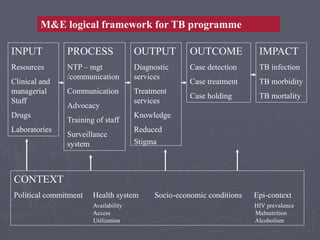
INPUT
Resources
Clinical and
managerial
Staff
Drugs
Laboratories
PROCESS
NTP – mgt
/communication
Communication
Advocacy
Training of staff
Surveillance
system
OUTPUT
Diagnostic
services
Treatment
services
Knowledge
Reduced
Stigma
OUTCOME
Case detection
Case treatment
Case holding
IMPACT
TB infection
TB morbidity
TB mortality
CONTEXT
Political commitment Health system Socio-economic conditions Epi-context
Availability HIV prevalence
Access Malnutrition
Utilization Alcoholism
M&E logical framework for TB programme
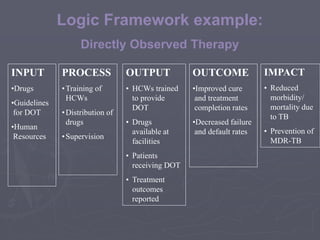
INPUT
•Drugs
•Guidelines
for DOT
•Human
Resources
PROCESS
•Training of
HCWs
•Distribution of
drugs
•Supervision
OUTPUT
• HCWs trained
to provide
DOT
• Drugs
available at
facilities
• Patients
receiving DOT
• Treatment
outcomes
reported
OUTCOME
•Improved cure
and treatment
completion rates
•Decreased failure
and default rates
IMPACT
• Reduced
morbidity/
mortality due
to TB
• Prevention of
MDR-TB
Logic Framework example:
Directly Observed Therapy
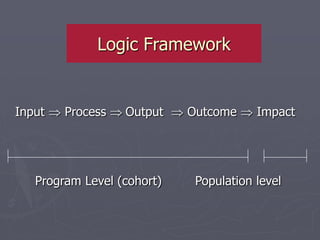
Logic Framework
Input  Process  Output  Outcome  Impact
Program Level (cohort) Population level
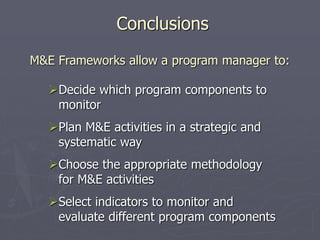
Conclusions
M&E Frameworks allow a program manager to:
Decide which program components to
monitor
Plan M&E activities in a strategic and
systematic way
Choose the appropriate methodology
for M&E activities
Select indicators to monitor and
evaluate different program components

Logic Framework.ppt

  • 1.
    Monitoring and Evaluation Frameworks Whatis a M&E Framework? Why do we use M&E Frameworks? How do we develop M&E Frameworks?
  • 2.
    M&E Frameworks ► Models,pictures or maps ► Visualize the factors that drive an intervention ► Maps that illustrate how a program should work ► Identify relationships between factors that influence program operation and the successful achievement of objectives
  • 3.
    Why do weuse M&E frameworks? ► Communication and planning tool ► As a ‘map’ for program’s goals ► Links between resources and activities ► Guide selection of indicators
  • 4.
    M&E LOGICAL FRAMEWORKS LogicalFramework: Logical frameworks are diagrams that identify and illustrate the relationships between program Inputs, Processes, Outputs, and Outcomes. Purposes: ► Provides a linear interpretation of planned use of resources and desired ends ► Clarifies project/program assumptions about linear relationships between key factors relevant to desired ends
  • 5.
    INPUT Resources Clinical and managerial Staff Drugs Laboratories PROCESS NTP –mgt /communication Communication Advocacy Training of staff Surveillance system OUTPUT Diagnostic services Treatment services Knowledge Reduced Stigma OUTCOME Case detection Case treatment Case holding IMPACT TB infection TB morbidity TB mortality CONTEXT Political commitment Health system Socio-economic conditions Epi-context Availability HIV prevalence Access Malnutrition Utilization Alcoholism M&E logical framework for TB programme
  • 6.
    INPUT •Drugs •Guidelines for DOT •Human Resources PROCESS •Training of HCWs •Distributionof drugs •Supervision OUTPUT • HCWs trained to provide DOT • Drugs available at facilities • Patients receiving DOT • Treatment outcomes reported OUTCOME •Improved cure and treatment completion rates •Decreased failure and default rates IMPACT • Reduced morbidity/ mortality due to TB • Prevention of MDR-TB Logic Framework example: Directly Observed Therapy
  • 7.
    Logic Framework Input Process  Output  Outcome  Impact Program Level (cohort) Population level
  • 8.
    Conclusions M&E Frameworks allowa program manager to: Decide which program components to monitor Plan M&E activities in a strategic and systematic way Choose the appropriate methodology for M&E activities Select indicators to monitor and evaluate different program components