/ 
Benefits Management, Network Rail 
Benefits Management 
Mike Reynolds 
Group Investment Controller 
Network Rail 
9th September 2014 1
/ 
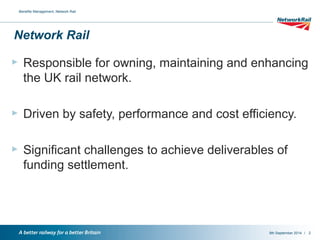
Network Rail 
► Responsible for owning, maintaining and enhancing 
the UK rail network. 
► Driven by safety, performance and cost efficiency. 
► Significant challenges to achieve deliverables of 
funding settlement. 
9th September 2014 
Benefits Management, Network Rail 
2
/ 
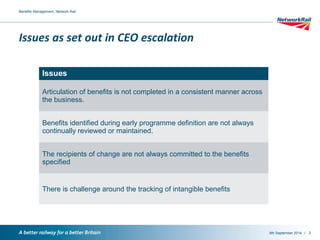
Issues as set out in CEO escalation 
Issues 
Articulation of benefits is not completed in a consistent manner across 
the business. 
Benefits identified during early programme definition are not always 
continually reviewed or maintained. 
The recipients of change are not always committed to the benefits 
specified 
There is challenge around the tracking of intangible benefits 
9th September 2014 
Benefits Management, Network Rail 
3
Background 
Currently tracking and realising the benefits from investment schemes, 
primarily financial but also performance, safety and other qualitative 
deliverables is not a transparent activity. 
There is no corporate tool for tracking and reporting claimed benefits. 
This leads to issues realising returns on investment, ensuring value for 
money and directly attributing project successes; or learning from our 
mistakes. 
Previously the cash benefits have been tracked via look-back reports, close 
out reports and pre-budget reductions. 
There is an increase focus on returns and our ability to report successful 
delivery of scheme objectives, maintain focus on commitments, remove 
duplication of claims, justify investment and secure RAB additions within the 
spend to save framework. 
/ 
9th September 2014 
Benefits Management, Network Rail 
4
/ 
…that’s not to say benefits tracking isn’t taking place. 
…..…plus others…level crossing safety..etc 
9th September 2014 
Benefits Management, Network Rail 
5 
Confidential information from slide removed
/ 
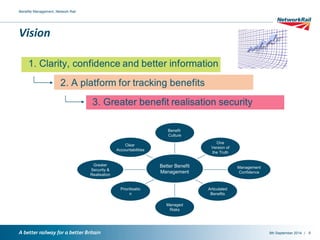
Vision 
Greater 
Security & 
Realisation 
Prioritisatio 
n 
Managed 
Risks 
Articulated 
Benefits 
Management 
Confidence 
Better Benefit 
Management 
One 
Version of 
the Truth 
Benefit 
Culture 
Clear 
Accountabilities 
9th September 2014 
Benefits Management, Network Rail 
6
/ 
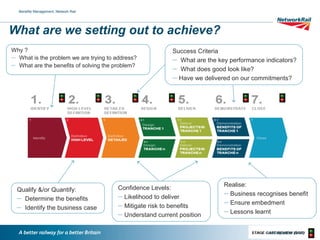
What are we setting out to achieve? 
Why ? 
▬ What is the problem we are trying to address? 
▬ What are the benefits of solving the problem? 
Qualify &/or Quantify: 
▬ Determine the benefits 
▬ Identify the business case 
Success Criteria 
▬ What are the key performance indicators? 
▬ What does good look like? 
▬ Have we delivered on our commitments? 
Confidence Levels: 
▬ Likelihood to deliver 
▬ Mitigate risk to benefits 
▬ Understand current position 
Realise: 
▬ Business recognises benefit 
▬ Ensure embedment 
▬ Lessons learnt 
9th September 2014 
Benefits Management, Network Rail 
7
/ 
Business and Programme Benefit Objectives 
► Assist sponsors with the articulation of benefits in a consistent and useful way 
► Senior management, Executive and Board confidence 
► Emphasis on benefits-led culture for activities outside core Enhancements & Renewals 
► Increased confidence in the benefits case as the programme matures 
► Process in place to enforce Benefit Owner sign-off 
► Audit trail 
► Standardised “proof” of benefits and “contract” between programme and the business 
► Improved realisation 
► Lessons learnt and optimism bias 
► One version of the truth 
► Value for Money comparisons and prioritisation 
9th September 2014 
Benefits Management, Network Rail 
8
/ 
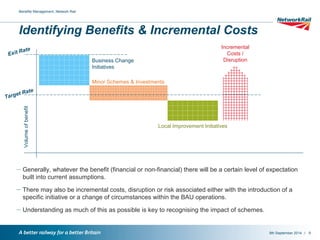
Identifying Benefits & Incremental Costs Exit Rate 
Target Rate 
Business Change 
Initiatives 
Minor Schemes & Investments 
Incremental 
Costs / 
Disruption 
Local Improvement Initiatives 
Volume of benefit 
▬ Generally, whatever the benefit (financial or non-financial) there will be a certain level of expectation 
built into current assumptions. 
▬ There may also be incremental costs, disruption or risk associated either with the introduction of a 
specific initiative or a change of circumstances within the BAU operations. 
▬ Understanding as much of this as possible is key to recognising the impact of schemes. 
9th September 2014 
Benefits Management, Network Rail 
9
/ 
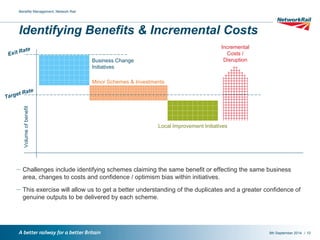
Identifying Benefits & Incremental Costs Exit Rate 
Target Rate 
Business Change 
Initiatives 
Minor Schemes & Investments 
Incremental 
Costs / 
Disruption 
Local Improvement Initiatives 
Volume of benefit 
▬ Challenges include identifying schemes claiming the same benefit or effecting the same business 
area, changes to costs and confidence / optimism bias within initiatives. 
▬ This exercise will allow us to get a better understanding of the duplicates and a greater confidence of 
genuine outputs to be delivered by each scheme. 
9th September 2014 
Benefits Management, Network Rail 
10
/ 
Benefits in Investment 
9th September 2014 
Benefits Management, Network Rail 
11
/ 
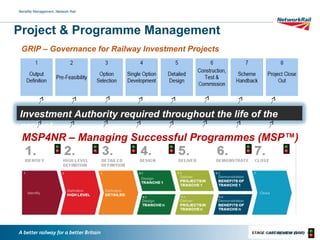
Project & Programme Management 
GRIP – Governance for Railway Investment Projects 
Investment Authority required throughout the life of the 
project 
MSP4NR – Managing Successful Programmes (MSP™) 
9th September 2014 
Benefits Management, Network Rail 
12
9th September 2014 / 
Benefits Management, Network Rail 
13
9th September 2014 / 
Benefits Management, Network Rail 
14
/ 
Benefits Management, Network Rail 
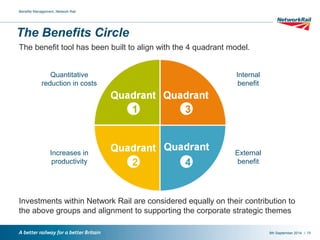
The Benefits Circle 
9th September 2014 15 
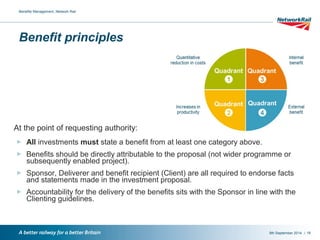
The benefit tool has been built to align with the 4 quadrant model. 
Quadrant 
4 
Quantitative 
reduction in costs 
1 3 
2 4 
Internal 
benefit 
External 
benefit 
Increases in 
productivity 
Investments within Network Rail are considered equally on their contribution to 
the above groups and alignment to supporting the corporate strategic themes
/ 
Benefits Management, Network Rail 
Benefit principles 
► All investments must state a benefit from at least one category above. 
► Benefits should be directly attributable to the proposal (not wider programme or 
subsequently enabled project). 
► Sponsor, Deliverer and benefit recipient (Client) are all required to endorse facts 
and statements made in the investment proposal. 
► Accountability for the delivery of the benefits sits with the Sponsor in line with the 
Clienting guidelines. 
9th September 2014 16 
At the point of requesting authority:
/ 
Investment Systems 
9th September 2014 
Benefits Management, Network Rail 
17
/ 
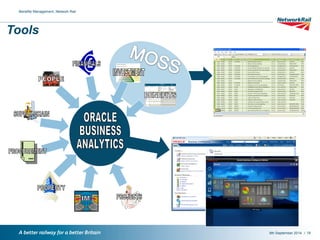
Tools 
9th September 2014 
Benefits Management, Network Rail 
18
/ 
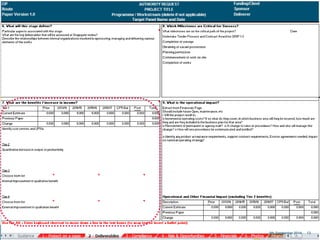
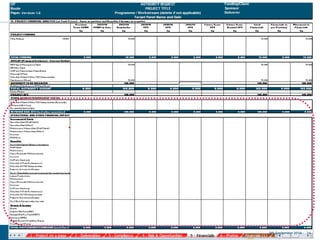
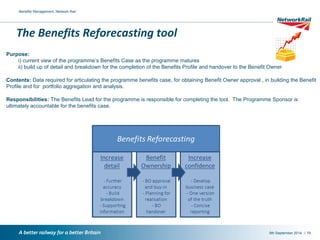
The Benefits Reforecasting tool 
Purpose: 
i) current view of the programme’s Benefits Case as the programme matures 
ii) build up of detail and breakdown for the completion of the Benefits Profile and handover to the Benefit Owner 
Contents: Data required for articulating the programme benefits case, for obtaining Benefit Owner approval , in building the Benefit 
Profile and for portfolio aggregation and analysis. 
Responsibilities: The Benefits Lead for the programme is responsible for completing the tool. The Programme Sponsor is 
ultimately accountable for the benefits case. 
9th September 2014 
Benefits Management, Network Rail 
19
/ 
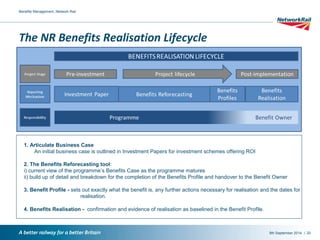
The NR Benefits Realisation Lifecycle 
1. Articulate Business Case 
An initial business case is outlined in Investment Papers for investment schemes offering ROI 
2. The Benefits Reforecasting tool: 
i) current view of the programme’s Benefits Case as the programme matures 
ii) build up of detail and breakdown for the completion of the Benefits Profile and handover to the Benefit Owner 
3. Benefit Profile - sets out exactly what the benefit is, any further actions necessary for realisation and the dates for 
realisation. 
4. Benefits Realisation - confirmation and evidence of realisation as baselined in the Benefit Profile. 
d 
9th September 2014 
Benefits Management, Network Rail 
20
/ 
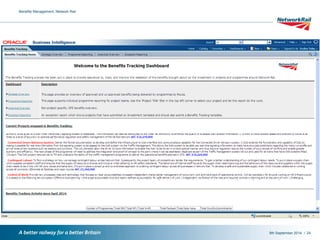
Accessing Information 
9th September 2014 
Benefits Management, Network Rail 
21
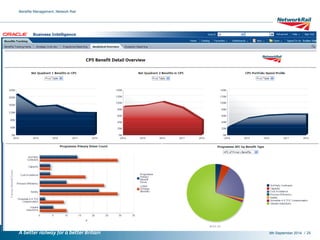
/ 
Benefits Management, Network Rail 
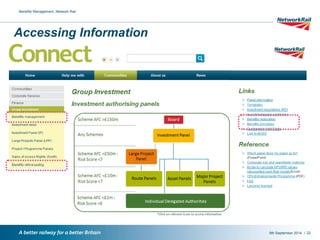
Accessing Information 
9th September 2014 22
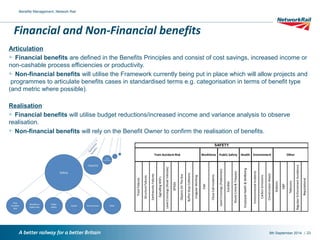
Financial and Non-Financial benefits 
Articulation 
► Financial benefits are defined in the Benefits Principles and consist of cost savings, increased income or 
non-cashable process efficiencies or productivity. 
► Non-financial benefits will utilise the Framework currently being put in place which will allow projects and 
programmes to articulate benefits cases in standardised terms e.g. categorisation in terms of benefit type 
(and metric where possible). 
Realisation 
► Financial benefits will utilise budget reductions/increased income and variance analysis to observe 
realisation. 
► Non-financial benefits will rely on the Benefit Owner to confirm the realisation of benefits. 
/ 
Health 
Track Failures 
Structure Failures 
Earthworks Failures 
Signalling WSFs 
Level Crossings (Road Vehicles) 
SPADs 
Objects On The line 
Buffer Stop Collisions 
Irregular Working 
FWI 
SAFETY 
Close Call Incidents 
Level Crossings (Pedestrian) 
Suicides 
Route Crime & Trespass 
Employee Health & Wellbeing 
Environmental Incidents 
Carbon Emissions 
Construction Waste 
Stations 
E&P 
Telecoms 
Regulaor Enforcement Avoidance 
Reputational 
Train Accident Risk Workforce Public Safety Environment Other 
9th September 2014 
Benefits Management, Network Rail 
23
9th September 2014 / 
Benefits Management, Network Rail 
24
9th September 2014 / 
Benefits Management, Network Rail 
25
/ 
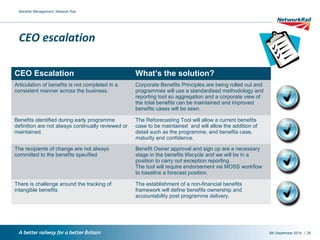
CEO escalation 
CEO Escalation What’s the solution? 
Articulation of benefits is not completed in a 
consistent manner across the business. 
Corporate Benefits Principles are being rolled out and 
programmes will use a standardised methodology and 
reporting tool so aggregation and a corporate view of 
the total benefits can be maintained and improved 
benefits cases will be seen. 
Benefits identified during early programme 
definition are not always continually reviewed or 
maintained. 
The Reforecasting Tool will allow a current benefits 
case to be maintained and will allow the addition of 
detail such as the programme, and benefits case, 
maturity and confidence. 
The recipients of change are not always 
committed to the benefits specified 
Benefit Owner approval and sign up are a necessary 
stage in the benefits lifecycle and we will be in a 
position to carry out exception reporting. 
The tool will require endorsement via MOSS workflow 
to baseline a forecast position. 
There is challenge around the tracking of 
intangible benefits 
The establishment of a non-financial benefits 
framework will define benefits ownership and 
accountability post programme delivery. 
9th September 2014 
Benefits Management, Network Rail 
26
/ 
Benefits Management, Network Rail 
Thank you. 
9th September 2014 27

Network rail - Benefits Management

  • 1.
    / Benefits Management,Network Rail Benefits Management Mike Reynolds Group Investment Controller Network Rail 9th September 2014 1
  • 2.
    / Network Rail ► Responsible for owning, maintaining and enhancing the UK rail network. ► Driven by safety, performance and cost efficiency. ► Significant challenges to achieve deliverables of funding settlement. 9th September 2014 Benefits Management, Network Rail 2
  • 3.
    / Issues asset out in CEO escalation Issues Articulation of benefits is not completed in a consistent manner across the business. Benefits identified during early programme definition are not always continually reviewed or maintained. The recipients of change are not always committed to the benefits specified There is challenge around the tracking of intangible benefits 9th September 2014 Benefits Management, Network Rail 3
  • 4.
    Background Currently trackingand realising the benefits from investment schemes, primarily financial but also performance, safety and other qualitative deliverables is not a transparent activity. There is no corporate tool for tracking and reporting claimed benefits. This leads to issues realising returns on investment, ensuring value for money and directly attributing project successes; or learning from our mistakes. Previously the cash benefits have been tracked via look-back reports, close out reports and pre-budget reductions. There is an increase focus on returns and our ability to report successful delivery of scheme objectives, maintain focus on commitments, remove duplication of claims, justify investment and secure RAB additions within the spend to save framework. / 9th September 2014 Benefits Management, Network Rail 4
  • 5.
    / …that’s notto say benefits tracking isn’t taking place. …..…plus others…level crossing safety..etc 9th September 2014 Benefits Management, Network Rail 5 Confidential information from slide removed
  • 6.
    / Vision Greater Security & Realisation Prioritisatio n Managed Risks Articulated Benefits Management Confidence Better Benefit Management One Version of the Truth Benefit Culture Clear Accountabilities 9th September 2014 Benefits Management, Network Rail 6
  • 7.
    / What arewe setting out to achieve? Why ? ▬ What is the problem we are trying to address? ▬ What are the benefits of solving the problem? Qualify &/or Quantify: ▬ Determine the benefits ▬ Identify the business case Success Criteria ▬ What are the key performance indicators? ▬ What does good look like? ▬ Have we delivered on our commitments? Confidence Levels: ▬ Likelihood to deliver ▬ Mitigate risk to benefits ▬ Understand current position Realise: ▬ Business recognises benefit ▬ Ensure embedment ▬ Lessons learnt 9th September 2014 Benefits Management, Network Rail 7
  • 8.
    / Business andProgramme Benefit Objectives ► Assist sponsors with the articulation of benefits in a consistent and useful way ► Senior management, Executive and Board confidence ► Emphasis on benefits-led culture for activities outside core Enhancements & Renewals ► Increased confidence in the benefits case as the programme matures ► Process in place to enforce Benefit Owner sign-off ► Audit trail ► Standardised “proof” of benefits and “contract” between programme and the business ► Improved realisation ► Lessons learnt and optimism bias ► One version of the truth ► Value for Money comparisons and prioritisation 9th September 2014 Benefits Management, Network Rail 8
  • 9.
    / Identifying Benefits& Incremental Costs Exit Rate Target Rate Business Change Initiatives Minor Schemes & Investments Incremental Costs / Disruption Local Improvement Initiatives Volume of benefit ▬ Generally, whatever the benefit (financial or non-financial) there will be a certain level of expectation built into current assumptions. ▬ There may also be incremental costs, disruption or risk associated either with the introduction of a specific initiative or a change of circumstances within the BAU operations. ▬ Understanding as much of this as possible is key to recognising the impact of schemes. 9th September 2014 Benefits Management, Network Rail 9
  • 10.
    / Identifying Benefits& Incremental Costs Exit Rate Target Rate Business Change Initiatives Minor Schemes & Investments Incremental Costs / Disruption Local Improvement Initiatives Volume of benefit ▬ Challenges include identifying schemes claiming the same benefit or effecting the same business area, changes to costs and confidence / optimism bias within initiatives. ▬ This exercise will allow us to get a better understanding of the duplicates and a greater confidence of genuine outputs to be delivered by each scheme. 9th September 2014 Benefits Management, Network Rail 10
  • 11.
    / Benefits inInvestment 9th September 2014 Benefits Management, Network Rail 11
  • 12.
    / Project &Programme Management GRIP – Governance for Railway Investment Projects Investment Authority required throughout the life of the project MSP4NR – Managing Successful Programmes (MSP™) 9th September 2014 Benefits Management, Network Rail 12
  • 13.
    9th September 2014/ Benefits Management, Network Rail 13
  • 14.
    9th September 2014/ Benefits Management, Network Rail 14
  • 15.
    / Benefits Management,Network Rail The Benefits Circle 9th September 2014 15 The benefit tool has been built to align with the 4 quadrant model. Quadrant 4 Quantitative reduction in costs 1 3 2 4 Internal benefit External benefit Increases in productivity Investments within Network Rail are considered equally on their contribution to the above groups and alignment to supporting the corporate strategic themes
  • 16.
    / Benefits Management,Network Rail Benefit principles ► All investments must state a benefit from at least one category above. ► Benefits should be directly attributable to the proposal (not wider programme or subsequently enabled project). ► Sponsor, Deliverer and benefit recipient (Client) are all required to endorse facts and statements made in the investment proposal. ► Accountability for the delivery of the benefits sits with the Sponsor in line with the Clienting guidelines. 9th September 2014 16 At the point of requesting authority:
  • 17.
    / Investment Systems 9th September 2014 Benefits Management, Network Rail 17
  • 18.
    / Tools 9thSeptember 2014 Benefits Management, Network Rail 18
  • 19.
    / The BenefitsReforecasting tool Purpose: i) current view of the programme’s Benefits Case as the programme matures ii) build up of detail and breakdown for the completion of the Benefits Profile and handover to the Benefit Owner Contents: Data required for articulating the programme benefits case, for obtaining Benefit Owner approval , in building the Benefit Profile and for portfolio aggregation and analysis. Responsibilities: The Benefits Lead for the programme is responsible for completing the tool. The Programme Sponsor is ultimately accountable for the benefits case. 9th September 2014 Benefits Management, Network Rail 19
  • 20.
    / The NRBenefits Realisation Lifecycle 1. Articulate Business Case An initial business case is outlined in Investment Papers for investment schemes offering ROI 2. The Benefits Reforecasting tool: i) current view of the programme’s Benefits Case as the programme matures ii) build up of detail and breakdown for the completion of the Benefits Profile and handover to the Benefit Owner 3. Benefit Profile - sets out exactly what the benefit is, any further actions necessary for realisation and the dates for realisation. 4. Benefits Realisation - confirmation and evidence of realisation as baselined in the Benefit Profile. d 9th September 2014 Benefits Management, Network Rail 20
  • 21.
    / Accessing Information 9th September 2014 Benefits Management, Network Rail 21
  • 22.
    / Benefits Management,Network Rail Accessing Information 9th September 2014 22
  • 23.
    Financial and Non-Financialbenefits Articulation ► Financial benefits are defined in the Benefits Principles and consist of cost savings, increased income or non-cashable process efficiencies or productivity. ► Non-financial benefits will utilise the Framework currently being put in place which will allow projects and programmes to articulate benefits cases in standardised terms e.g. categorisation in terms of benefit type (and metric where possible). Realisation ► Financial benefits will utilise budget reductions/increased income and variance analysis to observe realisation. ► Non-financial benefits will rely on the Benefit Owner to confirm the realisation of benefits. / Health Track Failures Structure Failures Earthworks Failures Signalling WSFs Level Crossings (Road Vehicles) SPADs Objects On The line Buffer Stop Collisions Irregular Working FWI SAFETY Close Call Incidents Level Crossings (Pedestrian) Suicides Route Crime & Trespass Employee Health & Wellbeing Environmental Incidents Carbon Emissions Construction Waste Stations E&P Telecoms Regulaor Enforcement Avoidance Reputational Train Accident Risk Workforce Public Safety Environment Other 9th September 2014 Benefits Management, Network Rail 23
  • 24.
    9th September 2014/ Benefits Management, Network Rail 24
  • 25.
    9th September 2014/ Benefits Management, Network Rail 25
  • 26.
    / CEO escalation CEO Escalation What’s the solution? Articulation of benefits is not completed in a consistent manner across the business. Corporate Benefits Principles are being rolled out and programmes will use a standardised methodology and reporting tool so aggregation and a corporate view of the total benefits can be maintained and improved benefits cases will be seen. Benefits identified during early programme definition are not always continually reviewed or maintained. The Reforecasting Tool will allow a current benefits case to be maintained and will allow the addition of detail such as the programme, and benefits case, maturity and confidence. The recipients of change are not always committed to the benefits specified Benefit Owner approval and sign up are a necessary stage in the benefits lifecycle and we will be in a position to carry out exception reporting. The tool will require endorsement via MOSS workflow to baseline a forecast position. There is challenge around the tracking of intangible benefits The establishment of a non-financial benefits framework will define benefits ownership and accountability post programme delivery. 9th September 2014 Benefits Management, Network Rail 26
  • 27.
    / Benefits Management,Network Rail Thank you. 9th September 2014 27