© 2012 Boise State University 1
ME 510 – Continuum
Mechanics
© 2012 Boise State University 2
Simplified Hyperelastic-Viscoplastic
Modeling of Concrete Subjected to
Uniaxial Loading.
MD ASIF RAHMAN
Graduate Student
Dept. of Civil Engineering
TITLE:
3
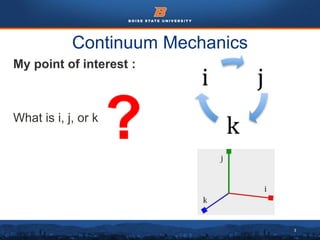
Continuum Mechanics
My point of interest :
What is i, j, or k
4
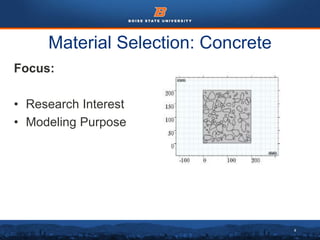
Material Selection: Concrete
Focus:
• Research Interest
• Modeling Purpose
5
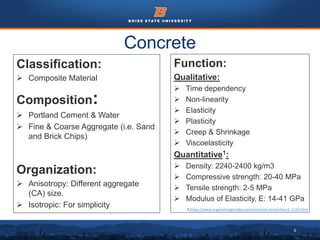
Concrete
What is Concrete:
Concrete = Aggregate + Cement Paste
Application:
 most frequently used construction material
 Concrete has environmental, social and
economic benefit
 Concrete is frequently used to build
skyscrapers, bridges, highways, houses,
dams, nuclear reactor and so on.
Picture Credit: free online resources
6
Concrete
Classification:
 Composite Material
Composition:
 Portland Cement & Water
 Fine & Coarse Aggregate (i.e. Sand
and Brick Chips)
Organization:
 Anisotropy: Different aggregate
(CA) size.
 Isotropic: For simplicity
Function:
Qualitative:
 Time dependency
 Non-linearity
 Elasticity
 Plasticity
 Creep & Shrinkage
 Viscoelasticity
Quantitative1:
 Density: 2240-2400 kg/m3
 Compressive strength: 20-40 MPa
 Tensile strength: 2-5 MPa
 Modulus of Elasticity, E: 14-41 GPa
1.https://www.engineeringtoolbox.com/concrete-properties-d_1223.html
7
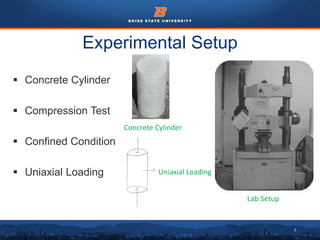
Experimental Setup
 Concrete Cylinder
 Compression Test
 Confined Condition
 Uniaxial Loading Uniaxial Loading
Concrete Cylinder
Lab Setup
8
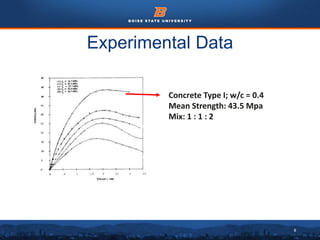
Experimental Data
Concrete Type I; w/c = 0.4
Mean Strength: 43.5 Mpa
Mix: 1 : 1 : 2
9
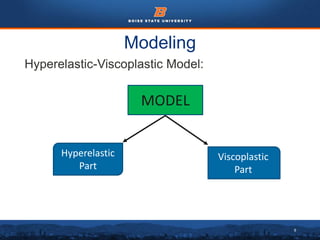
Modeling
Hyperelastic-Viscoplastic Model:
MODEL
Hyperelastic
Part
Viscoplastic
Part
10
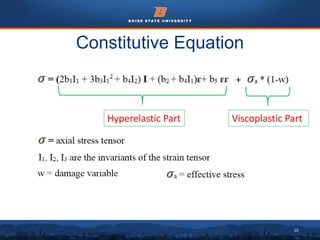
Constitutive Equation
+
Hyperelastic Part Viscoplastic Part
11
Constitutive Equation
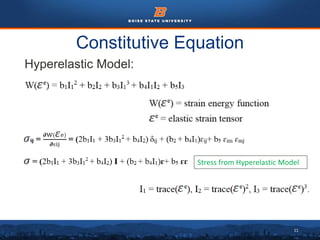
Hyperelastic Model:
Stress from Hyperelastic Model
12
Constitutive Equation
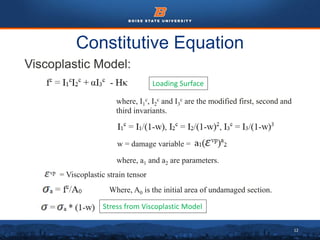
Viscoplastic Model:
Loading Surface
where, a1 and a2 are parameters.
where, I1
c, I2
c and I3
c are the modified first, second and
third invariants.
w = damage variable =
Where, A0 is the initial area of undamaged section.
= Viscoplastic strain tensor
Stress from Viscoplastic Model
13
Constitutive Equation
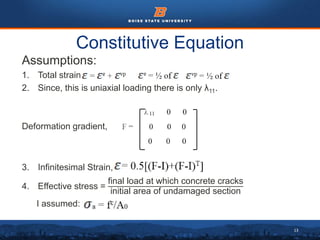
Assumptions:
1. Total strain,
2. Since, this is uniaxial loading there is only λ11.
Deformation gradient,
3. Infinitesimal Strain,
4. Effective stress =
final load at which concrete cracks
initial area of undamaged section
I assumed:
14
Material Coefficients
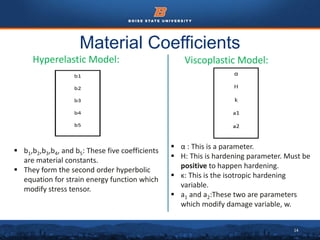
Hyperelastic Model:
 α : This is a parameter.
 H: This is hardening parameter. Must be
positive to happen hardening.
 κ: This is the isotropic hardening
variable.
 a1 and a2:These two are parameters
which modify damage variable, w.
Viscoplastic Model:
 b1,b2,b3,b4, and b5: These five coefficients
are material constants.
 They form the second order hyperbolic
equation for strain energy function which
modify stress tensor.
15
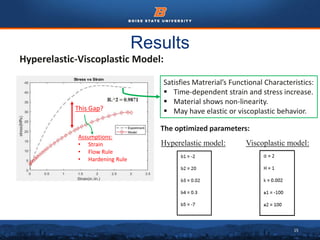
Results
Hyperelastic-Viscoplastic Model:
The optimized parameters:
Satisfies Matrerial’s Functional Characteristics:
 Time-dependent strain and stress increase.
 Material shows non-linearity.
 May have elastic or viscoplastic behavior.
Hyperelastic model: Viscoplastic model:
Assumptions:
• Strain
• Flow Rule
• Hardening Rule
This Gap?
16
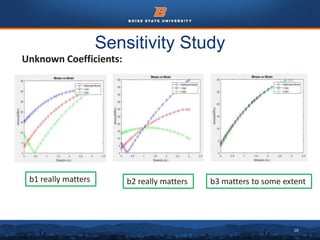
Sensitivity Study
Unknown Coefficients:
b1 really matters b2 really matters b3 matters to some extent
17
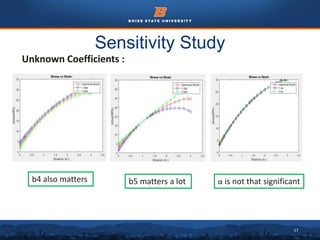
Sensitivity Study
Unknown Coefficients :
b4 also matters b5 matters a lot α is not that significant
18
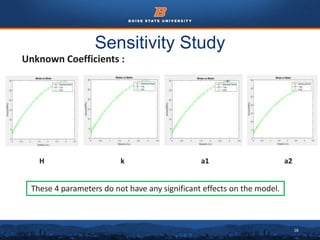
Sensitivity Study
Unknown Coefficients :
These 4 parameters do not have any significant effects on the model.
H k a1 a2
19
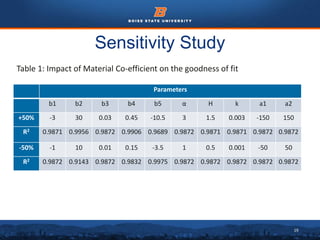
Sensitivity Study
Parameters
b1 b2 b3 b4 b5 α H k a1 a2
+50% -3 30 0.03 0.45 -10.5 3 1.5 0.003 -150 150
R2 0.9871 0.9956 0.9872 0.9906 0.9689 0.9872 0.9871 0.9871 0.9872 0.9872
-50% -1 10 0.01 0.15 -3.5 1 0.5 0.001 -50 50
R2 0.9872 0.9143 0.9872 0.9832 0.9975 0.9872 0.9872 0.9872 0.9872 0.9872
Table 1: Impact of Material Co-efficient on the goodness of fit
20
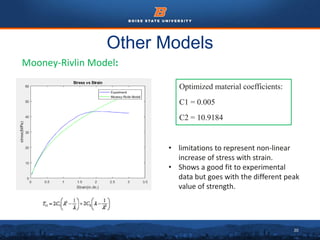
Other Models
Mooney-Rivlin Model:
Optimized material coefficients:
C1 = 0.005
C2 = 10.9184
• limitations to represent non-linear
increase of stress with strain.
• Shows a good fit to experimental
data but goes with the different peak
value of strength.
21
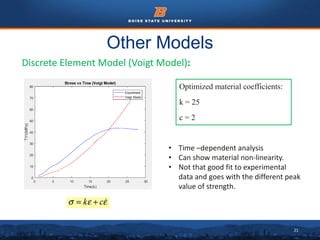
Other Models
Discrete Element Model (Voigt Model):
Optimized material coefficients:
k = 25
c = 2
• Time –dependent analysis
• Can show material non-linearity.
• Not that good fit to experimental
data and goes with the different peak
value of strength.
22
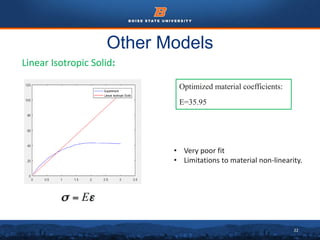
Other Models
Linear Isotropic Solid:
Optimized material coefficients:
E=35.95
• Very poor fit
• Limitations to material non-linearity.
23
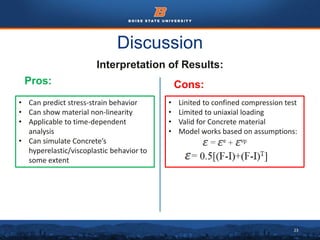
Discussion
Interpretation of Results:
Pros: Cons:
• Can predict stress-strain behavior
• Can show material non-linearity
• Applicable to time-dependent
analysis
• Can simulate Concrete’s
hyperelastic/viscoplastic behavior to
some extent
• Linited to confined compression test
• Limited to uniaxial loading
• Valid for Concrete material
• Model works based on assumptions:
24
Conclusion
• Though Model has some limitations, it can be used for
approximation/prediction of material behavior.
• Can be further developed using complete viscoplastic
model.
• Can be checked with other/realistic fraction of elastic and
viscoplastic strain.
• Can be validated by considering several experimental
data from different source/conditions.
25
References
• [1]. Dinesh Panneerselvam and Vassilis P. Panoskaltsis, Numerical
Implementation of A Hyperelastic-Viscoplastic Damage Model for
Asphalt Concrete Materials and Pavements, ASCE journal, 2006.
DOI: 10.1061/40825(185)7
• [2]. Jianlian Cheng, Xudong Qian, Tieshuan Zhao, Rheological
Viscoplastic Models of Asphalt Concrete and Rate-Dependent
Numerical Implement, International Journal of Plasticity, 81 (2016)
209-230, http://dx.doi.org/10.1016/j.ijplas.2016.01.004
• [3]. T. Yu, J.G. Teng, Y.L. Wong, S.L. Dong, Finite Element Modeling
of Confined Concrete-II: Plastic-Damage Model, Engineering
Structures, 32 (2010) 680-691, doi:10.1016/j.engstruct.2009.11.013
26
THANK YOU
Md. Asif Rahman
Graduate Student
ID: 114084345
Email mdasifrahman@u.boisestate.edu

ME 510 Continuum Mechanics

  • 1.
    © 2012 BoiseState University 1 ME 510 – Continuum Mechanics
  • 2.
    © 2012 BoiseState University 2 Simplified Hyperelastic-Viscoplastic Modeling of Concrete Subjected to Uniaxial Loading. MD ASIF RAHMAN Graduate Student Dept. of Civil Engineering TITLE:
  • 3.
    3 Continuum Mechanics My pointof interest : What is i, j, or k
  • 4.
    4 Material Selection: Concrete Focus: •Research Interest • Modeling Purpose
  • 5.
    5 Concrete What is Concrete: Concrete= Aggregate + Cement Paste Application:  most frequently used construction material  Concrete has environmental, social and economic benefit  Concrete is frequently used to build skyscrapers, bridges, highways, houses, dams, nuclear reactor and so on. Picture Credit: free online resources
  • 6.
    6 Concrete Classification:  Composite Material Composition: Portland Cement & Water  Fine & Coarse Aggregate (i.e. Sand and Brick Chips) Organization:  Anisotropy: Different aggregate (CA) size.  Isotropic: For simplicity Function: Qualitative:  Time dependency  Non-linearity  Elasticity  Plasticity  Creep & Shrinkage  Viscoelasticity Quantitative1:  Density: 2240-2400 kg/m3  Compressive strength: 20-40 MPa  Tensile strength: 2-5 MPa  Modulus of Elasticity, E: 14-41 GPa 1.https://www.engineeringtoolbox.com/concrete-properties-d_1223.html
  • 7.
    7 Experimental Setup  ConcreteCylinder  Compression Test  Confined Condition  Uniaxial Loading Uniaxial Loading Concrete Cylinder Lab Setup
  • 8.
    8 Experimental Data Concrete TypeI; w/c = 0.4 Mean Strength: 43.5 Mpa Mix: 1 : 1 : 2
  • 9.
  • 10.
  • 11.
  • 12.
    12 Constitutive Equation Viscoplastic Model: LoadingSurface where, a1 and a2 are parameters. where, I1 c, I2 c and I3 c are the modified first, second and third invariants. w = damage variable = Where, A0 is the initial area of undamaged section. = Viscoplastic strain tensor Stress from Viscoplastic Model
  • 13.
    13 Constitutive Equation Assumptions: 1. Totalstrain, 2. Since, this is uniaxial loading there is only λ11. Deformation gradient, 3. Infinitesimal Strain, 4. Effective stress = final load at which concrete cracks initial area of undamaged section I assumed:
  • 14.
    14 Material Coefficients Hyperelastic Model: α : This is a parameter.  H: This is hardening parameter. Must be positive to happen hardening.  κ: This is the isotropic hardening variable.  a1 and a2:These two are parameters which modify damage variable, w. Viscoplastic Model:  b1,b2,b3,b4, and b5: These five coefficients are material constants.  They form the second order hyperbolic equation for strain energy function which modify stress tensor.
  • 15.
    15 Results Hyperelastic-Viscoplastic Model: The optimizedparameters: Satisfies Matrerial’s Functional Characteristics:  Time-dependent strain and stress increase.  Material shows non-linearity.  May have elastic or viscoplastic behavior. Hyperelastic model: Viscoplastic model: Assumptions: • Strain • Flow Rule • Hardening Rule This Gap?
  • 16.
    16 Sensitivity Study Unknown Coefficients: b1really matters b2 really matters b3 matters to some extent
  • 17.
    17 Sensitivity Study Unknown Coefficients: b4 also matters b5 matters a lot α is not that significant
  • 18.
    18 Sensitivity Study Unknown Coefficients: These 4 parameters do not have any significant effects on the model. H k a1 a2
  • 19.
    19 Sensitivity Study Parameters b1 b2b3 b4 b5 α H k a1 a2 +50% -3 30 0.03 0.45 -10.5 3 1.5 0.003 -150 150 R2 0.9871 0.9956 0.9872 0.9906 0.9689 0.9872 0.9871 0.9871 0.9872 0.9872 -50% -1 10 0.01 0.15 -3.5 1 0.5 0.001 -50 50 R2 0.9872 0.9143 0.9872 0.9832 0.9975 0.9872 0.9872 0.9872 0.9872 0.9872 Table 1: Impact of Material Co-efficient on the goodness of fit
  • 20.
    20 Other Models Mooney-Rivlin Model: Optimizedmaterial coefficients: C1 = 0.005 C2 = 10.9184 • limitations to represent non-linear increase of stress with strain. • Shows a good fit to experimental data but goes with the different peak value of strength.
  • 21.
    21 Other Models Discrete ElementModel (Voigt Model): Optimized material coefficients: k = 25 c = 2 • Time –dependent analysis • Can show material non-linearity. • Not that good fit to experimental data and goes with the different peak value of strength.
  • 22.
    22 Other Models Linear IsotropicSolid: Optimized material coefficients: E=35.95 • Very poor fit • Limitations to material non-linearity.
  • 23.
    23 Discussion Interpretation of Results: Pros:Cons: • Can predict stress-strain behavior • Can show material non-linearity • Applicable to time-dependent analysis • Can simulate Concrete’s hyperelastic/viscoplastic behavior to some extent • Linited to confined compression test • Limited to uniaxial loading • Valid for Concrete material • Model works based on assumptions:
  • 24.
    24 Conclusion • Though Modelhas some limitations, it can be used for approximation/prediction of material behavior. • Can be further developed using complete viscoplastic model. • Can be checked with other/realistic fraction of elastic and viscoplastic strain. • Can be validated by considering several experimental data from different source/conditions.
  • 25.
    25 References • [1]. DineshPanneerselvam and Vassilis P. Panoskaltsis, Numerical Implementation of A Hyperelastic-Viscoplastic Damage Model for Asphalt Concrete Materials and Pavements, ASCE journal, 2006. DOI: 10.1061/40825(185)7 • [2]. Jianlian Cheng, Xudong Qian, Tieshuan Zhao, Rheological Viscoplastic Models of Asphalt Concrete and Rate-Dependent Numerical Implement, International Journal of Plasticity, 81 (2016) 209-230, http://dx.doi.org/10.1016/j.ijplas.2016.01.004 • [3]. T. Yu, J.G. Teng, Y.L. Wong, S.L. Dong, Finite Element Modeling of Confined Concrete-II: Plastic-Damage Model, Engineering Structures, 32 (2010) 680-691, doi:10.1016/j.engstruct.2009.11.013
  • 26.
    26 THANK YOU Md. AsifRahman Graduate Student ID: 114084345 Email mdasifrahman@u.boisestate.edu