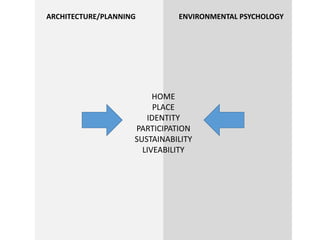
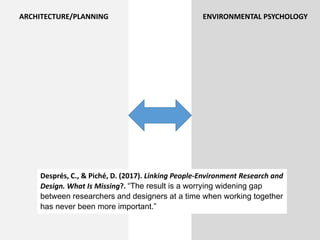
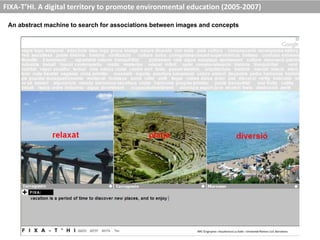
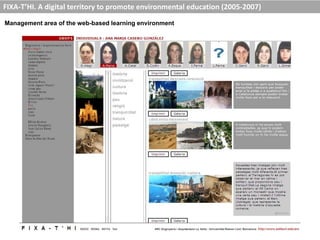
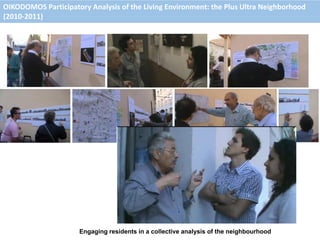
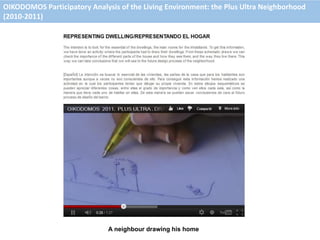
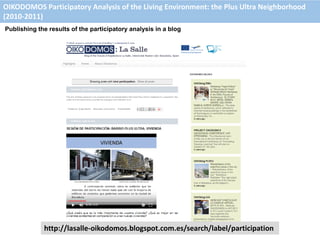
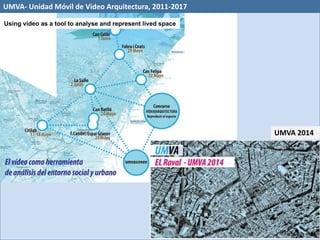
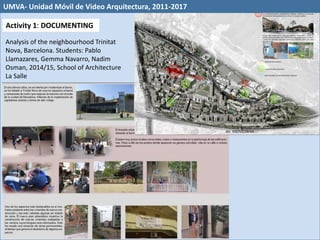
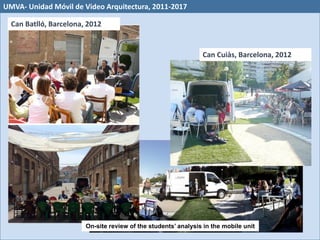
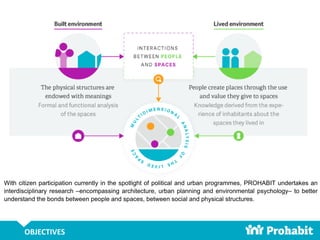
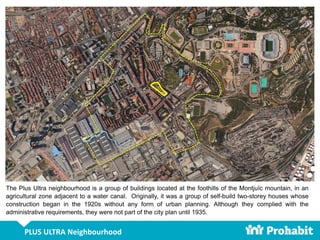
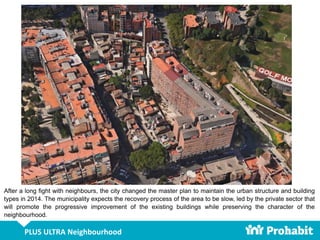
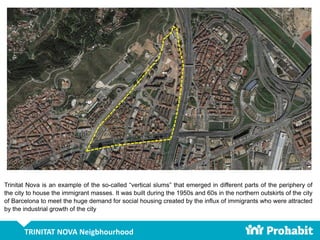
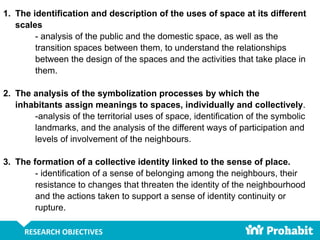
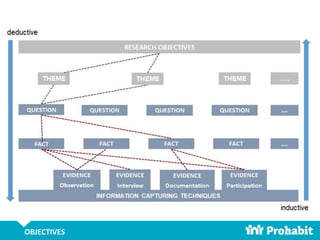
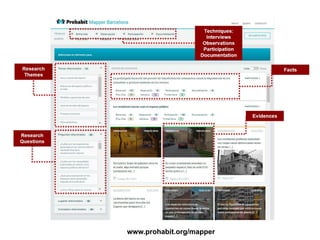
The document discusses an interdisciplinary analysis of lived spaces, integrating architecture, urban planning, and environmental psychology to foster a deeper understanding of the relationships between people and their environments. It highlights a research project, Prohabit, focusing on spatial usage, the symbolic meanings assigned by inhabitants, and the formation of collective identity in three neighborhoods. The study emphasizes the importance of understanding environmental psychology to achieve a harmonious relationship between individuals and their built and natural surroundings.


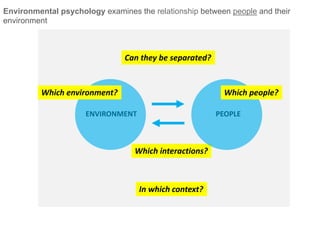
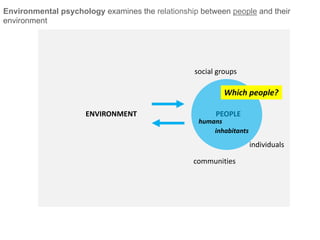
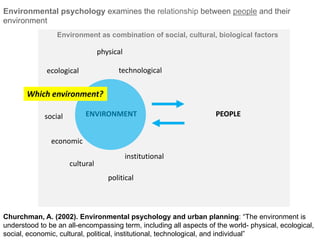
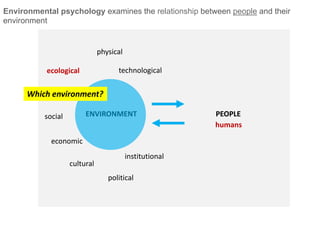

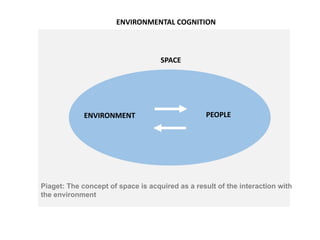
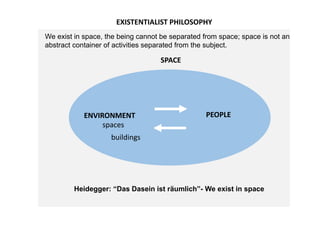
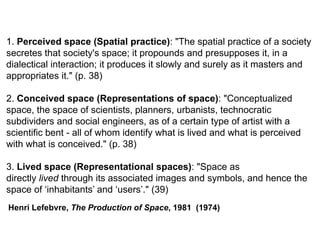
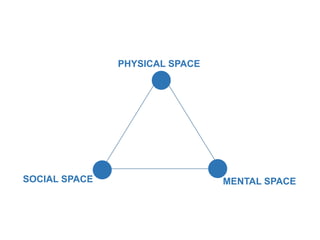
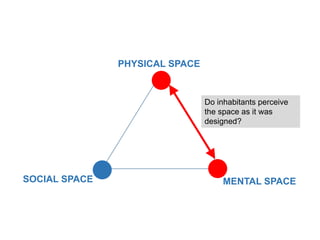
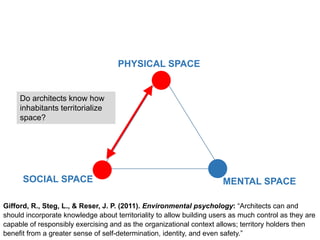
![ENVIRONMENT
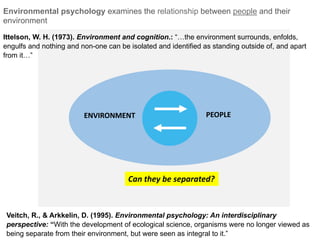
Can they be separated?
PEOPLEENVIRONMENT
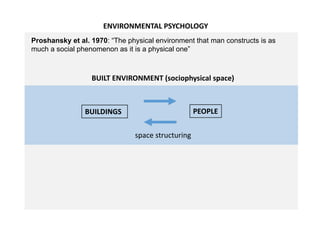
Proshansky, H. M., Ittelson, W. H., & Rivlin, L. G. (Eds.). (1970). Environmental psychology:
Man and his physical setting: “….from a theoretical point of view there is no physical
environment apart from human experience and social organization. The physical environment that
man constructs is as much a social phenomenon as it is a physical one”
[PHYSICAL]
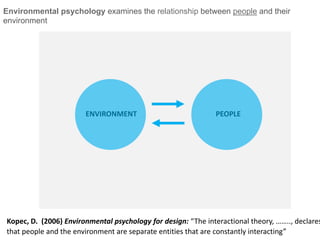
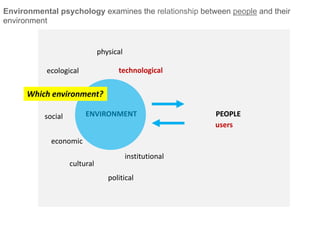
Environmental psychology examines the relationship between people and their
environment](https://image.slidesharecdn.com/prohabitoikonetlisbonseminar-180319084558/85/PROHABIT_OIKONET_Lisbon_Seminar-18-320.jpg)

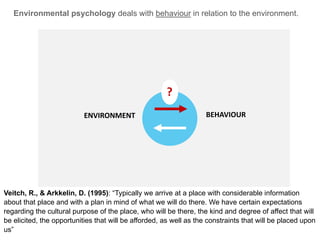
![PEOPLEENVIRONMENT
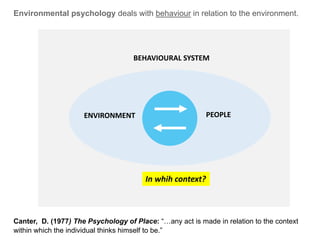
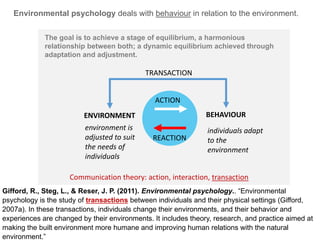
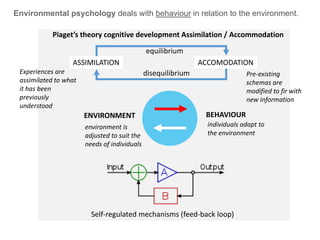
Environmental psychology deals with behaviour in relation to the environment.
BEHAVIOURENVIRONMENT
The goal is to achieve a stage of equilibrium, a harmonious
relationship between both; a dynamic equilibrium achieved through
adaptation and adjustment.
individuals adapt
to the
environment
ACTION
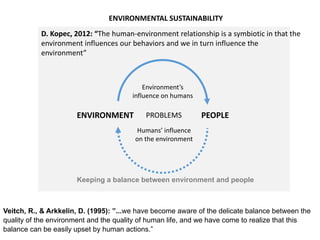
Veitch, R., & Arkkelin, D. (1995): “When environmental-stimulus properties change to the extent
that they have exceeded the AL [adaptation level] boundaries, the individual experiences
“unpleasantness”, and the influence of the environment is no longer steady-state. It is only at this
point that changes in the normative modes of behavior can be expected, that the regularized,
routinized behavioral-setting influence begins to break down.”
A system is in a steady state if the state variables which define its behaviour
are unchanging in time](https://image.slidesharecdn.com/prohabitoikonetlisbonseminar-180319084558/85/PROHABIT_OIKONET_Lisbon_Seminar-23-320.jpg)


![groups
individuals
communities
buildings
streets
commerce
green areas
internet energy sources
climate
neighbourhoods
housing
square
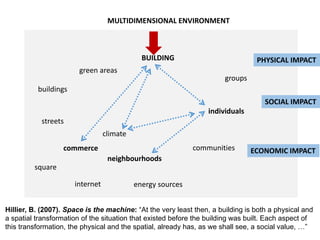
Proshansky, H. M., Ittelson, W. H., & Rivlin, L. G. (Eds.). (1970).: [“loss of privacy” in an urban
ghetto] “It is also a socio-psychological, economic, sociological, and architectural-design
phenomenon related to the organization of groups, institutional practices, and structural and
substantive properties of physical settings”
ENVIRONMENT AS SYSTEM](https://image.slidesharecdn.com/prohabitoikonetlisbonseminar-180319084558/85/PROHABIT_OIKONET_Lisbon_Seminar-31-320.jpg)
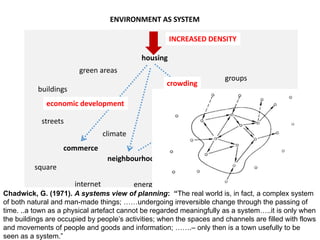
![groups
individuals
communities
buildings
streets
commerce
green areas
internet energy sources
climate
neighbourhoods
housing
square
crowding
INCREASED DENSITY
economic development
loss of privacy
Proshansky, H. M., Ittelson, W. H., & Rivlin, L. G. (Eds.). (1970): [“loss of privacy” in an urban
ghetto] “It is also a socio-psychological, economic, sociological, and architectural-design
phenomenon related to the organization of groups, institutional practices, and structural and
substantive properties of physical settings”
ENVIRONMENT AS SYSTEM](https://image.slidesharecdn.com/prohabitoikonetlisbonseminar-180319084558/85/PROHABIT_OIKONET_Lisbon_Seminar-32-320.jpg)
![groups
individuals
communities
buildings
streets
commerce
green areas
internet energy sources
climate
neighbourhoods
square
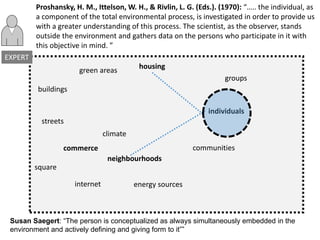
OBJECTIVE ANALYSIS [researcher as external observer of environmental transactions]
Proshansky, H. M., Ittelson, W. H., & Rivlin, L. G. (Eds.). (1970): “….. the individual, as
a component of the total environmental process, is investigated in order to provide us
with a greater understanding of this process. The scientist, as the observer, stands
outside the environment and gathers data on the persons who participate in it with
this objective in mind. ”
housing
EXPERT](https://image.slidesharecdn.com/prohabitoikonetlisbonseminar-180319084558/85/PROHABIT_OIKONET_Lisbon_Seminar-34-320.jpg)
![groups
individual
communities
buildings
streets
commerce
green areas
internet
energy sources
climate
neighbourhood
housing
square
Conceptualization of inhabitant’s perception of the environment s/he is part of
PHENOMENOLOGICAL [process participant]
Saegert, S. (1987). Environmental psychology and social change: “Thus the environment
exists in the psychological experience of the individual, in the social relationships of people, and in
the physical environment of time, space, and matter.“](https://image.slidesharecdn.com/prohabitoikonetlisbonseminar-180319084558/85/PROHABIT_OIKONET_Lisbon_Seminar-36-320.jpg)

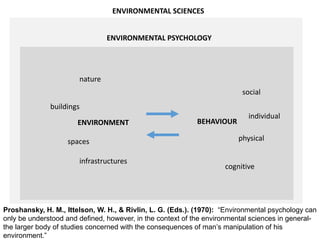
![Proshansky, H. M., Ittelson, W. H., & Rivlin, L. G. (Eds.). (1970): “….environmental psychology
is an emergent discipline that must evolve as an interdisciplinary superstructure of theoretical
constructs and principles rooted in the basic formulations and empirical findings of many separate
disciplines. Second this superstructure can emerge only from the cooperative theoretical and
empirical endeavors of the researchers representing these various disciplines.”
sociology
geography
architecture
ENVIRONMENTAL PSYCHOLOGY [AS SUPERSTRUCTURE]
Links created by researchers from the
various disciplines
Veitch, R., & Arkkelin, D. (1995):: “Environmental psychology constitutes an area of inquiry
that is rooted in numerous disciplines”.](https://image.slidesharecdn.com/prohabitoikonetlisbonseminar-180319084558/85/PROHABIT_OIKONET_Lisbon_Seminar-39-320.jpg)
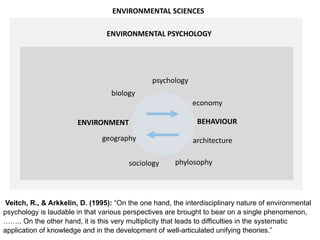
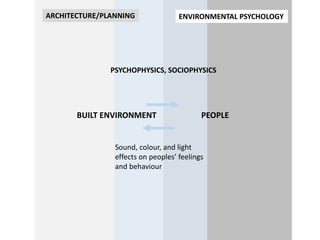
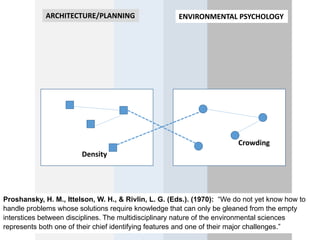


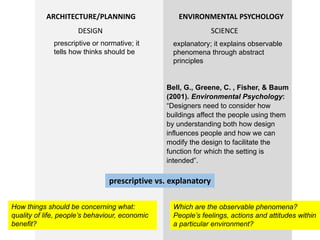
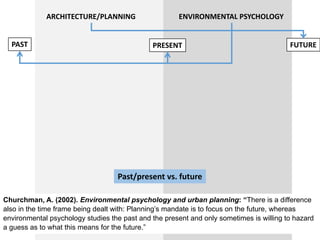
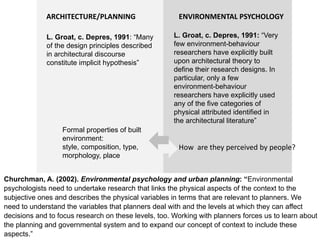
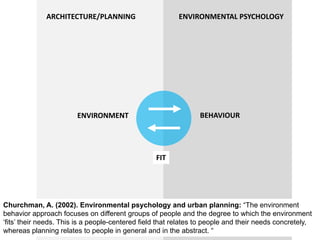
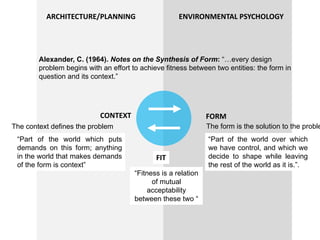
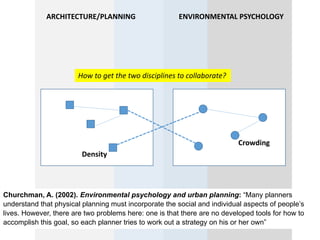
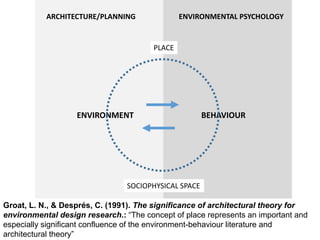
![ENVIRONMENTAL PSYCHOLOGYARCHITECTURE/PLANNING
Lynch, K. (1960). The image of the city: “[legibility] the ease with which the
parts of a city can be recognized and can be organized into a coherent
pattern”
FIT
BEHAVIOURENVIRONMENT image](https://image.slidesharecdn.com/prohabitoikonetlisbonseminar-180319084558/85/PROHABIT_OIKONET_Lisbon_Seminar-54-320.jpg)

![R. Veitch, D. Arkkelin, 1995
“Territorials markers. … it is common
for people to “personalize” their rooms
or offices with decorations that reflect
their personalities and that signify the
area is uniquely theirs. In a very real
sense, an individual’s personal identity
depends upon the ability to occupy
and mark a territory as one’s own”
Alison & Peter Smithson: “The
street-deck itself is articulated so that
the part by the individual front doors
offers itself for being taken possession
of by the householder.”
Allison & Peter Smithson, Robin Hood Gardens,
London, 1972 [Demolished 2017]
“Signs of occupancy”
ENVIRONMENTAL PSYCHOLOGYARCHITECTURE/PLANNING](https://image.slidesharecdn.com/prohabitoikonetlisbonseminar-180319084558/85/PROHABIT_OIKONET_Lisbon_Seminar-63-320.jpg)
![“[The transfer of the Taylors system to the household]”.
“[The nerve of the apartment is the kitchen, where the main work of the housewoman takes place
in the small household].”
Bruno Taut, Die Neue Wohnung, 1925 [author’s translation]](https://image.slidesharecdn.com/prohabitoikonetlisbonseminar-180319084558/85/PROHABIT_OIKONET_Lisbon_Seminar-65-320.jpg)


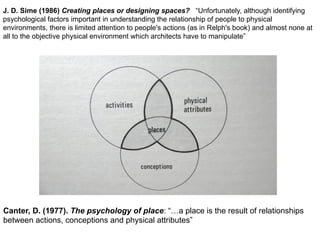
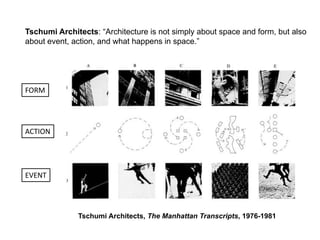
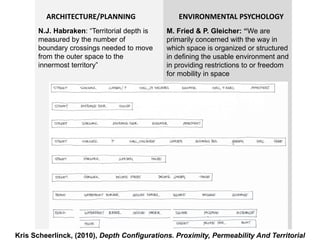
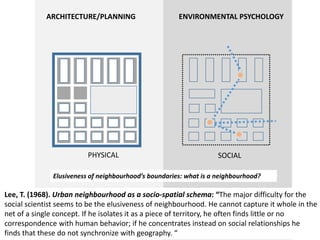



![“[Human settlements] are participatory, promote civic
engagement, engender a sense of belonging and ownership
among all their inhabitants, prioritize safe, inclusive,
accessible, green and quality public spaces that are friendly for
families, enhance social and intergenerational interactions,
cultural expressions and political participation…..”
UN New Urban Agenda, 2017](https://image.slidesharecdn.com/prohabitoikonetlisbonseminar-180319084558/85/PROHABIT_OIKONET_Lisbon_Seminar-103-320.jpg)