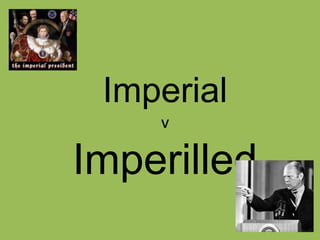
Imperial
    v

Imperilled
Imperial Presidency
• Growth of federal power – New Deal
• U.S. World’s policeman – foreign policy now
largely the domain of the president and Congress
usually defers to the White House in this area
• The Nixon presidency (1968 -1974) generally seen
as the culmination of the growth of presidential
power
• Schlesinger called this the ‘imperial presidency’ in
1973
• Because of this growth it contained more
possibility for abuse – which happened during
Vietnam War and the Watergate scandal
Imperilled
                  Presidency
• Increasing congressional resources to make Congress more
  effective in oversight, such as setting up Congressional Budget
  Office
• Passing the Case Act of 1972, forcing the president to inform
  Congress of all executive agreements made with other states
• Allowing the passage of the War Powers Resolution in 1973
  (vetoed by Nixon but overridden), restricting, in theory, the
  president’s powers to commit troops into hostilities.
• Passing the budget & Impoundment Control Act in 1974 to prevent
  the president from impounding money agreed by Congress
• The threat of impeachment leading to resignation of ‘imperial’
  president.

Imperial presidency v imperilled

  • 1.
    Imperial v Imperilled
  • 2.
    Imperial Presidency • Growthof federal power – New Deal • U.S. World’s policeman – foreign policy now largely the domain of the president and Congress usually defers to the White House in this area • The Nixon presidency (1968 -1974) generally seen as the culmination of the growth of presidential power • Schlesinger called this the ‘imperial presidency’ in 1973 • Because of this growth it contained more possibility for abuse – which happened during Vietnam War and the Watergate scandal
  • 3.
    Imperilled Presidency • Increasing congressional resources to make Congress more effective in oversight, such as setting up Congressional Budget Office • Passing the Case Act of 1972, forcing the president to inform Congress of all executive agreements made with other states • Allowing the passage of the War Powers Resolution in 1973 (vetoed by Nixon but overridden), restricting, in theory, the president’s powers to commit troops into hostilities. • Passing the budget & Impoundment Control Act in 1974 to prevent the president from impounding money agreed by Congress • The threat of impeachment leading to resignation of ‘imperial’ president.