THE BREATHTAKING DECLINE
For the last two years, global oil prices have been in free fall, and no one seems
to know when it will stop. In June 2014 you had to plunk down $110 to
purchasea barrelof Brent crude. By early 2015 that had dropped to $60.
Today it costs even less to buy that barrelof oil — a level not seen since 2004.
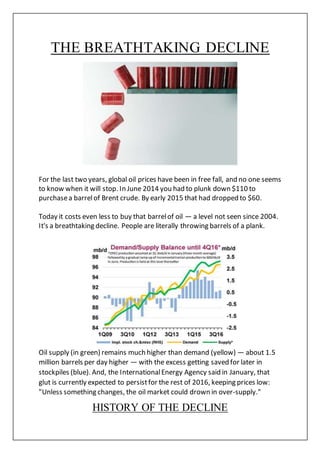
It's a breathtaking decline. People are literally throwing barrels of a plank.
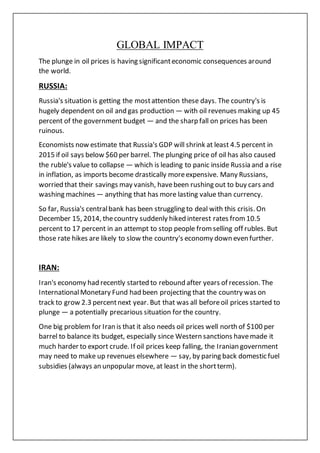
Oil supply (in green) remains much higher than demand (yellow) — about 1.5
million barrels per day higher — with the excess getting saved for later in
stockpiles (blue). And, the InternationalEnergy Agency said in January, that
glut is currently expected to persistfor the rest of 2016, keeping prices low:
"Unless something changes, the oil market could drown in over-supply."
HISTORY OF THE DECLINE
This wasn'talways the case. Between 2010 and 2014, oildemand was soaring
around the world, as countries recovered fromthe financial crisis but global
production was struggling to keep up. Many older oil fields werestagnating.
Conflicts in places like Libya and Iraq wererestricting supply. Countries had to
draw down their stockpiles, and prices soared to around $100 per barrel.
Those high prices, however, spurred drillers in the United States to use
innovative hydraulic fracturing and horizontaldrilling techniques to unlock vast
quantities of oil fromshale formations in places like North Dakota and Texas.
It's hard to overstate the impact of the fracking boom: US crude oil production
has nearly doubled since 2010.
Eventually, supply caughtup with demand — and then surpassed it. That's
when the crash came.
By mid-2014, globaldemand was starting to slow down. Europewas still
reeling from the euro zone mess. China's economy was starting to stumble. But
the United States continued to produce moreand more oil. Iraq and Libya
were also starting to bring more production back online. So prices began
sliding, down to $70 per barrel.
At that point, many people expected SaudiArabia and other oil producers in
OPEC to cut back on their own production to prop up prices, as they havein
the past. (Conventionalwisdomhad held that SaudiArabia needed $100 per
barrel oil to balance its budget.)
Surprisingly, thatdidn't happen. SaudiArabia decided to increase production in
order to maintain its market share, hoping that the subsequentfall in oil prices
would crush US, who requirehigher prices to stay profitable.
Ever sinceSaudi Arabia's decision to maintain output in late 2014, prices have
kept tumbling and tumbling — to $50 per barrel, then $40, then $30 — largely
because supply has remained strong and demand has been weaker than
expected.
US drillers turned out to be far more adaptable to low oil prices than the
Saudis thought, as companies cut costs and boosted productivity in order to
keep the oil flowing. (US production has finally stopped growing over the past
few months, butthe decline has been far less severe than originally predicted.)
Iraq has nearly doubled production since 2014 —to more than 4 million
barrels per day — as it recovers fromconflict. Thanks to the nuclear deal with
the US, Iran will startexporting more oil this year as sanctions are lifted,
offsetting declines elsewhere.
In the meantime, major developing economies like China, Russia, and Brazil
remain mired in a slump, putting a damper on oil consumption. An unusually
mild winter helped suppress demand for heating oil. And a stronger dollar
means that some countries now have to pay morefor crudeimports, which
further limits consumption.
As long as supply far outstrips demand, oil prices will stay relatively low.
Cratering prices are having all sorts of ripple effects around the world. Car
owners in places like the United States, Europe, and Japan aresuddenly paying
way less for gasoline, which means they have more money to spend on other
things. (Arguably, low prices have helped bolster the US economy over the past
year.) SUVs and gas guzzlers arecoming back in style.
On the flip side, crudeproducers like Saudi Arabia, Russia, and Venezuela are
struggling to balance their budgets and suffering froma major revenuecrunch.
Oil companies in the United States and elsewhereare watching profits
evaporate. Banks that financed the US shale boom are reeling froma waveof
defaults. Developing nations that previously relied on petrodollars for
financing are now hurting. It's a major disruption.
The plummeting price of oil is still the biggest energy story in the world. It's
bringing back cheap gasolineto the United States while wreaking havoc on oil-
producing countries like Russia and Venezuela.
FUTURE OF OIL
The future of the oil prices is largely uncertain. Lots of bets are being placed in
the financial markets on this regard.
Some banks projectoil prices to keep plummeting down to $20 per barrel this
year. Others expect a rebound to around $50 or $60 per barrel by year's end as
the US shale boom tapers off and demand recovers.
In January, the IEA pointed out that prices could easily slide lower this year if
Iran ramps up production faster than expected. "In a scenario whereby Iran
adds 600 kb/d to the market by mid-year and other members maintain current
output, global oil supply could exceed demand by 1.5 mb/d in the firsthalf of
2016. So it’s very much possiblethat the price could go lower.
Ultimately, the supply and demand dynamic is the thing to keep an eye on.
And expectations matter enormously here. Whenever new data shows an
unexpected boostin oil production or an unexpected drop in oil demand,
prices tend to go down. Conversely, a surprisedrop in supply or a surprise
surgein demand will push prices back up.
So if, say, the cold war between Saudi Arabia and Iran heats up and somehow
leads to conflict that crimps production, prices could rise. If low prices are
harder for the US shale industry to handle than anyonethought, that could
also causeprices to rise higher. If China's economy suddenly rebounds
unexpectedly, that could have a similar effect. Or maybe Iran will do something
that causes EU and US oil sanctions to snap back into place.
Alternatively, perhaps the supply glut — and hence low prices — will persist
indefinitely. It's a guessing game, and there are lots of plausible guesses.
The IEA significantly increased its projections of future oil costs in this year's
reportdue to the changing outlook for demand and production costs. Itnow
expects crude oil to average$100 per barrel over the next two decades and
more than $200 per barrelin 2030, in nominal terms. Last year's forecast
estimated that a 2030 barrelwould amount to only $108.
Will there be a spikeor glut? These are very possiblebut radically different
scenarios.
GLOBAL IMPACT
The plunge in oil prices is having significanteconomic consequences around
the world.
RUSSIA:
Russia's situation is getting the mostattention these days. The country's is
hugely dependent on oil and gas production — with oil revenues making up 45
percent of the government budget — and the sharp fall on prices has been
ruinous.
Economists now estimate that Russia's GDP will shrink at least 4.5 percent in
2015 if oil says below $60 per barrel. The plunging price of oil has also caused
the ruble's value to collapse — which is leading to panic inside Russia and a rise
in inflation, as imports become drastically moreexpensive. Many Russians,
worried that their savings may vanish, havebeen rushing out to buy cars and
washing machines — anything that has more lasting value than currency.
So far, Russia's centralbank has been struggling to deal with this crisis. On
December 15, 2014, thecountry suddenly hiked interest rates from10.5
percent to 17 percent in an attempt to stop people fromselling off rubles. But
those rate hikes are likely to slow the country's economy down even further.
IRAN:
Iran's economy had recently started to rebound after years of recession. The
InternationalMonetary Fund had been projecting that the country was on
track to grow 2.3 percentnext year. But that was all beforeoil prices started to
plunge — a potentially precarious situation for the country.
One big problem for Iran is that it also needs oil prices well north of $100 per
barrel to balance its budget, especially since Western sanctions havemade it
much harder to export crude. If oil prices keep falling, the Iranian government
may need to make up revenues elsewhere — say, by paring back domestic fuel
subsidies (always an unpopular move, at least in the shortterm).
VENEZUELA:
There's growing concern that the oil crash could cause Venezuela, another
major oil producer, to default. The nation's economy — heavily dependent on
oil revenue— is set to shrink some3 percent this year and inflation is rampant.
SAUDI ARABIA:
There's no question that SaudiArabia, the world's second-largestcrude
producer (after Russia), will suffer financially fromcheap oil. If oil stays at
around $60 per barrel next year, the government will run a deficit equal to 14
percent of GDP.
For now, however, the Saudis are toughing this out — and show no sign of
trying to prop up prices as they havein the past. The kingdomhas built up a
stockpile of foreign currency worth some $750 billion, which it will use to
finance its deficits. In December, the country's oilminister, Ali al-Naimi, said he
didn't care if prices crashed to $20 or $40 per barrel, he wasn'tgoing to budge
fromhis position. "Itis not in the interest of OPECproducers to cut their
production, whatever the price is," he said.
That said, if low oil prices persist, Saudi Arabia may have to cut back on some
of the social programs it had instituted after the Arab Spring. And Naimi's
strategy of maintaining oil output is controversialwithin the kingdom. (In
January 2015, SaudiKing Abdullah died, but his successor Salman said he
would maintain the current oil policy.)
THE UNITED STATES:
In the US, meanwhile, a fall in crudeprices will have both positiveand negative
impacts. For many people, it will offer an excellent economic boost: cheaper oil
means lower gasoline prices — which havefallen to $2.04 per gallon, the
lowest since2009.
The EIA projects that US drivers will spend about $550 less on gasoline in 2015
than they did in 2014, assuming prices stay low. Thatwill give consumers more
money to spend on other things.
But it's not all good news. Oil-producing states like Texas and North Dakota
are likely to see a drop in revenues and economic activity. The falling price of
oil is also putting severe pressureon Alaska's statebudget. All told, oil
prices are likely to be good for 42 states (in green) and bad for the other 8 (in
red):
If the price drop lasts a long time, that could also spur people to start using
more oil. Case in point: In recent years, high gasoline prices have spurred many
Americans to buy smaller, more efficient cars. But if gasoline prices fall, bigger
cars and SUVs could make a comeback.
IMPACT ON INDIA
Oil is one of the most important commodities in recent times. It greatly
influences the functioning of the economy and India is no exception. Here are
some of the ways in which the decline in oil prices haveaffected India:
 CURRENT ACCOUNT BALANCE:
India is one of the largest importers of oil in the world. Itimports nearly 80% of
its total oil needs. This accounts for one third of its total imports. For this
reason, the price of oil affects India a lot. A fall in price would drive down the
value of its imports. This helps narrow India's current account deficit - the
amount India owes to the world in foreign currency. A fall in oil prices by $10
per barrel helps reduce the current account deficit by $9.2 billion, according to
a report by Livemint. This amounts to nearly 0.43% of the Gross Domestic
Product - a measure of the size of the economy.
 INFLATION:
Oil price affects the entire economy, especially because of its use in
transportation of goods and services. A rise in oil price leads to an increase in
prices of all goods and services. It also affects us all directly as petrol and diesel
prices rise. As a result, inflation rises. A high inflation is bad for an economy. It
also affects companies - directly because of a rise in input costs and indirectly
through a fall in consumer demand. This is why the fall in global crude prices
comes as a boon to India. Every $10 per barrel fall in crude oil price helps
reduce retail inflation by 0.2% and wholesale price inflation by 0.5%, according
to a Moneycontrol report.
 OIL SUBSIDY AND FISCAL DEFICIT:
The government fixes the price of fuel at a subsidised rate. It then
compensates companies for any loss from selling fuel products at lower rates.
These losses are called under-recoveries. This adds to the government's total
expenditure and leads to a rise in fiscal deficit - the amount it borrows from
Indians staying abroad sent$70 billion worth money back home in
2013, according to a report by The Hindu, a national newspaper. This
is important becauseIndia uses this inflow to fund its currentaccount
deficit. Majority of this money comes fromIndians staying in Gulf
countries. A fall in oil prices could affect someof the oil-exporting Gulf
countries. This could in turn affect the flow of money into India.
the markets. A fall in oil prices reduces companies' losses, oil subsidies and
thus helps narrow fiscal deficit. However, since diesel was recently
deregulated, the fall in oil prices will likely have less effect on the government's
fiscal deficit. Moreover, the government still has to pay for previous under-
recoveries. Any benefit from the fall will be offset by payments for the past
under-recoveries.
 RUPEE EXCHANGE RATE:
The value of a free currency like Rupee depends on its demand in the currency
market. This is why it depends to a great extent on the current account deficit.
A high deficit means the country has to sell rupees and buy dollars to pay its
bills. This reduces the value of the rupee. A fall in oil prices is, thus, good for
the rupee. However, the downsideis that the dollar strengthens every time the
value of oil falls. This negates any benefits from a fall in current account deficit.
 PETROLEUM PRODUCERS:
The fall in global oil prices may be beneficial to India, but it also has its
downsides. Directly, it affects the exporters of petroleum producers in the
country. India is the sixth largest exporter of petroleum products in the world,
according to media reports. This helps it earn $60 billion annually. Any fall in oil
prices negatively impacts exports. At a time when India is running a trade
deficit - high imports and low exports, any fall in exports is bad news.
Moreover, a lot of India's trade partners and buyers of its exports are net oil
exporters. A fall in oil price may impact their economy, and hamper demand
for Indian products. This would indirectly affect India and its companies. For
example, the share prices of Bharti Airtel and Bajaj Auto fell because of the
devaluation of the Nigerian currency - Naira. Both the companies have a
significant presence in the African country.
CONCLUSION
Based on the above-mentioned facts, I believe that the oil prices will continue
to fall becausenothing is being done to redeem the excess supply of oil. The
OPEC will continue to produce oil despite the excess supply. They are only
concerned about maintaining their market shareand are willing to sell the oil
even at $20 per barrel. They believe that their reserves areenough to sustain
their economy even if the marketcrashes becauseof the falling oil prices. This
is the case in the shortrun, however in the long run the future of the oil prices
is a guessing game. Experts believe that the occurrenceof certain extra
ordinary events can tip the scales in favour of the OPEC and the oil marketcan
return to its former bloom.

The breathtaking decline

  • 1.
    THE BREATHTAKING DECLINE Forthe last two years, global oil prices have been in free fall, and no one seems to know when it will stop. In June 2014 you had to plunk down $110 to purchasea barrelof Brent crude. By early 2015 that had dropped to $60. Today it costs even less to buy that barrelof oil — a level not seen since 2004. It's a breathtaking decline. People are literally throwing barrels of a plank. Oil supply (in green) remains much higher than demand (yellow) — about 1.5 million barrels per day higher — with the excess getting saved for later in stockpiles (blue). And, the InternationalEnergy Agency said in January, that glut is currently expected to persistfor the rest of 2016, keeping prices low: "Unless something changes, the oil market could drown in over-supply." HISTORY OF THE DECLINE
  • 2.
    This wasn'talways thecase. Between 2010 and 2014, oildemand was soaring around the world, as countries recovered fromthe financial crisis but global production was struggling to keep up. Many older oil fields werestagnating. Conflicts in places like Libya and Iraq wererestricting supply. Countries had to draw down their stockpiles, and prices soared to around $100 per barrel. Those high prices, however, spurred drillers in the United States to use innovative hydraulic fracturing and horizontaldrilling techniques to unlock vast quantities of oil fromshale formations in places like North Dakota and Texas. It's hard to overstate the impact of the fracking boom: US crude oil production has nearly doubled since 2010. Eventually, supply caughtup with demand — and then surpassed it. That's when the crash came. By mid-2014, globaldemand was starting to slow down. Europewas still reeling from the euro zone mess. China's economy was starting to stumble. But the United States continued to produce moreand more oil. Iraq and Libya were also starting to bring more production back online. So prices began sliding, down to $70 per barrel. At that point, many people expected SaudiArabia and other oil producers in OPEC to cut back on their own production to prop up prices, as they havein the past. (Conventionalwisdomhad held that SaudiArabia needed $100 per barrel oil to balance its budget.) Surprisingly, thatdidn't happen. SaudiArabia decided to increase production in order to maintain its market share, hoping that the subsequentfall in oil prices would crush US, who requirehigher prices to stay profitable. Ever sinceSaudi Arabia's decision to maintain output in late 2014, prices have kept tumbling and tumbling — to $50 per barrel, then $40, then $30 — largely because supply has remained strong and demand has been weaker than expected. US drillers turned out to be far more adaptable to low oil prices than the Saudis thought, as companies cut costs and boosted productivity in order to keep the oil flowing. (US production has finally stopped growing over the past few months, butthe decline has been far less severe than originally predicted.) Iraq has nearly doubled production since 2014 —to more than 4 million barrels per day — as it recovers fromconflict. Thanks to the nuclear deal with
  • 3.
    the US, Iranwill startexporting more oil this year as sanctions are lifted, offsetting declines elsewhere. In the meantime, major developing economies like China, Russia, and Brazil remain mired in a slump, putting a damper on oil consumption. An unusually mild winter helped suppress demand for heating oil. And a stronger dollar means that some countries now have to pay morefor crudeimports, which further limits consumption. As long as supply far outstrips demand, oil prices will stay relatively low. Cratering prices are having all sorts of ripple effects around the world. Car owners in places like the United States, Europe, and Japan aresuddenly paying way less for gasoline, which means they have more money to spend on other things. (Arguably, low prices have helped bolster the US economy over the past year.) SUVs and gas guzzlers arecoming back in style. On the flip side, crudeproducers like Saudi Arabia, Russia, and Venezuela are struggling to balance their budgets and suffering froma major revenuecrunch. Oil companies in the United States and elsewhereare watching profits evaporate. Banks that financed the US shale boom are reeling froma waveof defaults. Developing nations that previously relied on petrodollars for financing are now hurting. It's a major disruption. The plummeting price of oil is still the biggest energy story in the world. It's bringing back cheap gasolineto the United States while wreaking havoc on oil- producing countries like Russia and Venezuela.
  • 4.
    FUTURE OF OIL Thefuture of the oil prices is largely uncertain. Lots of bets are being placed in the financial markets on this regard. Some banks projectoil prices to keep plummeting down to $20 per barrel this year. Others expect a rebound to around $50 or $60 per barrel by year's end as the US shale boom tapers off and demand recovers. In January, the IEA pointed out that prices could easily slide lower this year if Iran ramps up production faster than expected. "In a scenario whereby Iran adds 600 kb/d to the market by mid-year and other members maintain current output, global oil supply could exceed demand by 1.5 mb/d in the firsthalf of 2016. So it’s very much possiblethat the price could go lower. Ultimately, the supply and demand dynamic is the thing to keep an eye on. And expectations matter enormously here. Whenever new data shows an unexpected boostin oil production or an unexpected drop in oil demand, prices tend to go down. Conversely, a surprisedrop in supply or a surprise surgein demand will push prices back up. So if, say, the cold war between Saudi Arabia and Iran heats up and somehow leads to conflict that crimps production, prices could rise. If low prices are harder for the US shale industry to handle than anyonethought, that could also causeprices to rise higher. If China's economy suddenly rebounds unexpectedly, that could have a similar effect. Or maybe Iran will do something that causes EU and US oil sanctions to snap back into place. Alternatively, perhaps the supply glut — and hence low prices — will persist indefinitely. It's a guessing game, and there are lots of plausible guesses. The IEA significantly increased its projections of future oil costs in this year's reportdue to the changing outlook for demand and production costs. Itnow expects crude oil to average$100 per barrel over the next two decades and more than $200 per barrelin 2030, in nominal terms. Last year's forecast estimated that a 2030 barrelwould amount to only $108. Will there be a spikeor glut? These are very possiblebut radically different scenarios.
  • 5.
    GLOBAL IMPACT The plungein oil prices is having significanteconomic consequences around the world. RUSSIA: Russia's situation is getting the mostattention these days. The country's is hugely dependent on oil and gas production — with oil revenues making up 45 percent of the government budget — and the sharp fall on prices has been ruinous. Economists now estimate that Russia's GDP will shrink at least 4.5 percent in 2015 if oil says below $60 per barrel. The plunging price of oil has also caused the ruble's value to collapse — which is leading to panic inside Russia and a rise in inflation, as imports become drastically moreexpensive. Many Russians, worried that their savings may vanish, havebeen rushing out to buy cars and washing machines — anything that has more lasting value than currency. So far, Russia's centralbank has been struggling to deal with this crisis. On December 15, 2014, thecountry suddenly hiked interest rates from10.5 percent to 17 percent in an attempt to stop people fromselling off rubles. But those rate hikes are likely to slow the country's economy down even further. IRAN: Iran's economy had recently started to rebound after years of recession. The InternationalMonetary Fund had been projecting that the country was on track to grow 2.3 percentnext year. But that was all beforeoil prices started to plunge — a potentially precarious situation for the country. One big problem for Iran is that it also needs oil prices well north of $100 per barrel to balance its budget, especially since Western sanctions havemade it much harder to export crude. If oil prices keep falling, the Iranian government may need to make up revenues elsewhere — say, by paring back domestic fuel subsidies (always an unpopular move, at least in the shortterm).
  • 6.
    VENEZUELA: There's growing concernthat the oil crash could cause Venezuela, another major oil producer, to default. The nation's economy — heavily dependent on oil revenue— is set to shrink some3 percent this year and inflation is rampant. SAUDI ARABIA: There's no question that SaudiArabia, the world's second-largestcrude producer (after Russia), will suffer financially fromcheap oil. If oil stays at around $60 per barrel next year, the government will run a deficit equal to 14 percent of GDP. For now, however, the Saudis are toughing this out — and show no sign of trying to prop up prices as they havein the past. The kingdomhas built up a stockpile of foreign currency worth some $750 billion, which it will use to finance its deficits. In December, the country's oilminister, Ali al-Naimi, said he didn't care if prices crashed to $20 or $40 per barrel, he wasn'tgoing to budge fromhis position. "Itis not in the interest of OPECproducers to cut their production, whatever the price is," he said. That said, if low oil prices persist, Saudi Arabia may have to cut back on some of the social programs it had instituted after the Arab Spring. And Naimi's strategy of maintaining oil output is controversialwithin the kingdom. (In January 2015, SaudiKing Abdullah died, but his successor Salman said he would maintain the current oil policy.) THE UNITED STATES: In the US, meanwhile, a fall in crudeprices will have both positiveand negative impacts. For many people, it will offer an excellent economic boost: cheaper oil means lower gasoline prices — which havefallen to $2.04 per gallon, the lowest since2009. The EIA projects that US drivers will spend about $550 less on gasoline in 2015 than they did in 2014, assuming prices stay low. Thatwill give consumers more money to spend on other things.
  • 7.
    But it's notall good news. Oil-producing states like Texas and North Dakota are likely to see a drop in revenues and economic activity. The falling price of oil is also putting severe pressureon Alaska's statebudget. All told, oil prices are likely to be good for 42 states (in green) and bad for the other 8 (in red): If the price drop lasts a long time, that could also spur people to start using more oil. Case in point: In recent years, high gasoline prices have spurred many Americans to buy smaller, more efficient cars. But if gasoline prices fall, bigger cars and SUVs could make a comeback.
  • 8.
    IMPACT ON INDIA Oilis one of the most important commodities in recent times. It greatly influences the functioning of the economy and India is no exception. Here are some of the ways in which the decline in oil prices haveaffected India:  CURRENT ACCOUNT BALANCE: India is one of the largest importers of oil in the world. Itimports nearly 80% of its total oil needs. This accounts for one third of its total imports. For this reason, the price of oil affects India a lot. A fall in price would drive down the value of its imports. This helps narrow India's current account deficit - the amount India owes to the world in foreign currency. A fall in oil prices by $10 per barrel helps reduce the current account deficit by $9.2 billion, according to a report by Livemint. This amounts to nearly 0.43% of the Gross Domestic Product - a measure of the size of the economy.  INFLATION: Oil price affects the entire economy, especially because of its use in transportation of goods and services. A rise in oil price leads to an increase in prices of all goods and services. It also affects us all directly as petrol and diesel prices rise. As a result, inflation rises. A high inflation is bad for an economy. It also affects companies - directly because of a rise in input costs and indirectly through a fall in consumer demand. This is why the fall in global crude prices comes as a boon to India. Every $10 per barrel fall in crude oil price helps reduce retail inflation by 0.2% and wholesale price inflation by 0.5%, according to a Moneycontrol report.  OIL SUBSIDY AND FISCAL DEFICIT: The government fixes the price of fuel at a subsidised rate. It then compensates companies for any loss from selling fuel products at lower rates. These losses are called under-recoveries. This adds to the government's total expenditure and leads to a rise in fiscal deficit - the amount it borrows from
  • 9.
    Indians staying abroadsent$70 billion worth money back home in 2013, according to a report by The Hindu, a national newspaper. This is important becauseIndia uses this inflow to fund its currentaccount deficit. Majority of this money comes fromIndians staying in Gulf countries. A fall in oil prices could affect someof the oil-exporting Gulf countries. This could in turn affect the flow of money into India. the markets. A fall in oil prices reduces companies' losses, oil subsidies and thus helps narrow fiscal deficit. However, since diesel was recently deregulated, the fall in oil prices will likely have less effect on the government's fiscal deficit. Moreover, the government still has to pay for previous under- recoveries. Any benefit from the fall will be offset by payments for the past under-recoveries.  RUPEE EXCHANGE RATE: The value of a free currency like Rupee depends on its demand in the currency market. This is why it depends to a great extent on the current account deficit. A high deficit means the country has to sell rupees and buy dollars to pay its bills. This reduces the value of the rupee. A fall in oil prices is, thus, good for the rupee. However, the downsideis that the dollar strengthens every time the value of oil falls. This negates any benefits from a fall in current account deficit.  PETROLEUM PRODUCERS: The fall in global oil prices may be beneficial to India, but it also has its downsides. Directly, it affects the exporters of petroleum producers in the country. India is the sixth largest exporter of petroleum products in the world, according to media reports. This helps it earn $60 billion annually. Any fall in oil prices negatively impacts exports. At a time when India is running a trade deficit - high imports and low exports, any fall in exports is bad news. Moreover, a lot of India's trade partners and buyers of its exports are net oil exporters. A fall in oil price may impact their economy, and hamper demand for Indian products. This would indirectly affect India and its companies. For example, the share prices of Bharti Airtel and Bajaj Auto fell because of the devaluation of the Nigerian currency - Naira. Both the companies have a significant presence in the African country.
  • 10.
    CONCLUSION Based on theabove-mentioned facts, I believe that the oil prices will continue to fall becausenothing is being done to redeem the excess supply of oil. The OPEC will continue to produce oil despite the excess supply. They are only concerned about maintaining their market shareand are willing to sell the oil even at $20 per barrel. They believe that their reserves areenough to sustain their economy even if the marketcrashes becauseof the falling oil prices. This is the case in the shortrun, however in the long run the future of the oil prices is a guessing game. Experts believe that the occurrenceof certain extra ordinary events can tip the scales in favour of the OPEC and the oil marketcan return to its former bloom.