Become a 
Magistrate 
IT’S YOUR COMMUNITY
Who are the Magistrates? 
 Magistrates (also known as justices of the peace) are 21,500 
volunteer judicial office holders who serve in magistrates’ courts 
throughout England and Wales. 
 Magistrates can be appointed from the age of 18 and retire at 70. 
Magistrates do not require legal training or qualifications. 
Candidates must demonstrate six ‘key qualities’ – Good Character; 
Commitment and Reliability; Social Awareness; Sound Judgement; 
Understanding and Communication; Maturity and Sound 
Temperament. Once appointed, magistrates undertake mandatory 
training and are always supported in court by a trained legal 
advisor to guide them on points of law and procedure.
What do they do? 
 All magistrates begin their magisterial career in the adult court 
where they deal with crimes which, while not necessarily very serious 
in nature, can have the most widespread impact on communities; 
for example, anti-social behaviour and alcohol-related incidents. 
Magistrates’ courts are also the first stage in dealing with more 
serious crimes such as rape and murder, which are then referred on 
to the Crown Court.
Why become a Magistrate and 
what kind of crimes will I hear? 
 Magistrates come from a wide range of backgrounds and occupations – from bus 
drivers to architects, pilots to mechanics, nursery nurses to retired people, 
unemployed to teachers. They are ordinary men and women with common sense 
and personal integrity. They are able to listen to all sides of an argument and can 
contribute to fair and reasonable decisions. You do not have to have any legal 
qualification. 
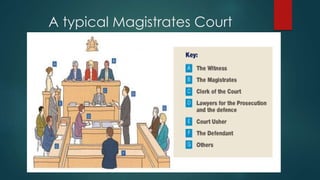
 Magistrates sit as one of a bench of three magistrates, including one who sits in the 
centre who has been trained to take the chair and deal with less serious criminal 
cases such as minor theft, criminal damage, public disorder and motoring offences. 
 Crimes can be divided into three categories: 
 Very Serious (called indictable offences eg murder, rape, manslaughter) which can 
only be dealt with in a Crown Court before a judge and jury 
 Serious (either way offences eg theft, fraud) when the defendant may be dealt with 
either by magistrates or in a Crown Court 
 Less serious (called summary offences eg traffic, excess alcohol) are only dealt with 
by magistrates
What other people are in the 
Magistrates Court? 
 The Court Clerk Legal Adviser - ensure that the magistrates have all the 
information they need to do their job. He/she identifies the defendant, reads the 
charges and at the end of the trial summarises the relevant law for the 
magistrates. 
 The Usher- makes sure that order is maintained in the court and that the 
proceedings run smoothly. 
 The Court Reporter- may work for local or national press, usually newspapers but 
also for radio and television stations. They attend court and report on the cases. 
 The Solicitor- a member of the public may approach him/her for advice and 
assistance in matters referred to the courts. Often solicitors will be able to handle 
cases in front of the Magistrate. 
 The Barrister- a solicitor may refer a case to a barrister if the matter is too serious 
for the solicitor to handle, a barrister will handle the case. Barristers, unlike 
solicitors, may represent clients in any of the countries' courts. 
 Probation Staff – advise magistrates about offenders when magistrates are 
deciding a sentence.
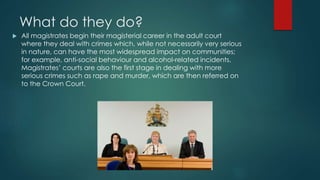
A typical Magistrates Court
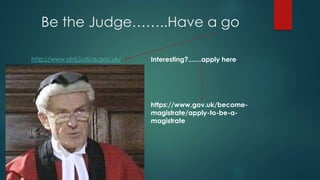
Be the Judge……..Have a go 
http://www.ybtj.justice.gov.uk/ Interesting?.......apply here 
https://www.gov.uk/become-magistrate/ 
apply-to-be-a-magistrate
SO……………… 
“ 
” 
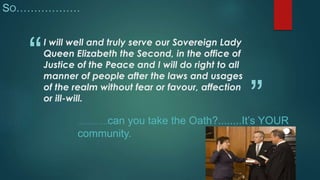
I will well and truly serve our Sovereign Lady 
Queen Elizabeth the Second, in the office of 
Justice of the Peace and I will do right to all 
manner of people after the laws and usages 
of the realm without fear or favour, affection 
or ill-will. 
……………can you take the Oath?........It’s YOUR 
community.

Become a magistrate

  • 1.
    Become a Magistrate IT’S YOUR COMMUNITY
  • 2.
    Who are theMagistrates?  Magistrates (also known as justices of the peace) are 21,500 volunteer judicial office holders who serve in magistrates’ courts throughout England and Wales.  Magistrates can be appointed from the age of 18 and retire at 70. Magistrates do not require legal training or qualifications. Candidates must demonstrate six ‘key qualities’ – Good Character; Commitment and Reliability; Social Awareness; Sound Judgement; Understanding and Communication; Maturity and Sound Temperament. Once appointed, magistrates undertake mandatory training and are always supported in court by a trained legal advisor to guide them on points of law and procedure.
  • 3.
    What do theydo?  All magistrates begin their magisterial career in the adult court where they deal with crimes which, while not necessarily very serious in nature, can have the most widespread impact on communities; for example, anti-social behaviour and alcohol-related incidents. Magistrates’ courts are also the first stage in dealing with more serious crimes such as rape and murder, which are then referred on to the Crown Court.
  • 4.
    Why become aMagistrate and what kind of crimes will I hear?  Magistrates come from a wide range of backgrounds and occupations – from bus drivers to architects, pilots to mechanics, nursery nurses to retired people, unemployed to teachers. They are ordinary men and women with common sense and personal integrity. They are able to listen to all sides of an argument and can contribute to fair and reasonable decisions. You do not have to have any legal qualification.  Magistrates sit as one of a bench of three magistrates, including one who sits in the centre who has been trained to take the chair and deal with less serious criminal cases such as minor theft, criminal damage, public disorder and motoring offences.  Crimes can be divided into three categories:  Very Serious (called indictable offences eg murder, rape, manslaughter) which can only be dealt with in a Crown Court before a judge and jury  Serious (either way offences eg theft, fraud) when the defendant may be dealt with either by magistrates or in a Crown Court  Less serious (called summary offences eg traffic, excess alcohol) are only dealt with by magistrates
  • 5.
    What other peopleare in the Magistrates Court?  The Court Clerk Legal Adviser - ensure that the magistrates have all the information they need to do their job. He/she identifies the defendant, reads the charges and at the end of the trial summarises the relevant law for the magistrates.  The Usher- makes sure that order is maintained in the court and that the proceedings run smoothly.  The Court Reporter- may work for local or national press, usually newspapers but also for radio and television stations. They attend court and report on the cases.  The Solicitor- a member of the public may approach him/her for advice and assistance in matters referred to the courts. Often solicitors will be able to handle cases in front of the Magistrate.  The Barrister- a solicitor may refer a case to a barrister if the matter is too serious for the solicitor to handle, a barrister will handle the case. Barristers, unlike solicitors, may represent clients in any of the countries' courts.  Probation Staff – advise magistrates about offenders when magistrates are deciding a sentence.
  • 6.
  • 7.
    Be the Judge……..Havea go http://www.ybtj.justice.gov.uk/ Interesting?.......apply here https://www.gov.uk/become-magistrate/ apply-to-be-a-magistrate
  • 8.
    SO……………… “ ” I will well and truly serve our Sovereign Lady Queen Elizabeth the Second, in the office of Justice of the Peace and I will do right to all manner of people after the laws and usages of the realm without fear or favour, affection or ill-will. ……………can you take the Oath?........It’s YOUR community.