Can you make a difference? 
LAY MAGISTRATES
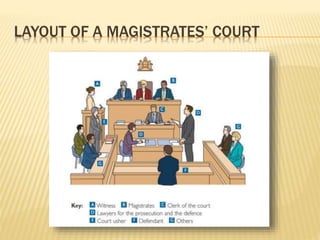
LAYOUT OF A MAGISTRATES’ COURT
TOUR OF A MAGISTRATES’ COURT
BEING A LAY MAGISTRATE... 
 The role of a Lay Magistrate is to hear 95% 
of criminal cases. They then decide if the 
person is guilty or innocent. 
 If found guilty, the defendant 
will either be dealt with in the 
Magistrates’ Court, or the case 
may be sent to a Crown Court. 
This is dependent on the severity of the 
case.
POWER... 
 Lay Magistrates have the power to sentence 
a defendant to prison for up to 6 
months for one offence. 
This increases to 12 
months for multiple offences. 
 They can also fine defendant 
any sum of money up to £5,000. 
 Lay Magistrates are also able to give a 
combination of these punishments.
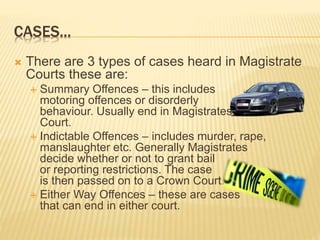
CASES... 
 There are 3 types of cases heard in Magistrate 
Courts these are: 
 Summary Offences – this includes 
motoring offences or disorderly 
behaviour. Usually end in Magistrates’ 
Court. 
 Indictable Offences – includes murder, rape, 
manslaughter etc. Generally Magistrates 
decide whether or not to grant bail 
or reporting restrictions. The case 
is then passed on to a Crown Court. 
 Either Way Offences – these are cases 
that can end in either court.
WHY? 
 You might now 
be asking yourself 
‘Why do I want to be a Lay Magistrate?’. Well, 
you can make a huge difference. 
 There is generally a specific type of person who 
sign up to be Lay Magistrates. It’s time for 
change. 
 You can make a difference to the 
criminal justice system. You can 
have your say in the justice for 
people in your local community.
WHAT WE’RE LOOKING FOR... 
 Mix of age, gender 
and ethnicity. 
 Between the ages of 
18 and 70. 
 Must have: 
 Good character 
 Understanding nature 
 Good communication 
skills 
 Social awareness 
 Maturity 
 Sound temperament 
 Sound judgement 
 Reliability 
 Commitment 
 Honesty 
 Open mindedness
BENEFITS AND ADVANTAGES... 
 You will be given free training on 
how to deal with cases appropriately. 
 You will have all of you expenses 
covered, this includes food and 
travel etc. 
 If you work, your employer is required to give 
you paid time of to do your duty. 
 It’s only 26 half days per year. 
Therefore it’s flexible and shouldn’t 
impact too much on your day to day life.
YOUR NEXT STEP... 
 Want more information about being a Lay Magistrate 
or want to apply to be one follow these links: 
 https://www.gov.uk/become-magistrate/what-magistrates-do 
 http://www.judiciary.gov.uk/about-the-judiciary/who-are-the- 
judiciary/judicial-roles/magistrates/ 
 https://www.gov.uk/become-magistrate/apply-to-be-a-magistrate 
 http://www.obv.org.uk/what-we-do/schemes/magistrate-scheme- 
2007/8/frequently-asked-questions-faq

Lay Magistrates

  • 1.
    Can you makea difference? LAY MAGISTRATES
  • 3.
    LAYOUT OF AMAGISTRATES’ COURT
  • 4.
    TOUR OF AMAGISTRATES’ COURT
  • 5.
    BEING A LAYMAGISTRATE...  The role of a Lay Magistrate is to hear 95% of criminal cases. They then decide if the person is guilty or innocent.  If found guilty, the defendant will either be dealt with in the Magistrates’ Court, or the case may be sent to a Crown Court. This is dependent on the severity of the case.
  • 6.
    POWER...  LayMagistrates have the power to sentence a defendant to prison for up to 6 months for one offence. This increases to 12 months for multiple offences.  They can also fine defendant any sum of money up to £5,000.  Lay Magistrates are also able to give a combination of these punishments.
  • 7.
    CASES...  Thereare 3 types of cases heard in Magistrate Courts these are:  Summary Offences – this includes motoring offences or disorderly behaviour. Usually end in Magistrates’ Court.  Indictable Offences – includes murder, rape, manslaughter etc. Generally Magistrates decide whether or not to grant bail or reporting restrictions. The case is then passed on to a Crown Court.  Either Way Offences – these are cases that can end in either court.
  • 8.
    WHY?  Youmight now be asking yourself ‘Why do I want to be a Lay Magistrate?’. Well, you can make a huge difference.  There is generally a specific type of person who sign up to be Lay Magistrates. It’s time for change.  You can make a difference to the criminal justice system. You can have your say in the justice for people in your local community.
  • 9.
    WHAT WE’RE LOOKINGFOR...  Mix of age, gender and ethnicity.  Between the ages of 18 and 70.  Must have:  Good character  Understanding nature  Good communication skills  Social awareness  Maturity  Sound temperament  Sound judgement  Reliability  Commitment  Honesty  Open mindedness
  • 10.
    BENEFITS AND ADVANTAGES...  You will be given free training on how to deal with cases appropriately.  You will have all of you expenses covered, this includes food and travel etc.  If you work, your employer is required to give you paid time of to do your duty.  It’s only 26 half days per year. Therefore it’s flexible and shouldn’t impact too much on your day to day life.
  • 11.
    YOUR NEXT STEP...  Want more information about being a Lay Magistrate or want to apply to be one follow these links:  https://www.gov.uk/become-magistrate/what-magistrates-do  http://www.judiciary.gov.uk/about-the-judiciary/who-are-the- judiciary/judicial-roles/magistrates/  https://www.gov.uk/become-magistrate/apply-to-be-a-magistrate  http://www.obv.org.uk/what-we-do/schemes/magistrate-scheme- 2007/8/frequently-asked-questions-faq