Prepared for                     Library Process Redesign:
    Cambridge
     University
      Library
                                    Renewing Services,
10 February 2011                    Changing Workflows


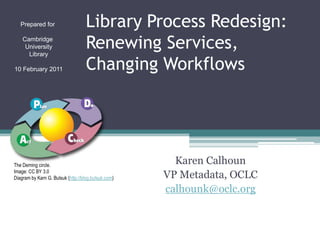
The Deming circle.
                                                       Karen Calhoun
Image: CC BY 3.0
Diagram by Karn G. Bulsuk (http://blog.bulsuk.com)   VP Metadata, OCLC
                                                     calhounk@oclc.org
2


Outline
• Review of library collection trends
 ▫ The Cambridge strategy
 ▫ E-resources and special collections as priorities
• Trends in special collections’ usage and
  management
• Freeing up time for new initiatives
 ▫ The principles and practice of library process
   redesign
Themes of the Cambridge University Library
Strategic Plan
User-centered collections and services
1. Usability, discoverability, access
   • Understanding of user communities
   • Knowledge organization
   • Visibility of collections
   • Ease of use – ‘desktop delivery’
2. Highly skilled staff; organizational development
   • Digital librarianship
3. Preservation and housing of collections
   • Storage and space
   • Collection management
4. The ‘hybrid library’ – not either/or but both/and
   • Physical and online collections; expansion of the digital library
5. Resourcing
   • UEF and HEFCE funding reductions
   • Fundraising
   • Increased efficiency
4

         Median Circulation and Reference Transactions in North
         American Research Libraries 1991-2008, With Five Year
         Forecast
400000
                                          “65% of information requests
                                          originate off-campus.” –
350000                                    University of Minnesota
                                          Discoverability report, p. 4
300000


250000

                                             Circulation
200000                                       Reference Transactions
                                             Linear (Circulation)
150000                                       Linear (Reference Transactions)


100000


50000
                                          Data source: ARL Statistics 2007-2008
                                          http://www.arl.org/bm~doc/arlstat08.pdf
    0
5


  Percentage Change in Median Resources Per Student at
  ARL Libraries, 2000-2008
  (Compared to 2000)
 0.005

     0

 -0.005

  -0.01                             Staff

 -0.015
                                    Monographs
  -0.02                                   2.00
                                    Purchased
                                          1.80
                                    Volumes Added
 -0.025
                                            1.60
  -0.03                                     1.40
 -0.035                                     1.20
                                            1.00
                                                                             Eserials
                                            0.80
                                                                             Expenditures
                                            0.60
   Change in Staff, Volumes Added,          0.40
  Monographs Purchased Per Student          0.20
                                            0.00

Data source: ARL Statistics 2007-2008
http://www.arl.org/bm~doc/arlstat08.pdf
                                                    Change in E-Serials Expenditures
                                                              Per Student
6


What Did Users Say They Want? (2002)
•Faculty and students do more
work and study away from
campus
•Loyal to the library, but library                  Do you use electronic sources all of the time,
                                                   most of the time, some of the time, or none of the
is only one element in complex                                          time?
information structure
                                                  60%
•Print still important, but almost                50%
half of undergraduates say they                   40%


                                        Percent
                                                                                                   Faculty/Graduate
rely exclusively or almost                        30%
                                                  20%
                                                                                                   Undergrad

exclusively on electronic                         10%
materials                                          0%
                                                          All of the   Some of the   None of the

•Seamless linking from one                              time/most of
                                                           the time
                                                                          time          time

information object to another is                                       Responses
expected
•Fast forward to 2011: these         http://www.clir.org/PUBS/reports/pub110/contents.html
trends many times stronger!
7

 Open Access Repositories Gaining
 Visibility and Impact
                                              2008-2009 Traffic
                                              Compared:

                                              *Social Science Research
                                                Network
                                              *arXiv.org
                                              *Research Papers in
                                                Economics
                                              *British Library (bl.uk)


Sources: Alexa.com 15 Nov 2009 and the Cybermetrics Lab’s ranking of top
Repositories (disciplinary and institutional) at
http://repositories.webometrics.info/about.html
8


                                                      October
                                                      2010


http://www.oclc.org/research/publications/library/2010/2010-11.pdf

“Special collections and archives are increasingly seen as elements
of distinction that serve to differentiate an academic or research library
from its peers … however, much rare and unique material remains
undiscoverable, and monetary resources are shrinking at the same time
that user demand is growing.”—Executive summary
9

Rising Interest in Digital Collections on the BnF
and LC Web Sites
                                 Where do people go
                                 on bnf.fr and
                                 loc.gov?

                                 BnF:
                                 Expositions: 30%
                                 Catalogue: 26%
                                 Gallica: 26%

                                 LC:
                                 American Memory: 41%
Source: Alexa.com, 15 Nov 2009
                                 Catalog: 17%
                                 Legislative information
                                 (THOMAS): 6%
10

                                        Research into use and users of digital
                                        library collections “The function of searching across
                                                              “The availability of primary sources has
                                   Usage of University of Wisconsin Digital Collections            collections is a the success of my
                                                                                                     been crucial for dream frequently

                                                                                                   discussedin history. Students have at a
                                                                                                     teaching
                                                      2001-2008 [1]
                                                                                                                but seldom realized
                                                                                                     remarked what a difference it has made,
                            10000000


                                                                                                   robusthave noticed apaper …
                                                                                                     and I level. This big difference
                            9000000
                                                                                  R2 = 0.9701
                            8000000
Millions of Sessions/Uses


                                                                                                   discusses this coursemight move
                                                                                                     between how we with the availability
                            7000000


                            6000000


                                                                                                   from isolated digital collections Ito
                                                                                                     of online primary resources to those
                            5000000


                            4000000


                                                                                                   interoperable digital libraries.”on
                                                                                                     have taught before that were based
                            3000000


                            2000000


                            1000000                                                                 printed resources.” –History instructor,
                                                                                                   —Howard Besser [4] [2]
                                                                                                    University of California
                                  0
                                       2001   2002   2003   2004   2005   2006   2007       2008


                                                       “Digital libraries, far from being simple digital
                                                       versions of library holdings, are now attracting a
                                                       new type of public, bringing about new, unique and
                                                       original ways for reading and understanding
                                                       texts.”—BibUsages Study 2002 [3]

                                                     See final slide for citations.
11


 Some process redesign principles for
 special collections
                                “Special collections are stuck in an eddy,
                                while the mass of digitized books drift by
                                in the current of the mainstream. We
                                need to jump into the flow or risk being
                                left high and dry.”—p. 4
                               • Programs not projects
                               • Describing special collections—
                                 take a page from the archivists
                               • Quality vs. quantity—quantity
                                 wins!
                               • Discovery happens elsewhere—
                                 get exposed!
http://www.oclc.org/research/publications/library/2007/2007-02.pdf
Don’t Get Further Behind! Learn
from the Archivists

 • Item level
   description – Get
   over it!
 • Some access is
   better than no
   access - really


                       David Steuart Erskine, founder, Scottish
                       Society of Antiquaries
13

Meanwhile …


… the demands of
   processing the
   print/AV collections
   continue to
   dominate how
   technical services
   staff spend their
   time
                          By Ulleskelf
                          CC-BY-NC-ND 2.0
                          http://www.flickr.com/photos/ulleskelf/349312876/
14


Staffing allocations = de facto
priorities
     Estimated FTE Allocations in A Research
               Library TS Division
                            3%        2%
                                 3%
                          5%
                           8%


                          9%
                                       70%


    Print/AV Support                         Management/Training
    Metadata                                 E-Resources
    Special Collections                      Programming/Web Support
    Desktop Support
15


What to do?
• How to free up time for these new priorities …
• … while TS staffing continues to shrink?


             The Deming circle.
             Image: CC BY 3.0
             Diagram by Karn G. Bulsuk (http://blog.bulsuk.com)
16


  A Blueprint for Change: Innovate and
  Reduce Costs


http://www.loc.gov/catdir/calhoun-report-final.pdf
17


Where metadata comes from
(and will come from)
                       • Library cataloging
                       • Publishers, vendors, aggregators
     Professionally    • Publication supply chain data
                         (ONIX)
       produced        • Abstracting and indexing services
                       • Authority, classification data,
                         terminologies
                       • Institutional repositories
      Author/User      • Scholarly portals (e.g., arXiv.org)
      contributed      • Tags, reviews, lists, etc.

                       •   Knowledge bases
                       •   Algorithmically-created indexes
         Mined         •   Author identity pages
                       •   Facets for topics, places, events
                       •   FRBR Work Sets …
     Algorithmically
      produced, re-
     used, harvested
18


Achieving efficiencies: workflow
redesign principles
1. Look at the whole process as one process (e.g.,
   selection to ordering to receipt to cataloging to
   shelf-ready)
2. Maximize acquisitions/cataloging collaboration
3. Capture bibliographic data as far upstream as
   possible (at point of selection/ordering if you can)
4. To the greatest extent possible, handle items and
   records only once
5. Perform work where it makes the most sense; and
   maximize use of students/volunteers
6. Wholly manual processes do not scale; integrate
   automated and manual operations
19


  Case study: Before and after workflow
  redesign for print monographs processing
                • All cataloging done in cataloging
                • Many exceptions
                                                                 Percent
   Before       • Manual approach                                Change
  redesign                                                       during this
                                                                 period:
                                                                 FTE down
             • Automated approach                                20%
             • Few exceptions
Redesign and • 50% of cataloging done in acquisitions            Cataloging
free up staff                                                    up 64%


                • E-resource unit staffed
                • Metadata unit staffed
 Address        • Special collections/digital projects staffed
 priorities
20


Themes of the Transition in Technical
Services
•   More with less
•   Streamlined workflows
•   Greater use of batch and macro strategies
•   Greater use of technology
•   Greater integration of acquisitions and cataloging
•   More cooperation
•   Partnerships with vendors
•   Outsourcing
•   New roles and responsibilities
    ▫ E-resources licensing and management
    ▫ Metadata services (institutional repositories)
    ▫ Special collections / digitization projects
21


A range of outsourcing solutions being
implemented by many
  ▫   Approval plans (with records supplied)
  ▫   Shelf ready services
  ▫   Outsourced non-English language cataloging
  ▫   Re-use of publisher and vendor records
  ▫   Post-cataloging authority control
  ▫   Batch search/record capture services
  ▫   Record sets for e-journals and e-books
  ▫   And now … patron-driven acquisitions (records
      loaded to library’s catalog or discovery service)
22


What is Technical Services “Quality”?
   • Must begin with user’s needs and end with
     user’s perceptions
   • What does ‘quality’ mean?
     ▫ Fast cycle time for new materials
     ▫ Providing for easy, convenient use of library
       collections*
     ▫ Being creative, responsive and flexible
     ▫ Optimizing the library’s investment in personnel,
       materials, equipment, etc.
     ▫ Balancing trade-offs

*A recent example = patron-driven acquisitions!
23

Metadata Before and After the Web:
What is a “Full” Record?
                           Product
                           description
                           & purchase
                           information
                           More like this

                           Editorial
                           reviews & author info
                           Inside the book
                           Tags, Ratings
     Bibliographic data    Customer reviews
     Library Holdings      Lists
     Details               More
     Subjects
     Editions
     Reviews
                                                   + 3 more screens

With thanks to David Lankes:
http://quartz.syr.edu/rdlankes/Presentations/2007/ALCTS.pdf
24


                                                                         What is
                                                                     ‘good enough’
                                                                       cataloging?


http://www.oclc.org/research/publications/library/2010/2010-06.pdf
25


How many of you have considered or
implemented changes to workflows for
physical materials? For example …
• Get most of your cataloging done as part of the
  acquisitions process?
• Re-use others’ records (including publisher or
  vendor record sets) with minimal or no further
  review?
• Ruthlessly pare down exceptions to standard
  workflows?
• Do patron-driven acquisitions for print books?
26


Library metadata has reached a point of
discontinuous change

We must change how we think about it and
what we do


               Photo by: OMG Ventures
               http://www.flickr.com/photos/imagebuilders/2877401212/
Endings


  What we call the beginning is often the end
  And to make an end is to make a beginning
        The end is where we start from
                       --T.S. Eliot


        27
28

“It’s not the changes that do you in,
it’s the transitions” –William Bridges
  Change = something in the external environment changes
  (e.g., a new library director is hired; a new system is being introduced;
  a reorganization occurs; new procedures or policies are planned)

  Transition = an internal psychological reorientation process to a change


                                                                           It is critical to
                                                                           manage transitions
                                                                           and include staff in
                                                                           the process.


                         The three phases of transition
Bridges, William. 1991. Managing transitions: making the most of change.
Reading, Mass: Addison-Wesley.
29


Digital Collections Slide - Citations
• [1] Data source for chart: University of Wisconsin Digital Collections Center. Summary
  Statistics. http://uwdcc.library.wisc.edu/usageStats/publicView.shtml
• [2] Quote from survey respondent as reported in Harley, Diane. 2007. Use and users of
  digital resources. Educause Quarterly 4, p. 12-20.
  http://net.educause.edu/ir/library/pdf/EQM0742.pdf
• [3a] Assadi, Houssem, et al. 2002. Use and users of online digital libraries in France.
  (BibUsages project) http://bibnum.bnf.fr/usages/bibusages_ecdl2003.pdf
• And
• [3b] Lupovici, Catherine, and Lesquins, Noémie. 2007. Gallica 2.0: a second life for the
  Bibliothèque nationale de France digital library. http://www.ifla.org.sg/IV/ifla73/papers/146-
  Lupovici-en.pdf
• [4] Besser, Howard. 2002. The next stage: moving from digital collections to interoperable
  digital libraries. First Monday 7:6.
  http://firstmonday.org/htbin/cgiwrap/bin/ojs/index.php/fm/article/view/958/879
30


Questions and Comments?

Library Process Redesign: Renewing Services, Changing Workflows

  • 1.
    Prepared for Library Process Redesign: Cambridge University Library Renewing Services, 10 February 2011 Changing Workflows The Deming circle. Karen Calhoun Image: CC BY 3.0 Diagram by Karn G. Bulsuk (http://blog.bulsuk.com) VP Metadata, OCLC calhounk@oclc.org
  • 2.
    2 Outline • Review oflibrary collection trends ▫ The Cambridge strategy ▫ E-resources and special collections as priorities • Trends in special collections’ usage and management • Freeing up time for new initiatives ▫ The principles and practice of library process redesign
  • 3.
    Themes of theCambridge University Library Strategic Plan User-centered collections and services 1. Usability, discoverability, access • Understanding of user communities • Knowledge organization • Visibility of collections • Ease of use – ‘desktop delivery’ 2. Highly skilled staff; organizational development • Digital librarianship 3. Preservation and housing of collections • Storage and space • Collection management 4. The ‘hybrid library’ – not either/or but both/and • Physical and online collections; expansion of the digital library 5. Resourcing • UEF and HEFCE funding reductions • Fundraising • Increased efficiency
  • 4.
    4 Median Circulation and Reference Transactions in North American Research Libraries 1991-2008, With Five Year Forecast 400000 “65% of information requests originate off-campus.” – 350000 University of Minnesota Discoverability report, p. 4 300000 250000 Circulation 200000 Reference Transactions Linear (Circulation) 150000 Linear (Reference Transactions) 100000 50000 Data source: ARL Statistics 2007-2008 http://www.arl.org/bm~doc/arlstat08.pdf 0
  • 5.
    5 PercentageChange in Median Resources Per Student at ARL Libraries, 2000-2008 (Compared to 2000) 0.005 0 -0.005 -0.01 Staff -0.015 Monographs -0.02 2.00 Purchased 1.80 Volumes Added -0.025 1.60 -0.03 1.40 -0.035 1.20 1.00 Eserials 0.80 Expenditures 0.60 Change in Staff, Volumes Added, 0.40 Monographs Purchased Per Student 0.20 0.00 Data source: ARL Statistics 2007-2008 http://www.arl.org/bm~doc/arlstat08.pdf Change in E-Serials Expenditures Per Student
  • 6.
    6 What Did UsersSay They Want? (2002) •Faculty and students do more work and study away from campus •Loyal to the library, but library Do you use electronic sources all of the time, most of the time, some of the time, or none of the is only one element in complex time? information structure 60% •Print still important, but almost 50% half of undergraduates say they 40% Percent Faculty/Graduate rely exclusively or almost 30% 20% Undergrad exclusively on electronic 10% materials 0% All of the Some of the None of the •Seamless linking from one time/most of the time time time information object to another is Responses expected •Fast forward to 2011: these http://www.clir.org/PUBS/reports/pub110/contents.html trends many times stronger!
  • 7.
    7 Open AccessRepositories Gaining Visibility and Impact 2008-2009 Traffic Compared: *Social Science Research Network *arXiv.org *Research Papers in Economics *British Library (bl.uk) Sources: Alexa.com 15 Nov 2009 and the Cybermetrics Lab’s ranking of top Repositories (disciplinary and institutional) at http://repositories.webometrics.info/about.html
  • 8.
    8 October 2010 http://www.oclc.org/research/publications/library/2010/2010-11.pdf “Special collections and archives are increasingly seen as elements of distinction that serve to differentiate an academic or research library from its peers … however, much rare and unique material remains undiscoverable, and monetary resources are shrinking at the same time that user demand is growing.”—Executive summary
  • 9.
    9 Rising Interest inDigital Collections on the BnF and LC Web Sites Where do people go on bnf.fr and loc.gov? BnF: Expositions: 30% Catalogue: 26% Gallica: 26% LC: American Memory: 41% Source: Alexa.com, 15 Nov 2009 Catalog: 17% Legislative information (THOMAS): 6%
  • 10.
    10 Research into use and users of digital library collections “The function of searching across “The availability of primary sources has Usage of University of Wisconsin Digital Collections collections is a the success of my been crucial for dream frequently discussedin history. Students have at a teaching 2001-2008 [1] but seldom realized remarked what a difference it has made, 10000000 robusthave noticed apaper … and I level. This big difference 9000000 R2 = 0.9701 8000000 Millions of Sessions/Uses discusses this coursemight move between how we with the availability 7000000 6000000 from isolated digital collections Ito of online primary resources to those 5000000 4000000 interoperable digital libraries.”on have taught before that were based 3000000 2000000 1000000 printed resources.” –History instructor, —Howard Besser [4] [2] University of California 0 2001 2002 2003 2004 2005 2006 2007 2008 “Digital libraries, far from being simple digital versions of library holdings, are now attracting a new type of public, bringing about new, unique and original ways for reading and understanding texts.”—BibUsages Study 2002 [3] See final slide for citations.
  • 11.
    11 Some processredesign principles for special collections “Special collections are stuck in an eddy, while the mass of digitized books drift by in the current of the mainstream. We need to jump into the flow or risk being left high and dry.”—p. 4 • Programs not projects • Describing special collections— take a page from the archivists • Quality vs. quantity—quantity wins! • Discovery happens elsewhere— get exposed! http://www.oclc.org/research/publications/library/2007/2007-02.pdf
  • 12.
    Don’t Get FurtherBehind! Learn from the Archivists • Item level description – Get over it! • Some access is better than no access - really David Steuart Erskine, founder, Scottish Society of Antiquaries
  • 13.
    13 Meanwhile … … thedemands of processing the print/AV collections continue to dominate how technical services staff spend their time By Ulleskelf CC-BY-NC-ND 2.0 http://www.flickr.com/photos/ulleskelf/349312876/
  • 14.
    14 Staffing allocations =de facto priorities Estimated FTE Allocations in A Research Library TS Division 3% 2% 3% 5% 8% 9% 70% Print/AV Support Management/Training Metadata E-Resources Special Collections Programming/Web Support Desktop Support
  • 15.
    15 What to do? •How to free up time for these new priorities … • … while TS staffing continues to shrink? The Deming circle. Image: CC BY 3.0 Diagram by Karn G. Bulsuk (http://blog.bulsuk.com)
  • 16.
    16 ABlueprint for Change: Innovate and Reduce Costs http://www.loc.gov/catdir/calhoun-report-final.pdf
  • 17.
    17 Where metadata comesfrom (and will come from) • Library cataloging • Publishers, vendors, aggregators Professionally • Publication supply chain data (ONIX) produced • Abstracting and indexing services • Authority, classification data, terminologies • Institutional repositories Author/User • Scholarly portals (e.g., arXiv.org) contributed • Tags, reviews, lists, etc. • Knowledge bases • Algorithmically-created indexes Mined • Author identity pages • Facets for topics, places, events • FRBR Work Sets … Algorithmically produced, re- used, harvested
  • 18.
    18 Achieving efficiencies: workflow redesignprinciples 1. Look at the whole process as one process (e.g., selection to ordering to receipt to cataloging to shelf-ready) 2. Maximize acquisitions/cataloging collaboration 3. Capture bibliographic data as far upstream as possible (at point of selection/ordering if you can) 4. To the greatest extent possible, handle items and records only once 5. Perform work where it makes the most sense; and maximize use of students/volunteers 6. Wholly manual processes do not scale; integrate automated and manual operations
  • 19.
    19 Casestudy: Before and after workflow redesign for print monographs processing • All cataloging done in cataloging • Many exceptions Percent Before • Manual approach Change redesign during this period: FTE down • Automated approach 20% • Few exceptions Redesign and • 50% of cataloging done in acquisitions Cataloging free up staff up 64% • E-resource unit staffed • Metadata unit staffed Address • Special collections/digital projects staffed priorities
  • 20.
    20 Themes of theTransition in Technical Services • More with less • Streamlined workflows • Greater use of batch and macro strategies • Greater use of technology • Greater integration of acquisitions and cataloging • More cooperation • Partnerships with vendors • Outsourcing • New roles and responsibilities ▫ E-resources licensing and management ▫ Metadata services (institutional repositories) ▫ Special collections / digitization projects
  • 21.
    21 A range ofoutsourcing solutions being implemented by many ▫ Approval plans (with records supplied) ▫ Shelf ready services ▫ Outsourced non-English language cataloging ▫ Re-use of publisher and vendor records ▫ Post-cataloging authority control ▫ Batch search/record capture services ▫ Record sets for e-journals and e-books ▫ And now … patron-driven acquisitions (records loaded to library’s catalog or discovery service)
  • 22.
    22 What is TechnicalServices “Quality”? • Must begin with user’s needs and end with user’s perceptions • What does ‘quality’ mean? ▫ Fast cycle time for new materials ▫ Providing for easy, convenient use of library collections* ▫ Being creative, responsive and flexible ▫ Optimizing the library’s investment in personnel, materials, equipment, etc. ▫ Balancing trade-offs *A recent example = patron-driven acquisitions!
  • 23.
    23 Metadata Before andAfter the Web: What is a “Full” Record? Product description & purchase information More like this Editorial reviews & author info Inside the book Tags, Ratings Bibliographic data Customer reviews Library Holdings Lists Details More Subjects Editions Reviews + 3 more screens With thanks to David Lankes: http://quartz.syr.edu/rdlankes/Presentations/2007/ALCTS.pdf
  • 24.
    24 What is ‘good enough’ cataloging? http://www.oclc.org/research/publications/library/2010/2010-06.pdf
  • 25.
    25 How many ofyou have considered or implemented changes to workflows for physical materials? For example … • Get most of your cataloging done as part of the acquisitions process? • Re-use others’ records (including publisher or vendor record sets) with minimal or no further review? • Ruthlessly pare down exceptions to standard workflows? • Do patron-driven acquisitions for print books?
  • 26.
    26 Library metadata hasreached a point of discontinuous change We must change how we think about it and what we do Photo by: OMG Ventures http://www.flickr.com/photos/imagebuilders/2877401212/
  • 27.
    Endings Whatwe call the beginning is often the end And to make an end is to make a beginning The end is where we start from --T.S. Eliot 27
  • 28.
    28 “It’s not thechanges that do you in, it’s the transitions” –William Bridges Change = something in the external environment changes (e.g., a new library director is hired; a new system is being introduced; a reorganization occurs; new procedures or policies are planned) Transition = an internal psychological reorientation process to a change It is critical to manage transitions and include staff in the process. The three phases of transition Bridges, William. 1991. Managing transitions: making the most of change. Reading, Mass: Addison-Wesley.
  • 29.
    29 Digital Collections Slide- Citations • [1] Data source for chart: University of Wisconsin Digital Collections Center. Summary Statistics. http://uwdcc.library.wisc.edu/usageStats/publicView.shtml • [2] Quote from survey respondent as reported in Harley, Diane. 2007. Use and users of digital resources. Educause Quarterly 4, p. 12-20. http://net.educause.edu/ir/library/pdf/EQM0742.pdf • [3a] Assadi, Houssem, et al. 2002. Use and users of online digital libraries in France. (BibUsages project) http://bibnum.bnf.fr/usages/bibusages_ecdl2003.pdf • And • [3b] Lupovici, Catherine, and Lesquins, Noémie. 2007. Gallica 2.0: a second life for the Bibliothèque nationale de France digital library. http://www.ifla.org.sg/IV/ifla73/papers/146- Lupovici-en.pdf • [4] Besser, Howard. 2002. The next stage: moving from digital collections to interoperable digital libraries. First Monday 7:6. http://firstmonday.org/htbin/cgiwrap/bin/ojs/index.php/fm/article/view/958/879
  • 30.