Social Dances
and Dance Mixers
Prepared by: Daniel M. Alcazarin
Science Teacher I
Talangan Integrated National High School
Social dances and dance mixers are
dances intended primarily to get to know
other people in attendance to a certain social
function. They are also called ballroom
dances. They are usually performed in pairs,
male and female, but may also be performed
in groups.
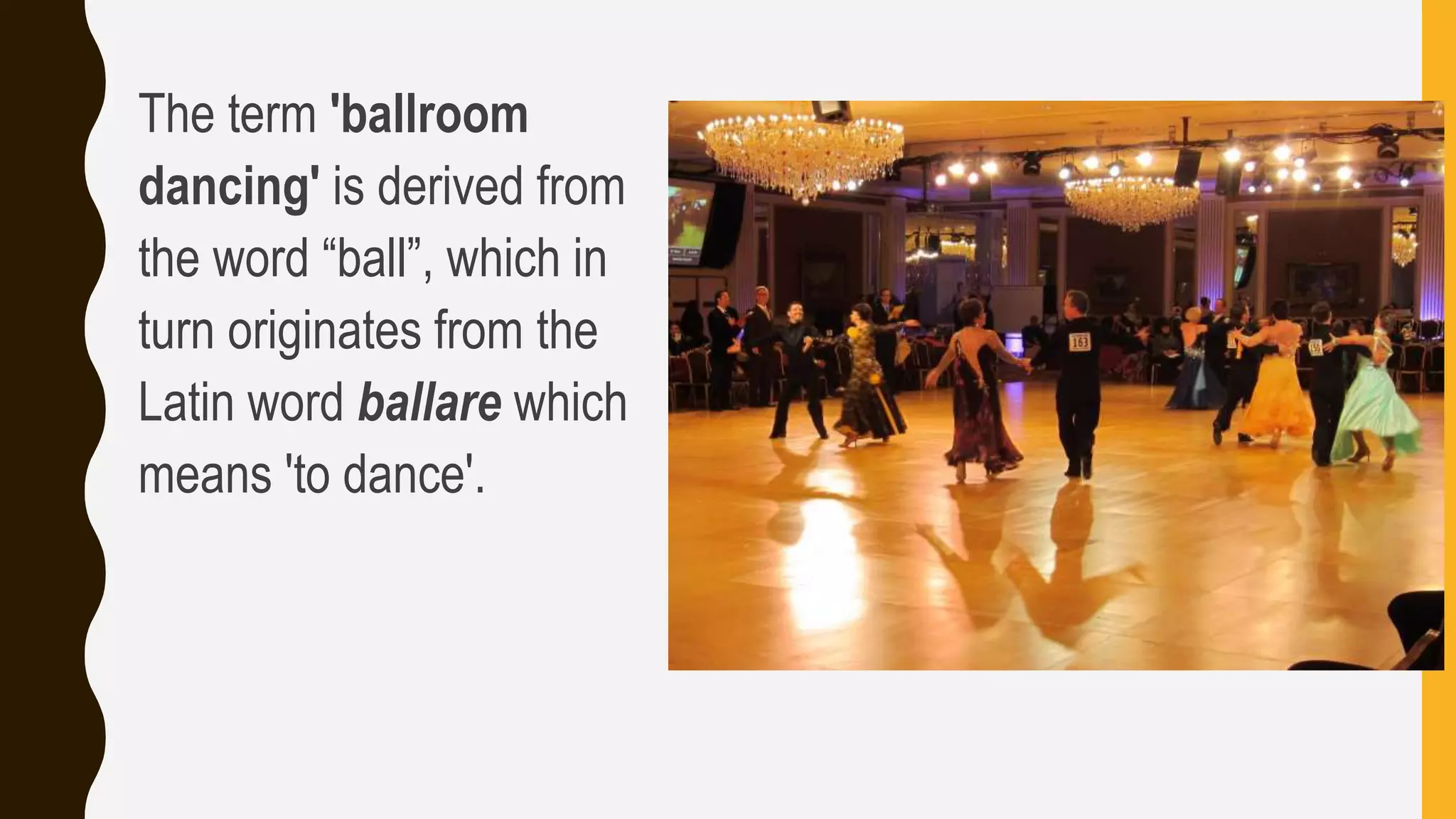
The term 'ballroom
dancing' is derived from
the word “ball”, which in
turn originates from the
Latin word ballare which
means 'to dance'.
E
SOCIAL DANCES
Social dances are communal
dances performed in any social
gatherings in any given space.
They are synonymously referred
to as ballroom dances, but
ballroom dances are performed
in balls or formal social functions.
CLASSIFICATION OF
SOCIAL DANCES
1. Latin American Dances
2. Modern Standard Dances
E
LATIN AMERICAN DANCES
- Salsa - Jive
- Mamba - Boogie
- Merengue - Paso doble
- Swing
- Cha-cha-cha
- Rumba
- Samba
E
MODERN STANDARD DANCES
- Slow Waltz
- Tango
- Viennese Waltz
- Foxtrot
- Quickstep
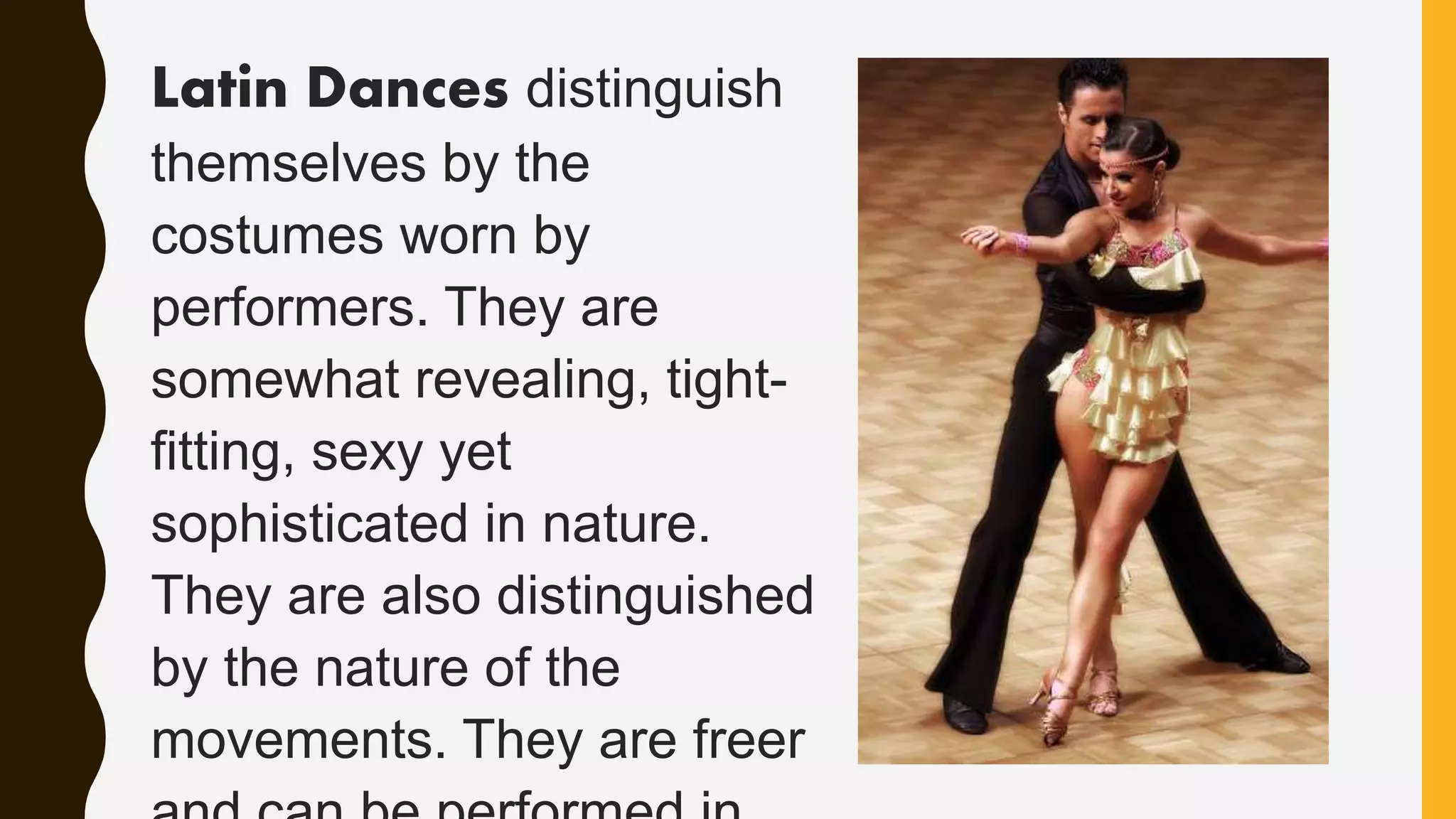
Latin Dances distinguish
themselves by the
costumes worn by
performers. They are
somewhat revealing, tight-
fitting, sexy yet
sophisticated in nature.
They are also distinguished
by the nature of the
movements. They are freer
Standard Dances on the
other hand wear formal ,
ankle length gowns for
females and coat-andtie
for males. Most of the time,
movements in these are
restricted to close ballroom
position with partner.
Social or ballroom dances are different from
dancesport because the latter is freer in nature
and
are primarily intended to widen one’s social
horizon,
for recreation; and fitness. The former is
performed
in competition and are referred to as competitive
ballroom dancing.
The required athleticism has established rules
of different levels of difficulty and is limited to fives
dances per category only.
They are cha-cha-cha, rumba, samba, paso
doble and jive for the Latin category and slow
waltz, tango, Viennese waltz, foxtrot, and
quickstep for the standard category.
LATIN
AMERICAN
DANCES
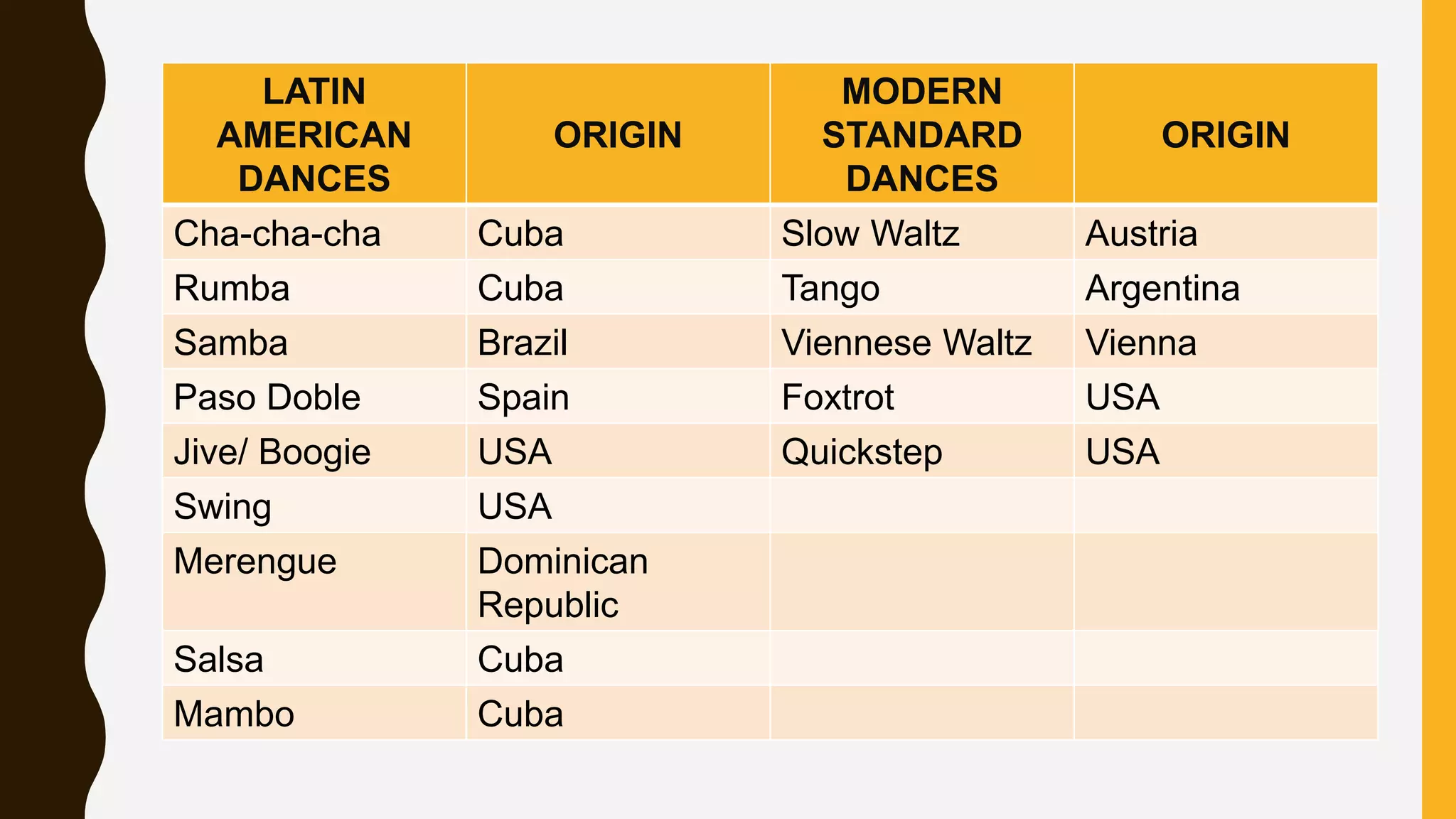
ORIGIN
MODERN
STANDARD
DANCES
ORIGIN
Cha-cha-cha Cuba Slow Waltz Austria
Rumba Cuba Tango Argentina
Samba Brazil Viennese Waltz Vienna
Paso Doble Spain Foxtrot USA
Jive/ Boogie USA Quickstep USA
Swing USA
Merengue Dominican
Republic
Salsa Cuba
Mambo Cuba
E
DANCE MIXERS
DANCE MIXERS are social dances
which allow group of performers to
change partners periodically while
dancing to allow chance to get to know
other members of the performing group.
Its primarily function is to maximize the
social dimensions of dancing.
E
DANCE MIXERS
There are specific dance mixers that
are performed in social events but
ballroom or social dance can be
converted into dance mixers by
expanding it from a pair-dancing to group
dancing activity with exchange of
partners periodically while dancing.
DEPARTMENT OF EDUCATION
REGION IV – A CALABARZON
DIVISION OF LAGUNA
DISTRICT OF NAGCARLAN-RIZAL
TALANGAN INTEGRATED
NATIONAL HIGH SCHOOL
Talangan, Nagcarlan, Laguna
Daniel M. Alcazarin
MAPEH/ Science Teacher I
For more inquiries, kindly message me in any of
my social media accts and follow me  :
FB acct: “Daniel Alcazarin”
IG acct. “@danielalcazarin”
Twitter acct: “@DanielAlcazarin”
 Let me know if you downloaded this presentation so I’ll be
more encouraged to upload more. Thank you!

MAPEH Grade 9 - PE - Social Dances and Dance Mixers - Second Quarter

  • 1.
    Social Dances and DanceMixers Prepared by: Daniel M. Alcazarin Science Teacher I Talangan Integrated National High School
  • 2.
    Social dances anddance mixers are dances intended primarily to get to know other people in attendance to a certain social function. They are also called ballroom dances. They are usually performed in pairs, male and female, but may also be performed in groups.
  • 3.
    The term 'ballroom dancing'is derived from the word “ball”, which in turn originates from the Latin word ballare which means 'to dance'.
  • 4.
    E SOCIAL DANCES Social dancesare communal dances performed in any social gatherings in any given space. They are synonymously referred to as ballroom dances, but ballroom dances are performed in balls or formal social functions.
  • 5.
    CLASSIFICATION OF SOCIAL DANCES 1.Latin American Dances 2. Modern Standard Dances
  • 6.
    E LATIN AMERICAN DANCES -Salsa - Jive - Mamba - Boogie - Merengue - Paso doble - Swing - Cha-cha-cha - Rumba - Samba
  • 7.
    E MODERN STANDARD DANCES -Slow Waltz - Tango - Viennese Waltz - Foxtrot - Quickstep
  • 8.
    Latin Dances distinguish themselvesby the costumes worn by performers. They are somewhat revealing, tight- fitting, sexy yet sophisticated in nature. They are also distinguished by the nature of the movements. They are freer
  • 9.
    Standard Dances onthe other hand wear formal , ankle length gowns for females and coat-andtie for males. Most of the time, movements in these are restricted to close ballroom position with partner.
  • 10.
    Social or ballroomdances are different from dancesport because the latter is freer in nature and are primarily intended to widen one’s social horizon, for recreation; and fitness. The former is performed in competition and are referred to as competitive ballroom dancing.
  • 11.
    The required athleticismhas established rules of different levels of difficulty and is limited to fives dances per category only. They are cha-cha-cha, rumba, samba, paso doble and jive for the Latin category and slow waltz, tango, Viennese waltz, foxtrot, and quickstep for the standard category.
  • 12.
    LATIN AMERICAN DANCES ORIGIN MODERN STANDARD DANCES ORIGIN Cha-cha-cha Cuba SlowWaltz Austria Rumba Cuba Tango Argentina Samba Brazil Viennese Waltz Vienna Paso Doble Spain Foxtrot USA Jive/ Boogie USA Quickstep USA Swing USA Merengue Dominican Republic Salsa Cuba Mambo Cuba
  • 13.
    E DANCE MIXERS DANCE MIXERSare social dances which allow group of performers to change partners periodically while dancing to allow chance to get to know other members of the performing group. Its primarily function is to maximize the social dimensions of dancing.
  • 14.
    E DANCE MIXERS There arespecific dance mixers that are performed in social events but ballroom or social dance can be converted into dance mixers by expanding it from a pair-dancing to group dancing activity with exchange of partners periodically while dancing.
  • 15.
    DEPARTMENT OF EDUCATION REGIONIV – A CALABARZON DIVISION OF LAGUNA DISTRICT OF NAGCARLAN-RIZAL TALANGAN INTEGRATED NATIONAL HIGH SCHOOL Talangan, Nagcarlan, Laguna Daniel M. Alcazarin MAPEH/ Science Teacher I For more inquiries, kindly message me in any of my social media accts and follow me  : FB acct: “Daniel Alcazarin” IG acct. “@danielalcazarin” Twitter acct: “@DanielAlcazarin”  Let me know if you downloaded this presentation so I’ll be more encouraged to upload more. Thank you!