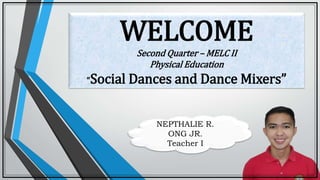
WELCOME
Second Quarter – MELC II
Physical Education
“Social Dances and Dance Mixers”
NEPTHALIE R.
ONG JR.
Teacher I
LET
US
PRAY
WhatarethedifferentgenresofDance?
To name a few:
1. Ballet
2. Ballroom
3. Contemporary
4. Hip Hop
5. Jazz
6. Tap Dance
7. Folk Dance
8. Irish Dance
9. Modern Dance
10. Social Dance
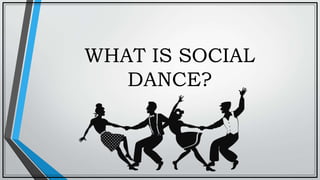
WHAT IS SOCIAL
DANCE?
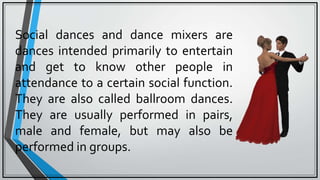
Social dances and dance mixers are
dances intended primarily to entertain
and get to know other people in
attendance to a certain social function.
They are also called ballroom dances.
They are usually performed in pairs,
male and female, but may also be
performed in groups.
Social dances are classified into two major
classifications namely the Latin American Dances
and the Modern Standard Dances. Social Dances are
communal dances performed in social gatherings in
any given space. They are synonymously referred to
as ballroom dances, but the former is performed in
balls or formal social functions.
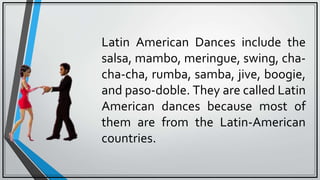
Latin American Dances include the
salsa, mambo, meringue, swing, cha-
cha-cha, rumba, samba, jive, boogie,
and paso-doble. They are called Latin
American dances because most of
them are from the Latin-American
countries.
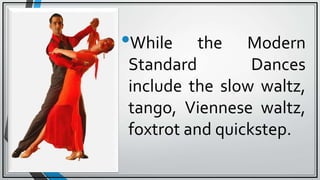
•While the Modern
Standard Dances
include the slow waltz,
tango, Viennese waltz,
foxtrot and quickstep.
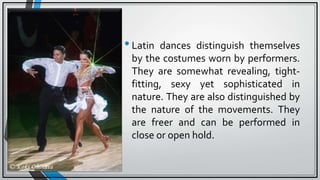
•Latin dances distinguish themselves
by the costumes worn by performers.
They are somewhat revealing, tight-
fitting, sexy yet sophisticated in
nature. They are also distinguished by
the nature of the movements. They
are freer and can be performed in
close or open hold.
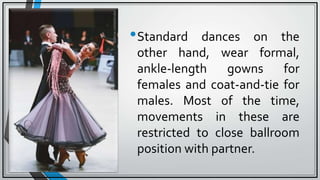
•Standard dances on the
other hand, wear formal,
ankle-length gowns for
females and coat-and-tie for
males. Most of the time,
movements in these are
restricted to close ballroom
position with partner.
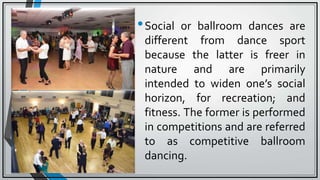
•Social or ballroom dances are
different from dance sport
because the latter is freer in
nature and are primarily
intended to widen one’s social
horizon, for recreation; and
fitness. The former is performed
in competitions and are referred
to as competitive ballroom
dancing.
•The required athleticism has established
rules of different levels of difficulty and is
limited to five 5 dances per category only.
They are the cha-cha-cha, rumba, samba,
paso doble and jive for the Latin category
and slow waltz, tango, Viennese waltz,
foxtrot and quickstep for the standard
category.
DANCE ETIQUETTE
Dance Etiquette the general term
referring to the Dos and DON'Ts in
social dancing.
DO’s
•Before
• Have a good hygiene
• Wear comfortable and appropriate clothes
• Bring clean spare shoes
• Be courteous “May I have this dance”
• Ask someone promptly if you want to dance with her
DO’s
• During
• Be polite, respectful when you ask or refuse someone for a dance
• Adapt the dance to your partner’s level
• Be aware of your space
• Apologize if you bump into someone
• Thank your partner for the dance
• Respect personal space
• Smile
• Wear appropriate dancing attire
• Always follow the counterclockwise as line of direction in social dancing
DONT’s
•Before
•Don’t be intimidated
•Don’t drink too much
•Don’t bring too much stuff
DONT’s
•During
•Don’t talk
•Don’t teach/ correct
•Don’t be too picky
•Don’t be intimidated to ask advanced dancers
•Don’t do crazy moves
•Don’t be selfish
•Don’t confuse dancing and flirting
Let’s learn the Cha-Cha-Cha
•Cha-Cha-Cha or Cha Cha is a lively dance with
African influences that developed in Cuba after
WorldWar II.
•Styles of cha-cha-cha dance may differ in the place
of the chasse in the rhythmical structure. The
original Cuban and the ballroom cha-cha-cha
count is "one, two, three, cha-cha", or "one, two,
three, four-and."
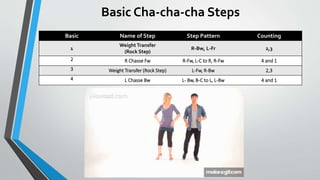
Basic Cha-cha-cha Steps
Basic Name of Step Step Pattern Counting
1
Weight Transfer
(Rock Step)
R-Bw, L-Fr 2,3
2 R Chasse Fw R-Fw, L-C to R, R-Fw 4 and 1
3 Weight Transfer (Rock Step) L-Fw, R-Bw 2,3
4 L Chasse Bw L- Bw, B-C to L, L-Bw 4 and 1
Basic Cha-cha-cha Steps
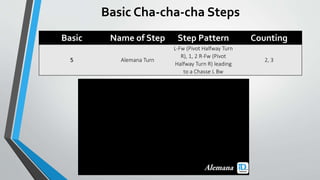
Basic Name of Step Step Pattern Counting
5 Alemana Turn
L-Fw (Pivot Halfway Turn
R), 1, 2 R-Fw (Pivot
Halfway Turn R) leading
to a Chasse L Bw
2, 3
Basic Cha-cha-cha Steps
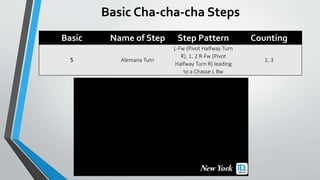
Basic Name of Step Step Pattern Counting
5 Alemana Turn
L-Fw (Pivot Halfway Turn
R), 1, 2 R-Fw (Pivot
Halfway Turn R) leading
to a Chasse L Bw
2, 3
Basic Cha-cha-cha Steps
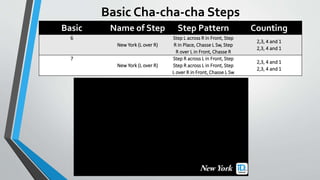
Basic Name of Step Step Pattern Counting
6
New York (L over R)
Step L across R in Front, Step
R in Place, Chasse L Sw, Step
R over L in Front, Chasse R
2,3, 4 and 1
2,3, 4 and 1
7
New York (L over R)
Step R across L in Front, Step
L over R in Front, Chasse L Sw
2,3, 4 and 1
2,3, 4 and 1
Basic Cha-cha-cha Steps
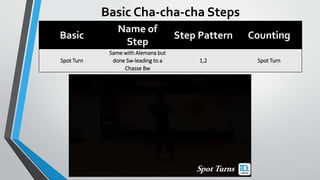
Basic
Name of
Step
Step Pattern Counting
Spot Turn
Same with Alemana but
done Sw-leading to a
Chasse Bw
1,2 Spot Turn

PE-Second-Quarter.pptx

  • 1.
    WELCOME Second Quarter –MELC II Physical Education “Social Dances and Dance Mixers” NEPTHALIE R. ONG JR. Teacher I
  • 2.
  • 3.
  • 4.
    To name afew: 1. Ballet 2. Ballroom 3. Contemporary 4. Hip Hop 5. Jazz 6. Tap Dance 7. Folk Dance 8. Irish Dance 9. Modern Dance 10. Social Dance
  • 5.
  • 6.
    Social dances anddance mixers are dances intended primarily to entertain and get to know other people in attendance to a certain social function. They are also called ballroom dances. They are usually performed in pairs, male and female, but may also be performed in groups.
  • 7.
    Social dances areclassified into two major classifications namely the Latin American Dances and the Modern Standard Dances. Social Dances are communal dances performed in social gatherings in any given space. They are synonymously referred to as ballroom dances, but the former is performed in balls or formal social functions.
  • 8.
    Latin American Dancesinclude the salsa, mambo, meringue, swing, cha- cha-cha, rumba, samba, jive, boogie, and paso-doble. They are called Latin American dances because most of them are from the Latin-American countries.
  • 9.
    •While the Modern StandardDances include the slow waltz, tango, Viennese waltz, foxtrot and quickstep.
  • 10.
    •Latin dances distinguishthemselves by the costumes worn by performers. They are somewhat revealing, tight- fitting, sexy yet sophisticated in nature. They are also distinguished by the nature of the movements. They are freer and can be performed in close or open hold.
  • 11.
    •Standard dances onthe other hand, wear formal, ankle-length gowns for females and coat-and-tie for males. Most of the time, movements in these are restricted to close ballroom position with partner.
  • 12.
    •Social or ballroomdances are different from dance sport because the latter is freer in nature and are primarily intended to widen one’s social horizon, for recreation; and fitness. The former is performed in competitions and are referred to as competitive ballroom dancing.
  • 13.
    •The required athleticismhas established rules of different levels of difficulty and is limited to five 5 dances per category only. They are the cha-cha-cha, rumba, samba, paso doble and jive for the Latin category and slow waltz, tango, Viennese waltz, foxtrot and quickstep for the standard category.
  • 14.
    DANCE ETIQUETTE Dance Etiquettethe general term referring to the Dos and DON'Ts in social dancing.
  • 15.
    DO’s •Before • Have agood hygiene • Wear comfortable and appropriate clothes • Bring clean spare shoes • Be courteous “May I have this dance” • Ask someone promptly if you want to dance with her
  • 16.
    DO’s • During • Bepolite, respectful when you ask or refuse someone for a dance • Adapt the dance to your partner’s level • Be aware of your space • Apologize if you bump into someone • Thank your partner for the dance • Respect personal space • Smile • Wear appropriate dancing attire • Always follow the counterclockwise as line of direction in social dancing
  • 17.
    DONT’s •Before •Don’t be intimidated •Don’tdrink too much •Don’t bring too much stuff
  • 18.
    DONT’s •During •Don’t talk •Don’t teach/correct •Don’t be too picky •Don’t be intimidated to ask advanced dancers •Don’t do crazy moves •Don’t be selfish •Don’t confuse dancing and flirting
  • 19.
    Let’s learn theCha-Cha-Cha •Cha-Cha-Cha or Cha Cha is a lively dance with African influences that developed in Cuba after WorldWar II. •Styles of cha-cha-cha dance may differ in the place of the chasse in the rhythmical structure. The original Cuban and the ballroom cha-cha-cha count is "one, two, three, cha-cha", or "one, two, three, four-and."
  • 20.
    Basic Cha-cha-cha Steps BasicName of Step Step Pattern Counting 1 Weight Transfer (Rock Step) R-Bw, L-Fr 2,3 2 R Chasse Fw R-Fw, L-C to R, R-Fw 4 and 1 3 Weight Transfer (Rock Step) L-Fw, R-Bw 2,3 4 L Chasse Bw L- Bw, B-C to L, L-Bw 4 and 1
  • 21.
    Basic Cha-cha-cha Steps BasicName of Step Step Pattern Counting 5 Alemana Turn L-Fw (Pivot Halfway Turn R), 1, 2 R-Fw (Pivot Halfway Turn R) leading to a Chasse L Bw 2, 3
  • 22.
    Basic Cha-cha-cha Steps BasicName of Step Step Pattern Counting 5 Alemana Turn L-Fw (Pivot Halfway Turn R), 1, 2 R-Fw (Pivot Halfway Turn R) leading to a Chasse L Bw 2, 3
  • 23.
    Basic Cha-cha-cha Steps BasicName of Step Step Pattern Counting 6 New York (L over R) Step L across R in Front, Step R in Place, Chasse L Sw, Step R over L in Front, Chasse R 2,3, 4 and 1 2,3, 4 and 1 7 New York (L over R) Step R across L in Front, Step Step R across L in Front, Step L over R in Front, Chasse L Sw 2,3, 4 and 1 2,3, 4 and 1
  • 24.
    Basic Cha-cha-cha Steps Basic Nameof Step Step Pattern Counting Spot Turn Same with Alemana but done Sw-leading to a Chasse Bw 1,2 Spot Turn