A VAR ANALYSIS
OF ELECTRICITY CONSUMPTION
Nurgul Mamatova
Higher School of Economics
Department of Statistics, Data Analysis and Demography
Moscow, Russia, nurgul.mamatova@gmail.com
OBJECTIVE
This study was conducted to:
- Determine the relationship between electricity consumption and other factors
- Find out how a shock to the variables affect each other
- Estimate the policy of the government in electricity consumption
METHODOLOGY
-First, we use statistical tests: Unit root test for cointegration (Augmented Dickey-
Fuller test), Granger-causality tests.
- A VAR for a system of N=3 runs 3 equations where in each case 1 lags of the
own and other variables are included.
RESULTS
Table 1. Variance Decomposition of Y:
Period T X Y
1 0.000 0.000 100.0
2 0.803 0.118 99.078
3 1.731 1.207 97.061
4 2.517 1.250 96.232
5 11.137 2.263 84.600
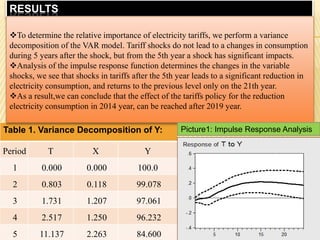
To determine the relative importance of electricity tariffs, we perform a variance
decomposition of the VAR model. Tariff shocks do not lead to a changes in consumption
during 5 years after the shock, but from the 5th year a shock has significant impacts.
Analysis of the impulse response function determines the changes in the variable
shocks, we see that shocks in tariffs after the 5th year leads to a significant reduction in
electricity consumption, and returns to the previous level only on the 21th year.
As a result,we can conclude that the effect of the tariffs policy for the reduction
electricity consumption in 2014 year, can be reached after 2019 year.
Picture1: Impulse Response Analysis

Нургуль Маматова - Применение модели векторной авторегрессии для анализа потребления электроэнергии

  • 1.
    A VAR ANALYSIS OFELECTRICITY CONSUMPTION Nurgul Mamatova Higher School of Economics Department of Statistics, Data Analysis and Demography Moscow, Russia, nurgul.mamatova@gmail.com
  • 2.
    OBJECTIVE This study wasconducted to: - Determine the relationship between electricity consumption and other factors - Find out how a shock to the variables affect each other - Estimate the policy of the government in electricity consumption METHODOLOGY -First, we use statistical tests: Unit root test for cointegration (Augmented Dickey- Fuller test), Granger-causality tests. - A VAR for a system of N=3 runs 3 equations where in each case 1 lags of the own and other variables are included.
  • 3.
    RESULTS Table 1. VarianceDecomposition of Y: Period T X Y 1 0.000 0.000 100.0 2 0.803 0.118 99.078 3 1.731 1.207 97.061 4 2.517 1.250 96.232 5 11.137 2.263 84.600 To determine the relative importance of electricity tariffs, we perform a variance decomposition of the VAR model. Tariff shocks do not lead to a changes in consumption during 5 years after the shock, but from the 5th year a shock has significant impacts. Analysis of the impulse response function determines the changes in the variable shocks, we see that shocks in tariffs after the 5th year leads to a significant reduction in electricity consumption, and returns to the previous level only on the 21th year. As a result,we can conclude that the effect of the tariffs policy for the reduction electricity consumption in 2014 year, can be reached after 2019 year. Picture1: Impulse Response Analysis