Toward fairer and more sustainable
logistics with gig workers
Adrian Friday
Prof. of Computing and Sustainability, Lancaster University, UK
+ Oliver Bates and Carolynne Lord (Lancaster); Tom Cherrett, Fraser McLeod and
Andy Oakey (Transportation Research/ U. Southampton); Antonio Martinez-Sykora
Southampton Business School; Ben Kirman (York)
Thanks to our funders and partners!
http://www.flipgig.org, FlipGig (2019-2021) EPSRC
grant agreement no. EP/S027726/1
FlipGig has collaborated on fieldwork with
the pilot project Switch-Gig funded by the
EPSRC Network+ Not-Equal
(EP/R044929/1).
Outline
• How digital tech is changing last mile logistics
• Exciting opportunities for sustainability, but why
social sustainability is important too
• Our learning with gig workers in Manchester, York and
Edinburgh
• Creating sustainable work
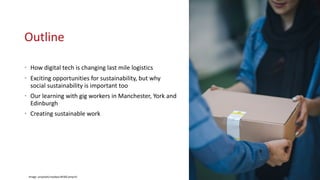
Image: unsplash/rosebox-BFdSCxmqvYc
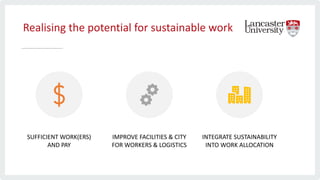
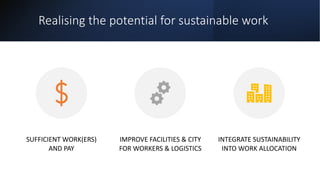
Realising the potential for sustainable work
SUFFICIENT WORK(ERS)
AND PAY
IMPROVE FACILITIES & CITY
FOR WORKERS & LOGISTICS
INTEGRATE SUSTAINABILITY
INTO WORK ALLOCATION
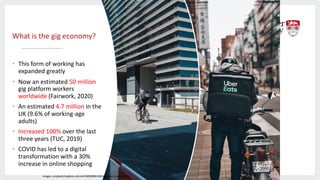
What is the gig economy?
• This form of working has
expanded greatly
• Now an estimated 50 million
gig platform workers
worldwide (Fairwork, 2020)
• An estimated 4.7 million in the
UK (9.6% of working-age
adults)
• Increased 100% over the last
three years (TUC, 2019)
• COVID has led to a digital
transformation with a 30%
increase in online shopping
Images: unsplash/stephan-schmid-0MtjR0BvV6A/eggbank-4w3UZBFDacI
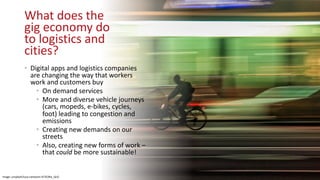
What does the
gig economy do
to logistics and
cities?
• Digital apps and logistics companies
are changing the way that workers
work and customers buy
• On demand services
• More and diverse vehicle journeys
(cars, mopeds, e-bikes, cycles,
foot) leading to congestion and
emissions
• Creating new demands on our
streets
• Also, creating new forms of work –
that could be more sustainable!
Image: unsplash/luca-campioni-AT3C0Ka_QcQ
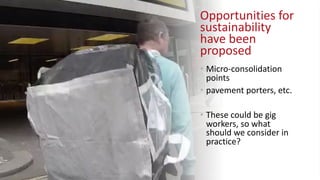
Opportunities for
sustainability
have been
proposed
• Micro-consolidation
points
• pavement porters, etc.
• These could be gig
workers, so what
should we consider in
practice?
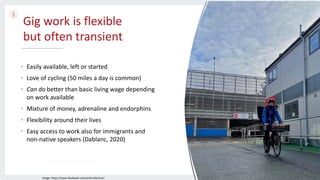
Gig work is flexible
but often transient
• Easily available, left or started
• Love of cycling (50 miles a day is common)
• Can do better than basic living wage depending
on work available
• Mixture of money, adrenaline and endorphins
• Flexibility around their lives
• Easy access to work also for immigrants and
non-native speakers (Dablanc, 2020)
Image: https://www.facebook.com/yorkcollective/
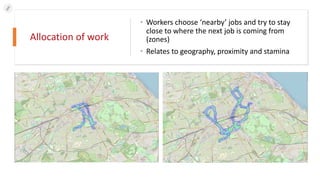
Allocation of work
• Workers choose ‘nearby’ jobs and try to stay
close to where the next job is coming from
(zones)
• Relates to geography, proximity and stamina
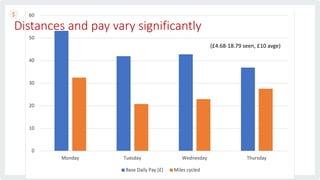
Distances and pay vary significantly
(£4.68-18.79 seen, £10 avge)
Practical
concerns
• Where to wait (c.f. a depot)
• (Personal) safety
• Stamina and energy, and length
of the day (bulky bags)
• Toileting and breaks
• Switching infrastructure (bikes,
bags) for different work, if
applicable
Image: unsplash/yena-kwon-_wWaO9HhXY4
Being successful =
retaining
experienced staff
• Experienced workers are proud to do good work
• Are more efficient and pick better routes
• Care more about safety (e.g. in traffic, c.f. Gregory, 2020)
“And I guess it starts spilling on to the next
day as well. You know, if you really push
yourself for one day, maybe you don't have
the energy the next day or you know, you
might hurt more. And you kind of have to
think about stamina over the week, not just
in the one day.”
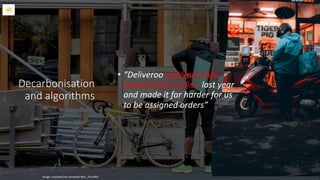
Decarbonisation
and algorithms
Image: unsplash/carl-campbell-NHv_7hIxJWQ
• “Deliveroo systematically
deprioritised cyclists last year
and made it far harder for us
to be assigned orders”
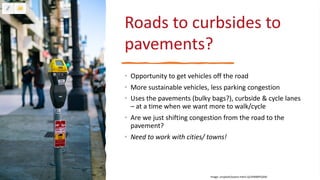
Roads to curbsides to
pavements?
• Opportunity to get vehicles off the road
• More sustainable vehicles, less parking congestion
• Uses the pavements (bulky bags?), curbside & cycle lanes
– at a time when we want more to walk/cycle
• Are we just shifting congestion from the road to the
pavement?
• Need to work with cities/ towns!
Image: unsplash/oxana-melis-Qc3VMB9YQAM
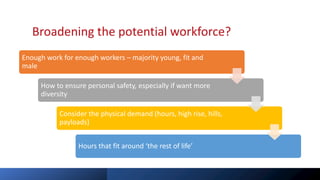
Broadening the potential workforce?
Enough work for enough workers – majority young, fit and
male
How to ensure personal safety, especially if want more
diversity
Consider the physical demand (hours, high rise, hills,
payloads)
Hours that fit around ‘the rest of life’
Realising the potential for sustainable work
SUFFICIENT WORK(ERS)
AND PAY
IMPROVE FACILITIES & CITY
FOR WORKERS & LOGISTICS
INTEGRATE SUSTAINABILITY
INTO WORK ALLOCATION
• My thanks to Oliver Bates, Carolynne Lord (Lancaster), Tom
Cherrett, Toni Martinez-Sykora, Fraser McLeod and Andy
Oakey (Southampton); Ben Kirman (York).
• a.friday@Lancaster.ac.uk
• @gulliblefish
• http://flipgig.org and http://wp.lancs.ac.uk/sds
Image: unsplash/jon-tyson-hhq1Lxtuwd8

Decarbonising the Last Mile ITS Oct 2021

  • 1.
    Toward fairer andmore sustainable logistics with gig workers Adrian Friday Prof. of Computing and Sustainability, Lancaster University, UK + Oliver Bates and Carolynne Lord (Lancaster); Tom Cherrett, Fraser McLeod and Andy Oakey (Transportation Research/ U. Southampton); Antonio Martinez-Sykora Southampton Business School; Ben Kirman (York)
  • 2.
    Thanks to ourfunders and partners! http://www.flipgig.org, FlipGig (2019-2021) EPSRC grant agreement no. EP/S027726/1 FlipGig has collaborated on fieldwork with the pilot project Switch-Gig funded by the EPSRC Network+ Not-Equal (EP/R044929/1).
  • 3.
    Outline • How digitaltech is changing last mile logistics • Exciting opportunities for sustainability, but why social sustainability is important too • Our learning with gig workers in Manchester, York and Edinburgh • Creating sustainable work Image: unsplash/rosebox-BFdSCxmqvYc
  • 4.
    Realising the potentialfor sustainable work SUFFICIENT WORK(ERS) AND PAY IMPROVE FACILITIES & CITY FOR WORKERS & LOGISTICS INTEGRATE SUSTAINABILITY INTO WORK ALLOCATION
  • 5.
    What is thegig economy? • This form of working has expanded greatly • Now an estimated 50 million gig platform workers worldwide (Fairwork, 2020) • An estimated 4.7 million in the UK (9.6% of working-age adults) • Increased 100% over the last three years (TUC, 2019) • COVID has led to a digital transformation with a 30% increase in online shopping Images: unsplash/stephan-schmid-0MtjR0BvV6A/eggbank-4w3UZBFDacI
  • 6.
    What does the gigeconomy do to logistics and cities? • Digital apps and logistics companies are changing the way that workers work and customers buy • On demand services • More and diverse vehicle journeys (cars, mopeds, e-bikes, cycles, foot) leading to congestion and emissions • Creating new demands on our streets • Also, creating new forms of work – that could be more sustainable! Image: unsplash/luca-campioni-AT3C0Ka_QcQ
  • 7.
    Opportunities for sustainability have been proposed •Micro-consolidation points • pavement porters, etc. • These could be gig workers, so what should we consider in practice?
  • 8.
    Gig work isflexible but often transient • Easily available, left or started • Love of cycling (50 miles a day is common) • Can do better than basic living wage depending on work available • Mixture of money, adrenaline and endorphins • Flexibility around their lives • Easy access to work also for immigrants and non-native speakers (Dablanc, 2020) Image: https://www.facebook.com/yorkcollective/
  • 9.
    Allocation of work •Workers choose ‘nearby’ jobs and try to stay close to where the next job is coming from (zones) • Relates to geography, proximity and stamina
  • 10.
    Distances and payvary significantly (£4.68-18.79 seen, £10 avge)
  • 11.
    Practical concerns • Where towait (c.f. a depot) • (Personal) safety • Stamina and energy, and length of the day (bulky bags) • Toileting and breaks • Switching infrastructure (bikes, bags) for different work, if applicable Image: unsplash/yena-kwon-_wWaO9HhXY4
  • 12.
    Being successful = retaining experiencedstaff • Experienced workers are proud to do good work • Are more efficient and pick better routes • Care more about safety (e.g. in traffic, c.f. Gregory, 2020) “And I guess it starts spilling on to the next day as well. You know, if you really push yourself for one day, maybe you don't have the energy the next day or you know, you might hurt more. And you kind of have to think about stamina over the week, not just in the one day.”
  • 13.
    Decarbonisation and algorithms Image: unsplash/carl-campbell-NHv_7hIxJWQ •“Deliveroo systematically deprioritised cyclists last year and made it far harder for us to be assigned orders”
  • 14.
    Roads to curbsidesto pavements? • Opportunity to get vehicles off the road • More sustainable vehicles, less parking congestion • Uses the pavements (bulky bags?), curbside & cycle lanes – at a time when we want more to walk/cycle • Are we just shifting congestion from the road to the pavement? • Need to work with cities/ towns! Image: unsplash/oxana-melis-Qc3VMB9YQAM
  • 15.
    Broadening the potentialworkforce? Enough work for enough workers – majority young, fit and male How to ensure personal safety, especially if want more diversity Consider the physical demand (hours, high rise, hills, payloads) Hours that fit around ‘the rest of life’
  • 16.
    Realising the potentialfor sustainable work SUFFICIENT WORK(ERS) AND PAY IMPROVE FACILITIES & CITY FOR WORKERS & LOGISTICS INTEGRATE SUSTAINABILITY INTO WORK ALLOCATION
  • 17.
    • My thanksto Oliver Bates, Carolynne Lord (Lancaster), Tom Cherrett, Toni Martinez-Sykora, Fraser McLeod and Andy Oakey (Southampton); Ben Kirman (York). • a.friday@Lancaster.ac.uk • @gulliblefish • http://flipgig.org and http://wp.lancs.ac.uk/sds Image: unsplash/jon-tyson-hhq1Lxtuwd8