Classification of malocclusion
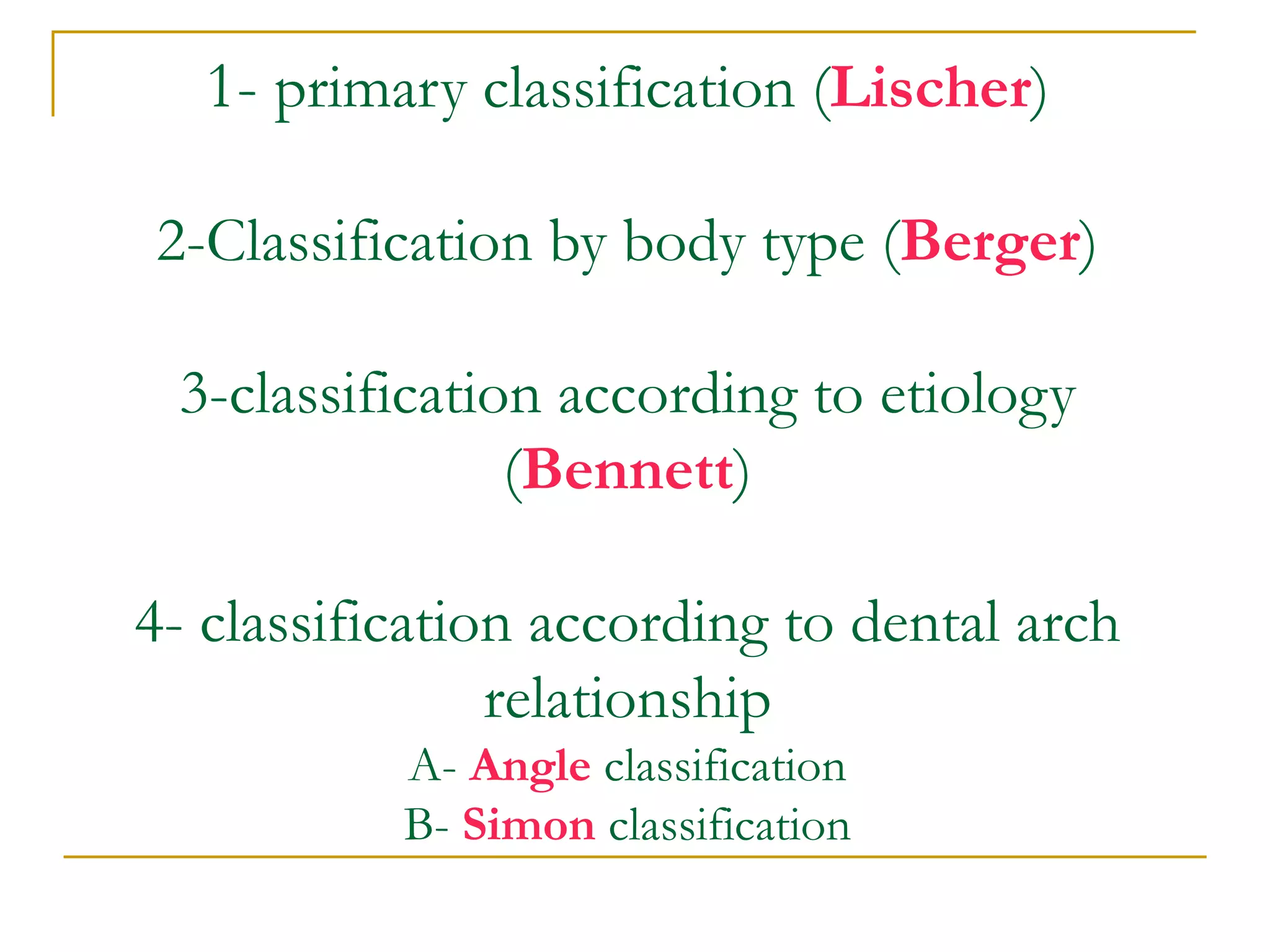
1- primary classification (Lischer)
2-Classification by body type (Berger)
3-classification according to etiology
(Bennett)
4- classification according to dental arch
relationship
A- Angle classification
B- Simon classification
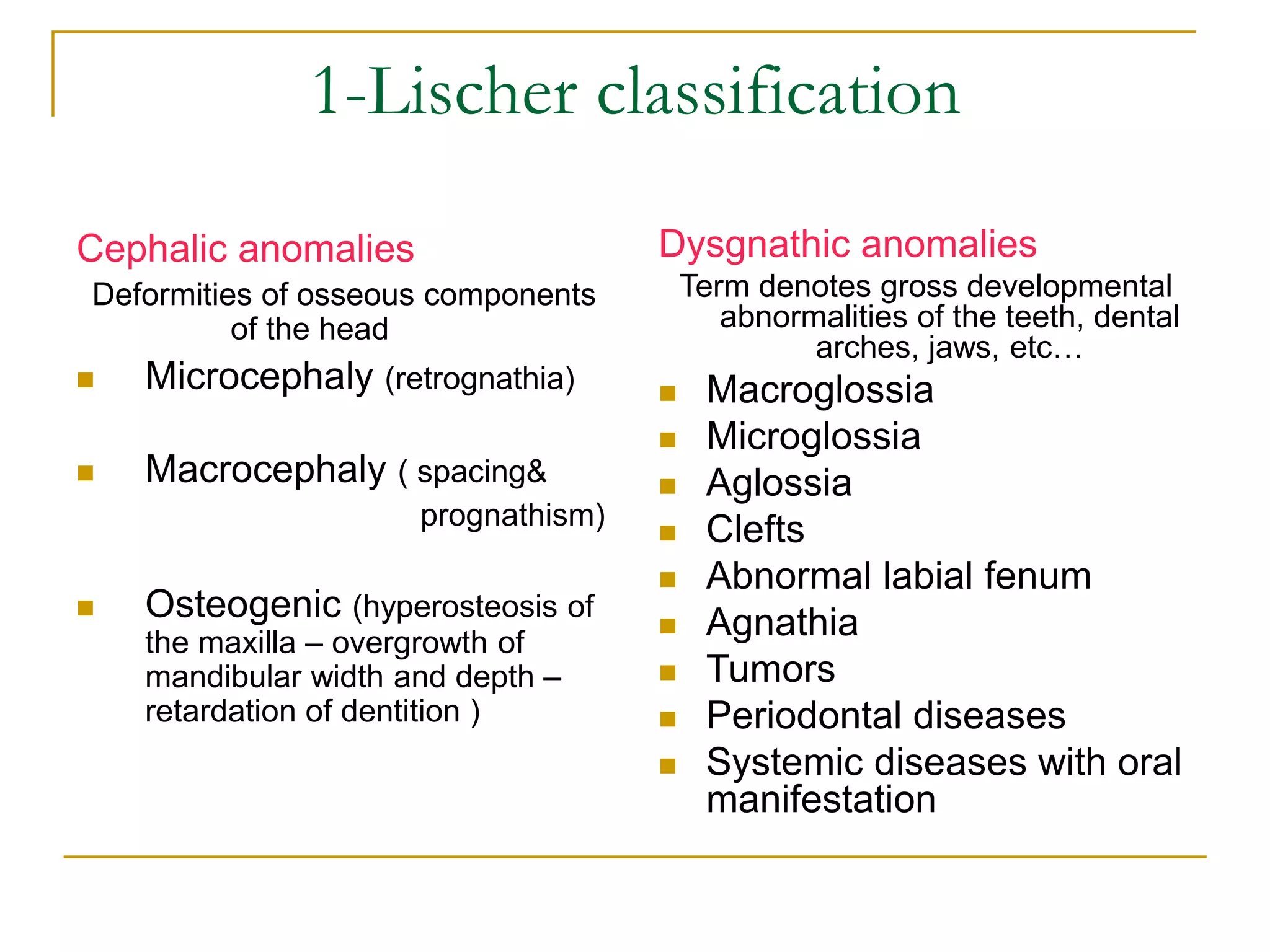
1-Lischer classification
Cephalic anomalies
Deformities of osseous components
of the head
◼ Microcephaly (retrognathia)
◼ Macrocephaly ( spacing&
prognathism)
◼ Osteogenic (hyperosteosis of
the maxilla – overgrowth of
mandibular width and depth –
retardation of dentition )
Dysgnathic anomalies
Term denotes gross developmental
abnormalities of the teeth, dental
arches, jaws, etc…
◼ Macroglossia
◼ Microglossia
◼ Aglossia
◼ Clefts
◼ Abnormal labial fenum
◼ Agnathia
◼ Tumors
◼ Periodontal diseases
◼ Systemic diseases with oral
manifestation
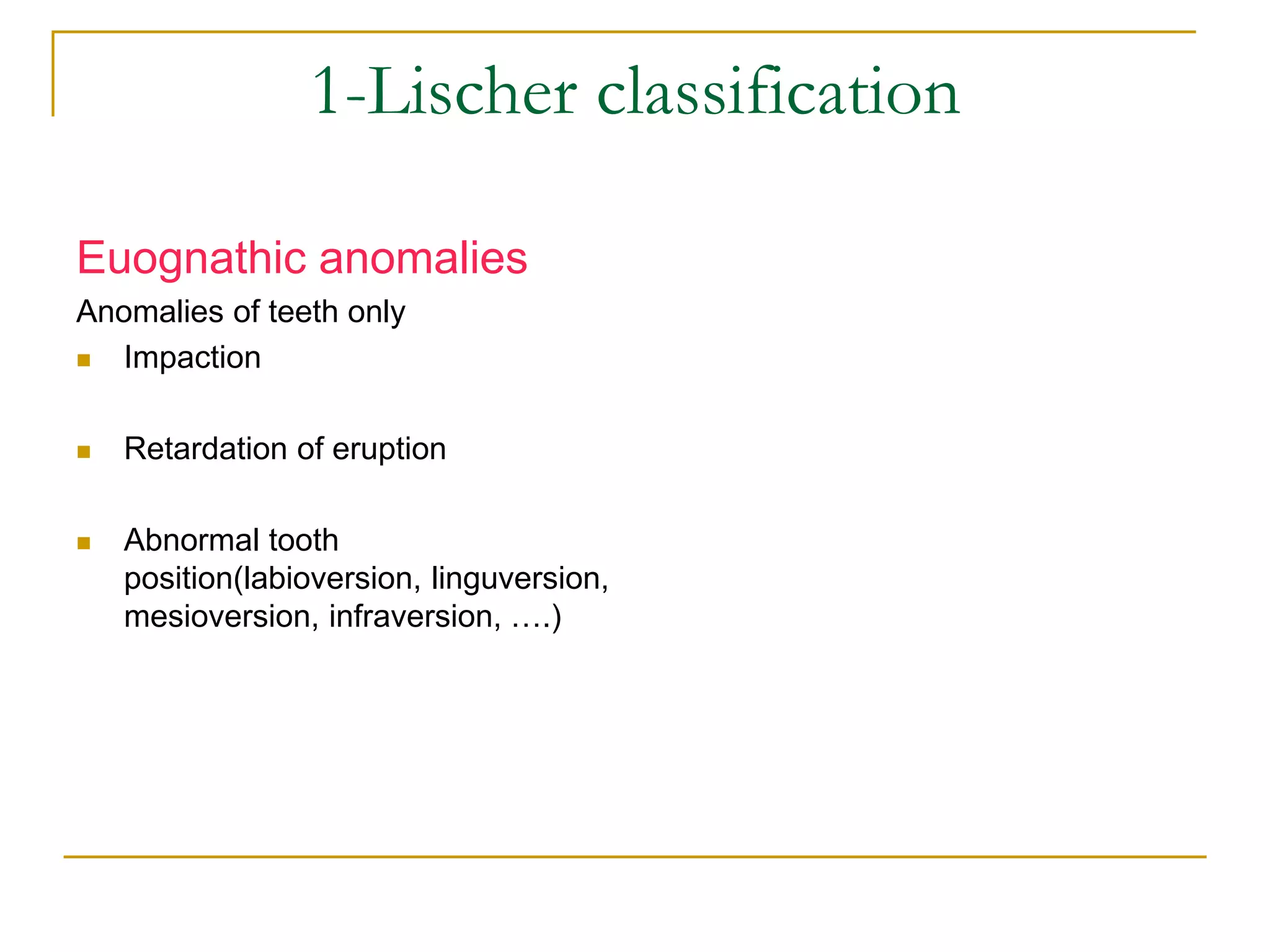
1-Lischer classification
Euognathic anomalies
Anomalies of teeth only
◼ Impaction
◼ Retardation of eruption
◼ Abnormal tooth
position(labioversion, linguversion,
mesioversion, infraversion, ….)
1- primary classification (Lischer)
2-Classification by body type (Berger)
3-classification according to etiology
(Bennett)
4- classification according to dental arch
relationship
A- Angle classification
B- Simon classification
2- Berger classification
Asthenic or liptosomatic
(long and slender)
◼ Underdeveloped mandible
◼ Bridge of the nose is
overdeveloped
2- Berger classification
Pyknic
(short and square)
◼ Broad face
◼ Short neck
◼ Face height is less than
asthenic
2- Berger classification
Athletic
(muscular type)
◼ Fully developed mandible
◼ Well developed skeleton
1- primary classification (Lischer)
2-Classification by body type (Berger)
3-classification according to etiology
(Bennett)
4- classification according to dental arch
relationship
A- Angle classification
B- Simon classification
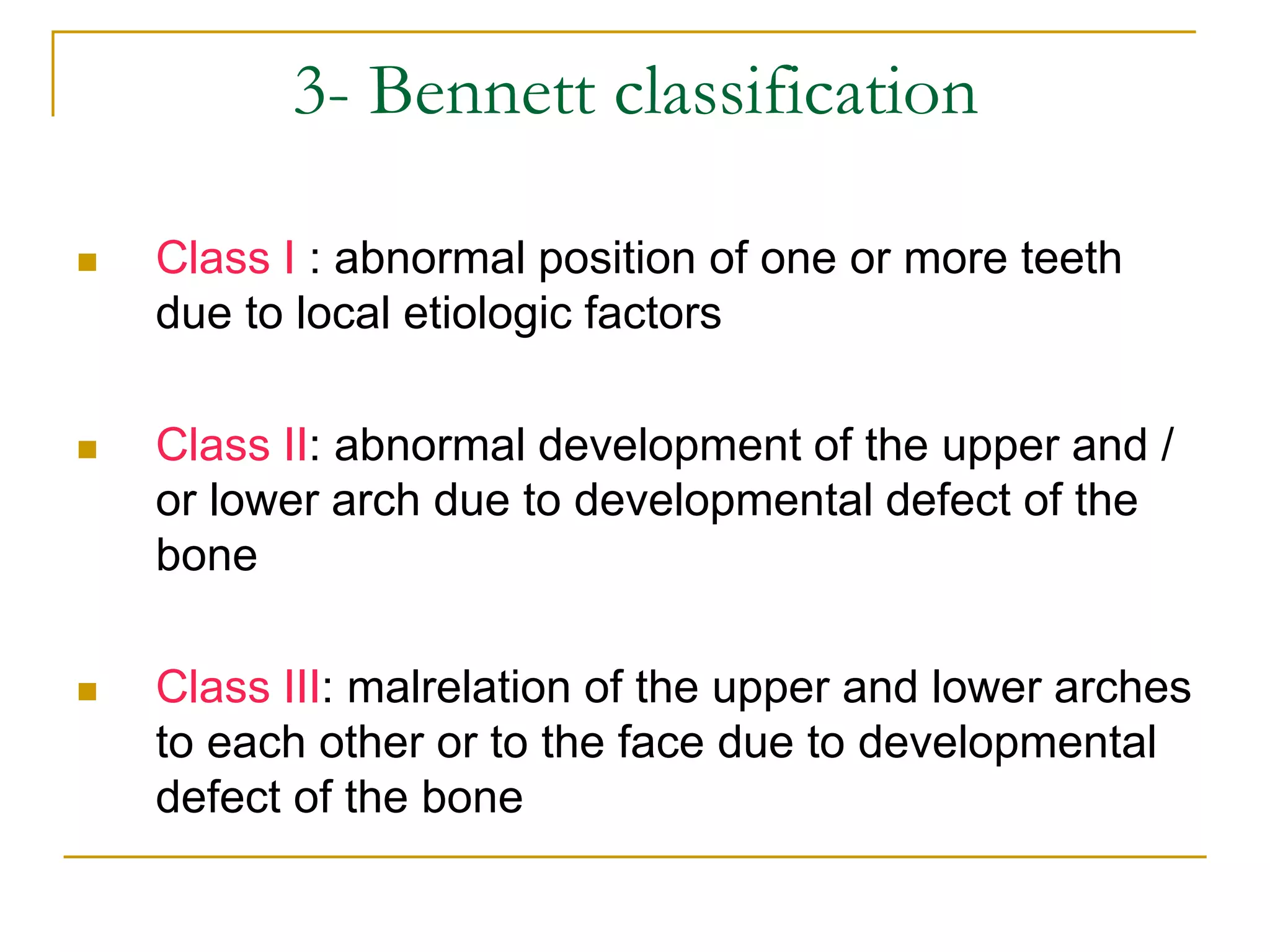
3- Bennett classification
◼ Class I : abnormal position of one or more teeth
due to local etiologic factors
◼ Class II: abnormal development of the upper and /
or lower arch due to developmental defect of the
bone
◼ Class III: malrelation of the upper and lower arches
to each other or to the face due to developmental
defect of the bone
1- primary classification (Lischer)
2-Classification by body type (Berger)
3-classification according to etiology
(Bennett)
4- classification according to dental arch
relationship
A- Angle classification
B- Simon classification
4- classification according to dental arch
relationship
◼ Angle classification
Angle classification
◼ Key of occlusion is upper first molar
◼ Upper first molar is a fixed point
Angle classification
◼ Class I
◼ Class II (division 1 & 2)
◼ Class III
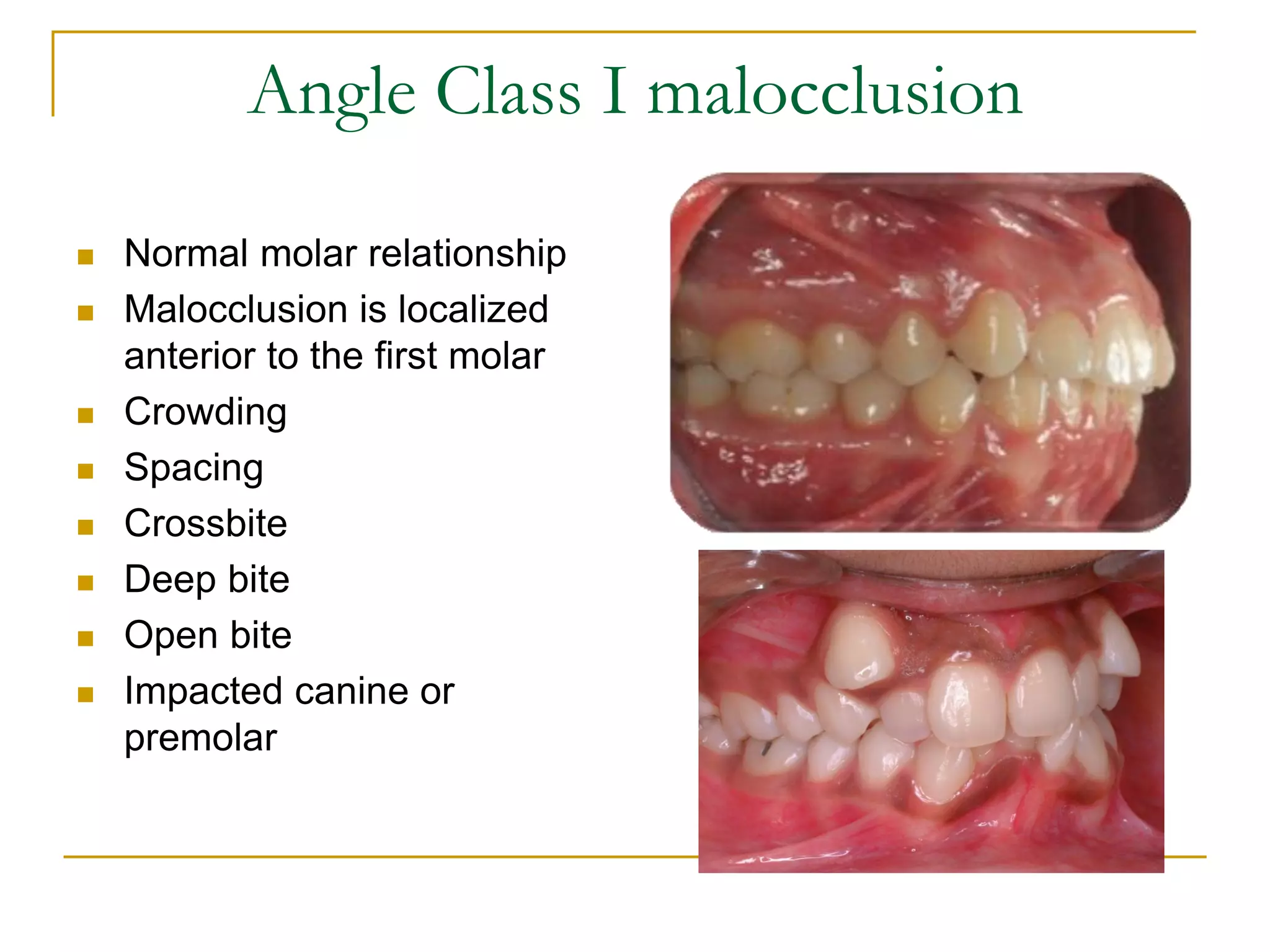
Angle Class I malocclusion
◼ Normal molar relationship
◼ Malocclusion is localized
anterior to the first molar
◼ Crowding
◼ Spacing
◼ Crossbite
◼ Deep bite
◼ Open bite
◼ Impacted canine or
premolar
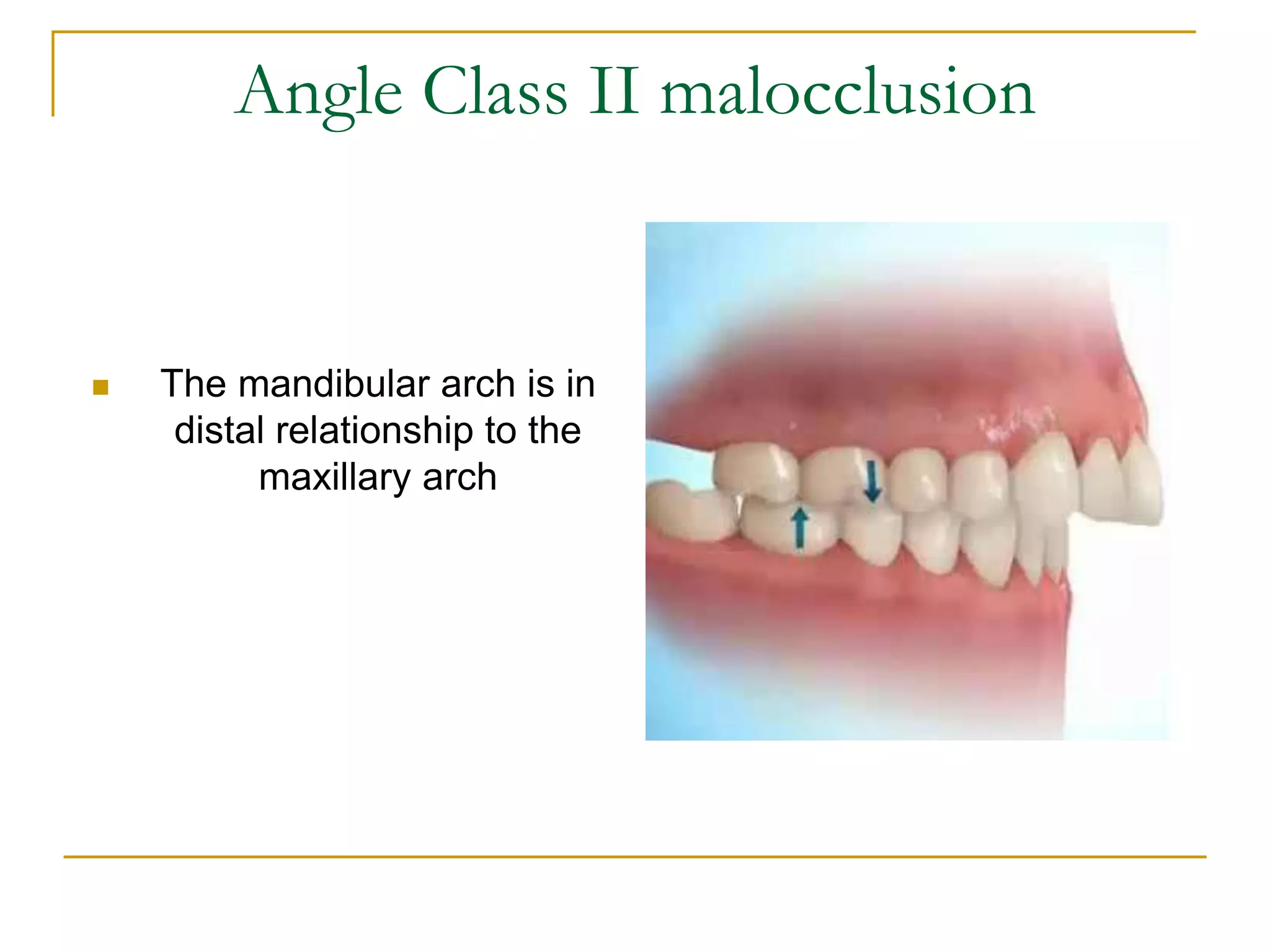
Angle Class II malocclusion
◼ The mandibular arch is in
distal relationship to the
maxillary arch
Angle Class II division 1 malocclusion
◼ Proclined upper incisors
◼ Excessive overjet and overbite
◼ V- shaped upper arch
◼ Short upper lip
◼ Incompetent lips
◼ Mandible may be deficient
◼ Underdeveloped chin
Angle Class II division II malocclusion
◼ Retroclined upper centrals
which may be overlapped
by upper laterals
◼ deep overbite
◼ broad upper arch
◼ normal upper lip
◼ Deep mental groove
◼ Mandible is of good size
Angle Class II subdivision
◼ The first molar
relationship is class I in
one side and class II in
the other side
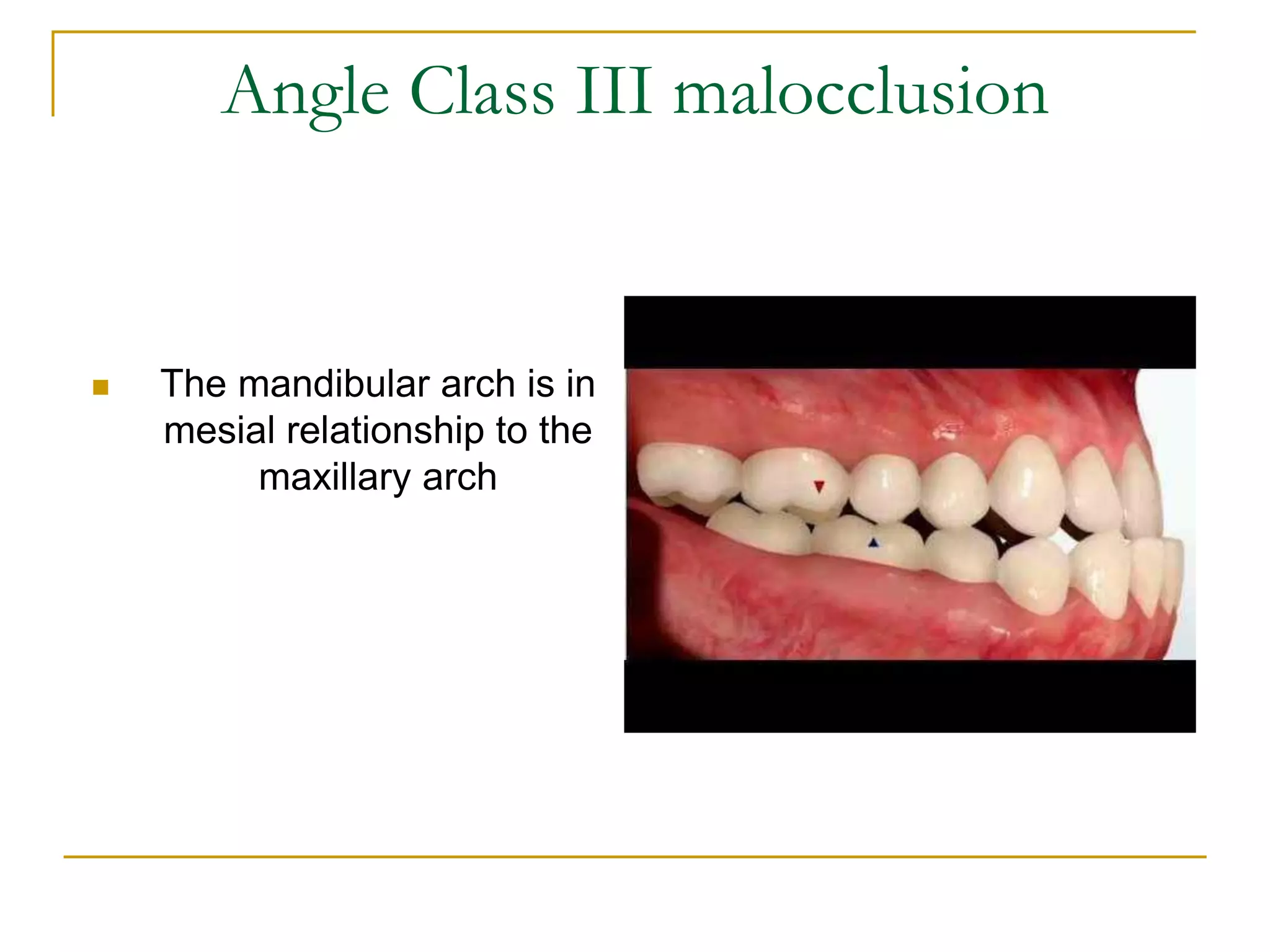
Angle Class III malocclusion
◼ The mandibular arch is in
mesial relationship to the
maxillary arch
Angle Class III subdivision
◼ The first molar
relationship is class I
in one side and class
III in the other side
Validity of angle classification
◼ Upper first molar is not fixed
◼ It is possible to have class II dental arches on skeltal
class I bases
◼ It does not differentiate between mandibular
retrusion or maxillary protrusion in class II (same for
class III)
◼ It is incomplete ( consider only anteroposterior
direction( (neglect vertical and transverse direction)
Modifications of Angle classification
1-Lischer’s modification
◼ Neutrocclusion (class I)
◼ Distocclusion (class II)
◼ Mesiocclusion (class III)
◼ Buccoversion
◼ Linguversion
◼ Supraversion (deep bite)
◼ Infraversion ( open bite)
◼ Transiversion
(transposition)
◼ Axiversion (wrong axial
angulation or inclination)
Modifications of Angle classification
2- Dewey’s modification
Dewey divided angle’s class I into 5 types:
◼ Type 1: crowded maxillary anteriors
◼ Type 2:maxillary incisors in labioversion
◼ Type 3:maxillary incisors in linguversion
◼ Type4: molars and occasionally premolars in buccoversion or
linguversion – normal anteriors and normal dental arches
relationship
◼ Type 5:molars in mesioversion due to loss of teeth anterior to
molars- rest of teeth are normal
1- primary classification (Lischer)
2-Classification by body type (Berger)
3-classification according to etiology
(Bennett)
4- classification according to dental arch
relationship
A- Angle classification
B- Simon classification
Simon Classification
◼ He relate the denture to the face and cranium
in the three planes of space
◼ Frankfort plane
◼ Orbital plane
◼ Mid-sagittal plane
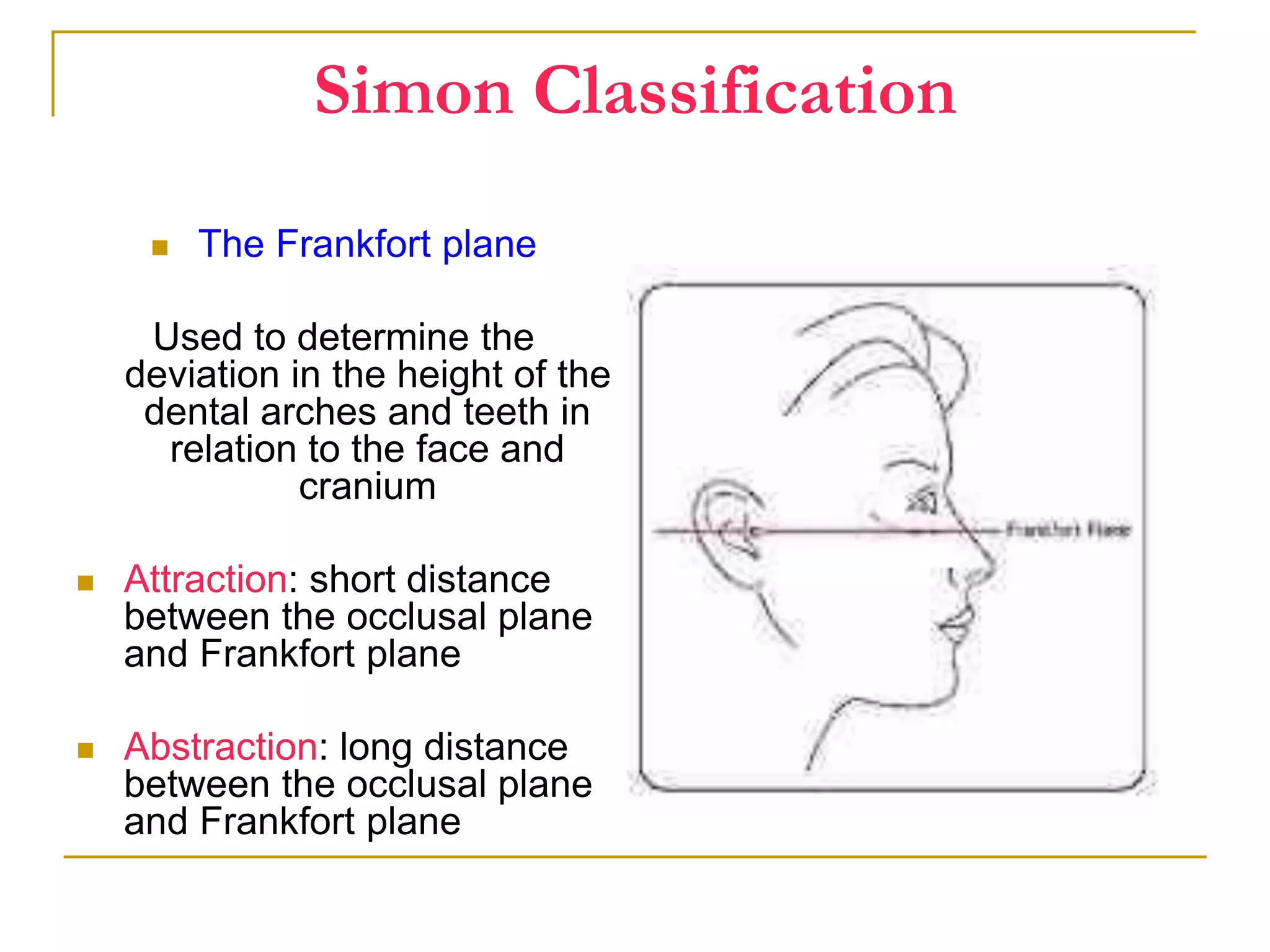
◼ The Frankfort plane
Used to determine the
deviation in the height of the
dental arches and teeth in
relation to the face and
cranium
◼ Attraction: short distance
between the occlusal plane
and Frankfort plane
◼ Abstraction: long distance
between the occlusal plane
and Frankfort plane
Simon Classification
◼ The orbital plane
◼ This plane is perpendicular
to the Frankfort plane at the
margin of the bony orbit
directly under the pupil of
the eye
◼ Used to determine the
sagittal deviation of the
dental arches and teeth in
relation to the face and
cranium
◼ The orbital plane passes
through the distal aspect of
the canine ( the law of the
canine)
Simon Classification
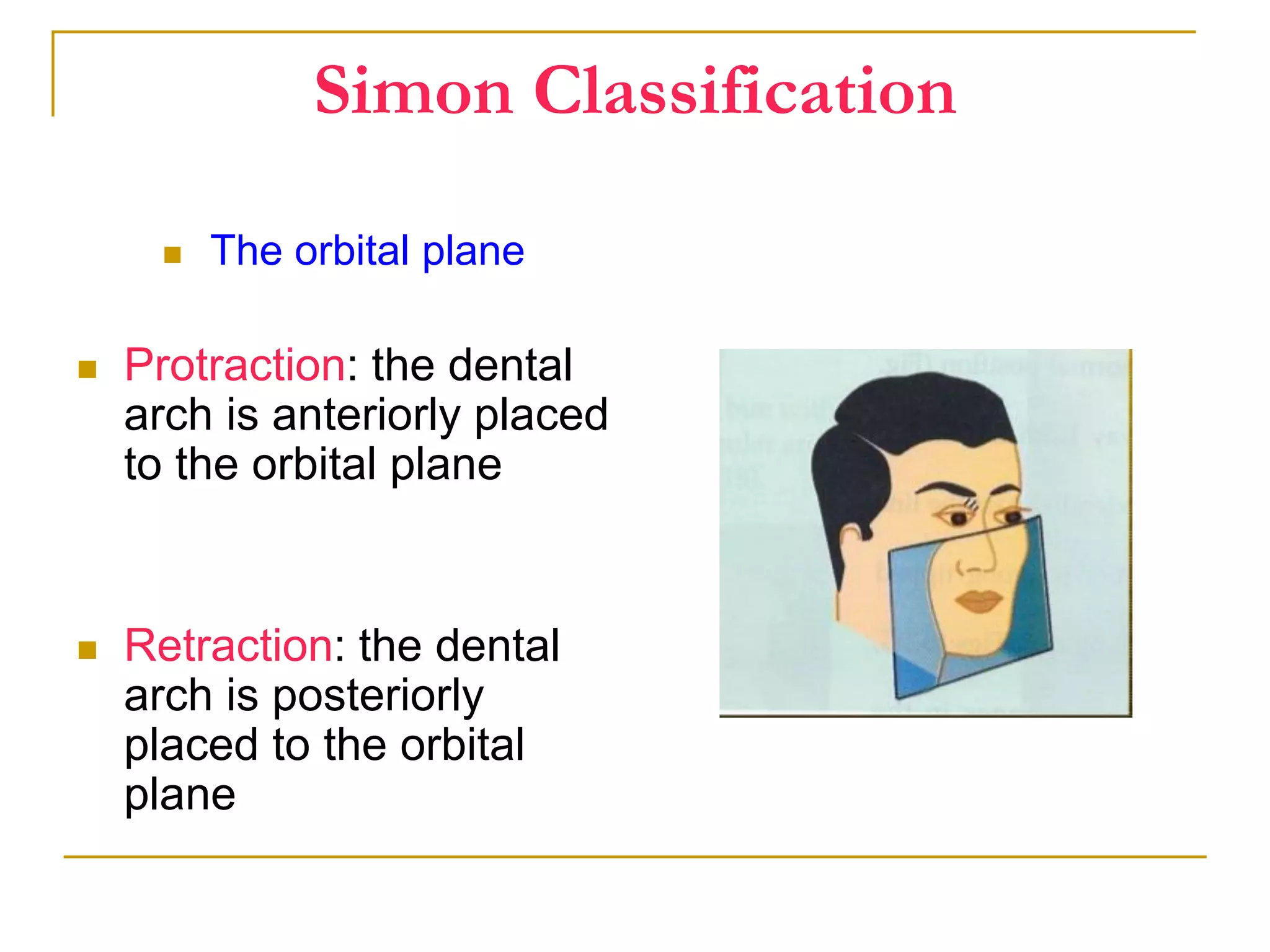
◼ The orbital plane
◼ Protraction: the dental
arch is anteriorly placed
to the orbital plane
◼ Retraction: the dental
arch is posteriorly
placed to the orbital
plane
Simon Classification
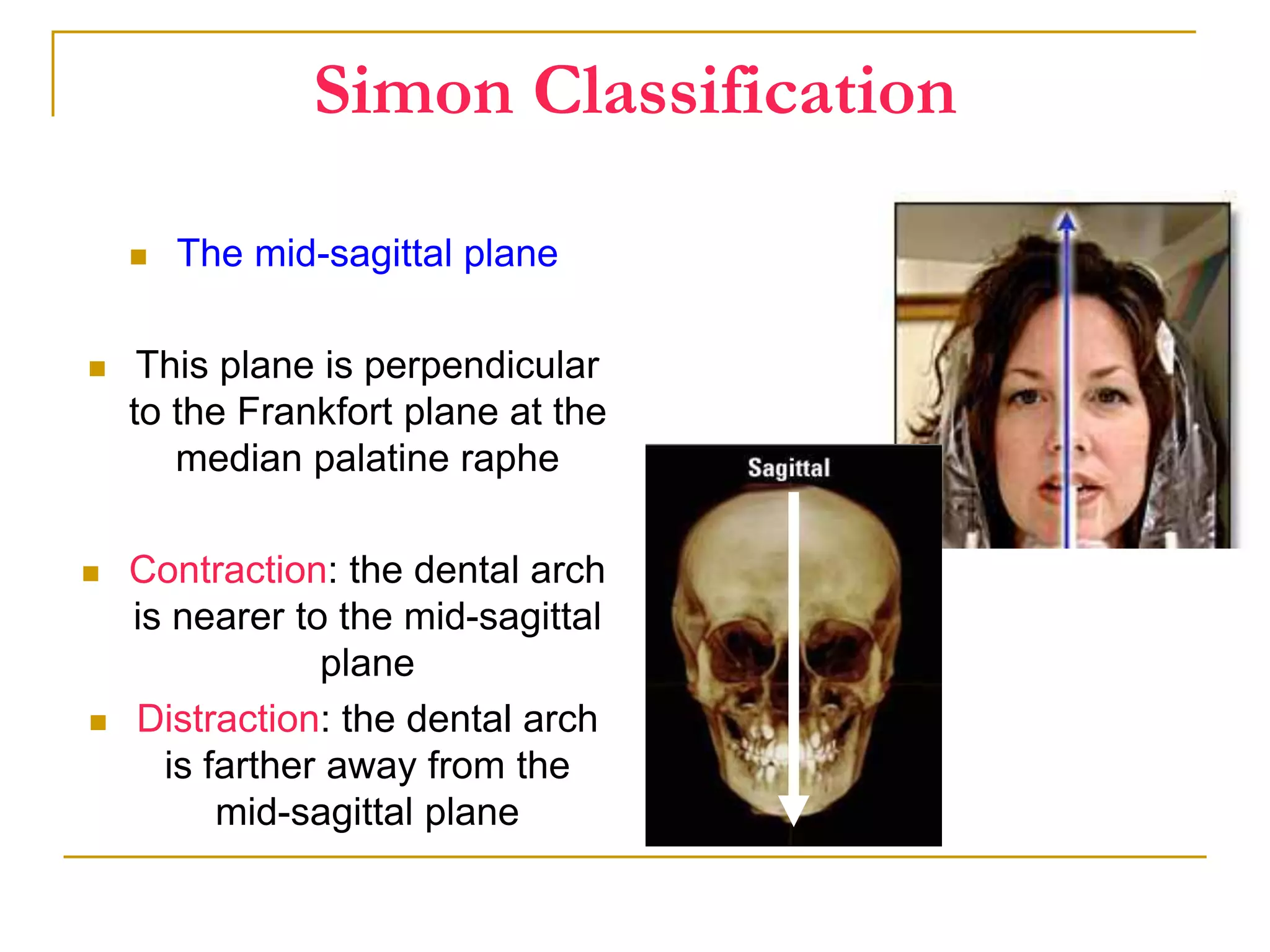
◼ The mid-sagittal plane
◼ This plane is perpendicular
to the Frankfort plane at the
median palatine raphe
◼ Contraction: the dental arch
is nearer to the mid-sagittal
plane
◼ Distraction: the dental arch
is farther away from the
mid-sagittal plane
Simon Classification
Classification of malocclusion-converted (1).pdf

Classification of malocclusion-converted (1).pdf

  • 1.
  • 2.
    1- primary classification(Lischer) 2-Classification by body type (Berger) 3-classification according to etiology (Bennett) 4- classification according to dental arch relationship A- Angle classification B- Simon classification
  • 3.
    1-Lischer classification Cephalic anomalies Deformitiesof osseous components of the head ◼ Microcephaly (retrognathia) ◼ Macrocephaly ( spacing& prognathism) ◼ Osteogenic (hyperosteosis of the maxilla – overgrowth of mandibular width and depth – retardation of dentition ) Dysgnathic anomalies Term denotes gross developmental abnormalities of the teeth, dental arches, jaws, etc… ◼ Macroglossia ◼ Microglossia ◼ Aglossia ◼ Clefts ◼ Abnormal labial fenum ◼ Agnathia ◼ Tumors ◼ Periodontal diseases ◼ Systemic diseases with oral manifestation
  • 4.
    1-Lischer classification Euognathic anomalies Anomaliesof teeth only ◼ Impaction ◼ Retardation of eruption ◼ Abnormal tooth position(labioversion, linguversion, mesioversion, infraversion, ….)
  • 5.
    1- primary classification(Lischer) 2-Classification by body type (Berger) 3-classification according to etiology (Bennett) 4- classification according to dental arch relationship A- Angle classification B- Simon classification
  • 6.
    2- Berger classification Asthenicor liptosomatic (long and slender) ◼ Underdeveloped mandible ◼ Bridge of the nose is overdeveloped
  • 7.
    2- Berger classification Pyknic (shortand square) ◼ Broad face ◼ Short neck ◼ Face height is less than asthenic
  • 8.
    2- Berger classification Athletic (musculartype) ◼ Fully developed mandible ◼ Well developed skeleton
  • 9.
    1- primary classification(Lischer) 2-Classification by body type (Berger) 3-classification according to etiology (Bennett) 4- classification according to dental arch relationship A- Angle classification B- Simon classification
  • 10.
    3- Bennett classification ◼Class I : abnormal position of one or more teeth due to local etiologic factors ◼ Class II: abnormal development of the upper and / or lower arch due to developmental defect of the bone ◼ Class III: malrelation of the upper and lower arches to each other or to the face due to developmental defect of the bone
  • 11.
    1- primary classification(Lischer) 2-Classification by body type (Berger) 3-classification according to etiology (Bennett) 4- classification according to dental arch relationship A- Angle classification B- Simon classification
  • 12.
    4- classification accordingto dental arch relationship ◼ Angle classification
  • 13.
    Angle classification ◼ Keyof occlusion is upper first molar ◼ Upper first molar is a fixed point
  • 14.
    Angle classification ◼ ClassI ◼ Class II (division 1 & 2) ◼ Class III
  • 15.
    Angle Class Imalocclusion ◼ Normal molar relationship ◼ Malocclusion is localized anterior to the first molar ◼ Crowding ◼ Spacing ◼ Crossbite ◼ Deep bite ◼ Open bite ◼ Impacted canine or premolar
  • 16.
    Angle Class IImalocclusion ◼ The mandibular arch is in distal relationship to the maxillary arch
  • 17.
    Angle Class IIdivision 1 malocclusion ◼ Proclined upper incisors ◼ Excessive overjet and overbite ◼ V- shaped upper arch ◼ Short upper lip ◼ Incompetent lips ◼ Mandible may be deficient ◼ Underdeveloped chin
  • 18.
    Angle Class IIdivision II malocclusion ◼ Retroclined upper centrals which may be overlapped by upper laterals ◼ deep overbite ◼ broad upper arch ◼ normal upper lip ◼ Deep mental groove ◼ Mandible is of good size
  • 19.
    Angle Class IIsubdivision ◼ The first molar relationship is class I in one side and class II in the other side
  • 20.
    Angle Class IIImalocclusion ◼ The mandibular arch is in mesial relationship to the maxillary arch
  • 21.
    Angle Class IIIsubdivision ◼ The first molar relationship is class I in one side and class III in the other side
  • 22.
    Validity of angleclassification ◼ Upper first molar is not fixed ◼ It is possible to have class II dental arches on skeltal class I bases ◼ It does not differentiate between mandibular retrusion or maxillary protrusion in class II (same for class III) ◼ It is incomplete ( consider only anteroposterior direction( (neglect vertical and transverse direction)
  • 23.
    Modifications of Angleclassification 1-Lischer’s modification ◼ Neutrocclusion (class I) ◼ Distocclusion (class II) ◼ Mesiocclusion (class III) ◼ Buccoversion ◼ Linguversion ◼ Supraversion (deep bite) ◼ Infraversion ( open bite) ◼ Transiversion (transposition) ◼ Axiversion (wrong axial angulation or inclination)
  • 24.
    Modifications of Angleclassification 2- Dewey’s modification Dewey divided angle’s class I into 5 types: ◼ Type 1: crowded maxillary anteriors ◼ Type 2:maxillary incisors in labioversion ◼ Type 3:maxillary incisors in linguversion ◼ Type4: molars and occasionally premolars in buccoversion or linguversion – normal anteriors and normal dental arches relationship ◼ Type 5:molars in mesioversion due to loss of teeth anterior to molars- rest of teeth are normal
  • 25.
    1- primary classification(Lischer) 2-Classification by body type (Berger) 3-classification according to etiology (Bennett) 4- classification according to dental arch relationship A- Angle classification B- Simon classification
  • 26.
    Simon Classification ◼ Herelate the denture to the face and cranium in the three planes of space ◼ Frankfort plane ◼ Orbital plane ◼ Mid-sagittal plane
  • 27.
    ◼ The Frankfortplane Used to determine the deviation in the height of the dental arches and teeth in relation to the face and cranium ◼ Attraction: short distance between the occlusal plane and Frankfort plane ◼ Abstraction: long distance between the occlusal plane and Frankfort plane Simon Classification
  • 28.
    ◼ The orbitalplane ◼ This plane is perpendicular to the Frankfort plane at the margin of the bony orbit directly under the pupil of the eye ◼ Used to determine the sagittal deviation of the dental arches and teeth in relation to the face and cranium ◼ The orbital plane passes through the distal aspect of the canine ( the law of the canine) Simon Classification
  • 29.
    ◼ The orbitalplane ◼ Protraction: the dental arch is anteriorly placed to the orbital plane ◼ Retraction: the dental arch is posteriorly placed to the orbital plane Simon Classification
  • 30.
    ◼ The mid-sagittalplane ◼ This plane is perpendicular to the Frankfort plane at the median palatine raphe ◼ Contraction: the dental arch is nearer to the mid-sagittal plane ◼ Distraction: the dental arch is farther away from the mid-sagittal plane Simon Classification