GO
JAVA,
GO!
ANDRES ALMIRAY
@AALMIRAY
ANDRESALMIRAY.COM
@aalmiray
@aalmiray
23 9
@aalmiray
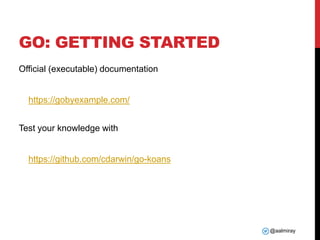
GO: GETTING STARTED
Official (executable) documentation
https://gobyexample.com/
Test your knowledge with
https://github.com/cdarwin/go-koans
@aalmiray
HELLO WORLD (JAVA)
package main;
public class HelloWorld {
public static void main(String[] args) {
System.out.println("Hello World");
}
}
$ java main/HelloWorld.java
$ javac –d classes main/HelloWorld.java
$ java –cp classes main.HelloWorld
@aalmiray
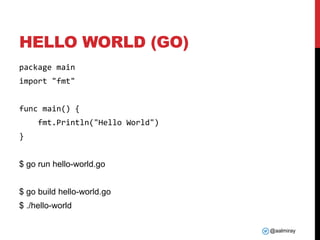
HELLO WORLD (GO)
package main
import "fmt"
func main() {
fmt.Println("Hello World")
}
$ go run hello-world.go
$ go build hello-world.go
$ ./hello-world
FAMILIAR
FEATURES
@aalmiray
VALUES (JAVA)
package main;
public class Values {
public static void main(String[] args) {
System.out.println("go" + "lang");
System.out.println("1+1 = "+ (1+1));
System.out.println("7.0/3.0 = " + (7.0/3.0));
System.out.println(true && false);
System.out.println(true || false);
System.out.println(!true);
}
}
@aalmiray
VALUES (GO)
package main
import "fmt"
func main() {
fmt.Println("go" + "lang")
fmt.Println("1+1 = ", 1+1)
fmt.Println("7.0/3.0 = ", 7.0/3.0)
fmt.Println(true && false)
fmt.Println(true || false)
fmt.Println(!true)
}
@aalmiray
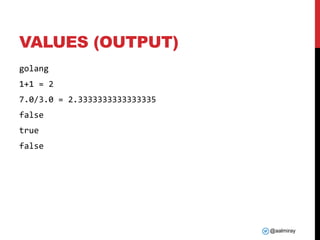
VALUES (OUTPUT)
golang
1+1 = 2
7.0/3.0 = 2.3333333333333335
false
true
false
@aalmiray
CONDITIONS (JAVA)
package main;
public class Conditions {
public static void main(String[] args) {
if (7%2 == 0) {
System.out.println("7 is odd");
} else {
System.out.println("7 is even");
}
}
}
@aalmiray
CONDITIONS (GO)
package main
import "fmt"
func main() {
if 7%2 == 0 {
fmt.Println("7 is odd")
} else {
fmt.Println("7 is even")
}
}
@aalmiray
@aalmiray
@aalmiray
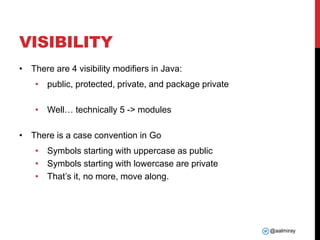
VISIBILITY
• There are 4 visibility modifiers in Java:
• public, protected, private, and package private
• Well… technically 5 -> modules
• There is a case convention in Go
• Symbols starting with uppercase as public
• Symbols starting with lowercase are private
• That’s it, no more, move along.
@aalmiray
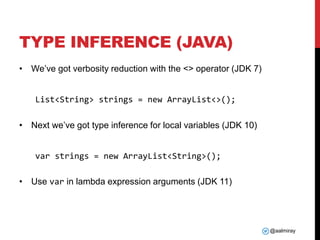
TYPE INFERENCE (JAVA)
• We’ve got verbosity reduction with the <> operator (JDK 7)
List<String> strings = new ArrayList<>();
• Next we’ve got type inference for local variables (JDK 10)
var strings = new ArrayList<String>();
• Use var in lambda expression arguments (JDK 11)
@aalmiray
TYPE INFERENCE (GO)
• You may define and assign variables in this way
var strings = []string{"a","b","c"};
• Or use the short notation
strings := []string{"a","b","c"};
@aalmiray
COLLECTIONS
• Slices and Maps (collections)
var sliceOfStrings = []string{"a", "b", "c"}
mapOfValues := make(map([string]int))
mapOfValues["foo"] = 1
anotherMap := map[string]int{"foo": 1}
@aalmiray
ARRAYS
• Arrays look like slices but their length is part of the type
var an_array [5]int
another_one := [5]int{1,2,3,4,5}
• Any function that takes [5]int can’t take [4]int or any other
array with a length other than 5.
@aalmiray
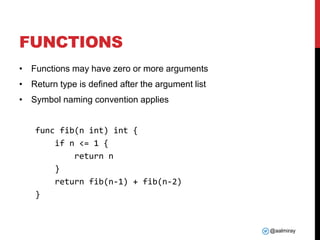
FUNCTIONS
• Functions may have zero or more arguments
• Return type is defined after the argument list
• Symbol naming convention applies
func fib(n int) int {
if n <= 1 {
return n
}
return fib(n-1) + fib(n-2)
}
@aalmiray
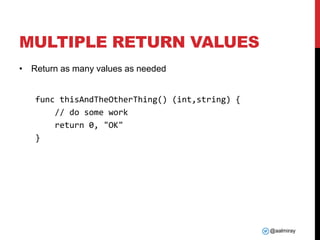
MULTIPLE RETURN VALUES
• Return as many values as needed
func thisAndTheOtherThing() (int,string) {
// do some work
return 0, "OK"
}
@aalmiray
FUNCTIONS AS CODE
• Just like lambda expressions
package main
import "fmt"
func greeting_gen() func(string) string {
return func(s string) string {
return "Hello " + s
}
}
func main() {
fmt.Println(greeting_gen()("Go"))
}
@aalmiray
THERE IS NO CLASS
@aalmiray
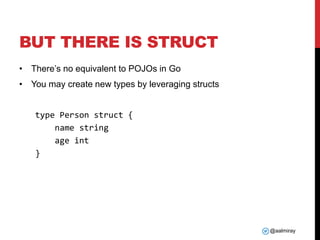
BUT THERE IS STRUCT
• There’s no equivalent to POJOs in Go
• You may create new types by leveraging structs
type Person struct {
name string
age int
}
@aalmiray
CONSTRUCTORS
package main
import "fmt"
type Person struct {
name string
age int
}
func main() {
p1 := Person{"Duke", 23}
p2 := Person{name: "Duke", age: 23}
}
@aalmiray
@aalmiray
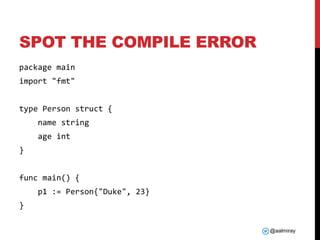
SPOT THE COMPILE ERROR
package main
import "fmt"
type Person struct {
name string
age int
}
func main() {
p1 := Person{"Duke", 23}
}
@aalmiray
SPOT THE COMPILE ERROR
package main
import "fmt" // UNUSED!
type Person struct {
name string
age int
}
func main() {
p1 := Person{"Duke", 23} // UNUSED!
}
@aalmiray
ONE SYNTAX TO RULE THEM ALL
@aalmiray
GOFMT
• Everyone’s Go code looks exactly the same.
• Tabs vs. Spaces? No more.
• Enables automated source code migration.
• https://golang.org/cmd/gofmt
@aalmiray
THERE ARE NO METHODS
@aalmiray
ATTACH FUNCTIONS TO TYPES
package main
import "fmt"
type Person struct {
name string
age int
}
func (p *Person) printAge() {
fmt.Println("Age is = ", p.age)
}
func main() {
p1 := Person{"Duke", 23}
p1.printAge()
}
@aalmiray
@aalmiray
WHILE LOOP (JAVA)
package main;
public class While {
public static void main(String[] args) {
int i = 0;
while(i <= 3) {
System.out.println(i);
i++;
}
}
}
@aalmiray
WHILE LOOP (GO)
package main
import "fmt"
func main() {
i := 0
for i <= 3 {
fmt.Println(i)
i++
}
}
@aalmiray
FOR LOOP (JAVA)
package main;
public class For {
public static void main(String[] args) {
for(int i = 0; i <=3; i++) {
System.out.println(i);
}
}
}
@aalmiray
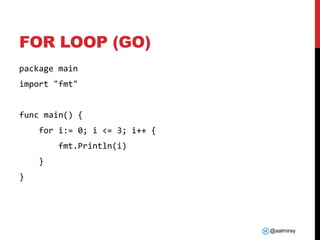
FOR LOOP (GO)
package main
import "fmt"
func main() {
for i:= 0; i <= 3; i++ {
fmt.Println(i)
}
}
@aalmiray
INFINITE LOOPS (JAVA)
package main;
public class Infinite {
public static void main(String[] args) {
while(true) {
System.out.println("Infinite loop");
break;
}
}
}
@aalmiray
INFINITE LOOPS (JAVA)
package main;
public class Infinite {
public static void main(String[] args) {
for(;;) {
System.out.println("Infinite loop");
break;
}
}
}
@aalmiray
INFINITE LOOPS (JAVA)
package main;
public class Infinite {
public static void main(String[] args) {
do {
System.out.println("Infinite loop");
break;
} while(true);
}
}
@aalmiray
INFINITE LOOPS (GO)
package main
import "fmt"
func main() {
for {
fmt.Println("Infinite loop")
break
}
}
@aalmiray
@aalmiray
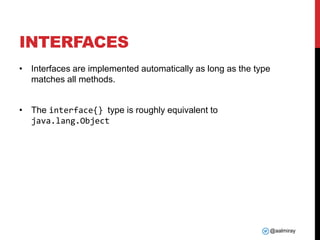
INTERFACES
• Interfaces are implemented automatically as long as the type
matches all methods.
• The interface{} type is roughly equivalent to
java.lang.Object
@aalmiray
package main
import "fmt"
import "math"
type geometry interface {
area() float64
perim() float64
}
type rect struct {
width, height float64
}
type circle struct {
radius float64
}
@aalmiray
func (r rect) area() float64 {
return r.width * r.height
}
func (r rect) perim() float64 {
return 2*r.width + 2*r.height
}
func (c circle) area() float64 {
return math.Pi * c.radius * c.radius
}
func (c circle) perim() float64 {
return 2 * math.Pi * c.radius
}
@aalmiray
func measure(g geometry) {
fmt.Println(g)
fmt.Println(g.area())
fmt.Println(g.perim())
}
func main() {
r := rect{width: 3, height: 4}
c := circle{radius: 5}
measure(r)
measure(c)
}
@aalmiray
ERRORS (1)
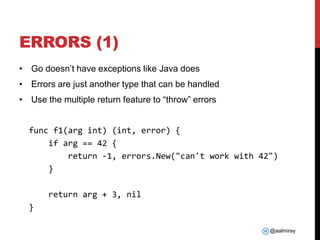
• Go doesn’t have exceptions like Java does
• Errors are just another type that can be handled
• Use the multiple return feature to “throw” errors
func f1(arg int) (int, error) {
if arg == 42 {
return -1, errors.New("can't work with 42")
}
return arg + 3, nil
}
@aalmiray
ERRORS (2)
• Handle, rethrow, or ignore
idx1, err := f1(42)
if err != nil {
// handle or rethrow
}
idx2, _ := f1(42)
@aalmiray
@aalmiray
TYPE CLONE VS TYPE ALIAS
• Type cloning
type foo int
• Type aliasing
type bar = int
• Instances of foo behave like int BUT they are not the same
as int, that is, a method taking an int as argument can’t take
a foo.
• Instances of bar are identical to int, that is, anywhere an int
fits so does a bar and viceversa.
OK,
BUT WHY?
@aalmiray
HELLO WORLD (JAVA)
$ time java main/HelloWorld.java
Hello World
real 0m0.538s
user 0m0.918s
sys 0m0.069s
$ javac -d classes main/HelloWorld.java
$ time java -cp classes main.HelloWorld
Hello World
real 0m0.112s
user 0m0.104s
sys 0m0.029s
@aalmiray
HELLO WORLD (GO)
$ time go run hello-world.go
Hello World
real 0m0.191s
user 0m0.135s
sys 0m0.080s
$ go build hello-world.go
$ time ./hello-world
Hello World
real 0m0.006s
user 0m0.001s
sys 0m0.004s
@aalmiray
TIMES
Java Go Percentage
Run
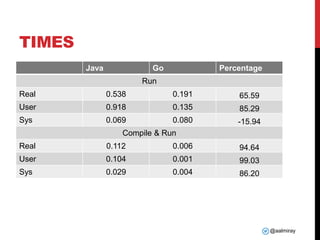
Real 0.538 0.191 65.59
User 0.918 0.135 85.29
Sys 0.069 0.080 -15.94
Compile & Run
Real 0.112 0.006 94.64
User 0.104 0.001 99.03
Sys 0.029 0.004 86.20
@aalmiray
CROSS COMPILATION
• It’s possible to compile binaries for different platforms at a
single location
• https://dave.cheney.net/2015/03/03/cross-compilation-just-got-
a-whole-lot-better-in-go-1-5
$ GOOS=darwin GOARCH=386 go build test.go
$ GOOS=linux GOARCH=arm GOARM=5 go build test.go
@aalmiray
@aalmiray
HTTPS://GRPC.IO
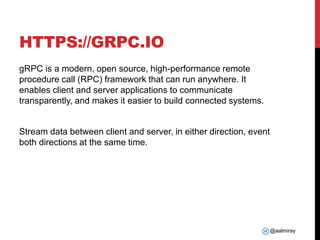
gRPC is a modern, open source, high-performance remote
procedure call (RPC) framework that can run anywhere. It
enables client and server applications to communicate
transparently, and makes it easier to build connected systems.
Stream data between client and server, in either direction, event
both directions at the same time.
@aalmiray
@aalmiray
@aalmiray
@aalmiray
@aalmiray
Go
Java
@aalmiray
@aalmiray
HTTPS://WEBASSEMBLY.ORG/
WebAssembly (abbreviated Wasm) is a binary instruction format
for a stack-based virtual machine. Wasm is designed as a
portable target for compilation of high-level languages, enabling
deployment on the web for client and server applications.
@aalmiray
GO + WEBASSEMBLY
https://github.com/golang/go/wiki/WebAssembly
@aalmiray
@aalmiray
@aalmiray
HTTP://ANDRESALMIRAY.COM/NEWSLETTER
HTTP://ANDRESALMIRAY.COM/EDITORIAL
@aalmiray
THANK YOU!
ANDRES ALMIRAY
@AALMIRAY
ANDRESALMIRAY.COM

Go Java, Go!