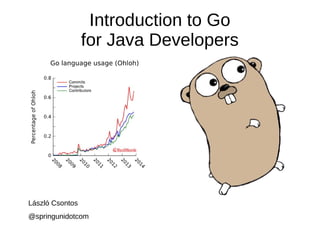
Introduction to Go
for Java Developers
László Csontos
@springunidotcom
Agenda
● Go's short history and features
● Packages
● Basic stuff: control structures and built-in types
● Composite types
● Go's approach to OO design
● Concurrency made easy
● Standard library
● Web apps with Go
History
● “Three of us [Ken Thompson, Rob Pike, and Robert
Griesemer] got together and decided that we hated C++.”
● “All three of us had to be talked into every feature in the
language, so there was no extraneous garbage put into
the it for any reason.”
● Development started in 2007
● Open source since 2009
● Stable 1.0 released in 2012
Features
● Statically typed with automatic type infer. (x := 0 // int x = 0)
● Garbage collected
● Fast compilation times
● Remote package management (~Maven)
● Built-in concurrency primitives: light-weight processes
(goroutines), channels
● An interface system in place of virtual inheritance, and type
embedding instead of non-virtual inheritance.
● A toolchain that, by default, produces statically linked native
binaries without external dependencies.
Features
● no type inheritance
● no method or operator overloading
● no circular dependencies among packages
● no pointer arithmetic
● no assertions
● no generic programming
● no implicit type conversions
Agenda
● Go's short history and features
● Packages
● Basic stuff: control structures and built-in types
● Composite types
● Go's approach to OO design
● Concurrency made easy
● Standard library
● Web apps with Go
Packages
● Go programs are organized into packages.
● They correspond to packages with classes in Java
● Package main with a main function is the entry point of the program
package main
import "fmt"
func main() {
  fmt.Println("Hello, playground")
}
https://play.golang.org/p/duRF5gXJEP
Agenda
● Go's short history and features
● Packages
● Basic stuff: control structures and built-in types
● Composite types
● Go's approach to OO design
● Concurrency made easy
● Standard library
● Web apps with Go
Basic stuff
● Control structures look very similar for those who came from
C/C++ or Java world.
● Parenthesis after if, for, switch, etc. isn't mandatory
● Semicolons are also optional at the end of the line (except if
you want to place multiple statements in a single line)
● Unused imports cause compiler error
● Array operator comes before the type: []int
● Types declaration comes after the variable name:
func add(a, b int) int { return a + b; }
Control structures
FOR is the only way of looping.
s := []string{"a", "b", "c"}
for i := 0; i < len(s); i++ {
  v := s[i]; fmt.Printf("index: %d, value: %vn", i, v)
}
for i, v := range s {
  fmt.Printf("index: %d, value: %vn", i, v)
}
m := map[int]string{1: "a", 2: "b", 3: "c"}
for k, v := range m {
  fmt.Printf("key: %d, value: %vn", k, v)
}
https://play.golang.org/p/HAdAf­D4al
Control structures
IF can have temporary variables
s := []int{3, 42, 73, 1}
max := ­1
for i := 0; i < len(s); i++ {
  if v := s[i]; v > max {
    max = v
  }
}
fmt.Println(max)
https://play.golang.org/p/hvhWqaw8UG
Control structures
SWITCH can have cases not just for values, but for types
// golang/src/pkg/fmt/print.go
switch f := arg.(type) {
case bool:
  p.fmtBool(f, verb)
case float32:
  p.fmtFloat32(f, verb)
...
default:
}
Control structures
There is no TRY/CATCH/FINALL
// golang/src/pkg/image/png/reader.go
func (d *decoder) decode() (image.Image, error) {
  // TRY
  r, err := zlib.NewReader(d)
  // CATCH
  if err != nil {
    return nil, err
  }
  // FINALLY
  defer r.Close()
  ...
}
Types system
● Simple types: int, float, bool, etc.
● Composite types: structures
● Reference types: slice, map, channel, interface and
function
● Named types: can refer to any of the above, we'll
see later why this matters
// golang/src/pkg/time/time.go
type Duration int64
Simple types
● Boolean: bool
● Singed integers: int8, ..., int64
● Unsigned integers: uint8, ..., uint64
● Floats: float32, float64
● byte ­> unit8
● rune ­> int32 (~char int Java)
● int ­> int32/int64, uint ­> uint32/uint64
● complex64, complex128
● string
Agenda
● Go's short history and features
● Packages
● Basic stuff: control structures and built-in types
● Composite types
● Go's approach to OO design
● Concurrency made easy
● Standard library
● Web apps with Go
Composite types
type Vertex struct {
  name string
  incomingEdges []*Edge
  outgoingEdges []*Edge
}
type Edge struct {
  head *Vertex
  tail *Vertex
  weight int
}
type Graph struct {
  verticesMap map[string]*Vertex
}
Composite types
type Graph struct {
  verticesMap map[string]*Vertex
}
// “g” is the receiver of method AddEdge()
func (g *Graph) AddEdge(
  tail, head string, weight int) {
 ...
}
https://play.golang.org/p/Ugoowc6fnd
Reference types
● All reference types have a lightweight “header” which in turn
contains pointers to the underlying data structures.
● This makes pass them by value very cheap
● Let's have a closer look at them:
– Slice
– Map
– Channel
– Interface
– Function
Reference types / Slice
A slice is just like a java.util.ArrayList, it shirks and grows as necessary
func printSlice(s []int) {
  fmt.Printf("len=%d, cap=%d, s=%vn", len(s), cap(s), s)
}
func main() {
  // empty slice
  var s []int;   printSlice(s)
  s = []int {1,2,3,4}; printSlice(s)
  s = append(s, 5); printSlice(s)
}
https://play.golang.org/p/hJl7iI­87H
Reference types / Map
●
A map is just like a java.util.HashMap
func (g *Graph) AddEdge(
  tailName, headName string, weight int) {
  tail, ok := g.verticesMap[tailName]
  if !ok {
    tail = &Vertex{name: tailName}
    g.verticesMap[tailName] = tail
  }
  ...
}
https://play.golang.org/p/Ugoowc6fnd
Reference types / Channel
● Channels are like java.util.concurrent.LinkedBlockingQueue
● Idiomatic means of communication among co-operating threads (go routines)
func main() {
  // LinkedBlockingQueue<Integer> lbq = new LinkedBlockingQueue<>(1) 
  c := make(chan int, 1)
  // lbq.offer(1)
  c <­ 1
  // lbq.poll()
  fmt.Println(<­c)
}
https://play.golang.org/p/SaZgJzU0qu
Reference types / Interface
● Interfaces define behaviour, just like in Java
● However there is no need to formally declare for any given type
which interface it implement
// golang/src/pkg/io/io.go
// Implementations of Read are discouraged from returning a
// zero byte count with a nil error, and callers should treat
// that situation as a no­op.
type Reader interface {
        Read(p []byte) (n int, err error)
}
https://play.golang.org/p/_­zJOHMJ5y
Agenda
● Go's short history and features
● Packages
● Basic stuff: control structures and built-in types
● Composite types
● Go's approach to OO design
● Concurrency made easy
● Standard library
● Web apps with Go
Go's approach to OO design
● Go doesn't directly support inheritance, but code
reuse can be implemented through composition
● Encapsulation is supposed through methods,
data hiding is done with unexported package
members
● Polymorphism is provided by interfaces, altought
formal declaration between concrete types and
interfaces isn't necessary
Inheritance
class User {
  private String firstName;
  private String lastName;
  private String userName;
}
class Admin
  extends User {
  private String level;
}
type User struct {
  firstName string
  lastName string
  userName string
}
type Admin struct {
  User
  level string
}
Encapsulation
class User {
  private String firstName;
  public String lastName;
  ...
  public String getFirstName() {
    return firstName;
  }
  
  public void SetFirstName(...) {
    ...
  }
}
type User struct {
  firstName string
  LastName string
}
func (u User)
  GetFirstName() string {
  return u.firstName
}
Polymorphism
type (
  Shape interface {
    Area() float64
  }
  Triangle struct {
    a, b, c float64
  }
)
func (t Triangle) Area() float64 {
  s := (t.a + t.b + t.c) / 2
  return math.Sqrt(s * (s ­ t.a) * (s ­ t.b) * (s ­ t.c))
}
func printShape(s Shape) {
  a := s.Area()
  fmt.Printf("%T's area is %fn", s, a)
}
https://play.golang.org/p/8KLa9b8Q-E
https://play.golang.org/p/t-yMdpVgC1
Agenda
● Go's short history and features
● Packages
● Basic stuff: control structures and built-in types
● Composite types
● Go's approach to OO design
● Concurrency made easy
● Standard library
● Web apps with Go
Concurrency made easy
● Concurrency is provided OOTB, in a similar way as we
would have an internal
java.util.concurrent.ThreadPoolExecutor
● A gorutine is like concrete implementation of
java.lang.Runnable submitted for async execution
● Internal scheduler sets blocked gorutines aside, so that
runnable ones are able to execute
● Channels are the idiomatic way of sharing data among
gorutines, although package sync provides similar
functionality like java.util.concurrent.
Concurrency made easy
func sum(a []int, c chan int) {
  ...
  c <­ sum // send sum to c
}
func main() {
  ...
  c := make(chan int)
  for i := 0; i < N/K; i++ {
    ...
    go sum(a[start:end], c)
  }
  total := 0
  for i := 0; i < N/K; i++ {
    total += <­ c
  }
  fmt.Println(total)
}
http://play.golang.org/p/2Ry6ycl6Go
Agenda
● Go's short history and features
● Packages
● Basic stuff: control structures and built-in types
● Composite types
● Go's approach to OO design
● Concurrency made easy
● Standard library
● Web apps with Go
Standard Library
● Go's standard library provides support for
implementing numerous functionalities
● In Go 1.3, there are 176 built-in packages
Standard Library
import (“errors”;"fmt";"http";"io";"encoder/json")
func (c *Client) newJiraRequest(method, path string, reader io.Reader) (*http.Request, error) {
  req, err := http.NewRequest(
    method, fmt.Sprintf("%s/rest/%s", c.uri, path), reader)
  if err != nil { return nil, err; }
  req.Header.Set("Content­Type", "application/json")
  return req, nil
}
func (c *Client) performJiraRequest(method, path string, reader io.Reader, output interface{}) error {
  req, err := c.newJiraRequest(method, path, reader)
  if err != nil { return err; }
  resp, err := c.httpClient.Do(req); defer resp.Body.Close()
  if err != nil { return err }
  if resp.StatusCode != 200 { return errors.New(resp.Status); }
  err = json.NewDecoder(resp.Body).Decode(output)
  if err != nil { return err; }
  return nil
}
Agenda
● Go's short history and features
● Packages
● Basic stuff: control structures and built-in types
● Composite types
● Go's approach to OO design
● Concurrency made easy
● Standard library
● Web apps with Go
Building Web apps with Gopackage main
import ("fmt";"log";"net/http";"time")
type timeHandler struct{}
func (th timeHandler) ServeHTTP(w http.ResponseWriter, req *http.Request) {
  currentTime := time.Now()
  fmt.Fprint(w, currentTime.Format(time.RFC1123Z))
}
func main() {
  err := http.ListenAndServe("localhost:4000", timeHandler{})
  if err != nil {
    log.Fatal(err)
  }
}
Building Web apps with Go
● There are many frameworks which support
Web app development
● The most notable ones are:
– Beego
– Martini
– Gorilla
– GoCraft
– Standard net/http
References
● Manning: Go in Action
● A Tour of Go
● Go Playground
● Go package reference
● Golang for Java programmers
● A Survey of 5 Go Web Frameworks
Questions?

Introduction to Go for Java Developers