1
CELLULAR MANUFACTURING
Presentation By :-
SAGAR S. KURDE Me 747
SAURABH P. GARDI Me 739
2
Introduction & Concept
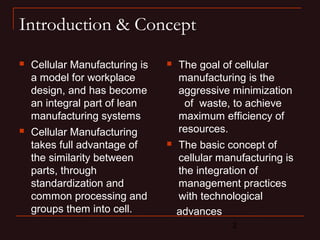
 Cellular Manufacturing is
a model for workplace
design, and has become
an integral part of lean
manufacturing systems
 Cellular Manufacturing
takes full advantage of
the similarity between
parts, through
standardization and
common processing and
groups them into cell.
 The goal of cellular
manufacturing is the
aggressive minimization
of waste, to achieve
maximum efficiency of
resources.
 The basic concept of
cellular manufacturing is
the integration of
management practices
with technological
advances
3
CELLULAR MANUFACTURING
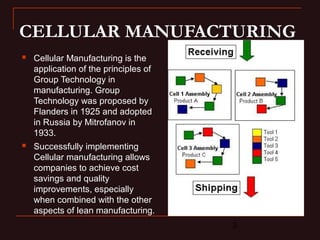
 Cellular Manufacturing is the
application of the principles of
Group Technology in
manufacturing. Group
Technology was proposed by
Flanders in 1925 and adopted
in Russia by Mitrofanov in
1933.
 Successfully implementing
Cellular manufacturing allows
companies to achieve cost
savings and quality
improvements, especially
when combined with the other
aspects of lean manufacturing.
4
CELLULAR MANUFACTURING
 It is having the flexibility to
produce a high variety of low
demand products, while
maintaining the high
productivity of large scale
production.
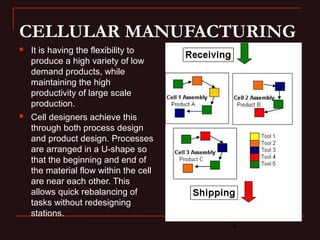
 Cell designers achieve this
through both process design
and product design. Processes
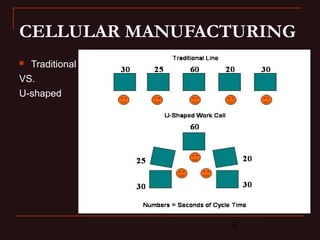
are arranged in a U-shape so
that the beginning and end of
the material flow within the cell
are near each other. This
allows quick rebalancing of
tasks without redesigning
stations.
5
CELLULAR MANUFACTURING
 Traditional
VS.
U-shaped
6
Cellular Manufacturing
One Piece Flow

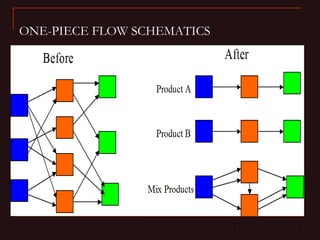
One-piece flow is the state
that exists when products
move through a
manufacturing process one
unit at a time, at a rate
determined by the needs of
the customer.
The important thing is to
promote continuous flow of
products, with the least
amount of delay and
waiting
 The opposite of one-
piece flow is large-lot
production. Goods
produced in large lots
build delays into the
process .No items can
move on to the next
process until all items in
the lot have been
processed .
The larger the lot, the
longer the items sit
and wait between
steps.
7 7
ONE-PIECE FLOW SCHEMATICS
8
Operations &Processes

To improve production, it
is not enough to improve
operations Companies
must also improve their
processes.

A particular cell is made
up of the team members
and the equipment that is
required to follow the
steps in manufacturing of
the product.
Improving a process
involves streamlining the
flow of materials to
minimize obstacles and
wastes such as:

Time spent in non-value-
adding steps

Such as waiting and
transport

Downtime caused by
changeover and
adjustments
9 9
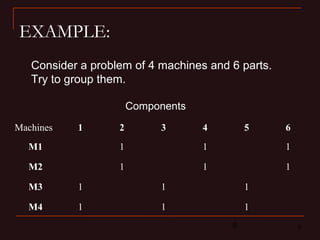
EXAMPLE:
Consider a problem of 4 machines and 6 parts.
Try to group them.
Machines 1 2 3 4 5 6
M1 1 1 1
M2 1 1 1
M3 1 1 1
M4 1 1 1
Components
10 10
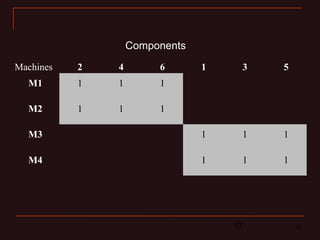
Machines 2 4 6 1 3 5
M1 1 1 1
M2 1 1 1
M3 1 1 1
M4 1 1 1
Components
11
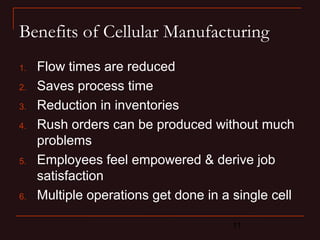
Benefits of Cellular Manufacturing
1. Flow times are reduced
2. Saves process time
3. Reduction in inventories
4. Rush orders can be produced without much
problems
5. Employees feel empowered & derive job
satisfaction
6. Multiple operations get done in a single cell
12
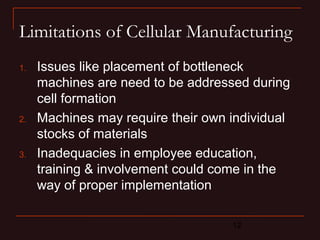
Limitations of Cellular Manufacturing
1. Issues like placement of bottleneck
machines are need to be addressed during
cell formation
2. Machines may require their own individual
stocks of materials
3. Inadequacies in employee education,
training & involvement could come in the
way of proper implementation
13
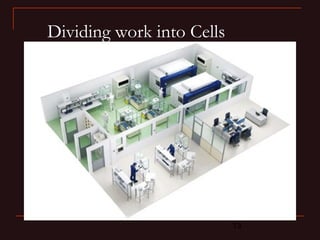
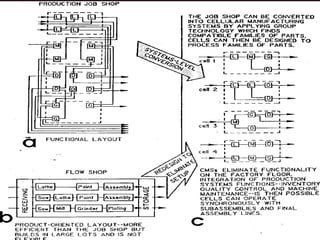
Dividing work into Cells
14
CELL DEVELOPMENT
Following points will be covered under this topic :

Cluster cells design technique

Clustering Schematics

CMS Facility

Working in a U-shaped Cell

Becoming Multiskilled

Using Small Flexible Machines

Autonomation
15

The cell is made up of workers and the
equipment required to create the product

The layout of the equipment and the
workstations is determined by the logical
sequence of production.

Parts are clustered to build part families

Part Families visit cells

Part Families share set-up ideas and
equipment and follow similar process
routing
CLUSTERING TECHNIQUES :
-The Fundamental Issue in Cell Development
16 16
 Machines are clustered to build cells:
 Cells lead to Flow Mathematics.
 Cells contain all equipment needed to produce
apart family
 Joining machining technologies with tooling
and setup technologies and combining them
with people skills and positive management ,
can all result in a very good manufacturing
environment.
 Each cell should work towards its own goals
and keep contact with other cells to the
minimum
CLUSTERING TECHNIQUES :
The Fundamental Issue in Cell Development
17 17
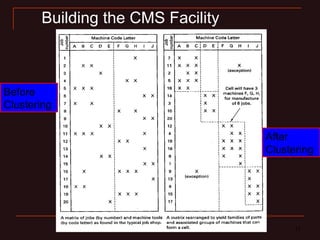
Building the CMS Facility
Before
Clustering
After
Clustering
10/01/14
19 19
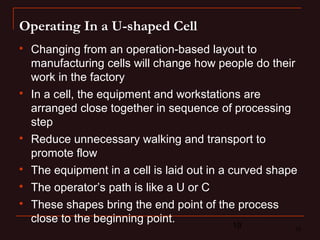
Operating In a U-shaped Cell

Changing from an operation-based layout to
manufacturing cells will change how people do their
work in the factory

In a cell, the equipment and workstations are
arranged close together in sequence of processing
step

Reduce unnecessary walking and transport to
promote flow

The equipment in a cell is laid out in a curved shape

The operator’s path is like a U or C

These shapes bring the end point of the process
close to the beginning point.
20 20
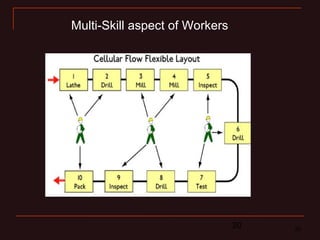
Multi-Skill aspect of Workers
21 21
Becoming Multiskilled/ Multimachine Operators
•
Creating a manufacturing cell often changes the
relationship between people and machines in the
workplace
•
Operators may need to learn how to run different types
of equipment to support the process
•
In cells where automatic machines are used, most of the
operator’s time is spent watching the equipment run
– Such waste is avoided by teaching people to operate
several different machines in the process
– Operators can be setting up a workpiece for step 2
while step 1 machine is processing another
workpiece
•
A cell may be run by one person or several people
depending on the size of the cell, cycle times, or
22 22
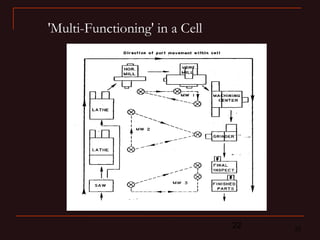
'Multi-Functioning' in a Cell
23 23
Cross-Training for Maximum Flexibility
•
Cross-training enables employees to perform different
functions within a process and lets teams take full
responsibility for their processes.
•
Operator trained on several machines is qualified to
respond to changes in production needs by performing
different tasks
– This versatility makes employees more valuable to
their teams and to their companies
•
Cross-training is a source of employee pride in many
workplaces
•
Visual display charts are often used to recognize
people’s skill attainment in a public way.
24
Moving with The Work
•
Running several machines in sequence
– An operator needs to work standing up rather
than sitting down
•
To assist one-piece flow manufacturing
– People stand and walk so that work moves
smoothly through the process
•
Working while standing
– Enables people to respond more quickly if
machine problems occur
25 25
Using Small, Flexible Machines
 Smaller machines save space Placing them close
together reduces walking distance
 They are less expensive
 Slower machines are appropriate can produce one
piece at a time at a speed determined by customer
requirements
 A cellular manufacturing process may use equipment
different from that used in large-lot production
 Works best with machines that are smaller and often
slower than large-lot equipment
26
Using Autonomation (Jidoka) to Eliminate
Machine Watching
•
Autonomation - an approach to automation that gives
equipment “intelligence” so people don’t have to monitor
automatic operation
•
“Autonomated” machines are semi-automatic machines
that autonomously (independently) support one-piece flow
processing. Many companies invest in automation because :
– Stop and signal when a cycle is complete or when
problems occur
– Often set up to unload automatically after processing
– Do not have to be tended
– People don’t have to perform difficult, dangerous, or
repetitive work
27
 Equipment and workstations arranged close together in
sequence of processing steps (U or C)
 Relationship between people and machines changes as
operators may need to learn how to run different types of
equipment to support the process
 Machine-watching is avoided by teaching people to operate
several different machines
 Flexibility to change how people work together in a cell comes
from cross-training
 Cellular manufacturing works best with smaller and often
slower machines
 Autonomation (jidoka) is an approach to automation that gives
equipment “intelligence” so people don’t have to monitor
automatic operation
Summary
28
Thank You

Cellular Manufacturing System

  • 1.
    1 CELLULAR MANUFACTURING Presentation By:- SAGAR S. KURDE Me 747 SAURABH P. GARDI Me 739
  • 2.
    2 Introduction & Concept Cellular Manufacturing is a model for workplace design, and has become an integral part of lean manufacturing systems  Cellular Manufacturing takes full advantage of the similarity between parts, through standardization and common processing and groups them into cell.  The goal of cellular manufacturing is the aggressive minimization of waste, to achieve maximum efficiency of resources.  The basic concept of cellular manufacturing is the integration of management practices with technological advances
  • 3.
    3 CELLULAR MANUFACTURING  CellularManufacturing is the application of the principles of Group Technology in manufacturing. Group Technology was proposed by Flanders in 1925 and adopted in Russia by Mitrofanov in 1933.  Successfully implementing Cellular manufacturing allows companies to achieve cost savings and quality improvements, especially when combined with the other aspects of lean manufacturing.
  • 4.
    4 CELLULAR MANUFACTURING  Itis having the flexibility to produce a high variety of low demand products, while maintaining the high productivity of large scale production.  Cell designers achieve this through both process design and product design. Processes are arranged in a U-shape so that the beginning and end of the material flow within the cell are near each other. This allows quick rebalancing of tasks without redesigning stations.
  • 5.
  • 6.
    6 Cellular Manufacturing One PieceFlow  One-piece flow is the state that exists when products move through a manufacturing process one unit at a time, at a rate determined by the needs of the customer. The important thing is to promote continuous flow of products, with the least amount of delay and waiting  The opposite of one- piece flow is large-lot production. Goods produced in large lots build delays into the process .No items can move on to the next process until all items in the lot have been processed . The larger the lot, the longer the items sit and wait between steps.
  • 7.
  • 8.
    8 Operations &Processes  To improveproduction, it is not enough to improve operations Companies must also improve their processes.  A particular cell is made up of the team members and the equipment that is required to follow the steps in manufacturing of the product. Improving a process involves streamlining the flow of materials to minimize obstacles and wastes such as:  Time spent in non-value- adding steps  Such as waiting and transport  Downtime caused by changeover and adjustments
  • 9.
    9 9 EXAMPLE: Consider aproblem of 4 machines and 6 parts. Try to group them. Machines 1 2 3 4 5 6 M1 1 1 1 M2 1 1 1 M3 1 1 1 M4 1 1 1 Components
  • 10.
    10 10 Machines 24 6 1 3 5 M1 1 1 1 M2 1 1 1 M3 1 1 1 M4 1 1 1 Components
  • 11.
    11 Benefits of CellularManufacturing 1. Flow times are reduced 2. Saves process time 3. Reduction in inventories 4. Rush orders can be produced without much problems 5. Employees feel empowered & derive job satisfaction 6. Multiple operations get done in a single cell
  • 12.
    12 Limitations of CellularManufacturing 1. Issues like placement of bottleneck machines are need to be addressed during cell formation 2. Machines may require their own individual stocks of materials 3. Inadequacies in employee education, training & involvement could come in the way of proper implementation
  • 13.
  • 14.
    14 CELL DEVELOPMENT Following pointswill be covered under this topic :  Cluster cells design technique  Clustering Schematics  CMS Facility  Working in a U-shaped Cell  Becoming Multiskilled  Using Small Flexible Machines  Autonomation
  • 15.
    15  The cell ismade up of workers and the equipment required to create the product  The layout of the equipment and the workstations is determined by the logical sequence of production.  Parts are clustered to build part families  Part Families visit cells  Part Families share set-up ideas and equipment and follow similar process routing CLUSTERING TECHNIQUES : -The Fundamental Issue in Cell Development
  • 16.
    16 16  Machinesare clustered to build cells:  Cells lead to Flow Mathematics.  Cells contain all equipment needed to produce apart family  Joining machining technologies with tooling and setup technologies and combining them with people skills and positive management , can all result in a very good manufacturing environment.  Each cell should work towards its own goals and keep contact with other cells to the minimum CLUSTERING TECHNIQUES : The Fundamental Issue in Cell Development
  • 17.
    17 17 Building theCMS Facility Before Clustering After Clustering
  • 18.
  • 19.
    19 19 Operating Ina U-shaped Cell  Changing from an operation-based layout to manufacturing cells will change how people do their work in the factory  In a cell, the equipment and workstations are arranged close together in sequence of processing step  Reduce unnecessary walking and transport to promote flow  The equipment in a cell is laid out in a curved shape  The operator’s path is like a U or C  These shapes bring the end point of the process close to the beginning point.
  • 20.
  • 21.
    21 21 Becoming Multiskilled/Multimachine Operators • Creating a manufacturing cell often changes the relationship between people and machines in the workplace • Operators may need to learn how to run different types of equipment to support the process • In cells where automatic machines are used, most of the operator’s time is spent watching the equipment run – Such waste is avoided by teaching people to operate several different machines in the process – Operators can be setting up a workpiece for step 2 while step 1 machine is processing another workpiece • A cell may be run by one person or several people depending on the size of the cell, cycle times, or
  • 22.
  • 23.
    23 23 Cross-Training forMaximum Flexibility • Cross-training enables employees to perform different functions within a process and lets teams take full responsibility for their processes. • Operator trained on several machines is qualified to respond to changes in production needs by performing different tasks – This versatility makes employees more valuable to their teams and to their companies • Cross-training is a source of employee pride in many workplaces • Visual display charts are often used to recognize people’s skill attainment in a public way.
  • 24.
    24 Moving with TheWork • Running several machines in sequence – An operator needs to work standing up rather than sitting down • To assist one-piece flow manufacturing – People stand and walk so that work moves smoothly through the process • Working while standing – Enables people to respond more quickly if machine problems occur
  • 25.
    25 25 Using Small,Flexible Machines  Smaller machines save space Placing them close together reduces walking distance  They are less expensive  Slower machines are appropriate can produce one piece at a time at a speed determined by customer requirements  A cellular manufacturing process may use equipment different from that used in large-lot production  Works best with machines that are smaller and often slower than large-lot equipment
  • 26.
    26 Using Autonomation (Jidoka)to Eliminate Machine Watching • Autonomation - an approach to automation that gives equipment “intelligence” so people don’t have to monitor automatic operation • “Autonomated” machines are semi-automatic machines that autonomously (independently) support one-piece flow processing. Many companies invest in automation because : – Stop and signal when a cycle is complete or when problems occur – Often set up to unload automatically after processing – Do not have to be tended – People don’t have to perform difficult, dangerous, or repetitive work
  • 27.
    27  Equipment andworkstations arranged close together in sequence of processing steps (U or C)  Relationship between people and machines changes as operators may need to learn how to run different types of equipment to support the process  Machine-watching is avoided by teaching people to operate several different machines  Flexibility to change how people work together in a cell comes from cross-training  Cellular manufacturing works best with smaller and often slower machines  Autonomation (jidoka) is an approach to automation that gives equipment “intelligence” so people don’t have to monitor automatic operation Summary
  • 28.