GREEN WHEELS TURNING?
Willingness to pay and participants' views on
green initiatives at the Cape Argus Pick 'n Pay
cycle tour
Paper prepared for the IATE 2013 International Conference, 1-4
July 2013, University of Ljubljana, Slovenia.
By
Waldo Krugell & Melville Saayman
1) Introduction
• Tourism and the environment – some key stats…
• Tourists are starting to demand “green” facilities and
experiences and are often willing to pay for it.
• This paper examines the characteristics of the people
who are willing to pay and focusses on a major sports
event – the Cape Argus Pick ‘n Pay Cycle Tour in Cape
Town, South Africa.
• Specifically, we asked them about their attitudes towards
the initiatives in place to ensure a greener cycle tour.
2) Why would they pay?
• The environment as a common pool resource:
• Is commonly owned by everyone and utilised by all.
• It suffers the effects of the pollution that occurs during all our
production and consumption activities.
• The market fails to account for the social costs.
• Getting people to pay: cooperation or coercion?
• Mitigation will require a combination of voluntary
contributions and compulsory taxes.
2) How can we determine WTP ?
• Since no formal market exists a sustainable tourism
experience or a green event, researchers have to use
indirect ways to determine willingness to pay.
• TCM, HPM, CVM…
• Contingent Valuation Method has key elements:
• The scenario presented to the respondents in the survey.
• This matters because…
• The way in which the willingness to pay question is asked.
• The "cheap talk" problem.
2) Who are willing to pay?
• Demographic variables are used to distinguish the
character of the survey samples.
• The common explanatory variables used in the studies
surveyed include measures of:
• Environmental engagement,
• Environmental attitudes / beliefs,
• Education level,
• Perceived efficacy of policy / strategy,
• Political views,
• Level of certainty of climate change and policy outcomes,
• Expected future temperature / precipitation levels, and
• Perceptions of others’ efforts.
Description of the survey data
• More about the survey…
• Elements of the CVM: knowledge, cooperation, mitigation.
• Description of the data:
• 180 completed questionnaires.
• 72% male.
• Average age 41 years.
• 54% English speaking.
• 37% diploma/degree, 29% post-grad qualification.
• 37% professional positions, 20% in management.
• 29% local residents.
• Our WTP question: “Would you be willing to pay R20 ($3)
extra, that will be donated to Trees of Africa, as an offset for
your carbon footprint?” (yes/no)
Description of the survey data
• Willingness to pay:
• 111 would pay, 39 would not, 30 skipped WTP question.
• Cross-tabs of WTP and demographic variables show:
• A greater proportion of women were willing to pay.
• The age groups 18 to 30 years (68.9%) and 51 to 60 years (71.4%)
had the biggest share of those who said they are willing to pay.
• There is little variation in willingness to pay between the differences
in marital status and different language groups.
• WTP per level of education were: 55% for Grade 12 only, 64% for
those with diploma/degree, 65% for those with post-grad
qualification.
• The average of total spending of those who said they are willing to
pay was R5’317, and for those who said they were not willing to
pay, it was R3’420.
PCA of the green views
• We also asked cyclists about their opinions on initiatives
that could ensure a greener cycle tour.
• Principle component analysis of these views was used to
characterise a type of cyclist.
• Exploratory factor analysis was used with principle components
extraction and varimax rotation.
• Anderson-Rubin method was used to obtain standard normal factor
scores.
• The KMO measure of sampling adequacy was 0.880.
• In total four factors were identified with Eigen values greater than
one and they explain 73 per cent of the variance of the data.
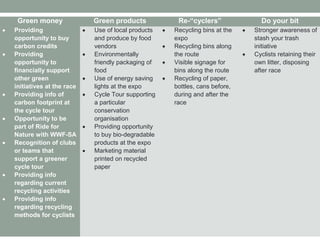
• The following table shows the type of cyclists by their
green views.
Green money Green products Re-“cyclers” Do your bit
• Providing
opportunity to buy
carbon credits
• Providing
opportunity to
financially support
other green
initiatives at the race
• Providing info of
carbon footprint at
the cycle tour
• Opportunity to be
part of Ride for
Nature with WWF-SA
• Recognition of clubs
or teams that
support a greener
cycle tour
• Providing info
regarding current
recycling activities
• Providing info
regarding recycling
methods for cyclists
• Use of local products
and produce by food
vendors
• Environmentally
friendly packaging of
food
• Use of energy saving
lights at the expo
• Cycle Tour supporting
a particular
conservation
organisation
• Providing opportunity
to buy bio-degradable
products at the expo
• Marketing material
printed on recycled
paper
• Recycling bins at the
expo
• Recycling bins along
the route
• Visible signage for
bins along the route
• Recycling of paper,
bottles, cans before,
during and after the
race
• Stronger awareness of
stash your trash
initiative
• Cyclists retaining their
own litter, disposing
after race
Predictors of WTP
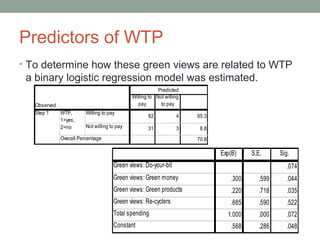
• To determine how these green views are related to WTP
a binary logistic regression model was estimated.
Willing to
pay
Not willing
to pay
Willing to pay
82 4 95.3
Not willing to pay 31 3 8.8
70.8
Observed
Predicted
Step 1 WTP,
1=yes,
2=no
Overall Percentage
Exp(B) S.E. Sig.
Green views: Do-your-bit .074
Green views: Green money .300 .599 .044
Green views: Green products .220 .718 .035
Green views: Re-cyclers .685 .590 .522
Total spending 1.000 .000 .072
Constant .568 .286 .048
Predictors of WTP
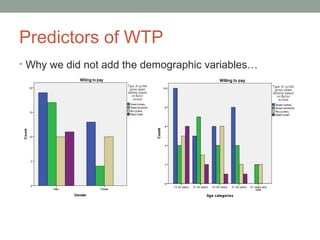
• Why we did not add the demographic variables…
Conclusions and recommendations
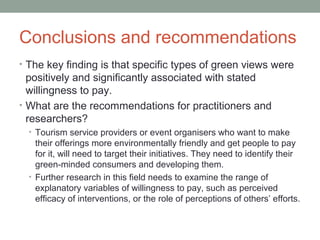
• The key finding is that specific types of green views were
positively and significantly associated with stated
willingness to pay.
• What are the recommendations for practitioners and
researchers?
• Tourism service providers or event organisers who want to make
their offerings more environmentally friendly and get people to pay
for it, will need to target their initiatives. They need to identify their
green-minded consumers and developing them.
• Further research in this field needs to examine the range of
explanatory variables of willingness to pay, such as perceived
efficacy of interventions, or the role of perceptions of others’ efforts.

Green wheels turning?

  • 1.
    GREEN WHEELS TURNING? Willingnessto pay and participants' views on green initiatives at the Cape Argus Pick 'n Pay cycle tour Paper prepared for the IATE 2013 International Conference, 1-4 July 2013, University of Ljubljana, Slovenia. By Waldo Krugell & Melville Saayman
  • 2.
    1) Introduction • Tourismand the environment – some key stats… • Tourists are starting to demand “green” facilities and experiences and are often willing to pay for it. • This paper examines the characteristics of the people who are willing to pay and focusses on a major sports event – the Cape Argus Pick ‘n Pay Cycle Tour in Cape Town, South Africa. • Specifically, we asked them about their attitudes towards the initiatives in place to ensure a greener cycle tour.
  • 3.
    2) Why wouldthey pay? • The environment as a common pool resource: • Is commonly owned by everyone and utilised by all. • It suffers the effects of the pollution that occurs during all our production and consumption activities. • The market fails to account for the social costs. • Getting people to pay: cooperation or coercion? • Mitigation will require a combination of voluntary contributions and compulsory taxes.
  • 4.
    2) How canwe determine WTP ? • Since no formal market exists a sustainable tourism experience or a green event, researchers have to use indirect ways to determine willingness to pay. • TCM, HPM, CVM… • Contingent Valuation Method has key elements: • The scenario presented to the respondents in the survey. • This matters because… • The way in which the willingness to pay question is asked. • The "cheap talk" problem.
  • 5.
    2) Who arewilling to pay? • Demographic variables are used to distinguish the character of the survey samples. • The common explanatory variables used in the studies surveyed include measures of: • Environmental engagement, • Environmental attitudes / beliefs, • Education level, • Perceived efficacy of policy / strategy, • Political views, • Level of certainty of climate change and policy outcomes, • Expected future temperature / precipitation levels, and • Perceptions of others’ efforts.
  • 6.
    Description of thesurvey data • More about the survey… • Elements of the CVM: knowledge, cooperation, mitigation. • Description of the data: • 180 completed questionnaires. • 72% male. • Average age 41 years. • 54% English speaking. • 37% diploma/degree, 29% post-grad qualification. • 37% professional positions, 20% in management. • 29% local residents. • Our WTP question: “Would you be willing to pay R20 ($3) extra, that will be donated to Trees of Africa, as an offset for your carbon footprint?” (yes/no)
  • 7.
    Description of thesurvey data • Willingness to pay: • 111 would pay, 39 would not, 30 skipped WTP question. • Cross-tabs of WTP and demographic variables show: • A greater proportion of women were willing to pay. • The age groups 18 to 30 years (68.9%) and 51 to 60 years (71.4%) had the biggest share of those who said they are willing to pay. • There is little variation in willingness to pay between the differences in marital status and different language groups. • WTP per level of education were: 55% for Grade 12 only, 64% for those with diploma/degree, 65% for those with post-grad qualification. • The average of total spending of those who said they are willing to pay was R5’317, and for those who said they were not willing to pay, it was R3’420.
  • 8.
    PCA of thegreen views • We also asked cyclists about their opinions on initiatives that could ensure a greener cycle tour. • Principle component analysis of these views was used to characterise a type of cyclist. • Exploratory factor analysis was used with principle components extraction and varimax rotation. • Anderson-Rubin method was used to obtain standard normal factor scores. • The KMO measure of sampling adequacy was 0.880. • In total four factors were identified with Eigen values greater than one and they explain 73 per cent of the variance of the data. • The following table shows the type of cyclists by their green views.
  • 9.
    Green money Greenproducts Re-“cyclers” Do your bit • Providing opportunity to buy carbon credits • Providing opportunity to financially support other green initiatives at the race • Providing info of carbon footprint at the cycle tour • Opportunity to be part of Ride for Nature with WWF-SA • Recognition of clubs or teams that support a greener cycle tour • Providing info regarding current recycling activities • Providing info regarding recycling methods for cyclists • Use of local products and produce by food vendors • Environmentally friendly packaging of food • Use of energy saving lights at the expo • Cycle Tour supporting a particular conservation organisation • Providing opportunity to buy bio-degradable products at the expo • Marketing material printed on recycled paper • Recycling bins at the expo • Recycling bins along the route • Visible signage for bins along the route • Recycling of paper, bottles, cans before, during and after the race • Stronger awareness of stash your trash initiative • Cyclists retaining their own litter, disposing after race
  • 10.
    Predictors of WTP •To determine how these green views are related to WTP a binary logistic regression model was estimated. Willing to pay Not willing to pay Willing to pay 82 4 95.3 Not willing to pay 31 3 8.8 70.8 Observed Predicted Step 1 WTP, 1=yes, 2=no Overall Percentage Exp(B) S.E. Sig. Green views: Do-your-bit .074 Green views: Green money .300 .599 .044 Green views: Green products .220 .718 .035 Green views: Re-cyclers .685 .590 .522 Total spending 1.000 .000 .072 Constant .568 .286 .048
  • 11.
    Predictors of WTP •Why we did not add the demographic variables…
  • 12.
    Conclusions and recommendations •The key finding is that specific types of green views were positively and significantly associated with stated willingness to pay. • What are the recommendations for practitioners and researchers? • Tourism service providers or event organisers who want to make their offerings more environmentally friendly and get people to pay for it, will need to target their initiatives. They need to identify their green-minded consumers and developing them. • Further research in this field needs to examine the range of explanatory variables of willingness to pay, such as perceived efficacy of interventions, or the role of perceptions of others’ efforts.

Editor's Notes

  • #3 Tourism is a key sector in the global economy that makes significant contributions to GDP and employment. Travel and tourism is also responsible for approximately 5% of global carbon dioxide emissions. By 2035, under a “business as usual” scenario, carbon dioxide emissions from global tourism are projected to increase by 130% . Environmentally and socially responsible leisure activities have become a key issue in the development of tourism. Tourists are starting to demand “green” facilities and experiences and are often willing to pay for it. This paper aims to make a contribution to the literature on the characteristics of the people who are willing to pay for greener products and services and focusses on a major sports event in South Africa – the Cape Argus Pick ‘n Pay Cycle Tour in Cape Town, South Africa. Most of the participants fly or drive significant distances to participate and spend a number of days in and around Cape Town as tourists. An online carbon calculator shows that the carbon footprint of the average participant is approximately 150kg of CO 2, for the event. This can be offset by planting 1.2 trees Specifically, we inks cyclists’ willingness to pay to offset their carbon footprint for a race to their attitudes towards or beliefs about the initiatives in place to ensure a greener cycle tour.
  • #4 The earth that sustains life as we know it, is commonly owned by everyone and utilised by all. As a consequence, the environment suffers the effects of negative externalities, specifically the pollution that occurs during all our production and consumption activities. The market fails to account for the social costs since no-one owns their share of a sustainable environment to sell to polluters and no market or price exists. Cooperation: Everyone could work together and cooperate to reduce our consumption and the consequent pollution. This is an unlikely global solution as cooperation will be undermined by the “prisoners’ dilemma”… Similarly, a user-pays approach may be possible, but will be limited to voluntary contributions. Since on-one owns the environment it is not clear to whom payments should be made when you pollute . Coercion: Government may sell pollution rights in a cap-and-trade system and fine those that do not cooperate. Or they may levy carbon taxes on polluters. The airline industry is an example. In both cases success will depend on the ability of government to measure the pollution, link it to the polluters, set the tax rate and enforce it.
  • #5 Three methods are used: the Travel Cost Method (TCM), the Hedonic Pricing Method (HPM) and the contingent valuation method (CVM). CVM: To determine willingness to pay, people are presented with a specific scenario about, for example climate change, and asked whether they would be willing to pay for mitigation efforts. This value that they attach to sustainability is contingent on the scenario presented and the payment is entirely hypothetical. Contingent Valuation Method has key elements: The scenario presented to the respondents in the survey matters because: It can challenge respondents' knowledge of the topic. It can influence their views on the coordination problem. It is linked to the proposed intervention. CV methods can employ open-ended questions, dichotomous choices, payment cards or bidding games. The way in which the willingness to pay question is framed determines the statistical analysis that is possible and whether the economic value of the environmental good in question can be inferred. The “cheap talk” problem: Since the payment is hypothetical, the stated preference may be distorted by a “warm glow” effect – people enjoy saying that they would contribute to a good cause. The difference between the willingness to pay and actual behaviour becomes the cheap talk. Researchers try to limit this by adding a direct explanation of this problem to their survey document.
  • #6 This paper extends this line of work by returning to a sports event and focusing on participants’ attitudes towards /beliefs about the initiatives in place to ensure a greener cycle tour. The following section describes the data collected at the 2012 Cape Argus Pick ‘n Pay Cycle Tour and cyclists’ responses to the question: “ Would you be willing to pay R20 ($3) extra, that will be donated to Food and Trees of Africa, as an offset for your carbon footprint?”
  • #7 About the survey: The cyclists were surveyed before the race at the expo and selected on a next-to-pass basis. A total of 180 completed questionnaires were used CVM: Knowledge: scenario of 150kg CO2 footprint and global warming Cooperation: green views focused on specific and feasible initiatives Mitigation: Food & Trees for Africa with a clear task of planting trees for mitigation
  • #10 The first factor represents the cyclists who feel that more information, about the carbon footprint and about recycling, is important. They want to get involved and feel that the opportunity to buy carbon credits or to financially support green initiatives will help to ensure a greener cycle tour. The second factor groups together responses that indicated the importance of a broader view of a green cycle tour. These cyclists want more local food products in environmentally friendly packaging, bio-degradable products, and material on recycled paper as well as energy saving at the expo. The recyclers are presented by the third factor. They focused on recycling as the key to a greener cycle tour. The final factor captured the views of cyclists who feel that doing your own bit – in the form of the “stash your trash” initiative – is the important part of a greener cycle tour.
  • #11 The model does well at predicting those who said that they are willing to pay, but less so for those who said that they are not willing to pay. There is a positive and significant relationship between stated willingness to pay and spending. Those cyclists that can afford to spend more say that they will do so. There are also positive and significant relationships between the types of cyclists, based on their green views, and their willingness to pay. Compared to the do-your-bit category that ranked the stash-your-trash initiative highly, those that with the green money, who want green products and the recyclers are positively associated with stated willingness to pay to offset their carbon footprint.
  • #12 Adding the gender age and education variables to the equation slightly improves the prediction, but in all of their cases the coefficients are insignificant. To have a closer look at the interactions that these variables may have with green views and willingness to pay, the following figures present cross-tabulations of willingness to pay, the different green views and the relevant explanatory variable. It is clear that there is a strong positive association between willingness to pay, education level and the green money and green products views. These levels of multicollinearity precludes including gender, age and education in the model.
  • #13 Surveys and promotions can be used to try to identify green-minded consumers. A survey can ask them about their green views, or green behaviour at home. Promotions can take the form of a voucher where consumers can choose between spending the money on themselves or spending it on a green project. To develop their green consumers, venues or events can raise awareness of the environmental impact of visitors’ behaviour. Providing more information about mitigation efforts, like planting trees or recycling can go some way to influence people’s green views. Further research in this field needs to examine the range of explanatory variables of willingness to pay. It would be possible to refine the measures of people’s green views, depending on the context, but researchers should also consider and try to measure other influences, such as perceived efficacy of interventions, or the role of perceptions of others’ efforts.