Silence of the Lambs 
Trailer Analysis
The non-diegetic soundtrack 
• The first thing the viewer would get from the trailer is a heavy, low 
toned synth soundtrack which informs the viewer that the film they 
may go and see is a dark tale. The low synth is met with quick and 
sudden crashes of metal
First shots 
• This sound is mirrored with very sudden flash images of Anthony 
Hopkins as Hannibal Lector. They come in the form of close-up shots/ 
They present the character as dangerous and foreshadowing his role 
as being gruesome and horrible. Adding to this is Hopkins' disturbing 
smile. It suggests the character he plays is scary and not to be trusted. 
This all draws viewer’s in. because they believe that from these very 
early moments something sinister may just about to hit the screen
First use of diegetic dialogue 
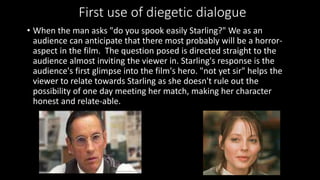
• When the man asks "do you spook easily Starling?" We as an 
audience can anticipate that there most probably will be a horror-aspect 
in the film. The question posed is directed straight to the 
audience almost inviting the viewer in. Starling's response is the 
audience's first glimpse into the film's hero. "not yet sir" helps the 
viewer to relate towards Starling as she doesn't rule out the 
possibility of one day meeting her match, making her character 
honest and relate-able.
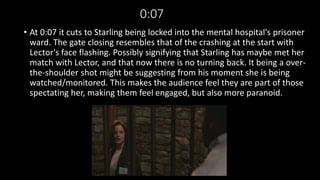
0:07 
• At 0:07 it cuts to Starling being locked into the mental hospital's prisoner 
ward. The gate closing resembles that of the crashing at the start with 
Lector's face flashing. Possibly signifying that Starling has maybe met her 
match with Lector, and that now there is no turning back. It being a over-the- 
shoulder shot might be suggesting from his moment she is being 
watched/monitored. This makes the audience feel they are part of those 
spectating her, making them feel engaged, but also more paranoid.
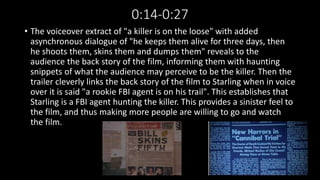
0:14-0:27 
• The voiceover extract of "a killer is on the loose" with added 
asynchronous dialogue of "he keeps them alive for three days, then 
he shoots them, skins them and dumps them" reveals to the 
audience the back story of the film, informing them with haunting 
snippets of what the audience may perceive to be the killer. Then the 
trailer cleverly links the back story of the film to Starling when in voice 
over it is said "a rookie FBI agent is on his trail". This establishes that 
Starling is a FBI agent hunting the killer. This provides a sinister feel to 
the film, and thus making more people are willing to go and watch 
the film.
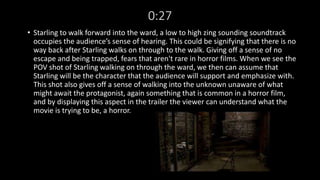
0:27 
• Starling to walk forward into the ward, a low to high zing sounding soundtrack 
occupies the audience’s sense of hearing. This could be signifying that there is no 
way back after Starling walks on through to the walk. Giving off a sense of no 
escape and being trapped, fears that aren't rare in horror films. When we see the 
POV shot of Starling walking on through the ward, we then can assume that 
Starling will be the character that the audience will support and emphasize with. 
This shot also gives off a sense of walking into the unknown unaware of what 
might await the protagonist, again something that is common in a horror film, 
and by displaying this aspect in the trailer the viewer can understand what the 
movie is trying to be, a horror.
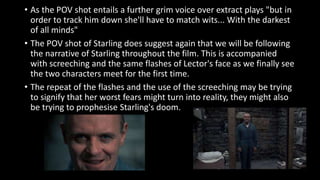
• As the POV shot entails a further grim voice over extract plays "but in 
order to track him down she'll have to match wits... With the darkest 
of all minds" 
• The POV shot of Starling does suggest again that we will be following 
the narrative of Starling throughout the film. This is accompanied 
with screeching and the same flashes of Lector's face as we finally see 
the two characters meet for the first time. 
• The repeat of the flashes and the use of the screeching may be trying 
to signify that her worst fears might turn into reality, they might also 
be trying to prophesise Starling's doom.
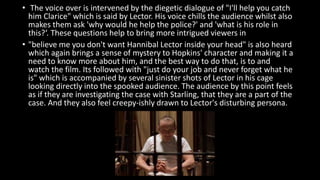
• The voice over is intervened by the diegetic dialogue of "I'll help you catch 
him Clarice" which is said by Lector. His voice chills the audience whilst also 
makes them ask 'why would he help the police?' and 'what is his role in 
this?‘. These questions help to bring more intrigued viewers in 
• "believe me you don't want Hannibal Lector inside your head" is also heard 
which again brings a sense of mystery to Hopkins' character and making it a 
need to know more about him, and the best way to do that, is to and 
watch the film. Its followed with "just do your job and never forget what he 
is" which is accompanied by several sinister shots of Lector in his cage 
looking directly into the spooked audience. The audience by this point feels 
as if they are investigating the case with Starling, that they are a part of the 
case. And they also feel creepy-ishly drawn to Lector's disturbing persona.
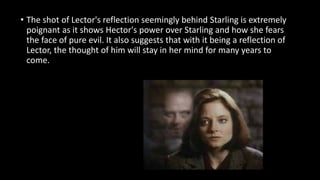
• The shot of Lector's reflection seemingly behind Starling is extremely 
poignant as it shows Hector's power over Starling and how she fears 
the face of pure evil. It also suggests that with it being a reflection of 
Lector, the thought of him will stay in her mind for many years to 
come.
0:50-1:03 
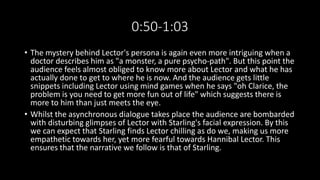
• The mystery behind Lector's persona is again even more intriguing when a 
doctor describes him as "a monster, a pure psycho-path". But this point the 
audience feels almost obliged to know more about Lector and what he has 
actually done to get to where he is now. And the audience gets little 
snippets including Lector using mind games when he says "oh Clarice, the 
problem is you need to get more fun out of life" which suggests there is 
more to him than just meets the eye. 
• Whilst the asynchronous dialogue takes place the audience are bombarded 
with disturbing glimpses of Lector with Starling's facial expression. By this 
we can expect that Starling finds Lector chilling as do we, making us more 
empathetic towards her, yet more fearful towards Hannibal Lector. This 
ensures that the narrative we follow is that of Starling.
1:03-1:11 
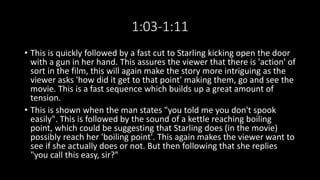
• This is quickly followed by a fast cut to Starling kicking open the door 
with a gun in her hand. This assures the viewer that there is 'action' of 
sort in the film, this will again make the story more intriguing as the 
viewer asks 'how did it get to that point' making them, go and see the 
movie. This is a fast sequence which builds up a great amount of 
tension. 
• This is shown when the man states "you told me you don't spook 
easily". This is followed by the sound of a kettle reaching boiling 
point, which could be suggesting that Starling does (in the movie) 
possibly reach her 'boiling point'. This again makes the viewer want to 
see if she actually does or not. But then following that she replies 
"you call this easy, sir?"
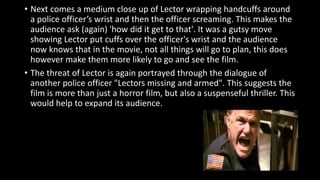
• Next comes a medium close up of Lector wrapping handcuffs around 
a police officer’s wrist and then the officer screaming. This makes the 
audience ask (again) 'how did it get to that'. It was a gutsy move 
showing Lector put cuffs over the officer's wrist and the audience 
now knows that in the movie, not all things will go to plan, this does 
however make them more likely to go and see the film. 
• The threat of Lector is again portrayed through the dialogue of 
another police officer "Lectors missing and armed". This suggests the 
film is more than just a horror film, but also a suspenseful thriller. This 
would help to expand its audience.
1:12-1:16 
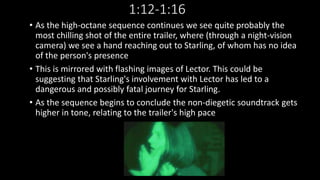
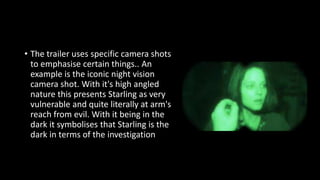
• As the high-octane sequence continues we see quite probably the 
most chilling shot of the entire trailer, where (through a night-vision 
camera) we see a hand reaching out to Starling, of whom has no idea 
of the person's presence 
• This is mirrored with flashing images of Lector. This could be 
suggesting that Starling's involvement with Lector has led to a 
dangerous and possibly fatal journey for Starling. 
• As the sequence begins to conclude the non-diegetic soundtrack gets 
higher in tone, relating to the trailer's high pace
1:17 
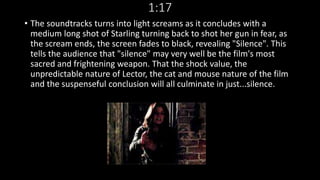
• The soundtracks turns into light screams as it concludes with a 
medium long shot of Starling turning back to shot her gun in fear, as 
the scream ends, the screen fades to black, revealing "Silence". This 
tells the audience that "silence" may very well be the film's most 
sacred and frightening weapon. That the shock value, the 
unpredictable nature of Lector, the cat and mouse nature of the film 
and the suspenseful conclusion will all culminate in just...silence.
1:19-1:26 
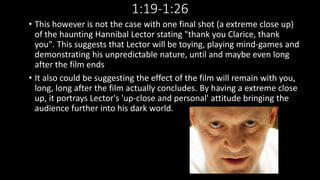
• This however is not the case with one final shot (a extreme close up) 
of the haunting Hannibal Lector stating "thank you Clarice, thank 
you". This suggests that Lector will be toying, playing mind-games and 
demonstrating his unpredictable nature, until and maybe even long 
after the film ends 
• It also could be suggesting the effect of the film will remain with you, 
long, long after the film actually concludes. By having a extreme close 
up, it portrays Lector's 'up-close and personal' attitude bringing the 
audience further into his dark world.
Target Audience 
• The film identifies it's audience by strengthening it's graphic and 
physiological content in the trailer. Its shows the viewer that only 
mature on-lookers should watch the film, and thus creating and 
identifying it's target audience. 
• After doing online research I have found that the target audience are 
middle-aged adults. From 31-40 years of age. This comes after looking 
at the young and ambitious Starling and the older Lector. After 
mixing this with the various recommendations online, this seems the 
most correct demograghic.
Further details 
• The trailer lasts 1:44 and holds 91 cuts. This fast use of cutting 
emphasises the point of the film being a fast, yet suspenseful thriller. 
It resembles the rate of heartbeat the viewer may behold when 
watching the film, and tells the viewer that the film will be a fast 
paced film
• The trailer uses specific camera shots 
to emphasise certain things.. An 
example is the iconic night vision 
camera shot. With it's high angled 
nature this presents Starling as very 
vulnerable and quite literally at arm's 
reach from evil. With it being in the 
dark it symbolises that Starling is the 
dark in terms of the investigation
Mise-en-scene 
• Looking back upon the trailer it uses mise-en-scene wisely by setting the 
film in it's present date. Meaning they would have to get historic clothing, 
cars etc to show it's older date. Instead the film uses modern day props and 
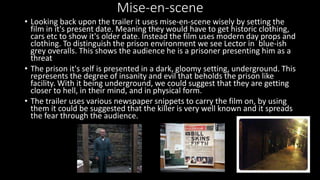
clothing. To distinguish the prison environment we see Lector in blue-ish 
grey overalls. This shows the audience he is a prisoner presenting him as a 
threat 
• The prison it's self is presented in a dark, gloomy setting, underground. This 
represents the degree of insanity and evil that beholds the prison like 
facility. With it being underground, we could suggest that they are getting 
closer to hell, in their mind, and in physical form. 
• The trailer uses various newspaper snippets to carry the film on, by using 
them it could be suggested that the killer is very well known and it spreads 
the fear through the audience.
Codes and Conventions 
• The trailer uses various codes and conventions that are commonly seen in trailers they include: 
• A voice over to carry the film's back story on 
• Newspaper snippets to bring an additional edge to the back-story 
• Introducing the two main protagonists, and providing us with a teasing amount of knowledge 
about them. 
• A gloomy non-diegetic soundtrack helps to identify the genre of the film 
• Explaining the break of the equilibrium, and teasing the audience as to how they might fix it. 
• Presenting the audience with scary/unpredictable moments in the film, that make the audience 
ask "how does it get to that?" 
• Revealing the name of the film at the end of the trailer as well as the credits 
• Naming the studios and sponsors at the beginning of the trailer 
• And finally providing a creepy final sequence to make the viewer remember the trailer.
Code of enigma 
• As a whole the film does make the audience ask certain questions, 
including "why does the prison guard scream in fear?" - "do they 
actually catch the killer?" - "what is Lector's role in the whole 
operation?" - "what happens to Starling/Lector?" and "how does it all 
end" These questions will all be answered when going to see the 
actual film, thus making the trailer an extremely successful promotion 
device

Silence of the lambs | Trailer Analysis

  • 1.
    Silence of theLambs Trailer Analysis
  • 2.
    The non-diegetic soundtrack • The first thing the viewer would get from the trailer is a heavy, low toned synth soundtrack which informs the viewer that the film they may go and see is a dark tale. The low synth is met with quick and sudden crashes of metal
  • 3.
    First shots •This sound is mirrored with very sudden flash images of Anthony Hopkins as Hannibal Lector. They come in the form of close-up shots/ They present the character as dangerous and foreshadowing his role as being gruesome and horrible. Adding to this is Hopkins' disturbing smile. It suggests the character he plays is scary and not to be trusted. This all draws viewer’s in. because they believe that from these very early moments something sinister may just about to hit the screen
  • 4.
    First use ofdiegetic dialogue • When the man asks "do you spook easily Starling?" We as an audience can anticipate that there most probably will be a horror-aspect in the film. The question posed is directed straight to the audience almost inviting the viewer in. Starling's response is the audience's first glimpse into the film's hero. "not yet sir" helps the viewer to relate towards Starling as she doesn't rule out the possibility of one day meeting her match, making her character honest and relate-able.
  • 5.
    0:07 • At0:07 it cuts to Starling being locked into the mental hospital's prisoner ward. The gate closing resembles that of the crashing at the start with Lector's face flashing. Possibly signifying that Starling has maybe met her match with Lector, and that now there is no turning back. It being a over-the- shoulder shot might be suggesting from his moment she is being watched/monitored. This makes the audience feel they are part of those spectating her, making them feel engaged, but also more paranoid.
  • 6.
    0:14-0:27 • Thevoiceover extract of "a killer is on the loose" with added asynchronous dialogue of "he keeps them alive for three days, then he shoots them, skins them and dumps them" reveals to the audience the back story of the film, informing them with haunting snippets of what the audience may perceive to be the killer. Then the trailer cleverly links the back story of the film to Starling when in voice over it is said "a rookie FBI agent is on his trail". This establishes that Starling is a FBI agent hunting the killer. This provides a sinister feel to the film, and thus making more people are willing to go and watch the film.
  • 7.
    0:27 • Starlingto walk forward into the ward, a low to high zing sounding soundtrack occupies the audience’s sense of hearing. This could be signifying that there is no way back after Starling walks on through to the walk. Giving off a sense of no escape and being trapped, fears that aren't rare in horror films. When we see the POV shot of Starling walking on through the ward, we then can assume that Starling will be the character that the audience will support and emphasize with. This shot also gives off a sense of walking into the unknown unaware of what might await the protagonist, again something that is common in a horror film, and by displaying this aspect in the trailer the viewer can understand what the movie is trying to be, a horror.
  • 8.
    • As thePOV shot entails a further grim voice over extract plays "but in order to track him down she'll have to match wits... With the darkest of all minds" • The POV shot of Starling does suggest again that we will be following the narrative of Starling throughout the film. This is accompanied with screeching and the same flashes of Lector's face as we finally see the two characters meet for the first time. • The repeat of the flashes and the use of the screeching may be trying to signify that her worst fears might turn into reality, they might also be trying to prophesise Starling's doom.
  • 9.
    • The voiceover is intervened by the diegetic dialogue of "I'll help you catch him Clarice" which is said by Lector. His voice chills the audience whilst also makes them ask 'why would he help the police?' and 'what is his role in this?‘. These questions help to bring more intrigued viewers in • "believe me you don't want Hannibal Lector inside your head" is also heard which again brings a sense of mystery to Hopkins' character and making it a need to know more about him, and the best way to do that, is to and watch the film. Its followed with "just do your job and never forget what he is" which is accompanied by several sinister shots of Lector in his cage looking directly into the spooked audience. The audience by this point feels as if they are investigating the case with Starling, that they are a part of the case. And they also feel creepy-ishly drawn to Lector's disturbing persona.
  • 10.
    • The shotof Lector's reflection seemingly behind Starling is extremely poignant as it shows Hector's power over Starling and how she fears the face of pure evil. It also suggests that with it being a reflection of Lector, the thought of him will stay in her mind for many years to come.
  • 11.
    0:50-1:03 • Themystery behind Lector's persona is again even more intriguing when a doctor describes him as "a monster, a pure psycho-path". But this point the audience feels almost obliged to know more about Lector and what he has actually done to get to where he is now. And the audience gets little snippets including Lector using mind games when he says "oh Clarice, the problem is you need to get more fun out of life" which suggests there is more to him than just meets the eye. • Whilst the asynchronous dialogue takes place the audience are bombarded with disturbing glimpses of Lector with Starling's facial expression. By this we can expect that Starling finds Lector chilling as do we, making us more empathetic towards her, yet more fearful towards Hannibal Lector. This ensures that the narrative we follow is that of Starling.
  • 12.
    1:03-1:11 • Thisis quickly followed by a fast cut to Starling kicking open the door with a gun in her hand. This assures the viewer that there is 'action' of sort in the film, this will again make the story more intriguing as the viewer asks 'how did it get to that point' making them, go and see the movie. This is a fast sequence which builds up a great amount of tension. • This is shown when the man states "you told me you don't spook easily". This is followed by the sound of a kettle reaching boiling point, which could be suggesting that Starling does (in the movie) possibly reach her 'boiling point'. This again makes the viewer want to see if she actually does or not. But then following that she replies "you call this easy, sir?"
  • 13.
    • Next comesa medium close up of Lector wrapping handcuffs around a police officer’s wrist and then the officer screaming. This makes the audience ask (again) 'how did it get to that'. It was a gutsy move showing Lector put cuffs over the officer's wrist and the audience now knows that in the movie, not all things will go to plan, this does however make them more likely to go and see the film. • The threat of Lector is again portrayed through the dialogue of another police officer "Lectors missing and armed". This suggests the film is more than just a horror film, but also a suspenseful thriller. This would help to expand its audience.
  • 14.
    1:12-1:16 • Asthe high-octane sequence continues we see quite probably the most chilling shot of the entire trailer, where (through a night-vision camera) we see a hand reaching out to Starling, of whom has no idea of the person's presence • This is mirrored with flashing images of Lector. This could be suggesting that Starling's involvement with Lector has led to a dangerous and possibly fatal journey for Starling. • As the sequence begins to conclude the non-diegetic soundtrack gets higher in tone, relating to the trailer's high pace
  • 15.
    1:17 • Thesoundtracks turns into light screams as it concludes with a medium long shot of Starling turning back to shot her gun in fear, as the scream ends, the screen fades to black, revealing "Silence". This tells the audience that "silence" may very well be the film's most sacred and frightening weapon. That the shock value, the unpredictable nature of Lector, the cat and mouse nature of the film and the suspenseful conclusion will all culminate in just...silence.
  • 16.
    1:19-1:26 • Thishowever is not the case with one final shot (a extreme close up) of the haunting Hannibal Lector stating "thank you Clarice, thank you". This suggests that Lector will be toying, playing mind-games and demonstrating his unpredictable nature, until and maybe even long after the film ends • It also could be suggesting the effect of the film will remain with you, long, long after the film actually concludes. By having a extreme close up, it portrays Lector's 'up-close and personal' attitude bringing the audience further into his dark world.
  • 17.
    Target Audience •The film identifies it's audience by strengthening it's graphic and physiological content in the trailer. Its shows the viewer that only mature on-lookers should watch the film, and thus creating and identifying it's target audience. • After doing online research I have found that the target audience are middle-aged adults. From 31-40 years of age. This comes after looking at the young and ambitious Starling and the older Lector. After mixing this with the various recommendations online, this seems the most correct demograghic.
  • 18.
    Further details •The trailer lasts 1:44 and holds 91 cuts. This fast use of cutting emphasises the point of the film being a fast, yet suspenseful thriller. It resembles the rate of heartbeat the viewer may behold when watching the film, and tells the viewer that the film will be a fast paced film
  • 19.
    • The traileruses specific camera shots to emphasise certain things.. An example is the iconic night vision camera shot. With it's high angled nature this presents Starling as very vulnerable and quite literally at arm's reach from evil. With it being in the dark it symbolises that Starling is the dark in terms of the investigation
  • 20.
    Mise-en-scene • Lookingback upon the trailer it uses mise-en-scene wisely by setting the film in it's present date. Meaning they would have to get historic clothing, cars etc to show it's older date. Instead the film uses modern day props and clothing. To distinguish the prison environment we see Lector in blue-ish grey overalls. This shows the audience he is a prisoner presenting him as a threat • The prison it's self is presented in a dark, gloomy setting, underground. This represents the degree of insanity and evil that beholds the prison like facility. With it being underground, we could suggest that they are getting closer to hell, in their mind, and in physical form. • The trailer uses various newspaper snippets to carry the film on, by using them it could be suggested that the killer is very well known and it spreads the fear through the audience.
  • 21.
    Codes and Conventions • The trailer uses various codes and conventions that are commonly seen in trailers they include: • A voice over to carry the film's back story on • Newspaper snippets to bring an additional edge to the back-story • Introducing the two main protagonists, and providing us with a teasing amount of knowledge about them. • A gloomy non-diegetic soundtrack helps to identify the genre of the film • Explaining the break of the equilibrium, and teasing the audience as to how they might fix it. • Presenting the audience with scary/unpredictable moments in the film, that make the audience ask "how does it get to that?" • Revealing the name of the film at the end of the trailer as well as the credits • Naming the studios and sponsors at the beginning of the trailer • And finally providing a creepy final sequence to make the viewer remember the trailer.
  • 22.
    Code of enigma • As a whole the film does make the audience ask certain questions, including "why does the prison guard scream in fear?" - "do they actually catch the killer?" - "what is Lector's role in the whole operation?" - "what happens to Starling/Lector?" and "how does it all end" These questions will all be answered when going to see the actual film, thus making the trailer an extremely successful promotion device