Genre Film Analysis
Genre Codes and Conventions
1- The Silence of the Lambs (1991)
2- Primal Fear (1996)
3- Gone Girl (2014)
Arthur Crossin
The Silence of the Lambs
Overview
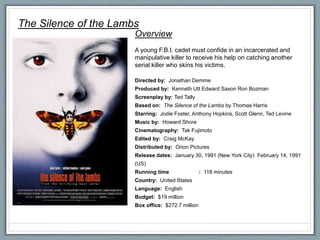
A young F.B.I. cadet must confide in an incarcerated and
manipulative killer to receive his help on catching another
serial killer who skins his victims.
Directed by: Jonathan Demme
Produced by: Kenneth Utt Edward Saxon Ron Bozman
Screenplay by: Ted Tally
Based on: The Silence of the Lambs by Thomas Harris
Starring: Jodie Foster, Anthony Hopkins, Scott Glenn, Ted Levine
Music by: Howard Shore
Cinematography: Tak Fujimoto
Edited by: Craig McKay
Distributed by: Orion Pictures
Release dates: January 30, 1991 (New York City) February 14, 1991
(US)
Running time : 118 minutes
Country: United States
Language: English
Budget: $19 million
Box office: $272.7 million
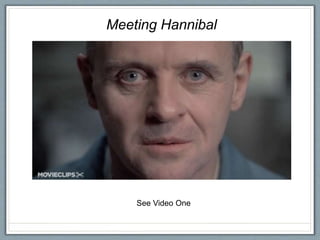
Meeting Hannibal
See Video One
Key Features:
• High Contrast lighting – Dark and Bright lighting used to create shadows and
highlights. This is seen when Foster greets Hopkins, here face is lit from one side and
her face is shadowed. This seems to create the idea that even though she is confident,
she still is fearful of the situation to come this also creates a realistic setting which is
key to the Drama Genre.
• Costume – The two have vastly different costumes. Hopkins wears a dark jumpsuit
which identifies him as the antagonist in the situation as the darkness signifies evil.
This composition of his costume is important for the audience to develop a relationship
with Hopkins’ character
• Facial Expression – It is used in this scene to highlight Fosters’ agitation and fear
towards Hopkins. This use of gulping shows that she is afraid which allows the
audience to relate to the Protagonist and causes a sense of disgust towards the
Antagonist.
• Character Relations – We can see in this scene that the Protagonist is at the mercy of
the Antagonist a key part of Thriller films, Hopkins has the ability to cause Foster to
have a mental breakdown
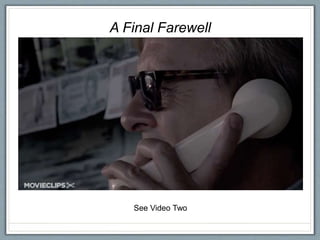
A Final Farewell
See Video Two
Key Features:
• Movement – Hopkins slow exit from the bar and his following of
Heald’s character is once again quite sinister and builds tension within
the scene This scene occurs at the very end of the scene and
progresses into the credits in the actual film. Furthermore it develops a
story that can be continued in a later installment or that creates a cliff-
hanger. This action also allows for some of the drama codes to be
utilized. For example; the use of Haiti as a location allows for a more
realistic portrayal of the scene which is a key part of creating a Drama.
This allows for the audience to find the story more relatable.
• Facial expression – When viewing Foster’s initial expression in
comparison towards the one show towards Hopkins, we can see a
distinct difference. She begins as happy and joyful at the party at the
start of the clip, then the scene changes to her fear and shock towards
Hopkins near the end. This final facial expression shows the use of the
realization. Foster comes to realize that Hannibal has escaped and
that she has to find him again. Furthermore, the cliffhanger is
emphasized by the retreat from Foster repeating, “Dr. Lecter!”
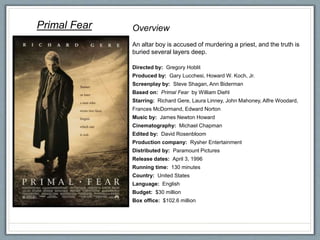
Primal Fear Overview
An altar boy is accused of murdering a priest, and the truth is
buried several layers deep.
Directed by: Gregory Hoblit
Produced by: Gary Lucchesi, Howard W. Koch, Jr.
Screenplay by: Steve Shagan, Ann Biderman
Based on: Primal Fear by William Diehl
Starring: Richard Gere, Laura Linney, John Mahoney, Alfre Woodard,
Frances McDormand, Edward Norton
Music by: James Newton Howard
Cinematography: Michael Chapman
Edited by: David Rosenbloom
Production company: Rysher Entertainment
Distributed by: Paramount Pictures
Release dates: April 3, 1996
Running time: 130 minutes
Country: United States
Language: English
Budget: $30 million
Box office: $102.6 million
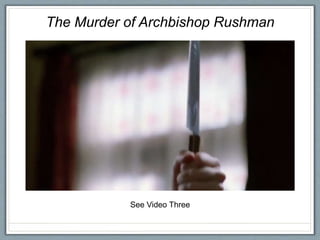
The Murder of Archbishop Rushman
See Video Three
Key Features:
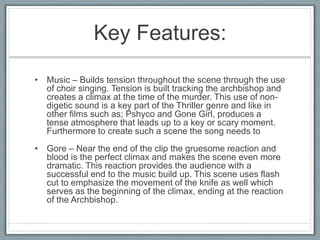
• Music – Builds tension throughout the scene through the use
of choir singing. Tension is built tracking the archbishop and
creates a climax at the time of the murder. This use of non-
digetic sound is a key part of the Thriller genre and like in
other films such as; Pshyco and Gone Girl, produces a
tense atmosphere that leads up to a key or scary moment.
Furthermore to create such a scene the song needs to
• Gore – Near the end of the clip the gruesome reaction and
blood is the perfect climax and makes the scene even more
dramatic. This reaction provides the audience with a
successful end to the music build up. This scene uses flash
cut to emphasize the movement of the knife as well which
serves as the beginning of the climax, ending at the reaction
of the Archbishop.
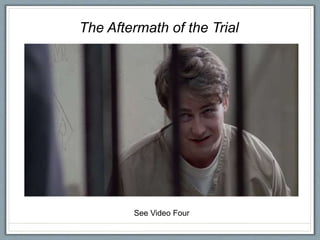
The Aftermath of the Trial
See Video Four
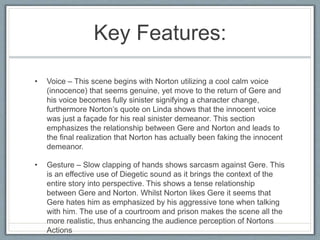
Key Features:
• Voice – This scene begins with Norton utilizing a cool calm voice
(innocence) that seems genuine, yet move to the return of Gere and
his voice becomes fully sinister signifying a character change,
furthermore Norton’s quote on Linda shows that the innocent voice
was just a façade for his real sinister demeanor. This section
emphasizes the relationship between Gere and Norton and leads to
the final realization that Norton has actually been faking the innocent
demeanor.
• Gesture – Slow clapping of hands shows sarcasm against Gere. This
is an effective use of Diegetic sound as it brings the context of the
entire story into perspective. This shows a tense relationship
between Gere and Norton. Whilst Norton likes Gere it seems that
Gere hates him as emphasized by his aggressive tone when talking
with him. The use of a courtroom and prison makes the scene all the
more realistic, thus enhancing the audience perception of Nortons
Actions
Gone Girl
Overview
With his wife's disappearance having become the focus of an
intense media circus, a man sees the spotlight turned on him
when it's suspected that he may not be innocent.
Directed by: David Fincher
Produced by: Arnon Milchan, Reese Witherspoon, Ceán Chaffin, Joshua
Donen
Screenplay by : Gillian Flynn
Based on: Gone Girl by Gillian Flynn
Starring: Ben Affleck, Rosamund Pike
Music by: Trent Reznor, Atticus Ross
Cinematography: Jeff Cronenweth
Edited by: Kirk Baxter
Production company: Regency Enterprises, TSG Entertainment
Distributed by: 20th Century Fox
Release date: September 26, 2014 (NYFF) October 3, 2014 (United
States)
Running time : 149 minutes
Country: United States
Language: English
Budget: $61 million
Box office: $369.3 million
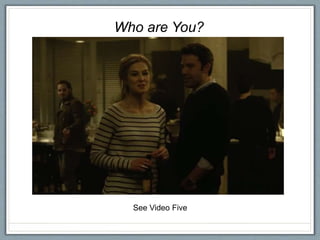
Who are You?
file://localhost/.file/id
=6571367.1609983
See Video Five
Key Features:
• Lighting – Dark Romantic setting that highlights the couples
bond. We see that they interact quite well. This scene shows
contrast to its content as even though the speech is calm
and romantic the lighting seems sinister and leads to the
idea of everything not being as it seems. More so we see
the use of Shadows in the scene, which even though are
meant to signify a more tense, more sinister scene,
successfully create an uneasy sense of calm within the
audience. Furthermore the use of low key-lighting brings
focus onto the two and matches the composition of the
remainder of the film.
• Voice – The voice is calm and enforces the idea that the two
are talking romantically about each other. Contrasts with the
lighting whilst also suiting (romantic and sinister at the same
time)
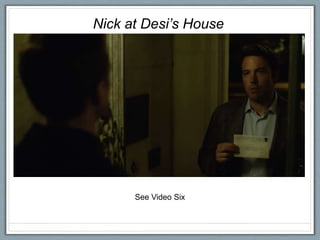
Nick at Desi’s House
See Video Six
Key Features:
• Shadow/Lighting – The shadow cast over Affleck's face seems to show
him as a sinister being, he is being quite confrontational towards NPH
and that is reflected by the directors choice of lighting. In addition this
creates the idea of an unreliable narrative. In this case the film is from
the perspective of the husband with that of the wife placed in at
random sections. Affleck seems, in his own opinion to be framed,
however the way he is portrayed is different. Overall it seems that the
story isn’t being told correctly and that information is being with held.
This lack of transparency within the storyline adds to the tension built
within the film.
• Voice – The use of voice in the scene show the duo to be suspicious
and in distress with one another, this is reflected by both of their
gestures and NPH’s aggressive tone towards Affleck. The overall
stress in this scene reinforces the idea that there is a lack of
transparency in the film. However the scene can be interpreted
differently the dialogue from Affleck reflects the idea that NPH is
responsible, whilst his reaction to the questioning reflects guilt.

Genre film analysis

  • 1.
    Genre Film Analysis GenreCodes and Conventions 1- The Silence of the Lambs (1991) 2- Primal Fear (1996) 3- Gone Girl (2014) Arthur Crossin
  • 2.
    The Silence ofthe Lambs Overview A young F.B.I. cadet must confide in an incarcerated and manipulative killer to receive his help on catching another serial killer who skins his victims. Directed by: Jonathan Demme Produced by: Kenneth Utt Edward Saxon Ron Bozman Screenplay by: Ted Tally Based on: The Silence of the Lambs by Thomas Harris Starring: Jodie Foster, Anthony Hopkins, Scott Glenn, Ted Levine Music by: Howard Shore Cinematography: Tak Fujimoto Edited by: Craig McKay Distributed by: Orion Pictures Release dates: January 30, 1991 (New York City) February 14, 1991 (US) Running time : 118 minutes Country: United States Language: English Budget: $19 million Box office: $272.7 million
  • 3.
  • 4.
    Key Features: • HighContrast lighting – Dark and Bright lighting used to create shadows and highlights. This is seen when Foster greets Hopkins, here face is lit from one side and her face is shadowed. This seems to create the idea that even though she is confident, she still is fearful of the situation to come this also creates a realistic setting which is key to the Drama Genre. • Costume – The two have vastly different costumes. Hopkins wears a dark jumpsuit which identifies him as the antagonist in the situation as the darkness signifies evil. This composition of his costume is important for the audience to develop a relationship with Hopkins’ character • Facial Expression – It is used in this scene to highlight Fosters’ agitation and fear towards Hopkins. This use of gulping shows that she is afraid which allows the audience to relate to the Protagonist and causes a sense of disgust towards the Antagonist. • Character Relations – We can see in this scene that the Protagonist is at the mercy of the Antagonist a key part of Thriller films, Hopkins has the ability to cause Foster to have a mental breakdown
  • 5.
  • 6.
    Key Features: • Movement– Hopkins slow exit from the bar and his following of Heald’s character is once again quite sinister and builds tension within the scene This scene occurs at the very end of the scene and progresses into the credits in the actual film. Furthermore it develops a story that can be continued in a later installment or that creates a cliff- hanger. This action also allows for some of the drama codes to be utilized. For example; the use of Haiti as a location allows for a more realistic portrayal of the scene which is a key part of creating a Drama. This allows for the audience to find the story more relatable. • Facial expression – When viewing Foster’s initial expression in comparison towards the one show towards Hopkins, we can see a distinct difference. She begins as happy and joyful at the party at the start of the clip, then the scene changes to her fear and shock towards Hopkins near the end. This final facial expression shows the use of the realization. Foster comes to realize that Hannibal has escaped and that she has to find him again. Furthermore, the cliffhanger is emphasized by the retreat from Foster repeating, “Dr. Lecter!”
  • 7.
    Primal Fear Overview Analtar boy is accused of murdering a priest, and the truth is buried several layers deep. Directed by: Gregory Hoblit Produced by: Gary Lucchesi, Howard W. Koch, Jr. Screenplay by: Steve Shagan, Ann Biderman Based on: Primal Fear by William Diehl Starring: Richard Gere, Laura Linney, John Mahoney, Alfre Woodard, Frances McDormand, Edward Norton Music by: James Newton Howard Cinematography: Michael Chapman Edited by: David Rosenbloom Production company: Rysher Entertainment Distributed by: Paramount Pictures Release dates: April 3, 1996 Running time: 130 minutes Country: United States Language: English Budget: $30 million Box office: $102.6 million
  • 8.
    The Murder ofArchbishop Rushman See Video Three
  • 9.
    Key Features: • Music– Builds tension throughout the scene through the use of choir singing. Tension is built tracking the archbishop and creates a climax at the time of the murder. This use of non- digetic sound is a key part of the Thriller genre and like in other films such as; Pshyco and Gone Girl, produces a tense atmosphere that leads up to a key or scary moment. Furthermore to create such a scene the song needs to • Gore – Near the end of the clip the gruesome reaction and blood is the perfect climax and makes the scene even more dramatic. This reaction provides the audience with a successful end to the music build up. This scene uses flash cut to emphasize the movement of the knife as well which serves as the beginning of the climax, ending at the reaction of the Archbishop.
  • 10.
    The Aftermath ofthe Trial See Video Four
  • 11.
    Key Features: • Voice– This scene begins with Norton utilizing a cool calm voice (innocence) that seems genuine, yet move to the return of Gere and his voice becomes fully sinister signifying a character change, furthermore Norton’s quote on Linda shows that the innocent voice was just a façade for his real sinister demeanor. This section emphasizes the relationship between Gere and Norton and leads to the final realization that Norton has actually been faking the innocent demeanor. • Gesture – Slow clapping of hands shows sarcasm against Gere. This is an effective use of Diegetic sound as it brings the context of the entire story into perspective. This shows a tense relationship between Gere and Norton. Whilst Norton likes Gere it seems that Gere hates him as emphasized by his aggressive tone when talking with him. The use of a courtroom and prison makes the scene all the more realistic, thus enhancing the audience perception of Nortons Actions
  • 12.
    Gone Girl Overview With hiswife's disappearance having become the focus of an intense media circus, a man sees the spotlight turned on him when it's suspected that he may not be innocent. Directed by: David Fincher Produced by: Arnon Milchan, Reese Witherspoon, Ceán Chaffin, Joshua Donen Screenplay by : Gillian Flynn Based on: Gone Girl by Gillian Flynn Starring: Ben Affleck, Rosamund Pike Music by: Trent Reznor, Atticus Ross Cinematography: Jeff Cronenweth Edited by: Kirk Baxter Production company: Regency Enterprises, TSG Entertainment Distributed by: 20th Century Fox Release date: September 26, 2014 (NYFF) October 3, 2014 (United States) Running time : 149 minutes Country: United States Language: English Budget: $61 million Box office: $369.3 million
  • 13.
  • 14.
    Key Features: • Lighting– Dark Romantic setting that highlights the couples bond. We see that they interact quite well. This scene shows contrast to its content as even though the speech is calm and romantic the lighting seems sinister and leads to the idea of everything not being as it seems. More so we see the use of Shadows in the scene, which even though are meant to signify a more tense, more sinister scene, successfully create an uneasy sense of calm within the audience. Furthermore the use of low key-lighting brings focus onto the two and matches the composition of the remainder of the film. • Voice – The voice is calm and enforces the idea that the two are talking romantically about each other. Contrasts with the lighting whilst also suiting (romantic and sinister at the same time)
  • 15.
    Nick at Desi’sHouse See Video Six
  • 16.
    Key Features: • Shadow/Lighting– The shadow cast over Affleck's face seems to show him as a sinister being, he is being quite confrontational towards NPH and that is reflected by the directors choice of lighting. In addition this creates the idea of an unreliable narrative. In this case the film is from the perspective of the husband with that of the wife placed in at random sections. Affleck seems, in his own opinion to be framed, however the way he is portrayed is different. Overall it seems that the story isn’t being told correctly and that information is being with held. This lack of transparency within the storyline adds to the tension built within the film. • Voice – The use of voice in the scene show the duo to be suspicious and in distress with one another, this is reflected by both of their gestures and NPH’s aggressive tone towards Affleck. The overall stress in this scene reinforces the idea that there is a lack of transparency in the film. However the scene can be interpreted differently the dialogue from Affleck reflects the idea that NPH is responsible, whilst his reaction to the questioning reflects guilt.