
CERVICAL
ARTERIAL
DYSFUNCTION
& CLINICAL PRACTICE:
MOVING FORWARD
@TaylorAlanJ & @RogerKerry1
Risk
Time/experience
Cervical spine risk … where are you?
@TaylorAlanJ & @RogerKerry1
WARNING
Acronyms ahead!
@TaylorAlanJ & @RogerKerry1
Cervical
arterial
dysfunction
• CAD covers ALL known
vascular pathologies &
anatomical structures
that may be
compromised by
assessment/management
Cervical
artery
dissection
• Specific to one type
of arterial pathology
• Anatomical site – not
stated
Carotid
artery
dissection
• Specific to one
arterial vessel
• Specific to one type
of arterial pathology
CAD
Cervical
arterial
dysfunction
• CAD covers ALL known
vascular pathologies &
anatomical structures that
may be compromised by
assessment/management
CAD
@TaylorAlanJ & @RogerKerry1
‘Cervical Arterial Dysfunction’ is an umbrella term
@TaylorAlanJ & @RogerKerry1
Diseased
(Atherosclerosis)Mechanics
Altered Haemodynamic Continuum
Healthy normal
Vessel??
TRAUMA?
@TaylorAlanJ & @RogerKerry1
Healthy vessel
Dissection
Source: DailyTelegraph
Source: Daily Telegraph
Phillip Hughes
@TaylorAlanJ & @RogerKerry1
Sub arachnoid
haemorrhage
Dissection of
Healthy vessel
Source: DailyTelegraph
@TaylorAlanJ & @RogerKerry1
Diseased vessel
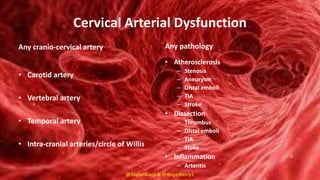
Cervical Arterial Dysfunction
Any cranio-cervical artery
• Carotid artery
• Vertebral artery
• Temporal artery
• Intra-cranial arteries/circle of Willis
Any pathology
• Atherosclerosis
– Stenosis
– Aneurysm
– Distal emboli
– TIA
– Stroke
• Dissection
– Thrombus
– Distal emboli
– TIA
– Stoke
• Inflammation
– Arteritis
@TaylorAlanJ & @RogerKerry1
ASSESSMENT &
SUB-GROUPING@TaylorAlanJ & @RogerKerry1
@TaylorAlanJ & @RogerKerry1
HISTORYIdentifying CAD risk factor
@TaylorAlanJ & @RogerKerry1
PHYSICAL EXAMINATION Identifying CAD risk
factors
@TaylorAlanJ & @RogerKerry1
High blood pressure is a level consistently at or above 140mmHg and/or 90mmHg
Normal adult blood pressure is considered to be between 90/60mmHg and 120/80mmHg
A blood pressure reading between 120/80mmHg and 140/90mmHg could mean you're at risk
of developing high blood pressure if you don't take steps to keep your blood pressure under control.
@TaylorAlanJ & @RogerKerry1
CRANIAL NERVES this should be a simple, two minute
screening examination
@TaylorAlanJ & @RogerKerry1
INTERVENTIONS@TaylorAlanJ & @RogerKerry1
So what can we do
with these folk?
What is our reasoned framework for
parameters of practice?
@TaylorAlanJ & @RogerKerry1
NEXT STEPS?
@TaylorAlanJ & @RogerKerry1
You can access the IFOMPT Cervical Framework
Altered Haemodynamics Blog which summarises
some clinical issues very well
IFOMPT Cervical Framework REVISION
2018
@TaylorAlanJ & @RogerKerry1
Thanks for your feedback . . . !
alan.taylor@nottingham.ac.uk
roger.Kerry@Nottingham.ac.uk
@rogerkerry1@TaylorAlanJ
The Pulse of Thought:
Haemodynamics of the Brain and
Mind
@TaylorAlanJ & @RogerKerry1

Cervical Arterial Dysfunction & Clinical Practice: Moving Forward