Download to read offline
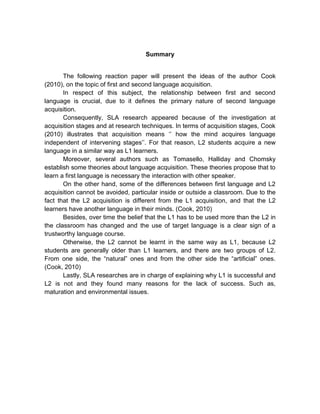
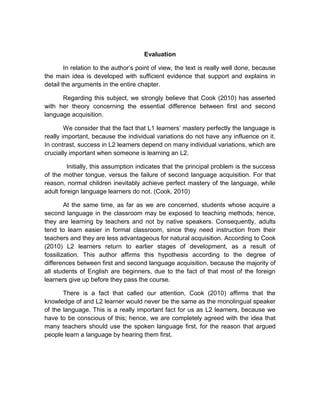


The document summarizes key ideas from Cook (2010) on the relationship between first and second language acquisition. Specifically: - First language acquisition is primary and defines how second languages are acquired later in life. However, second language acquisition differs in that learners already have another language and are generally older than first language learners. - While first language acquisition leads to perfect mastery, second language acquisition success depends on individual variations and often results in fossilization at earlier development stages. - Classroom second language learners may be exposed to different teaching methods than natural first language acquisition from native speakers. Younger learners also have an advantage in acquiring a new language more easily.


