Top 10 Trends
in Business Intelligence
for 2014
Let us know what you think
@tableau #analytics
1
The end of data scientists. Data science moves from the
specialist to the everyman. Familiarity with data analysis becomes part of the skill set of
ordinary business users, not experts with “analyst” in their titles. Organizations that use
data to make decisions are more successful, and those that don’t use data begin to fall
behind.
For more, see this Special Report from the Economist: Fostering a Data Driven Culture.

1
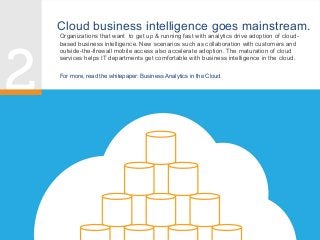
Cloud business intelligence goes mainstream.
Organizations that want to get up & running fast with analytics drive adoption of cloudbased business intelligence. New scenarios such as collaboration with customers and
outside-the-firewall mobile access also accelerate adoption. The maturation of cloud
services helps IT departments get comfortable with business intelligence in the cloud.
For more, read the whitepaper: Business Analytics in the Cloud.
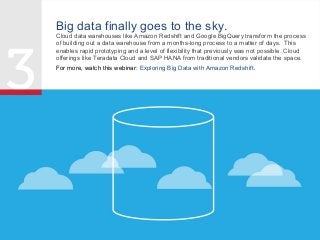
Big data finally goes to the sky.

Cloud data warehouses like Amazon Redshift and Google BigQuery transform the process
of building out a data warehouse from a months-long process to a matter of days. This
enables rapid prototyping and a level of flexibility that previously was not possible. Cloud
offerings like Teradata Cloud and SAP HANA from traditional vendors validate the space.
For more, watch this webinar: Exploring Big Data with Amazon Redshift.
Agile business intelligence extends its lead.
Self-service analytics becomes the norm at fast-moving companies. Business people begin
to expect flexibility and usability from their dashboards. And the monolithic infrastructure
stack finally crumbles in favor of solutions that can work with new data sources.
For more, read this whitepaper by GigaOm: Agile Business Intelligence: Reshaping the Landscape.
Predictive analytics, once the realm of advanced and specialized

systems, will move into the mainstream as businesses seek forward-looking rather than
backward-looking insight from data.

For more, watch TDWI’s David Stodder on this webinar:
Using Analytics to be Predictive and Proactive.
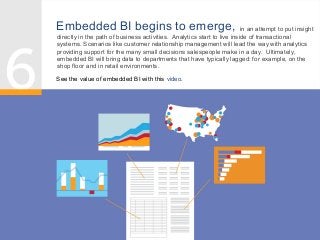
Embedded BI begins to emerge,

in an attempt to put insight
directly in the path of business activities. Analytics start to live inside of transactional
systems. Scenarios like customer relationship management will lead the way with analytics
providing support for the many small decisions salespeople make in a day. Ultimately,
embedded BI will bring data to departments that have typically lagged: for example, on the
shop floor and in retail environments.

See the value of embedded BI with this video.
Storytelling becomes a priority,
as people realize that a dashboard deluge without context is not helpful. Stories become
a way to communicate ideas and insights using data. They also help people gain
meaning from an overwhelming mass of big and disparate data.
Read more in this whitepaper: 5 Best Practices for Telling Great Stories.
mobile business intelligence
becomes the primary experience,

For leading-edge organizations,

not an occasional experience. Business users begin to demand access to information
within the natural flow of their day, not back at their desks.

For an example, read this whitepaper:
How Mobile Business Intelligence Drives Efficiency and Transformation for Supervalu.
Organizations begin to analyze social data
in earnest, gaining insight beyond number of their likes and followers. Social
data becomes a proxy for brand awareness and attitude, as well as fertile ground for
competitive analysis. Companies begin to use social data to understand how relevant
they are to their customers.
For an example of how to gain insight from social media data, watch this
video: Using Social Media Analytics for Insight.
NoSQL is the new Hadoop.
Organizations explore how to use unstructured data. NoSQL technologies become
more popular as companies seek ways to assimilate this kind of data. But in
2014, the intelligent use of unstructured data will still be the exception and not the
norm.
For more on noSQL, read this TechRepublic article:
10 Things You Should Know About noSQL databases.
About Tableau Software

Tableau Software (NYSE: DATA)
helps people see and understand
data. Tableau helps anyone quickly
analyze, visualize and share
information. More than 15,000
customer accounts get rapid results
with Tableau in the office and on-thego. And tens of thousands of people
use Tableau Public to share data in
their blogs and websites.

http://www.tableausoftware.com/business-intelligence

Top Ten Business Intelligence Trends for 2014

  • 1.
    Top 10 Trends inBusiness Intelligence for 2014
  • 2.
    Let us knowwhat you think @tableau #analytics
  • 3.
  • 4.
    The end ofdata scientists. Data science moves from the specialist to the everyman. Familiarity with data analysis becomes part of the skill set of ordinary business users, not experts with “analyst” in their titles. Organizations that use data to make decisions are more successful, and those that don’t use data begin to fall behind. For more, see this Special Report from the Economist: Fostering a Data Driven Culture. 1
  • 5.
    Cloud business intelligencegoes mainstream. Organizations that want to get up & running fast with analytics drive adoption of cloudbased business intelligence. New scenarios such as collaboration with customers and outside-the-firewall mobile access also accelerate adoption. The maturation of cloud services helps IT departments get comfortable with business intelligence in the cloud. For more, read the whitepaper: Business Analytics in the Cloud.
  • 6.
    Big data finallygoes to the sky. Cloud data warehouses like Amazon Redshift and Google BigQuery transform the process of building out a data warehouse from a months-long process to a matter of days. This enables rapid prototyping and a level of flexibility that previously was not possible. Cloud offerings like Teradata Cloud and SAP HANA from traditional vendors validate the space. For more, watch this webinar: Exploring Big Data with Amazon Redshift.
  • 7.
    Agile business intelligenceextends its lead. Self-service analytics becomes the norm at fast-moving companies. Business people begin to expect flexibility and usability from their dashboards. And the monolithic infrastructure stack finally crumbles in favor of solutions that can work with new data sources. For more, read this whitepaper by GigaOm: Agile Business Intelligence: Reshaping the Landscape.
  • 8.
    Predictive analytics, oncethe realm of advanced and specialized systems, will move into the mainstream as businesses seek forward-looking rather than backward-looking insight from data. For more, watch TDWI’s David Stodder on this webinar: Using Analytics to be Predictive and Proactive.
  • 9.
    Embedded BI beginsto emerge, in an attempt to put insight directly in the path of business activities. Analytics start to live inside of transactional systems. Scenarios like customer relationship management will lead the way with analytics providing support for the many small decisions salespeople make in a day. Ultimately, embedded BI will bring data to departments that have typically lagged: for example, on the shop floor and in retail environments. See the value of embedded BI with this video.
  • 10.
    Storytelling becomes apriority, as people realize that a dashboard deluge without context is not helpful. Stories become a way to communicate ideas and insights using data. They also help people gain meaning from an overwhelming mass of big and disparate data. Read more in this whitepaper: 5 Best Practices for Telling Great Stories.
  • 11.
    mobile business intelligence becomesthe primary experience, For leading-edge organizations, not an occasional experience. Business users begin to demand access to information within the natural flow of their day, not back at their desks. For an example, read this whitepaper: How Mobile Business Intelligence Drives Efficiency and Transformation for Supervalu.
  • 12.
    Organizations begin toanalyze social data in earnest, gaining insight beyond number of their likes and followers. Social data becomes a proxy for brand awareness and attitude, as well as fertile ground for competitive analysis. Companies begin to use social data to understand how relevant they are to their customers. For an example of how to gain insight from social media data, watch this video: Using Social Media Analytics for Insight.
  • 13.
    NoSQL is thenew Hadoop. Organizations explore how to use unstructured data. NoSQL technologies become more popular as companies seek ways to assimilate this kind of data. But in 2014, the intelligent use of unstructured data will still be the exception and not the norm. For more on noSQL, read this TechRepublic article: 10 Things You Should Know About noSQL databases.
  • 14.
    About Tableau Software TableauSoftware (NYSE: DATA) helps people see and understand data. Tableau helps anyone quickly analyze, visualize and share information. More than 15,000 customer accounts get rapid results with Tableau in the office and on-thego. And tens of thousands of people use Tableau Public to share data in their blogs and websites. http://www.tableausoftware.com/business-intelligence