TOO4TO MODULE
Sustainable Resource Management
PART 3
2
STRATEGIES AND VISIONS FOR A
SUSTAINABLE RESOURCE MANAGEMENT
Management of Resources; Policies and sustainable resource management;
Circular economy; Complexity and interlinkages with other thematises of
Sustainable Development
3
4
Sustainable Resource Management. Global trends, visions and policies. Bringezu S., Bleischwitz R. 2009
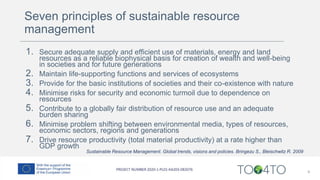
1. Secure adequate supply and efficient use of materials, energy and land
resources as a reliable biophysical basis for creation of wealth and well-being
in societies and for future generations
2. Maintain life-supporting functions and services of ecosystems
3. Provide for the basic institutions of societies and their co-existence with nature
4. Minimise risks for security and economic turmoil due to dependence on
resources
5. Contribute to a globally fair distribution of resource use and an adequate
burden sharing
6. Minimise problem shifting between environmental media, types of resources,
economic sectors, regions and generations
7. Drive resource productivity (total material productivity) at a rate higher than
GDP growth
Seven principles of sustainable resource
management
5
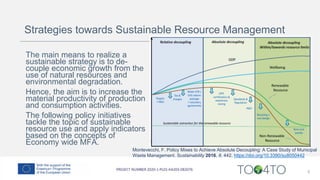
Montevecchi, F. Policy Mixes to Achieve Absolute Decoupling: A Case Study of Municipal
Waste Management. Sustainability 2016, 8, 442. https://doi.org/10.3390/su8050442
The main means to realize a
sustainable strategy is to de-
couple economic growth from the
use of natural resources and
environmental degradation.
Hence, the aim is to increase the
material productivity of production
and consumption activities.
The following policy initiatives
tackle the topic of sustainable
resource use and apply indicators
based on the concepts of
Economy wide MFA.
Strategies towards Sustainable Resource Management
6
2005 Thematic Strategy on Sustainable Use of Natural Resources
2011 Roadmap to a Resource Efficient Europe
2015 Closing the loop –An EU action plan for the Circular Economy
2008 The raw materials initiative
2014 Reviewed list of critical raw materials(CRM)
2011 Communication on raw materials
2017 Reviewed list of CRM
2020 Action plan on CRM. The reviewed list
2020 A European Green Deal. A new Circular Economy action plan
....
Policies towards SRM
Thematic Strategy on Sustainable Use of Natural
Resources
The strategy emphasizes the importance of integration of environmental
concerns into other policies that affect environmental impacts of natural
resources use.
Efficient use of resources contributes to growth.
• The main objective – Decoupling - To reduce the negative environmental
impacts generated by the use of natural resources in a growing economy
7
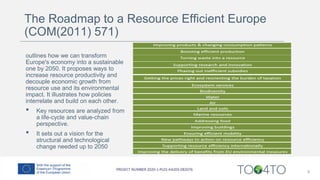
The Roadmap to a Resource Efficient Europe
(COM(2011) 571)
outlines how we can transform
Europe's economy into a sustainable
one by 2050. It proposes ways to
increase resource productivity and
decouple economic growth from
resource use and its environmental
impact. It illustrates how policies
interrelate and build on each other.
• Key resources are analyzed from
a life-cycle and value-chain
perspective.
• It sets out a vision for the
structural and technological
change needed up to 2050
8
9
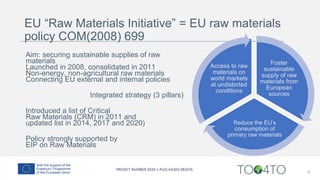
Foster
sustainable
supply of raw
materials from
European
sources
Reduce the EU’s
consumption of
primary raw materials
Access to raw
materials on
world markets
at undistorted
conditions
Aim: securing sustainable supplies of raw
materials
Launched in 2008, consolidated in 2011
Non-energy, non-agricultural raw materials
Connecting EU external and internal policies
Integrated strategy (3 pillars)
Introduced a list of Critical
Raw Materials (CRM) in 2011 and
updated list in 2014, 2017 and 2020)
Policy strongly supported by
EIP on Raw Materials
EU “Raw Materials Initiative” = EU raw materials
policy COM(2008) 699
10
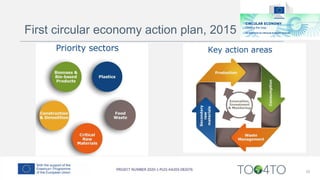
First circular economy action plan, 2015
EU Green Deal, 2020
Aim:
• there are no net emissions of greenhouse gases by 2050
• economic growth is decoupled from resource use
• no person and no place is left behind
The European Green Deal is our plan to make the EU's economy
sustainable
• boost the efficient use of resources by moving to a clean, circular
economy
• restore biodiversity and cut pollution
11
12
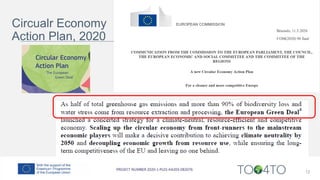
Circualr Economy
Action Plan, 2020
13
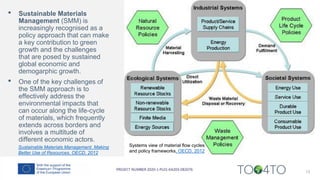
Systems view of material flow cycles
and policy frameworks, OECD, 2012
Sustainable Materials Management. Making
Better Use of Resources, OECD, 2012
• Sustainable Materials
Management (SMM) is
increasingly recognised as a
policy approach that can make
a key contribution to green
growth and the challenges
that are posed by sustained
global economic and
demogarphic growth.
• One of the key challenges of
the SMM approach is to
effectively address the
environmental impacts that
can occur along the life-cycle
of materials, which frequently
extends across borders and
involves a multitude of
different economic actors.
Classification of Resource Management Activities
• According to the EUROSTAT the classification of resource management activities
(CReMA) classifies activities, products, expenditure and other transactions that aim to
preserve and enhance the stock of natural resources.
• Resource management comprises a large variety of activities, including the production
of energy from renewable sources, measures to improve energy efficiency, recovery of
materials, and sustainable management of water and forest resources.
• Resource management activities are: production activities using equipment, labour,
manufacturing techniques, information networks or products, to create goods or
services for managing natural resources.
14
15
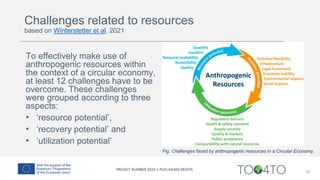
Fig. Challenges faced by anthropogenic resources in a Circular Economy,
To effectively make use of
anthropogenic resources within
the context of a circular economy,
at least 12 challenges have to be
overcome. These challenges
were grouped according to three
aspects:
• ‘resource potential’,
• ‘recovery potential’ and
• ‘utilization potential’
Challenges related to resources
based on Winterstetter et al. 2021
16
At the crossroads of all the United
Nations Economic Commission for
Europe (UNECE) programmes and
expertise, four high-impact “nexus”
areas have been identified where
multiple SDGs converge:
• Sustainable use of natural
resources
• Sustainable and smart cities for
all ages
• Sustainable mobility and smart
connectivity
• Measuring and monitoring
progress towards the SDGs.
The 2030 Agenda and its
Sustainable Development
Goals (SDGs) provide an
ambitious and comprehensive
framework that opens new
perspectives for policymaking
and international cooperation.
Its integrated character
highlights the linkages and
complementarities that exist
between different goals and
targets.
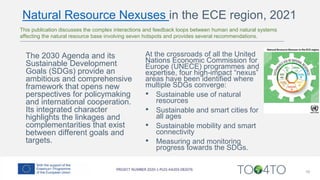
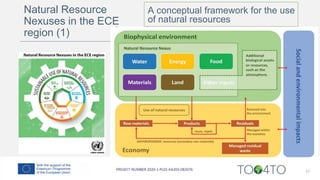
This publication discusses the complex interactions and feedback loops between human and natural systems
affecting the natural resource base involving seven hotspots and provides several recommendations.
Natural Resource Nexuses in the ECE region, 2021
17
A conceptual framework for the use
of natural resources
Natural Resource
Nexuses in the ECE
region (1)
18
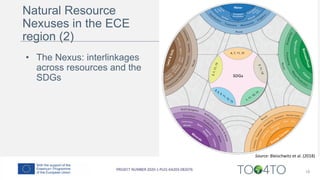
Source: Bleischwitz et al. (2018)
• The Nexus: interlinkages
across resources and the
SDGs
Natural Resource
Nexuses in the ECE
region (2)
19
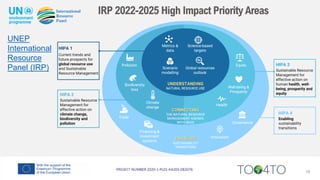
UNEP
International
Resource
Panel (IRP)
A global understanding is needed to face
the challenges of providing sustainable
supply bases for world-wide demand of
materials for sustainable technologies and
sustainable development
20
Sustainable Resource Managament
• Sustainable development is fundamentally linked to the access
to critical raw materials.
• It is crucial to define objectives on how to competently and
responsibly manage raw materials along the whole value chain,
considering impact on people, planet and prosperity.
• Reliable data and effective policy interventions can only be
developed in a defined framework and require improved
collaboration of all involved actors.
21
TOO4TO Module 5 / Sustainable Resource Management: Part 3

TOO4TO Module 5 / Sustainable Resource Management: Part 3

  • 2.
  • 3.
    STRATEGIES AND VISIONSFOR A SUSTAINABLE RESOURCE MANAGEMENT Management of Resources; Policies and sustainable resource management; Circular economy; Complexity and interlinkages with other thematises of Sustainable Development 3
  • 4.
    4 Sustainable Resource Management.Global trends, visions and policies. Bringezu S., Bleischwitz R. 2009 1. Secure adequate supply and efficient use of materials, energy and land resources as a reliable biophysical basis for creation of wealth and well-being in societies and for future generations 2. Maintain life-supporting functions and services of ecosystems 3. Provide for the basic institutions of societies and their co-existence with nature 4. Minimise risks for security and economic turmoil due to dependence on resources 5. Contribute to a globally fair distribution of resource use and an adequate burden sharing 6. Minimise problem shifting between environmental media, types of resources, economic sectors, regions and generations 7. Drive resource productivity (total material productivity) at a rate higher than GDP growth Seven principles of sustainable resource management
  • 5.
    5 Montevecchi, F. PolicyMixes to Achieve Absolute Decoupling: A Case Study of Municipal Waste Management. Sustainability 2016, 8, 442. https://doi.org/10.3390/su8050442 The main means to realize a sustainable strategy is to de- couple economic growth from the use of natural resources and environmental degradation. Hence, the aim is to increase the material productivity of production and consumption activities. The following policy initiatives tackle the topic of sustainable resource use and apply indicators based on the concepts of Economy wide MFA. Strategies towards Sustainable Resource Management
  • 6.
    6 2005 Thematic Strategyon Sustainable Use of Natural Resources 2011 Roadmap to a Resource Efficient Europe 2015 Closing the loop –An EU action plan for the Circular Economy 2008 The raw materials initiative 2014 Reviewed list of critical raw materials(CRM) 2011 Communication on raw materials 2017 Reviewed list of CRM 2020 Action plan on CRM. The reviewed list 2020 A European Green Deal. A new Circular Economy action plan .... Policies towards SRM
  • 7.
    Thematic Strategy onSustainable Use of Natural Resources The strategy emphasizes the importance of integration of environmental concerns into other policies that affect environmental impacts of natural resources use. Efficient use of resources contributes to growth. • The main objective – Decoupling - To reduce the negative environmental impacts generated by the use of natural resources in a growing economy 7
  • 8.
    The Roadmap toa Resource Efficient Europe (COM(2011) 571) outlines how we can transform Europe's economy into a sustainable one by 2050. It proposes ways to increase resource productivity and decouple economic growth from resource use and its environmental impact. It illustrates how policies interrelate and build on each other. • Key resources are analyzed from a life-cycle and value-chain perspective. • It sets out a vision for the structural and technological change needed up to 2050 8
  • 9.
    9 Foster sustainable supply of raw materialsfrom European sources Reduce the EU’s consumption of primary raw materials Access to raw materials on world markets at undistorted conditions Aim: securing sustainable supplies of raw materials Launched in 2008, consolidated in 2011 Non-energy, non-agricultural raw materials Connecting EU external and internal policies Integrated strategy (3 pillars) Introduced a list of Critical Raw Materials (CRM) in 2011 and updated list in 2014, 2017 and 2020) Policy strongly supported by EIP on Raw Materials EU “Raw Materials Initiative” = EU raw materials policy COM(2008) 699
  • 10.
    10 First circular economyaction plan, 2015
  • 11.
    EU Green Deal,2020 Aim: • there are no net emissions of greenhouse gases by 2050 • economic growth is decoupled from resource use • no person and no place is left behind The European Green Deal is our plan to make the EU's economy sustainable • boost the efficient use of resources by moving to a clean, circular economy • restore biodiversity and cut pollution 11
  • 12.
  • 13.
    13 Systems view ofmaterial flow cycles and policy frameworks, OECD, 2012 Sustainable Materials Management. Making Better Use of Resources, OECD, 2012 • Sustainable Materials Management (SMM) is increasingly recognised as a policy approach that can make a key contribution to green growth and the challenges that are posed by sustained global economic and demogarphic growth. • One of the key challenges of the SMM approach is to effectively address the environmental impacts that can occur along the life-cycle of materials, which frequently extends across borders and involves a multitude of different economic actors.
  • 14.
    Classification of ResourceManagement Activities • According to the EUROSTAT the classification of resource management activities (CReMA) classifies activities, products, expenditure and other transactions that aim to preserve and enhance the stock of natural resources. • Resource management comprises a large variety of activities, including the production of energy from renewable sources, measures to improve energy efficiency, recovery of materials, and sustainable management of water and forest resources. • Resource management activities are: production activities using equipment, labour, manufacturing techniques, information networks or products, to create goods or services for managing natural resources. 14
  • 15.
    15 Fig. Challenges facedby anthropogenic resources in a Circular Economy, To effectively make use of anthropogenic resources within the context of a circular economy, at least 12 challenges have to be overcome. These challenges were grouped according to three aspects: • ‘resource potential’, • ‘recovery potential’ and • ‘utilization potential’ Challenges related to resources based on Winterstetter et al. 2021
  • 16.
    16 At the crossroadsof all the United Nations Economic Commission for Europe (UNECE) programmes and expertise, four high-impact “nexus” areas have been identified where multiple SDGs converge: • Sustainable use of natural resources • Sustainable and smart cities for all ages • Sustainable mobility and smart connectivity • Measuring and monitoring progress towards the SDGs. The 2030 Agenda and its Sustainable Development Goals (SDGs) provide an ambitious and comprehensive framework that opens new perspectives for policymaking and international cooperation. Its integrated character highlights the linkages and complementarities that exist between different goals and targets. This publication discusses the complex interactions and feedback loops between human and natural systems affecting the natural resource base involving seven hotspots and provides several recommendations. Natural Resource Nexuses in the ECE region, 2021
  • 17.
    17 A conceptual frameworkfor the use of natural resources Natural Resource Nexuses in the ECE region (1)
  • 18.
    18 Source: Bleischwitz etal. (2018) • The Nexus: interlinkages across resources and the SDGs Natural Resource Nexuses in the ECE region (2)
  • 19.
  • 20.
    A global understandingis needed to face the challenges of providing sustainable supply bases for world-wide demand of materials for sustainable technologies and sustainable development 20
  • 21.
    Sustainable Resource Managament •Sustainable development is fundamentally linked to the access to critical raw materials. • It is crucial to define objectives on how to competently and responsibly manage raw materials along the whole value chain, considering impact on people, planet and prosperity. • Reliable data and effective policy interventions can only be developed in a defined framework and require improved collaboration of all involved actors. 21